engine MERCEDES-BENZ S-CLASS COUPE 2018 Repair Manual
[x] Cancel search | Manufacturer: MERCEDES-BENZ, Model Year: 2018, Model line: S-CLASS COUPE, Model: MERCEDES-BENZ S-CLASS COUPE 2018Pages: 502, PDF Size: 6.29 MB
Page 355 of 502
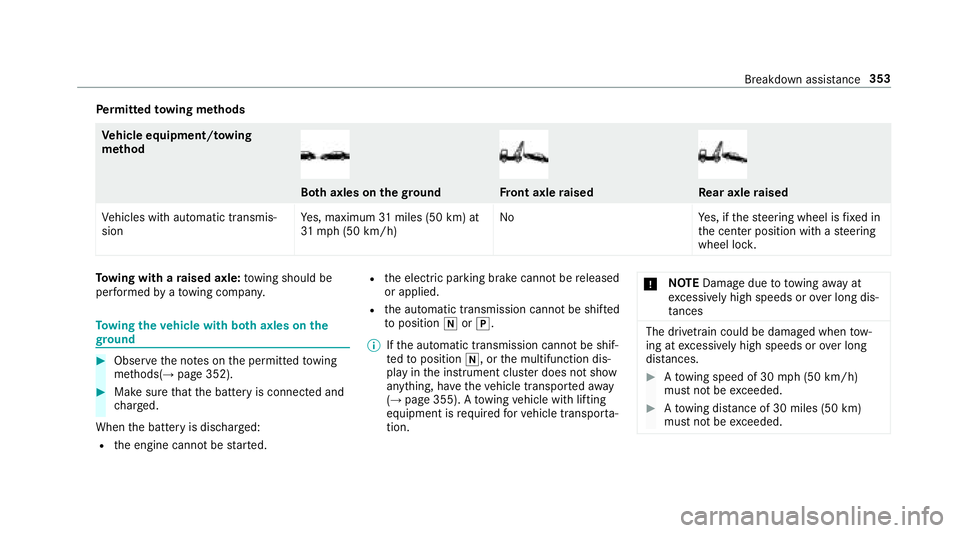
Perm itted towing me thods
Ve hicle equipment/to wing
me thod
Bo th axles on thegr oundFront axle raisedRe ar axle raised
Ve hicles with automatic transmis‐
sion Ye
s, maximum 31miles (50 km) at
31 mp h (50 km/h) No
Yes, if thesteering wheel is fixe d in
th e center position with a steering
wheel loc k.
Towing wit h araised axle: towing should be
per form ed byato wing compan y.
Towing theve hicle with bo thaxles on the
gr ound
#Obser vethe no tes on the permitted towing
me thods(→page 352).
#Make sure that the battery is connected and
ch arge d.
When the battery is dischar ged:
Rthe engine cannot bestar ted.
Rth e electric parking brake cannot bereleased
or applied.
Rth e automatic transmission cann otbe shif ted
to position iorj.
% Ifth e automatic transmission cannot be shif‐
te dto position i, orthe multifunction dis‐
play in the instrument clus ter does not show
anything, ha vetheve hicle transpor tedaw ay
(
→page 355). A towing vehicle with lifting
equipment is requiredforve hicle transpor ta‐
tion. *
NO
TEDama gedue to to wing away at
exc essively high speeds or over long dis‐
ta nces
The driv etra in could be damaged when tow‐
ing at excessively high speeds or over long
dis tances.
#A towing speed of 30 mph (50 km/h)
must not be exceeded.
#Atowing dis tance of 30 miles (50 km)
must not be exceeded.
Breakdown assis tance 353
Page 358 of 502
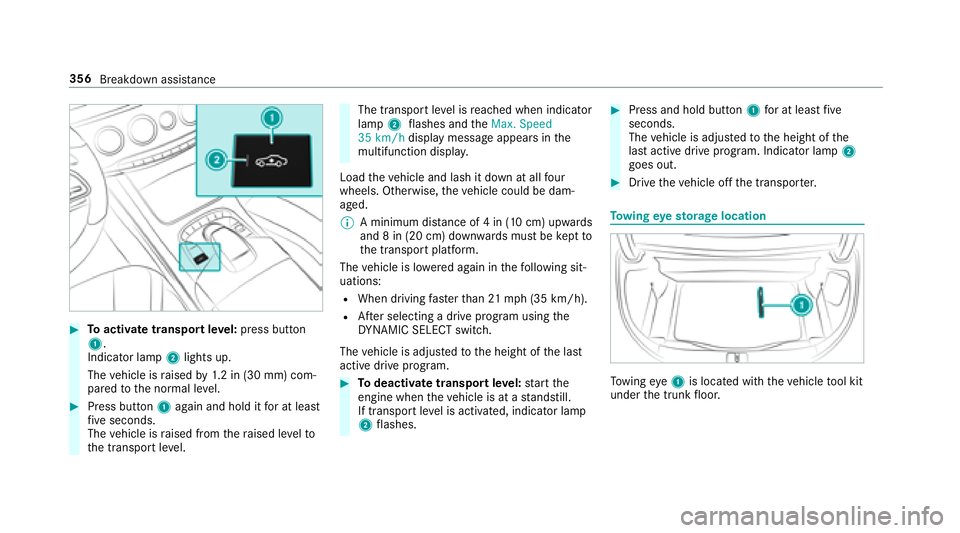
#Toactivate transport leve l:press button
1.
Indicator lamp 2lights up.
The vehicle is raised by1.2 in (30 mm) com‐
pared tothe normal le vel.
#Press button 1again and hold it for at least
fi ve seconds.
The vehicle is raised from thera ised le velto
th e transport le vel.
The transport le vel is reached when indicator
lamp 2flashes and theMax. Speed
35 km/h display message appears in the
multifunction displa y.
Load theve hicle and lash it down at all four
wheels. Otherwise, theve hicle could be dam‐
aged.
% A minimum dis tance of 4 in (10 cm) up wards
and 8 in (20 cm) down wards must be kept to
th e transport platform.
The vehicle is lo wered again in thefo llowing sit‐
uations:
RWhen driving fasterthan 21 mp h (35 km/h).
RAfter selecting a drive program using the
DY NA MIC SELECT switch.
The vehicle is adjus tedto the height of the last
active drive prog ram.
#To deactivate transpo rtleve l:start the
engine when theve hicle is at a standstill.
If transport leve l is activated, indicator lamp
2 flashes.
#Press and hold button 1for at least five
seconds.
The vehicle is adjus tedto the height of the
last active drive prog ram. Indicator lamp 2
goes out.
#Drive theve hicle off the transpor ter.
To wing eyesto rage location
Towing eye1 is located with theve hicle tool kit
under the trunk floor.
356
Breakdown assis tance
Page 359 of 502
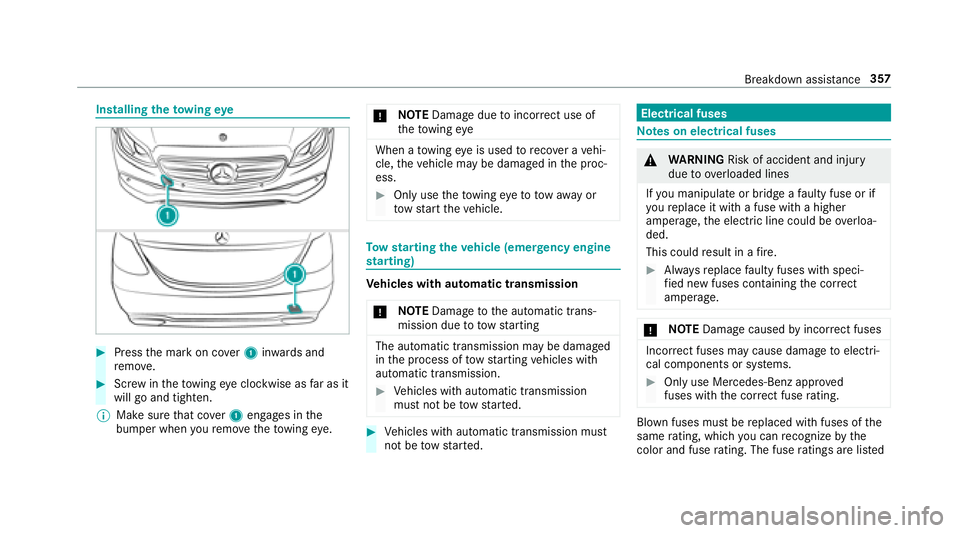
Installingtheto wing eye
#Press the mark on co ver1 inwa rds and
re mo ve.
#Scr ew intheto wing eyeclockwise as far as it
will go and tighten.
% Make sure that co ver1 engages in the
bumper when youre mo vetheto wing eye. *
NO
TEDama gedue toincor rect use of
th eto wing eye
When a towing eye is used toreco ver a vehi‐
cle, theve hicle may be damaged in the proc‐
ess.
#Only use theto wing eyeto to waw ay or
to w start theve hicle.
To w starting theve hicle (eme rgency engine
st arting)
Ve hicles with automatic transmission
* NO
TEDama getothe automatic trans‐
mission due to towstarting
The automatic transmission may be damaged
in the process of tow starting vehicles with
automatic transmission.
#Ve hicles with automatic transmission
must not be tow star ted.
#Ve hicles with automatic transmission must
not be tow star ted.
Electrical fuses
Note s on electrical fuses
&
WARNING Risk of accident and injury
due to ov erloaded lines
If yo u manipulate or bridge a faulty fuse or if
yo ure place it with a fuse with a higher
amperage, the electric line could be overloa‐
ded.
This could result in a fire .
#Alw aysre place faulty fuses with speci‐
fi ed new fuses conta iningthe cor rect
amperage.
* NO
TEDama gecaused byincor rect fuses
Incor rect fuses may cause damage toelectri‐
cal components or sy stems.
#Only use Mercedes-Benz appr oved
fuses with the cor rect fuse rating.
Blown fuses must bereplaced with fuses of the
same rating, which you can recognize bythe
color and fuse rating. The fuse ratings are li sted
Breakdown assis tance 357
Page 360 of 502
inthe fuse assignment diagram. The fuse assign‐
ment diagram is in theve hicle document wallet.
* NO
TEDama geor malfunctions caused
by moisture
Moisture may cause dama getothe electrical
sy stem or cause it tomalfunction.
#When the fuse box is open, make sure
th at no moisture can enter the fuse
box.
#When closing the fuse box, make sure
th at the seal of the lid is positioned cor‐
re ctly on the fuse box.
Ifth e newly inser ted fuse also blo ws, ha vethe
cause traced and rectified at a qualified special‐
ist workshop, e.g. an authorized Mercedes-Benz
Center.
Ensure thefo llowing before replacing a fuse:
RThe vehicle is secured against rolling away.
RAll electrical consumers are switched off.
RThe ignition is switched off. The electrical fuses are located in
thefo llowing
fuse bo xes:
RFu se box in the engine compartment on the
driver's side (→page 358)
RFu se box on the driver's side of the dash‐
board (→page 359)
RFu se box in the front-passen gerfo ot we ll
(→page 360)
Opening and closing the fuse box in the
engine compa rtment
Requ irements:RObser vethe no tes on electrical fuses
(→page 357).
RHa ve thefo llowing tools readily available:
-A dry clo th
-A screwdriver Opening
&
WARNING Risk of injury from usingthe
windshield wipers while the engine hood
is open
When the engine hood is open and the wind‐
shield wipers are set in motion, you can be
trapped bythe wiper linkage.
#Alw ays switch off the windshield wipers
and ignition before opening the engine
hood.
358 Breakdown assis tance
Page 387 of 502
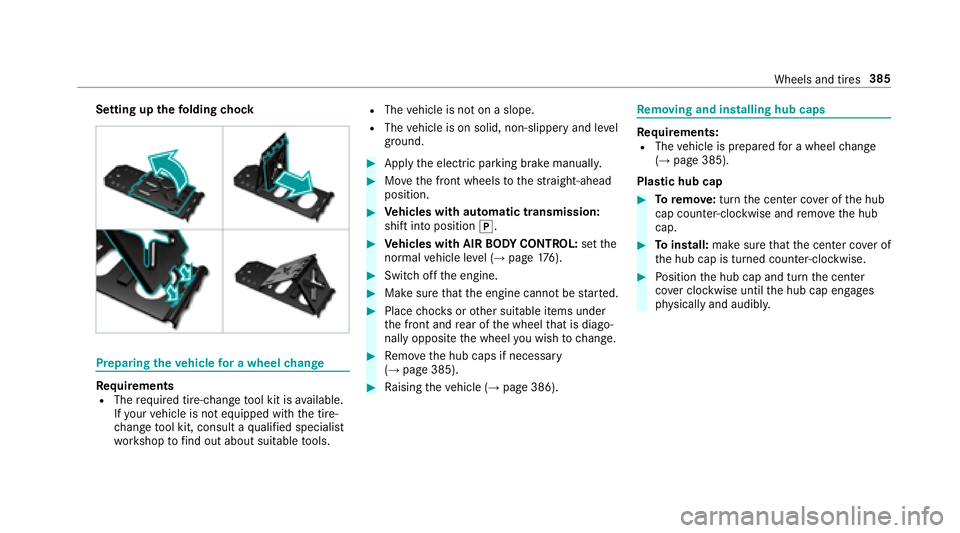
Setting upthefo lding chock
Prepa ring theve hicle for a wheel change
Re quirementsRThe requ ired tire-change tool kit is available.
If yo ur vehicle is not equipped with the tire-
ch ange tool kit, consult a qualified specialist
wo rkshop tofind out about suitable tools.
RThe vehicle is not on a slope.
RThe vehicle is on solid, non-slippery and le vel
ground .
#Applythe electric parking brake manually.
#Mo vethe front wheels tothest ra ight-ahead
position.
#Ve hicles with automatic transmission:
shift into position j.
#Vehicles with AIR BODY CONT ROL:set the
normal vehicle le vel (→page 176).
#Switch off the engine.
#Make sure that the engine cannot bestar ted.
#Place choc ks orother suitable items under
th e front and rear of the wheel that is diago‐
nally opposite the wheel youwish tochange.
#Re mo vethe hub caps if necessary
(→page 385).
#Ra ising theve hicle (→page 386).
Re moving and in stalling hub caps
Re quirements:RThe vehicle is prepared for a wheel change
(→page 385).
Plast ic hub cap
#Toremo ve:turn the center co ver of the hub
cap counter-clockwise and remo vethe hub
cap.
#To install: make sure that the center co ver of
th e hub cap is turned counter-clockwise.
#Po sition the hub cap and turn the center
co ver clockwise until the hub cap engages
ph ysically and audibly.
Wheels and tires 385
Page 388 of 502
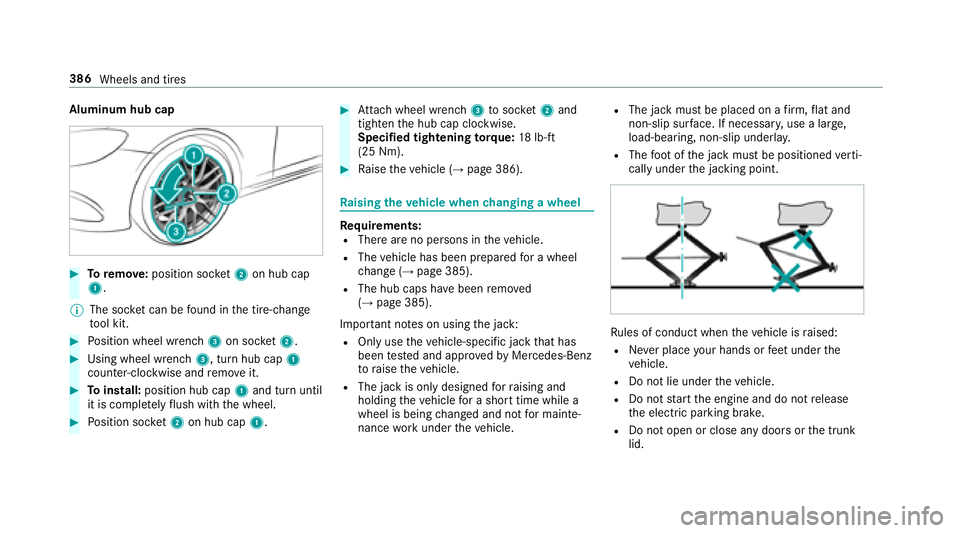
Aluminum hub cap
#Toremo ve:position soc ket2 on hub cap
1.
% The soc ket can be found inthe tire-change
to ol kit.
#Po sition wheel wrench 3on soc ket2.
#Using wheel wrench 3, turn hub cap1
counter-clo ckwise and remo veit.
#To install: position hub cap 1and turn until
it is comple tely flush withth e wheel.
#Po sition soc ket2 on hub cap 1.
#Attach wheel wrench 3tosoc ket2 and
tighten the hub cap clockwise.
Specified tightening torq ue: 18lb-ft
(25 Nm).
#Ra ise theve hicle (→page 386).
Ra ising theve hicle when changing a wheel
Re quirements:RThere are no persons in theve hicle.
RThe vehicle has been prepared for a wheel
ch ange (→page 385).
RThe hub caps ha vebeen remo ved
(→page 385).
Impor tant no tes on using the jack:
ROnly use theve hicle-specific jack that has
been tested and appr ovedby Mercedes-Benz
to raise theve hicle.
RThe jack is only designed forra ising and
holding theve hicle for a short time while a
wheel is being changed and not for mainte‐
nance workunder theve hicle.
RThe jack must be placed on a firm ,fl at and
non-slip sur face. If necessar y,use a lar ge,
load-bearing, non-slip underla y.
RThefoot ofthe jack must be positioned verti‐
cally under the jacking point.
Ru les of conduct when theve hicle is raised:
RNe ver place your hands or feet under the
ve hicle.
RDo not lie under theve hicle.
RDo not start the engine and do not release
th e electric parking brake.
RDo not open or close any doors or the trunk
lid.
386 Wheels and tires
Page 395 of 502
There are norestrictions when positioning the
antenna on the outside of theve hicle for some
wav ebands.
This applies tothefo llowing wavebands:
RTrunked radio sy stem/T etra
R70 cm waveband
R2G/3G/4G
Vehicle identification plate, VIN and engine
number overview
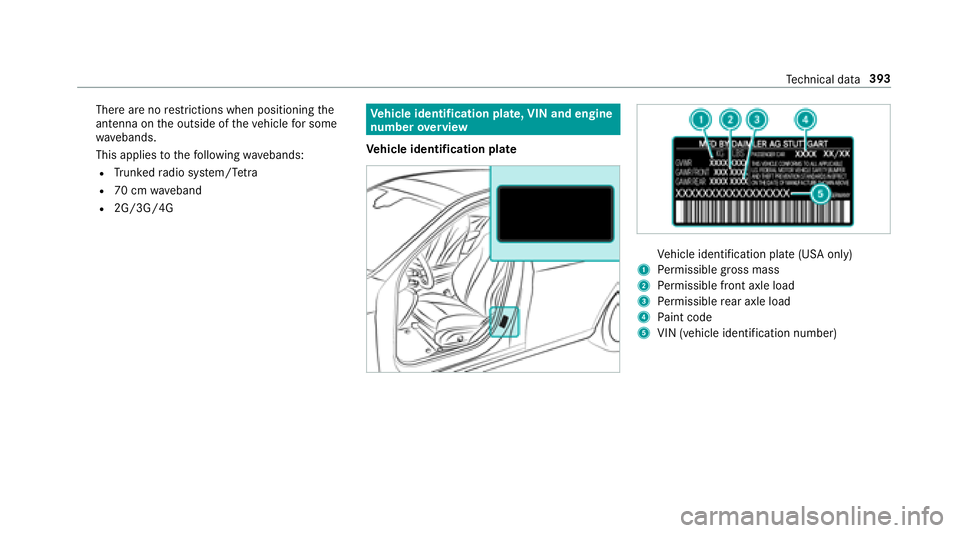
Ve hicle identification plate
Vehicle identification plate (USA only)
1Perm issible grossmass
2Pe rm issible front axle load
3Perm issible rear axle load
4Pa int code
5VIN (vehicle identification number)
Tech nical da ta393
Page 396 of 502
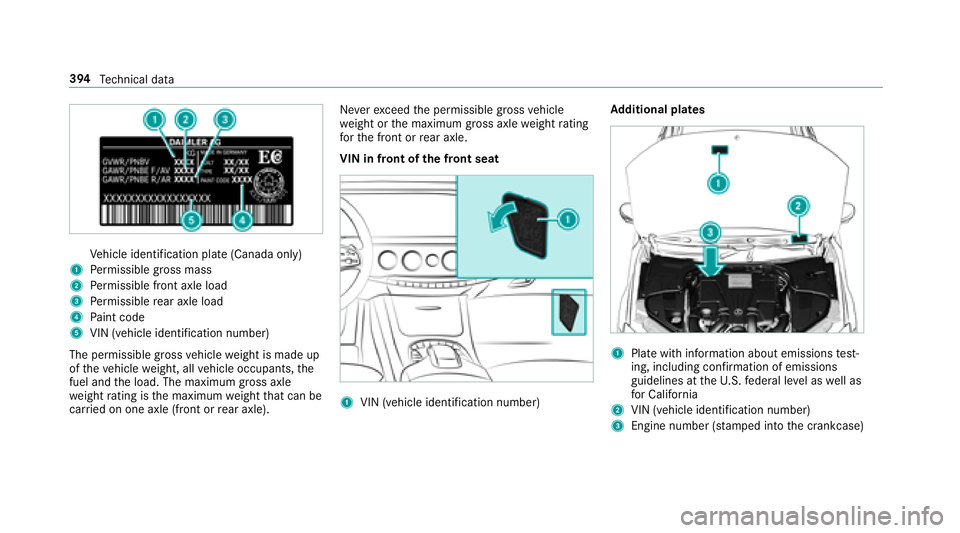
Vehicle identification plate (Canada only)
1Perm issible grossmass
2Pe rm issible front axle load
3Perm issible rear axle load
4Pa int code
5VIN (vehicle identification number)
The permissible gross vehicle weight is made up
of theve hicle weight, all vehicle occupants, the
fuel and the load. The maximum gross axle
we ight rating is the maximum weight that can be
car ried on one axle (front or rear axle). Ne
verexc eed the permissible gross vehicle
we ight or the maximum gross axle weight rating
fo rth e front or rear axle.
VIN in front of the front seat
1VIN (vehicle identification number) Ad
ditional plates
1Pla tewith information about emissions test‐
ing, including con firm ation of emissions
guidelines at theU. S. federal le vel as well as
fo r California
2VIN (vehicle identification number)
3Engine number (s tamp ed into the crankcase)
394
Tech nical da ta
Page 398 of 502
You can identify operating fluids appr ovedby
Mercedes-Benz bythefo llowing insc ript ions on
th e conta iner:
RMB-Freigabe (e.g. MB-Fr eigabe 229.51)
RMB-Approval (e.g. MB-App rova l 229.51)
Fu rther information on appr oved operating flu‐
ids:
Rin the Mercedes-Benz Specifications for
Operating Fluids at http://be vo.mercedes-
benz.com (byen tering the designation)
Rin the Mercedes-Benz Specifications for
Operating Fluids in the Mercedes-Benz BeVo
app (by entering the designation)
Rat a qualified specialist workshop
Fu el
Information on fuel grades forve hicles with
a ga soline engine
Obser vethe no tes on operating fluids
(
→page 395). *
NO
TEDama gecaused bythe wrong fuel
Even small amounts of the wrong fuel could
re sult in damage tothe fuel sy stem, the
engine and the emission control sy stem.
#Only refuel with lo w-sulfur unleaded
fuel.
This fuel may contain up to10 %ethanol.
Yo ur vehicle is suitable for use with E10 fuel.
Do not refuel using:
RDiesel
RE15, E85, E100
RGasoline containing me thanol (M15, M30,
M85, M100)
RGasoline with additives con taining me tal
If yo u accidenta llyrefuel with the wrong fuel:
#Do not switch the ignition on.
#Consult a qualified specialist workshop.
Ifth eav ailable fuel is not suf ficiently low in sul‐
fur, this can produce unpleasant odors. Only
refuel with fuel that has at least the octane
number specified in the instruction label in the
fuel filler flap (
→page 140).
If yo uwa nt maximum engine output: only
re fuel with unleaded premium grade gasoline
with an octane number of at least 91AKI/
95 RON.
As a temp orary measure, if there commended
fuel is not available, you may also use unleaded
re gular gasoline with an octane number of at
least 87AKI/91 RON.
* NO
TEPremature wearthro ugh unleaded
re gular gasoline
Unleaded regular gasoline can cause the
engine towe ar more quickly and impair lon‐
ge vity and per form ance.
If unleaded premium grade gasoline is
una vailable and you ha vetorefuel using
unleaded regular gasoline with 87AKI/
91 RON:
#Only fill th e fuel tank tohalf full with
unleaded regular gasoline and top up as
396
Tech nical da ta
Page 399 of 502
soon as possible with unleaded pre‐
mium gradegasoline.
#Do not drive at the maximum speed.
#Av oid sudden acceleration and engine
speeds over 3000 rpm.
This may reduce engine output and increase fuel
consum ption. Ne verre fuel using gasoline with a
lo we r octane number.
Fu rther information on fuel can be found:
Rat a gasst ation
Rat a qualified specialist workshop
RUSA onl y:at http://www.mbusa.com
Information on additives in gasoline
Obser vethe no tes on operating fluids
(
→page 395).
* NO
TEDama gecaused bynon-app rove d
additives
Even small amounts of the wrong additive
may lead tomalfunctions occur ring.
#Only add cleaning additives recommen‐
ded byMercedes-Benz tothe fuel.
Mercedes-Benz recommends that you use
br and-name fuels with additives.
The fuel grade available in some countries may
not be suf ficient. Residue could build up in the
fuel injection sy stem as a result. In this case, in
consultation with an authorized Mercedes-Benz
Center, the fuel may be mixed with the cleaning
additive recommended byMercedes-Benz. Be
sure toobser vethe no tes and mixing ratios
speci fied on the conta iner.
Ta nk content and fuel reser ve
The total capacity of the fuel tank may vary,
depending on theve hicle equipment.
Model Total capacity
S 56 02 1.1 ga l(8 0.0 l)
Model Of whichreser ve
S 560 2.1gal (8.0 l)
Engine oil
Note s on engine oil
Obser vethe no tes on operating fluids
(
→page 395).
* NO
TEEngine damage causedbyan
incor rect oil filter, incor rect oil or addi‐
tives
#Do not use engine oils or oil filters other
th an those which meet the specifica‐
tions necessary forth e prescribed
service inter vals.
Tech nical da ta397