clock MERCEDES-BENZ S-CLASS SEDAN 2013 User Guide
[x] Cancel search | Manufacturer: MERCEDES-BENZ, Model Year: 2013, Model line: S-CLASS SEDAN, Model: MERCEDES-BENZ S-CLASS SEDAN 2013Pages: 536, PDF Size: 24.14 MB
Page 324 of 536
use a sponge and cold water to clean it. DEF
residues crystallize after time and
contaminate the affected surfaces.
! DEF
is not a fuel additive and must not be
added to the fuel tank. If DEF is added to
the fuel tank, this can lead to engine
damage.
i If you are adding between maintenance
intervals, add approximately 1 gallon (3.8 l)
of DEF to the DEF tank. One gallon (3.8 l)
of DEF is approximately 2 DEF refill bottles.
Then, have the DEF supply checked and
filled completely if necessary. For this
purpose, Mercedes-Benz recommends a
qualified specialist workshop.
Further information on DEF (Y page 527).
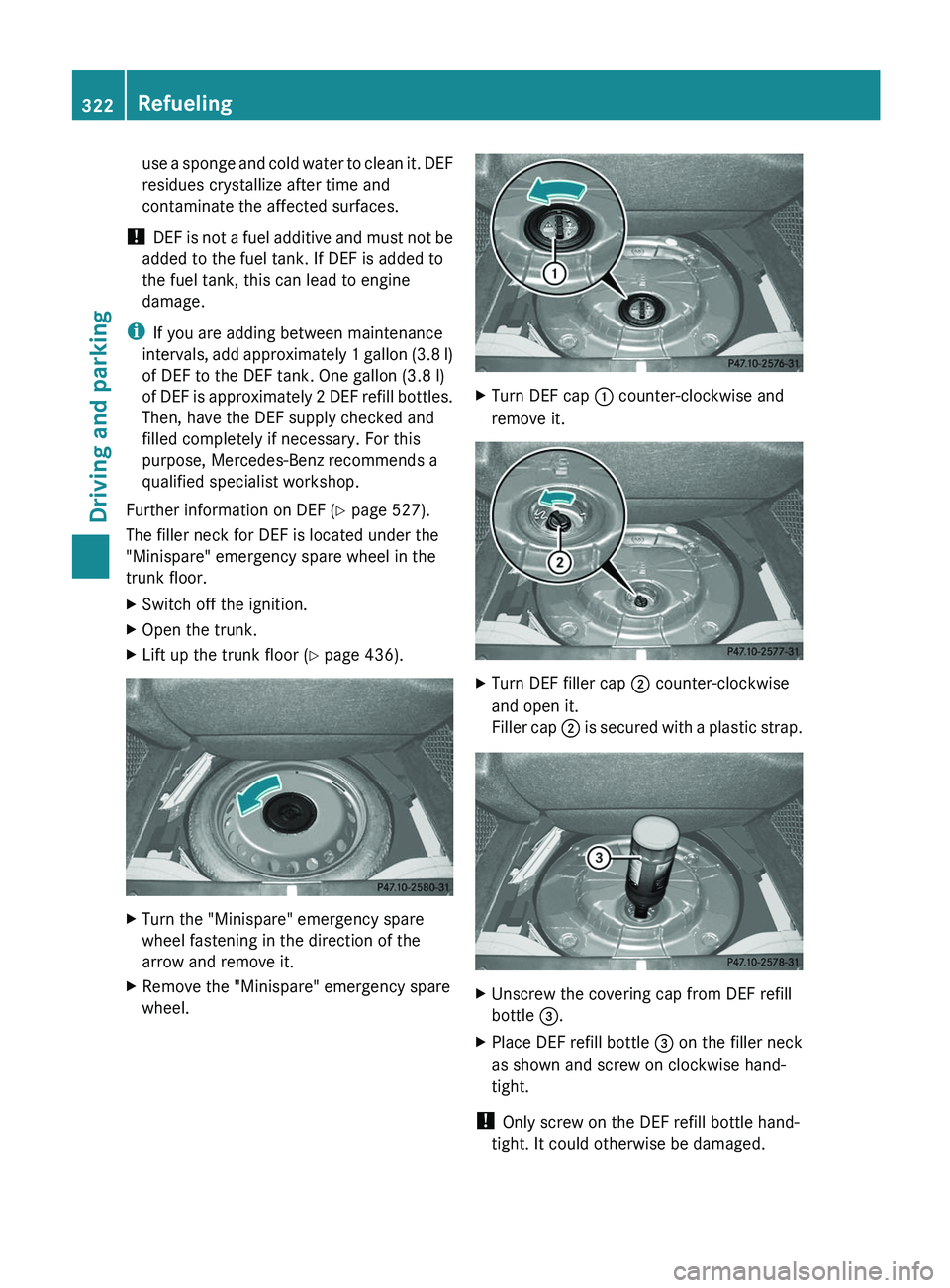
The filler neck for DEF is located under the
"Minispare" emergency spare wheel in the
trunk floor.
X Switch off the ignition.
X Open the trunk.
X Lift up the trunk floor ( Y page 436).X
Turn the "Minispare" emergency spare
wheel fastening in the direction of the
arrow and remove it.
X Remove the "Minispare" emergency spare
wheel. X
Turn DEF cap : counter-clockwise and
remove it. X
Turn DEF filler cap ; counter-clockwise
and open it.
Filler
cap ; is secured with a plastic strap. X
Unscrew the covering cap from DEF refill
bottle =.
X Place DEF refill bottle = on the filler neck
as shown and screw on clockwise hand-
tight.
! Only screw on the DEF refill bottle hand-
tight. It could otherwise be damaged. 322
Refueling
Driving and parking
Page 325 of 536
X
Press DEF refill bottle = down.
The DEF tank is filled. This may take up to
one minute.
i If the DEF refill bottle is no longer pressed
down, the filling process stops and the
partially emptied bottle can be removed.
X Release DEF refill bottle =.
X Turn DEF refill bottle = counter-clockwise
and remove it.
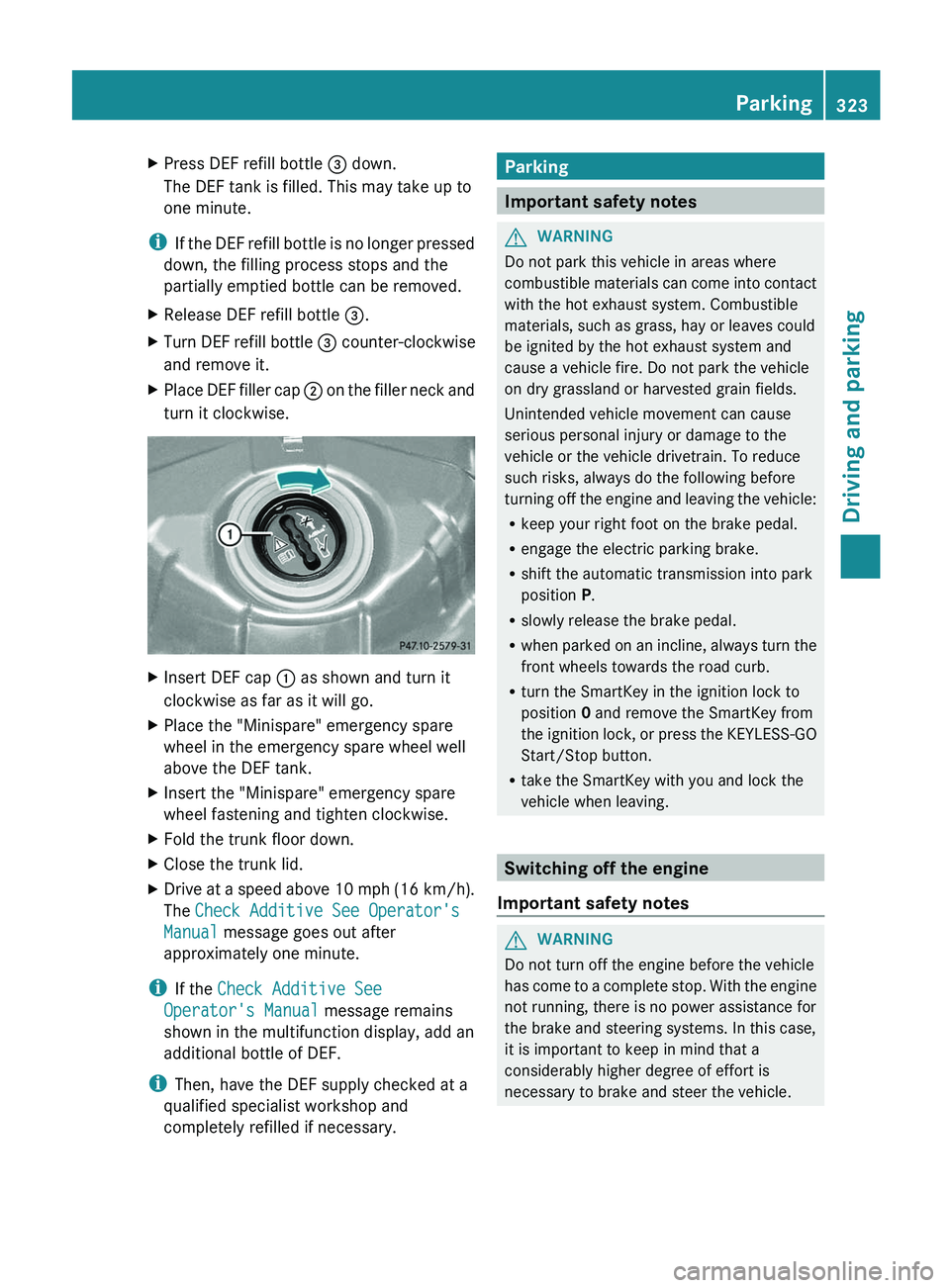
X Place DEF filler cap ;
on the filler neck and
turn it clockwise. X
Insert DEF cap : as shown and turn it
clockwise as far as it will go.
X Place the "Minispare" emergency spare
wheel in the emergency spare wheel well
above the DEF tank.
X Insert the "Minispare" emergency spare
wheel fastening and tighten clockwise.
X Fold the trunk floor down.
X Close the trunk lid.
X Drive at a speed above 10 mph (16 km/h)
.
The Check Additive See Operator's
Manual message goes out after
approximately one minute.
i If the Check Additive See
Operator's Manual message remains
shown in the multifunction display, add an
additional bottle of DEF.
i Then, have the DEF supply checked at a
qualified specialist workshop and
completely refilled if necessary. Parking
Important safety notes
G
WARNING
Do not park this vehicle in areas where
combustible
materials can come into contact
with the hot exhaust system. Combustible
materials, such as grass, hay or leaves could
be ignited by the hot exhaust system and
cause a vehicle fire. Do not park the vehicle
on dry grassland or harvested grain fields.
Unintended vehicle movement can cause
serious personal injury or damage to the
vehicle or the vehicle drivetrain. To reduce
such risks, always do the following before
turning off the engine and leaving the vehicle:
R keep your right foot on the brake pedal.
R engage the electric parking brake.
R shift the automatic transmission into park
position P.
R slowly release the brake pedal.
R when parked on an incline, always turn the
front wheels towards the road curb.
R turn the SmartKey in the ignition lock to
position 0 and remove the SmartKey from
the ignition lock, or press the KEYLESS-GO
Start/Stop button.
R take the SmartKey with you and lock the
vehicle when leaving. Switching off the engine
Important safety notes G
WARNING
Do not turn off the engine before the vehicle
has
come to a complete stop. With the engine
not running, there is no power assistance for
the brake and steering systems. In this case,
it is important to keep in mind that a
considerably higher degree of effort is
necessary to brake and steer the vehicle. Parking
323
Driving and parking Z
Page 361 of 536
X
To make brighter or dimmer : make sure
that Night View Assist Plus is activated.
X Turn control : counter-clockwise or
clockwise.
Fogged up or dirty windshield If the windshield in front of the camera is
fogged
up or dirty on the inside or outside, the
Night View Assist Plus display is affected. G
WARNING
Please do not forget that your primary
responsibility
is to drive the vehicle. A driver's
attention to the road must always be his/her
primary focus when driving. For your safety
and the safety of others, stop before trying to
remove window fogging or cleaning the
windshield in front of the Night View Assist
Plus camera.
Bear in mind that at a speed of just 30 mph
(approximately 50 km/h), your vehicle is
covering a distance of 44 feet
(approximately 14 m) every second.
X To defrost: check the automatic air
conditioning
settings (Y page 296) and fold
down the camera cover (Y page 467).
X To defrost the inside of the windshield:
fold down the camera cover ( Y page 467)
and clean the windshield
(Y page 466). Driving systems
359
Driving and parking Z
Page 462 of 536
X
Turn cap : counterclockwise and remove
it.
X Add engine oil.
Vehicles with oil level measurement
function
in the on-board computer: observe
the information in the on-board computer
when doing so. Vehicles with oil dipstick: if
the oil level is at or below the MIN mark on
the oil dipstick,
add 0.55 to 1.1 US qt (0.5 to 1.0 l) engine
oil.
X Replace cap : on the filler neck and turn
clockwise.
Ensure that the cap locks into place
securely.
X Check the oil level again with the oil
dipstick (Y page 458) or the on-board
computer (Y page 458).
Further information on engine oil
(Y page 527). Checking and adding other service
products
Checking the coolant level Only check the coolant level when the vehicle
is
on a level surface and the engine has cooled
down.
X Turn the SmartKey to position
2 (Y page 303) in the ignition lock.
On vehicles with KEYLESS-GO, press the
Start/Stop button twice
(Y page 303).
X Check the coolant temperature display in
the instrument cluster.
The coolant temperature must be below
158 ‡
(70 †). G
WARNING
In order to avoid any potentially serious burns:
R use extreme caution when opening the
hood if there are any signs of steam or
coolant
leaking from the cooling system, or if the coolant temperature display indicates
that the coolant is overheated.
R do not remove the pressure cap on the
coolant
reservoir if the coolant temperature
is above 158 ‡ (70 †). Allow the engine to
cool down before removing the cap. The
coolant reservoir contains hot fluid and is
under pressure.
R using a rag, slowly turn the cap
approximately 1
/ 2 turn to relieve excess
pressure. If opened immediately, scalding
hot fluid and steam will be blown out under
pressure.
R do not spill antifreeze on hot engine parts.
Antifreeze contains ethylene glycol which
may burn if it comes into contact with hot
engine parts. X
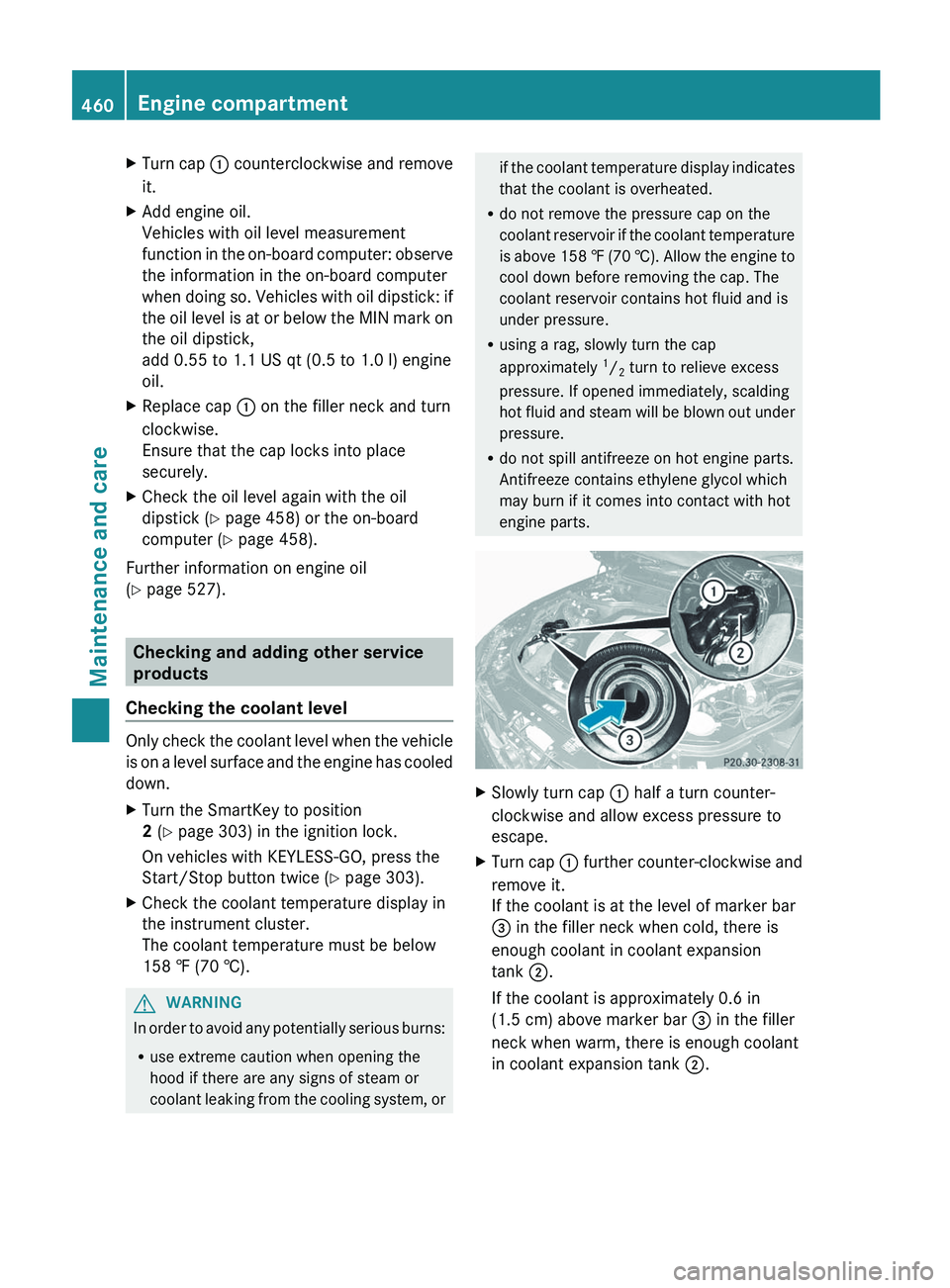
Slowly turn cap : half a turn counter-
clockwise and allow excess pressure to
escape.
X Turn cap :
further counter-clockwise and
remove it.
If the coolant is at the level of marker bar
= in the filler neck when cold, there is
enough coolant in coolant expansion
tank ;.
If the coolant is approximately 0.6 in
(1.5 cm) above marker bar = in the filler
neck when warm, there is enough coolant
in coolant expansion tank ;.460
Engine compartment
Maintenance and care
Page 463 of 536
X
If necessary, add coolant that has been
tested and approved by Mercedes-Benz.
X Replace cap : and turn it clockwise as far
as it will go.
For further information on coolant, see
(Y page 529).
Windshield washer system and
headlamp cleaning system The washer fluid reservoir is used for both the
windshield
washer system and the headlamp
cleaning system.
i Vehicle components and their service
products must match. You should,
therefore, only use products that have been
tested and approved by Mercedes-Benz.
Information on tested and approved
products can be obtained at any authorized
Mercedes-Benz Center or on the Internet at
http://www.mbusa.com (USA only).G
WARNING
Washer solvent/antifreeze is highly
flammable. Do not spill washer solvent/
antifreeze
on hot engine parts, because it may
ignite and burn. You could be seriously
burned.
! At temperatures below freezing: always
fill the washer fluid reservoir with a mix of
water and windshield washer concentrate
(e.g. MB WinterFit). There is otherwise a
risk of damaging the windshield washer
system/headlamp cleaning system.
! Only use washer fluid concentrate which
is suitable for plastic lenses. Unsuitable
washer fluid concentrate could damage the
plastic lenses of the headlamps.
! Do not add distilled or de-ionized water to
the washer fluid container. Otherwise, the
level sensor may be damaged.
i Add windshield washer concentrate, e.g.
MB SummerFit, to the washer fluid all year
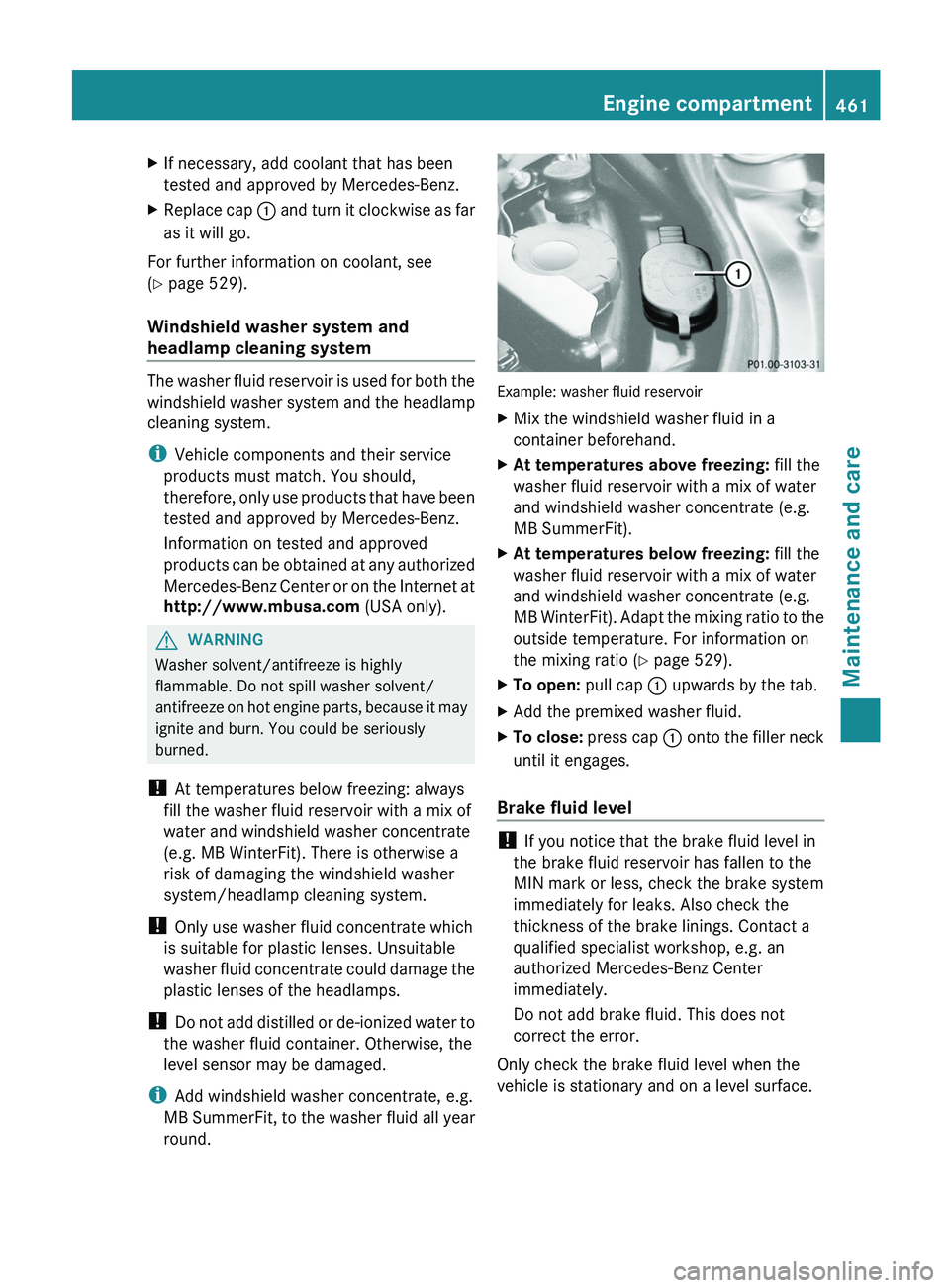
round. Example: washer fluid reservoir
X
Mix the windshield washer fluid in a
container beforehand.
X At temperatures above freezing: fill the
washer fluid reservoir with a mix of water
and windshield washer concentrate (e.g.
MB SummerFit).
X At temperatures below freezing: fill the
washer fluid reservoir with a mix of water
and windshield washer concentrate (e.g.
MB
WinterFit). Adapt the mixing ratio to the
outside temperature. For information on
the mixing ratio (Y page 529).
X To open: pull cap : upwards by the tab.
X Add the premixed washer fluid.
X To close:
press cap : onto the filler neck
until it engages.
Brake fluid level !
If you notice that the brake fluid level in
the brake fluid reservoir has fallen to the
MIN mark or less, check the brake system
immediately for leaks. Also check the
thickness of the brake linings. Contact a
qualified specialist workshop, e.g. an
authorized Mercedes-Benz Center
immediately.
Do not add brake fluid. This does not
correct the error.
Only check the brake fluid level when the
vehicle is stationary and on a level surface. Engine compartment
461
Maintenance and care Z
Page 474 of 536
Useful information
i This Operator's Manual describes all
models and all standard and optional
equipment of your vehicle available at the
time of publication of the Operator's
Manual. Country-specific differences are
possible.
Please note that your vehicle may
not be equipped with all features
described. This also applies to safety-
related systems and functions.
i Please read the information on qualified
specialist workshops (Y page 31). Where will I find...?
First-aid kit
X Open the trunk lid. X
Release strap :.
X Remove first-aid kit ;
from the parcel net.
i Check
the expiration date on the first-aid
kit at least once a year. Replace the
contents if necessary, and replace missing
contents. Vehicle tool kit
The vehicle tool kit can be found in the
stowage well under the trunk floor.
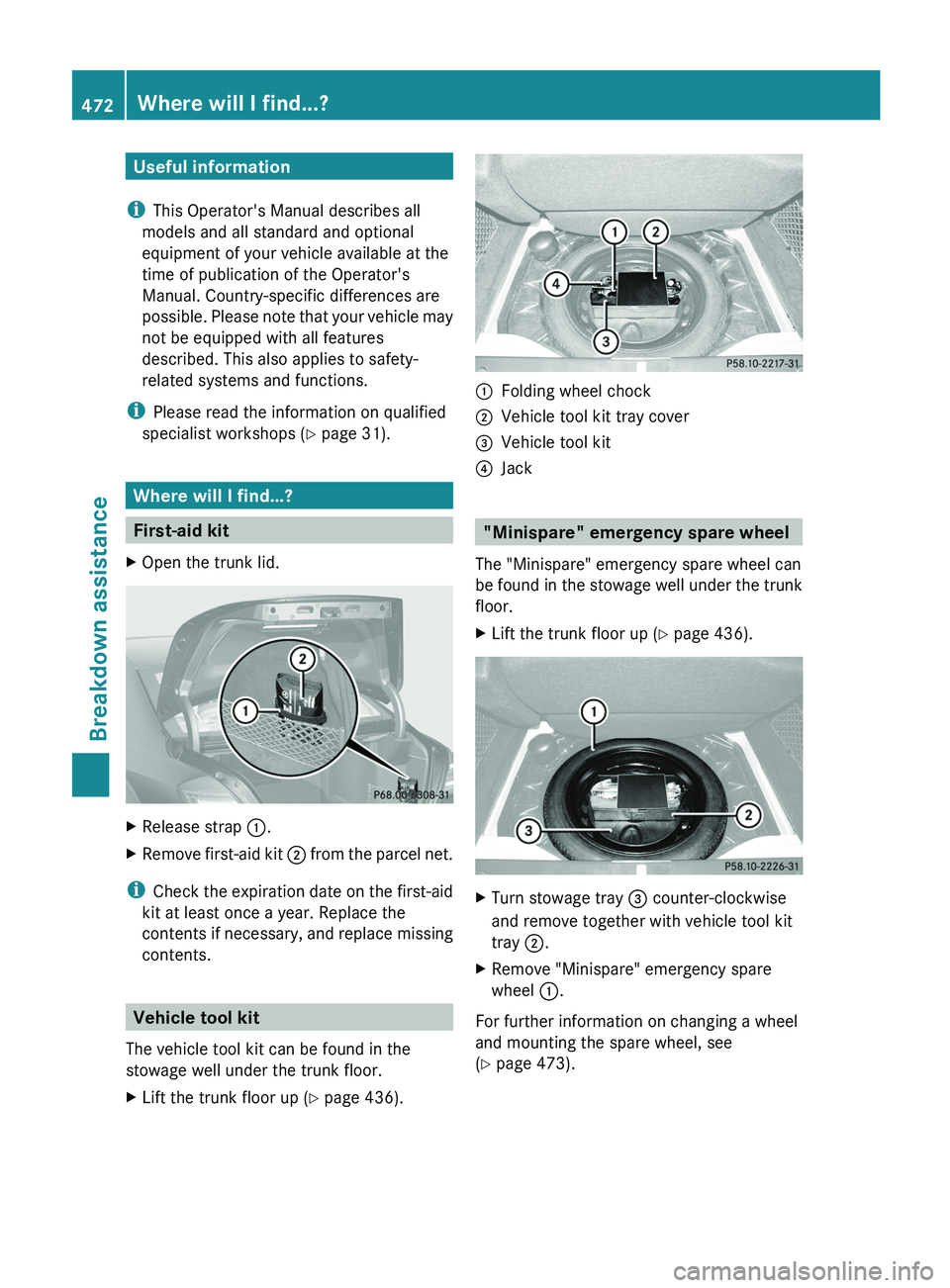
X Lift the trunk floor up ( Y page 436). :
Folding wheel chock
; Vehicle tool kit tray cover
= Vehicle tool kit
? Jack "Minispare" emergency spare wheel
The "Minispare" emergency spare wheel can
be
found in the stowage well under the trunk
floor.
X Lift the trunk floor up ( Y page 436). X
Turn stowage tray = counter-clockwise
and remove together with vehicle tool kit
tray ;.
X Remove "Minispare" emergency spare
wheel :.
For further information on changing a wheel
and mounting the spare wheel, see
(Y page 473). 472
Where will I find...?
Breakdown assistance
Page 478 of 536
X
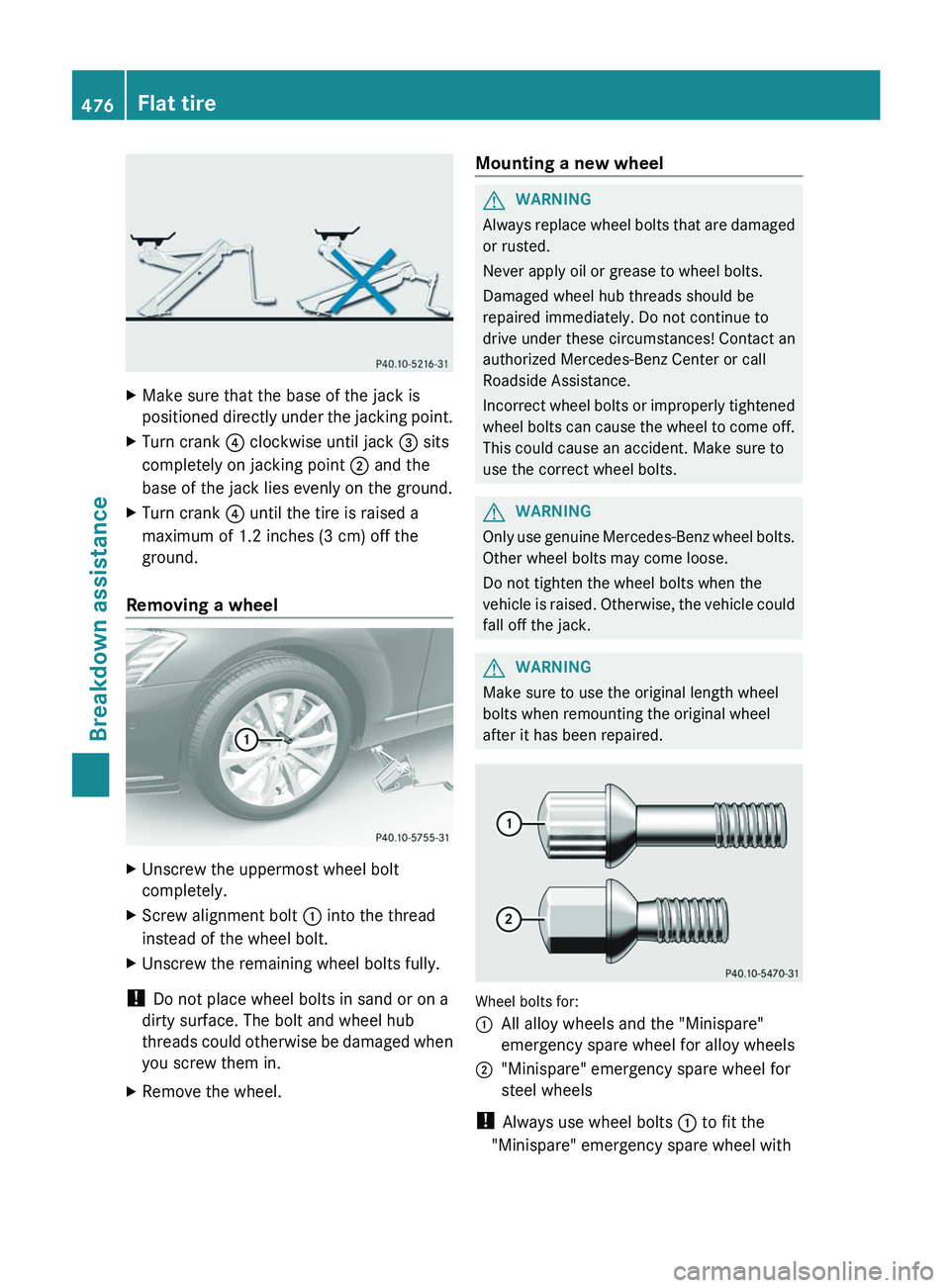
Make sure that the base of the jack is
positioned
directly under the jacking point.
X Turn crank ? clockwise until jack = sits
completely on jacking point ; and the
base of the jack lies evenly on the ground.
X Turn crank ? until the tire is raised a
maximum of 1.2 inches (3 cm) off the
ground.
Removing a wheel X
Unscrew the uppermost wheel bolt
completely.
X Screw alignment bolt : into the thread
instead of the wheel bolt.
X Unscrew the remaining wheel bolts fully.
! Do not place wheel bolts in sand or on a
dirty surface. The bolt and wheel hub
threads
could otherwise be damaged when
you screw them in.
X Remove the wheel. Mounting a new wheel G
WARNING
Always replace wheel bolts that are damaged
or rusted.
Never apply oil or grease to wheel bolts.
Damaged wheel hub threads should be
repaired immediately. Do not continue to
drive under these circumstances! Contact an
authorized Mercedes-Benz Center or call
Roadside Assistance.
Incorrect
wheel bolts or improperly tightened
wheel bolts can cause the wheel to come off.
This could cause an accident. Make sure to
use the correct wheel bolts. G
WARNING
Only use genuine Mercedes-Benz wheel bolts.
Other wheel bolts may come loose.
Do not tighten the wheel bolts when the
vehicle
is raised. Otherwise, the vehicle could
fall off the jack. G
WARNING
Make sure to use the original length wheel
bolts when remounting the original wheel
after it has been repaired. Wheel bolts for:
:
All alloy wheels and the "Minispare"
emergency spare wheel for alloy wheels
; "Minispare" emergency spare wheel for
steel wheels
! Always use wheel bolts : to fit the
"Minispare" emergency spare wheel with 476
Flat tire
Breakdown assistance
Page 479 of 536
light-alloy wheel. Using other wheel bolts
when fitting the "Minispare" emergency
spare wheel with light-alloy wheel could
damage the brake system.
Always use wheel bolts
; to fit the
"Minispare" emergency spare wheel with
steel wheel. Using other wheels when
fitting the "Minispare" emergency spare
wheel with steel wheel could damage the
brake system.
X Clean the wheel and wheel hub contact
surfaces.
! To prevent damage to the paintwork, hold
the wheel securely against the wheel hub
while screwing in the first wheel bolt. X
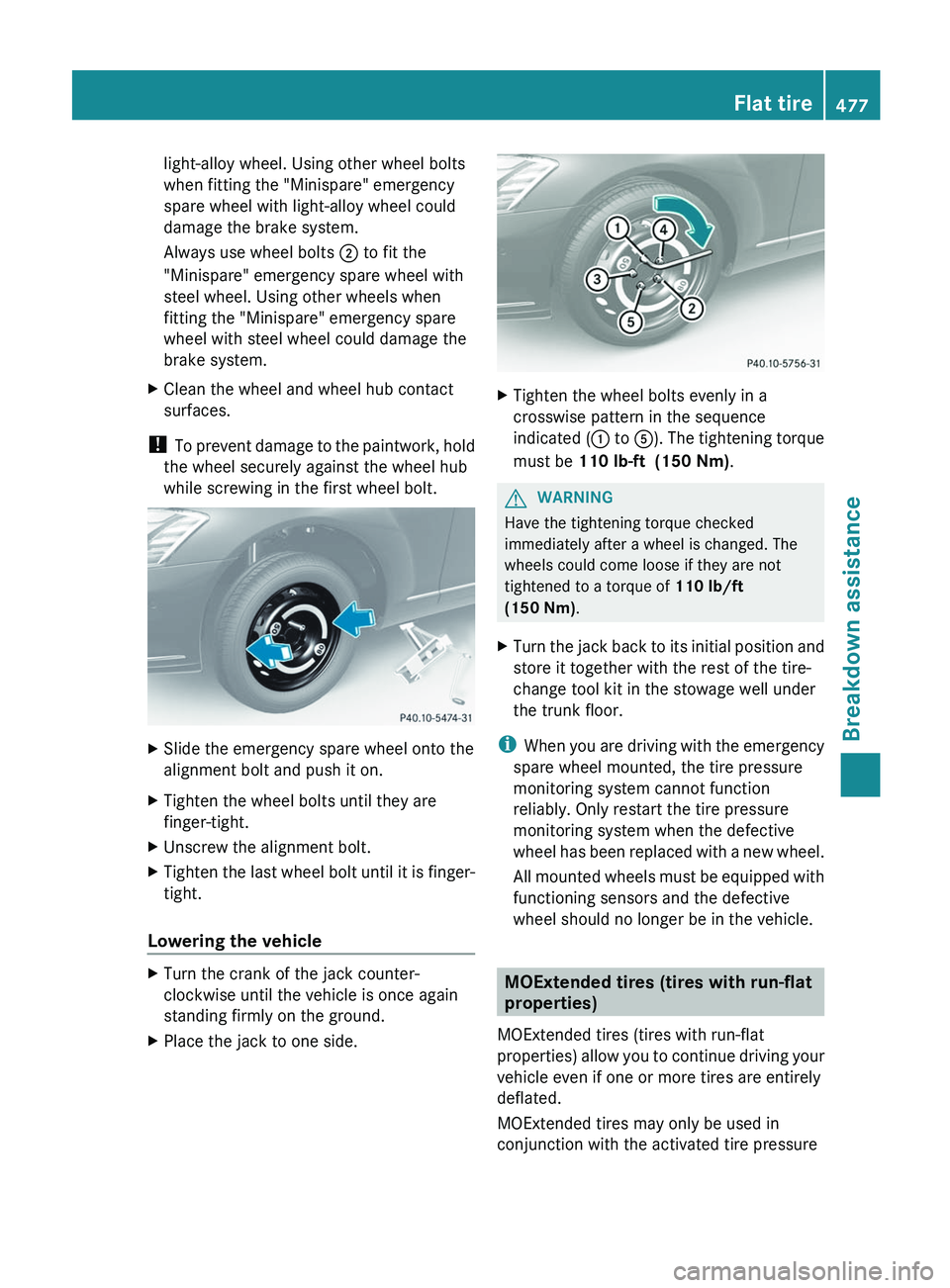
Slide the emergency spare wheel onto the
alignment bolt and push it on.
X Tighten the wheel bolts until they are
finger-tight.
X Unscrew the alignment bolt.
X Tighten the last wheel bolt until it is finger-
tight.
Lowering the vehicle X
Turn the crank of the jack counter-
clockwise until the vehicle is once again
standing firmly on the ground.
X Place the jack to one side. X
Tighten the wheel bolts evenly in a
crosswise pattern in the sequence
indicated ( :
to A). The tightening torque
must be 110 lb-ft (150 Nm). G
WARNING
Have the tightening torque checked
immediately after a wheel is changed. The
wheels could come loose if they are not
tightened to a torque of 110 lb/ft
(150 Nm).
X Turn the jack back to its initial position and
store it together with the rest of the tire-
change tool kit in the stowage well under
the trunk floor.
i When
you are driving with the emergency
spare wheel mounted, the tire pressure
monitoring system cannot function
reliably. Only restart the tire pressure
monitoring system when the defective
wheel has been replaced with a new wheel.
All mounted wheels must be equipped with
functioning sensors and the defective
wheel should no longer be in the vehicle. MOExtended tires (tires with run-flat
properties)
MOExtended tires (tires with run-flat
properties)
allow you to continue driving your
vehicle even if one or more tires are entirely
deflated.
MOExtended tires may only be used in
conjunction with the activated tire pressure Flat tire
477
Breakdown assistance Z
Page 486 of 536
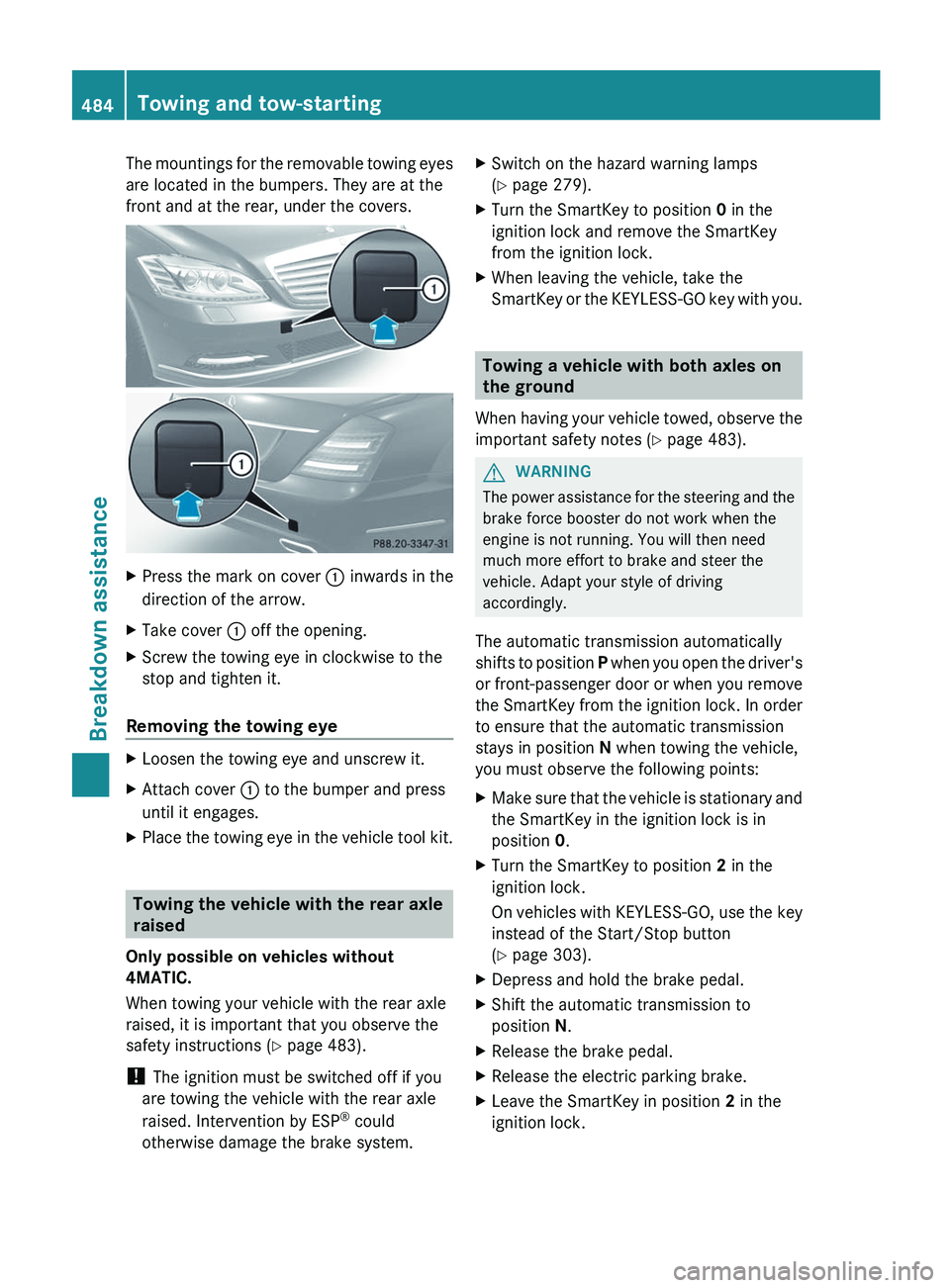
The mountings for the removable towing eyes
are located in the bumpers. They are at the
front and at the rear, under the covers.
X
Press the mark on cover : inwards in the
direction of the arrow.
X Take cover : off the opening.
X Screw the towing eye in clockwise to the
stop and tighten it.
Removing the towing eye X
Loosen the towing eye and unscrew it.
X Attach cover : to the bumper and press
until it engages.
X Place the towing eye in the vehicle tool kit. Towing the vehicle with the rear axle
raised
Only possible on vehicles without
4MATIC.
When towing your vehicle with the rear axle
raised, it is important that you observe the
safety instructions ( Y page 483).
! The ignition must be switched off if you
are towing the vehicle with the rear axle
raised. Intervention by ESP ®
could
otherwise damage the brake system. X
Switch on the hazard warning lamps
(Y page 279).
X Turn the SmartKey to position 0 in the
ignition lock and remove the SmartKey
from the ignition lock.
X When leaving the vehicle, take the
SmartKey
or the KEYLESS-GO key with you. Towing a vehicle with both axles on
the ground
When
having your vehicle towed, observe the
important safety notes ( Y page 483). G
WARNING
The power assistance for the steering and the
brake force booster do not work when the
engine is not running. You will then need
much more effort to brake and steer the
vehicle. Adapt your style of driving
accordingly.
The automatic transmission automatically
shifts
to position P when you open the driver's
or front-passenger door or when you remove
the SmartKey from the ignition lock. In order
to ensure that the automatic transmission
stays in position N when towing the vehicle,
you must observe the following points:
X Make sure that the vehicle is stationary and
the SmartKey in the ignition lock is in
position 0.
X Turn the SmartKey to position 2 in the
ignition lock.
On
vehicles with KEYLESS-GO, use the key
instead of the Start/Stop button
(Y page 303).
X Depress and hold the brake pedal.
X Shift the automatic transmission to
position N.
X Release the brake pedal.
X Release the electric parking brake.
X Leave the SmartKey in position 2 in the
ignition lock.484
Towing and tow-starting
Breakdown assistance