light MERCEDES-BENZ S-CLASS SEDAN 2013 Repair Manual
[x] Cancel search | Manufacturer: MERCEDES-BENZ, Model Year: 2013, Model line: S-CLASS SEDAN, Model: MERCEDES-BENZ S-CLASS SEDAN 2013Pages: 536, PDF Size: 24.14 MB
Page 168 of 536
Route guidance
General notes G
WARNING
COMAND calculates the route to the
destination without taking into account the
following, for example:
R Traffic lights
R Stop and right-of-way signs
R Lane merging
R Parking or stopping prohibited areas
R Other
road and traffic rules and regulations
R Narrow bridges
COMAND may give incorrect navigation
commands if the data in the digital map does
not correspond with the actual road/ traffic
situation. For example, if the traffic routing
has been changed or the direction of a one-
way road has been reversed.
For this reason, you must always observe
applicable road and traffic rules and
regulations during your journey. Road and
traffic rules and regulations always have
priority over the navigation commands
generated by the system.
Route guidance begins once a route has been
calculated (Y page 156).
COMAND guides you to your destination by
means of navigation commands in the form
of audible navigation announcements and
route guidance displays.
The route guidance displays can only be seen
if the display is switched to navigation mode.
If you do not follow the navigation
announcements or if you leave the calculated
route, COMAND automatically calculates a
new route to the destination.
If the digital map contains the corresponding
information, the following applies:
R when selecting a route, COMAND tries to
avoid roads that only have limited access, e.g. roads closed to through traffic and non-
residents.
R roads that have time restrictions (e.g.
closed
on Sundays and public holidays) are
avoided for route guidance.
Change of direction Introduction
Changes of direction have three phases:
R
preparation phase
R announcement phase
R change-of-direction phase
Preparation phase
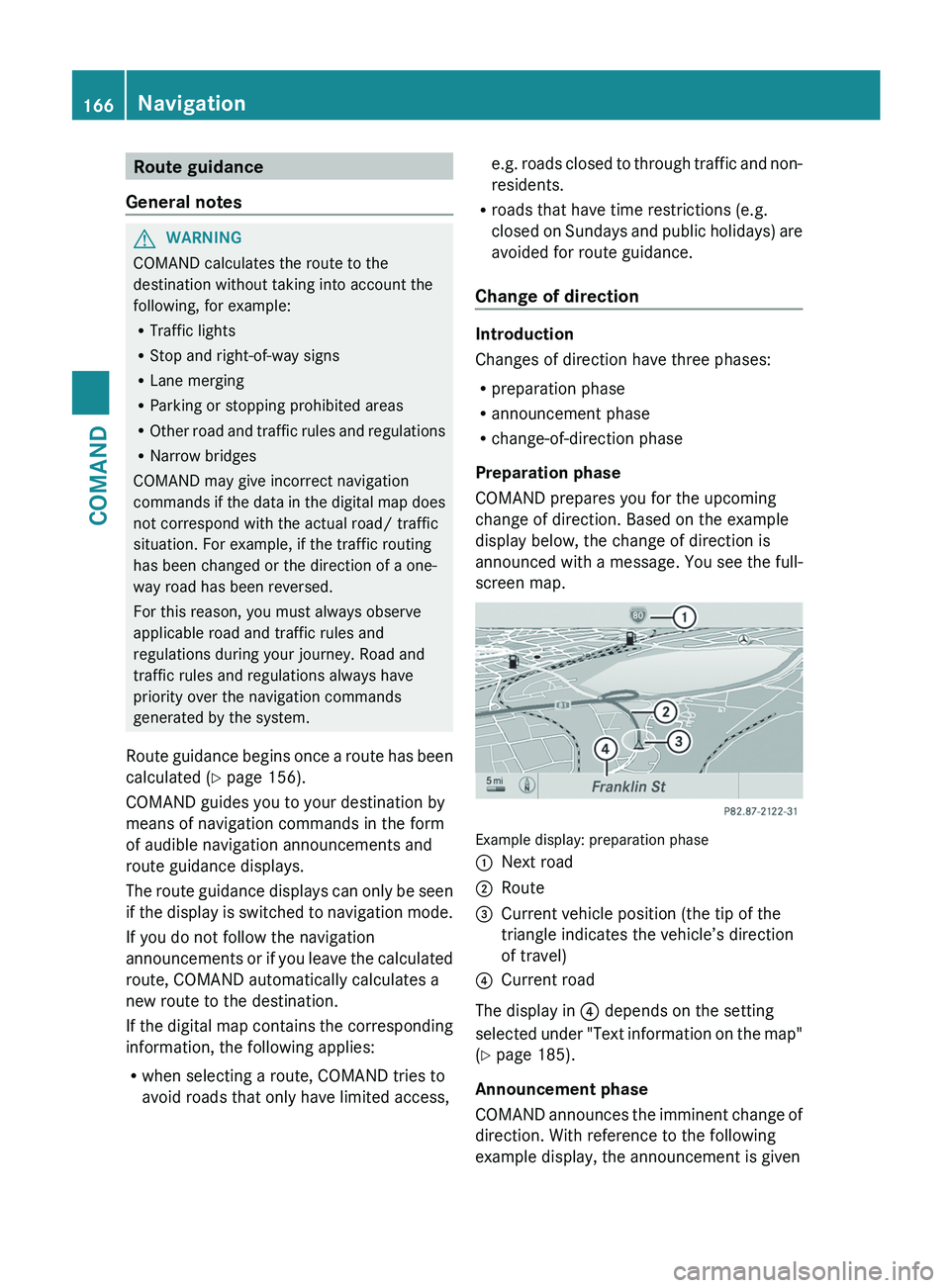
COMAND prepares you for the upcoming
change of direction. Based on the example
display below, the change of direction is
announced with a message. You see the full-
screen map. Example display: preparation phase
:
Next road
; Route
= Current vehicle position (the tip of the
triangle indicates the vehicle’s direction
of travel)
? Current road
The display in ? depends on the setting
selected
under "Text information on the map"
(Y page 185).
Announcement phase
COMAND announces the imminent change of
direction. With reference to the following
example display, the announcement is given 166
Navigation
COMAND
Page 169 of 536
before the change of direction with the
request Please turn right in 900 ft.
The announced distance to the next change
of direction depends on the type of road and
its permissible speed limit.
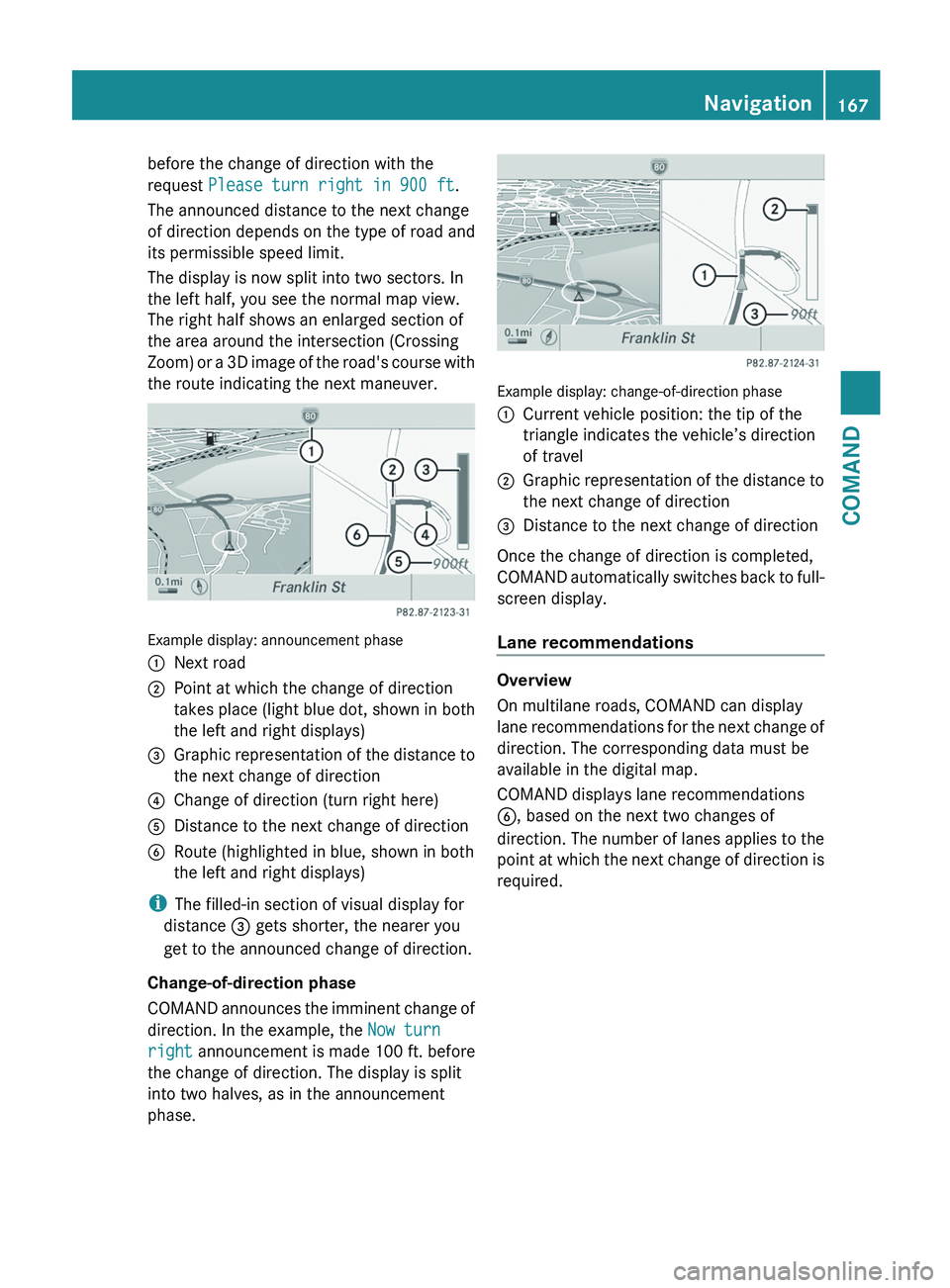
The display is now split into two sectors. In
the left half, you see the normal map view.
The right half shows an enlarged section of
the area around the intersection (Crossing
Zoom)
or a 3D image of the road's course with
the route indicating the next maneuver. Example display: announcement phase
:
Next road
; Point at which the change of direction
takes
place (light blue dot, shown in both
the left and right displays)
= Graphic representation of the distance to
the next change of direction
? Change of direction (turn right here)
A Distance to the next change of direction
B Route (highlighted in blue, shown in both
the left and right displays)
i The filled-in section of visual display for
distance = gets shorter, the nearer you
get to the announced change of direction.
Change-of-direction phase
COMAND
announces the imminent change of
direction. In the example, the Now turn
right announcement is made 100 ft. before
the change of direction. The display is split
into two halves, as in the announcement
phase. Example display: change-of-direction phase
:
Current vehicle position: the tip of the
triangle indicates the vehicle’s direction
of travel
; Graphic representation of the distance to
the next change of direction
= Distance to the next change of direction
Once the change of direction is completed,
COMAND
automatically switches back to full-
screen display.
Lane recommendations Overview
On multilane roads, COMAND can display
lane
recommendations for the next change of
direction. The corresponding data must be
available in the digital map.
COMAND displays lane recommendations
B, based on the next two changes of
direction. The number of lanes applies to the
point at which the next change of direction is
required. Navigation
167
COMAND Z
Page 170 of 536
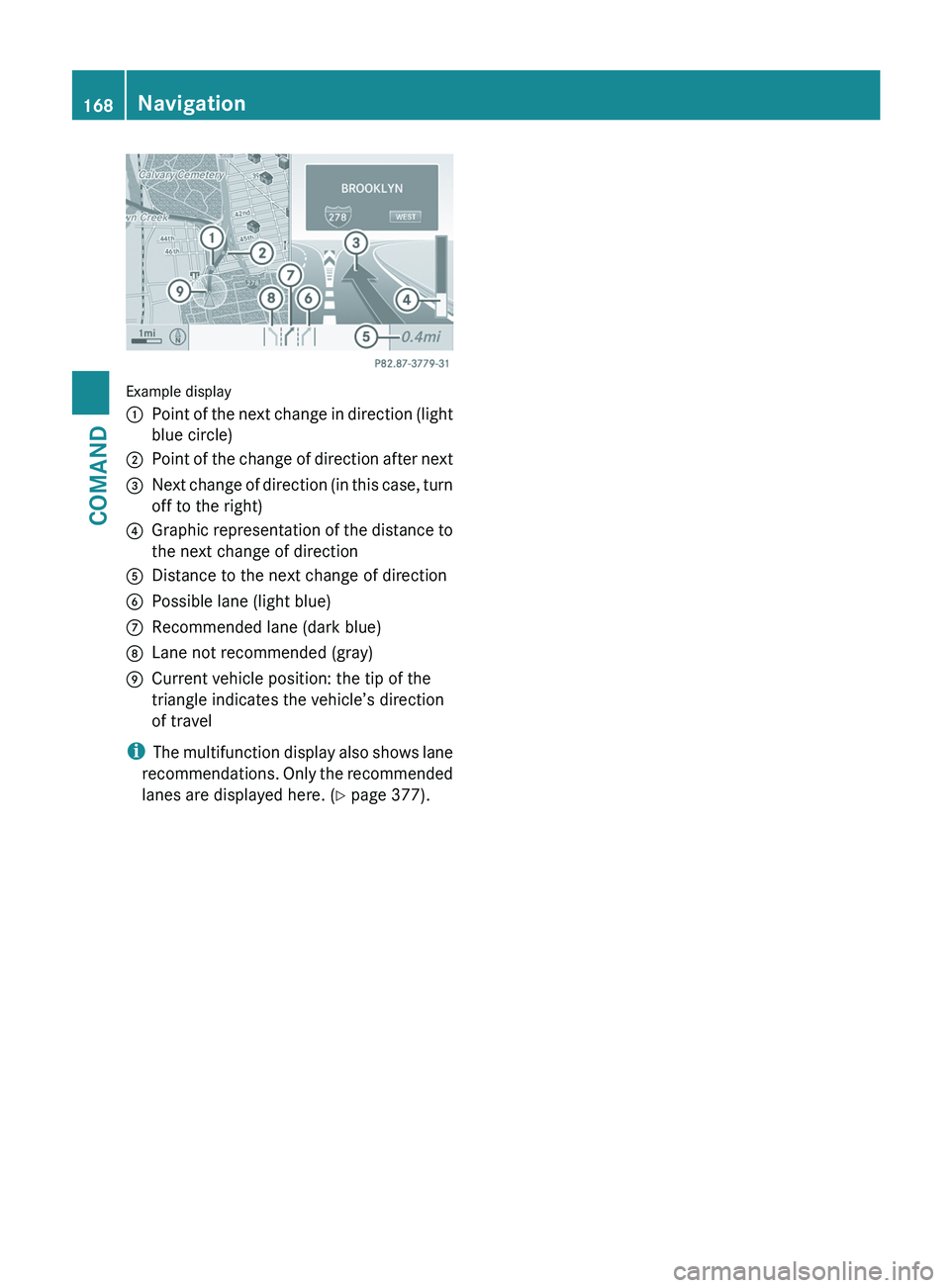
Example display
:
Point of the next change in direction (light
blue circle)
; Point of the change of direction after next
= Next change of direction (in this case, turn
off to the right)
? Graphic representation of the distance to
the next change of direction
A Distance to the next change of direction
B Possible lane (light blue)
C Recommended lane (dark blue)
D Lane not recommended (gray)
E Current vehicle position: the tip of the
triangle indicates the vehicle’s direction
of travel
i The multifunction display also shows lane
recommendations. Only the recommended
lanes are displayed here. ( Y page 377).168
Navigation
COMAND
Page 171 of 536
Display and description of lane recommendations
The
colors used in the lane recommendation display vary depending on whether day or night
design is switched on. Lane Day design Night design
Recommended lane
C
In this lane, you will be able to complete the
next two changes of direction without
changing lanes. Dark blue Light blue
Possible lane
B
In
this lane, you will only be able to complete
the next change of direction without
changing lanes. Light blue Dark blue
Lane not recommended
D
In this lane, you will not be able to complete
the next change of direction without
changing lane. Gray Gray
Display in the multifunction display
The
lane recommendations are also shown in
the multifunction display. You will find further
information in the "On-board computer"
section ( Y page 377).
Using car pool lanes
COMAND displays car pool lanes if you have
selected this option in the route options
(Y page 152).
If this is the case, COMAND checks whether
there are any car pool lanes on the route. If
there are, they are taken into account during
route calculation. Route guidance will then
include car pool lanes.
Car pool lanes may only be used under certain
conditions. Please observe the relevant legal
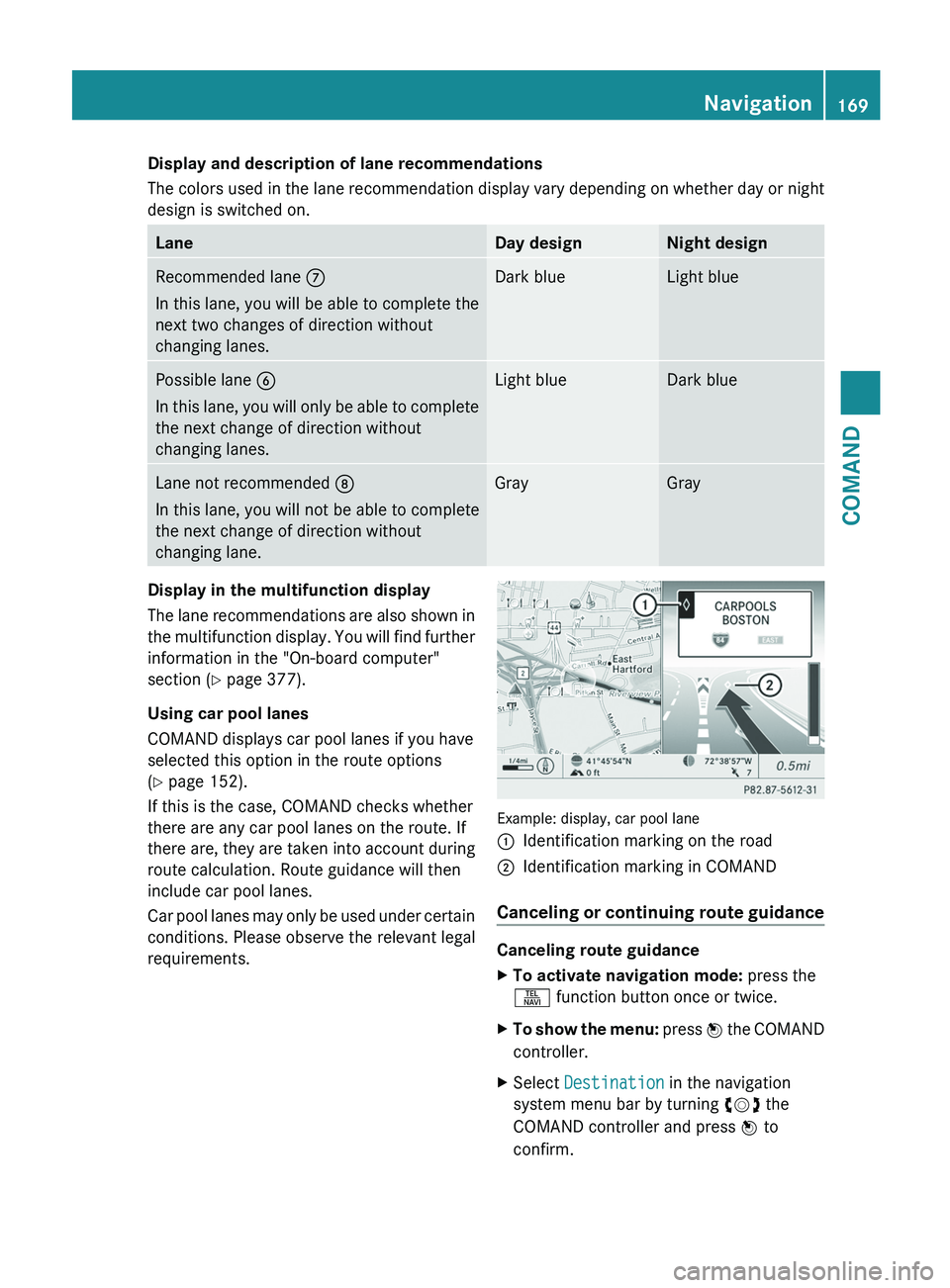
requirements. Example: display, car pool lane
:
Identification marking on the road
; Identification marking in COMAND
Canceling or continuing route guidance Canceling route guidance
X
To activate navigation mode: press the
S function button once or twice.
X To show the menu:
press W the COMAND
controller.
X Select Destination in the navigation
system menu bar by turning cVd the
COMAND controller and press W to
confirm. Navigation
169
COMAND Z
Page 173 of 536
Avoiding a section of the route blocked
by a traffic jam
This function blocks a section of the route
ahead of you. You can set the length of the
blocked route section. If possible, COMAND
calculates a detour around the blocked
section of the route.
X
To activate navigation mode: press the
S function button once or twice.
X To show the menu: press W the COMAND
controller.
X Select Route in the navigation system
menu bar by turning cVd the COMAND
controller and press W to confirm.
X Select Detour and press W to confirm.
X To block a section of the route: select
More
or Less repeatedly and confirm using
W until the desired section has been
selected.
i The
total length of the section that can be
blocked is defined by the digital map. The
menu items are available accordingly.
X To start route calculation: select Start
and press W to confirm.
X To delete the blocked section: select
Delete while the message is shown and
press W to confirm.
COMAND calculates the route without the
block.
Selecting an alternative route With the "Alternative route" function, routes
other
than the original one can be calculated.
X To activate navigation mode: press the
S function button once or twice.
X To show the menu:
press W the COMAND
controller.
X Select Route in the navigation system
menu bar by turning cVd the COMAND
controller and press W to confirm. X
Select Alternative Route and press W
to confirm.
You
see the selected route. The display now
shows a split-screen view. On the left-hand
side, one or more alternative routes are
shown from start to destination. The
current route is highlighted dark blue; other
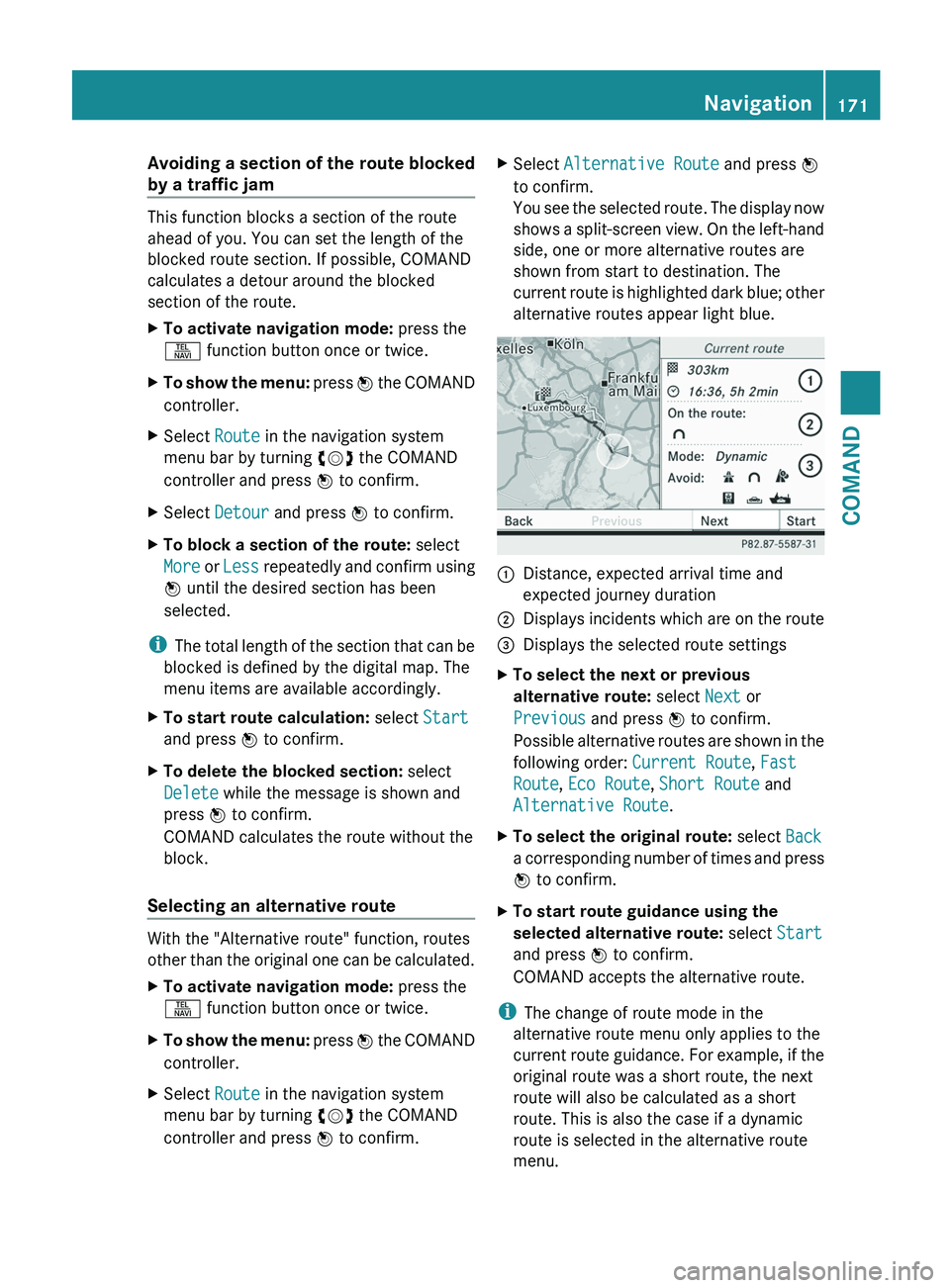
alternative routes appear light blue. :
Distance, expected arrival time and
expected journey duration
; Displays incidents which are on the route
= Displays the selected route settings
X To select the next or previous
alternative route: select Next or
Previous and press W to confirm.
Possible
alternative routes are shown in the
following order: Current Route, Fast
Route, Eco Route, Short Route and
Alternative Route.
X To select the original route: select Back
a
corresponding number of times and press
W to confirm.
X To start route guidance using the
selected alternative route: select Start
and press W to confirm.
COMAND accepts the alternative route.
i The change of route mode in the
alternative route menu only applies to the
current
route guidance. For example, if the
original route was a short route, the next
route will also be calculated as a short
route. This is also the case if a dynamic
route is selected in the alternative route
menu. Navigation
171
COMAND Z
Page 174 of 536
Displaying destination information
Prerequisite: you have entered a destination
(Y page 153) and possibly an intermediate
stop (Y page 161).
X
To activate navigation mode: press the
S function button once or twice.
X To show the menu: press W the COMAND
controller.
X Select Info in the menu bar by turning
cVd the COMAND controller and press
W to confirm.
Destination information is displayed.
If a telephone number is entered for the
address displayed, you can also select and
call the number using COMAND.
X To call the destination: select the
telephone number using the COMAND
controller and press W to confirm.
X To close the destination information:
slide XVY
the COMAND controller or press
the % back button.
Route overview You can use the overview of the route to move
along
the route section by section and to see
details of the route sections.
You have entered a destination
(Y page 153) or a point of interest
(Y page 162) and possibly an intermediate
stop (Y page 161).
X To activate navigation mode: press the
S function button once or twice.
X To show the menu:
press W the COMAND
controller.
X Select Route in the navigation system
menu bar by turning cVd the COMAND
controller and press W to confirm.
X Select Route Info and press W to
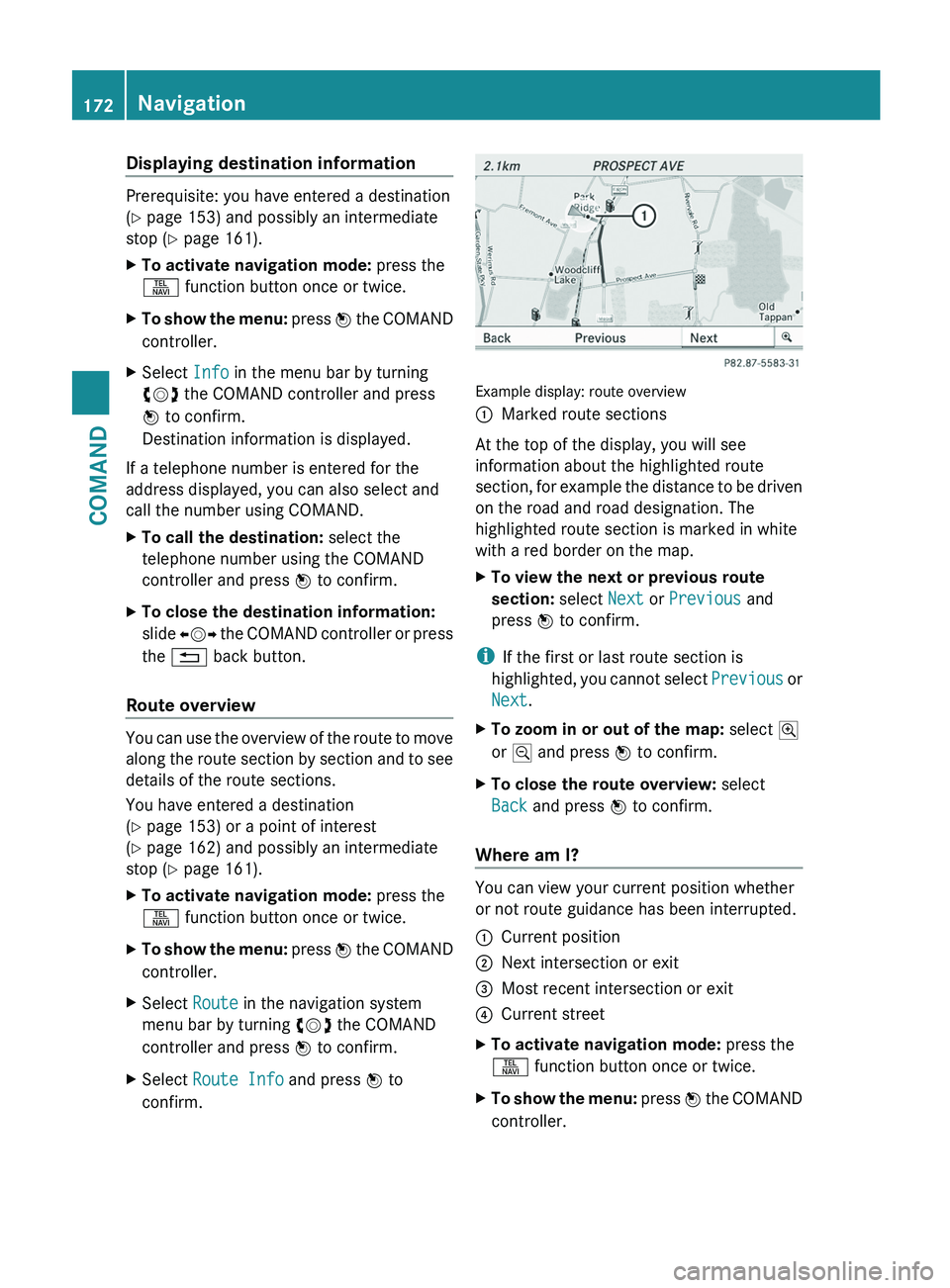
confirm. Example display: route overview
:
Marked route sections
At the top of the display, you will see
information about the highlighted route
section,
for example the distance to be driven
on the road and road designation. The
highlighted route section is marked in white
with a red border on the map.
X To view the next or previous route
section: select Next or Previous and
press W to confirm.
i If the first or last route section is
highlighted,
you cannot select Previous or
Next.
X To zoom in or out of the map: select N
or M and press W to confirm.
X To close the route overview: select
Back and press W to confirm.
Where am I? You can view your current position whether
or not route guidance has been interrupted.
:
Current position
; Next intersection or exit
= Most recent intersection or exit
? Current street
X To activate navigation mode: press the
S function button once or twice.
X To show the menu:
press W the COMAND
controller. 172
Navigation
COMAND
Page 177 of 536
i
COMAND uses corresponding icons to
highlight the entire section of the affected
route, regardless of how long the incident
actually
is. The icons are placed on the side
of the road affected by the incident. Navigation
175
COMAND Z
Page 180 of 536
6
Report text
C First exit/intersection after the affected
route section ends
X To scroll within a report or to access
the next report: turn cVd the COMAND
controller.
X To return to the list of messages: press
W or slide XVY the COMAND controller.
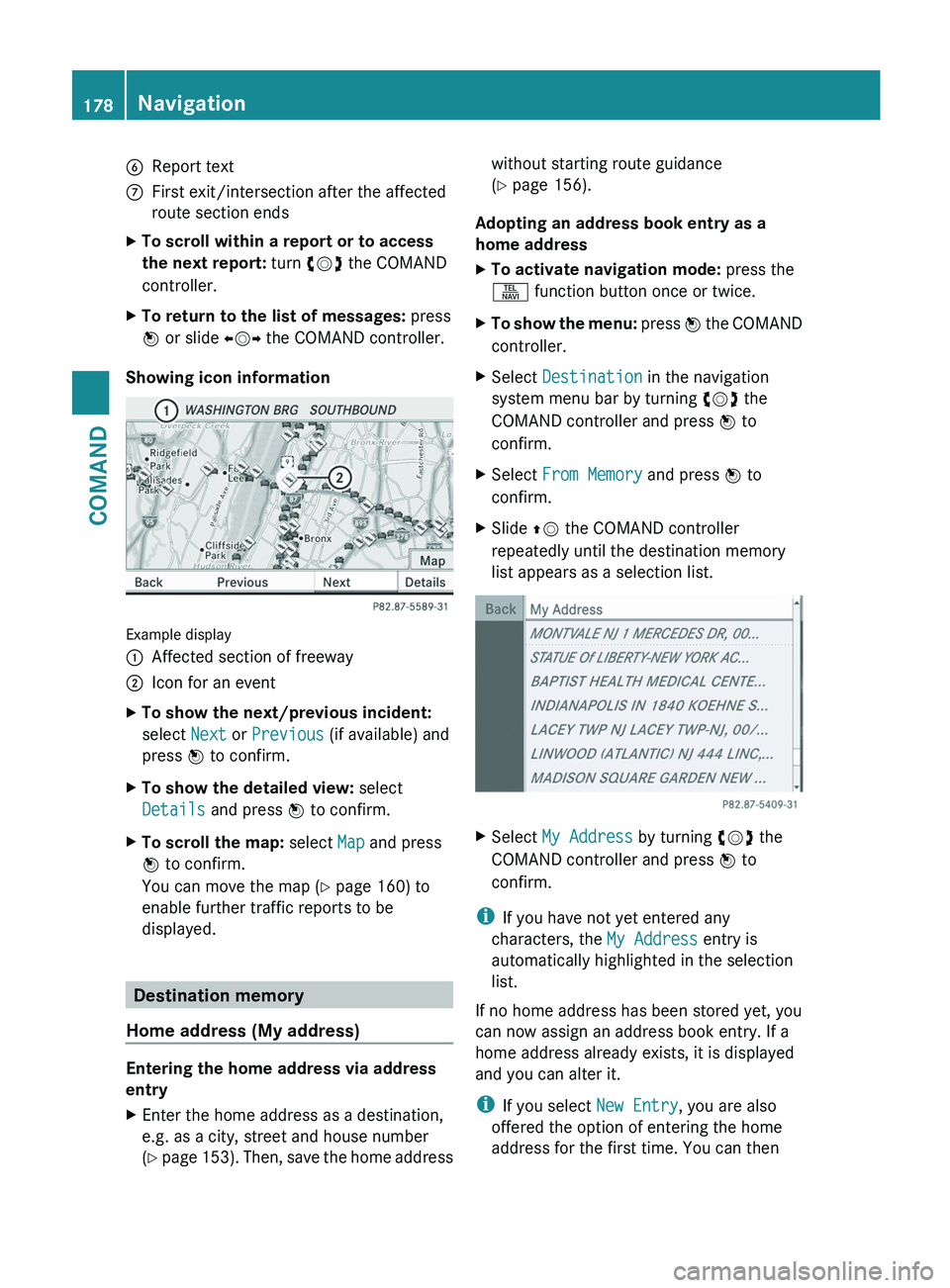
Showing icon information Example display
:
Affected section of freeway
; Icon for an event
X To show the next/previous incident:
select Next or Previous (if available) and
press W to confirm.
X To show the detailed view: select
Details and press W to confirm.
X To scroll the map: select Map and press
W to confirm.
You can move the map ( Y page 160) to
enable further traffic reports to be
displayed. Destination memory
Home address (My address) Entering the home address via address
entry
X
Enter the home address as a destination,
e.g. as a city, street and house number
(Y
page 153). Then, save the home address without starting route guidance
(Y page 156).
Adopting an address book entry as a
home address
X To activate navigation mode: press the
S function button once or twice.
X To show the menu:
press W the COMAND
controller.
X Select Destination in the navigation
system menu bar by turning cVd the
COMAND controller and press W to
confirm.
X Select From Memory and press W to
confirm.
X Slide ZV the COMAND controller
repeatedly until the destination memory
list appears as a selection list. X
Select My Address by turning cVd the
COMAND controller and press W to
confirm.
i If you have not yet entered any
characters, the My Address entry is
automatically highlighted in the selection
list.
If no home address has been stored yet, you
can now assign an address book entry. If a
home address already exists, it is displayed
and you can alter it.
i If you select New Entry, you are also
offered the option of entering the home
address for the first time. You can then 178
Navigation
COMAND
Page 181 of 536
save the home address without starting
route guidance.
X To enter the home address for the first
time: select Assign Address Book
Entry and press W to confirm.
X Select Home or Work and press W to
confirm.
X To change the home address: select
Change and press W to confirm.
X Select Assign Address Book Entry and
press W to confirm.
i If you select New Entry, you are also
offered the option of changing the home
address by entering an address. You can
then save the home address without
starting route guidance.
X Select Home or Work and press W to
confirm.
In
both cases, you will see the address book
either with the character bar or as a
selection list.
X To select an address book entry:
proceed
as described in the "Searching for
an address book entry" section
(Y page 205).
X To confirm the selection: press W the
COMAND controller.
If no home address has been stored,
COMAND saves the entry. You will see a
message and then the address menu with
the selected address. Start is highlighted
automatically.
If
a home address has already been stored,
you will see a prompt asking you whether
the My Address entry should be
overwritten.
X Select Yes or No and press W to confirm.
If you select Yes, COMAND overwrites the
destination. You will see a message and
then the address menu with the selected
address. Start is highlighted
automatically.
If you select No, the list will reappear. Selecting the home address for route
guidance
X
Proceed as described in the "Selecting a
destination from the destination memory"
section ( Y page 159).
Storing a destination in the destination
memory Note
This function also stores the destination in
the address book.
After destination entry
X
The destination has been entered and is
shown in the address entry menu
(Y page 156).
X Select Save by sliding VÆ and turning
cVd the COMAND controller and press
W to confirm.
You can now select storage options.
During route guidance
X To show the menu:
press W the COMAND
controller.
X Select Destination in the navigation
system menu bar by turning cVd the
COMAND controller and press W to
confirm.
X Select Save
Destination and press W to
confirm.
You can now select storage options.
From the list of previous destinations
X To show the menu:
press W the COMAND
controller.
X Select Destination in the navigation
system menu bar by turning cVd the
COMAND controller and press W to
confirm.
X Select From Last Destinations and
press W to confirm.
The list of last destinations appears. Navigation
179
COMAND Z
Page 191 of 536
You can install new map software yourself
which, depending on the scope, may consist
of one or more DVDs.
The installation process can take between
10
and 120 minutes, depending on the scope
of the map software. If the radio is switched
on before you start the installation process,
you can still adjust the volume. You can also
use COMAND to operate automatic climate
control and to cancel the process. Other
functions are not operational. If possible,
carry out the installation when the vehicle is
stationary. The DVD read speed is higher
when the vehicle is stationary than when it is
in motion, so less time is required. If the
starter battery is not sufficiently charged,
COMAND may end the process automatically
in order to protect the battery. Therefore, let
the engine idle during the installation
process. G
WARNING
Never leave the engine running in enclosed
spaces. The exhaust gases contain toxic
carbon
monoxide. Breathing in exhaust fumes
is a health hazard and can lead to
unconsciousness or death.
Displaying information on the map
version currently in use
X To activate navigation mode: press the
S function button once or twice.
X To show the menu:
press W the COMAND
controller.
X Select Navi in the main function bar by
sliding VÆ
and turning cVd the COMAND
controller and press W to confirm.
X Select Map Version and press W to
confirm.
Notes on handling DVDs
R Only hold DVDs by the edge.
R Handle DVDs carefully to prevent reading
errors.
R Avoid getting scratches, fingerprints and
dust on DVDs. R
Use a commercially-available cleaning
cloth to clean discs. When cleaning CDs,
you should wipe in straight lines from the
center outwards rather than in a circular
motion.
R Place DVDs back in their cases after use.
R Protect
DVDs from heat and direct sunlight.
Map software copy protection
Map software for COMAND is subject to a
charge. The map software has just one
activation code which is usable in one vehicle
only, and is not transferable. You can obtain
the six-digit activation code from your
authorized Mercedes-Benz Center. If you
have lost the activation code, or if COMAND
does not accept the activation code that you
have received, contact your authorized
Mercedes-Benz Center.
Your vehicle is supplied with map software at
the factory. Depending on the country, map
software for your region is either pre-installed
(Europe/USA) or the map software is
supplied as a DVD (all other countries). You
do not require an activation code for the map
software that is provided with your vehicle.
If the map software on your vehicle has been
installed at the factory and you wish to
reinstall it, this also does not necessitate
entry of the activation code.
Installation process
X Load the map software DVD in the DVD
drive ( Y page 220).
COMAND checks the DVD and shows a
corresponding message in the display.
Map software is not compatible with the
navigation system
You
will see a message that the map software
cannot be installed.
X To confirm the message: press W.
COMAND ejects the DVD.
X Take the DVD out of the slot.
X Insert a DVD which is compatible with the
vehicle’s navigation system. Navigation
189
COMAND Z