engine MERCEDES-BENZ SL CLASS 2019 User Guide
[x] Cancel search | Manufacturer: MERCEDES-BENZ, Model Year: 2019, Model line: SL CLASS, Model: MERCEDES-BENZ SL CLASS 2019Pages: 330, PDF Size: 16.53 MB
Page 21 of 330
Tank content
Fuel gauge....................................... 33
Technical data
Capacities ...................................... 321
Information .................................... 319
Tires/wheels ................................. 318
Vehicle data ................................... 326
TELEAID
Call priority .................................... 258
Emergency call .............................. 256
General notes ................................ 255
MB info call button ........................ 258
Roadside Assistance button .......... 257
Self-test ......................................... 255
System .......................................... 255
Vehicle Health Check .................... 259
Telephone
Accepting a call (multifunction
steering wheel) .............................. 197
Authorizing a mobile phone (con-
necting) ......................................... 247
Connecting a mobile phone (gen-
eral information) ............................ 246
Display message ............................ 230
Menu (on-board computer) ............ 196
Number from the phone book ........ 197
Redialing ........................................ 197
Rejecting/ending a call ................. 197
see also Digital Operator's Man-
ual .................................................. 243
Temperature
Coolant .......................................... 191
Coolant (on-board computer,
Mercedes-AMG vehicles) ............... 202
Engine oil (on-board computer,
Mercedes-AMG vehicles) ............... 202
Outside temperature ...................... 190
Setting (climate control)................ 119
Transmission oil (on-board com-
puter, Mercedes-AMG vehicles) ..... 202
Timing (RACETIMER)......................... 203
Tire pressure
Calling up (on-board computer) ..... 299
Checking manually ........................ 299
Display message ............................ 227
Maximum ....................................... 299
Not reached (TIREFIT) .................... 281
Notes ............................................. 298
Reached (TIREFIT) .......................... 281
Recommended ............................... 296
Tire pressure monitor
Checking the tire pressure elec-
tronically ........................................ 301
Function/notes............................. 299
General notes ................................ 299
Important safety notes .................. 300
Radio type approval for the tire
pressure monitor ........................... 302
Restarting ...................................... 301
Warning lamp ................................. 242
Warning message .......................... 301
Tire-change tool kit........................... 278
TIREFIT kit.......................................... 279
Important safety notes .................. 279
Storage location ............................ 277
Tire pressure not reached .............. 281
Tire pressure reached .................... 281
Tires
Aspect ratio (definition) ................. 312
Average weight of the vehicle
occupants (definition) .................... 311
Bar (definition) ............................... 311
Changing a wheel.......................... 313
Characteristics .............................. 311
Checking ........................................ 293
Curb weight (definition) ................. 312
Definition of terms ......................... 311
Direction of rotation ...................... 313
Display message ............................ 227
Distribution of the vehicle occu-
pants (definition) ............................ 313
DOT (Department of Transporta-
tion) (definition) ............................. 311
DOT, Tire Identification Number
(TIN) ............................................... 310
GAWR (Gross Axle Weight Rat-
ing) (definition) .............................. 311
GVW (Gross Vehicle Weight) (def-
inition) ........................................... 311
GVWR (Gross Vehicle Weight
Rating) (definition) ......................... 311
Important safety notes .................. 293
Increased vehicle weight due to
optional equipment (definition) ...... 311
Information on driving .................... 293
Kilopascal (kPa) (definition) ........... 312
Index19
Page 22 of 330

Labeling (overview) ........................ 307
Load bearing index (definition) ...... 312
Load index .....................................309
Load index (definition) ................... 312
M+S tires ....................................... 295
Maximum load on a tire (defini-
tion) ............................................... 312
Maximum loaded vehicle weight
(definition) ..................................... 312
Maximum permissible tire pres-
sure (definition) .............................312
Maximum tire load ......................... 310
Maximum tire load (definition) ....... 312
MOExtended tires .......................... 295
Optional equipment weight (defi-
nition) ............................................ 312
Overview ........................................ 293
PSI (pounds per square inch)
(definition) ..................................... 312
Replacing ....................................... 313
Service life ..................................... 294
Sidewall (definition) ....................... 312
Speed rating (definition) ................ 311
Storing ...........................................313
Structure and characteristics
(definition) ..................................... 311
Summer tires ................................. 295
Temperature .................................. 307
TIN (Tire Identification Number)
(definition) ..................................... 312
Tire bead (definition) ......................312
Tire pressure (definition) ................ 312
Tire pressures (recommended) ...... 311
Tire size (data) ............................... 318
Tire size designation, load-bear-
ing capacity, speed rating .............. 307
Tire tread ....................................... 294
Tire tread (definition) ..................... 312
Total load limit (definition) ............. 313
Traction ......................................... 306
Traction (definition) ....................... 312
Tread wear..................................... 306
Uniform Tire Quality Grading
Standards ...................................... 306
Uniform Tire Quality Grading
Standards (definition) .................... 311
Wear indicator (definition) ............. 313
Wheel and tire combination ........... 318
Wheel rim (definition) .................... 311
see Flat tire
Tow-starting
Emergency engine starting ............ 290
Important safety notes .................. 288
Towing
Permitted towing methods ............ 289
Towing away
Important safety guidelines ........... 288
Installing the towing eye ................ 288
Removing the towing eye ............... 289
Transporting the vehicle ................ 290
With both axles on the ground ....... 289
With the rear axle raised ................ 290
Traffic reports
see also Digital Operator's Man-
ual .................................................. 243
Traffic Sign Assist
Display message ............................ 222
Transmission
Overview of transmission posi-
tions .............................................. 134
Selector lever ................................ 134
see Automatic transmission
Transmission position display......... 135
Transporting the vehicle.................. 290
Trip computer (on-board com-
puter).................................................. 193
Trip odometer
Calling up ....................................... 193
Resetting (on-board computer) ...... 194
Trunk
Emergency release .......................... 86
Important safety notes .................... 81
Locking separately ........................... 86
Opening/closing (automatically
from inside) ...................................... 85
Opening/closing (automatically
from outside) ................................... 83
Opening/closing (from outside,
HANDS-FREE ACCESS) .................... 84
Opening/closing (manually from
outside) ............................................ 82
Overview .......................................... 81
Power closing .................................. 81
Trunk lid
Display message ............................ 230
Opening dimensions ...................... 326
20Index
Page 23 of 330
Trunk partition
Display message ............................ 230
General notes .................................. 92
Installing .......................................... 93
Opening/closing .............................. 93
Removing ......................................... 93
Turn signals
Display message ............................ 217
Switching on/off ........................... 110
Two-way radio
Frequencies ................................... 319
Installation ..................................... 319
Transmission output (maximum) .... 319
Type identification plate
see Vehicle identification plate
U
Umbrella holder................................. 250
Unlocking
Emergency unlocking ....................... 81
From inside the vehicle (central
unlocking button) ............................. 80
Upshift indicator (on-board com-
puter, Mercedes-AMG vehicles)....... 202
USB devices
Connecting to the Media Inter-
face ...............................................248
V
Vehicle
Correct use ...................................... 28
Data acquisition ............................... 29
Display message ............................ 228
Electronics ..................................... 319
Equipment ....................................... 25
Individual settings .......................... 199
Limited Warranty .............................29
Loading .......................................... 303
Locking (in an emergency) ............... 81
Locking (SmartKey) .......................... 74
Lowering ........................................ 317
Maintenance .................................... 26
Parking for a long period ................ 149
Pulling away................................... 128
Raising ........................................... 314
REACH Regulation ........................... 28
Reporting problems ......................... 29
Securing from rolling away ............ 314
Tow-starting ................................... 288
Towing away .................................. 288
Transporting .................................. 290
Unlocking (in an emergency) ........... 81
Unlocking (SmartKey)...................... 74
Vehicle data ................................... 326
Vehicle battery
see Battery (vehicle)
Vehicle data....................................... 326
Vehicle dimensions........................... 326
Vehicle emergency locking................ 81
Vehicle identification number
see VIN
Vehicle identification plate.............. 320
Vehicle level
Active Body Control (ABC)
(except Mercedes-AMG vehicles) .. 168
Active Body Control (ABC)
(Mercedes-AMG vehicles) .............. 170
Display message ............................ 221
Vehicle tool kit.................................. 277
Video
Operating the DVD ......................... 196
see also Digital Operator's Man-
ual .................................................. 243
VIN
Seat ............................................... 321
Type plate ...................................... 320
W
Warning and indicator lamps
ABS ................................................ 236
Active Brake Assist ........................ 241
Brake Assist ................................... 241
Brakes ........................................... 235
Check Engine ................................. 239
Coolant .......................................... 239
Distance warning ........................... 241
ESP®.............................................. 236
ESP®OFF ....................................... 237
Fuel tank ........................................ 239
General notes ................................ 233
Parking brake ................................ 238
PASSENGER AIR BAG ...................... 41
Reserve fuel................................... 239
Restraint system ............................ 238
Index21
Page 26 of 330

Protecting the environment
General notes
HEnvironmental note
Daimler's declared policy is one of compre-
hensive environmental protection.
The objectives are for the natural resources
that form the basis of our existence on this
planet to be used sparingly and in a manner
that takes the requirements of both nature
and humanity into account.
You too can help to protect the environment
by operating your vehicle in an environmen-
tally responsible manner.
Fuel consumption and the rate of engine,
transmission, brake and tire wear are affec-
ted by these factors:
Roperating conditions of your vehicle
Ryour personal driving style
You can influence both factors. You should
bear the following in mind:
Operating conditions:
Ravoid short trips as these increase fuel
consumption.
Ralways make sure that the tire pressures
are correct.
Rdo not carry any unnecessary weight.
Rremove roof racks once you no longer
need them.
Ra regularly serviced vehicle will contribute
to environmental protection. You should
therefore adhere to the service intervals.
Ralways have service work carried out at a
qualified specialist workshop.
Personal driving style:
Rdo not depress the accelerator pedal
when starting the engine.
Rdo not warm up the engine when the vehi-
cle is stationary.
Rdrive carefully and maintain a safe dis-
tance from the vehicle in front.
Ravoid frequent, sudden acceleration and
braking.
Rchange gear in good time and use each
gear only up to
Page 28 of 330

cause death or serious bodily injury if thevehicle is driven, that defect or malfunc-tion has been subject to repair two ormore times, and you have directly notifiedMercedes-Benz USA, LLC in writing of theneed for its repair.
(2) the same substantial defect or malfunc-tion of a less serious nature than category(1) has been subject to repair four or moretimes and you have directly notifiedMercedes-Benz in writing of the need forits repair.
(3) the vehicle is out of service by reason ofrepair of the same or different substantialdefects or malfunctions for a cumulativetotal of more than 30 calendar days.
Please send your written notice to:
Mercedes-Benz USA, LLC
Customer Assistance Center
One Mercedes-Benz Drive
Sandy Springs, GA 30328
Maintenance
The Service and Warranty Booklet describes allthe necessary maintenance work which shouldbe done at regular intervals.
Always have the Service and Warranty Bookletwith you when you bring the vehicle to anauthorized Mercedes-Benz Center. The serviceadvisor will record every service for you in theService and Warranty Booklet.
Roadside Assistance
The Mercedes-Benz Roadside Assistance Pro-gram offers technical help in the event of abreakdown. Calls to the toll-free RoadsideAssistance Hotline are answered by our agents24 hours a day, 365 days a year.
1-800-FOR-MERCedes(1-800-367-6372)(USA)
1-800-387-0100 (Canada)
For additional information, refer to theMercedes-Benz Roadside Assistance Programbrochure (USA) or the "Roadside Assistance"section in the Service and Warranty booklet(Canada). You will find both in your vehicle lit-erature portfolio.
Change of address or change of own-
ership
In the event of a change of address, pleasesend us the "Notification of Address Change"in the Service and Guarantee booklet or simplycall the Mercedes-Benz Customer AssistanceCenter (USA) at the hotline number1-800-FOR-MERCedes(1-800-367-6372) orCustomer Service Center (Canada) at1-800-387-0100. This will assist us in contact-ing you in a timely manner should the needarise.
If you sell your Mercedes, please leave theentire literature in the vehicle so that it isavailable to the next owner.
If you have purchased a used car, please sendus the "Notification of Used Car Purchase" inthe Service and Guarantee booklet or simplycall the Mercedes-Benz Customer AssistanceCenter (USA) at the hotline number1-800-FOR-MERCedes(1-800-367-6372) orCustomer Service (Canada) at1-800-387-0100.
Vehicle operation outside the USA
and Canada
When you are abroad with your vehicle,observe the following points:
RService facilities or replacement parts maynot be readily available.
RLead-free fuel for vehicles with a catalyticconverter may not be available. Leaded fuelcan cause damage to the catalytic con-verter.
RThe fuel may have a considerably loweroctane number. Unsuitable fuel can causeengine damage.
Some Mercedes-Benz models are available fordelivery in Europe through our European Deliv-ery Program. For details, consult an authorizedMercedes-Benz Center or write to one of thefollowing addresses.
In the USA
Mercedes-Benz USA, LLC
European Delivery Department
One Mercedes-Benz Drive
Sandy Springs, GA 30328
In Canada
Mercedes-Benz Canada, Inc.
26Service and vehicle operation
Introduction
Page 30 of 330

ing interference that may cause undesiredoperation of the device."
Diagnostics connection
The diagnostics connection is used for con-necting diagnostic equipment at a qualifiedspecialist workshop.
GWARNING
If you connect equipment to a diagnostics
connection in the vehicle, it may affect the
operation of vehicle systems. As a result,
the operating safety of the vehicle could be
affected. There is a risk of an accident.
Only connect equipment to a diagnostics
connection in the vehicle, which is approved
for your vehicle by Mercedes-Benz.
GWARNING
Objects in the driver's footwell may restrict
the clearance around the pedals or block a
depressed pedal. This jeopardizes the oper-
ating and road safety of the vehicle. There is
a risk of an accident.
Stow all objects securely in the vehicle so
that they do not get into the driver's foot-
well. When using floormats or carpets, make
sure that they are properly secured so that
they do not slip or obstruct the pedals. Do
not place several floormats or carpets on
top of one another.
!If the engine is switched off and equip-ment on the diagnostics connection is used,the starter battery may discharge.
Connecting equipment to the diagnostics con-nection can lead to emissions monitoringinformation being reset, for example. This maylead to the vehicle failing to meet the require-ments of the next emissions test during themain inspection.
Qualified specialist workshop
An authorized Mercedes-Benz Center is aqualified specialist workshop. It has the neces-sary specialist knowledge, tools and qualifica-tions to correctly carry out the work required
on your vehicle. This is especially the case forwork relevant to safety.
Observe the notes in the Maintenance Book-let.
Always have the following work carried out atan authorized Mercedes-Benz Center:
Rwork relevant to safety
Rservice and maintenance work
Rrepair work
Ralterations, installation work and modifica-tions
Rwork on electronic components
Correct use
If you remove any warning stickers, you or oth-ers could fail to recognize certain dangers.Leave warning stickers in position.
Observe the following information when driv-ing your vehicle:
Rthe safety notes in this manual
Rtechnical data for the vehicle
Rtraffic rules and regulations
Rlaws and safety standards pertaining tomotor vehicles
Information about the REACH decree
The REACH regulation (Regulation (EC) no.1907/2006, Article 33) lays down an informa-tion obligation for substances of very high con-cern (SVHC).
Daimler AG acts in good faith to avoid usingthese SVHCs and to allow the customer tohandle these substances safely. In accordancewith supplier information and internal productinformation from Daimler AG, SVHCs thataccount for more than 0.1 percent by weightof individual products in this vehicle areknown.
More detailed information can be found at thefollowing addresses:
Rhttp://www.daimler.com/reach(Germanversion)
Rhttp://www.daimler.com/reach/en(English version)
28Operating safety
Introduction
Page 43 of 330
Restraint system warning lamp
The functions of the restraint system arechecked after the ignition is switched on andat regular intervals while the engine is running.Therefore, malfunctions can be detected ingood time.
Theurestraint system warning lamp onthe instrument cluster lights up when the igni-tion is switched on. It goes out no later than afew seconds after the vehicle is started. Thecomponents of the restraint system are inoperational readiness.
A malfunction has occurred if theurestraint system warning lamp:
Rdoes not light up after the ignition isswitched on
Rdoes not go out after a few seconds with theengine running
Rlights up again while the engine is running
GWARNING
If the restraint system is malfunctioning,
restraint system components may be trig-
gered unintentionally or may not deploy as
intended during an accident. This can affect
for example the Emergency Tensioning
Device or the air bag. This poses an
increased risk of injury or even fatal injury.
Have the restraint system checked and
repaired in a qualified specialist workshop
as soon as possible.
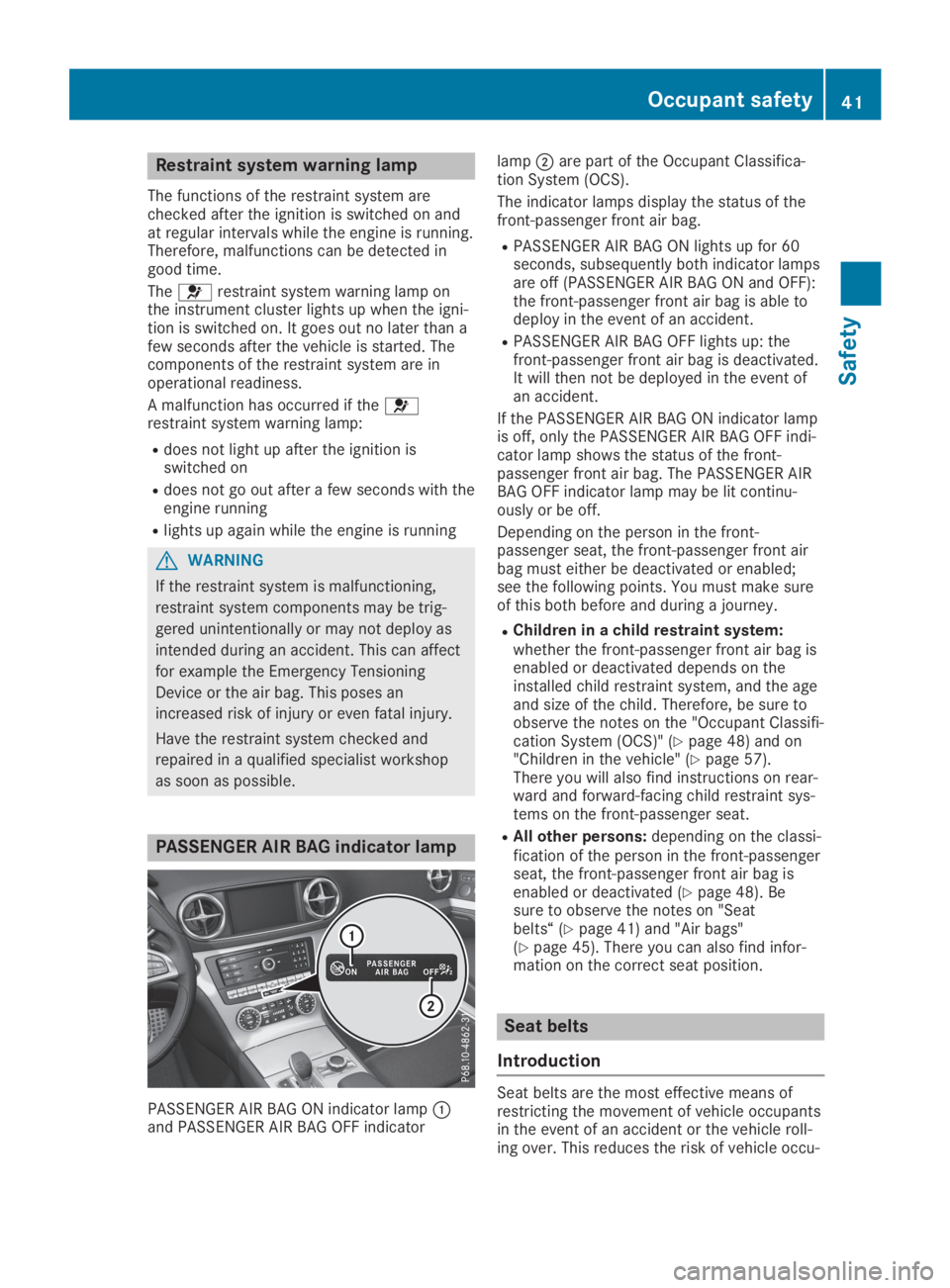
PASSENGER AIR BAG indicator lamp
PASSENGER AIR BAG ON indicator lampCand PASSENGER AIR BAG OFF indicator
lampDare part of the Occupant Classifica-tion System (OCS).
The indicator lamps display the status of thefront-passenger front air bag.
RPASSENGER AIR BAG ON lights up for 60seconds, subsequently both indicator lampsare off (PASSENGER AIR BAG ON and OFF):the front-passenger front air bag is able todeploy in the event of an accident.
RPASSENGER AIR BAG OFF lights up: thefront-passenger front air bag is deactivated.It will then not be deployed in the event ofan accident.
If the PASSENGER AIR BAG ON indicator lampis off, only the PASSENGER AIR BAG OFF indi-cator lamp shows the status of the front-passenger front air bag. The PASSENGER AIRBAG OFF indicator lamp may be lit continu-ously or be off.
Depending on the person in the front-passenger seat, the front-passenger front airbag must either be deactivated or enabled;see the following points. You must make sureof this both before and during a journey.
RChildren in a child restraint system:whether the front-passenger front air bag isenabled or deactivated depends on theinstalled child restraint system, and the ageand size of the child. Therefore, be sure toobserve the notes on the "Occupant Classifi-cation System (OCS)" (Ypage 48) and on"Children in the vehicle" (Ypage 57).There you will also find instructions on rear-ward and forward-facing child restraint sys-tems on the front-passenger seat.
RAll other persons:depending on the classi-fication of the person in the front-passengerseat, the front-passenger front air bag isenabled or deactivated (Ypage 48). Besure to observe the notes on "Seatbelts“ (Ypage 41) and "Air bags"(Ypage 45). There you can also find infor-mation on the correct seat position.
Seat belts
Introduction
Seat belts are the most effective means ofrestricting the movement of vehicle occupantsin the event of an accident or the vehicle roll-ing over. This reduces the risk of vehicle occu-
Occupant safety41
Safety
Z
Page 58 of 330
Rsetting a more favorable seat position forthe front-passenger seat.
Rvehicles with a multicontour seat: increasingthe air pressure in the side bolsters of theseat backrest.
!Make sure that there are no objects in thefootwell or behind the seats. There is a dan-ger that the seats and/or objects could be
damaged when PRE-SAFE®is activated.
Should an accident not occur, the preventativemeasures taken are reversed. Certain settingsmust be made yourself.
XIf the seat belt pre-tensioning is notreduced, move the seat backrest backslightly.Seat belt pre-tensioning is released.
PRE-SAFE®PLUS (anticipatory occu-
pant protection system PLUS)
Introduction
PRE-SAFE®PLUS is only available in vehicleswith the Driving Assistance package.
Using the radar sensor system, PRE-SAFE®
PLUS is able to detect that a head-on or rear-end collision is imminent. In certain hazardous
situations, PRE-SAFE®PLUS takes pre-emptivemeasures to protect the vehicle occupants.
Important safety notes
The intervention of PRE-SAFE®PLUS cannotprevent an imminent collision.
The driver is not warned about the intervention
of PRE-SAFE®PLUS.
PRE-SAFE®PLUS does not intervene if thevehicle is backing up.
When driving, or when parking or exiting aparking space using Active Parking Assist,
PRE-SAFE®PLUS will not apply the brakes.
Function
PRE-SAFE®PLUS intervenes in certain situa-tions if the radar sensor system detects animminent head-on or rear-end collision.
PRE-SAFE®PLUS takes the following meas-ures depending on the hazardous situationdetected:
Rif the radar sensor system detects that ahead-on collision is imminent, the seat beltsare pre-tensioned.
Rif the radar sensor system detects that arear-end collision is imminent:
-the brake pressure is increased if thedriver applies the brakes when the vehicleis stationary.
-the seat belts are pre-tensioned.
The PRE-SAFE®PLUS braking application iscanceled:
Rif the accelerator pedal is depressed when agear is engaged
Rif the risk of a collision passes or is no lon-ger detected
Rif Active Distance Assist DISTRONIC indi-cates an intention to intervene
If the hazardous situation passes withoutresulting in an accident, the original settingsare restored.
Automatic measures after an acci-
dent
Immediately after an accident, the followingmeasures are implemented, depending on thetype and severity of the impact:
Rthe hazard warning lamps are switched on
Rthe emergency lighting is activated
Rthe vehicle doors are unlocked
Rthe front side windows are lowered
Rthe electrically adjustable steering wheel israised when the driver's door is opened
Rthe engine is switched off and the fuel sup-ply is cut off
Rvehicles with Mercedes me connect: auto-matic emergency call
56Occupant safety
Safety
Page 59 of 330

Children in the vehicle
Important safety notes
If a child younger than twelve years old andunder 5 ft (1.50 m) in height is traveling in thevehicle:
Ralways secure the child in a child restraintsystem suitable for Mercedes-Benz vehicles.The child restraint system must be appropri-ate to the age, weight and size of the child.
Rbe sure to observe the instructions andsafety notes in this section in addition to thechild restraint system manufacturer's instal-lation instructions.
Ralways observe the instructions and safetynotes on the "Occupant classification sys-tem (OCS)". (Ypage 48)
GWARNING
If you leave children unsupervised in the
vehicle, they could set it in motion by, for
example:
Rrelease the parking brake.
Rshift the automatic transmission out of
the parking positionP.
Rstart the engine.
In addition, they may operate vehicle equip-
ment and become trapped. There is a risk of
an accident and injury.
When leaving the vehicle, always take the
SmartKey with you and lock the vehicle.
Never leave children unsupervised in the
vehicle.
GWARNING
If persons, particularly children are subjec-
ted to prolonged exposure to extreme heat
or cold, there is a risk of injury, possibly
even fatal. Never leave children unattended
in the vehicle.
GWARNING
If the child restraint system is subjected to
direct sunlight, parts may get very hot. Chil-
dren may burn themselves on these parts,
particularly on the metal parts of the child
restraint system. There is a risk of injury.
If you leave the vehicle, taking the child with
you, always ensure that the child restraint
system is not exposed to direct sunlight.
Protect it with a blanket, for example. If the
child restraint system has been exposed to
direct sunlight, let it cool down before secur-
ing the child in it. Never leave children unat-
tended in the vehicle.
Always ensure that all vehicle occupants havetheir seat belts fastened correctly and are sit-ting properly. Particular attention must be paidto children.
Observe the safety notes on the seat belt(Ypage 42) and the notes on correct use ofseat belts (Ypage 43).
A booster seat may be necessary to achieveproper seat belt positioning for children over40 lbs(18 kg)until they reach a height wherea three-point seat belt can be properly fas-tened without a booster seat.
Special seatbelt retractor
GWARNING
If the seat belt is released while driving, the
child restraint system will no longer be
secured properly. The special seat belt
retractor is disabled and the inertia real
draws in a portion of the seat belt. The seat
belt cannot be immediately refastened.
There is an increased risk of injury, possibly
even fatal.
Stop the vehicle immediately, paying atten-
tion to road and traffic conditions. Reacti-
vate the special seat belt retractor and
secure the child restraint system properly.
The seat belt on the front-passenger's side isequipped with a special seat belt retractor.When activated, the special seat belt retractorensures that the seat belt cannot slacken oncethe child seat is secured.
Children in the vehicle57
Safety
Z
Page 62 of 330

Always secure animals properly when driv-
ing, for instance with a suitable pet carrier.
Driving safety systems
Overview of driving safety systems
In this section, you will find information aboutthe following driving safety systems:
RABS (Anti-lockBrakingSystem)(Ypage 60)
RBAS (BrakeAssistSystem) (Ypage 61)
RBrake Assist with cross-traffic function(Ypage 61)
RActive Brake Assist (Ypage 63)
RAdaptive brake lights (Ypage 65)
RESP®(ElectronicStabilityProgram)(Ypage 65)
REBD (ElectronicBrake forceDistribution)(Ypage 69)
RADAPTIVE BRAKE (Ypage 70)
RActive Brake Assist with cross-traffic func-tion (Ypage 70)
RSTEER CONTROL (Ypage 72)
Important safety notes
If you fail to adapt your driving style or if youare inattentive, the driving safety systems canneither reduce the risk of an accident noroverride the laws of physics. Driving safetysystems are merely aids designed to assistdriving.
You are responsible for maintaining the dis-tance to the vehicle in front, for vehicle speed,for braking in good time, and for staying inlane. Always adapt your driving style to suitthe prevailing road and weather conditions andmaintain a safe distance from the vehicle infront. Drive carefully.
The driving safety systems described onlywork as effectively as possible when there isadequate contact between the tires and theroad surface. Pay particular attention to theinformation regarding tires, recommendedminimum tire tread depths etc. in the "Wheelsand tires" section (Ypage 293).
In wintry driving conditions, always use wintertires (M+S tires) and if necessary, snow
chains. Only in this way will the driving safetysystems described in this section work aseffectively as possible.
ABS (Anti-lock Braking System)
General information
ABS regulates brake pressure in such a waythat the wheels do not lock when you brake.This allows you to continue steering the vehi-cle when braking.
The%ABS warning lamp in the instrumentcluster lights up when the ignition is switchedon. It goes out when the engine is running.
ABS works from a speed of about 5 mph(8 km/h), regardless of road-surface condi-tions. ABS works on slippery surfaces, evenwhen you only brake gently.
Important safety notes
iObserve the "Important safety notes" sec-tion (Ypage 60).
GWARNING
If ABS is malfunctioning, the wheels could
lock when braking. The steerability and
braking characteristics would be severely
affected. There is an increased danger of
skidding and accidents.
Drive on carefully. Have ABS checked imme-
diately at a qualified specialist workshop.
When ABS is malfunctioning, other systems,including driving safety systems, will alsobecome inoperative. Observe the informationon the ABS warning lamp (Ypage 236) anddisplay messages which may be shown in theinstrument cluster (Ypage 206).
Brakes
XIf ABS intervenes:continue to depress thebrake pedal vigorously until the braking sit-uation is over.
XTo make a full brake application:depressthe brake pedal with full force.
If ABS intervenes when braking, you will feel apulsing in the brake pedal.
60Driving safety systems
Safety