belt MERCEDES-BENZ SL CLASS 2019 Owner's Manual
[x] Cancel search | Manufacturer: MERCEDES-BENZ, Model Year: 2019, Model line: SL CLASS, Model: MERCEDES-BENZ SL CLASS 2019Pages: 330, PDF Size: 16.53 MB
Page 58 of 330
Rsetting a more favorable seat position forthe front-passenger seat.
Rvehicles with a multicontour seat: increasingthe air pressure in the side bolsters of theseat backrest.
!Make sure that there are no objects in thefootwell or behind the seats. There is a dan-ger that the seats and/or objects could be
damaged when PRE-SAFE®is activated.
Should an accident not occur, the preventativemeasures taken are reversed. Certain settingsmust be made yourself.
XIf the seat belt pre-tensioning is notreduced, move the seat backrest backslightly.Seat belt pre-tensioning is released.
PRE-SAFE®PLUS (anticipatory occu-
pant protection system PLUS)
Introduction
PRE-SAFE®PLUS is only available in vehicleswith the Driving Assistance package.
Using the radar sensor system, PRE-SAFE®
PLUS is able to detect that a head-on or rear-end collision is imminent. In certain hazardous
situations, PRE-SAFE®PLUS takes pre-emptivemeasures to protect the vehicle occupants.
Important safety notes
The intervention of PRE-SAFE®PLUS cannotprevent an imminent collision.
The driver is not warned about the intervention
of PRE-SAFE®PLUS.
PRE-SAFE®PLUS does not intervene if thevehicle is backing up.
When driving, or when parking or exiting aparking space using Active Parking Assist,
PRE-SAFE®PLUS will not apply the brakes.
Function
PRE-SAFE®PLUS intervenes in certain situa-tions if the radar sensor system detects animminent head-on or rear-end collision.
PRE-SAFE®PLUS takes the following meas-ures depending on the hazardous situationdetected:
Rif the radar sensor system detects that ahead-on collision is imminent, the seat beltsare pre-tensioned.
Rif the radar sensor system detects that arear-end collision is imminent:
-the brake pressure is increased if thedriver applies the brakes when the vehicleis stationary.
-the seat belts are pre-tensioned.
The PRE-SAFE®PLUS braking application iscanceled:
Rif the accelerator pedal is depressed when agear is engaged
Rif the risk of a collision passes or is no lon-ger detected
Rif Active Distance Assist DISTRONIC indi-cates an intention to intervene
If the hazardous situation passes withoutresulting in an accident, the original settingsare restored.
Automatic measures after an acci-
dent
Immediately after an accident, the followingmeasures are implemented, depending on thetype and severity of the impact:
Rthe hazard warning lamps are switched on
Rthe emergency lighting is activated
Rthe vehicle doors are unlocked
Rthe front side windows are lowered
Rthe electrically adjustable steering wheel israised when the driver's door is opened
Rthe engine is switched off and the fuel sup-ply is cut off
Rvehicles with Mercedes me connect: auto-matic emergency call
56Occupant safety
Safety
Page 59 of 330

Children in the vehicle
Important safety notes
If a child younger than twelve years old andunder 5 ft (1.50 m) in height is traveling in thevehicle:
Ralways secure the child in a child restraintsystem suitable for Mercedes-Benz vehicles.The child restraint system must be appropri-ate to the age, weight and size of the child.
Rbe sure to observe the instructions andsafety notes in this section in addition to thechild restraint system manufacturer's instal-lation instructions.
Ralways observe the instructions and safetynotes on the "Occupant classification sys-tem (OCS)". (Ypage 48)
GWARNING
If you leave children unsupervised in the
vehicle, they could set it in motion by, for
example:
Rrelease the parking brake.
Rshift the automatic transmission out of
the parking positionP.
Rstart the engine.
In addition, they may operate vehicle equip-
ment and become trapped. There is a risk of
an accident and injury.
When leaving the vehicle, always take the
SmartKey with you and lock the vehicle.
Never leave children unsupervised in the
vehicle.
GWARNING
If persons, particularly children are subjec-
ted to prolonged exposure to extreme heat
or cold, there is a risk of injury, possibly
even fatal. Never leave children unattended
in the vehicle.
GWARNING
If the child restraint system is subjected to
direct sunlight, parts may get very hot. Chil-
dren may burn themselves on these parts,
particularly on the metal parts of the child
restraint system. There is a risk of injury.
If you leave the vehicle, taking the child with
you, always ensure that the child restraint
system is not exposed to direct sunlight.
Protect it with a blanket, for example. If the
child restraint system has been exposed to
direct sunlight, let it cool down before secur-
ing the child in it. Never leave children unat-
tended in the vehicle.
Always ensure that all vehicle occupants havetheir seat belts fastened correctly and are sit-ting properly. Particular attention must be paidto children.
Observe the safety notes on the seat belt(Ypage 42) and the notes on correct use ofseat belts (Ypage 43).
A booster seat may be necessary to achieveproper seat belt positioning for children over40 lbs(18 kg)until they reach a height wherea three-point seat belt can be properly fas-tened without a booster seat.
Special seatbelt retractor
GWARNING
If the seat belt is released while driving, the
child restraint system will no longer be
secured properly. The special seat belt
retractor is disabled and the inertia real
draws in a portion of the seat belt. The seat
belt cannot be immediately refastened.
There is an increased risk of injury, possibly
even fatal.
Stop the vehicle immediately, paying atten-
tion to road and traffic conditions. Reacti-
vate the special seat belt retractor and
secure the child restraint system properly.
The seat belt on the front-passenger's side isequipped with a special seat belt retractor.When activated, the special seat belt retractorensures that the seat belt cannot slacken oncethe child seat is secured.
Children in the vehicle57
Safety
Z
Page 60 of 330

Installing a child restraint system:
XMake sure you observe the child restraintsystem manufacturer's installation instruc-tions.
XPull the seat belt smoothly out of the seatbelt guide.
XEngage seat belt tongue in belt buckle.
Activating the special seat belt retractor:
XPull the seat belt out fully and let the inertiareel retract it again.While the seat belt is retracting, you shouldhear a ratcheting sound. The special seatbelt retractor is enabled.
XPush the child restraint system down so thatthe seat belt is tight and does not loosen.
Removing the child restraint system and deac-tivating the special seat belt retractor:
XMake sure you observe the child restraintsystem manufacturer's installation instruc-tions.
XPress the release button of the seat beltbuckle and route the seat belt tongue backtowards the seat belt guide.The special seat belt retractor is deactiva-ted.
child restraint system
The use of seat belts and child restraint sys-tems is required by law in:
Rall 50 states
Rthe U.S. territories
Rthe District of Columbia
Rall Canadian provinces
You can obtain further information about thecorrect child restraint system from any author-ized Mercedes-Benz Center.
GWARNING
If the child restraint system is installed
incorrectly on a suitable seat, it cannot pro-
tect as intended. The child cannot then be
restrained in the event of an accident, heavy
braking or sudden changes of direction.
There is an increased risk of injury, possibly
even fatal.
Make sure that you observe the child
restraint system manufacturer's installation
instructions and the notes on use. Please
ensure, that the base of the child restraint
system is always resting completely on the
seat cushion. Never place objects, e.g. cush-
ions, under or behind the child restraint sys-
tem. Only use child restraint systems with
the original cover designed for them. Only
replace damaged covers with genuine cov-
ers.
GWARNING
If the child restraint system is installed
incorrectly or is not secured, it can come
loose in the event of an accident, heavy
braking or a sudden change in direction. The
child restraint system could be thrown
about, striking vehicle occupants. There is
an increased risk of injury, possibly even
fatal.
Always install child restraint systems prop-
erly, even if they are not being used. Make
sure that you observe the child restraint sys-
tem manufacturer's installation instructions.
Further information on stowing objects, lug-gage and loads securely can be found under“Stowing options/stowage compartments”(Ypage 249).
GWARNING
Child restraint systems or their securing sys-
tems which have been damaged or subjec-
ted to a load in an accident can no longer
protect as intended. The child cannot then
be restrained in the event of an accident,
heavy braking or sudden changes of direc-
tion. There is an increased risk of injury,
possibly even fatal.
Replace child restraint systems which have
been damaged or subjected to a load in an
accident as soon as possible. Have the
securing systems on the child restraint sys-
tem checked at a qualified specialist work-
shop, before you install a child restraint sys-
tem again.
The securing system of child restraint systemsis the seat belt system.
58Children in the vehicle
Safety
Page 61 of 330

If you install a child restraint system on thefront passenger seat, be sure to observe theinstructions and safety notes on the "Occu-pant Classification System (OCS)" (Ypage 48).There you will also find information on disa-bling the front passenger front air bag.
All child restraint systems must meet the fol-lowing standards:
RU.S. Federal Motor Vehicle Safety Standards213 and 225
RCanadian Motor Vehicle Safety Standards213 and 210.2
Confirmation that the child restraint systemcorresponds to the standards can be found onan instruction label on the child restraint sys-tem. This confirmation can also be found inthe installation instructions that are includedwith the child restraint system.
Observe the warning labels in the vehicle inte-rior and on the child restraint system.
Child restraint system on the front-
passenger seat
General notes
If you install a child restraint system on thefront-passenger seat, always observe theinstructions and safety notes on the "Occu-pant Classification System (OCS)" (Ypage 48).
You can thus avoid the risks that could ariseas a result of:
Ran incorrectly categorized person in thefront-passenger seat
Rdeactivating the front passenger front airbag unintentionally
Rthe unsuitable positioning of the childrestraint system, e.g. too close to the dash-board
Rearward-facing child restraint system
If circumstances require you to secure a childin a rearward-facing child restraint system onthe front-passenger seat, always make surethat the front passenger front air bag is deacti-vated. Only if the PASSENGER AIR BAG OFFindicator lamp is lit continuously (Ypage 41),is the front passenger front air bag deactiva-ted.
Always observe the child restraint systemmanufacturer's installation and operatinginstructions.
Forward-facing child restraint system
If you secure a child in a forward-facing childrestraint system on the front-passenger seat,always move the front-passenger seat as farback as possible. Fully retract the seat cushionlength. The entire base of the child restraintsystem must always rest on the seat cushionof the front-passenger seat. The backrest ofthe child restraint system must lie as flat aspossible against the backrest of the front-passenger seat. The child restraint systemmust not touch the roof or be subjected to aload by the head restraint. Adjust the angle ofthe seat backrest and the head restraint posi-tion accordingly. Always make sure that theshoulder belt strap is correctly routed from thefront-passenger seat belt guide to the shoulderbelt guide on the child restraint system. Theshoulder belt strap must be routed forwardand down from the front-passenger seat beltguide. If necessary, adjust the front-passengerseat accordingly.
Always observe the child restraint systemmanufacturer's installation and operatinginstructions.
Pets in the vehicle
GWARNING
If you leave animals unsupervised or unse-
cured in the vehicle, they may press buttons
or switches, for instance.
In this way, animals may:
Ractivate vehicle equipment and become
trapped, for example
Rswitch systems on or off and thereby
endanger other road users
Furthermore, unsecured animals may be
flung around inside the vehicle in the event
of an accident or abrupt steering or braking
maneuver, and thereby injure vehicle occu-
pants. There is a risk of accident and injury.
Never leave animals unattended in the vehi-
cle.
Pets in the vehicle59
Safety
Z
Page 99 of 330
Correct driver's seat position
GWARNING
You could lose control of your vehicle if you
do the following while driving:
Radjust the driver's seat, head restraint,
steering wheel or mirrors
Rfasten the seat belt
There is a risk of an accident.
Adjust the driver's seat, head restraint,
steering wheel and mirror and fasten your
seat belt before starting the engine.
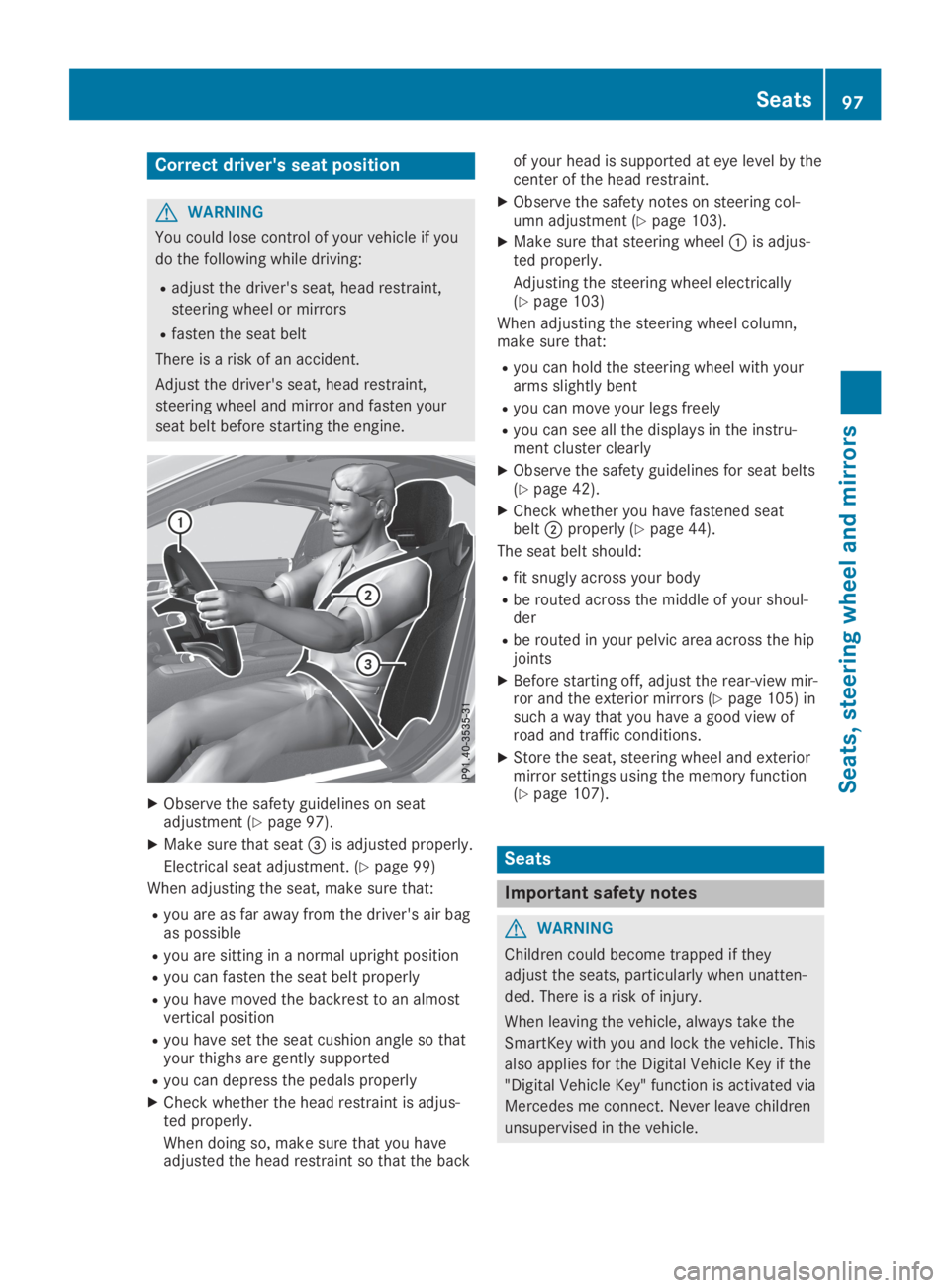
XObserve the safety guidelines on seatadjustment (Ypage 97).
XMake sure that seat
Page 100 of 330
The seats can still be adjusted when there isno SmartKey in the ignition lock.
GWARNING
When you adjust a seat, you or other vehicle
occupants could become trapped, e.g. on
the seat guide rail. There is a risk of injury.
When adjusting a seat, make sure that no
one has any body parts in the sweep of the
seat.
GWARNING
If the driver's seat is not engaged, it could
move forwards as far as the next catch dur-
ing movement such as braking or abrupt
changes of direction. As a result, you would
be pushed against your seat belt by the
unsecured driver's seat.
This could cause you to lose control of the
vehicle. The seat belt cannot protect as
intended and could result in additional
injury.
There is a risk of an accident and injury.
Before every journey, make sure that the
driver's seat is fully engaged.
Observe the safety notes on "Air bags"(Ypage 45) and "Children in the vehicle"(Ypage 57).
GWARNING
If you adjust the seat height carelessly, you
or other vehicle occupants could be trapped
and thereby injured. Children in particular
could accidentally press the electrical seat
adjustment buttons and become trapped.
There is a risk of injury.
While moving the seats, make sure that your
hands or other body parts do not get under
the lever assembly of the seat adjustment
system.
GWARNING
If the head restraints are not installed or not
adjusted correctly, they cannot provide pro-
tection as intended. There is an increased
risk of injury in the head and neck area, e.g.
in the event of an accident or when braking.
Always drive with the head restraints instal-
led. Before driving off, make sure for every
vehicle occupant that the center of the head
restraint supports the back of the head at
about eye level.
GWARNING
You could lose control of your vehicle if you
do the following while driving:
Radjust the driver's seat, head restraint,
steering wheel or mirrors
Rfasten the seat belt
There is a risk of an accident.
Adjust the driver's seat, head restraint,
steering wheel and mirror and fasten your
seat belt before starting the engine.
!To prevent damage to the seats and theseat heating, observe the following notes:
RDo not spill liquids onto the seats. Dry theseats as soon as possible if liquid doesget spilled on the seats.
RIf the seat covers are damp or wet, do notswitch on the seat heating. Also, do notuse the seat heating to dry the seats.
RClean the seat covers as recommended;see the "Interior care" section.
RDo not transport heavy loads on theseats. Do not place pointed objects onthe seat cushions such as knives, nails ortools. Where possible, use the seats onlyfor carrying passengers.
RWhen operating the seat heating, do notcover the seats with insulating materials,e.g. blankets, coats, bags, protective cov-ers, child seats or booster seats.
RWhen the seat heating is switched on, theseat surface can be damaged as a resultof objects being placed on the seats, forexample, seat cushions, child seats andprotective covers not approved byMercedes-Benz.
!Make sure that there are no objects in thefootwell under or behind the seats whenmoving the seats back. There is a risk thatthe seats and/or the objects could be dam-aged.
iThe head restraints cannot be removed.
98Seats
Seats, steering wheel and mirrors
Page 102 of 330
seat belt guide. This makes it easier to movethe seats forward.
Before you drive off, the seat belt must beinserted into the seat belt guide.
Observe the safety guidelines for seat belts(Ypage 42).
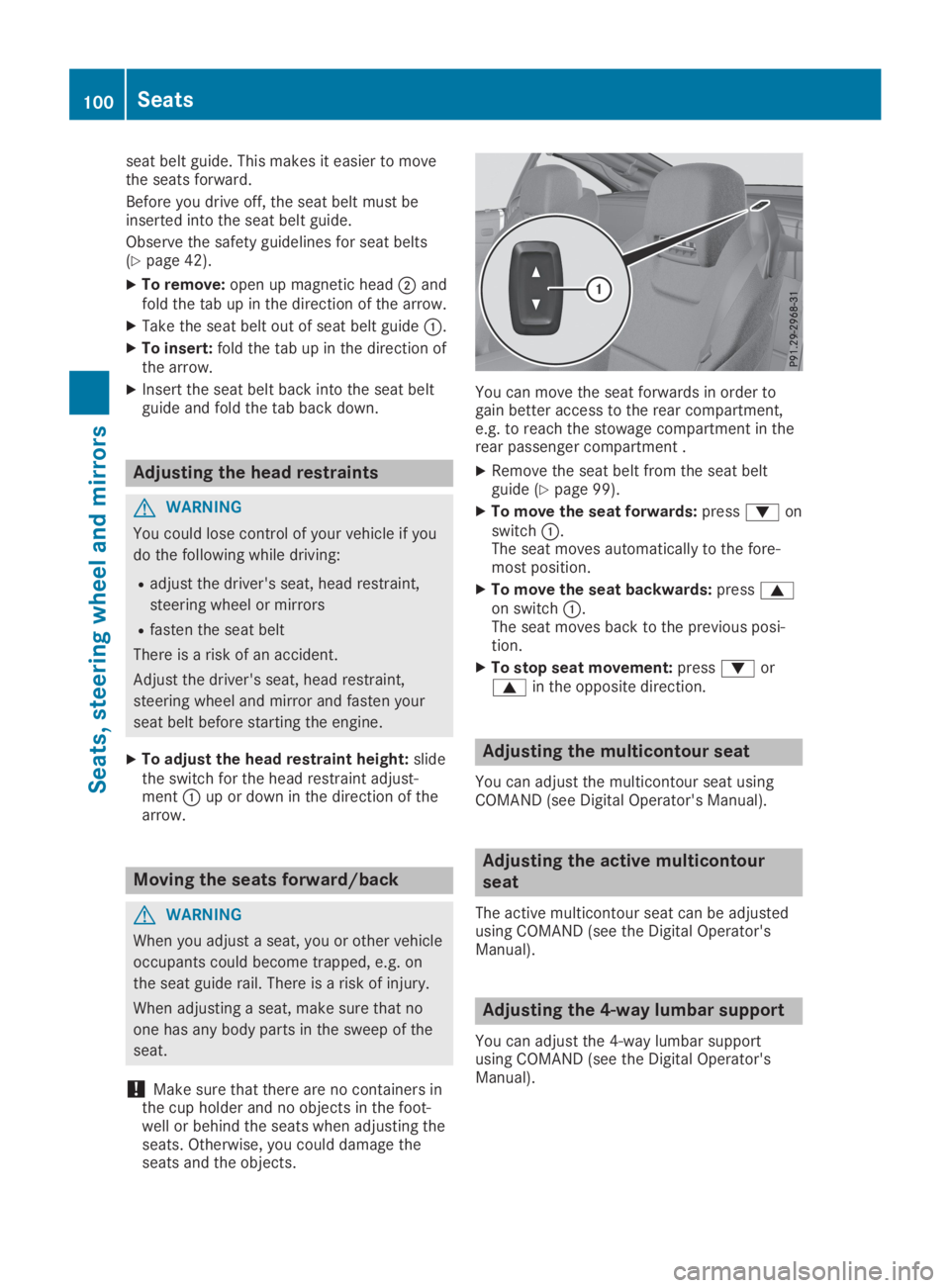
XTo remove:open up magnetic headDandfold the tab up in the direction of the arrow.
XTake the seat belt out of seat belt guideC.
XTo insert:fold the tab up in the direction ofthe arrow.
XInsert the seat belt back into the seat beltguide and fold the tab back down.
Adjusting the head restraints
GWARNING
You could lose control of your vehicle if you
do the following while driving:
Radjust the driver's seat, head restraint,
steering wheel or mirrors
Rfasten the seat belt
There is a risk of an accident.
Adjust the driver's seat, head restraint,
steering wheel and mirror and fasten your
seat belt before starting the engine.
XTo adjust the head restraint height:slidethe switch for the head restraint adjust-mentCup or down in the direction of thearrow.
Moving the seats forward/back
GWARNING
When you adjust a seat, you or other vehicle
occupants could become trapped, e.g. on
the seat guide rail. There is a risk of injury.
When adjusting a seat, make sure that no
one has any body parts in the sweep of the
seat.
!Make sure that there are no containers inthe cup holder and no objects in the foot-well or behind the seats when adjusting theseats. Otherwise, you could damage theseats and the objects.
You can move the seat forwards in order togain better access to the rear compartment,e.g. to reach the stowage compartment in therear passenger compartment .
XRemove the seat belt from the seat beltguide (Ypage 99).
XTo move the seat forwards:pressdonswitchC.The seat moves automatically to the fore-most position.
XTo move the seat backwards:presscon switchC.The seat moves back to the previous posi-tion.
XTo stop seat movement:pressdorcin the opposite direction.
Adjusting the multicontour seat
You can adjust the multicontour seat usingCOMAND (see Digital Operator's Manual).
Adjusting the active multicontour
seat
The active multicontour seat can be adjustedusing COMAND (see the Digital Operator'sManual).
Adjusting the 4-way lumbar support
You can adjust the 4-way lumbar supportusing COMAND (see the Digital Operator'sManual).
100Seats
Seats, steering wheel and mirrors
Page 105 of 330
Steering wheel
Important safety notes
GWARNING
You could lose control of your vehicle if you
do the following while driving:
Radjust the driver's seat, head restraint,
steering wheel or mirrors
Rfasten the seat belt
There is a risk of an accident.
Adjust the driver's seat, head restraint,
steering wheel and mirror and fasten your
seat belt before starting the engine.
GWARNING
Children could injure themselves if they
adjust the steering wheel. There is a risk of
injury.
Never leave children unsupervised in the
vehicle.
When leaving the vehicle, always take the
SmartKey with you and lock the vehicle. This
also applies for the Digital Vehicle Key if the
"Digital Vehicle Key" function is activated via
Mercedes me connect.
The electrically adjustable steering wheel canstill be adjusted when there is no SmartKey inthe ignition lock.
Adjusting the steering wheel electri-
cally
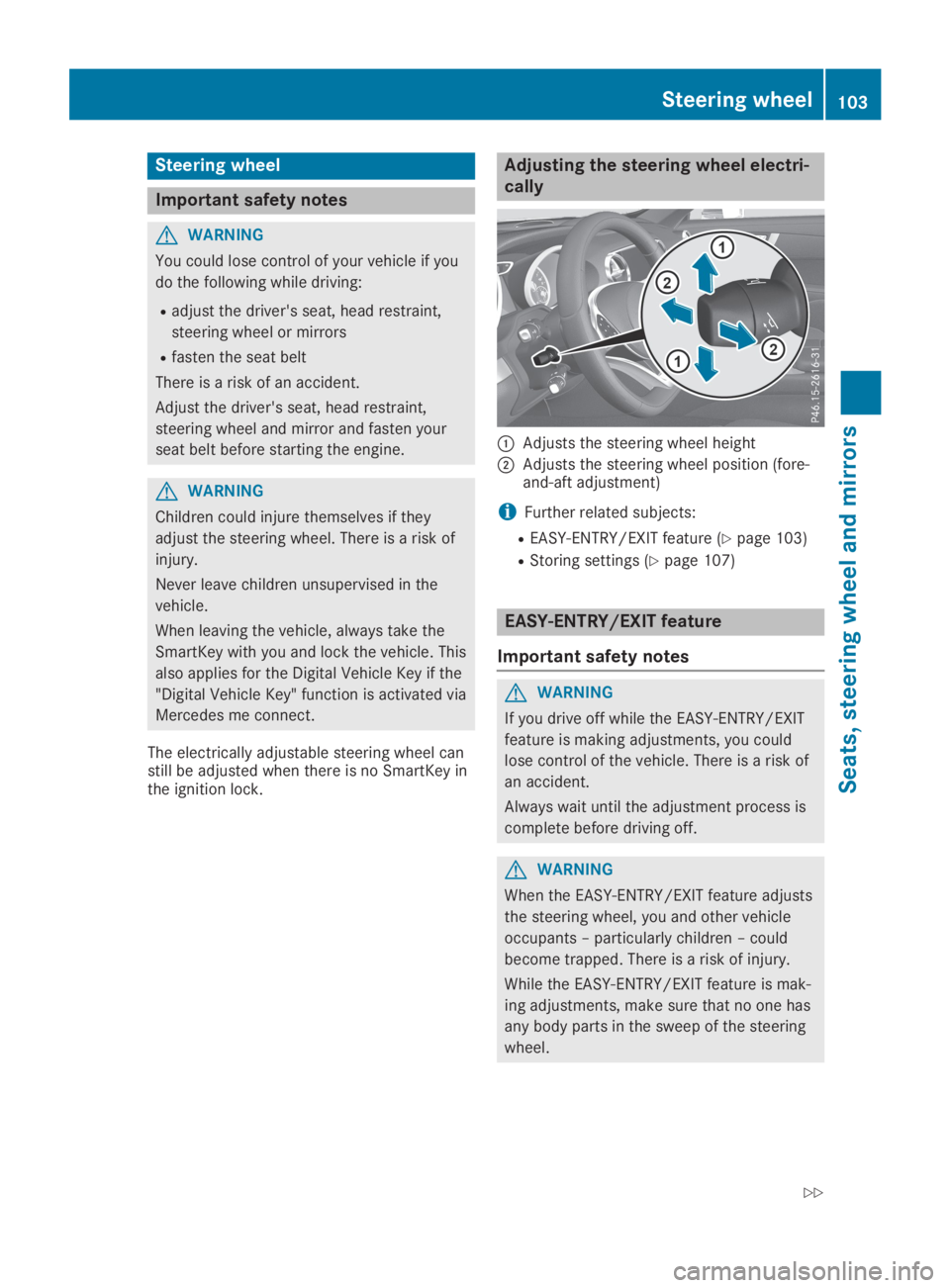
CAdjusts the steering wheel height
DAdjusts the steering wheel position (fore-and-aft adjustment)
iFurther related subjects:
REASY-ENTRY/EXIT feature (Ypage 103)
RStoring settings (Ypage 107)
EASY-ENTRY/EXIT feature
Important safety notes
GWARNING
If you drive off while the EASY-ENTRY/EXIT
feature is making adjustments, you could
lose control of the vehicle. There is a risk of
an accident.
Always wait until the adjustment process is
complete before driving off.
GWARNING
When the EASY-ENTRY/EXIT feature adjusts
the steering wheel, you and other vehicle
occupants – particularly children – could
become trapped. There is a risk of injury.
While the EASY-ENTRY/EXIT feature is mak-
ing adjustments, make sure that no one has
any body parts in the sweep of the steering
wheel.
Steering wheel103
Seats, steering wheel and mirrors
Z
Page 107 of 330
Mirrors
Exterior mirrors
Adjusting the exterior mirrors
GWARNING
You could lose control of your vehicle if you
do the following while driving:
Radjust the driver's seat, head restraint,
steering wheel or mirrors
Rfasten the seat belt
There is a risk of an accident.
Adjust the driver's seat, head restraint,
steering wheel and mirror and fasten your
seat belt before starting the engine.
GWARNING
The exterior mirror on the front-passenger
side reduces the size of the image. Visible
objects are actually closer than they appear.
This means that you could misjudge the dis-
tance from road users traveling behind, e.g.
when changing lane. There is a risk of an
accident.
For this reason, always make sure of the
actual distance from the road users traveling
behind by glancing over your shoulder.
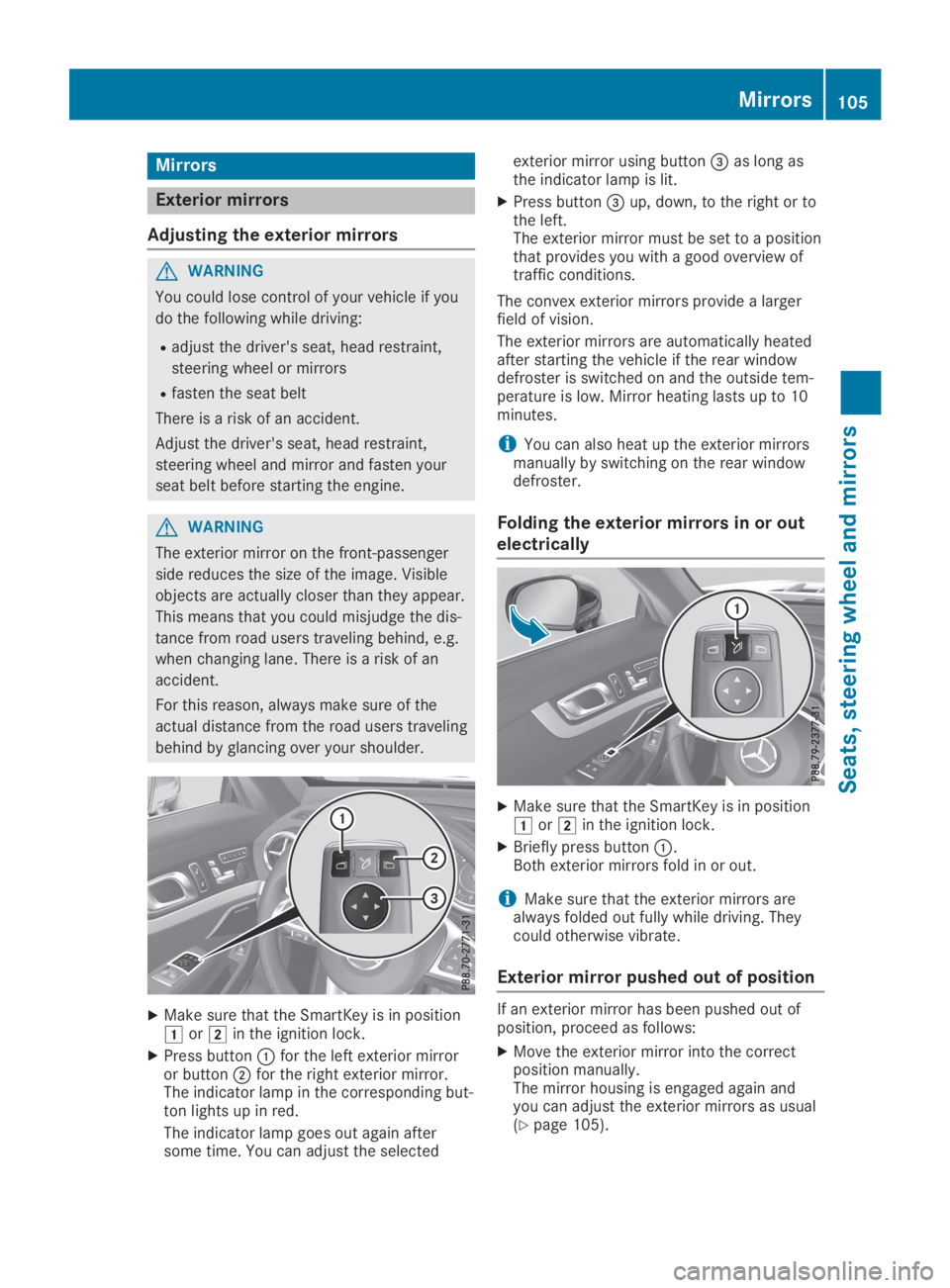
XMake sure that the SmartKey is in positionGorHin the ignition lock.
XPress buttonCfor the left exterior mirroror buttonDfor the right exterior mirror.The indicator lamp in the corresponding but-ton lights up in red.
The indicator lamp goes out again aftersome time. You can adjust the selected
exterior mirror using button
Page 132 of 330
Rthe system detects that the windshield isnot fogged up when the air-conditioning sys-tem is switched on
Rthe hood is closed
Rthe driver's door is closed and the driver'sseat belt is fastened
All of the vehicle's systems remain activewhen the engine is stopped automatically.
All vehicles (except Mercedes-AMG vehi-cles):automatic engine switch-off can takeplace a maximum of four times in a row (initialstop, then three subsequent stops).
Mercedes-AMG vehicles:the number of con-secutive automatic engine switch-offs isunlimited.
The HOLD function can be activated if theengine has been switched off automatically. Itis then not necessary to continue applying thebrakes during the automatic stop phase. Whenyou depress the accelerator pedal, the enginestarts automatically and the braking effect ofthe HOLD function is deactivated.
Automatic engine start
The engine starts automatically if:
Ryou switch off the ECO start/stop functionby pressing the ECO button
Rin transmission position[or\\, the brakepedal is released and the HOLD function isnot active
Ryou depress the accelerator pedal
Ryou engage reverse gear^
Ryou move the transmission out of position]
Ryou switch to drive programS+
Ryou switch to drive programSorM(Mercedes-AMG vehicles)
Ryou unfasten your seat belt or open the driv-er's door
Rthe vehicle starts to roll
Rthe brake system requires this
Rthe temperature in the vehicle interior devi-ates from the set range
Rthe system detects moisture on the wind-shield when the air-conditioning system isswitched on
Rthe battery's condition of charge is too low
Shifting the transmission to position]doesnot start the engine.
Deactivating or activating the ECO
start/stop function
All vehicles (except Mercedes-AMG vehi-
cles)
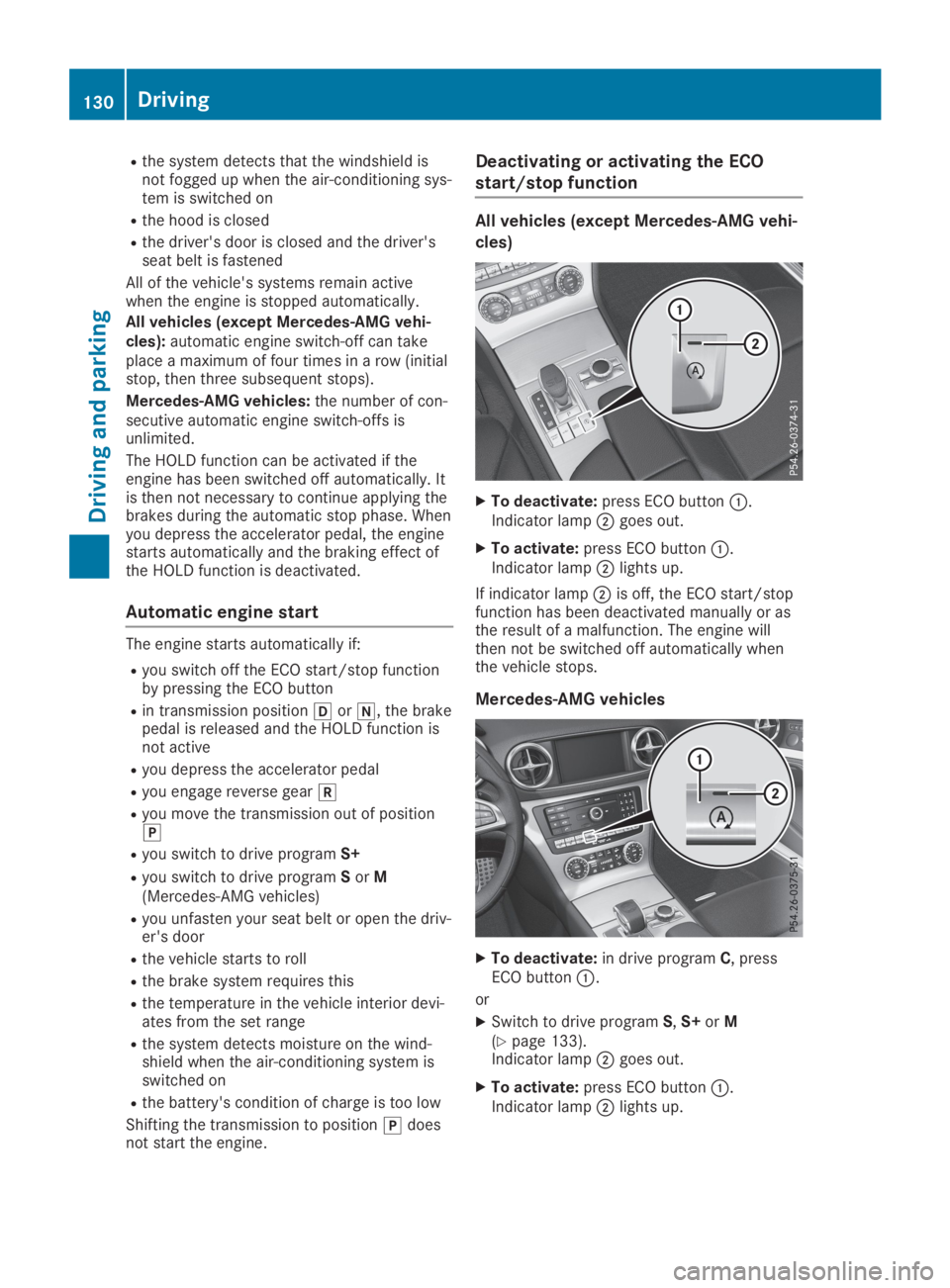
XTo deactivate:press ECO buttonC.Indicator lampDgoes out.
XTo activate:press ECO buttonC.Indicator lampDlights up.
If indicator lampDis off, the ECO start/stopfunction has been deactivated manually or asthe result of a malfunction. The engine willthen not be switched off automatically whenthe vehicle stops.
Mercedes-AMG vehicles
XTo deactivate:in drive programC, pressECO buttonC.
or
XSwitch to drive programS,S+orM(Ypage 133).Indicator lampDgoes out.
XTo activate:press ECO buttonC.Indicator lampDlights up.
130Driving
Driving an d parking