belt MERCEDES-BENZ SL CLASS 2019 User Guide
[x] Cancel search | Manufacturer: MERCEDES-BENZ, Model Year: 2019, Model line: SL CLASS, Model: MERCEDES-BENZ SL CLASS 2019Pages: 330, PDF Size: 16.53 MB
Page 45 of 330
If a child younger than twelve years old andunder 5 ft (1.50m)in height is traveling in thevehicle:
Ralways secure the child in a child restraintsystem suitable for this Mercedes-Benzvehicle. The child restraint system must beappropriate to the age, weight and size ofthe child.
Ralways observe the instructions and safetynotes on "Children in the vehicle"(Ypage 57) in addition to the childrestraint system manufacturer's installationand operating instructions
Ralways observe the instructions and safetynotes on the "Occupant Classification Sys-tem (OCS)" (Ypage 48)
GWARNING
The seat belts may not perform their inten-
ded protective function if:
Rthey are damaged, modified, extremely
dirty, bleached or dyed
Rthe seat belt buckle is damaged or
extremely dirty
Rthe Emergency Tensioning Devices, belt
anchorages or inertia reels have been
modified.
Seat belts may be damaged in an accident,
although the damage may not be visible, e.g.
due to splinters of glass. Modified or dam-
aged seat belts may tear or fail, e.g. in an
accident. Modified Emergency Tensioning
Devices could accidentally trigger or fail to
deploy when necessary. This poses an
increased risk of injury or even fatal injury.
Never modify the seat belts, Emergency Ten-
sioning Devices, belt anchorages and inertia
reels. Make sure that the seat belts are
undamaged, not worn out and clean. Follow-
ing an accident, have the seat belts checked
immediately at a qualified specialist work-
shop.
Only use seat belts that have been approvedfor your vehicle by Mercedes-Benz.
Proper use of the seat belts
Observe the safety notes on the seat belt(Ypage 42).
Every vehicle occupant must observe the fol-lowing notes to ensure a properly worn seatbelt can provide full protection. Also makesure that all vehicle occupants are alwayswearing the seat belt correctly while the vehi-cle is in motion.
When fastening the seat belt, always makesure that:
Rthe seat belt buckle tongue is inserted onlyinto the belt buckle belonging to that seat
Rthe seat belt is pulled tight across your body
Avoid wearing bulky clothing, e.g. a wintercoat.
Rthe seat belt is not twisted
Only then can the forces which occur be dis-tributed over the area of the belt.
Rthe shoulder section of the belt is routedacross the center of your shoulder
The shoulder section of the seat belt shouldnot touch your neck or be routed under yourarm or behind your back.
Rthe lap belt is taut and passes across yourlap as low down as possible
The lap belt must always be routed acrossyour hip joints and not across your abdo-men. This applies particularly to pregnantwomen. If necessary, push the lap belt downto your hip joint and pull it tight using theshoulder section of the belt.
Rthe seat belt is not routed across sharp,pointed or fragile objects
If you have such items located on or in yourclothing, e.g. pens, keys or eyeglasses,store these in a suitable place.
Ronly one person is using a seat belt
Infants and children must never travel sit-ting on the lap of a vehicle occupant. In theevent of an accident, they could be crushedbetween the vehicle occupant and seat belt.
Robjects are never secured with a seat belt ifthe seat belt is also being used by one ofthe vehicle's occupants
Also ensure that there are never objectsbetween a person and the seat, e.g. cush-ions.
Seat belts are only intended to secure andrestrain vehicle occupants. Always observe thenotes in the "Stowage options/compartments"
Occupant safety43
Safety
Z
Page 46 of 330
section for securing objects, luggage or loads(Ypage 249).
Fastening seat belts
Observe the safety notes on the seat belt(Ypage 42) and the notes on correct use ofseat belts (Ypage 43).
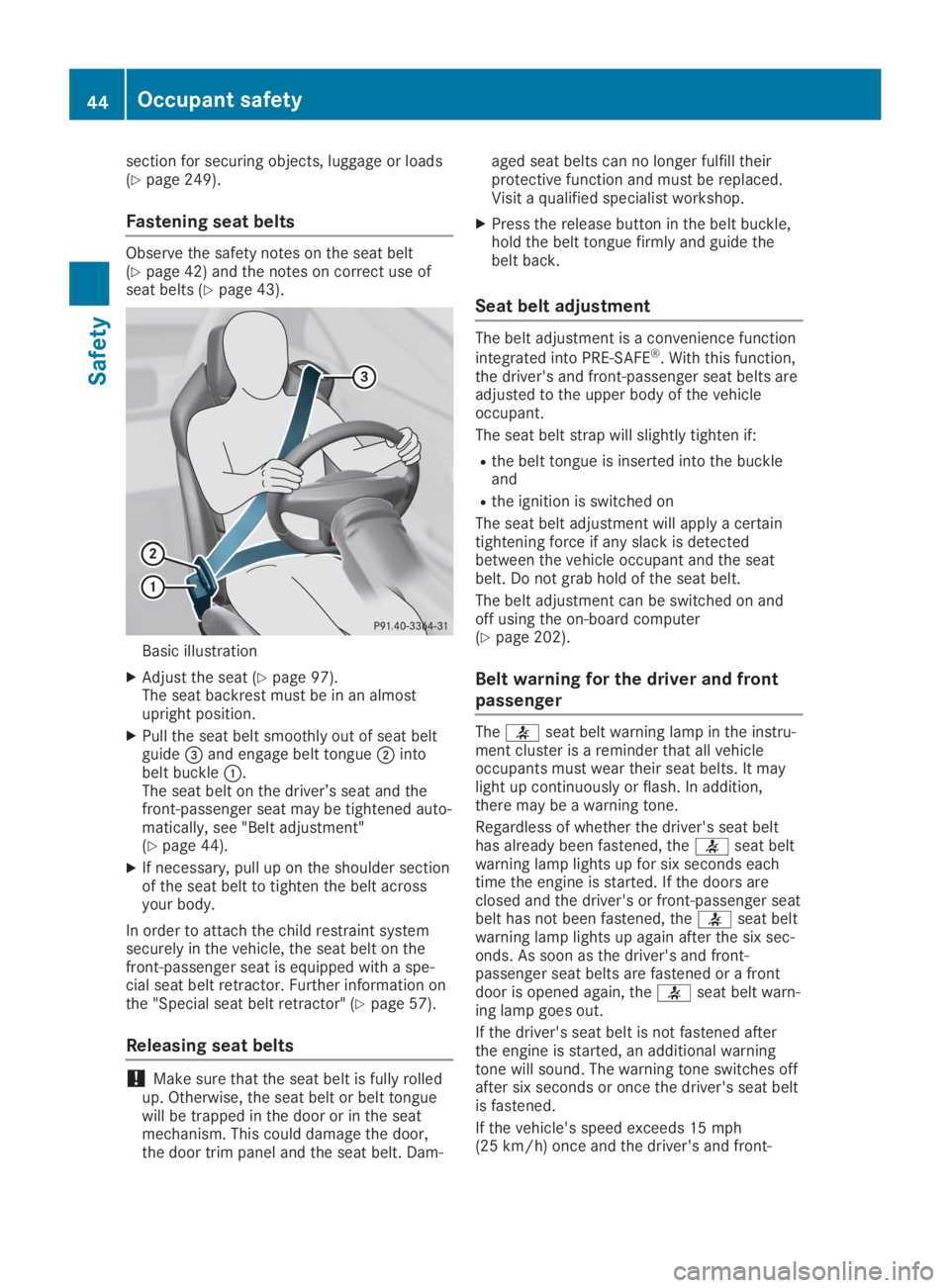
Basic illustration
XAdjust the seat (Ypage 97).The seat backrest must be in an almostupright position.
XPull the seat belt smoothly out of seat beltguide
Page 47 of 330
passenger seat belts are not fastened, a warn-ing tone sounds. A warning tone also soundswith increasing intensity for 60 seconds oruntil the driver or front passenger have fas-tened their seat belts.
If the driver or front passenger unfasten theirseat belts during the journey, the seat beltwarning is activated again.
Air bags
Introduction
The installation point of an airbag can be rec-ognized by the AIRBAG marking.
An airbag complements the correctly fastenedseat belt. It is no substitute for the seat belt.When deployed, an airbag can increase theprotection provided for the respective vehicleoccupant.
Not all airbags are deployed in an accident.The various airbags work independently ofeach other (Ypage 53).
However, no system available today can com-pletely eliminate injuries and fatalities.
It is also not possible to rule out a risk of injurycaused by an airbag due to the high speed atwhich the airbag must be deployed.
Important safety notes
GWARNING
If you do not sit in the correct seat position,
the air bag cannot protect as intended and
could even cause additional injury when
deployed. This poses an increased risk of
injury or even fatal injury.
To avoid hazardous situations, always make
sure that all of the vehicle's occupants:
Rhave fastened their seat belts correctly,
including pregnant women
Rare sitting correctly and maintain the
greatest possible distance to the air bags
Rfollow the following instructions
Always make sure that there are no objects
between the air bag and the vehicle's occu-
pants.
All vehicle occupants must observe the follow-ing notes to avoid risks posed by the airbagwhen it deploys.
RAdjust the seats properly before beginningyour journey. Always make sure that theseat is in an almost upright position. Thecenter of the head restraint must supportthe head at about eye level.
RMove the driver's and front-passenger seatsas far back as possible. The driver's seatposition must allow the vehicle to be drivensafely.
ROnly hold the steering wheel on the outside.This allows the airbag to be fully deployed.
RAlways lean against the backrest while driv-ing. Do not lean forward or lean against thedoor or side window. You may otherwise bein the deployment area of the airbags.
RAlways keep your feet in the footwell infront of the seat. Do not put your feet on thedashboard, for example. Your feet may oth-erwise be in the deployment area of the air-bag.
RFor this reason, always secure persons lessthan 5 ft (1.50 m) tall in suitable restraintsystems. Up to this height, the seat beltcannot be worn correctly.
If a child is traveling in your vehicle, alsoobserve the following notes:
RAlways secure children under twelve yearsof age and less than 5 ft (1.50 m) tall in suit-able child restraint systems.
RSecure a child to the front-passenger seatonly when the front-passenger front airbagis deactivated, and then only in a rearward-facing child restraint system. The front-passenger front airbag is deactivated whenthe PASSENGER AIR BAG OFF indicatorlamp is lit continuously (Ypage 41).
RAlways observe the instructions and safetynotes on the "Occupant Classification Sys-tem (OCS)" (Ypage 48) and on "Childrenin the vehicle" (Ypage 57) in addition tothe child restraint system manufacturer'sinstallation and operating instructions.
Objects in the vehicle interior may restrictthe airbag from functioning correctly.Toavoid risks resulting from the speed of the air-bag as it deploys, vehicle occupants mustensure the following points.
Occupant safety45
Safety
Z
Page 49 of 330
The driver's and front-passenger knee bagsoffer additional thigh, knee and lower leg pro-tection.
Side impact air bags
GWARNING
Unsuitable seat covers can obstruct or pre-
vent deployment of the air bags integrated
into the seats. Consequently, the air bags
cannot protect vehicle occupants as they
are designed to do. In addition, the opera-
tion of the occupant classification system
(OCS) could be adversely affected. This
poses an increased risk of injury or even
fatal injury.
You should only use seat covers that have
been approved for the respective seat by
Mercedes-Benz.
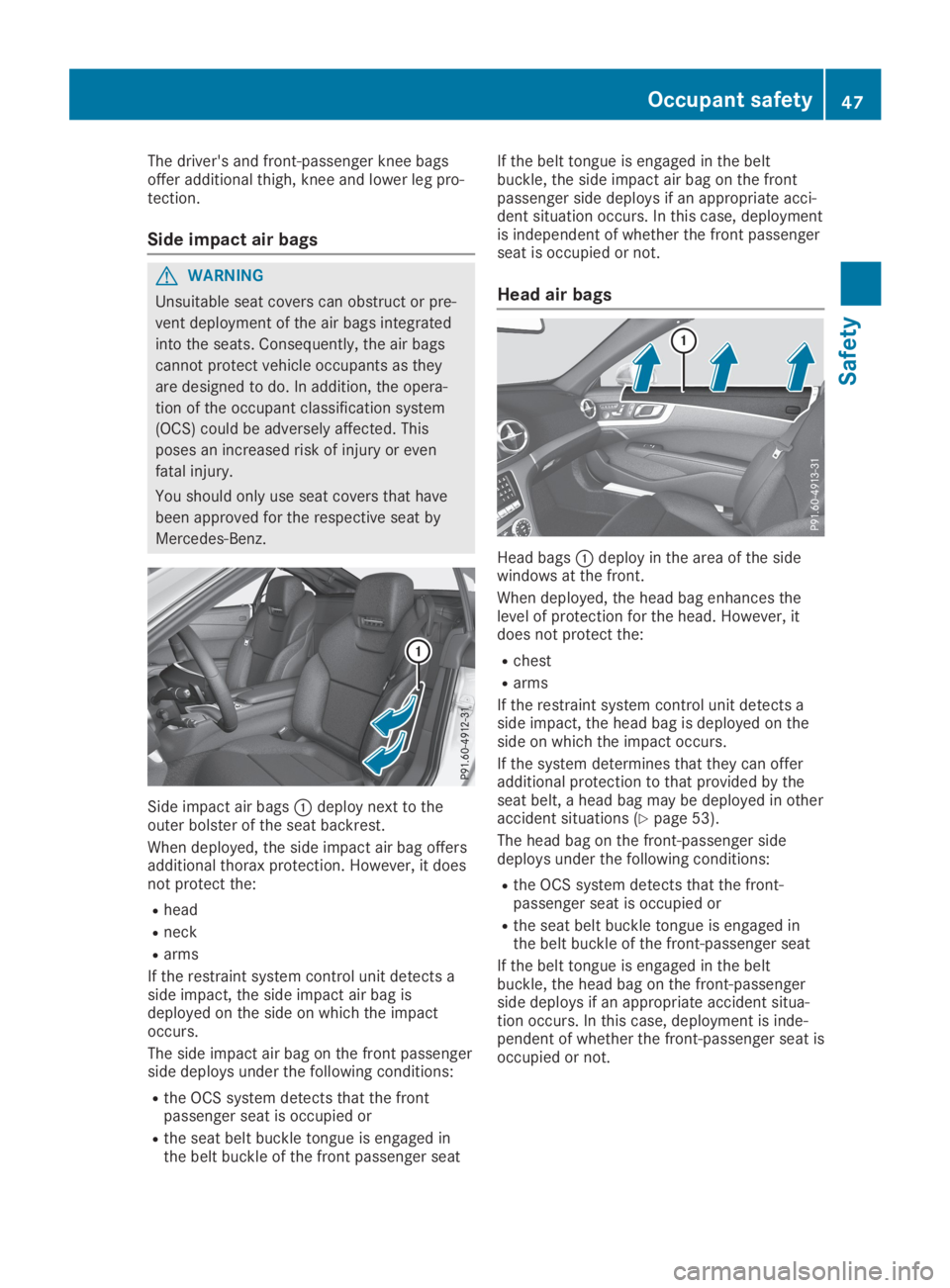
Side impact air bagsCdeploy next to theouter bolster of the seat backrest.
When deployed, the side impact air bag offersadditional thorax protection. However, it doesnot protect the:
Rhead
Rneck
Rarms
If the restraint system control unit detects aside impact, the side impact air bag isdeployed on the side on which the impactoccurs.
The side impact air bag on the front passengerside deploys under the following conditions:
Rthe OCS system detects that the frontpassenger seat is occupied or
Rthe seat belt buckle tongue is engaged inthe belt buckle of the front passenger seat
If the belt tongue is engaged in the beltbuckle, the side impact air bag on the frontpassenger side deploys if an appropriate acci-dent situation occurs. In this case, deploymentis independent of whether the front passengerseat is occupied or not.
Head air bags
Head bagsCdeploy in the area of the sidewindows at the front.
When deployed, the head bag enhances thelevel of protection for the head. However, itdoes not protect the:
Rchest
Rarms
If the restraint system control unit detects aside impact, the head bag is deployed on theside on which the impact occurs.
If the system determines that they can offeradditional protection to that provided by theseat belt, a head bag may be deployed in otheraccident situations (Ypage 53).
The head bag on the front-passenger sidedeploys under the following conditions:
Rthe OCS system detects that the front-passenger seat is occupied or
Rthe seat belt buckle tongue is engaged inthe belt buckle of the front-passenger seat
If the belt tongue is engaged in the beltbuckle, the head bag on the front-passengerside deploys if an appropriate accident situa-tion occurs. In this case, deployment is inde-pendent of whether the front-passenger seat isoccupied or not.
Occupant safety47
Safety
Z
Page 50 of 330
Occupant Classification System
(OCS)
Introduction
The Occupant Classification System (OCS) cat-egorizes the person in the front-passengerseat. Depending on that result, the front-passenger front air bag and front-passengerknee bag are either enabled or deactivated.
The system does not deactivate:
Rthe side impact air bag
Rthe headbag
Rthe Emergency Tensioning Devices
Requirements
To be classified correctly, the front passengermust sit:
Rwith the seat belt fastened correctly
Rin an almost upright position with their backagainst the seat backrest
Rwith their feet resting on the floor, if possi-ble
If the front passenger does not observe theseconditions, OCS may produce a false classifi-cation, e.g. because the front passenger:
Rtransfers their weight by supporting them-selves on a vehicle armrest
Rsits in such a way that their weight is raisedfrom the seat cushion
If you install a child restraint system on thefront-passenger seat, be sure to observe thecorrect positioning of the child restraint sys-tem. Never place objects under or behind thechild restraint system, e.g. a cushion. Fullyretract the seat cushion length. The entirebase of the child restraint system must alwaysrest on the seat cushion of the front-passenger seat. The backrest of the forward-facing child restraint system must lie as flat aspossible against the backrest of the front-passenger seat.
The child restraint system must not touch theroof or be subjected to a load by the headrestraint. Adjust the angle of the seat backrestand the head restraint position accordingly.
Only then can OCS be guaranteed to functioncorrectly. Always observe the child restraintsystem manufacturer's installation and operat-ing instructions.
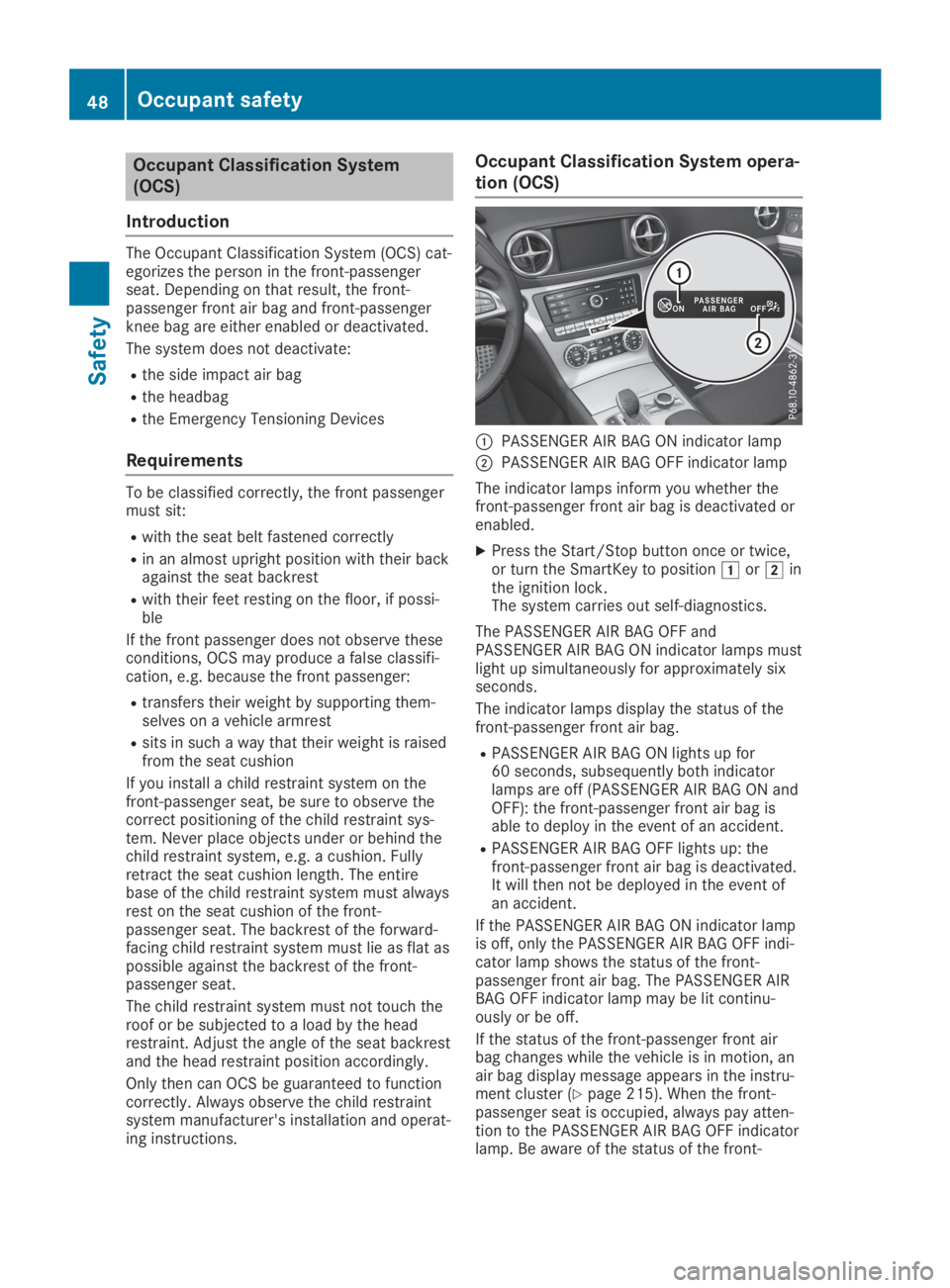
Occupant Classification System opera-
tion (OCS)
CPASSENGER AIR BAG ON indicator lamp
DPASSENGER AIR BAG OFF indicator lamp
The indicator lamps inform you whether thefront-passenger front air bag is deactivated orenabled.
XPress the Start/Stop button once or twice,or turn the SmartKey to positionGorHinthe ignition lock.The system carries out self-diagnostics.
The PASSENGER AIR BAG OFF andPASSENGER AIR BAG ON indicator lamps mustlight up simultaneously for approximately sixseconds.
The indicator lamps display the status of thefront-passenger front air bag.
RPASSENGER AIR BAG ON lights up for60 seconds, subsequently both indicatorlamps are off (PASSENGER AIR BAG ON andOFF): the front-passenger front air bag isable to deploy in the event of an accident.
RPASSENGER AIR BAG OFF lights up: thefront-passenger front air bag is deactivated.It will then not be deployed in the event ofan accident.
If the PASSENGER AIR BAG ON indicator lampis off, only the PASSENGER AIR BAG OFF indi-cator lamp shows the status of the front-passenger front air bag. The PASSENGER AIRBAG OFF indicator lamp may be lit continu-ously or be off.
If the status of the front-passenger front airbag changes while the vehicle is in motion, anair bag display message appears in the instru-ment cluster (Ypage 215). When the front-passenger seat is occupied, always pay atten-tion to the PASSENGER AIR BAG OFF indicatorlamp. Be aware of the status of the front-
48Occupant safety
Safety
Page 51 of 330

passenger front air bag both before and duringthe journey.
GWARNING
If the PASSENGER AIR BAG OFF indicator
lamp is lit, the front-passenger front air bag
is disabled. It will not be deployed in the
event of an accident and cannot perform its
intended protective function. A person in the
front-passenger seat could then, for exam-
ple, come into contact with the vehicle's
interior, especially if the person is sitting too
close to the dashboard. This poses an
increased risk of injury or even fatal injury.
When the front-passenger seat is occupied,
always ensure that:
Rthe classification of the person in the
front-passenger seat is correct and the
front-passenger front air bag is enabled or
disabled in accordance with the person in
the front-passenger seat
Rthe front-passenger seat has been moved
back as far back as possible.
Rthe person is seated correctly.
Make sure, both before and during the jour-
ney, that the status of the front-passenger
front air bag is correct.
GWARNING
If you secure a child in a rearward-facing
child restraint system on the front-
passenger seat and the PASSENGER AIR
BAG OFF indicator lamp is off, the front-
passenger front air bag can deploy in the
event of an accident. The child could be
struck by the air bag. This poses an
increased risk of injury or even fatal injury.
Make sure that the front-passenger front air
bag has been deactivated. The PASSENGER
AIR BAG OFF indicator lamp must be lit.
NEVER use a rearward-facing child restraint
on a seat protected by an ACTIVE FRONT
AIRBAG in front of it; DEATH or SERIOUS
INJURY to the child can occur.
If the PASSENGER AIR BAG OFF indicator lampstays off, do not install a rearward-facing child
restraint system on the front-passenger seat.You can find more information on OCS under"Problems with the Occupant ClassificationSystem" (Ypage 51).
GWARNING
If you secure a child in a forward-facing child
restraint system on the front-passenger seat
and you position the front-passenger seat
too close to the dashboard, in the event of
an accident, the child could:
Rcome into contact with the vehicle's inte-
rior if the PASSENGER AIR BAG OFF indi-
cator lamp is lit, for example
Rbe struck by the air bag if the
PASSENGER AIR BAG OFF indicator lamp
is off
This poses an increased risk of injury or
even fatal injury.
Always move the front-passenger seat as far
back as possible and fully retract the seat
cushion length. Always make sure that the
shoulder belt strap is correctly routed from
the vehicle seat belt guide to the shoulder
belt guide on the child restraint system. The
shoulder belt strap must be routed forwards
and downwards from the seat belt guide.
Always observe the child restraint system
manufacturer's installation instructions.
If OCS determines that:
RThe front-passenger seat is unoccupied, thePASSENGER AIR BAG OFF indicator lamplights up after the self-test and remains lit.This indicates that the front-passenger frontair bag is deactivated.
RThe front-passenger seat is occupied by achild of up to twelve months old, in a stand-ard child restraint system, the PASSENGERAIR BAG OFF indicator lamp lights up afterthe self-test and remains lit. This indicatesthat the front-passenger front air bag isdeactivated.
But even in the case of a twelve-month-oldchild, in a standard child restraint system,the PASSENGER AIR BAG OFF indicatorlamp can go out after the self-test. This indi-cates that the front-passenger front air bagis activated. The result of the classificationis dependent on, among other factors, the
Occupant safety49
Safety
Z
Page 53 of 330

deactivated in accordance with the per-
son in the front-passenger seat
Rthe person is seated properly with a cor-
rectly fastened seatbelt
Rthe front-passenger seat has been moved
as far back as possible
If the PASSENGER AIR BAG OFF indicator
lamp remains lit when it should not, the
front-passenger seat must not be used. Do
not install a child restraint system on the
front-passenger seat. Have the Occupant
Classification System (OCS) checked and
repaired immediately at a qualified specialist
workshop.
GWARNING
Objects between the seat surface and the
child restraint system could affect OCS
operation. This could result in the front-
passenger air bag not functioning as inten-
ded during an accident. This poses an
increased risk of injury or even fatal injury.
Do not place any objects between the seat
surface and the child restraint system. The
entire base of the child restraint system
must always rest on the seat cushion of the
front-passenger seat. The backrest of the
forward-facing child restraint system must,
as far as possible, be resting on the back-
rest of the front-passenger seat. Always
comply with the child restraint system man-
ufacturer's installation instructions.
After the self-test, the PASSENGER AIR BAGOFF or the PASSENGER AIR BAG ON indicatorlamp displays the status of the front-passenger front airbag (Ypage 48). If thefront-passenger front airbag is enabled, thePASSENGER AIR BAG ON indicator lamp lightsup for 60 seconds and then goes out.
If the PASSENGER AIR BAG ON indicator lampis off, only the PASSENGER AIR BAG OFF indi-cator lamp shows the status of the front-passenger front airbag. The PASSENGER AIRBAG OFF indicator lamp may be lit continu-ously or be off.
For more information about the OCS, see"Problems with the Occupant ClassificationSystem" (Ypage 51).
Problems with the Occupant Classification System (OCS)
Be sure to observe the notes on "System self-test" (Ypage 50).
Occupant safety51
Safety
Z
Page 54 of 330

ProblemPossible causes/consequences andPPSolutions
The PASSENGER AIRBAG OFF indicator lamplights up and remainslit, even though thefront-passenger seat isoccupied by an adult ora person of a staturecorresponding to that ofan adult.
The classification of the person on the front-passenger seat is incor-rect.
XMake sure the conditions for a correct classification of the per-son on the front-passenger seat are met (Ypage 48).
XIf the PASSENGER AIR BAG OFF indicator lamp remains lit, thefront-passenger seat may not be used.
XHave OCS checked as soon as possible at an authorizedMercedes-Benz Center.
The PASSENGER AIRBAG OFF indicator lampdoes not light upand/or does not stayon.
The front-passengerseat is:
Runoccupied
Roccupied by theweight of a child upto twelve months oldin a child restraintsystem
OCS is malfunctioning.
XMake sure there is nothing between the seat cushion and thechild seat.
XMake sure that the entire base of the child restraint system restson the seat cushion of the front-passenger seat. The backrest ofthe forward-facing child restraint system must lie as flat as possi-ble against the backrest of the front passenger seat. If necessary,adjust the position of the front-passenger seat.
XMake sure that the seat cushion length is fully retracted.
XWhen installing the child restraint system, make sure that theseat belt is tight. Do not pull the seat belt tight using the front-passenger seat adjustment. This could result in the seat belt andthe child restraint system being pulled too tightly.
XCheck for correct installation of the child restraint system.
Make sure that the head restraint does not apply a load to thechild restraint system. If necessary, adjust the head restraintaccordingly.
XMake sure that no objects are applying additional weight onto theseat.
XIf the PASSENGER AIR BAG OFF indicator lamp remains offand/or the PASSENGER AIR BAG ON indicator lamp lights up, donot install a child restraint system on the front-passenger seat.
XHave OCS checked as soon as possible at an authorizedMercedes-Benz Center.
Roll bar
GDANGER
If the roll bar has developed a malfunction, it
may not function, e.g. in the event of an
accident. The roll bars may then not protect
the vehicle occupants as intended. This
poses an increased risk of injury or even
fatal injury.
Have roll bars checked immediately at a
qualified specialist workshop.
GWARNING
If you place objects or clothing on the roll
bar covers, these could impair roll bar exten-
sion. The roll bars may then not protect the
vehicle occupants as intended. In addition,
objects could endanger the vehicle occu-
pants when the roll bar is extending. This
poses an increased risk of injury or even
fatal injury.
Ensure that the movement area of the roll
bar covers is kept clear. Always stow all
objects in the vehicle correctly.
52Occupant safety
Safety
Page 55 of 330
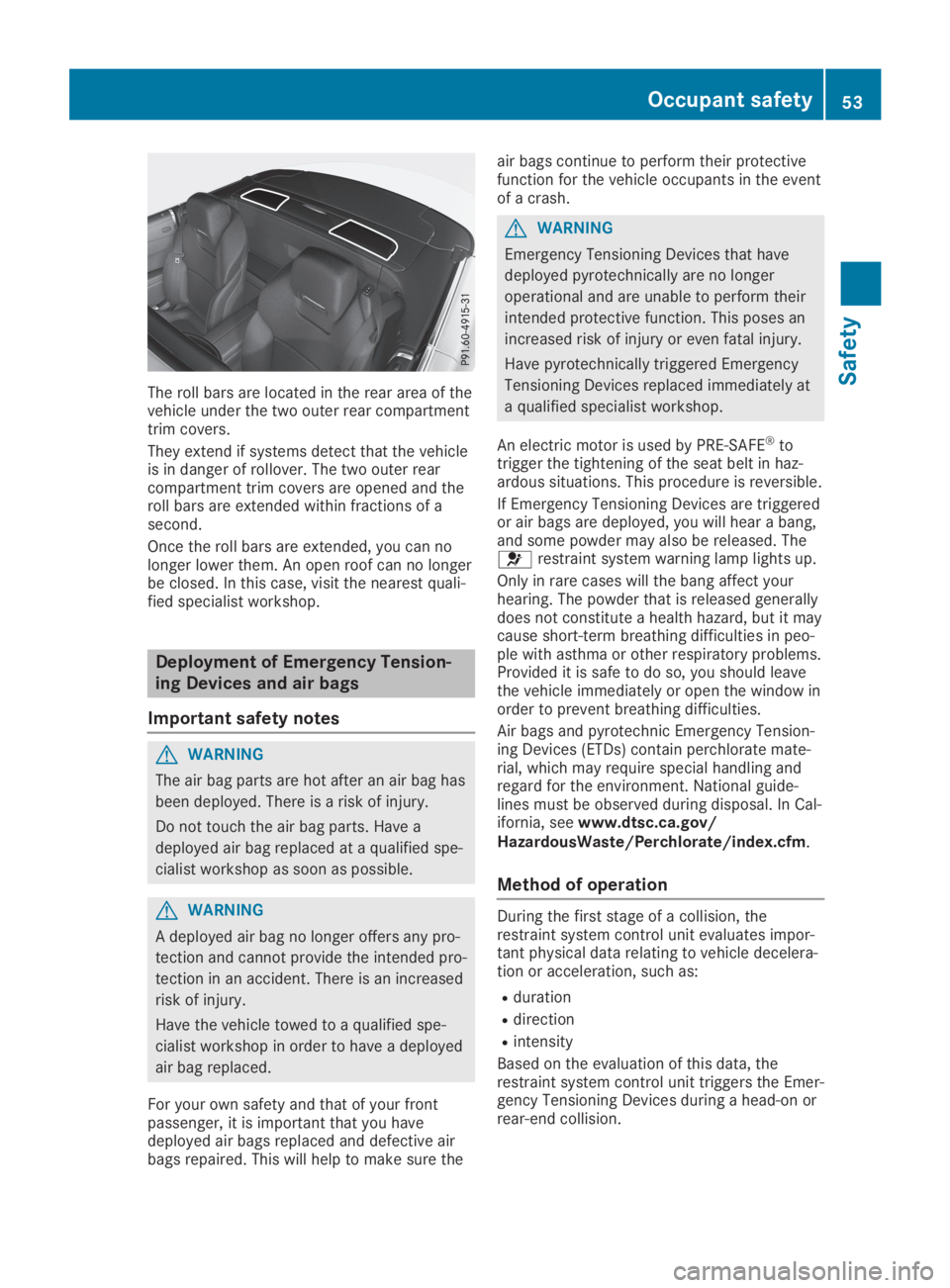
The roll bars are located in the rear area of thevehicle under the two outer rear compartmenttrim covers.
They extend if systems detect that the vehicleis in danger of rollover. The two outer rearcompartment trim covers are opened and theroll bars are extended within fractions of asecond.
Once the roll bars are extended, you can nolonger lower them. An open roof can no longerbe closed. In this case, visit the nearest quali-fied specialist workshop.
Deployment of Emergency Tension-
ing Devices and air bags
Important safety notes
GWARNING
The air bag parts are hot after an air bag has
been deployed. There is a risk of injury.
Do not touch the air bag parts. Have a
deployed air bag replaced at a qualified spe-
cialist workshop as soon as possible.
GWARNING
A deployed air bag no longer offers any pro-
tection and cannot provide the intended pro-
tection in an accident. There is an increased
risk of injury.
Have the vehicle towed to a qualified spe-
cialist workshop in order to have a deployed
air bag replaced.
For your own safety and that of your frontpassenger, it is important that you havedeployed air bags replaced and defective airbags repaired. This will help to make sure the
air bags continue to perform their protectivefunction for the vehicle occupants in the eventof a crash.
GWARNING
Emergency Tensioning Devices that have
deployed pyrotechnically are no longer
operational and are unable to perform their
intended protective function. This poses an
increased risk of injury or even fatal injury.
Have pyrotechnically triggered Emergency
Tensioning Devices replaced immediately at
a qualified specialist workshop.
An electric motor is used by PRE-SAFE®totrigger the tightening of the seat belt in haz-ardous situations. This procedure is reversible.
If Emergency Tensioning Devices are triggeredor air bags are deployed, you will hear a bang,and some powder may also be released. Theurestraint system warning lamp lights up.
Only in rare cases will the bang affect yourhearing. The powder that is released generallydoes not constitute a health hazard, but it maycause short-term breathing difficulties in peo-ple with asthma or other respiratory problems.Provided it is safe to do so, you should leavethe vehicle immediately or open the window inorder to prevent breathing difficulties.
Air bags and pyrotechnic Emergency Tension-ing Devices (ETDs) contain perchlorate mate-rial, which may require special handling andregard for the environment. National guide-lines must be observed during disposal. In Cal-ifornia, seewww.dtsc.ca.gov/HazardousWaste/Perchlorate/index.cfm.
Method of operation
During the first stage of a collision, therestraint system control unit evaluates impor-tant physical data relating to vehicle decelera-tion or acceleration, such as:
Rduration
Rdirection
Rintensity
Based on the evaluation of this data, therestraint system control unit triggers the Emer-gency Tensioning Devices during a head-on orrear-end collision.
Occupant safety53
Safety
Z
Page 56 of 330

An Emergency Tensioning Device can only betriggered, if:
Rthe ignition is switched on
Rthe components of the restraint system areoperational. You can find further informationunder "Restraint system warning lamp"(Ypage 41)
Rthe seat belt buckle tongue has engaged inthe belt buckle of the respective seat
If the restraint system control unit detects amore severe accident, further components ofthe restraint system are activated independ-ently of each other in certain frontal collisionsituations:
RFront air bags as well as driver's and front-passenger knee bags
Depending on the person in the front-passenger seat, the front-passenger front airbag is either enabled or disabled. The front-passenger front air bag can be deployed in anaccident only if the PASSENGER AIR BAG OFFindicator lamp is off. Observe the informationon the PASSENGER AIR BAG indicator lamps(Ypage 41).
Your vehicle has two-stage front air bags.
The activation threshold of the EmergencyTensioning Devices and the air bags is deter-mined by evaluating the rate of vehicle decel-eration or acceleration which occurs at variouspoints in the vehicle. This process is pre-emp-tive in nature. Deployment should take placein good time at the start of the collision.
The rate of vehicle deceleration or accelera-tion and the direction of the force are essen-tially determined by:
Rthe distribution of forces during the collision
Rthe collision angle
Rthe deformation characteristics of the vehi-cle
Rthe characteristics of the object with whichthe vehicle has collided
Factors which can only be seen and measuredafter a collision has occurred do not play adecisive role in the deployment of an air bag.Nor do they provide an indication of air bagdeployment.
The vehicle can be deformed considerably,without an air bag being deployed. This is thecase if only parts which are relatively easilydeformed are affected and the rate of deceler-ation is not high. Conversely, air bags may bedeployed even though the vehicle suffers only
minor deformation. This is the case if, forexample, very rigid vehicle parts such as longi-tudinal body members are hit, and sufficientdeceleration occurs as a result.
If the restraint system control unit detects aside impact or if the vehicle rolls over, theapplicable components of the restraint systemare deployed independently of each otherdepending on the apparent type of accident.
RSide impact air bag on the side of impact,independently of the Emergency TensioningDevice and the use of the seat belt on thedriver's seat
The side impact air bag on the frontpassenger side deploys under the followingconditions:
-the OCS system detects that the frontpassenger seat is occupied or
-the seat belt buckle tongue is engaged inthe belt buckle of the front passengerseat
RHead bag on the side of impact, independ-ently of the use of the seat belt and inde-pendently of whether the front-passengerseat is occupied
REmergency Tensioning Devices, if the sys-tem determines that deployment can offeradditional protection in this situation
RHead bags on the driver's and front-passenger side in certain situations whenthe vehicle rolls over, if the system deter-mines that deployment can offer additionalprotection to that provided by the seat belt
iNot all air bags are deployed in an acci-dent. The different air bag systems workindependently of each other.
How the air bag system works is determinedby the severity of the accident detected,especially the vehicle deceleration or accel-eration and the apparent type of accident:
RHead-on collision
RSide impact
RRollover
54Occupant safety
Safety