steering wheel MERCEDES-BENZ SL-CLASS ROADSTER 2013 Owners Manual
[x] Cancel search | Manufacturer: MERCEDES-BENZ, Model Year: 2013, Model line: SL-CLASS ROADSTER, Model: MERCEDES-BENZ SL-CLASS ROADSTER 2013Pages: 572, PDF Size: 9.23 MB
Page 5 of 572
Index
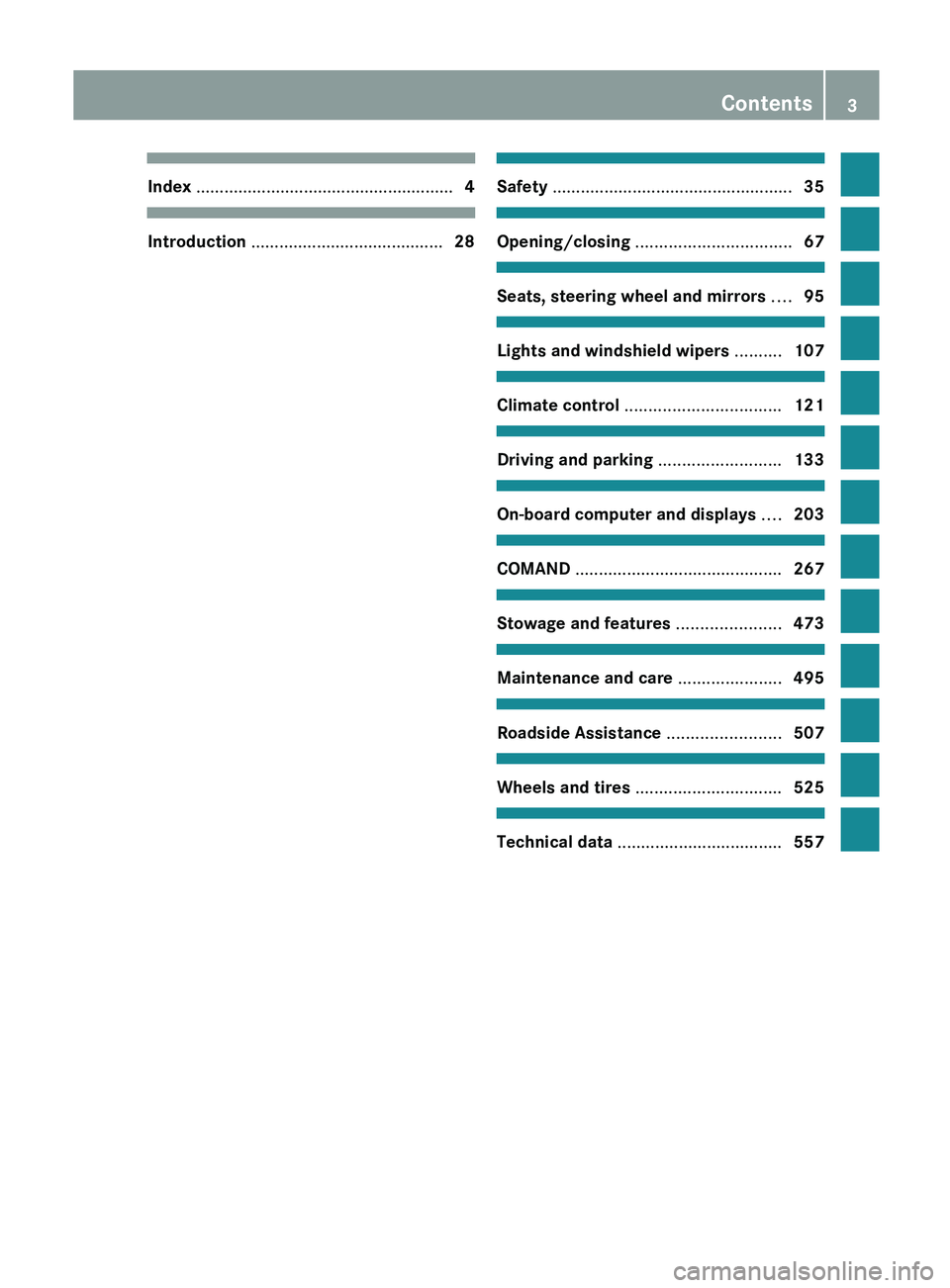
....................................................... 4Introduction .........................................
28 Safety ...................................................
35 Opening/closing
................................. 67 Seats, steering wheel and mirrors ....
95 Lights and windshield wipers
..........107 Climate control
................................. 121 Driving and parking ..........................
133 On-board computer and displays
....203 COMAND
............................................ 267 Stowage and features ......................
473 Maintenance and care
......................495 Roadside Assistance
........................507 Wheels and tires ...............................
525 Technical data ...................................
557 Contents
3
Page 7 of 572
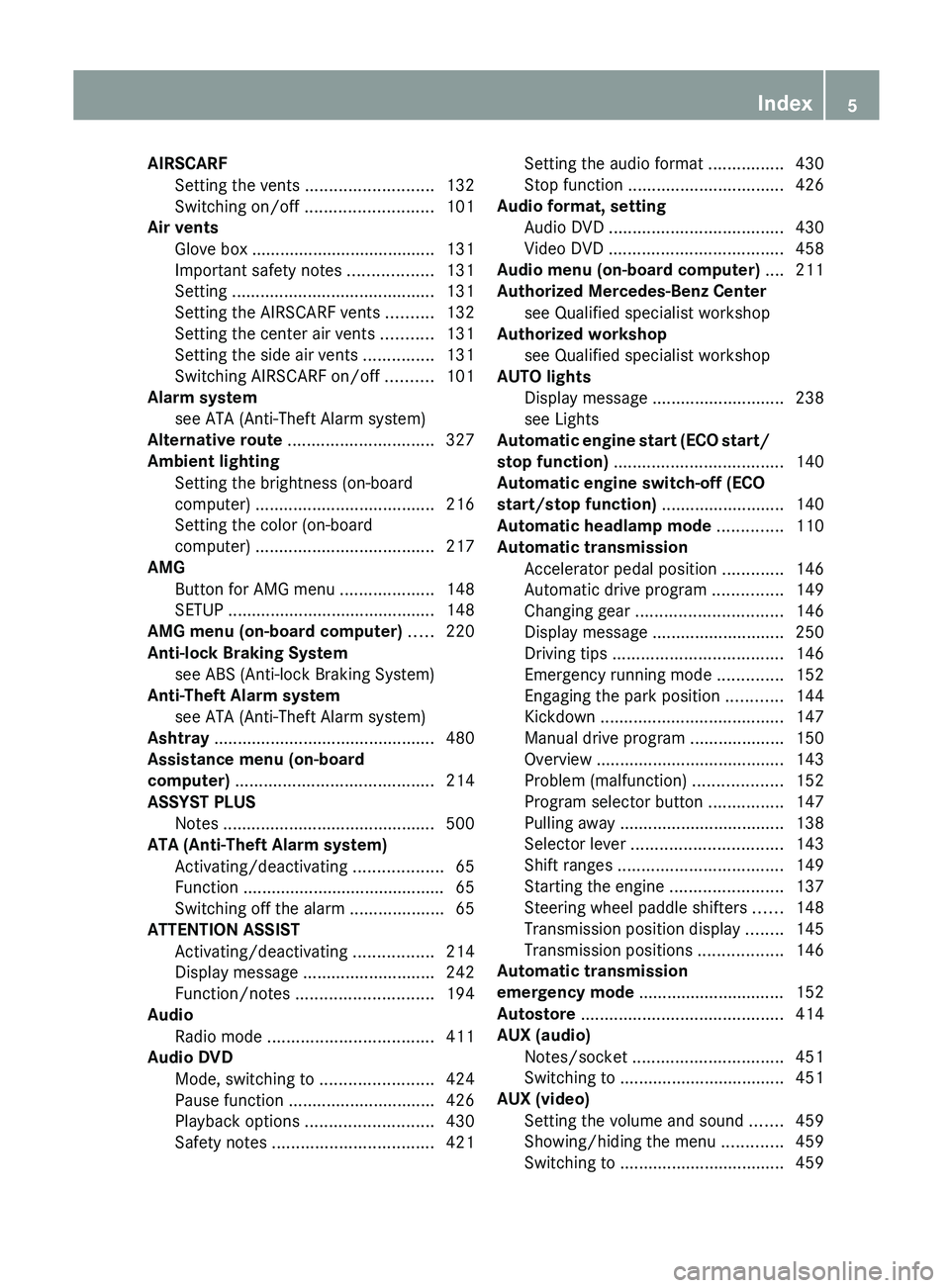
AIRSCARF
Setting the vents
...........................132
Switching on/off ........................... 101
Air vents
Glove box ....................................... 131
Important safety notes .................. 131
Setting ........................................... 131
Setting the AIRSCARF vents ..........132
Setting the center air vents ...........131
Setting the side air vents ............... 131
Switching AIRSCARF on/off ..........101
Alarm system
see ATA (Anti-Theft Alarm system)
Alternative route ............................... 327
Ambient lighting Setting the brightness (on-board
computer) ...................................... 216
Setting the color (on-board
computer) ...................................... 217
AMG
Button for AMG menu .................... 148
SETUP ............................................ 148
AMG menu (on-board computer) ..... 220
Anti-lock Braking System see ABS (Anti-lock Braking System)
Anti-Theft Alarm system
see ATA (Anti-Theft Alarm system)
Ashtray ............................................... 480
Assistance menu (on-board
computer) .......................................... 214
ASSYST PLUS Notes ............................................. 500
ATA (Anti-Theft Alarm system)
Activating/deactivating ................... 65
Function ........................................... 65
Switching off the alarm .................... 65
ATTENTION ASSIST
Activating/deactivating ................. 214
Display message ............................ 242
Function/notes ............................. 194
Audio
Radio mode ................................... 411
Audio DVD
Mode, switching to ........................ 424
Pause function ............................... 426
Playback options ........................... 430
Safety notes .................................. 421Setting the audio format ................
430
Stop function ................................. 426
Audio format, setting
Audio DVD
..................................... 430
Video DVD ..................................... 458
Audio menu (on-board computer) .... 211
Authorized Mercedes-Benz Center see Qualified specialist workshop
Authorized workshop
see Qualified specialist workshop
AUTO lights
Display message ............................ 238
see Lights
Automatic engine start (ECO start/
stop function) .................................... 140
Automatic engine switch-off (ECO
start/stop function) .......................... 140
Automatic headlamp mode ..............110
Automatic transmission Accelerator pedal position .............146
Automatic drive program ............... 149
Changing gear ............................... 146
Display message ............................ 250
Driving tips .................................... 146
Emergency running mode ..............152
Engaging the park position ............ 144
Kickdown ....................................... 147
Manual drive program ....................150
Overview ........................................ 143
Problem (malfunction) ...................152
Program selector button ................147
Pulling away ................................... 138
Selector lever ................................ 143
Shift ranges ................................... 149
Starting the engine ........................ 137
Steering wheel paddle shifters ...... 148
Transmission position display ........ 145
Transmission positions .................. 146
Automatic transmission
emergency mode ............................... 152
Autostore ........................................... 414
AUX (audio) Notes/socket ................................ 451
Switching to ................................... 451
AUX (video)
Setting the volume and sound ....... 459
Showing/hiding the menu ............. 459
Switching to ................................... 459 Index
5
Page 9 of 572
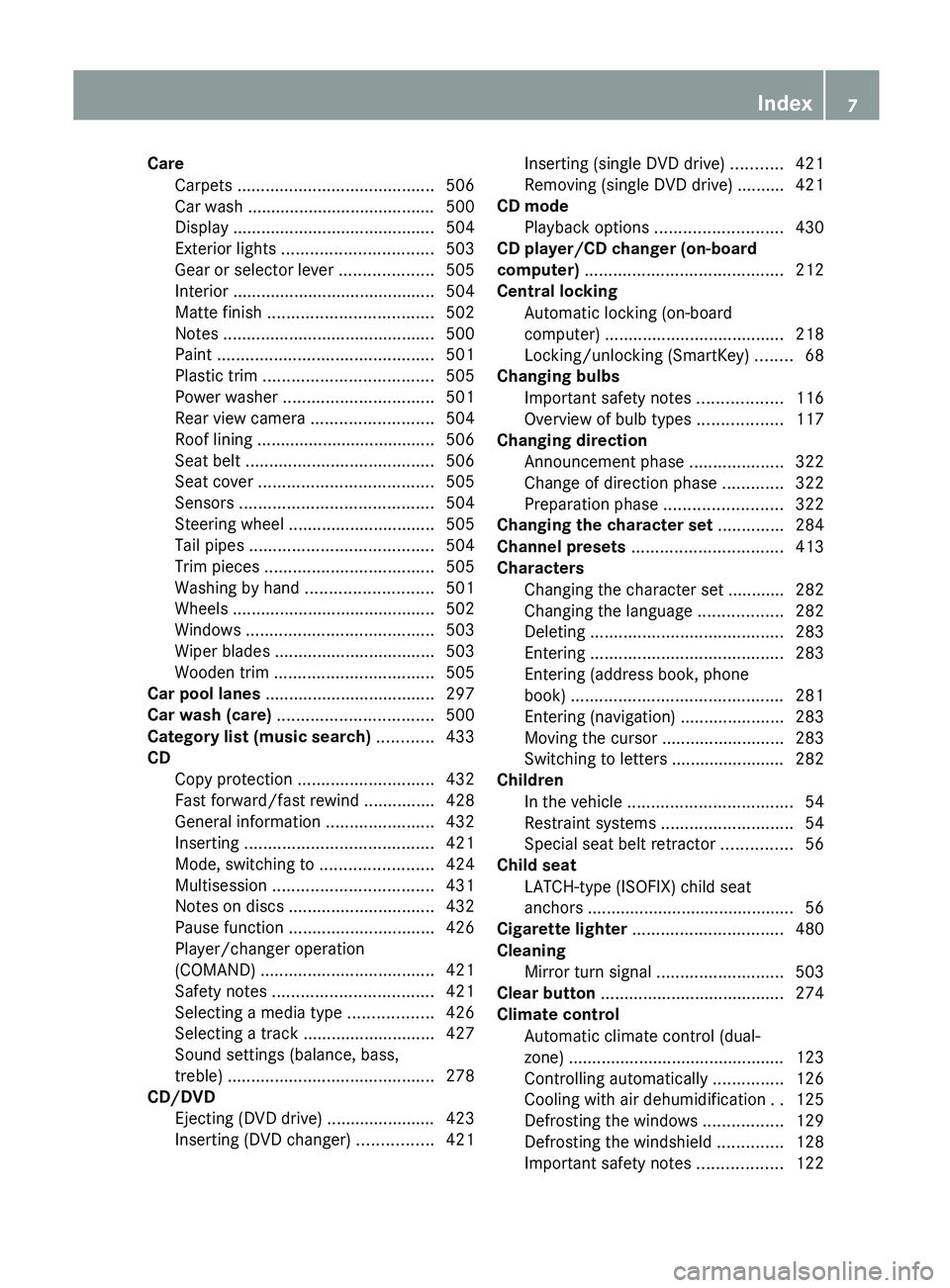
Care
Carpets .......................................... 506
Car wash ........................................
500
Display ........................................... 504
Exterior lights ................................ 503
Gear or selector lever ....................505
Interior ........................................... 504
Matte finish ................................... 502
Notes ............................................. 500
Paint .............................................. 501
Plastic trim .................................... 505
Power washer ................................ 501
Rear view camera .......................... 504
Roof lining ...................................... 506
Seat belt ........................................ 506
Seat cover ..................................... 505
Sensors ......................................... 504
Steering wheel ............................... 505
Tail pipes ....................................... 504
Trim pieces .................................... 505
Washing by hand ........................... 501
Wheels ........................................... 502
Windows ........................................ 503
Wiper blades .................................. 503
Wooden trim .................................. 505
Car pool lanes .................................... 297
Car wash (care) ................................. 500
Category list (music search) ............433
CD Copy protection ............................. 432
Fast forward/fast rewind ............... 428
General information ....................... 432
Inserting ........................................ 421
Mode, switching to ........................ 424
Multisession .................................. 431
Notes on discs ............................... 432
Pause function ............................... 426
Player/changer operation
(COMAND) ..................................... 421
Safety notes .................................. 421
Selecting a media type .................. 426
Selecting a track ............................ 427
Sound settings (balance, bass,
treble) ............................................ 278
CD/DVD
Ejecting (DVD drive) ....................... 423
Inserting (DVD changer) ................421Inserting (single DVD drive)
...........421
Removing (single DVD drive) .......... 421
CD mode
Playback options ........................... 430
CD player/CD changer (on-board
computer)
.......................................... 212
Central locking Automatic locking (on-board
computer) ...................................... 218
Locking/unlocking (SmartKey) ........ 68
Changing bulbs
Important safety notes .................. 116
Overview of bulb types ..................117
Changing direction
Announcement phase .................... 322
Change of direction phase ............. 322
Preparation phase ......................... 322
Changing the character set .............. 284
Channel presets ................................ 413
Characters Changing the character set ............ 282
Changing the language ..................282
Deleting ......................................... 283
Entering ......................................... 283
Entering (address book, phone
book) ............................................. 281
Entering (navigation) ......................283
Moving the cursor .......................... 283
Switching to letters ........................ 282
Children
In the vehicle ................................... 54
Restraint systems ............................ 54
Special seat belt retractor ............... 56
Child seat
LATCH-type (ISOFIX) child seat
anchors ............................................ 56
Cigarette lighter ................................ 480
Cleaning Mirror turn signal ........................... 503
Clear button ....................................... 274
Climate control Automatic climate control (dual-
zone) .............................................. 123
Controlling automatically ...............126
Cooling with air dehumidification ..125
Defrosting the windows ................. 129
Defrosting the windshield .............. 128
Important safety notes .................. 122 Index
7
Page 18 of 572
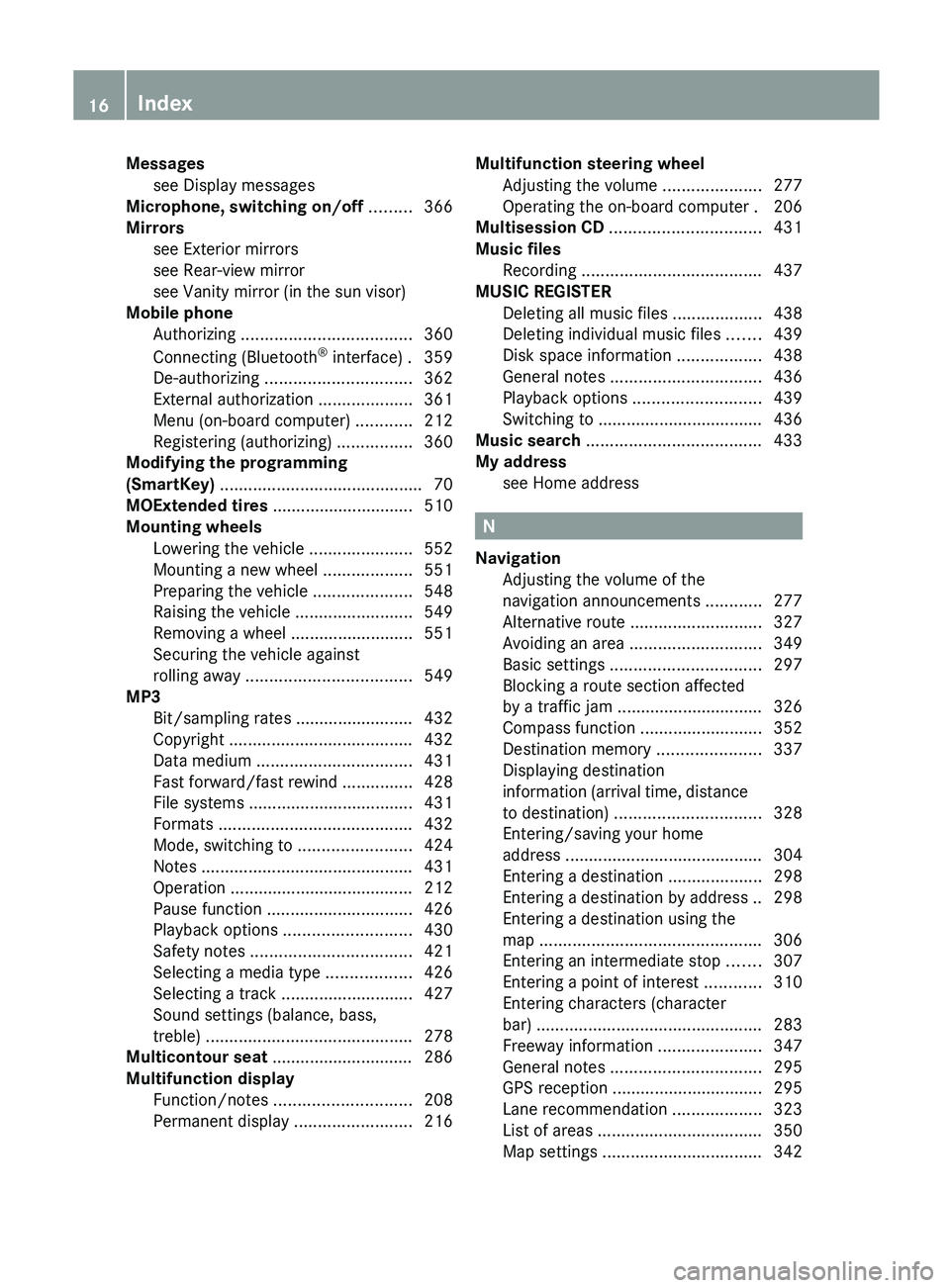
Messages
see Display messages
Microphone, switching on/off .........366
Mirrors see Exterior mirrors
see Rear-view mirror
see Vanity mirror (in the sun visor)
Mobile phone
Authorizing .................................... 360
Connecting (Bluetooth ®
interface) . 359
De-authorizing ............................... 362
External authorization ....................361
Menu (on-board computer) ............ 212
Registering (authorizing) ................ 360
Modifying the programming
(SmartKey) ........................................... 70
MOExtended tires .............................. 510
Mounting wheels Lowering the vehicle ......................552
Mounting a new wheel ................... 551
Preparing the vehicle .....................548
Raising the vehicle ......................... 549
Removing a wheel ..........................551
Securing the vehicle against
rolling away ................................... 549
MP3
Bit/sampling rates ......................... 432
Copyright ....................................... 432
Data medium ................................. 431
Fast forward/fast rewind ............... 428
File systems ................................... 431
Formats ......................................... 432
Mode, switching to ........................ 424
Notes ............................................. 431
Operation ....................................... 212
Pause function ............................... 426
Playback options ........................... 430
Safety notes .................................. 421
Selecting a media type .................. 426
Selecting a track ............................ 427
Sound settings (balance, bass,
treble) ............................................ 278
Multicontour seat .............................. 286
Multifunction display
Function/notes ............................. 208
Permanent display ......................... 216Multifunction steering wheel
Adjusting the volume ..................... 277
Operating the on-board computer . 206
Multisession CD
................................ 431
Music files Recording ...................................... 437
MUSIC REGISTER
Deleting all music files ................... 438
Deleting individual music files ....... 439
Disk space information ..................438
General notes ................................ 436
Playback options ........................... 439
Switching to ................................... 436
Music search ..................................... 433
My address see Home address N
Navigation Adjusting the volume of the
navigation announcements
............277
Alternative route ............................ 327
Avoiding an area ............................ 349
Basic settings ................................ 297
Blocking a route section affected
by a traffic jam ............................... 326
Compass function .......................... 352
Destination memory ......................337
Displaying destination
information (arrival time, distance
to destination) ............................... 328
Entering/saving your home
address .......................................... 304
Entering a destination .................... 298
Entering a destination by address .. 298
Entering a destination using the
map ............................................... 306
Entering an intermediate stop .......307
Entering a point of interest ............ 310
Entering characters (character
bar) ................................................ 283
Freeway information ......................347
General notes ................................ 295
GPS reception ................................ 295
Lane recommendation ...................323
List of areas ................................... 350
Map settings .................................. 34216
Index
Page 24 of 572
SRS (Supplemental Restraint
System)
Introduction
..................................... 37
Warning lamp ................................. 262
Warning lamp (function) ................... 37
Standing lamps
Display message ............................ 237
Switching on/off ........................... 111
Starting (engine) ................................ 137
Station search ................................... 413
STEER CONTROL .................................. 65
Steering (display message) ..............252
Steering wheel Adjusting (electrically) ...................101
Buttons (on-board computer) ......... 206
Cleaning ......................................... 505
Important safety notes .................. 101
Paddle shifters ............................... 148
Storing settings (memory
function) ........................................ 105
Steering wheel paddle shifters ........148
Stop function Audio DVD ..................................... 426
Video DVD ..................................... 455
Stopwatch (RACETIMER) ................... 220
Storing stations Radio ............................................. 414
Stowage areas ................................... 474
Stowage compartments Armrest (under) ............................. 475
Center console .............................. 475
Cup holders ................................... 478
Display message) ........................... 252
Eyeglasses compartment ............... 475
Glove box ....................................... 474
Important safety information ......... 474
Rear ............................................... 476
Stowage net ................................... 476
Stowage net ....................................... 476
Stowage space Center console (rear) ..................... 476
Umbrella holder ............................. 475
Stowage well beneath the trunk
floor .................................................... 478
Summer tires ..................................... 528
Sun visor ............................................ 479Supplemental Restraint System
see SRS (Supplemental Restraint
System)
Surround lighting (on-board
computer) .......................................... 217
Surround sound ................................. 278
Surround sound (harman/
kardon ®
surround sound system)
Notes ............................................. 278
Switching on/off ........................... 279
Suspension tuning
Active Body Control (AMG
vehicles) ........................................ 182
Active Body Control (except AMG
vehicles) ........................................ 180
SETUP (on-board computer) .......... 220
Switching air-recirculation mode
on/off ................................................. 130
Switching between picture
formats (TV, video) ............................453
Switching between summer time
and standard time ............................. 290
Switching off the alarm (ATA) ............65
Switching the hands-free
microphone on/off ............................ 366
Switching wavebands (radio) ...........413
System settings
Bluetooth ®
..................................... 292
Date ............................................... 289
Language ....................................... 292
Text reader speed ..........................291
Time ............................................... 289
Time zone ...................................... 290
Voice Control System .................... 291 T
Tachometer ........................................ 206
Tail lamps Display message ............................ 236
see Lights
Tank
see Fuel tank
Tank content
Fuel gauge ..................................... 205
Technical data
Capacities ...................................... 560
Notes ............................................. 55822
Index
Page 40 of 572
Safety guidelines for seat belts,
Emergency Tensioning Devices (ETDs)
and air bags
G
WARNING
R Damaged seat
belts or seat belts that have
been subjected to stress in an accident
must be replaced. Their anchoring points
must also be checked. Only use seat belts
installed or supplied by an authorized
Mercedes-Benz Center.
R Air bags and pyrotechnic Emergency
Tensioning Devices (ETDs) contain
perchlorate material, which may require
special handling and regard for the
environment. Check your national disposal
guidelines. California residents, see
www.dtsc.ca.gov/HazardousWaste/
Perchlorate/index.cfm.
R Air bags and ETDs are designed to function
on a one-time-only basis. An air bag or ETD
that has deployed must be replaced.
R Do not pass seat belts over sharp edges.
They could tear.
R Do not make any modification that could
change the effectiveness of the seat belts.
R Do not bleach or dye seat belts as this may
severely weaken them. In a crash they may
not be able to provide adequate protection.
R No modifications of any kind may be made
to any components or wiring of the SRS.
R Do not change or remove any component
or part of the SRS.
R Do not install additional trim material, seat
covers, badges, etc. over the steering
wheel hub, front-passenger front air bag
cover, outer sides of the seat backrests,
door trim panels, or door frame trims.
R Do not install additional electrical/
electronic equipment on or near SRS
components and wiring.
R Keep area between air bags and occupants
free of objects (e.g. packages, purses,
umbrellas, etc.). R
Air bag
system components will be hot after
an air bag has inflated. Do not touch them.
R Never place your feet on the instrument
panel, dashboard, or on the seat. Always
keep both feet on the floor in front of the
seat.
R Improper repair work on the SRS creates a
risk of rendering the SRS inoperative or
causing unintended air bag deployment.
Work on the SRS must therefore only be
performed by qualified technicians.
Contact an authorized Mercedes-Benz
Center.
R For your protection and the protection of
others, when scrapping the air bag unit or
ETD, our safety instructions must be
followed. These instructions are available
from any authorized Mercedes-Benz
Center.
R Given the considerable deployment speed,
required inflation volume, and the material
of the air bags, there is the possibility of
abrasions or other, potentially more serious
injuries resulting from air bag deployment.
If you sell your vehicle, Mercedes-Benz
strongly recommends that you inform the
subsequent owner that the vehicle is
equipped with SRS. Also, refer them to the
applicable section in the Operator's Manual. Air bags
Important safety notes G
WARNING
Air bags are designed to reduce the incidence
of injuries and fatalities in certain situations:
R frontal impacts (driver's and front-
passenger front air bags and knee bags)
R side impacts
(side impact air bags and head
bags)
R rollover (head bags)
However, no system available today can
completely eliminate injuries and fatalities. 38
Occupant safety
Safety
Page 41 of 572
When the air bags are deployed, a small
amount of powder is released. The powder
generally
does
not constitute a health hazard
and does not indicate that there is a fire in the
vehicle. In order to prevent potential
breathing difficulties, you should leave the
vehicle as soon as it is safe to do so. If you
have any breathing difficulty but cannot get
out of the vehicle after the air bag inflates,
then get fresh air by opening a window or
door. G
WARNING
In order to reduce the potential danger of
injuries caused during the deployment of the
front air bags, the driver and front passenger
must always be correctly seated and wear
their seat belts.
For maximum protection in the event of a
collision, you must always be in the normal
seat position with your back against the
backrest. Fasten
your seat belt and make sure
that it is correctly positioned on your body.
As the air bag inflates with considerable
speed and force, a proper seating position
and correct positioning of the hands on the
steering wheel will help to keep you at a safe
distance from the air bag. Occupants who are
not wearing their seat belt, are not seated
properly or are too close to the air bag can be
seriously injured or killed by an air bag, as it
inflates with great force instantaneously:
R sit with the seat belt fastened correctly and
in a position that is as upright as possible
with your back against the backrest.
R move the driver's seat as far back as
possible, still permitting proper operation
of vehicle controls. The distance from the
center of the driver's chest to the middle of
the air bag cover on the steering wheel
must be at least 10 inches (25 cm). You
should be able to accomplish this by
adjusting the seat and steering wheel. If
you have any difficulties, please contact a
qualified specialist workshop. R
do not
lean your head or chest close to the
steering wheel or dashboard.
R only hold the steering wheel on the outside.
Placing hands and arms inside the rim of
the steering wheel can increase the risk
and potential severity of hand/arm injuries
if the air bag inflates.
R adjust the front-passenger seat as far back
as possible from the dashboard when the
seat is occupied.
R occupants, especially children, should
never place their bodies or lean their heads
in the area of the door where the side
impact air bag and/or head bag inflates.
This could result in serious injuries or death
should the side impact air bag/head bag be
deployed. Always sit as upright as possible,
wear the seat belt properly and use an
appropriately sized infant restraint, toddler
restraint or booster seat recommended for
the size and weight of the child.
Failure to follow these instructions can result
in severe injuries to you or other occupants.
If you sell your vehicle, it is important that you
make the buyer aware of this safety
information. Be sure to give the buyer this
Operator's Manual. G
WARNING
If the side impact air bag and/or head bag is
deployed in
the event of a side impact and the
front passenger, especially a child, is not
properly seated or restrained when next to a
side impact air bag/head bag, injuries are
possible due to the rapid inflation of the side
impact air bag/head bag.
To help avoid the possibility of injury, please
follow these guidelines:
(1) Always sit as upright as possible, and use the seat belts properly.
Make sure that children 12 years
old and
under use an appropriately
sized child restraint, infant
restraint or booster seat Occupant safety
39
Safety
Z
Page 42 of 572
recommended for the size and
weight of the child.
(2) Always wear seat belts properly.
If the air bags are deployed, you will hear a
bang, and
a small amount of powder may also
be released. Only in rare cases will the bang
affect your hearing. The powder that is
released generally does not constitute a
health hazard. The 6 SRS warning lamp
lights up.
The air bags are deployed if the air bag control
unit detects the need for deployment. Only in
the event of such a situation will the air bags
provide their supplemental protection.
If the driver and front passenger do not wear
their seat belts, it is not possible for the air
bags to provide their supplemental
protection.
In the event of other types of impacts and
impacts below air bag deployment
thresholds, the air bags will not deploy. The
driver and passengers will then be protected
to the extent possible by a properly fastened
seat belt. A properly fastened seat belt is also
needed to provide the best possible
protection in a rollover.
Air bags provide additional protection; they
are not, however, a substitute for seat belts.
All vehicle occupants must fasten their seat
belts.
It is important for your safety and that of your
passengers to have deployed air bags
replaced and to have any malfunctioning air
bags repaired. This will help to make sure the
air bags continue to perform their protective
function for the vehicle occupants in the
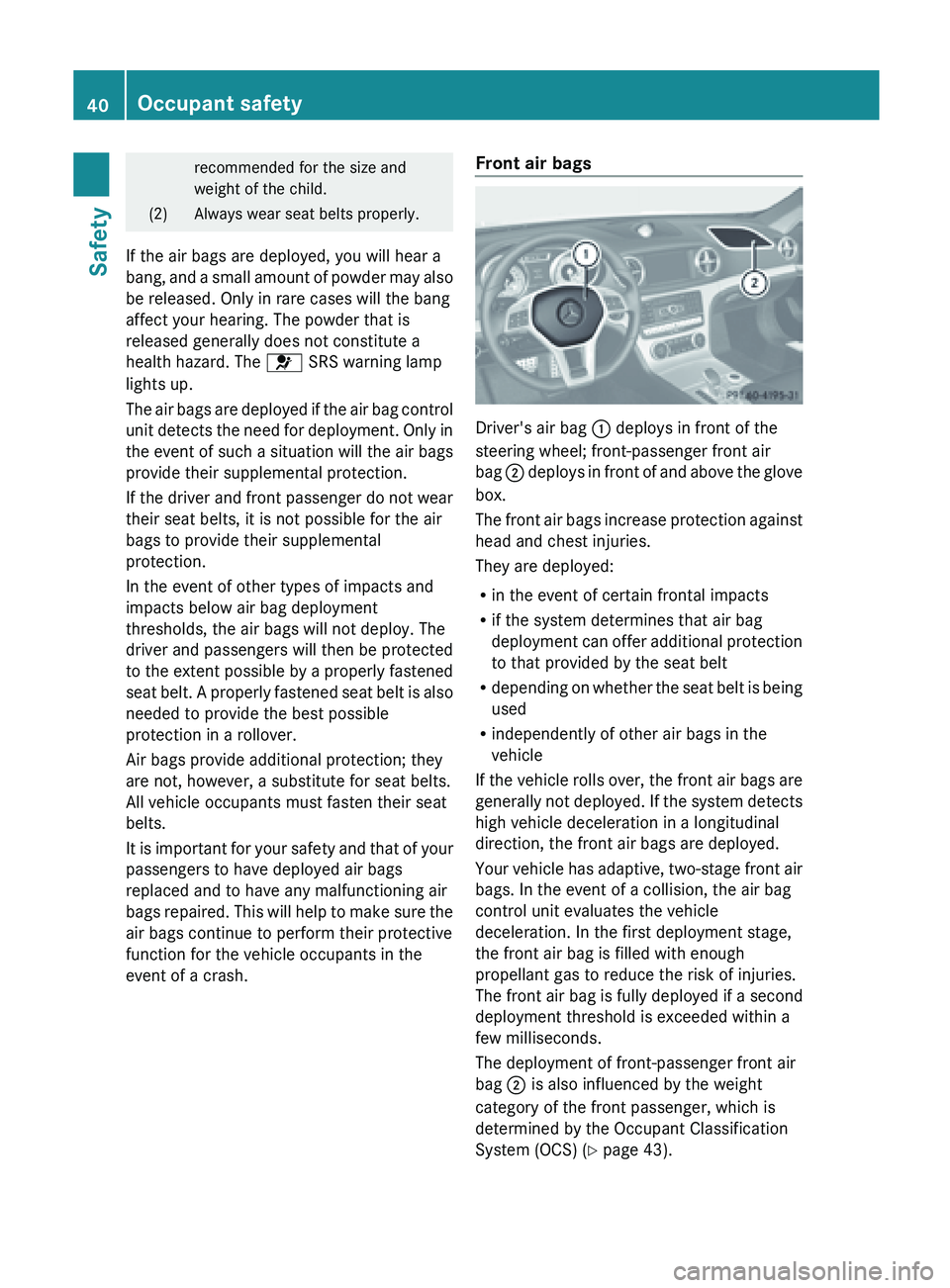
event of a crash. Front air bags
Driver's air bag
:
deploys in front of the
steering wheel; front-passenger front air
bag ; deploys
in front of and above the glove
box.
The front air bags increase protection against
head and chest injuries.
They are deployed:
R in the event of certain frontal impacts
R if the system determines that air bag
deployment can offer additional protection
to that provided by the seat belt
R depending on whether the seat belt is being
used
R independently of other air bags in the
vehicle
If the vehicle rolls over, the front air bags are
generally not deployed. If the system detects
high vehicle deceleration in a longitudinal
direction, the front air bags are deployed.
Your vehicle has adaptive, two-stage front air
bags. In the event of a collision, the air bag
control unit evaluates the vehicle
deceleration. In the first deployment stage,
the front air bag is filled with enough
propellant gas to reduce the risk of injuries.
The front air bag is fully deployed if a second
deployment threshold is exceeded within a
few milliseconds.
The deployment of front-passenger front air
bag ; is also influenced by the weight
category of the front passenger, which is
determined by the Occupant Classification
System (OCS) ( Y page 43).40
Occupant safety
Safety
Page 57 of 572
positioning for children over 41 lb (18 kg) until
they reach
a height where a lap-shoulder belt
fits properly without a booster.
When the child restraint is not in use, remove
it from the vehicle or secure it with the seat
belt to prevent the child restraint from
becoming a projectile in the event of an
accident. G
WARNING
When leaving the vehicle, always remove the
SmartKey from the ignition lock. Always take
the SmartKey with you and lock the vehicle.
Do not leave children unattended in the
vehicle, even if they are secured in a child
restraint system, or with access to an
unlocked vehicle. A child's unsupervised
access to
a vehicle could result in an accident
and/or serious personal injury. The children
could:
R injure themselves on parts of the vehicle
R be seriously or fatally injured through
excessive exposure to extreme heat or cold
R injure themselves or cause an accident with
vehicle equipment that can be operated
even if the SmartKey is removed from the
ignition lock or removed from the vehicle,
such as seat adjustment, steering wheel
adjustment, or the memory function
If children open a door, they could injure other
persons or get out of the vehicle and injure
themselves or be injured by following traffic.
Do not expose the child restraint system to
direct sunlight. The child restraint system's
metal parts, for example, could become very
hot, and the child could be burned on these
parts. G
WARNING
Do not carry heavy or hard objects in the
passenger compartment unless they are
firmly secured in place. Unsecured or improperly positioned cargo
increases a child's risk of injury in the event
of:
R
strong braking maneuvers
R sudden changes of direction
R an accident
If an
infant or child is traveling in the vehicle:
X Secure the child with a child or infant seat
restraint system
appropriate to the age and
weight of the child.
X Make sure that the infant or child is
properly secured at all times while the
vehicle is in motion.
Mercedes-Benz recommends that you always
properly secure all infants and children with
a child or infant seat restraint system for the
trip.
The use of seat belts and infant and child
restraint systems is required by law in:
R all 50 states
R U.S. territories
R the District of Columbia
R all Canadian provinces
Infants and
children must always be seated in
an appropriate infant or child restraint system
recommended for the size and weight of the
child. The infant or child restraint system
must be properly secured with a three-point
seat belt in accordance with the
manufacturer's instructions.
All infant or child restraint systems must meet
the following standards:
R U.S. Federal Motor Vehicle Safety
Standards 213 and 225
R Canadian Motor Vehicle Safety Standards
213 and 210.2
An information label on the child restraint
system indicates whether it meets these
standards. This information is also provided
in the installation instructions supplied with
the child restraint system. Child restraint systems
55
Safety Z
Page 60 of 572
When ABS is malfunctioning, other systems,
including driving safety systems, will also
become
inoperative.
Observe the information
on the ABS warning lamp ( Y page 257) and
display messages which may be shown in the
instrument cluster (Y page 224).
ABS regulates brake pressure in such a way
that the wheels do not lock when you brake.
This allows you to continue steering the
vehicle when braking.
ABS works from a speed of about 5 mph
(8 km/h) upwards, regardless of road-surface
conditions. ABS works on slippery surfaces,
even if you only brake gently.
The yellow ! ABS warning lamp in the
instrument cluster lights up when the ignition
is switched on. It goes out when the engine is
running.
Brakes X
If ABS intervenes: continue
to depress the
brake pedal vigorously until the braking
situation is over.
X To make a full brake application:
depress the brake pedal with full force.
If ABS intervenes when braking, you will feel
a pulsing in the brake pedal.
The pulsating brake pedal can be an
indication of hazardous road conditions, and
functions as a reminder to take extra care
while driving. BAS (Brake Assist System)
G
WARNING
If BAS is malfunctioning, the braking distance
in an emergency braking situation is
increased. There is a risk of an accident.
In an emergency braking situation, depress
the brake pedal with full force. ABS prevents
the wheels from locking.
BAS operates in emergency braking
situations. If you depress the brake pedal quickly, BAS automatically boosts the braking
force,
thus
shortening the stopping distance.
The brakes will function as usual once you
release the brake pedal. BAS is deactivated. BAS PLUS (Brake Assist System Plus)
BAS PLUS is only available in vehicles
equipped with DISTRONIC PLUS.
BAS PLUS provides braking assistance in
hazardous situations at speeds greater than
4 mph (7 km/h) and uses radar sensor
technology to assess the traffic situation.
With the
help of the radar sensor system, BAS
PLUS can detect obstacles that are in the
path of your vehicle for an extended period of
time.
At speeds up to 40 mph (70 km/h), BAS PLUS
may also detect stationary obstacles, for
example, stopped or parked vehicles.
To prevent a front-end collision, BAS PLUS
calculates the brake force necessary if:
R you approach an obstacle, and
R BAS PLUS has detected a risk of collision
At a speed greater than 20 mph
(30 km/h) : if you depress the brake sharply,
BAS PLUS automatically raises the brake
pressure to a value adapted to the traffic
situation.
At a speed less than 20 mph (30 km/h) : if
you depress the brake, BAS PLUS is
activated. The increase in brake pressure will
be carried out at the last possible moment.
If BAS PLUS demands particularly high
braking force, preventative passenger
protection measures (PRE-SAFE ®
) are
activated simultaneously.
X Keep the brake pedal depressed until the
emergency braking situation is over.
ABS prevents the wheels from locking.58
Driving safety systems
Safety