ESP MERCEDES-BENZ SL ROADSTER 2018 Service Manual
[x] Cancel search | Manufacturer: MERCEDES-BENZ, Model Year: 2018, Model line: SL ROADSTER, Model: MERCEDES-BENZ SL ROADSTER 2018Pages: 322, PDF Size: 5.43 MB
Page 131 of 322
EEconomy
(vehicles with
adjustable
damping)Particularly economical
driving characteristics
CV CURVE
(vehicles with
Active Body
Control)Particularly economical
driving characteristics with
cornering function
Additional information for drive programs
(Ypage 134).
DYNAMIC SELECT controller
(Mercedes-AMG vehicles)
General information
Select the drive program using the DYNAMIC
SELECT controller.
Available drive programs:
I IndividualIndividual settings
C ComfortComfort-oriented, opti-
mum-economy engine and
transmission settings
SSportSporty engine and trans-
mission settings
S+ Sport PlusParticularly sporty trans-
mission settings
RaceMaximum sportiness and
engine and transmission
settings suitable for the
racetrack
Depending on the drive program selected the
following vehicle characteristics will change:
Rthe drive (engine management)
Rthe transmission management
RESP®
Rthe suspension
Rthe steering
Rthe availability of the ECO start/stop function
Rthe driver assistance systems
Rthe availability of gliding mode
Further information for automatic drive program
characteristics (
Ypage 134). Additionally, in drive program
Iyou can config-
ure the respective vehicle characteristics using
the multimedia system. You can find informa-
tion about this in the Digital Operator's Manual.
Each time you start the engine with the Smart-
Key or the Start/Stop button, drive program Cis
activated. For further information about starting
the engine, see (
Ypage 123).
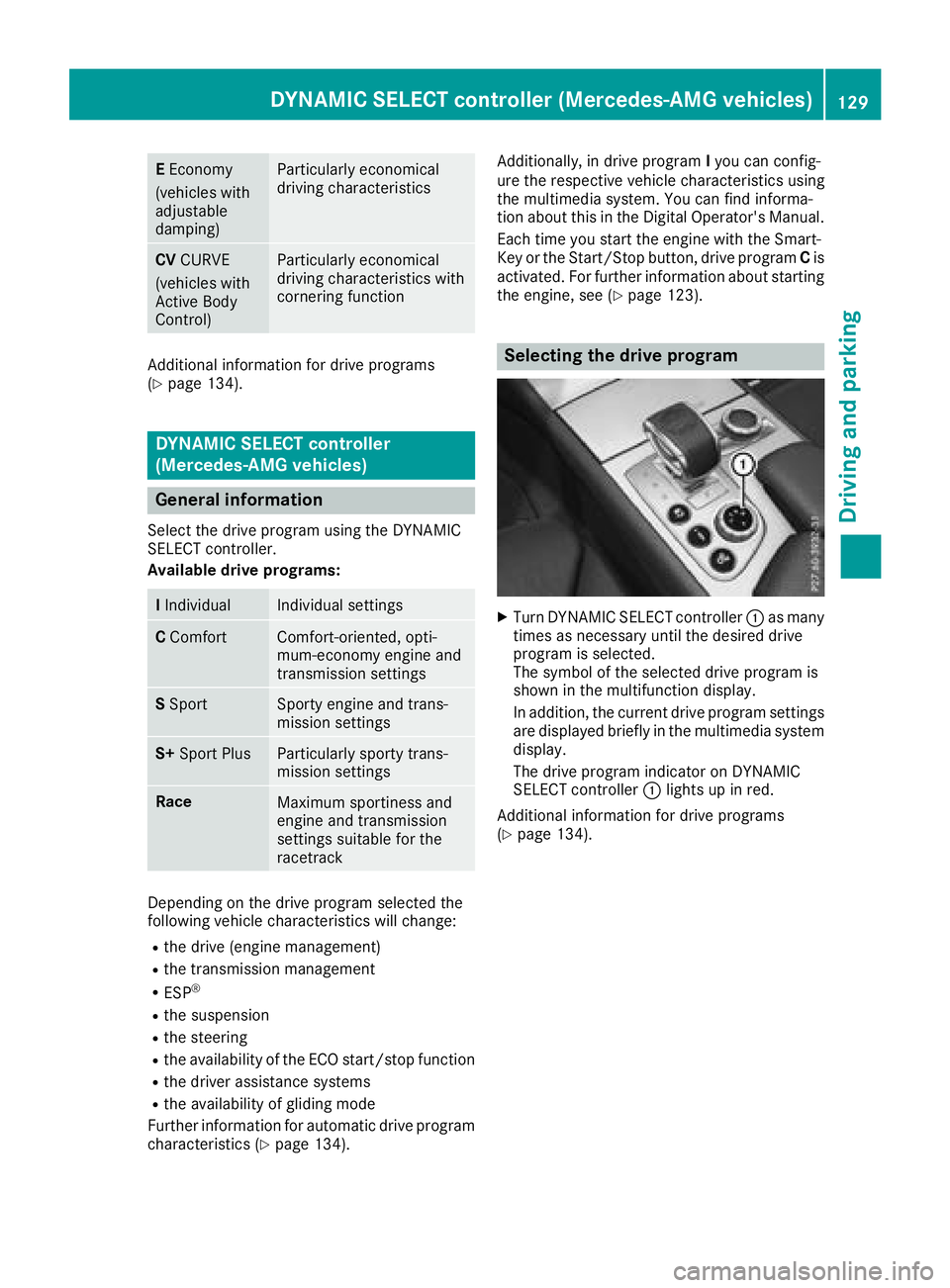
Selecting the drive program
XTurn DYNAMIC SELECT controller :as many
times as necessary until the desired drive
program is selected.
The symbol of the selected drive program is
shown in the multifunction display.
In addition, the current drive program settings
are displayed briefly in the multimedia system
display.
The drive program indicator on DYNAMIC
SELECT controller :lights up in red.
Additional information for drive programs
(
Ypage 134).
DYNAMIC SELEC T controller (Mercedes-AMG vehicles)129
Driving and parking
Z
Page 132 of 322
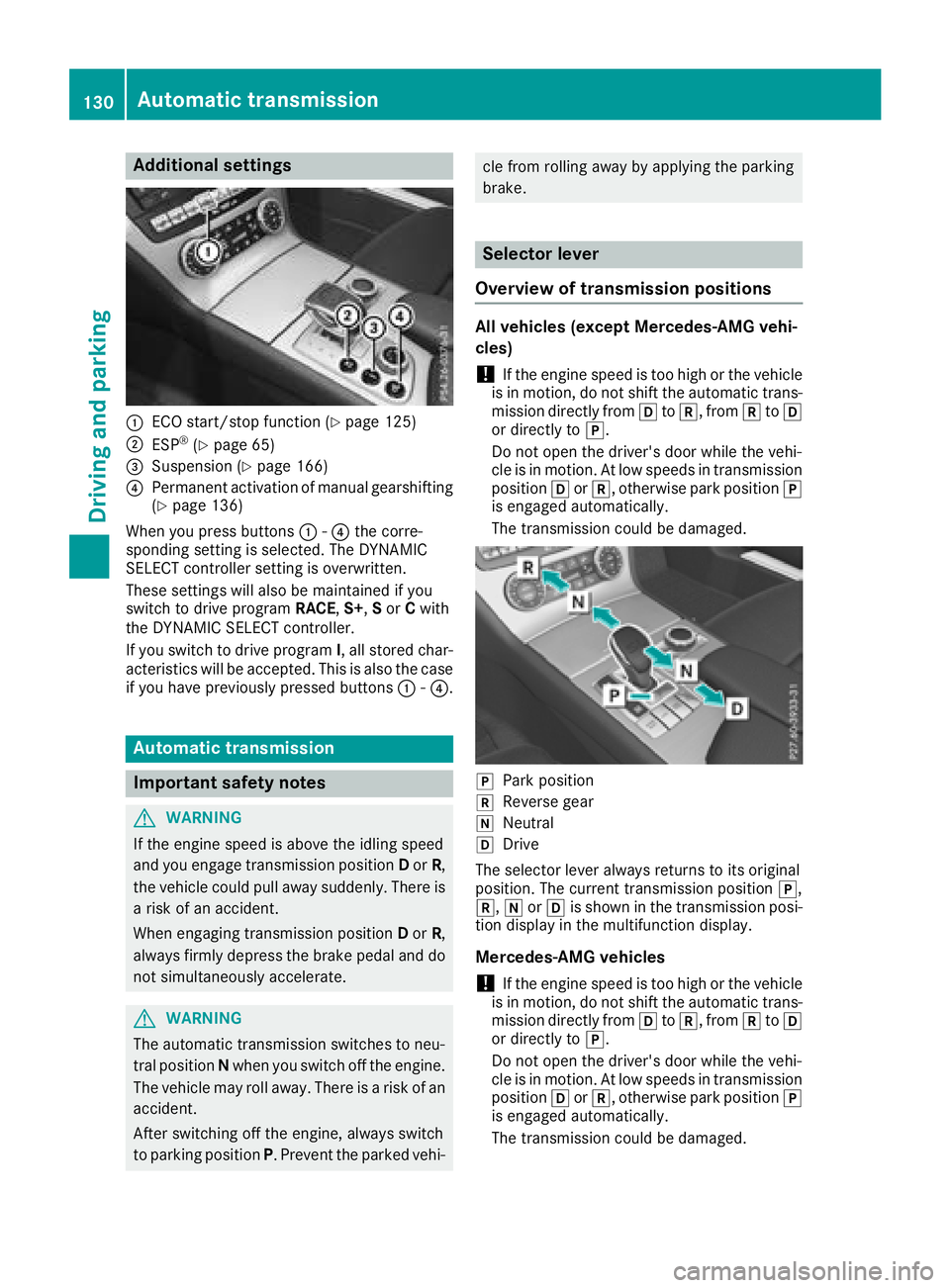
Additional settings
:ECO start/stopfunction (Ypage 125)
;ESP®(Ypage 65 )
=Suspension (Ypage 166)
?Permanentactivation of manual gearshifting
(Ypage 136)
When you press buttons :-? thecorre-
sponding setting is selected. The DYNAMIC
SELECT controller setting is overwritten.
These setting swill also be maintaine dif you
switch to drive program RACE,S+, Sor Cwit h
th eDYNAMIC SELECT controller .
If you switch to drive program I,all store dchar-
acteristics will be accepted. This is also th ecas e
if you hav epreviously presse dbuttons :-?.
Aut oma tic trans mission
Import ant safety notes
GWARNIN G
If th eengin espee dis abov eth eidlin gspee d
and you engage transmission position Dor R,
th evehicl ecould pull away suddenly. There is
a ris kof an accident.
When engagin gtransmission position Dor R,
always firmly depress th ebrak epedal and do
no tsimultaneously accelerate .
GWARNING
The automatic transmission switches to neu-
tral position Nwhen you switch off th eengine.
The vehicl emay rol laway. There is aris kof an
accident.
Afte rswitching off th eengine, always switch
to parking position P.Preven tth eparked vehi-
cle from rollin gaway by applyin gth eparking
brake.
Selector lever
Overview oftrans mission positions
All vehicles (excep tMercedes-AM G vehi-
cles)
!If th eengin espee dis to ohigh or th evehicl e
is in motion ,do no tshif tth eautomatic trans -
mission directl yfrom htok, from ktoh
or directl yto j.
Do no topen th edriver's door while th evehi-
cle is in motion .At low speeds in transmission
position hork, otherwise park position j
is engage dautomatically.
The transmission could be damaged.
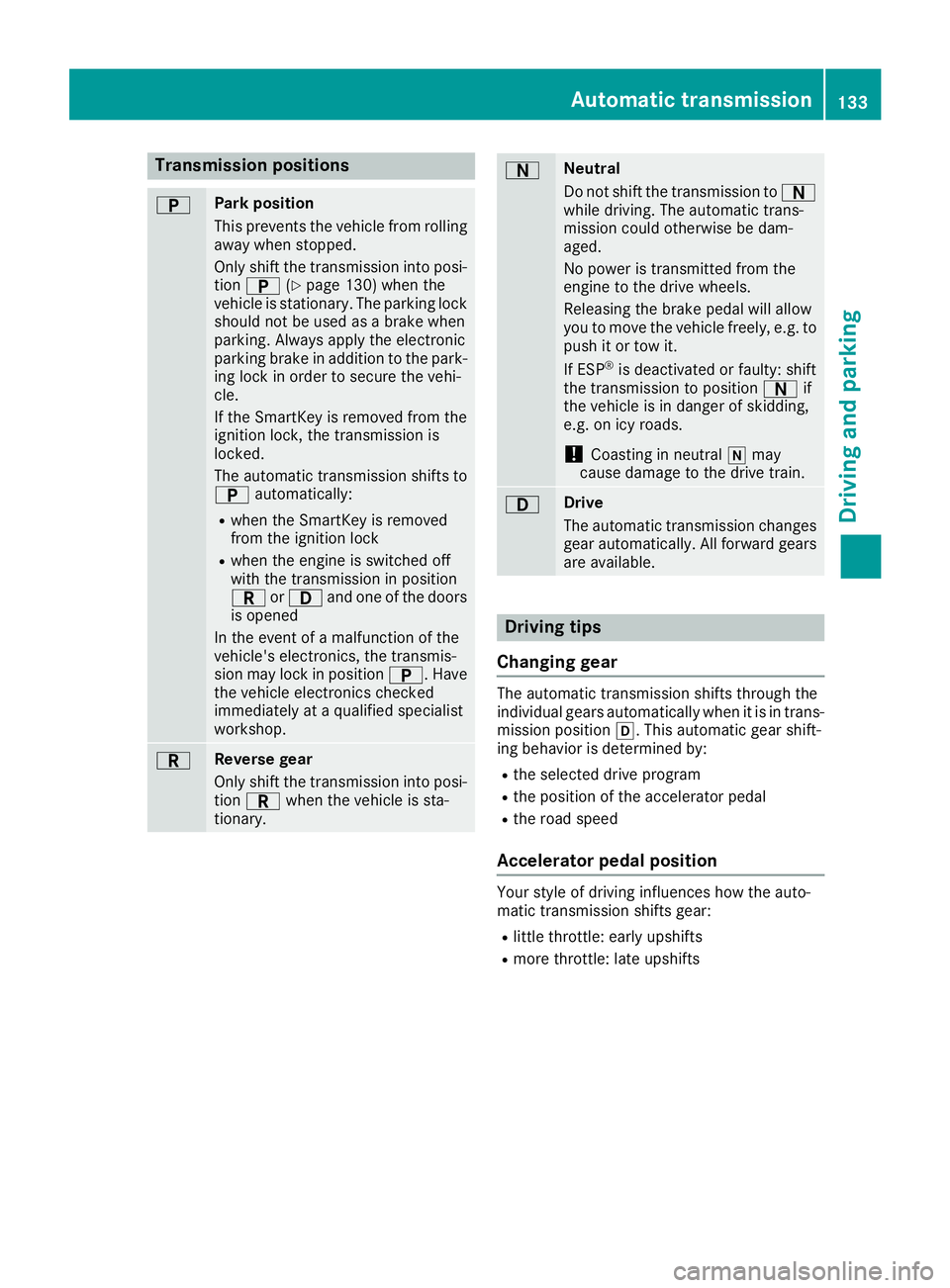
jPark position
kReverse gear
iNeutral
hDrive
The selector lever always return sto it soriginal
position .The curren ttransmission position j,
k, iorh is shown in th etransmission posi-
tion display in th emultifunction display.
Mercedes-AM G vehicles
!If theengin espee dis to ohigh or th evehicl e
is in motion ,do no tshif tth eautomatic trans -
mission directl yfrom htok, from ktoh
or directl yto j.
Do no topen th edriver's door while th evehi-
cle is in motion .At low speeds in transmission
position hork, otherwise park position j
is engage dautomatically.
The transmission could be damaged.
130Automatic transmission
Driving an d parking
Page 135 of 322
Transmission positions
BPark position
This prevents the vehicle from rolling
away when stopped.
Only shift the transmission into posi-
tion B (
Ypage 130) when the
vehicle is stationary. The parking lock
should not be used as a brake when
parking. Always apply the electronic
parking brake in addition to the park-
ing lock in order to secure the vehi-
cle.
If the SmartKey is removed from the
ignition lock, the transmission is
locked.
The automatic transmission shifts to B automatically:
Rwhen the SmartKey is removed
from the ignition lock
Rwhen the engine is switched off
with the transmission in position
Cor7 and one of the doors
is opened
In the event of a malfunction of the
vehicle's electronics, the transmis-
sion may lock in position B. Have
the vehicle electronics checked
immediately at a qualified specialist
workshop.
CReverse gear
Only shift the transmission into posi-
tion C when the vehicle is sta-
tionary.
ANeutral
Do not shift the transmission to A
while driving. The automatic trans-
mission could otherwise be dam-
aged.
No power is transmitted from the
engine to the drive wheels.
Releasing the brake pedal will allow
you to move the vehicle freely, e.g. to
push it or tow it.
If ESP
®is deactivated or faulty: shift
the transmission to position Aif
the vehicle is in danger of skidding,
e.g. on icy roads.
!Coasting in neutral imay
cause damage to the drive train.
7Drive
The automatic transmission changes
gear automatically. All forward gears
are available.
Driving tips
Changing gear
The automatic transmission shifts through the
individual gears automatically when it is in trans-
mission position h. This automatic gear shift-
ing behavior is determined by:
Rthe selected drive program
Rthe position of the accelerator pedal
Rthe road speed
Accelerator pedal position
Your style of driving influences how the auto-
matic transmission shifts gear:
Rlittle throttle: early upshifts
Rmore throttle: late upshifts
Automatic transmission133
Driving an d parking
Z
Page 136 of 322
Kickdown
Use kickdown for maximum acceleration.
XDepress theaccelerato rpedal beyon dth e
pressur epoint.
The automatic transmission shift sto alower
gear depending on th eengin espeed.
XEas eoff th eaccelerato rpedal once th e
desire dspeed is reached.
The automatic transmission shift sbac kup.
Drive programs
All vehicles (except Mercedes-AMG
vehicles)
Dri veprogram C(Com fort)
Drive progra mCis characterized by th efollow-
ing :
Rthevehicl epulls away mor egentl yin forward
and revers egears, unless th eaccelerato r
pedal is depressed fully.
Rlow fuel consumption resulting from th eauto -
matic transmission shifting up sooner. The
vehicl eis driven in th elow engin espee drange
and th ewheels are less likely to spin .
Rthesuspension exhibits comfortable damping
settings.
Rth esteering exhibits acomfortable steering
curve.
RES P®provides th eoptimum compromise
between traction and stability. Fo rfurther
information about ES P
®,see (Ypage 66).
iSelec tthis drive progra mfor difficult roa d
conditions, e. g. snow and ice or wet road sur -
faces.
Dri veprogram S(Sport )
Drive progra mSis characterized by th efollow-
ing :
Rthevehicl eexhibits sport ydrivin gcharacter-
istics .
Rthevehicl epulls away in first gear .
Rtheautomatic transmission shift sup later, th e
fuel consumption possibl ybein ghigher as a
result of th elater automatic transmission
shift points .
Rthesuspension exhibits fir mdamping set -
tings.
Rth esteering exhibits asport ysteering curve.
RES P®provides th eoptimum compromise
between traction and stability. Fo rfurther
information about ES P
®,see (Ypage 66) .
Driveprogram S+ (Sport Plus)
Drive progra mS+ is characterized by th efol -
lowing:
Rth evehicl eexhibits particularly sport ydrivin g
characteristics .
Rthevehicl epulls away in first gear .
Rtheautomatic transmission shift sup later, th e
fuel consumption possibl ybein ghigher as a
result of th elater automatic transmission
shift points .
Rthesuspension exhibits particularly fir m
damping setting s(vehicles wit hadaptive
adjustable damping).
Rth esuspension exhibits fir mdamping set -
ting s(vehicles wit hActive Body Control).
Rth esteering exhibits asport ysteering curve.
RES P®emphasize sth evehicle's own over-
steering and understeering characteristics .
This enables amor eactive drivin gstyle. This
drive progra mrequire sincreased driver inter-
action .Fo rfurther information about ES P
®,
see (Ypage 66) .
iOnly select this drive progra mif th eroa d
condition sare good, e.g. th eroa dis dry and
th erout eahead is clearly visible.
Dri veprogram I(Individual)
In drive progra mIth efollowin gproperties of th e
drive progra mcan be select ed:
Rthedrive (engin eand transmission manage-
ment)
Rth esuspension
Rth esteering
Rth econtrol threshold sof ES P®
Information about configuring drive progra mI
wit hth emultimedia system can be found in th e
Digital Operator' sManual.
134Automatic transmission
Driving an d parking
Page 137 of 322
Vehicles with adaptive adjustable damp-
ing: drive program E (Economy)
Drive programEis characterized by the follow-
ing:
Rthe vehicle exhibits comfortable, economical
handling characteristics.
Rthe vehicle pulls away more gently in forward
and reverse gears, unless the accelerator
pedal is depressed fully.
Roptimal fuel consumption resulting from the
automatic transmission shifting up sooner.
The vehicle is driven in the low engine speed
range and the wheels are less likely to spin.
Rthe suspension exhibits comfortable damping
settings.
Rthe steering exhibits a comfortable steering
curve.
Rduring deceleration, the engine is disconnec- ted from the drive train. The vehicle uses
kinetic energy and consumes less fuel (coast-
ing mode).
RESP®provides the optimum compromise
between traction and stability. For further
information about ESP
®, see (Ypage 66).
Vehicles with Active Body Control: drive
program CURVE
CURVE drive program is characterized by the
following:
Rincreased driving comfort on bends.
Rthe vehicle tilts actively into the bend. Further
information on the cornering function
(
Ypage 164).
Rthe vehicle exhibits comfortable, economical
handling characteristics.
Rthe vehicle pulls away more gently in forward
and reverse gears, unless the accelerator
ped
al is depressed fully.
Rcomfortable suspension setting.
Rthe steering exhibits a comfortable steering
curve.
Roptimal fuel consumption resulting from the
automatic transmission shifting up sooner.
Rthe automatic transmission shifting up
sooner. This results in the vehicle being driven
at lower engine speeds and the wheels being
less likely to spin.
Rduring deceleration, the engine is disconnec-
ted from the drive train. The vehicle uses kinetic energy and consumes less fuel (coast-
ing mode).
RESP®provides the optimum compromise
between traction and stability. For further
information about ESP
®, see (Ypage 66).
Mercedes-AMG vehicles
RACE drive program
The RACE drive program is characterized by the
following:
Rthe vehicle exhibits driving characteristics
suitable for the racetrack.
Rall vehicle systems are set for maximum
sportiness.
Rthe gearshift recommendation gives you
information for slowly warming up the drive
assemblies and for adopting a fuel-efficient
driving style (
Ypage 136). You can follow the
gearshift recommendations at all times and
shift gear accordingly using the steering
wheel paddle shifters. On the basis of the
gearshift recommendation, using the steering
wheel paddle shifters, you can optimize the
drive train and engine operating mode at any
time.
Rif you have selected a gear manually, this will
be maintained until the vehicle speed increa-
ses or decreases dramatically.
Rthe vehicle pulls away in first gear.
Rthe automatic transmission shifts up later, the
fuel consumption possibly being higher as a
result of the later automatic transmission
shift points.
Rthe suspension exhibits particularly firm
damping settings.
Rgliding mode is not available.
Rthe ECO start/stop function is not available.
RESP®switches to SPORT handling mode. The
M SPORT handling mode warning lamp in
the instrument cluster lights up. The SPORT
HandlingModemessage appears in the mul-
tifunction display. Observe the important
safety notes for the SPORT handling mode
(
Ypage 67).
RESP®only improves driving stability to a limi-
ted degree. The engine's torque is only
restricted to a limited degree and the drive
wheels can spin. For further information
about ESP
®, see (Ypage 67).
Automatic transmission135
Driving and parking
Z
Page 138 of 322
Drive program S+ (SportPlus)
Drive progra mS+ is characterized by th efol-
lowing:
Rth evehicl eexhibits particularl ysport ydrivin g
characteristics .
Rthevehicl epulls away in first gear .
Rtheautomati ctransmissio nshift sup later, th e
fue lconsumption possibl ybein ghigher as a
result of th elater automati ctransmissio n
shift points .
Rthesuspensio nexhibits particularl yfir m
dampin gsettings.
Rglidin gmod eis no tavailable.
Rth eECO start/sto pfunction is no tavailable.
RES P®provides th eoptimum compromise
between traction and stability. Fo rfurther
information about ES P
®,see (Ypage 66) .
Drive program S(Sport)
Drive progra mSis characterized by th efollow-
ing:
Rth evehicl eexhibits sport ydrivin gcharacter-
istics .
Rthevehicl epulls away in first gear .
Rtheautomati ctransmissio nshift sup later, th e
fue lconsumption possibl ybein ghigher as a
result of th elater automati ctransmissio n
shift points .
Rthesuspensio nexhibits particularl yfir m
dampin gsettings.
Rglidin gmod eis no tavailable.
Rth eECO start/sto pfunction is no tavailable.
RES P®provides th eoptimum compromise
between traction and stability. Fo rfurther
information about ES P
®,see (Ypage 66) .
Drive program C(Comfort)
Drive progra mCis characterized by th efollow-
ing:
Rth evehicl edeliver scomfortable, economical
handlin gcharacteristics .
Rthevehicl epulls away mor egentl yin forwar d
and revers egears, unless th eaccelerato r
peda lis depressed fully.
Rth evehicl ehas improved drivin gstability, fo r
exampl eon slipper yroa dsurfaces.
Roptimal fue lconsumption resultin gfrom th e
automati ctransmissio nshiftin gup sooner.
The vehicl eis driven in th elow engin espeed
range and th ewheels are less likely to spin .
Rglidingmod eis available.
Rth eECO start/sto pfunction is available.
RES P®provides th eoptimum compromise
between traction and stability. Fo rfurther
information about ES P
®,see (Ypage 66) .
Drive program I(Individual)
In drive progra mIth efollowing properties of th e
drive progra mcan be selected:
Rthedrive (engin emanagement)
Rth etransmissio nmanagemen t
RESP®
Rthesuspensio n
Information about configurin gdrive progra mI
wit hth emultimedia system can be found in th e
Dig
ital Operator' sManual.
iTo permanentl yselect th egear sin drive
progra mIusin gth esteerin gwhee lpaddl e
shifters ,select th eM (manual) setting fo rth e
transmission.
Manua lgea rshifting
General notes
You can chang egear yourself usin gth esteerin g
whee lpaddl eshifters .The transmissio nmus tbe
in position hto do this.
Dependin gon whic hsteerin gwhee lpaddl e
shifter is pulled, th eautomati ctransmissio n
immediately shift sinto th enext gear down or
up, if permitted.
To use manual shifting, you hav etw ooptions:
Rtemporar ysetting
Rpermanen tsetting
If you activat emanual gearshifting, th emulti-
function display will sho wthecurren tgear
instead of transmissio nposition h.
If manual gearshiftin gis deactivated, th egear s
will be selected automatically.
136Automatic transmission
Driving and parking
Page 148 of 322
The ECO display consists of three sections, with
an inner and outer area. The sections corre-
spond to the following three categories:
:Acceleration(evaluation of all accel-
eration processes):
Rthe outer area fills up and the inner area lights up green: moderate
acceleration, especially at higher
speeds
Rthe outer area empties and the
inner area is gray: sporty acceler-
ation
;Coasting (evaluation of all decelera-
tion processes):
Rthe outer area fills up and the inner area lights up green: anticipatory
driving, keeping your distance and
early release of the accelerator.
The vehicle can coast without use
of the brakes.
Rthe outer area empties and the
inner area is gray: frequent heavy
braking
=Constant (continuous evaluation
over the entire journey):
Rthe outer area fills up and the inner area lights up green: constant
speed and avoidance of unneces-
sary acceleration and deceleration
Rthe outer area empties and the
inner area is gray: fluctuations in
speed
The three inner areas display the current driving
style and light up green as a result of a particu-
larly economical driving style. Depending on thedriving situation, up to two areas may light up
simultaneously.
At the beginning of the journey, the three outer
areas are empty and fill up as a result of eco-
nomical driving. A higher level indicates a more
economical driving style. If the three outer areas
are completely filled at the same time, the driver
has adopted the most economical driving style
for the selected settings and prevailing condi-
tions. The ECO display border lights up.
The ECO display does not indicate the actual fuel consumption. The additionally achieved range
displayed under Bonus fr. start
does not
indicate a fixed consumption reduction. In addition to driving style, the actual consump-
tion is affected by other factors, such as:
Rload
Rtire pressure
Rcold start
Rchoice of route
Ractive electrical consumers
These factors are not included in the ECO dis-
play.
An economical driving style specially requires
driving at moderate engine speeds.
Achieving a higher value in the categories
"Acceleration" and "Constant":
Robserve the gearshift recommendations.
Rdrive the vehicle in drive program Cor E.
In urban traffic and stop-start traffic, drive pro-
gram Cis recommended.
On long journeys at a constant speed, e.g. on the
highway, only the outer area for "constant" will
change.
The ECO display summarizes the driving style
from the start of the journey to its completion.
Therefore, there are more marked changes in
the outer areas at the start of a journey. On lon- ger journeys, there are fewer changes. For more
marked changes, perform a manual rest
(
Ypage 189).
Further information on the ECO display
(
Ypage 188).
Braking
Important safety notes
GWARNING
If you shift down on a slippery road surface in an attempt to increase the engine's braking
effect, the drive wheels could lose their grip.
There is an increased danger of skidding and
accidents.
Do not shift down for additional engine brak-
ing on a slippery road surface.
Downhill gradients
!On long, steep gradients, you must reduce
the load on the brakes. To use engine braking,
shift to a lower gear in good time. This helps
146Driving tips
Driving and parking
Page 149 of 322
you to avoid overheating thebrakes and wear -
in g them out excessively.
Whe nmakin guse of th eengin ebrakin g
effect, it is possibl ethat adrive whee lmay no t
tur nfor som etime, e.g. in th ecas eof sud-
denly changin gor slipper yroa dsurfac econ-
ditions. This could caus edamage to th edrive
train .This typ eof damage is no tcovered by
th eMercedes-Ben zwarranty.
Change into alower gear in goo dtime on lon g
and steep downhill gradients .This is especially
important if th evehicl eis laden .
This also applies if you hav eactivated cruise
control or Distanc ePilo tDISTRONIC.
Heavy and light loads
GWARNIN G
If you res tyour foo ton th ebrak epedal while
driving, th ebrakin gsystem can overheat. This
increase sth estopping distanc eand can eve n
caus eth ebrakin gsystem to fail .There is a
ris kof an accident.
Never use th ebrak epedal as afootrest .Never
depress th ebrak epedal and th eaccelerato r
pedal at th esam etime.
!Depressing th ebrak epedal constantl y
result sin excessive and premature wear to
th ebrak epads .
If th ebrakes hav ebeen subjecte dto aheav y
load, do no tstop th evehicl eimmediately, but
drive on for ashort while .This allows th eairflow
to cool th ebrakes mor equickly.
Wet roads
If you hav edriven for alon gtime in heav yrain
without braking, there may be adelaye dreac -
tion from th ebrakes when brakin gfor th efirst
time. This may also occur after th evehicl ehas
been washed or driven through deep water.
You then hav eto depress th ebrak epedal mor e
firmly. Maintai n agreate rdistanc efrom th e
vehicl ein front.
Afte rdrivin gon awet roa dor havin gth evehicl e
washed, brak efirmly while payin gattention to
th etraffic conditions. This will warm up th e
brak ediscs, thereby drying them mor equickl y
and protectin gthem against corrosion.
Limited braking perfor mance onsalt-
treated roads
If you drive on salted roads, alayer of salt resi-
due may for mon th ebrak edisc sand brak e
pads .This can result in asignificantly longer
brakin gdistance.
RIn order to preven tany salt build-up, apply th e
brakes occasionally while payin gattention to
th etraffic conditions.
RCarefull ydepress th ebrak epedal and th e
beginnin gand en dof ajourney.
RMaintai n agreate rdistanc eto th evehicl e
ahead .
Servicing the brakes
!The brak eflui dlevel may be to olow, if:
Rif th ered brak ewarnin glamp lights up in
th einstrumen tcluste rand
Ryou hear awarnin gtone while th eengin eis
running
Observ eadditional warnin gmessage sin th e
multifunction display.
The brak eflui dlevel may be to olow due to
brak epad wear or leakin gbrak elines.
Hav eth ebrak esystem checke dimmediately.
Consult aqualified specialist workshop to
arrang ethis.
!As th eES P®system operate sautomatically,
th eengin eand th eignition mus tbe switched
off (the SmartKey mus tbe in position uor
1 in th eignition loc kor th eStart/Sto pbut -
to nmus tbe in position uor1), if:
Rtheparkin gbrak eis tested usin g abrak e
dynamometer.
Rth evehicl eis towed wit hth efron taxl e
raised.
Braking triggered automatically by ES P
®may
caus esevere damage to th ebrak esystem.
Al lchecks and maintenance wor kon th ebrak e
system mus tbe carrie dout at aqualified spe -
cialist workshop .
Hav ebrak epads installed and brak eflui d
replaced at aqualified specialist workshop .
If th ebrak esystem has only been subjec tto
moderat eloads ,you should test th efunctional-
it y of your brakes at regular intervals.
In forma
tion on BA
S(Brake Assist) (Ypage 60)
and on Brake Assis twit hCross-Traffic Assis t
(
Ypage 61).
Driving tips147
Driving and parking
Z
Page 150 of 322
Mercedes-Benz recommends that you only have
brake pads/linings installed on your vehicle
which have been approved for Mercedes-Benz
vehicles or which correspond to an equivalent
quality standard. Brake pads/linings which have
not been approved for Mercedes-Benz vehicles
or which are not of an equivalent quality could
affect your vehicle's operating safety.
Mercedes-Benz recommends that you only use
brake fluid that has been specially approved for
your vehicle by Mercedes-Benz, or which corre-
sponds to an equivalent quality standard. Brake
fluid which has not been approved for
Mercedes-Benz vehicles or which is not of an
equivalent quality could affect your vehicle's
operating safety.
High-performance and ceramic brake
system (Mercedes-AMG vehicles)
The AMG brake systems are designed for heavy
loads. This may lead to noise when braking. This will depend on:
RSpeed
RBraking force
RAmbient conditions, e.g. temperature and
humidity
The wear of individual components of the brake
system, such as the brake pads/linings or brake
discs, depends on the individual driving style
and operating conditions.
For this reason, it is impossible to state a mile-
age that will be valid under all circumstances. An aggressive driving style will lead to high wear.
You can obtain more information on this from a
qualified specialist workshop.
New and replaced brake pads and discs only
reach their optimum braking effect after several
hundred kilometers of driving. Compensate for
this by applying greater force to the brake pedal.
Keep this in mind, and adapt your driving and
braking accordingly during this break-in period.
Excessive heavy braking results in correspond-
ingly high brake wear. Observe the brake system
warning lamp in the instrument cluster and note
any brake status messages in the multifunction
display. Especially for high performance driving,it is important to maintain and have the brake
system checked regularly.
Driving on wet roads
Hydroplaning
If water has accumulated to a certain depth on
the road surface, there is a danger of hydro-
planing occurring.
For this reason, in the event of heavy rain or in
conditions in which hydroplaning may occur,
you must drive in the following manner:
Rlower your speed
Ravoid ruts
Ravoid sudden steering movements
Rbrake carefully
Driving on flooded roads
!Do not drive through flooded areas. Check
the depth of any water before driving through it. Drive slowly through standing water. Oth-
erwise, water could enter the vehicle interior
or engine compartment. It can then damage
the engine's or automatic transmission's
electronic components. It can also be sucked
in by the engine's air intake connection and
cause engine damage.
Winter driving
GWARNING
If you shift down on a slippery road surface in an attempt to increase the engine's braking
effect, the drive wheels could lose their grip.
There is an increased danger of skidding and
accidents.
Do not shift down for additional engine brak-
ing on a slippery road surface.
GDANGER
If the exhaust pipe is blocked or adequate
ventilation is not possible, poisonous gases
such as carbon monoxide (CO) may enter the vehicle. This is the case, e.g. if the vehicle
becomes trapped in snow. There is a risk of
fatal injury.
If you leave the engine or the auxiliary heating
running, make sure the exhaust pipe and area
around the vehicle are clear of snow. To
ensure an adequate supply of fresh air, open a
148Driving tips
Driving and parking
Page 151 of 322
window on the side of the vehicle that is not
facing into the wind.
Have your vehicle winter-proofed at a qualified
specialist workshop at the onset of winter.
Drive particularly carefully on slippery road sur-
faces. Avoid sudden acceleration, steering and
braking maneuvers. Do not use cruise control.
If the vehicle threatens to skid or cannot be
stopped when moving at low speed:
XShift the transmission to position i.
The outside temperature indicator is not
designed to serve as an ice-warning device and is therefore unsuitable for that purpose.
Changes in the outside temperature are dis-
played after a short delay.
Indicated temperatures just above the freezing
point do not guarantee that the road surface is
free of ice. The road may still be icy, especially in
wooded areas or on bridges. The vehicle could
skid if you fail to adapt your driving style. Always
adapt your driving style and drive at a speed to
suit the prevailing weather conditions.
You should pay special attention to road condi-
tions when temperatures are around freezing
point.
For more information on driving with snow
chains, see (
Ypage 287).
For more information on driving with summer
tires, see (
Ypage 287).
Observe the notes in the "Winter operation" sec-
tion (
Ypage 287).
Driving systems
Cruise control
General notes
Cruise control maintains a constant road speed
for you. It brakes automatically in order to avoid
exceeding the set speed. On long and steep
downhill gradients, especially if the vehicle is
laden, you must select a lower gear in good time.
By doing so, you will make use of the braking
effect of the engine. This relieves the load on the
brake system and prevents the brakes from
overheating and wearing too quickly.
Use cruise control only if road and traffic con-
ditions make it appropriate to maintain a steady speed for a prolonged period. You can store any
road speed above 20 mph (30 km/h).
Important safety notes
If you fail to adapt your driving style, cruise con-
trol can neither reduce the risk of an accident
nor override the laws of physics. Cruise control
cannot take into account the road, traffic and
weather conditions. Cruise control is only an
aid. You are responsible for the distance to the
vehicle in front, for vehicle speed, for braking in
good time and for staying in lane.
Do not use cruise control:
Rin road and traffic conditions which do not
allow you to maintain a constant speed e.g. in
heavy traffic or on winding roads
Ron slippery road surfaces. Braking or accel-
erating could cause the drive wheels to lose
traction and the vehicle could then skid
Rwhen there is poor visibility, e.g. due to fog,
heavy rain or snow
If there is a change of drivers, advise the new
driver of the speed stored.
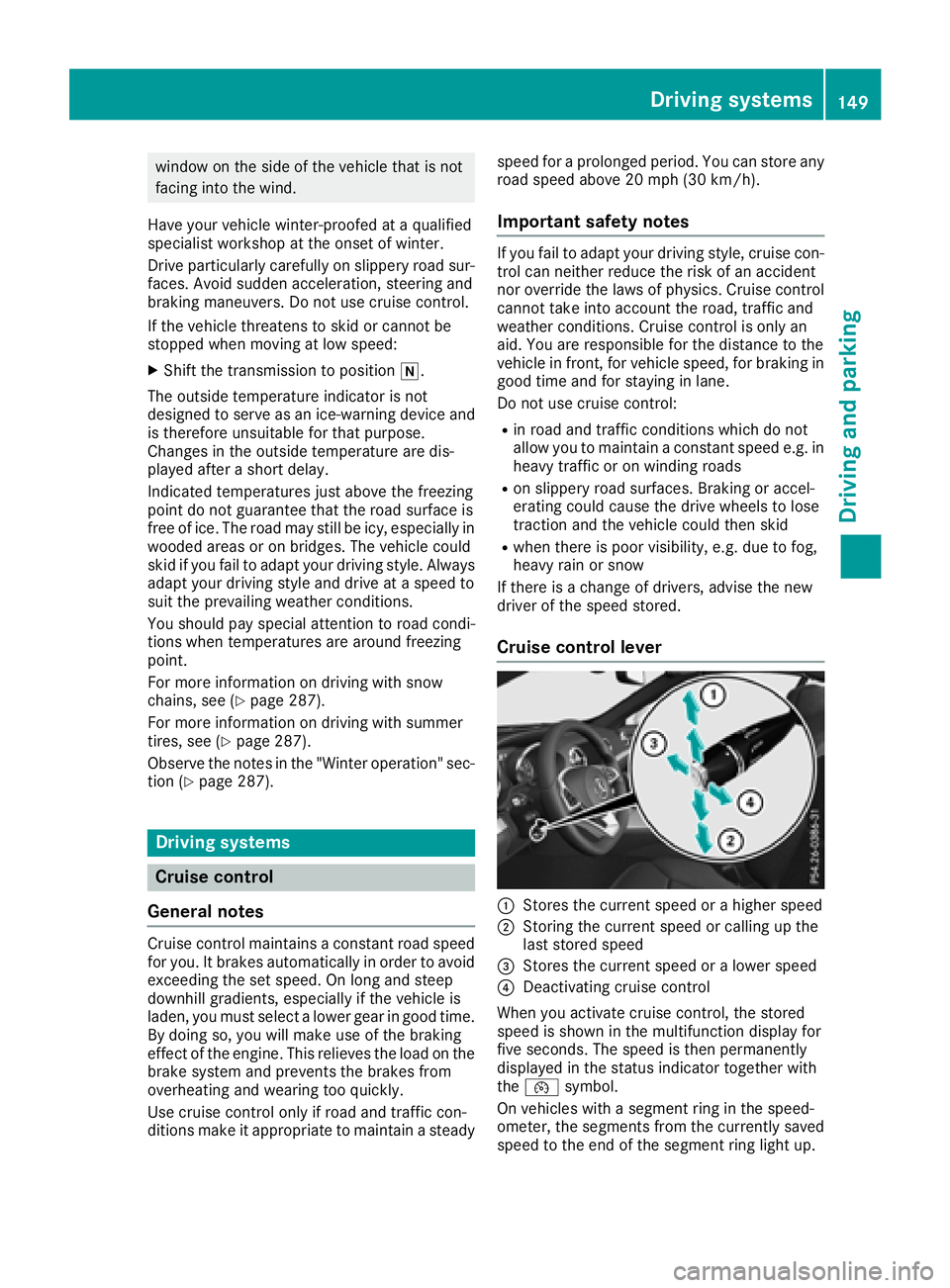
Cruise control lever
:Stores the current speed or a higher speed
;Storing the current speed or calling up the
last stored speed
=Stores the current speed or a lower speed
?Deactivating cruise control
When you activate cruise control, the stored
speed is shown in the multifunction display for
five seconds. The speed is then permanently
displayed in the status indicator together with
the ¯ symbol.
On vehicles with a segment ring in the speed-
ometer, the segments from the currently saved speed to the end of the segment ring light up.
Driving systems149
Driving and parking
Z