brake MERCEDES-BENZ SLC 2017 User Guide
[x] Cancel search | Manufacturer: MERCEDES-BENZ, Model Year: 2017, Model line: SLC, Model: MERCEDES-BENZ SLC 2017Pages: 294, PDF Size: 9.12 MB
Page 25 of 294
systems, e.g. the brake system. Use only genu-
ine Mercedes-Benz parts or parts of equa lq ual-
ity. Only use tires, wheels and accessories that
have been specifically approved for your vehi-
cle.
Genuine Mercedes-Benz parts are subject to
strict quality control. Every part has been spe-
cifically developed ,m anufactured or selected
for and adapted to Mercedes-Benz vehicles.
Therefore, only genuine Mercedes-Benz parts
should be used.
More than 300,000 different genuine
Mercedes-Benz parts are available for
Mercedes-Benz models.
All authorized Mercedes-Benz Centers maintain
as upply of genuine Mercedes-Benz parts for
necessary service and repair work. In addition,
strategically located parts delivery centers pro-
vide quick and reliable parts service.
Always specify the vehicle identification number
(VIN) when ordering genuine Mercedes-Benz
parts ( Y
page 283).
Operator's Manual
Vehicle equipment
i This Operator's Manual describes all models
and all standard and optional equipment of
your vehicle available at the time of going to
print. Country-specific differences are possi-
ble. Bear in mind that your vehicle may not
feature all functions described here. This also
applies to safety-relevant systems and func-
tions. The equipment in your vehicle may
therefore differ from that shown in the
descriptions and illustrations.
The original purchase agreement lists all sys-
tems installed in your vehicle.
Should you have any questions concerning
equipment and operation, please consult an
authorized Mercedes-Benz Center.
The Operator's Manual and Maintenance Book-
let are important documents and should be kept
in the vehicle.
Service and vehicl eo peration
Warranty
The implied warranty for your vehicle applies in
accordance with the warranty terms and condi- tions in the Service and Warranty Information
booklet.
Your authorized Mercedes-Benz Center will
replace and repair all factory-installe dp arts in
accordance with the following warranty terms
and conditions: R
New Vehicle Limited Warranty R
Emission System Warranty R
Emission Performance Warranty R
California, Connecticut ,M aine, Massachu-
setts, New York, Pennsylvania, Rhode Island
and Vermont Emission Control System War-
ranty R
State warranty enforcemen tl aws (lemon
laws)
Replacement parts and accessories are covered
by the Mercedes-Benz Parts and Accessories
warranties. These are available at any author-
ized Mercedes-Benz Center.
i Should you lose your Service and Warranty
Information booklet, have an authorized
Mercedes-Benz Center arrange for ar eplace-
ment. The new Service and Warranty Infor-
mation booklet will be posted to you.
Information for customers in Califor-
nia Under California law you may be entitled to a
replacement of your vehicle or ar efund of the
purchase price or lease price, if after ar eason-
able number of repair attempts Mercedes-Benz
USA, LLC and/or its authorized repair or service
facilities fail to fix one or more substantial
defects or malfunctions in the vehicle that are
covered by its express warranty.
During the period of 18 months from original
delivery of the vehicle or the accumulation of
18,000 miles (approximately 29,000 km) on the
odometer of the vehicle, whichever occurs first,
ar easonable number of repair attempts is pre-
sumed for ar etail buye rorl essee if one or more
of the following occurs:
(1) the same substantial defect or malfunction
results in ac ondition that is likely to cause
death or serious bodily injury if the vehicle is
driven, that defect or malfunction has been
subject to repair two or more times, and youService and vehicle operation 23
Introduction Z
Page 29 of 294
The following text is published as required of
manufacturers under Title 49, Code of U.S. Fed-
eral Regulations, Part 575 pursuant to the
"National Traffic and Motor Vehicle Safety Act of
1966".
If you believe that your vehicle has ad efect
which could cause ac rash or could cause injury
or death, you should immediately inform the
National Highway Traffic Safety Administration
(NHTSA )ina ddition to notifying Mercedes-Benz
USA ,L LC.
If NHTSA receives similar complaints ,itm ay
open an investigation, and if it finds that as afety
defect exists in ag roup of vehicles, it may order
ar ecall and remedy campaign. However, NHTSA
cannot become involved in individual problems
between you, your dealer, or Mercedes-Benz
USA ,L LC.
To contact NHTSA ,y ou may call the Vehicle
Safety Hotlin et oll-free at
1-888-327-4236(TTY: 1-800-424-9153 ); go to
http://www.safercar.gov ;orw rite to: Admin-
istrator ,N HTSA ,4 00 Sevent hS treet, SW.,
Washington ,DC2 0590.
You can also obtain other information about
motor vehicle safety from
http://www.safercar.gov
Limited Warranty
! Follow the instructions in this manual about
the proper operation of your vehicle as well as
about possible vehicle damage. Damage to
your vehicle that arises from culpable contra-
ventions against these instructions is not cov-
ered either by the Mercedes-Benz Limited
Warranty or by the New or Used-Vehicle War-
ranty.
QR codes for the rescue card
The QR codes are secured in the fuel filler flap
and on the opposite side on the B-pillar. In the
event of an accident ,r escue services can use
the QR code to quickly find the appropriate res-
cue card for your vehicle. The current rescue
card contains the most important information
about your vehicle in ac ompact form, e.g. the
routing of the electric cables.
You can find more information under http://
portal.aftersales.i.daimler.com/public/ content/asportal/en/communication/
informationen_fuer/QRCode.html.
Data stored in the vehicle
Data storage Aw ide range of electronic components in your
vehicle contain data memories.
These data memories temporarily or perma-
nently store technical information about: R
vehicle's operating state R
incidents R
malfunctions
In general, this technical information docu-
ment st he state of ac omponent, am odule, a
system or the surroundings.
These include, for example: R
operating conditions of system components,
e.g. fluid levels R
the vehicle's status messages and those of its
individual components, e.g. number of wheel
revolutions/speed, deceleration in move-
ment ,l ateral acceleration, accelerator pedal
position R
malfunction sa nd defects in important system
components, e.g. lights, brakes R
vehicle reaction sa nd operating conditions in
special driving situations, e.g. air bag deploy-
ment ,i ntervention of stability control sys-
tems R
ambient conditions, e.g. outside temperature
This data is of an exclusively technical nature
and can be used to: R
assist in recognizing and rectifying malfunc-
tions and defects R
analyze vehicle functions, e.g. after an acci-
dent R
optimize vehicle function
The data cannot be used to trace the vehicle's
movements.
When your vehicle is serviced, technical infor-
mation can be read from the event data memory
and malfunction data memory.
Services include, for example: R
repair services R
service processes R
warranties R
quality assuranceData stored in the vehicle 27
Introduction Z
Page 30 of 294
The vehicle is read out by employees of the ser-
vice network (including the manufacturer) using
special diagnostic testers. More detailed infor-
mation is obtained from it, if required.
After am alfunction has been rectified, the infor-
mation is deleted from the malfunction memory
or is continually overwritten.
When operating the vehicle, situations are con-
ceivable in which this technical data, in connec-
tion with other information (if necessary, under
consultation with an authorized expert), could
be traced to ap erson.
Examples include: R
accident reports R
damage to the vehicle R
witness statements
Further additional functions that have been con-
tractually agreed upon with the customer allow
certain vehicle data to be conveyed by the vehi-
cle as well. The additional functions include, for
example, vehicle location in case of an emer-
gency.
COMAND/mbrace (Canada: TELEAID) If the vehicle is equipped with COMAND or
mbrace, additional data about the vehicle's
operation, the use of the vehicle in certain sit-
uations, and the location of the vehicle may be
compiled through COMAND or the mbrace sys-
tem.
For additional information please refer to the
COMAND User Manual or the Digital Operator's
Manual and/or the mbrace Terms and Condi-
tions.
Event dat ar ecordersThis vehicle is equipped with an event data
recorder (EDR). This vehicle is equipped with an
event data recorder (EDR). The main purpose of
an ED Ristor ecord, in certain crash or near
crash-lik es ituations, such as an air bag deploy-
ment or hittin gar oad obstacle, data that will
assist in understanding how av ehicle's systems
performed. The ED Risd esigned to record data
related to vehicle dynamics and safety systems
for as hort period of time, typically 30 seconds
or less. The ED Rint his vehicle is designed to record
such data as: R
How various systems in your vehicle were
operating R
Whether or not the driver and passenger
safety belts were buckled/fastened R
How far (if at all) the driver was depressing the
accelerator and/or brake pedal and R
How fast the vehicle was traveling.
These data can help provide ab etter under-
standin goft he circumstances in which acci-
dents and injuries occur. NOTE: ED Rd ata are
recorded by your vehicle only if an on-trivial
crash situation occurs; no data is recorded by
the ED Ru nder normal driving conditions and no
personal data (e.g. name, gender, age and acci-
dent location) are recorded. However, other par-
ties, such as law enforcement could combine
ED Rd ata with the type of personally identifying
data routinely acquired during ac rash investi-
gation.
Access to the vehicle and/or the ED Risn eeded
to read data that is recorded by the EDR, and
special equipment is required. In addition to the
vehicle manufacturer, other parties that have
the special equipment, such as law enforce-
ment ,c an read the information by accessing the
vehicle or the EDR.
ED Rd ata may be used in civil and criminal mat-
ters as at ool in accident reconstruction, acci-
dent claims and vehicle safety. Sinc et he Crash
Data Retrieval CDR tool that is used to extract
data from the ED Risc ommercially available,
Mercedes-Benz USA ,L LC ("MBUSA") expressly
disclaims any and all liability arising from the
extraction of this information by unauthorized
Mercedes-Benz personnel.
MBUSA will not share ED Rd ata with others
without the consen toft he vehicle owners or, if
t he vehicle is leased, without the consen toft he
lessee. Exceptions to this representation
include responses to subpoenas by law enforce-
ment ;byf ederal, state or local government; in
connection with or arising out of litigation involv-
ing MBUSA or its subsidiaries and affiliates; or,
as required by law.
Warning: The ED Risac omponent of the
Restraint System Module. Tampering with, alter-
ing, modifying or removing the ED Rc omponent
may result in am alfunction of the Restraint Sys-
tem Module and other systems.
Stat el aws or regulations regarding EDRs that
conflict with federal regulation are pre-empted.28
Data stored in the vehicle
Introduction
Page 54 of 294
G WARNING
If you leave children unsupervised in the vehi-
cle, they coul ds et it in motion by, for example:R
release the parking brake. R
shift the automatic transmission out of the
parking position P .R
start the engine.
In addition, they may operate vehicl ee quip-
ment and become trapped. There is ar isk of
an accident and injury.
When leaving the vehicle, alway st ake the
SmartKey with you and lock the vehicle. Never
leave children unsupervised in the vehicle.
G WARNING
If persons, particularl yc hildren are subjected
to prolonged exposure to extreme hea to r
cold, there is ar isk of injury ,p ossibly even
fatal .N ever leave children unattended in the
vehicle.
G WARNING
If the child restraint system is subjected to
direct sunlight, parts may get very hot. Chil-
dren may burn themselves on these parts,
particularl yont he metal parts of the child
restraint system. There is ar isk of injury.
If you leave the vehicle, taking the child with
you ,a lway se nsure that the child restraint
system is not expose dtod irect sunlight. Pro-
tect it with ab lanket, for example. If the child
restraint system has been expose dtod irect
sunlight, let it cool dow nb efore securing the
child in it. Never leave children unattended in
the vehicle.
Always ensure that all vehicl eo ccupants have
their seat belts fastened correctly and are sitting
properly .P articular attention must be pai dt o
children.
Observe the safety notes on the seat belt
( Y
pag e3 9) and the notes on correct use of seat
belts ( Y
pag e4 0).
Ab ooster seat may be necessary to achieve
prope rs eat bel tp ositioning for children over
41 lbs (18 kg )u ntil they reach ah eight where a three-point seat bel tc an be properly fastened
without ab ooster seat.
Special seat bel tr etractor
G WARNING
If the seat bel tisr eleased while driving, the
child restraint system wil lnol onger be
secure dp roperly .T he special seat bel tr etrac-
tor is disable da nd the inertia real draw sina
portion of the seat belt. The seat bel tc annot
be immediatel yr efastened. There is an
increased risk of injury ,p ossibly even fatal.
Stop the vehicl ei mmediately, paying atten-
tion to road and traffic conditions. Reactivate
the special seat bel tr etractor and secure the
child restraint system properly.
The seat bel tont he front-passenge rs ide is
equipped with as pecial seat bel tr etractor.
When activated, the special seat bel tr etractor
ensure st hat the seat bel tw il ln ot slacken once
the child restraint system has been secured.
Installing ac hild restraint system: X
Always comply with the child restraint system
manufacturer's installation instructions. X
Pul lt he seat bel ts moothly out of the belt
loop. X
Engage the seat bel tt ongue in the bel tb uckle.
Activating the special seat bel tr etractor:X
Pul lt he seat bel to ut full ya nd let the inertia
reel retract it again.
Whil et he seat bel tisr etracting, you should
hear ar atcheting sound .T he special seat belt
retractor is activated. X
Push the child seat restraint system dow ns o
that the seat bel tist ight and does not loosen.
Removing ac hild restraint system and deacti-
vating the special seat bel tr etractor:X
Always comply with the child restraint system
manufacturer's installation instructions. X
Press the release button of the bel tb uckle,
hold the bel tt ongue firmly and guide it back
toward sb el tl oop.
The special seat bel tr etractor is deactivated.52
Children in the vehicle
Safety
Page 56 of 294
instructions and safet yn otes on the "Occupant
Classification System (OCS)" ( Y
page 44).
You can thus avoid the risk st hat could arise as
ar esult of: R
an incorrectly categorized perso nint he front-
passenger seat R
the unintentional deactivatio noft he front-
passenger front air bag R
the unsuitable positionin goft he child
restraint system, e.g. too clos etot he dash-
board
Rearward-facing child restraint system If it is absolutely necessary to install ar earward-
facin gc hild restraint system on the front-
passenger seat, always make sure that the
front-passenge rf ront air bag is deactivated.
Only if the PASSENGER AI RB AG OFF indicator
lamp is permanently lit ( Y
page 38) is the front-
passenger front air bag deactivated.
Always observe the child restraint system man-
ufacturer' si nstallation and operating instruc-
tions.
Forward-facing child restraint system If you secur eac hild in af orward-facin gc hild
restraint system on the front-passenge rs eat,
always move the front-passenge rs eat as far
back as possible .T he entire base of the child
restraint system must always rest on the seat
cushio noft he front-passenge rs eat. The back-
rest of the child restraint system must lie as flat
as possible against the backrest of the front-
passenger seat. The child restraint system must
not touc ht he roof or be subjected to al oad by
the head restraint .A djust the angle of the seat
backrest and the head restraint position accord-
ingly. Always make sure that the shoulder belt
strap is correctly routed fro mt he front-
passenger seat belt loop to the shoulder belt
guide on the child restraint system. The shoul-
der belt strap must be routed forwards and
downwards fro mt he front-passenge rs eat belt
loop.
Always observe the child restraint system man-
ufacturer' si nstallation and operating instruc-
tions. Pets in th ev ehicle
G WARNING
If you leave animals unattended or unsecured
in the vehicle, the yc ould press buttons or
switches, for example.
As ar esult ,t he yc ould: R
activat ev ehicle equipmen ta nd become
trapped, for example R
activat eord eactivat es ystems, thereby
endangerin go ther road users
Unsecure da nimals could also be flung around
the vehicle in the even tofana ccident or sud-
den steerin gorb raking, thereby injuring vehi-
cle occupants. There is ar isk of an accident
and injury.
Never leave animals unattended in the vehi-
cle. Always secur ea nimals properly during
the journey, e.g. use as uitable animal trans-
port box.
Driving safety systems
Overview of driving safety systems In this section, you will fin di nformation about
the followin gd rivin gs afet ys ystems:R
AB S( A nti-lock B raking S ystem)
( Y
page 55) R
BA S( B rake A ssist S ystem) ( Y
page 55)R
Activ eB rak eA ssist ( Y
page 56)R
ESP ®
( E lectronic S tability P rogram)
( Y
page 58) R
EB D( E lectronic B ra ke force D istribution)
( Y
page 61) R
ADAPTIVE BRAKE ( Y
page 61)
Important safety notes
If you fail to adapt your drivin gs tyle or if you are
inattentive, the drivin gs afet ys ystems can nei-
the rr educ et he risk of an accident nor override
the laws of physics .D ri vin gs afet ys ystems are
merely aids designed to assist driving. You are
responsible for maintainin gt he distanc etot he
vehicle in front ,f or vehicle speed, for braking in54
Driving safety systems
Safety
Page 57 of 294
good time, and for staying in lane. Always adapt
your driving style to suit the prevailing road and
weather conditions and maintain as afe distance
from the vehicle in front .D rive carefully.
The driving safety systems described only work
as effectively as possible when there is ade-
quate contact between the tires and the road
surface. Pay particular attention to the informa-
tion regarding tires, recommended minimum
tire tread depths etc. in the "Wheels and tires"
section ( Y
page 255).
In wintry driving conditions, always use winter
tires (M+S tires) and if necessary, snow chains.
Only in this way will the driving safety systems
described in this section work as effectively as
possible.
ABS (Anti-lock Braking System)
General information ABS regulates brake pressure in such aw ay that
the wheels do not lock when you brake. This
allows you to continue steering the vehicle when
braking.
The % ABS warning lamp in the instrument
cluster lights up when the ignition is switched
on. It goes out when the engine is running.
ABS works from as peed of about 5m ph
(8 km/h), regardless of road-surface conditions.
ABS works on slippery surfaces, even when you
only brake gently.
Important safety notes
i Observe the "Important safety notes" sec-
tion ( Y
page 54).
G WARNING
If ABS is faulty, the wheels could lock when
braking. The steerability and braking charac-
teristics may be severely impaired. Addition-
ally ,f urther driving safety systems are deac-
tivated. There is an increased danger of skid-
ding and accidents.
Drive on carefully. Have ABS checked imme-
diately at aq ualified specialist workshop.
When ABS is malfunctioning, other systems,
including driving safety systems, will also
become inoperative. Observe the information
on the ABS warning lamp ( Y
page 204) and dis- play messages which may be shown in the
instrument cluster ( Y
page 179).
Braking X
If ABS intervenes: continue to depress the
brake pedal vigorously until the braking sit-
uation is over. X
To make af ull brake application: depress
the brake pedal with full force.
If ABS intervenes when braking, you will feel a
pulsing in the brake pedal.
The pulsating brake pedal can be an indication
of hazardous road conditions, and functions as a
reminder to take extr ac are while driving.
BAS (Brake Assist System)
General information BAS operates in emergenc yb raking situations.
If you depress the brake pedal quickly, BAS
automatically boosts the braking force, thus
shortening the stopping distance.
Important safety notes
i Observe the "Important safety notes" sec-
tion ( Y
page 54).
G WARNING
If BAS is malfunctioning, the braking distance
in an emergenc yb raking situation is
increased. There is ar isk of an accident.
In an emergenc yb raking situation, depress
the brake pedal with full force. ABS prevents
the wheels from locking.
Braking X
Keep the brake pedal firmly depressed until
the emergenc yb raking situation is over.
ABS prevent st he wheels from locking.
The brakes will function as usual once you
release the brake pedal. BAS is deactivated.Driving safety systems 55
Safety Z
Page 58 of 294
Active Brak eA ssist
Gene ra li nf orm ation
i Observ et he "Importan ts afet yn otes "s ec -
tion ( Y
page 54).
Active Brake Assis tc onsists of ad istanc ew arn -
ing function wit hana utonomous braking func-
tion and Adaptive Brake Assist.
Active Brake Assis tc an help you to minimiz et he
ris kofac ol lision wit ht he vehicl einf ront or
reduce th ee ffects of suc hac ol lision .
If Active Brake Assis td etects that there is ar is k
of collision ,y ou will be warned visually and
acoustically. If you do no tr eac ttot he visual and
audible collision warning ,a utonomous braking
can be initiate dinc riti cal situations. If you apply
th eb rak ey ourself in ac riti cal situation ,A da p-
tive Brake Assis toft he Active Brake Assis ts ys-
te ms upport sy ou.
Import ant safety notesIn particular, th ed etection of obstacles can be
impaire di f:R
there is dir tont he sensor sora nythin ge lse
covering th es ensor sR
there is snow or heav yr ainR
there is interferenc ebyo th er radar source sR
there are stron gr adar reflections, for exam-
ple in parking garages R
an arrow vehicl eist ra veling in front, e.g. a
motorbik eR
av ehicl eist ra veling in fron tonad ifferen tl in eR
ne wv ehicles or after servicing is carrie do ut
on th eA ctiv eB ra ke Assis ts ystem
Observ et he important safet yn otes in th e
"Breaking-in notes" section ( Y
page 114).
Followin gd amag etot he fron te nd of th ev ehicle,
hav et he configuration and operation of th e
radar sensor checke dataq ualified specialis t
workshop .T his also applie stoc ol lision sats low
speeds wher et he re is no visible damag etot he
fron toft he vehicle.
Activating/deactivating
Active Brake Assis tisa utomatically active after
switching on th ei gnition .
You can activat eord eactivat eA ctiv eB ra ke
Assis tu sin gt he on-board computer
( Y
page 171). When deactivated, th ed istanc e warning function and th ea utonomous braking
function are also deactivated.
If Active Brake Assis tisd eactivated, th e
Page 60 of 294
Important safety notes
G WAR NING
Adaptive Brake Assist canno ta lways clearly
iden tif yo bj ect sa nd co mple xt ra ff ic situa-
tions.
In suc hc ases, Adaptive Brake Assist can:R
interven eu nnecessar ilyR
no ti ntervene
Ther eisar is kofana cc iden t.
Always pay careful attentio ntot he traff ic sit-
uation and be read yt ob rake. Terminate the
interventio ninan on-cri tical driv ing situation.
G WAR NING
Adaptive Brake Assist does no tr eact:R
to peop le or animalsR
to oncomin gv eh icle sR
to crossing traff icR
when cornering
As ar esult, th eA da pt ive Brake Assist may not
interven eina ll critical conditions. Ther eisa
ris kofana cc iden t.
Always pay careful attentio ntot he traff ic sit-
uation and be read yt ob rake.
Due to th en ature of th es ystem, particularly
co mpli cated but non-critical driv ing conditions
may also caus eB ra ke Assist to intervene.
If adaptive Brake Assist is no ta vailab le due to a
malfunctio nint he radar sensor system, the
brak es ystem remains availab le wit hf ull brake
boostin ge ffect and BA S.
ESP ®
(Electronic Stability Program)
General notes
i Observ et he "Im portan ts afety notes" sec-
tio n( Y
page 54).
ESP ®
monitors driving st abilit ya nd traction ,i .e.
power transmission between th et ir es and the
road surface.
If ESP ®
detect st ha tt he veh icle is deviating from
th ed irection desired by th ed river, on eorm ore
wheel sa re braked to st abiliz et he veh icle .T he
engin eo utput is also mod ifie dtok ee pt he veh i- cle on th ed esired course within physical limits.
ESP ®
assists th ed river when pullin ga way on
wet or slippery roads. ESP ®
can also stabilize
th ev ehicle durin gb raking.
ETS (Electronic Traction System)
i Observ et he "Importan ts afety notes" sec-
tio n( Y
page 54).
ET St ra ction control is part of ESP ®
.
ET Sb rakes th ed riv ew heel si nd ivid ually if they
spin .T his enables you to pull away and acceler-
ate on slippery surfaces, for example if th er oad
surface is slippery on on es ide .Ina ddit ion ,m ore
driv et or que is transferred to th ew heel or
wheel sw it ht ra ction.
ET Sr emains active when you deactivate ESP ®
.
Important safety notes
G WARNING
If ESP ®
is malfunctioning, ESP ®
is unab le to
stabiliz et he vehicle .A dd it ionally, further driv-
ing safety systems are deactivate d. This
increases th er is kofs ki ddin ga nd an accident.
Drive on carefully. Hav eE SP ®
checked at a
qualified specialist workshop.
When to win gt he vehicle wit ht he rear axle
raised, observ et he note sonE SP ®
( Y
page 252).
If the
Page 65 of 294
SmartKey
Important safety notes
G WARNING
If children are left unsupervised in the vehicle,
they could: R
open the doors, thus endangering other
people or road users. R
get out and disrupt traffic. R
operate the vehicle's equipment.
Additionally, children could set the vehicle in
motion if, for example, they: R
release the parking brake. R
shifting the automatic transmission out of
park position PR
Start the engine.
There is ar isk of an accident and injury.
When leaving the vehicle, always take the
SmartKey with you and lock the vehicle. Never
leave children or animals unattended in the
vehicle. Always keep the SmartKey out of
reach of children.
G WARNING
If you attach heavy or large object stot he
SmartKey, the SmartKey could be uninten-
tionally turned in the ignition lock. This could
cause the engine to be switched off. There is a
risk of an accident.
Do not attach any heavy or large object stot he
SmartKey. Remove any bulky key rings before
insertin gt he SmartKey into the ignition lock.
! Keep the SmartKey away from stron gm ag-
netic fields. Otherwise, the remote control
function could be affected.
Strong magnetic fields can occur in the vicin-
ity of powerful electrical installations.
Do not keep the SmartKey: R
with electronic devices, e.g. am obile phone
or another SmartKey. R
with metallic objects, e.g. coins or metal foil. R
inside metallic objects, e.g. am etal case.
This can affect the functionality of the Smart-
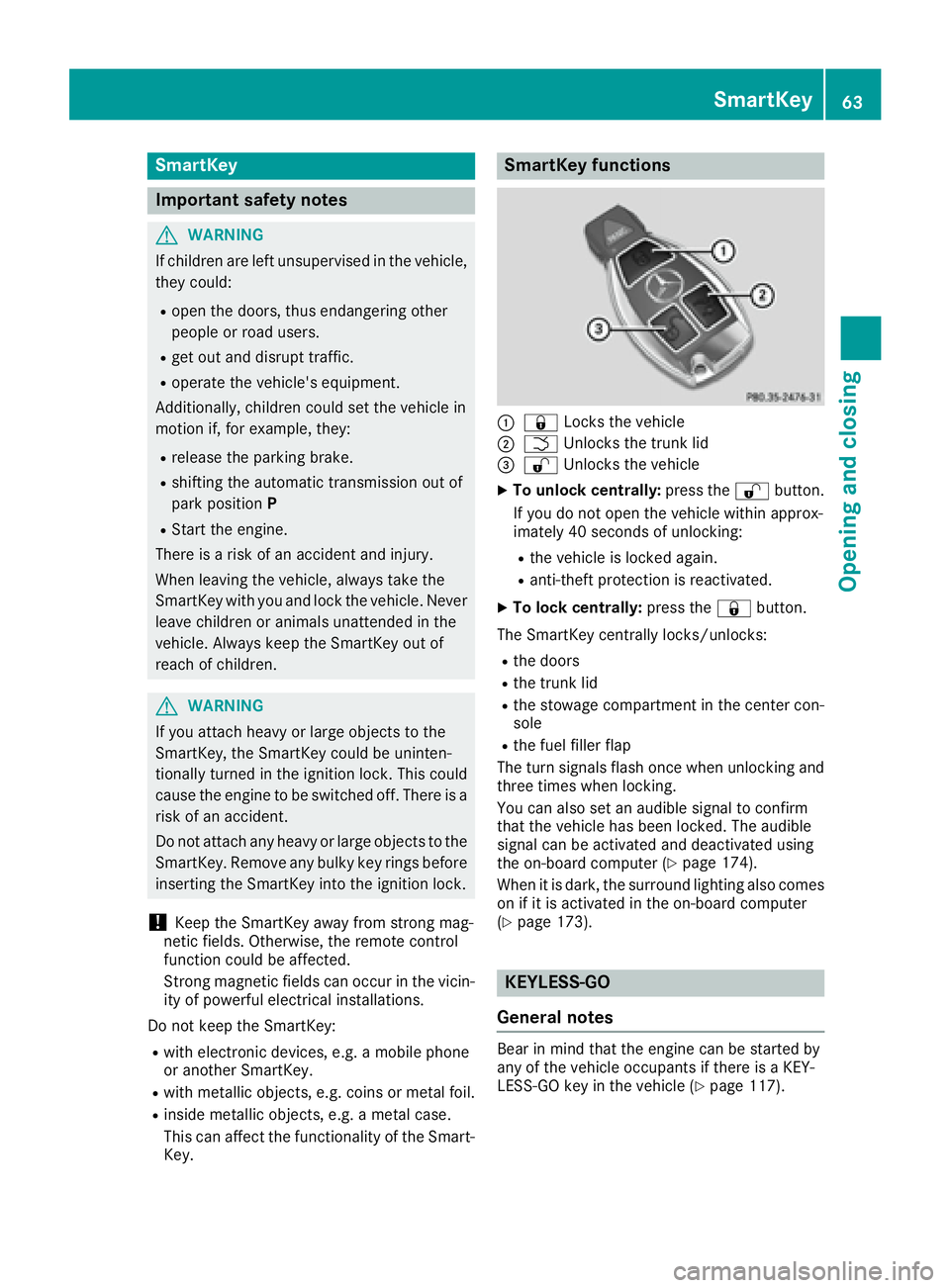
Key. SmartKey functions
C
7 Locks the vehicleD
T Unlock st he trunk lid
Page 70 of 294
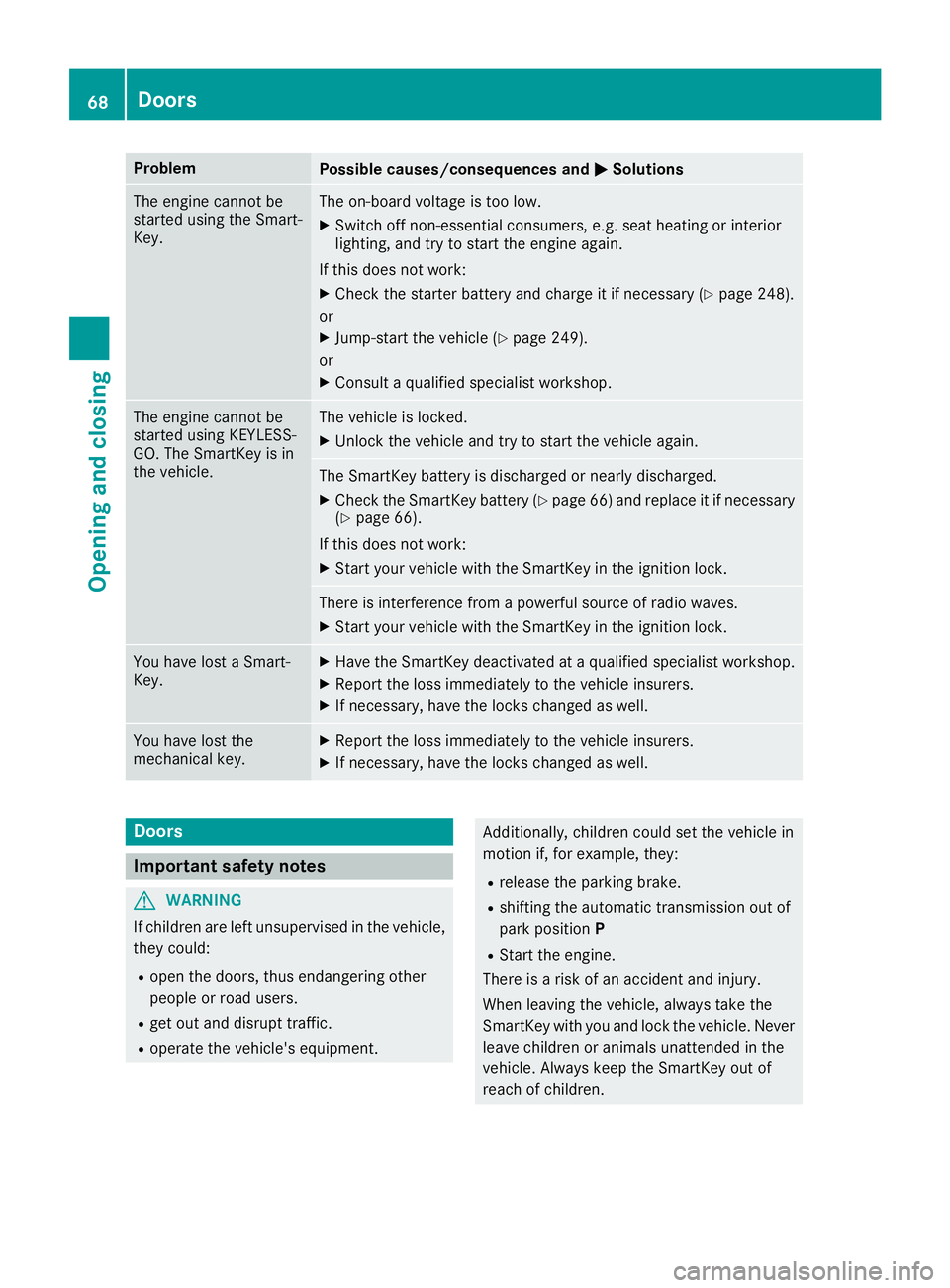
Problem
Possible causes/consequences and P Solutions
The engine cannot be
started using the Smart-
Key. The on-board voltage is too low. X
Switch off non-essential consumers, e.g. seat heating or interior
lighting, and try to start the engine again.
If this does not work: X
Check the starter battery and charge it if necessary ( Y
page 248).
or X
Jump-start the vehicle ( Y
page 249).
or X
Consult aq ualified specialist workshop.
The engine cannot be
started using KEYLESS-
GO. The SmartKey is in
the vehicle. The vehicle is locked. X
Unlock the vehicle and try to start the vehicle again.
The SmartKey battery is discharged or nearly discharged. X
Check the SmartKey battery ( Y
page 66) and replace it if necessary
( Y
page 66).
If this does not work: X
Start your vehicle with the SmartKey in the ignition lock.
There is interference from ap owerful source of radio waves.X
Start your vehicle with the SmartKey in the ignition lock.
You have lost aS mart-
Key. X
Have the SmartKey deactivated at aq ualified specialist workshop.X
Report the loss immediately to the vehicle insurers. X
If necessary, have the locks changed as well.
You have lost the
mechanical key. X
Report the loss immediately to the vehicle insurers. X
If necessary, have the locks changed as well.
Doors
Important safety notes
G WARNING
If children are left unsupervised in the vehicle,
they could: R
open the doors, thus endangering other
people or road users. R
get out and disrupt traffic. R
operate the vehicle's equipment. Additionally, children could set the vehicle in
motion if, for example, they: R
release the parking brake. R
shifting the automatic transmission out of
park position P R
Start the engine.
There is ar isk of an accident and injury.
When leaving the vehicle, always take the
SmartKey with you and lock the vehicle. Never
leave children or animals unattended in the
vehicle. Always keep the SmartKey out of
reach of children.68
Doors
Opening and closing