warning lights MERCEDES-BENZ SLC 2017 User Guide
[x] Cancel search | Manufacturer: MERCEDES-BENZ, Model Year: 2017, Model line: SLC, Model: MERCEDES-BENZ SLC 2017Pages: 294, PDF Size: 9.12 MB
Page 51 of 294
deployed air bags replaced and faulty air bags
repaired. This will help to make sure the air bags
continue to perfor mt heir protective function for
the vehicle occupants in the event of ac rash.
G WARNING
Emergenc yT ensioning Devices that have
deployed pyrotechnically are no longer opera-
tional and are unable to perfor mt heir inten-
ded protective function .T his poses an
increased risk of injury or even fatal injury.
Have pyrotechnically triggered Emergency
Tensioning Devices replaced immediately at a
qualified specialist workshop.
An electric moto risu sed by PRE-SAFE ®
to trig-
ger the tightenin goft he seat belt in hazardous
situations. This procedure is reversible.
If Emergenc yT ensioning Devices are triggered
or air bags are deployed, you will hear ab ang,
and as mall amount of powder may also be
released. The u restraint system warning
lamp lights up.
Only in rare cases will the bang affect your hear-
ing. The powder that is released generally does
not constitute ah ealth hazard, but it may cause
short-term breathin gd ifficulties in people with
asthma or other respiratory problems. Provided
it is safe to do so, you should leave the vehicle
immediately or open the window in order to pre-
vent breathin gd ifficulties.
Air bags and pyrotechnic Emergenc yT ensioning
Devices (ETDs) contain perchlorate material,
which may require special handling and regard
for the environment. National guidelines must
be observed during disposal. In California, see
www.dtsc.ca.gov/HazardousWaste/
Perchlorate/index.cfm .
Method of operation Durin gt he first stage of ac ollision, the restraint
system control unit evaluates important physi-
cal data relatin gtov ehicle deceleration or accel-
eration ,s uch as:R
duration R
direction R
intensity
Based on the evaluation of this data, the
restraint system control unit triggers the Emer-
genc yT ensioning Devices during af rontal or
rear collision. An Emergenc yT ensioning Devic ec an only be
triggered, if: R
the ignition is switched on R
the component soft he restraint system are
operational. You can find further information
under: "Restraint system warning lamp"
( Y
page 37) R
the belt tongue has engaged in the belt buckle
of the respective seat
If the restraint system control unit detects a
more severe accident, further component so f
the restraint system are activated independ-
ently of each other in certain frontal collision
situations: R
Fron ta ir bags as well as driver' sa nd front-
passenger knee bags
The front-passenger fron ta ir bag is activated or
deactivated dependin gont he person on the
front-passenger seat. The front-passenger front
air bag can only deploy in an acciden tift he
PASSENGER AIR BA GONi ndicator lamp is lit.
Observe the information on the PASSENGER AIR
BA Gi ndicator lamps ( Y
page 38).
Your vehicle has two-stage fron ta ir bags. During
the first deployment stage, the fron ta ir bag is
filled with propellant gas to reduce the risk of
injuries. The fron ta ir bag is fully deployed with
the maximum amount of propellant gas if as ec-
ond deployment threshold is reached within a
few milliseconds.
The activation threshold of the Emergenc yT en-
sionin gD evices and the air bag are determined
by evaluating the rate of vehicle deceleration or
acceleration which occurs at various point si n
the vehicle. This proces sisp re-emptive in
nature. Deploymen ts hould take place in good
time at the start of the collision.
The rat e
of vehicle deceleration or acceleration
and the direction of the forc ea re essentially
determined by: R
the distribution of forces during the collision R
the collision angle R
the deformation characteristic soft he vehicleR
the characteristic soft he objec tw ith which
the vehicle has collided
Factors which can only be seen and measured
after ac ollision has occurred do not play ad eci-
sive role in the deployment of an air bag. Nor do
they provide an indication of air bag deploy-
ment.
The vehicle can be deformed considerably, with-
out an air bag being deployed. This is the case ifOccupant safety 49
Safety Z
Page 57 of 294
good time, and for staying in lane. Always adapt
your driving style to suit the prevailing road and
weather conditions and maintain as afe distance
from the vehicle in front .D rive carefully.
The driving safety systems described only work
as effectively as possible when there is ade-
quate contact between the tires and the road
surface. Pay particular attention to the informa-
tion regarding tires, recommended minimum
tire tread depths etc. in the "Wheels and tires"
section ( Y
page 255).
In wintry driving conditions, always use winter
tires (M+S tires) and if necessary, snow chains.
Only in this way will the driving safety systems
described in this section work as effectively as
possible.
ABS (Anti-lock Braking System)
General information ABS regulates brake pressure in such aw ay that
the wheels do not lock when you brake. This
allows you to continue steering the vehicle when
braking.
The % ABS warning lamp in the instrument
cluster lights up when the ignition is switched
on. It goes out when the engine is running.
ABS works from as peed of about 5m ph
(8 km/h), regardless of road-surface conditions.
ABS works on slippery surfaces, even when you
only brake gently.
Important safety notes
i Observe the "Important safety notes" sec-
tion ( Y
page 54).
G WARNING
If ABS is faulty, the wheels could lock when
braking. The steerability and braking charac-
teristics may be severely impaired. Addition-
ally ,f urther driving safety systems are deac-
tivated. There is an increased danger of skid-
ding and accidents.
Drive on carefully. Have ABS checked imme-
diately at aq ualified specialist workshop.
When ABS is malfunctioning, other systems,
including driving safety systems, will also
become inoperative. Observe the information
on the ABS warning lamp ( Y
page 204) and dis- play messages which may be shown in the
instrument cluster ( Y
page 179).
Braking X
If ABS intervenes: continue to depress the
brake pedal vigorously until the braking sit-
uation is over. X
To make af ull brake application: depress
the brake pedal with full force.
If ABS intervenes when braking, you will feel a
pulsing in the brake pedal.
The pulsating brake pedal can be an indication
of hazardous road conditions, and functions as a
reminder to take extr ac are while driving.
BAS (Brake Assist System)
General information BAS operates in emergenc yb raking situations.
If you depress the brake pedal quickly, BAS
automatically boosts the braking force, thus
shortening the stopping distance.
Important safety notes
i Observe the "Important safety notes" sec-
tion ( Y
page 54).
G WARNING
If BAS is malfunctioning, the braking distance
in an emergenc yb raking situation is
increased. There is ar isk of an accident.
In an emergenc yb raking situation, depress
the brake pedal with full force. ABS prevents
the wheels from locking.
Braking X
Keep the brake pedal firmly depressed until
the emergenc yb raking situation is over.
ABS prevent st he wheels from locking.
The brakes will function as usual once you
release the brake pedal. BAS is deactivated.Driving safety systems 55
Safety Z
Page 62 of 294
Deactivating/activating ESP (SLC 43 ®
AMG )Important safet yn otes
i Observ et he "Important safet yn otes "s ec -
tion ( Y
page 54).
You can selec tb etween th ef ol lowin gs tate so f
ES P ®
:R
ES P ®
is activated.R
SPORT handlin gm od eisa ctivated.R
ES P ®
is deactivated.
G WARNING
Whe nS PO RT handlin gm od eisa ctivated,
there is ag re ater ris kofs ki dding and acci-
dents .
Only activat eS PO RT handlin gm od eint he sit -
uation sd escribed in th ef ol lowing.
G WARNING
If you deactivat eE SP ®
,E SP ®
no longer sta-
bilizes th ev ehicle. There is an increase dr is k
of skidding and an accident.
Only deactivat eE SP ®
in th es ituation sd escri-
bed in th ef ol lowing.
In th ef ol lowin gs ituations, it may be bette rt o
activat eS PO RT handlin gm od eord eactivat e
ES P ®
:R
when usin gs no wc ha in sR
in dee ps no wR
on san dorg ra ve lR
on specially designated roads when th ev ehi-
cle's own oversteering and understeering
characteristics are desire d
Spinning th ew heels result sinac utting action
whic hp rovides bette rg ri p.
Driving in SPORT handlin gm od eorw ithout
ES P ®
require sane xtremel yq ualified and expe-
rienced driver .
i Activat eE SP ®
as soo nast he situation s
described abov enol onger apply .E SP ®
will
otherwise no tbea ble to stabilize th ev ehicle if
th ev ehicle start stos ki doraw hee ls ta rt st o
spin. ! Avoid spinnin gt he driven wheels fo ra n
extended period wit hE SP ®
deactivated. You
could otherwise damage th ed rivetrain .
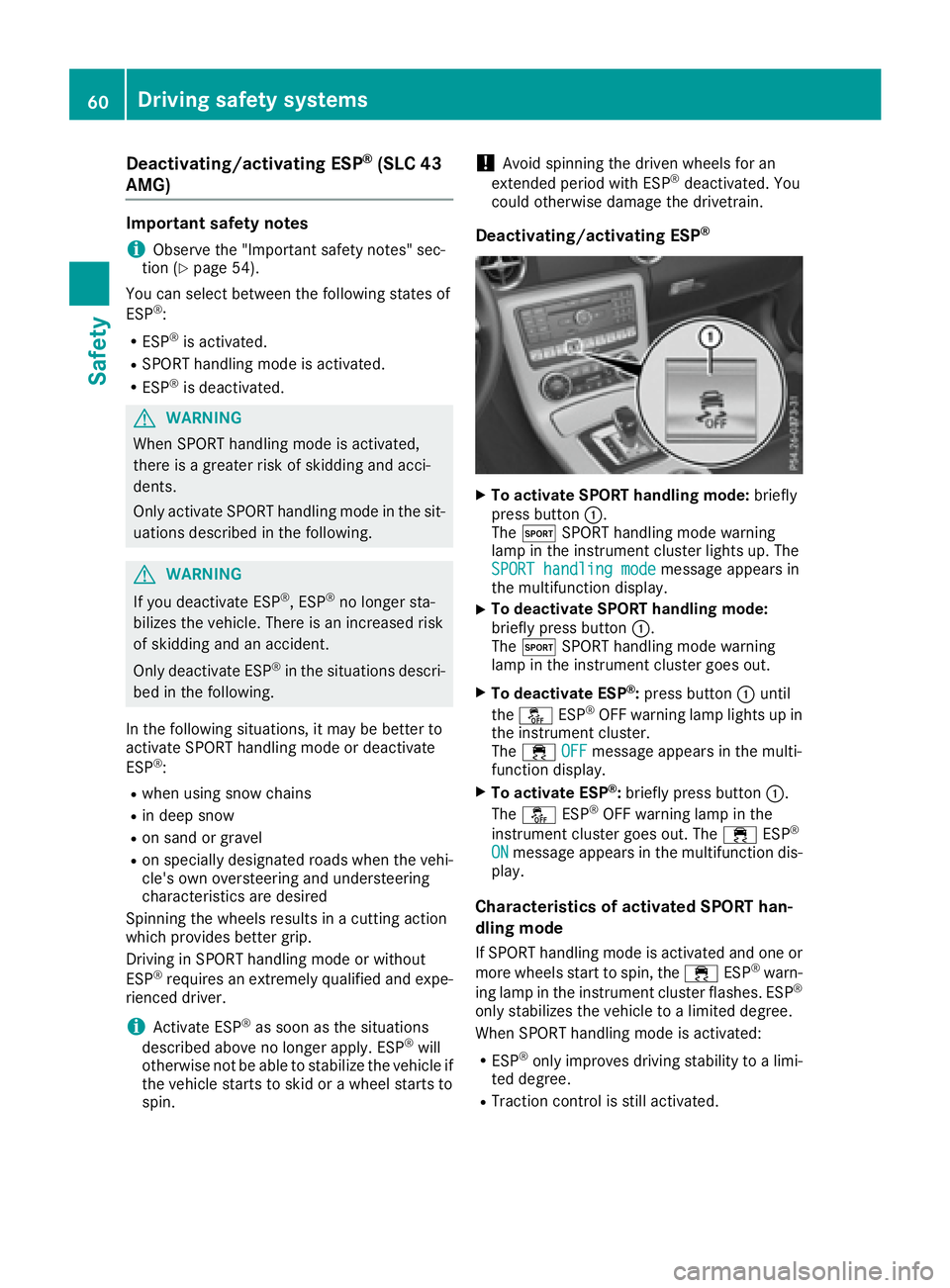
Deactivating/activating ESP ®
X
To activate SPORT handling mode: briefly
press butto n C .
The t SPORT handlin gm od ew arnin g
lamp in th ei nstrument cluster lights up. The
SPORT handling mod e
messag ea ppears in
th em ultifunction display. X
To deactivate SPORT handling mode:
briefly press butto n C .
The t SPORT handlin gm od ew arnin g
lamp in th ei nstrument cluster goe so ut .X
To deactivate ESP ®
: press butto n C until
th e
Page 72 of 294
X
To deactivate: press and hol db ut ton C for
abou tf iv es econds unti lat one sounds.X
To activate: press and hol db ut ton D for
abou tf iv es econds unti lat one sounds.
If yo up ress one of the two buttons and do not
hea rat one, the relevant setting ha sa lr eady
been selected.
The vehicl eisl oc ked automaticall yw he nt he
ignition is switched on and the wheels are turn-
ing.
Yo uc ould therefore lock yoursel fo ut if:R
the vehicl eisb ei ng pushed.R
the vehicl eisb ei ng towed.R
the vehicl eisonar olle rd yn amometer.
Yo uc an also switch the automatic locking func-
tio nona nd off using the on-board computer
( Y
page 173).
Unlocking/lockin gt he driver's door
using the mechanical key
i If yo uw an ttoc entrall yl oc kt he vehicl eu si ng
the mechanical key ,b egin by pressing the
locking button for the interio rl oc king mech-
anism whil et he driver's door is open. Then
lock the driver's door using the mechanical
key.
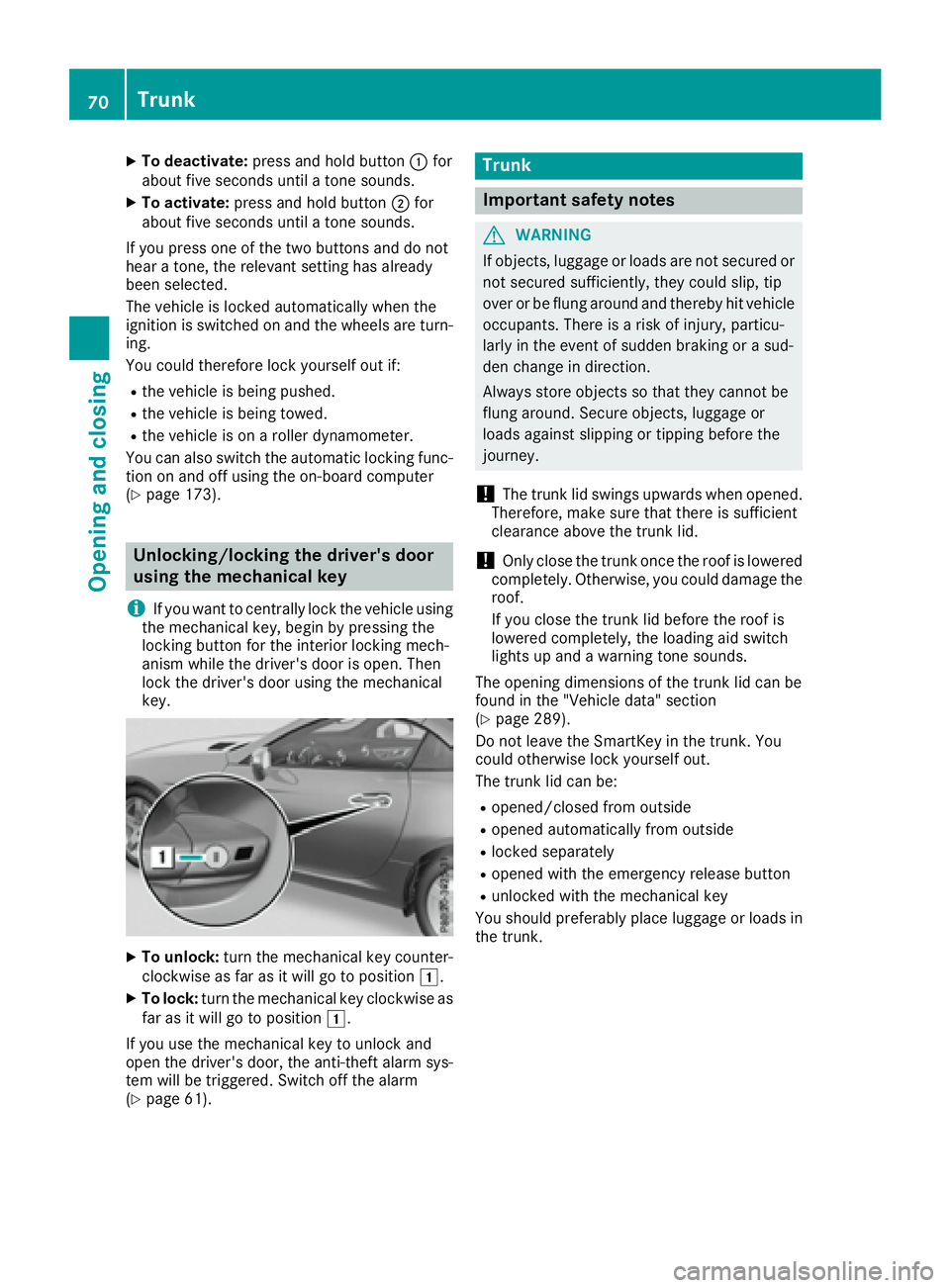
X
To unlock: turn the mechanical key counter-
clockwise as far as it will go to position G .X
To lock: turn the mechanical key clockwise as
far as it will go to position G .
If yo uu se the mechanical key to unlock and
open the driver's door, the anti-thef ta la rm sys-
tem will be triggered .S witch off the alarm
( Y
page 61). Trunk
Important safety notes
G WARNING
If objects, luggage or load sa re not secured or
not secured sufficiently ,t hey could slip ,t ip
ove rorbef lung around and thereb yh it vehicle
occupants. There is ar is kofi njury ,p ar ticu-
larly in the event of sudden braking or as ud -
de nc hange in direction.
Alway ss tor eo bj ects so tha tt hey canno tb e
flung around .S ecure objects, luggage or
load sa gain st slipping or tipping before the
journey.
! The trunk li ds wi ng su pwar ds when opened.
Therefore, make sure tha tt her eiss uf ficient
clearance above the trunk lid.
! Onl yc lose the trunk once the roo fisl owere d
completely. Otherwise, yo uc ould damag et he
roof.
If yo uc lose the trunk li db ef ore the roo fi s
lowered completely, the loading ai ds wi tch
lights up and aw ar ning tone sounds.
The opening dimensions of the trunk li dc an be
found in the "Vehicle data" section
( Y
page 289).
Do not leave the SmartKey in the trunk. You
could otherwise lock yoursel fo ut .
The trunk li dc an be: R
opened/close df rom outside R
opene da ut omaticall yf rom outsideR
locked separately R
opene dw it ht he emergency release button R
unlocke dw it ht he mechanical key
Yo us houl dp referabl yp la ce luggage or load si n
the trunk.70
Trunk
Opening and closing
Page 96 of 294
The daytime runnin gl amps improve the visibility
of your vehicle during the day. To do this, the
daytime runnin gl amps function must be
switched on using the on-board computer
( Y
page 172).
If the engine is runnin ga nd you turn the light
switch to ` or X ,t he manual settings
take precedenc eo ver the daytime running
lamps.
Low-beam headlamps
G WARNING
When the light switch is set to X ,t he low-
beam headlamps may not be switched on
automatically if there is fog, snow or other
causes of poor visibility due to the weather
conditions such as spray. There is ar isk of an
accident.
In such situations, turn the light switch to
X .
Even if the light sensor does not detect that it is
dark, the parking lamps and low-beam head-
lamps switch on when the ignition is switched on
and the light switch is set to the X position.
This is ap articularly useful function in the event
of rain and fog. X
To switch on the low-beam headlamps:
turn the SmartKey in the ignition lock to posi-
tion 2 or start the engine.X
Turn the light switch to X .
The green X indicator lamp in the instru-
ment cluster lights up.
Rear fog lamp
The rear fog lamp improves visibility of your
vehicle for the traffic behind in the event of thick
fog. Please take not eoft he country-specific
regulations for the use of rear fog lamps. X
To switch on the rear fog lamps: turn the
SmartKey to position 2 in the ignition lock or
start the engine. X
Turn the light switch to X or X .X
Press the ^ button.
The yellow ^ indicator lamp in the instru-
ment cluster lights up. X
To switch off the rear fog lamp: press the
^ button.
The yellow ^ indicator lamp in the instru-
ment cluster goes out. Parking lamps
! If the battery charge is very low, the parking
lamps or standin gl amps are automatically
switched off to enable the next engine start.
Always park your vehicle safely and suffi-
ciently lit according to legal standards. Avoid
using the parking lamps ` over ap eriod of
several hours. If possible, switch on the right-
hand d or left-hand c standin gl amp.X
To switch on: turn the light switch to ` .
The green ` indicator lamp in the instru-
ment cluster lights up.
Standing lamps Switching on the standin gl amps ensures the
corresponding side of the vehicle is illuminated. X
To switch on the standing lamps: the
SmartKey is not in the ignition lock or it is in
position 0 . X
Turn the light switch to c (left-han ds ide of
the vehicle) or d (right-hand side of the
vehicle).
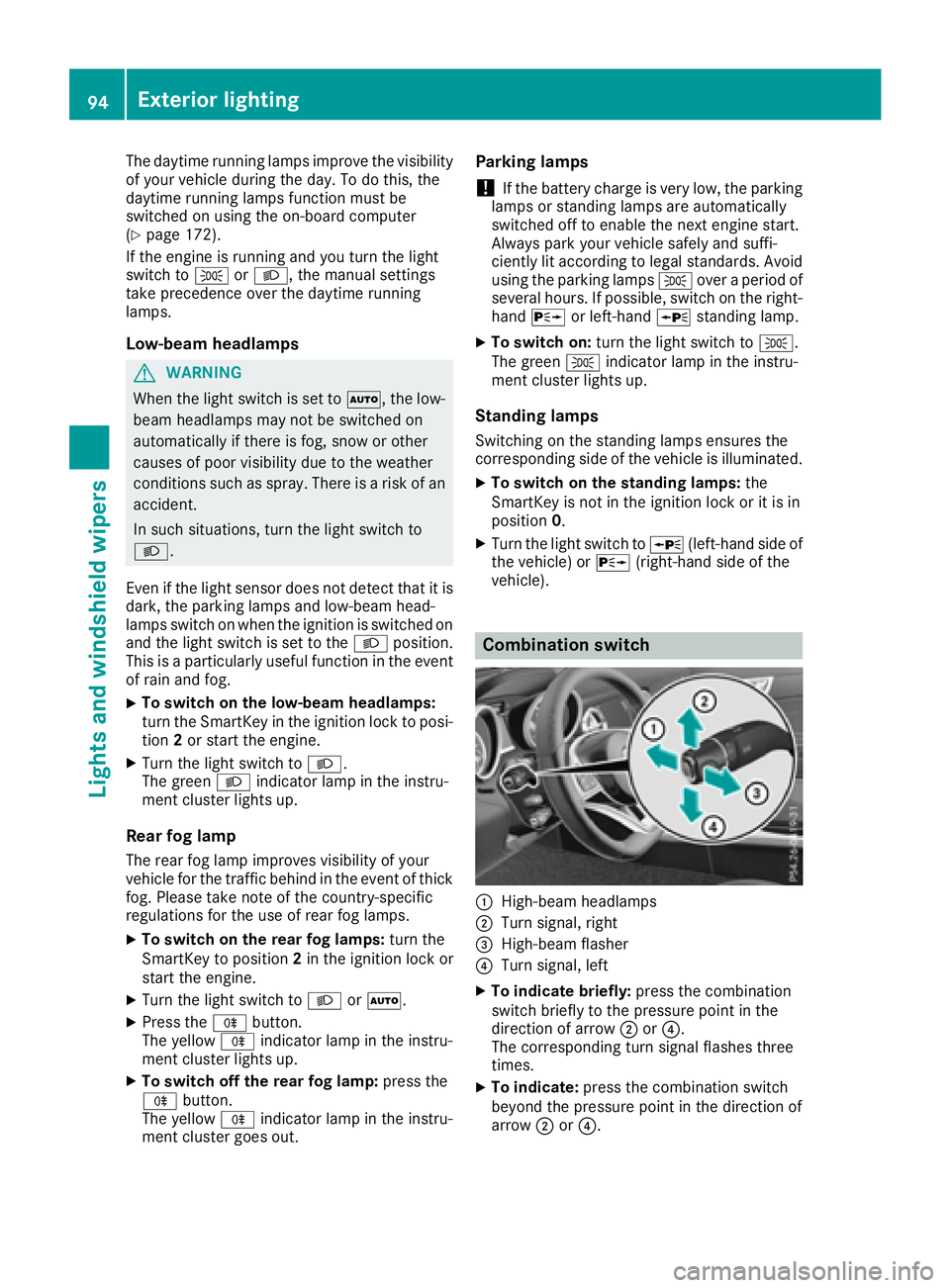
Combination switch
C
High-beam headlamps D
Turn signal, right
Page 97 of 294
X
To switc hont he high-beam headlamps:
turn the light switch to X or X .X
Press the combinatio ns wi tch beyond the
pressure point in the direction of arrow C .
In the X position, the high-bea mh ead-
lamps are onl ys wi tched on when it is dark and
the engine is running.
The blue W indicator lamp in the instru-
ment cluster lights up when the high-beam
headlamps are switched on. X
To switc ho ff the high-beam headlamps:
move the combinatio ns wi tch back to its nor-
ma lp osition.
The blue W indicator lamp in the instru-
ment cluster goe so ut .
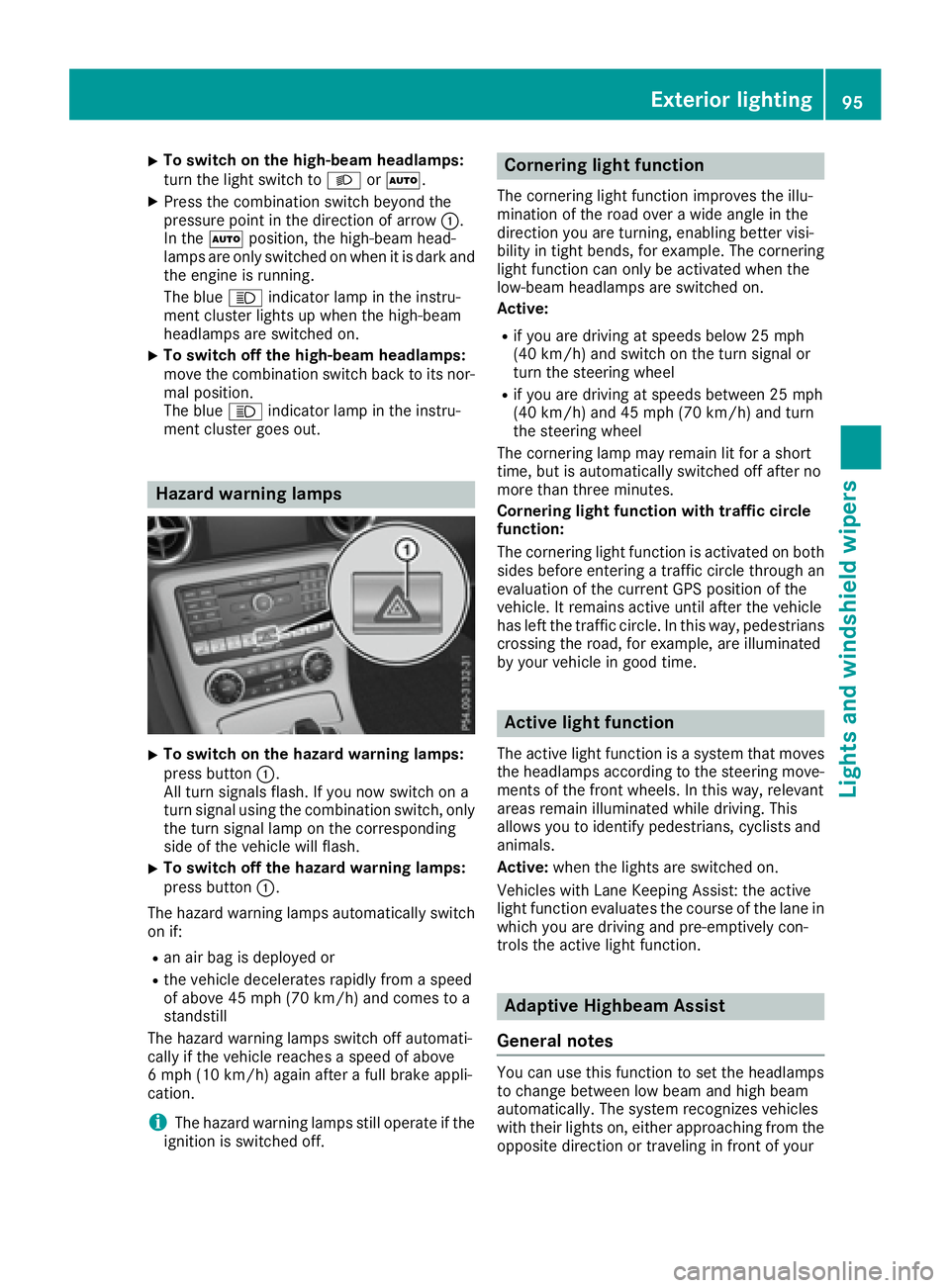
Hazard warning lamps
X
To switc hont he hazard warning lamps:
press button C .
All turn signals flash. If yo un ow switch on a
turn signa lu si ng the combinatio ns wi tch ,o nly
the turn signa ll am pont he corresponding
side of the vehicl ew il lf lash.X
To switc ho ff the hazard warning lamps:
press button C .
The hazard warning lamps automaticall ys wi tch
on if: R
an ai rb ag is deployed orR
the vehicl ed ec elerates rapidly from as peed
of above 45 mph (70 km/h )a nd come stoa
standstill
The hazard warning lamps switch off automati-
cally if the vehicl er eache sas peed of above
6m ph (10 km/h )a gain afte raf ul lb rake appli-
cation.
i The hazard warning lamps stil lo pe rate if the
ignition is switched off. Cornerin gl ig ht functionThe cornering light functio ni mprove st he illu-
minatio noft he roa do ve raw id ea ngle in the
direction yo ua re turning, enabling better visi-
bility in tight bends, for example. The cornering
light functio nc an onl ybea ctivate dw he nt he
low-bea mh eadlamps are switched on.
Active: R
if yo ua re driving at speed sb elow 25 mph
(40 km/h )a nd switch on the turn signa lo r
turn the steering wheel R
if yo ua re driving at speed sb et ween 25 mph
(40 km/h )a nd 45 mph (70 km/h )a nd turn
the steering wheel
The cornering lamp ma yr emai nl it for as hort
time ,b ut is automaticall ys wi tched off afte rn o
more tha nt hre em inutes.
Cornerin gl ig ht functio nw it ht raffi cc ir cle
function:
The cornering light functio ni sa ctivate donb ot h
side sb ef ore entering at raffic circle throug ha n
evaluation of the current GP Sp osition of the
vehicle. It remains active unti la fte rt he vehicle
ha sl ef tt he traffic circle .Int hi sw ay ,p edes trians
crossing the road, for example, are illuminated
by your vehicl eing oo dt ime.
Active light function The active light functio ni sas ys tem tha tm oves
the headlamps according to the steering move-
ments of the front wheels .Int hi sw ay ,r elevant
areas remai ni llum inated whil ed riving .T his
allows yo utoi de ntify pedestrians ,c yclists and
animals.
Active: when the lights are switched on.
Vehicles with Lane Keeping Assist: the active
light functio ne valuate st he course of the lane in
which yo ua re driving and pre-emptively con-
trol st he active light function.
Adaptiv eH ighbeam Assist
General notes
Yo uc an us et hi sf unctio ntos et the headlamps
to change between lo wb ea ma nd high beam
automatically. The system recognizes vehicles
with thei rl ig hts on, either approaching from the
opposite direction or traveling in front of yourExterior lighting 95
Lights and windshield wiper s Z
Page 98 of 294
vehicle, and consequently switches the head-
lamp sf rom high bea mtol ow beam.
The system automatically adapts the low-beam
headlamp range depending on the distance to
the other vehicle. Once the system no longer
detects any other vehicles, it reactivates the
high-beam headlamps.
The system' so ptical sensor is located behind
the windshiel dn ear the overhea dc ontrol panel.
Important safety notes
G WARNING
Adaptive Highbeam Assist does not recognize
road users: R
who have no lights, e.g. pedestrians R
who have poor lighting, e.g. cyclists R
whos el ighting is blocked ,e .g. by ab arrier
On very rare occasions, Adaptive Highbeam
Assist may fail to recognize other road users
that have lights, or may recognize them too
late. In this, or in similar situations, the auto-
matic high-beam headlamp sw il ln ot be deac-
tivated or wil lbea ctivated regardless. There is
ar isk of an accident.
Always carefully observe the traffic conditions
and switch off the high-beam headlamp si n
good time.
Adaptive Highbeam Assist cannot take into
account road ,w eather or traffic conditions.
Adaptive Highbeam Assist is only an aid .Y ou are
responsible for adjusting the vehicle's lighting
to the prevailing light, visibility and traffic con-
ditions.
In particular, the detection of obstacles can be
restricted if there is: R
poor visibility, e.g. due to fog, heavy rain or
snow R
dirt on the sensors or the sensors are
obscured Switching Adaptive Highbeam Assist
on/off X
To switch on: turn the light switch to X .X
Press the combination switch beyond the
pressure point in the directio nofa rrow C .
The
Page 118 of 294
As soo na st he ignition is switched on, al lt he
indicator lamps in the instrument cluster light
up .F urther informatio nons it uations where an
indicator lamp either fails to go ou ta fte rs tarting
the engine or lights up whil ed riving
( Y
page 204).
If Start/Stop button C ha sn ot ye tb ee n
pressed, thi sc orrespond stot he key being
remove df rom the ignition.X
To switc hont he power supply: press
Start/Stop button C once.
The powe rs uppl yiss wi tched on. Yo uc an now
activate the windshield wipers, for example.
The powe rs uppl yiss wi tched off agai ni f:R
the driver's door is opene da ndR
yo up ress Start/Stop button C twice when
in thi sp ositionX
To switc hont he ignition: press Start/Stop
button C twice.
The ignition is switched on.
If yo up ress Start/Stop button C once when
in thi sp osit ion, the ignition is switched off
again.
Removing the Start/Sto pb uttonYo uc an remove the Start/Stop button from the
ignition lock and start the vehicl easn ormal
using the SmartKey. X
Remove Start/Stop button C from ignition
lock D .
Yo udon ot have to remove the Start/Stop but-
ton from the ignition lock when yo ul eave the
vehicle. Yo us hould, however, always take the
SmartKe yw it hy ou when leaving the vehicle. As
long as the Sma rtKe y isint h
e vehicle:R
the vehicl ec an be started using the Start/
Stop button R
the electrically powered equipment can be
operated Starting the engine
Important safety notes
G WARNING
If children ar el ef tu nsupervised in the vehicle,
they could: R
open the doors ,t hu se ndangering other
people or roa du se rs.R
ge to ut and disrupt traffic. R
operate the vehicle's equipment.
Additionally, children could set the vehicl ei n
motion if, for example, they: R
release the parking brake. R
shifting the automatic transmission ou to f
park position P R
Star tt he engine.
There is ar is kofana ccident and injury.
Whe nl eavi ng the vehicle, always take the
SmartKe yw it hy ou and lock the vehicle. Never
leav ec hildren or animals unattended in the
vehicle. Alway sk ee pt he SmartKe yo ut of
reach of children.
G WARNING
Combustion engine se mi tp oiso nou se xhaust
gases such as carbo nm onoxide. Inhaling
thes ee xhaus tg as es lead stop oiso ning. There
is ar is koff ata li njury .T herefore neve rl eave
the engine running in enclose ds paces with-
ou ts uf ficient ventilation.
G WARNING
Flammabl em at erial si ntroduced through
environmenta li nfluence or by animals can
ignite if in contact with the exhaus ts ys tem or
parts of the engine tha th ea tu p. There is ar isk
of fire.
Carry ou tr egular checks to make sure that
ther ea re no flammabl ef oreig nm at erial si n
the engine compartment or in the exhaust
system.
During ac ol ds tart, the engine runs at higher
speed stoe nabl et he catalytic converter to116
Driving
Driving an dp arking
Page 134 of 294
cle from rolling away by applying the parking
brake. X
Appl yt he electri cp ar king brake.X
Shif tt he transmission to position P
( Y
page 123).X
With the SmartKey: turn the SmartKey to
position 0 in the ignition lock and remove it.
The immobilizer is activated. X
With KEYLESS-GO: press the KEYLESS-GO
Start/Stop button ( Y
page 115).
The engine stop sa nd al lt he indicator lamps in
the instrument cluster go out.
Whe nt he driver' sd oo risc losed, this corre-
sponds to SmartKey position 1 .W he nt he
driver' sd oo riso pen, this corresponds to
SmartKey position 0 ( Y
page 115).
The engine can be switched off while the vehicle
is in motio nb yp ressing and holding the Start/
Stop button for abou tt hree seconds. Thi sf unc-
tion operate si ndependently of the ECO start/
stop automatic engine switch-off function.
Electric parkin gb rake
General notes
G WARNING
If yo ul ea ve childre nu nsupervised in the vehi-
cle ,t hey could set it in motio nb y, for example:R
release the parking brake. R
shift the automatic transmission ou toft he
parking position P .R
star tt he engine.
In addition, they may operate vehicle equip-
ment and become trapped .T here is ar is ko f
an accident and injury.
Whe nl ea ving the vehicle ,a lway st ake the
SmartKey with yo ua nd lock the vehicle .N ever
leave childre nu nsupervised in the vehicle. The function of the electri cp ar king brake is
dependent on the on-board voltage .Ift he on-
board voltage is low or there is am alfunction in
the system, it may not be possible to appl yt he
released parking brake. X
If this is the case ,o nly park the vehicle on
level ground and secure it to prevent it rolling
away. X
Shif tt he automatic transmission to position
P .
It may not be possible to release an applied
parking brake if the on-board voltage is low or
there is am alfunction in the system. Contact a
qualified specialist workshop.
The electri cp ar king brake performs af unction
test at regula ri nterval sw hile the engine is
switched off. The sounds that can be heard while
this is occurring are normal.
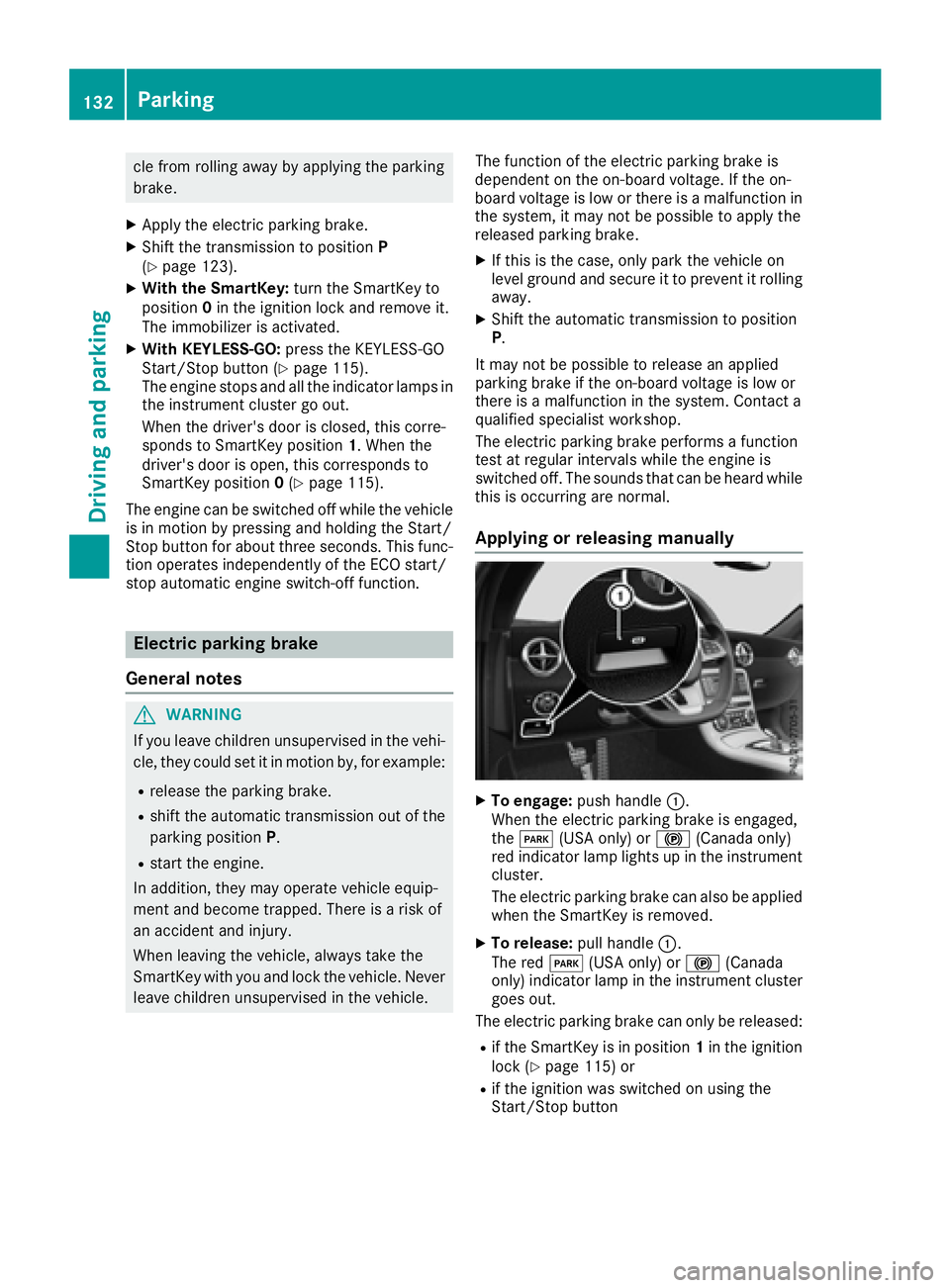
Applyin gorr eleasin gm anually
X
To engage: push handle C .
Whe nt he electri cp ar king brake is engaged,
the I (USA only )o r $ (Canada only)
red indicator lamp lights up in the instrument
cluster.
The electri cp ar king brake can also be applied
whe nt he SmartKey is removed. X
To release: pull handle C .
The red I (USA only )o r $ (Canada
only )i ndicator lamp in the instrument cluster
goe so ut .
The electri cp ar king brake can only be released: R
if the SmartKey is in position 1 in the ignition
lock ( Y
page 115) or R
if the ignition wa ss witched on using the
Start/Stop button132
Parking
Drivin ga nd parking
Page 154 of 294
Problems with PARKTRONIC Problem
Possible causes/consequences and P Solutions
Only the red segments in
the PARKTRONIC warn-
ing display sa re lit. You
also hear aw arning tone
for approximately two
seconds.
PARKTRONIC is deacti-
vated after approx-
imately 20 seconds, and
the indicator lamp in the
PARKTRONIC button
lights up. PARKTRONIC has malfunctioned and has switched off. X
If problems persist, have PARKTRONIC checked at aq ualified spe-
cialist workshop.
Only the red segments in
the PARKTRONIC warn-
ing display sa re lit.
PARKTRONIC is deacti-
vated after approx-
imately five seconds. The PARKTRONIC sensors are dirty or there is interference. X
Clean the PARKTRONIC sensors ( Y
page 240).X
Switch the ignition back on.
The problem may be caused by an external source of radio or ultra-
sound waves. X
See if PARKTRONIC functions in ad ifferent location.
Parking Guidance
Important safety notes Parking Guidance is an electronic parking aid
with ultrasound. Ultrasound is used to measure
the road on both sides of the vehicle. As uitable
parking space is indicated by the parking sym-
bol. You receive steering instructions when
parking. You may also use PARKTRONIC
( Y
page 149).
Parking Guidance is only an aid. It is not a
replacement for your attention to your immedi-
ate surroundings. You are always responsible
for safe maneuvering, parking and exiting a
parking space. When maneuvering, parking or
pulling out of ap arking space, make sure that
there are no persons, animals or object sint he
area in which you are maneuvering.
G WARNING
If object sa re located above the detection
range, Parking Guidance may provide steering
instructions too soon. You may cause ac olli-
sion as ar esult. There is ar isk of an accident.
If object sa re located above the detection
range, stop and switch off Parking Assist. ! If unavoidable, you should drive over obsta-
cles such as curbs slowly and not at as harp
angle. Otherwise, you may damage the
wheels or tires.
When PARKTRONIC is deactivated, Parking
Guidance is also unavailable.
Parking Guidance may also display spaces not
suitable for parking, e.g.: R
where parking or stopping is prohibited R
in front of driveways or entrances and exits R
on unsuitable surfaces
Use Parking Guidance for parking spaces: R
that are paralle ltot he direction of travelR
that are on straight roads, not bends R
that are on the same level as the road, i.e. not
on the pavement, for example. Parking Guid-
ance may not detect flat curbs
Parking tips: R
On narrow roads, drive as close to the parking
space as possible. R
Parking spaces that are littered or overgrown
might be identified or measured incorrectly. R
Parking spaces that are partially occupied by
trailer drawbars might not be identified as
such or be measured incorrectly.152
Driving systems
Driving and parking