service MERCEDES-BENZ SLC 2017 Owner's Manual
[x] Cancel search | Manufacturer: MERCEDES-BENZ, Model Year: 2017, Model line: SLC, Model: MERCEDES-BENZ SLC 2017Pages: 294, PDF Size: 9.12 MB
Page 237 of 294
ASSYS TP LUS
Service messages The ASSYS TP LU Ss ervic ei nterval display
inform sy ou of th en ex ts ervic ed ue date.
Information on th et yp eofs ervic ea nd servic e
intervals (see th es eparat eM aintenance Book -
let).
You can obtain further information from an
authorize dM ercedes-Benz Cente rora t
http://www.mbusa.co m( US Ao nl y).
i The ASSYS TP LU Ss ervic ei nterval display
does no ts ho wa ny information on th ee ng in e
oil level. Observ et he note sont he engin eo il
level ( Y
page 232).
The multifunction display shows as ervic em es -
sage for several seconds, e.g. :R
Servic eAin..D ay sR
Servic eAD ueR
Servic eAE xceeded by .. Day s
Dependin gont he operating condition soft he
vehicle, th er emaining time or distanc eu ntil th e
next servic ed ue dat eisd isplayed.
The lette r A or B ,p ossibl yinc onnectio nw it ha
number or another letter, shows th et yp eofs er -
vice. A stand sf or am inor servic ea nd B for a
major service.
You can obtain further information from an
authorize dM ercedes-Benz Center.
The ASSYS TP LU Ss ervic ei nterval display does
no tt ak ei nt oa ccoun ta ny periods of time during
whic ht he battery is disconnected.
Maintainin gt he time-dependen ts ervic es ch ed-
ule: X
Not ed own th es ervic ed ue dat ed isplayed in
th em ultifunction display before disconnect -
ing th eb attery.
or X
Afte rr econnecting th eb attery, subtrac tt he
battery disconnection periods from th es er -
vic ed at es hown on th ed isplay.
Hiding as ervice messageX
Press th e v or 8 butto nont he steering
wheel. Displaying service messages X
Switc hont he ignition .X
Press th e Y or e butto nont he steering
whee lt os elect th e Serv. menu.X
Press th e c or d butto ntos elect th e
ASSYST PLU S submen ua nd confirm by press-
ing th e v button.
The servic ed ue dat ea ppear sint he multi-
function display.
Infor ma ti on abou tS ervice
Resetting th eA SSYS TP LUS service
interval display
! If th eA SS YS TP LU Ss ervic ei nterval display
has been inadvertentl yr eset ,t hi ss etting can
be correcte dataq ualified specialist work-
shop.
Hav es ervic ew or kc arrie do ut as described in
th eM aintenance Booklet .T his may otherwise
lead to increased wear and damag etot he
major assemblies or th ev ehicle.
Aq ualified specialist workshop ,e .g .ana uthor-
ized Mercedes-Benz Center, will reset th e
ASSYS TP LU Ss ervic ei nterval display after th e
servic ew or kh as been carrie do ut .Y ou can also
obtain further information on maintenance
work, for example.
Special service requirements The specifie dm aintenance interval takes only
th en orma lo peration of th ev ehicl ei nt o
account. Under arduous operating condition so r
increased load on th ev ehicle, maintenance
wor km us tbec arrie do ut mor ef re quently, for
example: R
regular cit yd rivin gw it hf re quen ti ntermediat e
stops R
if th ev ehicl eisp rimarily used to travel short
distances R
use in mountainous terrain or on poor road
surfaces R
if th ee ng in eiso ften lef ti dlin gf or lon gp eriods
Under these or similar conditions, have, for
example, th ea ir filter, engin eo il and oil filter
replace dorc ha nged mor ef re quently. Under
arduous operating conditions, th et ir es mus tb e
checke dm or eo ften .F urther information can beASSYST PLUS 235
Maintenance and care Z
Page 238 of 294
obtained at aq ualified specialist workshop, e.g.
an authorized Mercedes-Benz Center.
Driving abroad An extensive Mercedes-Benz Service network is
also available in other countries. You can obtain
further information from any authorized
Mercedes-Benz Center.
Care
Notes on care
H Environmental note
Dispose of empty packaging and cleaning
cloths in an environmentally responsible man-
ner.
! For cleaning your vehicle, do not use any of
the following: R
dry, rough or hard cloths R
abrasive cleaning agents R
solvents R
cleaning agents containing solvents
Do not scrub.
Do not touch the surfaces or protective films
with hard objects, e.g. ar ing or ice scraper.
You could otherwise scratc hord amage the
surfaces and protective film.
! Do not park the vehicle for an extended
period straight after cleaning it, particularly
after having cleaned the wheels with wheel
cleaner. Wheel cleaners could cause
increased corrosion of the brake discs and
brake pads/linings. For this reason, you
should drive for af ew minutes after cleaning.
Brakin gh eats the brake discs and the brake
pads/linings, thus drying them. The vehicle
can then be parked.
Regula rc are of your vehicle is ac ondition for
retaining the quality in the long term.
Use care products and cleaning agents recom-
mended and approved by Mercedes-Benz. Washing the vehicle and cleaning the
paintwork
Automatic car wash
G WARNING
Brakin ge fficienc yisr educed after washing
the vehicle. There is ar isk of an accident.
After the vehicle has been washed, brake
carefully while paying attention to the traffic
conditions until full braking power is restored.
! If DISTRONIC PLUS or the HOLD function is
activated, the vehicle brakes automatically in
certain situations.
To prevent damage to the vehicle, deactivate
DISTRONIC PLUS and the HOLD function in
the following or other similar situations: R
when towing the vehicle R
in the car wash
! It is preferable to use car washes with
adjustable high-pressure pre-cleanin gt hat
corresponds to the specification for the Cab-
riolet program. In car washes that use high
water pressures, there is ar isk that as mall
amount of water may leak into the vehicle.
! Designo retractable hardtop: make sure
that the vehicle is not subsequently treated
with hot wax.
! Lock the car if you wash it in an automatic
car wash. Otherwise, the vehicle might be
damaged.
! Never clean your vehicle in aT ouchless
Automatic Car Wash as these use special
cleaning agents. These cleaning agents can
damage the paintwork or plastic parts.
If you have your vehicle cleaned in ah igh-
pressure automatic car wash, small amounts
of water may enter the vehicle.
! Make sure that the automatic transmission
is in position N when washing your vehicle in
at ow-through car wash. The vehicle could be
damaged if the transmission is in another
position.236
Care
Maintenance and care
Page 249 of 294
Avoi dc ontact with skin, eyes or clothing. Do
not inhal ea ny battery gases .Don ot lean over
the battery .K ee pc hildren away from batter-
ies. Wash away battery aci di mmediatel yw it h
plenty of clean water and see km edica la tten-
tion.
H Environmental note
Batterie sc ontain dangerous
substances .Itisa gain st the
la wtod is pose of them with
the househol dr ubbish .T hey
must be collected separately
and recycle dtop rotect the
environment.
Dispose of batteries in an
environmentally friendly
manner. Take discharged
batteries to aq uali fied spe-
cialist workshop or as pecial
collectio np oi nt for used bat-
teries.
! Hav et he battery checked regularly at a
qualified specialist workshop.
Observ et he service intervals in the Mainte-
nance Bookle torc ontact aq uali fied specialist
workshop for more information.
! Alway sh av ew or konb at teries carrie do ut at
aq uali fied specialist workshop .S hould it, in
exceptiona lc ircumstances ,bea bs olutely
necessary to disconnect the 12-volt battery
yourself, observe the following: R
secur et he vehicl etop revent it from rolling
away. R
switch off the ignition. R
always disconnect the negative terminal
clamp first, followe dbyt he positive termi-
nal clamp.
After the battery ha sb ee nd is connected ,t he
transmission is locked in position P .
After the work ha sb ee nd on e, instal lt he bat-
tery and replace the cove roft he positive ter-
mina lc lamp firmly.
Compl yw it hs af ety precautions and take pro-
tective measures when handling batteries. Risk of explosion.
Fire, open flames and smoking are
prohibited when handling the bat-
tery .A voi dc reating sparks.
Battery aci disc austic. Avoi dc ontact
with skin, eyes or clothing.
Wear suitabl ep rotective clothing,
especially gloves, apron and face-
guard.
Rinse any aci ds pill si mmediately
with clear water. Contact ap hysician
if necessary.
Wear ey ep rotection.
Kee pc hildren away.
Observ et hi sO perator' sM an ual.
For safety reasons ,M ercedes-Benz recom-
mend st ha ty ou onl yu se batteries which have
been teste da nd approved for your vehicl eb y
Mercedes-Benz. These batteries provide
increased impact protection to prevent vehicle
occupants from suffering aci db ur ns shoul dt he
battery be damaged in the event of an accident.
In order for the battery to achieve the maximum
possibl es ervice life, it must always be suffi-
ciently charged.
Like othe rb at teries, the vehicl eb at tery may
discharge ove rt ime if yo udon ot us et he vehicle.
In thi sc ase, have the battery disconnected at a
qualified specialist workshop .Y ou can also
charge the battery with ac harge rr ecommended
by Mercedes-Benz. Contact aq uali fied special-
is tw or kshop for furthe ri nformation.
Hav et he battery condition of charge checked
more frequentl yify ou us et he vehicl em ai nl yf or
short trip sorify ou leav eits tanding idle for a
lengthy period. Consult aq uali fied specialist
workshop if yo uw is htol eave your vehicle
parked for al on gp er io doft ime.
Remove the SmartKe yify ou park the vehicle
and do not require any electrical consumers.Battery (vehicle) 247
Breakdo wn assis tance Z
Page 250 of 294
The vehicle will then use very little energy, thus
conserving battery power.
If the power supply has been interrupted, e.g. if
you reconnect the battery, you will have to: R
reset the function for automatically folding
the exterior mirrors in/out by folding the mir-
rors out once ( Y
page 89)R
set the clock (see the Digital Operator's Man-
ual)
On vehicles with am ultimedia system, the
time is set automatically.
Charging the battery
G WARNING
During charging and jump-starting, explosive
gases can escape from the battery. There is a
risk of an explosion.
Particularly avoid fire, open flames, creating
sparks and smoking. Ensure there is sufficient
ventilation while charging and jump-starting.
Do not lean over ab attery.
G WARNING
Battery acid is caustic. There is ar isk of injury.
Avoid contact with skin, eyes or clothing. Do
not inhale any battery gases. Do not lean over
the battery. Keep children away from batter-
ies. Wash away battery acid immediately with
plenty of clean water and seek medical atten-
tion.
G WARNING
Ad ischarged battery can freeze at tempera-
tures below freezin gp oint. When jump-start-
ing the vehicle or charging the battery, gases
can escape from the battery. There is ar isk of
an explosion.
Allow the frozen battery to thaw out before
charging it or jump-starting.
! Only use battery chargers with am aximum
charging voltage of 14.8 V.
! Only charge the battery using the jump-
starting connection point.
The jump-starting connection point is in the
engine compartment. If the indicator/warning lamps do not light up at
low temperatures, it is very likely that the dis-
charged battery has frozen. In this case, you
may neither charge the battery nor jump-start
the vehicle. The service life of at hawed-out bat-
tery may be shorter .T he starting characteristics
can be impaired, particularly at low tempera-
tures. Have the thawed-out battery checked at a
qualified specialist workshop.
Read the battery charger's operating instruc-
tions before charging the battery. X
Open the hood. X
Connec tt he battery charger to the positive
terminal and ground point in the same order
as when connectin gt he donor battery in the
jump-starting procedure ( Y
page 249).248
Battery (vehicle)
Breakdown assistance
Page 251 of 294
Jump-starting For the jump-starting procedure, use only the jump-starting connection point in the engine com-
partment ,c onsisting of ap ositive terminal and ag round point.
G WARNING
Battery acid is caustic. There is ar isk of injury.
Avoid contact with skin, eyes or clothing. Do not inhale any battery gases. Do not lean over the
battery. Keep children away from batteries. Wash away battery acid immediately with plenty of
clean water and seek medical attention.
G WARNING
During charging and jump-starting, explosive gases can escape from the battery. There is ar isk
of an explosion.
Particularly avoid fire, open flames, creating sparks and smoking. Ensure there is sufficient ven-
tilation while charging and jump-starting. Do not lean over ab attery.
G WARNING
During the charging process, ab attery produces hydrogen gas. If as hort circuit occurs or sparks
are created, the hydrogen gas can ignite. There is ar isk of an explosion.R
Make sure that the positive terminal of ac onnected battery does not come into contact with
vehicle parts. R
Never place metal objects or tools on ab attery.R
It is important that you observe the described order of the battery terminals when connecting
and disconnecting ab attery.R
When jump-starting, make sure that the battery poles with identical polarity are connected. R
It is particularly important to observe the described order when connecting and disconnecting
the jumper cables. R
Never connect or disconnec tt he battery terminals while the engine is running.
G WARNING
Ad ischarged battery can freeze at temperatures below freezing point. When jump-starting the
vehicle or charging the battery, gases can escape from the battery. There is ar isk of an explosion.
Allow the frozen battery to thaw out before charging it or jump-starting.
! Avoid repeated and lengthy starting attempts. Otherwise, the catalytic converter could be
damaged by the non-combusted fuel.
If the indicator/warning lamps do not light up at low temperatures, it is very likely that the dis-
charged battery has frozen .Int his case, you may neither charge the battery nor jump-start the
vehicle. The service life of at hawed-out battery may be shorter. The starting characteristic sc an be
impaired, particularly at low temperatures. Have the thawed-out battery checked at aq ualified
specialist workshop. Jump-starting 249
Breakdown assistance Z
Page 270 of 294
Quality grades can be found ,w here applicable,
on the tire sidewall between tread shoulde ra nd
maximum sectio nw id th.
Example: R
Treadwear grade: 200R
Tractio ng rade: AAR
Temperature grade: A
All passenge rc ar tires must conform to the stat-
utory safety requirements in additio ntot hese
grades.
i The actua lv alues for tires are vehicle-spe-
cific and may deviate from the values in the
illustration.
Treadwear The treadwea rg rad eisac omparativ er ating
based on the wea rr ate of the tire whe nt ested
unde rc ontrolled conditions on as pecified U.S.
government course. For example, at ire graded
150 would wea ro ne and one-half times as well
on the government test track as at ire graded
100.
The relative performance of tires depends upon
the actua lc onditions of their use ,h owever, and
may depart significantly from the norm du et o
variations in driving habits, service practices
and differences in road characteristics and cli-
mate.
Traction
G WARNING
The tractio ng rad ea ssigne dtot his tire is
based on straight-ahead braking traction
tests, and doe sn ot include acceleration, cor-
nering, hydroplaning ,orp ea kt ractio nc har-
acteristics.
! Avoid wheelspin. Thi sc an lea dtod amage to
the driv et rain.
The tractio ng rades –f rom highest to lowest –
are AA, A, Ba nd C. Thos eg rades represent the
tire's ability to stop on wet pavement as meas-
ure du nde rc ontrolled conditions on specified
government test surfaces of asphal ta nd con-
crete. At ire marked Cm ay have poo rt raction
performance.
The safe spee donaw et, snow covere dori cy
road is always lower than on dry road surfaces. You should pay specia la ttentio ntor oa dc ondi-
tions whe nt emperatures are around freezing
point.
Mercedes-Benz recommends am inimum tread
depth of
Page 287 of 294
Other identifications, for example: R
0W -30R
5W -30R
5W -40
Fuel
Important safety notes
G WARNING
Fuel is highly flammable. If you handle fuel
incorrectly, there is ar isk of fire and explo-
sion.
You must avoid fire, open flames, creating
sparks and smoking. Switch off the engine
and, if applicable, the auxiliary heating before
refueling.
G WARNING
Fuel is poisonous and hazardous to health.
There is ar isk of injury.
You must make sure that fuel does not come
into contact with your skin, eyes or clothing
and that it is not swallowed. Do not inhale fuel
vapors. Keep fuel awa yf rom children.
If you or others come into contact with fuel,
observe the following: R
Wash awa yf uel from skin immediately
using soap and water. R
If fuel comes into contact with your eyes,
immediately rinse them thoroughly with
clean water. Seek medical assistance with-
out delay. R
If fuel is swallowed, seek medical assis-
tance without delay .Don ot induce vomit-
ing. R
Immediately change out of clothing which
has come into contact with fuel.
Tank capacity
Model Total capa-
city
All models
18.5 US gal
(70.0 l) Model Of which
reserve
All models
Approx.
2.4 US gal
(9.0 l)
Gasoline Fuel grade
! Do not use diesel to refue lv ehicles with a
gasoline engine. Do not switch on the ignition
if you accidentally refue lw ith the wrong fuel.
Otherwise, the fuel wil le nter the fuel system.
Even smal la mounts of the wrong fuel could
resul tind amage to the fuel system and the
engine. Notify aq ualified specialist workshop
and have the fuel tank and fuel lines drained
completely.
! Only refue lu sing unleaded premium grade
gasoline with at least 91 AKI/95 RON.
i E10 fuel contains up to 10% bioethanol.
You rv ehicl eisE 10-compatible. You can
refue ly ou rv ehicl eu sing E10 fuel.
! Only use the fuel recommended. Operating
the vehicl ew ith other fuel sc an lea dtod am-
age to the fuel system, engine and exhaust
system.
! Do not use the following: R
E15 (gasoline with 15% ethanol) R
E85 (gasoline with 85% ethanol) R
E100 (1 00% ethanol) R
M15 (gasoline with 15% methanol) R
M30 (gasoline with 30% methanol) R
M85 (gasoline with 85% methanol) R
M100 (1 00% methanol) R
Gasoline with metalliferous additives R
Diesel
Do not mix such fuel sw ith the fuel recom-
mended for you rv ehicle.
! To ensure the longevity and ful lp erform-
ance of the engine, only premium-grade
unleade dg asoline must be used.Service products and fillin gc apacities 285
Technical data Z
Page 288 of 294
If standard unleaded gasoline is unavailable
and you have to refuel with unleaded gasoline
of al owe rg rade ,o bserve the following pre-
cautions: R
Only fill the fuel tank to half full with regular
unleaded gasoline and fill the rest with pre-
mium-grade unleaded gasoline as soon as
possible. R
Do not drive at the maximum speed. R
Avoid sudden acceleration and engine
speed so ver 3,000 rpm.
You wil lu suall yf ind information abou tt he fuel
grade on the pump. If you cannot find the label
on the pump, ask the staff for assistance.
i For further information, consult aq ualified
specialist workshop or visit
http://www.mbusa.com (USA only).
As at emporary measure, if the recommended
fuel is not available, you may also use regular
unleaded gasoline with an octane rating of
87 AKI/91 RON. This may reduce engine per-
formance and increase fuel consumption. Avoid
driving at full throttle and sudden acceleration.
Never refuel using fuel with al owe rA KI.
Information on refueling ( Y
page 130).
Additives in gasoline
! Operating the engine with fuel additives
adde dl ater can lea dtoe ngine failure. Do not
mix fuel additives with fuel. This does not
include additives for the removal and preven-
tion of residu eb uildup. gasoline must only be
mixed with additives recommended by
Mercedes-Benz. Compl yw ith the instructions
for use on the product label. More information
abou tr ecommended additives can be
obtained from any authorized Mercedes-Benz
Center.
Mercedes-Benz recommends that you use bran-
ded fuels that have additives.
The fuel quality available in some countries may
not be sufficient. Residue could build up in the
fuel injection system as ar esult. In such cases,
and in consultation with an authorized
Mercedes-Benz Center, the fuel may be mixed
with the cleaning additive recommended by
Mercedes-Benz. You must observe the notes
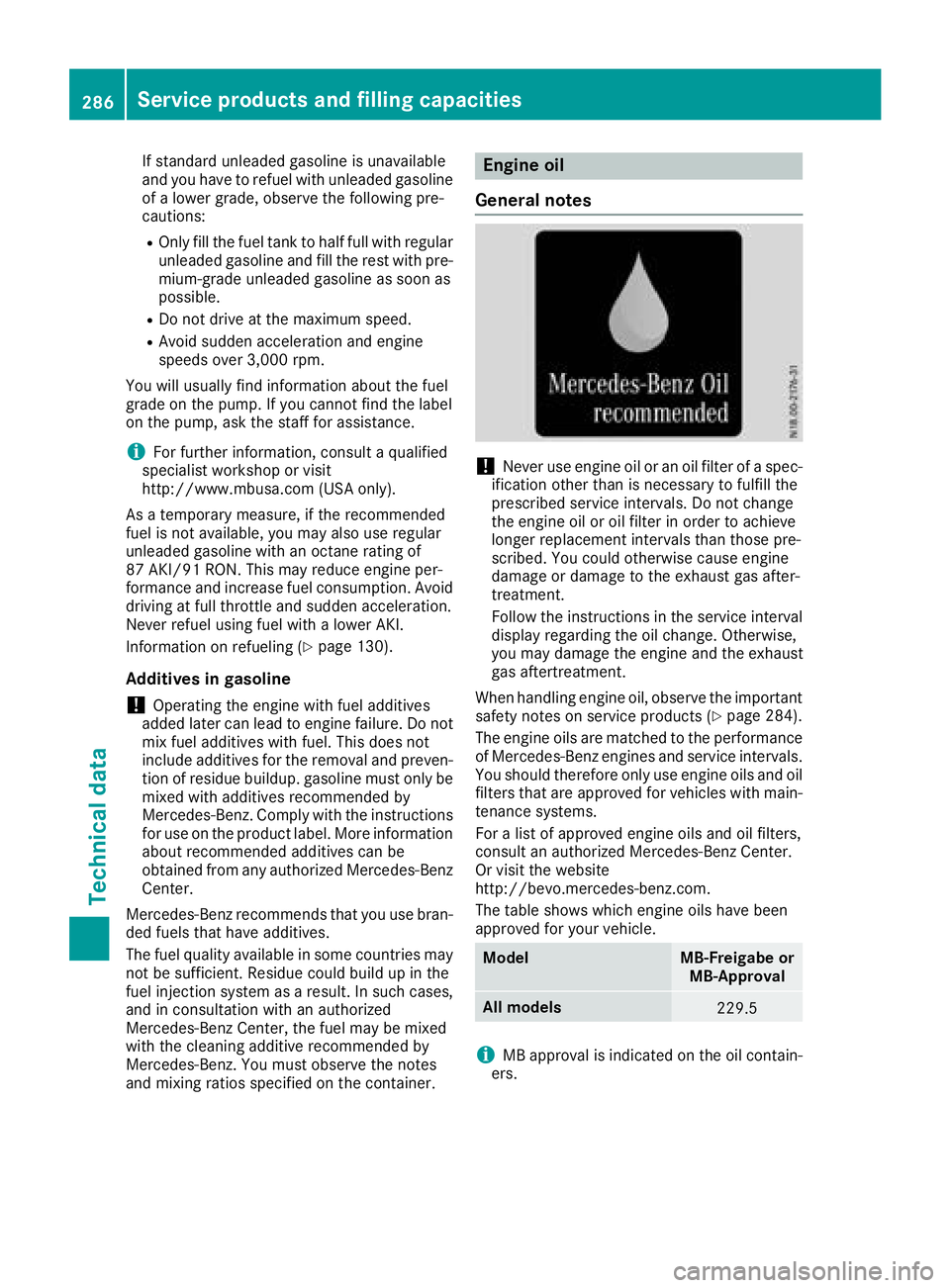
and mixing ratios specifie dont he container. Engine oil
General notes
! Never use engine oil or an oil filter of as pec-
ificatio no ther than is necessary to fulfill the
prescribe ds ervice intervals. Do not change
the engine oil or oil filter in order to achieve
longer replacement intervals than those pre-
scribed. You could otherwise cause engine
damage or damage to the exhaust gas after-
treatment.
Follow the instructions in the service interval
display regarding the oil change. Otherwise,
you may damage the engine and the exhaust
gas aftertreatment.
When handling engine oil, observe the important
safety notes on service products ( Y
page 284).
The engine oils are matched to the performance
of Mercedes-Benz engines and service intervals.
You shoul dt herefore only use engine oils and oil
filters that are approved for vehicle sw ith main-
tenance systems.
For al ist of approved engine oils and oil filters,
consult an authorized Mercedes-Benz Center.
Or visit the website
http://bevo.mercedes-benz.com.
The table shows which engine oils have been
approved for you rv ehicle.
Model MB-Freigabe or
MB-Approval
All models
229.5
i MB approval is indicated on the oil contain-
ers.286
Servic ep roducts and filling capacities
Technical data
Page 289 of 294
Filling capacities The followin gv alue sr efer to an oil chang e
includin gt he oil filter.
Model Capacit y
SLC 300
6. 7USq t( 6.3 l)
Mercedes ‑ Benz
SLC 43 AMG 6.9 US qt (6.5 l)
Ad ditives
! Do not us ea ny additive sint he engine oil.
Thi sc ould damag et he engine.
Brake fluid
G WARNING
The brake fluid constantly absorb sm oisture
from the air. Thi sl owers the boiling point of
the brake fluid .Ift he boiling point of the brake
fluid is too low, vapor pockets may form in the
brake system when the brakes are applied
hard. Thi sw ould impai rb raking efficiency.
There is ar is kofana ccident.
Yo us houl dh av et he brake fluid renewe da t
the specified intervals.
Whe nh an dling brake fluid ,o bserve the impor-
tant safety notes on service products
( Y
page 284).
The brake fluid change interval sc an be found in
the Maintenance Booklet.
Only us eb rake fluid approved by Mercedes-
Benz in accordance with MB-Freigab eorM B-
Approva l3 31.0.
Information abou ta pp roved brake fluid can be
obtaine data ny qualified specialist worksho po r
on the Interne ta t
http://bevo.mercedes-benz.co m.
i Have the brake fluid regularly replaced at a
qualified specialist workshop and the replace-
ment confirmed in the Maintenance Booklet. Coolant
Importan ts afety notes
G WARNING
If antifreeze comes into contact with hot com-
ponents in the engine compartment, it may
ignite. There is ar isk of fire and injury.
Let the engine cool dow nb efore yo ua dd anti-
freeze .M ake sur et hat antifreeze is not spilled
next to the filler neck. Thoroughly clea nt he
antifreeze from components before starting
the engine.
! Only ad dc oolant that has bee np remixed
with the desire da ntifreeze protection. You
coul do therwise damag et he engine.
Furthe ri nformatio nonc oolants can be found
in the Mercedes-Benz Specifications for Ser-
vice Products, MB BeVo 310.1, e.g. on the
Internet at http://bevo.mercedes-benz.com.
Or contact aq ualifie ds pecialist workshop.
! Always use as uitabl ec oolant mixture, even
in countries where hig ht emperatures prevail.
Otherwise ,t he engine cooling system is not
sufficiently protected from corrosion and
overheating.
i Have the coolant regularly replaced at a
qualified specialist workshop and the replace-
ment confirmed in the Maintenance Booklet.
Comply with the important safety precautions
for service products whe nh andling coolant
( Y
page 284).
The coolant is am ixture of water and anti-
freeze/corrosion inhibitor. It is responsible for
the following: R
Anti-corrosion protection R
Antifreeze protection R
Raising the boiling point
If the coolant has antifreeze protection dow nt o
-35 ‡( -37 †), the boiling point of the coolant
during operation is approximatel y2 66 ‡
(130 †).Service products and filling capacities 287
Technical data Z
Page 290 of 294
The antifreeze/corrosion inhibitor concentra-
tion in the engine cooling system should: R
be at least 50%. This will protec tt he engine
cooling system against freezin gd own to
approximately -35 ‡( -37 †).R
not exceed 55% (antifreez ep rotection down
to -49 ‡[ -45 †]). Otherwise, heat will not be
dissipated as effectively.
If the vehicle has lost coolant, add equal
amounts of water and antifreeze/corrosion
inhibitor.
Mercedes-Benz recommends an antifreeze/
corrosion inhibitor concentrate in accordance
with MB Specifications for Servic eP roducts
310.1.
i When the vehicle is first delivered, it is filled
with ac oolant mixture that ensures adequate
antifreeze and anti-corrosion protection.
i The coolant is checked with every mainte-
nanc ei nterval at aq ualified specialist work-
shop.
Fillin gc apacitiesMissing values were not availabl eatt ime of
going to print.
Model Capacity
SLC 300
Approx .8 .5 US qt
(8.0 l)
Mercedes ‑ Benz
SLC 43 AMG
Windshield washer system
Important safety notes
G WARNING
Windshield washer concentrate could ignite if
it comes into contact with hot engine compo-
nent sort he exhaust system. There is ar isk of
fire and injury.
Make sure that no windshield washer con-
centrate is spilled next to the filler neck.
! Only use washer fluid that is suitable for
plastic lamp lenses, e.g. MB SummerFit or MB
WinterFit. Unsuitable washer fluid could dam-
age the plastic lenses of the headlamps. ! Only MB SummerFit and MB WinterFit
washer fluid should be mixed together. The
spray nozzles may otherwise become
blocked.
Do not use distilled or de-ionised water. Other-
wise, the level sensor may give af alse reading.
When handling washer fluid, observe the impor-
tant safety notes on service products
( Y
page 284).
At temperatures above freezing: X
Fill the washer fluid reservoir with am ixture of
water and windshield washer fluid, e.g. MB
SummerFit. X
Add 1p art MB SummerFit to 100 parts water.
At temperatures below freezing: X
Fill the washer fluid reservoir with am ixture of
water and washer fluid, e.g. MB WinterFit.
For the correc tm ixing ratio refer to the infor-
mation on the antifreeze reservoir.
i Add windshield washer fluid, e.g. MB Sum-
merFit or MB WinterFit, to the washer fluid all
year round.
Climate control system refrigerant
Important safety notes The climate control system of your vehicle is fil-
led with refrigerant R ‑ 134a.
The instruction label regarding the refrigerant
type used can be found on the radiator cross
member.
! Only the refrigerant R ‑ 134a and the PAG oil
approved by Mercedes-Benz may be used.
The approved PAG oil may not be mixed with
any other PAG oil that is not approved for
R-134a refrigerant .O therwise, the climate
control system may be damaged.
Servic ew ork, such as refilling with refrigerant or
replacing component parts, may only be carried
out by aq ualified specialist workshop. All appli-
cable regulations, as well as SAE standard J639,
must be adhered to.
Always have work on the climate control system
carried out at aq ualified specialist workshop.288
Service products and filling capacities
Technical data