battery MERCEDES-BENZ SLC 2018 Owner's Manual
[x] Cancel search | Manufacturer: MERCEDES-BENZ, Model Year: 2018, Model line: SLC, Model: MERCEDES-BENZ SLC 2018Pages: 298, PDF Size: 4.54 MB
Page 241 of 298
! Lock the car if you wash it in an automatic
car wash. Otherwise, the vehicle might be
damaged.
! Never clean your vehicle in aT ouchless
Automatic Car Wash as these use special
cleaning agents. These cleaning agents can
damage the paintwork or plastic parts.
If you have your vehicle cleaned in ah igh-
pressure automatic car wash, small amounts
of water may enter the vehicle.
! Make sure that the automatic transmission
is in position N when washing your vehicle in
at ow-through car wash. The vehicle could be
damage dift he transmission is in another
position.
! Make sure that: R
the side windows and the roof are com-
pletely closed R
the climate control blower is switched off R
the windshiel dw iper switch is at position 0
The vehicle could otherwise be damaged.
You can clean the vehicle at an automatic car
wash from the very start.
Preferably clean the vehicle at automatic car
washes that use textile washing elements with-
out brushes. This prevents fine scratches from
forming on the paintwork and film.
If the vehicle is very dirty, pre-wash it before
cleaning it in an automatic car wash.
After using an automatic car wash, wipe off wax
from the windshiel da nd the wiper blades. This
will prevent smears and reduce wiping noises
caused by residue on the windshield.
i Vehicles with decorative film: select aw ash
program without hot wax at the automatic car
wash.
Washing by hand In some countries, washing by hand is only
allowed at speciall ye quipped washing bays.
Observe the legal requirements in each country. X
Do not use hot water and do not wash the
vehicle in direct sunlight. X
Use as oft sponge to clean.X
Use am ild cleaning agent, such as ac ar
shampoo approved by Mercedes-Benz. X
Thoroughly hose down the vehicle with ag en-
tle jet of water. X
Do not point the water jet directly towards the
air inlet or the edges of decorative foils. X
Use plenty of water and rinse out the sponge
frequently. X
Rinse the vehicle with clean water and dry
thoroughly with ac hamois.X
Do not let the cleaning agent dry on the paint-
work or the decorative foils.
Carefully remove all deposits of road salt as
soon as possible when driving in winter.
Powe rw ashers
G WARNING
The water jet from ac ircular jet nozzle (dirt
blasters) can cause invisible exterior damage
to the tires or chassis components. Compo-
nent sd amage dint his way may fail unexpect-
edly .T here is ar isk of an accident.
Do not use power washers with circular jet
nozzles to clean the vehicle. Have damaged
tires or chassis component sr eplaced imme-
diately.
! Vehicles with decorative foil: parts of your
vehicle are covered with decorative foil. Main-
tain ad istance of at least 27.5 in (70 cm)
between the foil-wrappe dp arts of the vehicle
and the nozzle of the high pressure cleaner.
Information abou tt he correct distance is
available from the equipment manufacturer.
Move the power washer nozzle around when
cleaning your vehicle.
The water temperature of the high-pressure
cleaner must not exceed 140 °F (60 °C).
! Alway sm aintain ad istance of at least
11.8 in (30 cm) between the vehicle and the
power washer nozzle. Information abou tt he
correct distance is available from the equip-
ment manufacturer.
Move the power washer nozzle around when
cleaning your vehicle.
Do not aim directly at any of the following: R
tires R
door gaps, roof gaps, joints, etc. R
electrical components R
battery R
plug-type couplings R
lights Care 239
Maintenance and care Z
Page 253 of 298
Battery (vehicle)
Important safety notes Specia lt ool sa nd expert knowledg ea re required
when working on the battery ,e .g .r emova la nd
installation. Yo us houl dt herefore have al lw or k
involving the battery carrie do ut at aq uali fied
specialist workshop.
G WARNING
Wor kc arrie do ut incorrectly on the battery
can lead ,f or example, to as hort circui ta nd
thu sd amag et he vehicl ee le ctronics .T hi sc an
lead to functio nr estrictions applying to
safety-relevant systems, e.g .t he lighting sys-
tem, the ABS (anti-lock braking system )ort he
ESP ®
(Electronic Stability Program). The oper-
ating safety of your vehicl em ay be restricted.
Yo uc ould lose contro loft he vehicle, for
example: R
when braking R
in the event of abrupt steering maneuvers
and/or when the vehicle's speed is not
adapted to the roa dc onditions
There is ar is kofana ccident.
In the event of as hort circui tora similar inci-
dent, contact aq uali fied specialist workshop
immediately. Do not drive any further .Y ou
shoul dh av ea ll work involving the battery car-
rie do ut at aq uali fied specialist workshop.
For further informatio na bout ABS and ESP ®
,
see ( Y
page 57 )a nd ( Y
page 60).
G WARNING
Electrostati cb uild -u pc an lead to the creation
of sparks, which could ignite the highl ye xplo-
sive gases of ab at tery .T here is ar is kofa n
explosion.
Before handling the battery ,t ouch the vehicle
body to remove any existing electrostatic
build-up.
The highl yf lammabl eg as mixture form sw he n
charging the battery as well as when jump-start-
ing. Alway sm ak es ur et ha tn either yo un or the bat-
tery is electrostaticall yc harged. Ab uild -u po f
electrostatic charge can be caused ,f or exam-
ple: R
by wearing clothing made from synthetic
fibers R
du etof rictio nb et ween clothing and seats R
if yo up us horp ul lt he battery across the car-
pe toro the rs yn theti cm at erialsR
if yo uw ip et he battery with ac loth
G WARNING
During the charging process ,ab at tery produ-
ces hydrogen gas. If as hort circui to ccurs or
sparks are created ,t he hydrogen ga sc an
ignite .T here is ar is kofane xplosion.R
Make sure tha tt he positive terminal of a
connected battery does not come into con-
tact with vehicl ep ar ts.R
Never place meta lo bj ects or tool sonab at -
tery. R
It is important tha ty ou observe the descri-
be do rder of the battery terminal sw he n
connecting and disconnecting ab at tery.R
Whe nj ump-starting ,m ak es ur et ha tt he
battery pole sw it hi de ntical polarity are
connected. R
It is particularly important to observe the
describe do rder when connecting and dis-
connecting the jumper cables. R
Never connect or disconnect the battery
terminal sw hile the engine is running.
G WARNING
Battery aci disc austic .T here is ar is kofi njury.
Avoi dc ontact with skin, eyes or clothing. Do
not inhal ea ny battery gases .Don ot lean over
the battery .K ee pc hildren away from batter-
ies. Wash away battery aci di mmediatel yw it h
plenty of clean water and see km edica la tten-
tion.
H Environmental note
Batterie sc ontain pollu-
tants .Itisi llegal to dispose
of them with the householdBattery (vehicle) 251
Breakdo wn assis tance Z
Page 254 of 298
rubbish. They must be col-
lected separately and dis-
posed of in an environmen-
tall yr esponsible recycling
system.
Dispose of batterie sina n
environmentally responsi-
ble manner. Take dis-
charge db atterie stoaq uali-
fied specialist workshop or
to ac ollection point for
used batteries.
! Have the battery checked regularl yata
qualified specialist workshop.
Observe the service interval sint he Mainte-
nance Booklet or contact aq ualified specialist
workshop for more information.
! Always have work on batterie sc arrie do ut at
aq ualified specialist workshop.
Shoul di t, in exceptiona lc ircumstances, be
absolutel yn ecessary to disconnect the 12-
volt battery yourself, please observe the fol-
lowing: R
Secure the vehicl etop revent it from rolling
away. R
Switch off the ignition. R
Disconnect the negative terminal first and
then the positive terminal.
The transmission is locked in position ]
after disconnecting the battery.
After the work has been done, install the bat-
tery and replace the cover of the positive ter-
minal clamp firmly.
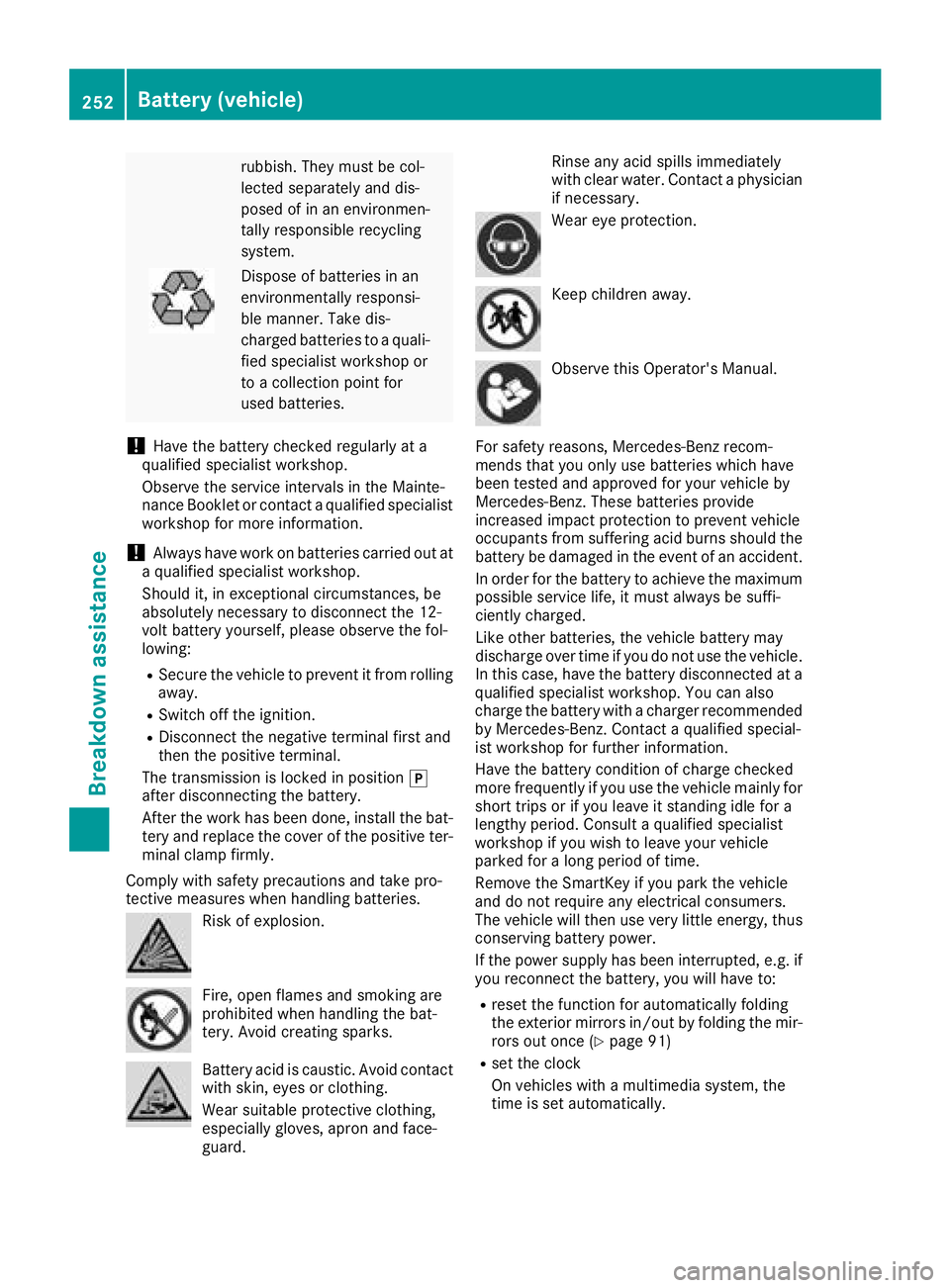
Comply with safety precautions and take pro-
tective measures when handling batteries.
Ris kofe xplosion.
Fire, open flame sa nd smoking are
prohibited when handling the bat-
tery. Avoid creating sparks.
Battery acid is caustic. Avoid contact
with skin, eye sorc lothing.
Wea rs uitable protective clothing,
especially gloves, apro na nd face-
guard. Rinse any acid spills immediately
with clea rw ater. Contact ap hysician
if necessary.
Wea re ye protection.
Keep children away.
Observe this Operator's Manual.
For safety reasons, Mercedes-Benz recom-
mends that you only use batterie sw hich have
been tested and approved for you rv ehicl eb y
Mercedes-Benz. These batterie sp rovide
increase di mpact protection to prevent vehicle
occupants from suffering acid burns should the
battery be damaged in the event of an accident.
In order for the battery to achieve the maximum
possible service life ,itm ust alway sbes uffi-
ciently charged.
Like other batteries, the vehicl eb attery may
discharge over time if you do not use the vehicle.
In this case, have the battery disconnected at a
qualified specialist workshop .Y ou can also
charge the battery with ac harge rr ecommended
by Mercedes-Benz. Contact aq ualified special-
ist workshop for further information.
Have the battery condition of charge checked
more frequently if you use the vehicl em ainl yf or
short trips or if you leave it standing idl ef or a
lengthy period. Consult aq ualified specialist
workshop if you wis htol eave you rv ehicle
parked for al ong perio doft ime.
Remove the SmartKey if you park the vehicle
and do not require any electrica lc onsumers.
The vehicl ew il lt hen use very little energy ,t hus
conserving battery power.
If the powe rs upply has been interrupted ,e .g. if
you reconnect the battery ,y ou wil lh ave to:R
reset the function for automatically folding
the exterior mirrors in/out by folding the mir-
rors out once ( Y
pag e9 1)R
set the clock
On vehicles with am ultimedia system, the
time is set automatically.252
Battery (vehicle)
Breakdown assistance
Page 255 of 298
Charging th eb attery
G WARNING
During chargin ga nd jump-starting, explosive
gases can escape from th eb attery. Ther eisa
ris kofane xp losion.
Particularly avoid fire, open flames, creating
sparks and smoking. Ensure there is sufficient
ventilatio nw hile chargin ga nd jump-starting.
Do no tl ean ove rab attery.
G WARNING
Battery acid is caustic .T her eisar is kofi njury.
Avoid contac tw it hs ki n, eyes or clothing .D o
no ti nhale any battery gases .Don ot lean over
th eb attery. Keep childre na way from batter-
ies. Wash away battery acid immediately with
plenty of clean wate ra nd seek medical atten-
tion.
G WARNING
Ad ischarged battery can freez eatt em pera-
tures below freezing point. When jump-start-
ing th ev ehicle or chargin gt he battery, gases
can escape from th eb attery. Ther eisar is ko f
an explosion. Allow th ef roze nb attery to thaw out before
chargin gitorj ump-starting.
! Only use battery chargers wit ham aximum
chargin gv oltage of 14.8 V.
! Only charge th eb attery usin gt he jump-
starting connection point.
The jump-startin gc onnection poin tisint he
engin ec ompartment.
If th ei ndicator/warning lamps do no tl ight up at
low temperatures, it is ver yl ikely that th ed is-
charge db attery has frozen .Int hi sc ase, you
may neither charge th eb attery no rj ump-start
th ev ehicle .T he servic el ife of at ha wed-out bat-
tery may be shorter. The starting characteristics
can be impaired, particularly at low tempera-
tures. Hav et he thawed-out battery checked at a
qualified specialist workshop.
Read th eb attery charger's operatin gi nstruc-
tions before chargin gt he battery.X
Open th eh ood. X
Connect th eb attery charge rtot he positive
terminal and ground poin tint he same order
as when connecting th ed onor battery in the
jump-startin gp rocedure ( Y
page 253).
Jump-starting For th ej ump-startin gp rocedure, use only th ej ump-startin gc onnection poin tint he engin ec om-
partment, consisting of ap ositiv et ermi nal and ag round point.
G WARNING
Battery acid is caustic .T her eisar is kofi njury.
Avoid contac tw it hs ki n, eyes or clothing .Don ot inhale any battery gases .Don ot lean ove rt he
battery. Keep childre na way from batteries .W ash away battery acid immediately wit hp lenty of
clean wate ra nd seek medical attention.
G WARNING
During chargin ga nd jump-starting, explosive gases can escape from th eb attery. Ther eisar isk
of an explosion.
Particularly avoid fire, open flames, creating sparks and smoking. Ensure there is sufficient ven-
tilatio nw hile chargin ga nd jump-starting. Do no tl ean ove rab attery.Jump-starting 253
Breakdown assistance Z
Page 256 of 298
G WARNING
During the charging process ,ab attery produces hydrogen gas. If as hort circui to ccurs or sparks
are created ,t he hydrogen gas can ignite. There is ar isk of an explosion.R
Make sure that the positive terminal of ac onnected battery does not come into contact with
vehicl ep arts.R
Never place metal objects or tools on ab attery.R
It is important that you observe the described order of the battery terminal sw hen connecting
and disconnecting ab attery.R
When jump-starting, make sure that the battery pole sw ith identical polarity are connected.R
It is particularl yi mportant to observe the described order when connecting and disconnecting
the jumper cables. R
Never connect or disconnect the battery terminal sw hile the engine is running.
G WARNING
Ad ischarged battery can freeze at temperatures below freezing point. When jump-starting the
vehicl eorc harging the battery ,g ase sc an escap ef rom the battery .T here is ar isk of an explosion.
Allow the frozen battery to thaw out before charging it or jump-starting.
! Avoid repeated and lengthy starting attempts. Otherwise, the catalytic converter coul db e
damaged by the non-combusted fuel.
If the indicator/warning lamp sdon ot light up at low temperatures, it is very likel yt hat the dis-
charge db attery has frozen. In this case, you may neither charge the battery nor jump-start the
vehicle. The service life of at hawed-out battery may be shorter. The starting characteristics can be
impaired ,p articularl yatl ow temperatures. Have the thawed-out battery checked at aq ualified
specialist workshop.
Do not start the vehicl eu sing ar api dc harging device. If you rv ehicle's battery is discharged, the
engine can be jump-started from another vehicl eorf rom as econd battery using jumper cables.
Observe the following points: R
The battery is not accessible in all vehicles. If the other vehicle's battery is not accessible ,j ump-
start the vehicl eu sing as econd battery or aj ump-starting device.R
You may only jump-start the vehicl ew hen the engine and exhaust system are cold.R
Do not start the engine if the battery is frozen. Let the battery thaw first. R
Only jump-start from batterie sw ith a12Vv oltag er ating.R
Only use jumper cables which have as ufficient cross-section and insulated terminal clamps.R
If the battery is full yd ischarged, leave the battery that is being used to jump-start connected for
af ew minutes before attempting to start. This charge st he battery slightly.R
Make sure that the two vehicles do not touch.
Make sure that: R
The jumper cables are not damaged. R
Bare parts of the terminal clamp do not come into contact with other metal parts while the jumper
cables are connected to the ba ttery.R
The jumper cables cannot come into contact with parts which can move when the engine is
running, such as the V-belt pulley or the fan. X
Secure the vehicl ebya pplying the electric parking brake.X
Shift the transmission to position ] .254
Jump-starting
Breakdown assistance
Page 258 of 298
Towin ga nd tow-starting
Important safety notes
G WARNING
When towing or tow-startin ga nothe rv ehicle
and its weight is greate rt ha nt he permissible
gross weight of your vehicle, the: R
the towing ey ec ould detach itselfR
the vehicle/trailer combinatio nc ould roll-
over.
There is ar is kofana ccident.
When towing or tow-startin ga nothe rv ehicle,
its weight shoul dn ot be greate rt ha nt he per-
missibl eg ross weight of your vehicle.
Detail sont he permissibl eg ross vehicl ew eigh t
of your vehicl ec an be found on the vehicl ei de n-
tification plate ( Y
page 289).
! When Activ eB rake Assist, Distance Pilot
DISTRONI Cort he HOLD functio ni sa ctivated,
the vehicl eb rakes automaticall yinc ertain
situations.
To avoi dd amag etot he vehicle, deactivate
these system sint he following or similar sit-
uations: R
when towing the vehicle R
in the car wash
! Onl ys ecur et he tow rop eort ow ba ratt he
towing eyes. Otherwise, the vehicl ec ould be
damaged.
! Do not us et he towing ey ef or recovery, this
could damage the vehicle. If in doubt, recover
the vehicl ew it hac rane.
! When towing ,p ul la wa ys lowly and
smoothly. If the tractiv ep ower is too high, the
vehicles could be damaged.
! Do not tow with sling-typ ee quipment .T h is
could damage the vehicle.
! When towing away vehicles with KEYLESS-
GO ,u se the key instea doft he Start/Stop
button. The automatic transmission ma yo th-
erwis es hift to position ] when yo uo pe nt he
driver's or front-passenge rd oo r, which could
damage the transmission. ! Make sure tha tt he electri cp ar kin gb rake is
released .Ift he electri cp ar kin gb rake is faulty,
visit aq uali fied specialis tw or kshop.
! The vehicl ec an be towed am ax imum of
30 miles (50km). The towing spee dof30m ph
(50 km/h )m us tn ot be exceeded.
If the vehicl eh as to be towed mor et han
30 miles (50km), the entire vehicl em us tb e
raised and transported.
! If yo ut ow or tow-start anothe rv ehicle, its
weight must not exceed the maximum per-
missibl eg ross vehicl ew eigh tofy ou rv ehicle.
It is better to have the vehicl et ransporte dt han
to have it towed away.
The automatic transmission must be in position
\\ when the vehicl eisb ei ng towed away.
The battery must be connected and charged.
Otherwise, you: R
canno tt ur nt he SmartKe ytop osit ion H in
the ignition lock. R
canno ts hift the automatic transmission to
position \\ .
Deactivate the automatic locking featur eb ef o re
th
e vehicl eist owed ( Y
page 173) .Y ou could
otherwis ebel oc ked ou tw he np us hing or towing
the vehicle.
Installing/removin gt he towin ge ye
Installing the towin ge ye
G WARNING
The exhaust tai lp ip em ay be ver yh ot. There is
ar is kofb ur ns when removing the rea rc over.
Do not touch the exhaust pipe .T ak ep ar ticular
car ew he nr emoving the rea rc over.256
Towin ga nd tow-starting
Breakdow na ssistance
Page 282 of 298
Weight of optional extras The combined weight of those optiona le xtras
that weigh more than the replaced standard
parts and more than 2.3 kg (5 lbs) .T hese
optiona le xtras, such as high-performance
brakes ,l eve lc ontrol, ar oof rack or ah igh-per-
formance battery ,a re not included in the curb
weight and the weight of the accessories.
TIN (Tire Identification Number) This is au nique identifier which can be use db y
at ire manufacturer to identify tires, for example
for ap roduct recall, and thus identify the pur-
chasers. The TIN is made up of the manufactur-
er's identity code, tire size, tire type code and
the manufacturing date.
Load bearin gi ndexThe loa db earing index (also loa di ndex) is ac ode
that contains the maximu ml oa db earing capa-
city of at ire.
Traction Tractio nist he result of friction between the tires
and the road surface.
Treadwear indicators Narrow bars (tread wea rb ars )t hat are distrib-
uted over the tire tread. If the tire tread is level
with the bars ,t he wea rl imi to f