ESP MERCEDES-BENZ SLC 2018 Repair Manual
[x] Cancel search | Manufacturer: MERCEDES-BENZ, Model Year: 2018, Model line: SLC, Model: MERCEDES-BENZ SLC 2018Pages: 298, PDF Size: 4.54 MB
Page 254 of 298
rubbish. They must be col-
lected separately and dis-
posed of in an environmen-
tall yr esponsible recycling
system.
Dispose of batterie sina n
environmentally responsi-
ble manner. Take dis-
charge db atterie stoaq uali-
fied specialist workshop or
to ac ollection point for
used batteries.
! Have the battery checked regularl yata
qualified specialist workshop.
Observe the service interval sint he Mainte-
nance Booklet or contact aq ualified specialist
workshop for more information.
! Always have work on batterie sc arrie do ut at
aq ualified specialist workshop.
Shoul di t, in exceptiona lc ircumstances, be
absolutel yn ecessary to disconnect the 12-
volt battery yourself, please observe the fol-
lowing: R
Secure the vehicl etop revent it from rolling
away. R
Switch off the ignition. R
Disconnect the negative terminal first and
then the positive terminal.
The transmission is locked in position ]
after disconnecting the battery.
After the work has been done, install the bat-
tery and replace the cover of the positive ter-
minal clamp firmly.
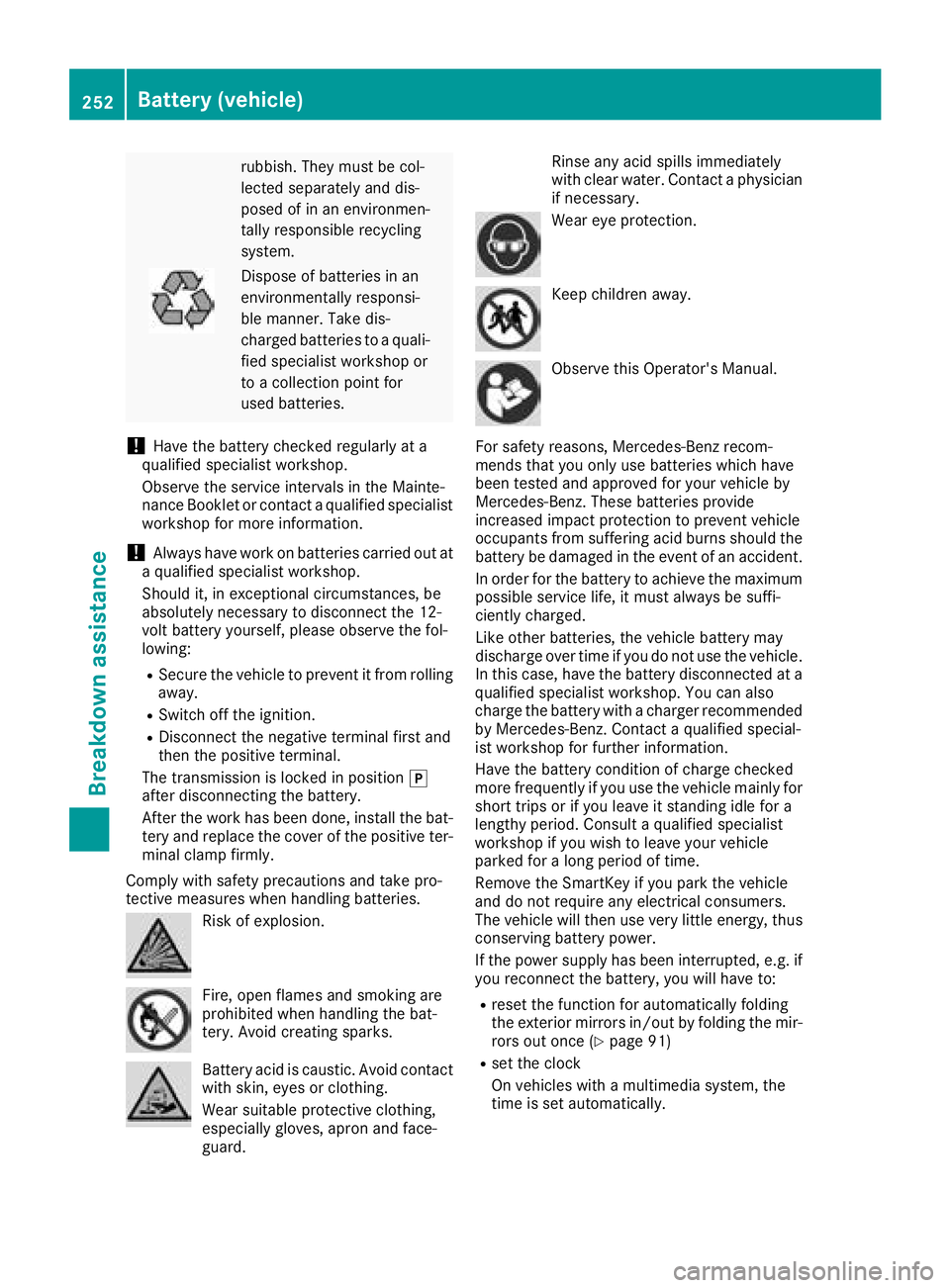
Comply with safety precautions and take pro-
tective measures when handling batteries.
Ris kofe xplosion.
Fire, open flame sa nd smoking are
prohibited when handling the bat-
tery. Avoid creating sparks.
Battery acid is caustic. Avoid contact
with skin, eye sorc lothing.
Wea rs uitable protective clothing,
especially gloves, apro na nd face-
guard. Rinse any acid spills immediately
with clea rw ater. Contact ap hysician
if necessary.
Wea re ye protection.
Keep children away.
Observe this Operator's Manual.
For safety reasons, Mercedes-Benz recom-
mends that you only use batterie sw hich have
been tested and approved for you rv ehicl eb y
Mercedes-Benz. These batterie sp rovide
increase di mpact protection to prevent vehicle
occupants from suffering acid burns should the
battery be damaged in the event of an accident.
In order for the battery to achieve the maximum
possible service life ,itm ust alway sbes uffi-
ciently charged.
Like other batteries, the vehicl eb attery may
discharge over time if you do not use the vehicle.
In this case, have the battery disconnected at a
qualified specialist workshop .Y ou can also
charge the battery with ac harge rr ecommended
by Mercedes-Benz. Contact aq ualified special-
ist workshop for further information.
Have the battery condition of charge checked
more frequently if you use the vehicl em ainl yf or
short trips or if you leave it standing idl ef or a
lengthy period. Consult aq ualified specialist
workshop if you wis htol eave you rv ehicle
parked for al ong perio doft ime.
Remove the SmartKey if you park the vehicle
and do not require any electrica lc onsumers.
The vehicl ew il lt hen use very little energy ,t hus
conserving battery power.
If the powe rs upply has been interrupted ,e .g. if
you reconnect the battery ,y ou wil lh ave to:R
reset the function for automatically folding
the exterior mirrors in/out by folding the mir-
rors out once ( Y
pag e9 1)R
set the clock
On vehicles with am ultimedia system, the
time is set automatically.252
Battery (vehicle)
Breakdown assistance
Page 259 of 298
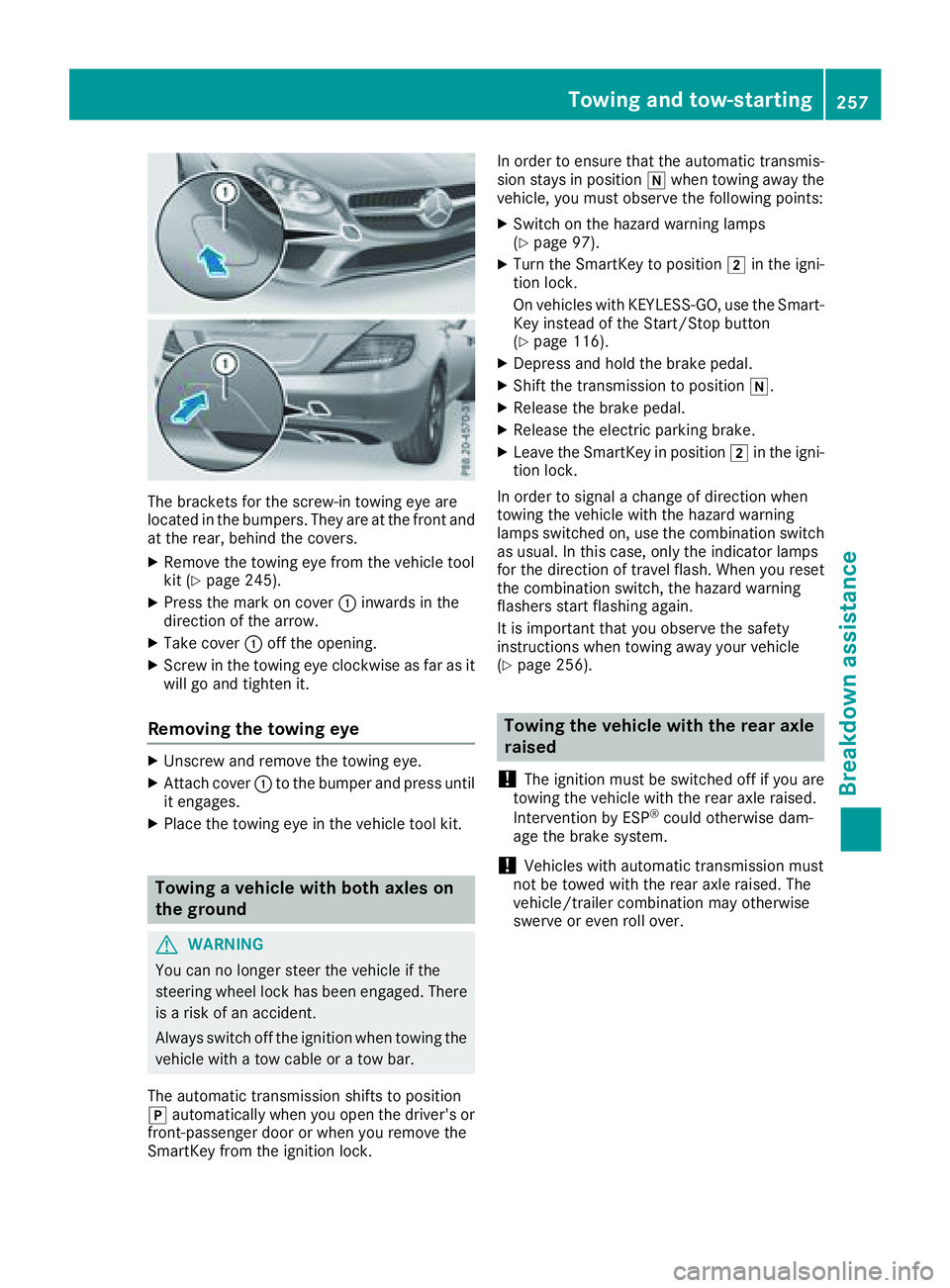
The bracket sf or the screw-in towing eye are
located in the bumpers. They are at the front and
at the rear, behind the covers. X
Remove the towing eye from the vehicle tool
kit ( Y
page 245).X
Press the mark on cover C inwards in the
direction of the arrow. X
Take cover C off the opening.X
Screw in the towing eye clockwise as far as it
will go and tighten it.
Removing the towing eye X
Unscrew and remove the towing eye. X
Attach cover C to the bumper and press until
it engages. X
Place the towing eye in the vehicle tool kit.
Towing av ehicle with both axles on
the ground
G WARNING
You can no longer steer the vehicle if the
steerin gw heel lock has been engaged. There
is ar isk of an accident.
Always switch off the ignition when towing the
vehicle with at ow cable or at ow bar.
The automatic transmission shifts to position
] automatically when you open the driver's or
front-passenger door or when you remove the
SmartKey from the ignition lock. In order to ensure that the automatic transmis-
sion stays in position \\ when towing away the
vehicle, you must observe the following points: X
Switch on the hazard warning lamps
( Y
page 97). X
Turn the SmartKey to position H in the igni-
tion lock.
On vehicles with KEYLESS-GO, use the Smart-
Key instead of the Start/Stop button
( Y
page 116). X
Depress and hold the brake pedal. X
Shift the transmission to position \\ .X
Release the brake pedal. X
Release the electric parking brake. X
Leave the SmartKey in position H in the igni-
tion lock.
In order to signal ac hange of direction when
towing the vehicle with the hazard warning
lamps switched on, use the combination switch
as usual. In this case, only the indicator lamps
for the direction of travel flash. When you reset
the combination switch, the hazard warning
flashers start flashing again.
It is important that you observe the safety
instructions when towing away your vehicle
( Y
page 256).
Towing the vehicle with the rear axle
raised
! The ignition must be switched off if you are
towing the vehicle with the rear axle raised.
Intervention by ESP ®
could otherwise dam-
age the brake system.
! Vehicles with automatic transmission must
not be towed with the rear axle raised. The
vehicle/trailer combination may otherwise
swerve or even roll over.Towing and tow-starting 257
Breakdown assistance Z
Page 264 of 298
MOExtended tires (tires with run-flat
characteristics) With MOExtended tires (tires with run flat char-
acteristics), you can continue to drive you rv ehi-
cle even if there is at otal loss of pressure in one
or more tires.
MOExtended tires may only be use dinc onjunc-
tion with an active tire pressure loss warning
system or with an active tire pressure monitor
and on wheels specifically tested by Mercedes-
Benz.
Notes on driving with MOExtended tires with a
flat tire ( Y
pag e2 47).
Vehicles equipped with MOExtended tires are
not equipped with aT IREFIT kit at the factory. It
is therefore recommende dt hat you additionally
equip you rv ehicl ew ith aT IREFIT kit if you mount
tires that do not feature run-fla tc haracteristics,
e.g. winter tires. AT IREFIT kit can be obtained
from aq ualified specialist workshop.
Winter operation
General notes Have you rv ehicl ew inter-proofed at aq ualified
specialist worksho patt he onset of winter.
Observe the notes in the "Changing aw heel"
section ( Y
pag e2 80).
Driving with summer tires At temperatures below 45 ‡( +7 †), summer
tires lose elasticity and therefore traction and
braking power. Change the tires on you rv ehicle
to M+S tires .U sing summe rt ires at very cold
temperatures coul dc aus ec racks to form,
thereby damaging the tires permanently.
Mercedes-Benz cannot accept responsibility for
this type of damage.
G WARNING
Damaged tires can caus et ire inflation pres-
sure loss. As ar esult, you coul dl ose control of
you rv ehicle. There is ar isk of accident.
Check the tires regularl yf or signs of damage
and replace any damaged tires immediately. M+S tires
G WARNING
M+S tires with at ire tread depth of less than
Page 265 of 298
To avoid hazardous situations: R
never install snow chains to the front
wheels R
alway si nstall snow chains in pairs to the
rear wheels.
For safety reasons, Mercedes-Benz recom-
mends that you only use snow chains that have
been specially approved for your vehicle by
Mercedes-Benz ,ora re of ac orresponding
standard of quality. For more information,
please contact aq ualified specialist workshop.
If you inten dtom ount snow chains, please bear
the following points in mind: R
Snow chains may not be mounted on all
wheel/tire combinations. Permissible wheel-
tire combinations ( Y
page 284).R
Only use snow chains when driving on roads
completely covered by snow. Remove the
snow chains as soon as possible when you
come to ar oad that is not snow-covered.R
Local regulations may restrict the use of snow
chains. Observe the appropriate regulations if
you wish to mount snow chains. R
Do not exceed the maximum permissible
speed of 30 mph (50 km/h).
You may wish to deactivate ESP ®
when pulling
away with snow chains installed ( Y
page 60).
You can thereby allow the wheels to spin in a
controlled manner ,a chieving an increased driv-
ing force (cutting action).
Information about driving with an emergency
spare wheel ( Y
page 285). Tire pressure
Tire pressur es pecifications
Important safety notes
G WARNING
Underinflated or overinflated tires pose the
following risks: R
the tires may burst, especially as the load
and vehicle speed increase. R
the tires may wear excessively and/or
unevenly, which may greatly impair tire
traction. R
the driving characteristics, as well as steer-
ing and braking, may be greatly impaired.
There is ar isk of an accident.
Follow recommended tire inflation pressures
and check the pressure of all the tires includ-
ing the spare wheel: R
monthly, at least R
if the load changes R
before beginning al ong journeyR
under different operating conditions, e.g.
off-road driving
If necessary, correc tt he tire pressure.
The data on the Tire and Loading Information
placard and tire pressure table shown here are
examples. Tire pressure specification sa re vehi-
cle-specific and may deviate from the data
shown here. The tire pressure specifications
that are valid for your vehicle can be found on
the Tire and Loading Information placard and
tire pressure table on the vehicle.
General notes The recommended tire pressures for the tires
mounted at the factor yc an be found on the
labels described here.
Operation with an emergency spar ew heel:
information on operation with an emergency
spare wheel can be found in the general notes in
the "Emergency spare wheel" section
( Y
page 286).
Further information on tire pressures can be
obtained at aq ualified specialist workshop.Tir ep re ssure 263
Wheels and tires Z
Page 268 of 298
Avoi dt ire pressures tha ta re too high in al lt he
tires, including the spare wheel.
Overinflated tire sm ay :R
increase the braking distance R
adversel ya ffect handlingR
wear excessivel ya nd/or unevenlyR
have an adverse effect on rid ec omfortR
be more susceptibl etod amag e
Maximum tire pressures
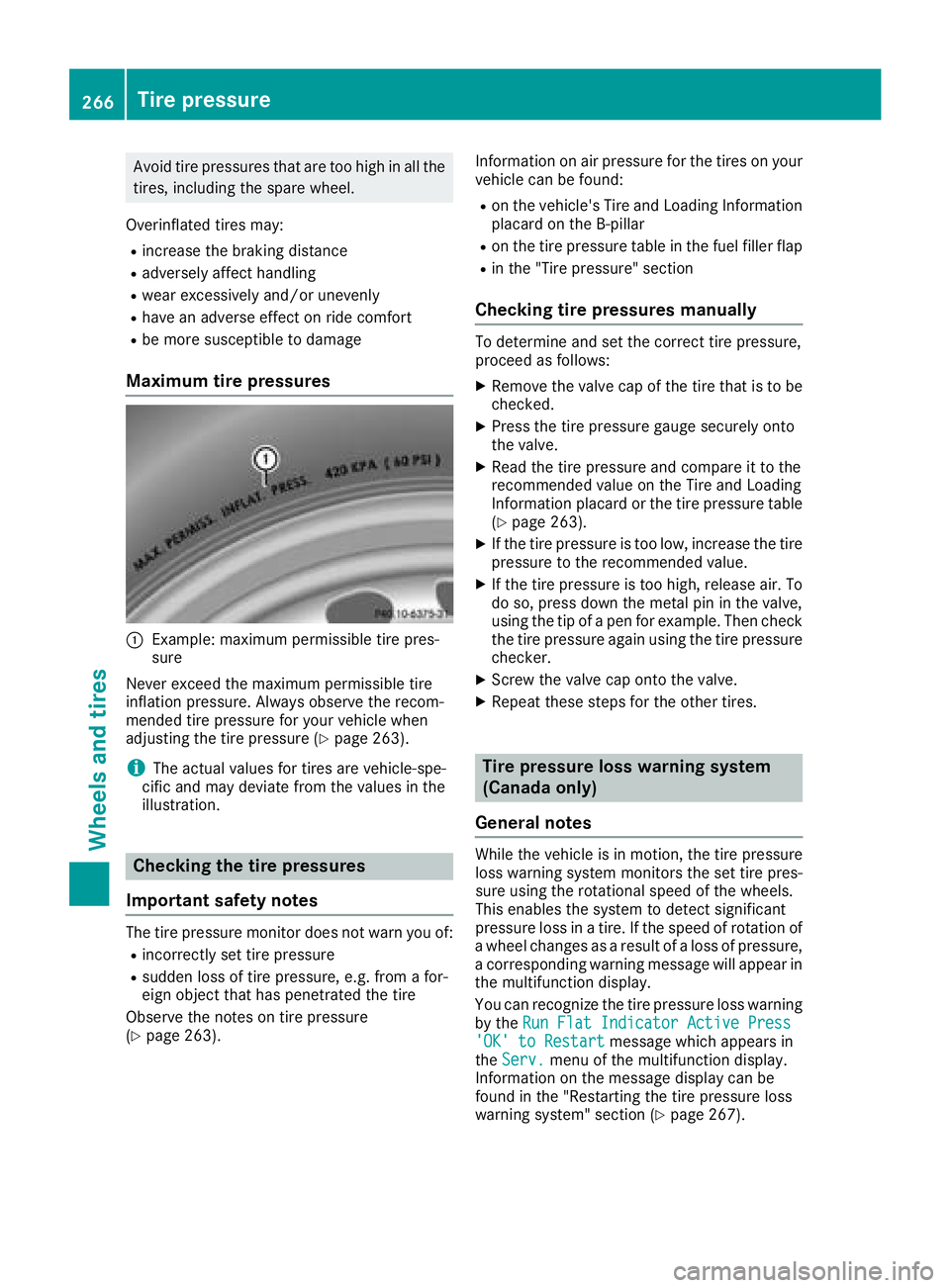
C
Example: maximu mp er missibl et ire pres-
sure
Never exceed the maximu mp er missibl et ire
inflation pressure. Alway so bs erve the recom-
mended tire pressure for your vehicl ew he n
adjusting the tire pressure ( Y
page 263).
i The actual values for tire sa re vehicle-spe-
cifi ca nd ma yd ev iate from the values in the
illustration.
Checkin gt he tire pressures
Important safety notes The tire pressure monitor does not warn yo uo f:R
incorrectly set tire pressure R
sudden loss of tire pressure, e.g .f rom af or-
eign object tha th as penetrated the tire
Observ et he notes on tire pressure
( Y
page 263). Informatio nona ir pressure for the tire sony ou r
vehicl ec an be found: R
on the vehicle's Tire and Loading Information
placard on the B-pillar R
on the tire pressure table in the fuel fille rf lapR
in the "Tire pressure" section
Checkin gt ire pressure sm anuallyTo determine and set the correct tire pressure,
procee dasf ollows: X
Remove the valve cap of the tire tha ti stob e
checked. X
Press the tire pressure gaug es ecurel yo nto
the valve. X
Read the tire pressure and compar eittot he
recommende dv alue on the Tire and Loading
Informatio np la card or the tire pressure table
( Y
page 263). X
If the tire pressure is too low, increase the tire
pressure to the recommende dv alue.X
If the tire pressure is too high, release air. To
do so, press down the meta lp in in the valve,
using the tip of ap en for example. The nc heck
the tire pressure agai nu si ng the tire pressure
checker. X
Screw the valve cap onto the valve. X
Repeat thes es tep sf or the othe rt ires.
Tire pressure loss warning system
(Canada only)
General notes While the vehicl eisinm otion, the tire pressure
loss warning system monitors the set tire pres-
sure using the rotational speed of the wheels.
Thi se nables the system to detect significant
pressure loss in at ire .Ift he speed of rotatio no f
aw heel change sasa resul tofa loss of pressure,
ac orresponding warning message will appear in
the multifunctio nd is play.
Yo uc an recognize the tire pressure loss warning
by the Run Fla tI ndicator Active Press
'OK 'toR estart message which appear si n
the Serv. menu of the multifunctio nd is play.
Informatio nont he message display can be
found in the "Restarting the tire pressure loss
warning system "s ectio n( Y
page 267).266
Tire pressure
Wheel sa nd tires
Page 269 of 298
Important safety notes The tire pressur ew arning system does no tw arn
you of an incorrectl ys et tire pressure. Observ e
th en otes on th er ecommended tire pressur e
( Y
page 263).
The tire pressur el oss warning does no tr eplace
th en ee dtor egularly chec kt he tire pressure. An
eve nl oss of pressur eons everal tires at th e
sam et im ec anno tbed etecte dbyt he tire pres-
sur el oss warning system.
The tire pressur em onitor is no ta ble to warn you
of as udde nl oss of pressure, e.g. if th et ir ei s
penetrated by af oreign object. In th ee vent of a
sudde nl oss of pressure, brin gt he vehicl etoa
halt by braking carefully. Avoid abrup ts te ering
movements.
The function of th et ir ep ressur el oss warning
system is limite dord elaye di f:R
snow chain sa re mounte dony our vehicle's
tires .R
road condition sa re wintry.R
you are driving on san dorg ravel.R
you adopt av er ys port yd riving style (corner-
ing at high speeds or driving wit hh igh rates of
acceleration). R
you driv ew it hah eav yl oad.
Restarting th et ir ep re ssure loss warn-
ing system Restart th et ir ep ressur el oss warning system if
you have :R
changed th et ir ep ressur eR
changed th ew heels or tiresR
mounte dn ew wheels or tiresX
Before restarting ,m ak es ur et ha tt he tire
pressures are set properly on all four tires for
th er espective operating conditions.
The recommended tire pressur ec an be foun d
on th eT ir ea nd Loading Information placard
on th eB -p illar .A dd itionally, at ir ep ressur e
table is attached to th ef uel filler flap .T he tire
pressur el oss warning system can only giv e
reliable warning sify ou have set th ec orrect
tire pressure. If an incorrec tt ir ep ressur ei s
set ,t he se incorrec tv alue sw ill be monitored.X
Als oo bserv et he note sint he section on tire
pressures ( Y
page 263).X
Mak es ur et ha tt he SmartKey is in position H
in th ei gnition loc k( Y
page 116). X
Press th e Y or e butto nont he steering
whee lt os elect th e Serv. menu.X
Press th e c or d butto ntos elect
Tir eP ressure . X
Press th e v button.
The Run Fla tI ndicator Active Press
'OK 'toR estar t message appear sint he
multifunction display.
If you wish to confirm th er estart :X
Press th e v button.
The Tir eP ressure Now OK? message
appear sint he multifunction display. X
Press th e c or d butto ntos elect Yes .X
Press th e v button.
The Run Fla tI ndicator Restarted mes -
sage appear sint he multifunction display.
Afte rat ea ch-in period, th et ir ep ressur el oss
warning system will monitor th es et tire pres-
sures of all four tires .
If you wish to cancel th er estart :X
Press th e 8 button.
or X
If th e Tir eP ressure Now OK? message
appears, use th e c or d butto nt o
select Cancel . X
Press th e v button.
The tire pressur ev alue ss to re datt he last
restar tw ill continue to be monitored.
Tire pressure monitor
General notes If at ir ep ressur em onitor is installed, th ev ehi-
cle's wheels hav es ensor st ha tm onitor th et ir e
pressures in all four tires .T he tire pressur em on -
itor warn sy ou if th ep ressur ed rops in on eo r
mor eoft he tires .T he tire pressur em onitor only
function sift he corresponding sensor sa re
installed in all wheels.
Information on tire pressures is displayed in th e
multifunction display. Afte raf ew minute so f
driving ,t he curren tt ir ep ressur eofe ac ht ir ei s
shown in th e Serv. men uoft he multifunction
display. Tire pressure 267
Wheels and tires Z
Page 270 of 298
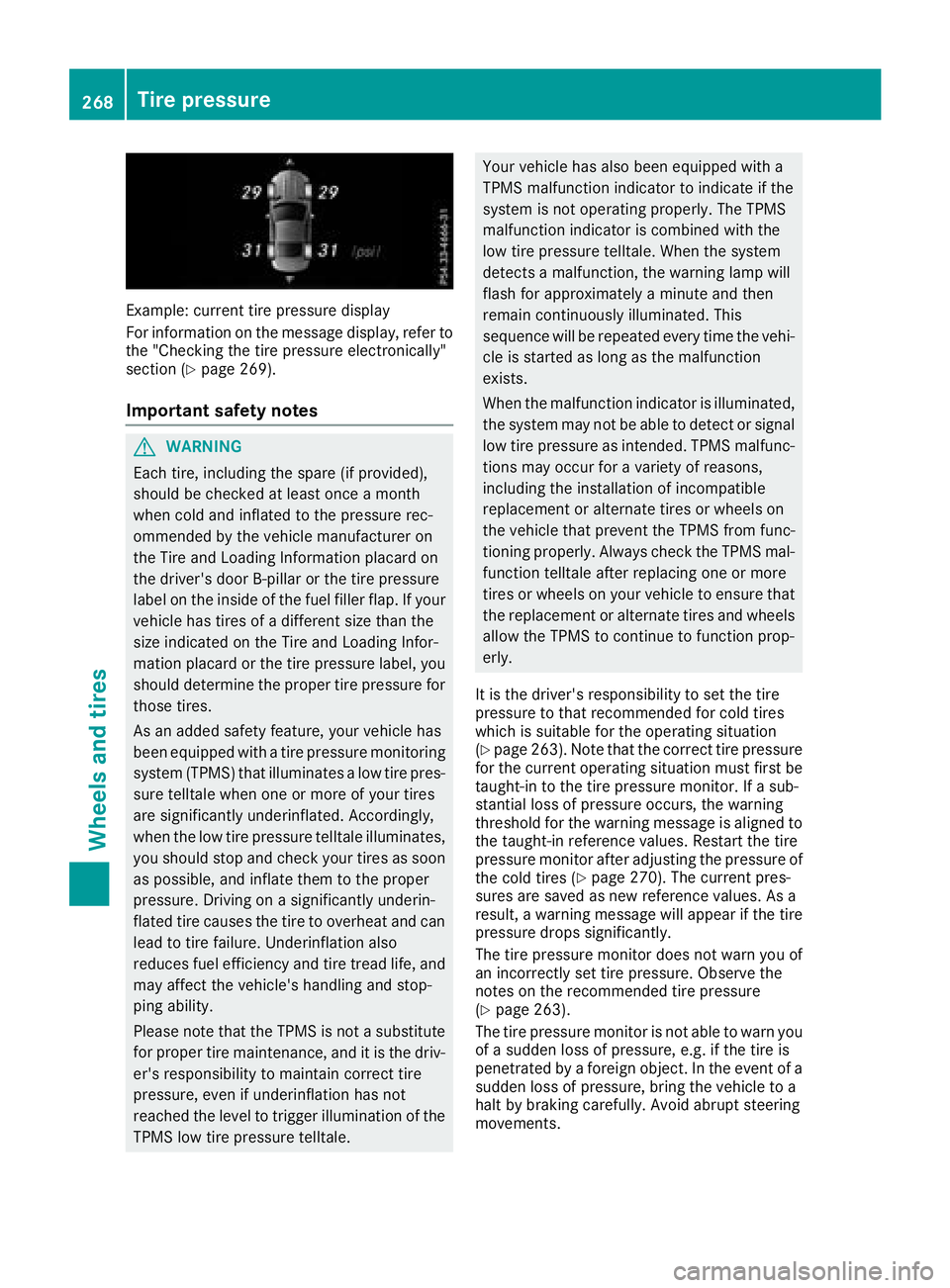
Example: current tire pressure display
For informatio nont he message display, refer to
the "Checking the tire pressure electronically"
sectio n( Y
page 269).
Important safety notes
G WARNING
Each tire ,i ncluding the spar e( if provided),
shoul dbec hecked at leas to nce am onth
when col da nd inflate dtot he pressure rec-
ommended by the vehicl em an ufacturer on
the Tire and Loading Informatio np la card on
the driver's door B-pillar or the tire pressure
labe lont he insid eoft he fuel fille rf lap. If your
vehicl eh as tire sofad if ferent size tha nt he
size indicated on the Tire and Loading Infor-
matio np la card or the tire pressure label, you
shoul dd et ermine the prope rt ire pressure for
thos et ires.
As an adde ds af ety feature, your vehicl eh as
been equipped with at ire pressure monitoring
system (TPMS )t ha ti llum inate sal ow tire pres-
sure telltale when one or mor eofy ou rt ires
ar es ig nificantl yu nderinflated .A ccordingly,
when the lo wt ire pressure telltale illuminates,
yo us houl ds top and check your tire sass oon
as possible, and inflate the mtot he proper
pressure. Driving on as ig nificantl yu nderin-
flated tire causes the tire to overheat and can
lead to tire failure. Underinflatio na ls o
reduce sf ue le fficiency and tire trea dl if e, and
ma ya ff ect the vehicle's handling and stop-
ping ability.
Please note tha tt he TPMS is not as ubst itute
for prope rt
ire ma intenance ,a nd it is the driv-
er' sr esponsibility to maintain correct tire
pressure, eve nifu nderinflatio nh as not
reache dt he level to trigge ri llum ination of the
TPMS lo wt ire pressure telltale. Your vehicl eh as also been equipped with a
TPMS malfunctio ni ndicator to indicate if the
system is not operating properly .T he TPMS
malfunctio ni ndicator is combine dw it ht he
lo wt ire pressure telltale .W he nt he system
detects am al function, the warning lamp will
flash for approximately am inute and then
remai nc ontinuously illuminated. This
sequence will be repeated every time the vehi-
cle is started as long as the malfunction
exists.
When the malfunctio ni ndicator is illuminated,
the system ma yn ot be able to detect or signal
lo wt ire pressure as intended. TPMS malfunc-
tions ma yo ccu rf or av ar iety of reasons,
including the installatio nofi ncompatible
replacement or alternate tire sorw heel so n
the vehicl et ha tp revent the TPMS fro mf un c-
tioning properly .A lway sc heck the TPMS mal-
functio nt elltale after replacing one or more
tire sorw heel sony ou rv ehicl etoe nsur et hat
the replacement or alternate tire sa nd wheels
allo wt he TPMS to continue to functio np rop-
erly.
It is the driver's responsibility to set the tire
pressure to tha tr ecommende df or col dt ires
which is suitabl ef or the operating situation
( Y
page 263) .N ote tha tt he correct tire pressure
for the curre nt operating situatio nm u s tf irst be
taught-i ntot he tire pressure monitor. If as ub -
stantia ll os sofp ressure occurs, the warning
threshold for the warning message is aligned to
the taught-i nr eference values. Restart the tire
pressure monitor after adjusting the pressure of
the col dt ire s( Y
page 270). The current pres-
sures ar es av ed as new reference values. As a
result, aw ar ning message will appear if the tire
pressure drops significantly.
The tire pressure monitor does not warn yo uo f
an incorrectly set tire pressure. Observe the
note sont he recommende dt ire pressure
( Y
page 263).
The tire pressure monitor is not able to warn you
of as udde nl os sofp ressure, e.g .ift he tire is
penetrated by af oreign object. In the event of a
sudden loss of pressure, bring the vehicl etoa
halt by braking carefully. Avoi da brup ts teering
movements.268
Tire pressure
Wheel sa nd tires
Page 272 of 298
Restarting the tire pressure monitor Whe ny ou restart the tire pressure monitor, all
existing warning messages are deleted and the
warning lamps go out. The monitor uses the cur-
rentl ys et tire pressures as the reference values
for monitoring. In most cases, the tire pressure
monitor will automaticall yd etect the new refer-
ence value sa fte ry ou have changed the tire
pressure. However, yo uc an also set reference
value sm anually as described here. The tire
pressure monitor then monitors the new tire
pressure values. X
Set the tire pressure to the value recommen-
ded for the corresponding driving situation on
the Tire and Loading Information placard on
the driver' ss id eB -pillar ( Y
page 263).
Additiona lt ire pressure value sf or different
load sc an also be found on the tire pressure
table on the inside of the fue lf ille rf lap
( Y
page 263).X
Make sure that the tire pressure is correct on
al lf ou rw he els.X
Ensur et hat the SmartKey is in position H in
the ignition lock. X
Press the Y or e button on the steering
wheel to select the Serv. menu.X
Press the c or d button to select
Tire Pressure .X
Press v .
The multifunction display shows the current
tire pressure for the individual tire sort he
Tire pressure will be displayed
afte rd riving af ew minutes message.X
Press the d button.
The Use Current Pressures as New Ref‐
erence Values message appears in the mul-
tifunction display.
If you wish to confirm the restart: X
Press v .
The Tire Press. Monitor Restarted mes-
sage appears in the multifunction display.
After driving for af ew minutes, the system
checks whethe rt he current tire pressures are
within the specified range. The new tire pres-
sures are then accepted as reference values
and monitored.
If you wish to cance lt he restart:X
Press 8 .
The tire pressure value ss tore datt he last
restart will continu etobem onitored. Radio type approval for the tire pres-
sure monitor Country Radio type approval number
USA FCC ID: MRXMW2433A
FCCIC ID:MRXGG4 Thi sd evice
complies with part 15 of the FCC
rules and with license exempt
RSS standard sofI ndustry Can-
ada. Operation is subject to the
following conditions .( 1) This
device may not cause harmful
interference, and (2) Thi sd evice
mus ta ccept any interference
received, including interference
that may cause undesired oper-
ation. Le present apparei le st
conforme d'industri eC an ada
applicables au xa ppar eils radio
exempts de licence. L'exploita-
tion est authorisee au xd eu xc on-
ditions suivantes. (1) L'appareil
ne doi tp as produire de brouil-
lage, et (2) L'autisatue rdel 'ap-
parei ld oi ta ccepter tou tb rouil-
lage radioelectriqu es ubi, meme
si le brouillag ee st susceptible
d'e nc ompromettre le fonc-
tionnement. WARNING :C ha nges
or modifications not expressly
approved by the party responsi-
bl ef or compliance could voi dt he
user' sa ut hority to operate the
equipment. The term "IC:" before
the radio certification number
only signifies Canad at echnical
specifications were met.
FCC ID:MRXMC34MA4 This
device complies with part 15 of
the FCC rules and with license
exempt RSS standard sofI ndus-
try Canada. Operation is subject
to the following conditions .( 1)
Thi sd evice may not cause harm-
ful interference, and (2) This
device mus ta ccept any interfer-
ence received, inclu ding interfer-
e nce that may cause undesired
operation. Le present appareil
est conforme d'industri eC an ada
applicables au xa ppar eils radio
exempts de licence. L'exploita-
tion est authorisee au xd eu xc on-
ditions suivantes. (1) L'appareil270
Tire pressure
Wheel sa nd tires
Page 273 of 298
Country Radio type approval number
ne doit pas produire de brouil-
lage, et (2) L'autisatuer de l'ap-
pareil doit accepter tout brouil-
lage radioelectrique subi, meme
si le brouillage est susceptible
d'en compromettre le fonc-
tionnement. WARNING: Changes
or modifications not expressly
approved by th ep art yr esponsi-
ble for compliance could void the
user' sa uthorit yt oo perate the
equipment .T he ter m" IC: "b efore
th er adio certification number
onl ys ignifies Canada technical
specifications were met.
Canada IC: 2546A-MW2433A
IC:2546A-GG4 This devic ec om-
plies with part 15 of th eF CC
rules and with licens ee xempt
RSS standards of Industry Can-
ada. Operatio niss ubject to the
following conditions. (1) This
devic em ay not cause harmful
interference, and (2) This device
must accept any interference
received ,i ncludin gi nterference
that may cause undesire do per-
ation. Le present appareil est
conforme d'industrie Canada
applicables aux appareils radio
exempt sdel icence. L'exploita-
tio ne st authorisee aux deux con-
dition ss uivantes .( 1) L'appareil
ne doit pas produire de brouil-
lage, et (2) L'autisatuer de l'ap-
pareil doit accepter tout brouil-
lage radioelectrique subi, meme
si le brouillage est susceptible
d'en compromettre le fonc-
tionnement. WARNING: Changes
or modifications not expressly
approved by th ep art yr esponsi-
ble for compliance could void the
user' sa uthorit yt oo perate the
equipment .T he ter m" IC: "b efore
th er adio certification number
onl ys ignifies Canada technical
specifications were met.
IC: 2546A-MC34MA4 Loading th ev ehicle
Instruction labels for tires and loads
G WARNING
Overloade dt ires can overheat ,c ausing a
blowout .O verloade dt ires can also impair the
steerin ga nd driving characteristic sa nd lead
to brak ef ailure. Ther eisar isk of accident.
Observe th el oad rating of th et ires. The load
rating must be at least half of th eG AWR of
your vehicle .N ever overload th et ires by
exceedin gt he maximum load.
Two instruction labels on your vehicle show the
maximum possible load.
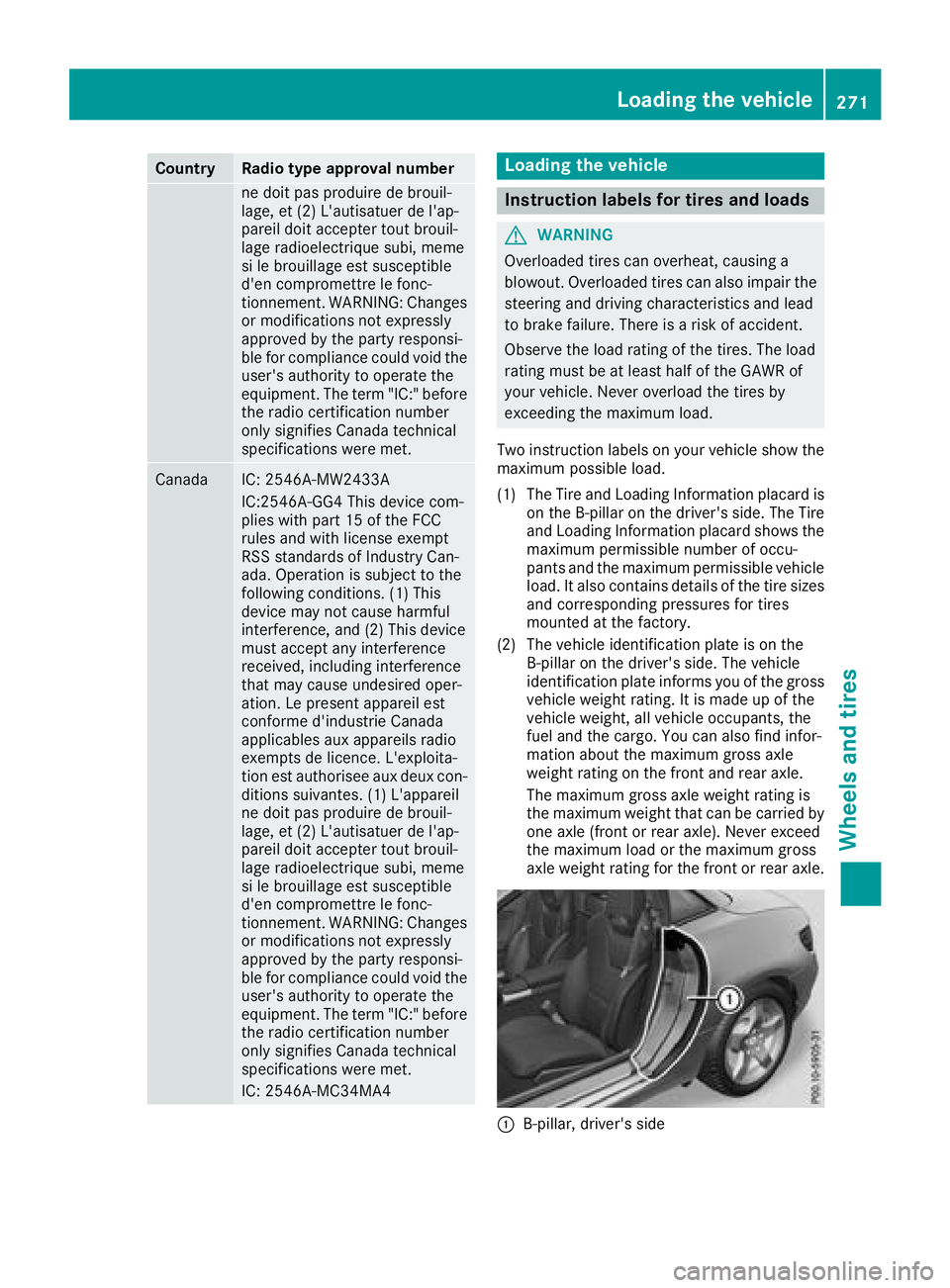
(1) The Tire and Loadin gI nf ormation placar di s
on th eB -p illar on th ed river' ss ide. The Tire
and Loadin gI nf ormation placar ds hows the
maximum permissible number of occu-
pant sa nd th em aximum permissible vehicle
load. It also contain sd etails of th et ir es izes
and corresponding pressures for tires
mounted at th ef actory.
(2) The vehicle identification plat eisont he
B-pillar on th ed river' ss ide. The vehicle
identification plat ei nform sy ou of th eg ross
vehicle weight rating .Itism ade up of the
vehicle weight ,a ll vehicle occupants, the
fuel and th ec argo. You can also fin di nfor-
mation about th em aximum gross axle
weight rating on th ef ront and rear axle.
The maximum gross axle weight rating is
th em aximum weight that can be carried by
one axle (front or rear axle) .N ever exceed
th em aximum load or th em aximum gross
axle weight rating for th ef ront or rear axle.
C
B-pillar ,d river' ss ideLoading th ev ehicle 271
Wheels and tires Z
Page 287 of 298
These tires have been specially adapted for
use with the control systems, such as ABS or
ESP ®
,a nd are marked as follows:R
MO = M ercedes-Benz OriginalR
MOE = M ercedes-Benz Original Extended
(tires featuring run-flat characteristics) R
MO1 = M ercedes-Benz Original (only cer-
tain AMG tires)
Mercedes-Benz Original Extended tires may
only be used on wheels that have been spe-
cifically approved by Mercedes-Benz.
Only use tires, wheels or accessories tested
and approved by Mercedes-Benz .C ertain
characteristics, e.g. handling, vehicle noise
emissions or fuel consumption, may other-
wise be adversely affected. In addition, when
driving with al oad, tire dimension variations
could cause the tires to come into contact
with the bodywork and axle components .T his
could result in damage to the tires or the vehi-
cle.
Mercedes-Benz accepts no liability for dam-
age resulting from the use of tires, wheels or
accessories other than those tested and
approved.
Information on tires, wheels and approved
combinations can be obtained from any quali-
fied specialist workshop.
! Retreaded tires are neither tested nor rec-
ommended by Mercedes-Benz ,s ince previ-
ous damage cannot alway sbed etected on
retreaded tires. As ar esult, Mercedes-Benz
cannot guarantee vehicle safety if retreaded
tires are mounted. Do not mount used tires if
you have no information about their previous
usage.
The recommended pressures for various oper-
ating conditions can be found: R
on the Tire and Loading Information placard
on the B-pillar on the driver's side R
in the tire pressure table on the fuel filler flap
Observe the notes on recommended tire pres-
sures under various operating conditions
( Y
page 263).
Check tire pressures regularly, and only when
the tires are cold. Comply with the maintenance
recommendations of the tire manufacturer in
the vehicle document wallet. Notes on the vehicle equipment –a lway se quip
the vehicle: R
with tires of the same size on ag iven axle (left
and right) R
with the same type of tires at ag iven time
(summer tires, winter tires, MOExtended
tires)
Exception: it is permissible to mount ad iffer-
ent type or make in the event of af lat tire.
Observe t he
"MOExtended tires (tires with
run-flat characteristics)" section
( Y
page 247).
Vehicles equipped with MOExtended tires are
not equipped with aT IREFIT kit at the factory. It
is therefor er ecommended that you additionally
equip your vehicle with aT IREFIT kit if you mount
tires that do not feature run-flat characteristics,
e.g. winter tires. AT IREFIT kit may be obtained
from aq ualified specialist workshop.
Emergency spar ew heel
Important safety notes
G WARNING
The wheel or tire size as well as the tire type of
the spare wheel or emergenc ys pare wheel
and the wheel to be replaced may differ.
Mountin gane mergenc ys pare wheel may
severely impair the driving characteristics.
There is ar isk of an accident.
To avoid hazardous situations: R
adapt your driving style accordingly and
drive carefully. R
never mount more than one spare wheel or
emergenc ys pare wheel that differs in size. R
only use as pare wheel or emergenc ys pare
wheel of ad ifferent size briefly. R
do not switch ESP ®
off.R
have as pare wheel or emergenc ys pare
wheel of ad ifferent size replaced at the
nearest qualified specialist workshop.
Observe that the wheel and tire dimensions
as well as the tire type must be correct.
When using an emergenc ys pare wheel or spare
wheel of ad ifferent size, you must not exceed
the maximum speed of 50 mph (80 km/h).Emergency spar ew heel 285
Wheels and tires Z