engine MERCEDES-BENZ SLC 2019 Owners Manual
[x] Cancel search | Manufacturer: MERCEDES-BENZ, Model Year: 2019, Model line: SLC, Model: MERCEDES-BENZ SLC 2019Pages: 306, PDF Size: 15 MB
Page 262 of 306
If the indicator/warning lamps do not light upat low temperatures, it is very likely that thedischarged battery has frozen. In this case,you may neither charge the battery nor jump-start the vehicle. The service life of a thawed-out battery may be shorter. The starting char-acteristics can be impaired, particularly at lowtemperatures. Have the thawed-out batterychecked at a qualified specialist workshop.
Read the battery charger's operating instruc-tions before charging the battery.
XOpen the hood.
XConnect the battery charger to the positiveterminal and ground point in the same orderas when connecting the donor battery in thejump-starting procedure (Ypage 260).
Replacing the 12 V battery
Observe the notes on the 12 V battery(Ypage 257).
Mercedes-Benz recommends that you havethe 12 V battery replaced at a qualified spe-cialist workshop, e.g. at an authorizedMercedes-Benz Center.
If you want to replace the battery yourself,observe the following notes:
RAlways replace a defective battery with abattery which meets the specific require-ments of the vehicle.
The vehicle is equipped with an AGM(Absorbent Glass Mat) technology battery.Full vehicle functionality is only guaranteedwith an AGM battery. For safety reasons,Mercedes-Benz recommends that you onlyuse batteries which have been tested andapproved for your vehicle by Mercedes-Benz.
RUse detachable parts such as breatherhoses, angled connecting pieces or terminalcovers from the battery which is to bereplaced.
RMake sure that the vent hose is always con-nected to the original opening on the bat-tery side.
RInstall existing or supplied cell caps to pre-vent gases or battery acid from escaping.
RMake sure that the detachable parts areconnected again in the same way.
Jump-starting
For the jump-starting procedure, use only the jump-starting connection point in the engine com-partment, consisting of a positive terminal and a ground point.
GWARNING
Battery acid is caustic. There is a risk of injury.
Avoid contact with skin, eyes or clothing. Do not inhale any battery gases. Do not lean over the
battery. Keep children away from batteries. Wash away battery acid immediately with plenty of
clean water and seek medical attention.
GWARNING
During charging and jump-starting, explosive gases can escape from the battery. There is a
risk of an explosion.
Particularly avoid fire, open flames, creating sparks and smoking. Ensure there is sufficient
ventilation while charging and jump-starting. Do not lean over a battery.
GWARNING
During the charging process, a battery produces hydrogen gas. If a short circuit occurs or
sparks are created, the hydrogen gas can ignite. There is a risk of an explosion.
260Jump-starting
Breakdown assistance
Page 263 of 306
RMake sure that the positive terminal of a connected battery does not come into contact with
vehicle parts.
RNever place metal objects or tools on a battery.
RIt is important that you observe the described order of the battery terminals when connect-
ing and disconnecting a battery.
RWhen jump-starting, make sure that the battery poles with identical polarity are connected.
RIt is particularly important to observe the described order when connecting and disconnect-
ing the jumper cables.
RNever connect or disconnect the battery terminals while the engine is running.
GWARNING
A discharged battery can freeze at temperatures below freezing point. When jump-starting the
vehicle or charging the battery, gases can escape from the battery. There is a risk of an explo-
sion.
Allow the frozen battery to thaw out before charging it or jump-starting.
!Avoid repeated and lengthy starting attempts. Otherwise, the catalytic converter could bedamaged by the non-combusted fuel.
If the indicator/warning lamps do not light up at low temperatures, it is very likely that the dis-charged battery has frozen. In this case, you may neither charge the battery nor jump-start thevehicle. The service life of a thawed-out battery may be shorter. The starting characteristics canbe impaired, particularly at low temperatures. Have the thawed-out battery checked at a quali-fied specialist workshop.
Do not start the vehicle using a rapid charging device. If your vehicle's battery is discharged, theengine can be jump-started from another vehicle or from a donor battery using jumper cables.Observe the following points:
RThe battery is not accessible in all vehicles. If the other vehicle's battery is not accessible,jump-start the vehicle using a donor battery or a jump-starting device.
RYou may only jump-start the vehicle when the engine and exhaust system are cold.
RDo not start the engine if the battery is frozen. Let the battery thaw first.
ROnly jump-start from batteries with a 12 V voltage rating.
ROnly use jumper cables which have a sufficient cross-section and insulated terminal clamps.
RIf the battery is fully discharged, leave the battery that is being used to jump-start connectedfor a few minutes before attempting to start. This charges the battery slightly.
RMake sure that the two vehicles do not touch.
Make sure that:
RThe jumper cables are not damaged.
RBare parts of the terminal clamp do not come into contact with other metal parts while thejumper cables are connected to the battery.
RThe jumper cables cannot come into contact with parts which can move when the engine isrunning, such as the V-belt pulley or the fan.
XSecure the vehicle by applying the electric parking brake.
XShift the transmission to position].
XMake sure that the ignition is switched off. All indicator lamps in the instrument cluster mustbe off. When using the SmartKey, turn the SmartKey to position
Page 291 of 306
Clean the contact surfaces of the wheel andthe brake disc thoroughly every time a wheelis rotated. Check the tire pressure and, if nec-essary, restart the tire pressure loss warningsystem or the tire pressure monitor.
Direction of rotation
Tires with a specified direction of rotation haveadditional benefits, e.g. if there is a risk ofhydroplaning. These advantages can only begained if the tires are installed correspondingto the direction of rotation.
An arrow on the sidewall of the tire indicatesits correct direction of rotation.
Storing wheels
Store wheels that are not being used in a cool,dry and preferably dark place. Protect the tiresfrom oil, grease, gasoline and diesel.
Mounting a wheel
Preparing the vehicle
XStop the vehicle on solid, non-slippery andlevel ground.
XApply the electric parking brake manually.
XBring the front wheels into the straight-ahead position.
XShift the transmission to position].
XSwitch off the engine.
XVehicles without KEYLESS-GO:removethe SmartKey from the ignition lock.
XVehicles with KEYLESS-GO:open the driv-er's door.The vehicle electronics now have status0.This is the same as the SmartKey havingbeen removed.
XVehicles with KEYLESS-GO:remove theStart/Stop button from the ignition lock(Ypage 118).
XIf included in the vehicle equipment, removethe tire-change tool kit from the vehicle.
XSafeguard the vehicle against rolling away.
iDue to differences in vehicle equipment,not all vehicles are equipped with a tire-change tool kit. For information on which
tools are required to perform a wheelchange on your vehicle, consult an author-ized Mercedes-Benz Center.
Necessary tire-changing tools can include,for example:
RJack
RWheel chock
RLug wrench
Securing the vehicle to prevent it from
rolling away
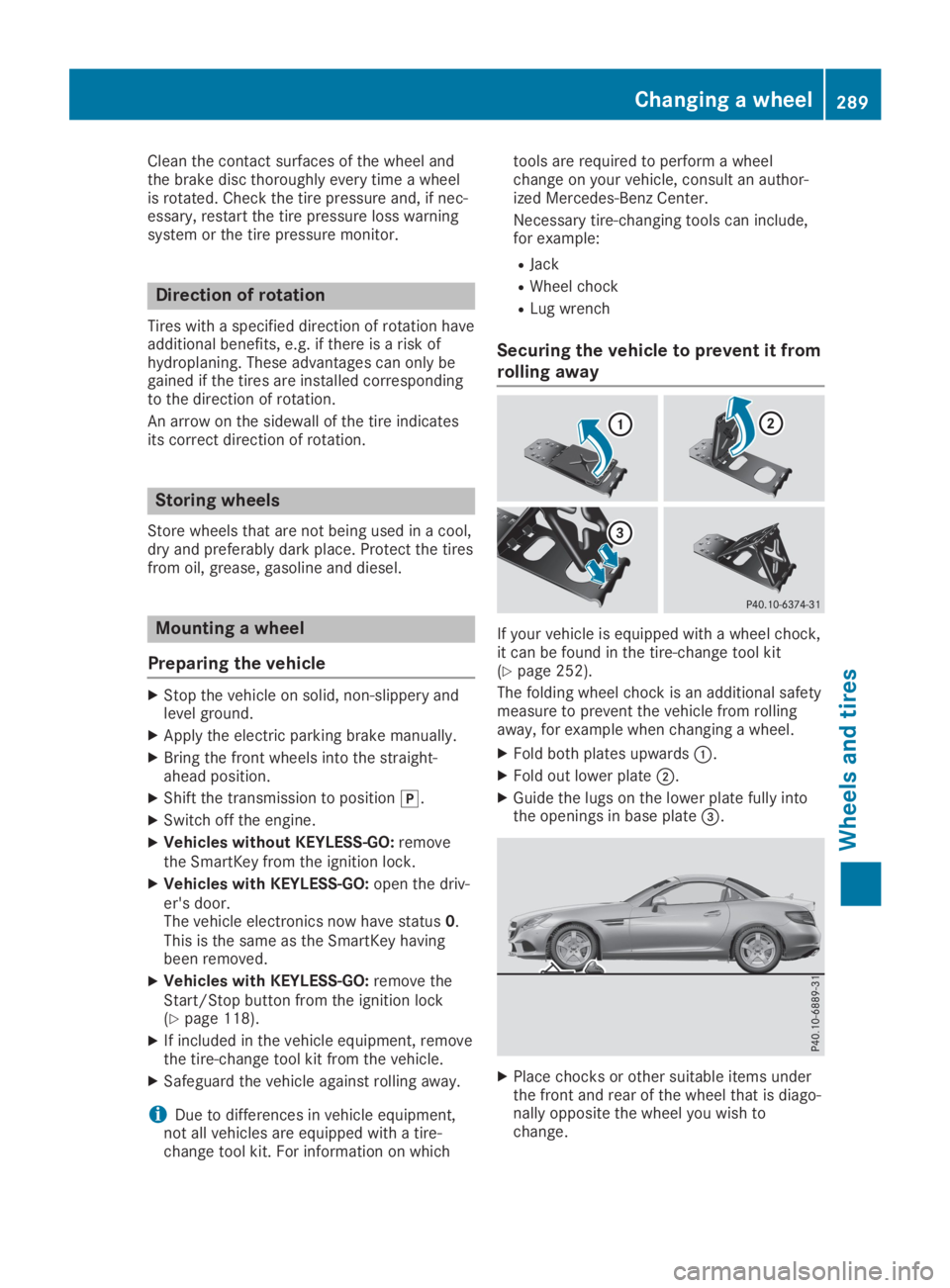
If your vehicle is equipped with a wheel chock,it can be found in the tire-change tool kit(Ypage 252).
The folding wheel chock is an additional safetymeasure to prevent the vehicle from rollingaway, for example when changing a wheel.
XFold both plates upwardsC.
XFold out lower plateD.
XGuide the lugs on the lower plate fully intothe openings in base plate
Page 292 of 306
Raising the vehicle
GWARNING
If you do not position the jack correctly at
the appropriate jacking point of the vehicle,
the jack could tip over with the vehicle
raised. There is a risk of injury.
Only position the jack at the appropriate
jacking point of the vehicle. The base of the
jack must be positioned vertically, directly
under the jacking point of the vehicle.
!Only position the jack at the appropriatejacking point of the vehicle. Otherwise, youcould damage the vehicle.
Observe the following when raising the vehi-cle:
RTo raise the vehicle, only use the vehicle-specific jack that has been tested andapproved by Mercedes-Benz. If used incor-rectly, the jack could tip over with the vehi-cle raised.
RThe jack is designed only to raise and holdthe vehicle for a short time while a wheelis being changed. It must not be used forperforming maintenance work under thevehicle.
RAvoid changing the wheel on uphill anddownhill slopes.
RBefore raising the vehicle, secure it fromrolling away by applying the parking brakeand inserting wheel chocks. Do not disen-gage the parking brake while the vehicle israised.
RThe jack must be placed on a firm, flat andnon-slip surface. On a loose surface, a large,flat, load-bearing underlay must be used. Ona slippery surface, a non-slip underlay mustbe used, e.g. rubber mats.
RDo not use wooden blocks or similar objectsas a jack underlay. Otherwise, the jack willnot be able to achieve its load-bearing capa-city due to the restricted height.
RMake sure that the distance between theunderside of the tires and the ground doesnot exceed 1.2 in (3 cm).
RNever place your hands and feet under theraised vehicle.
RDo not lie under the vehicle.
RDo not start the engine when the vehicle israised.
RDo not open or close a door or the trunk lidwhen the vehicle is raised.
RMake sure that no persons are present inthe vehicle when the vehicle is raised.
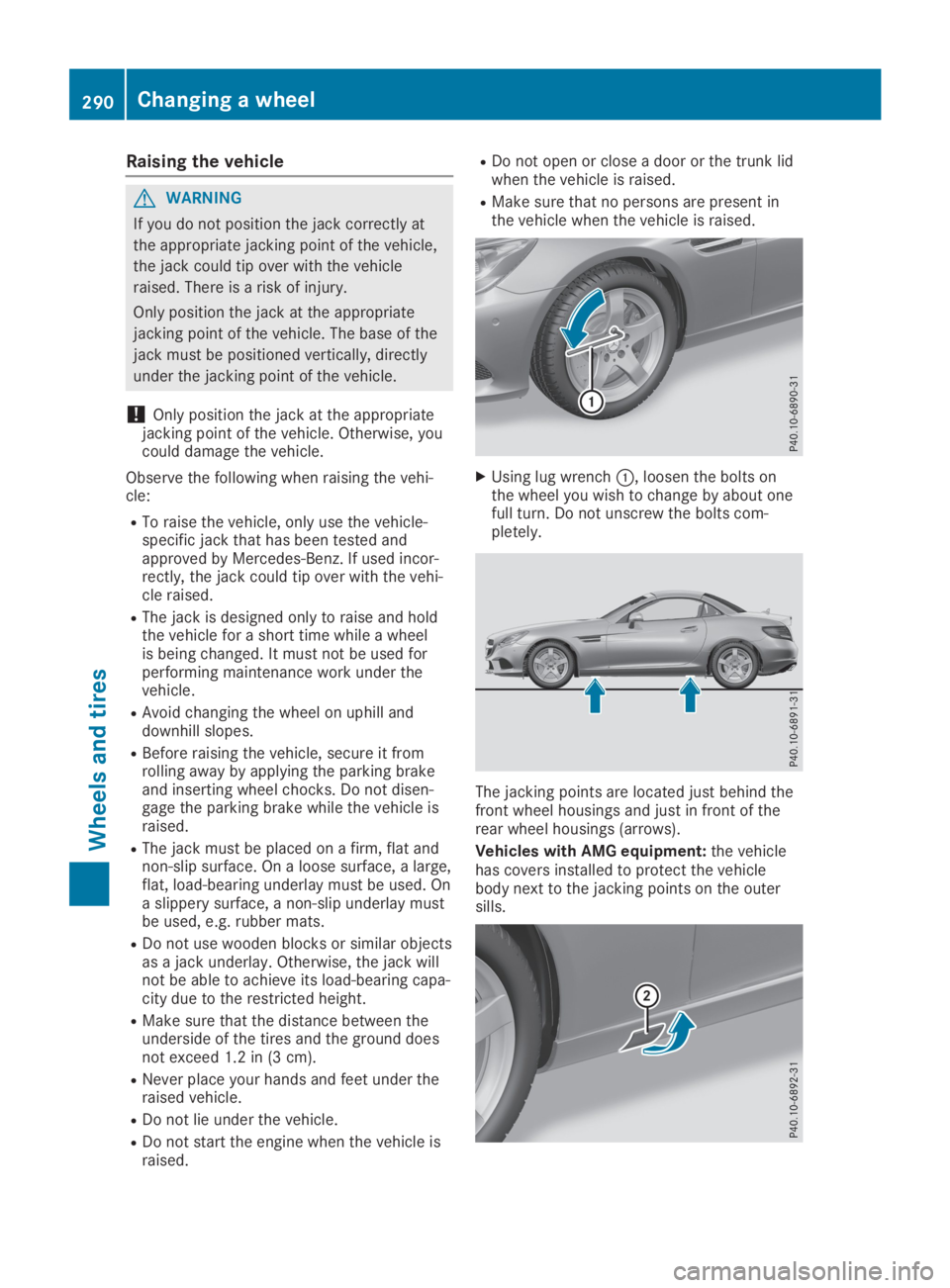
XUsing lug wrenchC, loosen the bolts onthe wheel you wish to change by about onefull turn. Do not unscrew the bolts com-pletely.
The jacking points are located just behind thefront wheel housings and just in front of therear wheel housings (arrows).
Vehicles with AMG equipment:the vehiclehas covers installed to protect the vehiclebody next to the jacking points on the outersills.
290Changing a wheel
Wheels and tires
Page 298 of 306
Information regarding technical data
iThe data stated here specifically refers toa vehicle with standard equipment. Consultan authorized Mercedes-Benz Center for thedata for all vehicle variants and trim levels.
Vehicle electronics
Tampering with the engine electron-
ics
!Have the engine electronics and associ-ated parts, such as control units, sensors,actuating components or electric cablesserviced only at a qualified specialist work-shop. Vehicle components may otherwisewear more quickly and the vehicle's operat-ing permit may be invalidated.
Installing two-way radios and mobile
phones (RF transmitters)
GWARNING
The electromagnetic radiation from two-way
radios can interfere with the vehicle elec-
tronics if two-way radios are manipulated or
retrofitted incorrectly. This could jeopardize
the operating safety of the vehicle. There is
a risk of an accident.
You should have all work on electrical and
electronic components carried out at a
qualified specialist workshop.
GWARNING
If you incorrectly operate two-way radios in
the vehicle, the electromagnetic radiation
may interfere with the vehicle electronics,
for example if:
Rthe two-way radio is not connected to an
exterior antenna
Rthe exterior antenna is not correctly
mounted or is not low-reflection
This could jeopardize the operating safety of
the vehicle. There is a risk of an accident.
Have the low-reflection exterior antenna
installed at a qualified specialist workshop.
Always connect two-way radios to the low-
reflection exterior antenna when operating
in the vehicle.
!The operating permit may be invalidated ifthe instructions for installation and use oftwo-way radios are not observed.
In particular, the following requirementsmust be complied with:
Ronly approved wavebands may be used
Robserve the maximum permissible outputin these wavebands
Ronly approved antenna positions may beused
Excessive levels of electromagnetic radiationmay cause damage to your health and thehealth of others. Using an exterior antennatakes into account current scientific discus-sions relating to the possible health hazardsthat may result from electromagnetic fields.
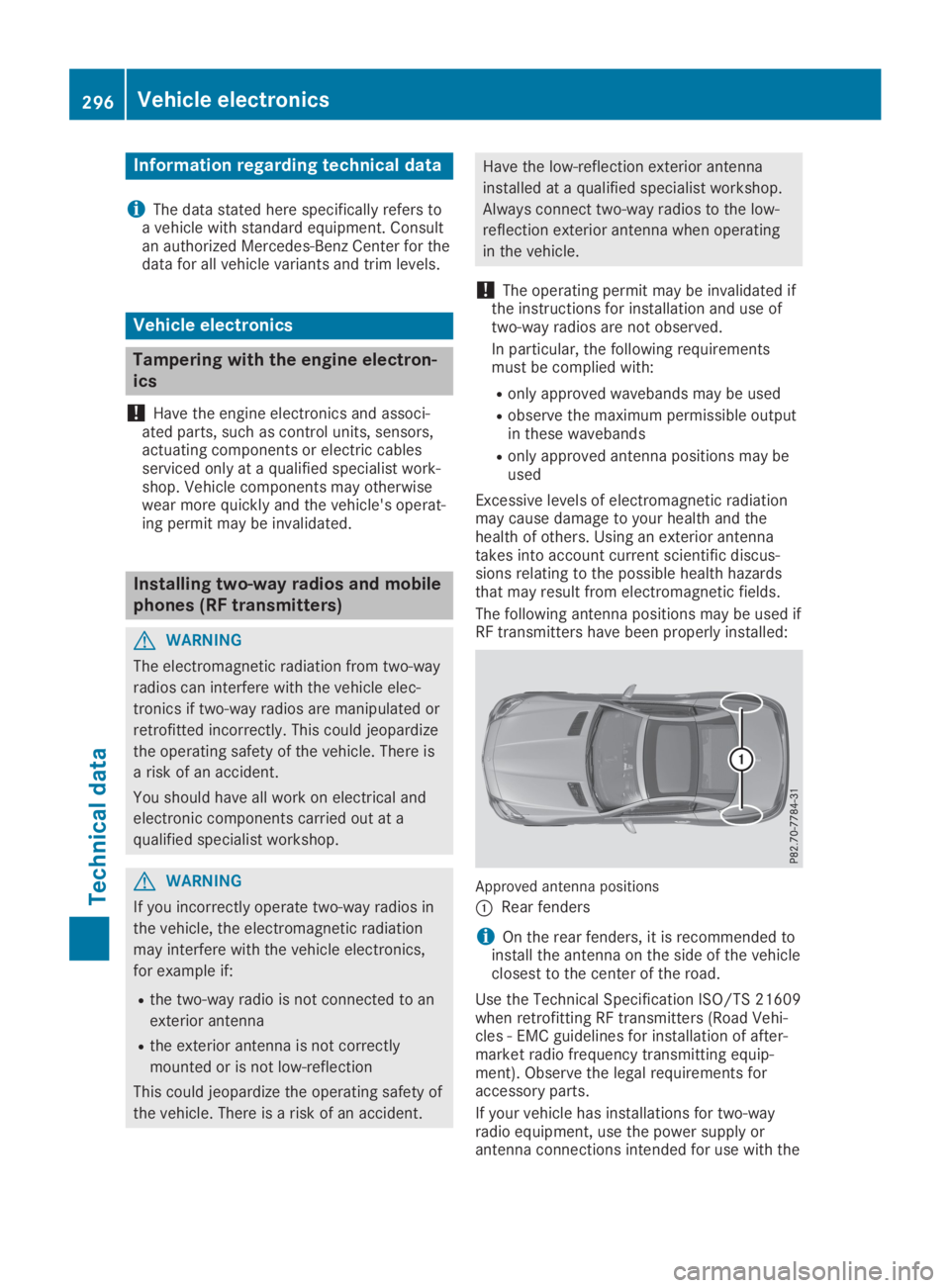
The following antenna positions may be used ifRF transmitters have been properly installed:
Approved antenna positions
CRear fenders
iOn the rear fenders, it is recommended toinstall the antenna on the side of the vehicleclosest to the center of the road.
Use the Technical Specification ISO/TS 21609when retrofitting RF transmitters (Road Vehi-cles - EMC guidelines for installation of after-market radio frequency transmitting equip-ment). Observe the legal requirements foraccessory parts.
If your vehicle has installations for two-wayradio equipment, use the power supply orantenna connections intended for use with the
296Vehicle electronics
Technical data
Page 300 of 306
data is different for every vehicle and candeviate from the data shown here. You canfind the data applicable to your vehicle onthe vehicle identification plate.
Vehicle identification number (VIN)
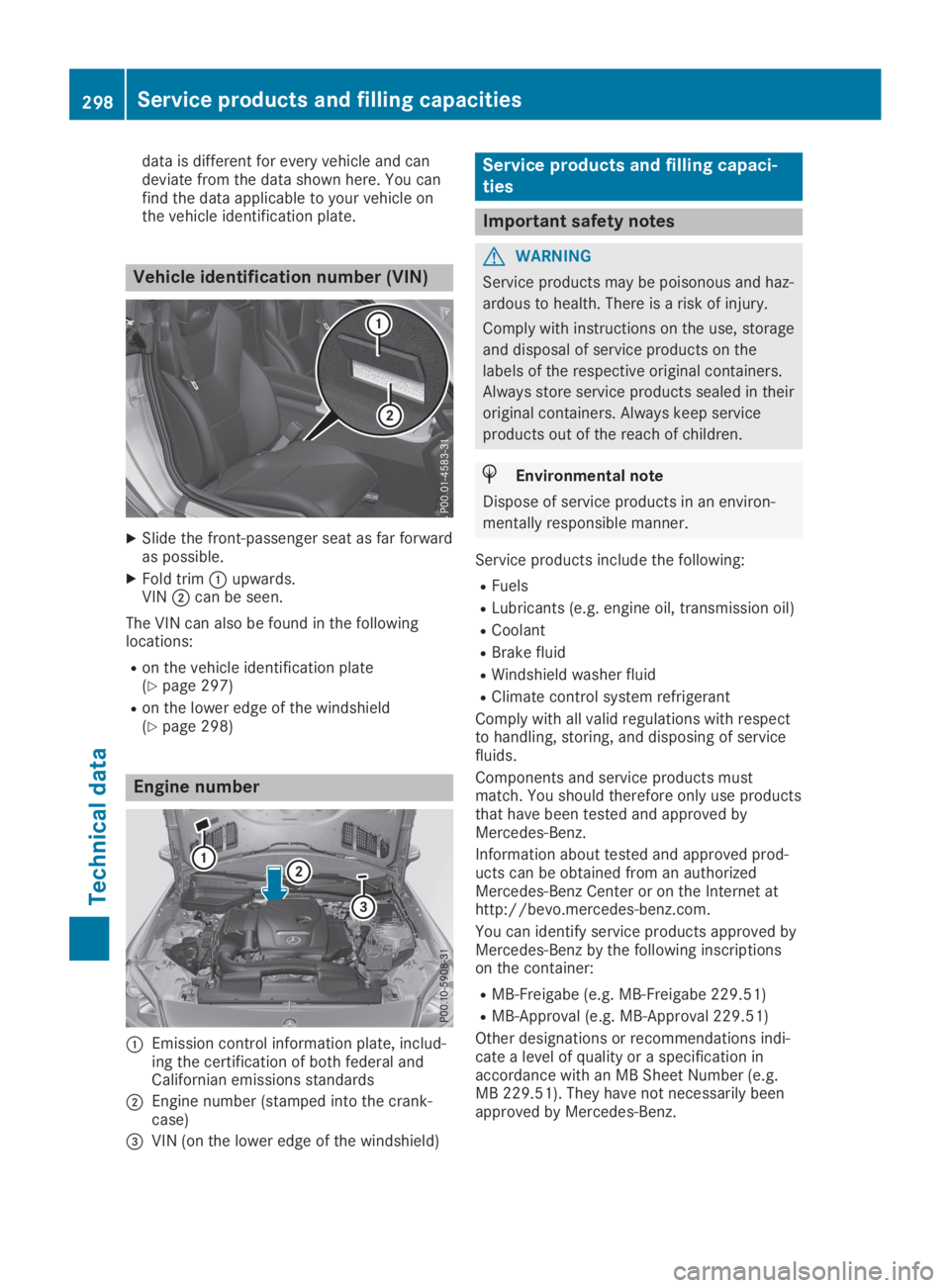
XSlide the front-passenger seat as far forwardas possible.
XFold trimCupwards.VINDcan be seen.
The VIN can also be found in the followinglocations:
Ron the vehicle identification plate(Ypage 297)
Ron the lower edge of the windshield(Ypage 298)
Engine number
CEmission control information plate, includ-ing the certification of both federal andCalifornian emissions standards
DEngine number (stamped into the crank-case)
Page 301 of 306
Other identifications, for example:
R0 W-30
R5 W-30
R5 W-40
Fuel
Important safety notes
GWARNING
Fuel is highly flammable. Improper handling
of fuel creates a risk of fire and explosion.
Avoid fire, open flames, smoking and creat-
ing sparks under all circumstances. Switch
off the engine and, if applicable, the auxiliary
heating before refueling.
GWARNING
Fuels are toxic and harmful to health. There
is a risk of injury.
You must avoid fuels coming into contact
with skin, eyes and clothes or being swal-
lowed.
Do not inhale the fuel vapors. Keep children
away from fuels.
Keep doors and windows closed during the
refueling process.
If you or others come into contact with fuel,
observe the following points:
RImmediately rinse the fuel off your skin
with soap and water.
RIf you get fuel into your eyes, immediately
rinse your eyes throughly with clean
water. Seek medical attention immedi-
ately.
RSeek medical attention immediately if fuel
has been swallowed. Do not induce vomit-
ing.
RImmediately change out of clothing which
has come into contact with fuel.
Tank capacity
ModelTotal capa-city
SLC 30018.5 US gal(70.0l)
Mercedes‑AMG vehicles15.8 US gal(60.0l)
ModelOf whichreserve
SLC 300Approx.2.4 US gal(9.0 l)
Mercedes‑AMG vehiclesApprox.2.1 US gal(8.0 l)
Gasoline
Fuel grade
!Do not use diesel to refuel vehicles with agasoline engine. Do not switch on the igni-tion if you accidentally refuel with the wrongfuel. Otherwise, the fuel will enter the fuelsystem. Even small amounts of the wrongfuel could result in damage to the fuel sys-tem and the engine. Notify a qualified spe-cialist workshop and have the fuel tank andfuel lines drained completely.
!Only refuel using unleaded premium gradegasoline with at least 91 AKI/95 RON.
iE10 fuel contains up to 10% bioethanol.Your vehicle is E10-compatible. You canrefuel your vehicle using E10 fuel.
!Only use the fuel recommended. Operatingthe vehicle with other fuels can lead to dam-age to the fuel system, engine and exhaustsystem.
!Do not use the following:
RGasoline with more than 10% ethanol
RE100 (100% ethanol)
RGasoline with methanol
RM100(100% methanol)
RGasoline with metalliferous additives
RDiesel
Service products and filling capacities299
Technical data
Z
Page 302 of 306
Do not mix such fuels with the fuel recom-mended for your vehicle.
!To ensure the longevity and full perform-ance of the engine, only premium-gradeunleaded gasoline must be used.
If standard unleaded gasoline is unavailableand you have to refuel with unleaded gaso-line of a lower grade, observe the followingprecautions:
ROnly fill the fuel tank to half full with regu-lar unleaded gasoline and fill the rest withpremium-grade unleaded gasoline as soonas possible.
RDo not drive at the maximum speed.
RAvoid sudden acceleration and enginespeeds over 3,000 rpm.
You will usually find information about the fuelgrade on the fuel pump. If you cannot find thelabel on the fuel pump, ask the gas stationstaff.
iFor further information, consult a qualifiedspecialist workshop or visithttp://www.mbusa.com (USA only).
As a temporary measure, if the recommendedfuel is not available, you may also use regularunleaded gasoline with an octane rating of87 AKI/91 RON. This may reduce engine per-formance and increase fuel consumption.Avoid driving at full throttle and sudden accel-eration. Never refuel using gasoline with alower AKI.
iThe fuels you can use in your vehicle maydiffer from the information in the Operator'sManual depending on the country. The fuelsthat have been approved for your vehiclecan be found on the instruction label on theinside of the fuel filler flap.
Information on refueling (Ypage 133).
Additives in gasoline
!Operating the engine with fuel additivesadded later can lead to engine failure. Donot mix fuel additives with fuel. This doesnot include additives for the removal andprevention of residue buildup. gasoline mustonly be mixed with additives recommendedby Mercedes-Benz. Comply with the instruc-tions for use on the product label. Moreinformation about recommended additivescan be obtained from any authorizedMercedes-Benz Center.
Mercedes-Benz recommends that you usebranded fuels that have additives.
The fuel quality available in some countriesmay not be sufficient. Residue could build upin the fuel injection system as a result. In suchcases, and in consultation with an authorizedMercedes-Benz Center, the fuel may be mixedwith the cleaning additive recommended byMercedes-Benz. You must observe the notesand mixing ratios specified on the container.
Engine oil
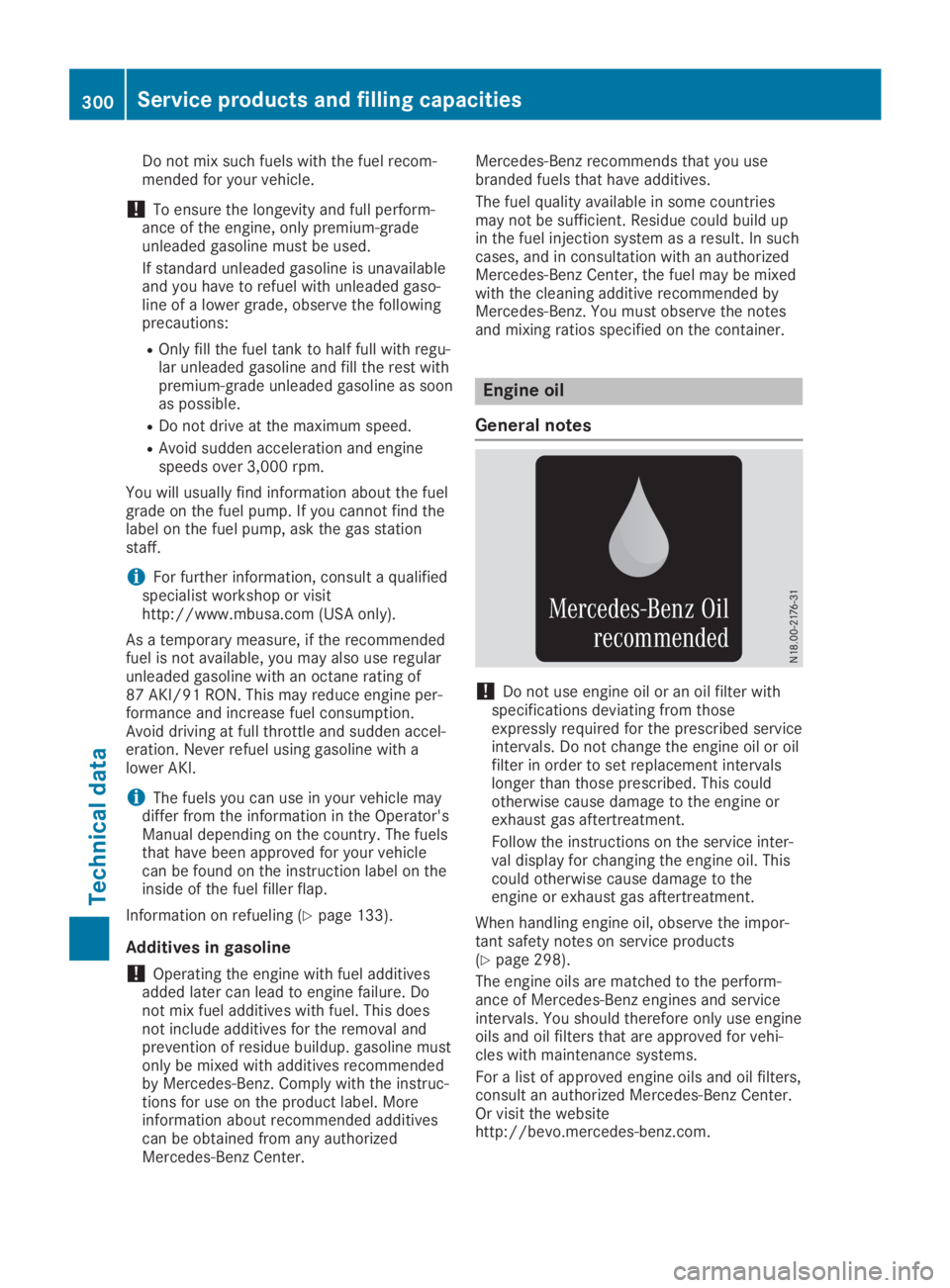
General notes
!Do not use engine oil or an oil filter withspecifications deviating from thoseexpressly required for the prescribed serviceintervals. Do not change the engine oil or oilfilter in order to set replacement intervalslonger than those prescribed. This couldotherwise cause damage to the engine orexhaust gas aftertreatment.
Follow the instructions on the service inter-val display for changing the engine oil. Thiscould otherwise cause damage to theengine or exhaust gas aftertreatment.
When handling engine oil, observe the impor-tant safety notes on service products(Ypage 298).
The engine oils are matched to the perform-ance of Mercedes-Benz engines and serviceintervals. You should therefore only use engineoils and oil filters that are approved for vehi-cles with maintenance systems.
For a list of approved engine oils and oil filters,consult an authorized Mercedes-Benz Center.Or visit the websitehttp://bevo.mercedes-benz.com.
300Service products and filling capacities
Technical data
Page 303 of 306
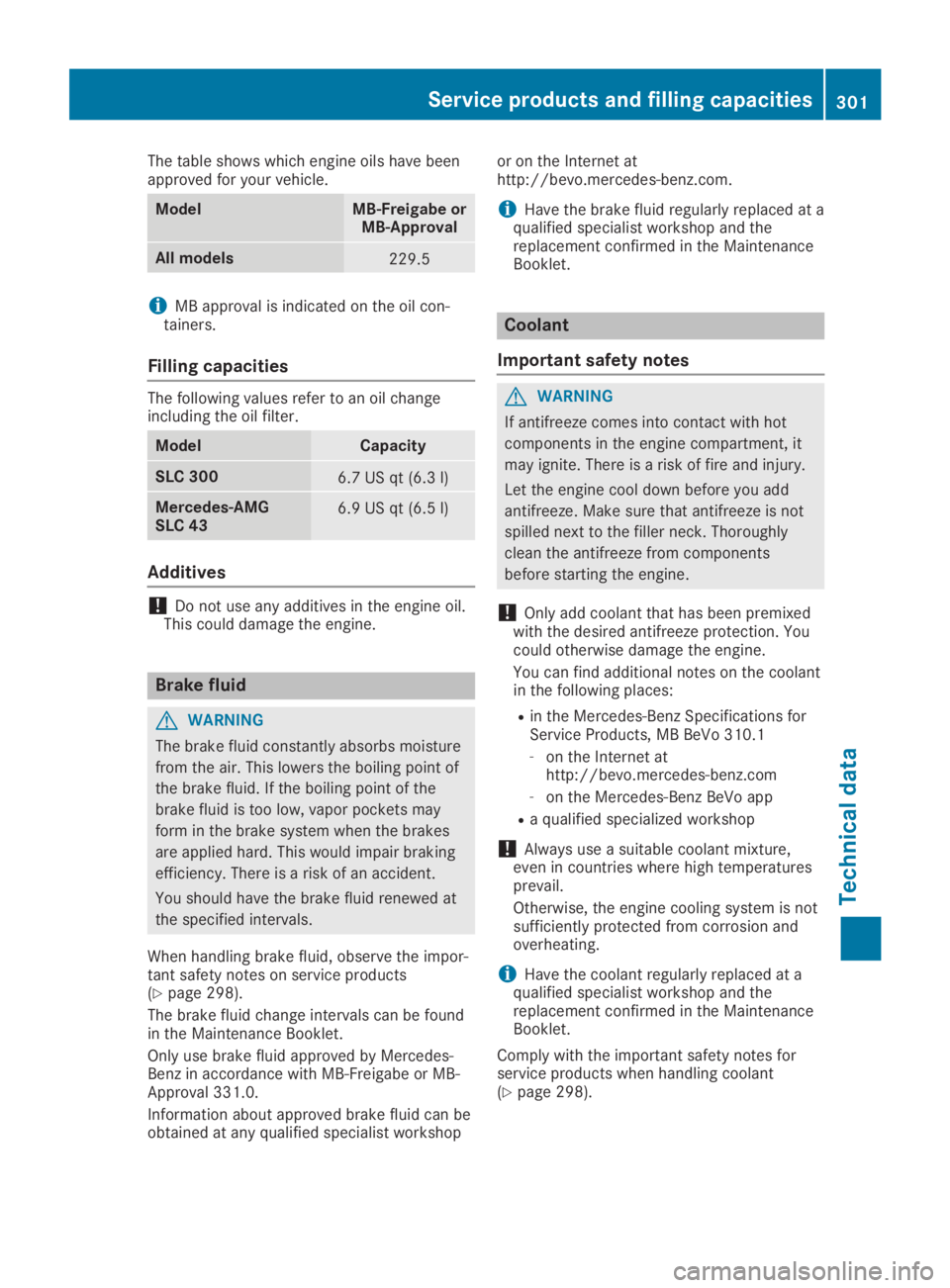
The table shows which engine oils have beenapproved for your vehicle.
ModelMB-Freigabe orMB-Approval
All models229.5
iMB approval is indicated on the oil con-tainers.
Filling capacities
The following values refer to an oil changeincluding the oil filter.
ModelCapacity
SLC 3006.7 US qt (6.3l)
Mercedes-AMGSLC 436.9 US qt (6.5l)
Additives
!Do not use any additives in the engine oil.This could damage the engine.
Brake fluid
GWARNING
The brake fluid constantly absorbs moisture
from the air. This lowers the boiling point of
the brake fluid. If the boiling point of the
brake fluid is too low, vapor pockets may
form in the brake system when the brakes
are applied hard. This would impair braking
efficiency. There is a risk of an accident.
You should have the brake fluid renewed at
the specified intervals.
When handling brake fluid, observe the impor-tant safety notes on service products(Ypage 298).
The brake fluid change intervals can be foundin the Maintenance Booklet.
Only use brake fluid approved by Mercedes-Benz in accordance with MB-Freigabe or MB-Approval 331.0.
Information about approved brake fluid can beobtained at any qualified specialist workshop
or on the Internet athttp://bevo.mercedes-benz.com.
iHave the brake fluid regularly replaced at aqualified specialist workshop and thereplacement confirmed in the MaintenanceBooklet.
Coolant
Important safety notes
GWARNING
If antifreeze comes into contact with hot
components in the engine compartment, it
may ignite. There is a risk of fire and injury.
Let the engine cool down before you add
antifreeze. Make sure that antifreeze is not
spilled next to the filler neck. Thoroughly
clean the antifreeze from components
before starting the engine.
!Only add coolant that has been premixedwith the desired antifreeze protection. Youcould otherwise damage the engine.
You can find additional notes on the coolantin the following places:
Rin the Mercedes-Benz Specifications forService Products, MB BeVo 310.1
-on the Internet athttp://bevo.mercedes-benz.com
-on the Mercedes-Benz BeVo app
Ra qualified specialized workshop
!Always use a suitable coolant mixture,even in countries where high temperaturesprevail.
Otherwise, the engine cooling system is notsufficiently protected from corrosion andoverheating.
iHave the coolant regularly replaced at aqualified specialist workshop and thereplacement confirmed in the MaintenanceBooklet.
Comply with the important safety notes forservice products when handling coolant(Ypage 298).
Service products and filling capacities301
Technical data
Z
Page 304 of 306
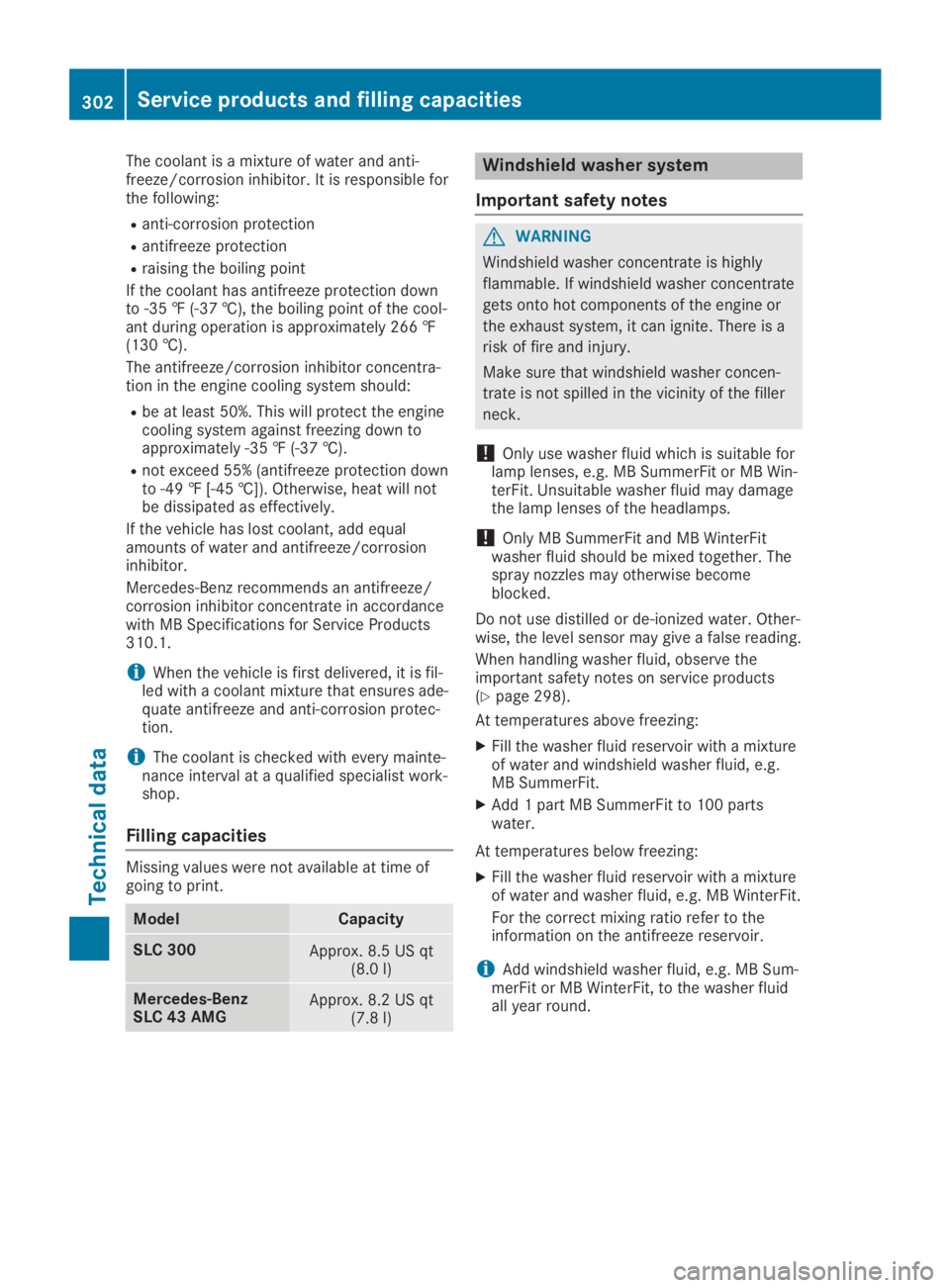
The coolant is a mixture of water and anti-freeze/corrosion inhibitor. It is responsible forthe following:
Ranti-corrosion protection
Rantifreeze protection
Rraising the boiling point
If the coolant has antifreeze protection downto -35 ‡ (-37 †), the boiling point of the cool-ant during operation is approximately 266 ‡(130 †).
The antifreeze/corrosion inhibitor concentra-tion in the engine cooling system should:
Rbe at least 50%. This will protect the enginecooling system against freezing down toapproximately -35 ‡ (-37 †).
Rnot exceed 55% (antifreeze protection downto -49 ‡ [-45 †]). Otherwise, heat will notbe dissipated as effectively.
If the vehicle has lost coolant, add equalamounts of water and antifreeze/corrosioninhibitor.
Mercedes-Benz recommends an antifreeze/corrosion inhibitor concentrate in accordancewith MB Specifications for Service Products310.1.
iWhen the vehicle is first delivered, it is fil-led with a coolant mixture that ensures ade-quate antifreeze and anti-corrosion protec-tion.
iThe coolant is checked with every mainte-nance interval at a qualified specialist work-shop.
Filling capacities
Missing values were not available at time ofgoing to print.
ModelCapacity
SLC 300Approx. 8.5 US qt(8.0 l)
Mercedes‑BenzSLC 43 AMGApprox. 8.2 US qt(7.8 l)
Windshield washer system
Important safety notes
GWARNING
Windshield washer concentrate is highly
flammable. If windshield washer concentrate
gets onto hot components of the engine or
the exhaust system, it can ignite. There is a
risk of fire and injury.
Make sure that windshield washer concen-
trate is not spilled in the vicinity of the filler
neck.
!Only use washer fluid which is suitable forlamp lenses, e.g. MB SummerFit or MB Win-terFit. Unsuitable washer fluid may damagethe lamp lenses of the headlamps.
!Only MB SummerFit and MB WinterFitwasher fluid should be mixed together. Thespray nozzles may otherwise becomeblocked.
Do not use distilled or de-ionized water. Other-wise, the level sensor may give a false reading.
When handling washer fluid, observe theimportant safety notes on service products(Ypage 298).
At temperatures above freezing:
XFill the washer fluid reservoir with a mixtureof water and windshield washer fluid, e.g.MB SummerFit.
XAdd 1 part MB SummerFit to 100 partswater.
At temperatures below freezing:
XFill the washer fluid reservoir with a mixtureof water and washer fluid, e.g. MB WinterFit.
For the correct mixing ratio refer to theinformation on the antifreeze reservoir.
iAdd windshield washer fluid, e.g. MB Sum-merFit or MB WinterFit, to the washer fluidall year round.
302Service products and filling capacities
Technical data