engine MERCEDES-BENZ SLC 2019 Repair Manual
[x] Cancel search | Manufacturer: MERCEDES-BENZ, Model Year: 2019, Model line: SLC, Model: MERCEDES-BENZ SLC 2019Pages: 306, PDF Size: 15 MB
Page 141 of 306
economical driving. A higher level indicates amore economical driving style. If the threeouter areas are completely filled at the sametime, the driver has adopted the most eco-nomical driving style for the selected settingsand prevailing conditions. The ECO displayborder lights up.
The ECO display does not indicate the actualfuel consumption. The additionally achievedrange displayed underBonus fr. startBonus fr. startdoesnot indicate a fixed consumption reduction.
In addition to driving style, the actual con-sumption is affected by other factors, such as:
Rload
Rtire pressure
Rcold start
Rchoice of route
Ractive electrical consumers
These factors are not included in the ECO dis-play.
An economical driving style specially requiresdriving at moderate engine speeds.
Achieving a higher value in the categories"Acceleration" and "Constant":
Robserve the gearshift recommendations.
Rdrive the vehicle in drive programCorE.
In urban traffic and stop-start traffic, drive pro-gramCis recommended.
On long journeys at a constant speed, e.g. onthe highway, only the outer area for "constant"will change.
The ECO display summarizes the driving stylefrom the start of the journey to its completion.Therefore, there are more marked changes inthe outer areas at the start of a journey. Onlonger journeys, there are fewer changes. Formore marked changes, perform a manual rest(Ypage 171).
Further information on the ECO display(Ypage 170).
Braking
Important safety notes
GWARNING
If you shift down on a slippery road surface
in an attempt to increase the engine's brak-
ing effect, the drive wheels could lose their
grip. There is an increased danger of skid-
ding and accidents.
Do not shift down for additional engine brak-
ing on a slippery road surface.
Downhill gradients
!On long, steep gradients, you must reducethe load on the brakes. To use engine brak-ing, shift to a lower gear in good time. Thishelps you to avoid overheating the brakesand wearing them out excessively.
When making use of the engine brakingeffect, it is possible that a drive wheel maynot turn for some time, e.g. in the case ofsuddenly changing or slippery road surfaceconditions. This could cause damage to thedrive train. This type of damage is not cov-ered by the Mercedes-Benz warranty.
Change into a lower gear in good time on longand steep downhill gradients. This is especiallyimportant if the vehicle is laden.
This also applies if you have activated cruisecontrol or Active Distance Assist DISTRONIC.
Heavy and light loads
GWARNING
If you rest your foot on the brake pedal
while driving, the braking system can over-
heat. This increases the stopping distance
and can even cause the braking system to
fail. There is a risk of an accident.
Never use the brake pedal as a footrest.
Never depress the brake pedal and the
accelerator pedal at the same time.
!Depressing the brake pedal constantlyresults in excessive and premature wear tothe brake pads.
If the brakes have been subjected to a heavyload, do not stop the vehicle immediately, butdrive on for a short while. This allows the air-flow to cool the brakes more quickly.
Wet roads
If you have driven for a long time in heavy rainwithout braking, there may be a delayed reac-tion from the brakes when braking for the first
Driving tips139
Driving and parking
Z
Page 142 of 306
time. This may also occur after the vehicle hasbeen washed or driven through deep water.
You then have to depress the brake pedalmore firmly. Maintain a greater distance fromthe vehicle in front.
After driving on a wet road or having the vehi-cle washed, brake firmly while paying attentionto the traffic conditions. This will warm up thebrake discs, thereby drying them more quicklyand protecting them against corrosion.
Limited braking performance on salt-
treated roads
If you drive on salted roads, a layer of salt resi-due may form on the brake discs and brakepads. This can result in a significantly longerbraking distance.
RIn order to prevent any salt build-up, applythe brakes occasionally while paying atten-tion to the traffic conditions.
RCarefully depress the brake pedal and thebeginning and end of a journey.
RMaintain a greater distance to the vehicleahead.
Servicing the brakes
!The brake fluid level may be too low, if:
Rif the red brake warning lamp lights up inthe instrument cluster and
Ryou hear a warning tone while the engineis running
Observe additional warning messages in themultifunction display.
The brake fluid level may be too low due tobrake pad wear or leaking brake lines.
Have the brake system checked immedi-ately. Consult a qualified specialist work-shop to arrange this.
!As the ESP®system operates automati-cally, the engine and the ignition must beswitched off (the SmartKey must be in posi-tion
Page 143 of 306
driving and braking accordingly during thisbreak-in period.
Excessive heavy braking results in correspond-ingly high brake wear. Observe the brake sys-tem warning lamp in the instrument clusterand note any brake status messages in themultifunction display. Especially for high per-formance driving, it is important to maintainand have the brake system checked regularly.
Driving on wet roads
Hydroplaning
If water has accumulated to a certain depth onthe road surface, there is a danger of hydro-planing occurring.
For this reason, in the event of heavy rain or inconditions in which hydroplaning may occur,you must drive in the following manner:
Rlower your speed
Ravoid ruts
Ravoid sudden steering movements
Rbrake carefully
Driving on flooded roads
!Do not drive through flooded areas. Checkthe depth of any water before drivingthrough it. Drive slowly through standingwater. Otherwise, water could enter thevehicle interior or engine compartment. Itcan then damage the engine's or automatictransmission's electronic components. Itcan also be sucked in by the engine's airintake connection and cause engine dam-age.
Winter driving
GWARNING
If you shift down on a slippery road surface
in an attempt to increase the engine's brak-
ing effect, the drive wheels could lose their
grip. There is an increased danger of skid-
ding and accidents.
Do not shift down for additional engine brak-
ing on a slippery road surface.
GDANGER
If the exhaust pipe is blocked or adequate
ventilation is not possible, poisonous gases
such as carbon monoxide (CO) may enter
the vehicle. This is the case, e.g. if the vehi-
cle becomes trapped in snow. There is a risk
of fatal injury.
If you leave the engine or the auxiliary heat-
ing running, make sure the exhaust pipe and
area around the vehicle are clear of snow.
To ensure an adequate supply of fresh air,
open a window on the side of the vehicle
that is not facing into the wind.
Have your vehicle winter-proofed at a qualifiedspecialist workshop at the onset of winter.
Drive particularly carefully on slippery roadsurfaces. Avoid sudden acceleration, steeringand braking maneuvers. Do not use cruisecontrol.
If the vehicle threatens to skid or cannot bestopped when moving at low speed:
XShift the transmission to position\\.
The outside temperature indicator is notdesigned to serve as an ice-warning deviceand is therefore unsuitable for that purpose.Changes in the outside temperature are dis-played after a short delay.
Indicated temperatures just above the freezingpoint do not guarantee that the road surface isfree of ice. The road may still be icy, especiallyin wooded areas or on bridges. The vehiclecould skid if you fail to adapt your drivingstyle. Always adapt your driving style and driveat a speed to suit the prevailing weather condi-tions.
You should pay special attention to road con-ditions when temperatures are around freezingpoint.
For more information on driving with snowchains, see (Ypage 270).
For more information on driving with summertires, see (Ypage 269).
Observe the notes in the "Winter operation"section (Ypage 269).
Driving tips141
Driving and parking
Z
Page 144 of 306
Driving systems
Cruise control
General notes
Cruise control maintains a constant roadspeed for you. It brakes automatically in orderto avoid exceeding the set speed. On long andsteep downhill gradients, especially if the vehi-cle is laden, you must select a lower gear ingood time. By doing so, you will make use ofthe braking effect of the engine. This relievesthe load on the brake system and prevents thebrakes from overheating and wearing tooquickly.
Use cruise control only if road and traffic con-ditions make it appropriate to maintain asteady speed for a prolonged period. You canstore any road speed above 20 mph(30 km/h).
Important safety notes
If you fail to adapt your driving style, cruisecontrol can neither reduce the risk of an acci-dent nor override the laws of physics. Cruisecontrol cannot take into account the road,traffic and weather conditions. Cruise controlis only an aid. You are responsible for the dis-tance to the vehicle in front, for vehicle speed,for braking in good time and for staying inlane.
Do not use cruise control:
Rin road and traffic conditions which do notallow you to maintain a constant speed e.g.in heavy traffic or on winding roads
Ron slippery road surfaces. Braking or accel-erating could cause the drive wheels to losetraction and the vehicle could then skid
Rwhen there is poor visibility, e.g. due to fog,heavy rain or snow
If there is a change of drivers, advise the newdriver of the speed stored.
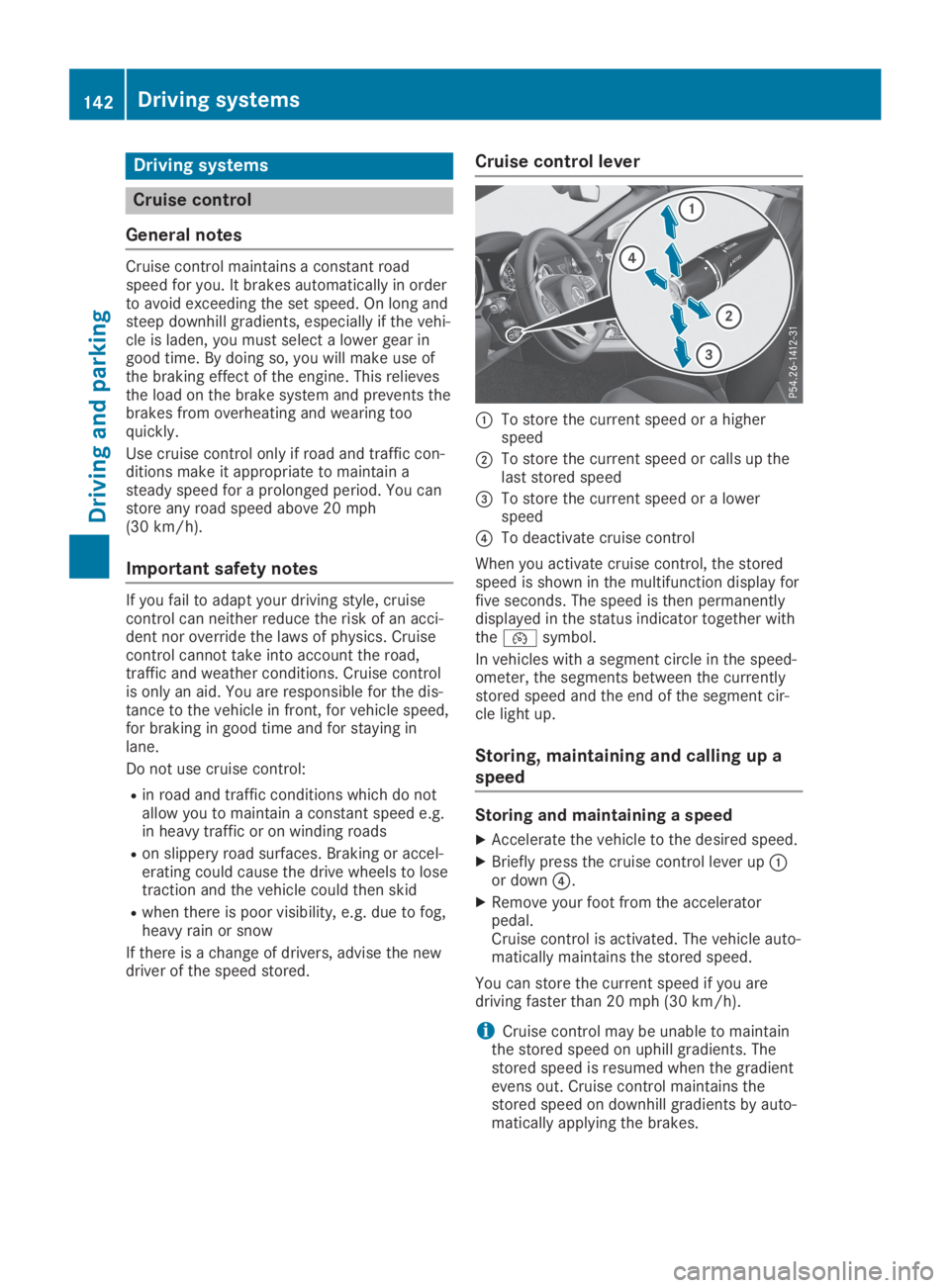
Cruise control lever
CTo store the current speed or a higherspeed
DTo store the current speed or calls up thelast stored speed
Page 146 of 306
Active Distance Assist DISTRONIC
General notes
Active Distance Assist DISTRONIC regulatesthe speed and automatically helps you main-tain the distance from the vehicle detected infront. Vehicles are detected with the aid of theradar sensor system. Active Distance AssistDISTRONIC brakes automatically to avoidexceeding the set speed or to maintain thedesignated distance from the vehicle in front.
Change into a lower gear in good time on longand steep downhill gradients. This is especiallyimportant if the vehicle is laden. By doing so,you will make use of the braking effect of theengine. This relieves the load on the brake sys-tem and prevents the brakes from overheatingand wearing too quickly.
If Active Distance Assist DISTRONIC detectsthat there is a risk of a collision with the vehi-cle in front, you will be warned visually andaudibly. Active Distance Assist DISTRONICcannot prevent a collision without your inter-vention. An intermittent warning tone will thensound and the distance warning lamp will lightup in the instrument cluster. Brake immedi-ately in order to increase the distance fromthe vehicle in front, or take evasive action, pro-vided it is safe to do so.
For Active Distance Assist DISTRONIC toassist you when driving, the radar sensor sys-tem must be operational.
Active Distance Assist DISTRONIC operates inthe speed range between 0 mph (0 km/h) and120 mph (200 km/h).
Do not use Active Distance Assist DISTRONICon roads with steep gradients.
As Active Distance Assist DISTRONIC trans-mits radar waves, it can resemble the radardetectors of the responsible authorities. Youcan refer to the relevant chapter in the Opera-tor's Manual if questions are asked about this.
iUSA only: This device has been approvedby the FCC as a "Vehicular Radar System".The radar sensor is intended for use in anautomotive radar system only. Removal,tampering, or altering of the device will voidany warranties, and is not permitted by theFCC. Do not tamper with, alter, or use in anynon-approved way.
Any unauthorized modification to this devicecould void the user's authority to operatethe equipment.
iCanada only: This device complies withRSS-210 of Industry Canada. Operation issubject to the following two conditions:
1. This device may not cause interference,and
2. This device must accept any interferencereceived, including interference that maycause undesired operation of the device.
Removal, tampering, or altering of thedevice will void any warranties, and is notpermitted. Do not tamper with, alter, or usein any non-approved way.
Any unauthorized modification to this devicecould void the user's authority to operatethe equipment.
Important safety notes
GWARNING
Active Distance Assist DISTRONIC does not
react to:
Rpeople or animals
Rstationary objects in the road, e.g. stop-
ped or parked vehicles
Roncoming vehicles and crossing traffic
As a result, Active Distance Assist
DISTRONIC may neither give warnings nor
intervene in such situations. There is a risk
of an accident.
Always pay careful attention to the traffic
situation and be ready to brake.
GWARNING
Active Distance Assist DISTRONIC does not
react to:
Rpeople or animals
Rstationary objects in the road, e.g. stop-
ped or parked vehicles (vehicles without
the Driving Assistance package)
Rstationary objects in the road, e.g. stop-
ped or parked vehicles, if sufficient detec-
tion is not possible (vehicles with the Driv-
ing Assistance package)
Roncoming vehicles and crossing traffic
144Driving systems
Driving and pa rking
Page 150 of 306
Rif the battery is disconnected
Rif the vehicle is accelerated, e.g. by a vehi-
cle occupant
There is a risk of an accident.
Always deactivate Active Distance Assist
DISTRONIC and secure the vehicle against
rolling away before you leave it.
Further information on deactivating Active Dis-tance Assist DISTRONIC (Ypage 149).
If Active Distance Assist DISTRONIC detectsthat the vehicle in front is stopping, it brakesyour vehicle until it is stationary.
Once your vehicle is stationary, it remains sta-tionary and you do not need to depress thebrake.
iAfter a time, the electric parking brakesecures the vehicle and relieves the servicebrake.
iDepending on the specified minimum dis-tance, your vehicle will come to a standstillat a sufficient distance behind the vehicle infront. The specified minimum distance is setusing the control on the cruise control lever.
When Active Distance Assist DISTRONIC isactivated, the transmission is shifted automati-cally to position]if:
Rthe driver's seat belt is not fastened and thedriver's door is open
Rthe engine is switched off, unless it is auto-matically switched off by the ECO start/stop function.
The electric parking brake is applied automati-cally if Active Distance Assist DISTRONIC isactive when the vehicle is stationary and:
Ra system malfunction occurs
Rthe power supply is not sufficient
If a malfunction occurs, the transmission mayalso shift to position]automatically.
Setting a speed
Keep in mind that it may take a brief momentuntil the vehicle has accelerated or braked tothe speed set.
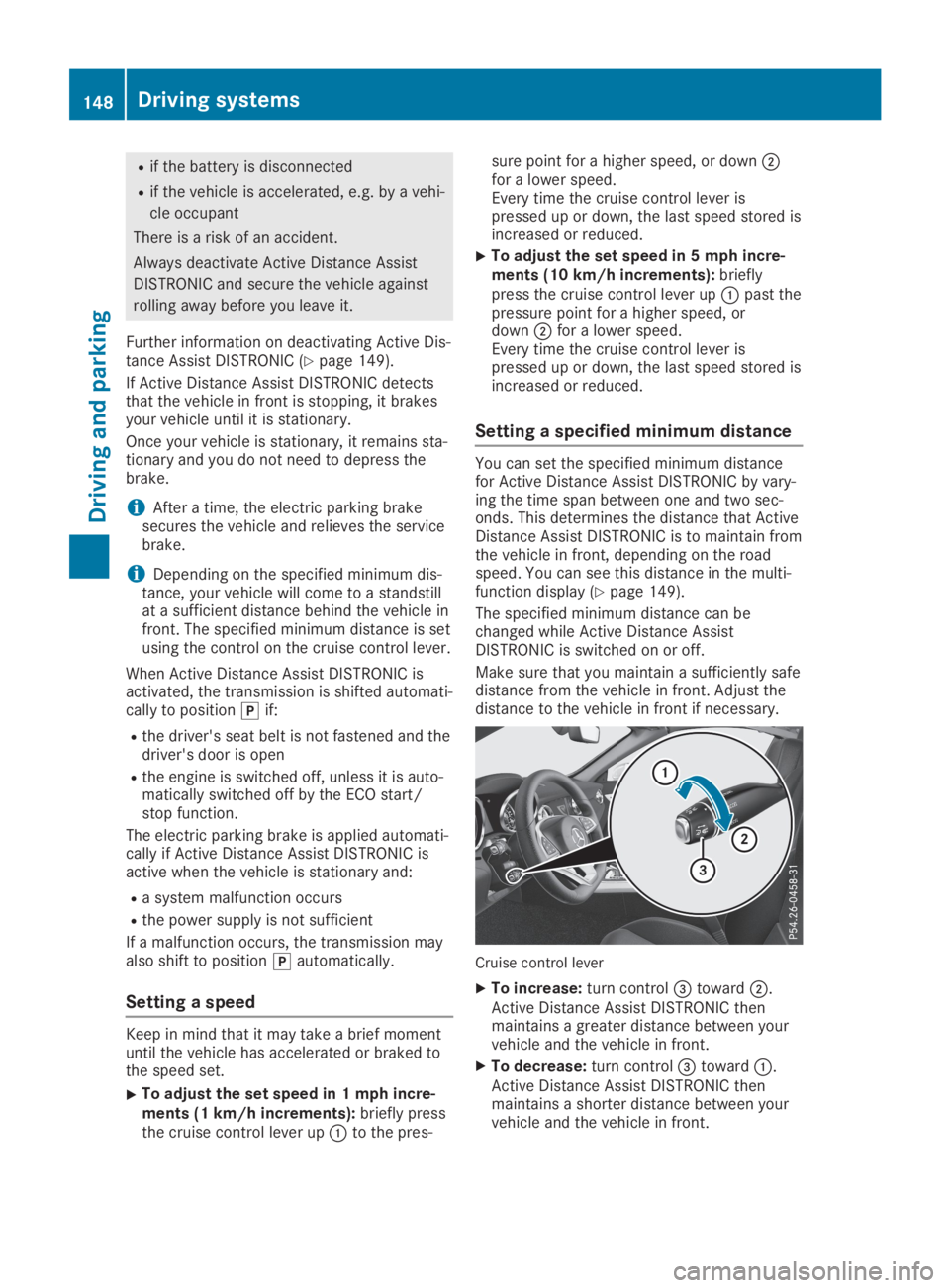
XTo adjust the set speed in 1 mph incre-ments (1 km/h increments):briefly pressthe cruise control lever upCto the pres-
sure point for a higher speed, or downDfor a lower speed.Every time the cruise control lever ispressed up or down, the last speed stored isincreased or reduced.
XTo adjust the set speed in 5 mph incre-ments (10 km/h increments):brieflypress the cruise control lever upCpast thepressure point for a higher speed, ordownDfor a lower speed.Every time the cruise control lever ispressed up or down, the last speed stored isincreased or reduced.
Setting a specified minimum distance
You can set the specified minimum distancefor Active Distance Assist DISTRONIC by vary-ing the time span between one and two sec-onds. This determines the distance that ActiveDistance Assist DISTRONIC is to maintain fromthe vehicle in front, depending on the roadspeed. You can see this distance in the multi-function display (Ypage 149).
The specified minimum distance can bechanged while Active Distance AssistDISTRONIC is switched on or off.
Make sure that you maintain a sufficiently safedistance from the vehicle in front. Adjust thedistance to the vehicle in front if necessary.
Cruise control lever
XTo increase:turn control
Page 152 of 306
iThe last speed stored remains stored untilyou switch off the engine.
iActive Distance Assist DISTRONIC is notdeactivated if you depress the acceleratorpedal. If you accelerate to overtake, ActiveDistance Assist DISTRONIC adjusts the vehi-cle's speed to the last speed stored afteryou have finished overtaking.
Active Distance Assist DISTRONIC is automati-cally deactivated if:
Ryou engage the electric parking brake or ifthe vehicle is automatically secured with theelectric parking brake
RESP®intervenes or you deactivate ESP®
Rthe transmission is in position],^or\\
Ryou pull the cruise control lever towards youin order to pull away and the front-passenger door is open
Ryou activate Active Parking Assist
Rthe vehicle is skidding
If Active Distance Assist DISTRONIC is deacti-vated automatically, you will hear a warningtone. TheActive Distance Assist OffActive Distance Assist Offmessage will appear on the multifunction dis-play for approximately five seconds.
Tips for driving with Active Distance
Assist DISTRONIC
General notes
The following contains descriptions of certainroad and traffic conditions in which you mustbe particularly attentive. In such situations,brake if necessary. Active Distance AssistDISTRONIC will then be deactivated.
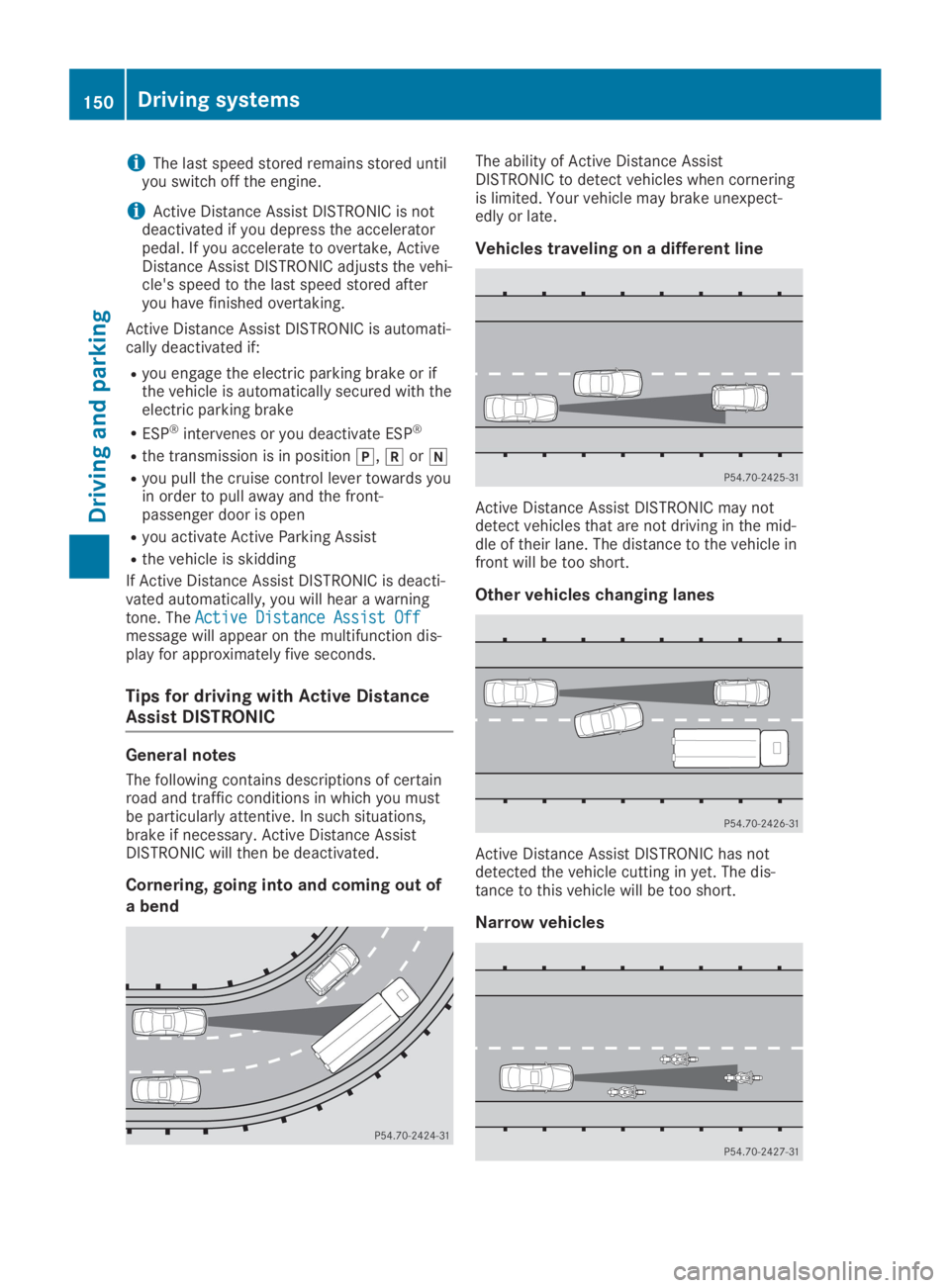
Cornering, going into and coming out of
a bend
The ability of Active Distance AssistDISTRONIC to detect vehicles when corneringis limited. Your vehicle may brake unexpect-edly or late.
Vehicles traveling on a different line
Active Distance Assist DISTRONIC may notdetect vehicles that are not driving in the mid-dle of their lane. The distance to the vehicle infront will be too short.
Other vehicles changing lanes
Active Distance Assist DISTRONIC has notdetected the vehicle cutting in yet. The dis-tance to this vehicle will be too short.
Narrow vehicles
150Driving systems
Driving and parking
Page 154 of 306
Activation conditions
You can activate the HOLD function if all of thefollowing conditions are fulfilled:
Rthe vehicle is stationary.
Rthe engine is running or if it has been auto-matically switched off by the ECO start/stop function.
Rthe driver's door is closed or your seat beltis fastened.
Rthe electric parking brake is released.
Rthe transmission is in position[,^or\\.
RActive Distance Assist DISTRONIC is deacti-vated
Activating the HOLD function
XMake sure that the activation conditions aremet.
XDepress the brake pedal.
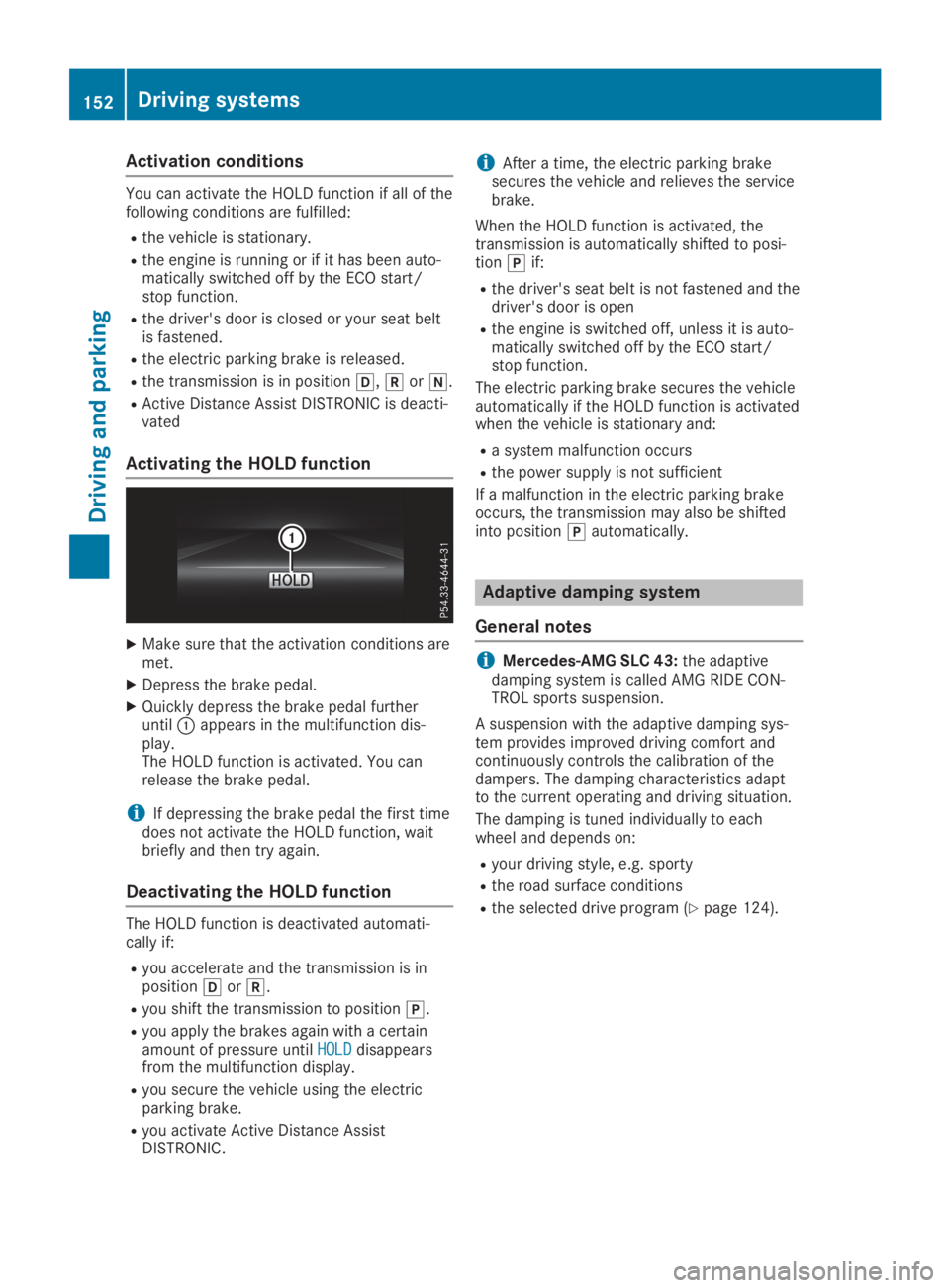
XQuickly depress the brake pedal furtheruntilCappears in the multifunction dis-play.The HOLD function is activated. You canrelease the brake pedal.
iIf depressing the brake pedal the first timedoes not activate the HOLD function, waitbriefly and then try again.
Deactivating the HOLD function
The HOLD function is deactivated automati-cally if:
Ryou accelerate and the transmission is inposition[or^.
Ryou shift the transmission to position].
Ryou apply the brakes again with a certainamount of pressure untilHOLDHOLDdisappearsfrom the multifunction display.
Ryou secure the vehicle using the electricparking brake.
Ryou activate Active Distance AssistDISTRONIC.
iAfter a time, the electric parking brakesecures the vehicle and relieves the servicebrake.
When the HOLD function is activated, thetransmission is automatically shifted to posi-tion]if:
Rthe driver's seat belt is not fastened and thedriver's door is open
Rthe engine is switched off, unless it is auto-matically switched off by the ECO start/stop function.
The electric parking brake secures the vehicleautomatically if the HOLD function is activatedwhen the vehicle is stationary and:
Ra system malfunction occurs
Rthe power supply is not sufficient
If a malfunction in the electric parking brakeoccurs, the transmission may also be shiftedinto position]automatically.
Adaptive damping system
General notes
iMercedes-AMG SLC 43:the adaptivedamping system is called AMG RIDE CON-TROL sports suspension.
A suspension with the adaptive damping sys-tem provides improved driving comfort andcontinuously controls the calibration of thedampers. The damping characteristics adaptto the current operating and driving situation.
The damping is tuned individually to eachwheel and depends on:
Ryour driving style, e.g. sporty
Rthe road surface conditions
Rthe selected drive program (Ypage 124).
152Driving systems
Driving and pa rking
Page 161 of 306
Reversing camera
General notes
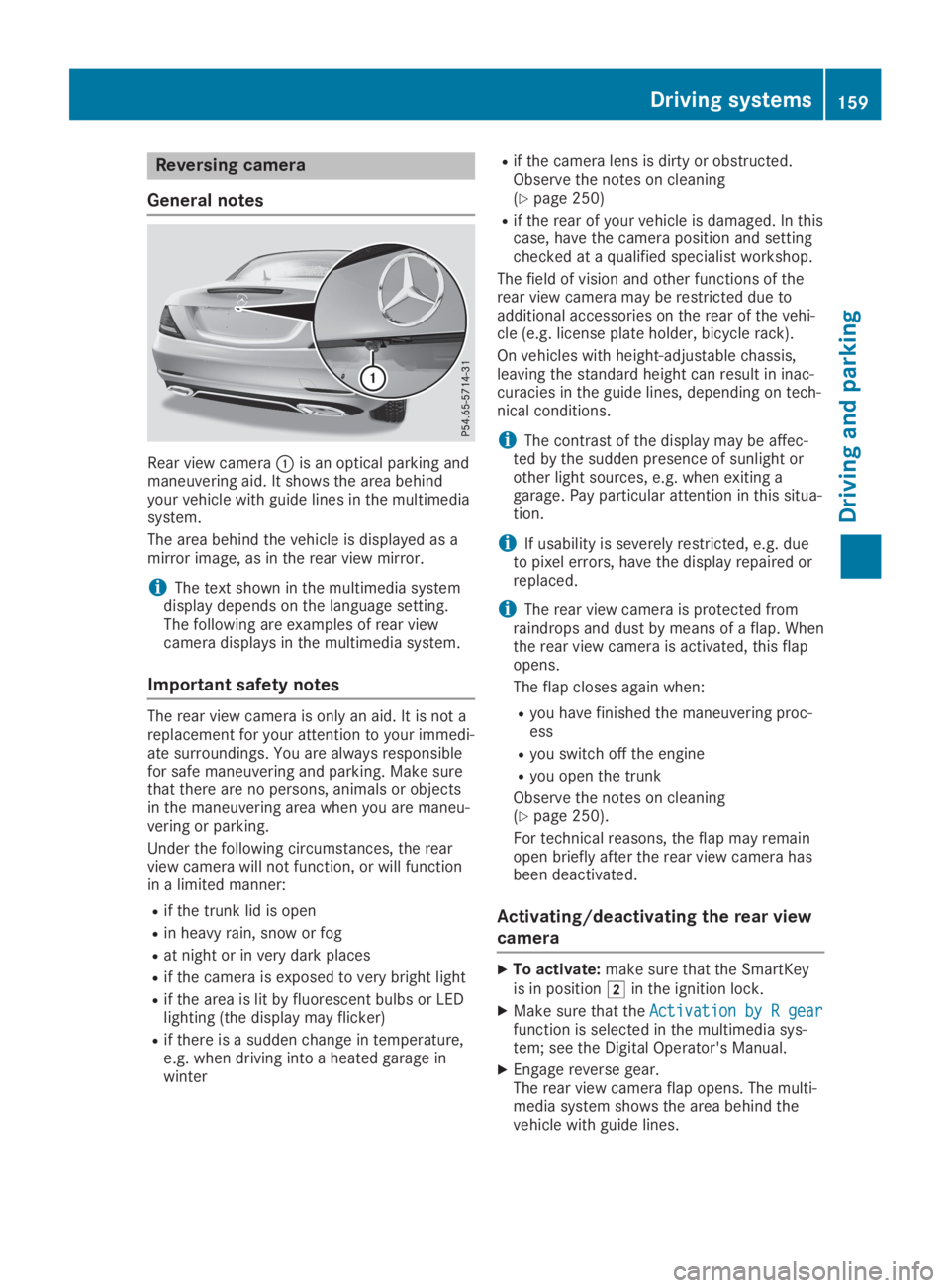
Rear view cameraCis an optical parking andmaneuvering aid. It shows the area behindyour vehicle with guide lines in the multimediasystem.
The area behind the vehicle is displayed as amirror image, as in the rear view mirror.
iThe text shown in the multimedia systemdisplay depends on the language setting.The following are examples of rear viewcamera displays in the multimedia system.
Important safety notes
The rear view camera is only an aid. It is not areplacement for your attention to your immedi-ate surroundings. You are always responsiblefor safe maneuvering and parking. Make surethat there are no persons, animals or objectsin the maneuvering area when you are maneu-vering or parking.
Under the following circumstances, the rearview camera will not function, or will functionin a limited manner:
Rif the trunk lid is open
Rin heavy rain, snow or fog
Rat night or in very dark places
Rif the camera is exposed to very bright light
Rif the area is lit by fluorescent bulbs or LEDlighting (the display may flicker)
Rif there is a sudden change in temperature,e.g. when driving into a heated garage inwinter
Rif the camera lens is dirty or obstructed.Observe the notes on cleaning(Ypage 250)
Rif the rear of your vehicle is damaged. In thiscase, have the camera position and settingchecked at a qualified specialist workshop.
The field of vision and other functions of therear view camera may be restricted due toadditional accessories on the rear of the vehi-cle (e.g. license plate holder, bicycle rack).
On vehicles with height-adjustable chassis,leaving the standard height can result in inac-curacies in the guide lines, depending on tech-nical conditions.
iThe contrast of the display may be affec-ted by the sudden presence of sunlight orother light sources, e.g. when exiting agarage. Pay particular attention in this situa-tion.
iIf usability is severely restricted, e.g. dueto pixel errors, have the display repaired orreplaced.
iThe rear view camera is protected fromraindrops and dust by means of a flap. Whenthe rear view camera is activated, this flapopens.
The flap closes again when:
Ryou have finished the maneuvering proc-ess
Ryou switch off the engine
Ryou open the trunk
Observe the notes on cleaning(Ypage 250).
For technical reasons, the flap may remainopen briefly after the rear view camera hasbeen deactivated.
Activating/deactivating the rear view
camera
XTo activate:make sure that the SmartKeyis in positionHin the ignition lock.
XMake sure that theActivation by R gearActivation by R gearfunction is selected in the multimedia sys-tem; see the Digital Operator's Manual.
XEngage reverse gear.The rear view camera flap opens. The multi-media system shows the area behind thevehicle with guide lines.
Driving systems159
Driving and parking
Z
Page 165 of 306
ATTENTION ASSIST assesses your level of fati-gue or lapses in concentration by taking thefollowing criteria into account:
Ryour personal driving style, e.g. steeringcharacteristics
Rjourney details, e.g. time of day and lengthof journey
The functionality of ATTENTION ASSIST isrestricted and warnings may be delayed or notoccur at all:
Rif the road condition is poor, e.g. if the sur-face is uneven or if there are potholes
Rif there is a strong side wind
Rif you have adopted a sporty driving stylewith high cornering speeds or high rates ofacceleration
Rif you are predominantly driving slower than50 mph (80 km/h) or faster than 112 mph(180 km/h)
Rif you are currently using COMAND or mak-ing a telephone call with it
Rif the time has been set incorrectly
Rin active driving situations, such as whenyou change lanes or change your speed
ATTENTION ASSIST is only an aid to the driver.It might not always recognize fatigue orincreasing inattentiveness in time or fail torecognize them at all. The system is not a sub-stitute for a well-rested and attentive driver.
Warning and display messages in the
multifunction display
XActivate ATTENTION ASSIST using the on-board computer (Ypage 175).
If ATTENTION ASSIST is active, you will bewarned no sooner than 20 minutes afteryour journey has begun. You then hear anintermittent warning tone twice and theATTENTION ASSIST: Take a Break!ATTENTION ASSIST: Take a Break!mes-sage appears in the multifunction display.
XIf necessary, take a break.
XPress thevor8button to confirmthe message.
On long journeys, take regular breaks in goodtime to allow yourself to rest properly. If youdo not take a break and ATTENTION ASSISTstill detects increasing lapses in concentra-tion, you will be warned again after 15 minutesat the earliest.
ATTENTION ASSIST is reset when you continueyour journey and starts assessing your tired-ness again if:
Ryou switch off the engine
Ryou take off your seat belt and open thedriver's door, e.g. for a change of drivers orto take a break
When ATTENTION ASSIST is deactivated, the