maintenance MERCEDES-BENZ SLC 2019 Owner's Manual
[x] Cancel search | Manufacturer: MERCEDES-BENZ, Model Year: 2019, Model line: SLC, Model: MERCEDES-BENZ SLC 2019Pages: 306, PDF Size: 15 MB
Page 277 of 306
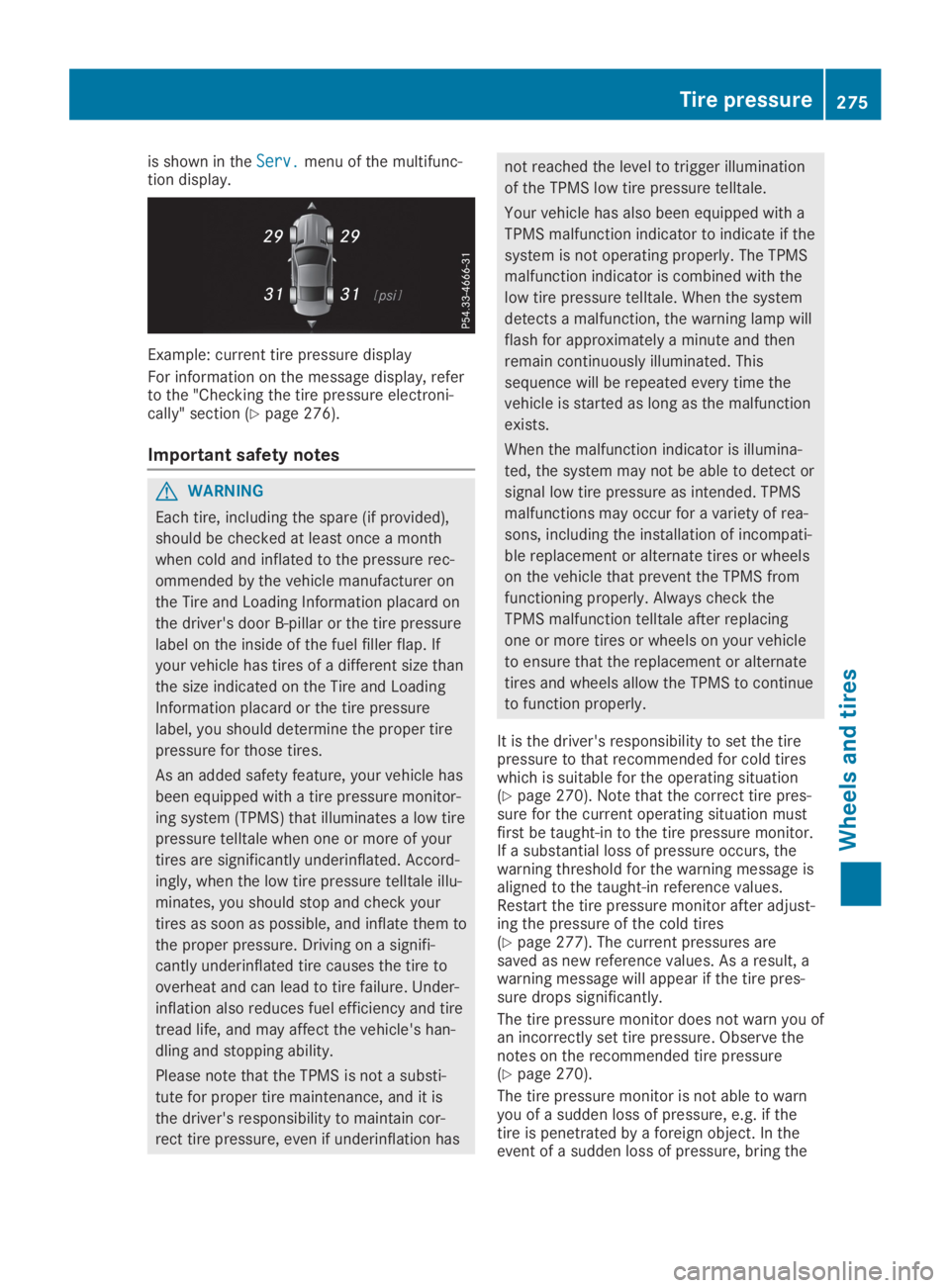
is shown in theServ.Serv.menu of the multifunc-tion display.
Example: current tire pressure display
For information on the message display, referto the "Checking the tire pressure electroni-cally" section (Ypage 276).
Important safety notes
GWARNING
Each tire, including the spare (if provided),
should be checked at least once a month
when cold and inflated to the pressure rec-
ommended by the vehicle manufacturer on
the Tire and Loading Information placard on
the driver's door B-pillar or the tire pressure
label on the inside of the fuel filler flap. If
your vehicle has tires of a different size than
the size indicated on the Tire and Loading
Information placard or the tire pressure
label, you should determine the proper tire
pressure for those tires.
As an added safety feature, your vehicle has
been equipped with a tire pressure monitor-
ing system (TPMS) that illuminates a low tire
pressure telltale when one or more of your
tires are significantly underinflated. Accord-
ingly, when the low tire pressure telltale illu-
minates, you should stop and check your
tires as soon as possible, and inflate them to
the proper pressure. Driving on a signifi-
cantly underinflated tire causes the tire to
overheat and can lead to tire failure. Under-
inflation also reduces fuel efficiency and tire
tread life, and may affect the vehicle's han-
dling and stopping ability.
Please note that the TPMS is not a substi-
tute for proper tire maintenance, and it is
the driver's responsibility to maintain cor-
rect tire pressure, even if underinflation has
not reached the level to trigger illumination
of the TPMS low tire pressure telltale.
Your vehicle has also been equipped with a
TPMS malfunction indicator to indicate if the
system is not operating properly. The TPMS
malfunction indicator is combined with the
low tire pressure telltale. When the system
detects a malfunction, the warning lamp will
flash for approximately a minute and then
remain continuously illuminated. This
sequence will be repeated every time the
vehicle is started as long as the malfunction
exists.
When the malfunction indicator is illumina-
ted, the system may not be able to detect or
signal low tire pressure as intended. TPMS
malfunctions may occur for a variety of rea-
sons, including the installation of incompati-
ble replacement or alternate tires or wheels
on the vehicle that prevent the TPMS from
functioning properly. Always check the
TPMS malfunction telltale after replacing
one or more tires or wheels on your vehicle
to ensure that the replacement or alternate
tires and wheels allow the TPMS to continue
to function properly.
It is the driver's responsibility to set the tirepressure to that recommended for cold tireswhich is suitable for the operating situation(Ypage 270). Note that the correct tire pres-sure for the current operating situation mustfirst be taught-in to the tire pressure monitor.If a substantial loss of pressure occurs, thewarning threshold for the warning message isaligned to the taught-in reference values.Restart the tire pressure monitor after adjust-ing the pressure of the cold tires(Ypage 277). The current pressures aresaved as new reference values. As a result, awarning message will appear if the tire pres-sure drops significantly.
The tire pressure monitor does not warn you ofan incorrectly set tire pressure. Observe thenotes on the recommended tire pressure(Ypage 270).
The tire pressure monitor is not able to warnyou of a sudden loss of pressure, e.g. if thetire is penetrated by a foreign object. In theevent of a sudden loss of pressure, bring the
Tire pressure275
Wheels and tires
Z
Page 292 of 306
Raising the vehicle
GWARNING
If you do not position the jack correctly at
the appropriate jacking point of the vehicle,
the jack could tip over with the vehicle
raised. There is a risk of injury.
Only position the jack at the appropriate
jacking point of the vehicle. The base of the
jack must be positioned vertically, directly
under the jacking point of the vehicle.
!Only position the jack at the appropriatejacking point of the vehicle. Otherwise, youcould damage the vehicle.
Observe the following when raising the vehi-cle:
RTo raise the vehicle, only use the vehicle-specific jack that has been tested andapproved by Mercedes-Benz. If used incor-rectly, the jack could tip over with the vehi-cle raised.
RThe jack is designed only to raise and holdthe vehicle for a short time while a wheelis being changed. It must not be used forperforming maintenance work under thevehicle.
RAvoid changing the wheel on uphill anddownhill slopes.
RBefore raising the vehicle, secure it fromrolling away by applying the parking brakeand inserting wheel chocks. Do not disen-gage the parking brake while the vehicle israised.
RThe jack must be placed on a firm, flat andnon-slip surface. On a loose surface, a large,flat, load-bearing underlay must be used. Ona slippery surface, a non-slip underlay mustbe used, e.g. rubber mats.
RDo not use wooden blocks or similar objectsas a jack underlay. Otherwise, the jack willnot be able to achieve its load-bearing capa-city due to the restricted height.
RMake sure that the distance between theunderside of the tires and the ground doesnot exceed 1.2 in (3 cm).
RNever place your hands and feet under theraised vehicle.
RDo not lie under the vehicle.
RDo not start the engine when the vehicle israised.
RDo not open or close a door or the trunk lidwhen the vehicle is raised.
RMake sure that no persons are present inthe vehicle when the vehicle is raised.
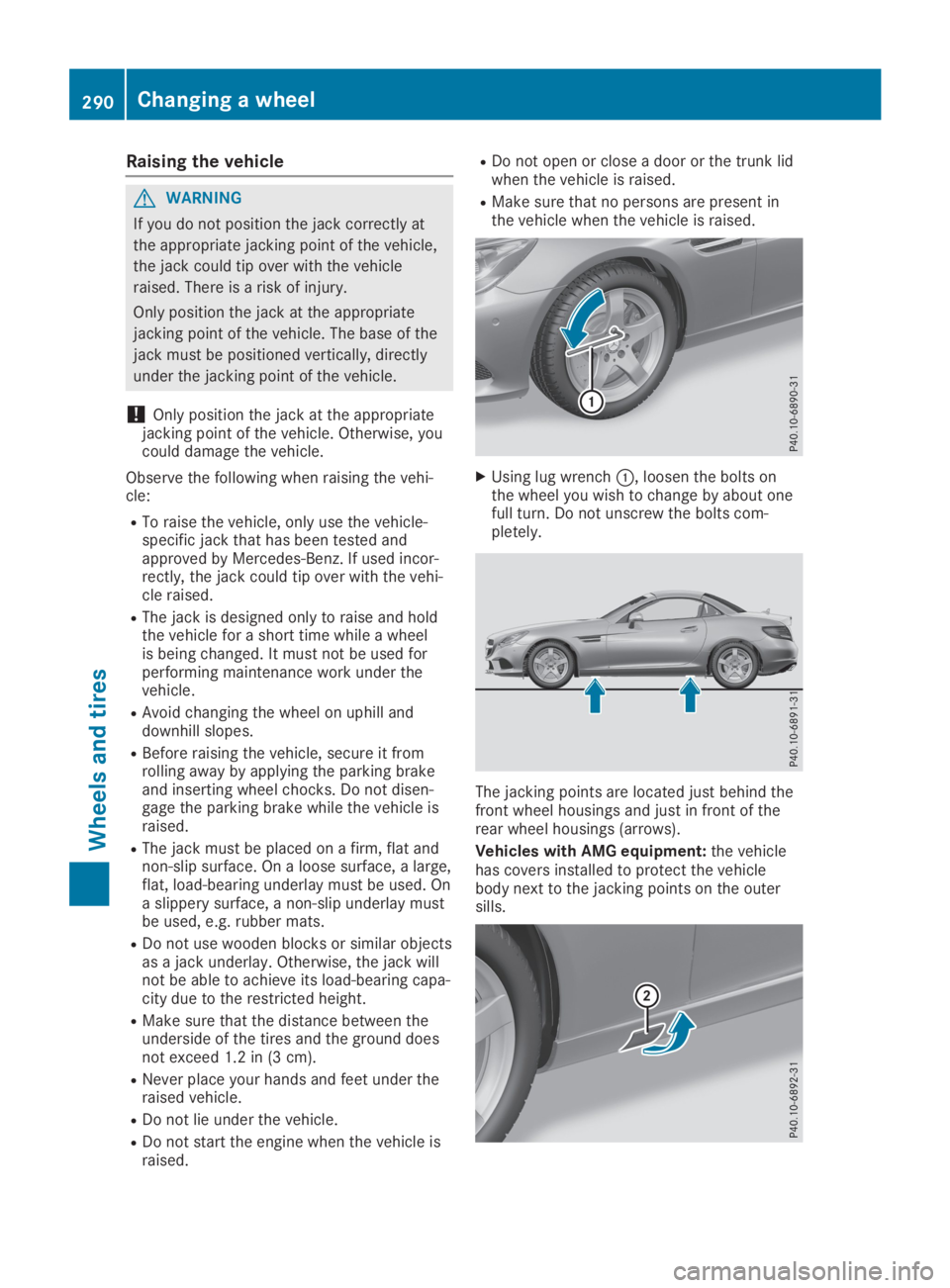
XUsing lug wrenchC, loosen the bolts onthe wheel you wish to change by about onefull turn. Do not unscrew the bolts com-pletely.
The jacking points are located just behind thefront wheel housings and just in front of therear wheel housings (arrows).
Vehicles with AMG equipment:the vehiclehas covers installed to protect the vehiclebody next to the jacking points on the outersills.
290Changing a wheel
Wheels and tires
Page 302 of 306
Do not mix such fuels with the fuel recom-mended for your vehicle.
!To ensure the longevity and full perform-ance of the engine, only premium-gradeunleaded gasoline must be used.
If standard unleaded gasoline is unavailableand you have to refuel with unleaded gaso-line of a lower grade, observe the followingprecautions:
ROnly fill the fuel tank to half full with regu-lar unleaded gasoline and fill the rest withpremium-grade unleaded gasoline as soonas possible.
RDo not drive at the maximum speed.
RAvoid sudden acceleration and enginespeeds over 3,000 rpm.
You will usually find information about the fuelgrade on the fuel pump. If you cannot find thelabel on the fuel pump, ask the gas stationstaff.
iFor further information, consult a qualifiedspecialist workshop or visithttp://www.mbusa.com (USA only).
As a temporary measure, if the recommendedfuel is not available, you may also use regularunleaded gasoline with an octane rating of87 AKI/91 RON. This may reduce engine per-formance and increase fuel consumption.Avoid driving at full throttle and sudden accel-eration. Never refuel using gasoline with alower AKI.
iThe fuels you can use in your vehicle maydiffer from the information in the Operator'sManual depending on the country. The fuelsthat have been approved for your vehiclecan be found on the instruction label on theinside of the fuel filler flap.
Information on refueling (Ypage 133).
Additives in gasoline
!Operating the engine with fuel additivesadded later can lead to engine failure. Donot mix fuel additives with fuel. This doesnot include additives for the removal andprevention of residue buildup. gasoline mustonly be mixed with additives recommendedby Mercedes-Benz. Comply with the instruc-tions for use on the product label. Moreinformation about recommended additivescan be obtained from any authorizedMercedes-Benz Center.
Mercedes-Benz recommends that you usebranded fuels that have additives.
The fuel quality available in some countriesmay not be sufficient. Residue could build upin the fuel injection system as a result. In suchcases, and in consultation with an authorizedMercedes-Benz Center, the fuel may be mixedwith the cleaning additive recommended byMercedes-Benz. You must observe the notesand mixing ratios specified on the container.
Engine oil
General notes
!Do not use engine oil or an oil filter withspecifications deviating from thoseexpressly required for the prescribed serviceintervals. Do not change the engine oil or oilfilter in order to set replacement intervalslonger than those prescribed. This couldotherwise cause damage to the engine orexhaust gas aftertreatment.
Follow the instructions on the service inter-val display for changing the engine oil. Thiscould otherwise cause damage to theengine or exhaust gas aftertreatment.
When handling engine oil, observe the impor-tant safety notes on service products(Ypage 298).
The engine oils are matched to the perform-ance of Mercedes-Benz engines and serviceintervals. You should therefore only use engineoils and oil filters that are approved for vehi-cles with maintenance systems.
For a list of approved engine oils and oil filters,consult an authorized Mercedes-Benz Center.Or visit the websitehttp://bevo.mercedes-benz.com.
300Service products and filling capacities
Technical data
Page 303 of 306
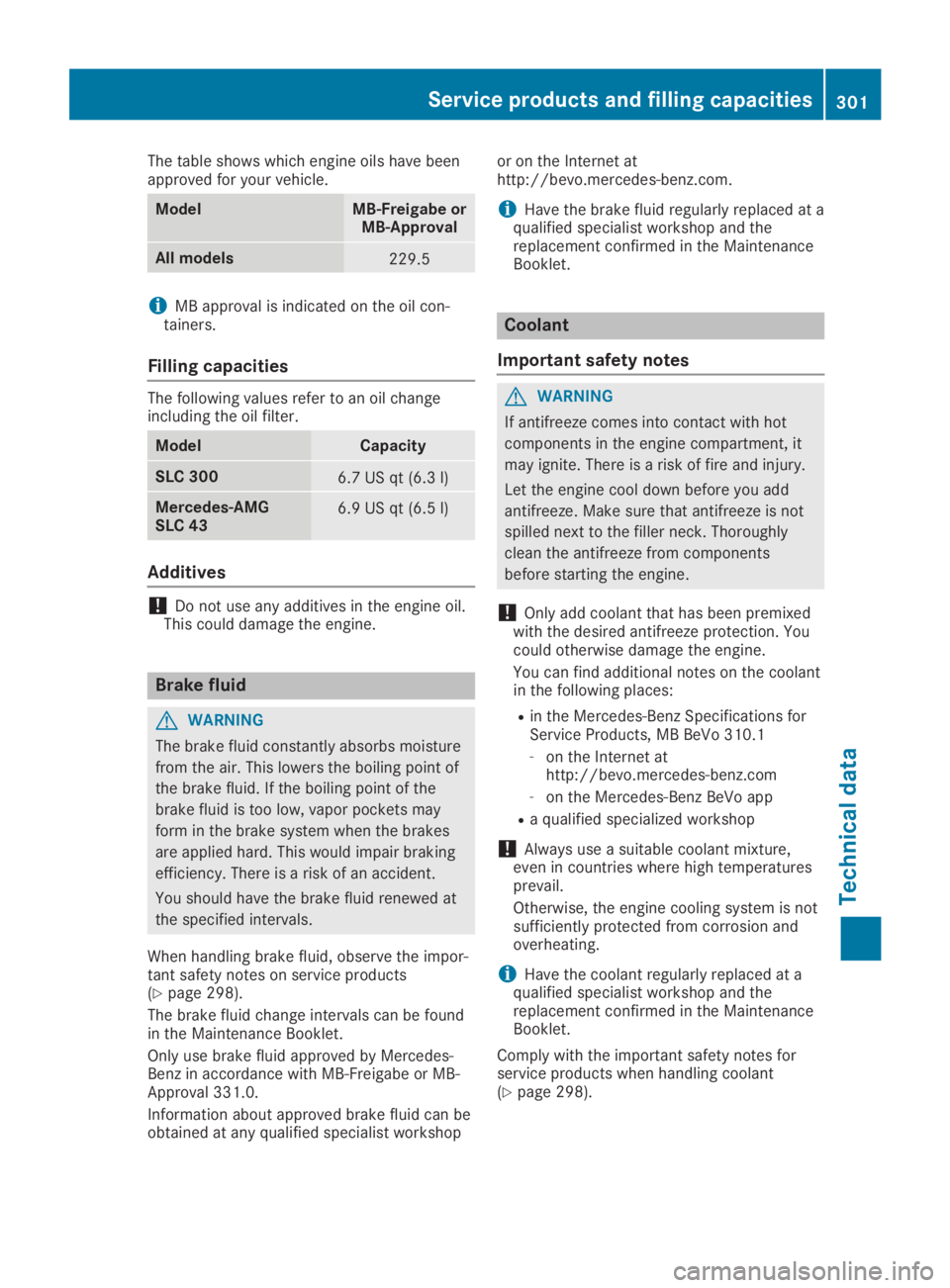
The table shows which engine oils have beenapproved for your vehicle.
ModelMB-Freigabe orMB-Approval
All models229.5
iMB approval is indicated on the oil con-tainers.
Filling capacities
The following values refer to an oil changeincluding the oil filter.
ModelCapacity
SLC 3006.7 US qt (6.3l)
Mercedes-AMGSLC 436.9 US qt (6.5l)
Additives
!Do not use any additives in the engine oil.This could damage the engine.
Brake fluid
GWARNING
The brake fluid constantly absorbs moisture
from the air. This lowers the boiling point of
the brake fluid. If the boiling point of the
brake fluid is too low, vapor pockets may
form in the brake system when the brakes
are applied hard. This would impair braking
efficiency. There is a risk of an accident.
You should have the brake fluid renewed at
the specified intervals.
When handling brake fluid, observe the impor-tant safety notes on service products(Ypage 298).
The brake fluid change intervals can be foundin the Maintenance Booklet.
Only use brake fluid approved by Mercedes-Benz in accordance with MB-Freigabe or MB-Approval 331.0.
Information about approved brake fluid can beobtained at any qualified specialist workshop
or on the Internet athttp://bevo.mercedes-benz.com.
iHave the brake fluid regularly replaced at aqualified specialist workshop and thereplacement confirmed in the MaintenanceBooklet.
Coolant
Important safety notes
GWARNING
If antifreeze comes into contact with hot
components in the engine compartment, it
may ignite. There is a risk of fire and injury.
Let the engine cool down before you add
antifreeze. Make sure that antifreeze is not
spilled next to the filler neck. Thoroughly
clean the antifreeze from components
before starting the engine.
!Only add coolant that has been premixedwith the desired antifreeze protection. Youcould otherwise damage the engine.
You can find additional notes on the coolantin the following places:
Rin the Mercedes-Benz Specifications forService Products, MB BeVo 310.1
-on the Internet athttp://bevo.mercedes-benz.com
-on the Mercedes-Benz BeVo app
Ra qualified specialized workshop
!Always use a suitable coolant mixture,even in countries where high temperaturesprevail.
Otherwise, the engine cooling system is notsufficiently protected from corrosion andoverheating.
iHave the coolant regularly replaced at aqualified specialist workshop and thereplacement confirmed in the MaintenanceBooklet.
Comply with the important safety notes forservice products when handling coolant(Ypage 298).
Service products and filling capacities301
Technical data
Z