light MERCEDES-BENZ SLC-Class 2017 R172 User Guide
[x] Cancel search | Manufacturer: MERCEDES-BENZ, Model Year: 2017, Model line: SLC-Class, Model: MERCEDES-BENZ SLC-Class 2017 R172Pages: 294, PDF Size: 7.28 MB
Page 16 of 294
R
RACETIMER (on-board computer).... 176
Radio
Selecting astation ......................... 168
see separate operating instructions
Radio mode
see also Digital Operator's Man-
ual.................................................. 211
Radio-wav ereception/transmis-
sion in the vehicle
Declaration of conformity ................ 25
Reading lamp ....................................... 97
Rear fog lamp
Displa ymessag e............................ 189
Switching on/of f.............................. 94
Rear lamps
see Lights
Rear vie wcamera
Cleaning instructions ..................... 240
Displa yinthe multimedi asystem .. 155
Function/note s............................. 154
Switching on/of f........................... 155
Rear windowd efroster
Genera lnotes ................................ 110
Problem (malfunction) ................... 111
Switching on/of f........................... 110
Rear-vie wmirror
Anti-glare (manual) .......................... 88
Dipping (automatic) ......................... 90
Refrigerant (air-conditioning sys-
tem)
Important safety notes .................. 288
Refueling
Fuelgauge ....................................... 31
Important safety notes .................. 129
Refueling process .......................... 130
see Fuel
Remote control
Programming (garage door
opener) .......................................... 226
Replacing bulbs
Important safety notes .................... 97
Overview of bulb types .................... 98
Removing/replacing the cover
(front wheela rch)............................ 98
Reporting safety defects .................... 26
Rescue card ......................................... 27 Reserve (fuel tank)
see Fuel
Reserve fuel
Displa ymessage ............................ 192
Warning lamp ................................. 207
Residual hea t(clim ate control) ........ 111
Restrain tsystem
Displa ymessage ............................ 185
Introduction ..................................... 37
Warning lamp ................................. 206
Warning lamp (function) ................... 37
Revers egear
Engaging (automati ctransmis-
sion) ............................................... 123
Reversible floor pane l(trunk)
.......... 218
Re
versin gfeature
Sid ew indow s................................... 72
Reversin glamps (display mes-
sage) ................................................... 189
Roadside Assistance (breakdown) .... 24
Roof
Displa ymessage ............................ 200
Important safety notes .................... 75
Opening/closing (with roof
switch) ............................................. 76
Opening/closing (with Smart-
Key )................................................. 77
Overview .......................................... 75
Problem (malfunction) ..................... 81
Relocking ......................................... 77
Roo fcarrier ........................................ 219
Roo fswitch .......................................... 76
Route guidance
see also Digital Operator's Man-
ual.................................................. 211
S
Safety
Childre ninthe vehicl e..................... 51
see Occupant safety
Safety system
see Driving safety systems
SD memory card
Ejecting .......................................... 216
Inserting ........................................ 216
Inserting/removing ........................ 216
14Index
Page 18 of 294
SMSsee also Digital Operator's Man-
ual .................................................. 211
Snow chains ...................................... 257
Sockets
Center console .............................. 221
General notes ................................ 221
Sound
Switchingo n/off ........................... 212
Special seat belt retractor .................. 52
Specialist workshop ............................26
Speed, controlling
see Cruise control
Speedometer
Digital ............................................ 167
In the Instrument cluster ................. 31
Segments. ..................................... 163
Selectingt he display unit ............... 172
Sport handling mode
Activating/deactivating (SLC 43
AMG) ............................................... 60
Warning lamp ................................. 206
Standing lamps
Display message ............................1 89
Switching on/off .............................. 94
Start/stop function
see ECO start/stop function
Starting (engine) ................................ 116
Steering
Display message ............................ 200
Steering wheel
Adjusting (electrically). .................... 87
Adjusting (manually). ....................... 86
Butto noverview ............................... 32
Buttons (on-board computer) ......... 164
Important safety notes .................... 86
Storing settings (memory func-
tion) ................................................. 91
Steering whee lpaddle shifters ........ 126
Stopwatch (RACETIMER) ................... 176
Stowag eareas ................................... 217
Stowag ecom partments
Armrest (under )............................. 217
Center console .............................. 218
Cu ph olders ................................... 219
Door ............................................... 218
Eyeglasses compartment ............... 218 Glove box ....................................... 217
Important safety information ......... 217
Rear
wal
l ........................................ 218
Stowag enet ................................... 218
Stowag enet....................................... 218
Summert ires..................................... 257
Sun visor ............................................ 220
Surround lighting (on-board com-
puter) .................................................. 173
Switchin gair-recirculatio nmode
on/off ................................................. 111
Switchin gonmediam ode
Via the device list .......................... 216
T
Tachometer ........................................ 163
Tail lamps
Displa ymessage ............................ 189
see Lights
Tank content
Fuelgauge ....................................... 31
Technical data
Capacities ...................................... 284
Emergency spare wheel. ................ 280
Information .................................... 282
Tires/wheels ................................. 278
Vehicl edata. .................................. 289
TELEAID
Call priority .................................... 225
Emergency cal l.............................. 222
Genera lnotes ................................ 221
MB info cal lbutton ........................ 224
Roadsid eAssistance button .......... 223
Self-test ......................................... 222
System .......................................... 222
Vehicl eHealth Check .................... 225
Telephone
Accepting acall( multifunction
steering wheel) .............................. 170
Authorizing amobilephone (con-
necting) ......................................... 215
Connecting amobilephone (gen-
era linformation) ............................ 214
Displa ymessage ............................ 200
Menu (on-board computer) ............ 169
Numbe rfrom the phone boo k........ 170
Redialing ........................................ 170
16Index
Page 29 of 294
The following text is published as required of
manufacturers under Title 49, Code of U.S. Fed-
eral Regulations, Part 575 pursuant to the
"National Traffic and Motor Vehicle Safety Act of
1966".
If you believe that your vehicle hasadefect
which could cause acrash or could cause injury
or death, you should immediately inform the
National Highway Traffic Safety Administration
(NHTSA)ina ddition to notifying Mercedes-Benz
USA,L LC.
If NHTSA receives similar complaints ,itmay
open an investigation, and if it finds that asafety
defect exists in agroup of vehicles, it may order
ar ecall and remedy campaign. However, NHTSA
cannot become involved in individual problems
between you, your dealer, or Mercedes-Benz
USA,L LC.
To contact NHTSA,y ou may call the Vehicle
Safety Hotlin etoll-free at
1-888-327-4236(TTY: 1-800-424-9153); go to
http://www.safercar.gov ;orwrite to: Admin-
istrator ,NHTSA,4 00 SeventhS treet, SW.,
Washington ,DC20590.
You can also obtain other information about
motor vehicle safety from
http://www.safercar.gov
Limited Warranty
!
Follow the instructions in this manual about
the proper operation of your vehicle as well as
about possible vehicle damage. Damage to
your vehicle that arises from culpable contra-
ventions against these instructions is not cov- ered either by the Mercedes-Benz Limited
Warranty or by the New or Used-Vehicle War-
ranty.
QR codes for the rescue card
The QR codes are secured in the fuel filler flap
and on the opposite side on the B-pillar. In the
event of an accident,r escue services can use
the QR code to quickly find the appropriate res- cue card for your vehicle. The current rescue
card contains the most important information
about your vehicle in acompact form, e.g. the
routing of the electric cables.
You can find more information under http://
portal.aftersales.i.daimler.com/public/ content/asportal/en/communication/
informationen_fuer/QRCode.html.
Data stored in the vehicle
Data storage
Aw
ide range of electronic components in your
vehicle contain data memories.
These data memories temporarily or perma-
nently store technical information about:
Rvehicle's operating state
Rincidents
Rmalfunctions
In general, this technical information docu-
mentst he state of acomponent, amodule, a
system or the surroundings.
These include, for example:
Roperating conditions of system components,
e.g. fluid levels
Rthe vehicle's status messages and those of its
individual components, e.g. number of wheel
revolutions/speed, deceleration in move-
ment,l ateral acceleration, accelerator pedal
position
Rmalfunction sand defects in important system
components, e.g. lights, brakes
Rvehicle reactionsa nd operating conditions in
special driving situations, e.g. air bag deploy-
ment,i ntervention of stability control sys-
tems
Rambient conditions, e.g. outside temperature
This data is of an exclusively technical nature
and can be used to:
Rassist in recognizing and rectifying malfunc-
tions and defects
Ranalyze vehicle functions, e.g. after an acci-
dent
Roptimize vehicle function
The data cannot be used to trace the vehicle's
movements.
When your vehicle is serviced, technical infor-
mation can be read from the event data memory
and malfunction data memory.
Services include, for example:
Rrepair services
Rservice processes
Rwarranties
Rquality assurance
Data stored in the vehicle27
Introduction
Z
Page 32 of 294
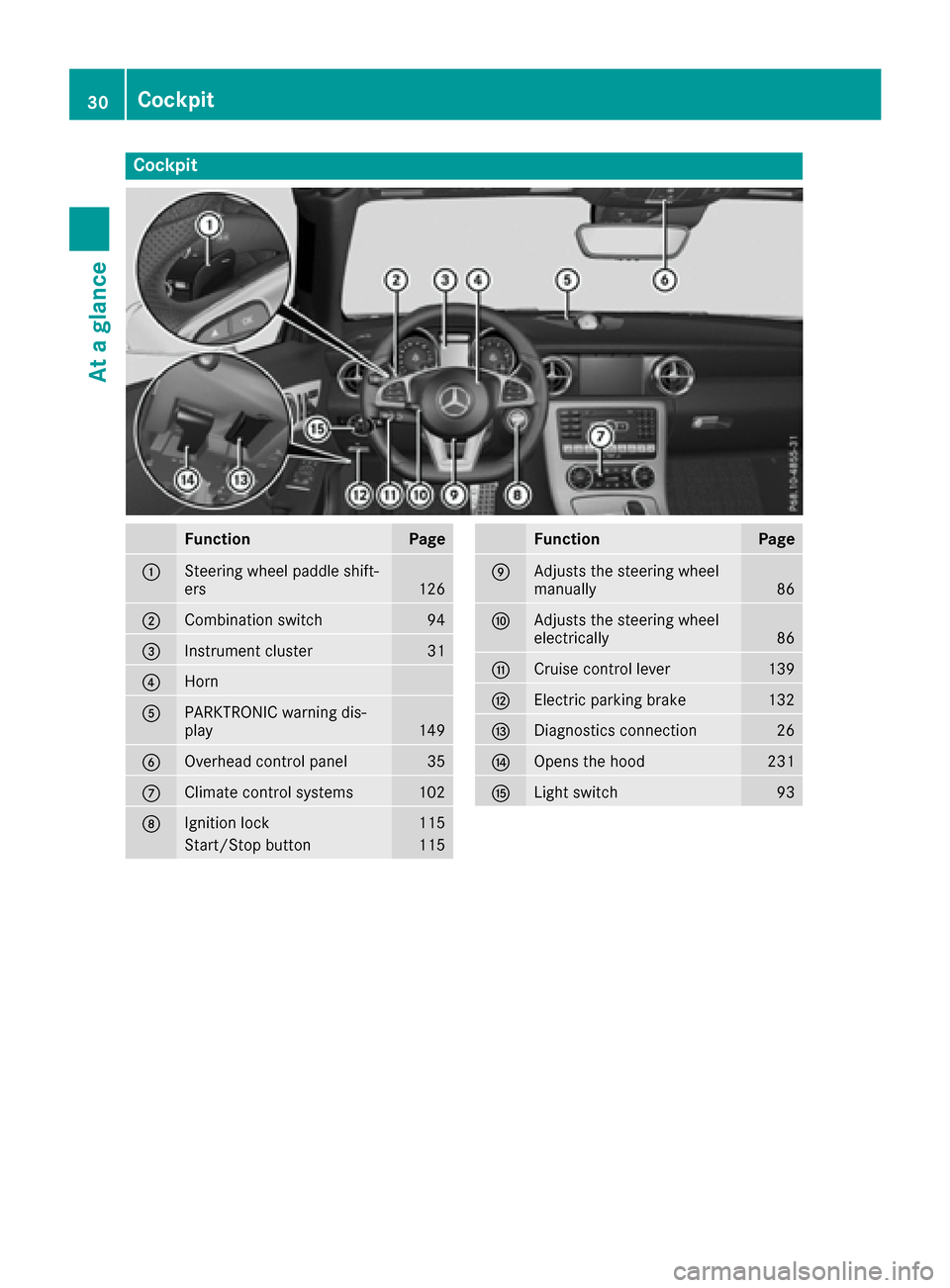
Cockpit
FunctionPage
:Steering wheel paddle shift-
ers126
;Combination switch94
=Instrumentcluster31
?Horn
APARKTRONIC warning dis-
play149
BOverhead control panel35
CClimatecontrol systems102
DIgnition lock115
Start/Sto pbutton115
FunctionPage
EAdjusts th esteering wheel
manually86
FAdjusts th esteering wheel
electrically86
GCruis econtrol lever139
HElectric parking brake132
IDiagnostics connection26
JOpenst hehood231
KLights witch93
30Cockpit
Atag lance
Page 33 of 294
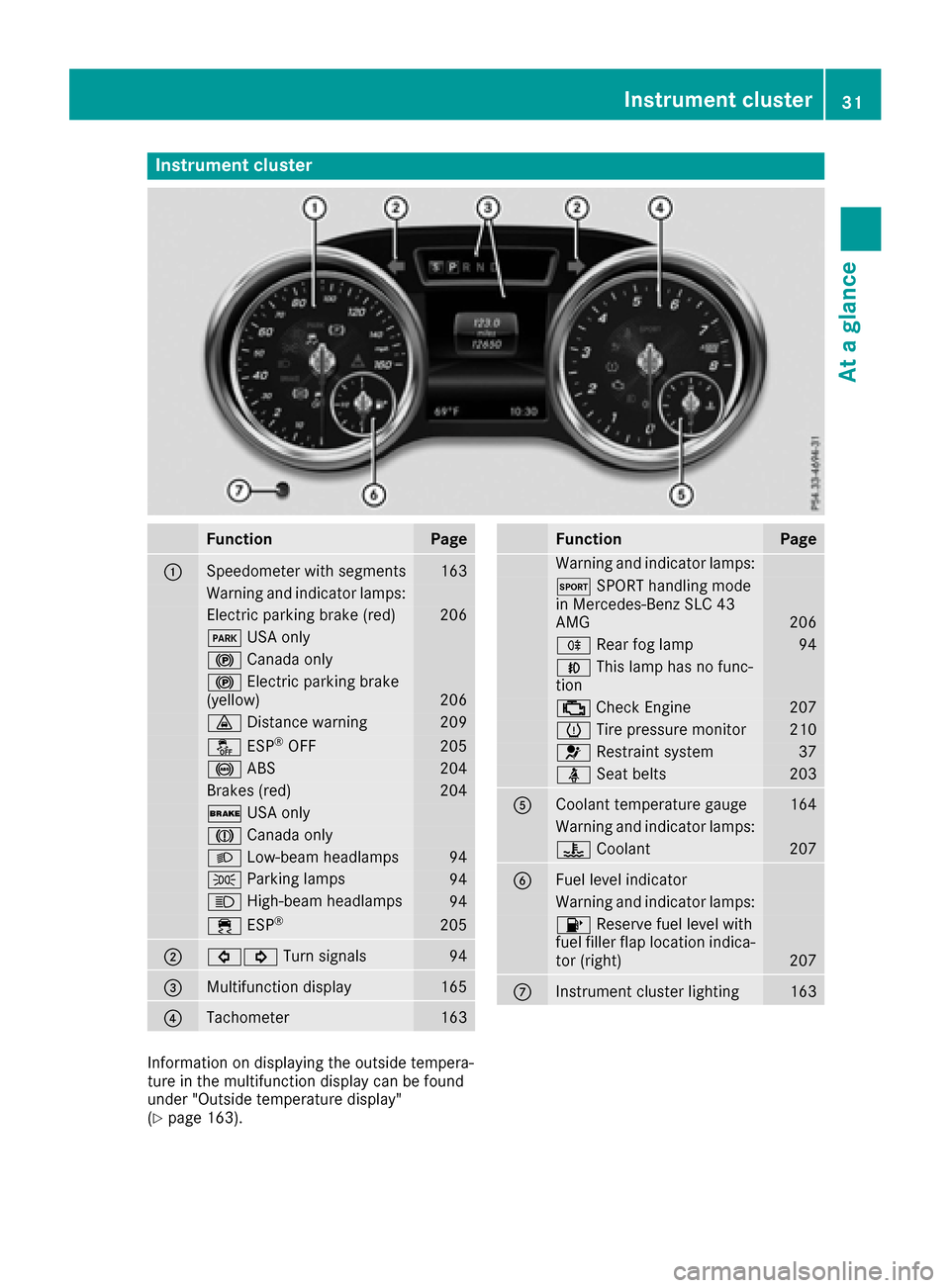
Instrumentcluster
FunctionPag e
:Speedometer wit hsegments163
Warning and indicator lamps:
Electric parking brak e(red)20 6
F USAo nly
! Canad aonly
! Electric parking brak e
(yellow)20 6
· Distanc ewarning209
å ESP®OF F205
! ABS204
Brake s(red)20 4
$ USAo nly
J Canad aonly
L Low-beam headlamps94
TParking lamp s94
KHigh-beam headlamps94
÷ESP®20 5
;#! Turn signals94
=Multifunction display165
?Tachometer163
FunctionPag e
Warning and indicator lamps:
M SPORT handlin gmode
in Mercedes-Ben zSLC 43
AM G
206
R Rear fog lamp94
NThis lamp has no func-
tion
; CheckEngine20 7
h Tirep ressur emonitor210
6 Restrain tsystem37
ü Seat belt s203
ACoolan ttem perature gauge164
Warning and indicator lamps:
? Coolan t207
BFue llevel indicator
Warning and indicator lamps:
8 Reserve fuel level wit h
fuel filler flap location indica-
to r( right )
207
CInstrumen tcluste rlighting16 3
Information on displayin gthe outside tempera-
tur eint hemultifunction display can be foun d
under "Outside temperature display"
(
Ypage 163).
Instrument cluster31
At ag lance
Page 36 of 294
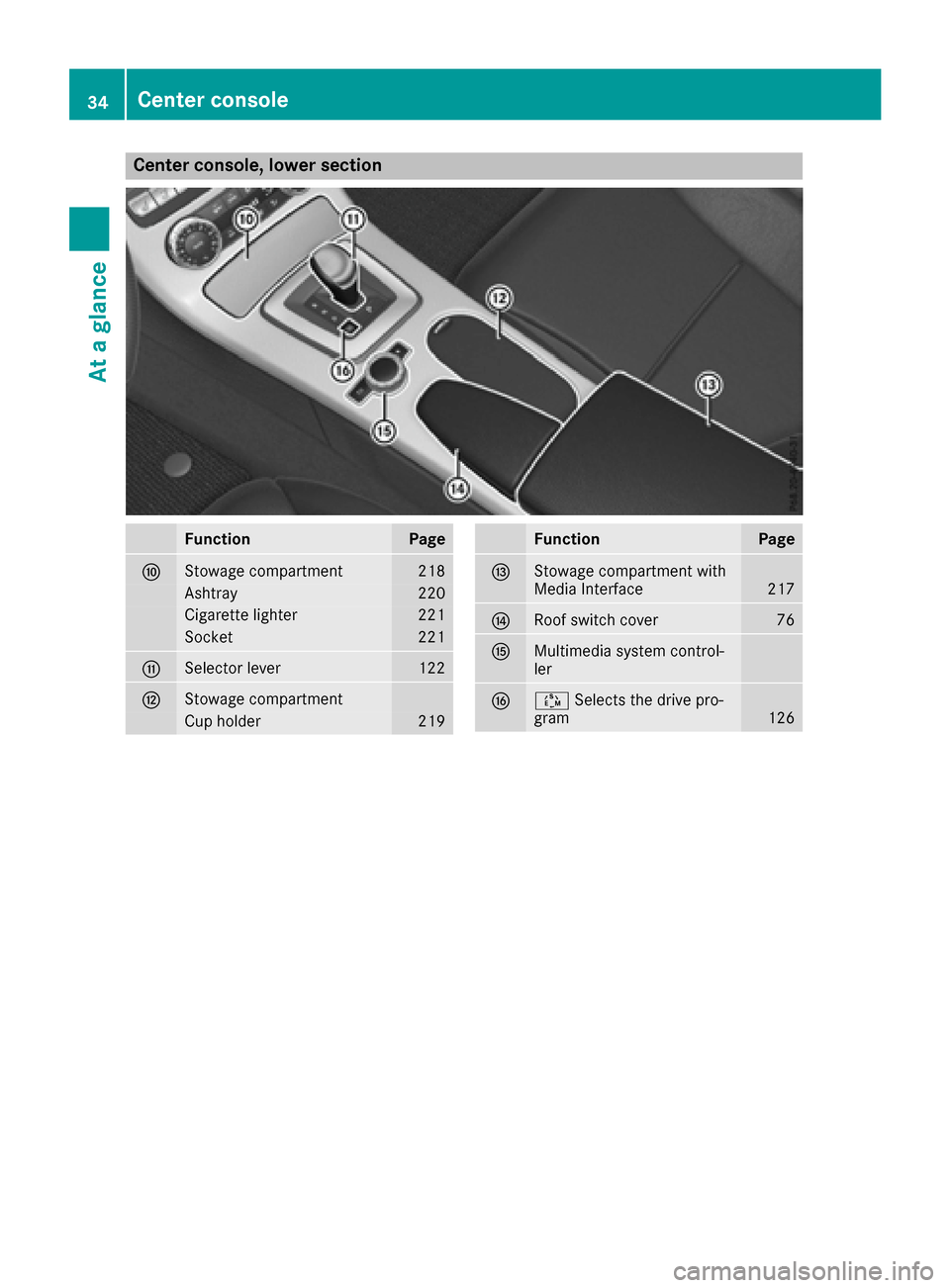
Center console, lower section
FunctionPage
FStowage compartment218
Ashtray220
Cigarettelighter221
Socket221
GSelector lever122
HStowage compartment
Cup holder219
FunctionPage
IStowage compartmen twith
Media Interface217
JRoof switch cover76
KMultimedia system control-
ler
LÚ Select sthe driv epro-
gram126
34Center console
At ag lance
Page 37 of 294
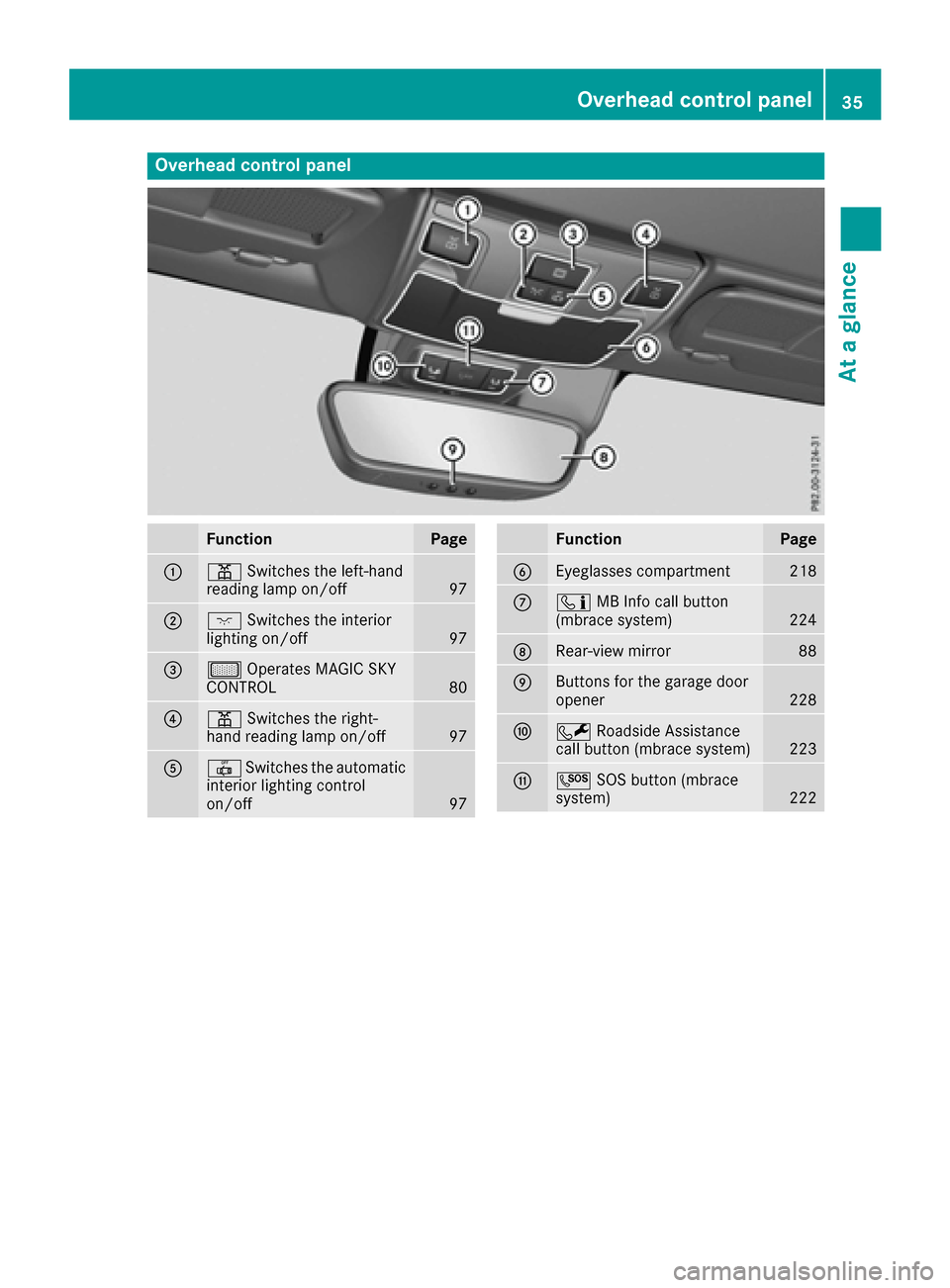
Overheadcontrol panel
FunctionPage
:p Switches the left-hand
reading lamp on/off97
;c Switches the interior
lighting on/off97
=µ Operates MAGIC SKY
CONTROL80
?p Switches the right-
hand reading lamp on/off97
A| Switches the automatic
interior lighting control
on/off
97
FunctionPage
BEyeglasses compartment218
Cï MB Inf ocall button
(mbrace system)224
DRear-view mirror88
EButtons for the garage door
opener228
FF Roadside Assistance
call button (mbrace system)223
GG SOS button (mbrace
system)222
Overhea dcontrol panel35
Atag lance
Page 40 of 294
The6 restraint system warning lamp in the
instrument cluster lights up when the ignition is
switched on. It goes out no later than afew sec-
onds after the vehicle is started. The compo-
nentsoft he restraint system are in operational
readiness.
Am alfunction has occurred if the 6restraint
system warning lamp:
Rdoes not light up after the ignition is switched
on
Rdoes not go out after afew seconds with the
engine running
Rlights up again while the engine is running
GWARNING
If the restraint system is malfunctioning,
restraint system components may be trig-
gered unintentionally or may not deploy as
intended during an accident .This can affect
for example the Emergency Tensioning
Device or the air bag. This poses an increased
risk of injury or even fatal injury.
Have the restraint system checked and
repaired in aqualified specialist workshop as
soon as possible.
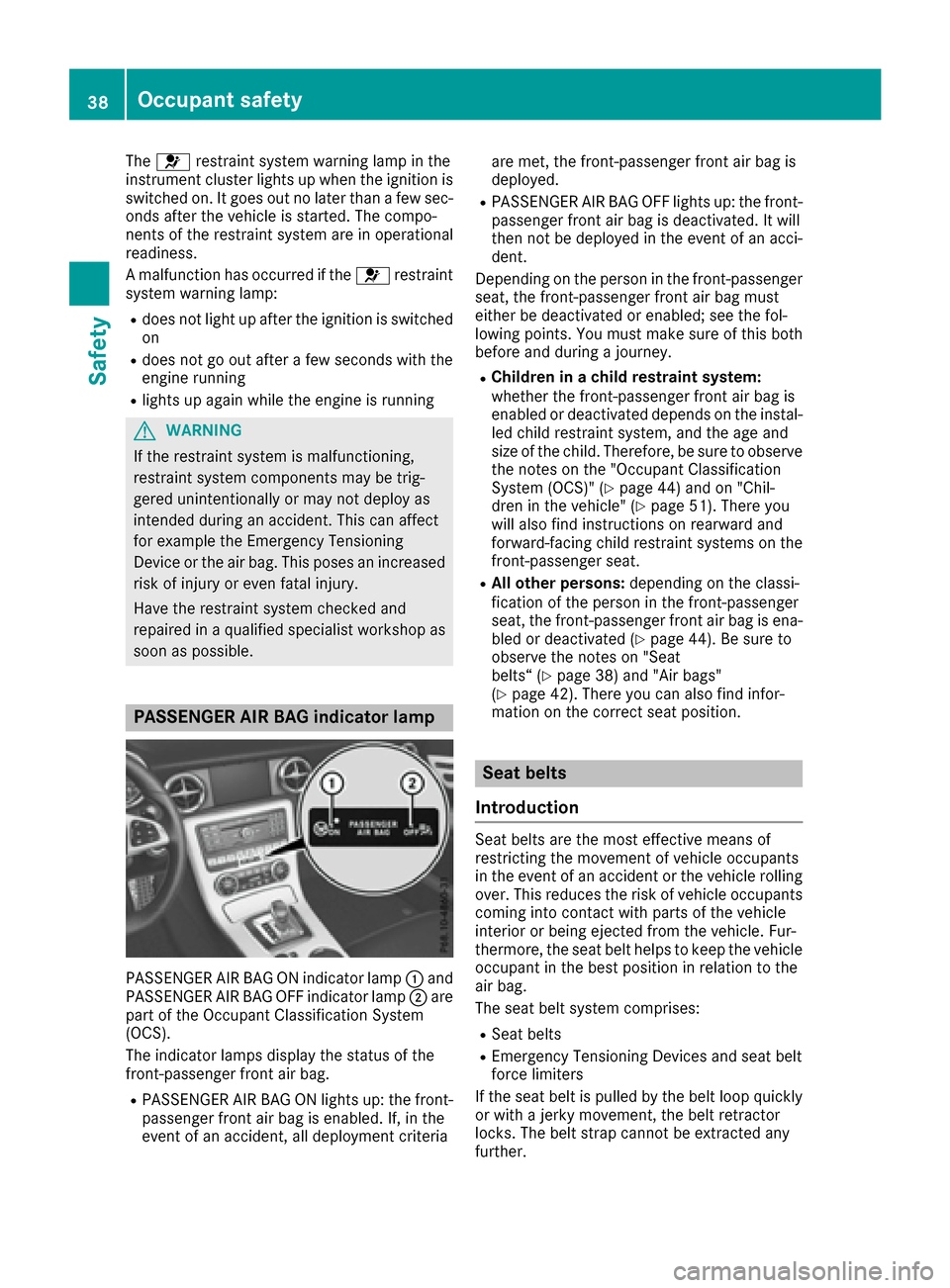
PASSENGER AIR BAG indicator lamp
PASSENGER AIR BAG ON indicator lamp :and
PASSENGER AIR BAG OFF indicator lamp ;are
part of the Occupant Classification System
(OCS).
The indicator lamps display the status of the
front-passenger front air bag.
RPASSENGER AIR BAG ON lights up: the front-
passenger front air bag is enabled. If, in the
event of an accident ,all deployment criteria are met, the front-passenger front air bag is
deployed.
RPASSENGER AIR BAG OFF lights up: the front-
passenger front air bag is deactivated. It will
then not be deployed in the event of an acci-
dent.
Dependin gonthe person in the front-passenger
seat, the front-passenger front air bag must
either be deactivated or enabled; see the fol-
lowing points. You must make sure of this both
before and during ajourney.
RChildren in achild restraint system:
whether the front-passenger front air bag is
enabled or deactivated depends on the instal-
led child restraint system, and the age and
size of the child. Therefore, be sure to observe
the notes on the "Occupant Classification
System (OCS)" (
Ypage 44) and on "Chil-
dren in the vehicle" (Ypage 51). There you
will also find instructions on rearward and
forward-facing child restraint systems on the
front-passenger seat.
RAll other persons: depending on the classi-
fication of the person in the front-passenger
seat, the front-passenger front air bag is ena-
bled or deactivated (
Ypage 44). Be sure to
observe the notes on "Seat
belts“ (
Ypage 38) and "Air bags"
(Ypage 42). There you can also find infor-
mation on the corrects eat position.
Seat belts
Introduction
Seat belts are the most effective means of
restrictingt he movementofv ehicle occupants
in the event of an accident or the vehicle rolling
over. This reduces the risk of vehicle occupants
coming into contact with parts of the vehicle
interior or being ejected from the vehicle. Fur-
thermore, the seat belt helps to keep the vehicle
occupant in the best position in relation to the
air bag.
The seat belt system comprises:
RSeat belts
REmergency Tensionin gDevices and seat belt
force limiters
If the seat belt is pulled by the belt loop quickly
or with ajerk ym ovement, the belt retractor
locks. The belt strap cannot be extracted any
further.
38Occupant safety
Safety
Page 43 of 294
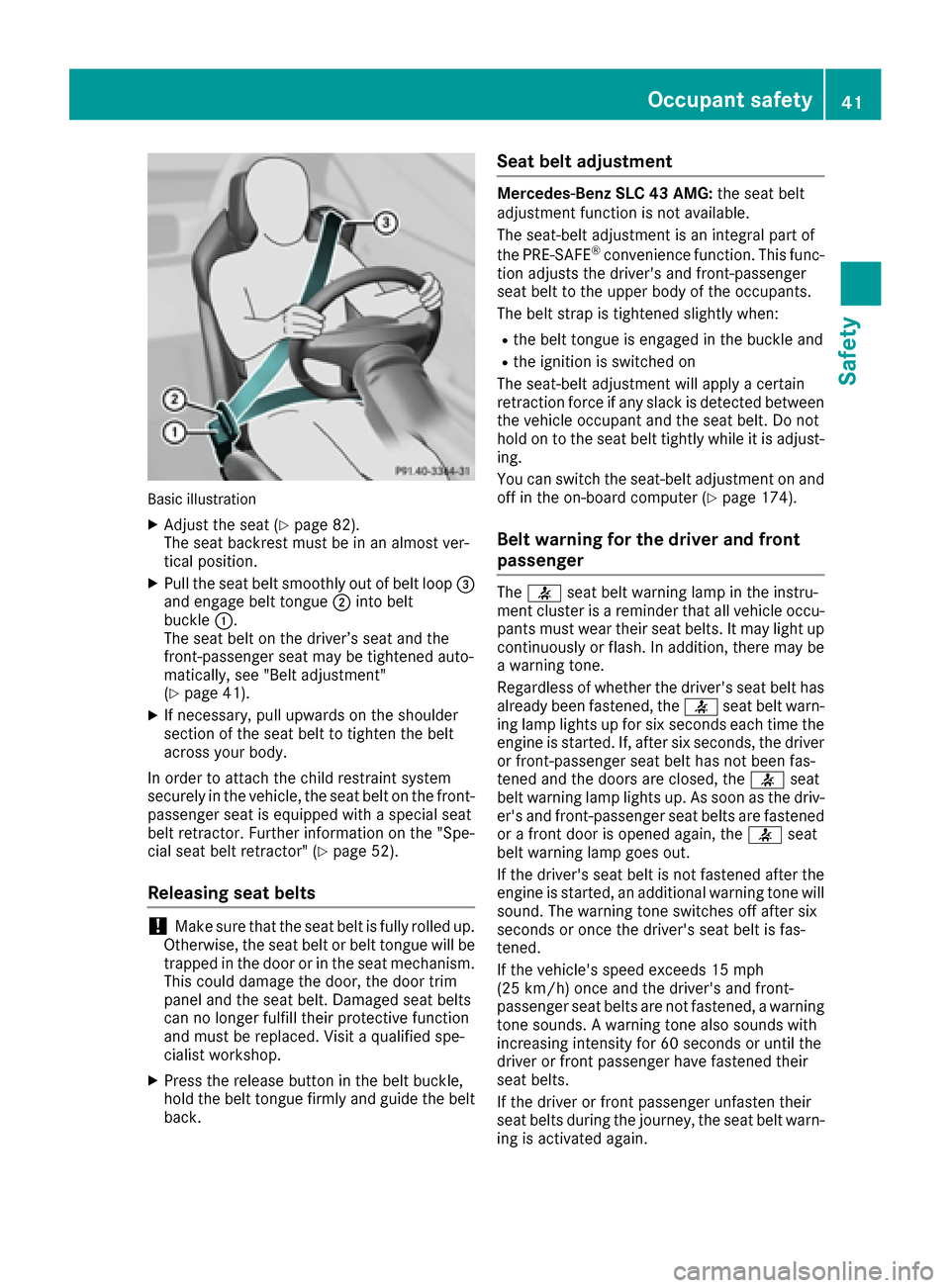
Basicillust ration
XAdjus tthe sea t(Ypage 82).
The sea tbackrest mus tbeinana lmost ver-
tical position.
XPull the sea tbelts moothly outofb eltl oop =
and engage bel ttongue ;into belt
buckle :.
The sea tbeltont he driver’ sseata nd the
front-passenger sea tmay be tightened auto-
matically ,see "Belt adjustment"
(
Ypage 41).
XIf necessary ,pullu pward sonthe shoulder
section of the sea tbelttot ighten the belt
across your body.
In orde rtoattach the chil drestraint system
securelyint he vehicle, the sea tbeltont he front-
passenger sea tisequipped with aspecia lseat
bel tretractor. Furthe rinformation on the "Spe-
cia lsea tb eltr etractor" (
Ypage 52).
Releasing seat belts
!Make sur ethat the sea tbeltisf ully rolled up.
Otherwise ,the sea tbeltorb eltt onguew illb e
trapped in the doo rorinthe seatmechanism.
Thisc ouldd amaget he door, the doo rtrim
panel and the sea tbelt. Damaged sea tbelts
can no longer fulfil lthei rprotective function
and mus tbereplaced. Visit aquali fied spe-
cialist workshop.
XPres sthe release button in the bel tbuckle,
hol dthe bel ttonguef irmlyand guide the belt
back.
Sea tbelta djustment
Mercedes-Ben zSLC 43 AMG: the seatbelt
adjustment function is not available.
The seat-bel tadjustment is an integral part of
the PRE-SAFE
®convenience function. Thisf unc-
tion adjusts the driver's and front-passenger
sea tbelttot he upper bod yofthe occupants.
The bel tstrap is tightened slightlyw hen:
Rthe belttongueise ngaged in the buckle and
Rthe ignition is switched on
The seat-bel tadjustment will apply acertain
retraction force if any slack is detected between
the vehicle occupant and the sea tbelt. Do not
hol dontot he seatbeltt ightly while it is adjust-
ing.
You can switch the seat-bel tadjustment on and
off in the on-board computer (
Ypage 174).
Beltw arning for the drive rand front
passenger
The 7 seatbeltw arning lamp in the instru-
ment cluster is areminder that al lvehicle occu-
pants mus twearthei rseatb elts. It may light up
continuously or flash. In addition, there may be
aw arning tone.
Regardless of whether the driver's sea tbelth as
already bee nfastened, the 7seatbeltw arn-
ing lamp lights up for six seconds each time the engine is started. If, afte rsix seconds ,the driver
or front-passenger sea tbelth as not bee nfas-
tened and the doors are closed, the 7seat
bel twarning lamp lights up .Assoon as the driv-
er's and front-passenger sea tbelts are fastened
or afront doo risopened again, the 7seat
bel tw arning lamp goeso ut.
If the driver's sea tbeltisn ot fastened afte rthe
engine is started, an additional warning tone will
sound. The warning tone switches off after six
seconds or once the driver's sea tbeltisf as-
tened.
If the vehicle' sspeed exceeds 15 mph
(25 km/h )once and the driver's and front-
passenger sea tbelts are not fastened, awarning
tone sounds. Awarning tone also sounds with
increasing intensity for 60 seconds or until the
driver or front passenger hav efastened their
sea tbelts.
If the driver or front passenger unfasten their
sea tbelts during the journey,t he seatbeltw arn-
ing is activated again.
Occupan tsafety41
Safety
Z
Page 47 of 294
If the front passenger does not observe these
conditions, OCS may produceafalse classifica-
tion, e.g. because the front passenger:
Rtransfers their weight by supporting them-
selves on avehicle armrest
Rsits in such away that their weight is raised
from the seat cushion
If you install achild restraint system on the
front-passenger seat, be sure to observe the
correct positioning of the child restraint system.
Never place objects under or behind the child
restraint system, e.g. acushion. The entire base
of the child restraint system must always rest on
the seat cushio nofthe front-passenger seat.
The backrest of the forward-facing child
restraint system must lie as flat as possible
against the backrest of the front-passenger
seat.
The child restraint system must not touch the
roof or be subjected to aload by the head
restraint. Adjust the angle of the seat backrest
and the head restraint positiona ccordingly.
Only then can OCS be guaranteed to function
correctly. Alway sobserve the child restraint sys-
tem manufacturer's installation and operating
instructions.
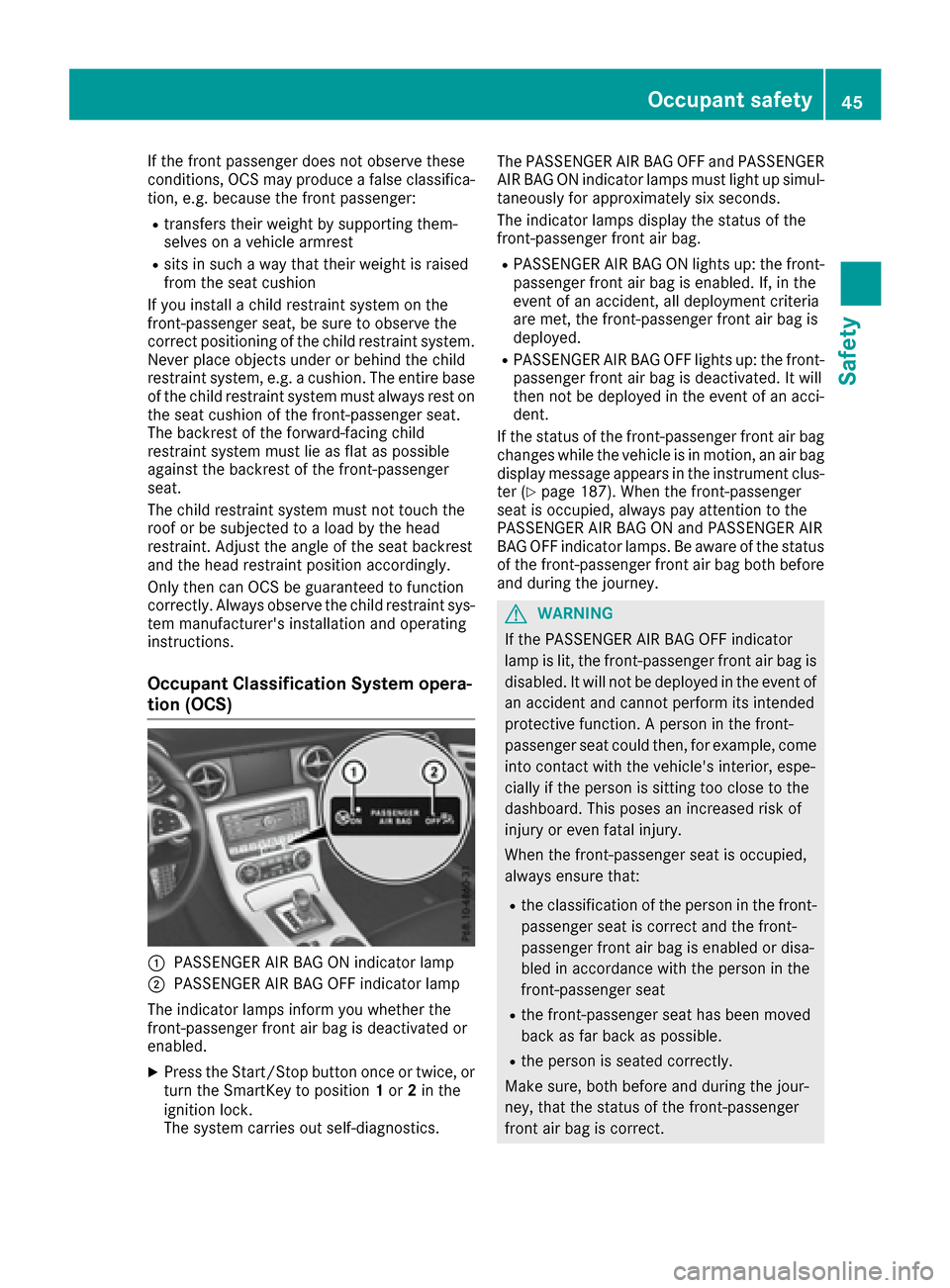
Occupant Classification System opera-
tion (OCS)
:PASSENGER AIR BAG ON indicator lamp
;PASSENGER AIR BAG OFF indicator lamp
The indicator lamp sinform you whether the
front-passenger front air bag is deactivated or
enabled.
XPress the Start/Stop button once or twice, or turn the SmartKey to position 1or 2in the
ignition lock.
The system carries out self-diagnostics. The PASSENGER AIR BAG OFF and PASSENGER
AIR BAG ON indicator lamp
smust lightu psimul-
taneousl yfor approximately six seconds.
The indicator lamp sdisplay the status of the
front-passenger front air bag.
RPASSENGER AIR BAG ON lights up: the front-
passenger front air bag is enabled. If, in the
event of an accident, all deployment criteria
are met, the front-passenger front air bag is
deployed.
RPASSENGER AIR BAG OFF lights up: the front-
passenger front air bag is deactivated. It will
then not be deployed in the event of an acci-
dent.
If the status of the front-passenger front air bag changes whil ethe vehicle is in motion, an air bag
display messag eappears in the instrument clus-
ter (
Ypage 187). When the front-passenger
seat is occupied, always pay attention to the
PASSENGER AIR BAG ON and PASSENGER AIR
BAG OFF indicator lamps. Be aware of the status
of the front-passenger front air bag both before
and during the journey.
GWARNING
If the PASSENGER AIR BAG OFF indicator
lamp is lit, the front-passenger front air bag is
disabled.Itw illnot be deployed in the event of
an accident and cannot perform its intended
protective function. Aperson in the front-
passenger seat could then, for example ,come
into contact with the vehicle's interior, espe-
ciallyift he person is sitting too close to the
dashboard. This poses an increased risk of
injury or even fatal injury.
When the front-passenger seat is occupied,
always ensure that:
Rthe classification of the person in the front- passenger seat is correct and the front-
passenger front air bag is enabled or disa-
bled in accordance with the person in the
front-passenger seat
Rthe front-passenger seat has been moved
back as far back as possible.
Rthe person is seated correctly.
Make sure, both before and during the jour-
ney, that the status of the front-passenger
front air bag is correct.
Occupant safety45
Safety
Z