keyless MERCEDES-BENZ SLC-Class 2017 R172 Owner's Guide
[x] Cancel search | Manufacturer: MERCEDES-BENZ, Model Year: 2017, Model line: SLC-Class, Model: MERCEDES-BENZ SLC-Class 2017 R172Pages: 294, PDF Size: 7.28 MB
Page 134 of 294
cle from rolling away by applying the parking
brake.
XApplythe electri cparking brake.
XShif tthe transmission to position P
(Ypage 123).
XWith the SmartKey: turn the SmartKey to
position 0in the ignition lock and remove it.
The immobilizer is activated.
XWith KEYLESS-GO: press the KEYLESS-GO
Start/Stop button (Ypage 115).
The engine stopsa nd allthe indicator lamps in
the instrument cluster go out.
Whe nthe driver' sdoorisc losed, this corre-
sponds to SmartKey position 1.W hent he
driver' sdooriso pen, this corresponds to
SmartKey position 0(
Ypage 115).
The engine can be switched off while the vehicle
is in motio nbypressing and holding the Start/
Stop button for aboutt hree seconds. Thisfunc-
tion operate sindependently of the ECO start/
stop automatic engine switch-off function.
Electric parkin gbrake
General notes
GWARNING
If yo ulea ve childre nunsupervised in the vehi-
cle ,they could set it in motio nby,for example:
Rrelease the parking brake.
Rshift the automatic transmission outoft he
parking position P.
Rstartthe engine.
In addition, they may operate vehicle equip-
ment and become trapped .There is arisko f
an accident and injury.
Whe nleaving the vehicle ,alway stake the
SmartKey with yo uand lock the vehicle .Never
leave childre nunsupervised in the vehicle. The function of the electri
cparking brake is
dependent on the on-board voltage .Ifthe on-
board voltage is low or there is amalfunction in
the system, it may not be possible to applyt he
released parking brake.
XIf this is the case ,only park the vehicle on
level ground and secure it to prevent it rolling
away.
XShif tthe automatic transmission to position
P.
It may not be possible to release an applied
parking brake if the on-board voltage is low or
there is amalfunction in the system. Contact a
qualified specialist workshop.
The electri cparking brake performs afunction
test at regula rinterval swhile the engine is
switched off. The sounds that can be heard while
this is occurring are normal.
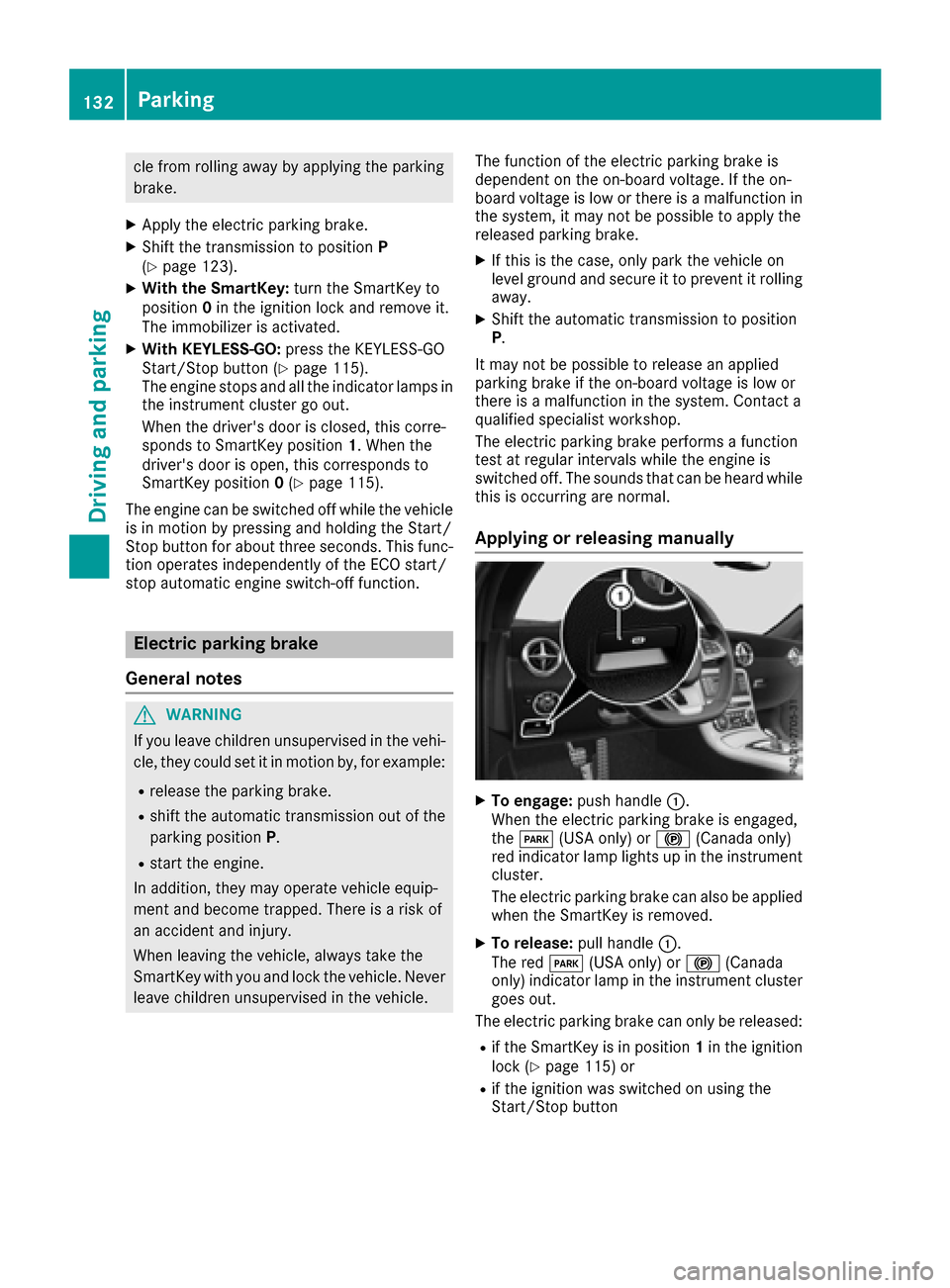
Applyin gorreleasin gmanually
XTo engage: push handle :.
Whe nthe electri cparking brake is engaged,
the F (USA only )or! (Canada only)
red indicator lamp lights up in the instrument
cluster.
The electricp arking brake can also be applied
whe nthe SmartKey is removed.
XTo release: pull handle:.
The red F(USA only )or! (Canada
only )indicator lamp in the instrument cluster
goe sout.
The electricp arking brake can only be released:
Rif the SmartKey is in position 1in the ignition
lock (Ypage 115) or
Rif the ignition wa sswitched on using the
Start/Stop button
132Parking
Drivin gand parking
Page 183 of 294

Display messagesPossible causes/consequences andMSolutions
T!
÷
Inoperative SeeOperator'sManual
EBD( electronic brak eforce distribution), AB Sand ES P®are malfunc -
tioning .
Other drivin gsystems and drivin gsafet ysystems may also malfunc -
tion .
In addition ,the ÷, åand! warning lamp sligh tupint he
instrumen tcluste rand aw arning tone sounds.
GWARNIN G
The brak esystem continues to function normally, but without th e
function slisted above. The fron tand rear wheels could therefor eloc k
if you brak ehard, for example.
The steerabilit yand braking characteristics may be severely affected.
The braking distanc einanemergenc ybraking situation can increase.
If ES P
®is no toperational, ES P®is unable to stabiliz ethe vehicle.
There is an increased ris kofskiddin gand an accident.
XDrive on carefully.
XVisit aqualified specialist workshop immediately.
F(USA
only)
!(C anada
only)
Tur nOnt he Igni‐
tiontoReleas etheParkingBrake
The red F(USAonly) or ! (Canada only) indicator lamp lights
up.
You attempte dtorelease th eelectric parking brak ewhile th eignition
was switched off .
XSmartKey:tur nthe SmartKey to position 1in th eignition lock.
XKEYLESS-GO: switch on theignition .
F(USA
only)
!(C anada
only)
Please
Releas ePark‐ing Brake
The red F(USAonly) or ! (Canada only) indicator lamp flashes
and awarning tone sounds. Aconditi on for automatic release of th e
electric parking brak eisnotfulfilled (
Ypage 132).
You are drivin gwitht he electric parking brak eapplied.
XReleas ethe electric parking brak emanually.
The red F(USAonly) or ! (Canada only) indicator lamp flashes
and awarning tone sounds.
You are usin gthe electric parking brak efor emergenc ybraking
(
Ypage 132).
F(USA
only)
!(C anada
only)
Parkin gBrake See
Operator' sManual
The yellow !warning lamp lights up.
The electric parking brak eismalfunctioning .
To apply :
XSwitchthe ignition off .
XPress theelectric parking brak ehandle for at least te nseconds.
XShift th etransmission to position P.
XConsultaqualified specialist workshop .
Display messages181
On-boardc omputer andd isplays
Z
Page 204 of 294

Display messagesPossible causes/consequences andMSolutions
Â
ReplaceKey Batter y
The SmartKey battery is discharged.
XChange thebattery (Ypage 66) .
Â
Don't Forget You rKey
The SmartKey is notintheignition lock. You hav eopened th edriver's
door wit hthe engin eswitched off .
The multifunction display shows th edisplay message amaximum of
60 seconds and is simply areminder.
XTak ethe SmartKey wit hyou when you leav ethe vehicle.
Â
Key Not Detected(redd isplay message )
The SmartKey is no tinthevehicle.
Aw arning tone also sounds.
If th eengineiss witched off ,you can no longer loc kthe vehicl ecen-
trally or start th eengine.
XPull ove rand stop th evehicl esafely as soo naspossible, payin g
attention to roa dand traffic conditions.
XSecur ethe vehicl eagainst rollin gaway (Ypage 131).
XLocate th eSmartKey.
XPress aon thesteering whee ltoc onfir mthedisplay message .
Becausethe re is interferenc efromas tron gs ource of radi owaves, th e
SmartKey is no tdetecte dwhilstthe engin eisrunning.
Aw arning tone also sounds.
XPull ove rand stop th evehicl esafely as soo naspossible, payin g
attention to roa dand traffic conditions.
XSecur ethe vehicl eagainst rollin gaway (Ypage 131).
XInser tthe SmartKey int othe ignition loc kand bring int okeymode.
Â
Key Not Detected(whit edisplay message )
The SmartKey is currentl yundetected.
XChange th elocation of th eSmartKey in th evehicle.
If th eSmartKey still canno tbedetected:
XInsertthe SmartKey int othe ignition loc kand tur nittot hedesire d
position .
Â
Remove 'Start 'But‐ton and Insert Key
The SmartKey is continually undetected.
KEYLESS-GO is temporarily malfunctioning or is defective. Awarning
tone also sounds.
XInser tthe SmartKey int othe ignition loc kand tur nittot hedesire d
position .
XVisitaqualified specialist workshop .
Warning and indicat orlamps
Gene raln otes
Some systems carry out aself-diagnosis when th eignition is switched on .Therefore ,som eindicator
and warning lamp smay ligh tuporf lashtem porarily. This behavio risnon-criti cal.These indicator
202Warning andi ndicator lamps
On-board computera nd displays
Page 236 of 294

XPark the vehicle onalevel surface.
Only check the coolant level when the vehicle is on alevel surface and the engine has cooled
down.
XTurn the SmartKey to position 2in the ignition
lock (Ypage 115).
On vehicles with KEYLESS-GO, press the
Start/Stop button twice (
Ypage 115).
XCheck the coolant temperature gauge in the
multifunction display.
The coolant temperature must be below
158 ‡(70 †).
XTurn the SmartKey to position 0(Ypage 115)
in the ignition lock.
XSlowly turn cap ;half aturn counter-clock-
wise to allow excess pressure to escape.
XTurn cap ;further counter-clockwise and
remove it.
If the coolant is at the level of marker bar =
in the filler neck when cold, there is enough
coolant in coolant expansion tank :.
If the coolant level is approximately 0.6 in
(1.5 cm) above marker bar =in the fuel filler
neck when warm, there is enough coolant in
expansion tank :.
XIf necessary, add coolant that has been tested
and approved by Mercedes-Benz.
XReplace cap;and turn it clockwise as far as
it will go.
For further information on coolant ,see
(
Ypage 287).
Windshield washer system
GWARNING
Certain components in the engine compart-
ment ,such as the engine, radiator and parts
of the exhaust system, can become very hot.
Workin ginthe engine compartment poses a
risk of injury.
Where possible, let the engine cool down and touch only the components described in the
following.
GWARNING
Windshield washer concentrate could ignite if it comes into contact with hot engine compo-
nentsort he exhaust system. There is arisk of
fire and injury.
Make sure that no windshield washer con-
centrate is spilled next to the filler neck.
Example
XTo open: pull cap:upwards by the tab.
XAdd the premixed washer fluid.
XTo close: press cap :ontothe filler neck
until it engages.
If the washer fluid level drops below the recom-
mended minimum fluid level of 1USgal (1 liter),
am essage appears in the multifunction display
promptin gyou to add washer fluid (
Ypage 201).
Further information on windshield washer fluid/
antifreeze (
Ypage 288).
Overview of the engine compartment
Example: gasoline engine
:
Engine oil cap
;Oil dipstick
=Brake fluid reservoir
?Washer fluid reservoir
ACoolant expansion tank
234Overview of the engine compartment
Maintenance and care
Page 244 of 294

XIf possible, bring the front wheelsinto the
straight-ahea dposition.
XSwitch off the engine.
XVehicles without KEYLESS-GO: remove the
SmartKey from the ignition lock.
XVehicles with KEYLESS-GO: open the driv-
er's door.
The on-board electronics now have status 0.
This is the same as the SmartKey having been
removed.
XVehicles with KEYLESS-GO: remove the
Start/Stop button from the ignition lock
(
Ypage 115).
XMake sure that the passengers are not endan-
gered as they do so. Make sure that no one is near the danger area whileaw heel is being
changed. Anyone who is not directly assisting
in the wheel change should, for example,
stand behind the barrier.
XGet out of the vehicle.P ay attention to traffic
conditions when doing so.
XClos ethe driver's door.
MOExtended tires (tires with run-flat
properties)
General notes
With MOExtended tires (tires with run flat char-
acteristics), you can continue to drive you rvehi-
cle even if there is atotal loss of pressure in one
or more tires. The affected tire must not show
any clearl yvisible damage.
You can recognize MOExtended tires by the
MOExtended marking which appears on the
sidewall of the tire. You wil lfind this marking
next to the tire size designation, the load-bear-
ing capacity and the speed index (
Ypage 269).
MOExtended tires may only be used in conjunc-
tion with an active tire pressure loss warning
system or with an active tire pressure monitor.
If ap ressure loss warning message appears
in the multifunction display:
Robserve the instructions in the display mes-
sages (Ypage 196).
Rcheck the tire for damage.
Rif driving on, observe the following notes.
The driving distance possible in run-flat mode is
approximately 50 miles (80 km) when the vehi-
cle is partially laden and approximately 19 miles
(30 km) when the vehicle is full yladen. In addition to the vehicle load
,the driving dis-
tance possible depends upon:
Rvehicle speed
Rroad condition
Routsid etemperature
The driving distance possible in run-flat mode
may be reduced by extreme driving conditions
or maneuvers, or it can be increased through a
moderate style of driving.
The driving distance possible in run-flat mode is
counted from the moment the tire pressure loss
warning appears in the multifunction display.
You must not exceed amaximum speed of
50 mph (80 km/h).
When replacing one or all tires, please observe
the following specifications for you rvehicle's
tires:
Rsize
Rtype and
Rthe "MOExtended" mark
If at ire has gone flat and cannot be replaced
with aMOExtended tire, astandard tire may be
used as atemporary measure. Make sure that
you use the proper size and type (summe ror
winter tire).
Vehiclese quipped with MOExtended tires are
not equipped with aTIREFIT kit at the factory. It
is therefore recommended that you additionally
equi pyourvehicle with aTIREFIT kit if y
ou mount
tires that do not feature run-flat properties, e.g.
winter tires. ATIREFIT kit is available, for exam-
ple, from aqualifieds pecialist workshop.
Important safety notes
GWARNING
When driving in emergency mode, the driving
characteristics deteriorate, e.g. when corner-
ing, accelerating quickly and when braking.
There is arisk of an accident.
Do not exceed the stated maximum speed.
Avoid abrupt steering and driving maneuvers,
and driving over obstacle s(curbs, potholes,
off-road). This applies in particular to aladen
vehicle.
Stop driving in emergency mode if:
Ryou hear banging noises.
Rthe vehicle starts to shake.
242Flat tire
Breakdowna ssistance
Page 254 of 294

wise be locked out when pushingortowing the
vehicle.
Installing/removing th etowing eye
Installing th etowing eye
GWARNING
The exhaust tail pipe may be veryh ot.Therei s
ar isk of burnsw hen removingt herear cover.
Do not touc hthe exhaust pipe. Take particular
car ew hen removin gthe rear cover.
The bracket sfor th escrew-in towing eye are
located in th ebumpers. They are at th efront and
at th erear ,behindt hecovers.
XRemovet hetowing eye fromt hevehicle tool
kit (Ypage 241).
XPresst hemark on cover :inwards in the
directio nofthearrow.
XTake cover :off th eopening.
XScrew in th etowing eye clockwis easfar as it
will go and tighten it.
Removing th etowing eye
XUnscrew and remove th etowing eye.
XAttac hcover :to th ebumper and pressu ntil
it engages.
XPlace th etowing eye in th evehicle too lkit.
Towing avehicle with both axles on
th eg round
GWARNING
You can no longer steer th evehicle if the
steeringw heel lock has been engaged. There
is ar isk of an accident.
Always switch off th eignitio nwhen towing the
vehicle with atow cable or atow bar.
The automatic transmission automatically shifts
to position Pwhen you open th edriver's or front-
passenger door or when you remove th eSmart-
Key fromt heignitio nlock.
In ordertoe nsure that th eautomatic transmis-
sion stays in position Nwhen towing th evehicle,
you must observe th efollowing points:
XSwitch on th ehazar dwarning lamps
(Ypage 95).
XTurn th eSma rtKey to position 2in th eignition
lock.
On vehicles with KEYLESS-GO, use th eSma rt-
Key instead of th eStart/Stop button
(
Ypage 115).
XDepress and hold th ebrakep edal.
XShiftthe transmission to position N.
XRelease th ebrakep edal.
XRelease th eelectric parking brake.
XLeave th eSmartKey in position 2in th eigni-
tio nlock.
In ordertos ignalachange of directio nwhen
towing th evehicle with th ehazar dwarning
lamps switche don, use th ecombination switch
as usual. In this case ,only th eindicator lamps
for th edirectio noftravel flash.W hen you reset
th ec ombination switch, th ehazar dwarning
flashers start flashing again.
It is importan ttha ty ou observe th esafety
instructions when towing away your vehicle
(
Ypage 251).
Towing th evehicle with th ereara xle
raised
!
The ignitio nmust be switche doff if you are
towing th evehicle with th erear axle raised.
Interventio nbyESP
®could otherwise dam-
age th ebrakes ystem.
252Towing and tow-starting
Breakdown assistance
Page 277 of 294

An arrow on the sidewall of the tire indicates its
correct direction of rotation.
Storingwheels
Store wheels thata renot being used in acool,
dry and preferably dark place .Protect the tires
from oil, grease, gasoline and diesel.
Mounting awheel
Preparin gthe vehicle
XStop the vehicl eonsolid,non-slippery and
level ground.
XApply the electri cparking brake manually.
XBring the front wheels into the straight-ahead
position.
XShift the transmission to position P.
XSwitch off the engine.
XVehicles withoutKEYLESS -GO:remove the
SmartKeyf rom the ignition lock.
XVehicles with KEYLESS-GO: open the driv-
er' sd oor.
The vehicl eelectronics now have status 0.
Thi sist he same as the SmartKeyh aving been
removed.
XVehicles with KEYLESS-GO: remove the
Start/Stop button from the ignition lock
(
Ypage 115).
XIf included in the vehicl eequipment ,remove
the tire-change tool kit from the vehicle.
XSafeguar dthe vehicl eagain st rolling away.
iDue to difference sinvehicleequipment ,not
al lv ehicles ar eequippe dwithat ire-change
tool kit. For informatio nonwhich tool sare
required to perfor mawheelchange on your
vehicle, consult an authorize dMercedes-
Benz Center.
Necessary tire-changing tool scan include, for
example:
RJack
RWheel chock
RLugw rench
Securin gthe vehicle to preven titfrom
rolling away
If your vehicl eisequippe dwithaw heelchock, it
can be found in the tire-change tool kit
(
Ypage 241).
The folding whee lchoc kisana dditional safety
measure to prevent the vehicl efrom rolling
away ,for exampl ewhenc hanging awheel .
XFoldb othp late su pwar ds:.
XFol do utlowe rplate ;.
XGuid ethe lugs on the lowe rplate full yinto the
openings in base plate =.
XPlace chocks or othersuitabl eitems under
the front and rea rofthe whee lthati sdiago -
nally opposite the whee lyou wish to change.
Raisin gthe vehicle
GWARNING
If yo udon ot positio nthe jack correctl yatthe
appropriate jacking point of the vehicle, the
jack could tip ove rwitht he vehicl eraised.
There is ariskofi njury.
Onlyp ositiont he jack at the appropriate jack-
ing point of the vehicle. The base of the jack
Changin gawheel275
Wheel sand tires
Z