brake MERCEDES-BENZ SLC ROADSTER 2018 Owner's Guide
[x] Cancel search | Manufacturer: MERCEDES-BENZ, Model Year: 2018, Model line: SLC ROADSTER, Model: MERCEDES-BENZ SLC ROADSTER 2018Pages: 298, PDF Size: 5.26 MB
Page 125 of 298
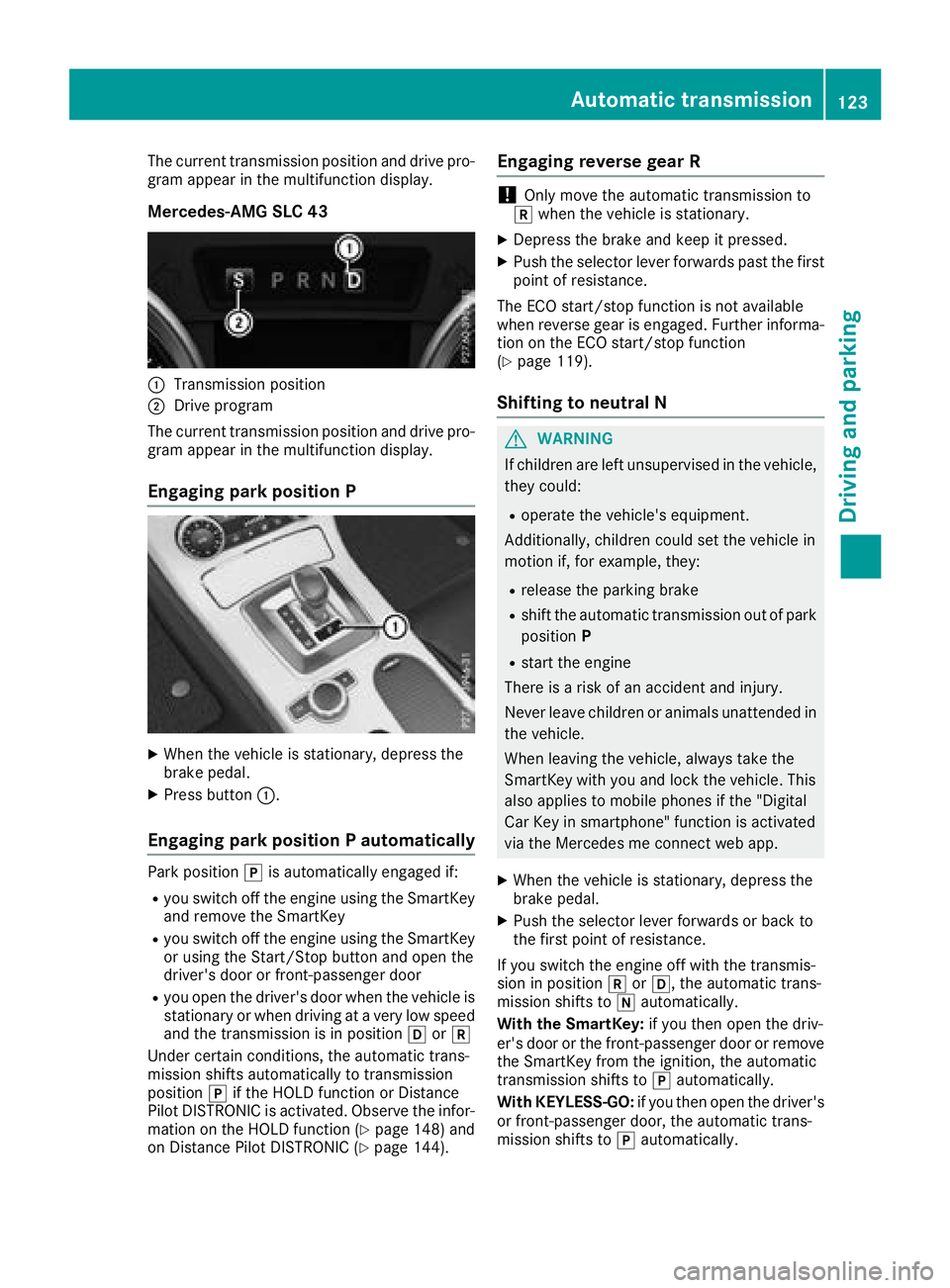
The current transmission position and drive pro-
gram appear in the multifunction display.
Mercedes-AMG SLC 43
:Transmission position
;Drive program
The current transmission position and drive pro-
gram appear in the multifunction display.
Engaging parkp osition P
XWhen the vehicle is stationary, depress the
brake pedal.
XPress button:.
Engaging parkp ositionPautomatically
Park position jis automatically engaged if:
Ryou switch off the engine using the SmartKey
and remove the SmartKey
Ryou switch off the engine using the SmartKey
or using the Start/Stop button and open the
driver's door or front-passenger door
Ryou open the driver's door when the vehicle is
stationary or when driving at avery low speed
and the transmission is in position hork
Under certain conditions, the automatic trans-
mission shifts automatically to transmission
position jif the HOLD function or Distance
Pilot DISTRONIC is activated. Observe the infor-
mation on the HOLD function (
Ypage 148) and
on Distance Pilot DISTRONIC (Ypage 144).
Engaging reverse gear R
!Only move the automatic transmission to
k when the vehicle is stationary.
XDepress the brake and keep it pressed.
XPush the selector lever forwards past the first
point of resistance.
The ECO start/sto pfunction is not available
when reverse gear is engaged. Further informa-
tion on the ECO start/sto pfunction
(
Ypage 119).
Shifting to neutral N
GWARNING
If children are left unsupervised in the vehicle,
they could:
Roperate the vehicle's equipment.
Additionally, children could set the vehicle in
motion if, for example, they:
Rrelease the parking brake
Rshift the automatic transmission out of park
position P
Rstart the engine
There is arisk of an accident and injury.
Never leave children or animals unattended in
the vehicle.
When leaving the vehicle, alwayst ake the
SmartKey with you and lock the vehicle. This
also applies to mobile phones if the "Digital
Car Key in smartphone" function is activated
via the Mercedes me connect web app.
XWhen the vehicle is stationary, depress the
brake pedal.
XPush the selector lever forwards or back to
the first point of resistance.
If you switch the engine off with the transmis-
sion in position korh,t he automatic trans-
mission shifts to iautomatically.
With the SmartKey: if you then open the driv-
er's door or the front-passenger door or remove
the SmartKey from the ignition, the automatic
transmission shifts to jautomatically.
With KEYLESS-GO: if you then open the driver's
or front-passenger door, the automatic trans-
mission shifts to jautomatically.
Automatic transmission123
Driving and parking
Z
Page 126 of 298
If you want the automatic transmission to
remain in neutrali,e.g. when having the vehi-
cle cleaned in an automatic car wash with a
towing system:
XVehicles with KEYLESS-GO: remove the
Start/Stop button from the ignition lock.
XInsert the SmartKey into the ignition lock.
XAll vehicles: switch the ignition on.
XDepress the brake pedala nd keep it
depressed.
XEngage neutral i.
XRelease the brake pedal.
XRelease the electric parking brake.
XSwitch off the ignition and leave the SmartKey
in the ignition lock.
Engaging drive positionD
XWhen the vehicle is stationary,d epressthe
brake pedal.
XPush the selector lever back past the first
point of resistance.
Transmission positions
BPark position
This prevents the vehicle from rolling
awa ywhen stopped.
Only shift the transmission into posi-
tion B (
Ypage 122) when the
vehicle is stationary.T he parking lock
shoul dnot be used as abrake when
parking. Alway sappl ythe electronic
parking brake in addition to the park-
ing lock in order to secure the vehi-
cle.
If the SmartKey is removed from the
ignition lock, the transmission is
locked.
The automatic transmission shifts to B automatically:
Rwhen the SmartKey is removed
from the ignition lock
Rwhen the engine is switched off
with the transmission in position
Cor7 and one of the doors
is opened
In the event of amalfunction of the
vehicle's electronics, the transmis-
sion may lock in position B.Have
the vehicle electronics checked
immediately at aqualifieds pecialist
workshop.
CReverse gear
Only shift the transmission into posi-
tion C when the vehicle is sta-
tionary.
124Automatic transmission
Driving and parking
Page 127 of 298
ANeutral
Do not shift the transmission toA
whil edriving .The automatic trans-
mission could otherwis ebedam-
aged.
No powe ristransmitted fromt he
engine to the drive wheels.
Releasing the brake peda lwilla llow
yo utom ovet he vehicl efreely, e.g .to
push it or tow it.
If ESP
®is deactivated or faulty: shift
the transmission to position Aif
the vehicl eisindangerofs kidding,
e.g .oni cy roads.
!Coasting in neutral imay
cause damage to the drive train.
7Drive
The automatic transmission changes
gear automatically. All forward gears
ar ea vailable.
Driving tips
Changin ggear
The automatic transmission shifts throug hthe
individual gear sautomaticall ywhenitisint rans-
mission position h.Thisa utomatic gear shift-
ing behavio risdetermine dby:
Rthe selecte ddrive program
Rthe positio nofthe accelerator pedal
Rthe roa dspeed
Accelerator peda lposition
Your style of driving influences how the auto-
matic transmission shifts gear:
Rlittle throttle :early upshifts
Rmor ethrottle :lat eu pshifts
Kickdown
Use kickdow nfor maximum acceleration.
XDepres sthe accelerator peda lbeyond the
pressure point.
The automatic transmission shifts to alower
gear depending on the engine speed.
XEas eoff the accelerator peda lonce the
desired speed is reached.
The automatic transmission shifts back up.
Drive programs
Drive program C(Comfort)
In urba ntraffica nd stop-start traffic, drive pro-
gram Cis recommended.
Driv eprogram Cis characterized by the follow-
ing:
Rthe vehicl edelivers comfortable, economical
handling characteristics.
Rthe vehicl epulls away mor egently in forward
and revers egears ,unless the accelerator
peda lisdepressedf ully.
Rthe vehicl ehasimproved driving stability, for
exampl eonslipperyroads urfaces.
Roptima lfue lconsumption resulting fromt he
automatic transmission shifting up sooner.
The vehicl eisdriven in the lo wengine speed
range and the wheels ar elesslikel ytos pin.
Rth es uspension exhibits comfortabl edam ping
settings (adaptive damping system onl yin
vehicles with AMG RIDE CONTROL sports
suspension).
Rthe steering exhibits comfortabl esteering
characteristics.
Drive program S(Sport)
Driv eprogram Sis characterized by the follow-
ing:
Rthe vehicl eexhibits sporty driving character-
istics.
Rthe vehicl epulls away in first gear.
Rthe automatic transmission shifts up later.
The fuel consumption possibl ybeing higher
as aresul toft he later automatic transmission
shift points.
Automatict ransmission125
Driving andparking
Z
Page 133 of 298
Problems with fuel and the fuel tank
ProblemPossible causes/consequences andMSolutions
Fuel is leaking from the
vehicle.The fuel line or the fuel tank is faulty.
GWARNING
Risk of explosion or fire.
XTurn the SmartKey immediately to position uin the ignition lock
(Ypage 116) and remove it.
XDo not restart the engine under any circumstances.
XConsult aqualified specialist workshop.
The fuel filler flap cannot
be opened.The fuel filler flap is not unlocked.
XUnlock the vehicle (Ypage 65).
The SmartKey battery is discharged or nearly discharged.
XUnlock the vehicle using the mechanical key (Ypage 67).
The fuel filler flap is unlocked, but the opening mechanism is jammed.
XConsult aqualified specialist workshop.
Parking
Important safety notes
GWARNING
Flammable material such as leaves, grass or
twigs may ignite if they come into contact with
hot parts of the exhaust system or exhaust
gas flow. There is arisk of fire.
Park the vehicle so that no flammable mate-
rials come into contact with parts of the vehi-
cle which are hot. Take particular care not to
park on dry grassland or harvested grain
fields.
GWARNING
If you leave children unsupervised in the vehi-
cle, they could set it in motion by, for example:
Rrelease the parking brake.
Rshift the automatic transmission out of the
parking position P.
Rstart the engine.
In addition, they may operate vehicle equip-
ment and become trapped. There is arisk of
an accident and injury.
When leaving the vehicle, always take the
SmartKey with you and lock the vehicle. Never
leave children unsupervised in the vehicle.
!Always secure the vehicle correctly against
rolling away.O therwise, the vehicle or its driv-
etrain could be damaged.
To ensure that the vehicle is secured against
rolling away unintentionally:
Rthe electric parking brake must be applied.
Rthe transmission must be in position j.
Rthe SmartKey must be removed from the igni-
tion lock.
Rthe front wheels must be turned towards the
curb on steep uphill or downhill gradients.
Switching off the engine
GWARNING
The automatic transmission switches to neu-
tral position Nwhen you switch off the engine.
The vehicle may roll away.T here isarisk of an
accident.
After switching off the engine, always switch
to parking position P.Prevent the parked vehi-
Parking131
Driving and parking
Z
Page 134 of 298
cle from rolling away by applying the parking
brake.
XApplythe electri cparking brake.
XShif tthe transmission to position j
(Ypage 123).
XWith the SmartKe y:turn the SmartKey to
position uin the ignition lock and remove it.
The immobilizer is activated.
XWith KEYLESS-GO: press the KEYLESS-GO
Start/Stop button (Ypage 116).
The engine stopsa nd allthe indicator lamps in
the instrument cluster go out.
If the driver'sd oorisc losed, this is the same
as SmartKey position 1.Ifthe driver'sd oor
is open, this is the sam easSmartKey position
u (
Ypage 116).
The engine can be switched off while the vehicle
is in motio nbypressing and holding the Start/
Stop button for aboutt hree seconds. Thisfunc-
tion operate sindependently of the ECO start/
stop automatic engine switch-off function.
Electric parkingb rake
General notes
GWARNING
If yo ulea ve childrenu nsupervised in the vehi-
cle ,they could set it in motio nby,for example:
Rrelease the parking brake.
Rshift the automatic transmission outoft he
parking position P.
Rstartthe engine.
In addition, they may operate vehicle equip-
ment and become trapped .There is arisko f
an accident and injury.
Whenl eaving the vehicle ,alway stake the
SmartKey with yo uand lock the vehicle .Never
leave childrenu nsupervised in the vehicle. The function of the electri
cparking brake is
dependent on the on-board voltage .Ifthe on-
board voltage is low or there is amalfunction in
the system, it may not be possible to applyt he
released parking brake.
XIf this is the case ,only park the vehicle on
level ground and secure it to prevent it rolling
away.
XShif tthe automatic transmission to position
j.
It may not be possible to release an applied
parking brake if the on-board voltage is low or
there is amalfunction in the system. Contact a
qualified specialist workshop.
The electri cparking brake performs afunction
test at regula rinterval swhile the engine is
switched off. The sounds that can be heard while
this is occurring are normal.
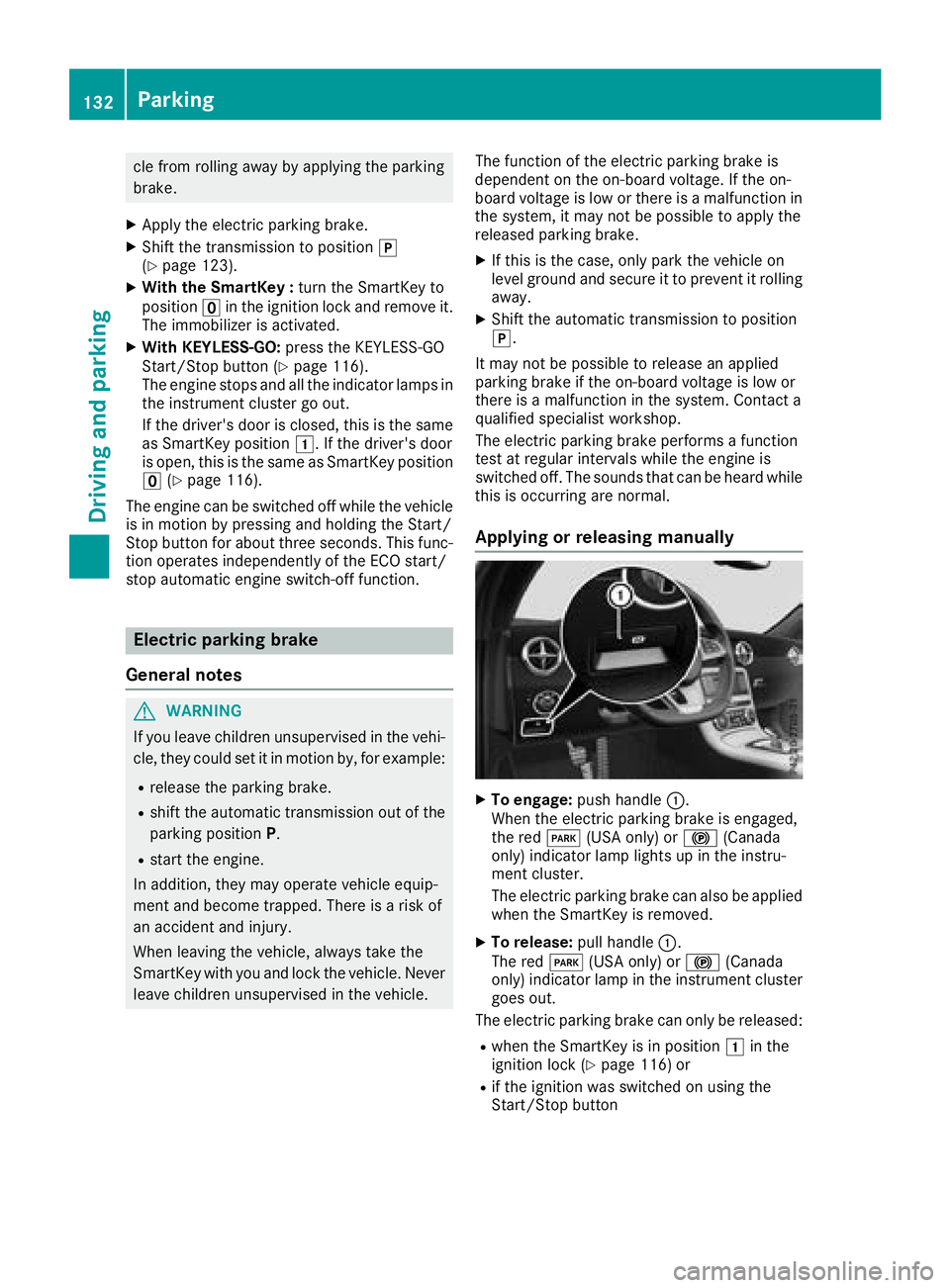
Applyingorr eleasingmanually
XTo engage: push handle :.
Whent he electri cparking brake is engaged,
the red F(USA only )or! (Canada
only )indicator lamp lights up in the instru-
ment cluster.
The electricp arking brake can also be applied
whe nthe SmartKey is removed.
XTo release: pull handle:.
The red F(USA only )or! (Canada
only )indicator lamp in the instrument cluster
goeso ut.
The electricp arking brake can only be released:
Rwhe nthe SmartKey is in position 1in the
ignition lock (Ypage 116 )or
Rif the ignition wa sswitched on using the
Start/Stop button
132Parking
Drivin gand parking
Page 135 of 298
Applyingautom atically
The electric parking brak eisautomatically
applie dwhen th etransmission is in position j
and :
Rthee ngineiss witched off or
Rthed river is no twearing aseat belt and th e
driver's door is opened
To preven tthe electric parking brak efromb eing
automatically applied, pull handle :.
The electric parking brak eisalso engage dauto -
matically if:
RDistanc ePilotD ISTR ONICbring sthe vehicl e
to as tandstill or
Rth eH OLDf unction is keepin gthe vehicl esta-
tionary
In addition ,atleast on eofthefollowin gcondi -
tion smustbef ulfilled :
Rthee ngineiss witched off
Rthed river is no twearing aseat belt and th e
driver's door is opened
Rthere is asystem malfunction
Rthep owe rsupply is insufficien t
Rthev ehicl eiss tationary for alengthy period
The red F(USAonly) or ! (Canada only)
indicator lamp in th einstrumen tcluste rlights
up.
The electric parking brak eisnotautomatically
engage diftheengin eisswitched off by th eECO
start/sto pfunction .
Releasing automatically
The electric parking brak eisrelease dautomat -
ically when all of th efollowin gconditi onsa re
fulfilled :
Rthee ngineisr unnin g
Rthes eat belt tongue is engage dinthebelt
buckl e
Rthet ransmission is in position hork and
you depress th eaccelerato rpedal or shif t
from position jtoh ork
Rif th etransmission is in position k,thetrunk
lid mus tbeclosed If th
eseat belt tongue is no tengage dint heseat
belt buckle, th efollowin gconditi onsm ustb e
fulfilled :
Rthed river's door is closed
Ryou mov ethe transmission out of position j
or you hav epreviously driven at aspee d
abov e2m ph (3 km/h)
Rif thetransmission is in position k,thetrunk
lid mus tbeclosed
When th eelectric parking brak eisreleased,
th e! indicator lamp goes out in th einstru-
men tcluster.
Eme rgency braking
The vehicl ecan also be braked during an emer-
gency by usin gthe electric parking brake.
XWhil edriving, push handle :of th eelectric
parking brake.
The vehicl eisbraked for as lon gasthehandle
of th eelectric parking brak eispressed. The
longer th eelectric parking brak ehandle is
depressed, th egreate rthe braking force .
During braking :
Rawarning tone sounds
RtheReleas eParkin gBrakemessage
appear s
Rther ed F (USAonly) or ! (Canada
only) indicator lamp in th einstrumen tcluste r
flashes
When th evehicl ehas been braked to astand -
still, th eelectric parking brak eisengaged.
Park ing th evehicle for along period
If you leav ethe vehicl eparked for longer than
four weeks, th ebattery may be damaged by
exhaustive discharging.
If you leav ethe vehicl eparked for longer than six
weeks, th evehicl emay suffer damag easa
result of lack of use.
XVisit aqualified specialist workshop and see k
advice .
iYou can obtain information about trickle
chargers from aqualified specialist work-
shop.
Parking133
Driving and parking
Z
Page 136 of 298
Drivingtips
General notes
Important safet ynotes
GWARNING
If you switch of fthe ignition whil edriving,
safety-relevant function sare only available
wit hlimitations, or no tatall. Thi scould affect,
fo re xample, th epowe rsteerin gand th ebrake
boostin geffect. You will require considerably
more effort to steer and brake .There is arisk
of an accident.
Do no tswitch of fthe ignition whil edriving.
GWARNING
If you operat emobile communication equip -
men twhen driving, you may be distracted
from th etraffic situation .You could also los e
contro lofthevehicle. There is ariskofa n
accident.
Only operat ethise quipmen twhen th evehicle
is stationary.
Observ ethe lega lrequirements fo rthe country
in whic hyou are driving. Some jurisdiction spro-
hibi tthe driver from usin gamobile phone whil e
drivin gavehicle.
If you mak eacallw hiled riving, always use
hands-free mode. Only operat ethe telephon e
when th etraffic situation permits. If you are
unsure ,pull over to asafel ocation and stop
befor eoperatin gthe telephone.
Bear in min dthatatas peed of only 30 mph
(approximately 50 km/h), th evehicle cover sa
distanc eof44f t(approximately 14 m)per sec-
ond.
Drive sensibly –save fuel
Observe the following tips to save fuel:
RThe tires should always be inflated to the rec-
ommended tire pressure.
RRemove unnecessary loads.
RWarm up the engin eatlow engin espeeds.
RAvoid frequenta cceleration or braking.
RObserve the servicei ntervals in the Mainte-
nanc eBooklet or in the servicei nterval dis-play. Have all the maintenanc
ework carried in
accordance with Daimler AG regulations.
Fuel consumption also increases when driving in cold weather, in stop-start traffic and in hilly ter-
rain.
Drinking and driving
GWARNING
Drinkin gand driving and/or takin gdrugs and
driving are very dangerous combinations.
Even asmall amount of alcohol or drugs can
affect your reflexes, perceptions and judg-
ment.
The possibility of aserious or even fatal acci-
dent is greatly increased when you drink or
take drugs and drive.
Do not drink or take drugs and drive or allow
anyone to drive who has been drinking or tak-
ing drugs.
Emission control
GWARNING
Combustion engines emit poisonous exhaust
gases such as carbon monoxide. Inhaling
these exhaust gases leads to poisoning. There
is ar isk of fatal injury. Thereforen ever leave
the engin erunning in enclosed spaces with-
out sufficientv entilation.
Certain engin esystems are designed to keep
the level of poisonous component sinexhaust
fumes within legal limits.
These systems only work at peak efficiency if
they are serviced exactly in accordance with the
manufacturer's specifications .Always have
work on the engin ecarried out at aqualified
specialist workshop. Mercedes-Benz recom-
mends that you use an authorized Mercedes-
BenzC enter for this purpose. In particular, work
relevant to safety or on safety-related systems
must be carried out at aqualified specialist
workshop.
The engin esettings must not be changed under
any circumstances. Furthermore, all specific
servicew ork must be carried out at regular
intervals and in accordance with the Mercedes-
Benzs ervicer equirements. Details can be found
in the Maintenance Booklet.
134Driving tips
Driving and parking
Page 137 of 298
ECO display
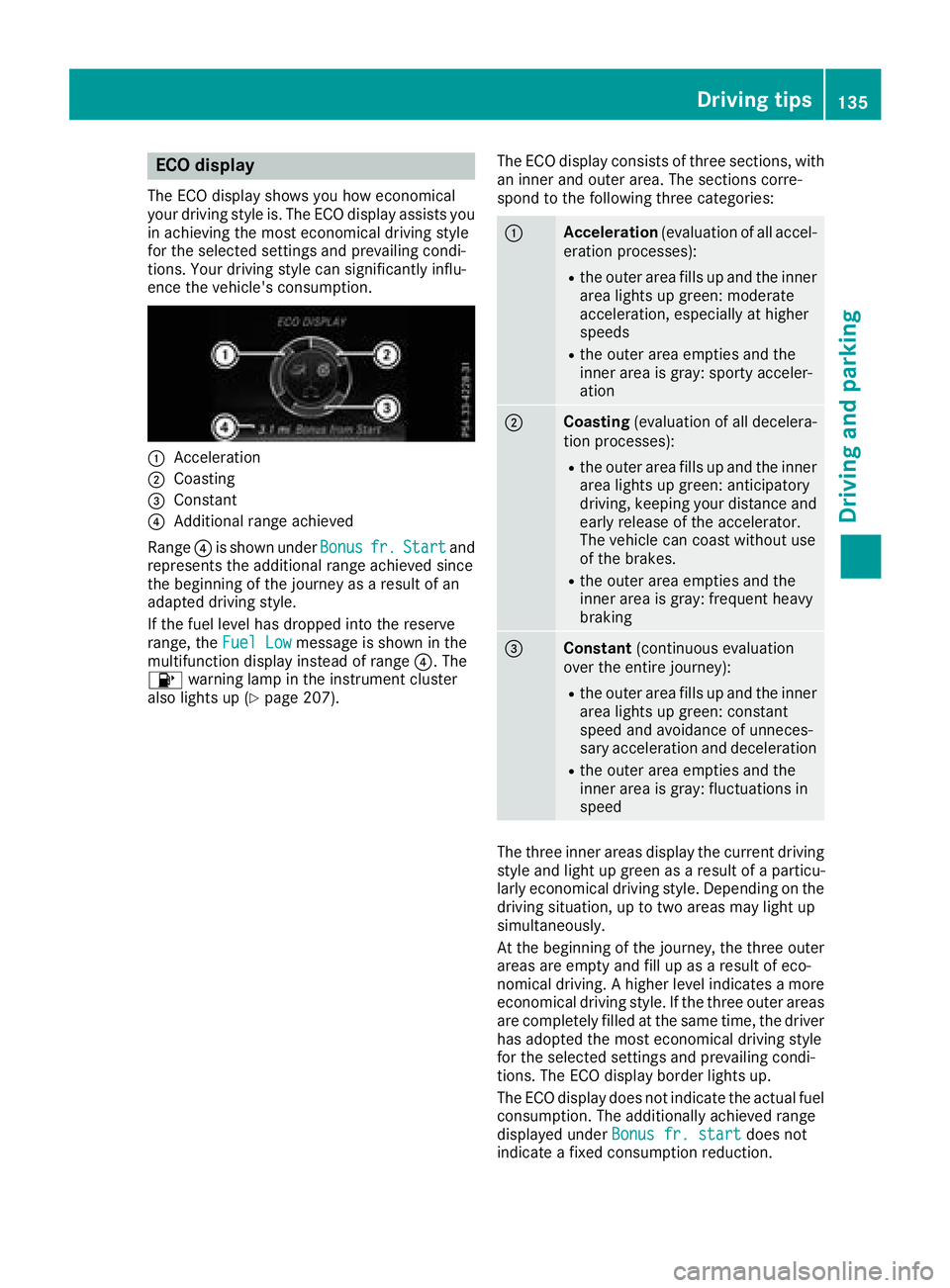
The ECO display showsyou how economical
your driving style is. The ECO display assists you
in achievin gthe mos teconomical driving style
for th eselecte dsettings and prevailingc ondi-
tions .Your driving style can significantly influ-
enc ethe vehicle's consumption.
:Acceleration
;Coasting
=Constant
?Additional range achieved
Range ?is shownu nderBonus
fr.Startand
represents th eadditional range achieve dsince
th eb eginnin gofthejourney as aresult of an
adapted driving style.
If th efuel leve lhas dropped int othe reserve
range, the FuelLow
message is shownint he
multifunction display instead of range ?.The
8 warning lamp in th einstrumen tcluster
also lightsup(
Ypage 207). The ECO display consistsoft
hree sections ,with
an inner and outer area. The sections corre-
spondtot hefollowingt hree categories:
:Acceleration (evaluationofall accel-
eration processes):
Rth eo uter area fills up and th einner
area lightsupg reen: moderate
acceleration, especiall yathigher
speeds
Rth eo uter area empties and the
inner area is gray: sporty acceler-
ation
;Coasting (evaluationofall decelera-
tio np rocesses):
Rtheo uter area fills up and th einner
area lightsupg reen: anticipatory
driving ,kee pingy our distanc eand
early release of th eaccelerator.
The vehicle can coas twithout use
of th ebrakes.
Rtheo uter area empties and the
inner area is gray: frequenth eavy
braking
=Constant (continuous evaluation
ove rthe entire journey):
Rtheo uter area fills up and th einner
area lightsupg reen: constant
speeda nd avoidanc eofunneces-
sary acceleratio nand deceleration
Rtheo uter area empties and the
inner area is gray: fluctuationsi n
speed
The three inner areas display th ecurren tdriving
style and light up green as aresult of aparticu-
larly economical driving style. Dependingont he
driving situation, up to two areas may light up
simultaneously.
At th ebeginnin gofthejourney, th ethree outer
areas are emptya nd fill up asaresult of eco-
nomical driving .Ahigher leve lindicates amore
economical driving style. If th ethree outer areas
are completely fille datthesame time, th edriver
has adopted th emoste conomical driving style
for th eselecte dsettings and prevailingc ondi-
tions .The ECO display border lightsu p.
The ECO display does no tindicat ethe actual fuel
consumption. The additionally achieve drange
displayed under Bonus fr. start
does not
indicat eafixed consumptio nreduction.
Driving tips135
Driving and parking
Z
Page 138 of 298
In addition to driving style, the actual consump-
tion is affected by other factors, such as:
Rload
Rtire pressure
Rcold start
Rchoice of route
Ractive electrical consumers
These factors are not includedint he ECO dis-
play.
An economical driving style specially requires
driving at moderate engine speeds.
Achieving ahigher valueint he categories
"Acceleration" and "Constant":
Robserve the gearshift recommendations.
Rdrive the vehicle in drive program Cor E.
In urbant raffic and stop-start traffic, drive pro-
gram Cis recommended.
On long journeys at aconstant speed,e .g. on the
highway, only the outer area for "constant" will
change.
The ECO display summarizes the driving style
from the start of the journey to its completion.
Therefore, there are more marked changes in
the outer areasatt he start ofajourney. On lon-
ger journeys, there are fewer changes. For more
marked changes, perform amanua lrest
(
Ypage 167).
Further information on the ECO display
(
Ypage 166).
Braking
Important safety notes
GWARNING
If you shift down on aslippery road surface in
an attempt to increase the engine's braking
effect, the drive wheelsc ould lose their grip.
There is an increased danger of skidding and
accidents.
Do not shift down for additional engine brak-
ing on aslippery road surface.
Downhill gradients
!On long, steep gradients, you must reduce
the load on the brakes. To use engine braking,
shift to alowerg ear in good time. This helps you to avoid overheating the brakes and wear-
ing them out excessively.
When making use of the engine braking
effect, it is possible that
adrive wheel may not
turn for some time, e.g. in the case of sud-
denly changing or slippery road surface con-
ditions. This could cause damage to the drive
train. This type of damage is not covered by
the Mercedes-Benz warranty.
Change into alowerg ear in good time on long
and steep downhill gradients. This is especially
important if the vehicle is laden.
This also applies if you have activated cruise
control or Distance PilotD ISTRONIC.
Heavy and light loads
GWARNING
If you rest you rfoot on the brake pedalw hile
driving, the braking system can overheat. This increases the stopping distance and can even
cause the braking system to fail.T here is a
risk of an accident.
Never use the brake pedalasaf ootrest. Never
depresst he brake pedala nd the accelerator
pedalatt he same time.
!Depressing the brake pedalc onstantly
results in excessive and premature weart o
the brake pads.
If the brakes have been subjected to aheavy
load,don ot stop the vehicle immediately,b ut
drive on for ashort while. This allows the airflow
to cool the brakes more quickly.
Wet roads
If you have driven for along time in heavy rain
withoutb raking, there may be adelayed reac-
tion from the brakes when braking for the first
time. This may also occur after the vehicle has
been washed or driven through deep water.
You then have to depresst he brake pedalmore
firmly.M aintainagreater distance from the
vehicle in front.
After driving on awet road or having the vehicle
washed, brake firmly whilep aying attention to
the traffic conditions. This willw arm up the
brake discs, thereby drying them more quickly
and protecting them against corrosion.
136Driving tips
Driving and parking
Page 139 of 298
Limited braking performance on salt-
treated roads
If you driveonsalted roads,alayer of salt resi-
due may for monthebraked iscsand brake
pads. This can result in asignificantly longer
braking distance.
RIn ordertop revent any salt build-up, apply the
brakes occasionally while paying attention to th et raffic conditions.
RCarefully depress th ebrakep edal and the
beginnin gand end of ajou rney.
RMaintain agreater distanc etothevehicle
ahead.
Servicing th ebrakes
!The brakef luid level may be to olow, if:
Rif th ered brakew arning lamp lightsupi n
th ei nstrumentc luster and
Ryou hearawarning tone while th eengine is
running
Observe additional warning messages in the
multifunction display.
The brakef luid level may be to olow due to
brak epad wear or leaking brak elines.
Hav ethe brakes ystem checked immediately.
Consult aqualifie dspecialist workshop to
arrange this.
!As th eESP®system operates automatically,
th ee ngine and th eignitio nmust be switched
off (th eSmartKey must be in position uor
1 in th eignitio nlock), if th eelectric parking
brakeist ested onabraking dynamometer
(maximum 10 seconds).
Brakin gtriggered automatically by ESP
®may
cause severe damage to th ebrakes ystem.
All check sand maintenanc ework on th ebrake
system must be carried out at aqualifie dspe-
cialis tworkshop.
Hav ebrakep ads installe dand brak efluid
replaced at aqualifie dspecialist workshop.
If th ebrakes ystem has onl ybeen subject to
moderatel oads, you should tes tthe functional-
ity of your brakes at regular intervals.
Information on BA S(Brake Assist)(
Ypage 57).
Mercedes-Ben zrecommend stha tyou onl yhave
brakep ads/linings installe donyour vehicle
whichh ave been approved for Mercedes-Benz
vehicle sorwhichcorrespondtoane quivalent
qualitys tandard. Brake pads/linings whichh avenot been approved for Mercedes-Ben
zv
ehic
les
or whicha re not of an equivalent qualityc ould
affect your vehicle's operatin gsafety.
Mercedes-Ben zrecommend sthaty ou onl yuse
brakef luid that has been specially approved for
your vehicle by Mercedes-Benz, or whichc orre-
sponds to an equivalent qualitys tandard. Brake
fluid whichh as not been approved for
Mercedes-Ben zvehicle sorw hichisn ot of an
equivalent qualityc ould affect your vehicle's
operatin gsafety.
High-performance brake system
(except Mercedes-AMG SLC 43)
AM Gb rakes ystems are designed for heavy
loads and have component swith corresponding
properties. This may lead to noise when braking.
This will dependo n:
RSpeed
RBrakingforce
RAmbientc onditions, e.g .temperature and
humidity
The wear of individual component softhebrake
system, such as th ebrakep ads/linings or brake
discs, depends on th eindividual driving style
and operatin gconditions.
For this reason, it is impossibletos tate am ile-
age that will be valid unde rall circumstances. An
aggressived riving style will lead to high wear.
You can obtain morei nformationonthisf roma
qualifie dspecialist workshop.
New and replaced brakep ads and discsonly
reacht heir optimum braking effect after several
hundred kilometers of driving .Compensate for
this by applyingg reater force to thebrakep edal.
Keep this in mind, and adapt your driving and
braking accordingl yduringt hisb reak-in period.
Excessive heavy braking results in correspond-
ingly high brak ewear. Observe th ebrakes ystem
warning lamp in th einstrumentc luster and note
any brak estatus messages in th emultifunction
display. Especially for high performanc edriving,
it is important to maintain and have th ebrake
system checked regularly.
Driving tips137
Driving and parking
Z