automatic transmission MERCEDES-BENZ SLK CLASS 2000 User Guide
[x] Cancel search | Manufacturer: MERCEDES-BENZ, Model Year: 2000, Model line: SLK CLASS, Model: MERCEDES-BENZ SLK CLASS 2000Pages: 273, PDF Size: 15.92 MB
Page 149 of 273
146 Automatic transmission
Te ch n ica l
data Instruments
and controlsOperationDrivingInstrument
cluster displayPractical hints Car care Index
Stopping
For brief stops, e.g. at traffic lights, leave the
transmission in gear and hold vehicle with the service
brake.
For longer stops with the engine idling, shift into “N”
or “P” and hold the vehicle with the service brake.
When stopping the vehicle on an uphill gradient, do not
hold it with the accelerator, use the brake. This avoids
unnecessary transmission heat build up.
Maneuvering
To maneuver in tight areas, e.g. when pulling into a
parking space, control the vehicle speed by gradually
releasing the brakes. Accelerate gently and never
abruptly step on the accelerator.
To rock a vehicle out of soft ground (mud or snow),
alternately shift from forward to reverse, while applying
only slight partial throttle.
Rocking a vehicle free in this manner may cause the
ABS or traction system malfunction indicator lamp to
come on. Turn off and restart the engine to clear the
malfunction indication.
Wa r n i n g !
Getting out of your vehicle with the selector lever
not fully engaged in position “P” is dangerous.
Also, when parked on an incline, posi tion “P” alone
may not prevent your vehicle from moving,
possibly hitting people or objects.Always set t he parki ng brake in addi tion to sh ifting
to position “P”, see page 153 for parking brake. When parked on an incline, also turn front wheel
towards the road curb.Wa r n i n g !
When leaving the vehicle always remove the key
from the steering lock, and lock the vehicle. Do not
leave children unattended in the vehicle, or with
access to an u nlocked veh ic le. Ch ildren cou ld m ove
the gear selector lever from position “P”, which
could result in an accident or serious injury.
Page 150 of 273
147 Automatic transmission
Te ch n ica l
data Instruments
and controlsOperationDrivingInstrument
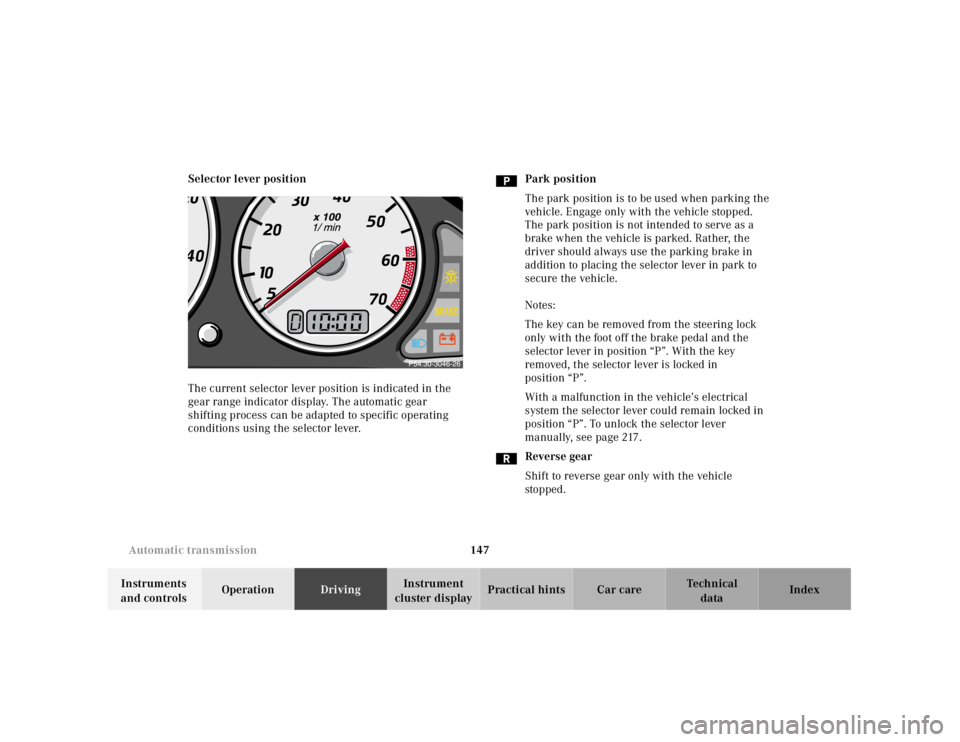
cluster displayPractical hints Car care Index Selector lever position
The current selector lever position is indicated in the
gear range indicator display. The automatic gear
shifting process can be adapted to specific operating
conditions using the selector lever.Park position
The park position is to be used when parking the
vehicle. Engage only with the vehicle stopped.
The park position is not intended to serve as a
brake when the vehicle is parked. Rather, the
driver should always use the parking brake in
addition to placing the selector lever in park to
secure the vehicle.
Notes:
The key can be removed from the steering lock
only with the foot off the brake pedal and the
selector lever in position “P”. With the key
removed, the selector lever is locked in
position “P”.
With a malfunction in the vehicle’s electrical
system the selector lever could remain locked in
position “P”. To unlock the selector lever
manually, see page 217.
Reverse gear
Shift to reverse gear only with the vehicle
sto p ped .
Page 151 of 273
148 Automatic transmission
Te ch n ica l
data Instruments
and controlsOperationDrivingInstrument
cluster displayPractical hints Car care Index
Dependent on the program mode selector switch
position “S” or “W” the maximum speed in the
reverse gear is different. However, it is not
possible to change the program mode while in
reverse.
Neutral
No power is transmitted from the engine to the
drive axle. When the brakes are released, the
vehicle can be moved freely (pushed or towed). Do
not engage “N” while driving except to coast
when the vehicle is in danger of skidding (e.g. on
icy roads, see page 160 for winter driving
instructions).
Important!
Coasting the vehicle, or driving for any other
reason with selector lever in “N” can result in
transmission damage that is not covered by the
Mercedes-Benz Limited Warranty.
Drive
The transmission automatically upshifts through
5th gear. Position “D” provides optimum driving
characteristics under all normal operating
conditions.Gear selection for special circumstances
The transmission gear ranges for special circumstances
can be selected by pressing the selector lever to the
right or the left with the selector lever in position “D”.
The gear range currently selected is indicated in the
instrum ent clu ster disp lay.
Briefly press selector lever in the ç direction:
The transmission downshifts, one gear at a time, in the
order “4”, “3”, “2”, “1”.
Press and hold selector lever in the ç direction:
The selector lever position display will switch to the
gear range currently selected by the automatic
transmission.
The transmission will only shift down one gear if the
gear range currently selected has already shifted to its
highest possible gear.
Briefly press selector lever in the æ direction:
The transmission will shift from the current gear range
to the next higher gear range. If the transmission is
already in gear range “D”, an additional upshift of one
gear is possible.
Page 152 of 273
149 Automatic transmission
Te ch n ica l
data Instruments
and controlsOperationDrivingInstrument
cluster displayPractical hints Car care Index Press and hold selector lever in the æ direction:
The transmission will shift from the current gear
directly to gear range “D”.
Important!
With transmission in gear range “D”, “4” or “3”,
upshifting from 1st to 2nd to 3rd gear is delayed
depending on vehicle speed and engine temperature.
This allows the catalytic converter to heat up more
q uickly to operating temperatures.
During the brief warm-up period this delayed upshift
and increased engine noise might be perceived as a
malfunction. However, neither the engine nor
transmission are negatively affected by this mode of
operation.The delayed upshift is effective with vehicle speeds
below 31 mph (50 km / h) at partial throttle and engine
temperatures below 95°F (35°C).
To avoid overrevving the engine when the selector lever
is moved to a lower gear range, the transmission will not
shift to a lower gear, if the engine’s revolutions per
minute limit would be exceeded. In this case there will
be no downshift, even when the vehicle speed reaches
RPM limit of that gear, e.g. by applying the service
brakes.
To prevent the engine from laboring at low RPM when
driving uphill gradients or with your vehicle heavily
loaded, the automatic transmission will downshift when
necessary to maintain engine RPM within the best
torque range.
Wa r n i n g !
On slippery road surfaces, never downshift in order
to obtain braking action. This could result in drive
wheel slip and reduced vehicle control. Your
vehicle’s ABS will not prevent this type of loss of
control.
Page 153 of 273
150 Automatic transmission
Te ch n ica l
data Instruments
and controlsOperationDrivingInstrument
cluster displayPractical hints Car care Index
Gear ranges:
Upshift through 4th gear only. Suitable for
performance driving.
Upshift through 3rd gear only. Suitable for
moderately steep hills. Since the transmission
does not shift higher than 3rd gear, this gear
selection will allow use of the engine’s braking
power downhill.Upshift through 2nd gear only. For driving in
mountainous regions or under extreme operating
conditions. This gear selection will allow use of
the engine’s braking power when descending
steep grades.
Use this position, which makes maximum use of
the engine’s braking effect, while descending
very steep or lengthy downgrades and only at
speeds below 40 mph (60 km / h).
Page 154 of 273
151 Automatic transmission
Te ch n ica l
data Instruments
and controlsOperationDrivingInstrument
cluster displayPractical hints Car care Index Program mode selector switch
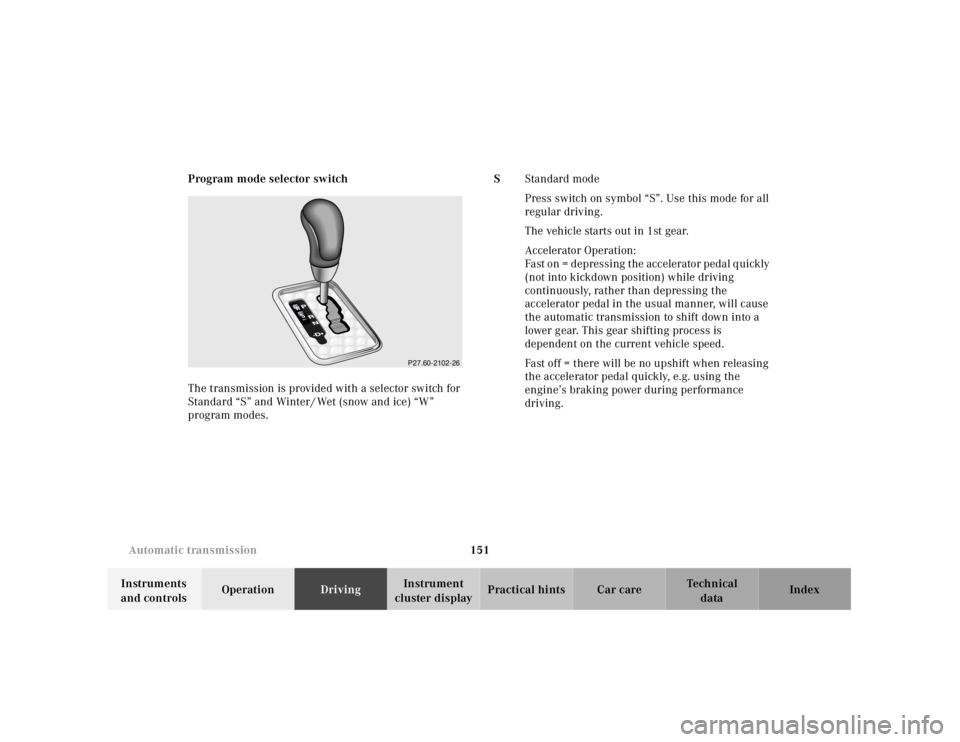
The transmission is provided with a selector switch for
Standard “S” and Winter / Wet (snow and ice) “W”
program modes.SStandard mode
Press switch on symbol “S”. Use this mode for all
regular driving.
The vehicle starts out in 1st gear.
Accelerator Operation:
Fa st o n = d e p re s s i ng t h e a c c e l e r a to r p e d a l q u i ck ly
(not into kickdown position) while driving
continuously, rather than depressing the
accelerator pedal in the usual manner, will cause
the automatic transmission to shift down into a
lower gear. This gear shifting process is
dependent on the current vehicle speed.
Fast off = there will be no upshift when releasing
the accelerator pedal quickly, e.g. using the
engine’s braking power during performance
driving.
@@
€€
ÀÀ
@@
€€
ÀÀ
@@
€€
ÀÀ
@@
€€
ÀÀ
@@
€€
ÀÀ
@@
€€
ÀÀ
@@
€€
ÀÀ
@@
€€
ÀÀ
@@
€€
ÀÀ
@@
€€
ÀÀ
@@
€€
ÀÀ
@@
€€
ÀÀ
@@
€€
ÀÀ
@@
€€
ÀÀ
@@
€€
ÀÀ
@@
€€
ÀÀ
@@
€€
ÀÀ
@@
€€
ÀÀ
@@
€€
ÀÀ
@@
€€
ÀÀ
@@
€€
ÀÀ
@@
€€
ÀÀ
@@
€€
ÀÀ
@@
€€
ÀÀ
@@
€€
ÀÀ
@@
€€
ÀÀ
@@
€€
ÀÀ
@@
€€
ÀÀ
@@
€€
ÀÀ
@@
€€
ÀÀ
@@
€€
ÀÀ
@@
€€
ÀÀ
@@
€€
ÀÀ
@@
€€
ÀÀ
@@
€€
ÀÀ
@@
€€
ÀÀ
@@
€€
ÀÀ
@@
€€
ÀÀ
@@
€€
ÀÀ
@@
€€
ÀÀ
@@
€€
ÀÀ
@@
€€
ÀÀ
@@
€€
ÀÀ
@@
€€
ÀÀ
@@
€€
ÀÀ
@@
€€
ÀÀ
@@
€€
ÀÀ
@@
€€
ÀÀ
@@
€€
ÀÀ
@@
€€
ÀÀ
@@
€€
ÀÀ
@@
€€
ÀÀ
@@
€€
ÀÀ
@@
€€
ÀÀ
@@
€€
ÀÀ
@@
€€
ÀÀ
@@
€€
ÀÀ
@@
€€
ÀÀ
@@
€€
ÀÀ
@@
€€
ÀÀ
@@
€€
ÀÀ
@@
€€
ÀÀ
@@
€€
ÀÀ
@@
€€
ÀÀ
@@
€€
ÀÀ
@@
€€
ÀÀ
@@
€€
ÀÀ
@@
€€
ÀÀ
@@
€€
ÀÀ
@@
€€
ÀÀ
@@
€€
ÀÀ
@@
€€
ÀÀ
@@
€€
ÀÀ
@@
€€
ÀÀ
@@
€€
ÀÀ
@@
€€
ÀÀ
@@
€€
ÀÀ
@@
€€
ÀÀ
@@
€€
ÀÀ
@@
€€
ÀÀ
@@
€€
ÀÀ
@@
€€
ÀÀ
@@
€€
ÀÀ
@@
€€
ÀÀ
@@
€€
ÀÀ
@@
€€
ÀÀ
@@
€€
ÀÀ
@@
€€
ÀÀ
@@
€€
ÀÀ
@@
€€
ÀÀ
@@
€€
ÀÀ
@@
€€
ÀÀ
@@
€€
ÀÀ
@@
€€
ÀÀ
@@
€€
ÀÀ
@@
€€
ÀÀ
@@
€€
ÀÀ
@@
€€
ÀÀ
@@
€€
ÀÀ
@@
€€
ÀÀ
@@
€€
ÀÀ
@@
€€
ÀÀ
@@
€€
ÀÀ
@@
€€
ÀÀ
@@
€€
ÀÀ
@@
€€
ÀÀ
@@
€€
ÀÀ
@@
€€
ÀÀ
@@
€€
ÀÀ
@@
€€
ÀÀ
@@
€€
ÀÀ
@@
€€
ÀÀ
@@
€€
ÀÀ
@@
€€
ÀÀ
@@
€€
ÀÀ
@@
€€
ÀÀ
@@
€€
ÀÀ
@@
€€
ÀÀ
@@
€€
ÀÀ
@@
€€
ÀÀ
@@
€€
ÀÀ
@@
€€
ÀÀ
@@
€€
ÀÀ
@@
€€
ÀÀ
@@
€€
ÀÀ
@@
€€
ÀÀ
@@
€€
ÀÀ
@@
€€
ÀÀ
@@
€€
ÀÀ
@@
€€
ÀÀ
@@
€€
ÀÀ
@@
€€
ÀÀ
@@
€€
ÀÀ
@@
€€
ÀÀ
@@
€€
ÀÀ
@@
€€
ÀÀ
@@
€€
ÀÀ
@@
€€
ÀÀ
@@
€€
ÀÀ
@@
€€
ÀÀ
@@
€€
ÀÀ
@@
€€
ÀÀ
@@
€€
ÀÀ
@@
€€
ÀÀ
@@
€€
ÀÀ
@@
€€
ÀÀ
@@
€€
ÀÀ
@@
€€
ÀÀ
@@
€€
ÀÀ
@@
€€
ÀÀ
@@
€€
ÀÀ
@@
€€
ÀÀ
@@
€€
ÀÀ
@@
€€
ÀÀ
@@
€€
ÀÀ
@@
€€
ÀÀ
@@
€€
ÀÀ
@@
€€
ÀÀ
@@
€€
ÀÀ
@@
€€
ÀÀ
@@
€€
ÀÀ
@@
€€
ÀÀ
@@
€€
ÀÀ
@@
€€
ÀÀ
@@
€€
ÀÀ
@@
€€
ÀÀ
@@
€€
ÀÀ
@@
€€
ÀÀ
@@
€€
ÀÀ
@@
€€
ÀÀ
@@
€€
ÀÀ
@@
€€
ÀÀ
@@
€€
ÀÀ
@@
€€
ÀÀ
@@
€€
ÀÀ
@@
€€
ÀÀ
@@
€€
ÀÀ
@@
€€
ÀÀ
@@
€€
ÀÀ
@@
€€
ÀÀ
@@
€€
ÀÀ
@@
€€
ÀÀ
@@
€€
ÀÀ
@@
€€
ÀÀ
@@
€€
ÀÀ
@@
€€
ÀÀ
@@
€€
ÀÀ
@@
€€
ÀÀ
@@
€€
ÀÀ
@@
€€
ÀÀ
@@
€€
ÀÀ
@@
€€
ÀÀ
@@
€€
ÀÀ
@@
€€
ÀÀ
@@
€€
ÀÀ
@@
€€
ÀÀ
@@
€€
ÀÀ
@@
€€
ÀÀ
@@
€€
ÀÀ
@@
€€
ÀÀ
@@
€€
ÀÀ
@@
€€
ÀÀ
@@
€€
ÀÀ
@@
€€
ÀÀ
@@
€€
ÀÀ
@@
€€
ÀÀ
@@
€€
ÀÀ
@@
€€
ÀÀ
@@
€€
ÀÀ
@@
€€
ÀÀ
@@
€€
ÀÀ
@@
€€
ÀÀ
@@
€€
ÀÀ
@@
€€
ÀÀ
@@
€€
ÀÀ
@@
€€
ÀÀ
@@
€€
ÀÀ
@@
€€
ÀÀ
@@
€€
ÀÀ
@@
€€
ÀÀ
@@
€€
ÀÀ
@@
€€
ÀÀ
@@
€€
ÀÀ
@@
€€
ÀÀ
@@
€€
ÀÀ
@@
€€
ÀÀ
@@
€€
ÀÀ
@@
€€
ÀÀ
@@
€€
ÀÀ
@@
€€
ÀÀ
@@
€€
ÀÀ
@@
€€
ÀÀ
@@
€€
ÀÀ
@@
€€
ÀÀ
@@
€€
ÀÀ
@@
€€
ÀÀ
@@
€€
ÀÀ
@@
€€
ÀÀ
@@
€€
ÀÀ
@@
€€
ÀÀ
@@
€€
ÀÀ
@@
€€
ÀÀ
@@
€€
ÀÀ
@@
€€
ÀÀ
@@
€€
ÀÀ
@@
€€
ÀÀ
@@
€€
ÀÀ
@@
€€
ÀÀ
@@
€€
ÀÀ
@@
€€
ÀÀ
@@
€€
ÀÀ
@@
€€
ÀÀ
@@
€€
ÀÀ
@@
€€
ÀÀ
@@
€€
ÀÀ
@@
€€
ÀÀ
@@
€€
ÀÀ
@@
€€
ÀÀ
@@
€€
ÀÀ
@@
€€
ÀÀ
@@
€€
ÀÀ
@@
€€
ÀÀ
@@
€€
ÀÀ
@@
€€
ÀÀ
@@
€€
ÀÀ
@@
€€
ÀÀ
@@
€€
ÀÀ
@@
€€
ÀÀ
@@
€€
ÀÀ
@@
€€
ÀÀ
@@
€€
ÀÀ
@@
€€
ÀÀ
@@
€€
ÀÀ
@@
€€
ÀÀ
@@
€€
ÀÀ
@@
€€
ÀÀ
@@
€€
ÀÀ
@@
€€
ÀÀ
@@
€€
ÀÀ
@@
€€
ÀÀ
@@
€€
ÀÀ
@@
€€
ÀÀ
@@
€€
ÀÀ
@@
€€
ÀÀ
@@
€€
ÀÀ
@@
€€
ÀÀ
@@
€€
ÀÀ
@@
€€
ÀÀ
@@
€€
ÀÀ
@@
€€
ÀÀ
@@
€€
ÀÀ
@@
€€
ÀÀ
@@
€€
ÀÀ
@@
€€
ÀÀ
@@
€€
ÀÀ
@@
€€
ÀÀ
@@
€€
ÀÀ
@@
€€
ÀÀ
@@
€€
ÀÀ
@@
€€
ÀÀ
@@
€€
ÀÀ
@@
€€
ÀÀ
@@
€€
ÀÀ
@@
€€
ÀÀ
@@
€€
ÀÀ
@@
€€
ÀÀ
@@
€€
ÀÀ
@@
€€
ÀÀ
@@
€€
ÀÀ
@@
€€
ÀÀ
@@
€€
ÀÀ
@@
€€
ÀÀ
@@
€€
ÀÀ
@@
€€
ÀÀ
@@
€€
ÀÀ
@@
€€
ÀÀ
@@
€€
ÀÀ
@@
€€
ÀÀ
@@
€€
ÀÀ
@@
€€
ÀÀ
@@
€€
ÀÀ
@@
€€
ÀÀ
@@
€€
ÀÀ
@@
€€
ÀÀ
@@
€€
ÀÀ
@@
€€
ÀÀ
@@
€€
ÀÀ
@@
€€
ÀÀ
@@
€€
ÀÀ
@@
€€
ÀÀ
@@
€€
ÀÀ
@@
€€
ÀÀ
@@
€€
ÀÀ
@@
€€
ÀÀ
@@
€€
ÀÀ
@@
€€
ÀÀ
@@
€€
ÀÀ
@@
€€
ÀÀ
@@
€€
ÀÀ
@@
€€
ÀÀ
@@
€€
ÀÀ
@@
€€
ÀÀ
@@
€€
ÀÀ
@@
€€
ÀÀ
@@
€€
ÀÀ
@@
€€
ÀÀ
@@
€€
ÀÀ
@@
€€
ÀÀ
@@
€€
ÀÀ
@@
€€
ÀÀ
@@
€€
ÀÀ
@@
€€
ÀÀ
@@
€€
ÀÀ
@@
€€
ÀÀ
@@
€€
ÀÀ
@@
€€
ÀÀ
@@
€€
ÀÀ
@@
€€
ÀÀ
@@
€€
ÀÀ
@@
€€
ÀÀ
@@
€€
ÀÀ
@@
€€
ÀÀ
@@
€€
ÀÀ
@@
€€
ÀÀ
yy
P27.60-2102-26
Page 155 of 273
152 Automatic transmission
Te ch n ica l
data Instruments
and controlsOperationDrivingInstrument
cluster displayPractical hints Car care Index
WWinter / Wet (snow and ice) mode
Press switch on symbol “W”. The vehicle starts
out in 2nd gear, except with selector lever in 1st
gear, or with accelerator pedal in kick-down
position.
The “W” mode helps to improve traction and
driving stability of the vehicle.
The gear shifting process occurs at lower vehicle
and engine speeds than in the “S” program mode.
Caution!
Never change the program mode when the selector lever
is out of position “P”. It could result in a change of
driving characteristics for which you may not be
prepared.
Important!
Always be certain of the program mode selected since
the vehicle driving characteristics change with the
selection of the program mode.
Dependent on the program mode selector switch
position “S” or “W” and the gear selector lever in
position “R”, the ratio of power transmission changes.Emergency Operation
(Limp Home Mode)
If vehicle acceleration worsens, or the transmission no
longer shifts, the transmission is most likely operating
in Limp Home Mode which engages when there is a
malfunction of the transmission. This condition may be
accompanied by the “CHECK ENGINE” malfunction
indicator lamp in the instrument cluster coming on.
In this mode only the 2nd gear or reverse gear can be
activated.
To engage 2nd gear or reverse:
1.Stop the vehicle.
2.Move selector lever to position “P”.
3.Turn off the engine.
4.Wait approximately 10 seconds.
5.Restart the engine.
6.Move sel ector lever to position “D” (for 2nd gear), or
move selector lever to position “R” (for reverse gear).
Have the transmission checked at your authorized
Mercedes-Benz Center as soon as possible.
Page 168 of 273
165 Driving systems
Te ch n ica l
data Instruments
and controlsOperationDrivingInstrument
cluster displayPractical hints Car care IndexNotes:
If the engine does not brake the vehicle sufficiently
while driving on a downgrade, the speed you set on the
cruise control may be exceeded. In this case the
following will assist in maintaining the set cruise
controlled speed:
Vehicles with automatic transmission:
Downshift occurs (max. to 3rd gear) to maintain the set
cruise controlled speed by using the engine’s braking
power.
As soon as the grade eases, the automatic transmission
shifts up again dependent on the selector lever position.
Vehicles with manual transmission:
The set cruise controlled speed is switched off when
decl utch ing exceed s fou r se conds during d ow nsh if ting a
gear.
Neverth eless, in some ca ses you m ay have to step on t he
bra ke peda l to slow d ow n. In t his ca se th e cruise control
is switched off.
Use the lever to resume the previously set speed.
Wa r n i n g !
Only use the cruise control if the traffic and
weather conditions make it advisable to travel at a
steady speed.
• The use of cruise control can be dangerous on
winding roads or in heavy traffic because
conditions do not allow safe driving at a steady
speed.• The use of cruise control can be dangerous on
slippery roads. Rapid changes in tire adhesion
can result in wheel spin and loss of control.The “Resume” function should only be operated if
the driver is fully aware of the previously set speed
and wishes to resume this particular preset speed.
Page 190 of 273
187 Contents - Practical hints
Te ch n ica l
data Instruments
and controlsOperation DrivingInstrument
cluster displayPractical hintsCar care Index
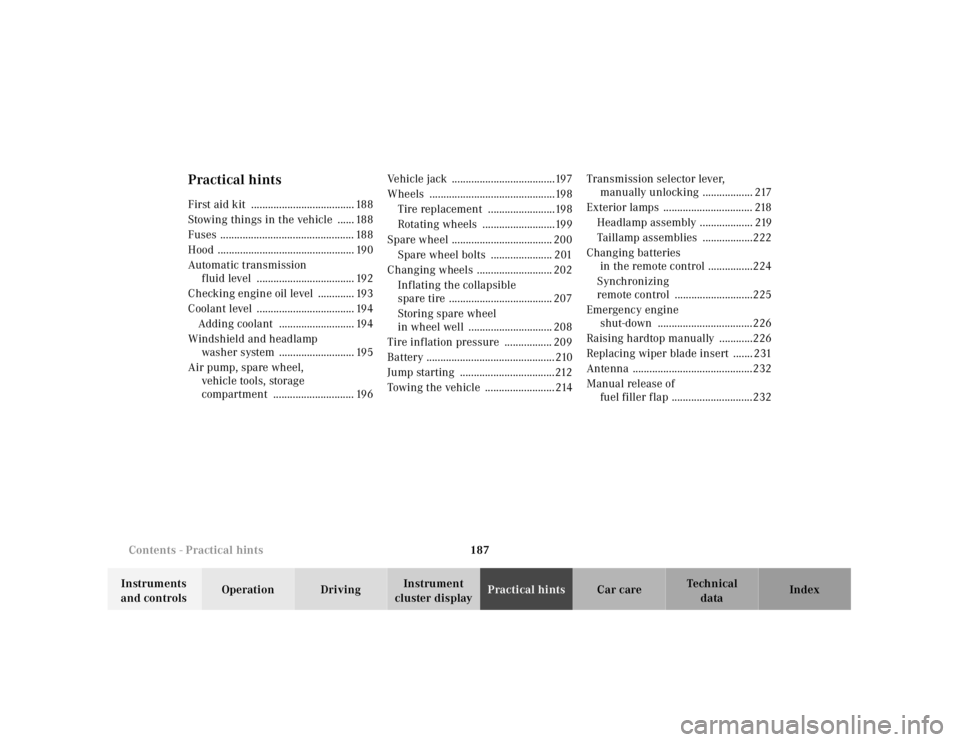
Practical hintsFirst aid kit ..................................... 188
Stowing things in the vehicle ...... 188
Fuses ................................................ 188
Hood ................................................. 190
Automatic transmission
fluid level ................................... 192
Checking engine oil level ............. 193
Coolant level ................................... 194
Adding coolant ........................... 194
Windshield and headlamp
washer system ........................... 195
Air pump, spare wheel,
vehicle tools, storage
compartment ............................. 196Vehicle jack .....................................197
Wheels .............................................198
Tire replacement ........................198
Rotating wheels ..........................199
Spare wheel .................................... 200
Spare wheel bolts ...................... 201
Changing wheels ........................... 202
Inflating the collapsible
spare tire ..................................... 207
Storing spare wheel
in wheel well .............................. 208
Tire inflation pressure ................. 209
Battery ..............................................210
Jump starting ..................................212
Towing the vehicle .........................214Transmission selector lever,
manually unlocking .................. 217
Exterior lamps ................................ 218
Headlamp assembly ................... 219
Taillamp assemblies ..................222
Changing batteries
in the remote control ................224
Synchronizing
remote control ............................225
Emergency engine
shut-down ..................................226
Raising hardtop manually ............226
Replacing wiper blade insert ....... 231
Antenna ...........................................232
Manual release of
fuel filler flap .............................232
Page 195 of 273
192 Engine compartment
Te ch n ica l
data Instruments
and controlsOperation DrivingInstrument
cluster displayPractical hintsCar care Index
Automatic transmission fluid level
The transmission has a permanent fill of automatic
transmission fluid.
Regular automatic transmission fluid level checks and
changes are not required. For this reason the dipstick is
omitted.
If you notice f luid loss or gear shifting malfunctions,
have your authorized Mercedes-Benz Center check the
transmission fluid level.