automatic transmission MERCEDES-BENZ SLK CLASS 2000 Owners Manual
[x] Cancel search | Manufacturer: MERCEDES-BENZ, Model Year: 2000, Model line: SLK CLASS, Model: MERCEDES-BENZ SLK CLASS 2000Pages: 273, PDF Size: 15.92 MB
Page 5 of 273

2 Contents
Power windows ............................... 109
Interior lighting ..............................110
Night security illumination ..........110
Sun visors with Vanity Mirror ......111
Interior .............................................111
Cup holder and glove box ............. 112
Storage compartments ...................113
Ashtrays ...........................................114
Coin Holder ......................................114
Lighter ..............................................115
Parcel net in
passenger footwell .....................116
Shelf behind roll bars .....................116
Cellular telephone ..........................116
Garage door opener ........................117
Retractable hardtop ....................... 120
Wind screen .................................... 125
Luggage cover ................................. 126
DrivingControl and operation
of radio transmitters ................ 128
The first 1 000 miles
(1 500 km) ................................. 129
Maintenance .................................. 129
Tele Aid ............................................130
Catalytic converter .........................138
Emission control .............................139
Steering lock .................................. 140
Starting and turning off
the engine .................................. 142
Manual transmission .................... 143
Automatic transmission ............... 144
Parking brake .................................153
Driving instructions .......................154
Drive sensibly – Save Fuel ........154
Drinking and driving .................154
Pedals ...........................................154Power assistance ........................ 155
Brakes .......................................... 155
Driving off ................................... 156
Parking ........................................ 156
Tires ............................................. 157
Snow chains ................................ 160
Winter driving instructions ...... 160
Block heater ................................ 162
Deep water .................................. 162
Passenger compartment ........... 162
Traveling abroad ........................ 162
Cruise control ................................. 163
Brake assist system (BAS) ............ 166
Antilock brake system (ABS) ....... 168
Electronic stability
program (ESP) ........................... 170
What you should know
at the gas station ....................... 174
Check regularly and
before a long trip ...................... 176
Page 6 of 273

3 Contents
Instrument cluster displayMalfunction and indicator
lamps in the instrument
cluster ......................................... 178
On-board diagnostic system ..... 178
Check engine malfunction
indicator lamp ............................. 178
Brake warning lamp .................. 179
Brake pad wear
indicator lamp ............................. 180
Seat belt nonusage
warning lamp .............................. 180
Supplemental restraint
system (SRS)
indicator lamp ............................. 180
Fuel reserve and fuel cap
placement warning .................... 181
Electronic stability
program (ESP) —
warning lamp .............................. 181
BAS / ESP malfunction
indicator lamp ............................. 181
ABS malfunction
indicator lamp ............................. 182Telescoping steering
column warning lamp ................182
Low engine coolant level
warning lamp ..............................183
Low windshield and
headlamp washer system
f luid level warning lamp ...........183
Low engine oil level
warning lamp ..............................184
Charge indicator lamp ...............184
Exterior lamp failure
indicator lamp .............................185
Additional function
indicator lamps
(in the odometer display) ..........185
Malfunction and indicator
lamp in the center console .......185
AIRBAG OFF
indicator lamp .............................185
Practical hintsFirst aid kit ......................................188
Stowing things
in the vehicle .............................188Fuses ................................................ 188
Hood ................................................. 190
Automatic transmission
fluid level ................................... 192
Checking engine oil level ............. 193
Coolant level ................................... 194
Adding coolant ........................... 194
Windshield and
headlamp washer system ........ 195
Air pump, spare wheel,
vehicle tools,
storage compartment ................ 196
Vehicle jack ..................................... 197
Wheels ............................................. 198
Tire replacement ........................ 198
Rotating wheels .......................... 199
Spare wheel ....................................200
Spare wheel bolts ....................... 201
Changing wheels ...........................202
Inflating the collapsible
spare tire .....................................207
Storing spare wheel in
wheel well ...................................208
Tire inflation pressure ..................209
Page 83 of 273
80 Exterior lamp switch
Te ch n ica l
data Instruments
and controlsOperationDrivingInstrument
cluster displayPractical hints Car care Index
Fog lamps are automatically switched off when the
exterior lamp switch is turned to position D.
Daytime running lamps (Canada only)
Vehicles with automatic transmission:
When the engine is running and the selector lever is in
a driving position, the low beam headlamps (includes
parking lamps, side marker lamps, taillamps and
license plate lamps) are automatically switched on.
When shifting from a driving position to position “N”
or “P”, the low beam switches off (2 seconds delay).
Vehicles with manual transmission:
With the engine running, the low beam headlamps
(includes parking lamps, side marker lamps, taillamps
and license plate lamps) are automatically switched on.
For nighttime driving the exterior lamp switch should
be turned to position B to permit activation of the
high beam headlamps.Headlamp cleaning system
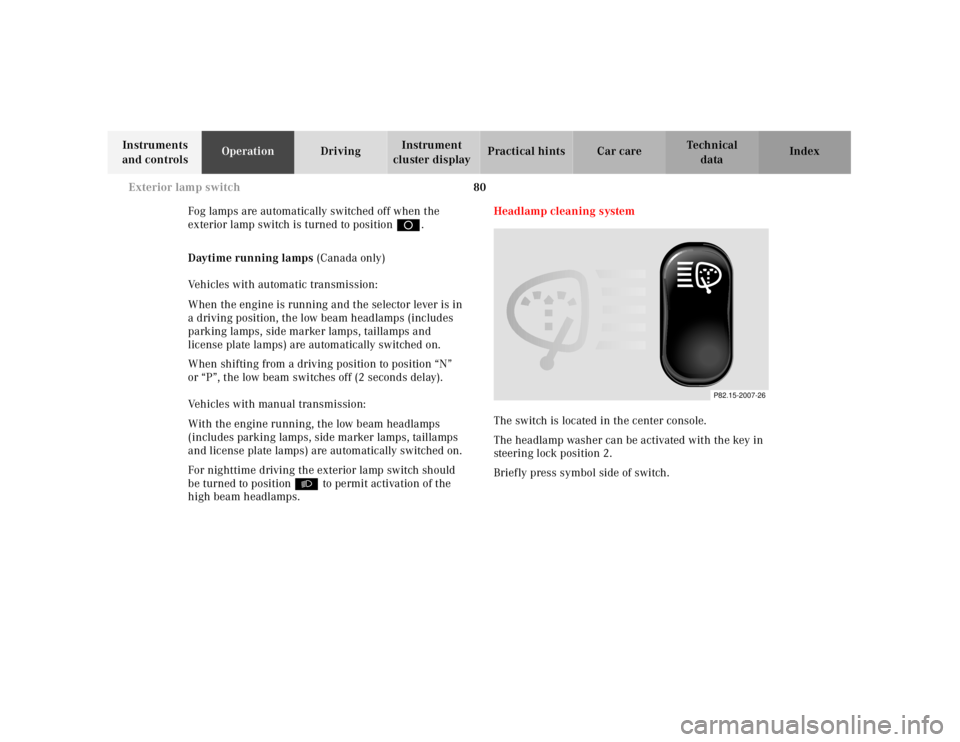
The switch is located in the center console.
The headlamp washer can be activated with the key in
steering lock position 2.
Briefly press symbol side of switch.
P82.15-2007-26
Page 130 of 273
127 Contents - Driving
Te ch n ica l
data Instruments
and controlsOperationDrivingInstrument
cluster displayPractical hints Car care Index
DrivingControl and operation of radio
transmitters ............................... 128
The first 1 000 miles
(1 500 km) ................................. 129
Maintenance ................................... 129
Tele Aid ........................................... 130
Catalytic converter ........................ 138
Emission control ............................ 139
Steering lock ................................... 140
Starting and turning off
the engine .................................. 142
Manual transmission .................... 143Automatic transmission ............... 144
Parking brake .................................153
Driving instructions .......................154
Drive sensibly – Save Fuel ........154
Drinking and driving .................154
Pedals ...........................................154
Power assistance .........................155
Brakes ...........................................155
Driving off ....................................156
Parking .........................................156
Tires ..............................................157
Snow chains ................................160
Winter driving
instructions .................................160Block heater ................................ 162
Deep water .................................. 162
Passenger compartment ........... 162
Traveling abroad ........................ 162
Cruise control ................................. 163
Brake assist system
(BAS) ........................................... 166
Antilock brake system
(ABS) ........................................... 168
Electronic stability program
(ESP) ........................................... 170
What you should know
at the gas station ....................... 174
Check regularly and
before a long trip ...................... 176
Page 132 of 273
129 The first 1 000 miles
Te ch n ica l
data Instruments
and controlsOperationDrivingInstrument
cluster displayPractical hints Car care Index The first 1 000 miles (1 500 km)
The more cautiously you treat your vehicle during the
break-in period, the more satisfied you will be with its
performance later on. Therefore, drive your vehicle
during the first 1 000 miles (1 500 km) at moderate
vehicle and engine speeds.
During this period, avoid heavy loads (full throttle
driving) and excessive engine speeds.
Manual transmission:
Downshift at proper engine speeds.
Automatic transmission:
Avoid accelerating by kickdown. It is not recommended
to bra ke t he veh icl e by ma nu al ly shif ting to a l owe r gear.
We recommend that you select positions “3”, “2” or “1”
only at moderate speeds (for hill driving).
After 1 000 miles (1 500 km) speeds may be gradually
increased to the permissible maximum.Maintenance
Approximately 30 days or 2000 miles (2000 km) prior to
the next recommended service, the remaining distance
or days are displayed in the main odometer field. See
Flexible service system (FSS) on page 75.
We strongly recommend that you have your vehicle
serviced by your authorized Mercedes-Benz Center, in
accordance with the Service Booklet at the times called
for by the FSS.
Failure to have the vehicle maintained in accordance
with the Service Booklet at the designated times /
mileage may result in vehicle damage not covered by
the Mercedes-Benz Limited Warranty.
Page 138 of 273
135 Tele Aid
Te ch n ica l
data Instruments
and controlsOperationDrivingInstrument
cluster displayPractical hints Car care Index Important!
If the indicator lamps do not start flashing after
pressing one of the buttons or remain illuminated (in
red) at any time, the Tele Aid system has detected a fault
or the service is not currently active, and may not
initiate a call. Visit your Mercedes-Benz Center and
h ave t he system checked or contac t t he Response Center
at 1-800-756-9018 (in the USA) or 1-888-923-8367 (in
Canada) as soon as possible.
Upgrade Signals
Tele Aid system processes calls using the following
priority.
•Automatic emergency – First priority
•Manual emergency – Second priority
•Roadside assistance – Third priority
•Information – Fourth priority
Should a higher priority call be initiated while you are
connected, an upgrade (alternating) tone will be heard,
and the appropriate indicator lamp will f lash. If certain
information such as vehicle identification number or
client information is not available, the operator may
need to retransmit. During this time you will hear a chirp and voice contact will be interrupted. Voice
contact will resume once the retransmission is
completed. Once a call is concluded, a chirp will be
heard and the appropriate indicator lamp will stop
f lashing. The audio system operation will resume.
Important!
If the indicator lamp continues to flash or the system
does not reset, contact the Response Center at
1-800-756-9018 (in the USA) or 1-888-923-8367 (in
Canada), or Mercedes-Benz Client Assistance at
1-800-FOR-MERCedes (1-800-367-6372) in the USA or
Customer Service at 1-800-387-0100 in Canada.
Notes:
The indicator lamp in the respective button flashes until
the call is concluded and this can only be completed by
a Response Center or Client Assistance Center
representative.
When a Tele Aid call has been initiated, the audio
system is muted and the selected mode (radio, tape or
CD) pauses. The optional cellular phone (if installed)
switches off. If you must use this phone, the vehicle
must be parked. Disconnect the coiled cord and place
the call.
Page 143 of 273
140 Steering lock
Te ch n ica l
data Instruments
and controlsOperationDrivingInstrument
cluster displayPractical hints Car care Index
Steering lock
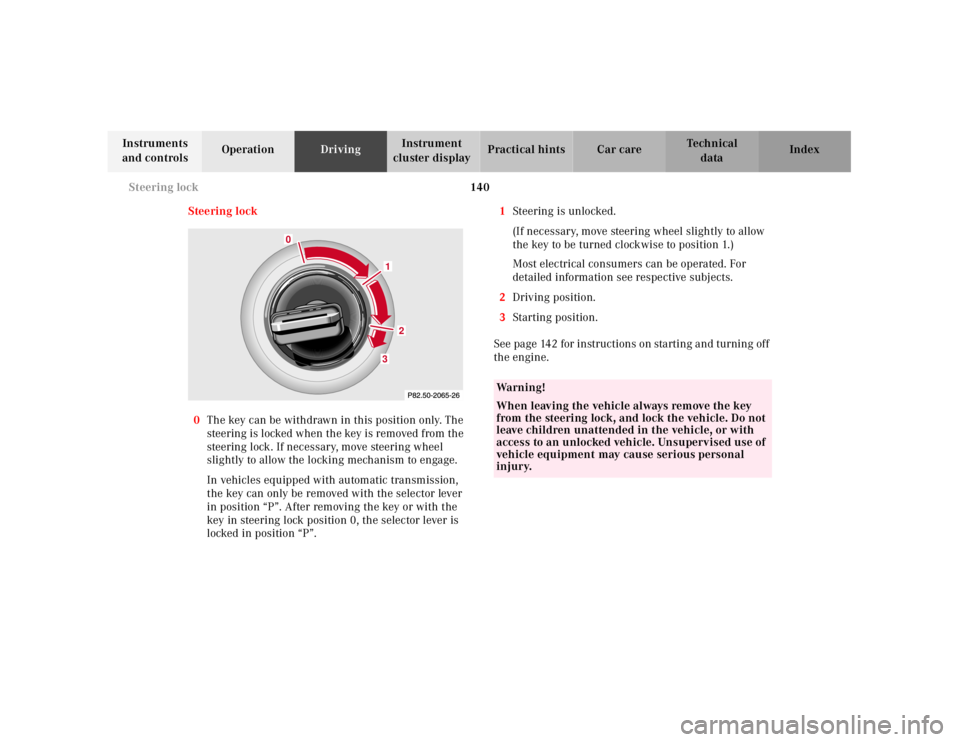
0The key can be withdrawn in this position only. The
steering is l ocked w hen th e key is removed f rom th e
steering lock. If necessary, move steering wheel
slightly to allow the locking mechanism to engage.
In vehicles equipped with automatic transmission,
the key can only be removed with the selector lever
in position “P”. After removing the key or with the
key in steering lock position 0, the selector lever is
locked in position “P”.1Steering is unlocked.
(If necessary, move steering wheel slightly to allow
the key to be turned clockwise to position 1.)
Most electrical consumers can be operated. For
detailed information see respective subjects.
2Driving position.
3Starting position.
See page 142 for instructions on starting and turning off
the engine.
2
3
0
1
Wa r n i n g !
When leaving the vehicle always remove the key
from the steering lock, and lock the vehicle. Do not
leave children unattended in the vehicle, or with
access to an unlocked vehicle. Unsupervised use of
vehicle equipment may cause serious personal
injury.
Page 145 of 273
142 Starting and turning off the enging
Te ch n ica l
data Instruments
and controlsOperationDrivingInstrument
cluster displayPractical hints Car care Index
Starting and turning off the engine
Before starting
Ensure that parking brake is engaged and that selector
lever is in position “P” or “N” (gearshift lever in
neutral). Turn key in steering lock to position 2.
Starting
Vehicles with automatic transmission:
Do not depress accelerator. Briefly turn key in steering
lock clockwise to the stop and release. The starter will
engage until the engine is running.
If engine will not run, and the starting procedure stops,
turn key completely to the left and repeat starting the
engine.
After several unsuccessful attempts, have the system
checked at the nearest authorized Mercedes-Benz
Center.Vehicles with manual transmission:
Do not depress accelerator. Fully depress clutch pedal,
otherwise the engine cannot be started due to the
integrated safety interlock.
Turn key in steering lock clockwise to the stop. Release
key only when the engine is firing regularly.
Important!
Due to the installed starter nonrepeat feature, the key
must be turned completely to the left before attempting
to start the engine again.
In areas where temperatures frequently drop below
-4°F(-20°C) we rec omm end tha t a n e ng ine bl ock h eater
be insta lled . You r a ut horized Mercedes-Benz Center will
advise you on this subject, see page 162.
Turning off
Turn the key in the steering lock to position 0 to stop the
engine.
Vehicles with automatic transmission:
The key can only be removed with your foot off the
brake pedal and the selector lever in position “P”.
Page 147 of 273
144 Automatic transmission
Te ch n ica l
data Instruments
and controlsOperationDrivingInstrument
cluster displayPractical hints Car care Index
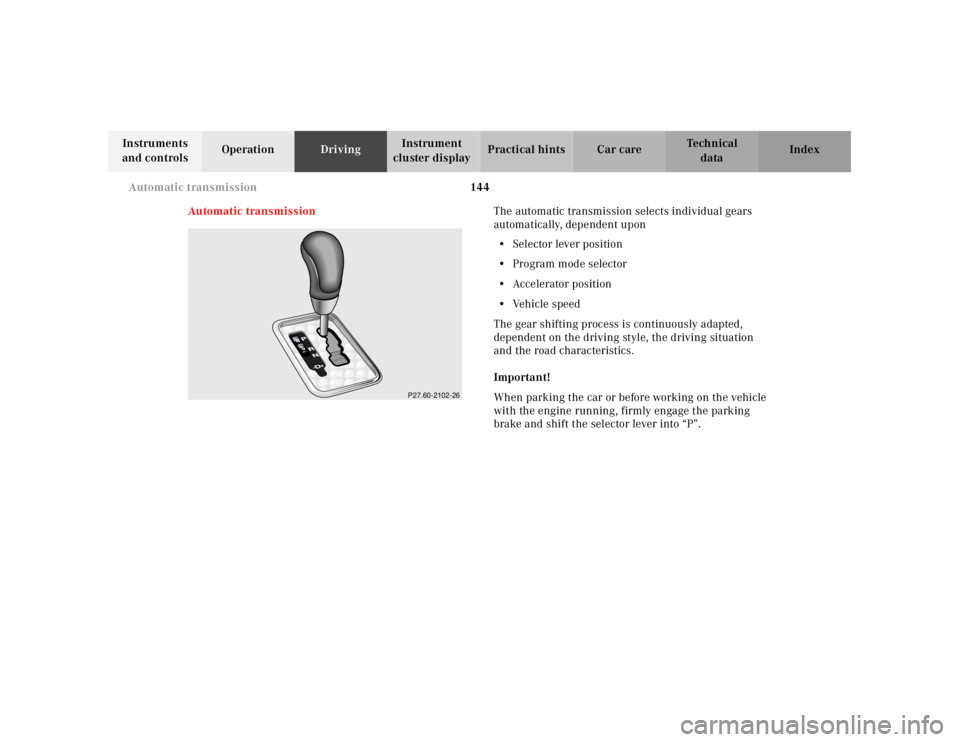
Automatic transmissionThe automatic transmission selects individual gears
automatically, dependent upon
•Selector lever position
•Program mode selector
•Accelerator position
•Vehicle speed
The gear shifting process is continuously adapted,
dependent on the driving style, the driving situation
and the road characteristics.
Important!
When parking the car or before working on the vehicle
with the engine running, firmly engage the parking
brake and shift the selector lever into “P”.
@@
€€
ÀÀ
@@
€€
ÀÀ
@@
€€
ÀÀ
@@
€€
ÀÀ
@@
€€
ÀÀ
@@
€€
ÀÀ
@@
€€
ÀÀ
@@
€€
ÀÀ
@@
€€
ÀÀ
@@
€€
ÀÀ
@@
€€
ÀÀ
@@
€€
ÀÀ
@@
€€
ÀÀ
@@
€€
ÀÀ
@@
€€
ÀÀ
@@
€€
ÀÀ
@@
€€
ÀÀ
@@
€€
ÀÀ
@@
€€
ÀÀ
@@
€€
ÀÀ
@@
€€
ÀÀ
@@
€€
ÀÀ
@@
€€
ÀÀ
@@
€€
ÀÀ
@@
€€
ÀÀ
@@
€€
ÀÀ
@@
€€
ÀÀ
@@
€€
ÀÀ
@@
€€
ÀÀ
@@
€€
ÀÀ
@@
€€
ÀÀ
@@
€€
ÀÀ
@@
€€
ÀÀ
@@
€€
ÀÀ
@@
€€
ÀÀ
@@
€€
ÀÀ
@@
€€
ÀÀ
@@
€€
ÀÀ
@@
€€
ÀÀ
@@
€€
ÀÀ
@@
€€
ÀÀ
@@
€€
ÀÀ
@@
€€
ÀÀ
@@
€€
ÀÀ
@@
€€
ÀÀ
@@
€€
ÀÀ
@@
€€
ÀÀ
@@
€€
ÀÀ
@@
€€
ÀÀ
@@
€€
ÀÀ
@@
€€
ÀÀ
@@
€€
ÀÀ
@@
€€
ÀÀ
@@
€€
ÀÀ
@@
€€
ÀÀ
@@
€€
ÀÀ
@@
€€
ÀÀ
@@
€€
ÀÀ
@@
€€
ÀÀ
@@
€€
ÀÀ
@@
€€
ÀÀ
@@
€€
ÀÀ
@@
€€
ÀÀ
@@
€€
ÀÀ
@@
€€
ÀÀ
@@
€€
ÀÀ
@@
€€
ÀÀ
@@
€€
ÀÀ
@@
€€
ÀÀ
@@
€€
ÀÀ
@@
€€
ÀÀ
@@
€€
ÀÀ
@@
€€
ÀÀ
@@
€€
ÀÀ
@@
€€
ÀÀ
@@
€€
ÀÀ
@@
€€
ÀÀ
@@
€€
ÀÀ
@@
€€
ÀÀ
@@
€€
ÀÀ
@@
€€
ÀÀ
@@
€€
ÀÀ
@@
€€
ÀÀ
@@
€€
ÀÀ
@@
€€
ÀÀ
@@
€€
ÀÀ
@@
€€
ÀÀ
@@
€€
ÀÀ
@@
€€
ÀÀ
@@
€€
ÀÀ
@@
€€
ÀÀ
@@
€€
ÀÀ
@@
€€
ÀÀ
@@
€€
ÀÀ
@@
€€
ÀÀ
@@
€€
ÀÀ
@@
€€
ÀÀ
@@
€€
ÀÀ
@@
€€
ÀÀ
@@
€€
ÀÀ
@@
€€
ÀÀ
@@
€€
ÀÀ
@@
€€
ÀÀ
@@
€€
ÀÀ
@@
€€
ÀÀ
@@
€€
ÀÀ
@@
€€
ÀÀ
@@
€€
ÀÀ
@@
€€
ÀÀ
@@
€€
ÀÀ
@@
€€
ÀÀ
@@
€€
ÀÀ
@@
€€
ÀÀ
@@
€€
ÀÀ
@@
€€
ÀÀ
@@
€€
ÀÀ
@@
€€
ÀÀ
@@
€€
ÀÀ
@@
€€
ÀÀ
@@
€€
ÀÀ
@@
€€
ÀÀ
@@
€€
ÀÀ
@@
€€
ÀÀ
@@
€€
ÀÀ
@@
€€
ÀÀ
@@
€€
ÀÀ
@@
€€
ÀÀ
@@
€€
ÀÀ
@@
€€
ÀÀ
@@
€€
ÀÀ
@@
€€
ÀÀ
@@
€€
ÀÀ
@@
€€
ÀÀ
@@
€€
ÀÀ
@@
€€
ÀÀ
@@
€€
ÀÀ
@@
€€
ÀÀ
@@
€€
ÀÀ
@@
€€
ÀÀ
@@
€€
ÀÀ
@@
€€
ÀÀ
@@
€€
ÀÀ
@@
€€
ÀÀ
@@
€€
ÀÀ
@@
€€
ÀÀ
@@
€€
ÀÀ
@@
€€
ÀÀ
@@
€€
ÀÀ
@@
€€
ÀÀ
@@
€€
ÀÀ
@@
€€
ÀÀ
@@
€€
ÀÀ
@@
€€
ÀÀ
@@
€€
ÀÀ
@@
€€
ÀÀ
@@
€€
ÀÀ
@@
€€
ÀÀ
@@
€€
ÀÀ
@@
€€
ÀÀ
@@
€€
ÀÀ
@@
€€
ÀÀ
@@
€€
ÀÀ
@@
€€
ÀÀ
@@
€€
ÀÀ
@@
€€
ÀÀ
@@
€€
ÀÀ
@@
€€
ÀÀ
@@
€€
ÀÀ
@@
€€
ÀÀ
@@
€€
ÀÀ
@@
€€
ÀÀ
@@
€€
ÀÀ
@@
€€
ÀÀ
@@
€€
ÀÀ
@@
€€
ÀÀ
@@
€€
ÀÀ
@@
€€
ÀÀ
@@
€€
ÀÀ
@@
€€
ÀÀ
@@
€€
ÀÀ
@@
€€
ÀÀ
@@
€€
ÀÀ
@@
€€
ÀÀ
@@
€€
ÀÀ
@@
€€
ÀÀ
@@
€€
ÀÀ
@@
€€
ÀÀ
@@
€€
ÀÀ
@@
€€
ÀÀ
@@
€€
ÀÀ
@@
€€
ÀÀ
@@
€€
ÀÀ
@@
€€
ÀÀ
@@
€€
ÀÀ
@@
€€
ÀÀ
@@
€€
ÀÀ
@@
€€
ÀÀ
@@
€€
ÀÀ
@@
€€
ÀÀ
@@
€€
ÀÀ
@@
€€
ÀÀ
@@
€€
ÀÀ
@@
€€
ÀÀ
@@
€€
ÀÀ
@@
€€
ÀÀ
@@
€€
ÀÀ
@@
€€
ÀÀ
@@
€€
ÀÀ
@@
€€
ÀÀ
@@
€€
ÀÀ
@@
€€
ÀÀ
@@
€€
ÀÀ
@@
€€
ÀÀ
@@
€€
ÀÀ
@@
€€
ÀÀ
@@
€€
ÀÀ
@@
€€
ÀÀ
@@
€€
ÀÀ
@@
€€
ÀÀ
@@
€€
ÀÀ
@@
€€
ÀÀ
@@
€€
ÀÀ
@@
€€
ÀÀ
@@
€€
ÀÀ
@@
€€
ÀÀ
@@
€€
ÀÀ
@@
€€
ÀÀ
@@
€€
ÀÀ
@@
€€
ÀÀ
@@
€€
ÀÀ
@@
€€
ÀÀ
@@
€€
ÀÀ
@@
€€
ÀÀ
@@
€€
ÀÀ
@@
€€
ÀÀ
@@
€€
ÀÀ
@@
€€
ÀÀ
@@
€€
ÀÀ
@@
€€
ÀÀ
@@
€€
ÀÀ
@@
€€
ÀÀ
@@
€€
ÀÀ
@@
€€
ÀÀ
@@
€€
ÀÀ
@@
€€
ÀÀ
@@
€€
ÀÀ
@@
€€
ÀÀ
@@
€€
ÀÀ
@@
€€
ÀÀ
@@
€€
ÀÀ
@@
€€
ÀÀ
@@
€€
ÀÀ
@@
€€
ÀÀ
@@
€€
ÀÀ
@@
€€
ÀÀ
@@
€€
ÀÀ
@@
€€
ÀÀ
@@
€€
ÀÀ
@@
€€
ÀÀ
@@
€€
ÀÀ
@@
€€
ÀÀ
@@
€€
ÀÀ
@@
€€
ÀÀ
@@
€€
ÀÀ
@@
€€
ÀÀ
@@
€€
ÀÀ
@@
€€
ÀÀ
@@
€€
ÀÀ
@@
€€
ÀÀ
@@
€€
ÀÀ
@@
€€
ÀÀ
@@
€€
ÀÀ
@@
€€
ÀÀ
@@
€€
ÀÀ
@@
€€
ÀÀ
@@
€€
ÀÀ
@@
€€
ÀÀ
@@
€€
ÀÀ
@@
€€
ÀÀ
@@
€€
ÀÀ
@@
€€
ÀÀ
@@
€€
ÀÀ
@@
€€
ÀÀ
@@
€€
ÀÀ
@@
€€
ÀÀ
@@
€€
ÀÀ
@@
€€
ÀÀ
@@
€€
ÀÀ
@@
€€
ÀÀ
@@
€€
ÀÀ
@@
€€
ÀÀ
@@
€€
ÀÀ
@@
€€
ÀÀ
@@
€€
ÀÀ
@@
€€
ÀÀ
@@
€€
ÀÀ
@@
€€
ÀÀ
@@
€€
ÀÀ
@@
€€
ÀÀ
@@
€€
ÀÀ
@@
€€
ÀÀ
@@
€€
ÀÀ
@@
€€
ÀÀ
@@
€€
ÀÀ
@@
€€
ÀÀ
@@
€€
ÀÀ
@@
€€
ÀÀ
@@
€€
ÀÀ
@@
€€
ÀÀ
@@
€€
ÀÀ
@@
€€
ÀÀ
@@
€€
ÀÀ
@@
€€
ÀÀ
@@
€€
ÀÀ
@@
€€
ÀÀ
@@
€€
ÀÀ
@@
€€
ÀÀ
@@
€€
ÀÀ
@@
€€
ÀÀ
@@
€€
ÀÀ
@@
€€
ÀÀ
@@
€€
ÀÀ
@@
€€
ÀÀ
@@
€€
ÀÀ
@@
€€
ÀÀ
@@
€€
ÀÀ
@@
€€
ÀÀ
@@
€€
ÀÀ
@@
€€
ÀÀ
@@
€€
ÀÀ
@@
€€
ÀÀ
@@
€€
ÀÀ
@@
€€
ÀÀ
@@
€€
ÀÀ
@@
€€
ÀÀ
@@
€€
ÀÀ
@@
€€
ÀÀ
@@
€€
ÀÀ
@@
€€
ÀÀ
@@
€€
ÀÀ
@@
€€
ÀÀ
@@
€€
ÀÀ
@@
€€
ÀÀ
@@
€€
ÀÀ
@@
€€
ÀÀ
@@
€€
ÀÀ
@@
€€
ÀÀ
@@
€€
ÀÀ
@@
€€
ÀÀ
@@
€€
ÀÀ
@@
€€
ÀÀ
@@
€€
ÀÀ
@@
€€
ÀÀ
@@
€€
ÀÀ
@@
€€
ÀÀ
@@
€€
ÀÀ
@@
€€
ÀÀ
@@
€€
ÀÀ
@@
€€
ÀÀ
@@
€€
ÀÀ
@@
€€
ÀÀ
@@
€€
ÀÀ
@@
€€
ÀÀ
@@
€€
ÀÀ
yy
P27.60-2102-26
Page 148 of 273
145 Automatic transmission
Te ch n ica l
data Instruments
and controlsOperationDrivingInstrument
cluster displayPractical hints Car care Index Driving
The selector lever is automatically locked while in
position “P”. To move the selector lever out of
position “P”, the service brake pedal must be firmly
depressed before the shift lock will release.
Shift selector lever to the desired position only when the
engine is idling normally and the service brake is
applied. Do not release the brake until ready to drive.
The vehicle may otherwise start creeping when the
selector lever is in drive or reverse position.Important!
After selecting any driving position from “N” or “P”,
wait a moment to allow the gear to fully engage before
accelerating, especially when the engine is cold.
Accelerator position
Partial throttle = early upshifting = normal acceleration
Full throttle = later upshifting = rapid acceleration
Kickdown (depressing the accelerator beyond full
throttle) = downshifting to a lower gear = maximum
acceleration. Once the desired speed is attained, ease up
on the accelerator – the transmission shifts up again.
Wa r n i n g !
It is dangerous to shift the selector lever out of “P”
or “N” if the engine speed is higher than idle speed.
If your foot is not firmly on the brake pedal, the
vehicle could accelerate quickly forward or in
reverse. You could lose control of the vehicle and
hit someone or something. Only shift into gear
when the engine is idling normally and when your
right foot is firmly on the brake pedal.