fuel MERCEDES-BENZ SLK CLASS 2000 Owner's Guide
[x] Cancel search | Manufacturer: MERCEDES-BENZ, Model Year: 2000, Model line: SLK CLASS, Model: MERCEDES-BENZ SLK CLASS 2000Pages: 273, PDF Size: 15.92 MB
Page 235 of 273

232 Antenna
Te ch n ica l
data Instruments
and controlsOperation DrivingInstrument
cluster displayPractical hintsCar care Index
Notes:
Do not open engine hood with wiper arms folded
forward.
Do not allow the wiper arms to contact the windshield
glass without a wiper blade inserted. The glass may be
scratched or broken.
Make certain that the wiper blade is properly installed.
An improperly installed wiper blade may cause
windshield damage.
Antenna
To prevent damage or diminished radio reception after
reinstallation, the non-retractable antenna should not
be removed. The antenna is automatic car-wash safe.Manual release of fuel filler flap
The manual release knob is located behind cover (1) in
the right slide trunk panel.
In case the central locking system does not release the
fuel filler flap, pull the manual release knob (arrow)
while simultaneously opening the fuel filler f lap.
1
P80.20-2110-26
Page 237 of 273
234 Cleaning and care of the vehicle
Te ch n ica l
data Instruments
and controlsOperation DrivingInstrument
cluster displayPractical hintsCar careIndex
Cleaning and care of the vehicle
In operation, your vehicle is subjected to varying
external inf luences which, if gone unchecked, can
attack the paintwork as well as the underbody and
cause lasting damage.
Such damage is caused not only by extreme and varying
climatic conditions, but also by air polution, road salt,
tar, gravel and stone chipping. Grease and oil, fuel,
coolant, brake fluid, bird droppings, insects, tree resins
etc. should be removed immediately to avoid paint
damage. Frequent washing reduces and/or eliminates
the aggressiveness and potency of the above adverse
influences.More frequent washings are necessary to deal with
unfavorable conditions; for example, near the ocean, in
industrial areas (smoke, exhaust emissions), or during
winter operation.
You should check your vehicle from time to time for
stone chipping or other damage. Any damage should be
repaired as soon as possible to prevent the start of
corrosion.
In doing so, do not neglect the underside of the vehicle.
A prerequisite for a thorough check is a washing of the
underbody followed by a thorough inspection. Damaged
areas need to be reundercoated.
Your vehicle has been treated at the factory with a wax-
base ru stproof ing in th e body cavities w hich will la st for
the lifetime of the vehicle. Post-production treatment is
neither necessary nor recommended by Mercedes-Benz
because of the possibility of incompatibility between
materials used in the production process and others
applied later.
We have selected car-care products and compiled
recommendations which are specially matched to our
vehicles and which always reflect the latest technology.
You can obtain Mercedes-Benz approved car-care
products at your authorized Mercedes-Benz Center.
Wa r n i n g !
Many cleaning products can be hazardous. Some
are poisonous, others are flammable. Always follow
the instructions on the particular container.
Always open your vehicle’s doors or windows when
cleaning the inside.Never use fluids or solvents that are not designed
for cleaning your vehicle.
Page 244 of 273
241 Contents - Technical data
Te ch n ica l
data Instruments
and controlsOperation DrivingInstrument
cluster displayPractical hints Car care Index
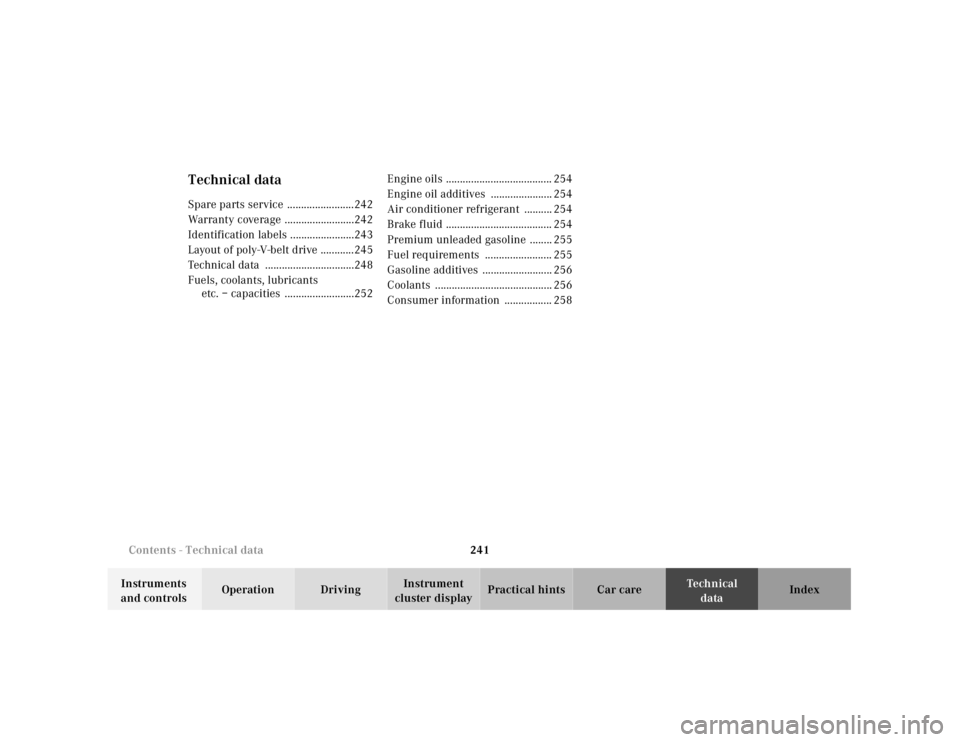
Technical dataSpare parts service ........................242
Warranty coverage .........................242
Identification labels .......................243
Layout of poly-V-belt drive ............245
Technical data ................................248
Fuels, coolants, lubricants
etc. – capacities .........................252Engine oils ...................................... 254
Engine oil additives ...................... 254
Air conditioner refrigerant .......... 254
Brake fluid ...................................... 254
Premium unleaded gasoline ........ 255
Fuel requirements ........................ 255
Gasoline additives ......................... 256
Coolants .......................................... 256
Consumer information ................. 258
Page 255 of 273
252 Fuels, coolants, lubricants etc. - capacities
Te ch n ica l
data Instruments
and controlsOperation DrivingInstrument
cluster displayPractical hints Car care Index
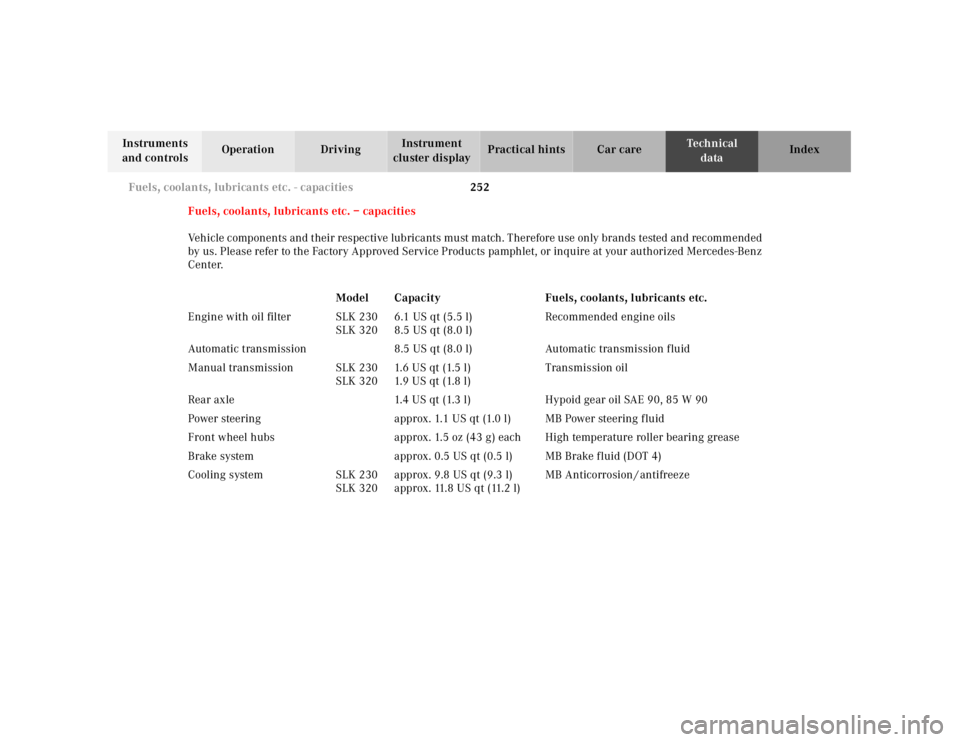
Fuels, coolants, lubricants etc. – capacities
Veh icle c omponents and t heir respec tive lub rica nts mu st ma tch . T herefore u se only brands tested and rec omm end ed
by us. Please refer to the Factory Approved Service Products pamphlet, or inquire at your authorized Mercedes-Benz
Center.
Model Capacity Fuels, coolants, lubricants etc.
Engine with oil filter SLK 230
SLK 3206.1 US qt (5.5 l)
8.5 US qt (8.0 l)Recommended engine oils
Automatic transmission 8.5 US qt (8.0 l) Automatic transmission fluid
Manual transmission SLK 230
SLK 3201.6 US qt (1.5 l)
1.9 US qt (1.8 l)Transmission oil
Rear axle 1.4 US qt (1.3 l) Hypoid gear oil SAE 90, 85 W 90
Power steering approx. 1.1 US qt (1.0 l) MB Power steering fluid
Front wheel hubs approx. 1.5 oz (43 g) each High temperature roller bearing grease
Brake system approx. 0.5 US qt (0.5 l) MB Brake f luid (DOT 4)
Cooling system SLK 230
SLK 320approx. 9.8 US qt (9.3 l)
a p p r ox . 11.8 U S q t ( 11.2 l )MB Anticorrosion / antifreeze
Page 256 of 273
253 Fuels, coolants, lubricants etc. - capacities
Te ch n ica l
data Instruments
and controlsOperation DrivingInstrument
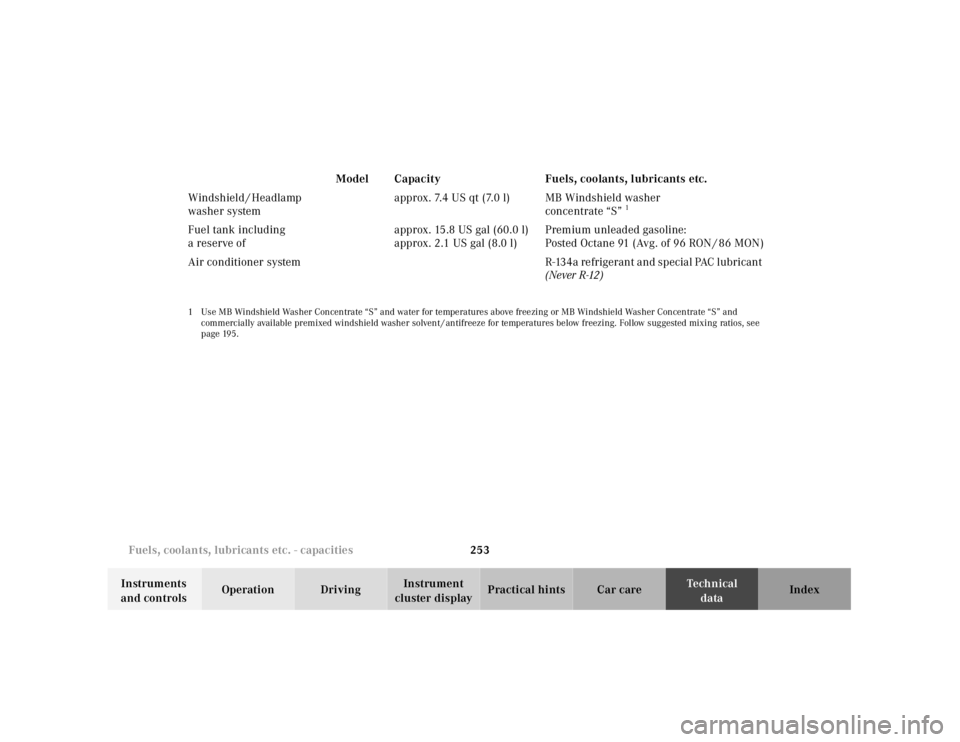
cluster displayPractical hints Car care Index Windshield / Headlamp
washer systemapprox. 7.4 US qt (7.0 l) MB Windshield washer
concentrate “S”
1
Fuel tank including
a reserve ofapprox. 15.8 US gal (60.0 l)
approx. 2.1 US gal (8.0 l)Premium unleaded gasoline:
Posted Octane 91 (Avg. of 96 RON / 86 MON)
Air conditioner system R-134a refrigerant and special PAC lubricant
(Never R-12)1 Use MB Windshield Washer Concentrate “S” and water for temperatures above freezing or MB Windshield Washer Concentrate “S” and
commercially available premixed windshield washer solvent / antifreeze for temperatures below freezing. Follow suggested mixing ratios, see
page 195.
Model Capacity Fuels, coolants, lubricants etc.
Page 257 of 273
254 Fuels, coolants, lubricants etc. - capacities
Te ch n ica l
data Instruments
and controlsOperation DrivingInstrument
cluster displayPractical hints Car care Index
Engine oils
Engine oils are specifically tested for their suitability in
our engines. Therefore, use only engine oils
recommended by Mercedes-Benz. Information on
recommended brands is available at your authorized
Mercedes-Benz Center.
Please follow Service Booklet recommendations for
scheduled oil changes. Failure to do so could result in
engine damage not covered by the Mercedes-Benz
Limited Warranty.
Engine oil additives
Do not blend oil additives with engine oil. They may be
harmful to the engine operation.
Damage or malfunctions resulting from blending oil
additives are not covered by the Mercedes-Benz Limited
War ra nt y.Air conditioner refrigerant
R-134a (H FC) ref rigerant a nd special PAG l ubricating oil
is used in the air conditioner system.
Never use R-12 (CFC) or mineral-based lubricating oil,
otherwise damage to the system will occur.
Brake fluid
During vehicle operation, the boiling point of the brake
fluid is continuously reduced through the absorption of
moisture from the atmosphere. Under extremely hard
operating conditions, this moisture content can lead to
the formation of bubbles in the system thus reducing
the system‘s efficiency.
The brake fluid must therefore be replaced every two
years, preferably in the spring.
It is recommended to use only brake fluid approved by
Mercedes-Benz. Your authorized Mercedes-Benz Center
will provide you with additional information.
Page 258 of 273
255 Fuels, coolants, lubricants etc. - capacities
Te ch n ica l
data Instruments
and controlsOperation DrivingInstrument
cluster displayPractical hints Car care Index Premium unleaded gasoline
Caution!
To maintain the engine’s durability and performance,
premium unleaded gasoline must be used. If premium
unleaded is not available and low octane fuel is used,
follow these precautions:
•have the fuel tank filled only partially with unleaded
regular and fill up with premium unleaded as soon
as possible,
•avoid full throttle driving and abrupt acceleration,
•do not exceed
2/3 of maximum accelerator pedal
position, if the vehicle is fully loaded or operating in
mountainous terrain.Fuel requirements
Use only Premium unleaded meeting ASTM
standard D 439:
The octane number (posted at the pump) must be
91 min. It is an average of both the Research (R) octane
number and the Motor (M) octane number: [(R+M) / 2].
This is also known as ANTI-KNOCK INDEX.
Unleaded gasoline containing oxygenates such as
Ethanol, IPA, IBA and TBA can be used provided the
ratio of any one of these oxygenates to gasoline does not
exceed 10%, MTBE not to exceed 15%.
The ratio of Methanol to gasoline must not exceed 3%
plus additional cosolvents.
Using mixtures of Ethanol and Methanol is not allowed.
Gasohol, which contains 10% Ethanol and 90% unleaded
gasoline, can be used.
These blends must also meet all other fuel requirements
such as resistance to spark knock, boiling range, vapor
pressure etc..
Page 259 of 273
256 Fuels, coolants, lubricants etc. - capacities
Te ch n ica l
data Instruments
and controlsOperation DrivingInstrument
cluster displayPractical hints Car care Index
Gasoline additives
A major concern among engine manufacturers is carbon
build up caused by gasoline. Mercedes-Benz
recommends the use of only quality gasoline containing
additives that prevent the build up of carbon deposits.
After an extended period of using fuels without such
a d d i t i ve s , c a r b o n d e po si t s c a n b u il d u p e s pe c ia l ly o n t h e
intake valves and in the combustion area, leading to
engine performance problems such as:
•warm-up hesitation,
•unstable idle,
•knocking / pinging,
•misfire,
•power loss.
Do not blend other specific fuel additives with fuel.
They only result in unnecessary cost, and may be
harmful to the engine operation.
Damage or malfunctions resulting from poor fuel
quality or from blending specific fuel additives are not
covered by the Mercedes-Benz Limited Warranty.Coolants
The engine coolant is a mixture of water and
anticorrosion / antifreeze, which provides:
•corrosion protection,
•freeze protection,
•boiling protection (by increasing the boiling point).
The cooling system was filled at the factory with a
coolant providing freeze protection to approximately
-22°F (-30°C) and corrosion protection.
If the antifreeze mixture is effective to -22°F (-30°C), the
boiling point of the coolant in the pressurized cooling
system is reached at approximately 266°F (130°C).
The cool ant sol ution must be used yea r round to provide
the necessary corrosion protection and increase in the
boil-over protection. You should have it replaced every
3years.
To provide the important corrosion protection, the
solution must be at least 45% anticorrosion / antifreeze
(equals a freeze protection to approx. - 22 °F [- 30 °C]). If
you use a solution that is more than 55% anticorrosion /
antifreeze (freeze protection to approx. - 49 °F [- 45°C]),
Page 260 of 273

257 Fuels, coolants, lubricants etc. - capacities
Te ch n ica l
data Instruments
and controlsOperation DrivingInstrument
cluster displayPractical hints Car care Index the engine temperature will increase due to the lower
h eat transfer ca pa bil ity of th e sol ution. Therefore, d o not
use more than this amount of anticorrosion / antifreeze.
If the coolant level is low, water and MB anticorrosion /
antifreeze should be used to bring it up to the proper
level (have cooling system checked for signs of leakage).
The water in the cooling system must meet minimum
requirements, which are usually satisfied by normal
drinking water. If your are not sure about the water
quality, consult your authorized Mercedes-Benz Center.
Anticorrosion / antifreeze
Your vehicle contains a number of aluminum parts. The
use of aluminum components in motor vehicle engines
necessitates that anticorrosion / antifreeze coolant used
in such e ng ines b e specif ica lly formul ated to protec t th e
aluminum parts. (Failure to use such anticorrosion /
antifreeze coolant will result in a significantly
shortened service life.)
Therefore the following product is strongly
recommended for use in your vehicle: Mercedes-Benz
Anticorrosion / Antifreeze Agent.Before the start of the winter season (or once a year in
the hot southern regions), you should have the
anticorrosion / antifreeze concentration checked. The
coolant is also regularly checked each time you bring
your vehicle to your authorized Mercedes-Benz Center
for service.
Anticorrosion / antifreeze quantity
Model Approx. freeze protection
– 35°F
(– 37°C)– 49°F
(– 45°C)
SLK 230 KOMPRESSOR 4.9 US qt
(4.7 l)5.4 US qt
(5.1 l)
SLK 320 5.9 US qt
(5.6 l)6.5 US qt
(6.2 l)
Page 264 of 273
261 Index
Te ch n ica l
data Instruments
and controlsOperation DrivingInstrument
cluster displayPractical hints Car careIndex Brake assist system (BAS) ............................................ 166
Malfunction indicator lamp ..................................... 181
Brake fluid ......................................................................254
Brake pad wear indicator lamp .................................... 180
Brake warning lamp ...................................................... 179
Brake fluid low .......................................................... 179
Brakes .....................................................155, 166, 168, 170
CCapacities
Fuels, coolants, lubricants etc. ...............................252
Catalytic converter ........................................................ 138
Cellular telephone ..........................................................116
Center console .................................................................. 18
Central locking switch .................................................... 30
Central locking system ................................................... 25
Automatic central locking ......................................... 31
Choosing global or selective mode ........................... 26
Emergency release for trunk lid ............................... 35
General notes ............................................................... 24
Locking and unlocking .............................................. 26
Remote control ............................................ 22, 25, 224
Vehicle keys ................................................................. 22Changing wheels ........................................................... 202
Inflating the collapsible spare tire ........................ 207
Storing spare wheel in wheel well ........................ 208
Charge indicator lamp ................................................... 184
Check engine malfunction indicator lamp .................178
Check regularly and before a long trip ....................... 176
Checking engine oil level
Via engine oil level .....................................................77
Via oil dipstick ........................................................... 193
Child restraint ...............................................44, 50, 51, 61
Cleaning and care of the vehicle ................................ 234
Climate control .................................................................84
Air Recirculation .........................................................89
Basic setting .................................................................86
Defogging windows .....................................................87
Defrosting .....................................................................87
Dust Filter .....................................................................90
Rear window defroster ............................................... 88
Residual Engine Heat Utilization (REST) ................ 89
Special settings ........................................................... 87
Clock, setting .................................................................... 74
Coin Holder ..................................................................... 114
Combination switch ......................................................... 81
Consumer information ................................................. 258
Control and operation of radio transmitters .............. 128