display MERCEDES-BENZ SLK CLASS 2002 Owners Manual
[x] Cancel search | Manufacturer: MERCEDES-BENZ, Model Year: 2002, Model line: SLK CLASS, Model: MERCEDES-BENZ SLK CLASS 2002Pages: 290, PDF Size: 18.21 MB
Page 216 of 290
213 Tires, wheels
Te ch n i c a l
data Instruments
and controlsOperation DrivingInstrument
cluster displayPractical hintsCar care Index 7. Operate air pump (approximately 5 minutes) until
pressure gauge displays 36 psi (2.5 bar).
8. To switch off air pump, turn key in steering lock to
position 0.
9. Unscrew filler hose from tire. Reinstall tire valve
cap.
Note:
Excessive tire air pressure should be released using the
vent screw.Storing spare wheel in wheel well
Deflate spare tire:
1. Unscrew valve stem removal tool, which is a part of
the valve cap, from tire valve.
2. Using the valve stem removal tool, open tire valve
slightly by turning the tire valve insert
counterclockwise to release air pressure.
3. When the tire air pressure has been released,
remove tire valve insert (protect it from dirt and
sand) using the previously removed tire valve cap.
4. Once all air is out of the tire, and the tire has
collapsed to its original shape, reinstall the tire
valve insert and valve cap.
Place spare wheel in wheel well and secure it with air
pump holder. Turn pump holder clockwise to its stop.
Page 217 of 290
214 Tires, wheels
Te ch n i c a l
data Instruments
and controlsOperation DrivingInstrument
cluster displayPractical hintsCar care Index
TIREFIT
(SLK 32 AMG only)
Small punctures, particularly those in the tread can be
sealed with TIREFIT.
Foreign objects (e.g. screws or nails) should not be
removed from the tire.
TIREFIT can be used in ambient temperatures down to
approx. - 4°F (- 20°C).
Wa r n i n g !
Cuts or punctures larger than approx. 0.16 in
(4 mm), tire damage caused by driving with
extremely low tire pressure or on a flat tire, or a
damaged wheel can pose a hazard while driving.
TIREFIT should not be used in such circumstances.Do not drive the vehicle under such circumstances.Contact your nearest Mercedes-Benz Center for
assistance.Take care not to allow the contents of TIREFIT to
come in contact with hair, eyes or clothing.
TIREFIT is harmful if inhaled, swallowed or
absorbed through the skin - causes skin, eye and
respiratory irritation.
Any contact with eyes or skin should be flushed
immediately with plenty of water.If clothing comes in contact with TIREFIT, change
clothing as soon as possible.In case of allergic reaction or rash, consult a
physician immediately.Keep TIREFIT out of reach of children.
If swallowed, rinse mouth immediately with plenty
of water and drink plenty of water.Do not induce vomiting!Consult a physician immediately.Keep away from open flame or heat source.
Page 218 of 290
215 Tires, wheels
Te ch n i c a l
data Instruments
and controlsOperation DrivingInstrument
cluster displayPractical hintsCar care Index Sealing tire with TIREFIT
1. Set parking brake and turn on hazard warning
flasher.
2. Move selector lever to position “P” and turn off
engine.
3. Take TIREFIT out of storage box, see page 202.
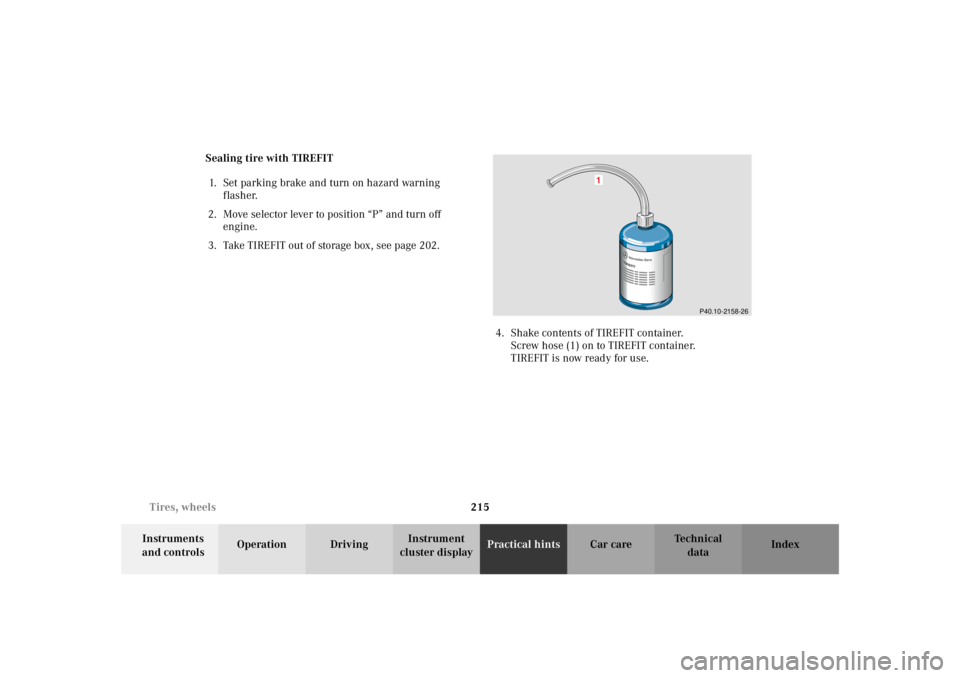
4. Shake contents of TIREFIT container.
Screw hose (1) on to TIREFIT container.
TIREFIT is now ready for use.
1
P40.10-2158-26
Page 219 of 290
216 Tires, wheels
Te ch n i c a l
data Instruments
and controlsOperation DrivingInstrument
cluster displayPractical hintsCar care Index
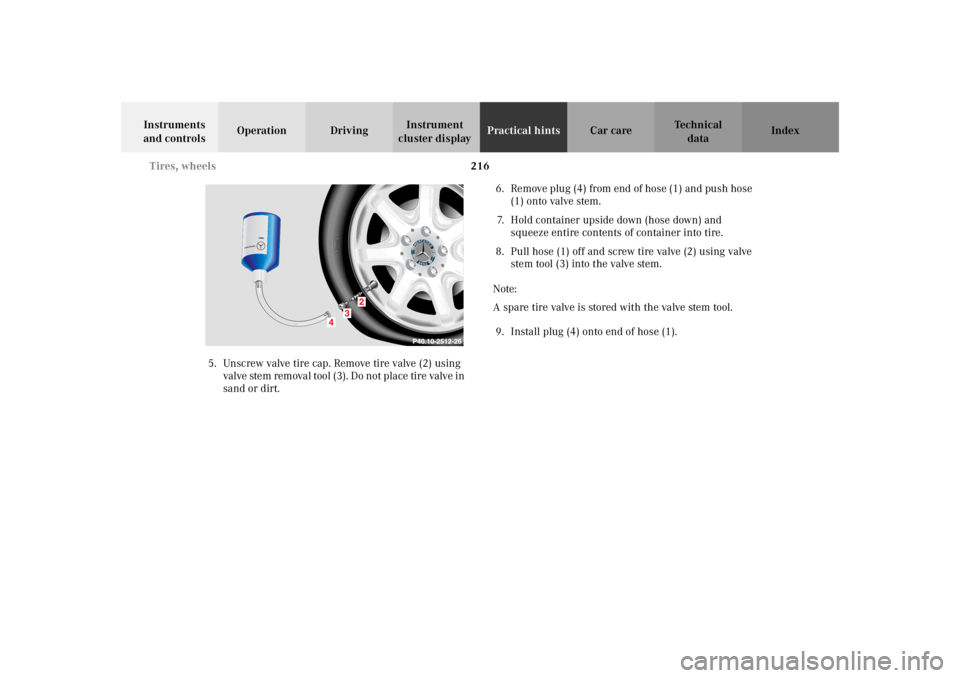
5. Unscrew valve tire cap. Remove tire valve (2) using
valve stem removal tool (3). Do not place tire valve in
sand or dirt.6. Remove plug (4) from end of hose (1) and push hose
(1) onto valve stem.
7. Hold container upside down (hose down) and
squeeze entire contents of container into tire.
8. Pull hose (1) off and screw tire valve (2) using valve
stem tool (3) into the valve stem.
Note:
A spare tire valve is stored with the valve stem tool.
9. Install plug (4) onto end of hose (1).
Page 220 of 290
217 Tires, wheels
Te ch n i c a l
data Instruments
and controlsOperation DrivingInstrument
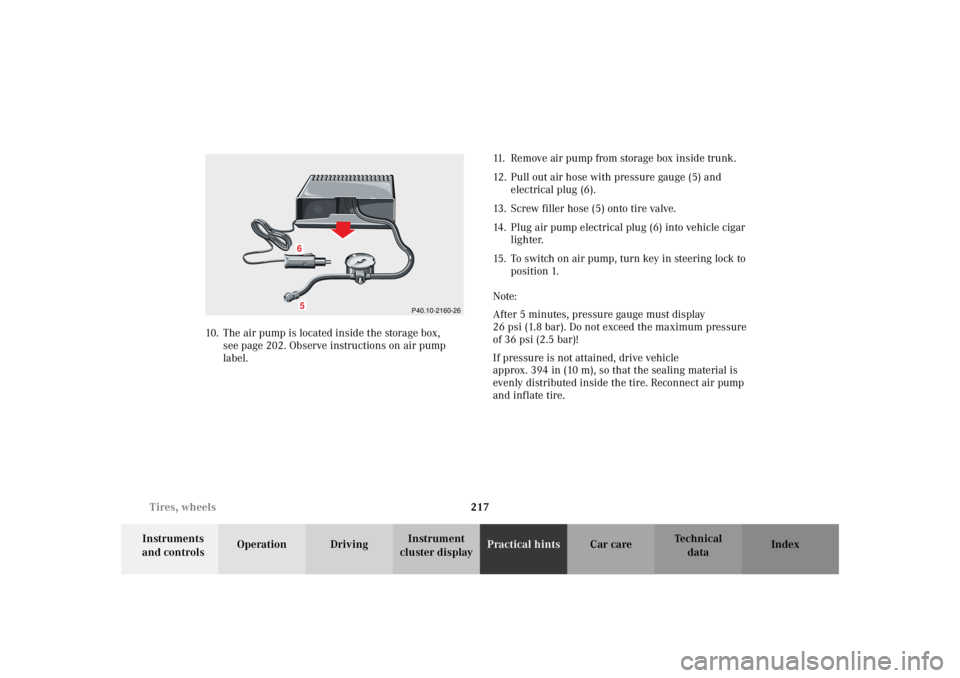
cluster displayPractical hintsCar care Index 10. The air pump is located inside the storage box,
see page 202. Observe instructions on air pump
label.11. Remove air pump from storage box inside trunk.
12. Pull out air hose with pressure gauge (5) and
electrical plug (6).
13. Screw filler hose (5) onto tire valve.
14. Plug air pump electrical plug (6) into vehicle cigar
lighter.
15. To switch on air pump, turn key in steering lock to
position 1.
Note:
After 5 minutes, pressure gauge must display
26 psi (1.8 bar). Do not exceed the maximum pressure
of 36 psi (2.5 bar)!
If pressure is not attained, drive vehicle
approx. 394 in (10 m), so that the sealing material is
evenly distributed inside the tire. Reconnect air pump
and inflate tire.
P40.10-2160-26
65
Page 221 of 290
218 Tires, wheels
Te ch n i c a l
data Instruments
and controlsOperation DrivingInstrument
cluster displayPractical hintsCar care Index
Note:
Do not operate electric air pump longer that 6 minutes
without interruption. Air pump could overheat! After air
pump has cooled off, operate air pump again.
16. To switch off air pump, turn key in steering lock to
position 0.
17. Reinstall valve tire cap.
18. Drive vehicle to distribute the sealant evenly inside
the tire.Notes:
If TIREFIT is liquid, clean water and a damp cloth will
remove the material from the vehicle or tire and wheel
components. Once TIREFIT sealing material had dried,
it can easily be peeled off and properly discarded.
Replace TIREFIT every 4 years.
Wa r n i n g !
If a tire pressure of 26 psi (1.8 bar) is not attained,
tire is too severely damaged for TIREFIT to provide
a reliable tire repair.In this case TIREFIT can not properly seal the tire.Do not drive the vehicle.Contact the nearest Mercedes-Benz Center or call
Roadside Assistance.
Wa r n i n g !
Do not exceed vehicle speed of 50 mph (80 km / h).
A TIREFIT repair is not designed to operate at
higher speeds.Vehicle handling characteristics may change.After driving vehicle for an initial 10 minutes,
check tire pressure. If tire pressure has fallen
below 20 psi (1.3 bar) do not continue to drive the
vehicle.If tire pressure is at least 20 psi (1.3 bar), inflate
tire to correct pressure (see label on fuel filler
flap), and drive vehicle to nearest tire repair
facility to have tire repaired or replaced.Recommended duration of use: 300 miles (500 km)
at 50 mph (80 km / h) with the recommended tire
pressure.
Page 222 of 290
219 Tires, wheels
Te ch n i c a l
data Instruments
and controlsOperation DrivingInstrument
cluster displayPractical hintsCar care Index Tire inflation pressure
A table (see fuel filler flap) lists the tire inflation
pressures specified for Mercedes-Benz recommended
tires as well as for the varying operating conditions.
Important!
Tire pressure changes by approximately 1.5 psi (0.1 bar)
per 18°F (10°C) of air temperature change. Keep this in
mind when checking tire pressure inside a garage -
especially in the winter.
Example:
If garage temperature = approximately +68°F (+20°C)
and ambient temperature = approximately +32°F (0°C)
then the adjusted air pressure = specified air pressure
+3psi (+0.2 bar).Tire pressures listed for light loads are minimum values
offering high driving comfort. Increased inflation
pressures for heavy loads produce favorable handling
characteristics with lighter loads and are perfectly
permissible. The ride of the vehicle, however, will
become somewhat harder.
Tire temperature and pressure increase with the vehicle
speed. Tire pressure should therefore only be checked
and corrected on cold tires. Correct tire pressure in
warm tires only if pressure has dropped below the
pressure listed in the table and the respective operating
conditions are taken into consideration.
An underinflated tire due to a slow leak (e.g. due to a
nail in the tire) may cause damage such as tread
separation, bulging etc.. Regular tire pressure checks at
intervals of no more than 14 days are therefore
essential.
Page 223 of 290
220 Battery
Te ch n i c a l
data Instruments
and controlsOperation DrivingInstrument
cluster displayPractical hintsCar care Index
If a tire constantly loses air, it should be inspected for
damage.
The spare tire should be checked periodically for
condition. Spare tire will age and become worn over
time even if never used, and thus should be inspected
and replaced when necessary.Battery
Important!
Battery replacement information:
The maintenance-free battery is located in the engine
compartment.
The service life of the battery is dependent on its
condition of charge. The battery should always be kept
sufficiently charged, in order to last an optimum length
of time.
Wa r n i n g !
Do not overinflate tires. Overinflating tires can
result in sudden deflation (blowout) because they
are more likely to become punctured or damaged
by road debris, potholes etc.. Follow recommended
inflation pressures.Do not overload the tires by exceeding the specified
vehicle capacity weight (as indicated by the label
on the driver’s door latch post). Overloading the
tires can overheat them, possibly causing a
blowout.
Wa r n i n g !
Failure to follow these instructions can result in
severe injury or death.Never lean over batteries while connecting, you
might get injured.Battery fluid contains sulfuric acid. Do not allow
this fluid to come in contact with eyes, skin or
clothing. In case it does, immediately flush affected
area with water and seek medical help.A battery will also produce hydrogen gas, which is
flammable and explosive. Keep flames or sparks
away from battery, avoid improper connection of
jumper cables, smoking etc..
Page 224 of 290
221 Battery
Te ch n i c a l
data Instruments
and controlsOperation DrivingInstrument
cluster displayPractical hintsCar care Index Therefore, we strongly recommend that you have the
battery charge checked frequently, and corrected if
necessary, especially if you use the vehicle less than
approximately 200 miles (300 km) per month,
mostly for short distance trips, or if it is not used for
long periods of time.
Only charge a battery with a battery charger after the
battery has been disconnected from the vehicle’s
electrical circuit.
Always disconnect the battery negative lead first and
connect last.
When removing and connecting the battery, always
make sure that all electrical consumers are off and the
key is in steering lock position 0. The battery must
always be securely installed when the vehicle is in
operation. During removal and installation always
protect the disconnected battery positive (+) terminal
with the cover attached to the battery.
While the engine is running the battery terminal clamps
must not be loosened or detached, otherwise the
generator and other electronic components will be
damaged.Battery recycling
Batteries contain materials that can harm the
environment with improper disposal.
Large 12 Volt storage batteries contain lead.
Recycling of batteries is the preferred method of
disposal.
Many states require sellers of batteries to accept old
batteries for recycling.
Page 225 of 290
222 Battery
Te ch n i c a l
data Instruments
and controlsOperation DrivingInstrument
cluster displayPractical hintsCar care Index
Jump startingImportant!
A discharged battery can freeze at approximately +14°F
(–10°C). In that case, it must be thawed out before
jumper cables are used. Attempting to jump start a
frozen battery can result in exploding, causing personal
injury.
Jumper cable specifications:
•Minimum cable cross-section of 25 mm
2 or
approximately 2 AWG
•Maximum length of 11.5 ft. (3.5 m).
If the battery is discharged, the engine should be started
with jumper cables and the (12 V) battery of another
vehicle.
Only use 12 V battery to jump start your vehicle. Jump
starting with more powerful battery could damage the
vehicle’s electrical systems, which will not be covered
by the Mercedes-benz Limited Warranty.
The battery is located in the engine compartment.
Wa r n i n g !
Failure to follow these directions will cause
damage to the electronic components, and can lead
to a battery explosion and severe injury or death.Never lean over batteries while connecting or jump
starting, you might get injured.Battery fluid contains sulfuric acid. Do not allow
this fluid to come in contact with eyes, skin or
clothing. In case it does, immediately flush affected
area with water, and seek medical help if
necessary.A battery will also produce hydrogen gas, which is
flammable and very explosive. Keep flames or
sparks away from battery, avoid improper
connection of jumper cables, smoking etc..Read all instructions before proceeding.