display MERCEDES-BENZ SLK CLASS 2002 Owners Manual
[x] Cancel search | Manufacturer: MERCEDES-BENZ, Model Year: 2002, Model line: SLK CLASS, Model: MERCEDES-BENZ SLK CLASS 2002Pages: 290, PDF Size: 18.21 MB
Page 226 of 290
223 Jump starting
Te ch n i c a l
data Instruments
and controlsOperation DrivingInstrument
cluster displayPractical hintsCar care Index Proceed as follows:
1. Position the vehicle with the charged battery so that
the jumper cables will reach, but never let the
vehicles touch. Make sure the jumper cables do not
have loose or missing insulation.
2. On both vehicles:
•Turn off engine and all lights and accessories,
except hazard warning flashers or work lights.
•Apply parking brake and shift selector lever to
position “P” (manual transmission to Neutral).
Important!
3. Clamp one end of the first jumper cable to the
positive (+) terminal of the discharged battery and
the other end to the positive (+) terminal of the
charged battery. Make sure the cable clamps do not
touch any other metal parts.
4. Clamp one end of the second jumper cable to the
grounded negative (–) terminal of the charged
battery and the final connection to a grounded
heavy metal bracket in the engine compartment or
on the engine of the disabled vehicle.Important!
5. Start engine of the vehicle with the charged battery
and run at high idle. Make sure the cables are not
on or near pulleys, fans, or other parts that will
move when the engine is started. Allow the
discharged battery to charge for a few minutes. Start
engine of the disabled vehicle in the usual manner.
6. After the engine has started, remove jumper cables
by exactly reversing the above installation
sequence, starting with the last connection made
first. When removing each clamp, make sure that it
does not touch any other metal while the other end
is still attached.
Note:
If engine does not run after several unsuccessful
starting attempts, have it checked at the nearest
authorized Mercedes-Benz Center.
Excessive unburned fuel may damage the catalytic
converter.
Page 227 of 290
224 Towing the vehicle
Te ch n i c a l
data Instruments
and controlsOperation DrivingInstrument
cluster displayPractical hintsCar care Index
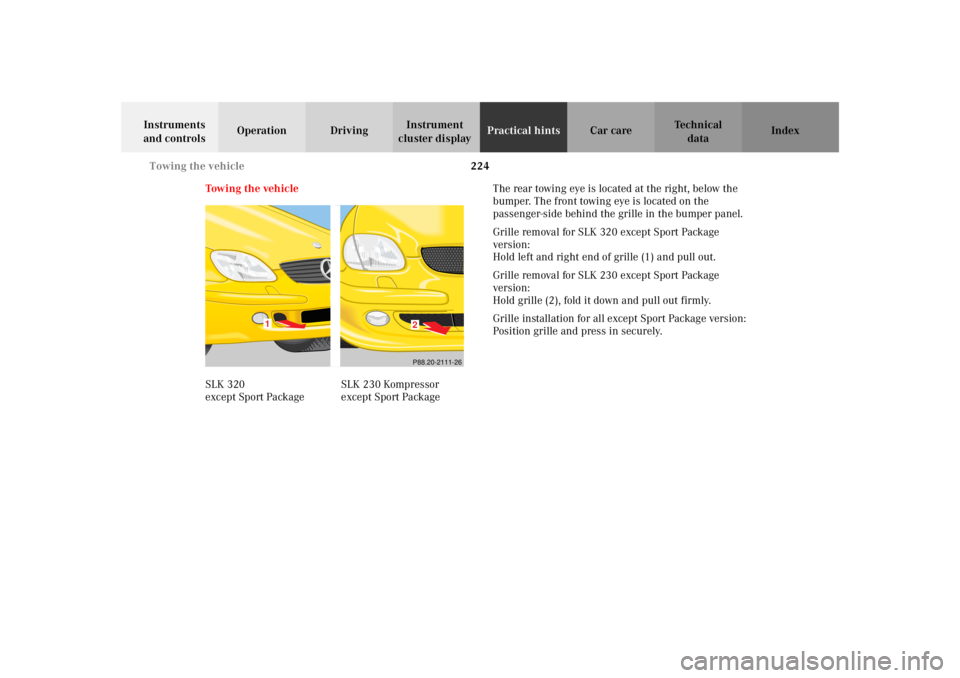
Tow i n g t h e ve h i c l eThe rear towing eye is located at the right, below the
bumper. The front towing eye is located on the
passenger-side behind the grille in the bumper panel.
Grille removal for SLK 320 except Sport Package
version:
Hold left and right end of grille (1) and pull out.
Grille removal for SLK 230 except Sport Package
version:
Hold grille (2), fold it down and pull out firmly.
Grille installation for all except Sport Package version:
Position grille and press in securely.
SLK 320
except Sport PackageSLK 230 Kompressor
except Sport Package
1
2P88.20-2111-26
Page 228 of 290
225 Towing the vehicle
Te ch n i c a l
data Instruments
and controlsOperation DrivingInstrument
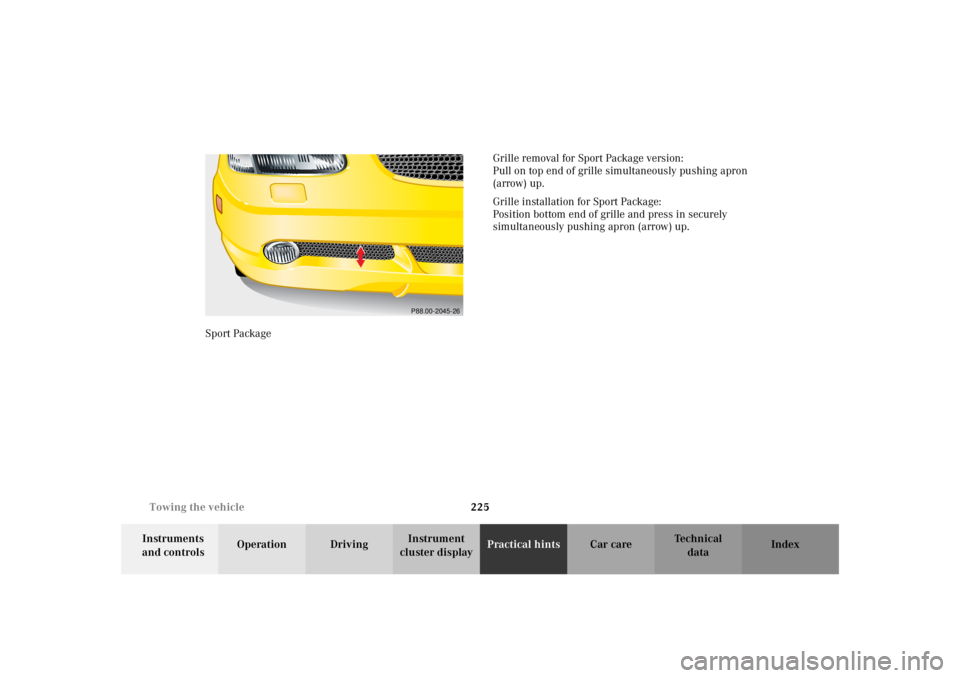
cluster displayPractical hintsCar care Index Sport PackageGrille removal for Sport Package version:
Pull on top end of grille simultaneously pushing apron
(arrow) up.
Grille installation for Sport Package:
Position bottom end of grille and press in securely
simultaneously pushing apron (arrow) up.
P88.00-2045-26
Page 229 of 290
226 Towing the vehicle
Te ch n i c a l
data Instruments
and controlsOperation DrivingInstrument
cluster displayPractical hintsCar care Index
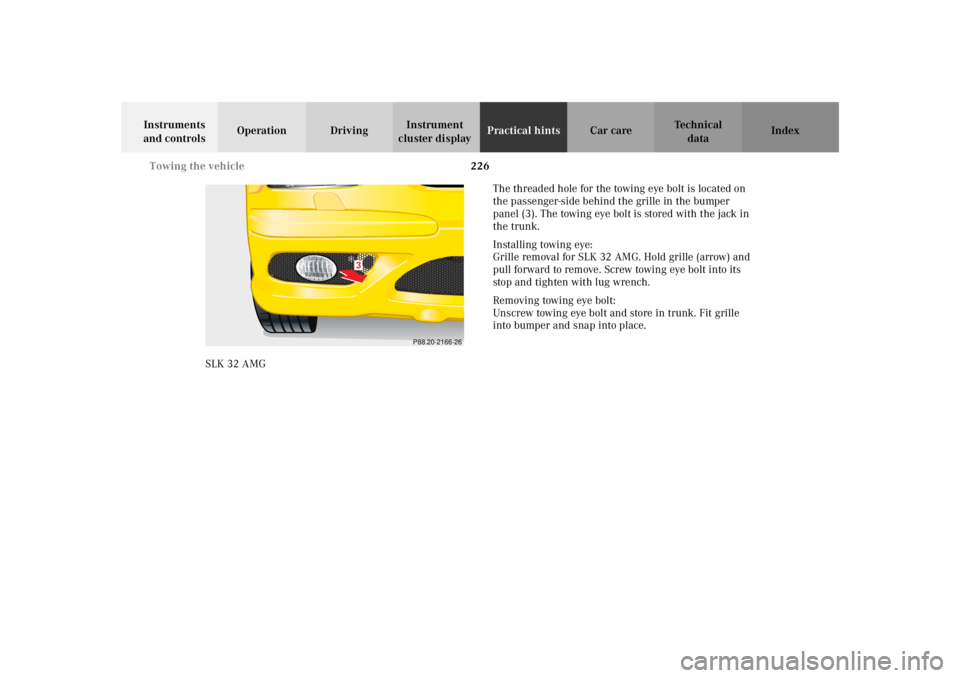
SLK 32 AMGThe threaded hole for the towing eye bolt is located on
the passenger-side behind the grille in the bumper
panel (3). The towing eye bolt is stored with the jack in
the trunk.
Installing towing eye:
Grille removal for SLK 32 AMG. Hold grille (arrow) and
pull forward to remove. Screw towing eye bolt into its
stop and tighten with lug wrench.
Removing towing eye bolt:
Unscrew towing eye bolt and store in trunk. Fit grille
into bumper and snap into place.
P88.20-2166-26
3
Page 230 of 290
227 Towing the vehicle
Te ch n i c a l
data Instruments
and controlsOperation DrivingInstrument
cluster displayPractical hintsCar care Index We recommend that the vehicle be transported using
flat bed equipment. This method is preferable to other
types of towing.
Do not tow with sling-type equipment. Front towing
with sling-type equipment over bumpy roads will
damage radiator and supports. Rear towing with sling-
type equipment over bumpy roads will damage the
lower edge of the front bumper cover.
Use wheel lift, dolly, or flat bed equipment, with key in
steering lock turned to position 0.
Towing restrictions for vehicles with automatic
transmission: The vehicle may be towed with all wheels
on the ground and the selector lever in position “N” for
distances up to 30 miles (50 km) and at a speed not to
exceed 30 mph (50 km / h). The key must be in steering
lock position 2.
To be certain to avoid a possibility of damage to the
transmission, however, we recommend the drive shaft
be disconnected at the rear axle drive flange for any
towing beyond a short tow to a nearby garage.Important!
When towing the vehicle, please, note the following:
With the automatic central locking activated and the
key in steering lock position 2, the vehicle doors lock if
the left front wheel as well as the right rear wheel are
turning at vehicle speeds of approximately 9 mph
(15 km / h) or more.
To prevent the vehicle door locks from locking,
deactivate the automatic central locking.
Wa r n i n g !
Prior to towing the vehicle with all wheels on the
ground make certain that the electronic key is in
steering lock position 2.
With the engine not running, there is no power
assistance for the braking and steering systems. In
this case, it is important to keep in mind that a
considerably higher degree of effort in necessary to
brake and steer the vehicle.
Page 231 of 290
228 Towing the vehicle
Te ch n i c a l
data Instruments
and controlsOperation DrivingInstrument
cluster displayPractical hintsCar care Index
Note:
To signal turns while being towed with hazard warning
flasher in use, turn key in steering lock to position 2 and
activate combination switch for left or right turn signal
in usual manner – only the selected turn signal will
operate. Upon canceling the turn signal, the hazard
warning flasher will operate again.Caution!
If the vehicle is towed with the front axle raised, the
engine must be shut off (key in steering lock position 0
or 1). Otherwise, the ESP will immediately be engaged
and will apply the rear wheel brakes. Switch off the
tow-away alarm as well as the automatic central locking,
see page 37 and page 31.
Page 232 of 290

229 Towing the vehicle
Te ch n i c a l
data Instruments
and controlsOperation DrivingInstrument
cluster displayPractical hintsCar care Index Transmission selector lever, manually unlocking
In the case of power failure the transmission selector
lever can be manually unlocked, e.g. when towing the
vehicle.To do so, insert a pin (1), e.g. ball point pen, into the
covered opening below the position “D” of the shift
pattern. While pushing the pin down, move selector
lever from position “P”.
After removal of the pin from the opening, the cover will
not close fully. Only after moving the selector lever to
positions “D+” and “D–” does the cover return to its
closed position.
P27.60-2101-26
1
Page 233 of 290

230 Exterior lamps
Te ch n i c a l
data Instruments
and controlsOperation DrivingInstrument
cluster displayPractical hintsCar care Index
Exterior lamps
Replacing bulbsNotes:
To prevent a possible electrical short circuit, switch off
lamp prior to replacing a bulb.
When replacing bulbs, install only 12 volt bulbs with
the specified watt rating.
When replacing halogen bulbs do not touch glass
portion of bulb with bare hands. Use plain paper or a
clean cloth.
Wa r n i n g !
Halogen lamps contain pressurized gas. A bulb can
explode if you:
• touch or move it when hot,
•drop the bulb,
•scratch the bulb.Wear eye and hand protection.Because of high voltage in Xenon lamps, it is
dangerous to replace the bulb or repair the Lamp
and its components. We recommend that you have
such work done by a qualified technician.
Page 234 of 290
231 Exterior lamps
Te ch n i c a l
data Instruments
and controlsOperation DrivingInstrument
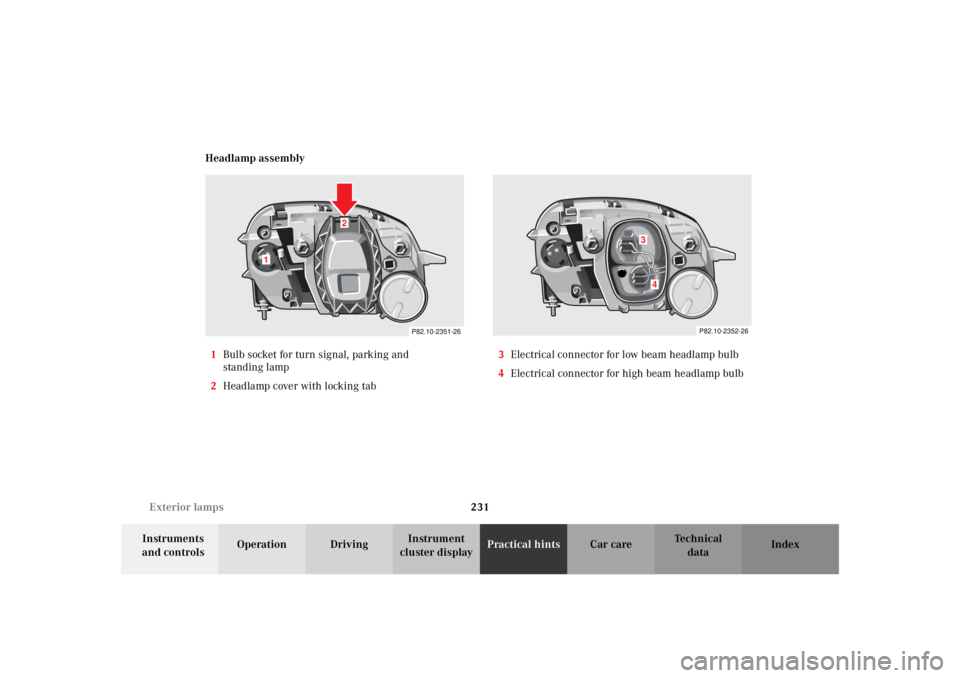
cluster displayPractical hintsCar care Index Headlamp assembly
1Bulb socket for turn signal, parking and
standing lamp
2Headlamp cover with locking tab3Electrical connector for low beam headlamp bulb
4Electrical connector for high beam headlamp bulb
2
P82.10-2351-26
1
P82.10-2352-26
3
4
Page 235 of 290

232 Exterior lamps
Te ch n i c a l
data Instruments
and controlsOperation DrivingInstrument
cluster displayPractical hintsCar care Index
Bulbs for high and low beam
H 7 (55 W)
Open hood.
Push down tab at top end of cover (2) and remove. Pull
off electrical connector (3) or (4). Unhook clamping ring
and pull out bulb together with clamping ring. Remove
bulb.
Insert new bulb (seating properly in cutouts of bulb
socket), mount clamping ring. Reinstall and push
electrical connector on securely. Reinstall cover (2).Xenon bulb for low beam (optional)
D2R (35W)
Wa r n i n g !
Because of high voltage in Xenon lamps, it is
dangerous to replace the bulb or repair the lamp
and its components. We recommend that you have
such work done by a qualified technician.