check engine MERCEDES-BENZ SLK ROADSTER 2008 User Guide
[x] Cancel search | Manufacturer: MERCEDES-BENZ, Model Year: 2008, Model line: SLK ROADSTER, Model: MERCEDES-BENZ SLK ROADSTER 2008Pages: 273, PDF Size: 4.42 MB
Page 183 of 273
Display
messages 18
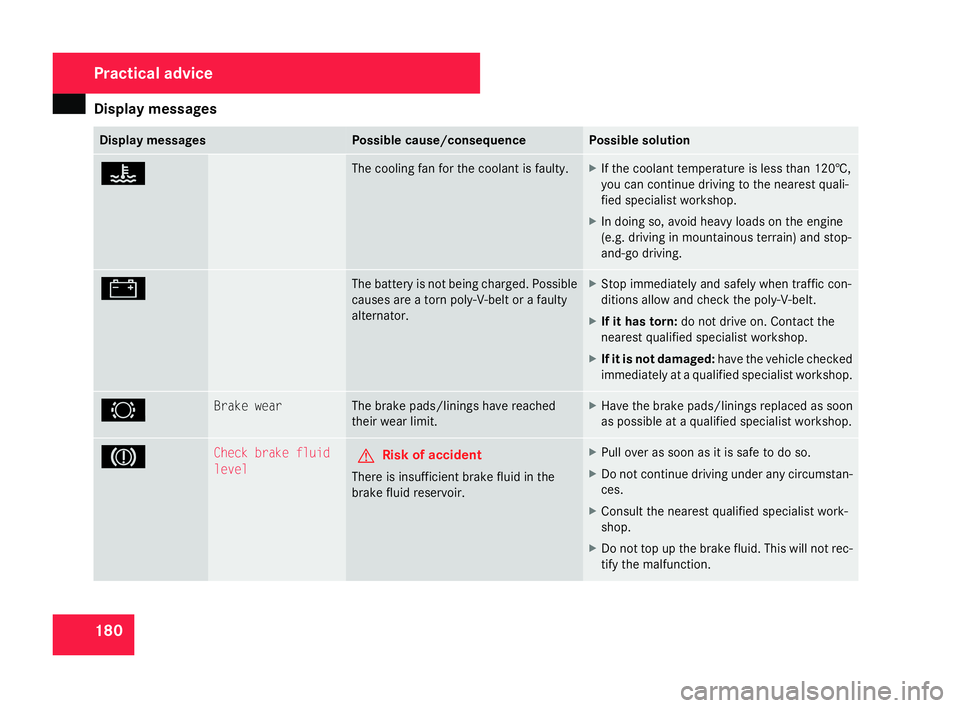
0 Display messages Possible cause/consequence Possible solution
D The cooling fan for the coolant is faulty. X
If the coolant temperature is less than 120†,
you can continue driving to the nearest quali-
fied specialist workshop.
X In doing so, avoid heavy loads on the engine
(e.g. driving in mountainous terrain) and stop-
and-go driving. # The battery is not being charged. Possible
causes are a torn poly-V-belt or a faulty
alternator. X
Stop immediately and safely when traffic con-
ditions allow and check the poly-V-belt.
X If it has torn: do not drive on. Contact th e
nearest qualified specialist workshop .
X If it is not damaged :have the vehicle checked
immediately at a qualified specialist workshop. 2 Brake wear The brake pads/linings have reached
their wear limit. X
Have the brake pads/linings replaced as soon
as possible at a qualified specialist workshop .3 Check brake fluid
level
G
Risk of accident
There is insufficient brake fluid in the
brake fluid reservoir. X
Pull over as soon as it is safe to do so.
X Do not continue driving under any circumstan-
ces .
X Consult the nearest qualified specialist work -
shop.
X Do not top up the brake fluid. This will not rec -
tify the malfunction. Practical advice
171_AKB; 3; 4, en-G
B
vpfaff7, 2007-11-13T10:50:25+01:00 - Seite 180
Page 185 of 273
Display
messages 18
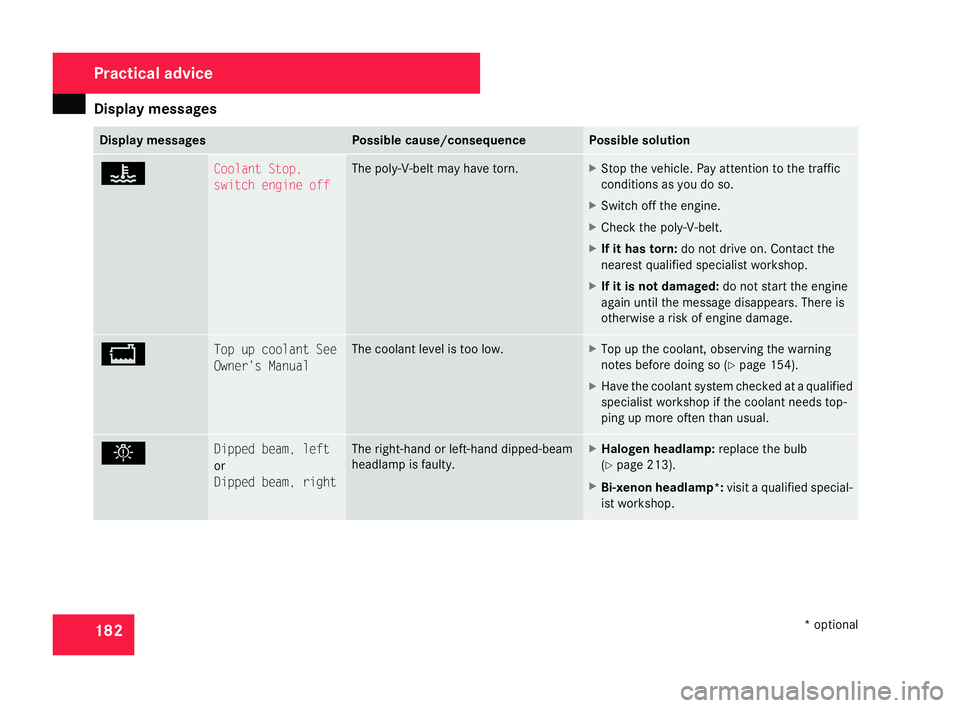
2 Display messages Possible cause/consequence Possible solution
D Coolant Stop,
switch engine off The poly-V-belt may have torn. X
Stop the vehicle. Pay attention to the traffic
conditions as you do so.
X Switch off the engine.
X Check the poly-V-belt .
X If it has torn: do not drive on. Contact th e
nearest qualified specialist workshop .
X If it is not damaged :do not start the engin e
again until the message disappears. There is
otherwise a risk of engine damage. B Top up coolant See
Owner's Manual The coolant level is too low. X
Top up the coolant, observing the warning
notes before doing so (Y page 154).
X Have the coolant system checked at a qualified
specialist workshop if the coolant needs top-
ping up more often than usual .. Dipped beam, left
or
Dipped beam, right The right-hand or left-hand dipped-beam
headlamp is faulty. X
Halogen headlamp: replace the bulb
( Y page 213).
X Bi-xenon headlamp* :visit a qualified special-
ist workshop. Practical advice
* optional
171_AKB; 3; 4, en-GB
vpfaff7,
2007-11-13T10:50:25+01:00 - Seite 182
Page 189 of 273
Display
messages 18
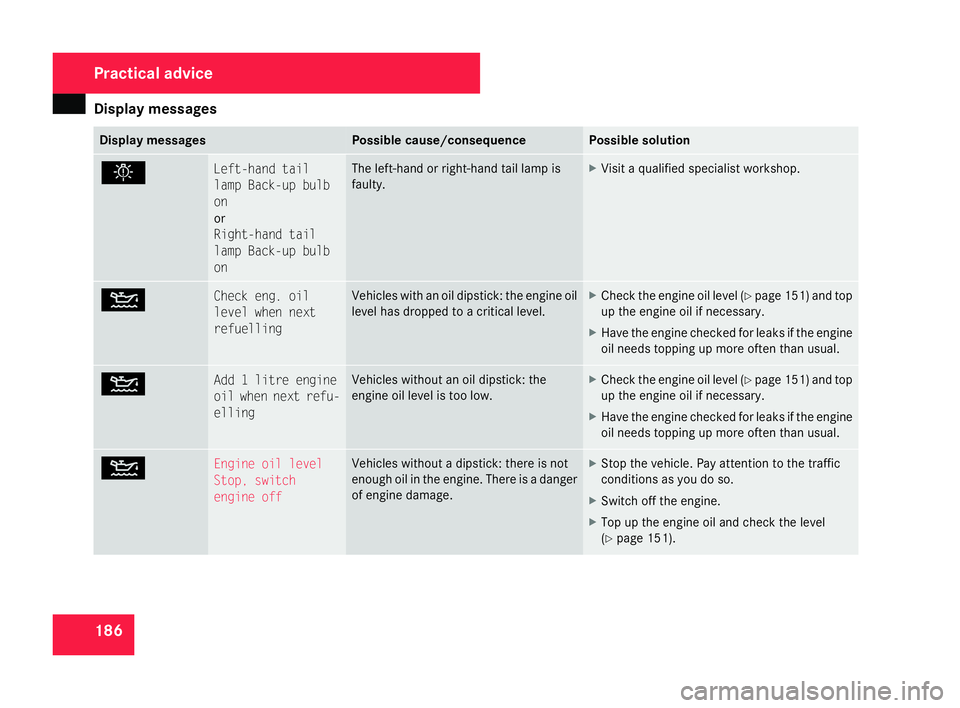
6 Display messages Possible cause/consequence Possible solution
. Left-hand tail
lamp Back-up bulb
on
or
Right-hand tail
lamp Back-up bulb
on The left-hand or right-hand tail lamp is
faulty. X
Visit a qualified specialist workshop. N Check eng. oil
level when next
refuelling Vehicles with an oil dipstick: the engine oil
level has dropped to a critical level. X
Check the engine oil level (Y page 151 )and top
up the engine oil if necessary .
X Have the engine checked for leaks if the engine
oil needs topping up more often than usual .N Add 1 litre engine
oil when next refu-
elling Vehicles without an oil dipstick: the
engine oil level is too low. X
Check the engine oil level (Y page 151 )and top
up the engine oil if necessary .
X Have the engine checked for leaks if the engine
oil needs topping up more often than usual .N Engine oil level
Stop, switch
engine off Vehicles without a dipstick: there is not
enough oil in the engine. There is a danger
of engine damage. X
Stop the vehicle. Pay attention to the traffic
conditions as you do so.
X Switch off the engine.
X Top up the engine oil and check the level
(Y page 151). Practical advice
171_AKB; 3; 4, en-GB
vpfaff7,
2007-11-13T10:50:25+01:00 - Seite 186
Page 198 of 273
Troubleshooting
19
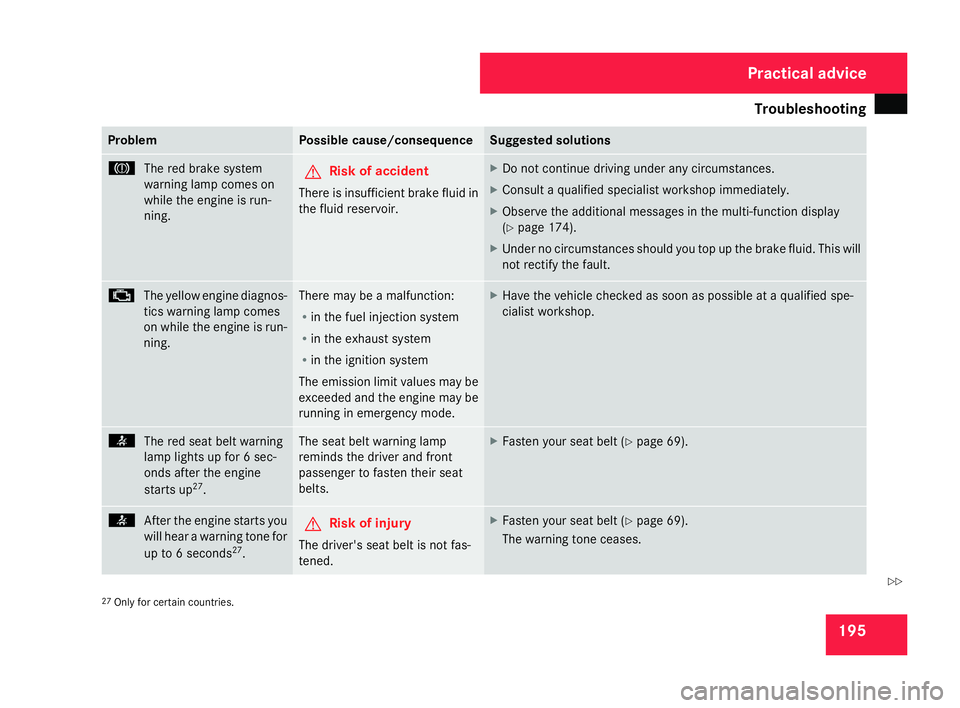
5 Problem Possible cause/consequence Suggested solutions
3
The red brake system
warning lamp comes on
while the engine is run-
ning. G
Risk of accident
There is insufficient brake fluid in
the fluid reservoir. X
Do not continue driving under any circumstances .
X Consult a qualified specialist workshop immediately.
X Observe the additional messages in the multi-function display
(Y page 174).
X Under no circumstances should you top up the brake fluid. This will
not rectify the fault. ±
The yellow engine diagnos-
tics warning lamp comes
on while the engine is run-
ning. There may be a malfunction:
R
in the fuel injection system
R in the exhaust system
R in the ignition system
The emission limit values may be
exceeded and the engine may be
running in emergency mode. X
Have the vehicle checked as soon as possible at a qualified spe -
cialist workshop. <
The red seat belt warning
lamp lights up for 6 sec-
onds after the engine
starts up 27
. The seat belt warning lamp
reminds the driver and front
passenger to fasten their seat
belts. X
Fasten your seat belt (Y page 69). <
After the engine starts yo u
will hear a warning tone for
up to 6 second s27
. G
Risk of injury
The driver's seat belt is not fas -
tened. X
Fasten your seat belt (Y page 69).
The warning tone ceases. 27
Only for certain countries. Practical advice
171_AKB; 3; 4, en-GB
vpfaff7,
2007-11-13T10:50:25+01:00 - Seite 195 Z
Page 205 of 273
Troubleshooting
20
2 Problem Possible cause/consequence Suggested solutions
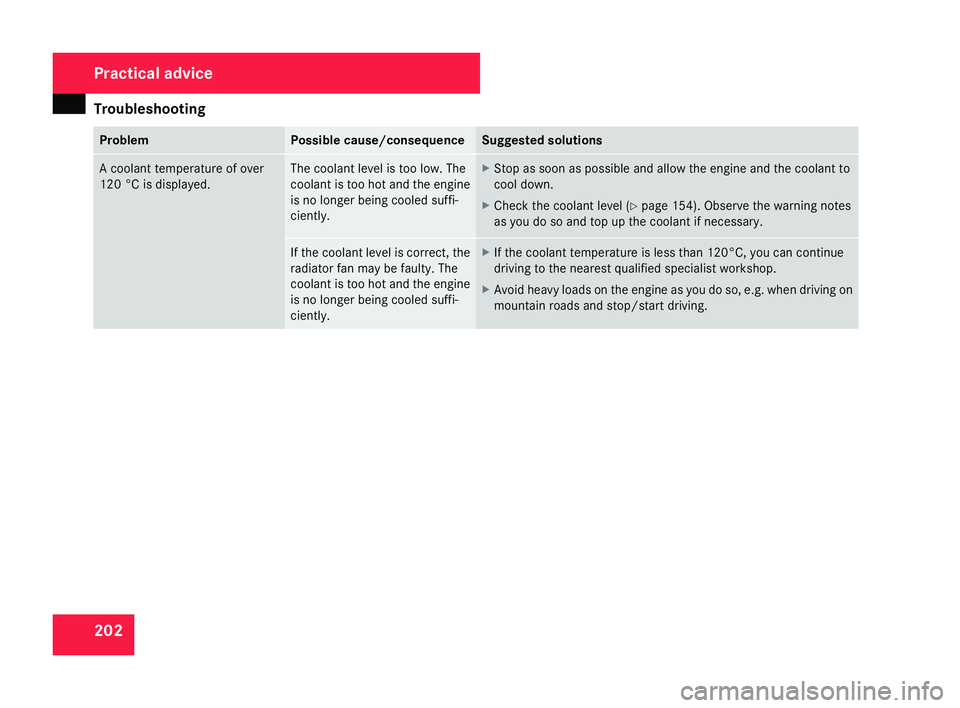
A coolant temperature of over
120 °C is displayed. The coolant level is too low. The
coolant is too hot and the engine
is no longer being cooled suffi-
ciently. X
Stop as soon as possible and allow the engine and the coolant to
cool down.
X Check the coolant level (Y page 154). Observe the warning notes
as you do so and top up the coolant if necessary. If the coolant level is correct, the
radiator fan may be faulty. The
coolant is too hot and the engin
e
is no longer being cooled suffi-
ciently. X
If the coolant temperature is less than 120°C, you can continue
driving to the nearest qualified specialist workshop.
X Avoid heavy loads on the engine as you do so, e.g. when driving on
mountain roads and stop/start driving .Practical advice
171_AKB; 3; 4, en-GB
vpfaff7,
2007-11-13T10:50:25+01:00 - Seite 202
Page 206 of 273
Troubleshooting
20
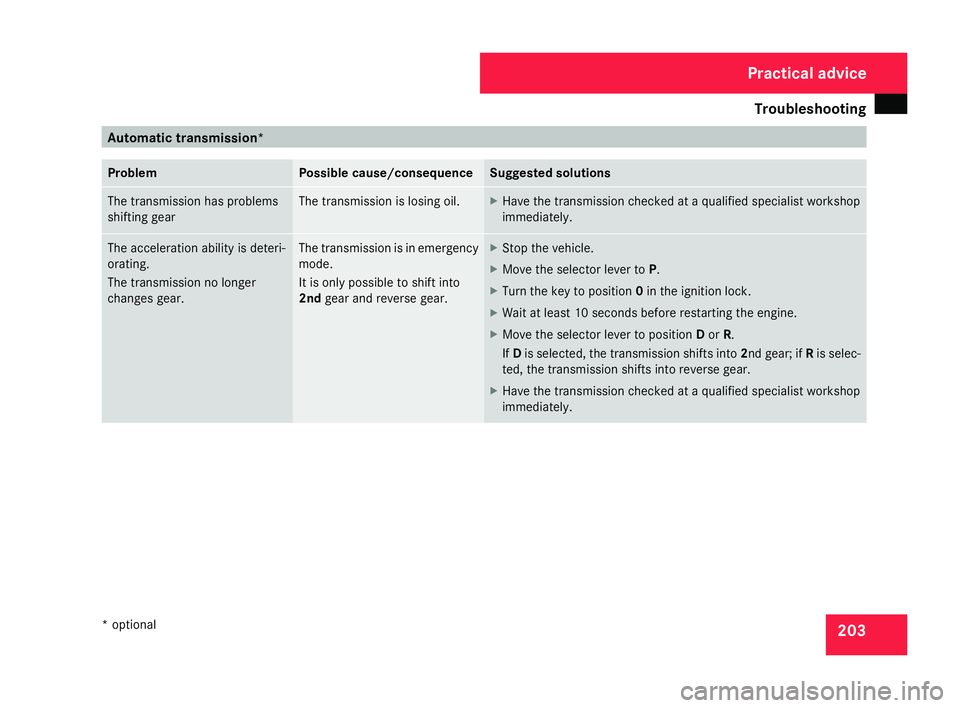
3 Automatic transmission
*Problem Possible cause/consequence Suggested solutions
The transmission has problems
shifting gear The transmission is losing oil. X
Have the transmission checked at a qualified specialist workshop
immediately . The acceleration ability is deteri-
orating.
The transmission no longer
changes gear. The transmission is in emergenc
y
mode.
It is only possible to shift into
2nd gear and reverse gear. X
Stop the vehicle.
X Move the selector lever to P.
X Turn the key to position 0in the ignition lock .
X Wait at least 10 seconds before restarting the engine.
X Move the selector lever to position Dor R.
If D is selected, the transmission shifts into 2nd gear; if Ris selec -
ted, the transmission shifts into reverse gear .
X Have the transmission checked at a qualified specialist workshop
immediately . Practical advice
* optional
171_AKB; 3; 4, en-GB
vpfaff7,
2007-11-13T10:50:25+01:00 - Seite 203
Page 211 of 273
Troubleshooting
20
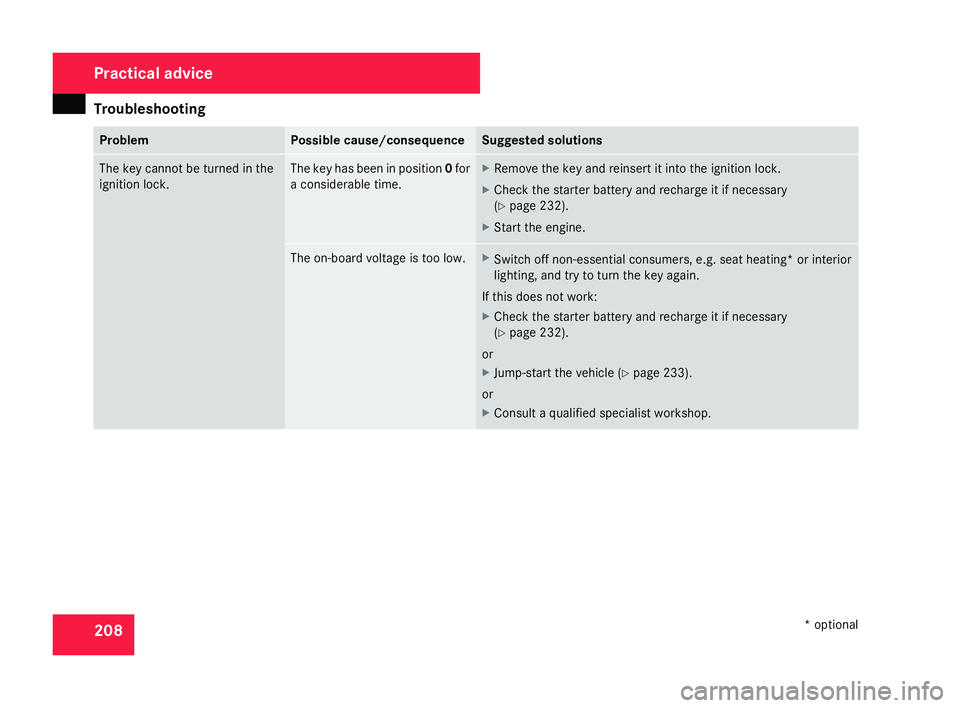
8 Problem Possible cause/consequence Suggested solutions
The key cannot be turned in the
ignition lock. The key has been in position
0for
a considerable time. X
Remove the key and reinsert it into the ignition lock.
X Check the starter battery and recharge it if necessary
(Y page 232).
X Start the engine. The on-board voltage is too low. X
Switch off non-essential consumers, e.g. seat heating* or interio r
lighting, and try to turn the key again.
If this does not work :
X Check the starter battery and recharge it if necessary
(Y page 232).
or
X Jump-start the vehicle (Y page 233).
or
X Consult a qualified specialist workshop. Practical advice
* optional
171_AKB; 3; 4, en-GB
vpfaff7,
2007-11-13T10:50:25+01:00 - Seite 20
8
Page 234 of 273
Battery
23
1 step out of the vehicle first and touch the
bodywork.
R Do not wipe the battery using a cloth. Th e
battery may explode as a result of elec-
trostatic charge or through the creation
of sparks .
! Switch the engine off and remove the key
before unscrewing or disconnecting the
terminal clamps from the battery. You may
otherwise destroy electronic components
such as the alternator.
Have the battery checked and, if neces-
sary, replaced at a qualified specialist
workshop, e.g. a Mercedes-Benz Service
Centre, every two years or at least every
20,000 km.
i Mercedes-Benz recommends that you
have all work involving the battery, e.g.
removing, charging and replacing, carried
out at a qualified specialist workshop, e.g.
a Mercedes-Benz Service Centre.
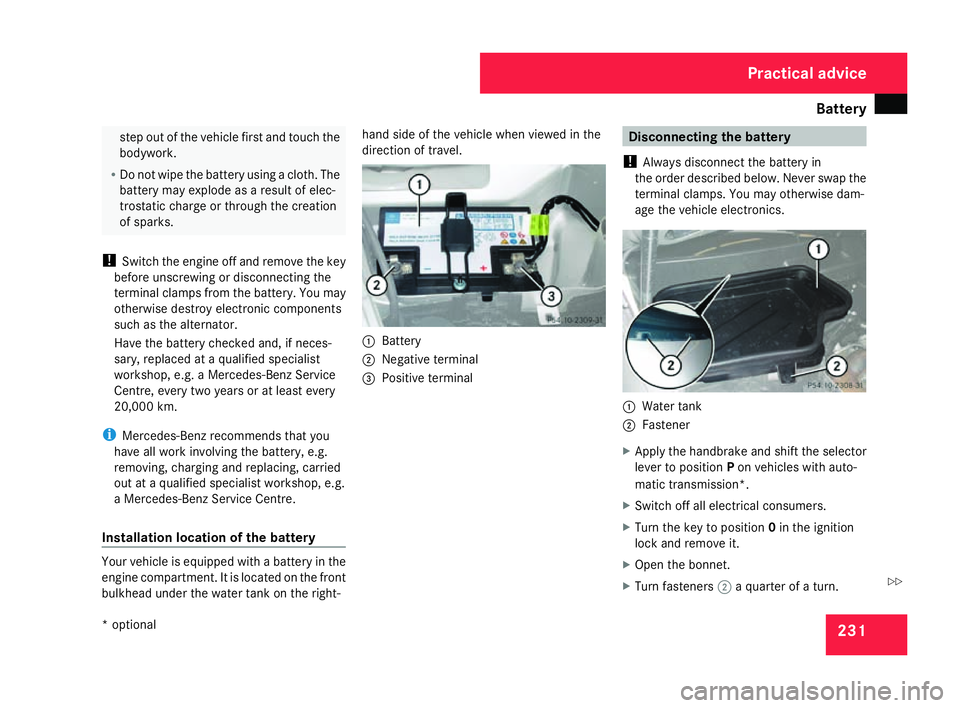
Installation location of the battery Your vehicle is equipped with a battery in the
engine compartment. It is located on the front
bulkhead under the water tank on the right- hand side of the vehicle when viewed in the
direction of travel.
1
Battery
2 Negative terminal
3 Positive terminal Disconnecting the battery
! Always disconnect the battery in
the order described below. Never swap the
terminal clamps. You may otherwise dam-
age the vehicle electronics. 1
Water tank
2 Fastener
X Apply the handbrake and shift the selecto r
lever to position Pon vehicles with auto-
matic transmission*.
X Switch off all electrical consumers .
X Turn the key to position 0in the ignition
lock and remove it.
X Open the bonnet.
X Turn fasteners 2a quarter of a turn. Practical advice
* optional
171_AKB; 3; 4, en-GB
vpfaff7,
2007-11-13T10:50:25+01:00 - Seite 23
1 Z
Page 237 of 273
Towing and tow-startin
g234
X
Start the engine of the donor vehicle and
run it at idling speed .
X Connect negative terminal 3of the donor
battery to earth point 4of your vehi-
cle using the jump lead, connecting the
jump lead to the donor battery first.
X Start the engine.
X Electrical consumers can be switched on
again. Do not switch the lights on however ,
as this will overload the battery.
X Remove the jump lead from eart h
point 4and negative terminal 3first,
then from positive terminal 2and positiv e
terminal 1, each time disconnecting from
the battery on your own vehicle first .
X Have the battery checked at a qualified
specialist workshop, e.g. a Mercedes-Benz
Service Centre. Towing and tow-starting
Points to remember
G
Risk of accident
If you tow the vehicle, you must use a rigid
towing bar if:
R the engine is not running
R there is a brake system malfunctio n
R the voltage supply or the vehicle's elec-
trical system is damage d
There is no power assistance for the steer-
ing when the engine is not running.
It is better to have the vehicle transported
than to have it towed.
When towing, observe the legal requirement s
in all countries concerned.
! When towing, pull away slowly and with-
out jerking. If the tractive power is too high,
the vehicles could be damaged. Do not use
the towing eye for recovery.
! You may tow the vehicle for a maximum
of 50 km. A towing speed of 50 km/h must
not be exceeded.
With towing distances over 50 km, the
entire vehicle needs to be lifted up and
transported. !
Only secure the tow cable or towing bar
to the towing eyes. You may otherwise
damage the vehicle.
R Vehicles with an automatic transmission*
must not be tow-started.
R If the engine does not start, try jump-start-
ing it (Y page 233).
R If it is not possible to jump-start the vehicle ,
have it towed to the nearest qualified spe-
cialist workshop, e.g. a Mercedes-Ben z
Service Centre.
R If the vehicle has suffered transmission
damage, it must only be towed with the rear
axle raised.
R The selector lever must be in position Non
vehicles with automatic transmission*.
R If you are towing the vehicle over a consid-
erable distance, this may only be done with
the rear axle raised.
R The ignition must be switched off if you are
towing the vehicle with the front/rear axle
raised. Intervention by ESP ®
could other-
wise damage the brake system.
R Before towing the vehicle, make sure that
the battery is connected and charged. Oth-
erwise : Practical advice
* optional
171_AKB; 3; 4, en-GB
vpfaff7,
2007-11-13T10:50:25+01:00 - Seite 234