check engine MERCEDES-BENZ SLK ROADSTER 2008 Owners Manual
[x] Cancel search | Manufacturer: MERCEDES-BENZ, Model Year: 2008, Model line: SLK ROADSTER, Model: MERCEDES-BENZ SLK ROADSTER 2008Pages: 273, PDF Size: 4.42 MB
Page 8 of 273
5
COMAN
D. . . . . . . . . . . . . . . . . . . . . . . .94
On-board computer . . . . . . . . . . . . .94
Constant headlamp mod e
Setting (on-board computer) . . . . .104
Consumption statistics (on-board
computer) . . . . . . . . . . . . . . . . . . . . . .107
Coolan t. . . . . . . . . . . . . . . . . . . . . . . .154
Checking the level . . . . . . . . . . . . .154
Display message . . . . . .180, 181, 182
Mixture ratio . . . . . . . . . . . . . . . . .259
Temperature gauge . . . . . . . . . . . . .96
Cruise control . . . . . . . . . . . . . . . . . .109
Display message . . . . . . . . . . . . . .179
Cup holde r. . . . . . . . . . . . . . . . . . . . .136 D
Dashboar d
see Cockpit
Date
Setting (on-board computer) . . . . .103
Daytime driving lights
see Constant headlamp mode
Delayed switch-off
Exterior lighting (on-board com-
puter) . . . . . . . . . . . . . . . . . . . . . . .105
Interior lighting (on-board com-
puter) . . . . . . . . . . . . . . . . . . . . . . .105
Digital speedometer . . . . . . . . . . . . ..96 Dipped-beam headlamps
Automatic headlamp mode* . . . . . .74
Display message . . . . . . . . . . . . . .182
Symmetrical . . . . . . . . . . . . . . . . . .164
Display messag e. . . . . . . . . . . . . . . .174
Service . . . . . . . . . . . . . . . . . . . . . .165
Symbol messages . . . . . . . . . . . . .179
Text messages . . . . . . . . . . . . . . . .175
Up (AMG menu) . . . . . . . . . . . . . . . .96
Door
Automatic locking . . . . . . . . . . . . . .57
Display message . . . . . . . . . . . . . .179
Emergency locking . . . . . . . . . . . . .211
Emergency unlocking . . . . . . . . . . .210
Opening (from the inside) . . . . . . . .57
Door control panel
Overview . . . . . . . . . . . . . . . . . . . . .33
Draught stop . . . . . . . . . . . . . . . . . . .135
Drinks holde r
see Cup holder
Driver's airbag . . . . . . . . . . . . . . . . . . .42
Driver's seat position . . . . . . . . . . . ..71
Driving abroad . . . . . . . . . . . . . . . . . .164
Driving safety syste m. . . . . . . . . . . . .50
ABS . . . . . . . . . . . . . . . . . . . . . . . . .50
BAS . . . . . . . . . . . . . . . . . . . . . . . . .50
ESP ®
. . . . . . . . . . . . . . . . . . . . . . . .51
Driving syste m. . . . . . . . . . . . . . . . . .109
Cruise control . . . . . . . . . . . . . . . .109 Parktroni
c.. . . . . . . . . . . . . . . . . .115
Speedtronic . . . . . . . . . . . . . . . . . .112
Driving tip
Braking . . . . . . . . . . . . . . . . . . . . . .162
Driving abroad . . . . . . . . . . . . . . . .164
Driving on flooded road s.. . . . . ..164
Driving on wet road s.. . . . . . . . ..164
Winter . . . . . . . . . . . . . . . . . . . . . .161
DVD audio
Operation (on-board computer) . . . .99
DVD video
Operation (on-board computer) . . . .99 E
Easy-entry/exit feature Activating/deactivating (on -
board computer) . . . . . . . . . . . . . .106
Easy-entry feature . . . . . . . . . . . . . . ..65
Easy-exit feature . . . . . . . . . . . . . . . . .65
Electrical/electronic equipment Retrofittin g.. . . . . . . . . . . . . . . . . .241
Electronic Stability Program
see ESP ®
e mark . . . . . . . . . . . . . . . . . . . . . . . . .241
Emergency engine starting . . . . . ..236
Emergency key element Lost . . . . . . . . . . . . . . . . . . . . . . . .207
Emergency locking
Vehicle . . . . . . . . . . . . . . . . . . . . . .211 Index
171_AKB; 3; 4, en-GB
vpfaff7,
2007-11-13T10:50:25+01:00 - Seite
5
Page 9 of 273
6
Emergency running mod
e
Automatic transmission . . . . . . . . .203
Emergency unlocking
Boot . . . . . . . . . . . . . . . . . . . . . . . .211
Vehicle . . . . . . . . . . . . . . . . . . . . . .210
Engine
Display message . . . . . . . . . . . . . .187
Running irregularl y.. . . . . . . . . . . .201
Starting problems . . . . . . . . . . . . .201
Starting with the key . . . . . . . . . . . .81
Technical data . . . . . . . . . . . . . . . .244
Engine diagnostic warning lamp . ..1 95
Engine electronics . . . . . . . . . . . . . ..241
Malfunction . . . . . . . . . . . . . . . . . .201
Engine number . . . . . . . . . . . . . . . . . .243
Engine oil . . . . . . . . . . . . . . . . . . . . . .258
Checking the oil level (dipstick) . . .153
Checking the oil level (on-board
computer) . . . . . . . . . . . . . . . . . . .152
Consumption . . . . . . . . . . . . . . . . .151
Display message . . . . . . . . . . . . . . . . . . .152, 186, 187
Filler neck . . . . . . . . . . . . . . . . . . .153
Temperature display (on-board
computer) . . . . . . . . . . . . . . . . . . . .96
Topping up . . . . . . . . . . . . . . . . . . .153
ESP ®
(Electronic Stability Program) .51
Activating/deactivating . . . . . . . . . .51
Display message . . . . . . . . . .176, 177
Warning lamp . . . . . . . . . . . . . .51, 194 Exterior lighting
Delayed switch-off (on-board
computer) . . . . . . . . . . . . . . . . . . .105
Exterior mirror parking position
Storing . . . . . . . . . . . . . . . . . . . .67, 69
Exterior mirrors
Adjusting . . . . . . . . . . . . . . . . . . . . .66
Anti-dazzle mode (automatic) . . . . .67
Folding in/out (automatically ).. . . .66
Folding in/out (electrically) . . . . . . .66
Folding in when locking (on-board
computer) . . . . . . . . . . . . . . . . . . .106
Malfunction . . . . . . . . . . . . . . . . . .206
Parking position . . . . . . . . . . . . .67, 69
Resetting . . . . . . . . . . . . . . . . . . . . .66
Storing settings . . . . . . . . . . . . . . . .68
Exterior view
Overview . . . . . . . . . . . . . . . . . . . . .18 F
Fire extinguishe r. . . . . . . . . . . . . . . .174
First-aid kit . . . . . . . . . . . . . . . . . . . . .174
Flat tyre Preparing the vehicle . . . . . . . . . . .218
TIREFIT kit . . . . . . . . . . . . . . . . . . .219
Floormat . . . . . . . . . . . . . . . . . . . . . . .146
Foglamps Display message . . . . . . . . . . . . . .185
Fording . . . . . . . . . . . . . . . . . . . . . . . .164 Frequencies
Garage door opene r.. . . . . . . . . . .262
Telephone . . . . . . . . . . . . . . . . . . .242
Front airbag . . . . . . . . . . . . . . . . . . . . .42
Front-passenger airbag . . . . . . . . . . ..42
Fuel . . . . . . . . . . . . . . . . . . . . . . . . . . .255
Loss . . . . . . . . . . . . . . . . . . . . . . . .200
Petrol . . . . . . . . . . . . . . . . . . . . . . .149
Fuel consumptio n. . . . . . . . . . .256, 257
Fuel filler flap Opening/closing . . . . . . . . . . . . . .148
Fuel lin e
Malfunction . . . . . . . . . . . . . . . . . .200
Fuel tank
Malfunction . . . . . . . . . . . . . . . . . .200
Fuse allocation chart . . . . . . . . . . ..237
Fuse box Boot . . . . . . . . . . . . . . . . . . . . . . . .238
Dashboard . . . . . . . . . . . . . . . . . . .238
Engine compartment . . . . . . . . . . .238
Fuse s. . . . . . . . . . . . . . . . . . . . . . . . . .237 G
Garage door Opening/closing (with the remote
control) . . . . . . . . . . . . . . . . . . . . .145
Garage door opener . . . . . . . . . . . . ..144
Clearing the memory . . . . . . . . . . .146 Index
171_AKB; 3; 4, en-GB
vpfaff7,
2007-11-13T10:50:25+01:00 - Seite
6
Page 10 of 273
7
Frequencies . . . . . . . . . . . . . . . . .
.262
Programming the remote control . .144
Gear indicator (on-board computer) .96
Gearshift program Manua l.. . . . . . . . . . . . . . . . . . . . . .88
Genuine Mercedes-Benz parts . . . ..240
Glove compartment . . . . . . . . . . . . ..138
Golf bag Storage location . . . . . . . . . . . . . . .138
Gross vehicle weight, maximum
permissible . . . . . . . . . . . . . . . . . . . . .253 H
Handbrake Display message . . . . . . . . . . . . . .181
Head/thorax airbags . . . . . . . . . . . . ..43
Headlamp Misting up . . . . . . . . . . . . . . . . . . .205
Headlamp mode (automatic ). . . . . . .74
Headlamps Cleaning . . . . . . . . . . . . . . . . . . . . .168
Cleaning system . . . . . . . . . . . . . . . .76
Headlamps delayed switch-off
see Exterior lighting delayed switch-off
Head restraint
Adjusting (front) . . . . . . . . . . . . .60, 61
Heatin g
see Air conditioning
High-pressure cleaners . . . . . . . . . ..167 HomeLink
®
see Garage door opener I
Immobiliser . . . . . . . . . . . . . . . . . . . . .52
Indicator and warning lam p
Brakes (red) . . . . . . . . . . . . . . . . . .194
Engine diagnostic . . . . . . . . . . . . . .195
ESP ®
. . . . . . . . . . . . . . . . . . . .51, 194
PASSENGER AIRBAG OFF . . . .46, 191
Reserve fuel . . . . . . . . . . . . . . . . . .197
Seat belt . . . . . . . . . . . . . . . . . . . . .195
SRS . . . . . . . . . . . . . . . . . . . . .39, 194
Indicator and warning lamps . . . . ..193
Indicator lamp see Indicator and warning lamp
Instrument cluster . . . . . . . . . . . . . ..90
Overview . . . . . . . . . . . . . . . . . . . . .24
Selecting the language (on-board
computer) . . . . . . . . . . . . . . . . . . .102
Instrument lighting . . . . . . . . . . . . . ..90
Interior lightin g. . . . . . . . . . . . . . . . . .77
Automatic contro l.. . . . . . . . . . . . .77
Delayed switch-off (on-boar d
computer) . . . . . . . . . . . . . . . . . . .105
Emergency lighting . . . . . . . . . . . . . .77
Manual control . . . . . . . . . . . . . . . . .78
Reading lamp . . . . . . . . . . . . . . . . . .78
Interior motion sensor . . . . . . . . . . ..54 Intermittent wipe
Windscreen wiper s.. . . . . . . . . . . . .79 J
Jack Operation . . . . . . . . . . . . . . . . . . . .225
Storage location . . . . . . . . . . . . . . .172
Jump-starting . . . . . . . . . . . . . . . . . . .233
Jump leads . . . . . . . . . . . . . . . . . . .233 K
Key . . . . . . . . . . . . . . . . . . . . . . . . . . . .56
Changing the battery . . . . . . . . . . .212
Checking the battery . . . . . . . . . . .212
Closing the roof . . . . . . . . . . . . . . .134
Display message . . . . . . . . . .184, 187
Factory setting . . . . . . . . . . . . . .56, 57
Loss . . . . . . . . . . . . . . . . . . . . . . . .207
Malfunction . . . . . . . . . . . . . . . . . .207
Modifying the programming . . . . . . .56
Opening the roof . . . . . . . . . . . . . .134
Key position s
Key . . . . . . . . . . . . . . . . . . . . . . . . . .59
Kickdown . . . . . . . . . . . . . . . . . . . .87, 89 Index
171_AKB; 3; 4, en-GB
vpfaff7,
2007-11-13T10:50:25+01:00 - Seite
7
Page 18 of 273
Operating safet
y 15Operating safet
y G
Risk of accident and injury
All work on the vehicle and, in particular,
work relevant to safety or on safety-relate d
systems must be carried out at a qualified
specialist workshop. The specialist work-
shop must have the necessary specialist
knowledge and tools to carry out the work
required. Mercedes-Benz recommends
that you use a Mercedes-Benz Service
Centre for this purpose. G
Risk of accident and injury
Some safety systems only function when
the engine is running. You should therefore
never switch off the engine when driving .
Otherwise the safety systems of your vehi-
cle may no longer protect you and other
persons as intended. In addition, there is
the danger that you may lose control of your
vehicle and thus cause an accident. G
Risk of accident and injury
Work carried out incorrectly, or alterations
made to the vehicle, e.g. rerouting of cable s
under coverings, could cause the safet y
systems of your vehicle to stop working
properly. The safety systems would thus no longer protect you and other persons as
intended. In addition, there is the danger
that you may lose control of your vehicle
and thus cause an accident.
All work and alterations to the vehicle, e.g.
installations or modifications, should there-
fore be carried out at a qualified specialist
workshop.
G
Risk of accident
A heavy impact to the underbody, tyres or
wheels, for example when bottoming out on
rough terrain or driving over an obstacle at
high speed, could damage your vehicle. As
a result, you could cause an accident. Thi s
also applies to vehicles which are equippe d
with underbody protection .
For this reason, drive slowly over obstacles,
avoid bottoming out the vehicle in rough
terrain and, if necessary, have your vehicle
checked at a qualified specialist workshop. G
Risk of accident
If work on electronic equipment and its
software is carried out incorrectly, this
equipment could stop working. The elec-
tronic systems are networked via interfa-
ces. Tampering with these electronic sys-
tems could cause malfunctions in systems which have not been modified. Malfunc-
tions such as these can seriously jeopard
-
ise the vehicle's operating safety and
therefore your own safety.
You should thus have all work and modifi-
cations to electronic components carried
out at a qualified specialist workshop. Introduction
171_AKB; 3; 4, en-GB
vpfaff7,
2007-11-13T10:50:25+01:00 - Seite 15
Page 42 of 273
Occupant safet
y 39In particular, work relevant to safety or on
safety-related systems must be carried out
at a qualified specialist workshop. If this
work is not carried out correctly, the oper-
ating safety of your vehicle may be affec -
ted. There is a risk of an accident and injury .SRS (Supplemental Restraint System)
The SRS reduces the risk of occupants com-
ing into contact with the vehicle's interior in
the event of an accident. It can also reduce
the forces to which occupants are exposed
during an accident.
The SRS consists of:
R 1 warning lamp
R belt tensioner s
R belt force limiters
R Airbag s
11 warning lam p The SRS functions are checked regularly
when you turn on the ignition and when the
engine is running. Malfunctions can therefore
be detected in good time. The
1 warning lamp in the instrumen t
cluster lights up when the ignition is switched
on. It goes out no later than a few seconds
after the engine is started. G
Risk of injury
If SRS is malfunctioning, individual systems
may be activated unintentionally or not be
triggered in the event of an accident with
heavy braking.
A malfunction has occurred if the 1
warning lamp:
R does not light up when you switch on the
ignition
R does not go out after the engine has been
running for a few seconds
R lights up again once the engine is running
In this case, have SRS checked immedi-
ately at a qualified specialist workshop.
Triggering of belt tensioners, belt force
limiters and airbags In the event of a collision, the sensor in the
airbag control unit evaluates important phys-
ical data such as duration, direction and force
of the vehicle deceleration or acceleration.
Based on the evaluation of this data anddepending on the vehicle's rate of longitudi-
nal deceleration in a collision, in the firs
t
stage the airbag control unit pre-emptively
triggers the belt tensioners.
i The belt tensioners can only be triggered
if the belt tongue is correctly engaged in the
seat belt buckle.
The front airbags are only deployed if there is
an even higher rate of vehicle deceleration in
a longitudinal direction .
Vehicles fitted with adaptive, dual-stage front
airbags: when the first deployment threshold
is reached, the front airbag is filled with
enough gas to reduce the risk of injuries. The
front airbag is only fully inflated if a second
threshold is reached within a few millisec-
onds due to the control unit having detected
further deceleration.
Criteria for triggering belt tensioners and
airbags
In the first stage of a collision, the airbag con-
trol unit evaluates the duration and direction
of vehicle acceleration or deceleration in
order to determine whether it is necessary to
trigger the belt tensioner and/or airbag.
The belt tensioner and airbag triggering
thresholds are variable and are adapted to the
rate of deceleration of the vehicle. This proc- Safety
171_AKB; 3; 4, en-GB
vpfaff7,
2007-11-13T10:50:25+01:00 - Seite 39 Z
Page 54 of 273
Driving safety sys
tems 51G
Risk of accident
If BAS has malfunctioned, the braking sys-
tem remains available with full brake boost-
ing effect. However, braking force is not
automatically increased in emergency
braking situations and the stopping dis-
tance may increase. ES
P®
(Electronic Stability Program)
ES P®
monitors driving stability and traction,
i.e. power transmission between the tyres
and the road surface.
If ESP ®
detects that the vehicle is deviatin g
from the direction desired by the driver, one
or more wheels are braked to stabilise the
vehicle. The engine output is also modified, if
necessary, to keep the vehicle on the desired
course within the scope of the laws of phys-
ics. ESP ®
assists the driver when pulling away
on wet or slippery roads. ES P®
can also sta-
bilise the vehicle during braking.
When ESP ®
intervenes, the vwarning
lamp flashes in the instrument cluster. G
Risk of accident
If the v warning lamp in the instrumen t
cluster flashes, proceed as follows: R
Do not deactivate ESP ®
under any cir -
cumstances .
R Only depress the accelerator pedal as far
as necessary when pulling away.
R Adapt your driving style to suit the pre -
vailing road and weather conditions.
The vehicle could otherwise go into a skid.
ESP ®
cannot reduce the risk of an accident
if you drive too fast. ESP ®
cannot overrid e
the laws of physics .
! The ignition must be switched off (key in
position 0or Iin the ignition lock) if:
R the vehicle is being towed with the front
or rear axle raised
R you are having the handbrake checke d
on the brake dynamometer
Application of the brakes by ESP ®
could
otherwise destroy the brake system on the
front or rear axle.
i Only use wheels with the recommended
tyre sizes. Only then will ESP ®
function
properly . To deactivate/activate ES
P® ESP
®
is activated automatically when the
engine is running.
It may be best to deactivate ES P®
in the fol-
lowing situations:
R when using snow chain s
R in deep sno w
R on sand or gravel G
Risk of accident
Activate ESP ®
as soon as the situations
described above no longer apply. ES P®
will
otherwise not be able to stabilise the vehi -
cle if the vehicle starts to skid or a wheel
starts to spin.
If you deactivate ESP ®
:
R ESP ®
no longer improves driving stability
R Engine torque is not limited and the drive
wheels are able to spin. The spinning
wheels produce a cutting effect for better
traction.
R traction control is still activated .
R ESP ®
still provides support when you
brake. Safety
171_AKB; 3; 4, en-GB
vpfaff7,
2007-11-13T10:50:25+01:00 - Seite 51
Page 113 of 273
Driving sys
tems 11
0 G
Risk of accident
Do not change down for additional engine
braking on a slippery road surface. Thi s
could cause the drive wheels to lose thei r
grip and the vehicle could skid.
Use cruise control only if road and traffic con-
ditions make it appropriate to maintain a
steady speed for a prolonged period. You can
store any road speed above 30 km/h. G
Risk of accident
Cruise control cannot take account of roa d
and traffic conditions.
Always pay attention to traffic condition s
even when cruise control is activated.
Cruise control is only an aid designed to
assist driving. You are responsible for the
vehicle's speed and for braking in good
time. G
Risk of accident
Do not use cruise control :
R in road and traffic conditions which do
not allow you to maintain a constant
speed (e.g. heavy traffic or windin g roads). You could otherwise cause an
accident.
R on slippery roads. Braking or accelerat-
ing could cause the drive wheels to lose
traction and the vehicle could then skid.
R when there is poor visibility, e.g. due to
fog, heavy rain or snow
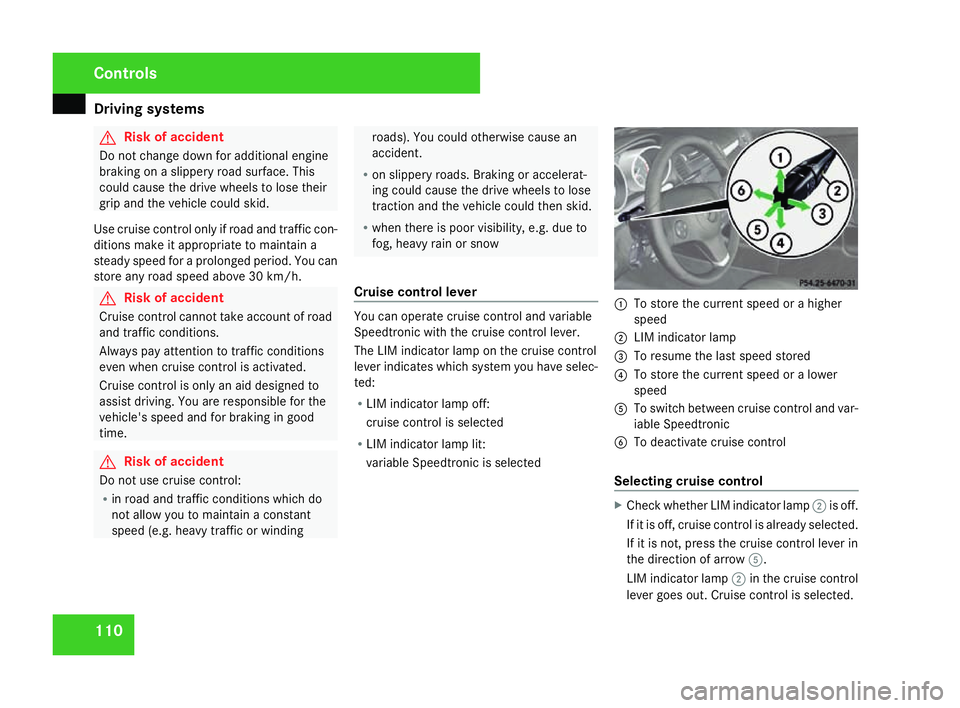
Cruise control lever You can operate cruise control and variable
Speedtronic with the cruise control lever
.
The LIM indicator lamp on the cruise control
lever indicates which system you have selec-
ted:
R LIM indicator lamp off:
cruise control is selected
R LIM indicator lamp lit:
variable Speedtronic is selected 1
To store the current speed or a higher
speed
2 LIM indicator lamp
3 To resume the last speed stored
4 To store the current speed or a lower
speed
5 To switch between cruise control and var-
iable Speedtronic
6 To deactivate cruise control
Selecting cruise control X
Check whether LIM indicator lamp 2is off .
If it is off, cruise control is already selected.
If it is not, press the cruise control lever in
the direction of arrow 5.
LIM indicator lamp 2in the cruise control
lever goes out. Cruise control is selected. Controls
171_AKB; 3; 4, en-GB
vpfaff7,
2007-11-13T10:50:25+01:00 - Seite 110
Page 116 of 273
Driving sys
tems 11
3
i
The speed indicated in the speedometer
may differ slightly from the limit speed
stored.
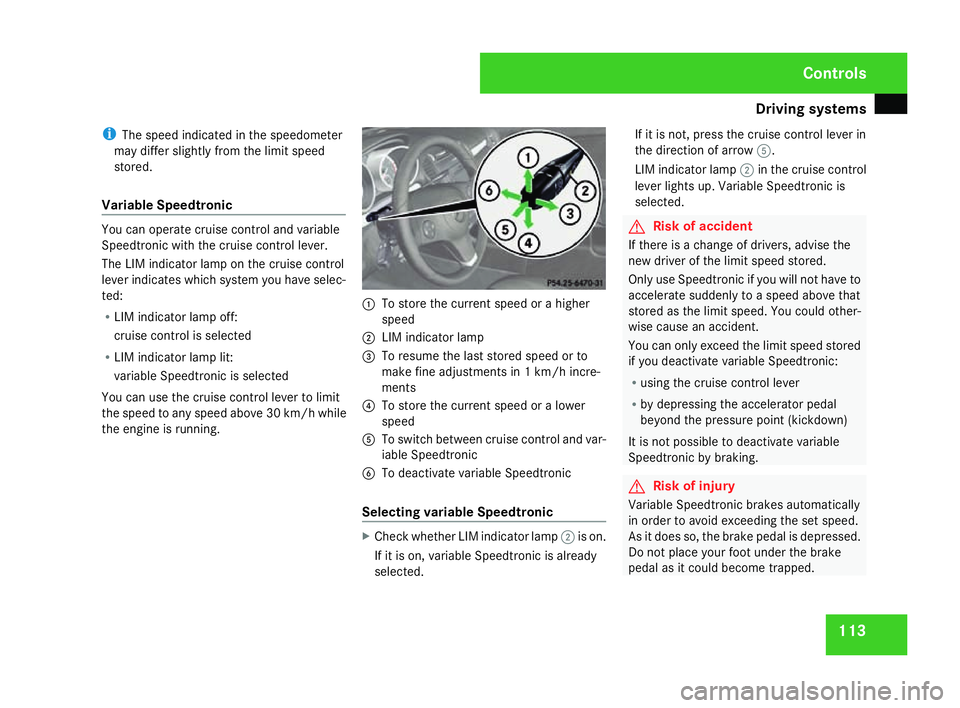
Variable Speedtronic You can operate cruise control and variable
Speedtronic with the cruise control lever.
The LIM indicator lamp on the cruise control
lever indicates which system you have selec-
ted:
R
LIM indicator lamp off:
cruise control is selected
R LIM indicator lamp lit:
variable Speedtronic is selected
You can use the cruise control lever to limit
the speed to any speed above 30 km/h whil e
the engine is running . 1
To store the current speed or a higher
speed
2 LIM indicator lamp
3 To resume the last stored speed or to
make fine adjustments in 1 km/h incre-
ments
4 To store the current speed or a lower
speed
5 To switch between cruise control and var-
iable Speedtronic
6 To deactivate variable Speedtronic
Selecting variable Speedtronic X
Check whether LIM indicator lamp 2is on.
If it is on, variable Speedtronic is already
selected. If it is not, press the cruise control lever in
the direction of arrow
5.
LIM indicator lamp 2in the cruise control
lever lights up. Variable Speedtronic is
selected. G
Risk of accident
If there is a change of drivers, advise the
new driver of the limit speed stored.
Only use Speedtronic if you will not have to
accelerate suddenly to a speed above that
stored as the limit speed. You could other-
wise cause an accident.
You can only exceed the limit speed store d
if you deactivate variable Speedtronic :
R using the cruise control leve r
R by depressing the accelerator pedal
beyond the pressure point (kickdown)
It is not possible to deactivate variable
Speedtronic by braking. G
Risk of injury
Variable Speedtronic brakes automaticall y
in order to avoid exceeding the set speed.
As it does so, the brake pedal is depressed.
Do not place your foot under the brak e
pedal as it could become trapped. Controls
171_AKB; 3; 4, en-GB
vpfaff7,
2007-11-13T10:50:25+01:00 - Seite 113
Page 154 of 273
Engine compartment
151
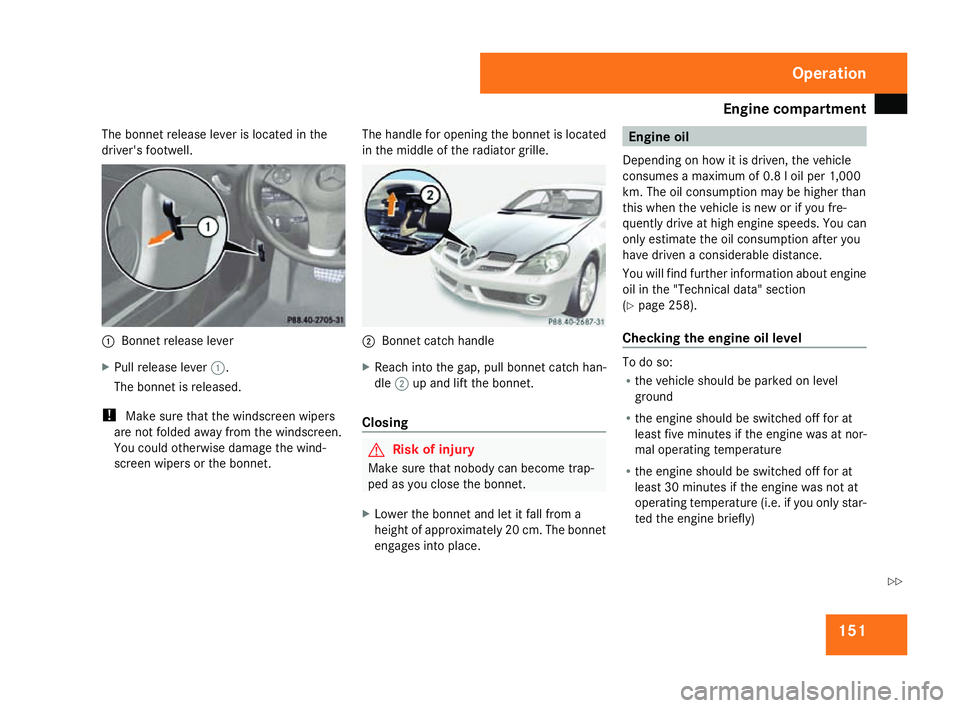
The bonnet release lever is located in th
e
driver's footwell. 1
Bonnet release lever
X Pull release lever 1.
The bonnet is released.
! Make sure that the windscreen wipers
are not folded away from the windscreen.
You could otherwise damage the wind-
screen wipers or the bonnet. The handle for opening the bonnet is located
in the middle of the radiator grille. 2
Bonnet catch handl e
X Reach into the gap, pull bonnet catch han-
dle 2up and lift the bonnet.
Closing G
Risk of injury
Make sure that nobody can become trap-
ped as you close the bonnet.
X Lower the bonnet and let it fall from a
height of approximately 20 cm. The bonnet
engages into place. Engine oil
Depending on how it is driven, the vehicle
consumes a maximum of 0.8 l oil per 1,000
km. The oil consumption may be higher than
this when the vehicle is new or if you fre-
quently drive at high engine speeds. You can
only estimate the oil consumption after you
have driven a considerable distance.
You will find further information about engine
oil in the "Technical data" section
( Y page 258).
Checking the engine oil level To do so:
R
the vehicle should be parked on leve l
ground
R the engine should be switched off for at
least five minutes if the engine was at nor -
mal operating temperature
R the engine should be switched off for at
least 30 minutes if the engine was not at
operating temperature (i.e. if you only star-
ted the engine briefly ) Operation
171_AKB; 3; 4, en-GB
vpfaff7,
2007-11-13T10:50:25+01:00 - Seite 151 Z
Page 157 of 273
Engine compartment
154 Coolan
t G
Risk of injury
The cooling system is pressurised. There-
fore, only unscrew the cap once the engine
has cooled down. The coolant temperature
gauge must display less than 70°C. Yo u
could otherwise be scalded by escaping hot
coolant.
Coolant consists of water and antifreeze/cor-
rosion inhibitor. Only check the coolant level
when the vehicle is on a level surface and the
engine has cooled down. Checking the coolant leve
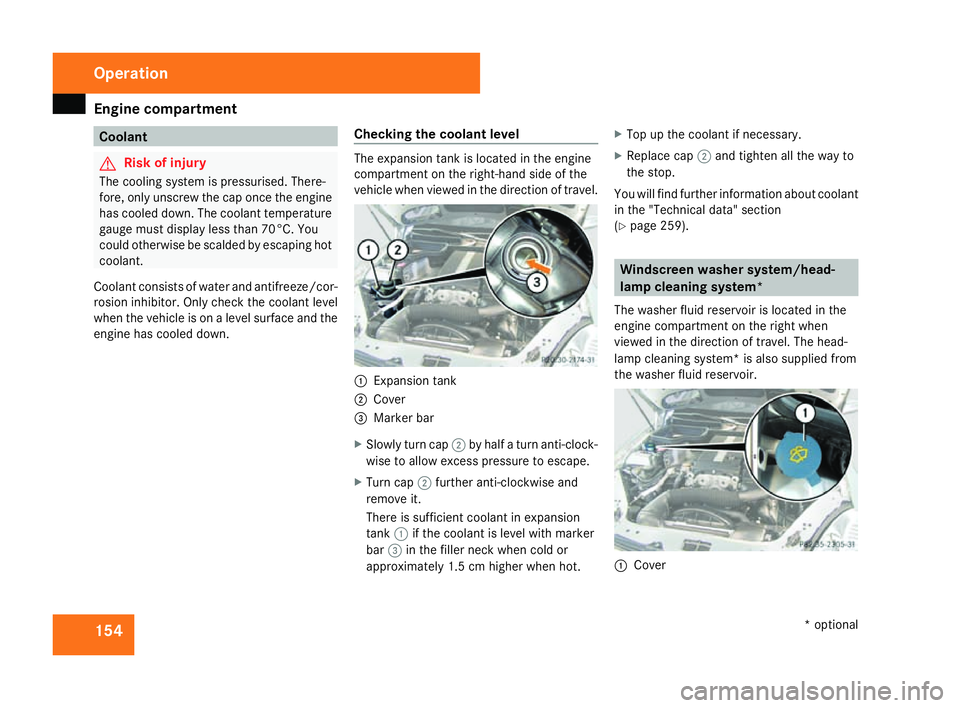
l The expansion tank is located in the engine
compartment on the right-hand side of the
vehicle when viewed in the direction of travel.
1
Expansion tank
2 Cove r
3 Marker bar
X Slowly turn cap 2by half a turn anti-clock -
wise to allow excess pressure to escape.
X Turn cap 2further anti-clockwise and
remove it.
There is sufficient coolant in expansion
tank 1if the coolant is level with marker
bar 3in the filler neck when cold or
approximately 1.5 cm higher when hot .X
Top up the coolant if necessary.
X Replace cap 2and tighten all the way to
the stop.
You will find further information about coolan t
in the "Technical data" section
( Y page 259). Windscreen washer system/head-
lamp cleaning system
*
The washer fluid reservoir is located in the
engine compartment on the right when
viewed in the direction of travel. The head-
lamp cleaning system* is also supplied from
the washer fluid reservoir. 1
Cove r Operation
* optional
171_AKB; 3; 4, en-GB
vpfaff7,
2007-11-13T10:50:25+01:00 - Seite 154