warning MERCEDES-BENZ SLK300 2011 R170 User Guide
[x] Cancel search | Manufacturer: MERCEDES-BENZ, Model Year: 2011, Model line: SLK300, Model: MERCEDES-BENZ SLK300 2011 R170Pages: 312, PDF Size: 5.64 MB
Page 22 of 312
contacting you in a timely manner should the
need arise.
If you sell your Mercedes, please leave all
literature
with the vehicle to make it available
to the next operator.
If you bought this vehicle used, be sure to
send in the “Notice of Purchase of Used Car”
found in the Service and Warranty
Information Booklet, or call the Mercedes-
Benz Customer Assistance Center (in the
USA) at 1-800-FOR-MERCedes, or Customer
Service (in Canada) at 1-800-387-0100. Operating your vehicle outside the
USA or Canada
If you plan to operate your vehicle in foreign
countries, please be aware that:
R Service
facilities or replacement parts may
not be readily available.
R Unleaded gasoline for vehicles with
catalytic converters may not be available;
the use of leaded fuels will damage the
catalysts.
R Gasoline may have a considerably lower
octane rating, and improper fuel can cause
engine damage.
Certain Mercedes-Benz models are available
for delivery in Europe under our European
Delivery Program. For details, consult an
authorized Mercedes-Benz Center or write to:
In the USA:
Mercedes-Benz USA, LLC
European Delivery Department
One Mercedes Drive
Montvale, NJ 07645-0350
In Canada:
Mercedes-Benz Canada, Inc.
European Delivery Department
98 Vanderhoof Avenue
Toronto, Ontario M4G 4C9 Operating safety
G
Warning!
Work improperly carried out on electronic
components and associated software could
cause
them to cease functioning. Because the
vehicle’s electronic components are
interconnected, any modifications made may
produce an undesired effect on other
systems. Electronic malfunctions could
seriously impair the operating safety of your
vehicle.
Contact an authorized Mercedes-Benz Center
for repairs or modifications to electronic
components.
Other improper work or modifications on the
vehicle could also have a negative impact on
the operating safety of the vehicle.
Some safety systems only function while the
engine is running. You should therefore never
turn off the engine while driving. G
Warning!
Heavy blows against the vehicle underbody or
tires/wheels may cause serious damage and
impair the operating safety of your vehicle.
Such blows can be caused, for example, by
running over an obstacle, road debris or a
pothole. If you feel a sudden significant
vibration or ride disturbance, or you suspect
that damage to your vehicle as occurred:
R turn on your hazard warning flashers
R slow down carefully
R drive
with caution to an area which is a safe
distance from the road
Inspect the vehicle underbody and tires/
wheels for possible damage. If the vehicle
appears unsafe, have it towed to the nearest
authorized Mercedes-Benz Center or other
qualified maintenance or repair facility for
further inspection or repairs. 20
Introduction 171_AKB; 3; 60, en-US
d2ureepe,
Version: 2.11.8.1 2009-05-11T16:00:23+02:00 - Seite 20
Page 23 of 312
Proper use of the vehicle
Proper use of the vehicle requires that you are
familiar with the following information and
rules:
R the safety precautions in this manual
R the “Technical data” section in this manual
R traffic rules and regulations
R motor vehicle laws and safety standards G
Warning!
Various warning labels are attached to your
vehicle.
These warning labels are intended to
make you and others aware of various risks.
Do not remove any of these warning labels
unless explicitly instructed to do so by
information on the label itself. Removing
warning labels may cause you and others to
be unaware of certain risks which may result
in an accident and/or personal injury. Problems with your vehicle
If
you should experience a problem with your
vehicle, particularly one that you believe may
affect its safe operation, we urge you to
contact an authorized Mercedes-Benz Center
immediately to have the problem diagnosed
and corrected if required. If the matter is not
handled to your satisfaction, please discuss
the problem with the Mercedes-Benz Center
management or, if necessary, contact us at
one of the following addresses:
In the USA:
Customer Assistance Center
Mercedes-Benz USA, LLC
One Mercedes Drive
Montvale, NJ 07645-0350
In Canada:
Customer Relations Department
Mercedes-Benz Canada, Inc.
98 Vanderhoof Avenue
Toronto, Ontario M4G 4C9 Reporting safety defects
For the USA only:
The
following text is published as required of
manufacturers under Title 49, Code of U.S.
Federal Regulations, Part 575 pursuant to the
“National Traffic and Motor Vehicle Safety Act
of 1966”. Reporting safety defects
If you believe that your vehicle has a defect
which could cause a crash or could cause
injury or death, you should immediately
inform the National Highway Traffic Safety
Administration (NHTSA) in addition to
notifying Mercedes-Benz USA, LLC.
If NHTSA receives similar complaints, it may
open an investigation, and if it finds that a
safety defect exists in a group of vehicles, it
may order a recall and remedy campaign.
However, NHTSA cannot become involved in
individual problems between you, your
dealer, or Mercedes-Benz USA, LLC.
To contact NHTSA, you may call the Vehicle
Safety Hotline toll-free at 1-888-327-4236
(TTY: 1-800-424-9153)
; go to
www.safercar.gov ; or write to:
Administrator, NHTSA Headquarters,
1200 New Jersey Avenue, SE, West Building,
Washington, DC 20590.
You can also obtain other information about
motor vehicle safety from
www.safercar.gov . Vehicle data recording
Information regarding electronic
recording devices
(Including
notice pursuant to California Code
§ 9951)
Please note that your vehicle is equipped with
devices that can record vehicle systems data
and, if equipped with the Tele Aid system, may
transmit some data in certain accidents. Introduction
21171_AKB; 3; 60, en-US
d2ureepe,
Version: 2.11.8.1 2009-05-11T16:00:23+02:00 - Seite 21 Z
Page 28 of 312
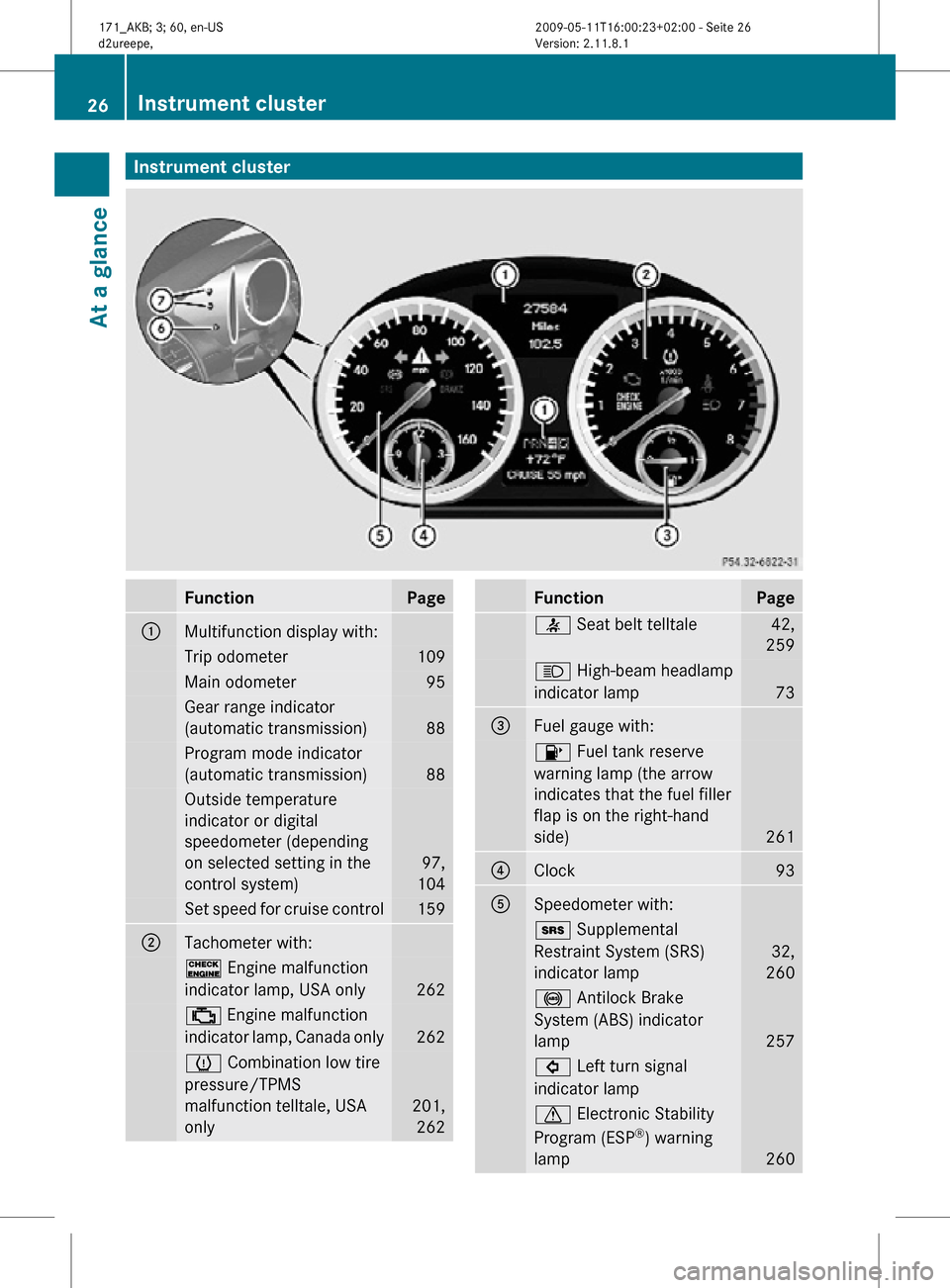
Instrument cluster
Function Page
:
Multifunction display with:
Trip odometer 109
Main odometer 95
Gear range indicator
(automatic transmission)
88
Program mode indicator
(automatic transmission)
88
Outside temperature
indicator or digital
speedometer (depending
on selected setting in the
control system)
97,
104 Set speed for cruise control 159
;
Tachometer with:
! Engine malfunction
indicator lamp, USA only
262
; Engine malfunction
indicator lamp, Canada only
262
h Combination low tire
pressure/TPMS
malfunction telltale, USA
only
201,
262 Function Page
7 Seat belt telltale 42,
259 K High-beam headlamp
indicator lamp
73
=
Fuel gauge with:
8 Fuel tank reserve
warning lamp (the arrow
indicates that the fuel filler
flap is on the right-hand
side)
261
?
Clock 93
A
Speedometer with:
+ Supplemental
Restraint System (SRS)
indicator lamp
32,
260 ! Antilock Brake
System (ABS) indicator
lamp
257
# Left turn signal
indicator lamp
d Electronic Stability
Program (ESP
®
) warning
lamp 26026
Instrument clusterAt a glance
171_AKB; 3; 60, en-US
d2ureepe,
Version: 2.11.8.1 2009-05-11T16:00:23+02:00 - Seite 26
Page 29 of 312
Function Page
! Right turn signal
indicator lamp
J Brake warning lamp,
Canada only
258
$ Brake warning lamp,
USA only
258
B
Reset button for:
Trip odometer 93
Settings 102
C
Knobs for instrument
cluster illumination
93 Multifunction steering wheel
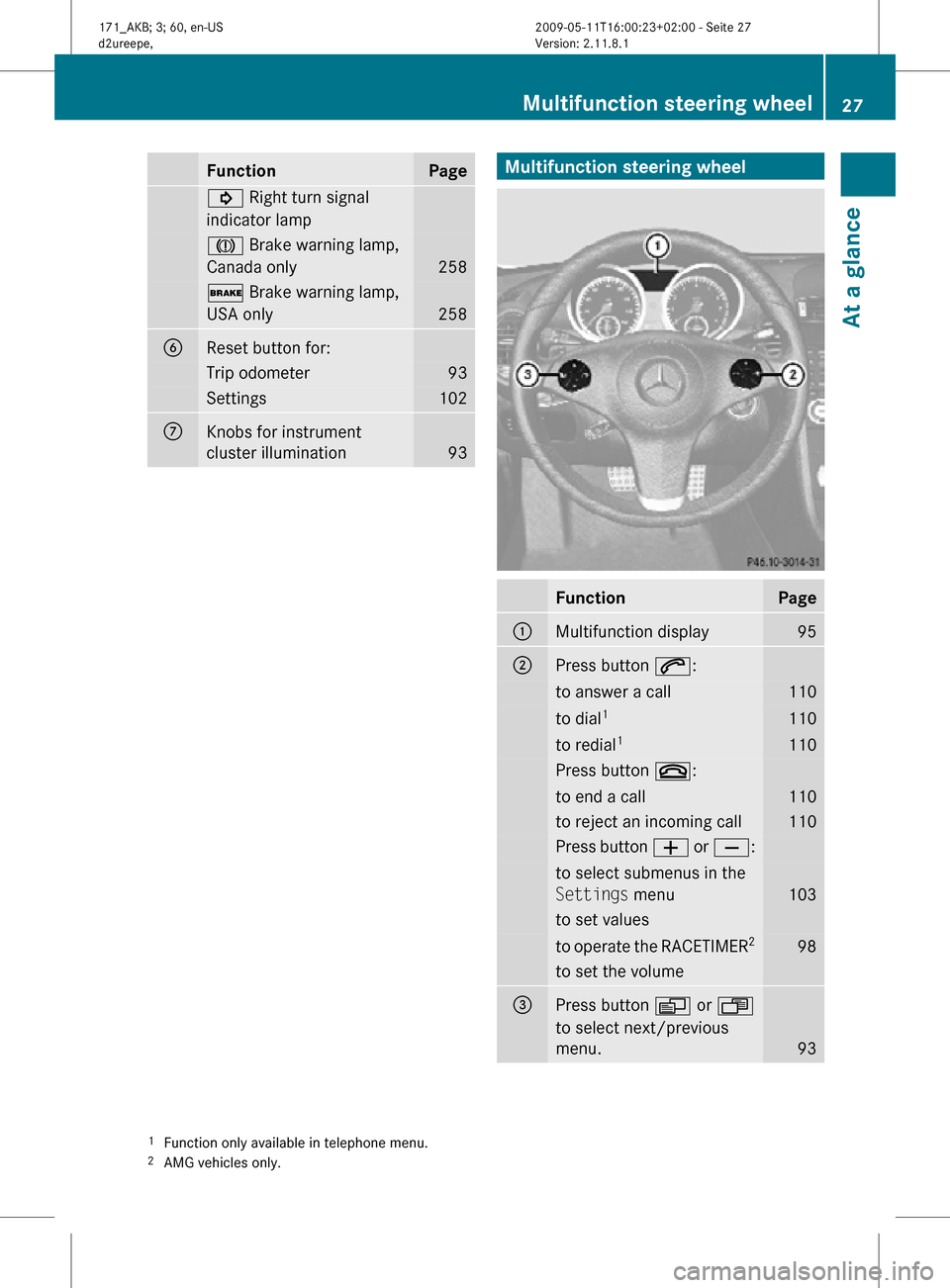
Function Page
:
Multifunction display 95
;
Press button 6:
to answer a call 110
to dial
1 110
to redial
1 110
Press button ~:
to end a call 110
to reject an incoming call 110
Press button
W or X: to select submenus in the
Settings menu
103
to set values
to operate the RACETIMER
2 98
to set the volume
=
Press button V or U
to select next/previous
menu. 93
1
Function only available in telephone menu.
2 AMG vehicles only. Multifunction steering wheel
27At a glance
171_AKB; 3; 60, en-US
d2ureepe, Version: 2.11.8.1 2009-05-11T16:00:23+02:00 - Seite 27 Z
Page 30 of 312
Function Page
Press button & or *
briefly: to move within a menu
to select previous or next
track, scene or stored
station within Audio/DVD
menu
100
to switch to the phone book
and select a name or
number within Telephone
menu
110
Press and hold button
& or *:
to select previous or next
track with quick search or
to select previous or next
station in station list or
wave band within
Audio/
DVD menu 100
to start the quick search in
the phone book within
Telephone
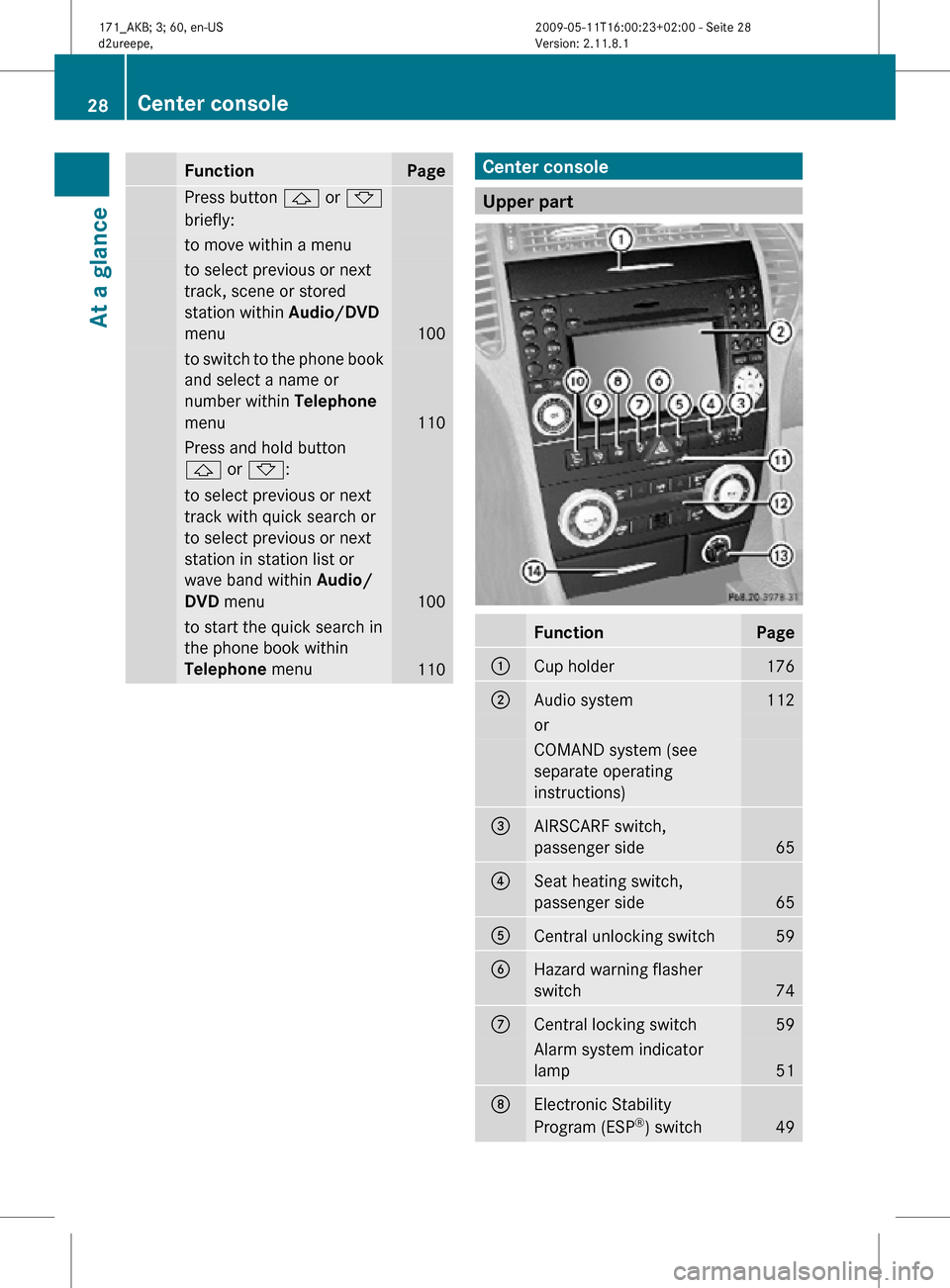
menu 110 Center console
Upper part
Function Page
:
Cup holder 176
;
Audio system 112
or
COMAND system (see
separate operating
instructions)
=
AIRSCARF switch,
passenger side
65
?
Seat heating switch,
passenger side
65
A
Central unlocking switch 59
B
Hazard warning flasher
switch
74
C
Central locking switch 59
Alarm system indicator
lamp
51
D
Electronic Stability
Program (ESP
®
) switch 4928
Center consoleAt a glance
171_AKB; 3; 60, en-US
d2ureepe,
Version: 2.11.8.1 2009-05-11T16:00:23+02:00 - Seite 28
Page 34 of 312
Vehicle equipment
i This Operator’s Manual describes all
features, standard or optional, potentially
available for your vehicle at the time of
purchase. Please be aware that your
vehicle might not be equipped with all
features described in this manual. Occupant safety
Introduction
In this section you will learn the most
important facts about the restraint system
components of the vehicle.
The restraint systems are:
R Seat belts
R Child restraints
Additional
protection potential is provided by:
R Supplemental Restraint System (SRS) with
- Air bags
- Air bag control unit (with crash sensors)
- Emergency Tensioning Device (ETD) for
seat belts
- Seat belt force limiter
R Air bag system components with
-Passenger
front air bag off indicator lamp
- Passenger seat with Occupant
Classification System (OCS)
Although the systems are independent, their
protective
functions work in conjunction with
each other. G
Warning!
Modifications to or work improperly
conducted on restraint system components
or their wiring, as well as tampering with
interconnected electronic systems, can lead
to
the restraint systems no longer functioning
as intended. Air bags or Emergency Tensioning Devices
(ETDs), for example, could deploy
inadvertently or fail to deploy in accidents
although the deceleration threshold for air
bag deployment is exceeded. Therefore,
never modify the restraint systems. Do not
tamper with electronic components or their
software.
i See “Children in the vehicle”
(Y page 45) for information on
R infants
and children traveling with you in
the vehicle
R restraint systems for infants and children SRS indicator lamp
The SRS system conducts a self-test when
the ignition is switched on and in regular
intervals while the engine is running. This
facilitates detection of system malfunctions.
The SRS indicator lamp + in the
instrument cluster comes on when the
ignition is switched on. It goes out no later
than
a few seconds after the engine has been
started.
The SRS components are in operational
readiness when the SRS indicator lamp
+ is not lit while the engine is running. G
Warning!
The SRS self-check has detected a
malfunction when the SRS indicator lamp
+
R does not come on at all
R fails to go out after approximately
4 seconds after the engine was started
R comes on after the engine was started or
while driving
For
your safety, we strongly recommend that
you contact an authorized Mercedes-Benz
Center immediately to have the system
checked. Otherwise the SRS may not be
activated when needed in an accident, which 32
Occupant safety
Safety and security
171_AKB; 3; 60, en-US
d2ureepe,
Version: 2.11.8.1 2009-05-11T16:00:23+02:00 - Seite 32
Page 35 of 312
could result in serious or fatal injury. The SRS
might also deploy unexpectedly and
unnecessarily
which could also result in injury
as well.
In addition, improper work on the SRS creates
a risk of rendering the SRS inoperative or
causing unintended air bag deployment. Work
on the SRS must therefore only be performed
by qualified technicians. Contact an
authorized Mercedes-Benz Center.
If it is necessary to modify an air bag system
to accommodate a person with disabilities,
contact an authorized Mercedes-Benz Center.
USA only: Call our Customer Assistance
Center at 1-800-FOR-MERCedes
(1-800-367-6372) for details. Air bags
G
Warning!
Air bags are designed to reduce the potential
of injury and fatality in certain
R frontal impacts (front air bags and knee
bags)
R side impacts (head-thorax air bags)
However, no system available today can
completely eliminate injuries and fatalities.
Deployment of the air bags temporarily
releases a small amount of dust from the air
bags. This dust, however, is neither harmful
to
your health, nor does it indicate a fire in the
vehicle. The dust might cause some
temporary breathing difficulty for people with
asthma or other breathing trouble. To avoid
this, you may wish to get out of the vehicle as
soon as it is safe to do so. If you have any
breathing difficulty but cannot get out of the
vehicle after the air bag inflates, then get fresh
air by opening a window or door. G
Warning!
To reduce the risk of injury when the front air
bags
inflate, it is very important for the driver and passenger to always be in a properly
seated position and to wear their seat belts.
For maximum protection in the event of a
collision always be in normal seated position
with your back against the seat backrest.
Fasten your seat belt and make sure it is
properly positioned on your body.
Since the air bag inflates with considerable
speed and force, a proper seating position
and correct positioning of the hands on the
steering
wheel will help to keep you at a safe
distance from the air bag. Occupants who are
not wearing their seat belt, are not seated
properly or are too close to the air bag can be
seriously injured or killed by an air bag as it
inflates with great force instantaneously:
R Sit with the seat belt properly fastened in a
position that is as upright as possible with
your back against the seat backrest.
R Move the driver’s seat as far back as
possible, still permitting proper operation
of vehicle controls. The distance from the
center of the driver’s chest to the center of
the air bag cover on the steering wheel
must be at least 10 inches (25 cm) or more.
You should be able to accomplish this by
adjusting the seat and steering wheel. If
you have any difficulties, please contact an
authorized Mercedes-Benz Center.
R Do not lean your head or chest close to the
steering wheel or dashboard.
R Keep hands on the outside of the steering
wheel rim. Placing hands and arms inside
the rim can increase the risk and potential
severity of hand/arm injury when the driver
front air bag inflates.
R Adjust the passenger seat as far as possible
rearward from the dashboard when the
seat is occupied.
R Occupants, especially children, should
never place their bodies or lean their heads
in the area of the door where the head-
thorax air bag inflates. This could result in
serious injuries or death should the head- Occupant safety
33
Safety and security
171_AKB; 3; 60, en-US
d2ureepe, Version: 2.11.8.1 2009-05-11T16:00:23+02:00 - Seite 33 Z
Page 36 of 312
thorax air bag be deployed. Always sit as
upright as possible, wear the seat belt
properly and use an appropriately sized
infant restraint, toddler restraint, or
booster
seat recommended for the size and
weight of the child.
Failure to follow these instructions can result
in severe injuries to you or other occupants.
If you sell your vehicle, it is important that you
make the buyer aware of this safety
information. Be sure to give the buyer this
Operator’s Manual. G
Warning!
There is a possibility of a head-thorax air bag-
related injury if occupants, especially
children,
are not properly seated or restrained
when next to a head-thorax air bag which
needs to deploy rapidly in a side impact in
order to do its job.
To help avoid the possibility of injury, please
follow these guidelines:
(1) Occupants, especially children, should
never place their bodies or
lean their heads in the area of the
door where the head-thorax air
bag inflates. This could result in
serious injuries or death should
the head-thorax air bag be
deployed.
(2) Always sit as upright as possible, wear
the seat belt properly, and for
children 12 years old and under,
use an appropriately sized infant
restraint, toddler restraint, or
booster seat recommended for the
size and weight of the child.
(3) Always wear seat belts properly.
If you believe that, even with the use of these
guidelines, it would be safer for your
passenger seat occupants to have the
passenger side head-thorax air bag
deactivated,
then deactivation can be carried
out upon your written request at an authorized Mercedes-Benz Center at an
additional cost.
Please
contact an authorized Mercedes-Benz
Center or call the Customer Assistance
Center (in the USA) at 1-800-FOR-MERCedes
(1-800-367-6372), or Customer Service (in
Canada) at 1-800-387-0100 for details.
Air bags are designed to deploy only in certain
frontal impacts (front air bags and knee bags)
and in side impacts (head-thorax air bags) if
the system determines the need for air bag
deployment. Only in the event of such a
situation will they provide their supplemental
protection.
The driver and passenger should always wear
their seat belts. Otherwise it is not possible
for the air bags to provide their supplemental
protection.
In case of other types of impacts and impacts
below air bag deployment thresholds, air
bags will not deploy. The driver and passenger
will then be protected to the extent possible
by a properly fastened seat belt. A properly
fastened seat belt is also needed to provide
the best possible protection in a rollover.
Air bags are not a substitute for seat belts.
Always wear your seat belt, regardless of
whether or not your vehicle is equipped with
air bags.
It is important to your safety and that of your
passenger to have deployed air bags replaced
and to have any malfunctioning air bags
repaired. This will help to make sure the air
bags will continue to provide supplemental
crash protection for occupants.
Safety guidelines for the seat belt,
Emergency Tensioning Device (ETD)
and air bag G
Warning!
R Damaged
seat belts or seat belts that have
been subjected to stress in an accident
must be replaced. Their anchoring points
must also be checked. Only use seat belts 34
Occupant safety
Safety and security
171_AKB; 3; 60, en-US
d2ureepe,
Version: 2.11.8.1 2009-05-11T16:00:23+02:00 - Seite 34
Page 39 of 312
R
independently of the front air bags
R independently of the ETDs
The passenger head-thorax air bag : will
only deploy if the OCS senses that the
passenger seat is occupied and the impact
exceeds a preset deployment threshold.
Head-thorax air bags : are not deployed in
side impacts which do not exceed the
system’s deployment threshold. G
Warning!
Only use seat covers which have been tested
and approved by Mercedes-Benz for your
vehicle model. Using other seat covers may
interfere with or prevent the deployment of
the head-thorax air bags. Contact an
authorized Mercedes-Benz Center for
availability. Occupant Classification System
The Occupant Classification System (OCS)
activates or deactivates the passenger front
air bag and passenger-side knee bag
automatically.
The respective status is based
on the classified occupant weight category
determined by weight sensor readings from
the passenger seat.
The system does not deactivate the
passenger head-thorax air bag and the
Emergency Tensioning Devices (ETDs).
To be classified correctly, the passenger must
sit
R with the seat belt properly fastened
R in a position that is as upright as possible
with the back against the seat backrest
R with the feet on the floor
If the occupant’s weight is transferred to
another object in the vehicle (e.g. by leaning
on armrests), the OCS may not be able to
properly approximate the occupant’s weight
category.
If your seat, including the trim cover and
cushion, needs to be serviced in any way, take the vehicle to an authorized Mercedes-Benz
Center.
Only seat accessories approved by
Mercedes-Benz may be used.
Both the driver and the passenger should
always use the
04 indicator
lamp as an indication of whether or not the
passenger is properly positioned. G
Warning!
If the 04 indicator lamp
illuminates when an adult or someone larger
than a small individual is in the passenger
seat, have the passenger reposition himself
or herself in the seat until the
04 indicator lamp goes out.
In the event of a collision, the air bag control
unit will not allow passenger front air bag
deployment when the OCS has classified the
passenger seat occupant as weighting as
much as or less than a typical 12-month-old
child in a standard child restraint or if the
passenger seat is classified as being empty.
When
the OCS senses that the passenger seat
occupant is classified as being up to or less
than the weight of a typical 12-month-old
child in a standard child restraint, the
04 indicator lamp will illuminate
when the engine is started and remain
illuminated, indicating that the passenger
front air bag is deactivated.
When the OCS senses that the passenger seat
is classified as being empty, the
04 indicator lamp will illuminate
when the engine is started and remain
illuminated, indicating that the passenger
front air bag is deactivated.
When the OCS senses that the passenger seat
occupant is classified as being heavier than
the weight of a typical 12-month-old child
seated in a standard child restraint or as being
a small individual (such as a young teenager
or a small adult), the 04
indicator lamp will illuminate for
approximately 6 seconds when the engine is
started and then, depending on occupant Occupant safety
37
Safety and security
171_AKB; 3; 60, en-US
d2ureepe, Version: 2.11.8.1 2009-05-11T16:00:23+02:00 - Seite 37 Z
Page 40 of 312
weight sensor readings from the seat, remain
illuminated or go out. With the
04 indicator lamp illuminated,
the passenger front air bag is deactivated.
With the 04 indicator lamp out,
the passenger front air bag is activated.
When
the OCS senses that the passenger seat
occupant is classified as an adult or someone
larger than a small individual, the
04 indicator lamp will illuminate
for approximately 6 seconds when the engine
is started and then go out, indicating that the
passenger front air bag is activated.
If the 04 indicator lamp is
illuminated, the passenger front air bag is
deactivated and will not be deployed.
If the 04 indicator lamp is not
illuminated, the passenger front air bag is
activated and will be deployed
R in the event of certain frontal impacts
R if impact exceeds a preset deployment
threshold
R independently of the head-thorax air bag
If the passenger front air bag is deployed, the
rate of inflation will be influenced by
R the rate of relevant vehicle deceleration as
assessed by the air bag control unit
R the passenger’s weight category as
identified by the OCS
For more information on air bag display
messages in the multifunction display, see
(Y page 239). G
Warning!
Children 12 years old and under must be
seated
and properly secured in an appropriate
infant restraint, toddler restraint, or booster
seat recommended for the size and weight of
the child.
The infant or child restraint must be properly
secured with the vehicle’s seat belt fully in
accordance with the child seat
manufacturer’s instructions. Occupants, especially children, should always
sit as upright as possible, wear the seat belt
properly
and use an appropriately sized infant
restraint, toddler restraint, or booster seat
recommended for the size and weight of the
child.
Children can be killed or seriously injured by
an inflating air bag. Note the following
important information:
R Your vehicle is equipped with air bag
technology designed to deactivate the
passenger front air bag in your vehicle
when the system senses the weight of a
typical 12-month-old child or less along
with the weight of a standard appropriate
child restraint on the passenger seat.
R A child in a rear-facing child restraint on the
passenger seat will be seriously injured or
even killed if the passenger front air bag
inflates in a collision which could occur
under some circumstances, even with the
air bag technology installed in your vehicle.
R If you install a rear-facing child restraint on
the passenger seat, make sure the
04 indicator lamp is
illuminated, indicating that the passenger
front air bag is deactivated. Should the
04 indicator lamp not
illuminate or go out while the restraint is
installed, please check installation.
Periodically check the 04
indicator lamp while driving to make sure
the 04 indicator lamp is
illuminated. If the 04 indicator
lamp goes out or remains out, do not
transport a child on the passenger seat
until the system has been repaired.
A child in a rear-facing child restraint on the
passenger seat will be seriously injured or
even killed if the passenger front air bag
inflates.
R If you place a child in a forward-facing child
restraint on the passenger seat, move the
seat as far back as possible, use the proper
child restraint recommended for the age, 38
Occupant safety
Safety and security
171_AKB; 3; 60, en-US
d2ureepe,
Version: 2.11.8.1 2009-05-11T16:00:23+02:00 - Seite 38