engine MERCEDES-BENZ SLS AMG COUPE 2012 User Guide
[x] Cancel search | Manufacturer: MERCEDES-BENZ, Model Year: 2012, Model line: SLS AMG COUPE, Model: MERCEDES-BENZ SLS AMG COUPE 2012Pages: 288, PDF Size: 18.46 MB
Page 30 of 288
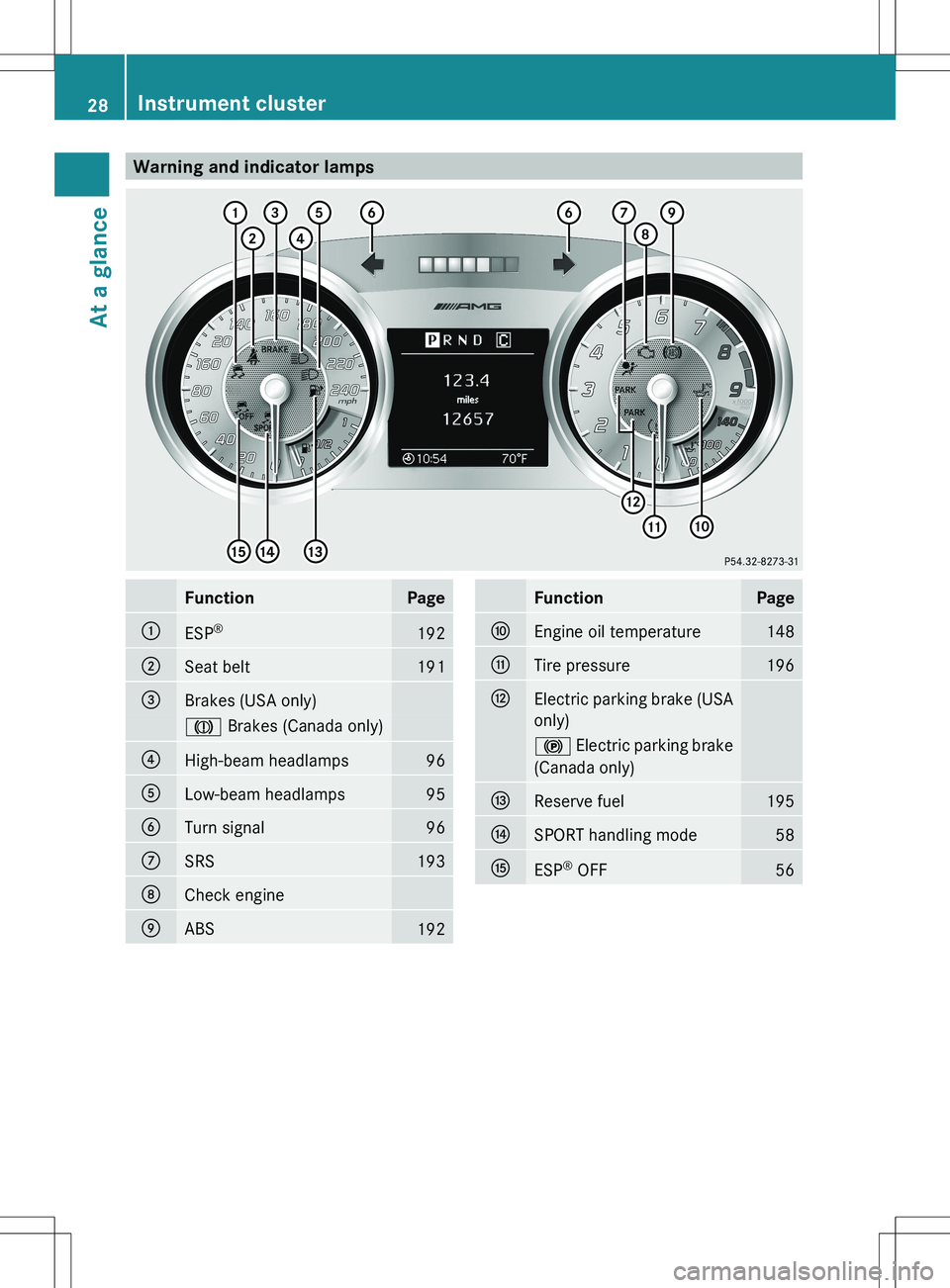
Warning and indicator lampsFunctionPage:ESP®192;Seat belt191=Brakes (USA only)J
Brakes (Canada only)?High-beam headlamps96ALow-beam headlamps95BTurn signal96CSRS193DCheck engineEABS192FunctionPageFEngine oil temperature148GTire pressure196HElectric parking brake (USA
only)! Electric parking brake
(Canada only)IReserve fuel195JSPORT handling mode58KESP ®
OFF5628Instrument clusterAt a glance
Page 38 of 288
Useful information
i This Operator's Manual describes all
models and all standard and optional
equipment of your vehicle available at the
time of publication of the Operator's
Manual. Country-specific differences are
possible. Please note that your vehicle may
not be equipped with all features
described. This also applies to safety-
related systems and functions.
i Please read the information on qualified
specialist workshops ( Y page 21).
Occupant safety
Introduction
In this section, you will learn the most
important facts about the restraint system
components of the vehicle.
The restraint system consists of:
R seat belts
R child restraint systems
Additional protection is provided by:
R SRS (Supplemental Restraint System)
R air bag system components with:
- PASSENGER AIR BAG OFF indicator lamp
- front-passenger seat with Occupant
Classification System (OCS)
The different air bag systems work
independently of each other. The protective
functions of the system work in conjunction
with each other. Not all air bags are deployed
in an accident.
GWARNING
Modifications to or work improperly
conducted on restraint system components
or their wiring, as well as tampering with
interconnected electronic systems, can lead
to the restraint systems no longer functioning
as intended.
Air bags or Emergency Tensioning Devices
(ETDs), for example, could deploy
inadvertently or fail to deploy in accidents
although the deceleration threshold for air
bag deployment is exceeded. Therefore,
never modify the restraint systems. Do not
tamper with electronic components or their
software.
i See "Children in the vehicle"
( Y page 51) for more information on
infants and children traveling with you in
the vehicle and restraints for infants and
children.
SRS (Supplemental Restraint System)
Introduction
SRS reduces the risk of occupants coming
into contact with the vehicle's interior in the
event of an accident. It can also reduce the
effect of the forces to which occupants are
subjected during an accident.
SRS consists of:
R 6 SRS warning lamp
R air bags
R air bag control unit (with crash sensors)
R Emergency Tensioning Devices
R seat belt force limiters
SRS warning lamp
SRS functions are checked regularly when
you switch on the ignition and when the
engine is running. Therefore, malfunctions
can be detected in good time.
The 6 SRS warning lamp in the instrument
cluster lights up when the ignition is switched
on. It goes out no later than a few seconds
after the engine is started.
36Occupant safetySafety
Page 39 of 288
GWARNING
The SRS self-check has detected a
malfunction if the 6 SRS indicator lamp:
R does not light up at all
R does not go out after approximately four
seconds after the engine is started
R comes on after the engine was started or
while driving.
For your safety, Mercedes-Benz strongly
recommends that you have the system
checked as soon as possible at an authorized
Mercedes-Benz Center. SRS may otherwise
fail to activate when it is needed in the event
of an accident, which could lead to serious or
fatal injuries. SRS might also be activated
unexpectedly and unnecessarily, which could
also result in injury.
In addition, work carried out improperly on
SRS may render SRS inoperative or cause
unintended air bag deployment. Work on the
SRS system should only be carried out by
qualified specialist personnel. Consult an
authorized Mercedes-Benz Center.
If it is necessary to modify an air bag system
to accommodate a person with disabilities,
contact an authorized Mercedes-Benz Center
for details. USA only: for further information
contact our Customer Assistance center at
1-800-FOR-MERCedes (1-800-367-6372).
Safety guidelines for seat belts,
Emergency Tensioning Devices (ETDs)
and air bags
GWARNING
R Damaged seat belts or seat belts that have
been subjected to stress in an accident
must be replaced. Their anchoring points
must also be checked. Only use seat belts
installed or supplied by an authorized
Mercedes-Benz Center.
R Air bags and pyrotechnic Emergency
Tensioning Devices (ETDs) contain
perchlorate material, which may require
special handling and regard for the
environment. Check your national disposal
guidelines. California residents, see
www.dtsc.ca.gov/HazardousWaste/
Perchlorate/index.cfm .
R Air bags and ETDs are designed to function
on a one-time-only basis. An air bag or ETD
that has deployed must be replaced.
R Do not pass seat belts over sharp edges.
They could tear.
R Do not make any modification that could
change the effectiveness of the seat belts.
R Do not bleach or dye seat belts as this may
severely weaken them. In a crash they may
not be able to provide adequate protection.
R No modifications of any kind may be made
to any components or wiring of the SRS.
R Do not change or remove any component
or part of the SRS.
R Do not install additional trim material, seat
covers, badges, etc. over the steering
wheel hub, front-passenger front air bag
cover, outer sides of the seat backrests,
door trim panels, or door frame trims.
R Do not install additional electrical/
electronic equipment on or near SRS
components and wiring.
R Keep area between air bags and occupants
free of objects (e.g. packages, purses,
umbrellas, etc.).
R Air bag system components will be hot after
an air bag has inflated. Do not touch them.
R Never place your feet on the instrument
panel, dashboard, or on the seat. Always
keep both feet on the floor in front of the
seat.
R Improper repair work on the SRS creates a
risk of rendering the SRS inoperative or
causing unintended air bag deployment.
Work on the SRS must therefore only be
performed by qualified technicians.
Contact an authorized Mercedes-Benz
Center.
R For your protection and the protection of
others, when scrapping the air bag unit or
ETD, our safety instructions must beOccupant safety37SafetyZ
Page 45 of 288
GWARNING
If the 45 indicator lamp lights up when
the front-passenger seat is occupied by an
adult or a larger person, ask the passenger to
reposition themselves on the seat so that the
45 indicator lamp goes out.
In the event of a collision, the air bag control
unit will not allow front-passenger front air
bag and front-passenger knee bag
deployment when the OCS has classified the
front-passenger occupant as weighing as
much as or less than a typical 12-month-old
child in a standard child restraint or if the
front-passenger seat is classified as being
unoccupied.
If OCS has detected that the front passenger
weighs the same as or less than a typical 12-
month-old child in a standard child restraint
system, the 45 indicator lamp lights
up when the engine is started and remains lit.
This indicates that the front-passenger front
air bag is deactivated.
If OCS determines that the front-passenger
seat is unoccupied, the 45 indicator
lamp lights up once the engine has been
started and remains lit. This shows that the
front-passenger front air bag and front-
passenger knee bag are deactivated.
If OCS determines that the front passenger
weighs more than a typical 12 month old child
in a standard child restraint system and
classifies this as a small person (e.g. a
teenager or small adult), the 45
indicator lamp lights up for approximately 6
seconds when the engine is started.
Depending on occupant weight sensor
readings from the seat, it will then remain
illuminated or go out. If the 45
indicator lamp is illuminated, the front-
passenger front air bag is deactivated. With
the 45 indicator lamp out, the front-
passenger front air bag and front-passenger
knee bag are deactivated.
If OCS has determined that the front
passenger is an adult or medium sized person,
the 45 indicator lamp lights up for
approximately 6 seconds when the engine is
started and then goes out. This shows that the
front-passenger front air bag and front-
passenger knee bag are activated.
If the 45 indicator lamp is illuminated,
the front-passenger front air bag and the
front-passenger knee bag are deactivated and
are not deployed.
If the 45 indicator lamp does not light
up, the front-passenger air bag is enabled and
will be deployed:
R in the event of certain frontal impacts
R if the impact exceeds a preset deployment
threshold
R independently of the other air bags
If the front-passenger air bag is deployed, the
rate of inflation is influenced by:
R the rate of vehicle deceleration as assessed
by the air bag control unit
R the front passenger's weight category as
determined by the OCS
For further information, see "Air bag display
messages" ( Y page 171).GWARNING
Children 12 years old and under must be
seated and properly secured in an appropriate
infant restraint, toddler restraint, or booster
seat recommended for the size and weight of
the child.
The infant or child restraint must be properly
secured with the vehicle's seat belt fully in
accordance with the child seat
manufacturer's instructions.
Occupants, especially children, should always
sit as upright as possible, wear the seat belt
properly and use an appropriately sized infant
restraint, toddler restraint, or booster seat
recommended for the size and weight of the
child.
Occupant safety43SafetyZ
Page 51 of 288
Fastening seat beltsGWARNING
Children 12 years old and under must be
seated and properly secured in an
appropriately sized infant restraint, child
restraint system, or booster seat
recommended for the size and weight of the
child. For additional information, see the
"Children in the vehicle" section.
A child's risk of serious or fatal injuries is
significantly increased if the child restraints
are not properly secured in the vehicle and/
or the child is not properly secured in the child
restraint.
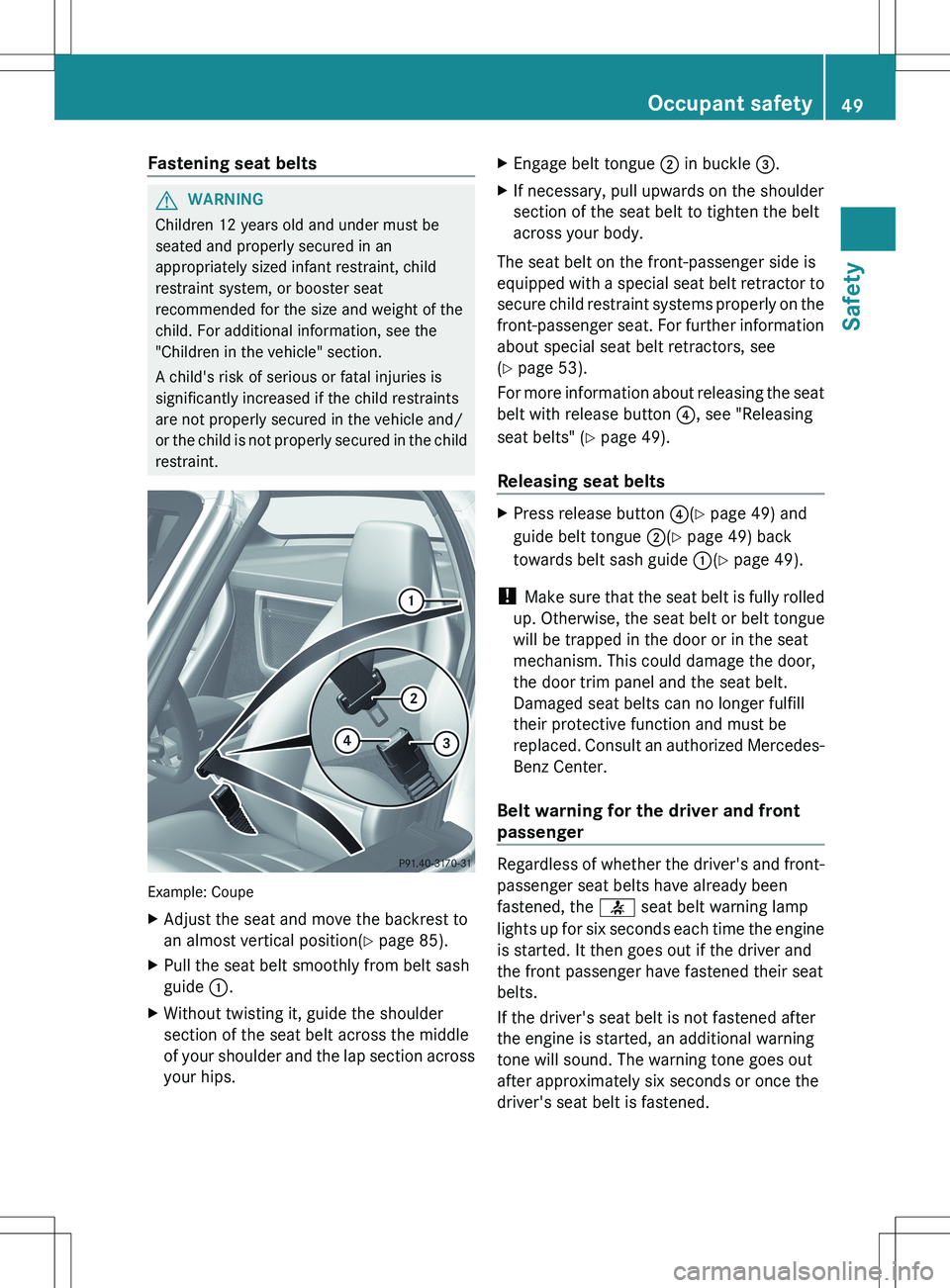
Example: Coupe
XAdjust the seat and move the backrest to
an almost vertical position( Y page 85).XPull the seat belt smoothly from belt sash
guide :.XWithout twisting it, guide the shoulder
section of the seat belt across the middle
of your shoulder and the lap section across
your hips.XEngage belt tongue ; in buckle =.XIf necessary, pull upwards on the shoulder
section of the seat belt to tighten the belt
across your body.
The seat belt on the front-passenger side is
equipped with a special seat belt retractor to
secure child restraint systems properly on the
front-passenger seat. For further information
about special seat belt retractors, see
( Y page 53).
For more information about releasing the seat
belt with release button ?, see "Releasing
seat belts" ( Y page 49).
Releasing seat belts
XPress release button ?(Y page 49) and
guide belt tongue ;(Y page 49) back
towards belt sash guide :(Y page 49).
!
Make sure that the seat belt is fully rolled
up. Otherwise, the seat belt or belt tongue
will be trapped in the door or in the seat
mechanism. This could damage the door,
the door trim panel and the seat belt.
Damaged seat belts can no longer fulfill
their protective function and must be
replaced. Consult an authorized Mercedes-
Benz Center.
Belt warning for the driver and front
passenger
Regardless of whether the driver's and front-
passenger seat belts have already been
fastened, the 7 seat belt warning lamp
lights up for six seconds each time the engine
is started. It then goes out if the driver and
the front passenger have fastened their seat
belts.
If the driver's seat belt is not fastened after
the engine is started, an additional warning
tone will sound. The warning tone goes out
after approximately six seconds or once the
driver's seat belt is fastened.
Occupant safety49SafetyZ
Page 57 of 288
The driving safety systems described in this
section cannot reduce these risks or prevent
the natural laws of physics from acting on the
vehicle. They cannot increase braking or
steering efficiency beyond that afforded by
the condition of the vehicle brakes and tires
or the traction afforded.
Only a safe, attentive, and skillful driver can
prevent accidents.
The capabilities of a vehicle equipped with the
driving safety systems described in this
section must never be exploited in a reckless
or dangerous manner which could jeopardize
the user's safety or the safety of others.
Always adjust your driving style to the
prevailing road and weather conditions and
keep a safe distance to other road users and
objects on the street.
If a driving system malfunctions, other driving
safety systems may also switch off. Observe
indicator and warning lamps that may come
on as well as messages in the multifunction
display that may appear.
i In wintry driving conditions, always use
winter tires (M+S tires) and if necessary,
snow chains. Only in this way will the
driving safety systems described in this
section work as effectively as possible.
ABS (Anti-lock Braking System)
Important safety notes
GWARNING
Do not pump the brake pedal. Use firm, steady
brake pedal pressure instead. Pumping the
brake pedal reduces the braking effect.
ABS regulates brake pressure in such a way
that the wheels do not lock when you brake.
This allows you to continue steering the
vehicle when braking.
ABS works from a speed of about
5 mph(8 km/h) upwards, regardless of road-
surface conditions. ABS works on slippery
surfaces, even when you only brake gently.
The ! warning lamp in the instrument
cluster lights up when the ignition is switched
on. It goes out when the engine is running.
Braking
If ABS intervenes when braking, you will feel
a pulsing in the brake pedal.
XIf ABS intervenes: continue to depress the
brake pedal with force until the braking
situation is over.XTo make a full brake application:
depress the brake pedal with full force.GWARNING
If the ABS malfunctions, other driving systems
such as the BAS or the ESP ®
are also switched
off. Observe indicator and warning lamps that
may come on as well as messages in the
multifunction display that may appear.
If the ABS malfunctions, the wheels may lock
during hard braking, reducing the steering
capability and extending the braking distance.
The pulsating brake pedal can be an
indication of hazardous road conditions and
functions as a reminder to take extra care
while driving.
BAS (Brake Assist System)
Observe the "Important safety notes" section
( Y page 56).
BAS operates in emergency braking
situations. If you depress the brake pedal
quickly, BAS automatically boosts the braking
force, thus shortening the stopping distance.
XKeep the brake pedal firmly depressed until
the emergency braking situation is over.
ABS prevents the wheels from locking.
The brakes will function as usual once you
release the brake pedal. BAS is deactivated.
Driving safety systems55SafetyZ
Page 58 of 288
GWARNING
If the BAS malfunctions, the brake system still
functions, but without the additional brake
boost available that the BAS would normally
provide in an emergency braking maneuver.
Therefore, the braking distance may increase.
ESP ®
(Electronic Stability Program)
Important safety notes
GWARNING
Under no circumstances should you
deactivate ESP ®
when the ÷ ESP®
warning lamp in the instrument cluster
flashes. Proceed as follows:
R when driving off, apply as little throttle as
possible.
R while driving, ease up on the accelerator
pedal.
R adapt your speed to suit the prevailing road
and weather conditions.
Failure to observe these guidelines could
cause the vehicle to skid. ESP ®
cannot
prevent accidents resulting from excessive
speed.
! Switch the ignition off when:
R the electric parking brake is being tested
using a brake dynamometer.
R the vehicle is being towed with the rear
axle raised.
Application of the brakes by ESP ®
may
otherwise destroy the brake system.
i Only use wheels with the recommended
tire sizes. Only then will ESP ®
function
properly.
You can select between the three following
states of ESP ®
:
R ESP ®
is activated.
R SPORT handling mode is activated.
R ESP ®
is deactivated.
ESP ®
is activated as soon as you start the
engine. When SPORT handling mode is
activated, the M warning lamp lights up in
the instrument panel. When ESP ®
is
deactivated, the å and h warning
lamps light up in the instrument panel.
ETS (Electronic Traction System)
Observe the "Important safety notes" section
( Y page 56).
Traction control is part of ESP ®
.
Traction control brakes the drive wheels
individually if they spin. This enables you to
pull away and accelerate on slippery surfaces,
for example if the road surface is slippery on
one side.
Traction control remains active if you
deactivate ESP ®
.
Characteristics of ESP ®
GWARNING
ESP should not be deactivated during normal
driving.
Deactivating ESP SPORT will have the
following effects:
R there is no limit to the engine torque.
R the system-based traction control is
limited.
"ESP OFF" is designed for driving on closed
tracks when the vehicle's natural oversteer
and understeer characteristics are desired
and requires a highly skilled and experienced
driver able to handle these critical driving
situations.
You could lose control of your vehicle and
cause an accident.
Please be aware of these limits when you
switch off ESP.
GWARNING
Activate ESP ®
as soon as the situations
described above no longer apply. ESP ®
will
otherwise not be able to stabilize the vehicle
56Driving safety systemsSafety
Page 59 of 288
if the vehicle starts to skid or a wheel starts
to spin.
ESP ®
monitors driving stability and traction,
i.e. power transmission between the tires and
the road surface.
If ESP ®
detects that the vehicle is deviating
from the direction desired by the driver, one
or more wheels are braked to stabilize the
vehicle. If necessary, the engine output is also
modified to keep the vehicle on the desired
course within physical limits. ESP ®
assists
the driver when pulling away on wet or
slippery roads. ESP ®
can also stabilize the
vehicle during braking.
If ESP ®
intervenes, the h warning lamp
flashes in the instrument cluster.GWARNING
If the h warning lamp in the instrument
cluster flashes, proceed as follows:
R do not deactivate ESP ®
under any
circumstances
R only depress the accelerator pedal as far as
necessary when pulling away.
R adapt your driving style to suit the
prevailing road and weather conditions.
Otherwise, the vehicle could go into a skid.
ESP ®
cannot reduce the risk of an accident if
you drive too fast. ESP ®
cannot override the
laws of physics.
i Only use wheels with the recommended
tire sizes. Only then will ESP ®
function
properly.
ESP ®
is activated automatically when the
engine is running. In the following situations,
it may be better to activate SPORT handling
mode or deactivate ESP ®
:
R when using snow chains
R in deep snow
R on sand or gravel
GWARNING
Activate ESP ®
as soon as the situations
described above no longer apply. Otherwise,
ESP ®
will only be able to stabilize the vehicle
to a limited degree if the vehicle starts to skid
or if a wheel starts to spin.
Characteristics when ESP ®
is
deactivated
When you deactivate ESP ®
:
R ESP ®
no longer improves driving stability.
R engine torque is no longer limited and the
drive wheels are able to spin. The spinning
wheels produce a cutting effect for better
traction.
R traction control is still activated.
R ESP ®
still provides support when you brake
firmly.
i If ESP ®
is deactivated and one or more
wheels start to spin, the h warning lamp
in the instrument cluster does not flash. In
such situations, ESP ®
will not stabilize the
vehicle.
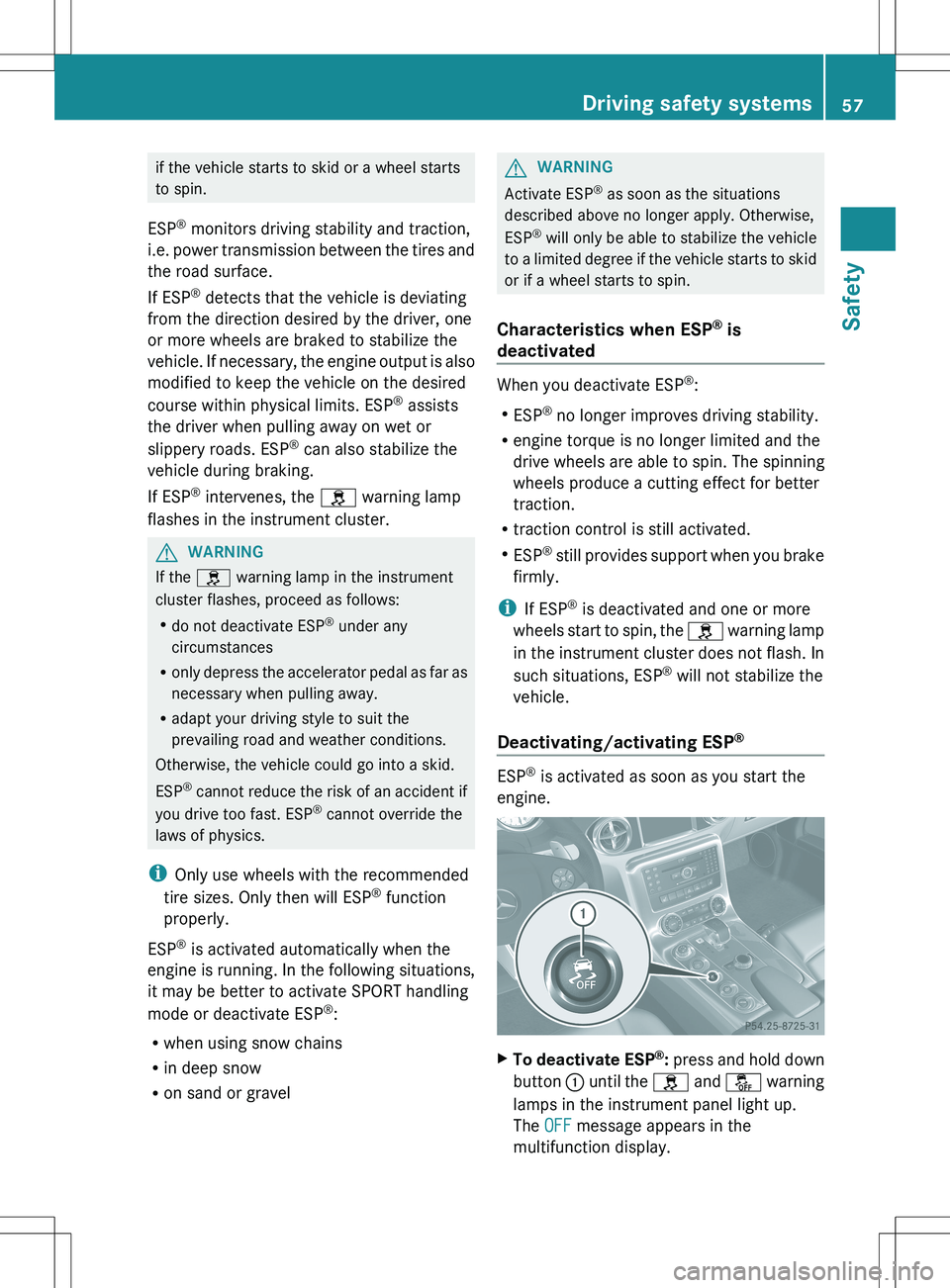
Deactivating/activating ESP ®
ESP
®
is activated as soon as you start the
engine.
XTo deactivate ESP ®
: press and hold down
button : until the h and å warning
lamps in the instrument panel light up.
The OFF message appears in the
multifunction display.Driving safety systems57SafetyZ
Page 60 of 288

GWARNING
ESP®
is deactivated if the h and å
warning lamps in the instrument cluster are
lit continuously when the engine is running.
There is an increased risk of your vehicle
skidding in certain situations.
You should always adapt your driving style to
suit the prevailing road and weather
conditions.
XTo activate ESP ®
: when SPORT handling
mode is activated or ESP ®
is deactivated,
press button : briefly.
The h and å warning lamps in the
instrument cluster go out. The ON message
appears in the multifunction display.
SPORT handling mode
GWARNING
SPORT handling mode should not be switched
on during normal driving.
Switching on SPORT handling mode will result
in the following:
R there is no limit to the engine torque.
R the system-based traction control is
limited.
SPORT handling mode is designed for driving
on closed tracks when the vehicle's own
natural oversteer and understeer
characteristics are desired and requires a
highly skilled and experienced driver able to
handle these critical driving situations.
You could lose control of your vehicle and
cause an accident.
Please be aware of these limits when you
switch on SPORT handling mode.
Do not switch on SPORT handling mode when
a spare wheel is mounted.
GWARNING
Switch off SPORT handling mode and
immediately switch on ESP ®
if one of the
previously stated conditions no longer
applies. SPORT handling mode will otherwise
only stabilize the vehicle to a limited degree if
it begins to lurch or if a wheel spins.
SPORT handling mode raises the intervention
threshold for stabilizing the vehicle. This
allows for a sportier driving style on
designated race circuits and may in certain
situations improve the traction in comparison
with ESP ®
.
When SPORT handling mode is activated:
R ESP ®
only improves driving stability to a
limited degree.
R engine torque is only restricted to a limited
degree, and the drive wheels are able to
spin. The spinning wheels produce a
cutting effect for better traction.
R traction control is still activated.
R ESP ®
still provides support when you brake
firmly.
i If SPORT handling mode is activated and
one or more wheels start to spin, the
h warning lamp in the instrument
cluster flashes. ESP ®
only stabilizes the
vehicle to a limited degree.XTo activate SPORT handling mode:
briefly press button :.
The M warning lamp in the instrument
cluster lights up. The SPORT handling 58Driving safety systemsSafety
Page 61 of 288
mode message appears in the multifunction
display.XTo deactivate SPORT handling mode:
briefly press button :.
The M warning lamp in the instrument
cluster goes out. ESP ®
is activated.
EBD (electronic brake force
distribution)
Observe the "Important safety notes" section
( Y page 56).
EBD monitors and controls the brake
pressure on the rear wheels to improve
driving stability while braking.
GWARNING
If the EBD malfunctions, the brake system will
still function with full brake boost. However,
the rear wheels could lock up during
emergency braking situations, for example.
You could lose control of the vehicle and
cause an accident.
Adapt your driving style to the changed
driving characteristics.
ADAPTIVE BRAKE
Observe the "Important safety notes" section
( Y page 54).
ADAPTIVE BRAKE enhances braking safety
and offers increased braking comfort. In
addition to the braking function, ADAPTIVE
BRAKE also features the hill start assist
function ( Y page 117). For further
information, see Driving tips ( Y page 133).
Anti-theft systems
Immobilizer
The immobilizer prevents your vehicle from
being started without the correct SmartKey.
When leaving the vehicle, always take the
SmartKey with you and lock the vehicle. The
engine can be started by anyone with a valid
SmartKey that is left inside the vehicle.XTo activate with KEYLESS-GO: switch the
engine off and open the driver's door.XTo activate with the SmartKey: remove
the SmartKey from the ignition lock.XTo deactivate: switch on the ignition.
i
The immobilizer is always deactivated
when you start the engine.
In the event that the engine cannot be
started when the starter battery is fully
charged, the immobilizer may be faulty.
Contact an authorized Mercedes-Benz
Center or call 1-800-FOR-MERCedes (in
USA) or 1-800-387-0100 (in Canada).
ATA (anti-theft alarm system)
A visual and audible alarm is triggered if the
alarm system is armed and you open:
R a door
R the trunk lid
R the hood
R Roadster: the glove box
R Roadster: a compartment in the center
console
R the vehicle with the mechanical key
The alarm is not switched off, even if you
close the open door that has triggered it, for
example.
Anti-theft systems59SafetyZ