display MERCEDES-BENZ SLS AMG ROADSTER 2014 User Guide
[x] Cancel search | Manufacturer: MERCEDES-BENZ, Model Year: 2014, Model line: SLS AMG ROADSTER, Model: MERCEDES-BENZ SLS AMG ROADSTER 2014Pages: 292, PDF Size: 37.82 MB
Page 15 of 292
Refrigerant (air-conditioning
system)
.......................................... 282
Washer fluid .................................. .284
Settings
Factory (on-board computer) .........160
On-board computer .......................157
Setting the air distribution ...............110
Setting the airflow ............................111
SETUP (on-board computer) .............161
Shift ranges ....................................... 127
Side impact air bag .............................41
Side marker lamp (display
message) ............................................ 176
Side windows Cleaning ......................................... 227
Convenience closing feature ............77
Convenience opening feature ..........76
Important safety information ...........75
Opening/closing .............................. 75
Opening/closing (all) .......................76
Problem (malfunction) .....................78
SmartKey ............................................. 68
Changing the battery .......................65
Changing the programming .............63
Checking the battery .......................65
Convenience closing feature ............77
Convenience opening feature ..........76
Display message ............................ 185
Door central locking/unlocking .......62
Loss ................................................. 66
Mechanical key ................................ 64
Opening/closing soft top .................80
Positions (ignition lock) .................119
Problem (malfunction) .....................66
Starting the engine ........................120
Unlocking/locking vehicle ...............68
SmartKey positions
KEYLESS-GO start function ............119
Snow chains ...................................... 251
Socket Glove box ...................................... .204
Sockets
Center console .............................. 204
Points to observe before use .........203
Soft top
Cleaning ......................................... 226
Display message ............................ 184
Important safety notes ....................78Opening/closing (SmartKey)
...........80
Opening/closing (with soft-top
switch) ............................................. 79
Problem (malfunction) .....................82
Relocking ......................................... 80
wind screen ..................................... 80
Soft-top switch .................................... 79
Specialist workshop ............................ 22
Speed, controlling see Cruise control
Speedometer
Activating/deactivating the
additional speedometer .................158
Digital ............................................ 152
In the Instrument cluster .................27
Selecting the unit of measurement 157
see Instrument cluster
SPORT handling mode
Warning lamp ................................. 193
SRS
see SRS (Supplemental Restraint
System)
SRS (Supplemental Restraint
System)
Display message ............................ 173
Introduction ..................................... 37
Warning lamp ................................. 194
Warning lamp (function) ................... 37
Standing lamps
Display message ............................ 176
Switching on/off .............................. 97
Starting (engine) ................................ 120
Steering wheel Adjusting (electrically) .....................89
Button overview ............................... 29
Buttons (on-board computer) ......... 151
Cleaning ......................................... 229
Important safety notes ....................88
Paddle shifters ............................... 125
Storing settings (memory function) .. 92
Stopwatch (RACETIMER) ................... 161
Stowage areas ................................... 200
Stowage compartments Armrest (under) ............................. 201
Center console .............................. 201
Cup holders ................................... 202
Glove box ...................................... .200
Important safety information .........200 Index
13
Page 16 of 292
Parcel net
...................................... 201
Rear wall ........................................ 201
Stowage space
Center console (rear) .....................201
Summer opening
see Convenience opening feature
Summer tires ..................................... 250
Sun visor ............................................ 202
Surround lighting (on-board
computer) .......................................... 159
Suspension tuning AMG adaptive sport suspension
system ........................................... 140
Switching air-recirculation mode
on/off ................................................. 113
Switching off the alarm (ATA) ............58 T
Tachometer ........................................ 150
Tail lamps Display message ............................ 175
Tail lamps (Display message) ........... 175
Tank content Fuel gauge ....................................... 27
Technical data
Notes ............................................. 278
Tires/wheels ................................. 273
TELEAID
Call priority .................................... 208
Display message ............................ 173
Downloading destinations
(COMAND) ..................................... 208
Emergency call .............................. 205
Locating a stolen vehicle ...............209
MB info call button ........................207
Remote vehicle locking ..................209
Roadside Assistance button ..........207
Search & Send ............................... 209
Self-test ......................................... 205
System .......................................... 205
Tele Aid
General notes ................................ 204
Telephone
Accepting a call ............................. 156
Menu (on-board computer) ............155
Number from the phone book ....... .156 Redialing
........................................ 157
Rejecting/ending a call .................156
Temperature
Coolant (on-board computer) ......... 161
Engine oil ....................................... 150
Engine oil (on-board computer) ...... 161
Outside temperature ..................... .150
Theft deterrent systems
ATA (Anti-Theft Alarm system) .........58
Immobilizer ...................................... 58
Tow-away alarm ............................... 59
Time
see separate operating instructions
Timing (RACETIMER) .........................161
TIREFIT kit .......................................... 233
Tire pressure Calling up (on-board computer) .....254
Checking manually ........................254
Display message ............................ 182
Maximum ....................................... 254
Notes ............................................. 253
Not reached (TIREFIT) ....................235
Reached (TIREFIT) ..........................235
Recommended ............................... 251
Tire pressure monitoring system
Checking the tire pressure
electronically ................................. 256
Function/notes ............................. 254
Restarting ...................................... 257
Warning lamp ................................. 197
Warning message .......................... 257
Tires
Aspect ratio (definition) .................267
Average weight of the vehicle
occupants (definition) ....................266
Bar (definition) ............................... 266
Characteristics .............................. 266
Checking ........................................ 249
Definition of terms .........................266
Direction of rotatio n...................... 269
Display message ............................ 182
Distribution of the vehicle
occupants (definition) ....................268
DOT, Tire Identification Number
(TIN) .............................................. .265
DOT (Department of
Transportation) (definition) ............266 14
Index
Page 17 of 292
GAWR (Gross Axle Weight Rating)
(definition)
..................................... 266
GVW (Gross Vehicle Weight)
(definition) ..................................... 267
GVWR (Gross Vehicle Weight
Rating) (definition) .........................267
Important safety notes ..................248
Increased vehicle weight due to
optional equipment (definition) ......266
Kilopascal (kPa) (definition) ...........267
Labeling (overview )........................ 262
Load bearing index (definition) ......268
Load index ..................................... 265
Load index (definition) ...................267
Maximum loaded vehicle weight
(definition) ..................................... 267
Maximum load on a tire (definition) 267
Maximum permissible tire
pressure (definition) ....................... 267
Maximum tire loa d......................... 265
Maximum tire load (definition) .......267
Optional equipment weight
(definition) ..................................... 268
PSI (pounds per square inch)
(definition) ..................................... 267
Replacing ....................................... 268
Service life ..................................... 250
Sidewall (definition) .......................268
Speed rating (definition) ................267
Storing ........................................... 269
Structure and characteristics
(definition) ..................................... 266
Technical data ............................... 275
Temperature .................................. 262
TIN (Tire Identification Number)
(definition) ..................................... 268
Tire bead (definition) ......................268
Tire pressure (definition) ................267
Tire pressures (recommended )...... 266
Tire size (data) ............................... 273
Tire size designation, load-bearing
capacity, speed rating .................... 262
Tire tread ....................................... 249
Tire tread (definition) .....................268
Total load limit (definition) .............268
Traction ......................................... 261
Traction (definition) .......................268
Tread wea r..................................... 261Uniform Tire Quality Grading
Standards
...................................... 261
Uniform Tire Quality Grading
Standards (definition) ....................266
Unladen weight (definition) ............267
Wear indicator (definition) .............268
Wheel rim (definition) ....................266
see Flat tire
Top Tether ............................................ 53
Tow-away alarm .................................. 59
Towing Important safety guidelines ...........242
Installing the towing eye ................243
Removing the towing eye ...............243
With the rear axle raised ................243
Towing away
With both axles on the ground .......244
Transmission
Driving tips .................................... 124
Selector lever ................................ 121
Shift range ..................................... 127
Transmission position display .........123
Transmission positions ....................123
Transporting the vehicle ..................244
Trim pieces (cleaning instructions) .229
Trip computer (on-board computer) 153
Trip odometer Calling up ....................................... 152
Trunk
Emergency release ..........................74
Important safety guidelines .............72
Locking separately ...........................74
Opening (automatically from
inside) .............................................. 73
Trunk lid
Display message ............................ 184
Opening/closing ........................72, 73
Opening dimensions ......................284
Trunk load (maximum) ......................284
see Technical data
Turn signal (display message) .........174
Turn signals Switching on/off .............................. 98
Type identification plate
see Vehicle identification plate Index
15
Page 18 of 292
U
Unlocking Emergency unlocking .......................71
From inside the vehicle (central
unlocking button) ............................. 70
Upshift indicator ............................... 128V
Vanity mirror (in the sun visor) ........202
Vehicle Correct use ...................................... 23
Data acquisition ............................... 24
Display message ............................ 184
Equipment ....................................... 19
Individual settings ..........................157
Limited Warranty ............................. 23
Loading .......................................... 258
Locking (in an emergency) ...............71
Locking (SmartKey) .......................... 62
Lowering ........................................ 273
Maintenance .................................... 20
Parking for a long period ................ 134
Pulling away ................................... 120
Raising ........................................... 270
Reporting problems .........................23
Towing away .................................. 242
Transporting .................................. 244
Unlocking (in an emergency) ...........71
Unlocking (SmartKey) ................62, 68
Vehicle data ................................... 284
Vehicle data ....................................... 284
see Technical data
Vehicle dimensions ...........................284
see Technical data
Vehicle emergency locking ................71
Vehicle identification number see VIN
Vehicle identification plate ..............278
Vehicle tool kit .................................. 232
Vehicle weights see Technical data
Video (DVD) ........................................ 155
VIN ...................................................... 278 W
Warning and indicator lamps ABS ................................................ 192
Brakes ................................... 190, 192
Check Engine ................................. 195
Cruise control ................................ 139
ESP ®
.............................................. 193
Fuel tank ........................................ 196
Overview .......................................... 28
PASSENGER AIR BAG OFF
indicator lamp .................................. 42
Reserve fuel ................................... 196
Seat belt ........................................ 191
SPORT handling mode ...................193
SRS ................................................ 194
Tire pressure monitor ....................197
Warranty ............................................ 278
Washer fluid see Windshield washer system
Washer fluid (display message) .......185
Weight see Technical data
Wheel bolt tightening torque ...........273
Wheel chock ...................................... 269
Wheels Checking ........................................ 249
Cleaning ......................................... 225
Important safety notes ..................248
Interchanging/changing ................268
Mounting a new wheel ...................272
Mounting a wheel .......................... 269
Removing a wheel ..........................271
Storing ........................................... 269
Tightening torque ........................... 273
Wheel size/tire size .......................273
Windows
see Side windows
Windshield washer system ..............221
Filling capacity ............................... 284
Notes ............................................. 284
Windshield wipers
Problem (malfunction) ...................103
Replacing the wiper blades ............102
Switching on/off ........................... 10116
Index
Page 28 of 292
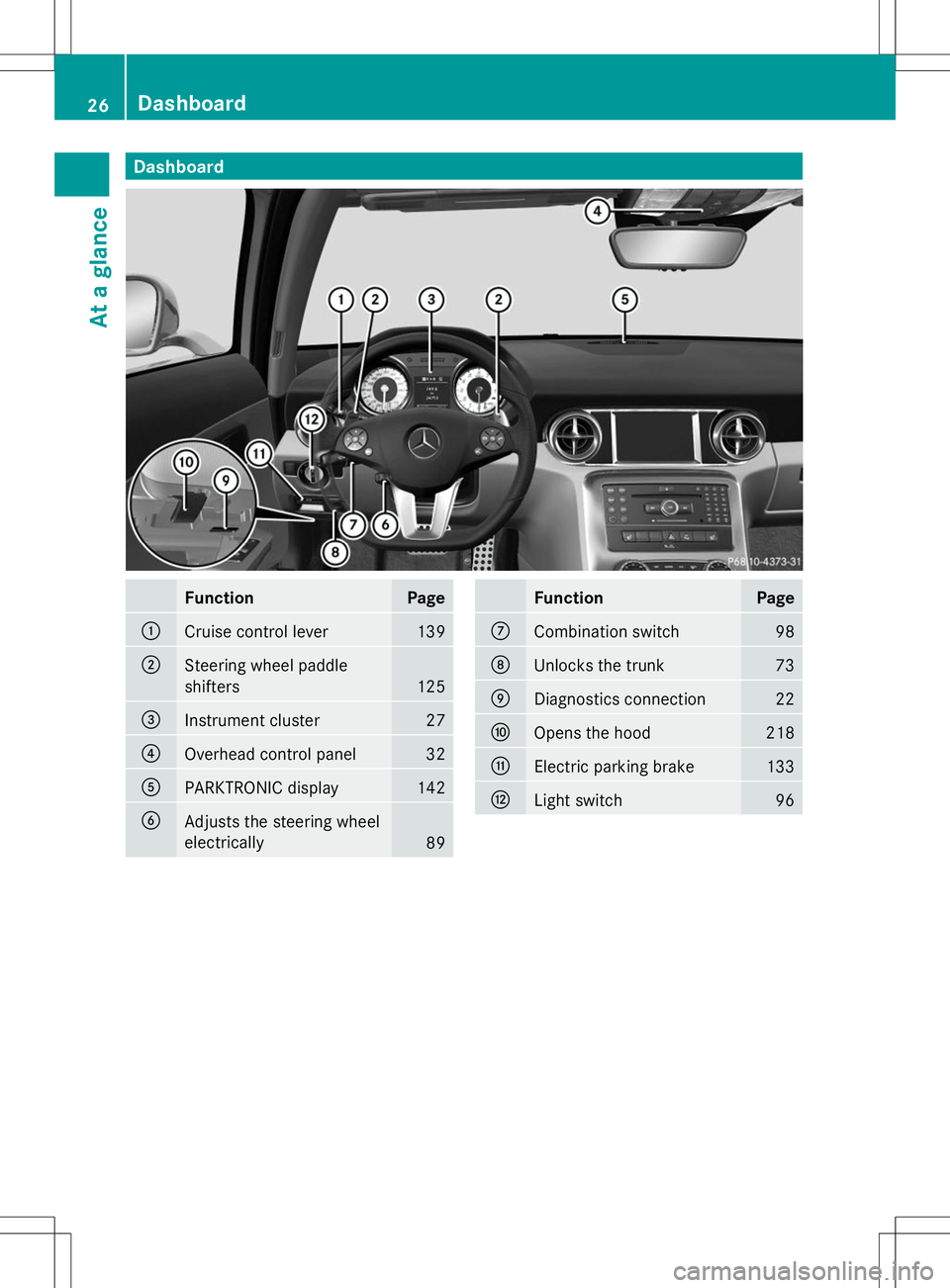
Dashboard
Function Page
:
Cruise control lever 139
;
Steering wheel paddle
shifters
125
=
Instrument cluster 27
?
Overhead control panel 32
A
PARKTRONIC display 142
B
Adjusts the steering wheel
electrically
89 Function Page
C
Combination switch 98
D
Unlocks the trunk 73
E
Diagnostics connection 22
F
Opens the hood 218
G
Electric parking brake 133
H
Light switch 9626
Dashboa
rdAt a glance
Page 29 of 292
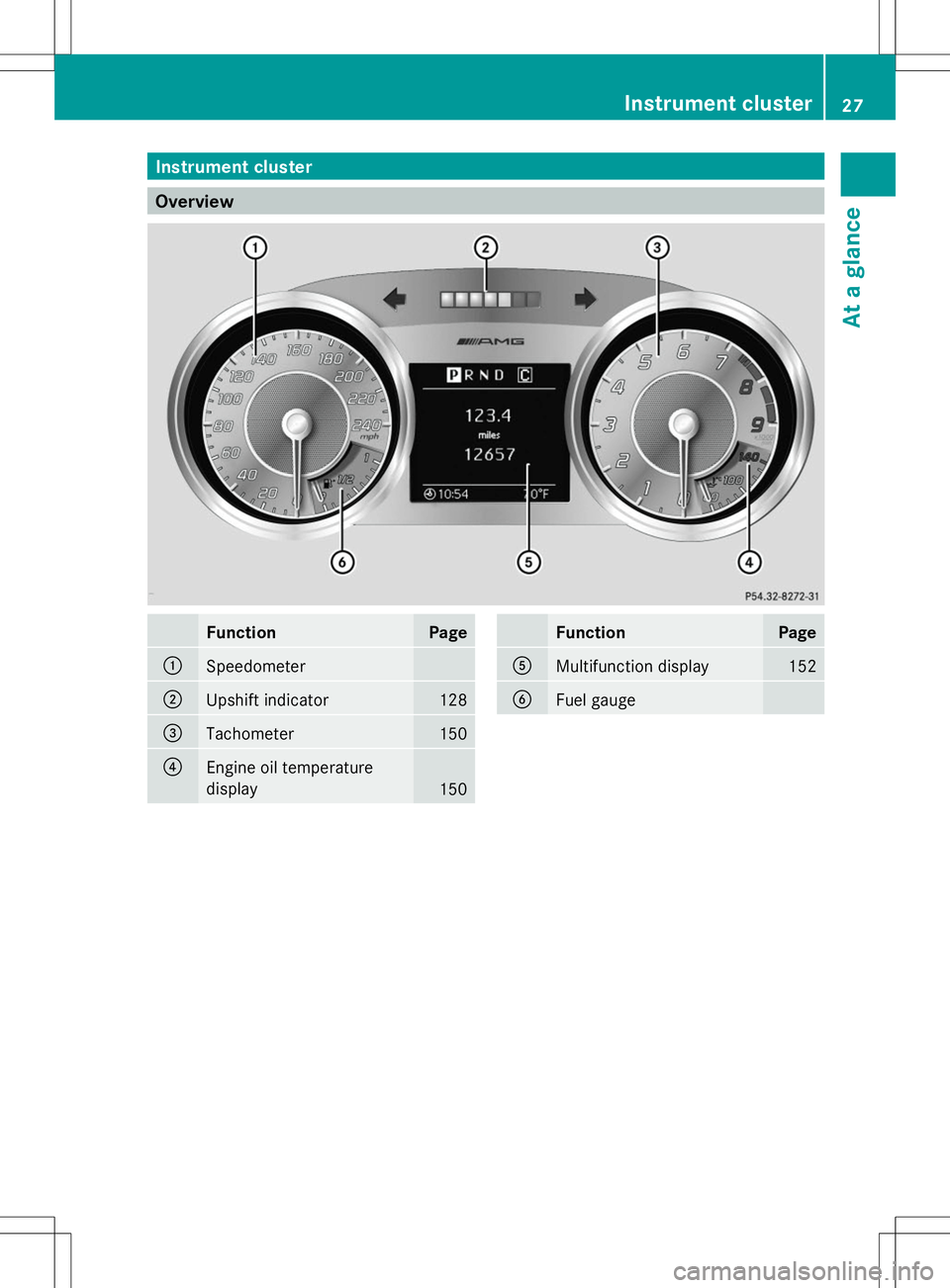
Instrument cluster
Overview
Function Page
:
Speedometer
;
Upshift indicator 128
=
Tachometer 150
?
Engine oil temperature
display
150 Function Page
A
Multifunction display 152
B
Fuel gauge Instrument cluster
27At a glance
Page 31 of 292
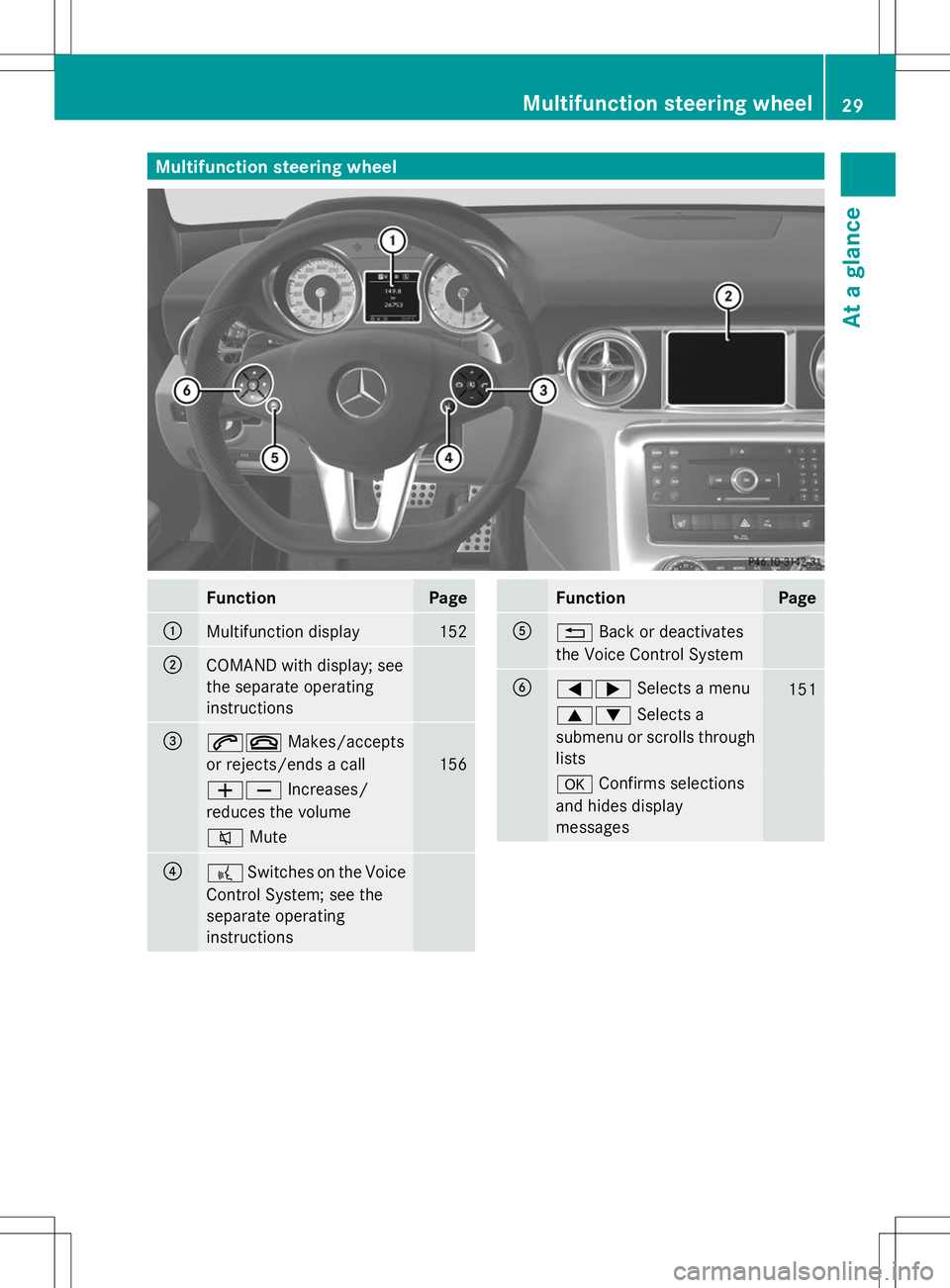
Multifunction steering wheel
Function Page
:
Multifunction display 152
;
COMAND with display; see
the separate operating
instructions =
6~
Makes/accepts
or rejects/ends a call 156
WX
Increases/
reduces the volume 8
Mute ?
?
Switches on the Voice
Control System; see the
separate operating
instructions Function Page
A
%
Back or deactivates
the Voice Control System B
=;
Selects a menu 151
9:
Selects a
submenu or scrolls through
lists a
Confirms selections
and hides display
messages Multifunction steering wheel
29At a glance
Page 46 of 292
For further information, see "Air bag display
messages" (Y page 171). G
WARNING
Children 12 years old and under must be
seated and properly secured in an appropriate
infant restraint, toddler restraint, or booster
seat recommended for the size and weight of
the child.
The infant or child restraint must be properly
secured with the vehicle's seat belt fully in
accordance with the child seat
manufacturer's instructions.
Occupants, especially children, should always
sit as upright as possible, wear the seat belt
properly and use an appropriately sized infant
restraint, toddler restraint, or booster seat
recommended for the size and weight of the
child.
Children can be killed or seriously injured by
an inflating air bag. Note the following
important information:
R Your vehicle is equipped with air bag
technology designed to deactivate the
front-passenger front air bag in your vehicle
when the system senses the weight of a
typical 12-month-old child or less along
with the weight of a standard appropriate
child restraint on the front-passenger seat.
R A child in a rear-facing child restraint on the
front-passenger seat will be seriously
injured or even killed if the front-passenger
front air bag inflates in a collision which
could occur under some circumstances,
even with the air bag technology installed
in your vehicle.
R If you install a rear-facing child restraint on
the front-passenger seat, make sure the
45 indicator lamp is illuminated,
indicating that the front-passenger front air
bag is deactivated. Should the 45
indicator lamp not illuminate or go out while
the restraint is installed, please check
installation. Periodically check the
45 indicator lamp while driving to
make sure the 45indicator lamp is illuminated. If the
45indicator lamp
goes out or remains out, do not transport a
child on the front-passenger seat until the
system has been repaired.
A child in a rear-facing child restraint on the
front-passenger seat will be seriously
injured or even killed if the front-passenger
front air bag inflates.
R If you place a child in a forward-facing child
restraint on the front-passenger seat:
- move the seat as far back as possible
- use the proper child restraint
recommended for the age, size and
weight of the child
- secure child restraint with the vehicle's
seat belt according to the child seat
manufacturer's instructions
R For children larger than a typical 12-month-
old child, the front-passenger front air bag
may or may not be activated.
If the driver's air bag deploys, this does not
mean that the front-passenger front air bag
will also deploy.
The OCS may have detected that the seat:
R is empty or occupied by a person with a
weight of up to or less than that of a typical
12-month-old child seated in a standard
child restraint.
R is occupied by a small individual, such as a
young teenager or a small adult.
R is occupied by a child in a child restraint
system whose weight is greater than that
of a typical 12-month-old child.
These are examples of when the OCS
deactivates the front-passenger front air bag
and front-passenger knee bag. Deactivation
takes place although the collision fulfills the
criteria for deploying the driver's air bag. 44
Occupant safetySafety
Page 48 of 292
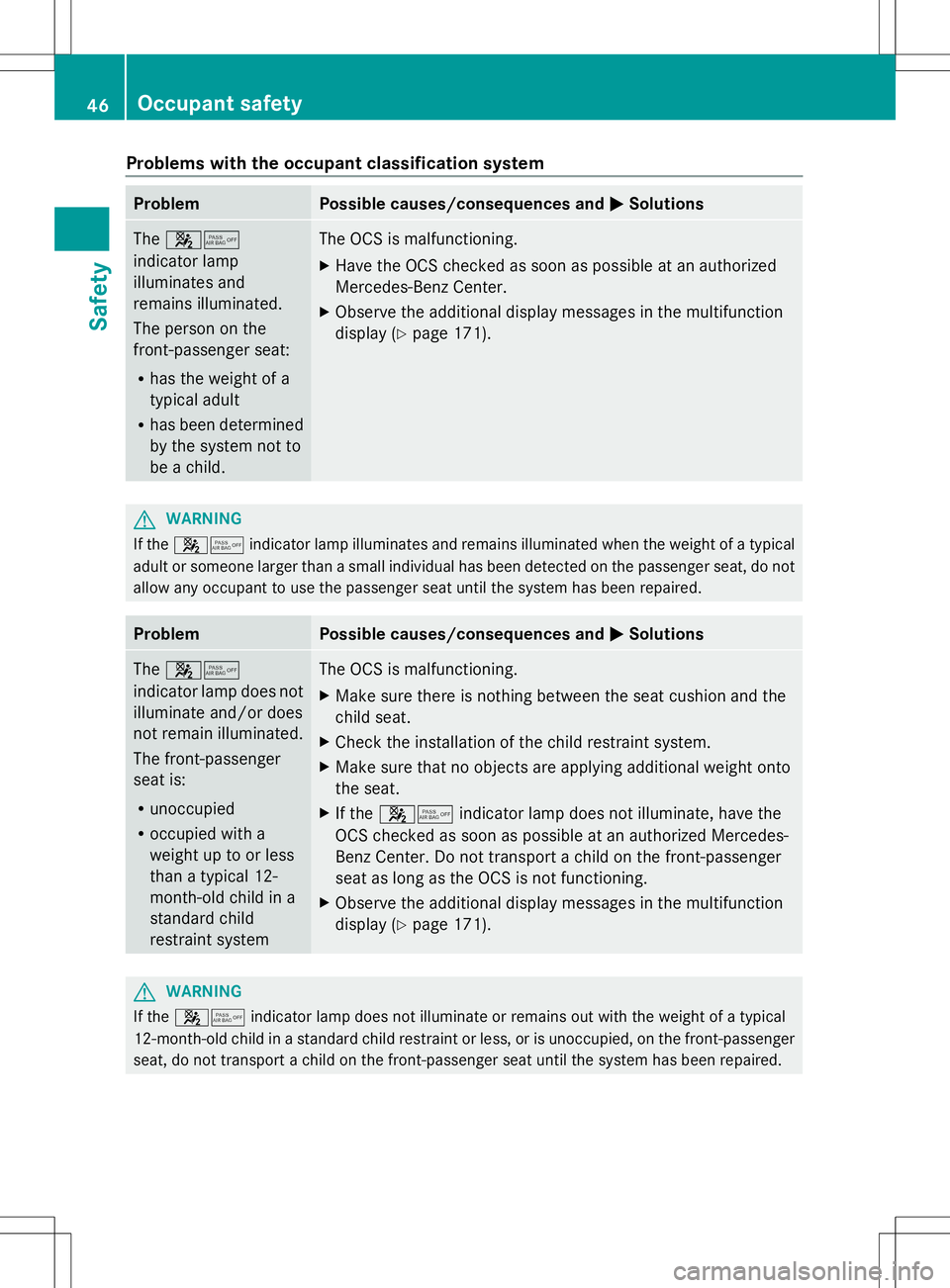
Problems with the occupant classification system
Problem Possible causes/consequences and
M
MSolutions The
45
indicator lamp
illuminates and
remains illuminated.
The person on the
front-passenger seat:
R has the weight of a
typical adult
R has been determined
by the system not to
be a child. The OCS is malfunctioning.
X
Have the OCS checked as soon as possible at an authorized
Mercedes-Benz Center.
X Observe the additional display messages in the multifunction
display (Y page 171). G
WARNING
If the 45 indicator lamp illuminates and remains illuminated when the weight of a typical
adult or someone larger than a small individual has been detected on the passenger seat, do not
allow any occupant to use the passenger seat until the system has been repaired. Problem Possible causes/consequences and
M MSolutions The
45
indicator lamp does not
illuminate and/or does
not remain illuminated.
The front-passenger
seat is:
R unoccupied
R occupied with a
weight up to or less
than a typical 12-
month-old child in a
standard child
restraint system The OCS is malfunctioning.
X
Make sure there is nothing between the seat cushion and the
child seat.
X Check the installation of the child restraint system.
X Make sure that no objects are applying additional weight onto
the seat.
X If the 45 indicator lamp does not illuminate, have the
OCS checked as soon as possible at an authorized Mercedes-
Benz Center. Do not transport a child on the front-passenger
seat as long as the OCS is not functioning.
X Observe the additional display messages in the multifunction
display (Y page 171). G
WARNING
If the 45 indicator lamp does not illuminate or remains out with the weight of a typical
12-month-old child in a standard child restraint or less, or is unoccupied, on the front-passenger
seat, do not transport a child on the front-passenger seat until the system has been repaired. 46
Occupant safetySafety
Page 57 of 292
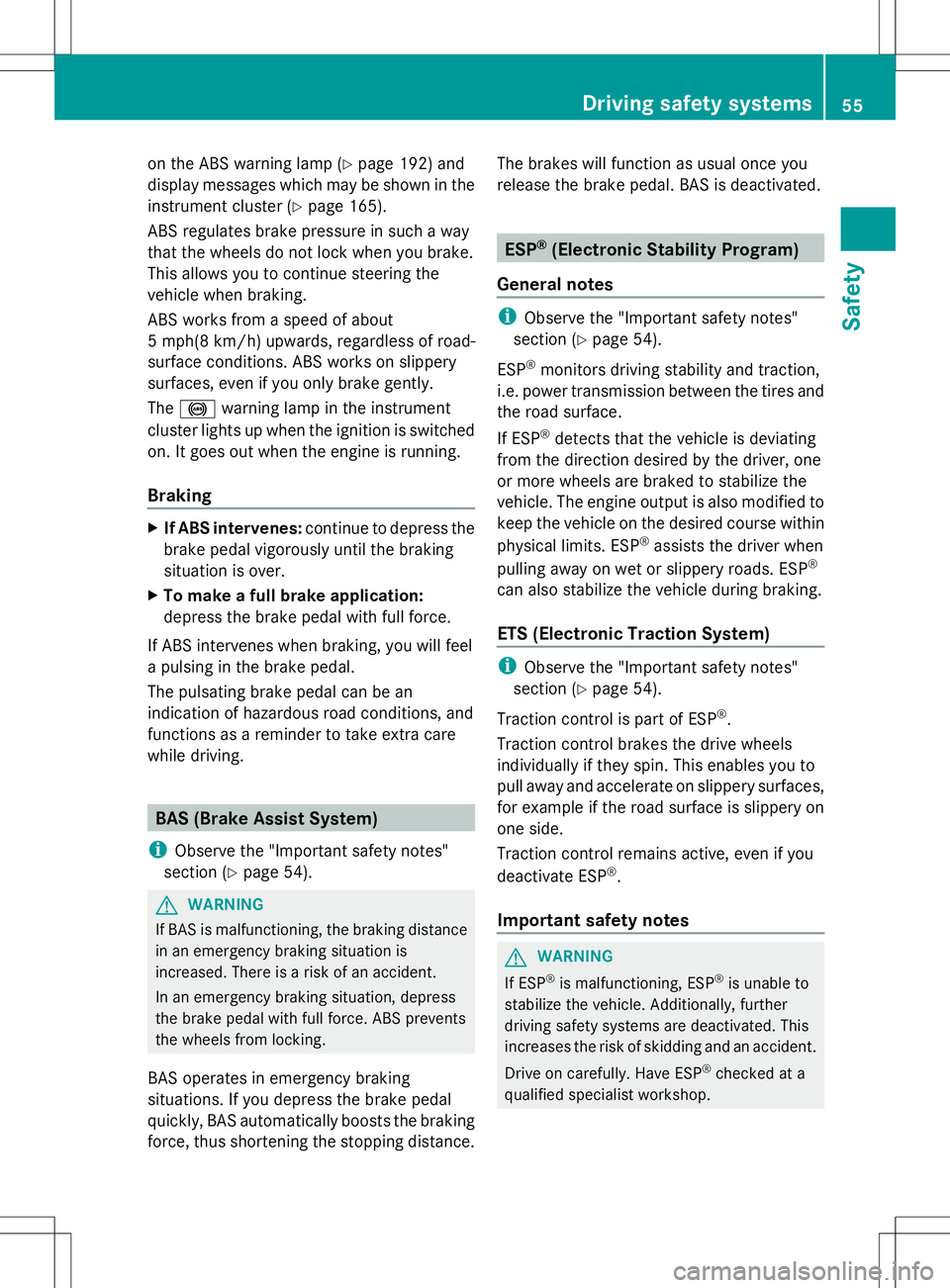
on the ABS warning lamp (Y
page 192) and
display messages which may be shown in the
instrument cluster (Y page 165).
ABS regulates brake pressure in such a way
that the wheels do not lock when you brake.
This allows you to continue steering the
vehicle when braking.
ABS works from a speed of about
5 mph(8 km/h) upwards, regardless of road-
surface conditions. ABS works on slippery
surfaces, even if you only brake gently.
The ! warning lamp in the instrument
cluster lights up when the ignition is switched
on. It goes out when the engine is running.
Braking X
If ABS intervenes: continue to depress the
brake pedal vigorously until the braking
situation is over.
X To make a full brake application:
depress the brake pedal with full force.
If ABS intervenes when braking, you will feel
a pulsing in the brake pedal.
The pulsating brake pedal can be an
indication of hazardous road conditions, and
functions as a reminder to take extra care
while driving. BAS (Brake Assist System)
i Observe the "Important safety notes"
section (Y page 54). G
WARNING
If BAS is malfunctioning, the braking distance
in an emergency braking situation is
increased. There is a risk of an accident.
In an emergency braking situation, depress
the brake pedal with full force. ABS prevents
the wheels from locking.
BAS operates in emergency braking
situations. If you depress the brake pedal
quickly, BAS automatically boosts the braking
force, thus shortening the stopping distance. The brakes will function as usual once you
release the brake pedal. BAS is deactivated. ESP
®
(Electronic Stability Program)
General notes i
Observe the "Important safety notes"
section (Y page 54).
ESP ®
monitors driving stability and traction,
i.e. power transmission between the tires and
the road surface.
If ESP ®
detects that the vehicle is deviating
from the direction desired by the driver, one
or more wheels are braked to stabilize the
vehicle. The engine output is also modified to
keep the vehicle on the desired course within
physical limits. ESP ®
assists the driver when
pulling away on wet or slippery roads. ESP ®
can also stabilize the vehicle during braking.
ETS (Electronic Traction System) i
Observe the "Important safety notes"
section (Y page 54).
Traction control is part of ESP ®
.
Traction control brakes the drive wheels
individually if they spin. This enables you to
pull away and accelerate on slippery surfaces,
for example if the road surface is slippery on
one side.
Traction control remains active, even if you
deactivate ESP ®
.
Important safety notes G
WARNING
If ESP ®
is malfunctioning, ESP ®
is unable to
stabilize the vehicle. Additionally, further
driving safety systems are deactivated. This
increases the risk of skidding and an accident.
Drive on carefully. Have ESP ®
checked at a
qualified specialist workshop. Driving safety systems
55Safety Z