coolant MERCEDES-BENZ SPRINTER 2006 Service Manual
[x] Cancel search | Manufacturer: MERCEDES-BENZ, Model Year: 2006, Model line: SPRINTER, Model: MERCEDES-BENZ SPRINTER 2006Pages: 2305, PDF Size: 48.12 MB
Page 2088 of 2305
(12) Install the two bolts that secure the refriger-
ant line terminal block to the A/C evaporator.
Tighten the bolts to 5 N´m (45 in. lbs.).
(13) Unplug or remove the tape from the heater
core hoses and tubes.
(14) Connect the heater hoses to the heater core
tubes and install the heater hose clamps.
(15) Install the ventilation housing to the dash
panel.
(16) Install the nuts and washers that secure the
ventilation housing to the dash panel. Tighten the
nuts to 5 N´m (45 in. lbs.).
(17) Connect the wire harness connectors to the
blower motor, blower motor resistor block and the
recirculation door actuator.
(18) Connect the vacuum harness connector to the
recirculation door actuator.
(19) Install the air filter into the ventilation hous-
ing (Refer to 24 - HEATING & AIR CONDITION-
ING/DISTRIBUTION/AIR FILTER -
INSTALLATION).
(20) Install the windshield washer reservoir (Refer
to 8 - ELECTRICAL/WIPERS/WASHERS/WASHER
RESERVOIR - INSTALLATION).
(21) Install the air cleaner housing (Refer to 9 -
ENGINE/AIR INTAKE SYSTEM/AIR CLEANER
HOUSING - INSTALLATION).
(22) Reconnect the negative battery cable.
(23) If the heater core is being replaced, flush the
cooling system (Refer to 7 - COOLING - STANDARD
PROCEDURE - COOLING SYSTEM CLEANING/
REVERSE FLUSHING).
(24) Refill the engine cooling system (Refer to 7 -
COOLING/ENGINE/COOLANT - STANDARD PRO-
CEDURE - COOLANT SYSTEM FILL).
(25) Evacuate the refrigerant system (Refer to 24 -
HEATING & AIR CONDITIONING/PLUMBING -
STANDARD PROCEDURE - REFRIGERANT SYS-
TEM EVACUATE).
(26) Charge the refrigerant system (Refer to 24 -
HEATING & AIR CONDITIONING/PLUMBING -
STANDARD PROCEDURE - REFRIGERANT SYS-
TEM CHARGE).
INSTRUMENT PANEL DUCTS
REMOVAL
(1) Remove the instrument panel (Refer to 23 -
BODY/INSTRUMENT PANEL/INSTRUMENT
PANEL ASSEMBLY - REMOVAL).
(2) Remove the defroster ducts (Refer to 24 -
HEATING & AIR CONDITIONING/DISTRIBUTION/
DEFROSTER DUCTS - REMOVAL).
(3) Remove the floor distribution ducts (Refer to 24
- HEATING & AIR CONDITIONING/DISTRIBU-
TION/FLOOR DISTRIBUTION DUCTS -
REMOVAL).(4) If removing the right instrument panel duct,
remove the passenger air bag module and bracket
(Refer to 8 - ELECTRICAL/RESTRAINTS/PASSEN-
GER AIRBAG - REMOVAL).
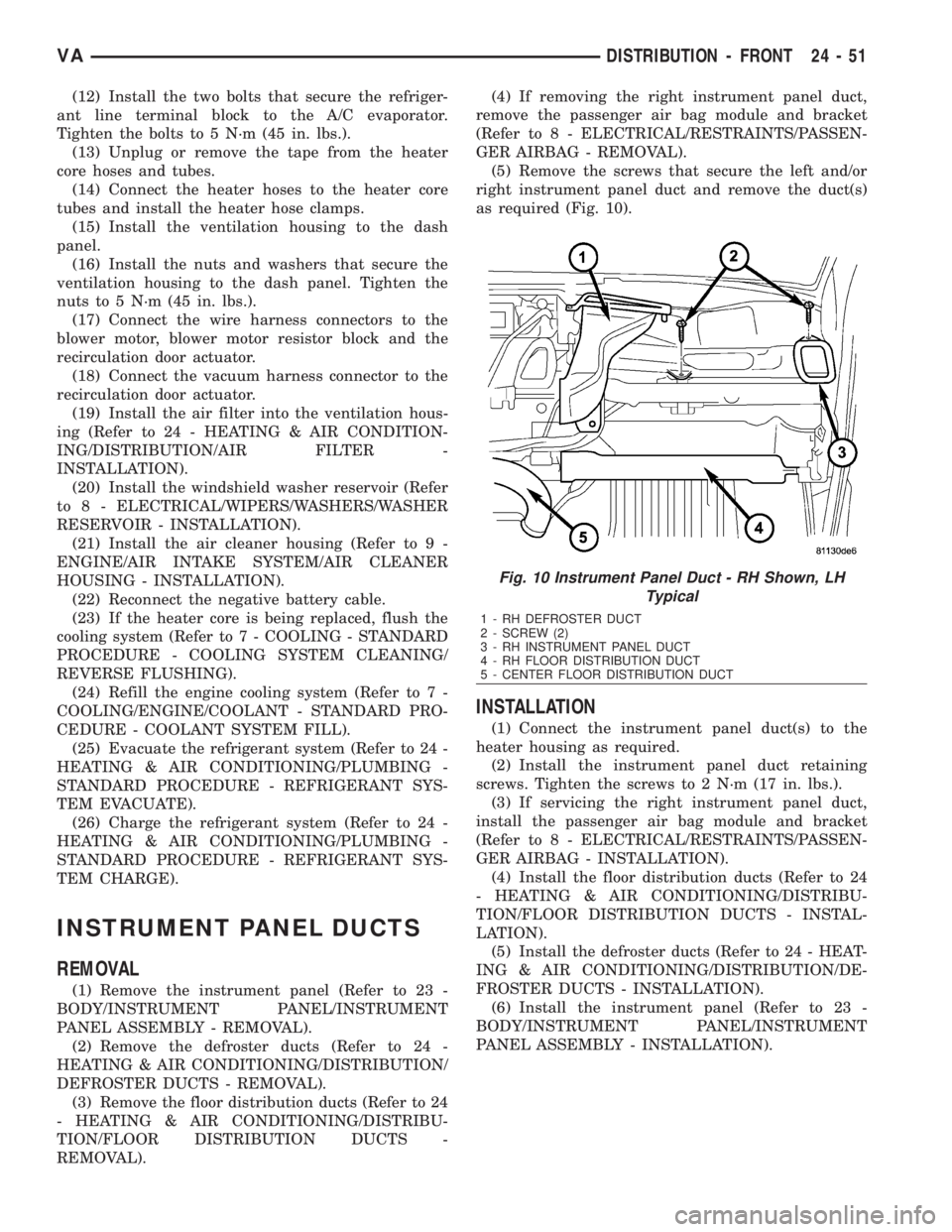
(5) Remove the screws that secure the left and/or
right instrument panel duct and remove the duct(s)
as required (Fig. 10).
INSTALLATION
(1) Connect the instrument panel duct(s) to the
heater housing as required.
(2) Install the instrument panel duct retaining
screws. Tighten the screws to 2 N´m (17 in. lbs.).
(3) If servicing the right instrument panel duct,
install the passenger air bag module and bracket
(Refer to 8 - ELECTRICAL/RESTRAINTS/PASSEN-
GER AIRBAG - INSTALLATION).
(4) Install the floor distribution ducts (Refer to 24
- HEATING & AIR CONDITIONING/DISTRIBU-
TION/FLOOR DISTRIBUTION DUCTS - INSTAL-
LATION).
(5) Install the defroster ducts (Refer to 24 - HEAT-
ING & AIR CONDITIONING/DISTRIBUTION/DE-
FROSTER DUCTS - INSTALLATION).
(6) Install the instrument panel (Refer to 23 -
BODY/INSTRUMENT PANEL/INSTRUMENT
PANEL ASSEMBLY - INSTALLATION).
Fig. 10 Instrument Panel Duct - RH Shown, LH
Typical
1 - RH DEFROSTER DUCT
2 - SCREW (2)
3 - RH INSTRUMENT PANEL DUCT
4 - RH FLOOR DISTRIBUTION DUCT
5 - CENTER FLOOR DISTRIBUTION DUCT
VADISTRIBUTION - FRONT 24 - 51
Page 2097 of 2305
PLUMBING
TABLE OF CONTENTS
page page
PLUMBING
DESCRIPTION.........................61
OPERATION...........................61
WARNINGS...........................61
CAUTIONS............................62
DIAGNOSIS AND TESTING
REFRIGERANT SYSTEM LEAKS..........62
STANDARD PROCEDURE
REFRIGERANT SYSTEM SERVICE
EQUIPMENT.........................63
REFRIGERANT SYSTEM RECOVERY......64
REFRIGERANT SYSTEM EVACUATE......64
REFRIGERANT SYSTEM CHARGE........64
A/C COMPRESSOR
DESCRIPTION.........................66
OPERATION...........................66
DIAGNOSIS AND TESTING
A/C COMPRESSOR NOISE..............66
REMOVAL
DENSO 7SBU16C A/C COMPRESSOR.....67
DENSO 10S17 A/C COMPRESSOR........68
INSTALLATION
DENSO 7SBU16C A/C COMPRESSOR.....68
DENSO 10S17 A/C COMPRESSOR........69
A/C CONDENSER
DESCRIPTION.........................69
OPERATION...........................69
REMOVAL.............................70
INSTALLATION.........................70
A/C DISCHARGE LINE
REMOVAL.............................71
INSTALLATION.........................71
A/C EVAPORATOR
DESCRIPTION.........................72
OPERATION...........................72
REMOVAL.............................72
INSTALLATION.........................73
A/C EXPANSION VALVE
DESCRIPTION.........................73
OPERATION...........................73
DIAGNOSIS AND TESTING
A/C EXPANSION VALVE................74
REMOVAL.............................74
INSTALLATION.........................74
ELECTRIC COOLANT PUMP
DESCRIPTION.........................75
OPERATION...........................75
REMOVAL.............................75
INSTALLATION.........................76HEATER CORE
DESCRIPTION.........................76
OPERATION...........................76
REMOVAL.............................76
INSTALLATION.........................77
LIQUID LINE
REMOVAL.............................77
INSTALLATION.........................79
RECEIVER/DRIER
DESCRIPTION.........................79
OPERATION...........................79
REMOVAL.............................80
INSTALLATION.........................80
REFRIGERANT
DESCRIPTION.........................80
OPERATION...........................80
REFRIGERANT OIL
DESCRIPTION.........................81
OPERATION...........................81
STANDARD PROCEDURE
REFRIGERANT OIL LEVEL..............81
SUCTION LINE
REMOVAL.............................81
INSTALLATION.........................82
WAT E R VA LV E
REMOVAL.............................83
INSTALLATION.........................83
REAR A/C CONDENSER FAN
REMOVAL.............................83
INSTALLATION.........................84
REAR A/C EVAPORATOR
REMOVAL.............................84
INSTALLATION.........................85
REAR A/C EXPANSION VALVE
DESCRIPTION.........................85
OPERATION...........................85
REMOVAL.............................86
INSTALLATION.........................87
REAR DISCHARGE LINE
DESCRIPTION.........................88
REMOVAL.............................88
INSTALLATION.........................90
REAR LIQUID LINE
DESCRIPTION.........................91
REMOVAL.............................91
INSTALLATION.........................93
REAR RECEIVER/DRIER
REMOVAL.............................94
INSTALLATION.........................94
24 - 60 PLUMBINGVA
Page 2098 of 2305
REAR REFRIGERANT RESERVOIR
REMOVAL.............................95
INSTALLATION.........................95
REAR SUCTION LINE
DESCRIPTION.........................96
REMOVAL.............................96
INSTALLATION.........................98
REFRIGERANT LINE COUPLER
DESCRIPTION.........................98OPERATION...........................98
REMOVAL.............................99
INSTALLATION.........................99
UNDERBODY LINES
REMOVAL............................100
INSTALLATION........................102
PLUMBING
DESCRIPTION
The refrigerant lines and hoses are used to carry
the refrigerant between the various air conditioning
system components. A barrier hose design with a
nylon tube, which is sandwiched between rubber lay-
ers, is used for the R-134a air conditioning system on
this vehicle. This nylon tube helps to further contain
the R-134a refrigerant, which has a smaller molecu-
lar structure than R-12 refrigerant. The ends of the
refrigerant hoses are made from lightweight alumi-
num or steel, and commonly use braze-less fittings.
Any kinks or sharp bends in the refrigerant plumb-
ing will reduce the capacity of the entire air condi-
tioning system. Kinks and sharp bends reduce the
flow of refrigerant in the system. A good rule for the
flexible hose refrigerant lines is to keep the radius of
all bends at least ten times the diameter of the hose.
In addition, the flexible hose refrigerant lines should
be routed so they are at least 80 millimeters (3
inches) from the exhaust manifold.
OPERATION
High pressures are produced in the refrigerant sys-
tem when the air conditioning compressor is operat-
ing. Extreme care must be exercised to make sure
that each of the refrigerant system connections is
pressure-tight and leak free. It is a good practice to
inspect all flexible hose refrigerant lines at least once
a year to make sure they are in good condition and
properly routed.
The refrigerant lines and hoses cannot be repaired
and, if faulty or damaged, they must be replaced.
WARNINGS
WARNING: The A/C system contains refrigerant
under high pressure. Repairs should only be per-
formed by qualified service personnel. Severe per-
sonal injury or death may result from improper
service procedures.
WARNING: Avoid breathing the refrigerant and
refrigerant oil vapor or mist. Exposure may irritate
the eyes, nose, and/or throat. Wear eye protectionwhen servicing the A/C refrigerant system. Serious
eye injury can result from direct contact with the
refrigerant. If eye contact occurs, seek medical
attention immediately.
WARNING: Do not expose the refrigerant to open
flame. Poisonous gas is created when refrigerant is
burned. An electronic leak detector is recom-
mended. Severe personal injury or death may result
from improper service procedures.
WARNING: If accidental system discharge occurs,
ventilate the work area before resuming service.
Large amounts of refrigerant released in a closed
work area will displace the oxygen and cause suf-
focation and death.
WARNING: The evaporation rate of R-134a refriger-
ant at average temperature and altitude is extremely
high. As a result, anything that comes in contact
with the refrigerant will freeze. Always protect the
skin or delicate objects from direct contact with the
refrigerant.
WARNING: The R-134a service equipment or the
vehicle refrigerant system should not be pressure
tested or leak tested with compressed air. Some
mixtures of air and R-134a have been shown to be
combustible at elevated pressures. These mixtures
are potentially dangerous, and may result in fire or
explosion causing property damage, personal injury
or death.
WARNING: The engine cooling system is designed
to develop internal pressures of 97 to 123 kilopas-
cals (14 to 18 pounds per square inch). Do not
remove or loosen the coolant pressure cap, cylin-
der block drain plugs, radiator drain, radiator
hoses, heater hoses, or hose clamps while the
engine cooling system is hot and under pressure.
Allow the vehicle to cool for a minimum of 15 min-
utes before opening the cooling system for service.
Failure to observe this warning can result in seri-
ous burns from the heated engine coolant.
VAPLUMBING 24 - 61
Page 2112 of 2305
(4) Install the two bolts that secure the A/C expan-
sion valve to the evaporator tube tapping plate.
Tighten the bolts to 5 N´m (45 in. lbs.).
(5) Remove the tape or plugs from the liquid and
suction line fittings and both expansion valve ports.
(6) Lubricate new rubber O-ring seals with clean
refrigerant oil and install them on the liquid and suc-
tion line fittings.
(7) Connect the liquid line fitting to the A/C expan-
sion valve.
(8) Connect the suction line fitting to the A/C
expansion valve.
(9) Install the nut that secures the suction line
and liquid line fittings to the stud on the A/C expan-
sion valve. Tighten the nut to 10 N´m (89 in. lbs.).
(10) Reconnect the negative battery cable.
(11) Evacuate the refrigerant system (Refer to 24 -
HEATING & AIR CONDITIONING/PLUMBING -
STANDARD PROCEDURE - REFRIGERANT SYS-
TEM EVACUATE).
(12) Charge the refrigerant system (Refer to 24 -
HEATING & AIR CONDITIONING/PLUMBING -
STANDARD PROCEDURE - REFRIGERANT SYS-
TEM CHARGE).
ELECTRIC COOLANT PUMP
DESCRIPTION
The electric coolant pump ensures the uniform flow
of coolant through the heater core without bubbles,
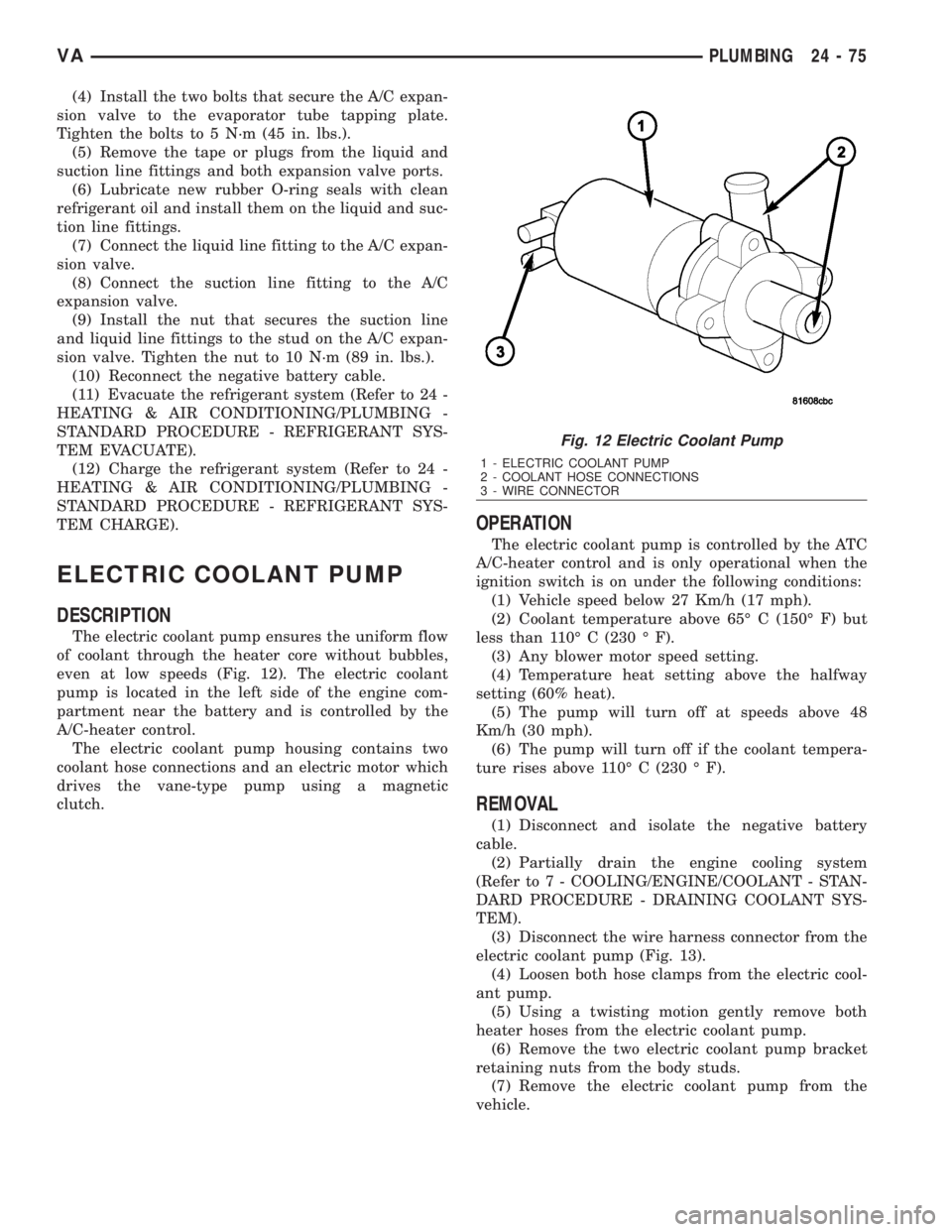
even at low speeds (Fig. 12). The electric coolant
pump is located in the left side of the engine com-
partment near the battery and is controlled by the
A/C-heater control.
The electric coolant pump housing contains two
coolant hose connections and an electric motor which
drives the vane-type pump using a magnetic
clutch.
OPERATION
The electric coolant pump is controlled by the ATC
A/C-heater control and is only operational when the
ignition switch is on under the following conditions:
(1) Vehicle speed below 27 Km/h (17 mph).
(2) Coolant temperature above 65É C (150É F) but
less than 110É C (230 É F).
(3) Any blower motor speed setting.
(4) Temperature heat setting above the halfway
setting (60% heat).
(5) The pump will turn off at speeds above 48
Km/h (30 mph).
(6) The pump will turn off if the coolant tempera-
ture rises above 110É C (230 É F).
REMOVAL
(1) Disconnect and isolate the negative battery
cable.
(2) Partially drain the engine cooling system
(Refer to 7 - COOLING/ENGINE/COOLANT - STAN-
DARD PROCEDURE - DRAINING COOLANT SYS-
TEM).
(3) Disconnect the wire harness connector from the
electric coolant pump (Fig. 13).
(4) Loosen both hose clamps from the electric cool-
ant pump.
(5) Using a twisting motion gently remove both
heater hoses from the electric coolant pump.
(6) Remove the two electric coolant pump bracket
retaining nuts from the body studs.
(7) Remove the electric coolant pump from the
vehicle.
Fig. 12 Electric Coolant Pump
1 - ELECTRIC COOLANT PUMP
2 - COOLANT HOSE CONNECTIONS
3 - WIRE CONNECTOR
VAPLUMBING 24 - 75
Page 2113 of 2305
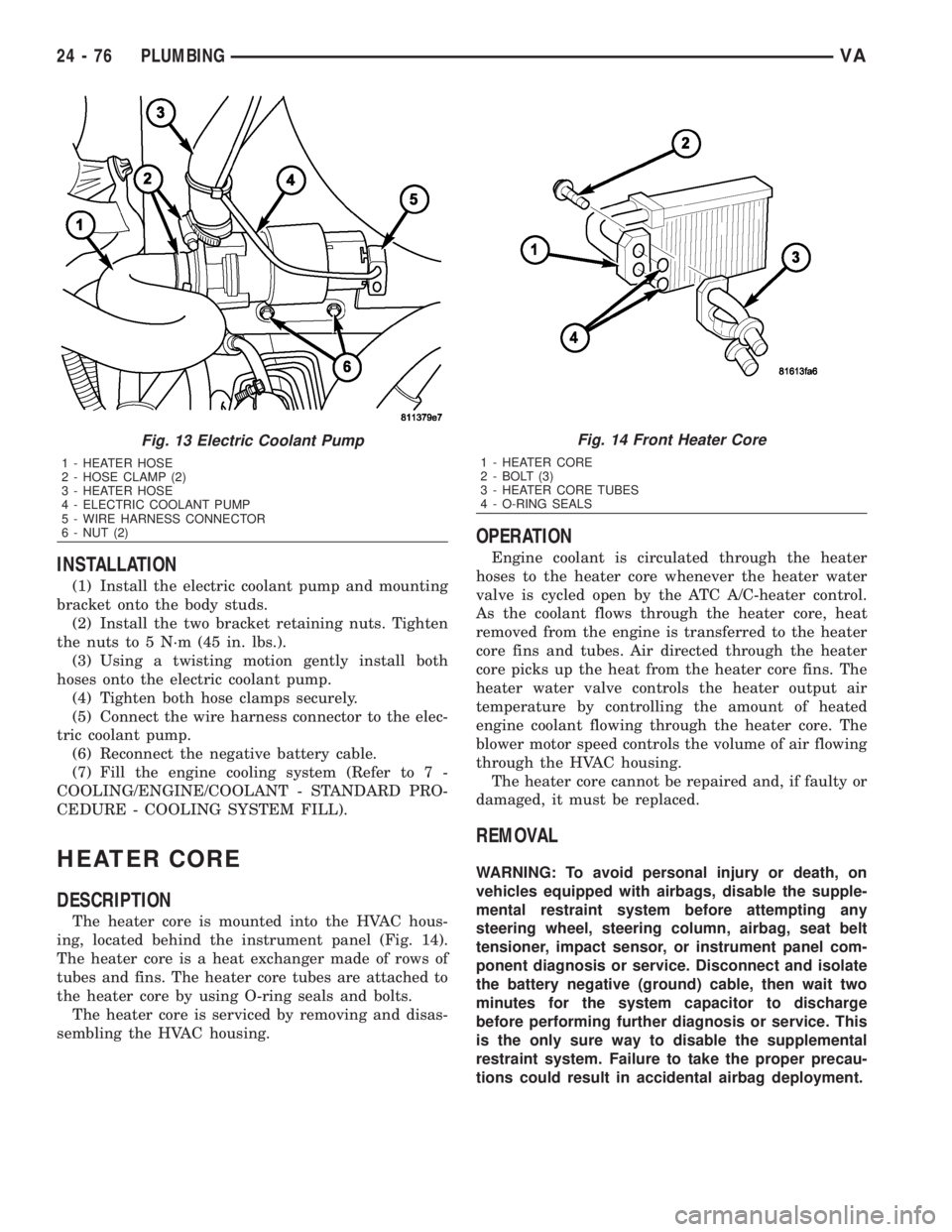
INSTALLATION
(1) Install the electric coolant pump and mounting
bracket onto the body studs.
(2) Install the two bracket retaining nuts. Tighten
the nuts to 5 N´m (45 in. lbs.).
(3) Using a twisting motion gently install both
hoses onto the electric coolant pump.
(4) Tighten both hose clamps securely.
(5) Connect the wire harness connector to the elec-
tric coolant pump.
(6) Reconnect the negative battery cable.
(7) Fill the engine cooling system (Refer to 7 -
COOLING/ENGINE/COOLANT - STANDARD PRO-
CEDURE - COOLING SYSTEM FILL).
HEATER CORE
DESCRIPTION
The heater core is mounted into the HVAC hous-
ing, located behind the instrument panel (Fig. 14).
The heater core is a heat exchanger made of rows of
tubes and fins. The heater core tubes are attached to
the heater core by using O-ring seals and bolts.
The heater core is serviced by removing and disas-
sembling the HVAC housing.
OPERATION
Engine coolant is circulated through the heater
hoses to the heater core whenever the heater water
valve is cycled open by the ATC A/C-heater control.
As the coolant flows through the heater core, heat
removed from the engine is transferred to the heater
core fins and tubes. Air directed through the heater
core picks up the heat from the heater core fins. The
heater water valve controls the heater output air
temperature by controlling the amount of heated
engine coolant flowing through the heater core. The
blower motor speed controls the volume of air flowing
through the HVAC housing.
The heater core cannot be repaired and, if faulty or
damaged, it must be replaced.
REMOVAL
WARNING: To avoid personal injury or death, on
vehicles equipped with airbags, disable the supple-
mental restraint system before attempting any
steering wheel, steering column, airbag, seat belt
tensioner, impact sensor, or instrument panel com-
ponent diagnosis or service. Disconnect and isolate
the battery negative (ground) cable, then wait two
minutes for the system capacitor to discharge
before performing further diagnosis or service. This
is the only sure way to disable the supplemental
restraint system. Failure to take the proper precau-
tions could result in accidental airbag deployment.
Fig. 13 Electric Coolant Pump
1 - HEATER HOSE
2 - HOSE CLAMP (2)
3 - HEATER HOSE
4 - ELECTRIC COOLANT PUMP
5 - WIRE HARNESS CONNECTOR
6 - NUT (2)
Fig. 14 Front Heater Core
1 - HEATER CORE
2 - BOLT (3)
3 - HEATER CORE TUBES
4 - O-RING SEALS
24 - 76 PLUMBINGVA
Page 2114 of 2305
WARNING: Refer to the applicable warnings and
cautions for this system before performing the fol-
lowing operation (Refer to 24 - HEATING & AIR
CONDITIONING/PLUMBING - WARNINGS) and (Refer
to 24 - HEATING & AIR CONDITIONING/PLUMBING -
CAUTIONS). Failure to follow the warnings and cau-
tions could result in possible personal injury or
death.
(1) Remove the heater housing (Refer to 24 -
HEATING & AIR CONDITIONING/DISTRIBUTION/
HVAC HOUSING - REMOVAL).
(2) Disassemble the HVAC housing to access the
heater core (Refer to 24 - HEATING & AIR CONDI-
TIONING/DISTRIBUTION/HVAC HOUSING - DIS-
ASSEMBLY).
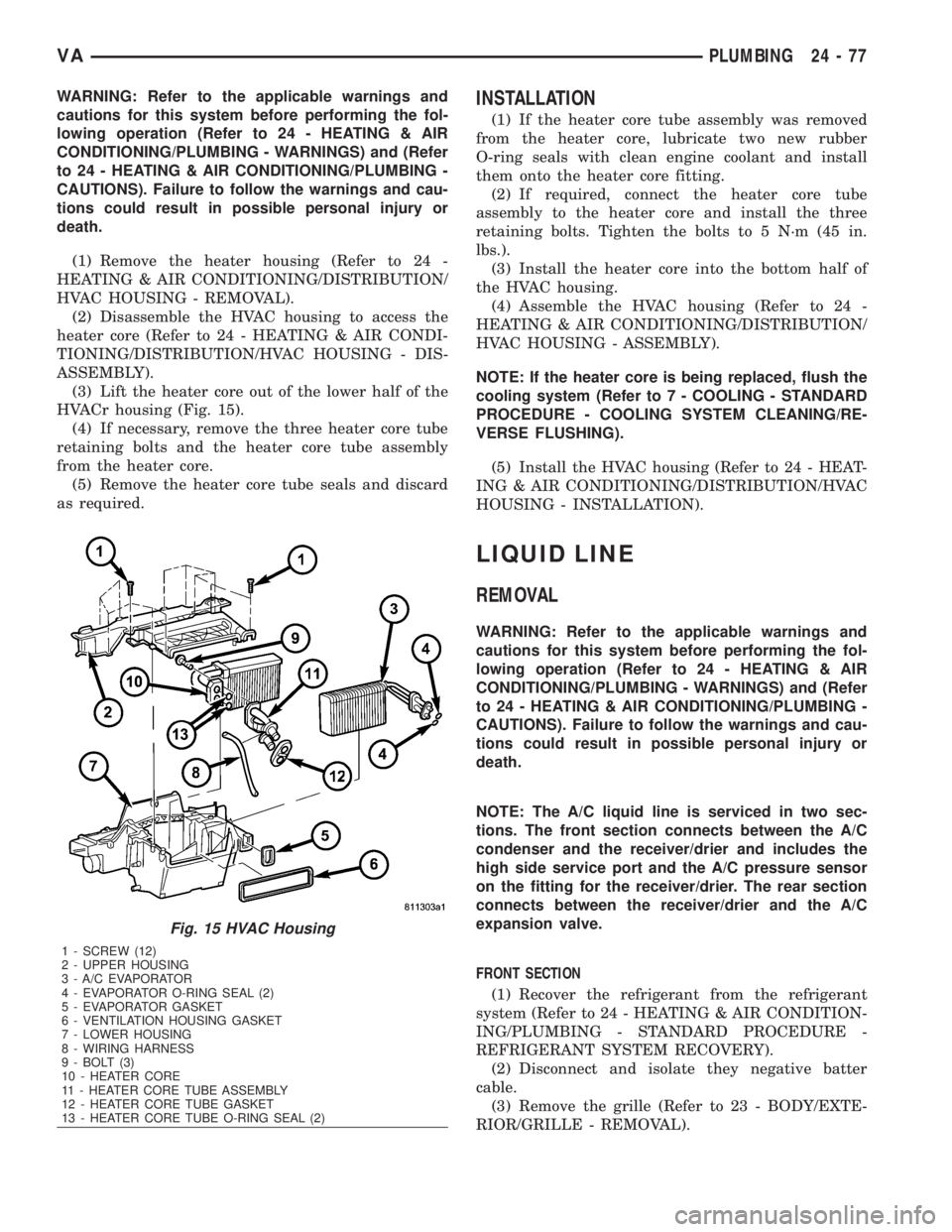
(3) Lift the heater core out of the lower half of the
HVACr housing (Fig. 15).
(4) If necessary, remove the three heater core tube
retaining bolts and the heater core tube assembly
from the heater core.
(5) Remove the heater core tube seals and discard
as required.INSTALLATION
(1) If the heater core tube assembly was removed
from the heater core, lubricate two new rubber
O-ring seals with clean engine coolant and install
them onto the heater core fitting.
(2) If required, connect the heater core tube
assembly to the heater core and install the three
retaining bolts. Tighten the bolts to 5 N´m (45 in.
lbs.).
(3) Install the heater core into the bottom half of
the HVAC housing.
(4) Assemble the HVAC housing (Refer to 24 -
HEATING & AIR CONDITIONING/DISTRIBUTION/
HVAC HOUSING - ASSEMBLY).
NOTE: If the heater core is being replaced, flush the
cooling system (Refer to 7 - COOLING - STANDARD
PROCEDURE - COOLING SYSTEM CLEANING/RE-
VERSE FLUSHING).
(5) Install the HVAC housing (Refer to 24 - HEAT-
ING & AIR CONDITIONING/DISTRIBUTION/HVAC
HOUSING - INSTALLATION).
LIQUID LINE
REMOVAL
WARNING: Refer to the applicable warnings and
cautions for this system before performing the fol-
lowing operation (Refer to 24 - HEATING & AIR
CONDITIONING/PLUMBING - WARNINGS) and (Refer
to 24 - HEATING & AIR CONDITIONING/PLUMBING -
CAUTIONS). Failure to follow the warnings and cau-
tions could result in possible personal injury or
death.
NOTE: The A/C liquid line is serviced in two sec-
tions. The front section connects between the A/C
condenser and the receiver/drier and includes the
high side service port and the A/C pressure sensor
on the fitting for the receiver/drier. The rear section
connects between the receiver/drier and the A/C
expansion valve.
FRONT SECTION
(1) Recover the refrigerant from the refrigerant
system (Refer to 24 - HEATING & AIR CONDITION-
ING/PLUMBING - STANDARD PROCEDURE -
REFRIGERANT SYSTEM RECOVERY).
(2) Disconnect and isolate they negative batter
cable.
(3) Remove the grille (Refer to 23 - BODY/EXTE-
RIOR/GRILLE - REMOVAL).
Fig. 15 HVAC Housing
1 - SCREW (12)
2 - UPPER HOUSING
3 - A/C EVAPORATOR
4 - EVAPORATOR O-RING SEAL (2)
5 - EVAPORATOR GASKET
6 - VENTILATION HOUSING GASKET
7 - LOWER HOUSING
8 - WIRING HARNESS
9 - BOLT (3)
10 - HEATER CORE
11 - HEATER CORE TUBE ASSEMBLY
12 - HEATER CORE TUBE GASKET
13 - HEATER CORE TUBE O-RING SEAL (2)
VAPLUMBING 24 - 77
Page 2120 of 2305
(12) Install the plastic routing clip retainer onto
the A/C suction line.
(13) Reconnect the negative battery cable.
(14) Evacuate the refrigerant system (Refer to 24 -
HEATING & AIR CONDITIONING/PLUMBING -
STANDARD PROCEDURE - REFRIGERANT SYS-
TEM EVACUATE).
(15) Charge the refrigerant system (Refer to 24 -
HEATING & AIR CONDITIONING/PLUMBING -
STANDARD PROCEDURE - REFRIGERANT SYS-
TEM CHARGE).
WATER VALVE
REMOVAL
(1) Disconnect and isolate the negative battery
cable.
(2) Partially drain the engine cooling system
(Refer to 7 - COOLING/ENGINE/COOLANT - STAN-
DARD PROCEDURE - DRAINING COOLING SYS-
TEM).
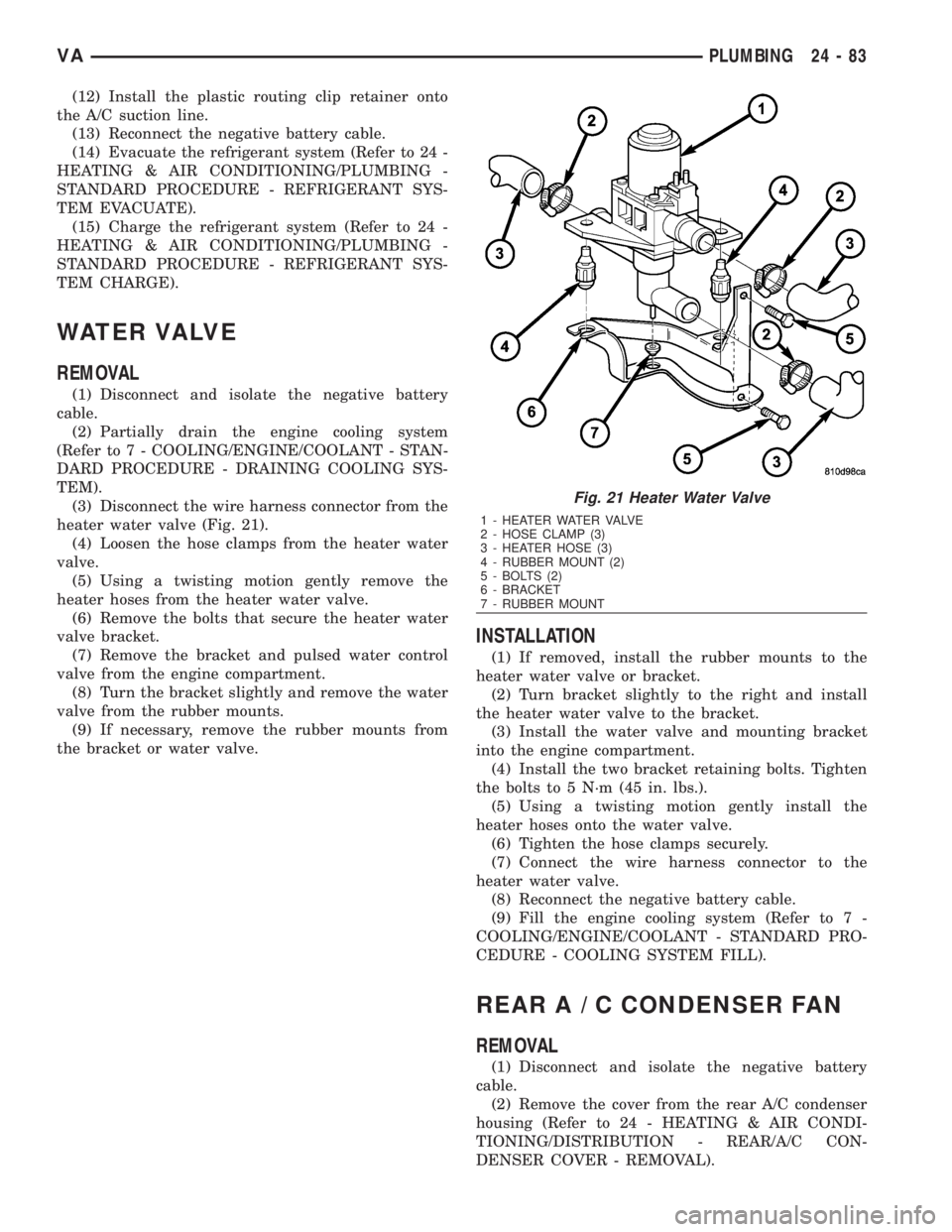
(3) Disconnect the wire harness connector from the
heater water valve (Fig. 21).
(4) Loosen the hose clamps from the heater water
valve.
(5) Using a twisting motion gently remove the
heater hoses from the heater water valve.
(6) Remove the bolts that secure the heater water
valve bracket.
(7) Remove the bracket and pulsed water control
valve from the engine compartment.
(8) Turn the bracket slightly and remove the water
valve from the rubber mounts.
(9) If necessary, remove the rubber mounts from
the bracket or water valve.
INSTALLATION
(1) If removed, install the rubber mounts to the
heater water valve or bracket.
(2) Turn bracket slightly to the right and install
the heater water valve to the bracket.
(3) Install the water valve and mounting bracket
into the engine compartment.
(4) Install the two bracket retaining bolts. Tighten
the bolts to 5 N´m (45 in. lbs.).
(5) Using a twisting motion gently install the
heater hoses onto the water valve.
(6) Tighten the hose clamps securely.
(7) Connect the wire harness connector to the
heater water valve.
(8) Reconnect the negative battery cable.
(9) Fill the engine cooling system (Refer to 7 -
COOLING/ENGINE/COOLANT - STANDARD PRO-
CEDURE - COOLING SYSTEM FILL).
REARA/CCONDENSER FAN
REMOVAL
(1) Disconnect and isolate the negative battery
cable.
(2) Remove the cover from the rear A/C condenser
housing (Refer to 24 - HEATING & AIR CONDI-
TIONING/DISTRIBUTION - REAR/A/C CON-
DENSER COVER - REMOVAL).
Fig. 21 Heater Water Valve
1 - HEATER WATER VALVE
2 - HOSE CLAMP (3)
3 - HEATER HOSE (3)
4 - RUBBER MOUNT (2)
5 - BOLTS (2)
6 - BRACKET
7 - RUBBER MOUNT
VAPLUMBING 24 - 83
Page 2141 of 2305
CABIN HEATER
TABLE OF CONTENTS
page page
CABIN HEATER
DESCRIPTION........................104
OPERATION..........................104
DIAGNOSIS AND TESTING
SUPPLEMENTAL CABIN HEATER........104
EXHAUST TUBE
REMOVAL............................105
INSTALLATION........................106
FUEL DOSING PUMP
DESCRIPTION........................106
OPERATION..........................106
REMOVAL............................106
INSTALLATION........................107
FUEL LINE
STANDARD PROCEDURE
CLEANING.........................107REMOVAL............................108
INSTALLATION........................109
HEATER UNIT
REMOVAL
HEATER UNIT.......................110
WIRE HARNESS.....................110
INSTALLATION
HEATER UNIT.......................110
WIRE HARNESS.....................111
INLET HOSE
REMOVAL............................111
INSTALLATION........................112
CABIN HEATER
DESCRIPTION
Vehicles equipped with the diesel engine are also
equipped with a supplemental cabin heater. This
cabin heater is mounted under the vehicle and oper-
ates similar to an oil fired furnace. The heater burns
small amounts of fuel to provide additional heat to
the coolant. Coolant is routed from the engine, to the
supplemental cabin heater and then to the front
heater core. This provides additional heat to the pas-
senger compartment. The supplemental cabin heater
system is interfaced to the vehicles on-board com-
puter systems and DRBIIItdiagnostics.
The supplemental cabin heater has an electronic
control module that monitors the heat output of the
heater. The cabin heater operates at full load (5 kW),
half load or idle mode (no additional heat) depending
on engine coolant temperature.
OPERATION
The supplemental cabin heater is activated by
using the temperature control on the A/C-heater con-
trol. The supplemental cabin heater is activated
when the temperature control is set to/or above the
upper set point. The supplemental cabin heater can
operate in a full or partial load range as well as an
idle mode, all dependent on the engine coolant tem-
perature. The heater unit will also turn off if the
temperature control is set to less than the lower set
point. The supplemental cabin heater can take up to
three minutes to completely shut down when eitherthe heater temperature is set below the lower set
point or the vehicle ignition is turned off.
The supplemental cabin heater only operates when
the engine is running, the mileage exceeds 8 kilome-
ter (5 mph) and the fuel tank volume exceeds 1/8 of a
tank. The heater should start if the coolant temper-
ature is below 40É C (104É F).
NOTE: Do not apply a strong vacuum directly on
the supplemental cabin heater exhaust line. Place
the vacuum within 75 mm (3 inches) of the exhaust
port. Too strong of a vacuum can prevent the heater
from starting. The heater control module monitors
the blower speed and combustion during its start-
up.
DIAGNOSIS AND TESTING
SUPPLEMENTAL CABIN HEATER
Refer to the Symptoms Diagnosis table for basic
checks of the diesel fueled supplemental cabin heater.
24 - 104 CABIN HEATERVA
Page 2142 of 2305
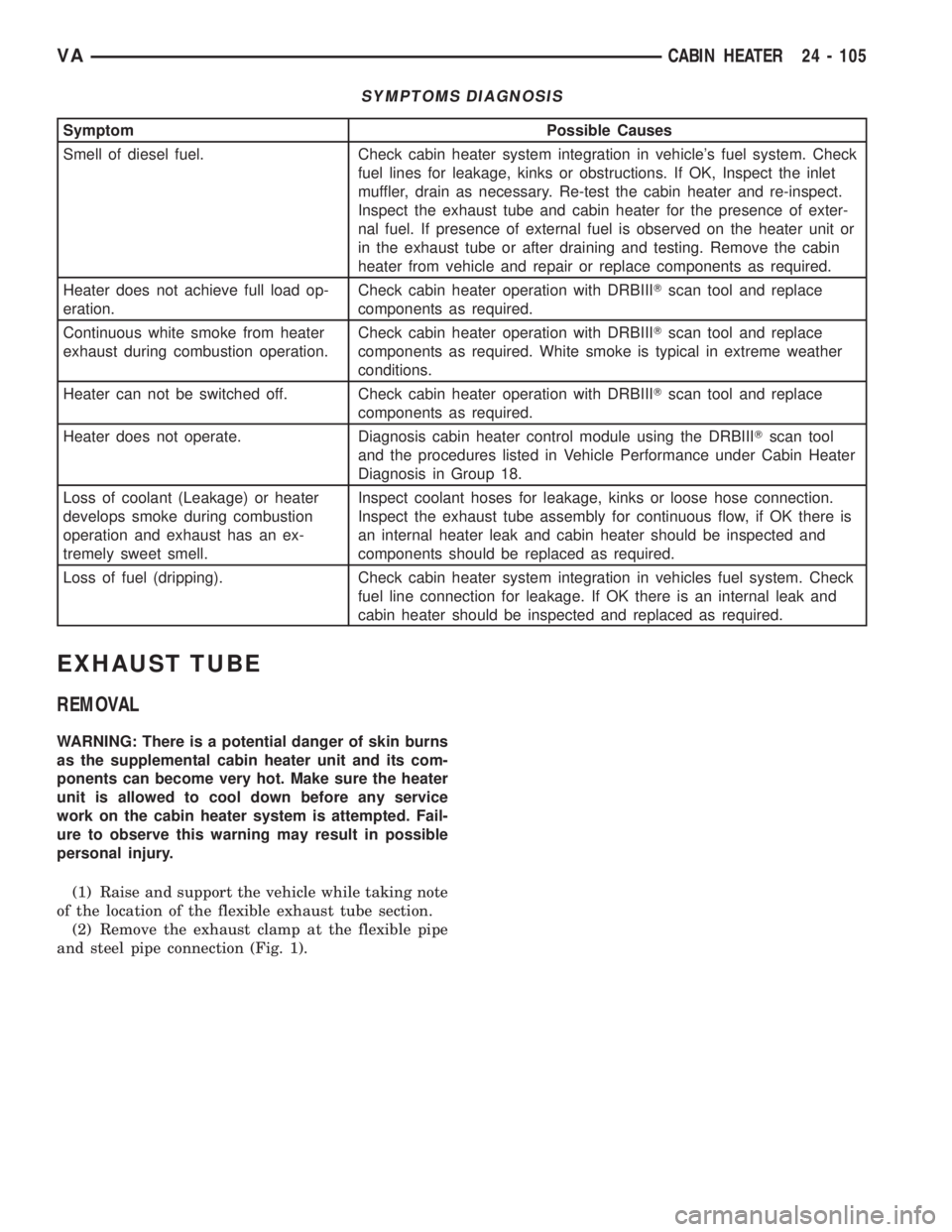
SYMPTOMS DIAGNOSIS
Symptom Possible Causes
Smell of diesel fuel. Check cabin heater system integration in vehicle's fuel system. Check
fuel lines for leakage, kinks or obstructions. If OK, Inspect the inlet
muffler, drain as necessary. Re-test the cabin heater and re-inspect.
Inspect the exhaust tube and cabin heater for the presence of exter-
nal fuel. If presence of external fuel is observed on the heater unit or
in the exhaust tube or after draining and testing. Remove the cabin
heater from vehicle and repair or replace components as required.
Heater does not achieve full load op-
eration.Check cabin heater operation with DRBIIITscan tool and replace
components as required.
Continuous white smoke from heater
exhaust during combustion operation.Check cabin heater operation with DRBIIITscan tool and replace
components as required. White smoke is typical in extreme weather
conditions.
Heater can not be switched off. Check cabin heater operation with DRBIIITscan tool and replace
components as required.
Heater does not operate. Diagnosis cabin heater control module using the DRBIIITscan tool
and the procedures listed in Vehicle Performance under Cabin Heater
Diagnosis in Group 18.
Loss of coolant (Leakage) or heater
develops smoke during combustion
operation and exhaust has an ex-
tremely sweet smell.Inspect coolant hoses for leakage, kinks or loose hose connection.
Inspect the exhaust tube assembly for continuous flow, if OK there is
an internal heater leak and cabin heater should be inspected and
components should be replaced as required.
Loss of fuel (dripping). Check cabin heater system integration in vehicles fuel system. Check
fuel line connection for leakage. If OK there is an internal leak and
cabin heater should be inspected and replaced as required.
EXHAUST TUBE
REMOVAL
WARNING: There is a potential danger of skin burns
as the supplemental cabin heater unit and its com-
ponents can become very hot. Make sure the heater
unit is allowed to cool down before any service
work on the cabin heater system is attempted. Fail-
ure to observe this warning may result in possible
personal injury.
(1) Raise and support the vehicle while taking note
of the location of the flexible exhaust tube section.
(2) Remove the exhaust clamp at the flexible pipe
and steel pipe connection (Fig. 1).
VACABIN HEATER 24 - 105
Page 2147 of 2305
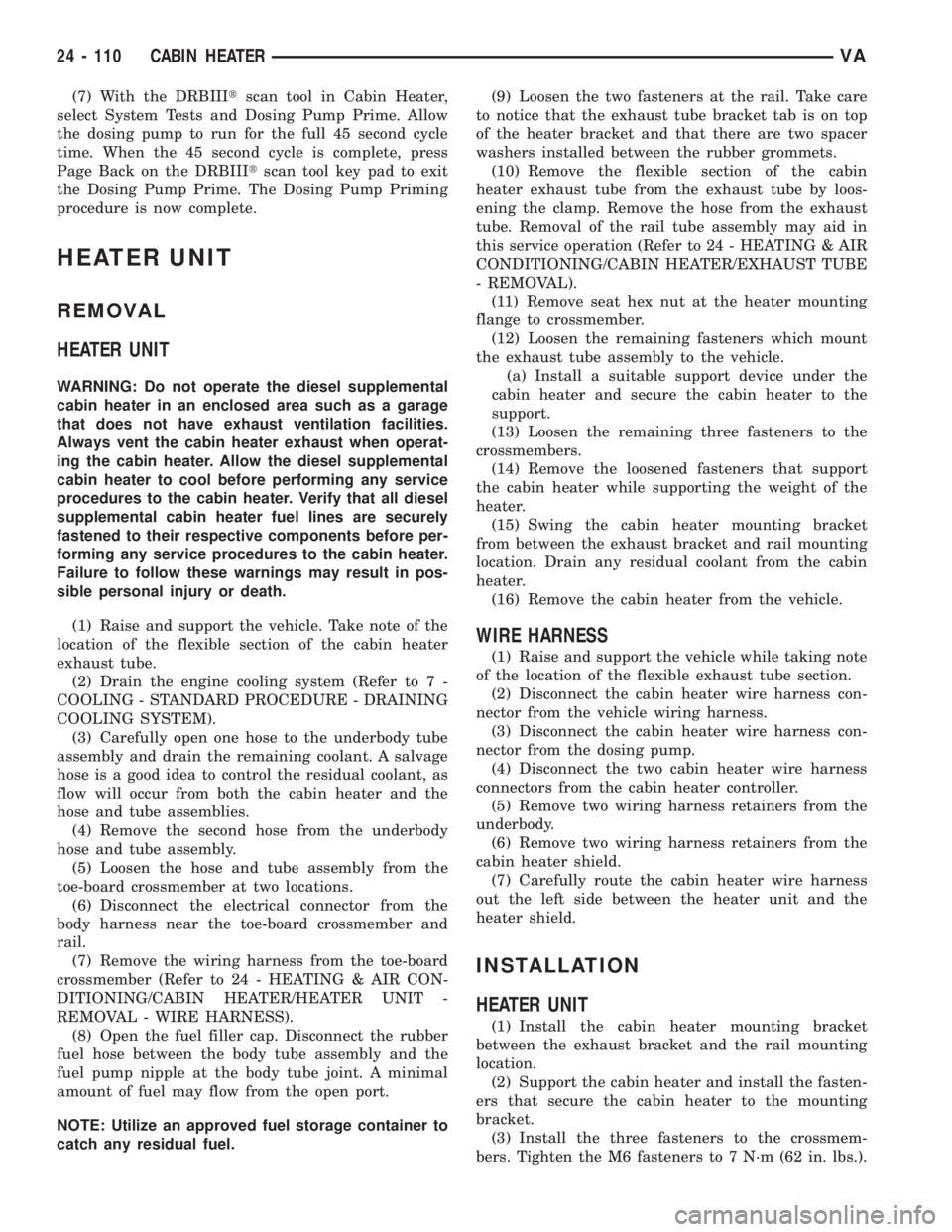
(7) With the DRBIIItscan tool in Cabin Heater,
select System Tests and Dosing Pump Prime. Allow
the dosing pump to run for the full 45 second cycle
time. When the 45 second cycle is complete, press
Page Back on the DRBIIItscan tool key pad to exit
the Dosing Pump Prime. The Dosing Pump Priming
procedure is now complete.
HEATER UNIT
REMOVAL
HEATER UNIT
WARNING: Do not operate the diesel supplemental
cabin heater in an enclosed area such as a garage
that does not have exhaust ventilation facilities.
Always vent the cabin heater exhaust when operat-
ing the cabin heater. Allow the diesel supplemental
cabin heater to cool before performing any service
procedures to the cabin heater. Verify that all diesel
supplemental cabin heater fuel lines are securely
fastened to their respective components before per-
forming any service procedures to the cabin heater.
Failure to follow these warnings may result in pos-
sible personal injury or death.
(1) Raise and support the vehicle. Take note of the
location of the flexible section of the cabin heater
exhaust tube.
(2) Drain the engine cooling system (Refer to 7 -
COOLING - STANDARD PROCEDURE - DRAINING
COOLING SYSTEM).
(3) Carefully open one hose to the underbody tube
assembly and drain the remaining coolant. A salvage
hose is a good idea to control the residual coolant, as
flow will occur from both the cabin heater and the
hose and tube assemblies.
(4) Remove the second hose from the underbody
hose and tube assembly.
(5) Loosen the hose and tube assembly from the
toe-board crossmember at two locations.
(6) Disconnect the electrical connector from the
body harness near the toe-board crossmember and
rail.
(7) Remove the wiring harness from the toe-board
crossmember (Refer to 24 - HEATING & AIR CON-
DITIONING/CABIN HEATER/HEATER UNIT -
REMOVAL - WIRE HARNESS).
(8) Open the fuel filler cap. Disconnect the rubber
fuel hose between the body tube assembly and the
fuel pump nipple at the body tube joint. A minimal
amount of fuel may flow from the open port.
NOTE: Utilize an approved fuel storage container to
catch any residual fuel.(9) Loosen the two fasteners at the rail. Take care
to notice that the exhaust tube bracket tab is on top
of the heater bracket and that there are two spacer
washers installed between the rubber grommets.
(10) Remove the flexible section of the cabin
heater exhaust tube from the exhaust tube by loos-
ening the clamp. Remove the hose from the exhaust
tube. Removal of the rail tube assembly may aid in
this service operation (Refer to 24 - HEATING & AIR
CONDITIONING/CABIN HEATER/EXHAUST TUBE
- REMOVAL).
(11) Remove seat hex nut at the heater mounting
flange to crossmember.
(12) Loosen the remaining fasteners which mount
the exhaust tube assembly to the vehicle.
(a) Install a suitable support device under the
cabin heater and secure the cabin heater to the
support.
(13) Loosen the remaining three fasteners to the
crossmembers.
(14) Remove the loosened fasteners that support
the cabin heater while supporting the weight of the
heater.
(15) Swing the cabin heater mounting bracket
from between the exhaust bracket and rail mounting
location. Drain any residual coolant from the cabin
heater.
(16) Remove the cabin heater from the vehicle.
WIRE HARNESS
(1) Raise and support the vehicle while taking note
of the location of the flexible exhaust tube section.
(2) Disconnect the cabin heater wire harness con-
nector from the vehicle wiring harness.
(3) Disconnect the cabin heater wire harness con-
nector from the dosing pump.
(4) Disconnect the two cabin heater wire harness
connectors from the cabin heater controller.
(5) Remove two wiring harness retainers from the
underbody.
(6) Remove two wiring harness retainers from the
cabin heater shield.
(7) Carefully route the cabin heater wire harness
out the left side between the heater unit and the
heater shield.
INSTALLATION
HEATER UNIT
(1) Install the cabin heater mounting bracket
between the exhaust bracket and the rail mounting
location.
(2) Support the cabin heater and install the fasten-
ers that secure the cabin heater to the mounting
bracket.
(3) Install the three fasteners to the crossmem-
bers. Tighten the M6 fasteners to 7 N´m (62 in. lbs.).
24 - 110 CABIN HEATERVA