transmission MERCEDES-BENZ SPRINTER 2006 Service Manual
[x] Cancel search | Manufacturer: MERCEDES-BENZ, Model Year: 2006, Model line: SPRINTER, Model: MERCEDES-BENZ SPRINTER 2006Pages: 2305, PDF Size: 48.12 MB
Page 1773 of 2305

command valve (5) to clutch K1 (6). The multiple-disc
holding clutch B1 (7) is deactivated (unpressurized).
The spring of the shift pressure shift valve (3) pushes
the valve back to its basic position.
21 - 30 AUTOMATIC TRANSMISSION NAG1 - SERVICE INFORMATIONVA
Page 1774 of 2305
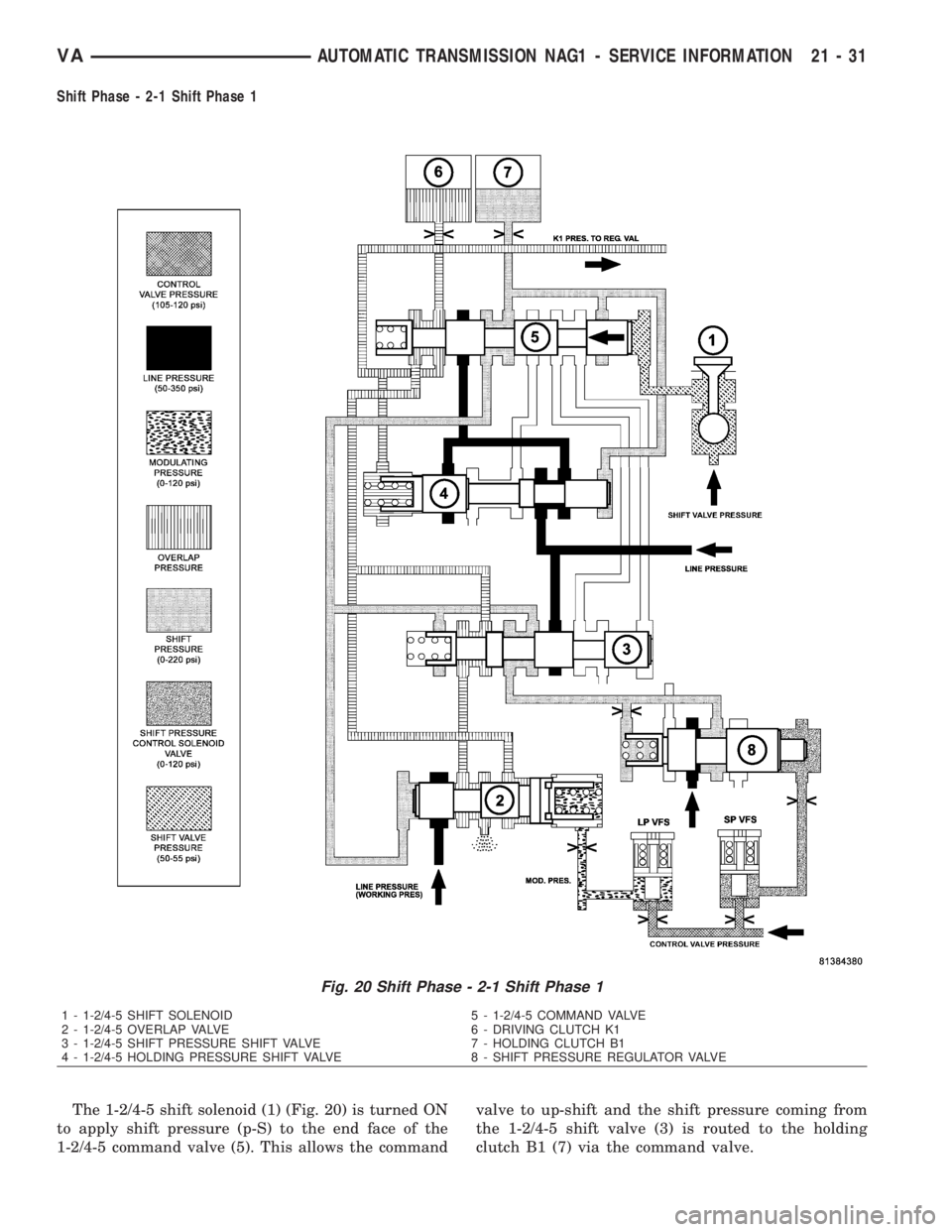
Shift Phase - 2-1 Shift Phase 1
The 1-2/4-5 shift solenoid (1) (Fig. 20) is turned ON
to apply shift pressure (p-S) to the end face of the
1-2/4-5 command valve (5). This allows the commandvalve to up-shift and the shift pressure coming from
the 1-2/4-5 shift valve (3) is routed to the holding
clutch B1 (7) via the command valve.
Fig. 20 Shift Phase - 2-1 Shift Phase 1
1 - 1-2/4-5 SHIFT SOLENOID 5 - 1-2/4-5 COMMAND VALVE
2 - 1-2/4-5 OVERLAP VALVE 6 - DRIVING CLUTCH K1
3 - 1-2/4-5 SHIFT PRESSURE SHIFT VALVE 7 - HOLDING CLUTCH B1
4 - 1-2/4-5 HOLDING PRESSURE SHIFT VALVE 8 - SHIFT PRESSURE REGULATOR VALVE
VAAUTOMATIC TRANSMISSION NAG1 - SERVICE INFORMATION 21 - 31
Page 1775 of 2305

Simultaneously, the pressure in the releasing
clutch, K1 (6), is regulated at the 1-2/4-5 overlap
valve (2). The pressure in the K1 clutch as it disen-
gages is controlled during the shift phase depending
on engine load, via the modulating pressure
(p-MOD), and the shift pressure in clutch B1 (7). The
increasing shift pressure in clutch B1, which also
acts on the end face of the overlap valve, reduces the
overlap pressure.
21 - 32 AUTOMATIC TRANSMISSION NAG1 - SERVICE INFORMATIONVA
Page 1776 of 2305
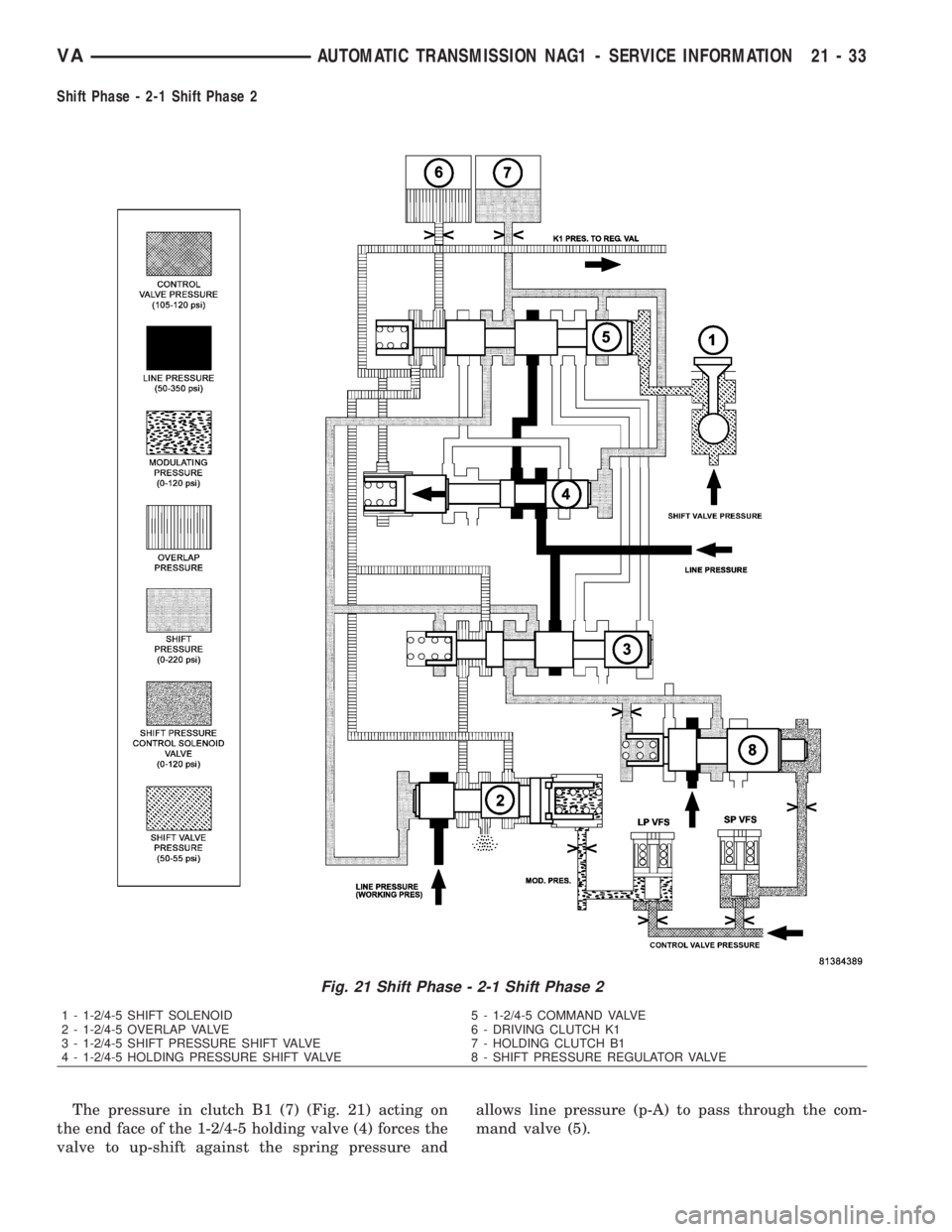
Shift Phase - 2-1 Shift Phase 2
The pressure in clutch B1 (7) (Fig. 21) acting on
the end face of the 1-2/4-5 holding valve (4) forces the
valve to up-shift against the spring pressure andallows line pressure (p-A) to pass through the com-
mand valve (5).
Fig. 21 Shift Phase - 2-1 Shift Phase 2
1 - 1-2/4-5 SHIFT SOLENOID 5 - 1-2/4-5 COMMAND VALVE
2 - 1-2/4-5 OVERLAP VALVE 6 - DRIVING CLUTCH K1
3 - 1-2/4-5 SHIFT PRESSURE SHIFT VALVE 7 - HOLDING CLUTCH B1
4 - 1-2/4-5 HOLDING PRESSURE SHIFT VALVE 8 - SHIFT PRESSURE REGULATOR VALVE
VAAUTOMATIC TRANSMISSION NAG1 - SERVICE INFORMATION 21 - 33
Page 1777 of 2305
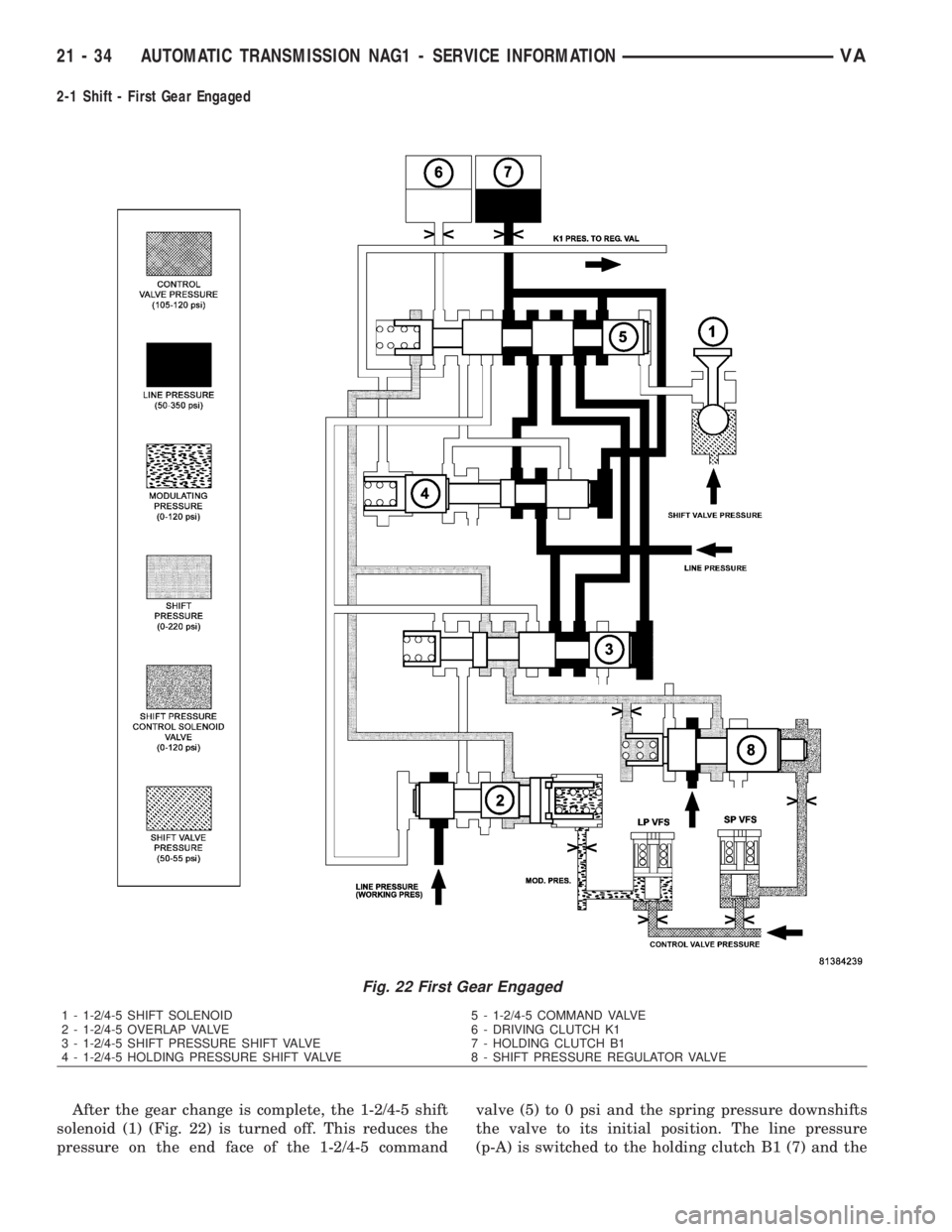
2-1 Shift - First Gear Engaged
After the gear change is complete, the 1-2/4-5 shift
solenoid (1) (Fig. 22) is turned off. This reduces the
pressure on the end face of the 1-2/4-5 commandvalve (5) to 0 psi and the spring pressure downshifts
the valve to its initial position. The line pressure
(p-A) is switched to the holding clutch B1 (7) and the
Fig. 22 First Gear Engaged
1 - 1-2/4-5 SHIFT SOLENOID 5 - 1-2/4-5 COMMAND VALVE
2 - 1-2/4-5 OVERLAP VALVE 6 - DRIVING CLUTCH K1
3 - 1-2/4-5 SHIFT PRESSURE SHIFT VALVE 7 - HOLDING CLUTCH B1
4 - 1-2/4-5 HOLDING PRESSURE SHIFT VALVE 8 - SHIFT PRESSURE REGULATOR VALVE
21 - 34 AUTOMATIC TRANSMISSION NAG1 - SERVICE INFORMATIONVA
Page 1778 of 2305

end face of the holding valve by the downshifted com-
mand valve. The upshifted holding valve also allows
the remaining pressure in clutch K1 (6) to be vented.
VAAUTOMATIC TRANSMISSION NAG1 - SERVICE INFORMATION 21 - 35
Page 1779 of 2305
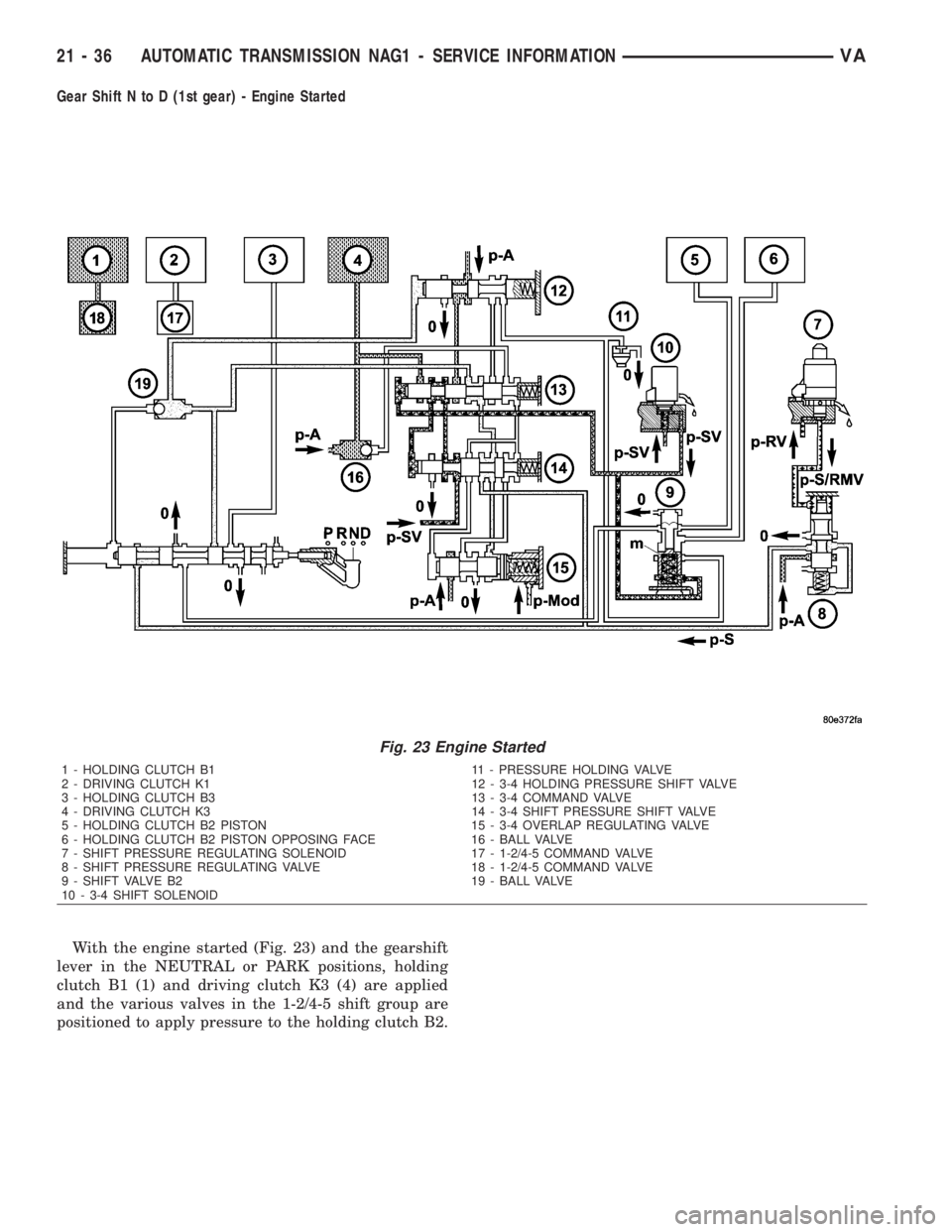
Gear Shift N to D (1st gear) - Engine Started
With the engine started (Fig. 23) and the gearshift
lever in the NEUTRAL or PARK positions, holding
clutch B1 (1) and driving clutch K3 (4) are applied
and the various valves in the 1-2/4-5 shift group are
positioned to apply pressure to the holding clutch B2.
Fig. 23 Engine Started
1 - HOLDING CLUTCH B1 11 - PRESSURE HOLDING VALVE
2 - DRIVING CLUTCH K1 12 - 3-4 HOLDING PRESSURE SHIFT VALVE
3 - HOLDING CLUTCH B3 13 - 3-4 COMMAND VALVE
4 - DRIVING CLUTCH K3 14 - 3-4 SHIFT PRESSURE SHIFT VALVE
5 - HOLDING CLUTCH B2 PISTON 15 - 3-4 OVERLAP REGULATING VALVE
6 - HOLDING CLUTCH B2 PISTON OPPOSING FACE 16 - BALL VALVE
7 - SHIFT PRESSURE REGULATING SOLENOID 17 - 1-2/4-5 COMMAND VALVE
8 - SHIFT PRESSURE REGULATING VALVE 18 - 1-2/4-5 COMMAND VALVE
9 - SHIFT VALVE B2 19 - BALL VALVE
10 - 3-4 SHIFT SOLENOID
21 - 36 AUTOMATIC TRANSMISSION NAG1 - SERVICE INFORMATIONVA
Page 1780 of 2305
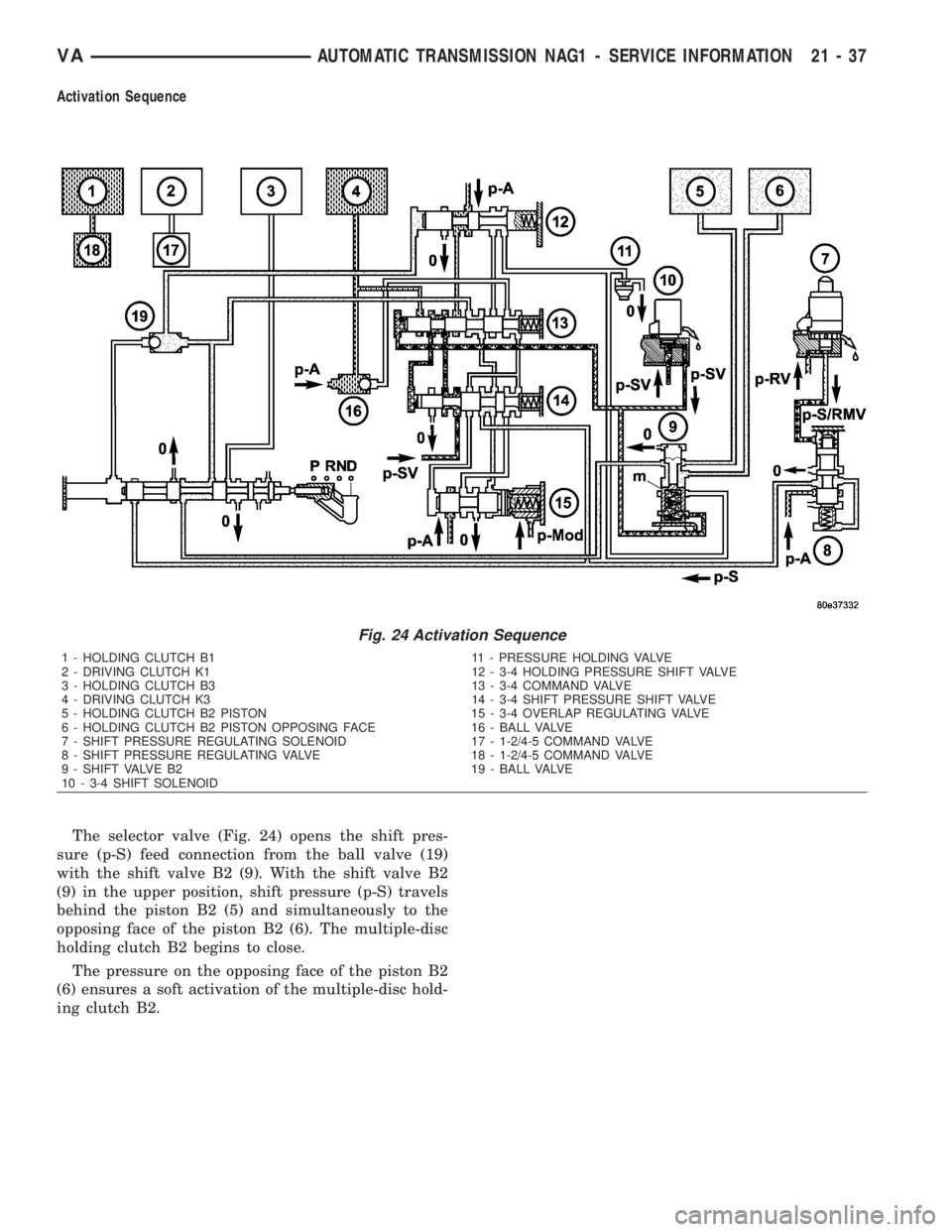
Activation Sequence
The selector valve (Fig. 24) opens the shift pres-
sure (p-S) feed connection from the ball valve (19)
with the shift valve B2 (9). With the shift valve B2
(9) in the upper position, shift pressure (p-S) travels
behind the piston B2 (5) and simultaneously to the
opposing face of the piston B2 (6). The multiple-disc
holding clutch B2 begins to close.
The pressure on the opposing face of the piston B2
(6) ensures a soft activation of the multiple-disc hold-
ing clutch B2.
Fig. 24 Activation Sequence
1 - HOLDING CLUTCH B1 11 - PRESSURE HOLDING VALVE
2 - DRIVING CLUTCH K1 12 - 3-4 HOLDING PRESSURE SHIFT VALVE
3 - HOLDING CLUTCH B3 13 - 3-4 COMMAND VALVE
4 - DRIVING CLUTCH K3 14 - 3-4 SHIFT PRESSURE SHIFT VALVE
5 - HOLDING CLUTCH B2 PISTON 15 - 3-4 OVERLAP REGULATING VALVE
6 - HOLDING CLUTCH B2 PISTON OPPOSING FACE 16 - BALL VALVE
7 - SHIFT PRESSURE REGULATING SOLENOID 17 - 1-2/4-5 COMMAND VALVE
8 - SHIFT PRESSURE REGULATING VALVE 18 - 1-2/4-5 COMMAND VALVE
9 - SHIFT VALVE B2 19 - BALL VALVE
10 - 3-4 SHIFT SOLENOID
VAAUTOMATIC TRANSMISSION NAG1 - SERVICE INFORMATION 21 - 37
Page 1781 of 2305
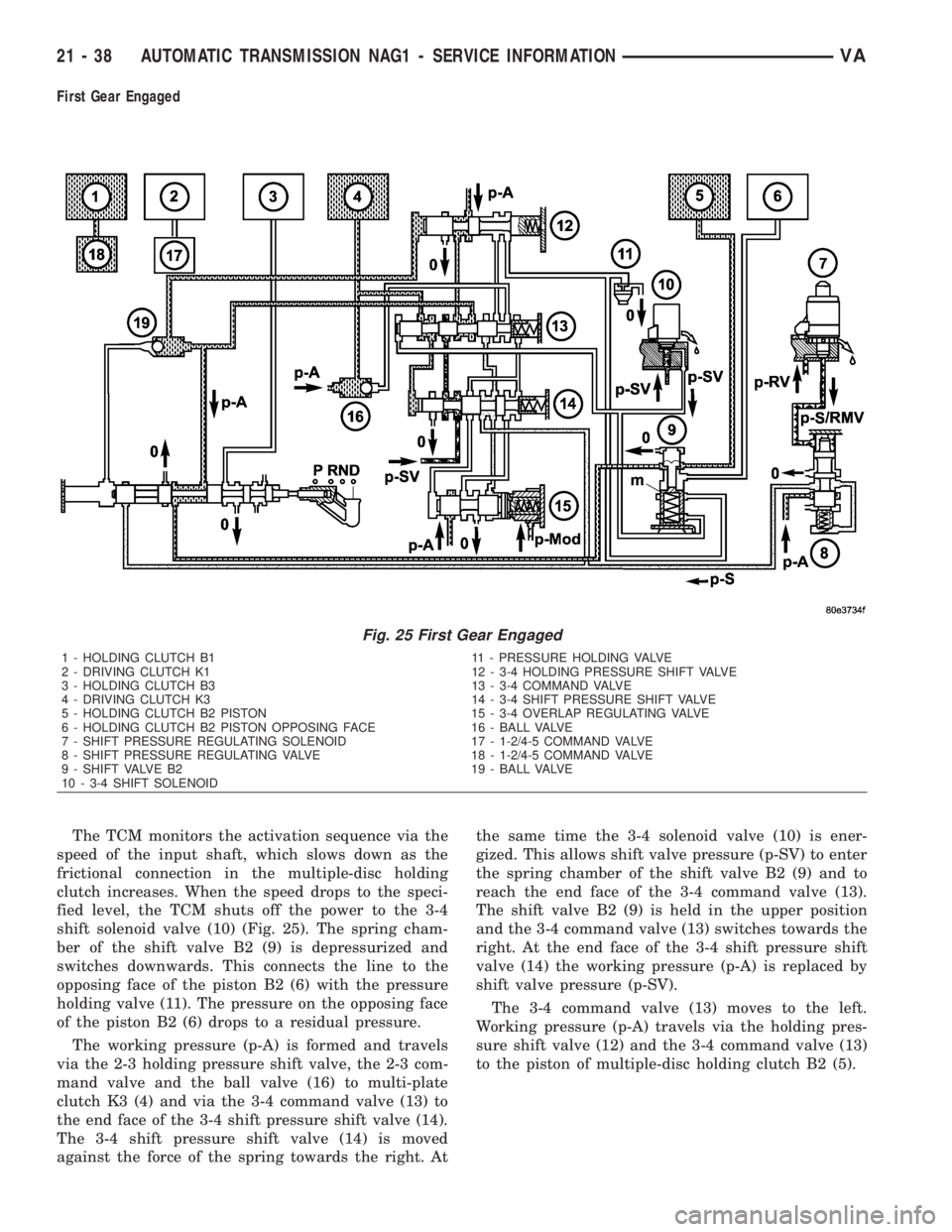
First Gear Engaged
The TCM monitors the activation sequence via the
speed of the input shaft, which slows down as the
frictional connection in the multiple-disc holding
clutch increases. When the speed drops to the speci-
fied level, the TCM shuts off the power to the 3-4
shift solenoid valve (10) (Fig. 25). The spring cham-
ber of the shift valve B2 (9) is depressurized and
switches downwards. This connects the line to the
opposing face of the piston B2 (6) with the pressure
holding valve (11). The pressure on the opposing face
of the piston B2 (6) drops to a residual pressure.
The working pressure (p-A) is formed and travels
via the 2-3 holding pressure shift valve, the 2-3 com-
mand valve and the ball valve (16) to multi-plate
clutch K3 (4) and via the 3-4 command valve (13) to
the end face of the 3-4 shift pressure shift valve (14).
The 3-4 shift pressure shift valve (14) is moved
against the force of the spring towards the right. Atthe same time the 3-4 solenoid valve (10) is ener-
gized. This allows shift valve pressure (p-SV) to enter
the spring chamber of the shift valve B2 (9) and to
reach the end face of the 3-4 command valve (13).
The shift valve B2 (9) is held in the upper position
and the 3-4 command valve (13) switches towards the
right. At the end face of the 3-4 shift pressure shift
valve (14) the working pressure (p-A) is replaced by
shift valve pressure (p-SV).
The 3-4 command valve (13) moves to the left.
Working pressure (p-A) travels via the holding pres-
sure shift valve (12) and the 3-4 command valve (13)
to the piston of multiple-disc holding clutch B2 (5).
Fig. 25 First Gear Engaged
1 - HOLDING CLUTCH B1 11 - PRESSURE HOLDING VALVE
2 - DRIVING CLUTCH K1 12 - 3-4 HOLDING PRESSURE SHIFT VALVE
3 - HOLDING CLUTCH B3 13 - 3-4 COMMAND VALVE
4 - DRIVING CLUTCH K3 14 - 3-4 SHIFT PRESSURE SHIFT VALVE
5 - HOLDING CLUTCH B2 PISTON 15 - 3-4 OVERLAP REGULATING VALVE
6 - HOLDING CLUTCH B2 PISTON OPPOSING FACE 16 - BALL VALVE
7 - SHIFT PRESSURE REGULATING SOLENOID 17 - 1-2/4-5 COMMAND VALVE
8 - SHIFT PRESSURE REGULATING VALVE 18 - 1-2/4-5 COMMAND VALVE
9 - SHIFT VALVE B2 19 - BALL VALVE
10 - 3-4 SHIFT SOLENOID
21 - 38 AUTOMATIC TRANSMISSION NAG1 - SERVICE INFORMATIONVA
Page 1782 of 2305
DIAGNOSIS AND TESTING
AUTOMATIC TRANSMISSION
CAUTION: Before attempting any repair on a NAG1
automatic transmission, check for Diagnostic Trou-
ble Codes with the appropriate scan tool.
Transmission malfunctions may be caused by these
general conditions:
²Poor engine performance.
²Improper adjustments.
²Hydraulic malfunctions.
²Mechanical malfunctions.
²Electronic malfunctions.
²Transfer case performance (if equipped).
Diagnosis of these problems should always begin
by checking the easily accessible variables: fluid level
and condition, gearshift cable adjustment. Then per-
form a road test to determine if the problem has been
corrected or if more diagnosis is necessary.
PRELIMINARY
Two basic procedures are required. One procedure
for vehicles that are drivable and an alternate proce-
dure for disabled vehicles (will not back up or move
forward).
VEHICLE IS DRIVABLE
(1) Check for transmission fault codes using the
appropriate scan tool.
(2) Check fluid level and condition.
(3) Adjust gearshift cable if complaint was based
on delayed, erratic, or harsh shifts.
(4) Road test and note how transmission upshifts,
downshifts, and engages.
VEHICLE IS DISABLED
(1) Check fluid level and condition.(2) Check for broken or disconnected gearshift
cable.
(3) Check for cracked, leaking cooler lines, or loose
or missing pressure-port plugs.
(4) Raise and support vehicle on safety stands,
start engine, shift transmission into gear, and note
following:
(a) If propeller shaft turns but wheels do not,
problem is with differential or axle shafts.
(b) If propeller shaft does not turn and transmis-
sion is noisy, stop engine. Remove oil pan, and
check for debris. If pan is clear, remove transmis-
sion and check for damaged driveplate, converter,
oil pump, or input shaft.
(c) If propeller shaft does not turn and transmis-
sion is not noisy, perform hydraulic-pressure test to
determine if problem is hydraulic or mechanical.
ROAD TESTING
Before road testing, be sure the fluid level and con-
trol cable adjustments have been checked and
adjusted if necessary. Verify that all diagnostic trou-
ble codes have been resolved.
Observe engine performance during the road test.
A poorly tuned engine will not allow accurate analy-
sis of transmission operation.
Operate the transmission in all gear ranges. Check
for shift variations and engine flare which indicates
slippage. Note if shifts are harsh, spongy, delayed,
early, or if part throttle downshifts are sensitive.
Slippage indicated by engine flare, usually means
clutch, overrunning clutch, or line pressure problems.
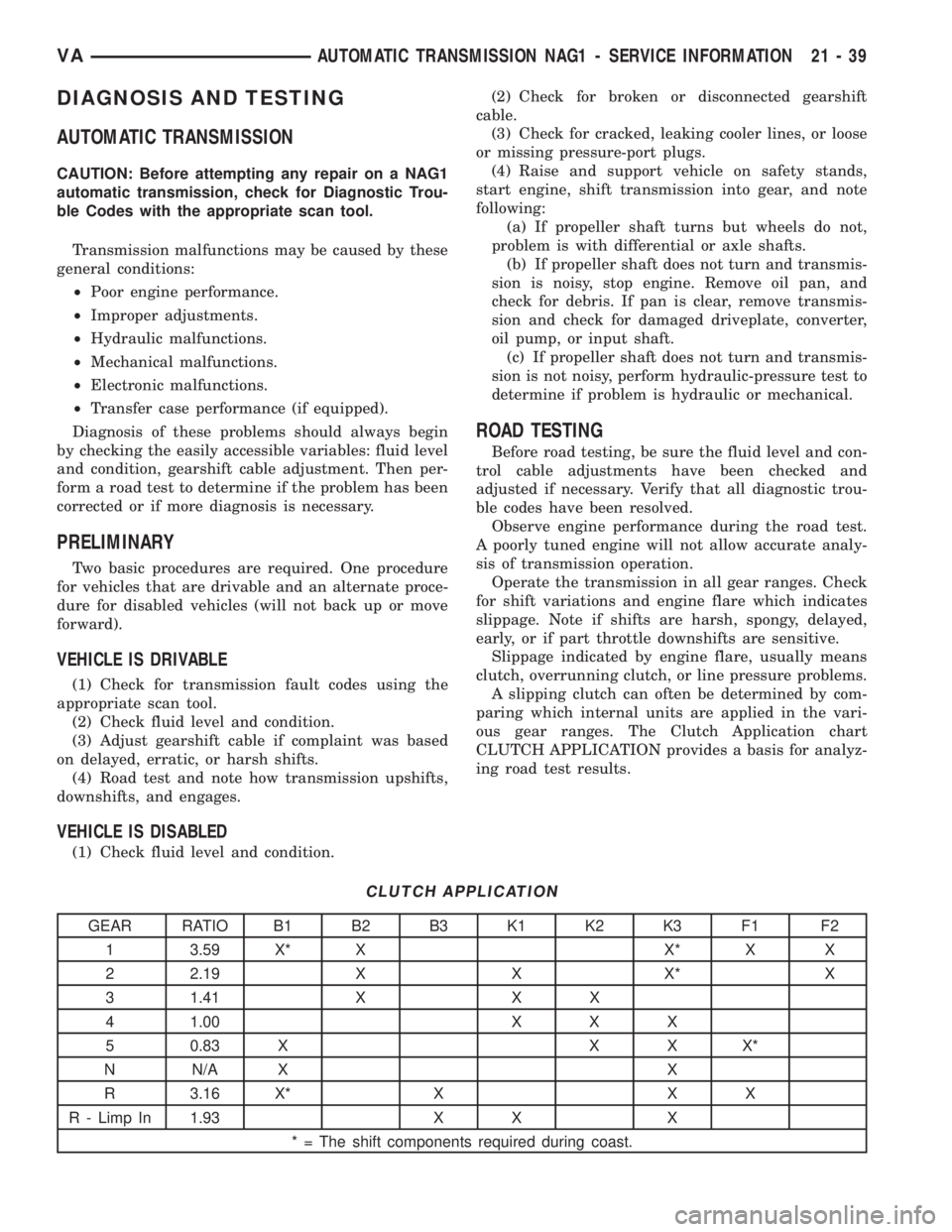
A slipping clutch can often be determined by com-
paring which internal units are applied in the vari-
ous gear ranges. The Clutch Application chart
CLUTCH APPLICATION provides a basis for analyz-
ing road test results.
CLUTCH APPLICATION
GEAR RATIO B1 B2 B3 K1 K2 K3 F1 F2
1 3.59 X* X X* X X
2 2.19 X X X* X
3 1.41 X X X
4 1.00 X X X
5 0.83 X X X X*
N N/A X X
R 3.16 X* X X X
R - Limp In 1.93 X X X
* = The shift components required during coast.
VAAUTOMATIC TRANSMISSION NAG1 - SERVICE INFORMATION 21 - 39