remote control MERCEDES-BENZ SPRINTER 2006 User Guide
[x] Cancel search | Manufacturer: MERCEDES-BENZ, Model Year: 2006, Model line: SPRINTER, Model: MERCEDES-BENZ SPRINTER 2006Pages: 2305, PDF Size: 48.12 MB
Page 297 of 2305
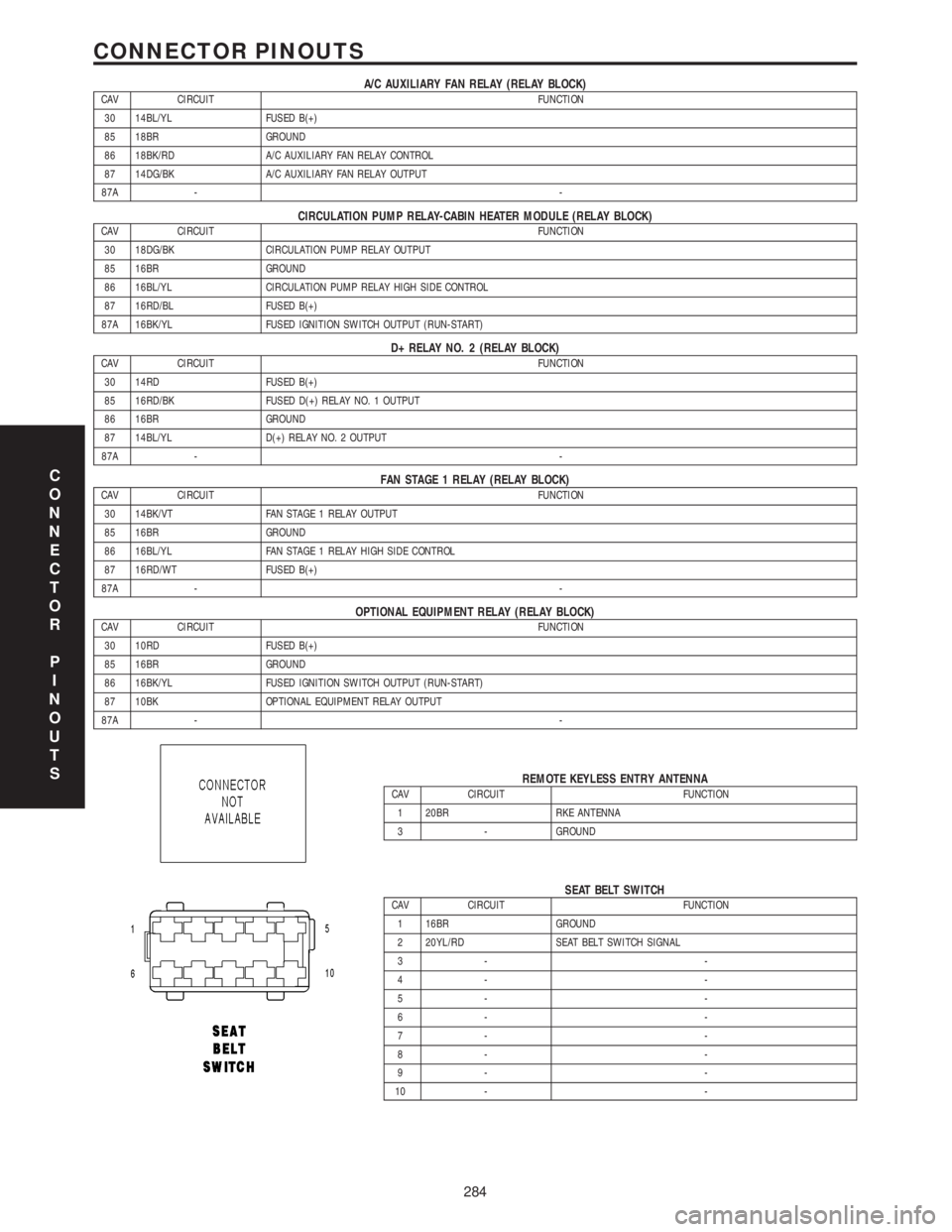
A/C AUXILIARY FAN RELAY (RELAY BLOCK)CAV CIRCUIT FUNCTION
30 14BL/YL FUSED B(+)
85 18BR GROUND
86 18BK/RD A/C AUXILIARY FAN RELAY CONTROL
87 14DG/BK A/C AUXILIARY FAN RELAY OUTPUT
87A --
CIRCULATION PUMP RELAY-CABIN HEATER MODULE (RELAY BLOCK)CAV CIRCUIT FUNCTION
30 18DG/BK CIRCULATION PUMP RELAY OUTPUT
85 16BR GROUND
86 16BL/YL CIRCULATION PUMP RELAY HIGH SIDE CONTROL
87 16RD/BL FUSED B(+)
87A 16BK/YL FUSED IGNITION SWITCH OUTPUT (RUN-START)
D+ RELAY NO. 2 (RELAY BLOCK)CAV CIRCUIT FUNCTION
30 14RD FUSED B(+)
85 16RD/BK FUSED D(+) RELAY NO. 1 OUTPUT
86 16BR GROUND
87 14BL/YL D(+) RELAY NO. 2 OUTPUT
87A --
FAN STAGE 1 RELAY (RELAY BLOCK)CAV CIRCUIT FUNCTION
30 14BK/VT FAN STAGE 1 RELAY OUTPUT
85 16BR GROUND
86 16BL/YL FAN STAGE 1 RELAY HIGH SIDE CONTROL
87 16RD/WT FUSED B(+)
87A --
OPTIONAL EQUIPMENT RELAY (RELAY BLOCK)CAV CIRCUIT FUNCTION
30 10RD FUSED B(+)
85 16BR GROUND
86 16BK/YL FUSED IGNITION SWITCH OUTPUT (RUN-START)
87 10BK OPTIONAL EQUIPMENT RELAY OUTPUT
87A --
REMOTE KEYLESS ENTRY ANTENNACAV CIRCUIT FUNCTION
1 20BR RKE ANTENNA
3 - GROUND
SEAT BELT SWITCHCAV CIRCUIT FUNCTION
1 16BR GROUND
2 20YL/RD SEAT BELT SWITCH SIGNAL
3- -
4- -
5- -
6- -
7- -
8- -
9- -
10 - -
C
O
N
N
E
C
T
O
R
P
I
N
O
U
T
S
284
CONNECTOR PINOUTS
Page 299 of 2305
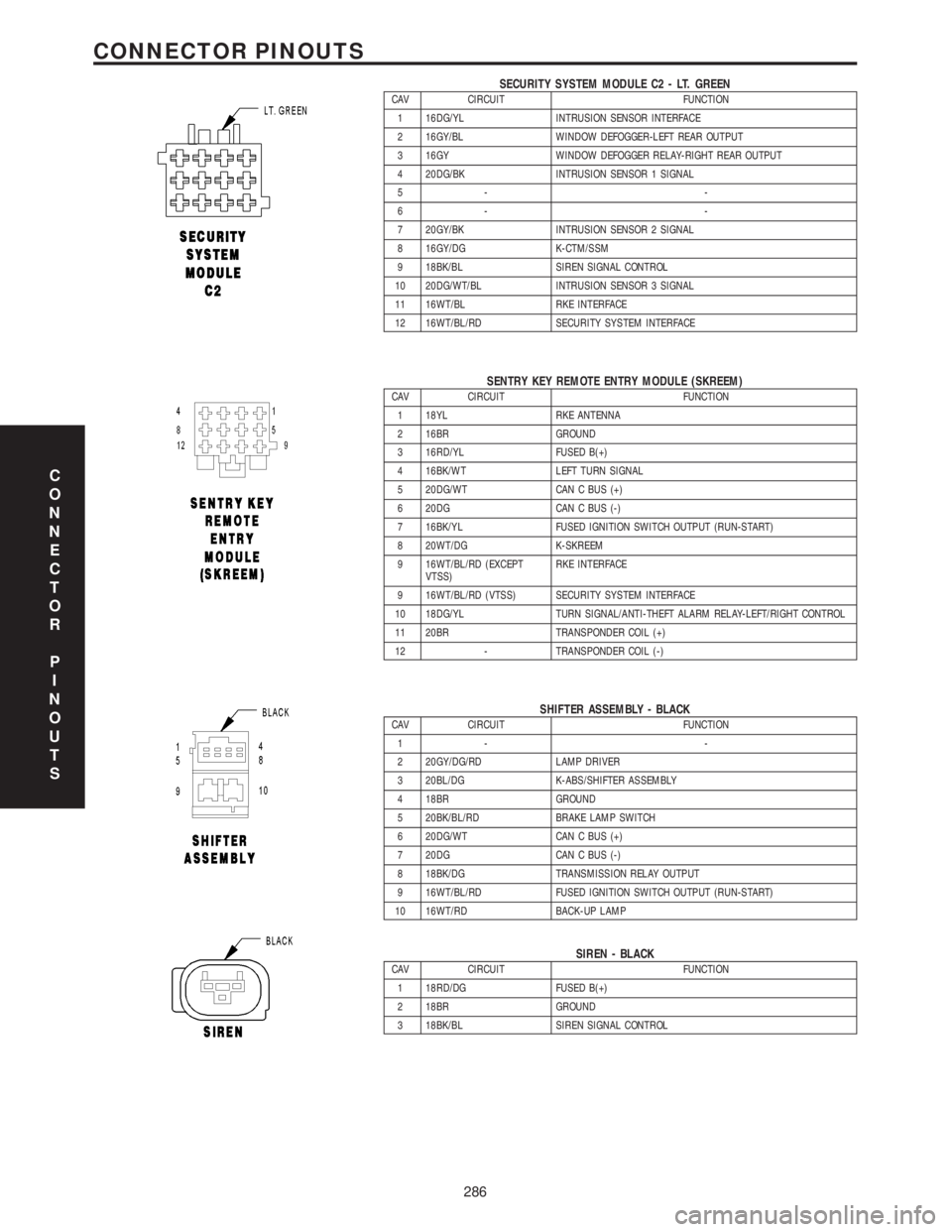
SECURITY SYSTEM MODULE C2 - LT. GREENCAV CIRCUIT FUNCTION
1 16DG/YL INTRUSION SENSOR INTERFACE
2 16GY/BL WINDOW DEFOGGER-LEFT REAR OUTPUT
3 16GY WINDOW DEFOGGER RELAY-RIGHT REAR OUTPUT
4 20DG/BK INTRUSION SENSOR 1 SIGNAL
5- -
6- -
7 20GY/BK INTRUSION SENSOR 2 SIGNAL
8 16GY/DG K-CTM/SSM
9 18BK/BL SIREN SIGNAL CONTROL
10 20DG/WT/BL INTRUSION SENSOR 3 SIGNAL
11 16WT/BL RKE INTERFACE
12 16WT/BL/RD SECURITY SYSTEM INTERFACE
SENTRY KEY REMOTE ENTRY MODULE (SKREEM)CAV CIRCUIT FUNCTION
1 18YL RKE ANTENNA
2 16BR GROUND
3 16RD/YL FUSED B(+)
4 16BK/WT LEFT TURN SIGNAL
5 20DG/WT CAN C BUS (+)
6 20DG CAN C BUS (-)
7 16BK/YL FUSED IGNITION SWITCH OUTPUT (RUN-START)
8 20WT/DG K-SKREEM
9 16WT/BL/RD (EXCEPT
VTSS)RKE INTERFACE
9 16WT/BL/RD (VTSS) SECURITY SYSTEM INTERFACE
10 18DG/YL TURN SIGNAL/ANTI-THEFT ALARM RELAY-LEFT/RIGHT CONTROL
11 20BR TRANSPONDER COIL (+)
12 - TRANSPONDER COIL (-)
SHIFTER ASSEMBLY - BLACKCAV CIRCUIT FUNCTION
1- -
2 20GY/DG/RD LAMP DRIVER
3 20BL/DG K-ABS/SHIFTER ASSEMBLY
4 18BR GROUND
5 20BK/BL/RD BRAKE LAMP SWITCH
6 20DG/WT CAN C BUS (+)
7 20DG CAN C BUS (-)
8 18BK/DG TRANSMISSION RELAY OUTPUT
9 16WT/BL/RD FUSED IGNITION SWITCH OUTPUT (RUN-START)
10 16WT/RD BACK-UP LAMP
SIREN - BLACKCAV CIRCUIT FUNCTION
1 18RD/DG FUSED B(+)
2 18BR GROUND
3 18BK/BL SIREN SIGNAL CONTROL
C
O
N
N
E
C
T
O
R
P
I
N
O
U
T
S
286
CONNECTOR PINOUTS
Page 370 of 2305
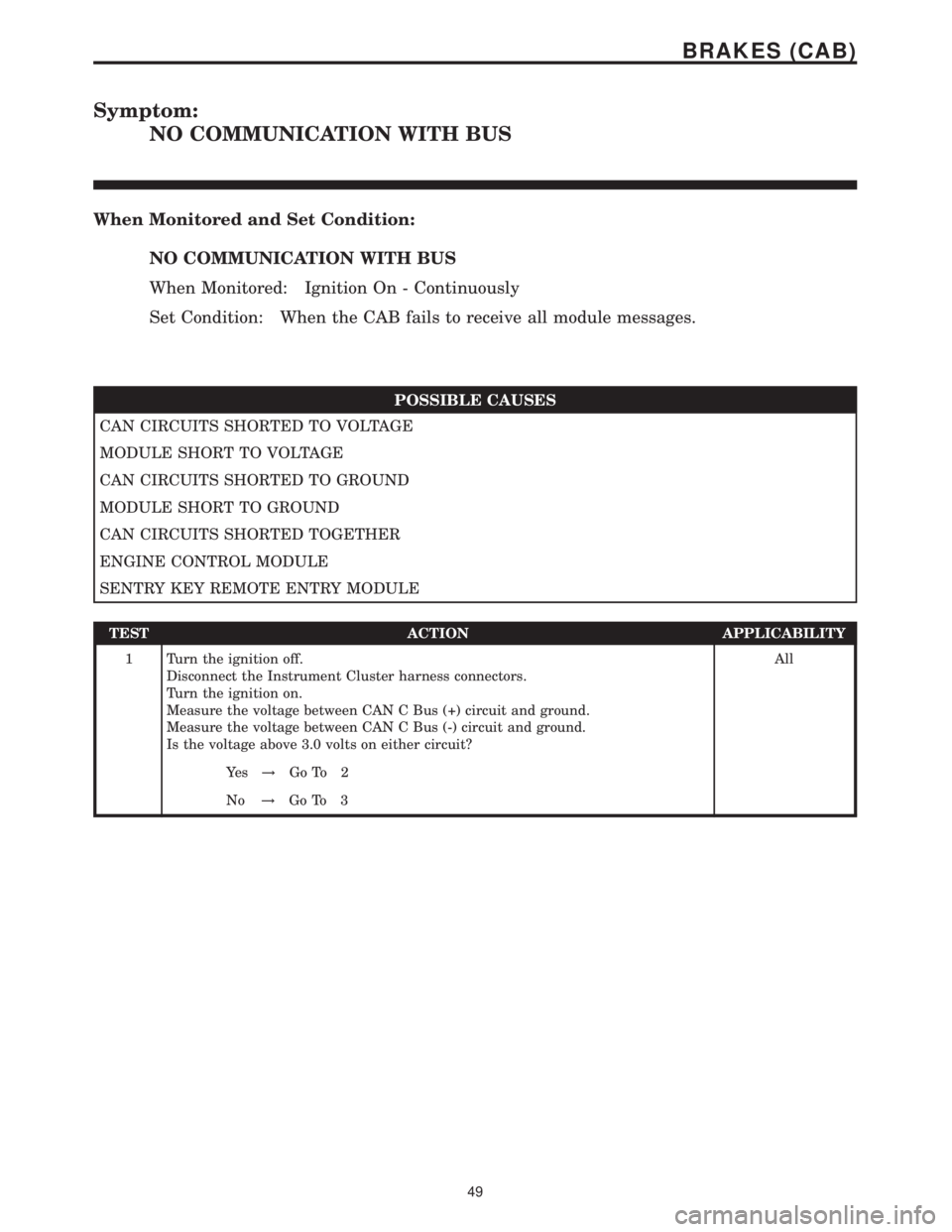
Symptom:
NO COMMUNICATION WITH BUS
When Monitored and Set Condition:
NO COMMUNICATION WITH BUS
When Monitored: Ignition On - Continuously
Set Condition: When the CAB fails to receive all module messages.
POSSIBLE CAUSES
CAN CIRCUITS SHORTED TO VOLTAGE
MODULE SHORT TO VOLTAGE
CAN CIRCUITS SHORTED TO GROUND
MODULE SHORT TO GROUND
CAN CIRCUITS SHORTED TOGETHER
ENGINE CONTROL MODULE
SENTRY KEY REMOTE ENTRY MODULE
TEST ACTION APPLICABILITY
1 Turn the ignition off.
Disconnect the Instrument Cluster harness connectors.
Turn the ignition on.
Measure the voltage between CAN C Bus (+) circuit and ground.
Measure the voltage between CAN C Bus (-) circuit and ground.
Is the voltage above 3.0 volts on either circuit?All
Ye s!Go To 2
No!Go To 3
49
BRAKES (CAB)
Page 372 of 2305
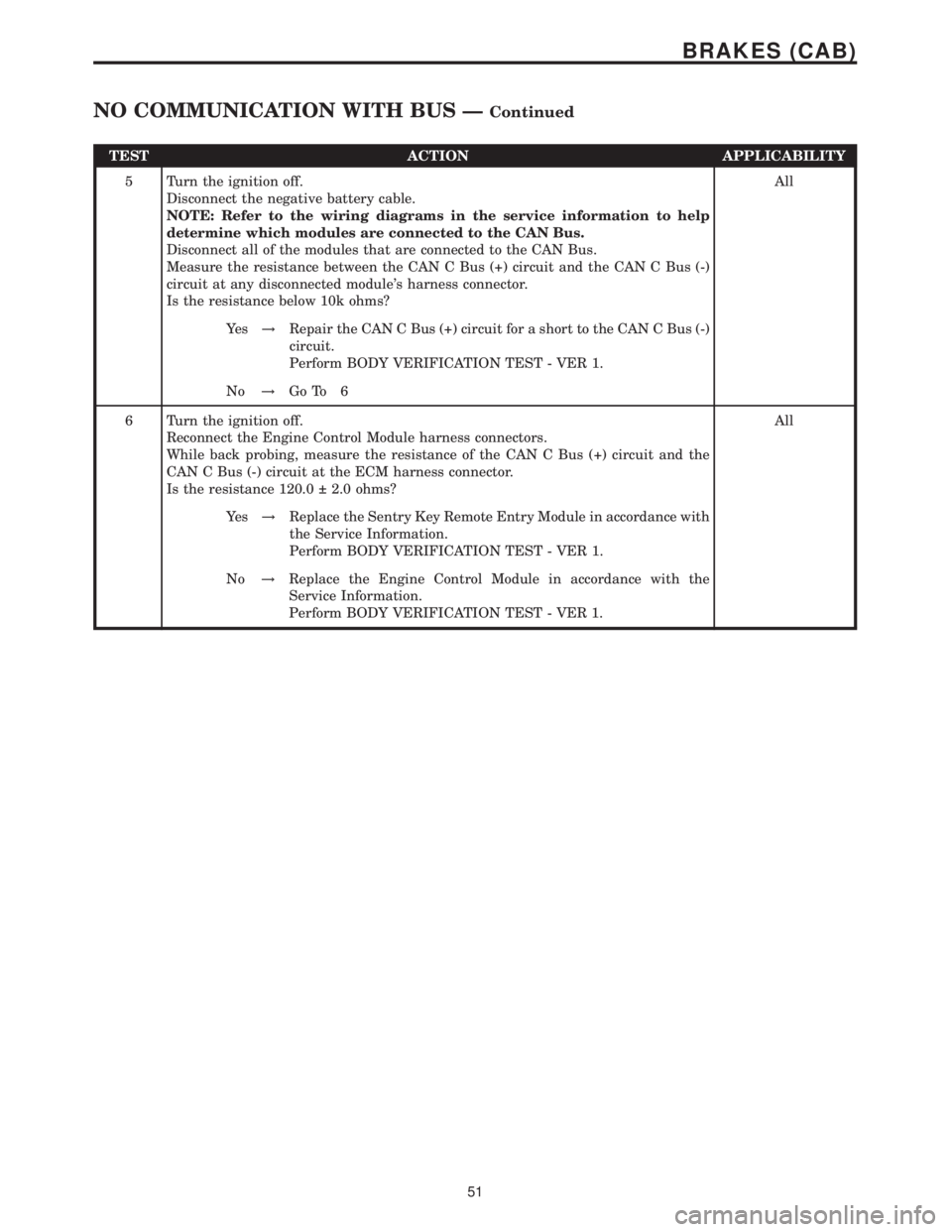
TEST ACTION APPLICABILITY
5 Turn the ignition off.
Disconnect the negative battery cable.
NOTE: Refer to the wiring diagrams in the service information to help
determine which modules are connected to the CAN Bus.
Disconnect all of the modules that are connected to the CAN Bus.
Measure the resistance between the CAN C Bus (+) circuit and the CAN C Bus (-)
circuit at any disconnected module's harness connector.
Is the resistance below 10k ohms?All
Ye s!Repair the CAN C Bus (+) circuit for a short to the CAN C Bus (-)
circuit.
Perform BODY VERIFICATION TEST - VER 1.
No!Go To 6
6 Turn the ignition off.
Reconnect the Engine Control Module harness connectors.
While back probing, measure the resistance of the CAN C Bus (+) circuit and the
CAN C Bus (-) circuit at the ECM harness connector.
Is the resistance 120.0 2.0 ohms?All
Ye s!Replace the Sentry Key Remote Entry Module in accordance with
the Service Information.
Perform BODY VERIFICATION TEST - VER 1.
No!Replace the Engine Control Module in accordance with the
Service Information.
Perform BODY VERIFICATION TEST - VER 1.
51
BRAKES (CAB)
NO COMMUNICATION WITH BUS ÐContinued
Page 412 of 2305
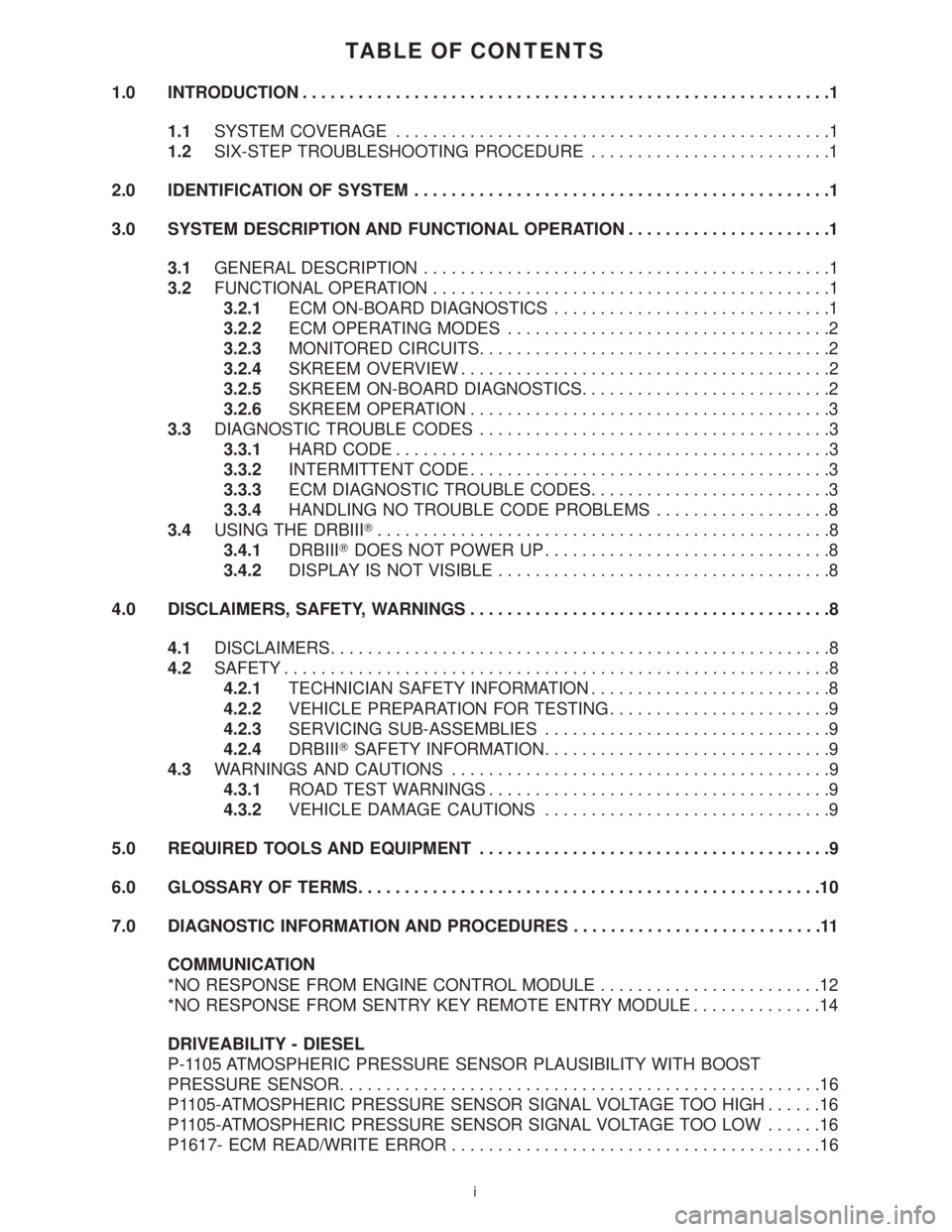
TABLE OF CONTENTS
1.0 INTRODUCTION.........................................................1
1.1SYSTEM COVERAGE...............................................1
1.2SIX-STEP TROUBLESHOOTING PROCEDURE..........................1
2.0 IDENTIFICATION OF SYSTEM.............................................1
3.0 SYSTEM DESCRIPTION AND FUNCTIONAL OPERATION......................1
3.1GENERAL DESCRIPTION............................................1
3.2FUNCTIONAL OPERATION...........................................1
3.2.1ECM ON-BOARD DIAGNOSTICS..............................1
3.2.2ECM OPERATING MODES...................................2
3.2.3MONITORED CIRCUITS......................................2
3.2.4SKREEM OVERVIEW........................................2
3.2.5SKREEM ON-BOARD DIAGNOSTICS...........................2
3.2.6SKREEM OPERATION.......................................3
3.3DIAGNOSTIC TROUBLE CODES......................................3
3.3.1HARD CODE...............................................3
3.3.2INTERMITTENT CODE.......................................3
3.3.3ECM DIAGNOSTIC TROUBLE CODES..........................3
3.3.4HANDLING NO TROUBLE CODE PROBLEMS...................8
3.4USING THE DRBIIIT.................................................8
3.4.1DRBIIITDOES NOT POWER UP...............................8
3.4.2DISPLAY IS NOT VISIBLE....................................8
4.0 DISCLAIMERS, SAFETY, WARNINGS.......................................8
4.1DISCLAIMERS......................................................8
4.2SAFETY...........................................................8
4.2.1TECHNICIAN SAFETY INFORMATION..........................8
4.2.2VEHICLE PREPARATION FOR TESTING........................9
4.2.3SERVICING SUB-ASSEMBLIES...............................9
4.2.4DRBIIITSAFETY INFORMATION...............................9
4.3WARNINGS AND CAUTIONS.........................................9
4.3.1ROAD TEST WARNINGS.....................................9
4.3.2VEHICLE DAMAGE CAUTIONS...............................9
5.0 REQUIRED TOOLS AND EQUIPMENT......................................9
6.0 GLOSSARY OF TERMS..................................................10
7.0 DIAGNOSTIC INFORMATION AND PROCEDURES...........................11
COMMUNICATION
*NO RESPONSE FROM ENGINE CONTROL MODULE........................12
*NO RESPONSE FROM SENTRY KEY REMOTE ENTRY MODULE..............14
DRIVEABILITY - DIESEL
P-1105 ATMOSPHERIC PRESSURE SENSOR PLAUSIBILITY WITH BOOST
PRESSURE SENSOR....................................................16
P1105-ATMOSPHERIC PRESSURE SENSOR SIGNAL VOLTAGE TOO HIGH......16
P1105-ATMOSPHERIC PRESSURE SENSOR SIGNAL VOLTAGE TOO LOW......16
P1617- ECM READ/WRITE ERROR........................................16
i
Page 424 of 2305
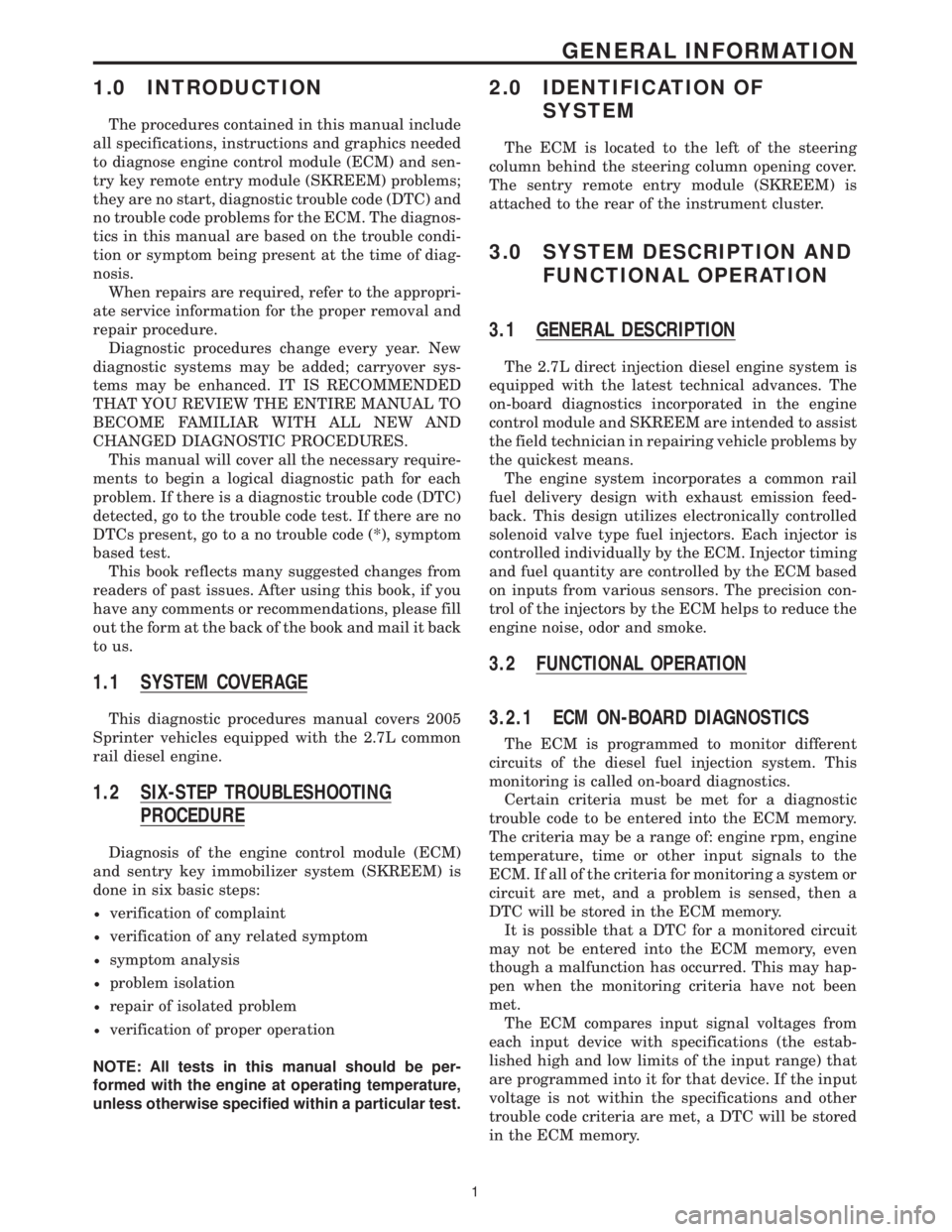
1.0 INTRODUCTION
The procedures contained in this manual include
all specifications, instructions and graphics needed
to diagnose engine control module (ECM) and sen-
try key remote entry module (SKREEM) problems;
they are no start, diagnostic trouble code (DTC) and
no trouble code problems for the ECM. The diagnos-
tics in this manual are based on the trouble condi-
tion or symptom being present at the time of diag-
nosis.
When repairs are required, refer to the appropri-
ate service information for the proper removal and
repair procedure.
Diagnostic procedures change every year. New
diagnostic systems may be added; carryover sys-
tems may be enhanced. IT IS RECOMMENDED
THAT YOU REVIEW THE ENTIRE MANUAL TO
BECOME FAMILIAR WITH ALL NEW AND
CHANGED DIAGNOSTIC PROCEDURES.
This manual will cover all the necessary require-
ments to begin a logical diagnostic path for each
problem. If there is a diagnostic trouble code (DTC)
detected, go to the trouble code test. If there are no
DTCs present, go to a no trouble code (*), symptom
based test.
This book reflects many suggested changes from
readers of past issues. After using this book, if you
have any comments or recommendations, please fill
out the form at the back of the book and mail it back
to us.
1.1 SYSTEM COVERAGE
This diagnostic procedures manual covers 2005
Sprinter vehicles equipped with the 2.7L common
rail diesel engine.
1.2 SIX-STEP TROUBLESHOOTING
PROCEDURE
Diagnosis of the engine control module (ECM)
and sentry key immobilizer system (SKREEM) is
done in six basic steps:
²verification of complaint
²verification of any related symptom
²symptom analysis
²problem isolation
²repair of isolated problem
²verification of proper operation
NOTE: All tests in this manual should be per-
formed with the engine at operating temperature,
unless otherwise specified within a particular test.
2.0 IDENTIFICATION OF
SYSTEM
The ECM is located to the left of the steering
column behind the steering column opening cover.
The sentry remote entry module (SKREEM) is
attached to the rear of the instrument cluster.
3.0 SYSTEM DESCRIPTION AND
FUNCTIONAL OPERATION
3.1 GENERAL DESCRIPTION
The 2.7L direct injection diesel engine system is
equipped with the latest technical advances. The
on-board diagnostics incorporated in the engine
control module and SKREEM are intended to assist
the field technician in repairing vehicle problems by
the quickest means.
The engine system incorporates a common rail
fuel delivery design with exhaust emission feed-
back. This design utilizes electronically controlled
solenoid valve type fuel injectors. Each injector is
controlled individually by the ECM. Injector timing
and fuel quantity are controlled by the ECM based
on inputs from various sensors. The precision con-
trol of the injectors by the ECM helps to reduce the
engine noise, odor and smoke.
3.2 FUNCTIONAL OPERATION
3.2.1 ECM ON-BOARD DIAGNOSTICS
The ECM is programmed to monitor different
circuits of the diesel fuel injection system. This
monitoring is called on-board diagnostics.
Certain criteria must be met for a diagnostic
trouble code to be entered into the ECM memory.
The criteria may be a range of: engine rpm, engine
temperature, time or other input signals to the
ECM. If all of the criteria for monitoring a system or
circuit are met, and a problem is sensed, then a
DTC will be stored in the ECM memory.
It is possible that a DTC for a monitored circuit
may not be entered into the ECM memory, even
though a malfunction has occurred. This may hap-
pen when the monitoring criteria have not been
met.
The ECM compares input signal voltages from
each input device with specifications (the estab-
lished high and low limits of the input range) that
are programmed into it for that device. If the input
voltage is not within the specifications and other
trouble code criteria are met, a DTC will be stored
in the ECM memory.
1
GENERAL INFORMATION
Page 425 of 2305
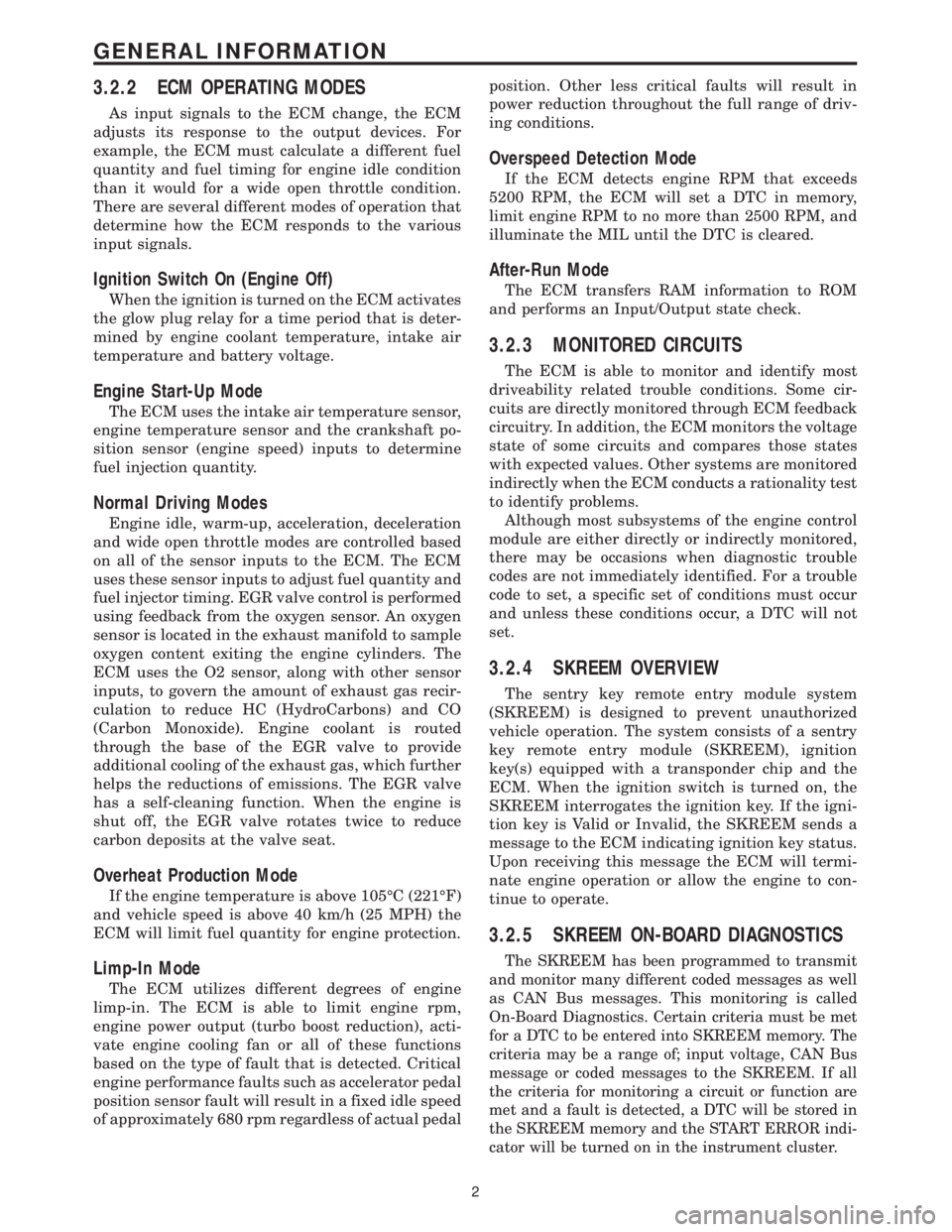
3.2.2 ECM OPERATING MODES
As input signals to the ECM change, the ECM
adjusts its response to the output devices. For
example, the ECM must calculate a different fuel
quantity and fuel timing for engine idle condition
than it would for a wide open throttle condition.
There are several different modes of operation that
determine how the ECM responds to the various
input signals.
Ignition Switch On (Engine Off)
When the ignition is turned on the ECM activates
the glow plug relay for a time period that is deter-
mined by engine coolant temperature, intake air
temperature and battery voltage.
Engine Start-Up Mode
The ECM uses the intake air temperature sensor,
engine temperature sensor and the crankshaft po-
sition sensor (engine speed) inputs to determine
fuel injection quantity.
Normal Driving Modes
Engine idle, warm-up, acceleration, deceleration
and wide open throttle modes are controlled based
on all of the sensor inputs to the ECM. The ECM
uses these sensor inputs to adjust fuel quantity and
fuel injector timing. EGR valve control is performed
using feedback from the oxygen sensor. An oxygen
sensor is located in the exhaust manifold to sample
oxygen content exiting the engine cylinders. The
ECM uses the O2 sensor, along with other sensor
inputs, to govern the amount of exhaust gas recir-
culation to reduce HC (HydroCarbons) and CO
(Carbon Monoxide). Engine coolant is routed
through the base of the EGR valve to provide
additional cooling of the exhaust gas, which further
helps the reductions of emissions. The EGR valve
has a self-cleaning function. When the engine is
shut off, the EGR valve rotates twice to reduce
carbon deposits at the valve seat.
Overheat Production Mode
If the engine temperature is above 105ÉC (221ÉF)
and vehicle speed is above 40 km/h (25 MPH) the
ECM will limit fuel quantity for engine protection.
Limp-In Mode
The ECM utilizes different degrees of engine
limp-in. The ECM is able to limit engine rpm,
engine power output (turbo boost reduction), acti-
vate engine cooling fan or all of these functions
based on the type of fault that is detected. Critical
engine performance faults such as accelerator pedal
position sensor fault will result in a fixed idle speed
of approximately 680 rpm regardless of actual pedalposition. Other less critical faults will result in
power reduction throughout the full range of driv-
ing conditions.
Overspeed Detection Mode
If the ECM detects engine RPM that exceeds
5200 RPM, the ECM will set a DTC in memory,
limit engine RPM to no more than 2500 RPM, and
illuminate the MIL until the DTC is cleared.
After-Run Mode
The ECM transfers RAM information to ROM
and performs an Input/Output state check.
3.2.3 MONITORED CIRCUITS
The ECM is able to monitor and identify most
driveability related trouble conditions. Some cir-
cuits are directly monitored through ECM feedback
circuitry. In addition, the ECM monitors the voltage
state of some circuits and compares those states
with expected values. Other systems are monitored
indirectly when the ECM conducts a rationality test
to identify problems.
Although most subsystems of the engine control
module are either directly or indirectly monitored,
there may be occasions when diagnostic trouble
codes are not immediately identified. For a trouble
code to set, a specific set of conditions must occur
and unless these conditions occur, a DTC will not
set.
3.2.4 SKREEM OVERVIEW
The sentry key remote entry module system
(SKREEM) is designed to prevent unauthorized
vehicle operation. The system consists of a sentry
key remote entry module (SKREEM), ignition
key(s) equipped with a transponder chip and the
ECM. When the ignition switch is turned on, the
SKREEM interrogates the ignition key. If the igni-
tion key is Valid or Invalid, the SKREEM sends a
message to the ECM indicating ignition key status.
Upon receiving this message the ECM will termi-
nate engine operation or allow the engine to con-
tinue to operate.
3.2.5 SKREEM ON-BOARD DIAGNOSTICS
The SKREEM has been programmed to transmit
and monitor many different coded messages as well
as CAN Bus messages. This monitoring is called
On-Board Diagnostics. Certain criteria must be met
for a DTC to be entered into SKREEM memory. The
criteria may be a range of; input voltage, CAN Bus
message or coded messages to the SKREEM. If all
the criteria for monitoring a circuit or function are
met and a fault is detected, a DTC will be stored in
the SKREEM memory and the START ERROR indi-
cator will be turned on in the instrument cluster.
2
GENERAL INFORMATION
Page 433 of 2305
ohmmeter
voltmeter
jumper wires and probes
oscilloscope
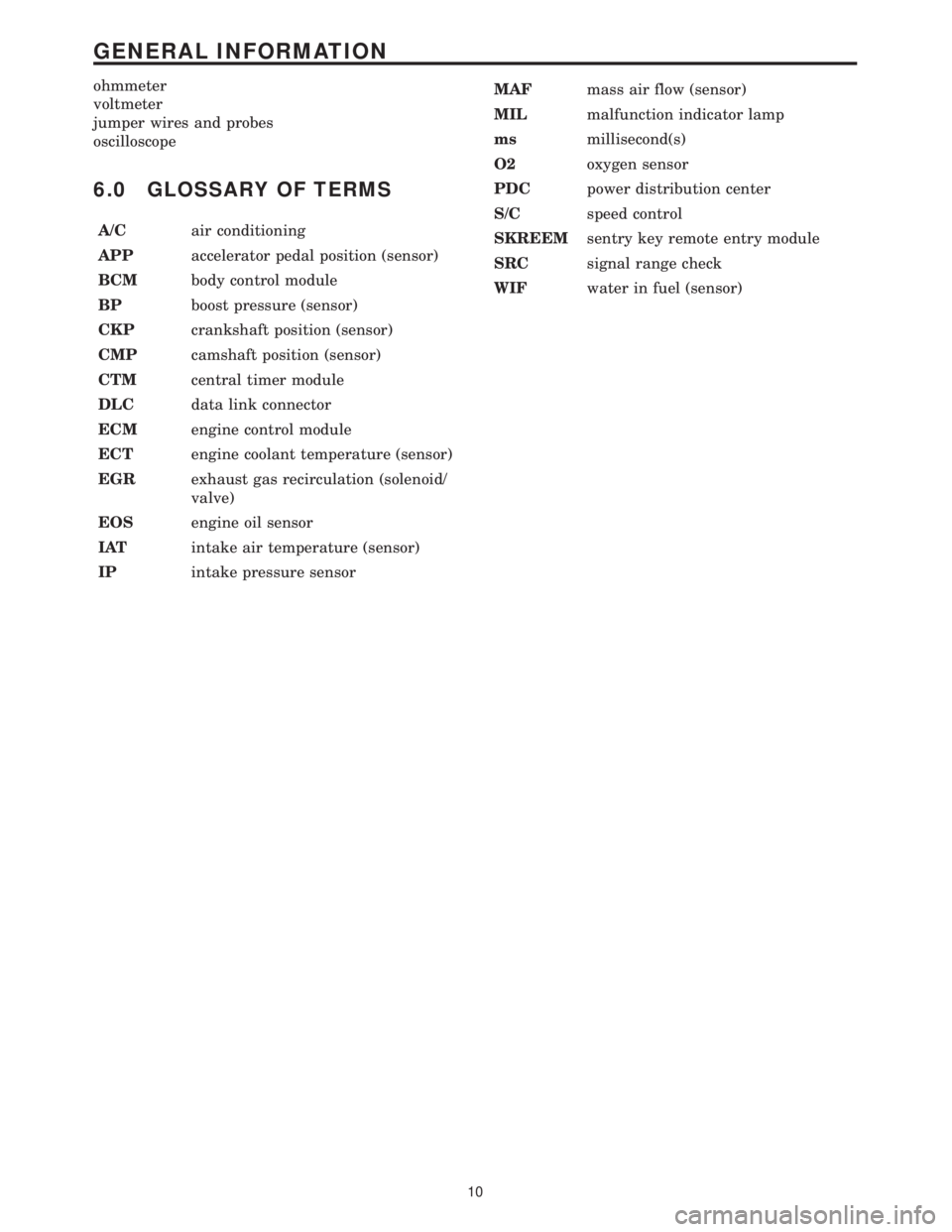
6.0 GLOSSARY OF TERMS
A/Cair conditioning
APPaccelerator pedal position (sensor)
BCMbody control module
BPboost pressure (sensor)
CKPcrankshaft position (sensor)
CMPcamshaft position (sensor)
CTMcentral timer module
DLCdata link connector
ECMengine control module
ECTengine coolant temperature (sensor)
EGRexhaust gas recirculation (solenoid/
valve)
EOSengine oil sensor
IATintake air temperature (sensor)
IPintake pressure sensorMAFmass air flow (sensor)
MILmalfunction indicator lamp
msmillisecond(s)
O2oxygen sensor
PDCpower distribution center
S/Cspeed control
SKREEMsentry key remote entry module
SRCsignal range check
WIFwater in fuel (sensor)
10
GENERAL INFORMATION
Page 856 of 2305
ELECTRONIC CONTROL MODULES
TABLE OF CONTENTS
page page
CENTRAL TIMER MODULE
DESCRIPTION..........................1
OPERATION............................1
DIAGNOSIS AND TESTING - CENTRAL TIMER
MODULE.............................2
REMOVAL.............................2
INSTALLATION..........................3
CONTROLLER ANTILOCK BRAKE
DESCRIPTION..........................3
REMOVAL.............................3INSTALLATION..........................3
ENGINE CONTROL MODULE
DESCRIPTION..........................3
REMOVAL.............................6
INSTALLATION..........................6
TRANSMISSION CONTROL MODULE
DESCRIPTION..........................6
OPERATION............................7
STANDARD PROCEDURE - TCM ADAPTATION . 10
CENTRAL TIMER MODULE
DESCRIPTION
The central timer module (CTM) is located beneath
the driver seat. The CTM uses information carried on
the programmable communications interface (PCI)
data bus network along with many hard wired inputs
to monitor many sensor and switch inputs. In
response to those inputs, the circuitry and program-
ming of the CTM allow it to supply the vehicle occu-
pants with audible and visual information, and to
control and integrate many functions and features of
the vehicle through both hard wired outputs and the
transmission of message outputs to other modules in
the vehicle over the PCI data bus.
The features that the CTM supports or controls
include the following:
²Central Locking- The CTM on vehicles
equipped with the optional Vehicle Theft Security
System (VTSS) includes a central locking/unlocking
feature.
²Enhanced Accident Response- The CTM pro-
vides an optional enhanced accident response fea-
ture. This is a programmable feature.
²Panic Mode- The CTM provides support for
the optional RKE system panic mode including horn,
headlamp, and park lamp flash features.
²Power Lock Control- The CTM provides the
optional power lock system features, including sup-
port for the automatic door lock and door lock inhibit
modes.
²Programmable Features- The CTM provides
support for certain programmable features.
²Remote Keyless Entry- The CTM provides
the optional Remote Keyless Entry (RKE) system fea-
tures, including support for the RKE Lock (with
optional horn and park lamps flash), Unlock (with
park lamps flash, driver-door-only unlock, andunlock-all-doors), Panic, and illuminated entry
modes, as well as the ability to be programmed to
recognize up to four RKE transmitters. The RKE
horn, driver-door-only unlock, and unlock-all-doors
features are programmable.
²Vehicle Theft Security System- The CTM
provides control of the optional Vehicle Theft Secu-
rity System (VTSS) features, including support for
the central locking/unlocking mode and control of the
Security indicator in the instrument cluster.
Hard wired circuitry connects the CTM to the elec-
trical system of the vehicle. Refer to the appropriate
wiring information.
Many of the features in the vehicle controlled or
supported by the CTM are programmable using the
DRBIIItscan tool. However, if any of the CTM hard-
ware components are damaged or faulty, the entire
CTM unit must be replaced. The hard wired inputs
or outputs of all CTM versions can be diagnosed
using conventional diagnostic tools and methods;
however, for diagnosis of the CTM or the PCI data
bus, the use of a DRBIIItscan tool is required. Refer
to the appropriate diagnostic information.
OPERATION
The central timer module (CTM) monitors many
hard wired switch and sensor inputs as well as those
resources it shares with other modules in the vehicle
through its communication over the programmable
communications interface (PCI) data bus network.
The internal programming and all of these inputs
allow the CTM to determine the tasks it needs to
perform and their priorities, as well as both the stan-
dard and optional features that it should provide.
The CTM then performs those tasks and provides
those features through both PCI data bus communi-
cation with other modules and hard wired outputs
through a number of driver circuits, relays, and
VAELECTRONIC CONTROL MODULES 8E - 1
Page 921 of 2305
INSTRUMENT CLUSTER
DESCRIPTION
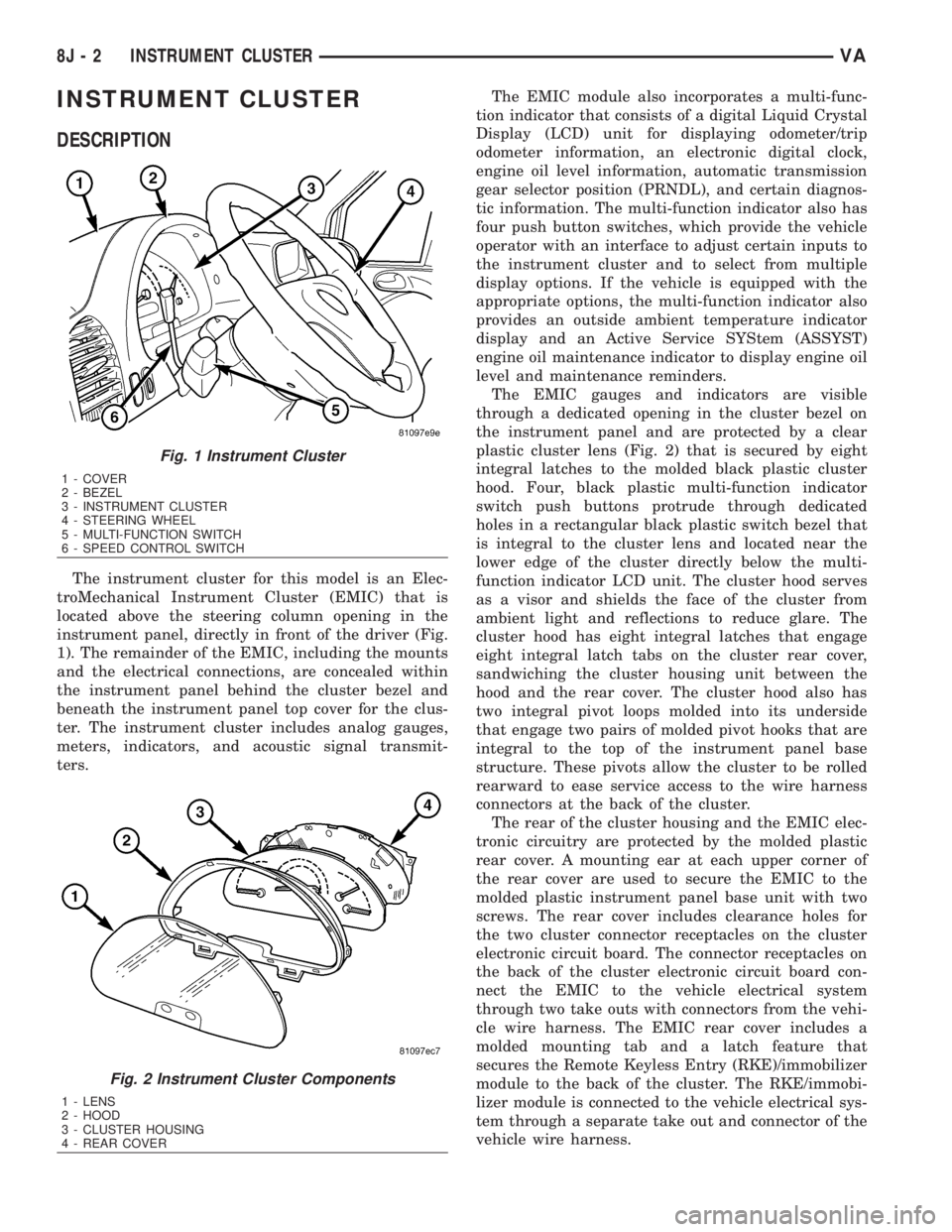
The instrument cluster for this model is an Elec-
troMechanical Instrument Cluster (EMIC) that is
located above the steering column opening in the
instrument panel, directly in front of the driver (Fig.
1). The remainder of the EMIC, including the mounts
and the electrical connections, are concealed within
the instrument panel behind the cluster bezel and
beneath the instrument panel top cover for the clus-
ter. The instrument cluster includes analog gauges,
meters, indicators, and acoustic signal transmit-
ters.The EMIC module also incorporates a multi-func-
tion indicator that consists of a digital Liquid Crystal
Display (LCD) unit for displaying odometer/trip
odometer information, an electronic digital clock,
engine oil level information, automatic transmission
gear selector position (PRNDL), and certain diagnos-
tic information. The multi-function indicator also has
four push button switches, which provide the vehicle
operator with an interface to adjust certain inputs to
the instrument cluster and to select from multiple
display options. If the vehicle is equipped with the
appropriate options, the multi-function indicator also
provides an outside ambient temperature indicator
display and an Active Service SYStem (ASSYST)
engine oil maintenance indicator to display engine oil
level and maintenance reminders.
The EMIC gauges and indicators are visible
through a dedicated opening in the cluster bezel on
the instrument panel and are protected by a clear
plastic cluster lens (Fig. 2) that is secured by eight
integral latches to the molded black plastic cluster
hood. Four, black plastic multi-function indicator
switch push buttons protrude through dedicated
holes in a rectangular black plastic switch bezel that
is integral to the cluster lens and located near the
lower edge of the cluster directly below the multi-
function indicator LCD unit. The cluster hood serves
as a visor and shields the face of the cluster from
ambient light and reflections to reduce glare. The
cluster hood has eight integral latches that engage
eight integral latch tabs on the cluster rear cover,
sandwiching the cluster housing unit between the
hood and the rear cover. The cluster hood also has
two integral pivot loops molded into its underside
that engage two pairs of molded pivot hooks that are
integral to the top of the instrument panel base
structure. These pivots allow the cluster to be rolled
rearward to ease service access to the wire harness
connectors at the back of the cluster.
The rear of the cluster housing and the EMIC elec-
tronic circuitry are protected by the molded plastic
rear cover. A mounting ear at each upper corner of
the rear cover are used to secure the EMIC to the
molded plastic instrument panel base unit with two
screws. The rear cover includes clearance holes for
the two cluster connector receptacles on the cluster
electronic circuit board. The connector receptacles on
the back of the cluster electronic circuit board con-
nect the EMIC to the vehicle electrical system
through two take outs with connectors from the vehi-
cle wire harness. The EMIC rear cover includes a
molded mounting tab and a latch feature that
secures the Remote Keyless Entry (RKE)/immobilizer
module to the back of the cluster. The RKE/immobi-
lizer module is connected to the vehicle electrical sys-
tem through a separate take out and connector of the
vehicle wire harness.
Fig. 1 Instrument Cluster
1 - COVER
2 - BEZEL
3 - INSTRUMENT CLUSTER
4 - STEERING WHEEL
5 - MULTI-FUNCTION SWITCH
6 - SPEED CONTROL SWITCH
Fig. 2 Instrument Cluster Components
1 - LENS
2 - HOOD
3 - CLUSTER HOUSING
4 - REAR COVER
8J - 2 INSTRUMENT CLUSTERVA