seats MERCEDES-BENZ SPRINTER 2006 User Guide
[x] Cancel search | Manufacturer: MERCEDES-BENZ, Model Year: 2006, Model line: SPRINTER, Model: MERCEDES-BENZ SPRINTER 2006Pages: 2305, PDF Size: 48.12 MB
Page 1080 of 2305
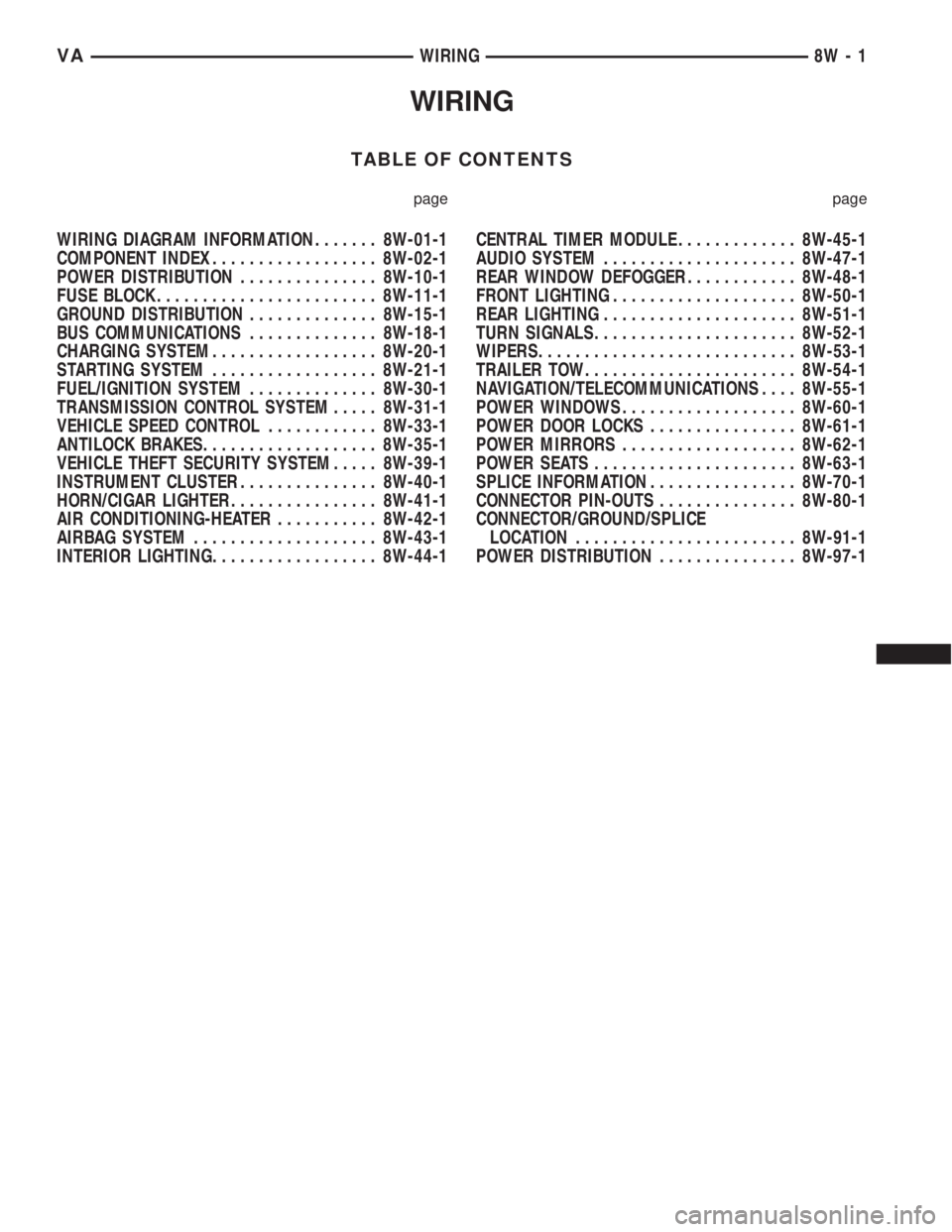
WIRING
TABLE OF CONTENTS
page page
WIRING DIAGRAM INFORMATION....... 8W-01-1
COMPONENT INDEX.................. 8W-02-1
POWER DISTRIBUTION............... 8W-10-1
FUSE BLOCK........................ 8W-11-1
GROUND DISTRIBUTION.............. 8W-15-1
BUS COMMUNICATIONS.............. 8W-18-1
CHARGING SYSTEM.................. 8W-20-1
STARTING SYSTEM.................. 8W-21-1
FUEL/IGNITION SYSTEM.............. 8W-30-1
TRANSMISSION CONTROL SYSTEM..... 8W-31-1
VEHICLE SPEED CONTROL............ 8W-33-1
ANTILOCK BRAKES................... 8W-35-1
VEHICLE THEFT SECURITY SYSTEM..... 8W-39-1
INSTRUMENT CLUSTER............... 8W-40-1
HORN/CIGAR LIGHTER................ 8W-41-1
AIR CONDITIONING-HEATER........... 8W-42-1
AIRBAG SYSTEM.................... 8W-43-1
INTERIOR LIGHTING.................. 8W-44-1CENTRAL TIMER MODULE............. 8W-45-1
AUDIO SYSTEM..................... 8W-47-1
REAR WINDOW DEFOGGER............ 8W-48-1
FRONT LIGHTING.................... 8W-50-1
REAR LIGHTING..................... 8W-51-1
TURN SIGNALS...................... 8W-52-1
WIPERS............................ 8W-53-1
TRAILER TOW....................... 8W-54-1
NAVIGATION/TELECOMMUNICATIONS.... 8W-55-1
POWER WINDOWS................... 8W-60-1
POWER DOOR LOCKS................ 8W-61-1
POWER MIRRORS................... 8W-62-1
POWER SEATS...................... 8W-63-1
SPLICE INFORMATION................ 8W-70-1
CONNECTOR PIN-OUTS............... 8W-80-1
CONNECTOR/GROUND/SPLICE
LOCATION........................ 8W-91-1
POWER DISTRIBUTION............... 8W-97-1 VAWIRING 8W - 1
Page 1412 of 2305
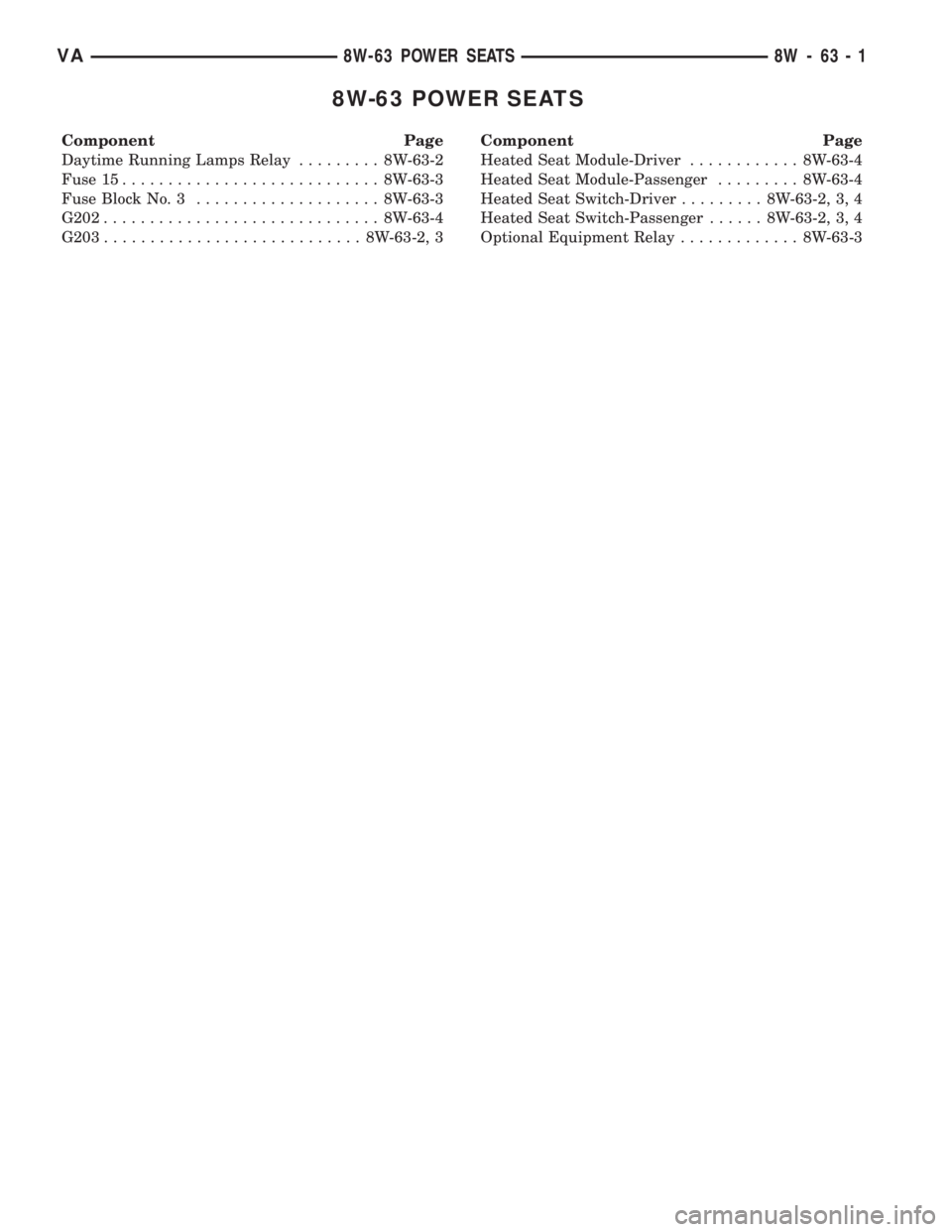
8W-63 POWER SEATS
Component Page
Daytime Running Lamps Relay......... 8W-63-2
Fuse 15............................ 8W-63-3
Fuse Block No. 3.................... 8W-63-3
G202.............................. 8W-63-4
G203............................ 8W-63-2, 3Component Page
Heated Seat Module-Driver............ 8W-63-4
Heated Seat Module-Passenger......... 8W-63-4
Heated Seat Switch-Driver......... 8W-63-2, 3, 4
Heated Seat Switch-Passenger...... 8W-63-2, 3, 4
Optional Equipment Relay............. 8W-63-3
VA8W-63 POWER SEATS 8W - 63 - 1
Page 1579 of 2305
NOTE: If the retaining lock is installed, remove it,
rotate engine and install lock once again.
(2) Carry out test of other cylinders in the firing
order of engine.
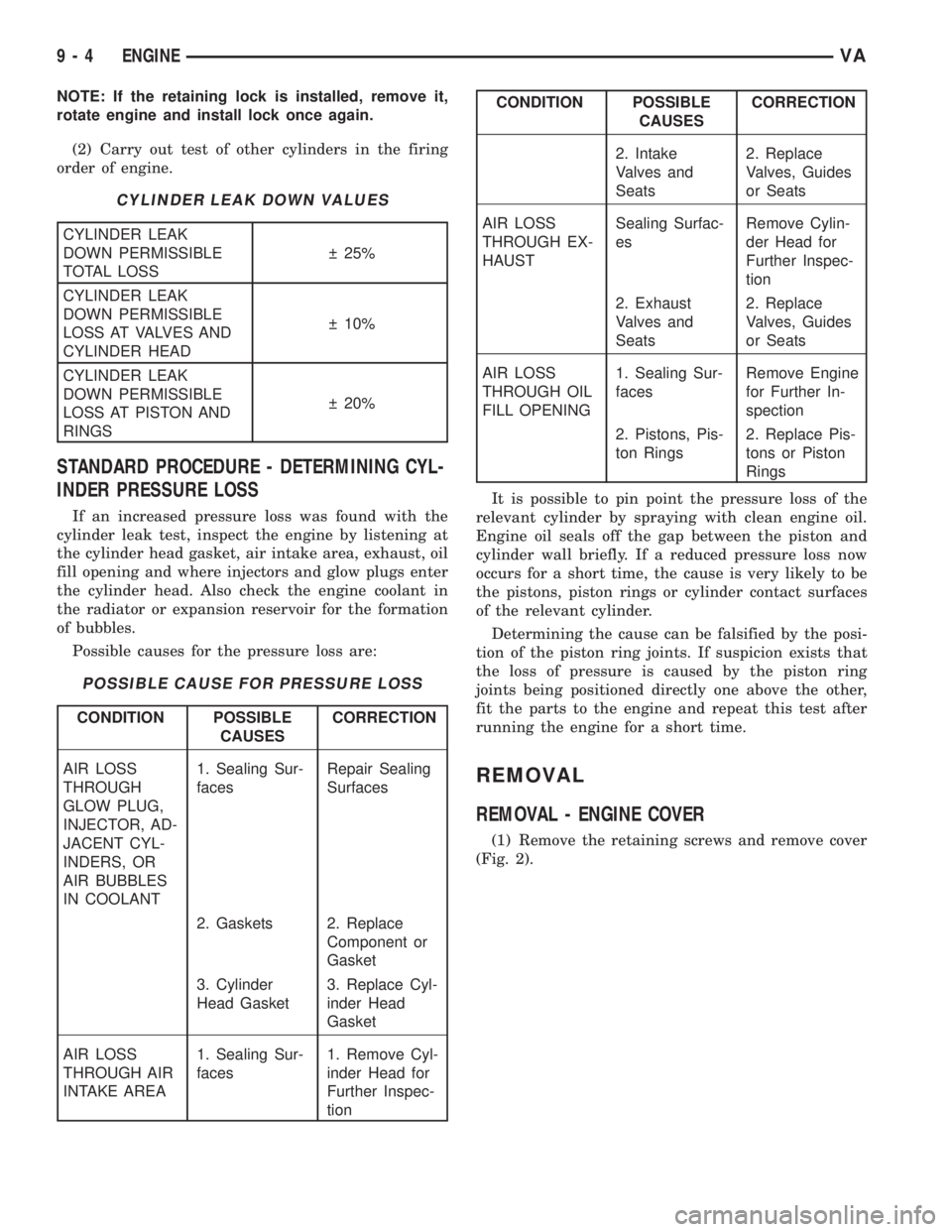
CYLINDER LEAK DOWN VALUES
CYLINDER LEAK
DOWN PERMISSIBLE
TOTAL LOSS 25%
CYLINDER LEAK
DOWN PERMISSIBLE
LOSS AT VALVES AND
CYLINDER HEAD 10%
CYLINDER LEAK
DOWN PERMISSIBLE
LOSS AT PISTON AND
RINGS 20%
STANDARD PROCEDURE - DETERMINING CYL-
INDER PRESSURE LOSS
If an increased pressure loss was found with the
cylinder leak test, inspect the engine by listening at
the cylinder head gasket, air intake area, exhaust, oil
fill opening and where injectors and glow plugs enter
the cylinder head. Also check the engine coolant in
the radiator or expansion reservoir for the formation
of bubbles.
Possible causes for the pressure loss are:
POSSIBLE CAUSE FOR PRESSURE LOSS
CONDITION POSSIBLE
CAUSESCORRECTION
AIR LOSS
THROUGH
GLOW PLUG,
INJECTOR, AD-
JACENT CYL-
INDERS, OR
AIR BUBBLES
IN COOLANT1. Sealing Sur-
facesRepair Sealing
Surfaces
2. Gaskets 2. Replace
Component or
Gasket
3. Cylinder
Head Gasket3. Replace Cyl-
inder Head
Gasket
AIR LOSS
THROUGH AIR
INTAKE AREA1. Sealing Sur-
faces1. Remove Cyl-
inder Head for
Further Inspec-
tion
CONDITION POSSIBLE
CAUSESCORRECTION
2. Intake
Valves and
Seats2. Replace
Valves, Guides
or Seats
AIR LOSS
THROUGH EX-
HAUSTSealing Surfac-
esRemove Cylin-
der Head for
Further Inspec-
tion
2. Exhaust
Valves and
Seats2. Replace
Valves, Guides
or Seats
AIR LOSS
THROUGH OIL
FILL OPENING1. Sealing Sur-
facesRemove Engine
for Further In-
spection
2. Pistons, Pis-
ton Rings2. Replace Pis-
tons or Piston
Rings
It is possible to pin point the pressure loss of the
relevant cylinder by spraying with clean engine oil.
Engine oil seals off the gap between the piston and
cylinder wall briefly. If a reduced pressure loss now
occurs for a short time, the cause is very likely to be
the pistons, piston rings or cylinder contact surfaces
of the relevant cylinder.
Determining the cause can be falsified by the posi-
tion of the piston ring joints. If suspicion exists that
the loss of pressure is caused by the piston ring
joints being positioned directly one above the other,
fit the parts to the engine and repeat this test after
running the engine for a short time.
REMOVAL
REMOVAL - ENGINE COVER
(1) Remove the retaining screws and remove cover
(Fig. 2).
9 - 4 ENGINEVA
Page 1944 of 2305
BODY
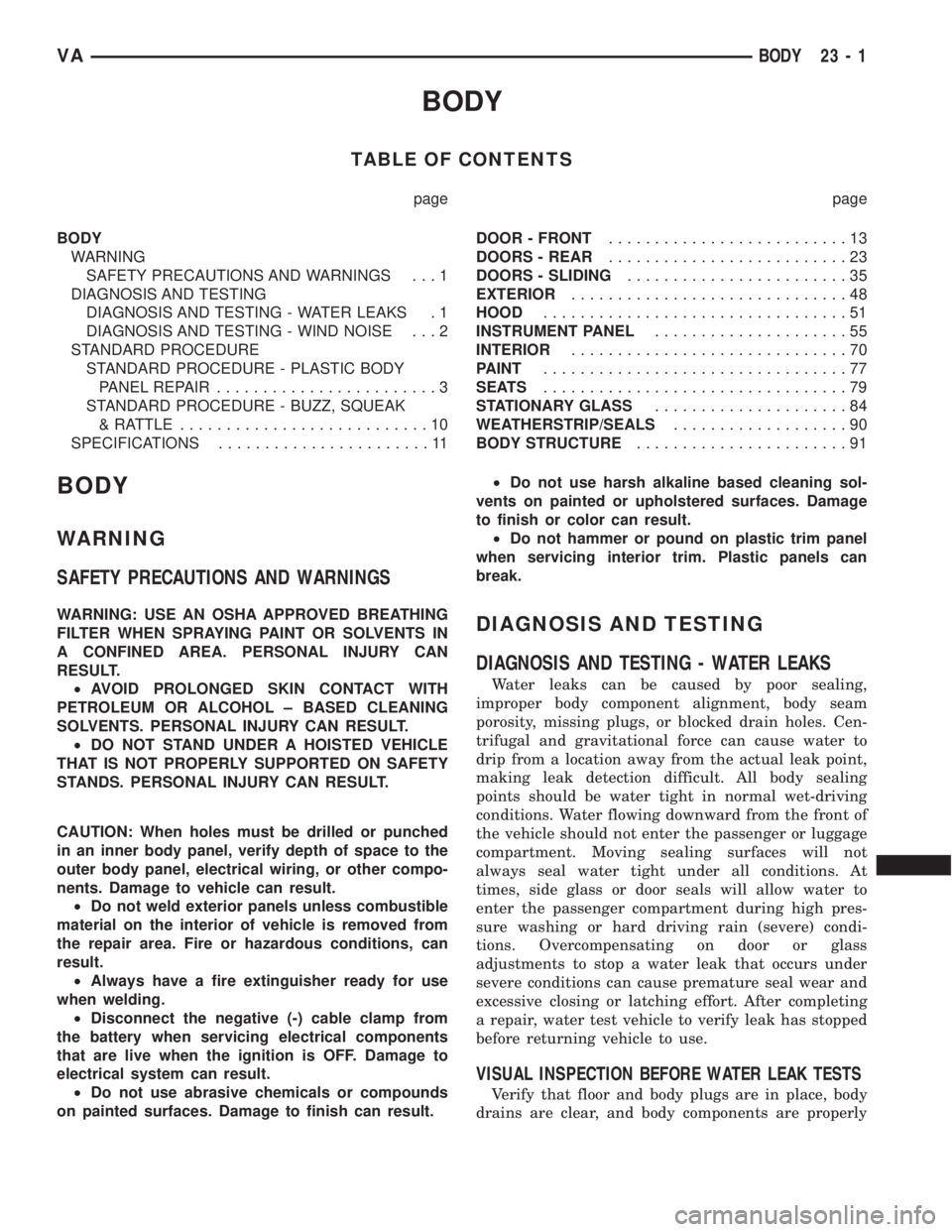
TABLE OF CONTENTS
page page
BODY
WARNING
SAFETY PRECAUTIONS AND WARNINGS . . . 1
DIAGNOSIS AND TESTING
DIAGNOSIS AND TESTING - WATER LEAKS . 1
DIAGNOSIS AND TESTING - WIND NOISE . . . 2
STANDARD PROCEDURE
STANDARD PROCEDURE - PLASTIC BODY
PANEL REPAIR........................3
STANDARD PROCEDURE - BUZZ, SQUEAK
& RATTLE...........................10
SPECIFICATIONS.......................11DOOR - FRONT..........................13
DOORS - REAR..........................23
DOORS - SLIDING........................35
EXTERIOR..............................48
HOOD.................................51
INSTRUMENT PANEL.....................55
INTERIOR..............................70
PAINT.................................77
SEATS.................................79
STATIONARY GLASS.....................84
WEATHERSTRIP/SEALS...................90
BODY STRUCTURE.......................91
BODY
WARNING
SAFETY PRECAUTIONS AND WARNINGS
WARNING: USE AN OSHA APPROVED BREATHING
FILTER WHEN SPRAYING PAINT OR SOLVENTS IN
A CONFINED AREA. PERSONAL INJURY CAN
RESULT.
²AVOID PROLONGED SKIN CONTACT WITH
PETROLEUM OR ALCOHOL ± BASED CLEANING
SOLVENTS. PERSONAL INJURY CAN RESULT.
²DO NOT STAND UNDER A HOISTED VEHICLE
THAT IS NOT PROPERLY SUPPORTED ON SAFETY
STANDS. PERSONAL INJURY CAN RESULT.
CAUTION: When holes must be drilled or punched
in an inner body panel, verify depth of space to the
outer body panel, electrical wiring, or other compo-
nents. Damage to vehicle can result.
²Do not weld exterior panels unless combustible
material on the interior of vehicle is removed from
the repair area. Fire or hazardous conditions, can
result.
²Always have a fire extinguisher ready for use
when welding.
²Disconnect the negative (-) cable clamp from
the battery when servicing electrical components
that are live when the ignition is OFF. Damage to
electrical system can result.
²Do not use abrasive chemicals or compounds
on painted surfaces. Damage to finish can result.²Do not use harsh alkaline based cleaning sol-
vents on painted or upholstered surfaces. Damage
to finish or color can result.
²Do not hammer or pound on plastic trim panel
when servicing interior trim. Plastic panels can
break.DIAGNOSIS AND TESTING
DIAGNOSIS AND TESTING - WATER LEAKS
Water leaks can be caused by poor sealing,
improper body component alignment, body seam
porosity, missing plugs, or blocked drain holes. Cen-
trifugal and gravitational force can cause water to
drip from a location away from the actual leak point,
making leak detection difficult. All body sealing
points should be water tight in normal wet-driving
conditions. Water flowing downward from the front of
the vehicle should not enter the passenger or luggage
compartment. Moving sealing surfaces will not
always seal water tight under all conditions. At
times, side glass or door seals will allow water to
enter the passenger compartment during high pres-
sure washing or hard driving rain (severe) condi-
tions. Overcompensating on door or glass
adjustments to stop a water leak that occurs under
severe conditions can cause premature seal wear and
excessive closing or latching effort. After completing
a repair, water test vehicle to verify leak has stopped
before returning vehicle to use.
VISUAL INSPECTION BEFORE WATER LEAK TESTS
Verify that floor and body plugs are in place, body
drains are clear, and body components are properly
VABODY 23 - 1
Page 2015 of 2305
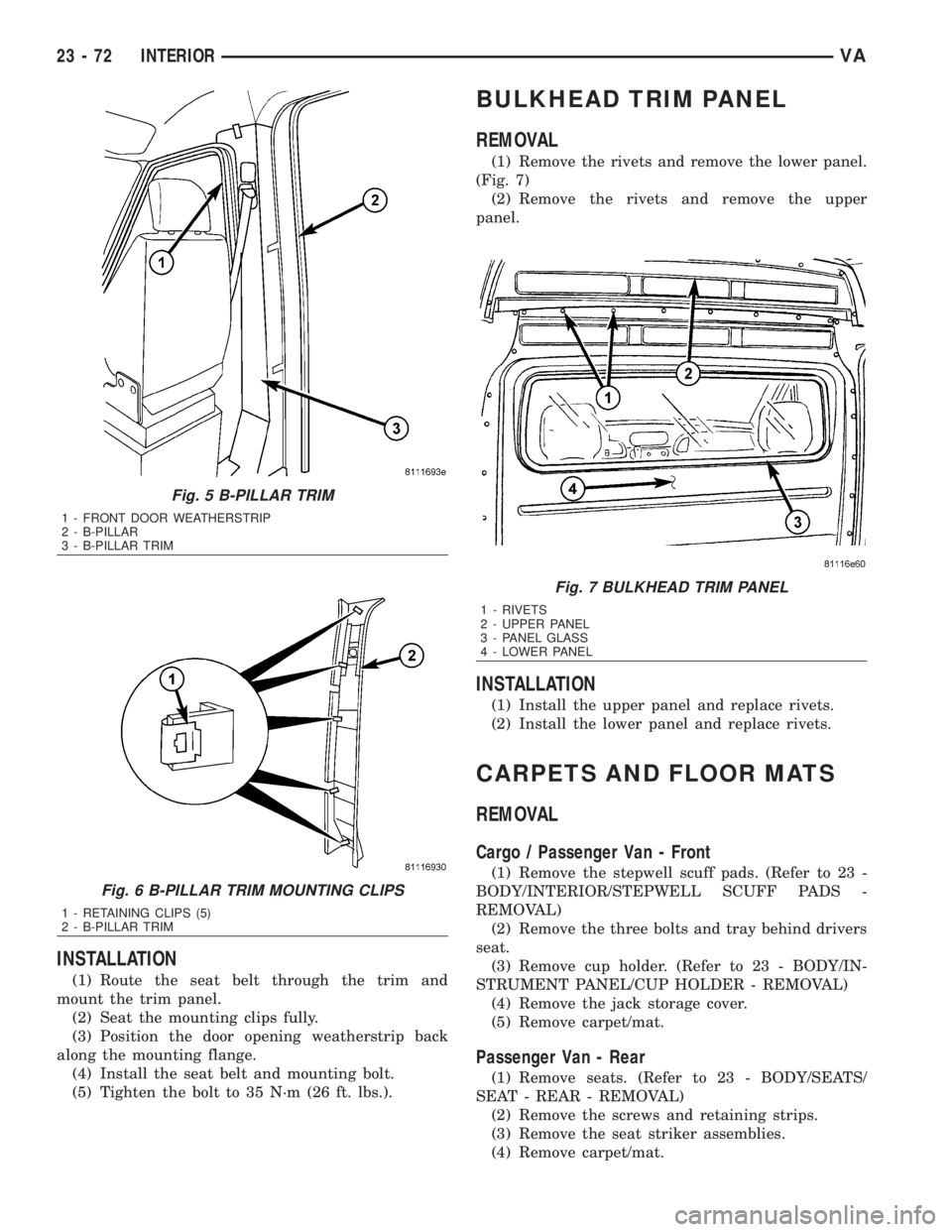
INSTALLATION
(1) Route the seat belt through the trim and
mount the trim panel.
(2) Seat the mounting clips fully.
(3) Position the door opening weatherstrip back
along the mounting flange.
(4) Install the seat belt and mounting bolt.
(5) Tighten the bolt to 35 N´m (26 ft. lbs.).
BULKHEAD TRIM PANEL
REMOVAL
(1) Remove the rivets and remove the lower panel.
(Fig. 7)
(2) Remove the rivets and remove the upper
panel.
INSTALLATION
(1) Install the upper panel and replace rivets.
(2) Install the lower panel and replace rivets.
CARPETS AND FLOOR MATS
REMOVAL
Cargo / Passenger Van - Front
(1) Remove the stepwell scuff pads. (Refer to 23 -
BODY/INTERIOR/STEPWELL SCUFF PADS -
REMOVAL)
(2) Remove the three bolts and tray behind drivers
seat.
(3) Remove cup holder. (Refer to 23 - BODY/IN-
STRUMENT PANEL/CUP HOLDER - REMOVAL)
(4) Remove the jack storage cover.
(5) Remove carpet/mat.
Passenger Van - Rear
(1) Remove seats. (Refer to 23 - BODY/SEATS/
SEAT - REAR - REMOVAL)
(2) Remove the screws and retaining strips.
(3) Remove the seat striker assemblies.
(4) Remove carpet/mat.
Fig. 5 B-PILLAR TRIM
1 - FRONT DOOR WEATHERSTRIP
2 - B-PILLAR
3 - B-PILLAR TRIM
Fig. 6 B-PILLAR TRIM MOUNTING CLIPS
1 - RETAINING CLIPS (5)
2 - B-PILLAR TRIM
Fig. 7 BULKHEAD TRIM PANEL
1 - RIVETS
2 - UPPER PANEL
3 - PANEL GLASS
4 - LOWER PANEL
23 - 72 INTERIORVA
Page 2016 of 2305
Cargo Van - Rear
(1) Remove the screws and retaining strips.
(2) Remove carpet/mat.
INSTALLATION
Cargo / Passenger Van - Front
(1) Position carpet/mat in vehicle.
(2) Install the jack storage cover.
(3) Install the cup holder. (Refer to 23 - BODY/IN-
STRUMENT PANEL/CUP HOLDER - INSTALLA-
TION)
(4) Install the tray behind the driver's seat and
install the three bolts.
(5) Install the stepwell scuff pads. (Refer to 23 -
BODY/INTERIOR/STEPWELL SCUFF PADS -
INSTALLATION)
Passenger Van - Rear
(1) Position carpet/mat in vehicle.
(2) Install the seat striker assemblies.
(3) Install the retaining strips and screws.
(4) Install the seats. (Refer to 23 - BODY/SEATS/
SEAT - INSTALLATION)
Cargo Van - Rear
(1) Position carpet/mat in vehicle.
(2) Install the retaining strips and screws.
COWL TRIM
REMOVAL
(1) Position door weatherstrip aside.
(2) Remove the jack storage cover, if necessary.
(3) Position aside carpet/mat, if necessary.
(4) Using a trim stick C-4755 or equivalent,
remove the cowl trim panel.
INSTALLATION
(1) Position the cowl trim panel and seat the clips
fully.
(2) Install the jack storage cover, if necessary.
(3) Position the carpet/mat back.
(4) Position the door weatherstrips back.
D - PILLAR TRIM
REMOVAL
(1) Remove the three plastic twist screws and
remove the panel.
INSTALLATION
(1) Install the panel and install the three twist
screws.
HEADLINER
REMOVAL
Cab Section
(1) Remove the a-pillar trim. (Refer to 23 - BODY/
INTERIOR/A-PILLAR TRIM - REMOVAL)
(2) Remove the sun visors. (Refer to 23 - BODY/
INTERIOR/SUN VISOR - REMOVAL)
(3) Remove the b-pillar trim. (Refer to 23 - BODY/
INTERIOR/B-PILLAR TRIM - REMOVAL)
(4) Remove the assist handle. (Refer to 23 - BODY/
INTERIOR/ASSIST HANDLE - REMOVAL)
(5) Remove the dome light. (Refer to 8 - ELECTRI-
CAL/LAMPS/LIGHTING - INTERIOR/CARGO
LAMP UNIT - REMOVAL)
(6) Carefully separate the headliner and remove.
Number 2 Section
(1) Disconnect and isolate battery negative cable.
(2) Remove the second and third row seats. (Refer
to 23 - BODY/SEATS/SEAT - REAR - REMOVAL)
NOTE: If vehicle is not equipped with rear air con-
ditioning unit, skip to step 8.
(3) Remove the push pin fasteners and remove the
rear air front duct cover.
(4) Disconnect the electrical connector at front of
cover.
(5) Remove the push pin fasteners and remove the
rear air middle duct cover.
(6) Disconnect the electrical connector.
(7) Remove the three push-pins and three screws
and remove the rear air cover.
(8) Remove the duct work.
(9) Release clips at front and rear of headliner and
remove.
Number 3 Section
(1) Disconnect and isolate battery negative cable.
(2) Remove the third and fourth row seats. (Refer
to 23 - BODY/SEATS/SEAT - REAR - REMOVAL)
NOTE: If vehicle is not equipped with rear air con-
ditioning unit, skip to step 8.
(3) Remove the push pin fasteners and remove the
rear air front duct cover.
(4) Disconnect the electrical connector at front of
cover.
(5) Remove the push pin fasteners and remove the
rear air middle duct cover.
(6) Disconnect the electrical connector.
(7) Remove the three push-pins and three screws
and remove the rear air cover.
(8) Remove the duct work.
VAINTERIOR 23 - 73
Page 2017 of 2305
(9) Release clips at front and rear of headliner and
remove.
Number 4 Section
(1) Disconnect and isolate battery negative cable.
(2) Remove the third and fourth row seats. (Refer
to 23 - BODY/SEATS/SEAT - REAR - REMOVAL)
NOTE: If vehicle is not equipped with rear air con-
ditioning unit, skip to step 8.
(3) Remove the push pin fasteners and remove the
rear air front duct cover.
(4) Disconnect the electrical connector at front of
cover.
(5) Remove the push pin fasteners and remove the
rear air middle duct cover.
(6) Disconnect the electrical connector.
(7) Remove the three push-pins and three screws
and remove the rear air cover.
(8) Remove the duct work.
(9) Release clips at front and rear of headliner and
remove.
INSTALLATION
Cab Section
(1) Position the headliner in vehicle and seat fully.
(2) Install dome light. (Refer to 8 - ELECTRICAL/
LAMPS/LIGHTING - INTERIOR/CARGO LAMP
UNIT - INSTALLATION)
(3) Install assist handle. (Refer to 23 - BODY/IN-
TERIOR/ASSIST HANDLE - INSTALLATION)
(4) Install b-pillar trim. (Refer to 23 - BODY/IN-
TERIOR/B-PILLAR TRIM - INSTALLATION)
(5) Install the sun visors. (Refer to 23 - BODY/IN-
TERIOR/SUN VISOR - INSTALLATION)
(6) Install the a-pillar trim. (Refer to 23 - BODY/
INTERIOR/A-PILLAR TRIM - INSTALLATION)
(7) Connect battery negative cable.
Number 2 Section
(1) Position the headliner in vehicle and seat fully.
NOTE: If vehicle is not equipped with rear air con-
ditioning unit, skip to step 8.
(2) Install rear air unit duct work.
(3) Install the rear air unit rear cover and install
the three screws and push-pins.
(4) Connect the electrical connector and install the
middle duct work cover.
(5) Install the push pin fasteners.
(6) Connect the electrical connector and install the
front duct work cover.
(7) Install the push pin fasteners.
(8) Install the second and third row seats. (Refer
to 23 - BODY/SEATS/SEAT - INSTALLATION)(9) Connect battery negative cable.
Number 3 Section
(1) Position the headliner in vehicle and seat fully.
NOTE: If vehicle is not equipped with rear air con-
ditioning unit, skip to step 8.
(2) Install rear air unit duct work.
(3) Install the rear air unit rear cover and install
the three screws and push-pins.
(4) Connect the electrical connector and install the
middle duct work cover.
(5) Install the push pin fasteners.
(6) Connect the electrical connector and install the
front duct work cover.
(7) Install the push pin fasteners.
(8) Install the third and fourth row seats. (Refer to
23 - BODY/SEATS/SEAT - INSTALLATION)
(9) Connect battery negative cable.
Number 4 Section
(1) Position the headliner in vehicle and seat fully.
NOTE: If vehicle is not equipped with rear air con-
ditioning unit, skip to step 8.
(2) Install rear air unit duct work.
(3) Install the rear air unit rear cover and install
the three screws and push-pins.
(4) Connect the electrical connector and install the
middle duct work cover.
(5) Install the push pin fasteners.
(6) Connect the electrical connector and install the
front duct work cover.
(7) Install the push pin fasteners.
(8) Install the third and fourth row seats. (Refer to
23 - BODY/SEATS/SEAT - INSTALLATION)
(9) Connect battery negative cable.
QUARTER TRIM PANEL
REMOVAL
Passenger Van
(1) Remove seats as necessary. (Refer to 23 -
BODY/SEATS/SEAT - REMOVAL)
(2) Remove d-pillar trim if necessary. (Refer to 23 -
BODY/INTERIOR/D-PILLAR TRIM - REMOVAL)
(3) Using a trim stick C-4755 or equivalent, sepa-
rate the push-pin fasteners and remove trim panels.
Cargo Van
(1) Remove bolts and remove tie down rings, if
equipped.
(2) Remove rivets and remove paneling
23 - 74 INTERIORVA
Page 2018 of 2305
INSTALLATION
Passenger Van
(1) Position trim panels and seat push-pin fasten-
ers fully.
(2) Install d-pillar trim, if necessary. (Refer to 23 -
BODY/INTERIOR/D-PILLAR TRIM - INSTALLA-
TION)
(3) Install seats, if necessary. (Refer to 23 - BODY/
SEATS/SEAT - INSTALLATION)
Cargo Van
(1) Install paneling and replace rivets.
(2) Install tie down rings and bolts, if equipped.
REAR VIEW MIRROR
REMOVAL
(1) Slide mirror off support bracket.
INSTALLATION
INSTALLATION
(1) Install the support bracket if necessary. (Refer
to 23 - BODY/INTERIOR/REAR VIEW MIRROR -
INSTALLATION - SUPPORT BRACKET)
(2) Slide mirror onto support bracket fully.
INSTALLATION - REAR VIEW MIRROR SUP-
PORT BRACKET
(1) Mark the position for the mirror bracket on the
outside of the windshield glass with a wax pencil.
(2) Clean the bracket contact area on the glass.
Use a mild powdered cleanser on a cloth saturated
with isopropyl (rubbing) alcohol. Finally, clean the
glass with a paper towel dampened with alcohol.
(3) Sand the surface on the support bracket with
fine grit-sandpaper. Wipe the bracket surface clean
with a paper towel.
(4) Apply accelerator to the surface on the bracket
according to the following instructions:
(a) Crush the vial to saturate the felt applicator.
(b) Remove the paper sleeve.
(c) Apply accelerator to the contact surface on
the bracket.
(d) Allow the accelerator to dry for five minutes.
(e) Do not touch the bracket contact surface
after the accelerator has been applied.
(5) Apply adhesive accelerator to the bracket con-
tact surface on the windshield glass. Allow the accel-
erator to dry for one minute. Do not touch the glass
contact surface after the accelerator has been
applied.
(6) Install the bracket according to the following
instructions:(a) Apply one drop of adhesive at the center of
the bracket contact-surface on the windshield
glass.
(b) Apply an even coat of adhesive to the contact
surface on the bracket.
(c) Align the bracket with the marked position
on the windshield glass.
(d) Press and hold the bracket in place for at
least one minute.
NOTE: Verify that the mirror support bracket is cor-
rectly aligned, because the adhesive will cure rap-
idly.
(7) Allow the adhesive to cure for 8-10 minutes.
Remove any excess adhesive with an alcohol-damp-
ened cloth.
(8) Allow the adhesive to cure for an additional
8-10 minutes before installing the mirror.
STEPWELL SCUFF PADS
REMOVAL
(1) Remove screws and remove seat bracket if nec-
essary.
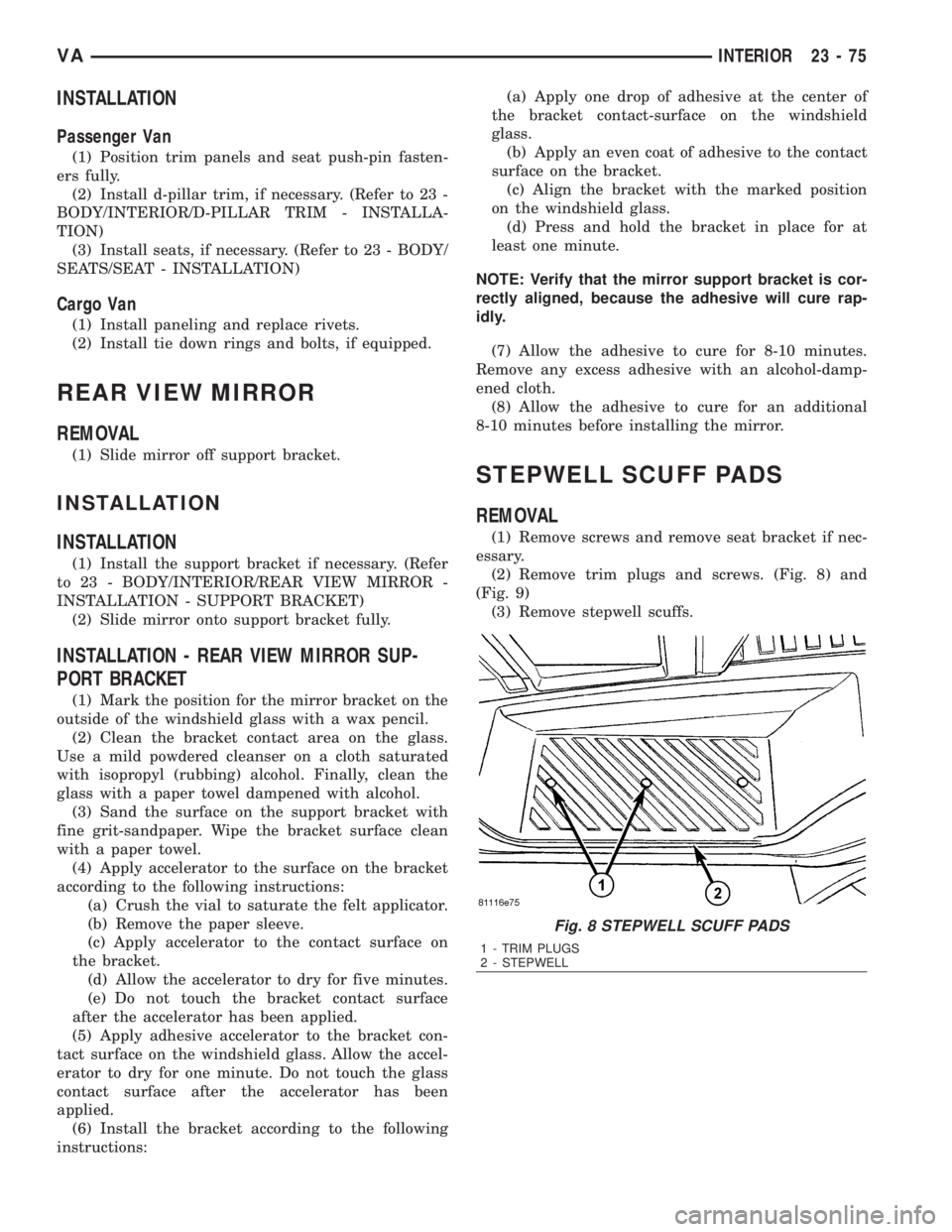
(2) Remove trim plugs and screws. (Fig. 8) and
(Fig. 9)
(3) Remove stepwell scuffs.
Fig. 8 STEPWELL SCUFF PADS
1 - TRIM PLUGS
2 - STEPWELL
VAINTERIOR 23 - 75
Page 2022 of 2305
SEATS
TABLE OF CONTENTS
page page
ARMREST
REMOVAL.............................79
INSTALLATION.........................79
HEADREST
REMOVAL.............................79
INSTALLATION.........................79
SEAT - FRONT
REMOVAL.............................79
INSTALLATION.........................80
SEAT BACK - FRONT
REMOVAL.............................80
INSTALLATION.........................80
SEAT CUSHION - FRONT
REMOVAL.............................80
INSTALLATION.........................81SEAT ADJUSTERS - FRONT
REMOVAL.............................81
INSTALLATION.........................81
SEAT - REAR
REMOVAL.............................81
INSTALLATION.........................82
REAR SEAT BACK SHIELD
REMOVAL.............................82
INSTALLATION.........................82
SEAT BACK CUSHION/COVER - REAR
REMOVAL.............................82
INSTALLATION.........................82
SEAT CUSHION/COVER - REAR
REMOVAL.............................83
INSTALLATION.........................83
ARMREST
REMOVAL
(1) Remove the screws and remove the armrest
cover.
(2) Remove the three bolts and remove the arm-
rest from the seat back.
INSTALLATION
(1) Install the armrest and install the three bolts.
(2) Install the armrest cover and install the
screws.
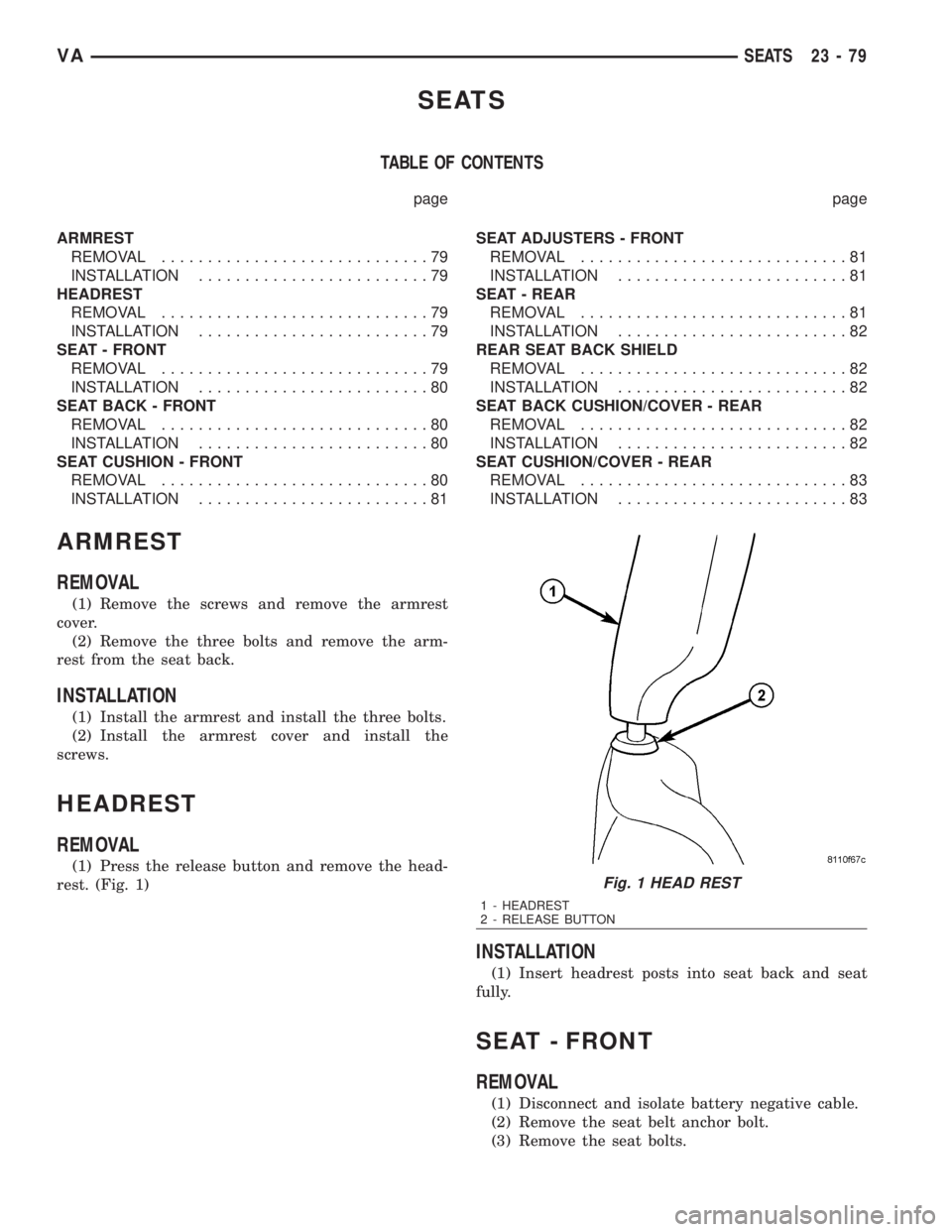
HEADREST
REMOVAL
(1) Press the release button and remove the head-
rest. (Fig. 1)
INSTALLATION
(1) Insert headrest posts into seat back and seat
fully.
SEAT - FRONT
REMOVAL
(1) Disconnect and isolate battery negative cable.
(2) Remove the seat belt anchor bolt.
(3) Remove the seat bolts.
Fig. 1 HEAD REST
1 - HEADREST
2 - RELEASE BUTTON
VASEATS 23 - 79
Page 2023 of 2305

(4) Disconnect the electrical connectors, if
equipped.
INSTALLATION
(1) Position seat in vehicle and connect the electri-
cal connectors, if equipped.
(2) Install the mounting bolts and tighten to 25
N´m (18 ft. lbs.).
(3) Install the seat belt anchor and bolt.
(4) Tighten anchor bolt to 35 N´m (26 ft. lbs.).
(5) Connect battery negative cable.
SEAT BACK - FRONT
REMOVAL
(1) Disconnect and isolate battery negative cable.
(2) Remove seat cushion. (Refer to 23 - BODY/
SEATS/SEAT CUSHION - FRONT - REMOVAL)
(3) Verify that seat back is in full upright position.
(4) Disconnect lumbar support hose, if equipped.
(Fig. 3)
(5) Remove seat back bolts and remove seat
back.
INSTALLATION
(1) Remove stop screw.
(2) Install seat back locking spline side first.
NOTE: For better centering of seat back in the
mounting bore during installation, operate the seat
back release lever once.
(3) Install the spline side seat back bolt.
(4) Install remaining seat back side.
NOTE: It may be necessary to press the guide tabs
apart slightly.
(5) Install the remaining seat back bolt.
(6) Tighten the seat back bolts to 20 N´m (15 ft.
lbs.).
(7) Place seat back in the foremost position until
the hold down spring latches audibly.
(8) Install stop bolt and tighten to 20 N´m (15 ft.
lbs.).
(9) Connect the lumbar support hose, if equipped.
(10) Check seat back operation.
(11) Install the seat cushion. (Refer to 23 - BODY/
SEATS/SEAT CUSHION - FRONT - INSTALLA-
TION)
SEAT CUSHION - FRONT
REMOVAL
(1) Disconnect and isolate battery negative cable.
(2) Move seat to the foremost position.
(3) On standard cushion equipped vehicles, remove
the front two screws. (Fig. 4)
Fig. 2 FRONT SEAT
1 - SEAT BELT ANCHOR BOLT
2 - BOLTS (6)
Fig. 3 FRONT SEAT BACK
1 - SEAT BACK
2 - STOP BOLT
3 - LUMBAR SUPPORT HOSE
4 - GUIDE TAB
5 - RELEASE LEVER
6 - SEAT BACK BOLTS (2)
23 - 80 SEATSVA