wiring MERCEDES-BENZ SPRINTER 2006 Service Manual
[x] Cancel search | Manufacturer: MERCEDES-BENZ, Model Year: 2006, Model line: SPRINTER, Model: MERCEDES-BENZ SPRINTER 2006Pages: 2305, PDF Size: 48.12 MB
Page 1640 of 2305
REMOVAL
(1) Disconnect the negative battery cable.
(2) Raise and support the vehicle.
(3) Drain engine oil into a suitable, and appropri-
ately marked container.
(4) Remove engine mount to chassis nuts.
(5) Lower vehicle and install engine support.
(6) Remove the turbo charger heat shield to radia-
tor support bolts.
(7) Raise engine until the weight of the engine no
longer rests on the engine mounts.
(8) Raise and support the vehicle.
(9) Detach the front stabilizer bar at the front axle
and rotate it downward.
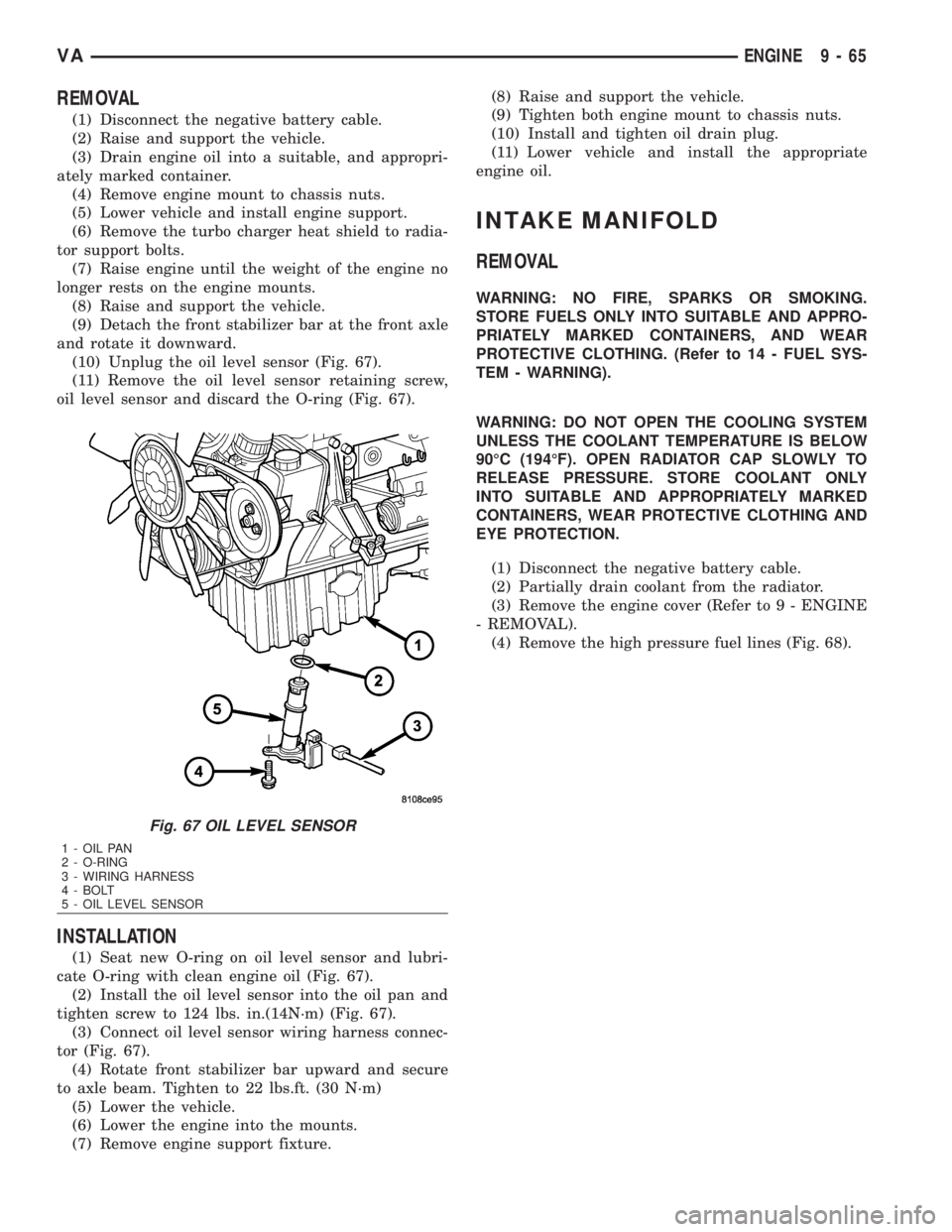
(10) Unplug the oil level sensor (Fig. 67).
(11) Remove the oil level sensor retaining screw,
oil level sensor and discard the O-ring (Fig. 67).
INSTALLATION
(1) Seat new O-ring on oil level sensor and lubri-
cate O-ring with clean engine oil (Fig. 67).
(2) Install the oil level sensor into the oil pan and
tighten screw to 124 lbs. in.(14N´m) (Fig. 67).
(3) Connect oil level sensor wiring harness connec-
tor (Fig. 67).
(4) Rotate front stabilizer bar upward and secure
to axle beam. Tighten to 22 lbs.ft. (30 N´m)
(5) Lower the vehicle.
(6) Lower the engine into the mounts.
(7) Remove engine support fixture.(8) Raise and support the vehicle.
(9) Tighten both engine mount to chassis nuts.
(10) Install and tighten oil drain plug.
(11) Lower vehicle and install the appropriate
engine oil.
INTAKE MANIFOLD
REMOVAL
WARNING: NO FIRE, SPARKS OR SMOKING.
STORE FUELS ONLY INTO SUITABLE AND APPRO-
PRIATELY MARKED CONTAINERS, AND WEAR
PROTECTIVE CLOTHING. (Refer to 14 - FUEL SYS-
TEM - WARNING).
WARNING: DO NOT OPEN THE COOLING SYSTEM
UNLESS THE COOLANT TEMPERATURE IS BELOW
90ÉC (194ÉF). OPEN RADIATOR CAP SLOWLY TO
RELEASE PRESSURE. STORE COOLANT ONLY
INTO SUITABLE AND APPROPRIATELY MARKED
CONTAINERS, WEAR PROTECTIVE CLOTHING AND
EYE PROTECTION.
(1) Disconnect the negative battery cable.
(2) Partially drain coolant from the radiator.
(3) Remove the engine cover (Refer to 9 - ENGINE
- REMOVAL).
(4) Remove the high pressure fuel lines (Fig. 68).
Fig. 67 OIL LEVEL SENSOR
1 - OIL PAN
2 - O-RING
3 - WIRING HARNESS
4 - BOLT
5 - OIL LEVEL SENSOR
VAENGINE 9 - 65
Page 1642 of 2305
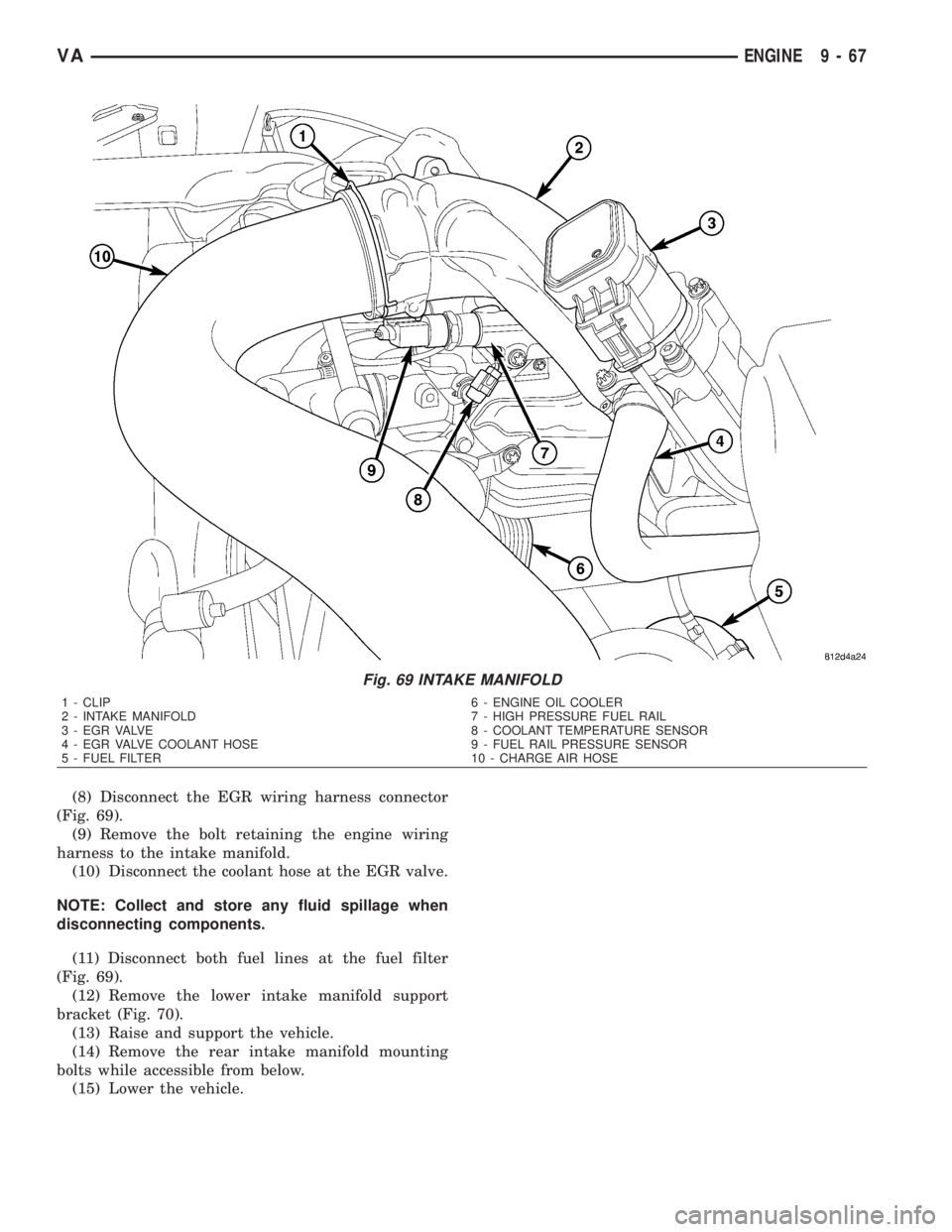
(8) Disconnect the EGR wiring harness connector
(Fig. 69).
(9) Remove the bolt retaining the engine wiring
harness to the intake manifold.
(10) Disconnect the coolant hose at the EGR valve.
NOTE: Collect and store any fluid spillage when
disconnecting components.
(11) Disconnect both fuel lines at the fuel filter
(Fig. 69).
(12) Remove the lower intake manifold support
bracket (Fig. 70).
(13) Raise and support the vehicle.
(14) Remove the rear intake manifold mounting
bolts while accessible from below.
(15) Lower the vehicle.
Fig. 69 INTAKE MANIFOLD
1 - CLIP 6 - ENGINE OIL COOLER
2 - INTAKE MANIFOLD 7 - HIGH PRESSURE FUEL RAIL
3 - EGR VALVE 8 - COOLANT TEMPERATURE SENSOR
4 - EGR VALVE COOLANT HOSE 9 - FUEL RAIL PRESSURE SENSOR
5 - FUEL FILTER 10 - CHARGE AIR HOSE
VAENGINE 9 - 67
Page 1643 of 2305
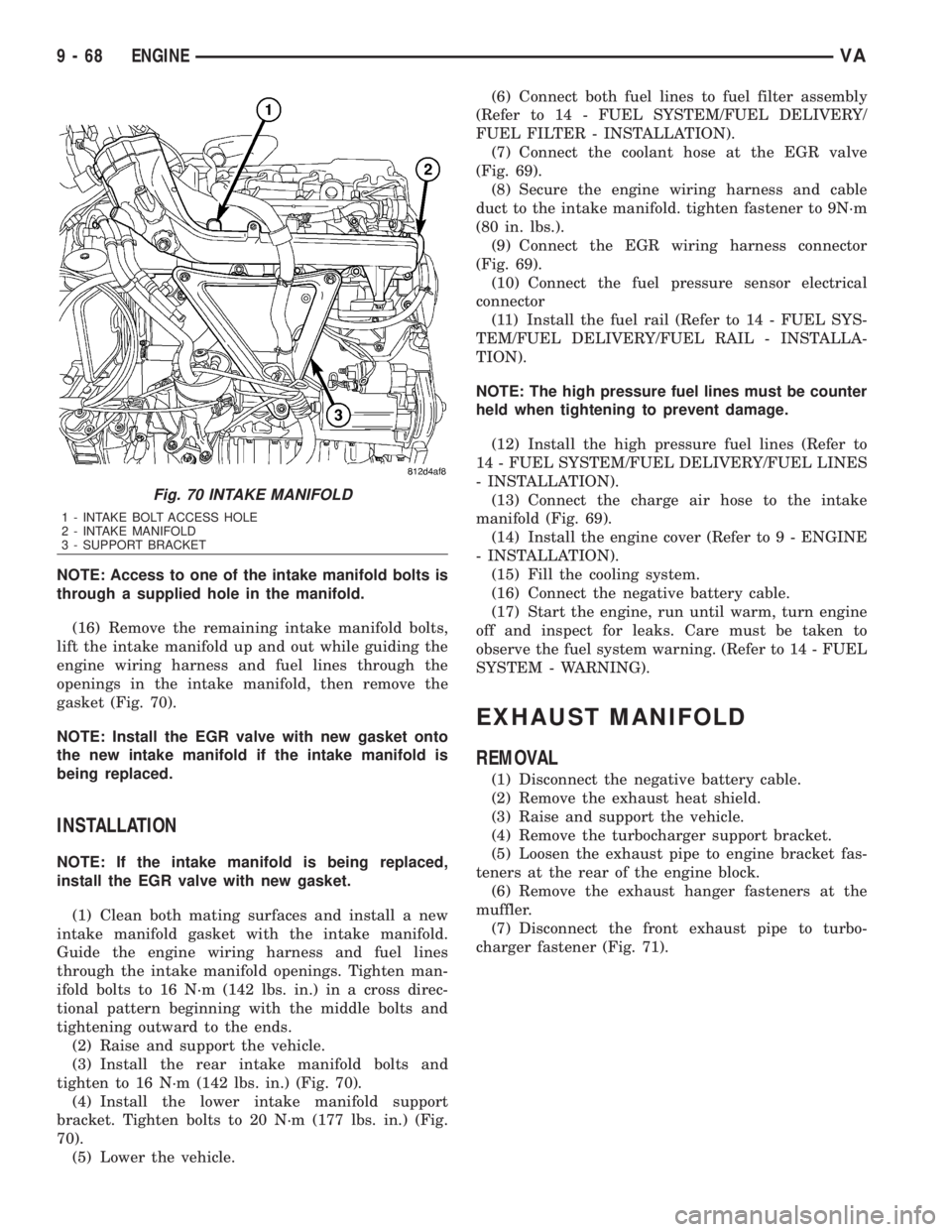
NOTE: Access to one of the intake manifold bolts is
through a supplied hole in the manifold.
(16) Remove the remaining intake manifold bolts,
lift the intake manifold up and out while guiding the
engine wiring harness and fuel lines through the
openings in the intake manifold, then remove the
gasket (Fig. 70).
NOTE: Install the EGR valve with new gasket onto
the new intake manifold if the intake manifold is
being replaced.
INSTALLATION
NOTE: If the intake manifold is being replaced,
install the EGR valve with new gasket.
(1) Clean both mating surfaces and install a new
intake manifold gasket with the intake manifold.
Guide the engine wiring harness and fuel lines
through the intake manifold openings. Tighten man-
ifold bolts to 16 N´m (142 lbs. in.) in a cross direc-
tional pattern beginning with the middle bolts and
tightening outward to the ends.
(2) Raise and support the vehicle.
(3) Install the rear intake manifold bolts and
tighten to 16 N´m (142 lbs. in.) (Fig. 70).
(4) Install the lower intake manifold support
bracket. Tighten bolts to 20 N´m (177 lbs. in.) (Fig.
70).
(5) Lower the vehicle.(6) Connect both fuel lines to fuel filter assembly
(Refer to 14 - FUEL SYSTEM/FUEL DELIVERY/
FUEL FILTER - INSTALLATION).
(7) Connect the coolant hose at the EGR valve
(Fig. 69).
(8) Secure the engine wiring harness and cable
duct to the intake manifold. tighten fastener to 9N´m
(80 in. lbs.).
(9) Connect the EGR wiring harness connector
(Fig. 69).
(10) Connect the fuel pressure sensor electrical
connector
(11) Install the fuel rail (Refer to 14 - FUEL SYS-
TEM/FUEL DELIVERY/FUEL RAIL - INSTALLA-
TION).
NOTE: The high pressure fuel lines must be counter
held when tightening to prevent damage.
(12) Install the high pressure fuel lines (Refer to
14 - FUEL SYSTEM/FUEL DELIVERY/FUEL LINES
- INSTALLATION).
(13) Connect the charge air hose to the intake
manifold (Fig. 69).
(14) Install the engine cover (Refer to 9 - ENGINE
- INSTALLATION).
(15) Fill the cooling system.
(16) Connect the negative battery cable.
(17) Start the engine, run until warm, turn engine
off and inspect for leaks. Care must be taken to
observe the fuel system warning. (Refer to 14 - FUEL
SYSTEM - WARNING).
EXHAUST MANIFOLD
REMOVAL
(1) Disconnect the negative battery cable.
(2) Remove the exhaust heat shield.
(3) Raise and support the vehicle.
(4) Remove the turbocharger support bracket.
(5) Loosen the exhaust pipe to engine bracket fas-
teners at the rear of the engine block.
(6) Remove the exhaust hanger fasteners at the
muffler.
(7) Disconnect the front exhaust pipe to turbo-
charger fastener (Fig. 71).
Fig. 70 INTAKE MANIFOLD
1 - INTAKE BOLT ACCESS HOLE
2 - INTAKE MANIFOLD
3 - SUPPORT BRACKET
9 - 68 ENGINEVA
Page 1645 of 2305
(8) Install the exhaust hanger fasteners at the
muffler.
(9) Tighten the exhaust hanger bracket to engine
block.
(10) Install the turbocharger support bracket.
(11) Lower the vehicle.
(12) Install the air cleaner duct to the turbo-
charger (Fig. 71).
(13) Install the exhaust heat shield.
(14) Connect the negative battery cable.
TIMING CHAIN COVER
REMOVAL
WARNING: DO NOT OPEN COOLING SYSTEM
UNLESS TEMPERATURE IS BELOW 90ÉC (194ÉF).
OPEN CAP SLOWLY TO RELEASE PRESSURE.
STORE COOLANT IN APPROVED CONTAINER
ONLY. RISK OF INJURY TO SKIN AND EYES FROM
SCALDING COOLANT. WEAR PROTECTIVE
GLOVES, CLOTHING AND EYE WEAR.
(1) Disconnect negative battery cable.
NOTE: Rotate engine on crankshaft. DO NOT crank
the engine at the bolt of the camshaft sprocket.
NOTE: DO NOT crank engine back.
(2) Position piston of cylinder 1 to ignition TDC.
Markings on the camshaft bearing cap must be
aligned.
(3) Drain coolant (Refer to 7 - COOLING/ENGINE/
COOLANT - STANDARD PROCEDURE).
(4) Install retaining lock for crankshaft/starter
ring gear (Refer to 9 - ENGINE/ENGINE BLOCK/
FLEX PLATE - INSTALLATION).
(5) Drain engine oil.
(6) Remove the oil filter to allow the oil to flow off
into the oil pan.
(7) Remove the radiator assembly (Refer to 7 -
COOLING/ENGINE/RADIATOR - REMOVAL).
(8) Remove engine cover (Refer to 9 - ENGINE -
REMOVAL).
(9) Remove front cover at cylinder head (Refer to 9
- ENGINE/CYLINDER HEAD - REMOVAL).
(10) Remove accessory drive belt.
(11) Remove the high pressure fuel pump (Refer to
14 - FUEL SYSTEM/FUEL DELIVERY/FUEL PUMP
- REMOVAL).
(12) Remove water pump (Refer to 7 - COOLING/
ENGINE/WATER PUMP - REMOVAL).
(13) Remove accessory drive belt pulley and vibra-
tion damper (Refer to 9 - ENGINE/ENGINE BLOCK/
VIBRATION DAMPER - REMOVAL).
(14) Remove the power steering pump.NOTE: NO NOT open the air conditioning system.
(15) Unplug AC compressor electrical connector
and unbolt AC compressor. Relocate in lower engine
compartmentwith outopening the system.
(16) Remove the generator with wiring attached
and relocate somewhere in the engine compartment.
(17) Install engine support fixture.
(18) Remove the oil pan.
(19) Detach the coolant hose to oil-water heat
exchanger at crankcase (Fig. 73).
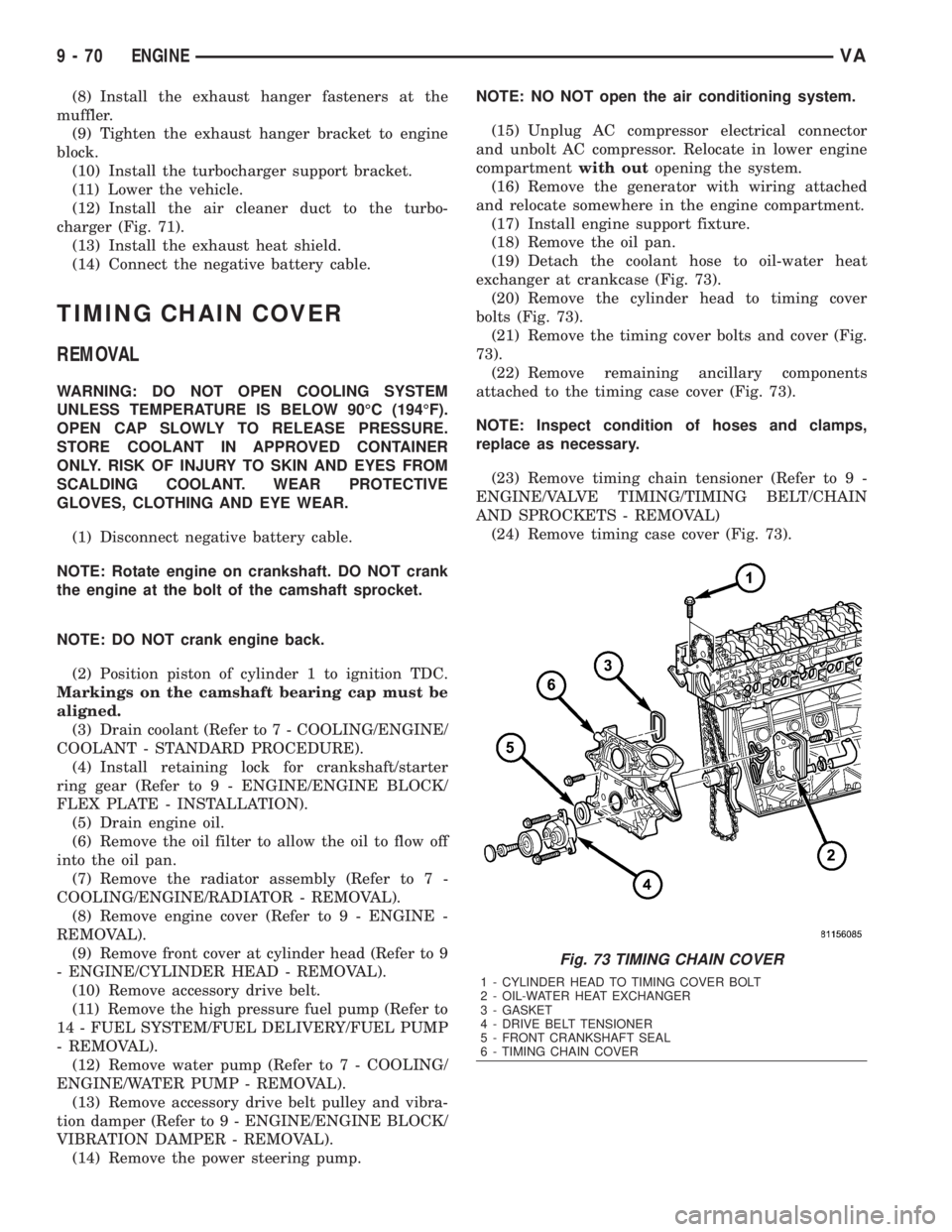
(20) Remove the cylinder head to timing cover
bolts (Fig. 73).
(21) Remove the timing cover bolts and cover (Fig.
73).
(22) Remove remaining ancillary components
attached to the timing case cover (Fig. 73).
NOTE: Inspect condition of hoses and clamps,
replace as necessary.
(23) Remove timing chain tensioner (Refer to 9 -
ENGINE/VALVE TIMING/TIMING BELT/CHAIN
AND SPROCKETS - REMOVAL)
(24) Remove timing case cover (Fig. 73).
Fig. 73 TIMING CHAIN COVER
1 - CYLINDER HEAD TO TIMING COVER BOLT
2 - OIL-WATER HEAT EXCHANGER
3 - GASKET
4 - DRIVE BELT TENSIONER
5 - FRONT CRANKSHAFT SEAL
6 - TIMING CHAIN COVER
9 - 70 ENGINEVA
Page 1692 of 2305
INSTALLATION
WARNING: NO SPARKS, OPEN FLAMES OR SMOK-
ING. RISK OF POISONING FROM INHALING AND
SWALLOWING FUEL. RISK OF INJURY TO EYES
AND SKIN FROM CONTACT WITH FUEL. POUR
FUELS ONLY INTO SUITABLE AND APPROPRI-
ATELY MARKED CONTAINERS. WEAR PROTECTIVE
CLOTHING.
CAUTION: DO NOT bend, twist or cut the fuel hose
clamps. The fuel hose clamps through out the fuel
system are reusable when using special tool #9539.
Orginal clamps must be used when servicing the
fuel system.
NOTE: Capture any fuel spillage and dispose of in
appropriately marked container.
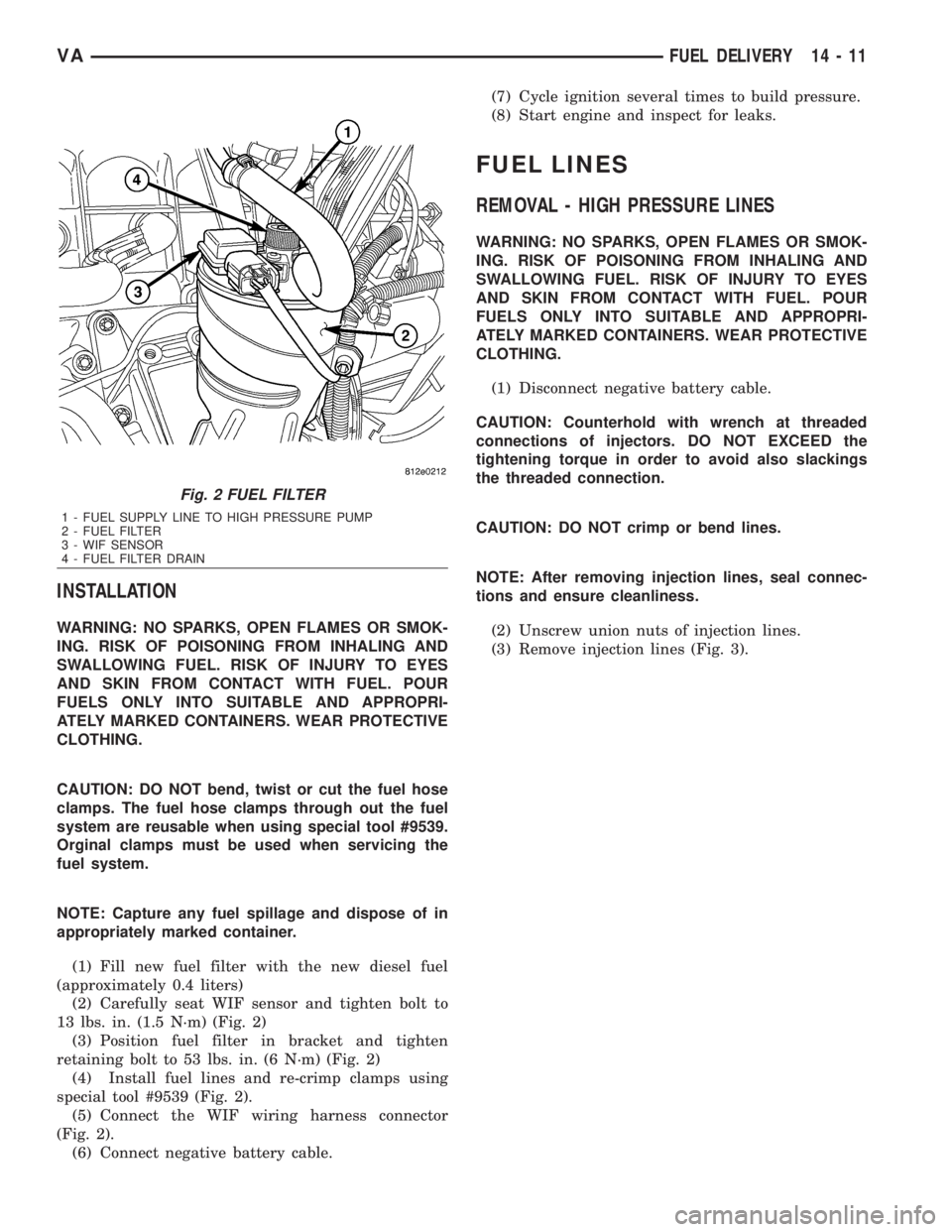
(1) Fill new fuel filter with the new diesel fuel
(approximately 0.4 liters)
(2) Carefully seat WIF sensor and tighten bolt to
13 lbs. in. (1.5 N´m) (Fig. 2)
(3) Position fuel filter in bracket and tighten
retaining bolt to 53 lbs. in. (6 N´m) (Fig. 2)
(4) Install fuel lines and re-crimp clamps using
special tool #9539 (Fig. 2).
(5) Connect the WIF wiring harness connector
(Fig. 2).
(6) Connect negative battery cable.(7) Cycle ignition several times to build pressure.
(8) Start engine and inspect for leaks.
FUEL LINES
REMOVAL - HIGH PRESSURE LINES
WARNING: NO SPARKS, OPEN FLAMES OR SMOK-
ING. RISK OF POISONING FROM INHALING AND
SWALLOWING FUEL. RISK OF INJURY TO EYES
AND SKIN FROM CONTACT WITH FUEL. POUR
FUELS ONLY INTO SUITABLE AND APPROPRI-
ATELY MARKED CONTAINERS. WEAR PROTECTIVE
CLOTHING.
(1) Disconnect negative battery cable.
CAUTION: Counterhold with wrench at threaded
connections of injectors. DO NOT EXCEED the
tightening torque in order to avoid also slackings
the threaded connection.
CAUTION: DO NOT crimp or bend lines.
NOTE: After removing injection lines, seal connec-
tions and ensure cleanliness.
(2) Unscrew union nuts of injection lines.
(3) Remove injection lines (Fig. 3).
Fig. 2 FUEL FILTER
1 - FUEL SUPPLY LINE TO HIGH PRESSURE PUMP
2 - FUEL FILTER
3 - WIF SENSOR
4 - FUEL FILTER DRAIN
VAFUEL DELIVERY 14 - 11
Page 1693 of 2305
INSTALLATION - HIGH PRESSURE LINES
WARNING: NO SPARKS, OPEN FLAMES OR SMOK-
ING. RISK OF POISONING FROM INHALING AND
SWALLOWING FUEL. RISK OF INJURY TO EYES
AND SKIN FROM CONTACT WITH FUEL. POUR
FUELS ONLY INTO SUITABLE AND APPROPRI-
ATELY MARKED CONTAINERS. WEAR PROTECTIVE
CLOTHING.
(1) Loosen the fuel rail mounting bolts to install
lines free of stress.
CAUTION: Inspect sealing cone at lines. Replace if
compression points exist. Ensure lines are exactly
located.
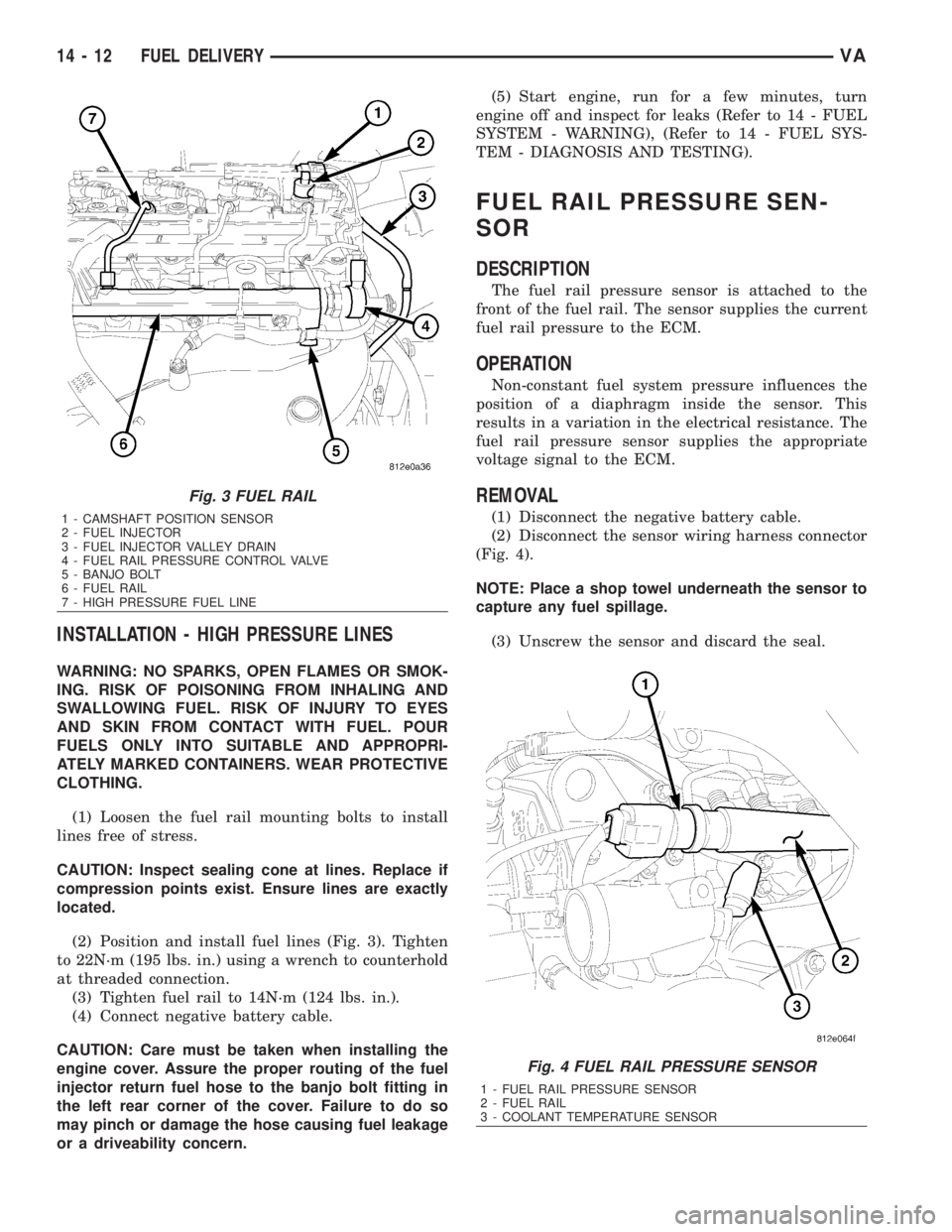
(2) Position and install fuel lines (Fig. 3). Tighten
to 22N´m (195 lbs. in.) using a wrench to counterhold
at threaded connection.
(3) Tighten fuel rail to 14N´m (124 lbs. in.).
(4) Connect negative battery cable.
CAUTION: Care must be taken when installing the
engine cover. Assure the proper routing of the fuel
injector return fuel hose to the banjo bolt fitting in
the left rear corner of the cover. Failure to do so
may pinch or damage the hose causing fuel leakage
or a driveability concern.(5) Start engine, run for a few minutes, turn
engine off and inspect for leaks (Refer to 14 - FUEL
SYSTEM - WARNING), (Refer to 14 - FUEL SYS-
TEM - DIAGNOSIS AND TESTING).
FUEL RAIL PRESSURE SEN-
SOR
DESCRIPTION
The fuel rail pressure sensor is attached to the
front of the fuel rail. The sensor supplies the current
fuel rail pressure to the ECM.
OPERATION
Non-constant fuel system pressure influences the
position of a diaphragm inside the sensor. This
results in a variation in the electrical resistance. The
fuel rail pressure sensor supplies the appropriate
voltage signal to the ECM.
REMOVAL
(1) Disconnect the negative battery cable.
(2) Disconnect the sensor wiring harness connector
(Fig. 4).
NOTE: Place a shop towel underneath the sensor to
capture any fuel spillage.
(3) Unscrew the sensor and discard the seal.
Fig. 3 FUEL RAIL
1 - CAMSHAFT POSITION SENSOR
2 - FUEL INJECTOR
3 - FUEL INJECTOR VALLEY DRAIN
4 - FUEL RAIL PRESSURE CONTROL VALVE
5 - BANJO BOLT
6 - FUEL RAIL
7 - HIGH PRESSURE FUEL LINE
Fig. 4 FUEL RAIL PRESSURE SENSOR
1 - FUEL RAIL PRESSURE SENSOR
2 - FUEL RAIL
3 - COOLANT TEMPERATURE SENSOR
14 - 12 FUEL DELIVERYVA
Page 1694 of 2305
INSTALLATION
(1) Install the sealing ring onto the sensor and
screw the fuel pressure sensor into the fuel rail.
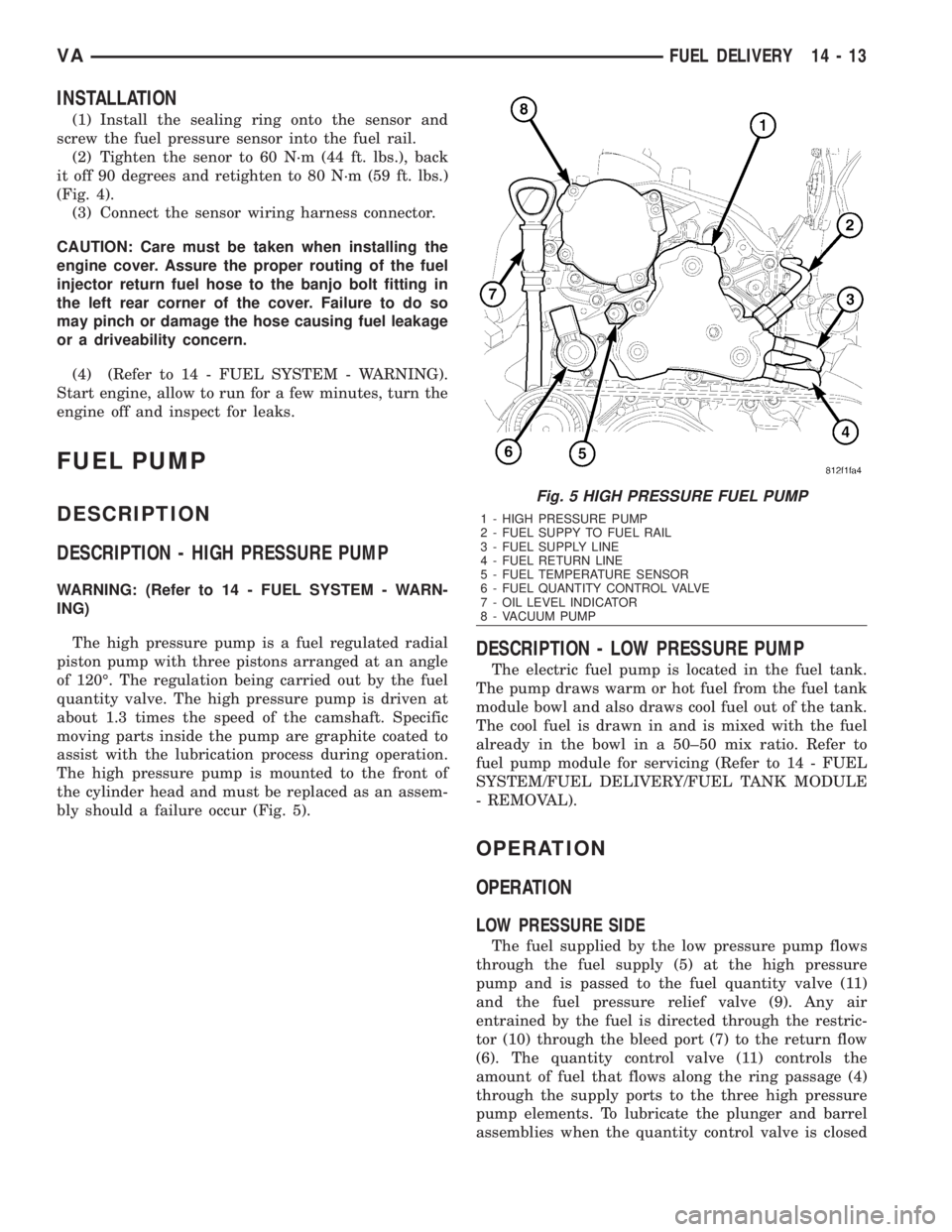
(2) Tighten the senor to 60 N´m (44 ft. lbs.), back
it off 90 degrees and retighten to 80 N´m (59 ft. lbs.)
(Fig. 4).
(3) Connect the sensor wiring harness connector.
CAUTION: Care must be taken when installing the
engine cover. Assure the proper routing of the fuel
injector return fuel hose to the banjo bolt fitting in
the left rear corner of the cover. Failure to do so
may pinch or damage the hose causing fuel leakage
or a driveability concern.
(4) (Refer to 14 - FUEL SYSTEM - WARNING).
Start engine, allow to run for a few minutes, turn the
engine off and inspect for leaks.
FUEL PUMP
DESCRIPTION
DESCRIPTION - HIGH PRESSURE PUMP
WARNING: (Refer to 14 - FUEL SYSTEM - WARN-
ING)
The high pressure pump is a fuel regulated radial
piston pump with three pistons arranged at an angle
of 120É. The regulation being carried out by the fuel
quantity valve. The high pressure pump is driven at
about 1.3 times the speed of the camshaft. Specific
moving parts inside the pump are graphite coated to
assist with the lubrication process during operation.
The high pressure pump is mounted to the front of
the cylinder head and must be replaced as an assem-
bly should a failure occur (Fig. 5).
DESCRIPTION - LOW PRESSURE PUMP
The electric fuel pump is located in the fuel tank.
The pump draws warm or hot fuel from the fuel tank
module bowl and also draws cool fuel out of the tank.
The cool fuel is drawn in and is mixed with the fuel
already in the bowl in a 50±50 mix ratio. Refer to
fuel pump module for servicing (Refer to 14 - FUEL
SYSTEM/FUEL DELIVERY/FUEL TANK MODULE
- REMOVAL).
OPERATION
OPERATION
LOW PRESSURE SIDE
The fuel supplied by the low pressure pump flows
through the fuel supply (5) at the high pressure
pump and is passed to the fuel quantity valve (11)
and the fuel pressure relief valve (9). Any air
entrained by the fuel is directed through the restric-
tor (10) through the bleed port (7) to the return flow
(6). The quantity control valve (11) controls the
amount of fuel that flows along the ring passage (4)
through the supply ports to the three high pressure
pump elements. To lubricate the plunger and barrel
assemblies when the quantity control valve is closed
Fig. 5 HIGH PRESSURE FUEL PUMP
1 - HIGH PRESSURE PUMP
2 - FUEL SUPPY TO FUEL RAIL
3 - FUEL SUPPLY LINE
4 - FUEL RETURN LINE
5 - FUEL TEMPERATURE SENSOR
6 - FUEL QUANTITY CONTROL VALVE
7 - OIL LEVEL INDICATOR
8 - VACUUM PUMP
VAFUEL DELIVERY 14 - 13
Page 1702 of 2305
FUEL QUANTITY CONTROL
VA LV E
DESCRIPTION
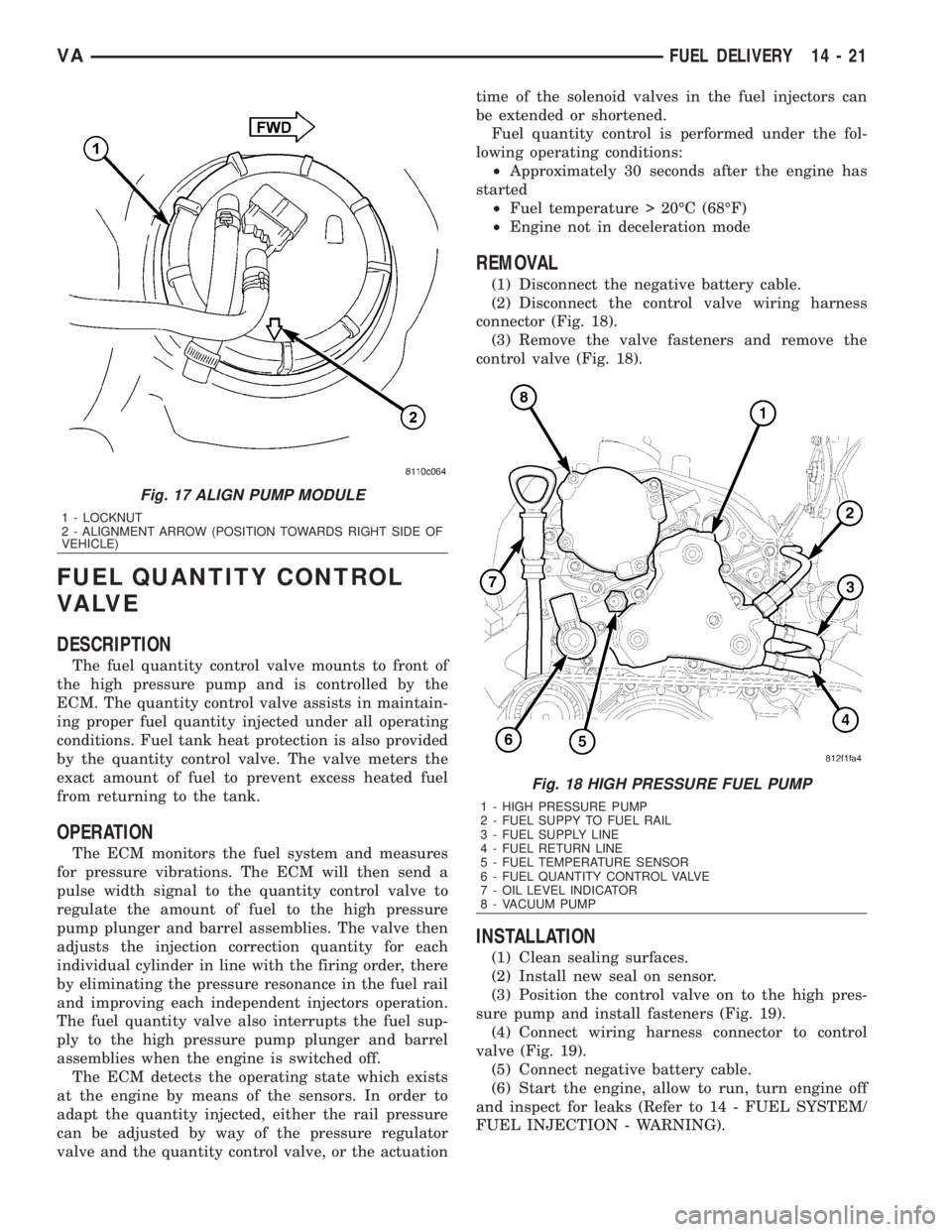
The fuel quantity control valve mounts to front of
the high pressure pump and is controlled by the
ECM. The quantity control valve assists in maintain-
ing proper fuel quantity injected under all operating
conditions. Fuel tank heat protection is also provided
by the quantity control valve. The valve meters the
exact amount of fuel to prevent excess heated fuel
from returning to the tank.
OPERATION
The ECM monitors the fuel system and measures
for pressure vibrations. The ECM will then send a
pulse width signal to the quantity control valve to
regulate the amount of fuel to the high pressure
pump plunger and barrel assemblies. The valve then
adjusts the injection correction quantity for each
individual cylinder in line with the firing order, there
by eliminating the pressure resonance in the fuel rail
and improving each independent injectors operation.
The fuel quantity valve also interrupts the fuel sup-
ply to the high pressure pump plunger and barrel
assemblies when the engine is switched off.
The ECM detects the operating state which exists
at the engine by means of the sensors. In order to
adapt the quantity injected, either the rail pressure
can be adjusted by way of the pressure regulator
valve and the quantity control valve, or the actuationtime of the solenoid valves in the fuel injectors can
be extended or shortened.
Fuel quantity control is performed under the fol-
lowing operating conditions:
²Approximately 30 seconds after the engine has
started
²Fuel temperature > 20ÉC (68ÉF)
²Engine not in deceleration mode
REMOVAL
(1) Disconnect the negative battery cable.
(2) Disconnect the control valve wiring harness
connector (Fig. 18).
(3) Remove the valve fasteners and remove the
control valve (Fig. 18).
INSTALLATION
(1) Clean sealing surfaces.
(2) Install new seal on sensor.
(3) Position the control valve on to the high pres-
sure pump and install fasteners (Fig. 19).
(4) Connect wiring harness connector to control
valve (Fig. 19).
(5) Connect negative battery cable.
(6) Start the engine, allow to run, turn engine off
and inspect for leaks (Refer to 14 - FUEL SYSTEM/
FUEL INJECTION - WARNING).
Fig. 17 ALIGN PUMP MODULE
1 - LOCKNUT
2 - ALIGNMENT ARROW (POSITION TOWARDS RIGHT SIDE OF
VEHICLE)
Fig. 18 HIGH PRESSURE FUEL PUMP
1 - HIGH PRESSURE PUMP
2 - FUEL SUPPY TO FUEL RAIL
3 - FUEL SUPPLY LINE
4 - FUEL RETURN LINE
5 - FUEL TEMPERATURE SENSOR
6 - FUEL QUANTITY CONTROL VALVE
7 - OIL LEVEL INDICATOR
8 - VACUUM PUMP
VAFUEL DELIVERY 14 - 21
Page 1703 of 2305
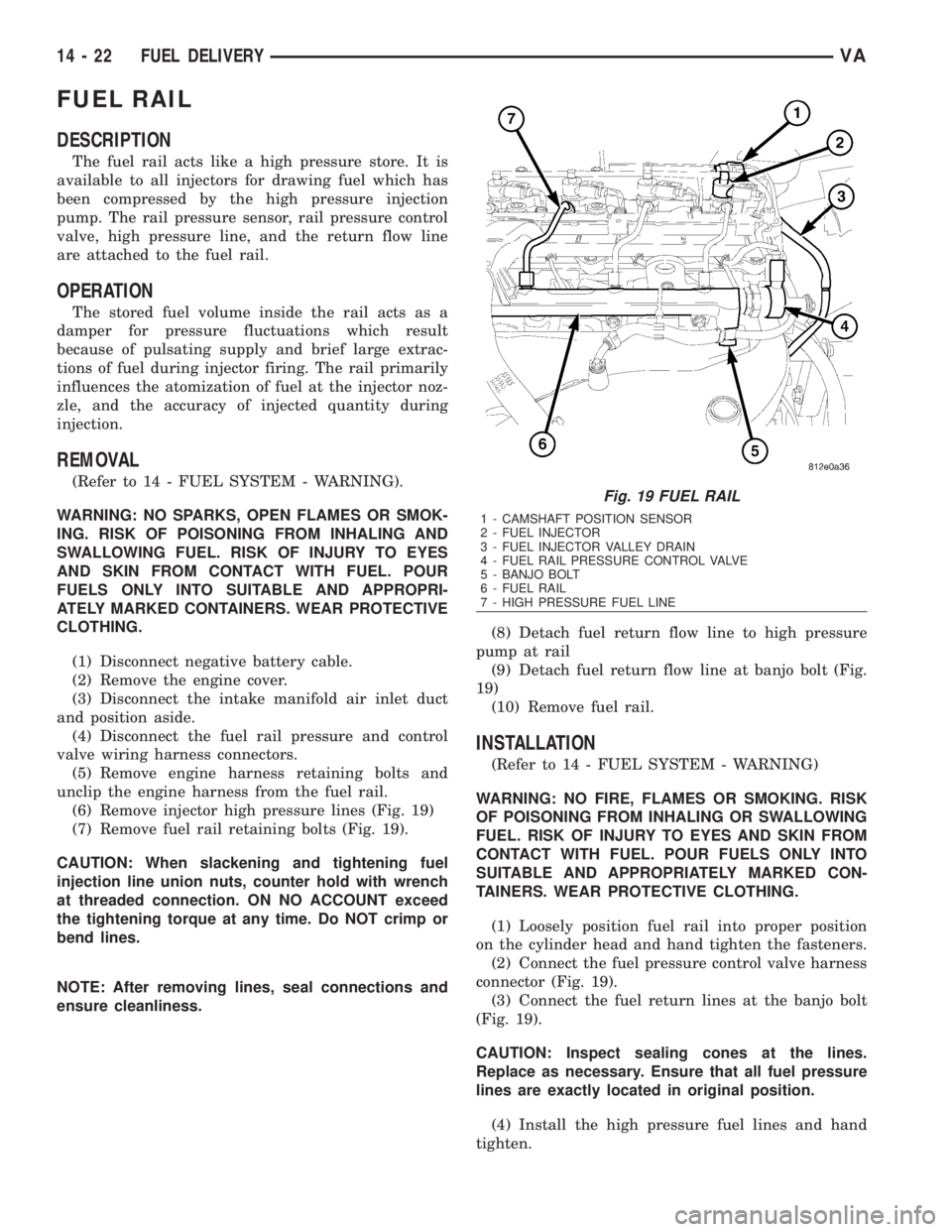
FUEL RAIL
DESCRIPTION
The fuel rail acts like a high pressure store. It is
available to all injectors for drawing fuel which has
been compressed by the high pressure injection
pump. The rail pressure sensor, rail pressure control
valve, high pressure line, and the return flow line
are attached to the fuel rail.
OPERATION
The stored fuel volume inside the rail acts as a
damper for pressure fluctuations which result
because of pulsating supply and brief large extrac-
tions of fuel during injector firing. The rail primarily
influences the atomization of fuel at the injector noz-
zle, and the accuracy of injected quantity during
injection.
REMOVAL
(Refer to 14 - FUEL SYSTEM - WARNING).
WARNING: NO SPARKS, OPEN FLAMES OR SMOK-
ING. RISK OF POISONING FROM INHALING AND
SWALLOWING FUEL. RISK OF INJURY TO EYES
AND SKIN FROM CONTACT WITH FUEL. POUR
FUELS ONLY INTO SUITABLE AND APPROPRI-
ATELY MARKED CONTAINERS. WEAR PROTECTIVE
CLOTHING.
(1) Disconnect negative battery cable.
(2) Remove the engine cover.
(3) Disconnect the intake manifold air inlet duct
and position aside.
(4) Disconnect the fuel rail pressure and control
valve wiring harness connectors.
(5) Remove engine harness retaining bolts and
unclip the engine harness from the fuel rail.
(6) Remove injector high pressure lines (Fig. 19)
(7) Remove fuel rail retaining bolts (Fig. 19).
CAUTION: When slackening and tightening fuel
injection line union nuts, counter hold with wrench
at threaded connection. ON NO ACCOUNT exceed
the tightening torque at any time. Do NOT crimp or
bend lines.
NOTE: After removing lines, seal connections and
ensure cleanliness.(8) Detach fuel return flow line to high pressure
pump at rail
(9) Detach fuel return flow line at banjo bolt (Fig.
19)
(10) Remove fuel rail.
INSTALLATION
(Refer to 14 - FUEL SYSTEM - WARNING)
WARNING: NO FIRE, FLAMES OR SMOKING. RISK
OF POISONING FROM INHALING OR SWALLOWING
FUEL. RISK OF INJURY TO EYES AND SKIN FROM
CONTACT WITH FUEL. POUR FUELS ONLY INTO
SUITABLE AND APPROPRIATELY MARKED CON-
TAINERS. WEAR PROTECTIVE CLOTHING.
(1) Loosely position fuel rail into proper position
on the cylinder head and hand tighten the fasteners.
(2) Connect the fuel pressure control valve harness
connector (Fig. 19).
(3) Connect the fuel return lines at the banjo bolt
(Fig. 19).
CAUTION: Inspect sealing cones at the lines.
Replace as necessary. Ensure that all fuel pressure
lines are exactly located in original position.
(4) Install the high pressure fuel lines and hand
tighten.
Fig. 19 FUEL RAIL
1 - CAMSHAFT POSITION SENSOR
2 - FUEL INJECTOR
3 - FUEL INJECTOR VALLEY DRAIN
4 - FUEL RAIL PRESSURE CONTROL VALVE
5 - BANJO BOLT
6 - FUEL RAIL
7 - HIGH PRESSURE FUEL LINE
14 - 22 FUEL DELIVERYVA
Page 1710 of 2305
a variable resistor track (card).
REMOVAL
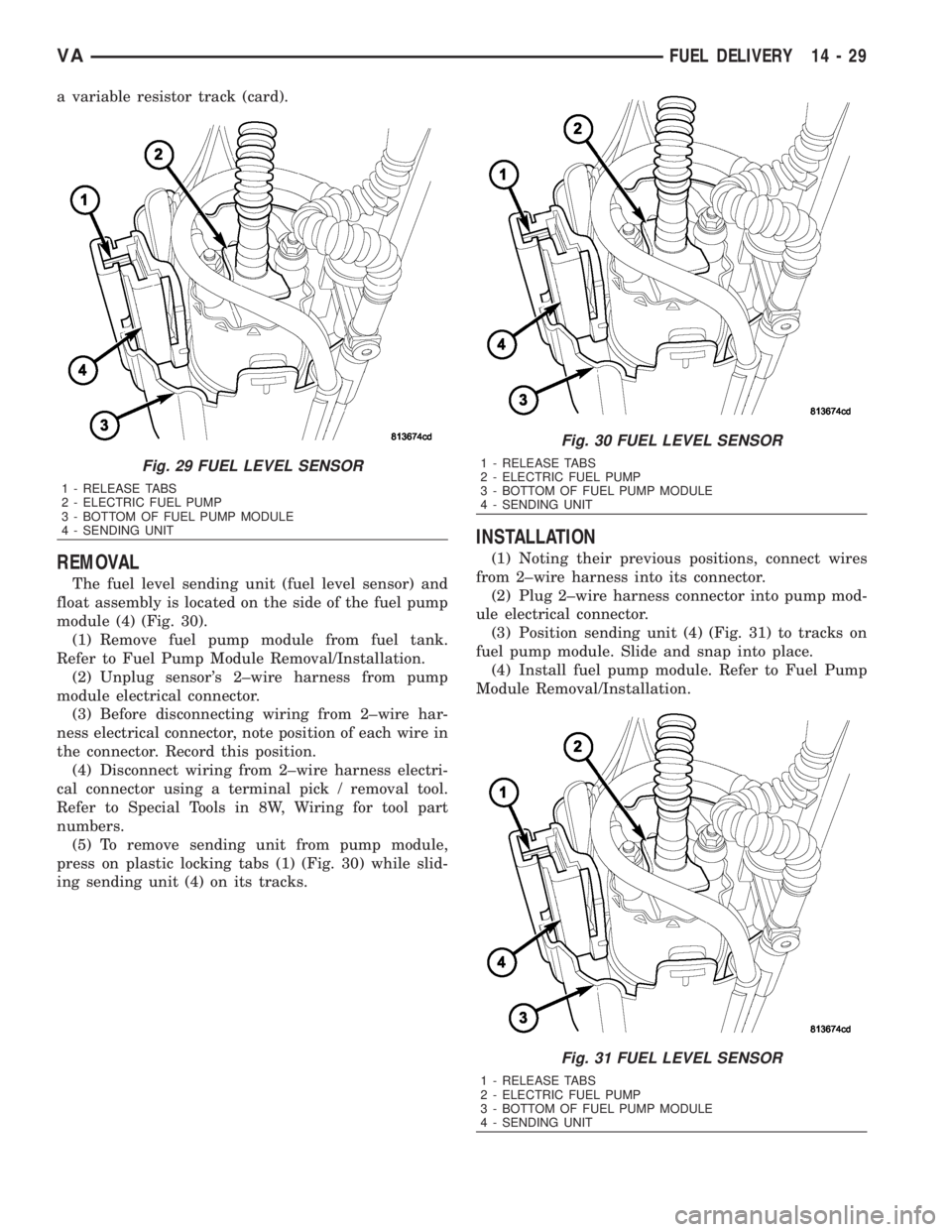
The fuel level sending unit (fuel level sensor) and
float assembly is located on the side of the fuel pump
module (4) (Fig. 30).
(1) Remove fuel pump module from fuel tank.
Refer to Fuel Pump Module Removal/Installation.
(2) Unplug sensor's 2±wire harness from pump
module electrical connector.
(3) Before disconnecting wiring from 2±wire har-
ness electrical connector, note position of each wire in
the connector. Record this position.
(4) Disconnect wiring from 2±wire harness electri-
cal connector using a terminal pick / removal tool.
Refer to Special Tools in 8W, Wiring for tool part
numbers.
(5) To remove sending unit from pump module,
press on plastic locking tabs (1) (Fig. 30) while slid-
ing sending unit (4) on its tracks.
INSTALLATION
(1) Noting their previous positions, connect wires
from 2±wire harness into its connector.
(2) Plug 2±wire harness connector into pump mod-
ule electrical connector.
(3) Position sending unit (4) (Fig. 31) to tracks on
fuel pump module. Slide and snap into place.
(4) Install fuel pump module. Refer to Fuel Pump
Module Removal/Installation.
Fig. 29 FUEL LEVEL SENSOR
1 - RELEASE TABS
2 - ELECTRIC FUEL PUMP
3 - BOTTOM OF FUEL PUMP MODULE
4 - SENDING UNIT
Fig. 30 FUEL LEVEL SENSOR
1 - RELEASE TABS
2 - ELECTRIC FUEL PUMP
3 - BOTTOM OF FUEL PUMP MODULE
4 - SENDING UNIT
Fig. 31 FUEL LEVEL SENSOR
1 - RELEASE TABS
2 - ELECTRIC FUEL PUMP
3 - BOTTOM OF FUEL PUMP MODULE
4 - SENDING UNIT
VAFUEL DELIVERY 14 - 29