battery MERCEDES-BENZ SPRINTER 2006 Service Manual
[x] Cancel search | Manufacturer: MERCEDES-BENZ, Model Year: 2006, Model line: SPRINTER, Model: MERCEDES-BENZ SPRINTER 2006Pages: 2305, PDF Size: 48.12 MB
Page 1649 of 2305
(12) Remove the intake camshaft (Refer to 9 -
ENGINE/CYLINDER HEAD/CAMSHAFT(S) -
REMOVAL).
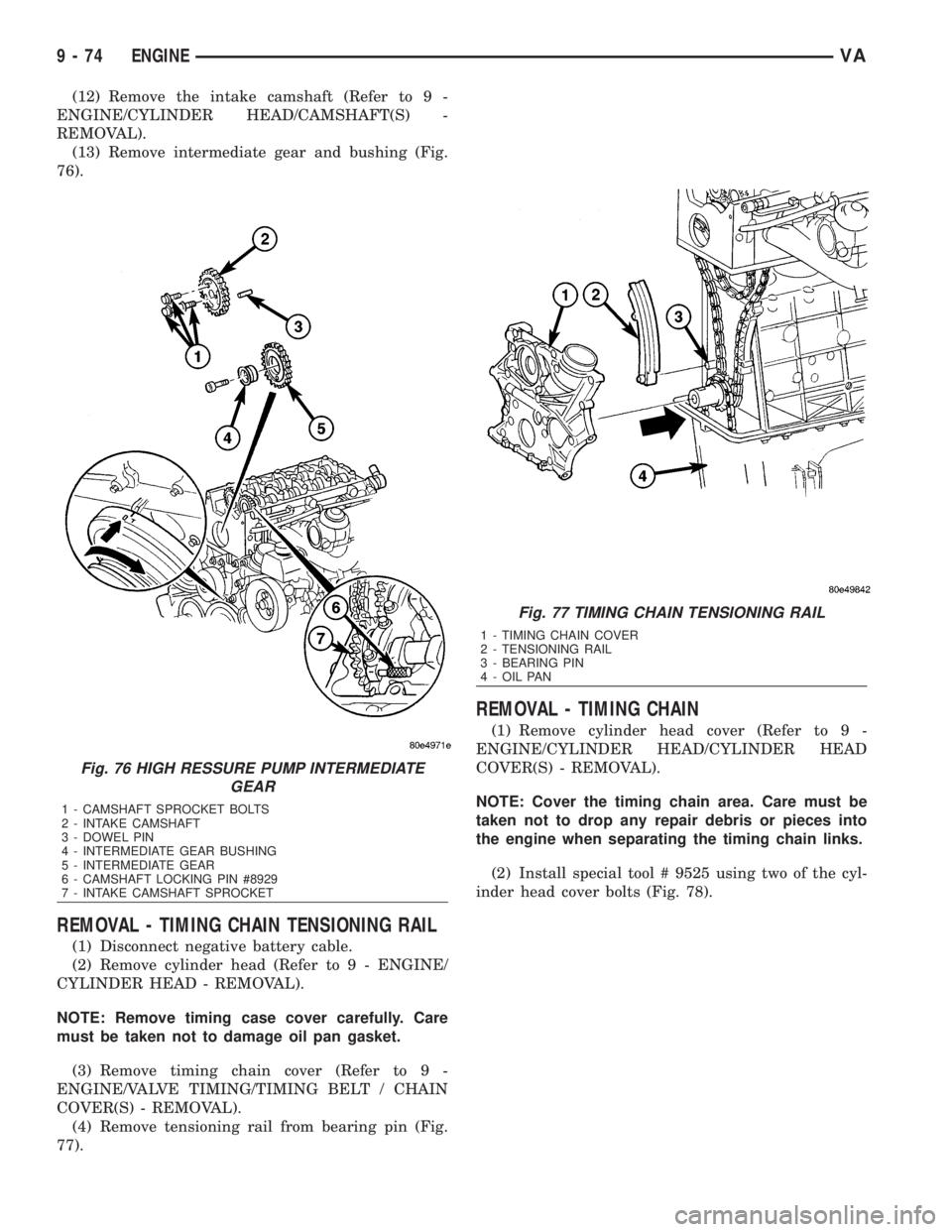
(13) Remove intermediate gear and bushing (Fig.
76).
REMOVAL - TIMING CHAIN TENSIONING RAIL
(1) Disconnect negative battery cable.
(2) Remove cylinder head (Refer to 9 - ENGINE/
CYLINDER HEAD - REMOVAL).
NOTE: Remove timing case cover carefully. Care
must be taken not to damage oil pan gasket.
(3) Remove timing chain cover (Refer to 9 -
ENGINE/VALVE TIMING/TIMING BELT / CHAIN
COVER(S) - REMOVAL).
(4) Remove tensioning rail from bearing pin (Fig.
77).
REMOVAL - TIMING CHAIN
(1) Remove cylinder head cover (Refer to 9 -
ENGINE/CYLINDER HEAD/CYLINDER HEAD
COVER(S) - REMOVAL).
NOTE: Cover the timing chain area. Care must be
taken not to drop any repair debris or pieces into
the engine when separating the timing chain links.
(2) Install special tool # 9525 using two of the cyl-
inder head cover bolts (Fig. 78).
Fig. 76 HIGH RESSURE PUMP INTERMEDIATE
GEAR
1 - CAMSHAFT SPROCKET BOLTS
2 - INTAKE CAMSHAFT
3 - DOWEL PIN
4 - INTERMEDIATE GEAR BUSHING
5 - INTERMEDIATE GEAR
6 - CAMSHAFT LOCKING PIN #8929
7 - INTAKE CAMSHAFT SPROCKET
Fig. 77 TIMING CHAIN TENSIONING RAIL
1 - TIMING CHAIN COVER
2 - TENSIONING RAIL
3 - BEARING PIN
4 - OIL PAN
9 - 74 ENGINEVA
Page 1651 of 2305
NOTE: Care must be taken not to drop any repair
debris or pieces into the engine when separating
the timing chain links.
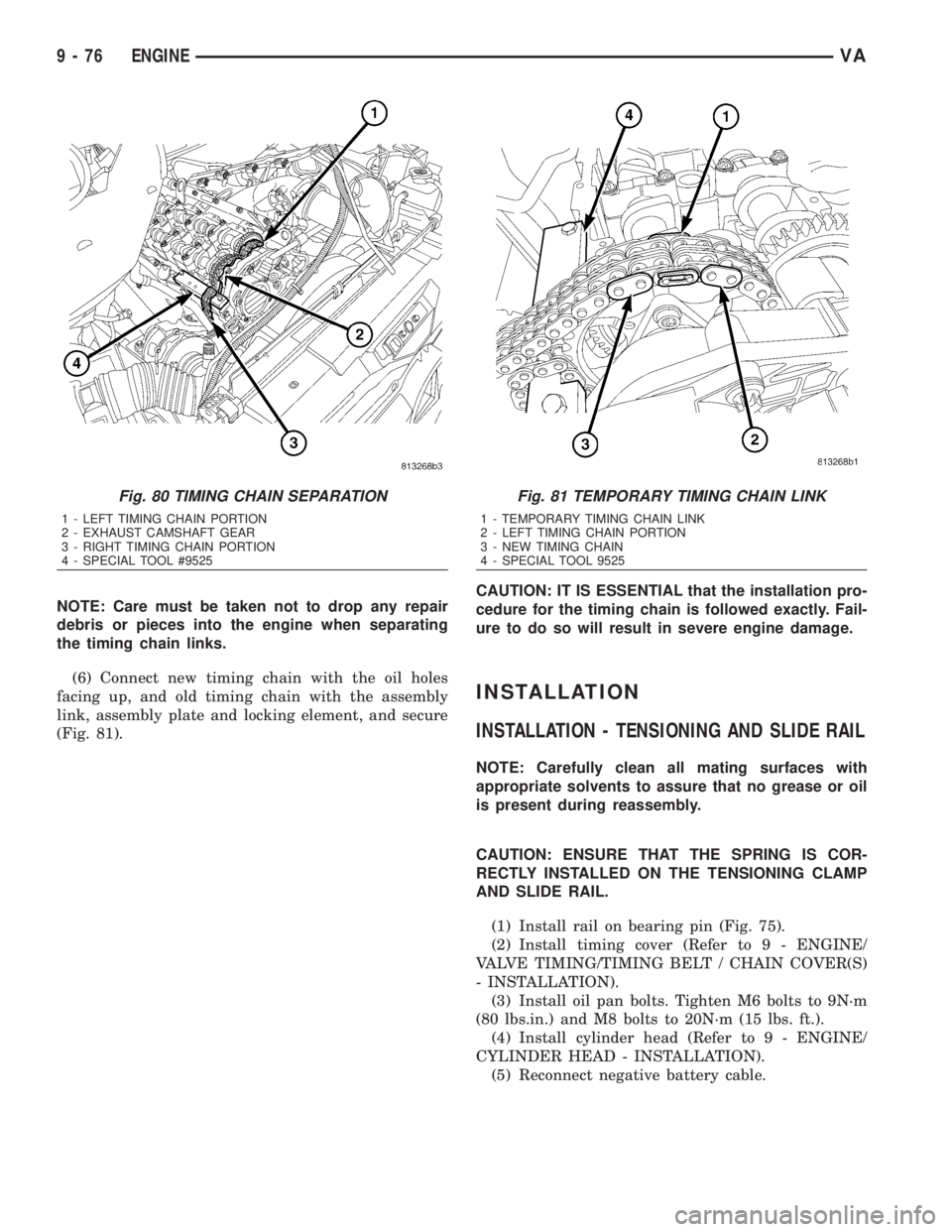
(6) Connect new timing chain with the oil holes
facing up, and old timing chain with the assembly
link, assembly plate and locking element, and secure
(Fig. 81).CAUTION: IT IS ESSENTIAL that the installation pro-
cedure for the timing chain is followed exactly. Fail-
ure to do so will result in severe engine damage.
INSTALLATION
INSTALLATION - TENSIONING AND SLIDE RAIL
NOTE: Carefully clean all mating surfaces with
appropriate solvents to assure that no grease or oil
is present during reassembly.
CAUTION: ENSURE THAT THE SPRING IS COR-
RECTLY INSTALLED ON THE TENSIONING CLAMP
AND SLIDE RAIL.
(1) Install rail on bearing pin (Fig. 75).
(2) Install timing cover (Refer to 9 - ENGINE/
VALVE TIMING/TIMING BELT / CHAIN COVER(S)
- INSTALLATION).
(3) Install oil pan bolts. Tighten M6 bolts to 9N´m
(80 lbs.in.) and M8 bolts to 20N´m (15 lbs. ft.).
(4) Install cylinder head (Refer to 9 - ENGINE/
CYLINDER HEAD - INSTALLATION).
(5) Reconnect negative battery cable.
Fig. 80 TIMING CHAIN SEPARATION
1 - LEFT TIMING CHAIN PORTION
2 - EXHAUST CAMSHAFT GEAR
3 - RIGHT TIMING CHAIN PORTION
4 - SPECIAL TOOL #9525
Fig. 81 TEMPORARY TIMING CHAIN LINK
1 - TEMPORARY TIMING CHAIN LINK
2 - LEFT TIMING CHAIN PORTION
3 - NEW TIMING CHAIN
4 - SPECIAL TOOL 9525
9 - 76 ENGINEVA
Page 1652 of 2305
WARNING: USE EXTREME CAUTION WHEN THE
ENGINE IS OPERATING. DO NOT STAND IN A
DIRECT LINE WITH THE FAN. DO NOT PUT YOUR
HANDS NEAR THE PULLEYS, BELTS OR FAN. DO
NOT WEAR LOOSE CLOTHES.
(6) Start the engine, allow to warm, turn engine
off and inspect for leaks. Care must be take to
observe the fuel system warning (Refer to 14 - FUEL
SYSTEM - WARNING).
INSTALLATION - INTERMEDIATE GEAR
NOTE: Refer to appropriate injector servicing proce-
dures for cleaning of injectors and recesses.
(1) Install intermediate gear and bushing. Tighten
bolt to 40N´m (30 lbs.ft.)
(2) Install the intake camshaft (Refer to 9 -
ENGINE/CYLINDER HEAD/CAMSHAFT(S) -
INSTALLATION).
(3) Install exhaust camshaft sprocket, noting
dowel pin alignment. Tighten bolt to 18 N´m (159 lbs.
in.).
WARNING: NO FIRE, FLAMES OR SMOKING. SER-
VICE VEHICLE IN WELL VENTILATED AREA. RISK
OF INJURY FROM INHALING OR SWALLOWING
FUEL. RISK OF INJURY TO EYES AND SKIN FROM
CONTACT WITH FUEL. WEAR PROTECTIVE CLOTH-
ING.
(4) Install high pressure pump (Refer to 14 -
FUEL SYSTEM/FUEL DELIVERY/FUEL INJEC-
TION PUMP - INSTALLATION).
(5) Install top slide rail (Refer to 9 - ENGINE/
VALVE TIMING/TIMING BELT/CHAIN AND
SPROCKETS - INSTALLATION).
(6) Install cylinder head front cover (Refer to 9 -
ENGINE/CYLINDER HEAD - INSTALLATION).
(7) Install timing chain tensioner with new gasket
(Refer to 9 - ENGINE/VALVE TIMING/TIMING
BELT/CHAIN AND SPROCKETS - INSTALLA-
TION).
NOTE: Inspect basic position of camshaft and reset
if necessary (Refer to 9 - ENGINE/CYLINDER HEAD/
CAMSHAFT(S) - STANDARD PROCEDURE).
(8) Remove camshaft locking pin.
(9) Install cylinder head cover (Refer to 9 -
ENGINE/CYLINDER HEAD/CYLINDER HEAD
COVER(S) - INSTALLATION).
WARNING: NO FIRE, FLAMES OR SMOKING. SER-
VICE VEHICLE IN WELL VENTILATED AREA. RISK
OF INJURY FROM INHALING OR SWALLOWING
FUEL. RISK OF INJURY TO EYES AND SKIN FROMCONTACT WITH FUEL. WEAR PROTECTIVE CLOTH-
ING.
(10) Install fuel high pressure lines and injectors
(Refer to 14 - FUEL SYSTEM/FUEL INJECTION/
FUEL INJECTOR - INSTALLATION).
(11) Install engine cover (Refer to 9 - ENGINE -
INSTALLATION).
(12) Connect negative battery cable.
WARNING: USE EXTREME CAUTION WHEN THE
ENGINE IS OPERATING. DO NOT STAND IN A
DIRECT LINE WITH FAN. DO NOT PUT YOUR
HANDS NEAR THE PULLEYS, BELTS OR FAN. DO
NOT WEAR LOOSE CLOTHING.
(13) Start engine and inspect for leaks. Care must
be taken to observe the fuel system warning (Refer to
14 - FUEL SYSTEM - WARNING).
INSTALLATION - TIMING CHAIN TENSIONING
RAIL
NOTE: Carefully clean all mating surfaces with
appropriate solvents to assure that no grease or oil
is present during reassembly.
(1) Install tensioning rail on bearing pin
(2) Install timing cover (Refer to 9 - ENGINE/
VALVE TIMING/TIMING BELT / CHAIN COVER(S)
- INSTALLATION).
(3) Install oil pan and bolts. Tighten M6 bolts to
9N´m (80 lbs.in.) and M8 bolts to 20N´m (15 lbs. ft.).
(4) Install cylinder head (Refer to 9 - ENGINE/
CYLINDER HEAD - INSTALLATION).
(5) Reconnect negative battery cable.
WARNING: USE EXTREME CAUTION WHEN THE
ENGINE IS OPERATING. DO NOT PUT YOUR
HANDS NEAR THE PULLEYS, BELTS OR FAN. DO
NOT WEAR LOOSE CLOTHES.
(6) Start the engine and inspect for leaks. Care
must be taken to observe the fuel system warning
(Refer to 14 - FUEL SYSTEM - WARNING).
ADJUSTMENTS
INSTALLATION - TIMING CHAIN
CAUTION: IT IS ESSENTIAL that the installation pro-
cedure is followed exactly. Failure to do so will
result in severe engine damage.
CAUTION: Cover timing case recesses to prevent
foreign material from entering engine.
VAENGINE 9 - 77
Page 1655 of 2305
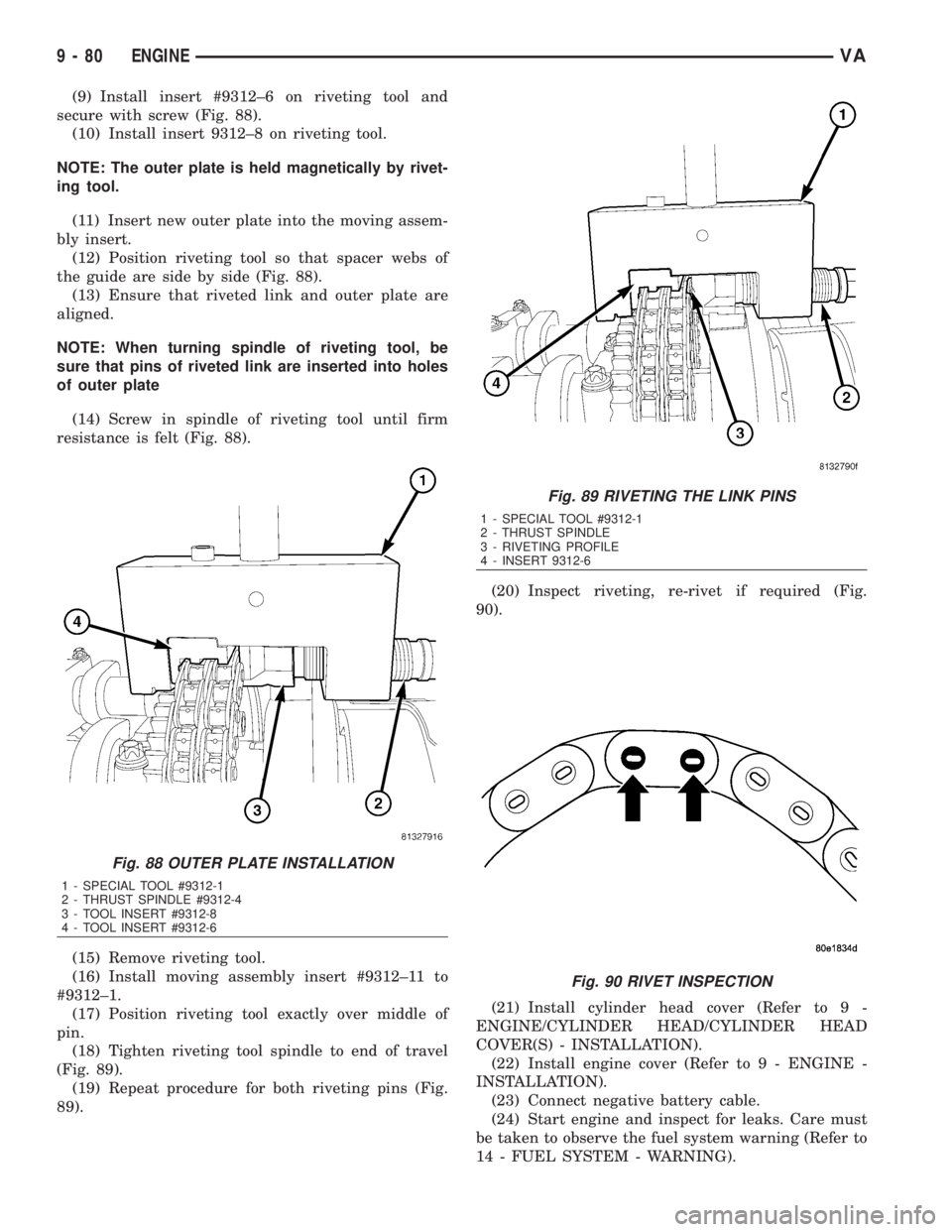
(9) Install insert #9312±6 on riveting tool and
secure with screw (Fig. 88).
(10) Install insert 9312±8 on riveting tool.
NOTE: The outer plate is held magnetically by rivet-
ing tool.
(11) Insert new outer plate into the moving assem-
bly insert.
(12) Position riveting tool so that spacer webs of
the guide are side by side (Fig. 88).
(13) Ensure that riveted link and outer plate are
aligned.
NOTE: When turning spindle of riveting tool, be
sure that pins of riveted link are inserted into holes
of outer plate
(14) Screw in spindle of riveting tool until firm
resistance is felt (Fig. 88).
(15) Remove riveting tool.
(16) Install moving assembly insert #9312±11 to
#9312±1.
(17) Position riveting tool exactly over middle of
pin.
(18) Tighten riveting tool spindle to end of travel
(Fig. 89).
(19) Repeat procedure for both riveting pins (Fig.
89).(20) Inspect riveting, re-rivet if required (Fig.
90).
(21) Install cylinder head cover (Refer to 9 -
ENGINE/CYLINDER HEAD/CYLINDER HEAD
COVER(S) - INSTALLATION).
(22) Install engine cover (Refer to 9 - ENGINE -
INSTALLATION).
(23) Connect negative battery cable.
(24) Start engine and inspect for leaks. Care must
be taken to observe the fuel system warning (Refer to
14 - FUEL SYSTEM - WARNING).
Fig. 88 OUTER PLATE INSTALLATION
1 - SPECIAL TOOL #9312-1
2 - THRUST SPINDLE #9312-4
3 - TOOL INSERT #9312-8
4 - TOOL INSERT #9312-6
Fig. 89 RIVETING THE LINK PINS
1 - SPECIAL TOOL #9312-1
2 - THRUST SPINDLE
3 - RIVETING PROFILE
4 - INSERT 9312-6
Fig. 90 RIVET INSPECTION
9 - 80 ENGINEVA
Page 1656 of 2305
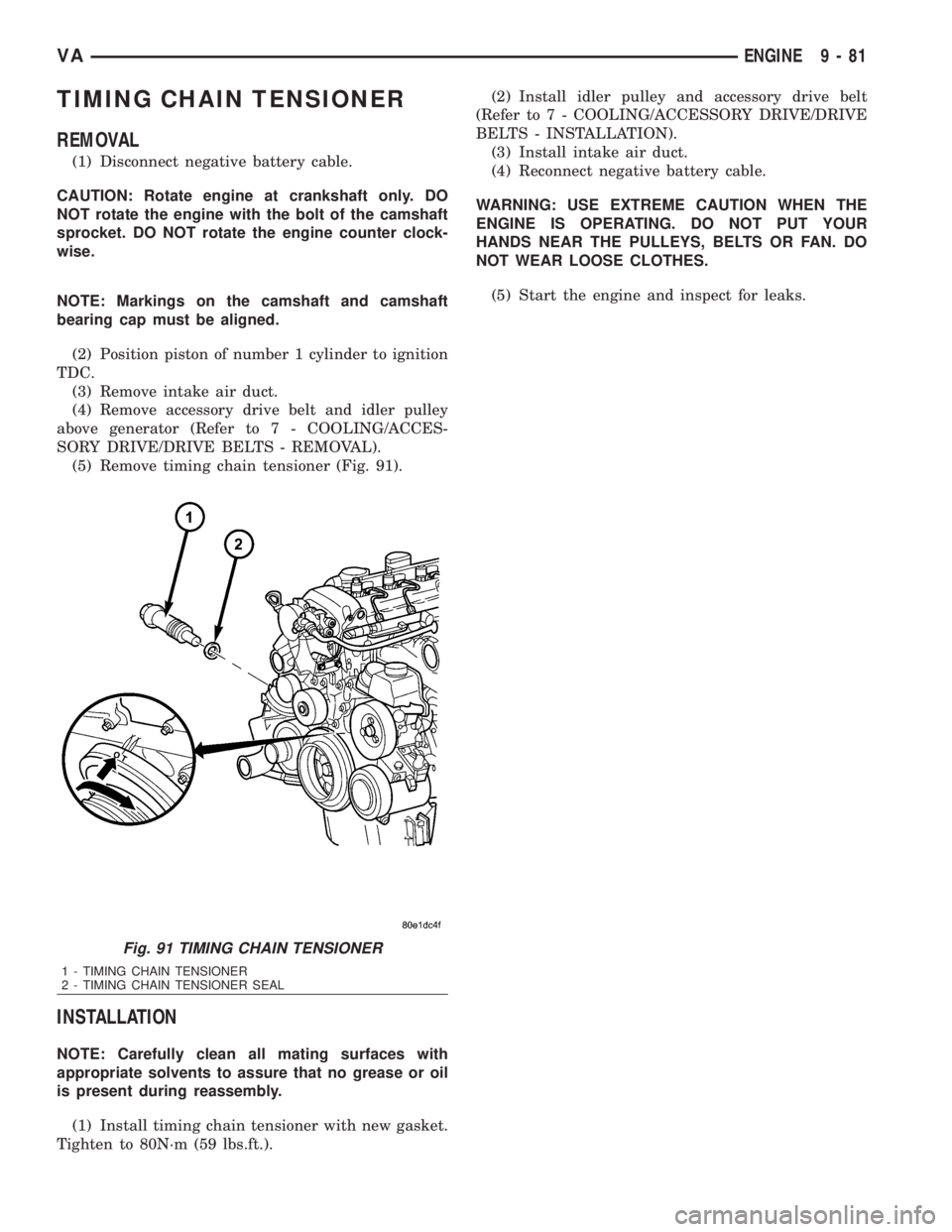
TIMING CHAIN TENSIONER
REMOVAL
(1) Disconnect negative battery cable.
CAUTION: Rotate engine at crankshaft only. DO
NOT rotate the engine with the bolt of the camshaft
sprocket. DO NOT rotate the engine counter clock-
wise.
NOTE: Markings on the camshaft and camshaft
bearing cap must be aligned.
(2) Position piston of number 1 cylinder to ignition
TDC.
(3) Remove intake air duct.
(4) Remove accessory drive belt and idler pulley
above generator (Refer to 7 - COOLING/ACCES-
SORY DRIVE/DRIVE BELTS - REMOVAL).
(5) Remove timing chain tensioner (Fig. 91).
INSTALLATION
NOTE: Carefully clean all mating surfaces with
appropriate solvents to assure that no grease or oil
is present during reassembly.
(1) Install timing chain tensioner with new gasket.
Tighten to 80N´m (59 lbs.ft.).(2) Install idler pulley and accessory drive belt
(Refer to 7 - COOLING/ACCESSORY DRIVE/DRIVE
BELTS - INSTALLATION).
(3) Install intake air duct.
(4) Reconnect negative battery cable.
WARNING: USE EXTREME CAUTION WHEN THE
ENGINE IS OPERATING. DO NOT PUT YOUR
HANDS NEAR THE PULLEYS, BELTS OR FAN. DO
NOT WEAR LOOSE CLOTHES.
(5) Start the engine and inspect for leaks.
Fig. 91 TIMING CHAIN TENSIONER
1 - TIMING CHAIN TENSIONER
2 - TIMING CHAIN TENSIONER SEAL
VAENGINE 9 - 81
Page 1664 of 2305
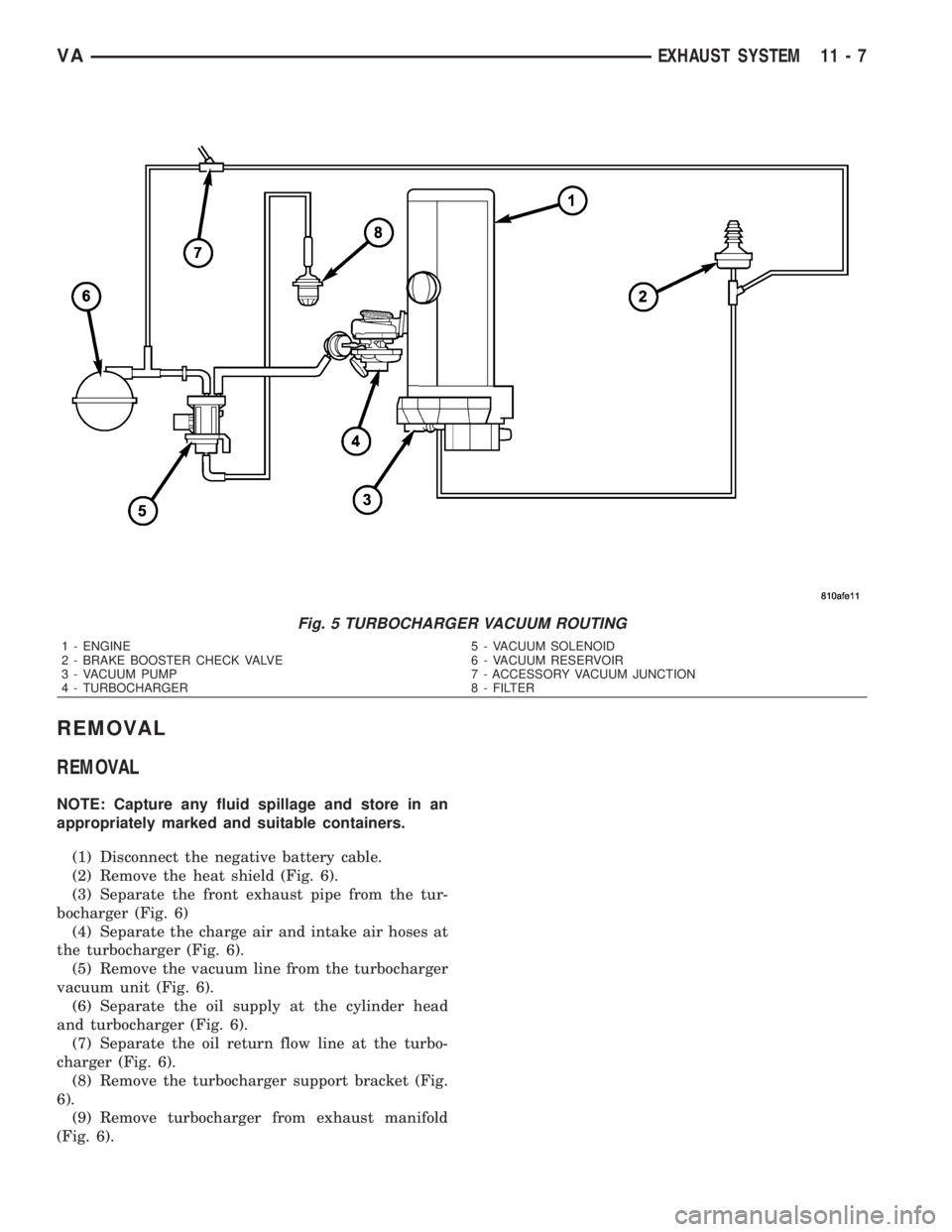
REMOVAL
REMOVAL
NOTE: Capture any fluid spillage and store in an
appropriately marked and suitable containers.
(1) Disconnect the negative battery cable.
(2) Remove the heat shield (Fig. 6).
(3) Separate the front exhaust pipe from the tur-
bocharger (Fig. 6)
(4) Separate the charge air and intake air hoses at
the turbocharger (Fig. 6).
(5) Remove the vacuum line from the turbocharger
vacuum unit (Fig. 6).
(6) Separate the oil supply at the cylinder head
and turbocharger (Fig. 6).
(7) Separate the oil return flow line at the turbo-
charger (Fig. 6).
(8) Remove the turbocharger support bracket (Fig.
6).
(9) Remove turbocharger from exhaust manifold
(Fig. 6).
Fig. 5 TURBOCHARGER VACUUM ROUTING
1 - ENGINE 5 - VACUUM SOLENOID
2 - BRAKE BOOSTER CHECK VALVE 6 - VACUUM RESERVOIR
3 - VACUUM PUMP 7 - ACCESSORY VACUUM JUNCTION
4 - TURBOCHARGER 8 - FILTER
VAEXHAUST SYSTEM 11 - 7
Page 1665 of 2305
REMOVAL - VACUUM TRANSDUCER
(1) Disconnect the negative battery cable.
(2) Remove the air cleaner housing (Refer to 9 -
ENGINE/AIR INTAKE SYSTEM/AIR CLEANER
HOUSING - REMOVAL).
(3) Disconnect the electrical connector.
(4) Disconnect the vacuum hoses.
(5) Remove the vacuum transducer retaining bolts
and remove vacuum transducer.
INSTALLATION
INSTALLATION
(1) Clean all mating surfaces
(2) Install turbocharger to exhaust manifold.
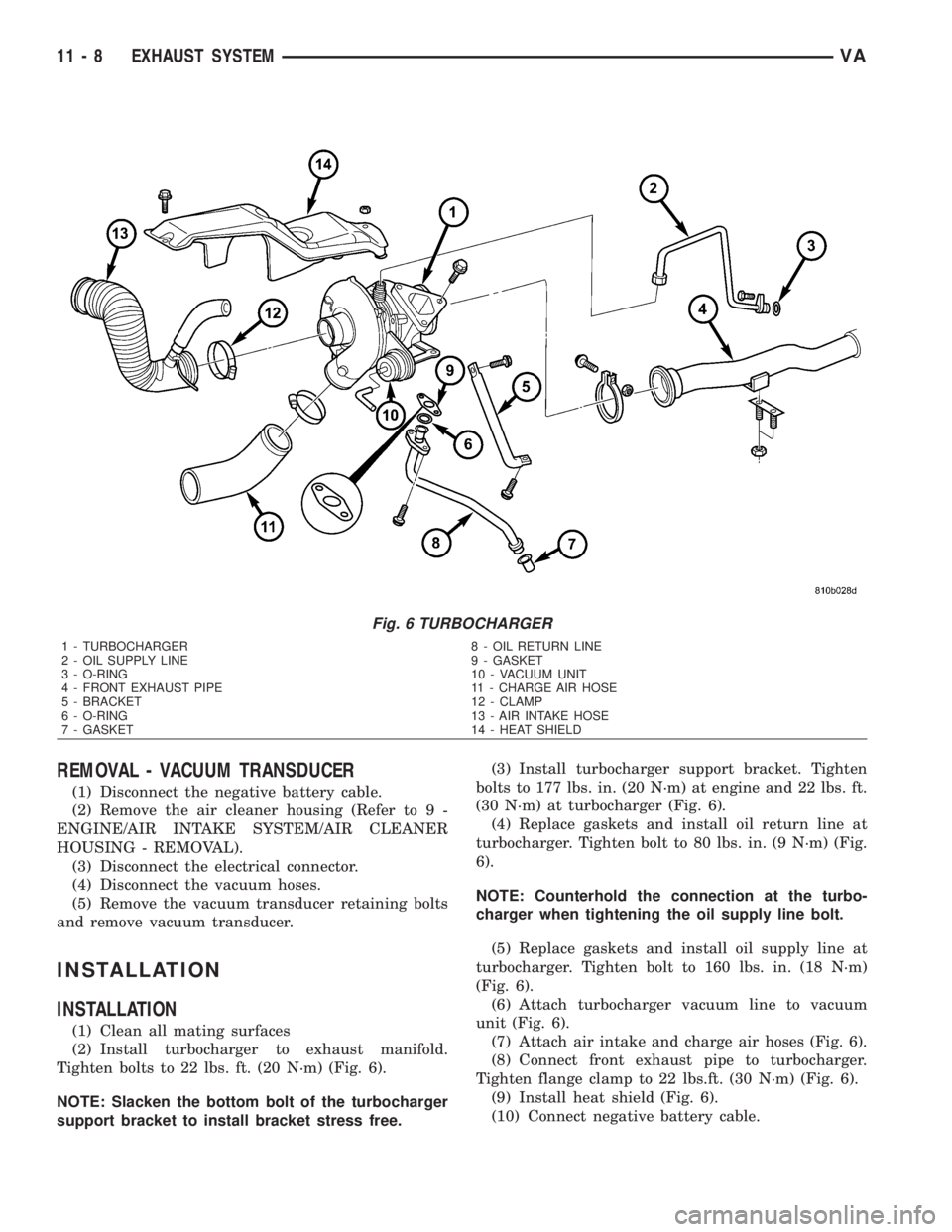
Tighten bolts to 22 lbs. ft. (20 N´m) (Fig. 6).
NOTE: Slacken the bottom bolt of the turbocharger
support bracket to install bracket stress free.(3) Install turbocharger support bracket. Tighten
bolts to 177 lbs. in. (20 N´m) at engine and 22 lbs. ft.
(30 N´m) at turbocharger (Fig. 6).
(4) Replace gaskets and install oil return line at
turbocharger. Tighten bolt to 80 lbs. in. (9 N´m) (Fig.
6).
NOTE: Counterhold the connection at the turbo-
charger when tightening the oil supply line bolt.
(5) Replace gaskets and install oil supply line at
turbocharger. Tighten bolt to 160 lbs. in. (18 N´m)
(Fig. 6).
(6) Attach turbocharger vacuum line to vacuum
unit (Fig. 6).
(7) Attach air intake and charge air hoses (Fig. 6).
(8) Connect front exhaust pipe to turbocharger.
Tighten flange clamp to 22 lbs.ft. (30 N´m) (Fig. 6).
(9) Install heat shield (Fig. 6).
(10) Connect negative battery cable.
Fig. 6 TURBOCHARGER
1 - TURBOCHARGER 8 - OIL RETURN LINE
2 - OIL SUPPLY LINE 9 - GASKET
3 - O-RING 10 - VACUUM UNIT
4 - FRONT EXHAUST PIPE 11 - CHARGE AIR HOSE
5 - BRACKET 12 - CLAMP
6 - O-RING 13 - AIR INTAKE HOSE
7 - GASKET 14 - HEAT SHIELD
11 - 8 EXHAUST SYSTEMVA
Page 1666 of 2305
INSTALLATION - VACUUM TRANSDUCER
(1) Position vacuum transducer and install the
retaining bolts. Tighten bolts to 70 lbs.in (8 N´m).
(2) Connect vacuum hoses.
(3) Connect electrical connector
(4) Install air cleaner housing (Refer to 9 -
ENGINE/AIR INTAKE SYSTEM/AIR CLEANER
HOUSING - INSTALLATION)
(5) Connect negative battery cable.
VAEXHAUST SYSTEM 11 - 9
Page 1678 of 2305
(18) Install calipers. (Refer to 5 - BRAKES/HY-
DRAULIC/MECHANICAL/DISC BRAKE CALIPERS
- INSTALLATION)
(19) Install new tie straps holding wheel speed
sensors and brake pad wear sensors wire harness to
cradle.
(20) Check and align vehicle to specifications.
(Refer to 2 - SUSPENSION/WHEEL ALIGNMENT -
STANDARD PROCEDURE)
REAR CROSSMEMBER -
TRANSMISSION
REMOVAL
(1) Raise and support the vehicle. (Refer to
LUBRICATION & MAINTENANCE/HOISTING -
STANDARD PROCEDURE)
(2) Support transmission with a suitable lifting
device.
(3) Remove the bolts/nuts and remove transmis-
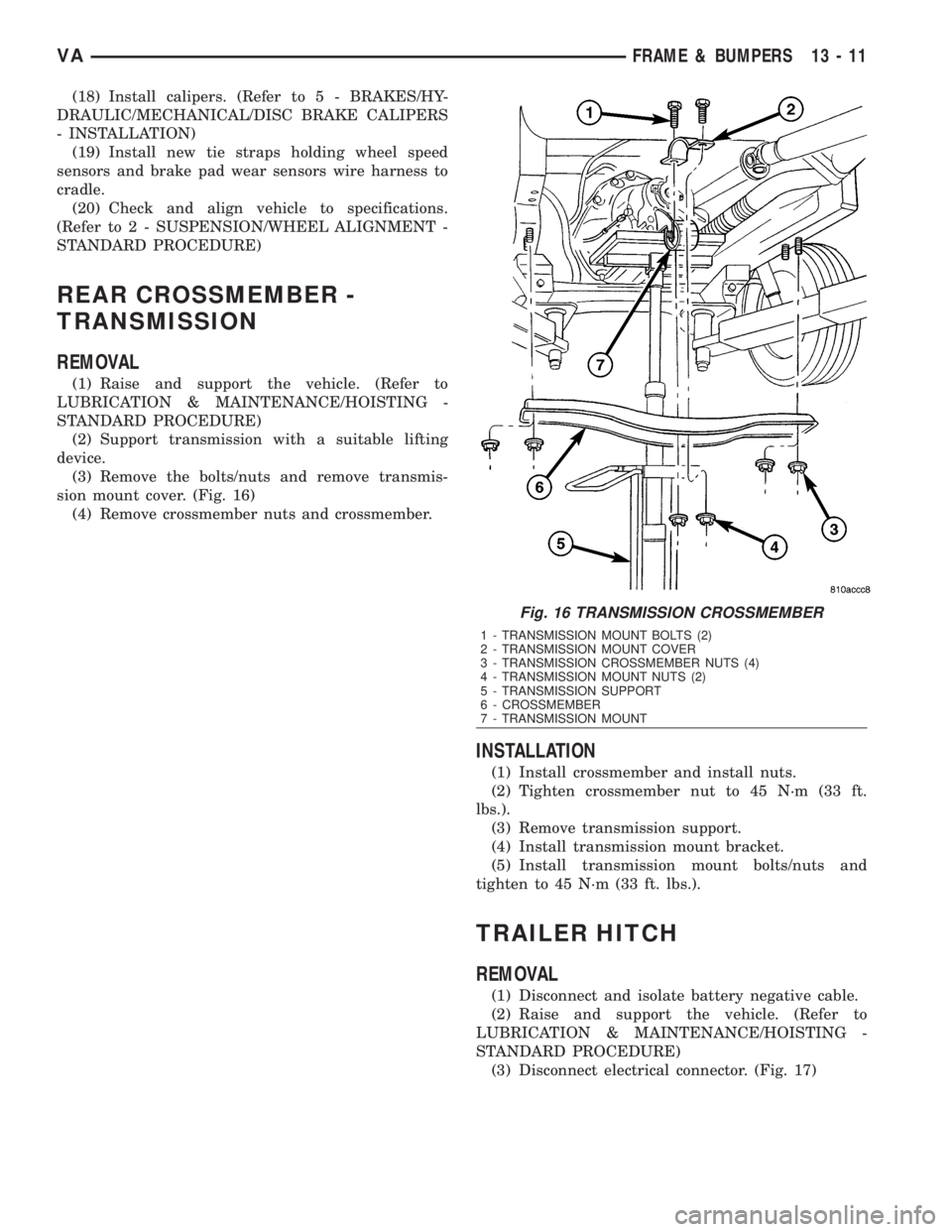
sion mount cover. (Fig. 16)
(4) Remove crossmember nuts and crossmember.
INSTALLATION
(1) Install crossmember and install nuts.
(2) Tighten crossmember nut to 45 N´m (33 ft.
lbs.).
(3) Remove transmission support.
(4) Install transmission mount bracket.
(5) Install transmission mount bolts/nuts and
tighten to 45 N´m (33 ft. lbs.).
TRAILER HITCH
REMOVAL
(1) Disconnect and isolate battery negative cable.
(2) Raise and support the vehicle. (Refer to
LUBRICATION & MAINTENANCE/HOISTING -
STANDARD PROCEDURE)
(3) Disconnect electrical connector. (Fig. 17)
Fig. 16 TRANSMISSION CROSSMEMBER
1 - TRANSMISSION MOUNT BOLTS (2)
2 - TRANSMISSION MOUNT COVER
3 - TRANSMISSION CROSSMEMBER NUTS (4)
4 - TRANSMISSION MOUNT NUTS (2)
5 - TRANSMISSION SUPPORT
6 - CROSSMEMBER
7 - TRANSMISSION MOUNT
VAFRAME & BUMPERS 13 - 11
Page 1685 of 2305
STANDARD PROCEDURE - LOW PRESSURE
FUEL PUMP TEST
NOTE: Assure fuel tank quantity and proper fuel
gauge operation. Assure that the fuel pump fuse or
relay is not open. Capture any fuel spillage and
store in appropriately marked containers.
NOTE: When the ignition switch is turned to the ON
position the fuel pump will begin to run for 20±30
seconds and then it stops.
The low pressure pump draws fuel out of the fuel
tank module and pushes the fuel towards the fuel fil-
ter. If the pressure reading is below specification,
look for damaged or leaking fuel lines or a restricted
fuel filter. If no problem is found with the fuel sys-
tem replace the low pressure fuel pump.
(1) Disconnect the negative battery cable.
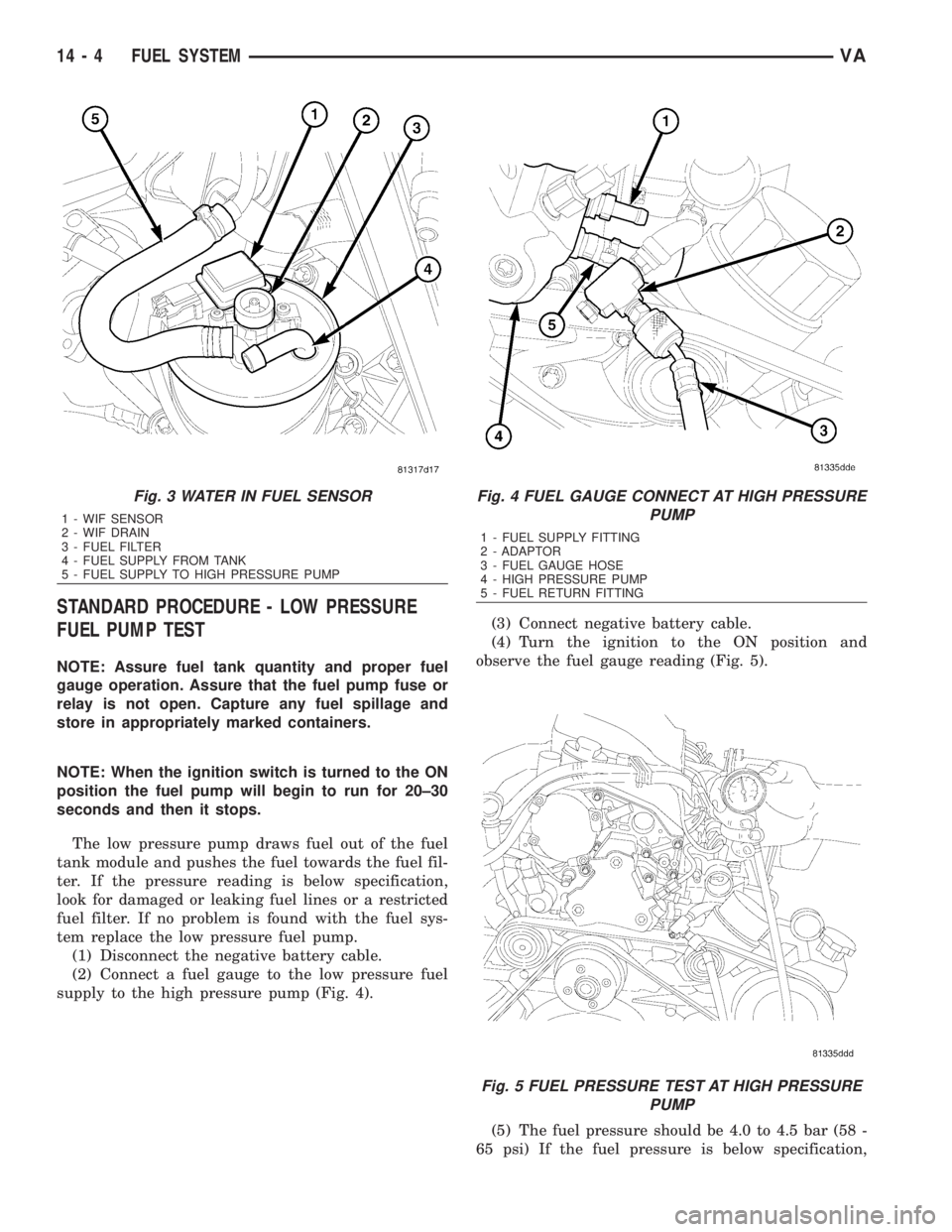
(2) Connect a fuel gauge to the low pressure fuel
supply to the high pressure pump (Fig. 4).(3) Connect negative battery cable.
(4) Turn the ignition to the ON position and
observe the fuel gauge reading (Fig. 5).
(5) The fuel pressure should be 4.0 to 4.5 bar (58 -
65 psi) If the fuel pressure is below specification,
Fig. 3 WATER IN FUEL SENSOR
1 - WIF SENSOR
2 - WIF DRAIN
3 - FUEL FILTER
4 - FUEL SUPPLY FROM TANK
5 - FUEL SUPPLY TO HIGH PRESSURE PUMP
Fig. 4 FUEL GAUGE CONNECT AT HIGH PRESSURE
PUMP
1 - FUEL SUPPLY FITTING
2 - ADAPTOR
3 - FUEL GAUGE HOSE
4 - HIGH PRESSURE PUMP
5 - FUEL RETURN FITTING
Fig. 5 FUEL PRESSURE TEST AT HIGH PRESSURE
PUMP
14 - 4 FUEL SYSTEMVA