AUX MERCEDES-BENZ SPRINTER 2006 Workshop Manual
[x] Cancel search | Manufacturer: MERCEDES-BENZ, Model Year: 2006, Model line: SPRINTER, Model: MERCEDES-BENZ SPRINTER 2006Pages: 2305, PDF Size: 48.12 MB
Page 1504 of 2305
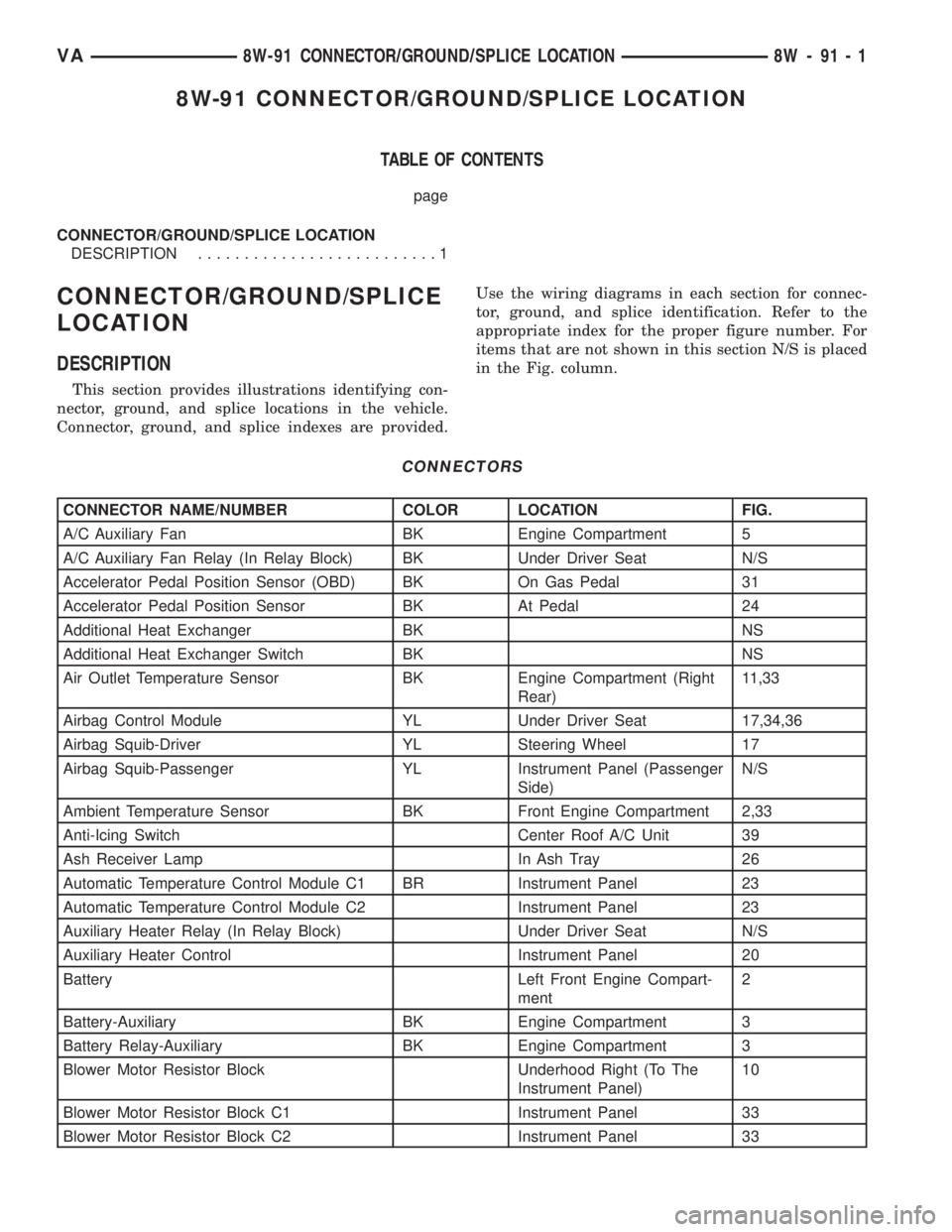
8W-91 CONNECTOR/GROUND/SPLICE LOCATION
TABLE OF CONTENTS
page
CONNECTOR/GROUND/SPLICE LOCATION
DESCRIPTION..........................1
CONNECTOR/GROUND/SPLICE
LOCATION
DESCRIPTION
This section provides illustrations identifying con-
nector, ground, and splice locations in the vehicle.
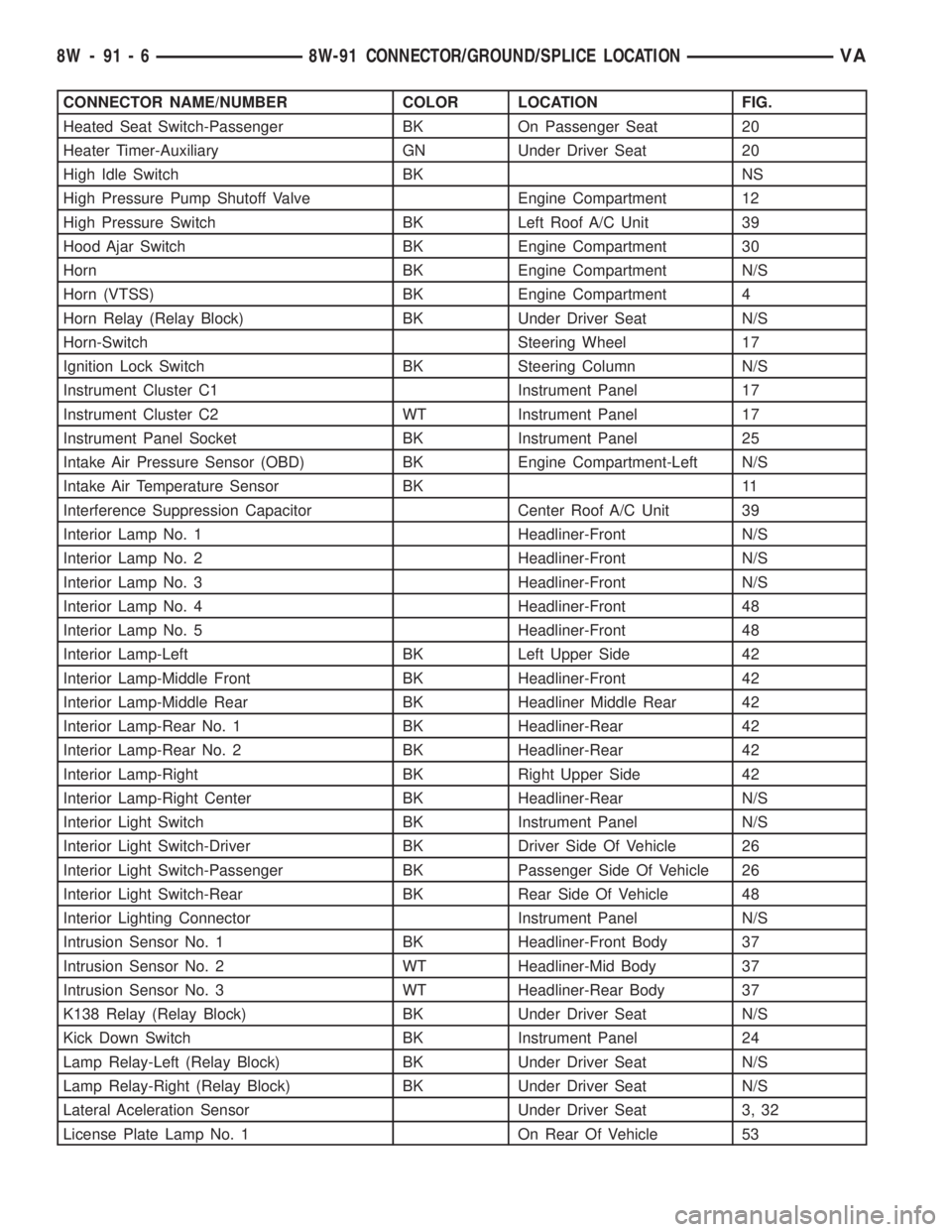
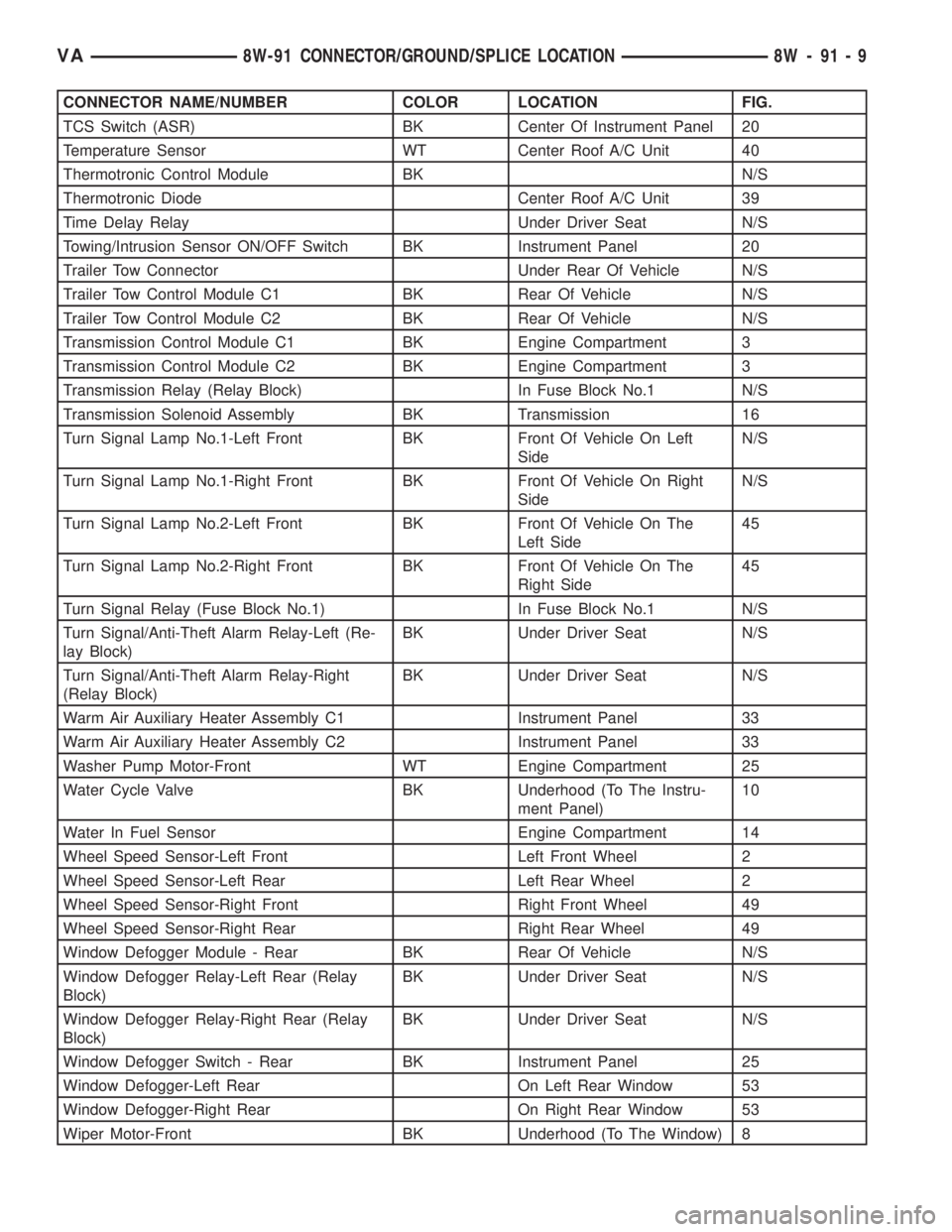
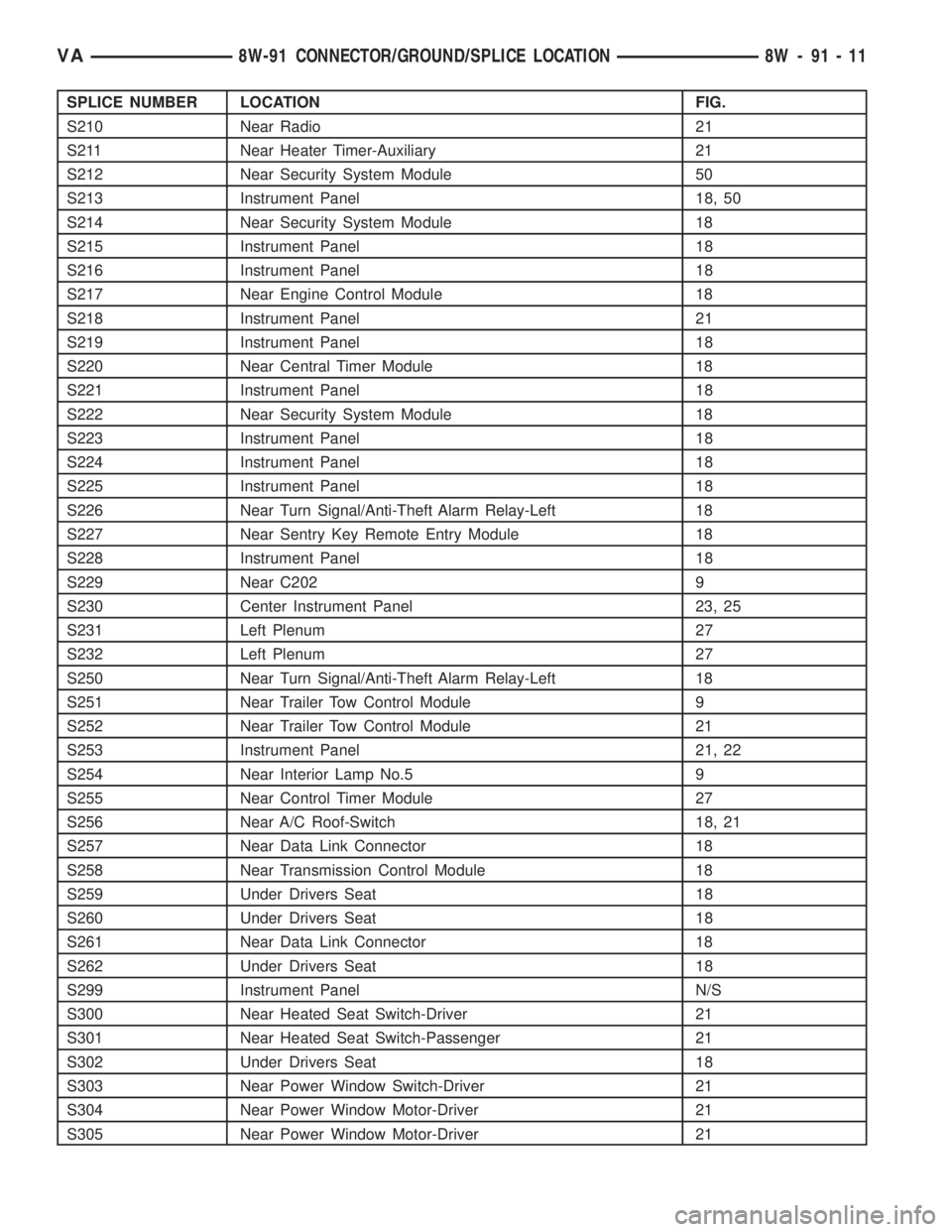
Connector, ground, and splice indexes are provided.Use the wiring diagrams in each section for connec-
tor, ground, and splice identification. Refer to the
appropriate index for the proper figure number. For
items that are not shown in this section N/S is placed
in the Fig. column.
CONNECTORS
CONNECTOR NAME/NUMBER COLOR LOCATION FIG.
A/C Auxiliary Fan BK Engine Compartment 5
A/C Auxiliary Fan Relay (In Relay Block) BK Under Driver Seat N/S
Accelerator Pedal Position Sensor (OBD) BK On Gas Pedal 31
Accelerator Pedal Position Sensor BK At Pedal 24
Additional Heat Exchanger BK NS
Additional Heat Exchanger Switch BK NS
Air Outlet Temperature Sensor BK Engine Compartment (Right
Rear)11,33
Airbag Control Module YL Under Driver Seat 17,34,36
Airbag Squib-Driver YL Steering Wheel 17
Airbag Squib-Passenger YL Instrument Panel (Passenger
Side)N/S
Ambient Temperature Sensor BK Front Engine Compartment 2,33
Anti-Icing Switch Center Roof A/C Unit 39
Ash Receiver Lamp In Ash Tray 26
Automatic Temperature Control Module C1 BR Instrument Panel 23
Automatic Temperature Control Module C2 Instrument Panel 23
Auxiliary Heater Relay (In Relay Block) Under Driver Seat N/S
Auxiliary Heater Control Instrument Panel 20
Battery Left Front Engine Compart-
ment2
Battery-Auxiliary BK Engine Compartment 3
Battery Relay-Auxiliary BK Engine Compartment 3
Blower Motor Resistor Block Underhood Right (To The
Instrument Panel)10
Blower Motor Resistor Block C1 Instrument Panel 33
Blower Motor Resistor Block C2 Instrument Panel 33
VA8W-91 CONNECTOR/GROUND/SPLICE LOCATION 8W - 91 - 1
Page 1509 of 2305
CONNECTOR NAME/NUMBER COLOR LOCATION FIG.
Heated Seat Switch-Passenger BK On Passenger Seat 20
Heater Timer-Auxiliary GN Under Driver Seat 20
High Idle Switch BK NS
High Pressure Pump Shutoff Valve Engine Compartment 12
High Pressure Switch BK Left Roof A/C Unit 39
Hood Ajar Switch BK Engine Compartment 30
Horn BK Engine Compartment N/S
Horn (VTSS) BK Engine Compartment 4
Horn Relay (Relay Block) BK Under Driver Seat N/S
Horn-Switch Steering Wheel 17
Ignition Lock Switch BK Steering Column N/S
Instrument Cluster C1 Instrument Panel 17
Instrument Cluster C2 WT Instrument Panel 17
Instrument Panel Socket BK Instrument Panel 25
Intake Air Pressure Sensor (OBD) BK Engine Compartment-Left N/S
Intake Air Temperature Sensor BK 11
Interference Suppression Capacitor Center Roof A/C Unit 39
Interior Lamp No. 1 Headliner-Front N/S
Interior Lamp No. 2 Headliner-Front N/S
Interior Lamp No. 3 Headliner-Front N/S
Interior Lamp No. 4 Headliner-Front 48
Interior Lamp No. 5 Headliner-Front 48
Interior Lamp-Left BK Left Upper Side 42
Interior Lamp-Middle Front BK Headliner-Front 42
Interior Lamp-Middle Rear BK Headliner Middle Rear 42
Interior Lamp-Rear No. 1 BK Headliner-Rear 42
Interior Lamp-Rear No. 2 BK Headliner-Rear 42
Interior Lamp-Right BK Right Upper Side 42
Interior Lamp-Right Center BK Headliner-Rear N/S
Interior Light Switch BK Instrument Panel N/S
Interior Light Switch-Driver BK Driver Side Of Vehicle 26
Interior Light Switch-Passenger BK Passenger Side Of Vehicle 26
Interior Light Switch-Rear BK Rear Side Of Vehicle 48
Interior Lighting Connector Instrument Panel N/S
Intrusion Sensor No. 1 BK Headliner-Front Body 37
Intrusion Sensor No. 2 WT Headliner-Mid Body 37
Intrusion Sensor No. 3 WT Headliner-Rear Body 37
K138 Relay (Relay Block) BK Under Driver Seat N/S
Kick Down Switch BK Instrument Panel 24
Lamp Relay-Left (Relay Block) BK Under Driver Seat N/S
Lamp Relay-Right (Relay Block) BK Under Driver Seat N/S
Lateral Aceleration Sensor Under Driver Seat 3, 32
License Plate Lamp No. 1 On Rear Of Vehicle 53
8W - 91 - 6 8W-91 CONNECTOR/GROUND/SPLICE LOCATIONVA
Page 1512 of 2305
CONNECTOR NAME/NUMBER COLOR LOCATION FIG.
TCS Switch (ASR) BK Center Of Instrument Panel 20
Temperature Sensor WT Center Roof A/C Unit 40
Thermotronic Control Module BK N/S
Thermotronic Diode Center Roof A/C Unit 39
Time Delay Relay Under Driver Seat N/S
Towing/Intrusion Sensor ON/OFF Switch BK Instrument Panel 20
Trailer Tow Connector Under Rear Of Vehicle N/S
Trailer Tow Control Module C1 BK Rear Of Vehicle N/S
Trailer Tow Control Module C2 BK Rear Of Vehicle N/S
Transmission Control Module C1 BK Engine Compartment 3
Transmission Control Module C2 BK Engine Compartment 3
Transmission Relay (Relay Block) In Fuse Block No.1 N/S
Transmission Solenoid Assembly BK Transmission 16
Turn Signal Lamp No.1-Left Front BK Front Of Vehicle On Left
SideN/S
Turn Signal Lamp No.1-Right Front BK Front Of Vehicle On Right
SideN/S
Turn Signal Lamp No.2-Left Front BK Front Of Vehicle On The
Left Side45
Turn Signal Lamp No.2-Right Front BK Front Of Vehicle On The
Right Side45
Turn Signal Relay (Fuse Block No.1) In Fuse Block No.1 N/S
Turn Signal/Anti-Theft Alarm Relay-Left (Re-
lay Block)BK Under Driver Seat N/S
Turn Signal/Anti-Theft Alarm Relay-Right
(Relay Block)BK Under Driver Seat N/S
Warm Air Auxiliary Heater Assembly C1 Instrument Panel 33
Warm Air Auxiliary Heater Assembly C2 Instrument Panel 33
Washer Pump Motor-Front WT Engine Compartment 25
Water Cycle Valve BK Underhood (To The Instru-
ment Panel)10
Water In Fuel Sensor Engine Compartment 14
Wheel Speed Sensor-Left Front Left Front Wheel 2
Wheel Speed Sensor-Left Rear Left Rear Wheel 2
Wheel Speed Sensor-Right Front Right Front Wheel 49
Wheel Speed Sensor-Right Rear Right Rear Wheel 49
Window Defogger Module - Rear BK Rear Of Vehicle N/S
Window Defogger Relay-Left Rear (Relay
Block)BK Under Driver Seat N/S
Window Defogger Relay-Right Rear (Relay
Block)BK Under Driver Seat N/S
Window Defogger Switch - Rear BK Instrument Panel 25
Window Defogger-Left Rear On Left Rear Window 53
Window Defogger-Right Rear On Right Rear Window 53
Wiper Motor-Front BK Underhood (To The Window) 8
VA8W-91 CONNECTOR/GROUND/SPLICE LOCATION 8W - 91 - 9
Page 1514 of 2305
SPLICE NUMBER LOCATION FIG.
S210 Near Radio 21
S211 Near Heater Timer-Auxiliary 21
S212 Near Security System Module 50
S213 Instrument Panel 18, 50
S214 Near Security System Module 18
S215 Instrument Panel 18
S216 Instrument Panel 18
S217 Near Engine Control Module 18
S218 Instrument Panel 21
S219 Instrument Panel 18
S220 Near Central Timer Module 18
S221 Instrument Panel 18
S222 Near Security System Module 18
S223 Instrument Panel 18
S224 Instrument Panel 18
S225 Instrument Panel 18
S226 Near Turn Signal/Anti-Theft Alarm Relay-Left 18
S227 Near Sentry Key Remote Entry Module 18
S228 Instrument Panel 18
S229 Near C202 9
S230 Center Instrument Panel 23, 25
S231 Left Plenum 27
S232 Left Plenum 27
S250 Near Turn Signal/Anti-Theft Alarm Relay-Left 18
S251 Near Trailer Tow Control Module 9
S252 Near Trailer Tow Control Module 21
S253 Instrument Panel 21, 22
S254 Near Interior Lamp No.5 9
S255 Near Control Timer Module 27
S256 Near A/C Roof-Switch 18, 21
S257 Near Data Link Connector 18
S258 Near Transmission Control Module 18
S259 Under Drivers Seat 18
S260 Under Drivers Seat 18
S261 Near Data Link Connector 18
S262 Under Drivers Seat 18
S299 Instrument Panel N/S
S300 Near Heated Seat Switch-Driver 21
S301 Near Heated Seat Switch-Passenger 21
S302 Under Drivers Seat 18
S303 Near Power Window Switch-Driver 21
S304 Near Power Window Motor-Driver 21
S305 Near Power Window Motor-Driver 21
VA8W-91 CONNECTOR/GROUND/SPLICE LOCATION 8W - 91 - 11
Page 1875 of 2305
CAUSES OF BURNT FLUID
Burnt, discolored fluid is a result of overheating
which has three primary causes.
1. Internal clutch slippage, usually caused by low
line pressure, inadequate clutch apply pressure, or
clutch seal failure.
2. A result of restricted fluid flow through the
main and/or auxiliary cooler. This condition is usu-
ally the result of a faulty or improperly installed
drainback valve, a damaged oil cooler, or severe
restrictions in the coolers and lines caused by debris
or kinked lines.
3. Heavy duty operation with a vehicle not prop-
erly equipped for this type of operation. Trailer tow-
ing or similar high load operation will overheat the
transmission fluid if the vehicle is improperly
equipped. Such vehicles should have an auxiliary
transmission fluid cooler, a heavy duty cooling sys-
tem, and the engine/axle ratio combination needed to
handle heavy loads.
FLUID CONTAMINATION
Transmission fluid contamination is generally a
result of:
²adding incorrect fluid
²failure to clean dipstick and fill tube when
checking level
²engine coolant entering the fluid
²internal failure that generates debris
²overheat that generates sludge (fluid break-
down)
²failure to replace contaminated converter after
repair
The use of non-recommended fluids can result in
transmission failure. The usual results are erratic
shifts, slippage, abnormal wear and eventual failure
due to fluid breakdown and sludge formation. Avoid
this condition by using recommended fluids only.
The dipstick cap and fill tube should be wiped
clean before checking fluid level. Dirt, grease and
other foreign material on the cap and tube could fall
into the tube if not removed beforehand. Take the
time to wipe the cap and tube clean before withdraw-
ing the dipstick.
Engine coolant in the transmission fluid is gener-
ally caused by a cooler malfunction. The only remedy
is to replace the radiator as the cooler in the radiator
is not a serviceable part. If coolant has circulated
through the transmission, an overhaul is necessary.
The torque converter should be replaced whenever
a failure generates sludge and debris. This is neces-
sary because normal converter flushing procedures
will not remove all contaminants.
STANDARD PROCEDURE
CHECK OIL LEVEL
(1) Verify that the vehicle is parked on a level sur-
face.
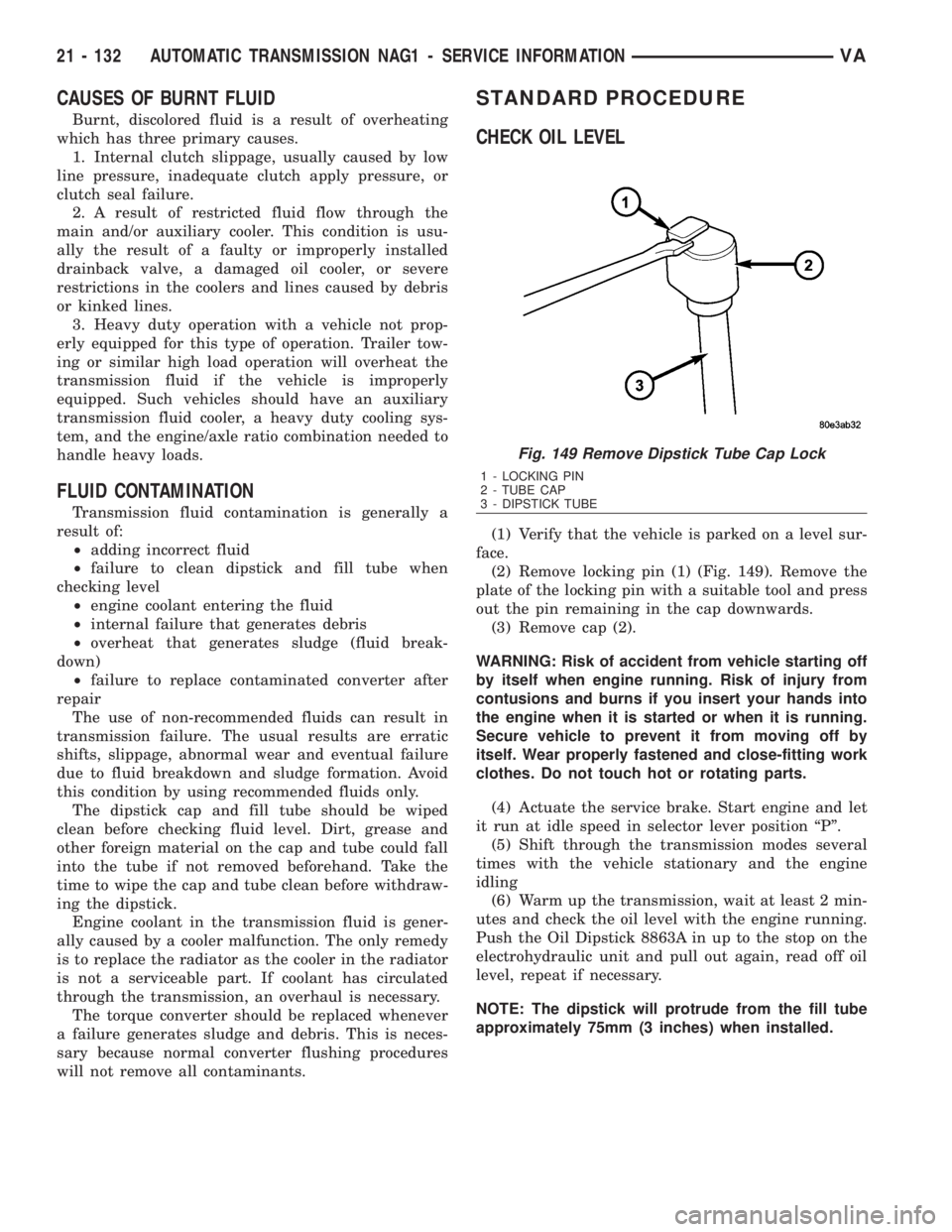
(2) Remove locking pin (1) (Fig. 149). Remove the
plate of the locking pin with a suitable tool and press
out the pin remaining in the cap downwards.
(3) Remove cap (2).
WARNING: Risk of accident from vehicle starting off
by itself when engine running. Risk of injury from
contusions and burns if you insert your hands into
the engine when it is started or when it is running.
Secure vehicle to prevent it from moving off by
itself. Wear properly fastened and close-fitting work
clothes. Do not touch hot or rotating parts.
(4) Actuate the service brake. Start engine and let
it run at idle speed in selector lever position ªPº.
(5) Shift through the transmission modes several
times with the vehicle stationary and the engine
idling
(6) Warm up the transmission, wait at least 2 min-
utes and check the oil level with the engine running.
Push the Oil Dipstick 8863A in up to the stop on the
electrohydraulic unit and pull out again, read off oil
level, repeat if necessary.
NOTE: The dipstick will protrude from the fill tube
approximately 75mm (3 inches) when installed.
Fig. 149 Remove Dipstick Tube Cap Lock
1 - LOCKING PIN
2 - TUBE CAP
3 - DIPSTICK TUBE
21 - 132 AUTOMATIC TRANSMISSION NAG1 - SERVICE INFORMATIONVA
Page 2051 of 2305
(5) Install the two A/C-heater control retaining
screws. Tighten the screws to 2 N´m (17 in. lbs.).
(6) Install the center bezel onto the instrument
panel (Refer to 23 - BODY/INSTRUMENT PANEL/
INSTRUMENT PANEL CENTER BEZEL - INSTAL-
LATION).
(7) Reconnect the negative battery cable.
A / C PRESSURE TRANS-
DUCER
DESCRIPTION
The A/C pressure transducer is installed on the liq-
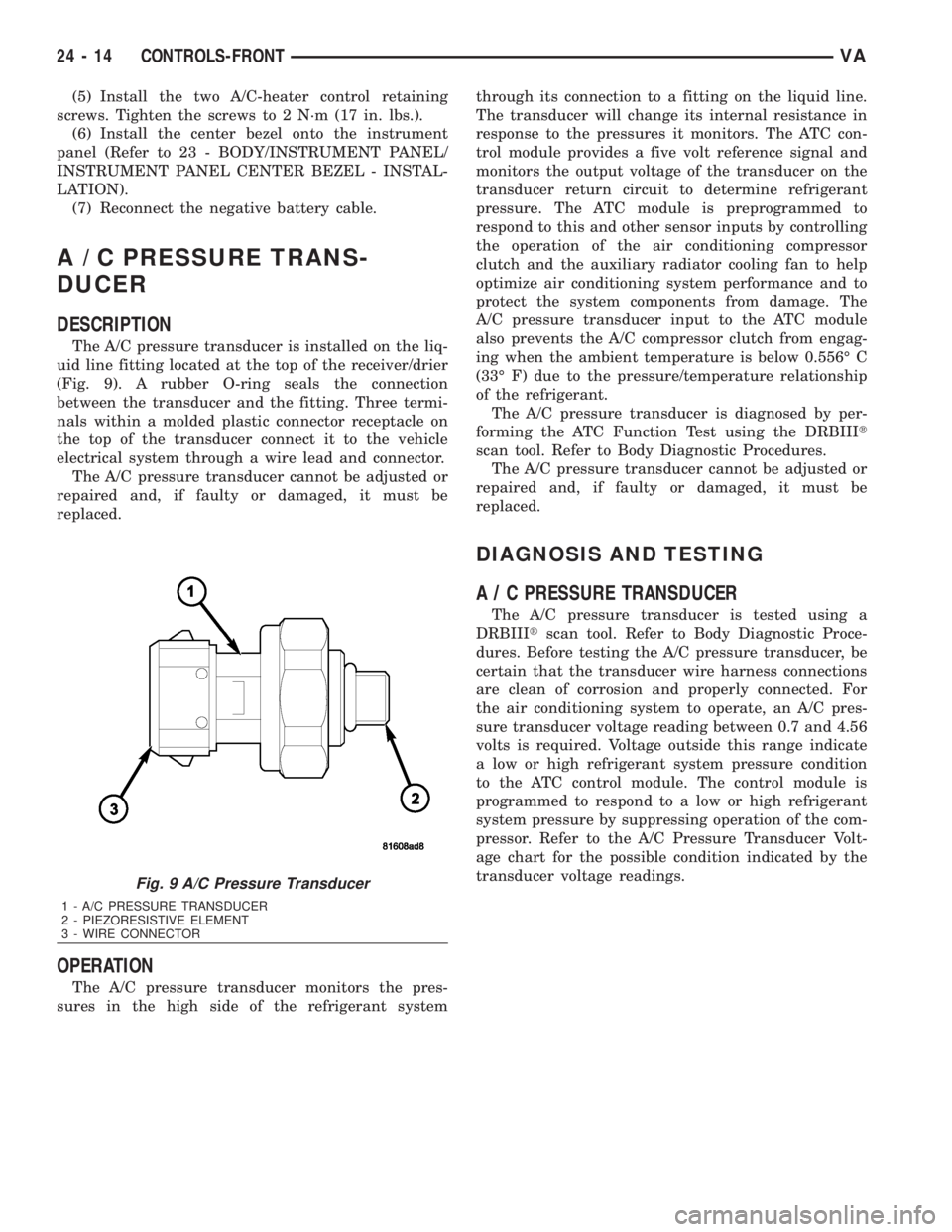
uid line fitting located at the top of the receiver/drier
(Fig. 9). A rubber O-ring seals the connection
between the transducer and the fitting. Three termi-
nals within a molded plastic connector receptacle on
the top of the transducer connect it to the vehicle
electrical system through a wire lead and connector.
The A/C pressure transducer cannot be adjusted or
repaired and, if faulty or damaged, it must be
replaced.
OPERATION
The A/C pressure transducer monitors the pres-
sures in the high side of the refrigerant systemthrough its connection to a fitting on the liquid line.
The transducer will change its internal resistance in
response to the pressures it monitors. The ATC con-
trol module provides a five volt reference signal and
monitors the output voltage of the transducer on the
transducer return circuit to determine refrigerant
pressure. The ATC module is preprogrammed to
respond to this and other sensor inputs by controlling
the operation of the air conditioning compressor
clutch and the auxiliary radiator cooling fan to help
optimize air conditioning system performance and to
protect the system components from damage. The
A/C pressure transducer input to the ATC module
also prevents the A/C compressor clutch from engag-
ing when the ambient temperature is below 0.556É C
(33É F) due to the pressure/temperature relationship
of the refrigerant.
The A/C pressure transducer is diagnosed by per-
forming the ATC Function Test using the DRBIIIt
scan tool. Refer to Body Diagnostic Procedures.
The A/C pressure transducer cannot be adjusted or
repaired and, if faulty or damaged, it must be
replaced.
DIAGNOSIS AND TESTING
A / C PRESSURE TRANSDUCER
The A/C pressure transducer is tested using a
DRBIIItscan tool. Refer to Body Diagnostic Proce-
dures. Before testing the A/C pressure transducer, be
certain that the transducer wire harness connections
are clean of corrosion and properly connected. For
the air conditioning system to operate, an A/C pres-
sure transducer voltage reading between 0.7 and 4.56
volts is required. Voltage outside this range indicate
a low or high refrigerant system pressure condition
to the ATC control module. The control module is
programmed to respond to a low or high refrigerant
system pressure by suppressing operation of the com-
pressor. Refer to the A/C Pressure Transducer Volt-
age chart for the possible condition indicated by the
transducer voltage readings.
Fig. 9 A/C Pressure Transducer
1 - A/C PRESSURE TRANSDUCER
2 - PIEZORESISTIVE ELEMENT
3 - WIRE CONNECTOR
24 - 14 CONTROLS-FRONTVA
Page 2107 of 2305
there are no objects placed in front of the radiator
grille openings in the front of the vehicle or foreign
material on the condenser fins that might obstruct
proper air flow. Also, any factory-installed air seals or
shrouds must be properly reinstalled following radia-
tor or condenser service.
The condenser cannot be repaired and, if faulty or
damaged, it must be replaced.
REMOVAL
WARNING: Refer to the applicable warnings and
cautions for this system before performing the fol-
lowing operation (Refer to 24 - HEATING & AIR
CONDITIONING/PLUMBING - WARNINGS) and (Refer
to 24 - HEATING & AIR CONDITIONING/PLUMBING -
CAUTIONS). Failure to follow the warnings and cau-
tions could result in possible personal injury or
death.
(1) Disconnect and isolate the negative battery
cable.
(2) Recover the refrigerant from the refrigerant
system (Refer to 24 - HEATING & AIR CONDITION-
ING/PLUMBING - STANDARD PROCEDURE -
REFRIGERANT SYSTEM RECOVERY).
(3) Remove the front fascia.
(4) Remove the grille (Refer to 23 - BODY/EXTE-
RIOR/GRILLE - REMOVAL).
(5) Remove the headlamps from their mounts.
(6) Remove the radiator crossmember (Refer to 23
- BODY/EXTERIOR/RADIATOR CROSSMEMBER -
REMOVAL).
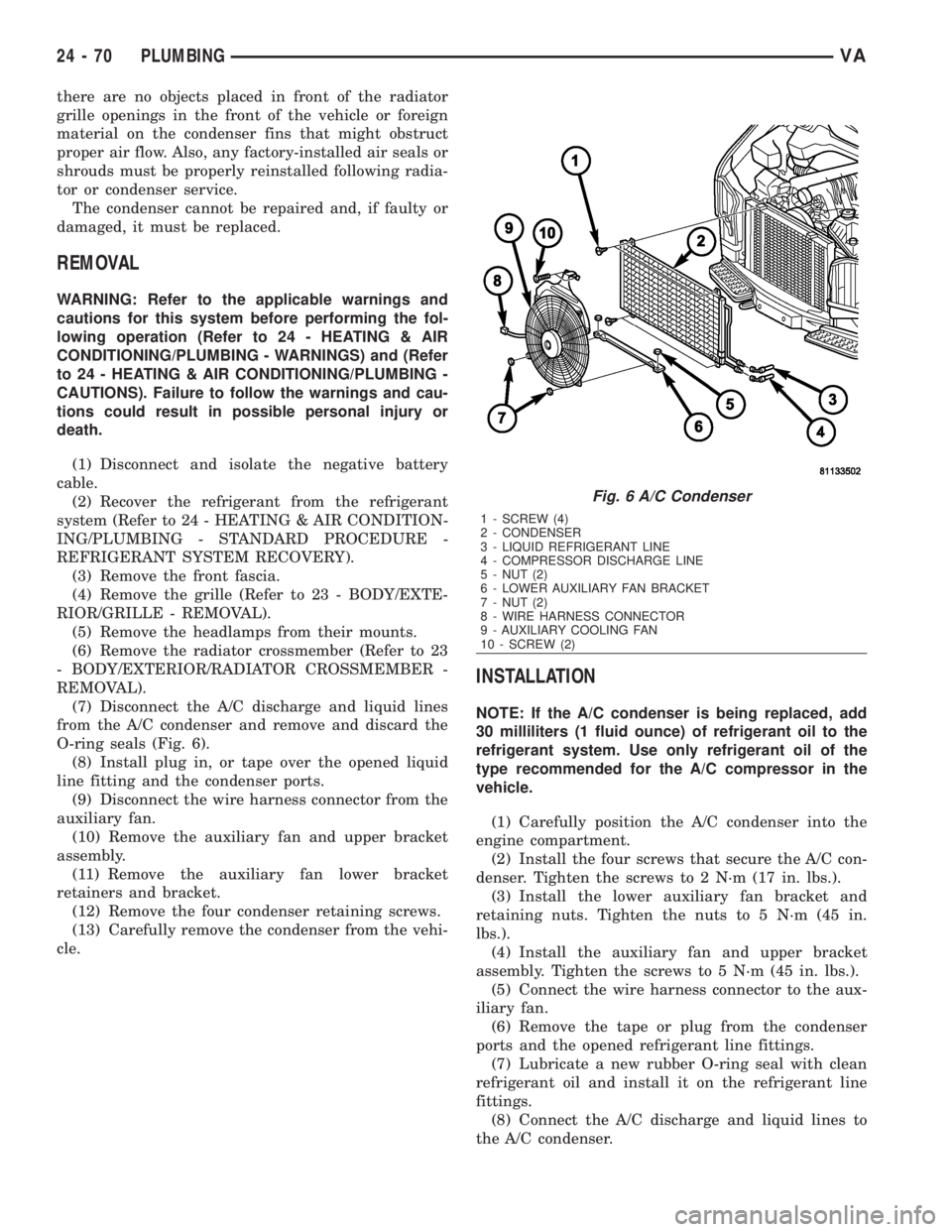
(7) Disconnect the A/C discharge and liquid lines
from the A/C condenser and remove and discard the
O-ring seals (Fig. 6).
(8) Install plug in, or tape over the opened liquid
line fitting and the condenser ports.
(9) Disconnect the wire harness connector from the
auxiliary fan.
(10) Remove the auxiliary fan and upper bracket
assembly.
(11) Remove the auxiliary fan lower bracket
retainers and bracket.
(12) Remove the four condenser retaining screws.
(13) Carefully remove the condenser from the vehi-
cle.
INSTALLATION
NOTE: If the A/C condenser is being replaced, add
30 milliliters (1 fluid ounce) of refrigerant oil to the
refrigerant system. Use only refrigerant oil of the
type recommended for the A/C compressor in the
vehicle.
(1) Carefully position the A/C condenser into the
engine compartment.
(2) Install the four screws that secure the A/C con-
denser. Tighten the screws to 2 N´m (17 in. lbs.).
(3) Install the lower auxiliary fan bracket and
retaining nuts. Tighten the nuts to 5 N´m (45 in.
lbs.).
(4) Install the auxiliary fan and upper bracket
assembly. Tighten the screws to 5 N´m (45 in. lbs.).
(5) Connect the wire harness connector to the aux-
iliary fan.
(6) Remove the tape or plug from the condenser
ports and the opened refrigerant line fittings.
(7) Lubricate a new rubber O-ring seal with clean
refrigerant oil and install it on the refrigerant line
fittings.
(8) Connect the A/C discharge and liquid lines to
the A/C condenser.
Fig. 6 A/C Condenser
1 - SCREW (4)
2 - CONDENSER
3 - LIQUID REFRIGERANT LINE
4 - COMPRESSOR DISCHARGE LINE
5 - NUT (2)
6 - LOWER AUXILIARY FAN BRACKET
7 - NUT (2)
8 - WIRE HARNESS CONNECTOR
9 - AUXILIARY COOLING FAN
10 - SCREW (2)
24 - 70 PLUMBINGVA