drain bolt MERCEDES-BENZ SPRINTER 2006 Workshop Manual
[x] Cancel search | Manufacturer: MERCEDES-BENZ, Model Year: 2006, Model line: SPRINTER, Model: MERCEDES-BENZ SPRINTER 2006Pages: 2305, PDF Size: 48.12 MB
Page 2112 of 2305
(4) Install the two bolts that secure the A/C expan-
sion valve to the evaporator tube tapping plate.
Tighten the bolts to 5 N´m (45 in. lbs.).
(5) Remove the tape or plugs from the liquid and
suction line fittings and both expansion valve ports.
(6) Lubricate new rubber O-ring seals with clean
refrigerant oil and install them on the liquid and suc-
tion line fittings.
(7) Connect the liquid line fitting to the A/C expan-
sion valve.
(8) Connect the suction line fitting to the A/C
expansion valve.
(9) Install the nut that secures the suction line
and liquid line fittings to the stud on the A/C expan-
sion valve. Tighten the nut to 10 N´m (89 in. lbs.).
(10) Reconnect the negative battery cable.
(11) Evacuate the refrigerant system (Refer to 24 -
HEATING & AIR CONDITIONING/PLUMBING -
STANDARD PROCEDURE - REFRIGERANT SYS-
TEM EVACUATE).
(12) Charge the refrigerant system (Refer to 24 -
HEATING & AIR CONDITIONING/PLUMBING -
STANDARD PROCEDURE - REFRIGERANT SYS-
TEM CHARGE).
ELECTRIC COOLANT PUMP
DESCRIPTION
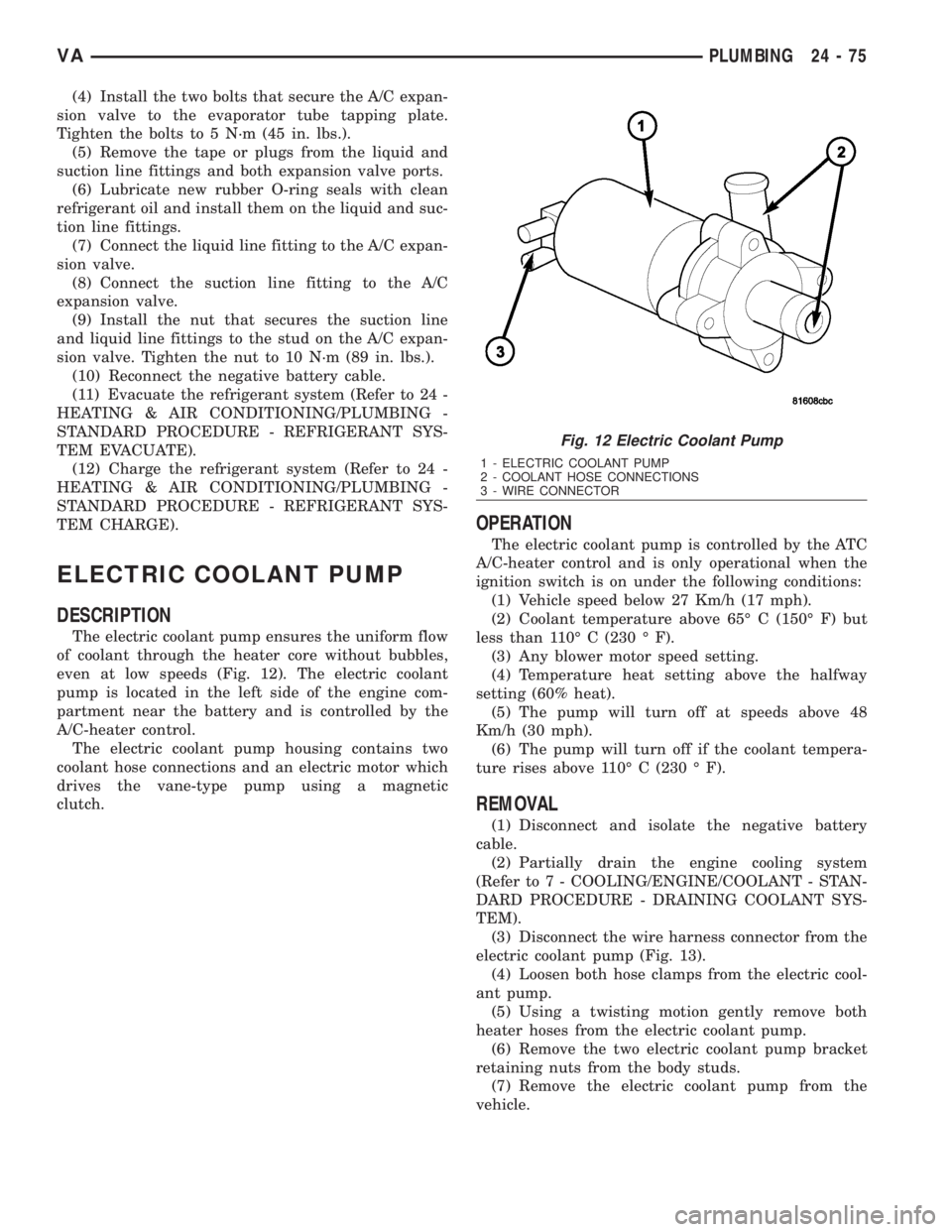
The electric coolant pump ensures the uniform flow
of coolant through the heater core without bubbles,
even at low speeds (Fig. 12). The electric coolant
pump is located in the left side of the engine com-
partment near the battery and is controlled by the
A/C-heater control.
The electric coolant pump housing contains two
coolant hose connections and an electric motor which
drives the vane-type pump using a magnetic
clutch.
OPERATION
The electric coolant pump is controlled by the ATC
A/C-heater control and is only operational when the
ignition switch is on under the following conditions:
(1) Vehicle speed below 27 Km/h (17 mph).
(2) Coolant temperature above 65É C (150É F) but
less than 110É C (230 É F).
(3) Any blower motor speed setting.
(4) Temperature heat setting above the halfway
setting (60% heat).
(5) The pump will turn off at speeds above 48
Km/h (30 mph).
(6) The pump will turn off if the coolant tempera-
ture rises above 110É C (230 É F).
REMOVAL
(1) Disconnect and isolate the negative battery
cable.
(2) Partially drain the engine cooling system
(Refer to 7 - COOLING/ENGINE/COOLANT - STAN-
DARD PROCEDURE - DRAINING COOLANT SYS-
TEM).
(3) Disconnect the wire harness connector from the
electric coolant pump (Fig. 13).
(4) Loosen both hose clamps from the electric cool-
ant pump.
(5) Using a twisting motion gently remove both
heater hoses from the electric coolant pump.
(6) Remove the two electric coolant pump bracket
retaining nuts from the body studs.
(7) Remove the electric coolant pump from the
vehicle.
Fig. 12 Electric Coolant Pump
1 - ELECTRIC COOLANT PUMP
2 - COOLANT HOSE CONNECTIONS
3 - WIRE CONNECTOR
VAPLUMBING 24 - 75
Page 2120 of 2305
(12) Install the plastic routing clip retainer onto
the A/C suction line.
(13) Reconnect the negative battery cable.
(14) Evacuate the refrigerant system (Refer to 24 -
HEATING & AIR CONDITIONING/PLUMBING -
STANDARD PROCEDURE - REFRIGERANT SYS-
TEM EVACUATE).
(15) Charge the refrigerant system (Refer to 24 -
HEATING & AIR CONDITIONING/PLUMBING -
STANDARD PROCEDURE - REFRIGERANT SYS-
TEM CHARGE).
WATER VALVE
REMOVAL
(1) Disconnect and isolate the negative battery
cable.
(2) Partially drain the engine cooling system
(Refer to 7 - COOLING/ENGINE/COOLANT - STAN-
DARD PROCEDURE - DRAINING COOLING SYS-
TEM).
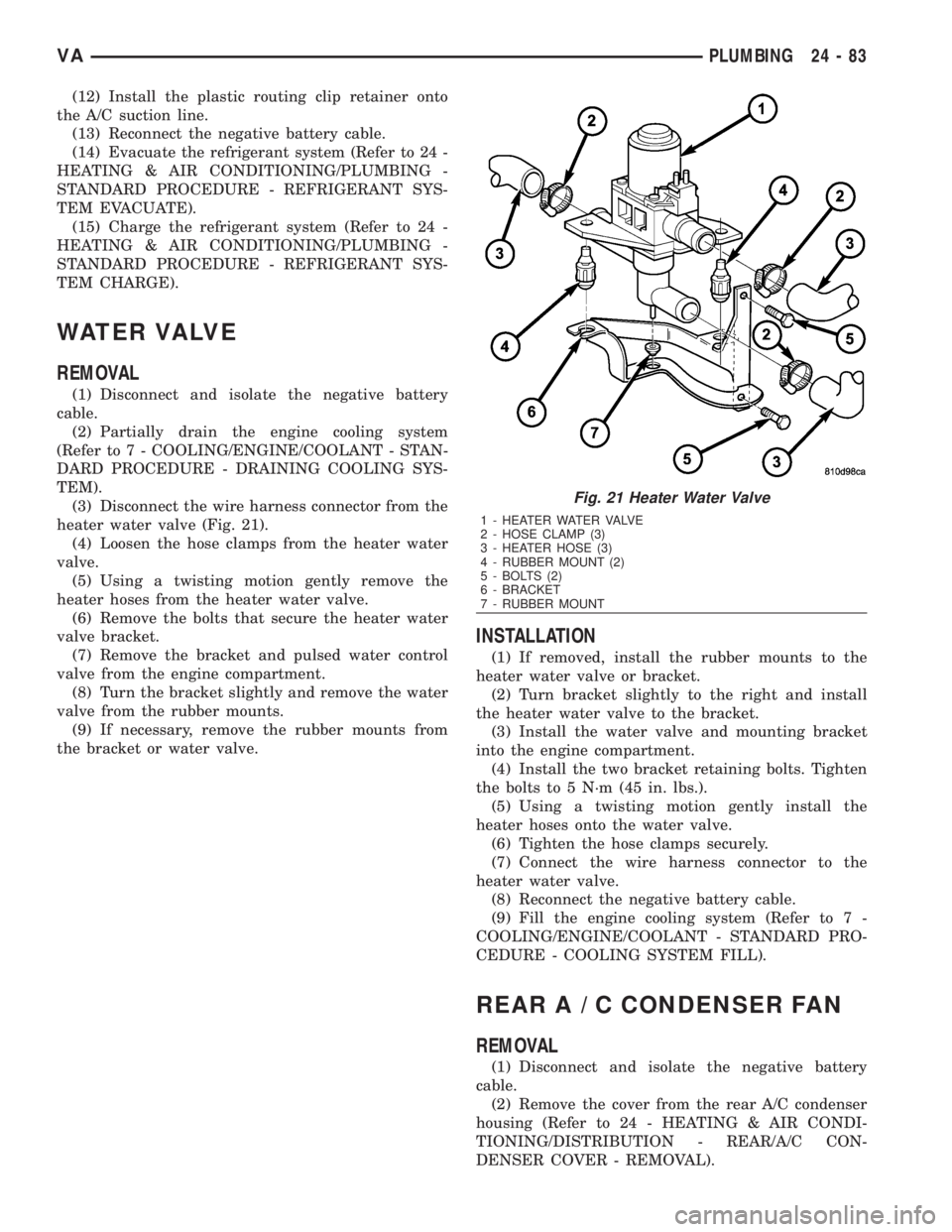
(3) Disconnect the wire harness connector from the
heater water valve (Fig. 21).
(4) Loosen the hose clamps from the heater water
valve.
(5) Using a twisting motion gently remove the
heater hoses from the heater water valve.
(6) Remove the bolts that secure the heater water
valve bracket.
(7) Remove the bracket and pulsed water control
valve from the engine compartment.
(8) Turn the bracket slightly and remove the water
valve from the rubber mounts.
(9) If necessary, remove the rubber mounts from
the bracket or water valve.
INSTALLATION
(1) If removed, install the rubber mounts to the
heater water valve or bracket.
(2) Turn bracket slightly to the right and install
the heater water valve to the bracket.
(3) Install the water valve and mounting bracket
into the engine compartment.
(4) Install the two bracket retaining bolts. Tighten
the bolts to 5 N´m (45 in. lbs.).
(5) Using a twisting motion gently install the
heater hoses onto the water valve.
(6) Tighten the hose clamps securely.
(7) Connect the wire harness connector to the
heater water valve.
(8) Reconnect the negative battery cable.
(9) Fill the engine cooling system (Refer to 7 -
COOLING/ENGINE/COOLANT - STANDARD PRO-
CEDURE - COOLING SYSTEM FILL).
REARA/CCONDENSER FAN
REMOVAL
(1) Disconnect and isolate the negative battery
cable.
(2) Remove the cover from the rear A/C condenser
housing (Refer to 24 - HEATING & AIR CONDI-
TIONING/DISTRIBUTION - REAR/A/C CON-
DENSER COVER - REMOVAL).
Fig. 21 Heater Water Valve
1 - HEATER WATER VALVE
2 - HOSE CLAMP (3)
3 - HEATER HOSE (3)
4 - RUBBER MOUNT (2)
5 - BOLTS (2)
6 - BRACKET
7 - RUBBER MOUNT
VAPLUMBING 24 - 83
Page 2121 of 2305
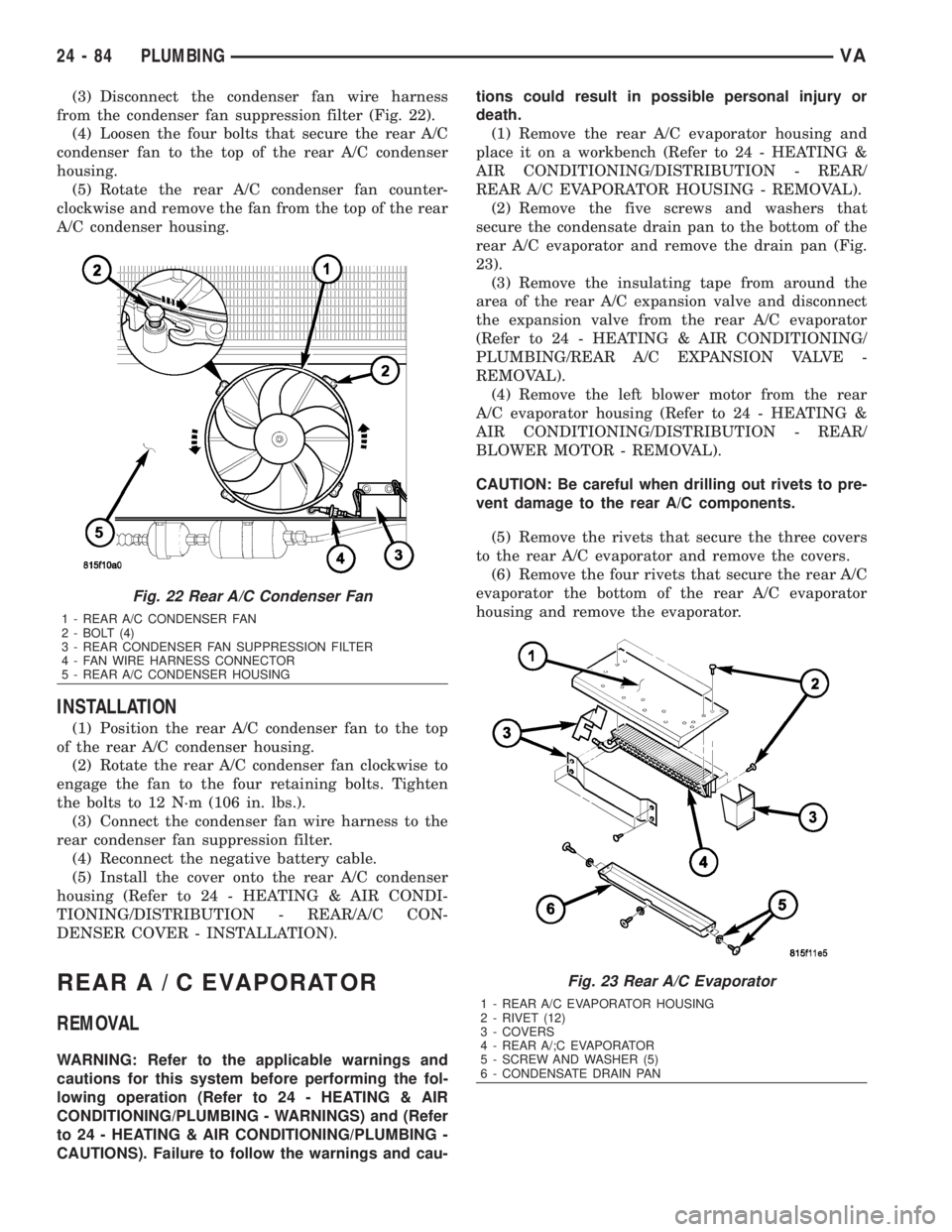
(3) Disconnect the condenser fan wire harness
from the condenser fan suppression filter (Fig. 22).
(4) Loosen the four bolts that secure the rear A/C
condenser fan to the top of the rear A/C condenser
housing.
(5) Rotate the rear A/C condenser fan counter-
clockwise and remove the fan from the top of the rear
A/C condenser housing.
INSTALLATION
(1) Position the rear A/C condenser fan to the top
of the rear A/C condenser housing.
(2) Rotate the rear A/C condenser fan clockwise to
engage the fan to the four retaining bolts. Tighten
the bolts to 12 N´m (106 in. lbs.).
(3) Connect the condenser fan wire harness to the
rear condenser fan suppression filter.
(4) Reconnect the negative battery cable.
(5) Install the cover onto the rear A/C condenser
housing (Refer to 24 - HEATING & AIR CONDI-
TIONING/DISTRIBUTION - REAR/A/C CON-
DENSER COVER - INSTALLATION).
REARA/CEVAPORATOR
REMOVAL
WARNING: Refer to the applicable warnings and
cautions for this system before performing the fol-
lowing operation (Refer to 24 - HEATING & AIR
CONDITIONING/PLUMBING - WARNINGS) and (Refer
to 24 - HEATING & AIR CONDITIONING/PLUMBING -
CAUTIONS). Failure to follow the warnings and cau-tions could result in possible personal injury or
death.
(1) Remove the rear A/C evaporator housing and
place it on a workbench (Refer to 24 - HEATING &
AIR CONDITIONING/DISTRIBUTION - REAR/
REAR A/C EVAPORATOR HOUSING - REMOVAL).
(2) Remove the five screws and washers that
secure the condensate drain pan to the bottom of the
rear A/C evaporator and remove the drain pan (Fig.
23).
(3) Remove the insulating tape from around the
area of the rear A/C expansion valve and disconnect
the expansion valve from the rear A/C evaporator
(Refer to 24 - HEATING & AIR CONDITIONING/
PLUMBING/REAR A/C EXPANSION VALVE -
REMOVAL).
(4) Remove the left blower motor from the rear
A/C evaporator housing (Refer to 24 - HEATING &
AIR CONDITIONING/DISTRIBUTION - REAR/
BLOWER MOTOR - REMOVAL).
CAUTION: Be careful when drilling out rivets to pre-
vent damage to the rear A/C components.
(5) Remove the rivets that secure the three covers
to the rear A/C evaporator and remove the covers.
(6) Remove the four rivets that secure the rear A/C
evaporator the bottom of the rear A/C evaporator
housing and remove the evaporator.
Fig. 22 Rear A/C Condenser Fan
1 - REAR A/C CONDENSER FAN
2 - BOLT (4)
3 - REAR CONDENSER FAN SUPPRESSION FILTER
4 - FAN WIRE HARNESS CONNECTOR
5 - REAR A/C CONDENSER HOUSING
Fig. 23 Rear A/C Evaporator
1 - REAR A/C EVAPORATOR HOUSING
2 - RIVET (12)
3 - COVERS
4 - REAR A/;C EVAPORATOR
5 - SCREW AND WASHER (5)
6 - CONDENSATE DRAIN PAN
24 - 84 PLUMBINGVA
Page 2131 of 2305
(8) Charge the rear refrigerant system (Refer to 24
- HEATING & AIR CONDITIONING/PLUMBING -
STANDARD PROCEDURE - REFRIGERANT SYS-
TEM CHARGE).
(9) Install the cover onto the rear A/C evaporator
housing (Refer to 24 - HEATING & AIR CONDI-
TIONING/DISTRIBUTION - REAR/A/C EVAPORA-
TOR COVER-REAR - INSTALLATION).
(10) Install the cover onto the rear A/C condenser
housing (Refer to 24 - HEATING & AIR CONDI-
TIONING/DISTRIBUTION - REAR/A/C CON-
DENSER COVER - INSTALLATION).
REAR RECEIVER / DRIER
REMOVAL
WARNING: Refer to the applicable warnings and
cautions for this system before performing the fol-
lowing operation (Refer to 24 - HEATING & AIR
CONDITIONING/PLUMBING - WARNINGS) and (Refer
to 24 - HEATING & AIR CONDITIONING/PLUMBING -
CAUTIONS). Failure to follow the warnings and cau-
tions could result in possible personal injury or
death.
(1) Disconnect and isolate the negative battery
cable.
(2) Remove the air filter from the rear A/C evapo-
rator housing (Refer to 24 - HEATING & AIR CON-
DITIONING/DISTRIBUTION - REAR/AIR FILTER -
REMOVAL).
(3) Recover the refrigerant from the rear refriger-
ant system (Refer to 24 - HEATING & AIR CONDI-
TIONING/PLUMBING - STANDARD PROCEDURE -
REFRIGERANT RECOVERY).
(4) Remove the cover from the rear A/C condenser
housing (Refer to 24 - HEATING & AIR CONDI-
TIONING/DISTRIBUTION - REAR/A/C CON-
DENSER COVER - REMOVAL).
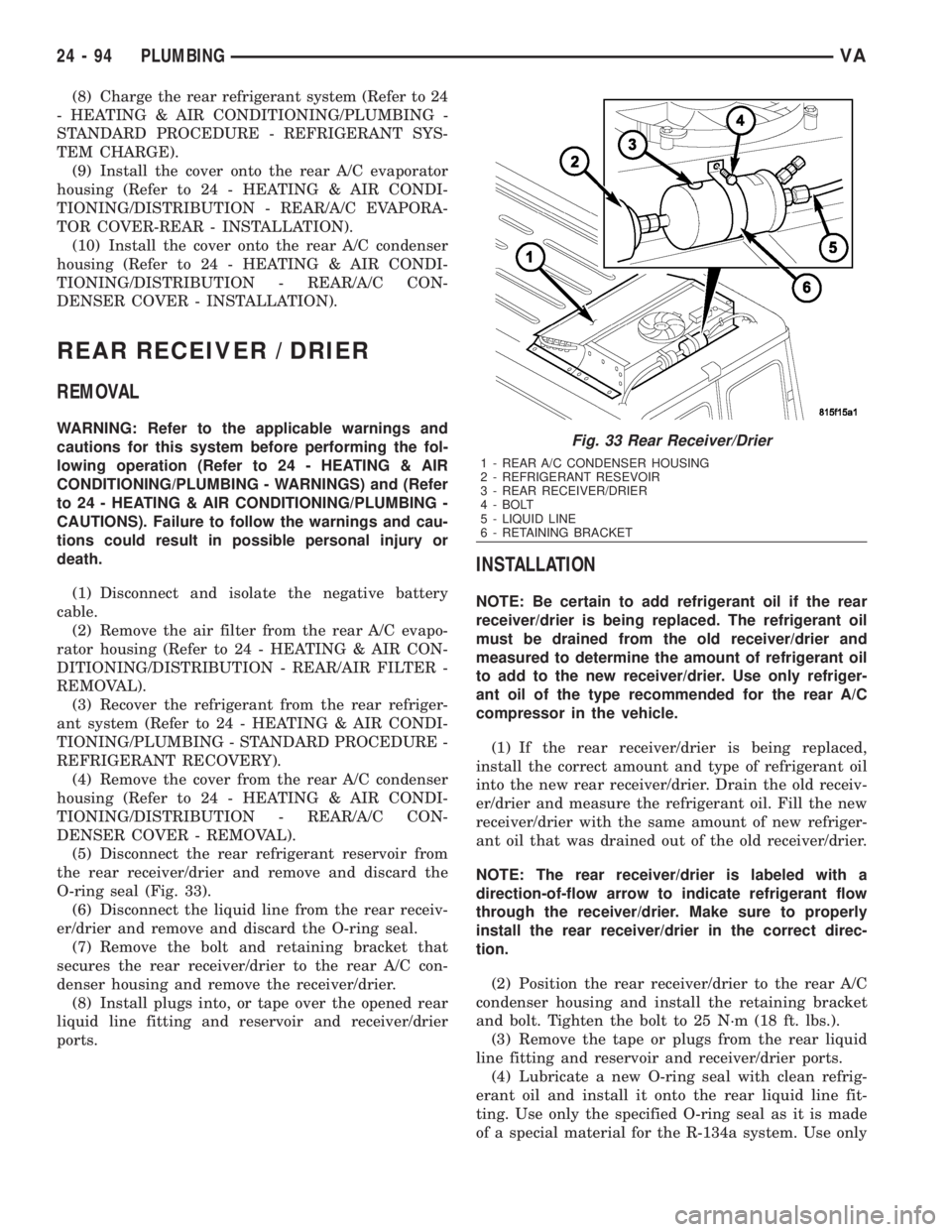
(5) Disconnect the rear refrigerant reservoir from
the rear receiver/drier and remove and discard the
O-ring seal (Fig. 33).
(6) Disconnect the liquid line from the rear receiv-
er/drier and remove and discard the O-ring seal.
(7) Remove the bolt and retaining bracket that
secures the rear receiver/drier to the rear A/C con-
denser housing and remove the receiver/drier.
(8) Install plugs into, or tape over the opened rear
liquid line fitting and reservoir and receiver/drier
ports.
INSTALLATION
NOTE: Be certain to add refrigerant oil if the rear
receiver/drier is being replaced. The refrigerant oil
must be drained from the old receiver/drier and
measured to determine the amount of refrigerant oil
to add to the new receiver/drier. Use only refriger-
ant oil of the type recommended for the rear A/C
compressor in the vehicle.
(1) If the rear receiver/drier is being replaced,
install the correct amount and type of refrigerant oil
into the new rear receiver/drier. Drain the old receiv-
er/drier and measure the refrigerant oil. Fill the new
receiver/drier with the same amount of new refriger-
ant oil that was drained out of the old receiver/drier.
NOTE: The rear receiver/drier is labeled with a
direction-of-flow arrow to indicate refrigerant flow
through the receiver/drier. Make sure to properly
install the rear receiver/drier in the correct direc-
tion.
(2) Position the rear receiver/drier to the rear A/C
condenser housing and install the retaining bracket
and bolt. Tighten the bolt to 25 N´m (18 ft. lbs.).
(3) Remove the tape or plugs from the rear liquid
line fitting and reservoir and receiver/drier ports.
(4) Lubricate a new O-ring seal with clean refrig-
erant oil and install it onto the rear liquid line fit-
ting. Use only the specified O-ring seal as it is made
of a special material for the R-134a system. Use only
Fig. 33 Rear Receiver/Drier
1 - REAR A/C CONDENSER HOUSING
2 - REFRIGERANT RESEVOIR
3 - REAR RECEIVER/DRIER
4 - BOLT
5 - LIQUID LINE
6 - RETAINING BRACKET
24 - 94 PLUMBINGVA
Page 2132 of 2305
refrigerant oil of the type recommended for the rear
A/C compressor in the vehicle.
(5) Connect the rear liquid line to the rear receiv-
er/drier. Tighten the nut to 35 N´m (26 ft. lbs.).
(6) Lubricate a new O-ring seal with clean refrig-
erant oil and install it onto the receiver/drier outlet
fitting. Use only the specified O-ring seal as it is
made of a special material for the R-134a system.
Use only refrigerant oil of the type recommended for
the rear A/C compressor in the vehicle.
(7) Connect the rear refrigerant reservoir to the
rear receiver/drier. Tighten the nut to 35 N´m (26 ft.
lbs.).
(8) Reconnect the negative battery cable.
(9) Evacuate the rear refrigerant system (Refer to
24 - HEATING & AIR CONDITIONING/PLUMBING
- STANDARD PROCEDURE - REFRIGERANT SYS-
TEM EVACUATE).
(10) Charge the rear refrigerant system (Refer to
24 - HEATING & AIR CONDITIONING/PLUMBING
- STANDARD PROCEDURE - REFRIGERANT SYS-
TEM CHARGE).
(11) Install the rear air filter (Refer to 24 - HEAT-
ING & AIR CONDITIONING/DISTRIBUTION -
REAR/AIR FILTER - INSTALLATION).
(12) Install the cover onto the rear A/C condenser
housing (Refer to 24 - HEATING & AIR CONDI-
TIONING/DISTRIBUTION - REAR/A/C CON-
DENSER COVER - INSTALLATION).
REAR REFRIGERANT RESER-
VOIR
REMOVAL
WARNING: Refer to the applicable warnings and
cautions for this system before performing the fol-
lowing operation (Refer to 24 - HEATING & AIR
CONDITIONING/PLUMBING - WARNINGS) and (Refer
to 24 - HEATING & AIR CONDITIONING/PLUMBING -
CAUTIONS). Failure to follow the warnings and cau-
tions could result in possible personal injury or
death.
(1) Disconnect and isolate the negative battery
cable.
(2) Remove the air filter from the rear A/C evapo-
rator housing (Refer to 24 - HEATING & AIR CON-
DITIONING/DISTRIBUTION - REAR/AIR FILTER -
REMOVAL).
(3) Recover the refrigerant from the rear refriger-
ant system (Refer to 24 - HEATING & AIR CONDI-
TIONING/PLUMBING - STANDARD PROCEDURE -
REFRIGERANT RECOVERY).
(4) Remove the cover from the rear A/C condenser
housing (Refer to 24 - HEATING & AIR CONDI-TIONING/DISTRIBUTION - REAR/A/C CON-
DENSER COVER - REMOVAL).
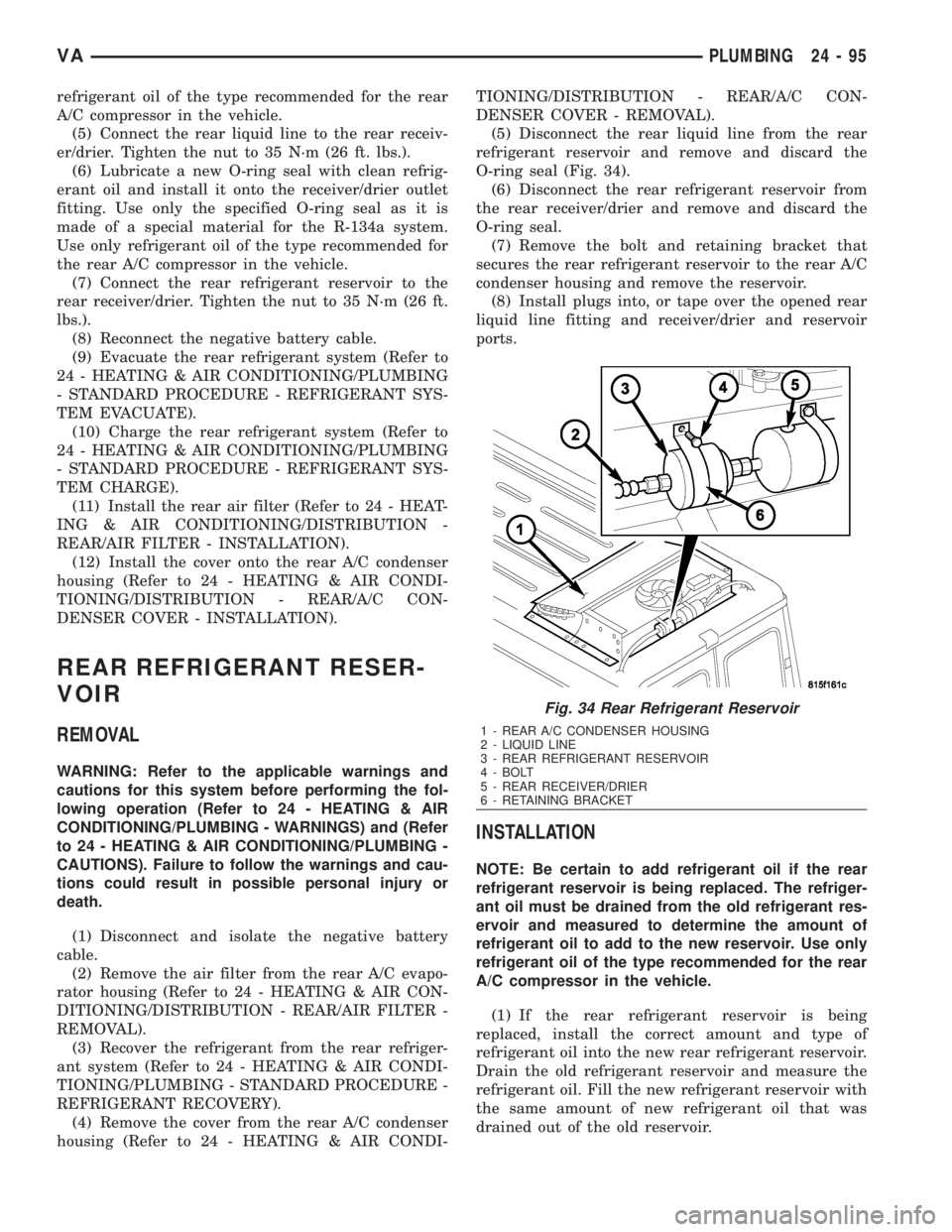
(5) Disconnect the rear liquid line from the rear
refrigerant reservoir and remove and discard the
O-ring seal (Fig. 34).
(6) Disconnect the rear refrigerant reservoir from
the rear receiver/drier and remove and discard the
O-ring seal.
(7) Remove the bolt and retaining bracket that
secures the rear refrigerant reservoir to the rear A/C
condenser housing and remove the reservoir.
(8) Install plugs into, or tape over the opened rear
liquid line fitting and receiver/drier and reservoir
ports.
INSTALLATION
NOTE: Be certain to add refrigerant oil if the rear
refrigerant reservoir is being replaced. The refriger-
ant oil must be drained from the old refrigerant res-
ervoir and measured to determine the amount of
refrigerant oil to add to the new reservoir. Use only
refrigerant oil of the type recommended for the rear
A/C compressor in the vehicle.
(1) If the rear refrigerant reservoir is being
replaced, install the correct amount and type of
refrigerant oil into the new rear refrigerant reservoir.
Drain the old refrigerant reservoir and measure the
refrigerant oil. Fill the new refrigerant reservoir with
the same amount of new refrigerant oil that was
drained out of the old reservoir.
Fig. 34 Rear Refrigerant Reservoir
1 - REAR A/C CONDENSER HOUSING
2 - LIQUID LINE
3 - REAR REFRIGERANT RESERVOIR
4 - BOLT
5 - REAR RECEIVER/DRIER
6 - RETAINING BRACKET
VAPLUMBING 24 - 95
Page 2148 of 2305
(4) Position the two spacer washers between the
body and the rubber grommets for the two mounting
points on the rail.
(5) Tighten the remaining M6 fasteners to 7 N´m
(62 in. lbs.) and the M8 fasteners to 23 N´m (17 ft.
lbs.) which mount the exhaust tube assembly to the
vehicle.
(6) Install the seat hex nut at the heater mounting
flange to the crossmembers. Tighten the nut to 60
N´m (44 ft. lbs.)
(7) Install the flexible section of the cabin heater
exhaust tube to the exhaust tube. Tighten the M6
bolt of the clamp securley. Install the hose to the
exhaust tube.
(8) Tighten the two M8 fasteners at the rail to 23
N´m (17 ft. lbs.). Taking care so that the exhaust
tube bracket tab is on the top of the heater bracket.
(9) Install the wiring harness (Refer to 24 - HEAT-
ING & AIR CONDITIONING/CABIN HEATER/
HEATER UNIT - INSTALLATION - WIRE
HARNESS).
(10) Tighten the hose and tube assembly to the
toe-board crossmember at two locations.
(11) Install the second hose to the underbody hose
and tube assembly.
(12) Connect the rubber fuel hose between the
body tube assembly and the fuel pump nipple at the
body tube joint. Close the fuel fill cap.
(13) Remove the cabin heater support device from
under the vehicle.
(14) Lower the vehicle.
(15) Fill the engine cooling system (Refer to 7 -
COOLING - STANDARD PROCEDURE - COOLING
SYSTEM FILL).
(16) Verify function of the heater unit.
WIRE HARNESS
(1) Carefully route the cabin heater wire harness
from the left side between the heater unit and the
heater shield.
(2) Install the two wiring harness retainers to the
cabin heater shield.
(3) Route the wiring harness along the underside
of the vehicle and install the two wiring harness
retainers to the underbody.
(4) Connect the two cabin heater wire harness con-
nectors to the cabin heater controller.
(5) Connect the cabin heater wire harness to the
dosing pump.
(6) Connect the cabin heater wire harness connec-
tor to the vehicle wiring harness.
(7) Lower the vehicle.
(8) Verify function of the heater unit.
INLET HOSE
REMOVAL
NOTE: The air intake tube for the supplemental
cabin heater is part of an assembly that includes
the heater cooling intake and return pipes. If the
cabin heater air intake tube requires removal or
replacement the entire cabin heater assembly will
require removal or replacement.
(1) Drain the engine cooling system (Refer to 7 -
COOLING - STANDARD PROCEDURE - DRAINING
COOLING STSTEM).
(2) Remove clamps from the cabin heater tubes at
the lower heater port and the lower EGR connector
which are located under the hood.
(3) Remove the retaining clamp at the cabin
heater air intake muffler connection (Refer to 24 -
HEATING & AIR CONDITIONING/CABIN HEAT-
ER/INLET MUFFLER - REMOVAL).
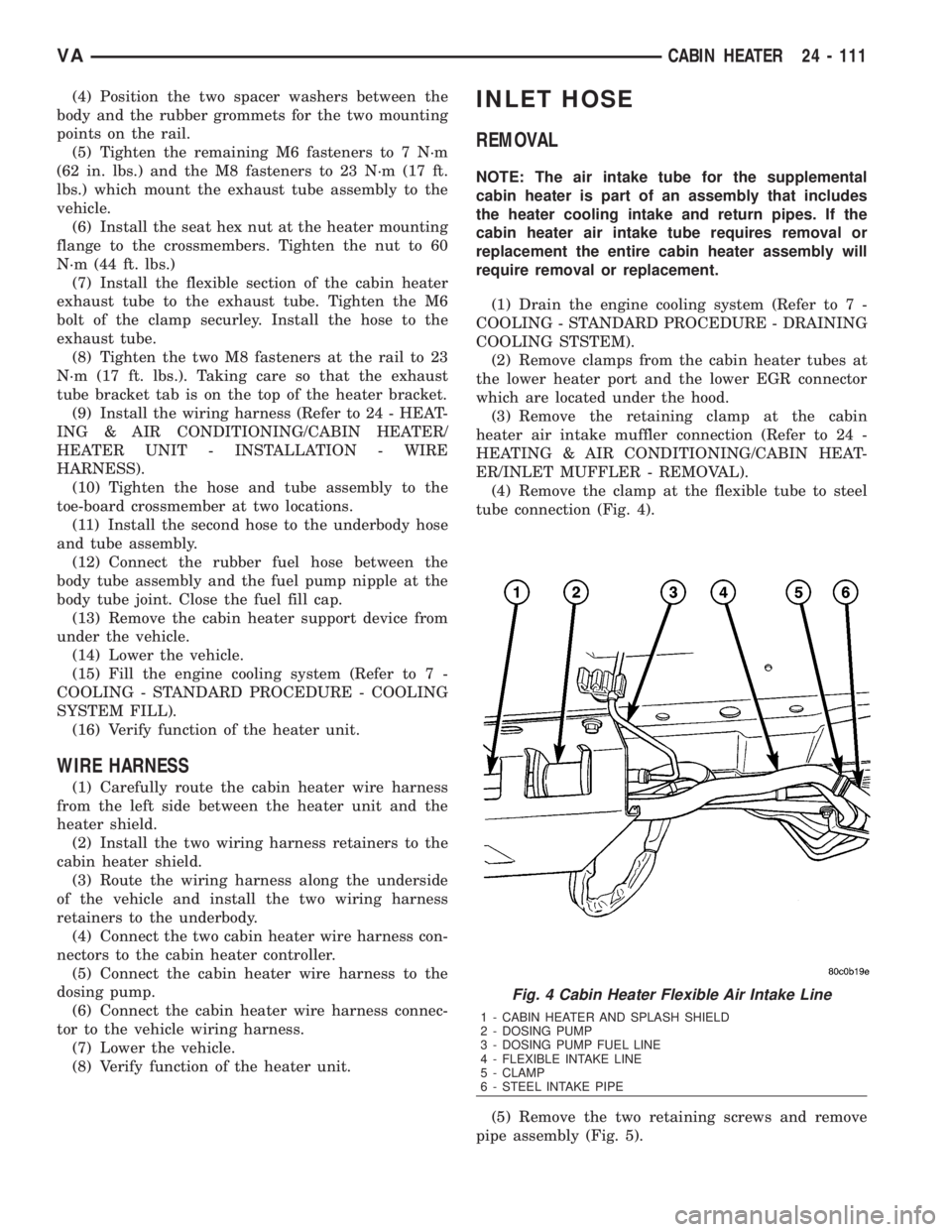
(4) Remove the clamp at the flexible tube to steel
tube connection (Fig. 4).
(5) Remove the two retaining screws and remove
pipe assembly (Fig. 5).
Fig. 4 Cabin Heater Flexible Air Intake Line
1 - CABIN HEATER AND SPLASH SHIELD
2 - DOSING PUMP
3 - DOSING PUMP FUEL LINE
4 - FLEXIBLE INTAKE LINE
5 - CLAMP
6 - STEEL INTAKE PIPE
VACABIN HEATER 24 - 111
Page 2155 of 2305
OPERATION
The mass of the air supplied to the cylinders per
stroke is the decisive factor for determining the opti-
mum quantity of exhaust gas for the operating con-
dition. This is calculated from the Mass Air Flow
sensor information.
The ECM evaluates this signal as well as that
from the Charge Air Pressure sensor, and outputs a
PWM signal in accordance with one of the maps
stored in it. The signal is sent to the exhaust gas
recirculation valve. The map is formulated to keep
the NOx as low as possible. The EGR valve is actu-
ated by an electric positioning motor and has a self
cleaning function. Every time the ignition switch is
turned off, the valve rotates twice to eliminate any
carbon deposits.
REMOVAL
NOTE: The EGR and EGR Cooler are serviced as an
assembly.
(1) Disconnect the negative battery cable.
(2) Partailly drain the cooling system (Refer to 7 -
COOLING/ENGINE/COOLANT - STANDARD PRO-
CEDURE).
(3) Lift up on the charge air hose retaining clip at
the intake manifold and disconnect hose with seal
(4) Disconnect the electrical connector at the EGR
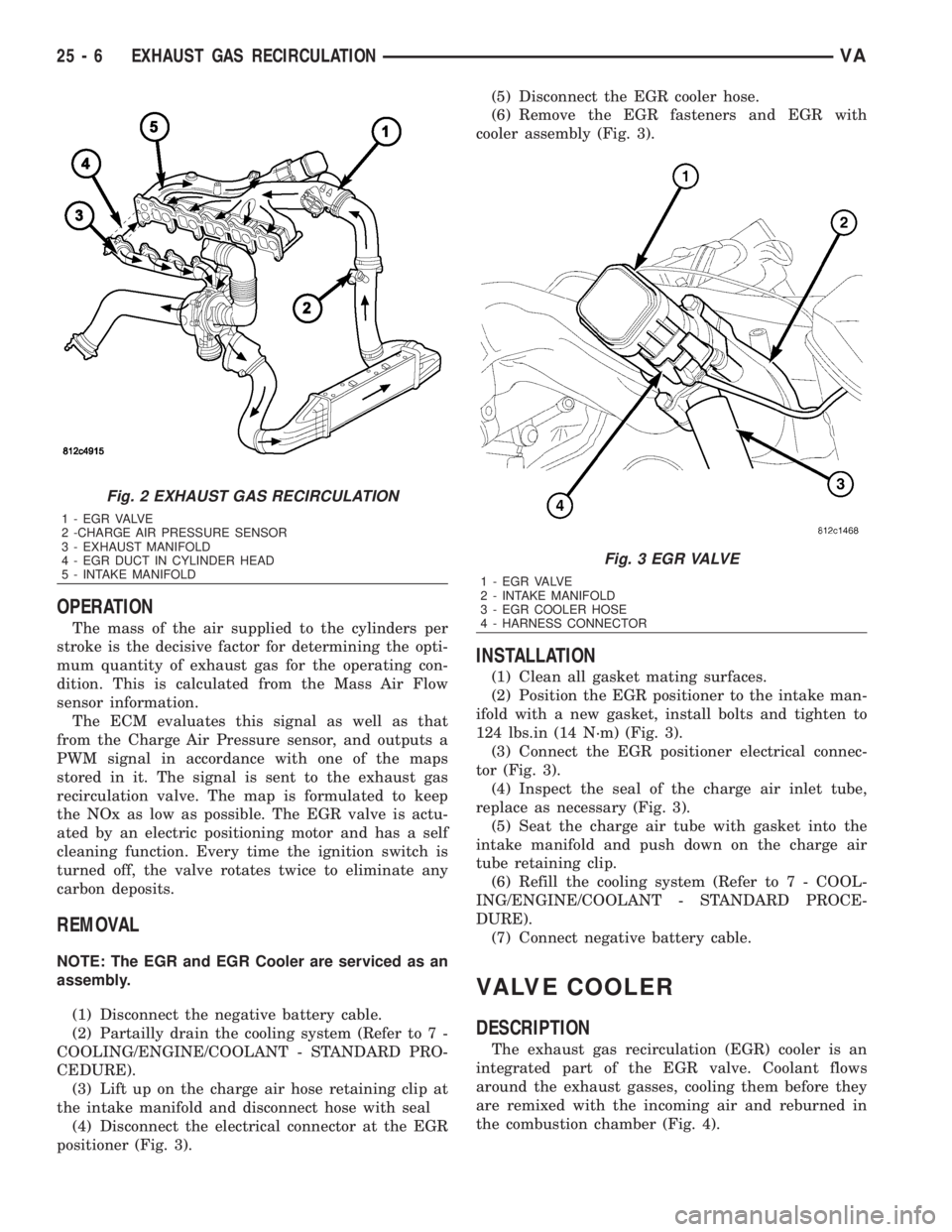
positioner (Fig. 3).(5) Disconnect the EGR cooler hose.
(6) Remove the EGR fasteners and EGR with
cooler assembly (Fig. 3).
INSTALLATION
(1) Clean all gasket mating surfaces.
(2) Position the EGR positioner to the intake man-
ifold with a new gasket, install bolts and tighten to
124 lbs.in (14 N´m) (Fig. 3).
(3) Connect the EGR positioner electrical connec-
tor (Fig. 3).
(4) Inspect the seal of the charge air inlet tube,
replace as necessary (Fig. 3).
(5) Seat the charge air tube with gasket into the
intake manifold and push down on the charge air
tube retaining clip.
(6) Refill the cooling system (Refer to 7 - COOL-
ING/ENGINE/COOLANT - STANDARD PROCE-
DURE).
(7) Connect negative battery cable.
VALVE COOLER
DESCRIPTION
The exhaust gas recirculation (EGR) cooler is an
integrated part of the EGR valve. Coolant flows
around the exhaust gasses, cooling them before they
are remixed with the incoming air and reburned in
the combustion chamber (Fig. 4).
Fig. 2 EXHAUST GAS RECIRCULATION
1 - E G R VA LV E
2 -CHARGE AIR PRESSURE SENSOR
3 - EXHAUST MANIFOLD
4 - EGR DUCT IN CYLINDER HEAD
5 - INTAKE MANIFOLD
Fig. 3 EGR VALVE
1 - E G R VA LV E
2 - INTAKE MANIFOLD
3 - EGR COOLER HOSE
4 - HARNESS CONNECTOR
25 - 6 EXHAUST GAS RECIRCULATIONVA