drain bolt MERCEDES-BENZ SPRINTER 2006 Owner's Guide
[x] Cancel search | Manufacturer: MERCEDES-BENZ, Model Year: 2006, Model line: SPRINTER, Model: MERCEDES-BENZ SPRINTER 2006Pages: 2305, PDF Size: 48.12 MB
Page 1807 of 2305
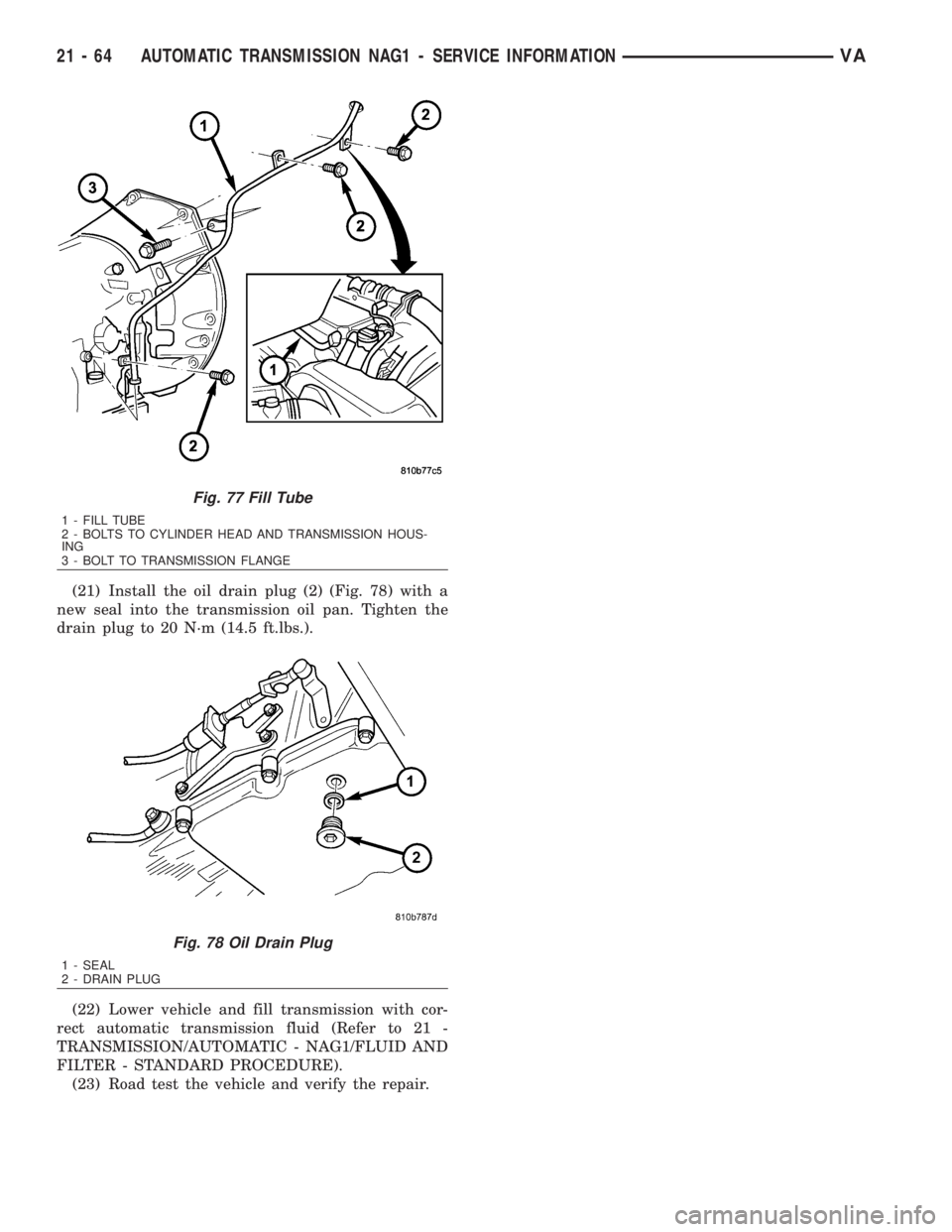
(21) Install the oil drain plug (2) (Fig. 78) with a
new seal into the transmission oil pan. Tighten the
drain plug to 20 N´m (14.5 ft.lbs.).
(22) Lower vehicle and fill transmission with cor-
rect automatic transmission fluid (Refer to 21 -
TRANSMISSION/AUTOMATIC - NAG1/FLUID AND
FILTER - STANDARD PROCEDURE).
(23) Road test the vehicle and verify the repair.
Fig. 77 Fill Tube
1 - FILL TUBE
2 - BOLTS TO CYLINDER HEAD AND TRANSMISSION HOUS-
ING
3 - BOLT TO TRANSMISSION FLANGE
Fig. 78 Oil Drain Plug
1 - SEAL
2 - DRAIN PLUG
21 - 64 AUTOMATIC TRANSMISSION NAG1 - SERVICE INFORMATIONVA
Page 1830 of 2305
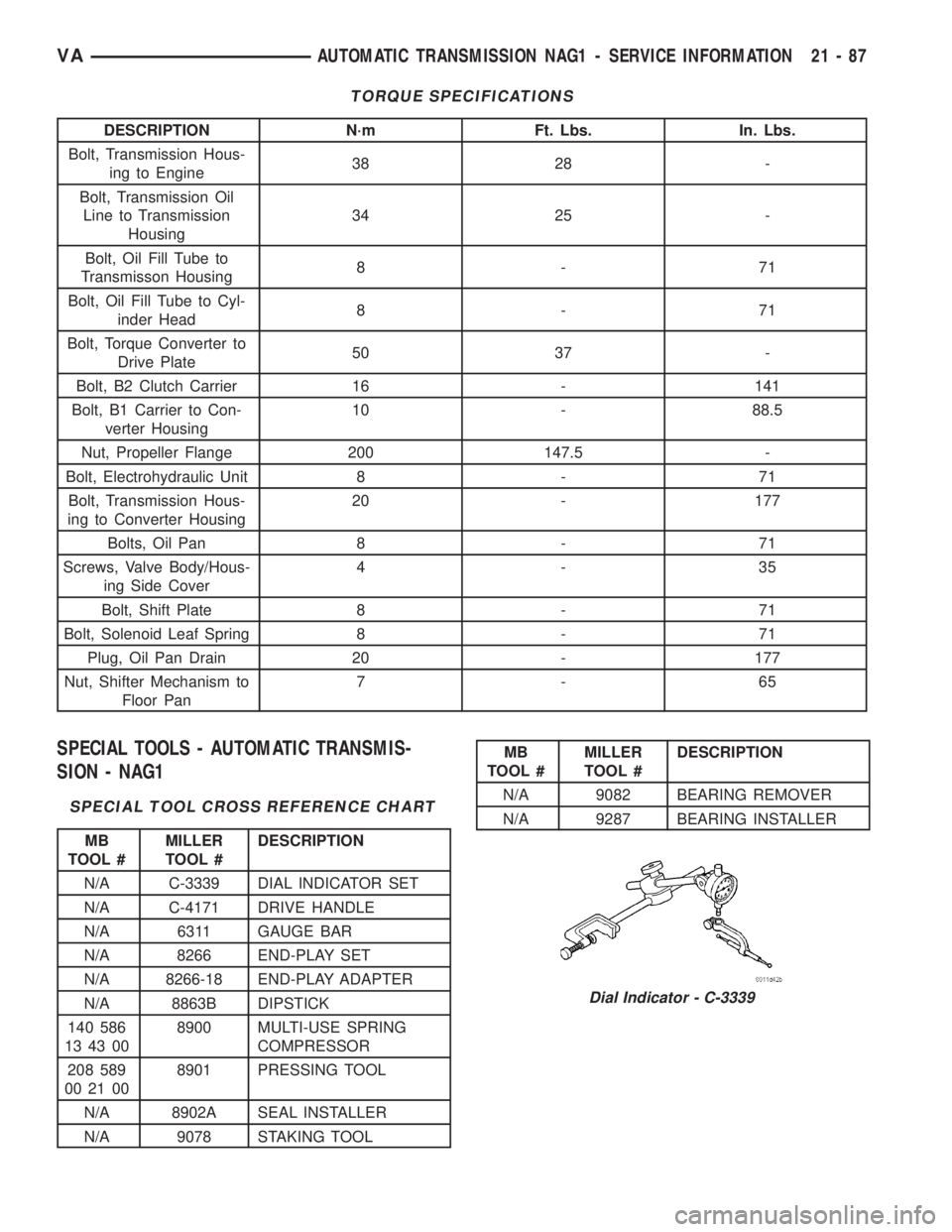
TORQUE SPECIFICATIONS
DESCRIPTION N´m Ft. Lbs. In. Lbs.
Bolt, Transmission Hous-
ing to Engine38 28 -
Bolt, Transmission Oil
Line to Transmission
Housing34 25 -
Bolt, Oil Fill Tube to
Transmisson Housing8-71
Bolt, Oil Fill Tube to Cyl-
inder Head8-71
Bolt, Torque Converter to
Drive Plate50 37 -
Bolt, B2 Clutch Carrier 16 - 141
Bolt, B1 Carrier to Con-
verter Housing10 - 88.5
Nut, Propeller Flange 200 147.5 -
Bolt, Electrohydraulic Unit 8 - 71
Bolt, Transmission Hous-
ing to Converter Housing20 - 177
Bolts, Oil Pan 8 - 71
Screws, Valve Body/Hous-
ing Side Cover4-35
Bolt, Shift Plate 8 - 71
Bolt, Solenoid Leaf Spring 8 - 71
Plug, Oil Pan Drain 20 - 177
Nut, Shifter Mechanism to
Floor Pan7-65
SPECIAL TOOLS - AUTOMATIC TRANSMIS-
SION - NAG1
SPECIAL TOOL CROSS REFERENCE CHART
MB
TOOL #MILLER
TOOL #DESCRIPTION
N/A C-3339 DIAL INDICATOR SET
N/A C-4171 DRIVE HANDLE
N/A 6311 GAUGE BAR
N/A 8266 END-PLAY SET
N/A 8266-18 END-PLAY ADAPTER
N/A 8863B DIPSTICK
140 586
13 43 008900 MULTI-USE SPRING
COMPRESSOR
208 589
00 21 008901 PRESSING TOOL
N/A 8902A SEAL INSTALLER
N/A 9078 STAKING TOOL
MB
TOOL #MILLER
TOOL #DESCRIPTION
N/A 9082 BEARING REMOVER
N/A 9287 BEARING INSTALLER
Dial Indicator - C-3339
VAAUTOMATIC TRANSMISSION NAG1 - SERVICE INFORMATION 21 - 87
Page 1863 of 2305
REMOVAL
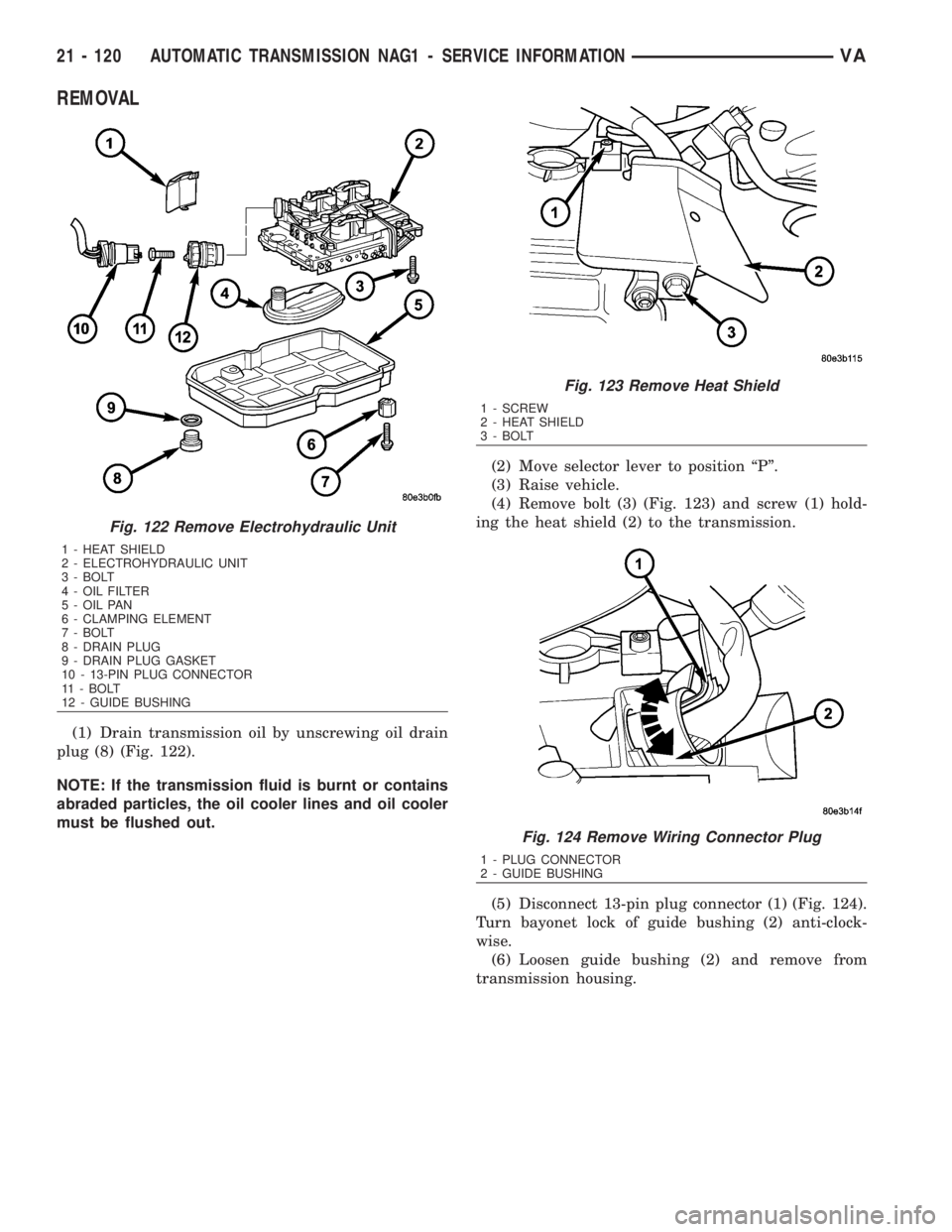
(1) Drain transmission oil by unscrewing oil drain
plug (8) (Fig. 122).
NOTE: If the transmission fluid is burnt or contains
abraded particles, the oil cooler lines and oil cooler
must be flushed out.(2) Move selector lever to position ªPº.
(3) Raise vehicle.
(4) Remove bolt (3) (Fig. 123) and screw (1) hold-
ing the heat shield (2) to the transmission.
(5) Disconnect 13-pin plug connector (1) (Fig. 124).
Turn bayonet lock of guide bushing (2) anti-clock-
wise.
(6) Loosen guide bushing (2) and remove from
transmission housing.
Fig. 122 Remove Electrohydraulic Unit
1 - HEAT SHIELD
2 - ELECTROHYDRAULIC UNIT
3 - BOLT
4 - OIL FILTER
5 - OIL PAN
6 - CLAMPING ELEMENT
7 - BOLT
8 - DRAIN PLUG
9 - DRAIN PLUG GASKET
10 - 13-PIN PLUG CONNECTOR
11 - BOLT
12 - GUIDE BUSHING
Fig. 123 Remove Heat Shield
1 - SCREW
2 - HEAT SHIELD
3 - BOLT
Fig. 124 Remove Wiring Connector Plug
1 - PLUG CONNECTOR
2 - GUIDE BUSHING
21 - 120 AUTOMATIC TRANSMISSION NAG1 - SERVICE INFORMATIONVA
Page 1864 of 2305
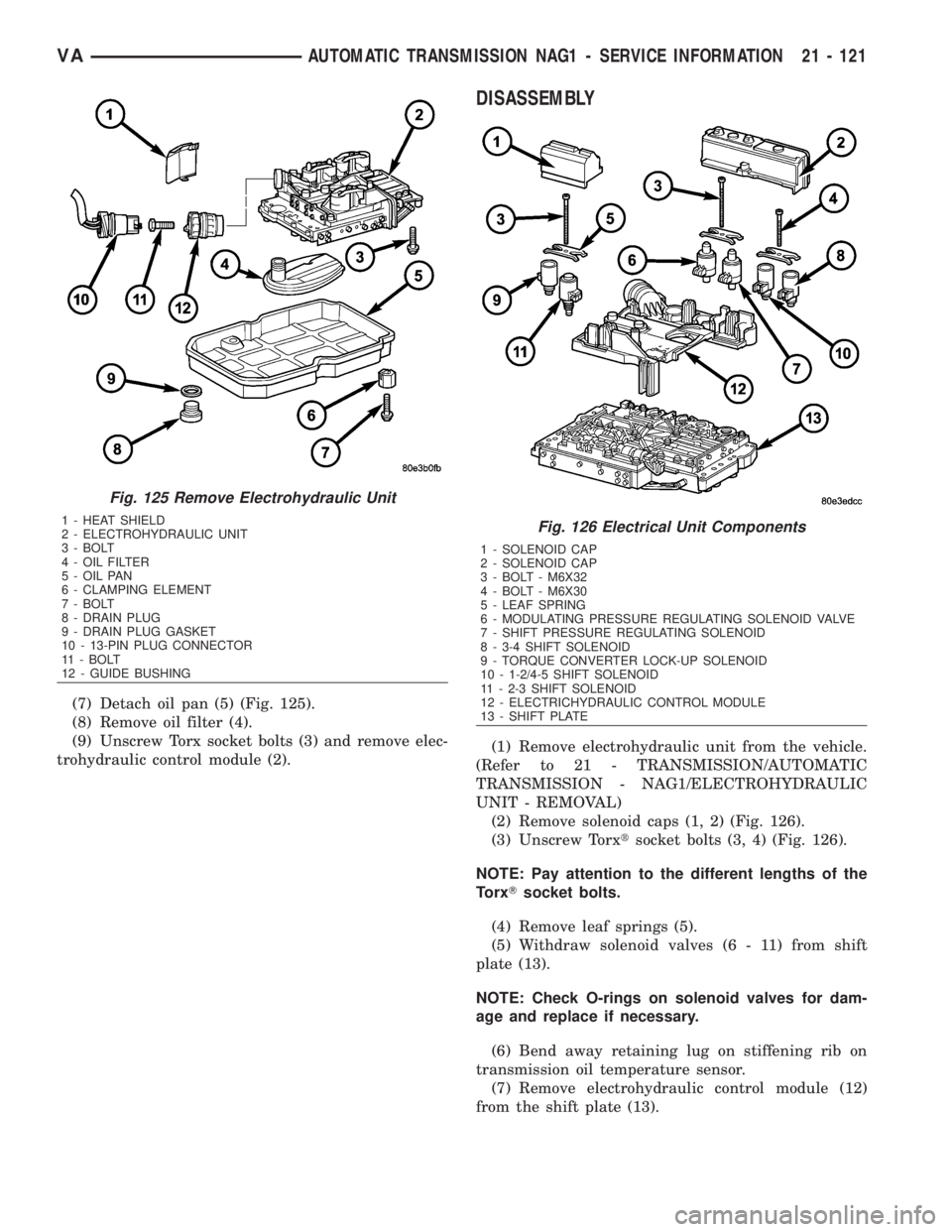
(7) Detach oil pan (5) (Fig. 125).
(8) Remove oil filter (4).
(9) Unscrew Torx socket bolts (3) and remove elec-
trohydraulic control module (2).
DISASSEMBLY
(1) Remove electrohydraulic unit from the vehicle.
(Refer to 21 - TRANSMISSION/AUTOMATIC
TRANSMISSION - NAG1/ELECTROHYDRAULIC
UNIT - REMOVAL)
(2) Remove solenoid caps (1, 2) (Fig. 126).
(3) Unscrew Torxtsocket bolts (3, 4) (Fig. 126).
NOTE: Pay attention to the different lengths of the
TorxTsocket bolts.
(4) Remove leaf springs (5).
(5) Withdraw solenoid valves (6 - 11) from shift
plate (13).
NOTE: Check O-rings on solenoid valves for dam-
age and replace if necessary.
(6) Bend away retaining lug on stiffening rib on
transmission oil temperature sensor.
(7) Remove electrohydraulic control module (12)
from the shift plate (13).
Fig. 125 Remove Electrohydraulic Unit
1 - HEAT SHIELD
2 - ELECTROHYDRAULIC UNIT
3 - BOLT
4 - OIL FILTER
5 - OIL PAN
6 - CLAMPING ELEMENT
7 - BOLT
8 - DRAIN PLUG
9 - DRAIN PLUG GASKET
10 - 13-PIN PLUG CONNECTOR
11 - BOLT
12 - GUIDE BUSHINGFig. 126 Electrical Unit Components
1 - SOLENOID CAP
2 - SOLENOID CAP
3 - BOLT - M6X32
4 - BOLT - M6X30
5 - LEAF SPRING
6 - MODULATING PRESSURE REGULATING SOLENOID VALVE
7 - SHIFT PRESSURE REGULATING SOLENOID
8 - 3-4 SHIFT SOLENOID
9 - TORQUE CONVERTER LOCK-UP SOLENOID
10 - 1-2/4-5 SHIFT SOLENOID
11 - 2-3 SHIFT SOLENOID
12 - ELECTRICHYDRAULIC CONTROL MODULE
13 - SHIFT PLATE
VAAUTOMATIC TRANSMISSION NAG1 - SERVICE INFORMATION 21 - 121
Page 1873 of 2305
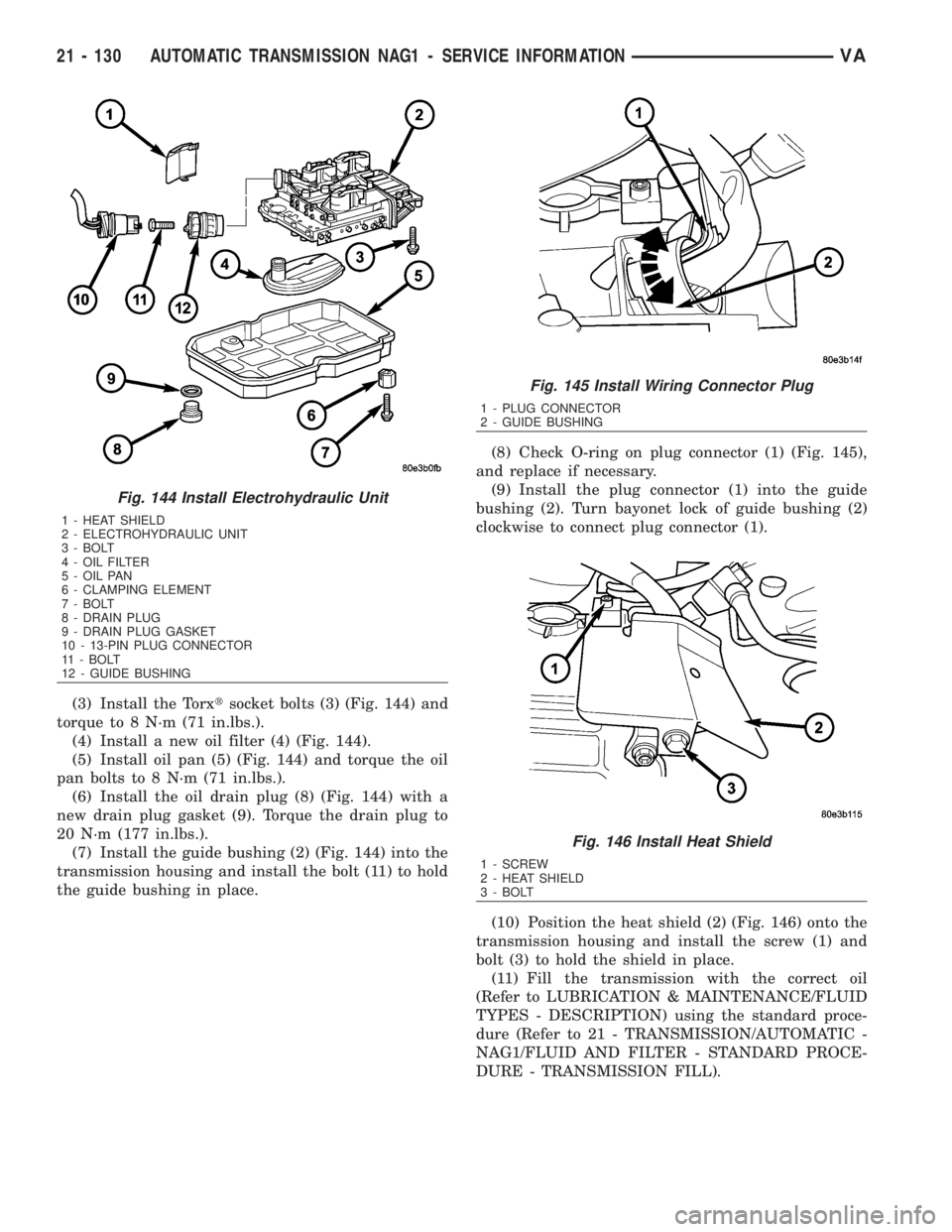
(3) Install the Torxtsocket bolts (3) (Fig. 144) and
torque to 8 N´m (71 in.lbs.).
(4) Install a new oil filter (4) (Fig. 144).
(5) Install oil pan (5) (Fig. 144) and torque the oil
pan bolts to 8 N´m (71 in.lbs.).
(6) Install the oil drain plug (8) (Fig. 144) with a
new drain plug gasket (9). Torque the drain plug to
20 N´m (177 in.lbs.).
(7) Install the guide bushing (2) (Fig. 144) into the
transmission housing and install the bolt (11) to hold
the guide bushing in place.(8) Check O-ring on plug connector (1) (Fig. 145),
and replace if necessary.
(9) Install the plug connector (1) into the guide
bushing (2). Turn bayonet lock of guide bushing (2)
clockwise to connect plug connector (1).
(10) Position the heat shield (2) (Fig. 146) onto the
transmission housing and install the screw (1) and
bolt (3) to hold the shield in place.
(11) Fill the transmission with the correct oil
(Refer to LUBRICATION & MAINTENANCE/FLUID
TYPES - DESCRIPTION) using the standard proce-
dure (Refer to 21 - TRANSMISSION/AUTOMATIC -
NAG1/FLUID AND FILTER - STANDARD PROCE-
DURE - TRANSMISSION FILL).
Fig. 144 Install Electrohydraulic Unit
1 - HEAT SHIELD
2 - ELECTROHYDRAULIC UNIT
3 - BOLT
4 - OIL FILTER
5 - OIL PAN
6 - CLAMPING ELEMENT
7 - BOLT
8 - DRAIN PLUG
9 - DRAIN PLUG GASKET
10 - 13-PIN PLUG CONNECTOR
11 - BOLT
12 - GUIDE BUSHING
Fig. 145 Install Wiring Connector Plug
1 - PLUG CONNECTOR
2 - GUIDE BUSHING
Fig. 146 Install Heat Shield
1 - SCREW
2 - HEAT SHIELD
3 - BOLT
21 - 130 AUTOMATIC TRANSMISSION NAG1 - SERVICE INFORMATIONVA
Page 1877 of 2305
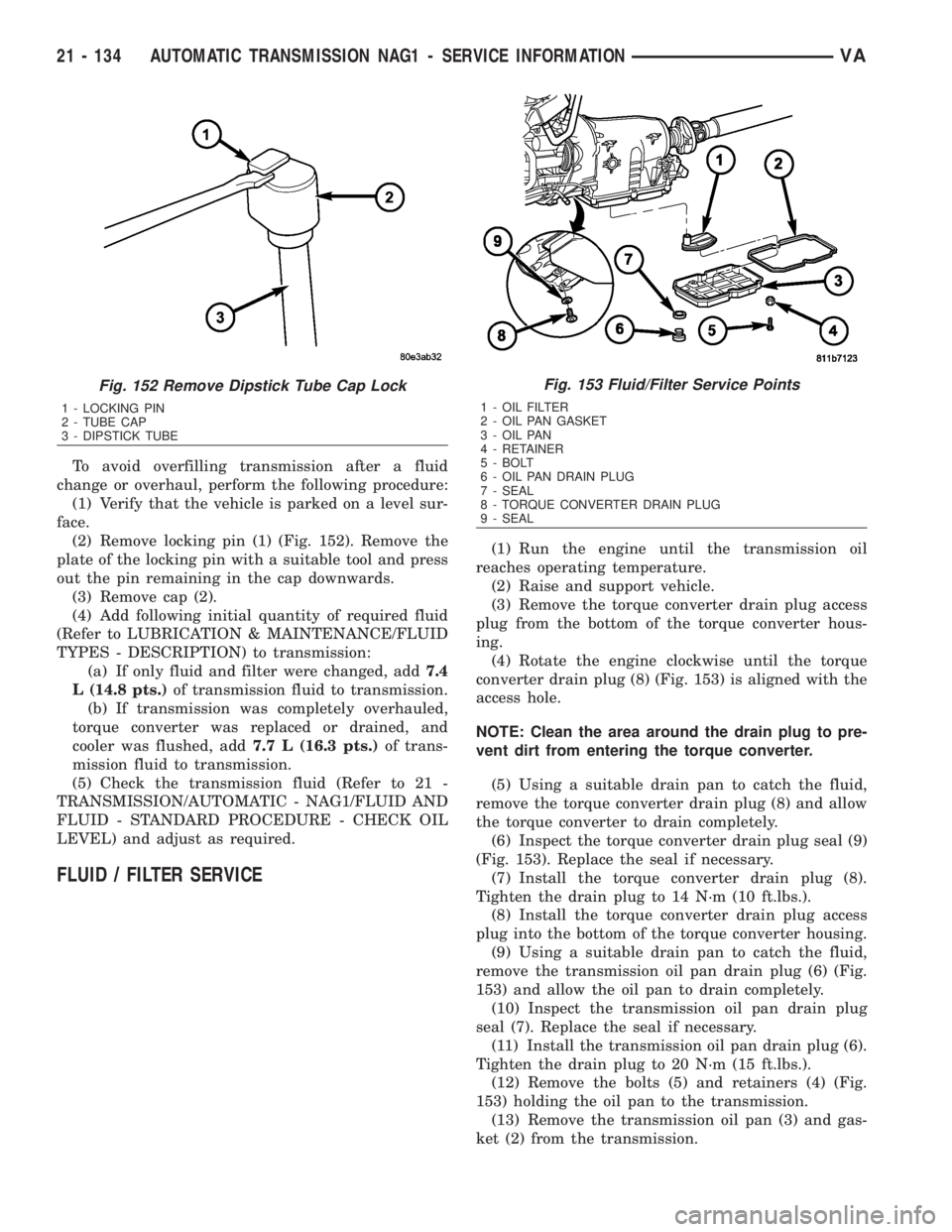
To avoid overfilling transmission after a fluid
change or overhaul, perform the following procedure:
(1) Verify that the vehicle is parked on a level sur-
face.
(2) Remove locking pin (1) (Fig. 152). Remove the
plate of the locking pin with a suitable tool and press
out the pin remaining in the cap downwards.
(3) Remove cap (2).
(4) Add following initial quantity of required fluid
(Refer to LUBRICATION & MAINTENANCE/FLUID
TYPES - DESCRIPTION) to transmission:
(a) If only fluid and filter were changed, add7.4
L (14.8 pts.)of transmission fluid to transmission.
(b) If transmission was completely overhauled,
torque converter was replaced or drained, and
cooler was flushed, add7.7 L (16.3 pts.)of trans-
mission fluid to transmission.
(5) Check the transmission fluid (Refer to 21 -
TRANSMISSION/AUTOMATIC - NAG1/FLUID AND
FLUID - STANDARD PROCEDURE - CHECK OIL
LEVEL) and adjust as required.
FLUID / FILTER SERVICE
(1) Run the engine until the transmission oil
reaches operating temperature.
(2) Raise and support vehicle.
(3) Remove the torque converter drain plug access
plug from the bottom of the torque converter hous-
ing.
(4) Rotate the engine clockwise until the torque
converter drain plug (8) (Fig. 153) is aligned with the
access hole.
NOTE: Clean the area around the drain plug to pre-
vent dirt from entering the torque converter.
(5) Using a suitable drain pan to catch the fluid,
remove the torque converter drain plug (8) and allow
the torque converter to drain completely.
(6) Inspect the torque converter drain plug seal (9)
(Fig. 153). Replace the seal if necessary.
(7) Install the torque converter drain plug (8).
Tighten the drain plug to 14 N´m (10 ft.lbs.).
(8) Install the torque converter drain plug access
plug into the bottom of the torque converter housing.
(9) Using a suitable drain pan to catch the fluid,
remove the transmission oil pan drain plug (6) (Fig.
153) and allow the oil pan to drain completely.
(10) Inspect the transmission oil pan drain plug
seal (7). Replace the seal if necessary.
(11) Install the transmission oil pan drain plug (6).
Tighten the drain plug to 20 N´m (15 ft.lbs.).
(12) Remove the bolts (5) and retainers (4) (Fig.
153) holding the oil pan to the transmission.
(13) Remove the transmission oil pan (3) and gas-
ket (2) from the transmission.
Fig. 152 Remove Dipstick Tube Cap Lock
1 - LOCKING PIN
2 - TUBE CAP
3 - DIPSTICK TUBE
Fig. 153 Fluid/Filter Service Points
1 - OIL FILTER
2 - OIL PAN GASKET
3 - OIL PAN
4 - RETAINER
5 - BOLT
6 - OIL PAN DRAIN PLUG
7 - SEAL
8 - TORQUE CONVERTER DRAIN PLUG
9 - SEAL
21 - 134 AUTOMATIC TRANSMISSION NAG1 - SERVICE INFORMATIONVA
Page 2086 of 2305
(11) Disconnect the heater hoses from the heater
core.
(12) Disconnect the heater hoses from the heater
core tubes. Install plugs in, or tape over the opened
heater core tubes.
(13) Remove the two bolts securing the refrigerant
lines to the evaporator tubes and disconnect the lines
from the tubes. Install plugs in, or tape over all of
the opened refrigerant line fittings.
(14) Remove the seals from the refrigerant line fit-
tings and discard.
(15) Install plugs in, or tape over the opened
refrigerant line fittings and evaporator tubes.
(16) Remove the instrument panel from the vehicle
(Refer to 23 - BODY/INSTRUMENT PANEL -
REMOVAL).
(17) Remove the defroster, floor distribution and
instrument panel ducts (Refer to 24 - HEATING &
AIR CONDITIONING/DISTRIBUTION/DEFROSTER
DUCTS - REMOVAL), (Refer to 24 - HEATING &
AIR CONDITIONING/DISTRIBUTION/FLOOR DIS-
TRIBUTION DUCTS - REMOVAL) and (Refer to 24 -
HEATING & AIR CONDITIONING/DISTRIBUTION/
INSTRUMENT PANEL DUCTS - REMOVAL).
(18) Disconnect the two bulkhead ground connec-
tions near instrument cluster area.
(19) Remove the passenger airbag bracket (Refer
to 8 - ELECTRICAL/RESTRAINTS/PASSENGER
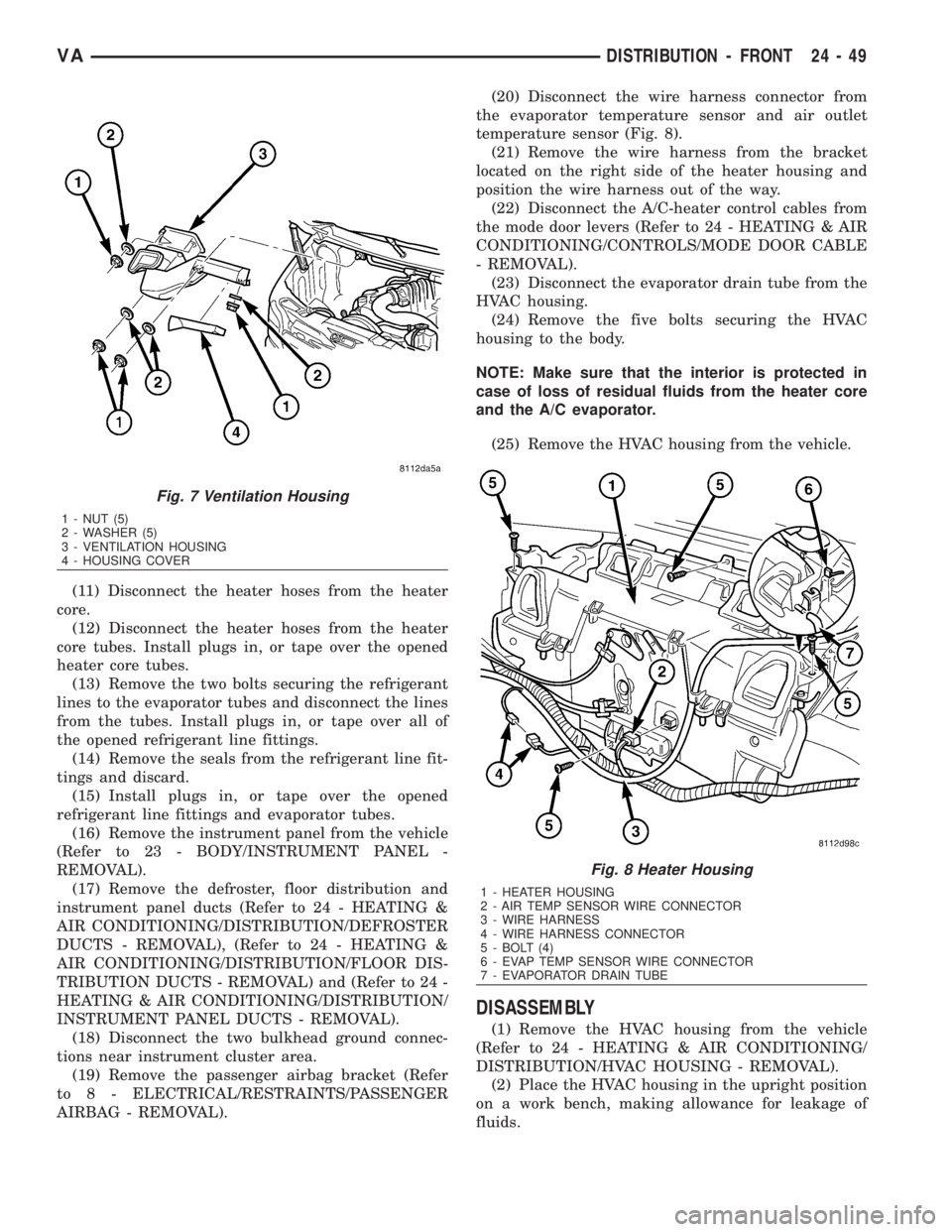
AIRBAG - REMOVAL).(20) Disconnect the wire harness connector from
the evaporator temperature sensor and air outlet
temperature sensor (Fig. 8).
(21) Remove the wire harness from the bracket
located on the right side of the heater housing and
position the wire harness out of the way.
(22) Disconnect the A/C-heater control cables from
the mode door levers (Refer to 24 - HEATING & AIR
CONDITIONING/CONTROLS/MODE DOOR CABLE
- REMOVAL).
(23) Disconnect the evaporator drain tube from the
HVAC housing.
(24) Remove the five bolts securing the HVAC
housing to the body.
NOTE: Make sure that the interior is protected in
case of loss of residual fluids from the heater core
and the A/C evaporator.
(25) Remove the HVAC housing from the vehicle.
DISASSEMBLY
(1) Remove the HVAC housing from the vehicle
(Refer to 24 - HEATING & AIR CONDITIONING/
DISTRIBUTION/HVAC HOUSING - REMOVAL).
(2) Place the HVAC housing in the upright position
on a work bench, making allowance for leakage of
fluids.
Fig. 7 Ventilation Housing
1 - NUT (5)
2 - WASHER (5)
3 - VENTILATION HOUSING
4 - HOUSING COVER
Fig. 8 Heater Housing
1 - HEATER HOUSING
2 - AIR TEMP SENSOR WIRE CONNECTOR
3 - WIRE HARNESS
4 - WIRE HARNESS CONNECTOR
5 - BOLT (4)
6 - EVAP TEMP SENSOR WIRE CONNECTOR
7 - EVAPORATOR DRAIN TUBE
VADISTRIBUTION - FRONT 24 - 49
Page 2087 of 2305
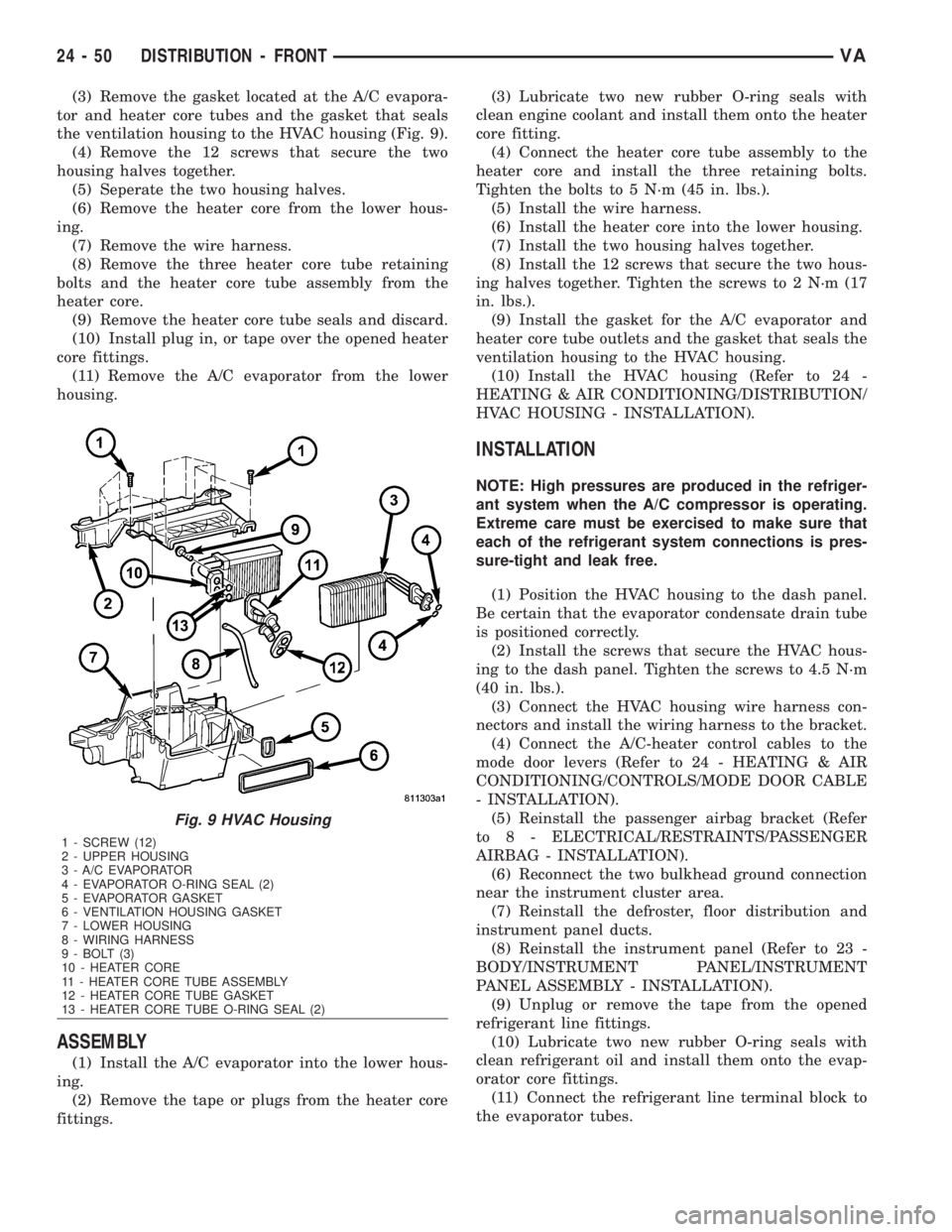
(3) Remove the gasket located at the A/C evapora-
tor and heater core tubes and the gasket that seals
the ventilation housing to the HVAC housing (Fig. 9).
(4) Remove the 12 screws that secure the two
housing halves together.
(5) Seperate the two housing halves.
(6) Remove the heater core from the lower hous-
ing.
(7) Remove the wire harness.
(8) Remove the three heater core tube retaining
bolts and the heater core tube assembly from the
heater core.
(9) Remove the heater core tube seals and discard.
(10) Install plug in, or tape over the opened heater
core fittings.
(11) Remove the A/C evaporator from the lower
housing.
ASSEMBLY
(1) Install the A/C evaporator into the lower hous-
ing.
(2) Remove the tape or plugs from the heater core
fittings.(3) Lubricate two new rubber O-ring seals with
clean engine coolant and install them onto the heater
core fitting.
(4) Connect the heater core tube assembly to the
heater core and install the three retaining bolts.
Tighten the bolts to 5 N´m (45 in. lbs.).
(5) Install the wire harness.
(6) Install the heater core into the lower housing.
(7) Install the two housing halves together.
(8) Install the 12 screws that secure the two hous-
ing halves together. Tighten the screws to 2 N´m (17
in. lbs.).
(9) Install the gasket for the A/C evaporator and
heater core tube outlets and the gasket that seals the
ventilation housing to the HVAC housing.
(10) Install the HVAC housing (Refer to 24 -
HEATING & AIR CONDITIONING/DISTRIBUTION/
HVAC HOUSING - INSTALLATION).
INSTALLATION
NOTE: High pressures are produced in the refriger-
ant system when the A/C compressor is operating.
Extreme care must be exercised to make sure that
each of the refrigerant system connections is pres-
sure-tight and leak free.
(1) Position the HVAC housing to the dash panel.
Be certain that the evaporator condensate drain tube
is positioned correctly.
(2) Install the screws that secure the HVAC hous-
ing to the dash panel. Tighten the screws to 4.5 N´m
(40 in. lbs.).
(3) Connect the HVAC housing wire harness con-
nectors and install the wiring harness to the bracket.
(4) Connect the A/C-heater control cables to the
mode door levers (Refer to 24 - HEATING & AIR
CONDITIONING/CONTROLS/MODE DOOR CABLE
- INSTALLATION).
(5) Reinstall the passenger airbag bracket (Refer
to 8 - ELECTRICAL/RESTRAINTS/PASSENGER
AIRBAG - INSTALLATION).
(6) Reconnect the two bulkhead ground connection
near the instrument cluster area.
(7) Reinstall the defroster, floor distribution and
instrument panel ducts.
(8) Reinstall the instrument panel (Refer to 23 -
BODY/INSTRUMENT PANEL/INSTRUMENT
PANEL ASSEMBLY - INSTALLATION).
(9) Unplug or remove the tape from the opened
refrigerant line fittings.
(10) Lubricate two new rubber O-ring seals with
clean refrigerant oil and install them onto the evap-
orator core fittings.
(11) Connect the refrigerant line terminal block to
the evaporator tubes.
Fig. 9 HVAC Housing
1 - SCREW (12)
2 - UPPER HOUSING
3 - A/C EVAPORATOR
4 - EVAPORATOR O-RING SEAL (2)
5 - EVAPORATOR GASKET
6 - VENTILATION HOUSING GASKET
7 - LOWER HOUSING
8 - WIRING HARNESS
9 - BOLT (3)
10 - HEATER CORE
11 - HEATER CORE TUBE ASSEMBLY
12 - HEATER CORE TUBE GASKET
13 - HEATER CORE TUBE O-RING SEAL (2)
24 - 50 DISTRIBUTION - FRONTVA
Page 2093 of 2305
(1) Disconnect and isolate the negative battery
cable.
(2) Remove the cover from the rear A/C evaporator
housing (Refer to 24 - HEATING & AIR CONDI-
TIONING/DISTRIBUTION - REAR/A/C EVAPORA-
TOR COVER-REAR - REMOVAL).
(3) Recover the refrigerant from the rear refriger-
ant system (Refer to 24 - HEATING & AIR CONDI-
TIONING/PLUMBING - STANDARD PROCEDURE -
REFRIGERANT RECOVERY).
(4) Remove the cover from the rear A/C condenser
housing (Refer to 24 - HEATING & AIR CONDI-
TIONING/DISTRIBUTION - REAR/A/C CON-
DENSER COVER - REMOVAL).
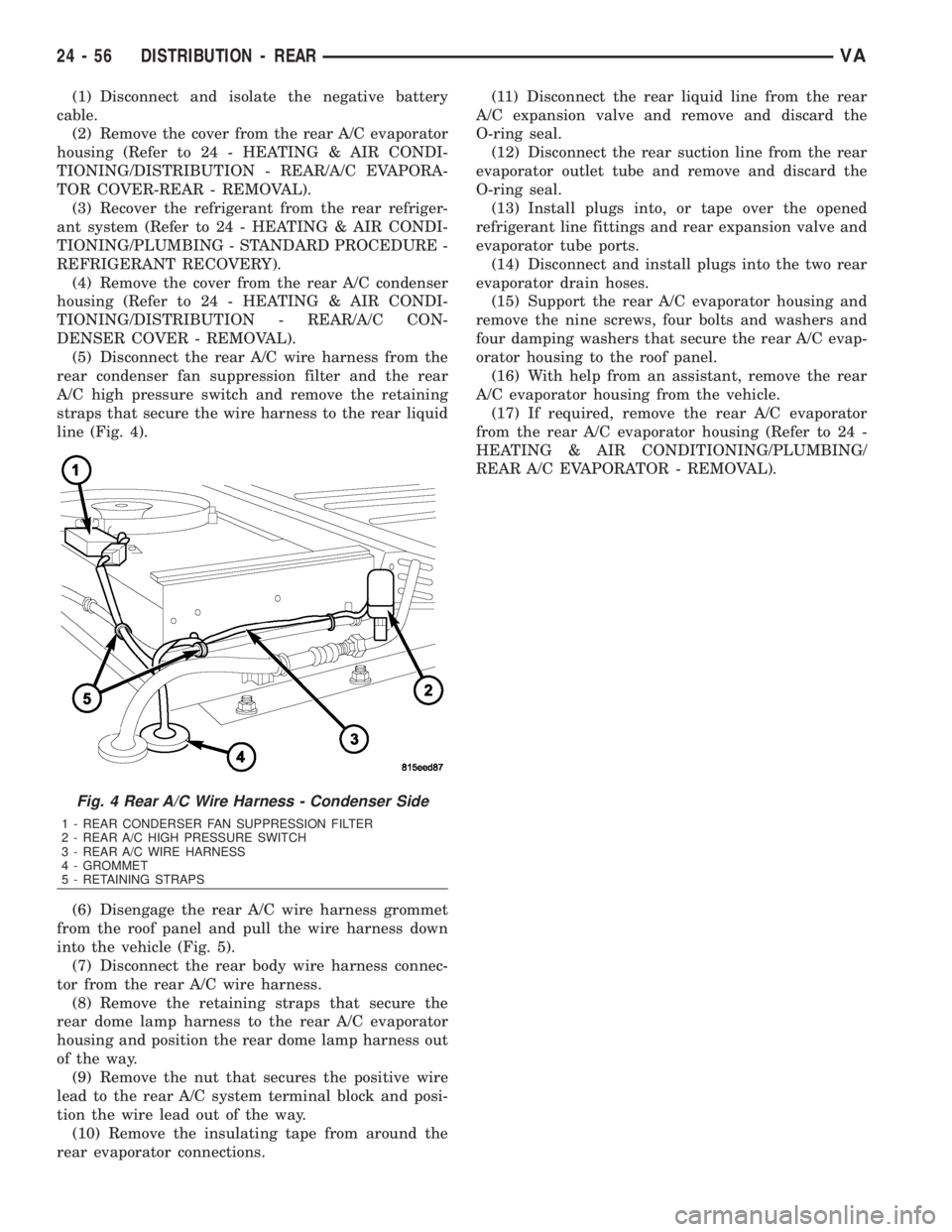
(5) Disconnect the rear A/C wire harness from the
rear condenser fan suppression filter and the rear
A/C high pressure switch and remove the retaining
straps that secure the wire harness to the rear liquid
line (Fig. 4).
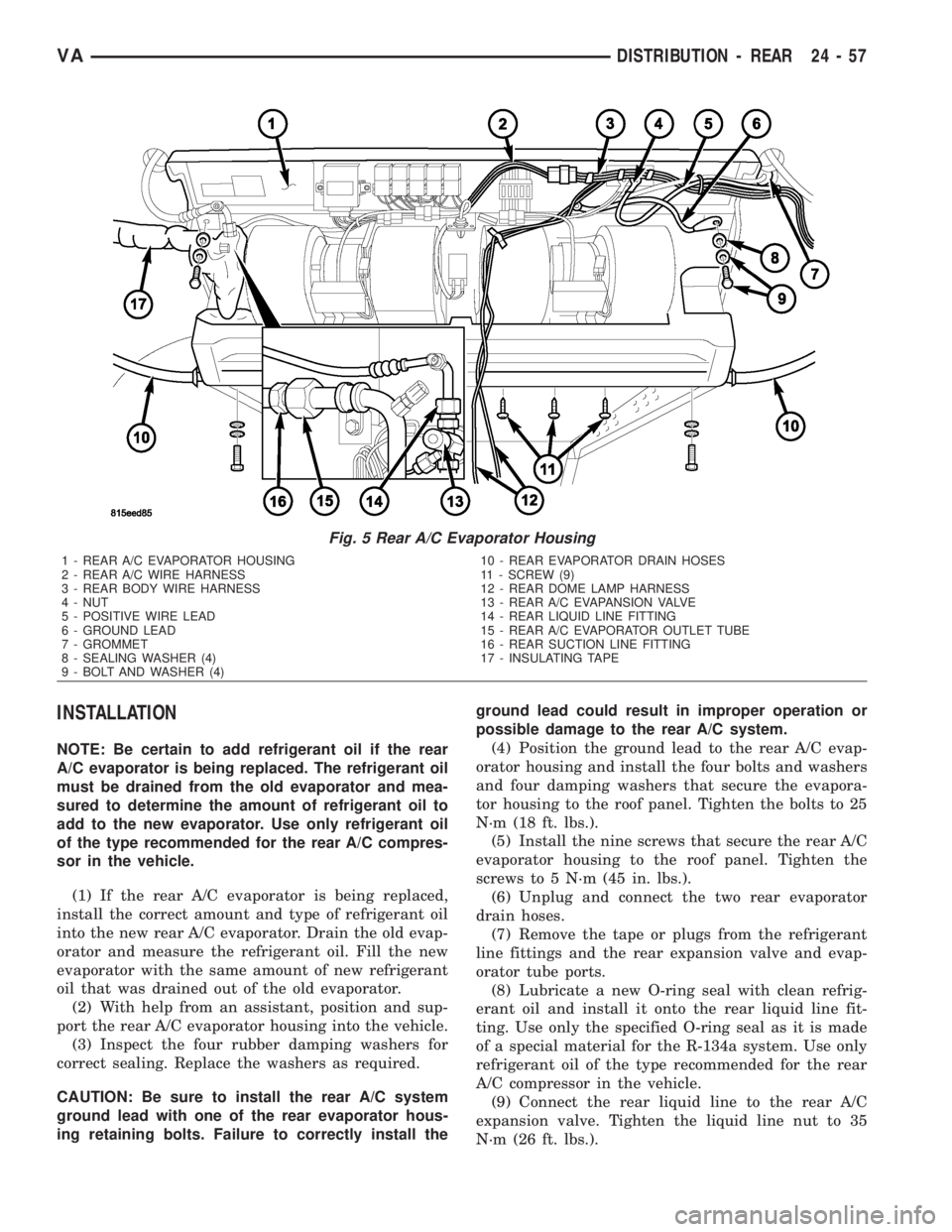
(6) Disengage the rear A/C wire harness grommet
from the roof panel and pull the wire harness down
into the vehicle (Fig. 5).
(7) Disconnect the rear body wire harness connec-
tor from the rear A/C wire harness.
(8) Remove the retaining straps that secure the
rear dome lamp harness to the rear A/C evaporator
housing and position the rear dome lamp harness out
of the way.
(9) Remove the nut that secures the positive wire
lead to the rear A/C system terminal block and posi-
tion the wire lead out of the way.
(10) Remove the insulating tape from around the
rear evaporator connections.(11) Disconnect the rear liquid line from the rear
A/C expansion valve and remove and discard the
O-ring seal.
(12) Disconnect the rear suction line from the rear
evaporator outlet tube and remove and discard the
O-ring seal.
(13) Install plugs into, or tape over the opened
refrigerant line fittings and rear expansion valve and
evaporator tube ports.
(14) Disconnect and install plugs into the two rear
evaporator drain hoses.
(15) Support the rear A/C evaporator housing and
remove the nine screws, four bolts and washers and
four damping washers that secure the rear A/C evap-
orator housing to the roof panel.
(16) With help from an assistant, remove the rear
A/C evaporator housing from the vehicle.
(17) If required, remove the rear A/C evaporator
from the rear A/C evaporator housing (Refer to 24 -
HEATING & AIR CONDITIONING/PLUMBING/
REAR A/C EVAPORATOR - REMOVAL).
Fig. 4 Rear A/C Wire Harness - Condenser Side
1 - REAR CONDERSER FAN SUPPRESSION FILTER
2 - REAR A/C HIGH PRESSURE SWITCH
3 - REAR A/C WIRE HARNESS
4 - GROMMET
5 - RETAINING STRAPS
24 - 56 DISTRIBUTION - REARVA
Page 2094 of 2305
INSTALLATION
NOTE: Be certain to add refrigerant oil if the rear
A/C evaporator is being replaced. The refrigerant oil
must be drained from the old evaporator and mea-
sured to determine the amount of refrigerant oil to
add to the new evaporator. Use only refrigerant oil
of the type recommended for the rear A/C compres-
sor in the vehicle.
(1) If the rear A/C evaporator is being replaced,
install the correct amount and type of refrigerant oil
into the new rear A/C evaporator. Drain the old evap-
orator and measure the refrigerant oil. Fill the new
evaporator with the same amount of new refrigerant
oil that was drained out of the old evaporator.
(2) With help from an assistant, position and sup-
port the rear A/C evaporator housing into the vehicle.
(3) Inspect the four rubber damping washers for
correct sealing. Replace the washers as required.
CAUTION: Be sure to install the rear A/C system
ground lead with one of the rear evaporator hous-
ing retaining bolts. Failure to correctly install theground lead could result in improper operation or
possible damage to the rear A/C system.
(4) Position the ground lead to the rear A/C evap-
orator housing and install the four bolts and washers
and four damping washers that secure the evapora-
tor housing to the roof panel. Tighten the bolts to 25
N´m (18 ft. lbs.).
(5) Install the nine screws that secure the rear A/C
evaporator housing to the roof panel. Tighten the
screws to 5 N´m (45 in. lbs.).
(6) Unplug and connect the two rear evaporator
drain hoses.
(7) Remove the tape or plugs from the refrigerant
line fittings and the rear expansion valve and evap-
orator tube ports.
(8) Lubricate a new O-ring seal with clean refrig-
erant oil and install it onto the rear liquid line fit-
ting. Use only the specified O-ring seal as it is made
of a special material for the R-134a system. Use only
refrigerant oil of the type recommended for the rear
A/C compressor in the vehicle.
(9) Connect the rear liquid line to the rear A/C
expansion valve. Tighten the liquid line nut to 35
N´m (26 ft. lbs.).
Fig. 5 Rear A/C Evaporator Housing
1 - REAR A/C EVAPORATOR HOUSING
2 - REAR A/C WIRE HARNESS
3 - REAR BODY WIRE HARNESS
4 - NUT
5 - POSITIVE WIRE LEAD
6 - GROUND LEAD
7 - GROMMET
8 - SEALING WASHER (4)
9 - BOLT AND WASHER (4)10 - REAR EVAPORATOR DRAIN HOSES
11 - SCREW (9)
12 - REAR DOME LAMP HARNESS
13 - REAR A/C EVAPANSION VALVE
14 - REAR LIQUID LINE FITTING
15 - REAR A/C EVAPORATOR OUTLET TUBE
16 - REAR SUCTION LINE FITTING
17 - INSULATING TAPE
VADISTRIBUTION - REAR 24 - 57