ESP MERCEDES-BENZ SPRINTER 2006 Workshop Manual
[x] Cancel search | Manufacturer: MERCEDES-BENZ, Model Year: 2006, Model line: SPRINTER, Model: MERCEDES-BENZ SPRINTER 2006Pages: 2305, PDF Size: 48.12 MB
Page 389 of 2305
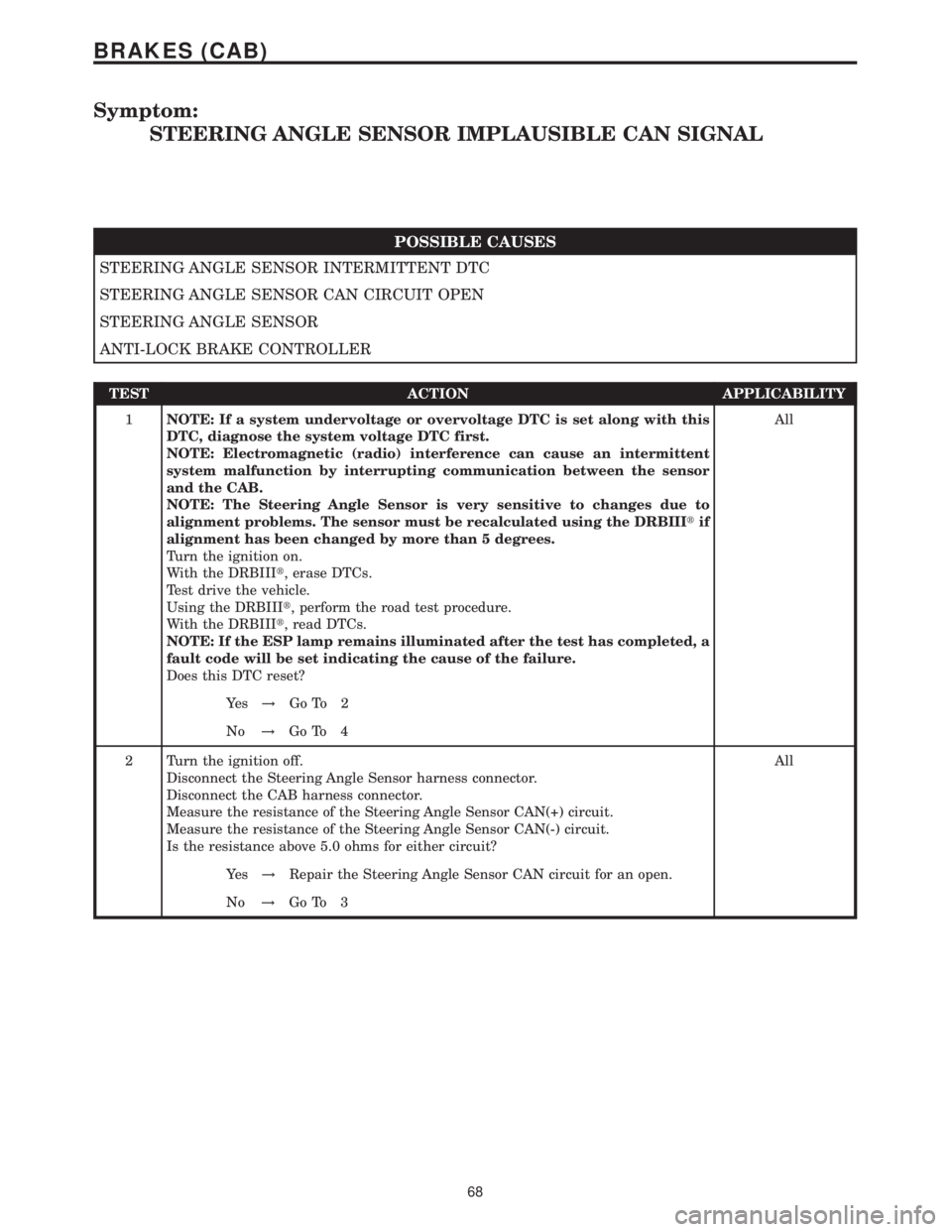
Symptom:
STEERING ANGLE SENSOR IMPLAUSIBLE CAN SIGNAL
POSSIBLE CAUSES
STEERING ANGLE SENSOR INTERMITTENT DTC
STEERING ANGLE SENSOR CAN CIRCUIT OPEN
STEERING ANGLE SENSOR
ANTI-LOCK BRAKE CONTROLLER
TEST ACTION APPLICABILITY
1NOTE: If a system undervoltage or overvoltage DTC is set along with this
DTC, diagnose the system voltage DTC first.
NOTE: Electromagnetic (radio) interference can cause an intermittent
system malfunction by interrupting communication between the sensor
and the CAB.
NOTE: The Steering Angle Sensor is very sensitive to changes due to
alignment problems. The sensor must be recalculated using the DRBIIItif
alignment has been changed by more than 5 degrees.
Turn the ignition on.
With the DRBIIIt, erase DTCs.
Test drive the vehicle.
Using the DRBIIIt, perform the road test procedure.
With the DRBIIIt, read DTCs.
NOTE: If the ESP lamp remains illuminated after the test has completed, a
fault code will be set indicating the cause of the failure.
Does this DTC reset?All
Ye s!Go To 2
No!Go To 4
2 Turn the ignition off.
Disconnect the Steering Angle Sensor harness connector.
Disconnect the CAB harness connector.
Measure the resistance of the Steering Angle Sensor CAN(+) circuit.
Measure the resistance of the Steering Angle Sensor CAN(-) circuit.
Is the resistance above 5.0 ohms for either circuit?All
Ye s!Repair the Steering Angle Sensor CAN circuit for an open.
No!Go To 3
68
BRAKES (CAB)
Page 391 of 2305
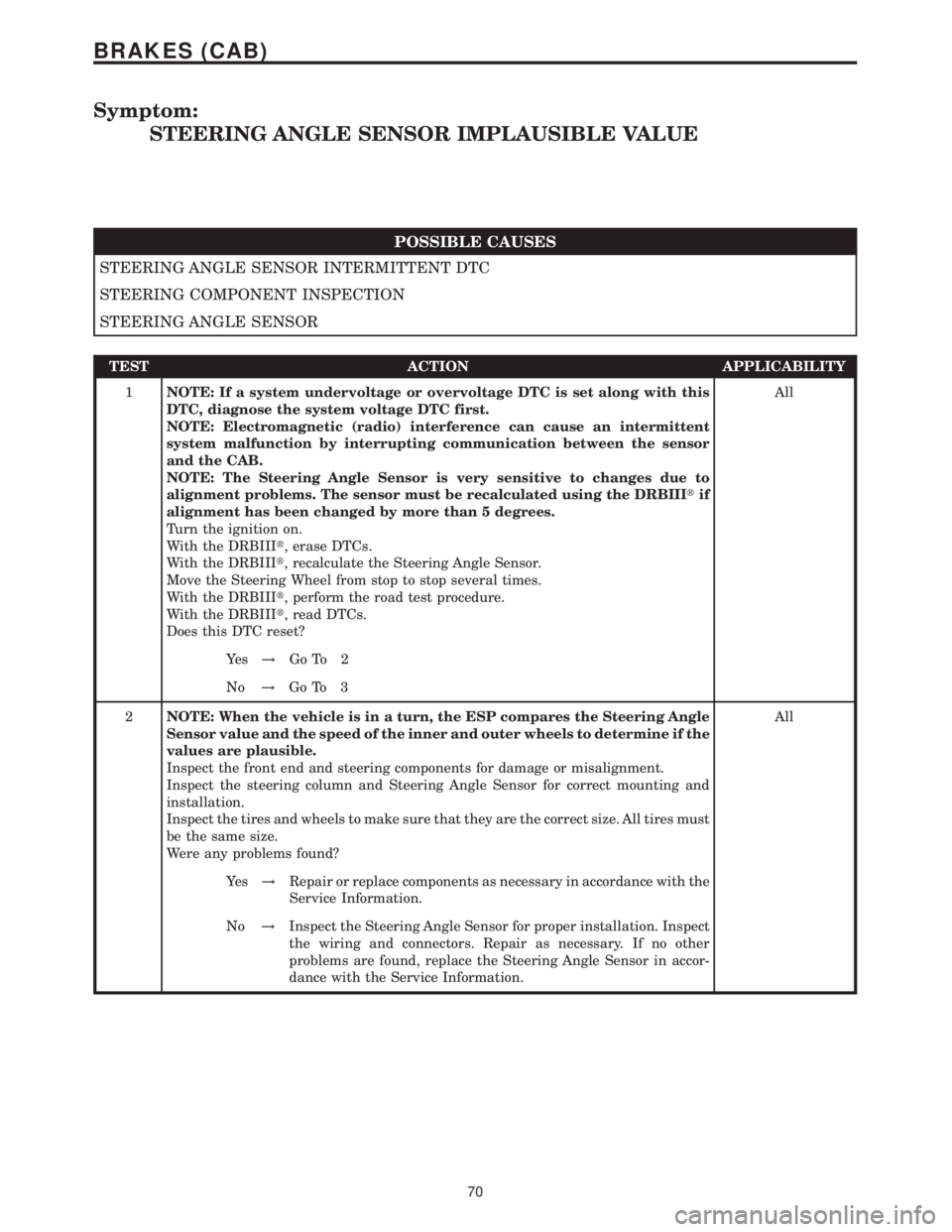
Symptom:
STEERING ANGLE SENSOR IMPLAUSIBLE VALUE
POSSIBLE CAUSES
STEERING ANGLE SENSOR INTERMITTENT DTC
STEERING COMPONENT INSPECTION
STEERING ANGLE SENSOR
TEST ACTION APPLICABILITY
1NOTE: If a system undervoltage or overvoltage DTC is set along with this
DTC, diagnose the system voltage DTC first.
NOTE: Electromagnetic (radio) interference can cause an intermittent
system malfunction by interrupting communication between the sensor
and the CAB.
NOTE: The Steering Angle Sensor is very sensitive to changes due to
alignment problems. The sensor must be recalculated using the DRBIIItif
alignment has been changed by more than 5 degrees.
Turn the ignition on.
With the DRBIIIt, erase DTCs.
With the DRBIIIt, recalculate the Steering Angle Sensor.
Move the Steering Wheel from stop to stop several times.
With the DRBIIIt, perform the road test procedure.
With the DRBIIIt, read DTCs.
Does this DTC reset?All
Ye s!Go To 2
No!Go To 3
2NOTE: When the vehicle is in a turn, the ESP compares the Steering Angle
Sensor value and the speed of the inner and outer wheels to determine if the
values are plausible.
Inspect the front end and steering components for damage or misalignment.
Inspect the steering column and Steering Angle Sensor for correct mounting and
installation.
Inspect the tires and wheels to make sure that they are the correct size. All tires must
be the same size.
Were any problems found?All
Ye s!Repair or replace components as necessary in accordance with the
Service Information.
No!Inspect the Steering Angle Sensor for proper installation. Inspect
the wiring and connectors. Repair as necessary. If no other
problems are found, replace the Steering Angle Sensor in accor-
dance with the Service Information.
70
BRAKES (CAB)
Page 393 of 2305
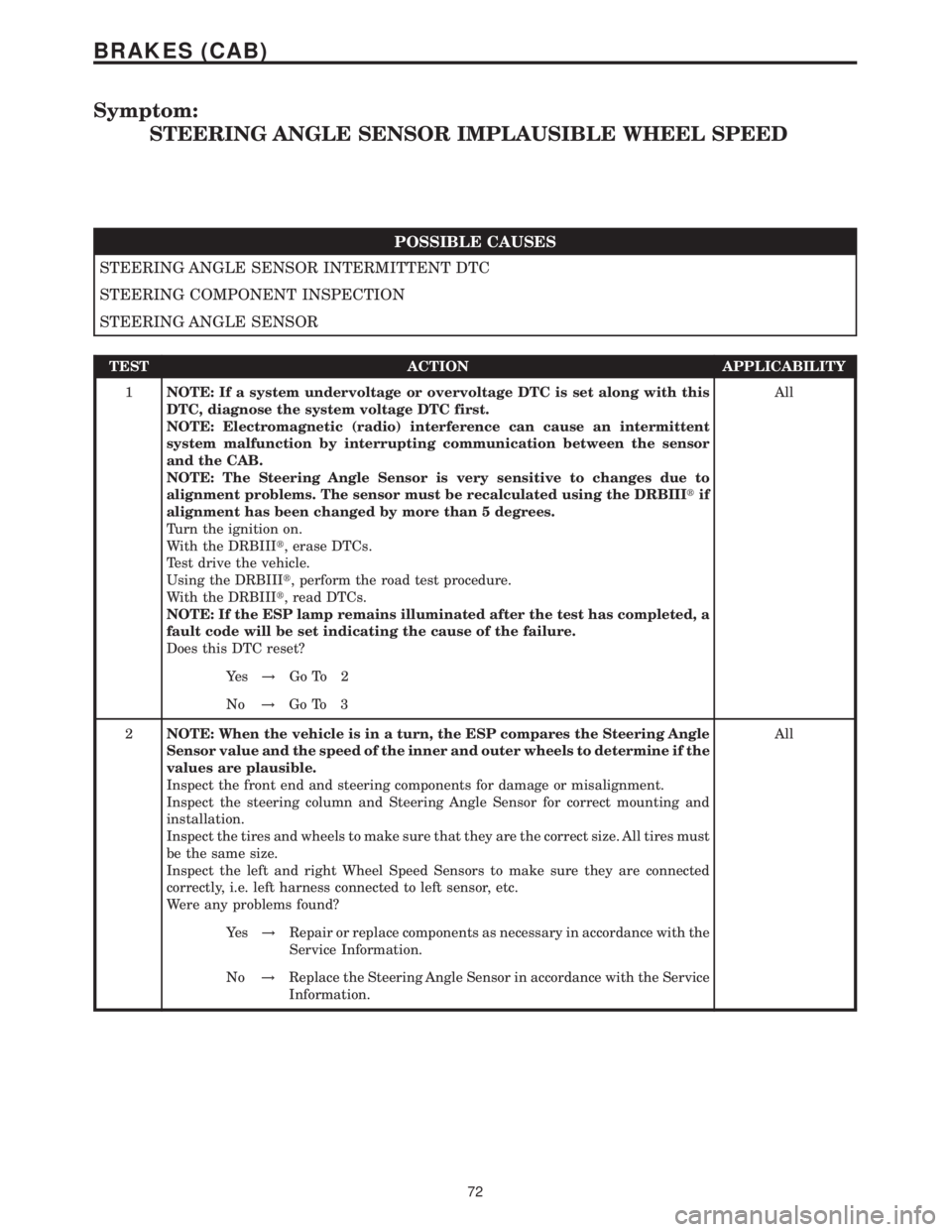
Symptom:
STEERING ANGLE SENSOR IMPLAUSIBLE WHEEL SPEED
POSSIBLE CAUSES
STEERING ANGLE SENSOR INTERMITTENT DTC
STEERING COMPONENT INSPECTION
STEERING ANGLE SENSOR
TEST ACTION APPLICABILITY
1NOTE: If a system undervoltage or overvoltage DTC is set along with this
DTC, diagnose the system voltage DTC first.
NOTE: Electromagnetic (radio) interference can cause an intermittent
system malfunction by interrupting communication between the sensor
and the CAB.
NOTE: The Steering Angle Sensor is very sensitive to changes due to
alignment problems. The sensor must be recalculated using the DRBIIItif
alignment has been changed by more than 5 degrees.
Turn the ignition on.
With the DRBIIIt, erase DTCs.
Test drive the vehicle.
Using the DRBIIIt, perform the road test procedure.
With the DRBIIIt, read DTCs.
NOTE: If the ESP lamp remains illuminated after the test has completed, a
fault code will be set indicating the cause of the failure.
Does this DTC reset?All
Ye s!Go To 2
No!Go To 3
2NOTE: When the vehicle is in a turn, the ESP compares the Steering Angle
Sensor value and the speed of the inner and outer wheels to determine if the
values are plausible.
Inspect the front end and steering components for damage or misalignment.
Inspect the steering column and Steering Angle Sensor for correct mounting and
installation.
Inspect the tires and wheels to make sure that they are the correct size. All tires must
be the same size.
Inspect the left and right Wheel Speed Sensors to make sure they are connected
correctly, i.e. left harness connected to left sensor, etc.
Were any problems found?All
Ye s!Repair or replace components as necessary in accordance with the
Service Information.
No!Replace the Steering Angle Sensor in accordance with the Service
Information.
72
BRAKES (CAB)
Page 404 of 2305
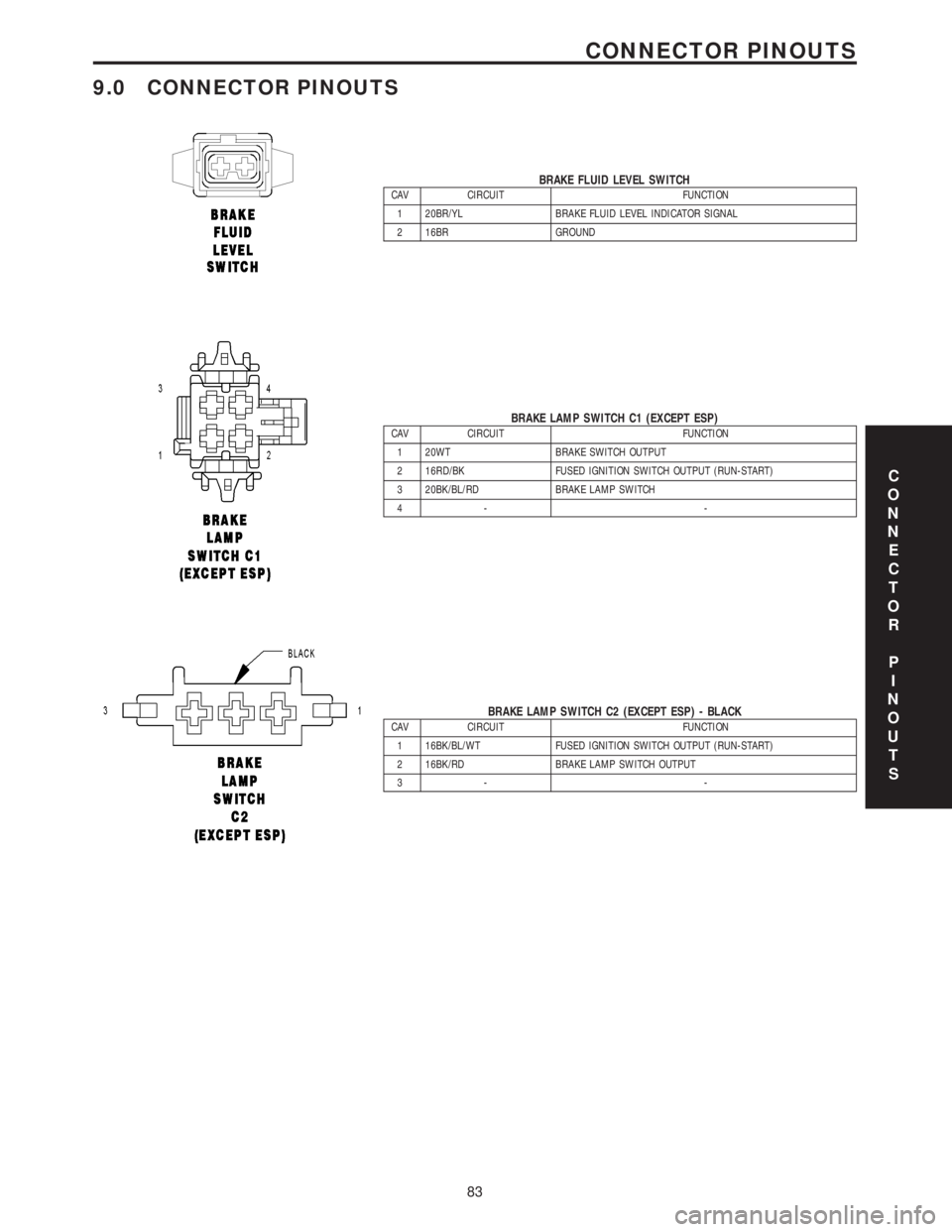
9.0 CONNECTOR PINOUTS
BRAKE FLUID LEVEL SWITCHCAV CIRCUIT FUNCTION
1 20BR/YL BRAKE FLUID LEVEL INDICATOR SIGNAL
2 16BR GROUND
BRAKE LAMP SWITCH C1 (EXCEPT ESP)CAV CIRCUIT FUNCTION
1 20WT BRAKE SWITCH OUTPUT
2 16RD/BK FUSED IGNITION SWITCH OUTPUT (RUN-START)
3 20BK/BL/RD BRAKE LAMP SWITCH
4- -
BRAKE LAMP SWITCH C2 (EXCEPT ESP) - BLACKCAV CIRCUIT FUNCTION
1 16BK/BL/WT FUSED IGNITION SWITCH OUTPUT (RUN-START)
2 16BK/RD BRAKE LAMP SWITCH OUTPUT
3- -
C
O
N
N
E
C
T
O
R
P
I
N
O
U
T
S
83
CONNECTOR PINOUTS
Page 412 of 2305
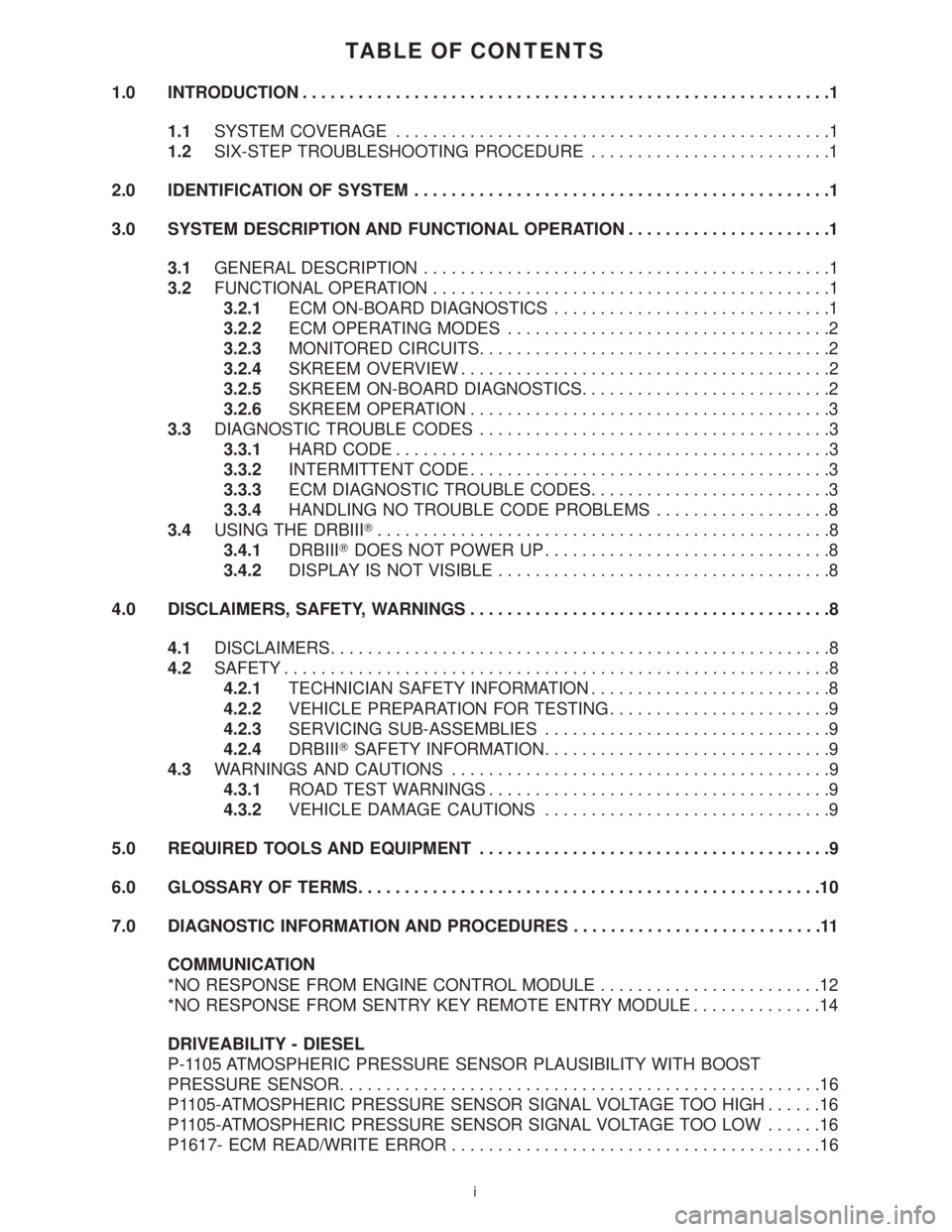
TABLE OF CONTENTS
1.0 INTRODUCTION.........................................................1
1.1SYSTEM COVERAGE...............................................1
1.2SIX-STEP TROUBLESHOOTING PROCEDURE..........................1
2.0 IDENTIFICATION OF SYSTEM.............................................1
3.0 SYSTEM DESCRIPTION AND FUNCTIONAL OPERATION......................1
3.1GENERAL DESCRIPTION............................................1
3.2FUNCTIONAL OPERATION...........................................1
3.2.1ECM ON-BOARD DIAGNOSTICS..............................1
3.2.2ECM OPERATING MODES...................................2
3.2.3MONITORED CIRCUITS......................................2
3.2.4SKREEM OVERVIEW........................................2
3.2.5SKREEM ON-BOARD DIAGNOSTICS...........................2
3.2.6SKREEM OPERATION.......................................3
3.3DIAGNOSTIC TROUBLE CODES......................................3
3.3.1HARD CODE...............................................3
3.3.2INTERMITTENT CODE.......................................3
3.3.3ECM DIAGNOSTIC TROUBLE CODES..........................3
3.3.4HANDLING NO TROUBLE CODE PROBLEMS...................8
3.4USING THE DRBIIIT.................................................8
3.4.1DRBIIITDOES NOT POWER UP...............................8
3.4.2DISPLAY IS NOT VISIBLE....................................8
4.0 DISCLAIMERS, SAFETY, WARNINGS.......................................8
4.1DISCLAIMERS......................................................8
4.2SAFETY...........................................................8
4.2.1TECHNICIAN SAFETY INFORMATION..........................8
4.2.2VEHICLE PREPARATION FOR TESTING........................9
4.2.3SERVICING SUB-ASSEMBLIES...............................9
4.2.4DRBIIITSAFETY INFORMATION...............................9
4.3WARNINGS AND CAUTIONS.........................................9
4.3.1ROAD TEST WARNINGS.....................................9
4.3.2VEHICLE DAMAGE CAUTIONS...............................9
5.0 REQUIRED TOOLS AND EQUIPMENT......................................9
6.0 GLOSSARY OF TERMS..................................................10
7.0 DIAGNOSTIC INFORMATION AND PROCEDURES...........................11
COMMUNICATION
*NO RESPONSE FROM ENGINE CONTROL MODULE........................12
*NO RESPONSE FROM SENTRY KEY REMOTE ENTRY MODULE..............14
DRIVEABILITY - DIESEL
P-1105 ATMOSPHERIC PRESSURE SENSOR PLAUSIBILITY WITH BOOST
PRESSURE SENSOR....................................................16
P1105-ATMOSPHERIC PRESSURE SENSOR SIGNAL VOLTAGE TOO HIGH......16
P1105-ATMOSPHERIC PRESSURE SENSOR SIGNAL VOLTAGE TOO LOW......16
P1617- ECM READ/WRITE ERROR........................................16
i
Page 425 of 2305
3.2.2 ECM OPERATING MODES
As input signals to the ECM change, the ECM
adjusts its response to the output devices. For
example, the ECM must calculate a different fuel
quantity and fuel timing for engine idle condition
than it would for a wide open throttle condition.
There are several different modes of operation that
determine how the ECM responds to the various
input signals.
Ignition Switch On (Engine Off)
When the ignition is turned on the ECM activates
the glow plug relay for a time period that is deter-
mined by engine coolant temperature, intake air
temperature and battery voltage.
Engine Start-Up Mode
The ECM uses the intake air temperature sensor,
engine temperature sensor and the crankshaft po-
sition sensor (engine speed) inputs to determine
fuel injection quantity.
Normal Driving Modes
Engine idle, warm-up, acceleration, deceleration
and wide open throttle modes are controlled based
on all of the sensor inputs to the ECM. The ECM
uses these sensor inputs to adjust fuel quantity and
fuel injector timing. EGR valve control is performed
using feedback from the oxygen sensor. An oxygen
sensor is located in the exhaust manifold to sample
oxygen content exiting the engine cylinders. The
ECM uses the O2 sensor, along with other sensor
inputs, to govern the amount of exhaust gas recir-
culation to reduce HC (HydroCarbons) and CO
(Carbon Monoxide). Engine coolant is routed
through the base of the EGR valve to provide
additional cooling of the exhaust gas, which further
helps the reductions of emissions. The EGR valve
has a self-cleaning function. When the engine is
shut off, the EGR valve rotates twice to reduce
carbon deposits at the valve seat.
Overheat Production Mode
If the engine temperature is above 105ÉC (221ÉF)
and vehicle speed is above 40 km/h (25 MPH) the
ECM will limit fuel quantity for engine protection.
Limp-In Mode
The ECM utilizes different degrees of engine
limp-in. The ECM is able to limit engine rpm,
engine power output (turbo boost reduction), acti-
vate engine cooling fan or all of these functions
based on the type of fault that is detected. Critical
engine performance faults such as accelerator pedal
position sensor fault will result in a fixed idle speed
of approximately 680 rpm regardless of actual pedalposition. Other less critical faults will result in
power reduction throughout the full range of driv-
ing conditions.
Overspeed Detection Mode
If the ECM detects engine RPM that exceeds
5200 RPM, the ECM will set a DTC in memory,
limit engine RPM to no more than 2500 RPM, and
illuminate the MIL until the DTC is cleared.
After-Run Mode
The ECM transfers RAM information to ROM
and performs an Input/Output state check.
3.2.3 MONITORED CIRCUITS
The ECM is able to monitor and identify most
driveability related trouble conditions. Some cir-
cuits are directly monitored through ECM feedback
circuitry. In addition, the ECM monitors the voltage
state of some circuits and compares those states
with expected values. Other systems are monitored
indirectly when the ECM conducts a rationality test
to identify problems.
Although most subsystems of the engine control
module are either directly or indirectly monitored,
there may be occasions when diagnostic trouble
codes are not immediately identified. For a trouble
code to set, a specific set of conditions must occur
and unless these conditions occur, a DTC will not
set.
3.2.4 SKREEM OVERVIEW
The sentry key remote entry module system
(SKREEM) is designed to prevent unauthorized
vehicle operation. The system consists of a sentry
key remote entry module (SKREEM), ignition
key(s) equipped with a transponder chip and the
ECM. When the ignition switch is turned on, the
SKREEM interrogates the ignition key. If the igni-
tion key is Valid or Invalid, the SKREEM sends a
message to the ECM indicating ignition key status.
Upon receiving this message the ECM will termi-
nate engine operation or allow the engine to con-
tinue to operate.
3.2.5 SKREEM ON-BOARD DIAGNOSTICS
The SKREEM has been programmed to transmit
and monitor many different coded messages as well
as CAN Bus messages. This monitoring is called
On-Board Diagnostics. Certain criteria must be met
for a DTC to be entered into SKREEM memory. The
criteria may be a range of; input voltage, CAN Bus
message or coded messages to the SKREEM. If all
the criteria for monitoring a circuit or function are
met and a fault is detected, a DTC will be stored in
the SKREEM memory and the START ERROR indi-
cator will be turned on in the instrument cluster.
2
GENERAL INFORMATION
Page 426 of 2305
3.2.6 SKREEM OPERATION
When ignition power is supplied to the SKREEM,
the SKREEM performs an internal self-test. After
the self-test is complete, the SKREEM energizes
the antenna (this activates the transponder chip)
and sends a challenge to the transponder chip. The
transponder chip responds to the challenge by gen-
erating an encrypted response message.
After responding to the coded message, the tran-
sponder sends a transponder ID message to the
SKREEM. The SKREEM compares the transpon-
der ID message to the available valid key codes in
SKREEM memory (8 key maximum at any one
time). After validating the ignition key the
SKREEM sends a CAN Bus message request to the
ECM, then waits for the ECM response. If the ECM
does not respond, the SKREEM will send the re-
quest again. If the ECM does not respond again, the
SKREEM will stop sending the request and store a
trouble code in memory. If the ECM sends a correct
response to the SKREEM, the SKREEM sends a
valid/invalid key message to the ECM. The ECM
will allow or disallow engine operation based on this
message.
Secret Key - an electronically stored value (iden-
tification number) that is unique to each SKREEM.
The secret key is stored in the SKREEM, ECM and
all ignition key transponders.
Challenge - a random number that is generated by
the SKREEM at each ignition key cycle.
The secret key and challenge are the two vari-
ables used in the algorithm that produces the
encrypted response message. The transponder uses
the crypto algorithm to receive, decode and respond
to the message sent by the SKREEM. After re-
sponding to the coded message, the transponder
sends a transponder ID message to the SKREEM.
3.3 DIAGNOSTIC TROUBLE CODES
Each diagnostic trouble code (DTC) is diagnosed
by following a specific procedure. The diagnostic
test procedure contains step-by-step instruction for
determining the cause of the DTC as well as no
trouble code problems. It is not necessary to per-
form all of the tests in this book to diagnose an
individual code.
Always begin diagnosis by reading the DTCs
using the DRBIIIt. This will direct you to the
specific test(s) that must be performed.
3.3.1 HARD CODE
A DTC that comes back within one cycle of the
ignition key is a hard code. This means that the
problem is current every time the ECM/SKREEM
checks that circuit or function. Procedures in this
manual verify if the DTC is a hard code at thebeginning of each test. When the fault is not a hard
code, an intermittent test must be performed.
NOTE: If the DRBIIITdisplays faults for
multiple components (i.e. ECT, MAF, IAT
sensors) identify and check the shared
circuits for possible problems before
continuing (i.e. sensor grounds or 5-volt
supply circuits). Refer to the appropriate
schematic to identify shared circuits.
3.3.2 INTERMITTENT CODE
A DTC that is not current every time the ECM/
SKREEM checks the circuit or function is an inter-
mittent code. Most intermittent DTCs are caused
by wiring or connector problems. Problems that
come and go like this are the most difficult to
diagnose; they must be looked for under specific
conditions that cause them. The following checks
may assist you in identifying a possible intermit-
tent problem.
± Visually inspect the related wire harness con-
nectors. Look for broken, bent, pushed out or
corroded terminals.
± Visually inspect the related wire harness.
Look for chafed, pierced or partially broken
wire.
± Refer to hotlines or technical service bulletins
that may apply.
NOTE: Electromagnetic (radio) interference
can cause an intermittent system
malfunction. This interference can interrupt
communication between the ignition key
transponder and the SKREEM.
3.3.3 ECM DIAGNOSTIC TROUBLE CODES
IMPORTANT NOTE: Before replacing the
ECM for a failed driver, control circuit or
ground circuit, be sure to check the related
component/circuit integrity for failures not
detected due to a double fault in the circuit.
Most ECM driver/control circuit failures are
caused by internal failures to components
(i.e. relays and solenoids) and shorted
circuits (i.e. sensor pull-ups, drivers and
ground circuits). These faults are difficult to
detect when a double fault has occurred and
only one DTC has set.
If the DRBIIItdisplays faults for multiple com-
ponents (i.e. MAF, ECT, ENG OIL, etc.), identify
and check the shared circuits for possible problems
before continuing (i.e. sensor grounds or 5-volt
3
GENERAL INFORMATION
Page 431 of 2305
3.3.4 HANDLING NO TROUBLE CODE
PROBLEMS
After reading Section 3.0 (System Description
and Functional Operation), you should have a bet-
ter understanding of the theory and operation of the
on-board diagnostics and how this relates to the
diagnosis of a vehicle that may have a driveability-
related symptom or complaint. When there are no
trouble codes present, refer to the no trouble code
(*) tests.
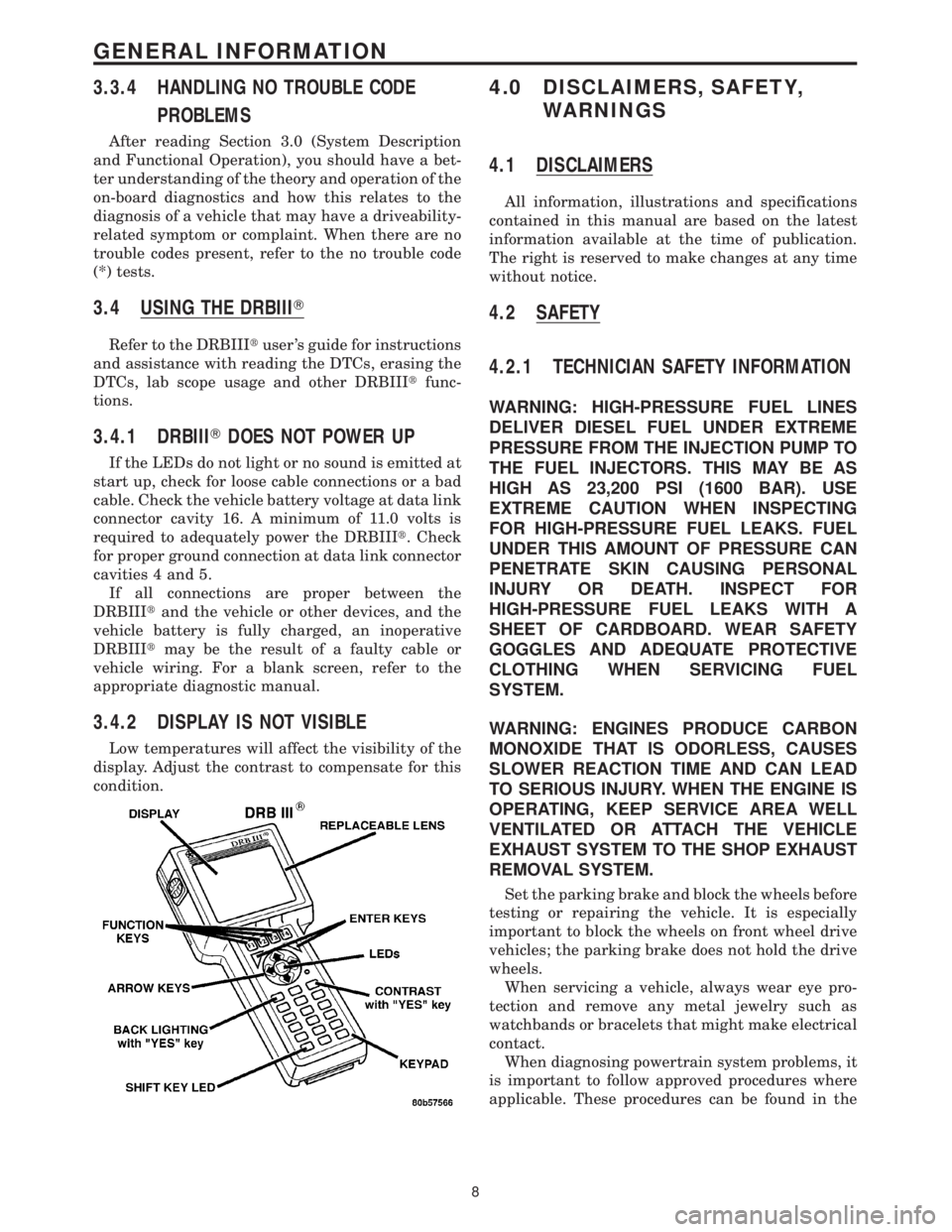
3.4 USING THE DRBIIIT
Refer to the DRBIIItuser 's guide for instructions
and assistance with reading the DTCs, erasing the
DTCs, lab scope usage and other DRBIIItfunc-
tions.
3.4.1 DRBIIITDOES NOT POWER UP
If the LEDs do not light or no sound is emitted at
start up, check for loose cable connections or a bad
cable. Check the vehicle battery voltage at data link
connector cavity 16. A minimum of 11.0 volts is
required to adequately power the DRBIIIt. Check
for proper ground connection at data link connector
cavities 4 and 5.
If all connections are proper between the
DRBIIItand the vehicle or other devices, and the
vehicle battery is fully charged, an inoperative
DRBIIItmay be the result of a faulty cable or
vehicle wiring. For a blank screen, refer to the
appropriate diagnostic manual.
3.4.2 DISPLAY IS NOT VISIBLE
Low temperatures will affect the visibility of the
display. Adjust the contrast to compensate for this
condition.
4.0 DISCLAIMERS, SAFETY,
WARNINGS
4.1 DISCLAIMERS
All information, illustrations and specifications
contained in this manual are based on the latest
information available at the time of publication.
The right is reserved to make changes at any time
without notice.
4.2 SAFETY
4.2.1 TECHNICIAN SAFETY INFORMATION
WARNING: HIGH-PRESSURE FUEL LINES
DELIVER DIESEL FUEL UNDER EXTREME
PRESSURE FROM THE INJECTION PUMP TO
THE FUEL INJECTORS. THIS MAY BE AS
HIGH AS 23,200 PSI (1600 BAR). USE
EXTREME CAUTION WHEN INSPECTING
FOR HIGH-PRESSURE FUEL LEAKS. FUEL
UNDER THIS AMOUNT OF PRESSURE CAN
PENETRATE SKIN CAUSING PERSONAL
INJURY OR DEATH. INSPECT FOR
HIGH-PRESSURE FUEL LEAKS WITH A
SHEET OF CARDBOARD. WEAR SAFETY
GOGGLES AND ADEQUATE PROTECTIVE
CLOTHING WHEN SERVICING FUEL
SYSTEM.
WARNING: ENGINES PRODUCE CARBON
MONOXIDE THAT IS ODORLESS, CAUSES
SLOWER REACTION TIME AND CAN LEAD
TO SERIOUS INJURY. WHEN THE ENGINE IS
OPERATING, KEEP SERVICE AREA WELL
VENTILATED OR ATTACH THE VEHICLE
EXHAUST SYSTEM TO THE SHOP EXHAUST
REMOVAL SYSTEM.
Set the parking brake and block the wheels before
testing or repairing the vehicle. It is especially
important to block the wheels on front wheel drive
vehicles; the parking brake does not hold the drive
wheels.
When servicing a vehicle, always wear eye pro-
tection and remove any metal jewelry such as
watchbands or bracelets that might make electrical
contact.
When diagnosing powertrain system problems, it
is important to follow approved procedures where
applicable. These procedures can be found in the
8
GENERAL INFORMATION
Page 435 of 2305
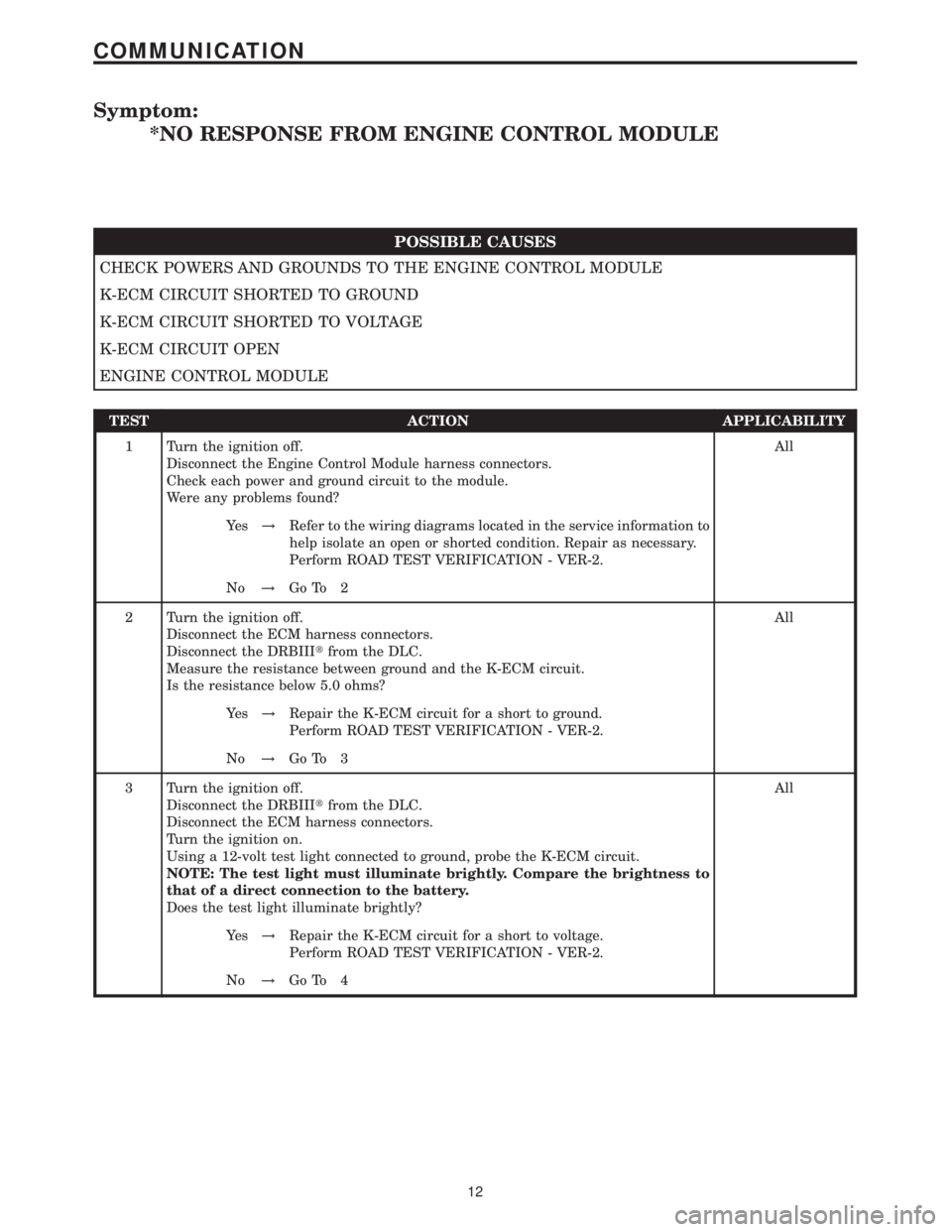
Symptom:
*NO RESPONSE FROM ENGINE CONTROL MODULE
POSSIBLE CAUSES
CHECK POWERS AND GROUNDS TO THE ENGINE CONTROL MODULE
K-ECM CIRCUIT SHORTED TO GROUND
K-ECM CIRCUIT SHORTED TO VOLTAGE
K-ECM CIRCUIT OPEN
ENGINE CONTROL MODULE
TEST ACTION APPLICABILITY
1 Turn the ignition off.
Disconnect the Engine Control Module harness connectors.
Check each power and ground circuit to the module.
Were any problems found?All
Ye s!Refer to the wiring diagrams located in the service information to
help isolate an open or shorted condition. Repair as necessary.
Perform ROAD TEST VERIFICATION - VER-2.
No!Go To 2
2 Turn the ignition off.
Disconnect the ECM harness connectors.
Disconnect the DRBIIItfrom the DLC.
Measure the resistance between ground and the K-ECM circuit.
Is the resistance below 5.0 ohms?All
Ye s!Repair the K-ECM circuit for a short to ground.
Perform ROAD TEST VERIFICATION - VER-2.
No!Go To 3
3 Turn the ignition off.
Disconnect the DRBIIItfrom the DLC.
Disconnect the ECM harness connectors.
Turn the ignition on.
Using a 12-volt test light connected to ground, probe the K-ECM circuit.
NOTE: The test light must illuminate brightly. Compare the brightness to
that of a direct connection to the battery.
Does the test light illuminate brightly?All
Ye s!Repair the K-ECM circuit for a short to voltage.
Perform ROAD TEST VERIFICATION - VER-2.
No!Go To 4
12
COMMUNICATION
Page 436 of 2305
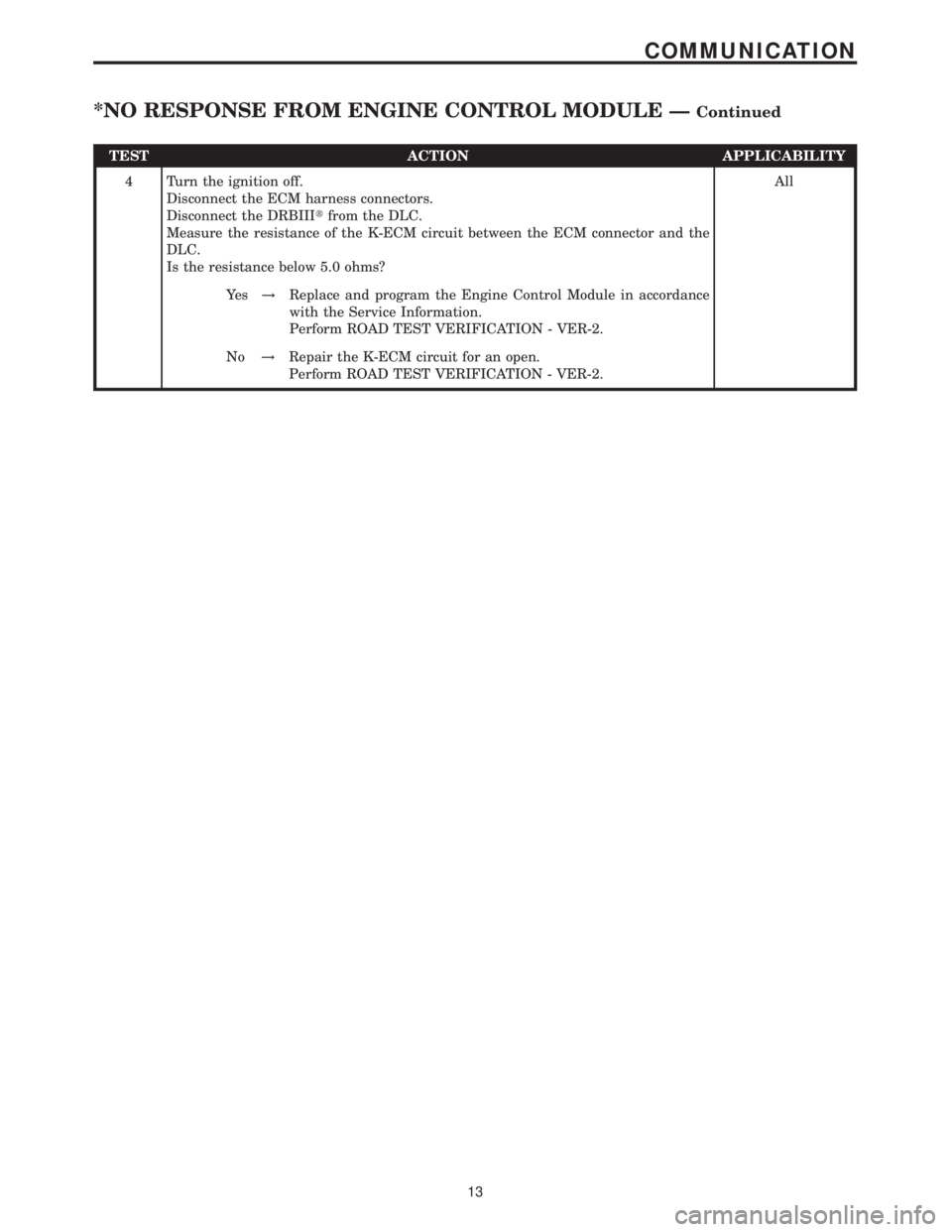
TEST ACTION APPLICABILITY
4 Turn the ignition off.
Disconnect the ECM harness connectors.
Disconnect the DRBIIItfrom the DLC.
Measure the resistance of the K-ECM circuit between the ECM connector and the
DLC.
Is the resistance below 5.0 ohms?All
Ye s!Replace and program the Engine Control Module in accordance
with the Service Information.
Perform ROAD TEST VERIFICATION - VER-2.
No!Repair the K-ECM circuit for an open.
Perform ROAD TEST VERIFICATION - VER-2.
13
COMMUNICATION
*NO RESPONSE FROM ENGINE CONTROL MODULE ÐContinued