engine MERCEDES-BENZ SPRINTER 2006 Service Manual
[x] Cancel search | Manufacturer: MERCEDES-BENZ, Model Year: 2006, Model line: SPRINTER, Model: MERCEDES-BENZ SPRINTER 2006Pages: 2305, PDF Size: 48.12 MB
Page 1717 of 2305
OPERATION
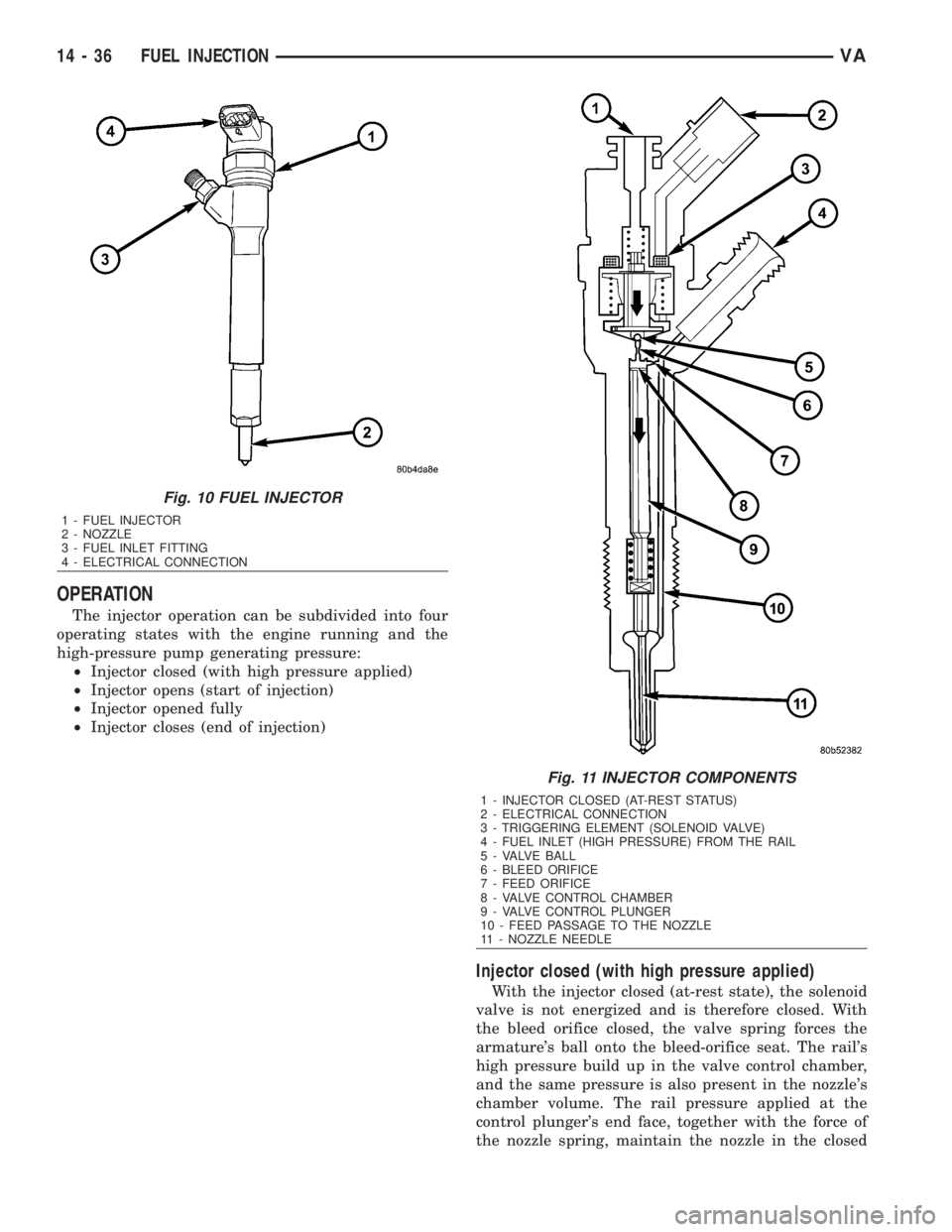
The injector operation can be subdivided into four
operating states with the engine running and the
high-pressure pump generating pressure:
²Injector closed (with high pressure applied)
²Injector opens (start of injection)
²Injector opened fully
²Injector closes (end of injection)
Injector closed (with high pressure applied)
With the injector closed (at-rest state), the solenoid
valve is not energized and is therefore closed. With
the bleed orifice closed, the valve spring forces the
armature's ball onto the bleed-orifice seat. The rail's
high pressure build up in the valve control chamber,
and the same pressure is also present in the nozzle's
chamber volume. The rail pressure applied at the
control plunger's end face, together with the force of
the nozzle spring, maintain the nozzle in the closed
Fig. 10 FUEL INJECTOR
1 - FUEL INJECTOR
2 - NOZZLE
3 - FUEL INLET FITTING
4 - ELECTRICAL CONNECTION
Fig. 11 INJECTOR COMPONENTS
1 - INJECTOR CLOSED (AT-REST STATUS)
2 - ELECTRICAL CONNECTION
3 - TRIGGERING ELEMENT (SOLENOID VALVE)
4 - FUEL INLET (HIGH PRESSURE) FROM THE RAIL
5 - VALVE BALL
6 - BLEED ORIFICE
7 - FEED ORIFICE
8 - VALVE CONTROL CHAMBER
9 - VALVE CONTROL PLUNGER
10 - FEED PASSAGE TO THE NOZZLE
11 - NOZZLE NEEDLE
14 - 36 FUEL INJECTIONVA
Page 1718 of 2305
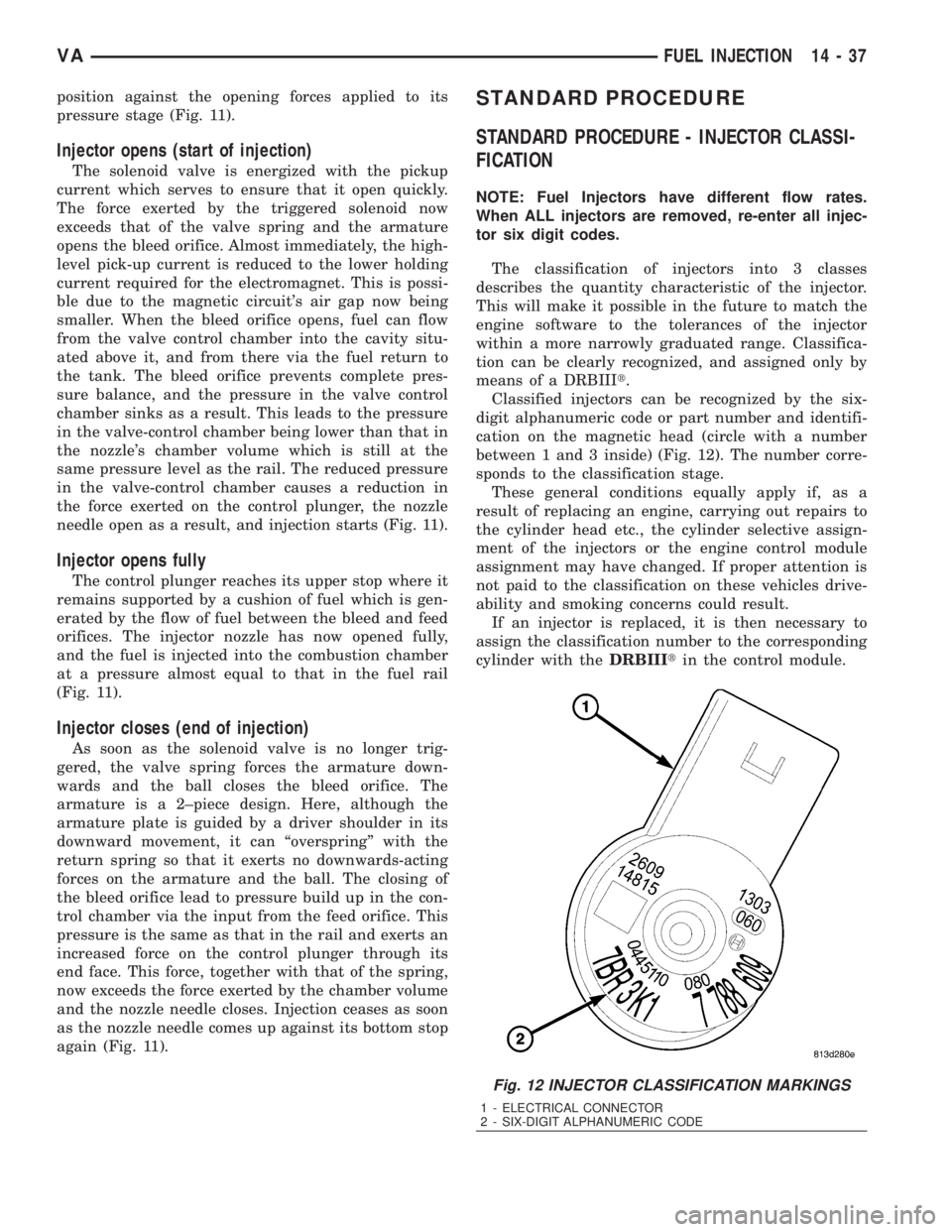
position against the opening forces applied to its
pressure stage (Fig. 11).
Injector opens (start of injection)
The solenoid valve is energized with the pickup
current which serves to ensure that it open quickly.
The force exerted by the triggered solenoid now
exceeds that of the valve spring and the armature
opens the bleed orifice. Almost immediately, the high-
level pick-up current is reduced to the lower holding
current required for the electromagnet. This is possi-
ble due to the magnetic circuit's air gap now being
smaller. When the bleed orifice opens, fuel can flow
from the valve control chamber into the cavity situ-
ated above it, and from there via the fuel return to
the tank. The bleed orifice prevents complete pres-
sure balance, and the pressure in the valve control
chamber sinks as a result. This leads to the pressure
in the valve-control chamber being lower than that in
the nozzle's chamber volume which is still at the
same pressure level as the rail. The reduced pressure
in the valve-control chamber causes a reduction in
the force exerted on the control plunger, the nozzle
needle open as a result, and injection starts (Fig. 11).
Injector opens fully
The control plunger reaches its upper stop where it
remains supported by a cushion of fuel which is gen-
erated by the flow of fuel between the bleed and feed
orifices. The injector nozzle has now opened fully,
and the fuel is injected into the combustion chamber
at a pressure almost equal to that in the fuel rail
(Fig. 11).
Injector closes (end of injection)
As soon as the solenoid valve is no longer trig-
gered, the valve spring forces the armature down-
wards and the ball closes the bleed orifice. The
armature is a 2±piece design. Here, although the
armature plate is guided by a driver shoulder in its
downward movement, it can ªoverspringº with the
return spring so that it exerts no downwards-acting
forces on the armature and the ball. The closing of
the bleed orifice lead to pressure build up in the con-
trol chamber via the input from the feed orifice. This
pressure is the same as that in the rail and exerts an
increased force on the control plunger through its
end face. This force, together with that of the spring,
now exceeds the force exerted by the chamber volume
and the nozzle needle closes. Injection ceases as soon
as the nozzle needle comes up against its bottom stop
again (Fig. 11).
STANDARD PROCEDURE
STANDARD PROCEDURE - INJECTOR CLASSI-
FICATION
NOTE: Fuel Injectors have different flow rates.
When ALL injectors are removed, re-enter all injec-
tor six digit codes.
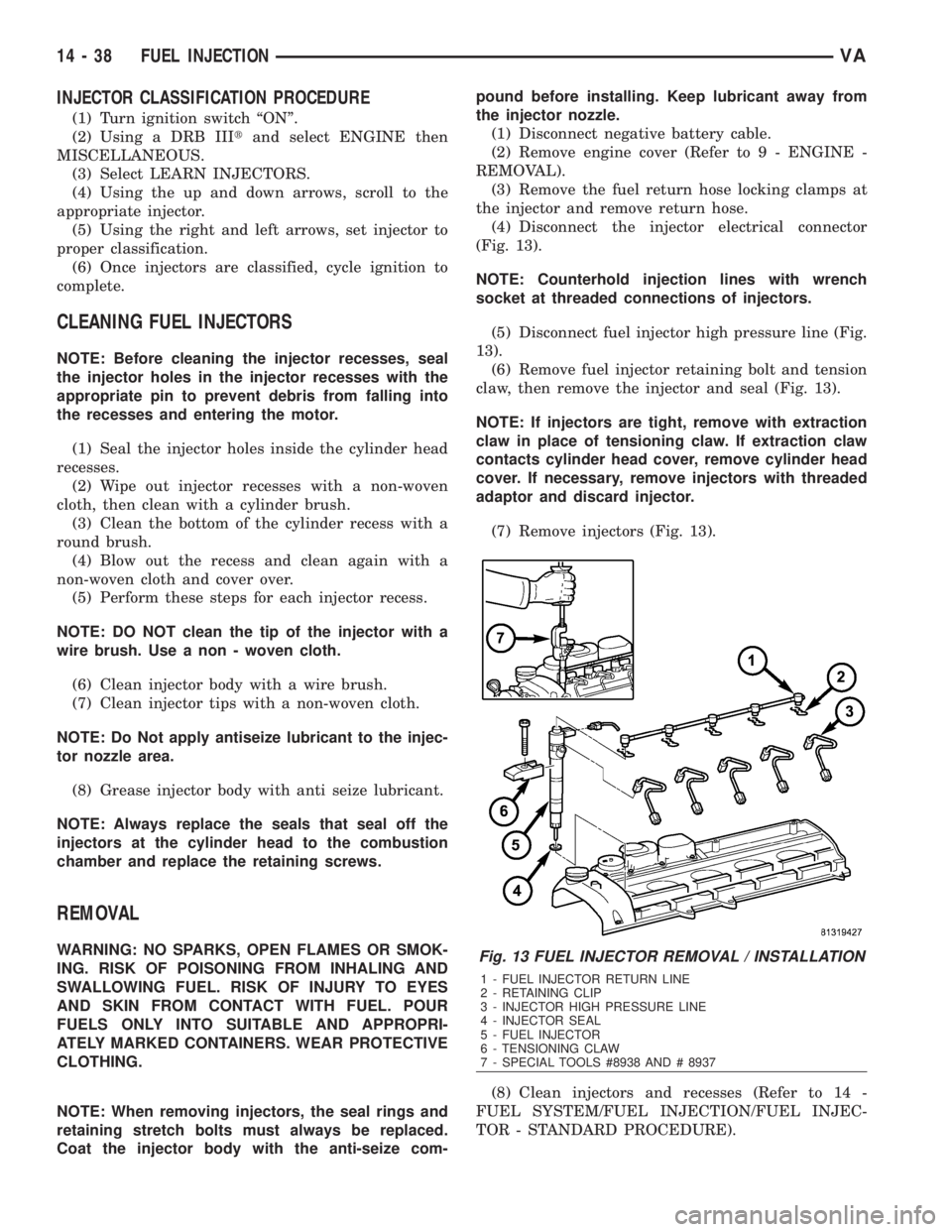
The classification of injectors into 3 classes
describes the quantity characteristic of the injector.
This will make it possible in the future to match the
engine software to the tolerances of the injector
within a more narrowly graduated range. Classifica-
tion can be clearly recognized, and assigned only by
means of a DRBIIIt.
Classified injectors can be recognized by the six-
digit alphanumeric code or part number and identifi-
cation on the magnetic head (circle with a number
between 1 and 3 inside) (Fig. 12). The number corre-
sponds to the classification stage.
These general conditions equally apply if, as a
result of replacing an engine, carrying out repairs to
the cylinder head etc., the cylinder selective assign-
ment of the injectors or the engine control module
assignment may have changed. If proper attention is
not paid to the classification on these vehicles drive-
ability and smoking concerns could result.
If an injector is replaced, it is then necessary to
assign the classification number to the corresponding
cylinder with theDRBIIItin the control module.
Fig. 12 INJECTOR CLASSIFICATION MARKINGS
1 - ELECTRICAL CONNECTOR
2 - SIX-DIGIT ALPHANUMERIC CODE
VAFUEL INJECTION 14 - 37
Page 1719 of 2305
INJECTOR CLASSIFICATION PROCEDURE
(1) Turn ignition switch ªONº.
(2) Using a DRB IIItand select ENGINE then
MISCELLANEOUS.
(3) Select LEARN INJECTORS.
(4) Using the up and down arrows, scroll to the
appropriate injector.
(5) Using the right and left arrows, set injector to
proper classification.
(6) Once injectors are classified, cycle ignition to
complete.
CLEANING FUEL INJECTORS
NOTE: Before cleaning the injector recesses, seal
the injector holes in the injector recesses with the
appropriate pin to prevent debris from falling into
the recesses and entering the motor.
(1) Seal the injector holes inside the cylinder head
recesses.
(2) Wipe out injector recesses with a non-woven
cloth, then clean with a cylinder brush.
(3) Clean the bottom of the cylinder recess with a
round brush.
(4) Blow out the recess and clean again with a
non-woven cloth and cover over.
(5) Perform these steps for each injector recess.
NOTE: DO NOT clean the tip of the injector with a
wire brush. Use a non - woven cloth.
(6) Clean injector body with a wire brush.
(7) Clean injector tips with a non-woven cloth.
NOTE: Do Not apply antiseize lubricant to the injec-
tor nozzle area.
(8) Grease injector body with anti seize lubricant.
NOTE: Always replace the seals that seal off the
injectors at the cylinder head to the combustion
chamber and replace the retaining screws.
REMOVAL
WARNING: NO SPARKS, OPEN FLAMES OR SMOK-
ING. RISK OF POISONING FROM INHALING AND
SWALLOWING FUEL. RISK OF INJURY TO EYES
AND SKIN FROM CONTACT WITH FUEL. POUR
FUELS ONLY INTO SUITABLE AND APPROPRI-
ATELY MARKED CONTAINERS. WEAR PROTECTIVE
CLOTHING.
NOTE: When removing injectors, the seal rings and
retaining stretch bolts must always be replaced.
Coat the injector body with the anti-seize com-pound before installing. Keep lubricant away from
the injector nozzle.
(1) Disconnect negative battery cable.
(2) Remove engine cover (Refer to 9 - ENGINE -
REMOVAL).
(3) Remove the fuel return hose locking clamps at
the injector and remove return hose.
(4) Disconnect the injector electrical connector
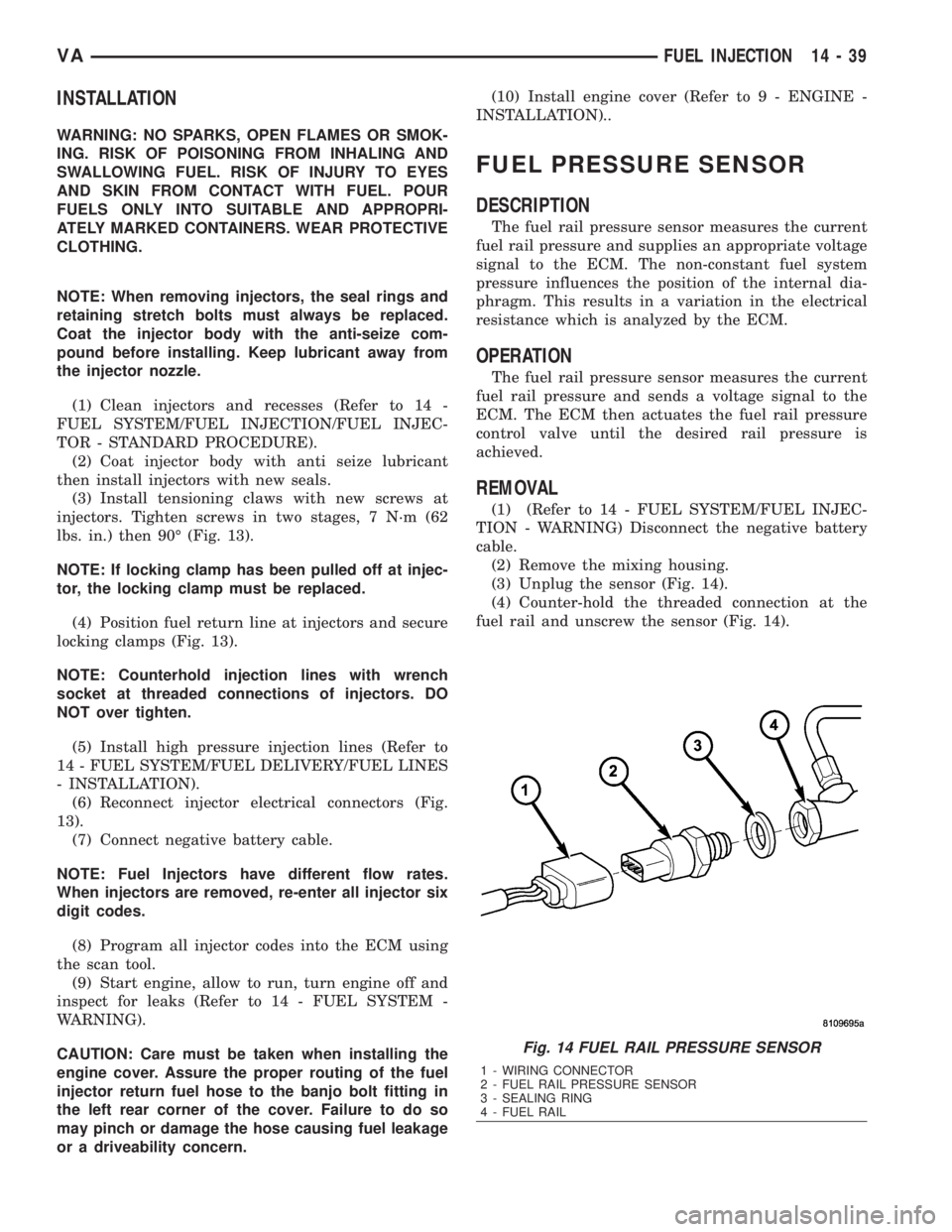
(Fig. 13).
NOTE: Counterhold injection lines with wrench
socket at threaded connections of injectors.
(5) Disconnect fuel injector high pressure line (Fig.
13).
(6) Remove fuel injector retaining bolt and tension
claw, then remove the injector and seal (Fig. 13).
NOTE: If injectors are tight, remove with extraction
claw in place of tensioning claw. If extraction claw
contacts cylinder head cover, remove cylinder head
cover. If necessary, remove injectors with threaded
adaptor and discard injector.
(7) Remove injectors (Fig. 13).
(8) Clean injectors and recesses (Refer to 14 -
FUEL SYSTEM/FUEL INJECTION/FUEL INJEC-
TOR - STANDARD PROCEDURE).Fig. 13 FUEL INJECTOR REMOVAL / INSTALLATION
1 - FUEL INJECTOR RETURN LINE
2 - RETAINING CLIP
3 - INJECTOR HIGH PRESSURE LINE
4 - INJECTOR SEAL
5 - FUEL INJECTOR
6 - TENSIONING CLAW
7 - SPECIAL TOOLS #8938 AND # 8937
14 - 38 FUEL INJECTIONVA
Page 1720 of 2305
INSTALLATION
WARNING: NO SPARKS, OPEN FLAMES OR SMOK-
ING. RISK OF POISONING FROM INHALING AND
SWALLOWING FUEL. RISK OF INJURY TO EYES
AND SKIN FROM CONTACT WITH FUEL. POUR
FUELS ONLY INTO SUITABLE AND APPROPRI-
ATELY MARKED CONTAINERS. WEAR PROTECTIVE
CLOTHING.
NOTE: When removing injectors, the seal rings and
retaining stretch bolts must always be replaced.
Coat the injector body with the anti-seize com-
pound before installing. Keep lubricant away from
the injector nozzle.
(1) Clean injectors and recesses (Refer to 14 -
FUEL SYSTEM/FUEL INJECTION/FUEL INJEC-
TOR - STANDARD PROCEDURE).
(2) Coat injector body with anti seize lubricant
then install injectors with new seals.
(3) Install tensioning claws with new screws at
injectors. Tighten screws in two stages, 7 N´m (62
lbs. in.) then 90É (Fig. 13).
NOTE: If locking clamp has been pulled off at injec-
tor, the locking clamp must be replaced.
(4) Position fuel return line at injectors and secure
locking clamps (Fig. 13).
NOTE: Counterhold injection lines with wrench
socket at threaded connections of injectors. DO
NOT over tighten.
(5) Install high pressure injection lines (Refer to
14 - FUEL SYSTEM/FUEL DELIVERY/FUEL LINES
- INSTALLATION).
(6) Reconnect injector electrical connectors (Fig.
13).
(7) Connect negative battery cable.
NOTE: Fuel Injectors have different flow rates.
When injectors are removed, re-enter all injector six
digit codes.
(8) Program all injector codes into the ECM using
the scan tool.
(9) Start engine, allow to run, turn engine off and
inspect for leaks (Refer to 14 - FUEL SYSTEM -
WARNING).
CAUTION: Care must be taken when installing the
engine cover. Assure the proper routing of the fuel
injector return fuel hose to the banjo bolt fitting in
the left rear corner of the cover. Failure to do so
may pinch or damage the hose causing fuel leakage
or a driveability concern.(10) Install engine cover (Refer to 9 - ENGINE -
INSTALLATION)..
FUEL PRESSURE SENSOR
DESCRIPTION
The fuel rail pressure sensor measures the current
fuel rail pressure and supplies an appropriate voltage
signal to the ECM. The non-constant fuel system
pressure influences the position of the internal dia-
phragm. This results in a variation in the electrical
resistance which is analyzed by the ECM.
OPERATION
The fuel rail pressure sensor measures the current
fuel rail pressure and sends a voltage signal to the
ECM. The ECM then actuates the fuel rail pressure
control valve until the desired rail pressure is
achieved.
REMOVAL
(1) (Refer to 14 - FUEL SYSTEM/FUEL INJEC-
TION - WARNING) Disconnect the negative battery
cable.
(2) Remove the mixing housing.
(3) Unplug the sensor (Fig. 14).
(4) Counter-hold the threaded connection at the
fuel rail and unscrew the sensor (Fig. 14).
Fig. 14 FUEL RAIL PRESSURE SENSOR
1 - WIRING CONNECTOR
2 - FUEL RAIL PRESSURE SENSOR
3 - SEALING RING
4 - FUEL RAIL
VAFUEL INJECTION 14 - 39
Page 1721 of 2305
INSTALLATION
(1) (Refer to 14 - FUEL SYSTEM/FUEL INJEC-
TION - WARNING) Install the sealing ring on to the
sensor (Fig. 14).
(2) Screw the sensor in to the fuel rail. Counter-
hold the threaded connection and tighten the sensor
to 18 lbs. ft. (25 N´m.) (Fig. 14).
(3) Connect the wiring harness to the sensor.
(4) Install the mixing housing.
CAUTION: Care must be taken when installing the
engine cover. Assure the proper routing of the fuel
injector return fuel hose to the banjo bolt fitting in
the left rear corner of the cover. Failure to do so
may pinch or damage the hose causing fuel leakage
or a driveability concern.
(5) Connect negative battery cable.
FUEL PRESSURE SOLENOID
DESCRIPTION
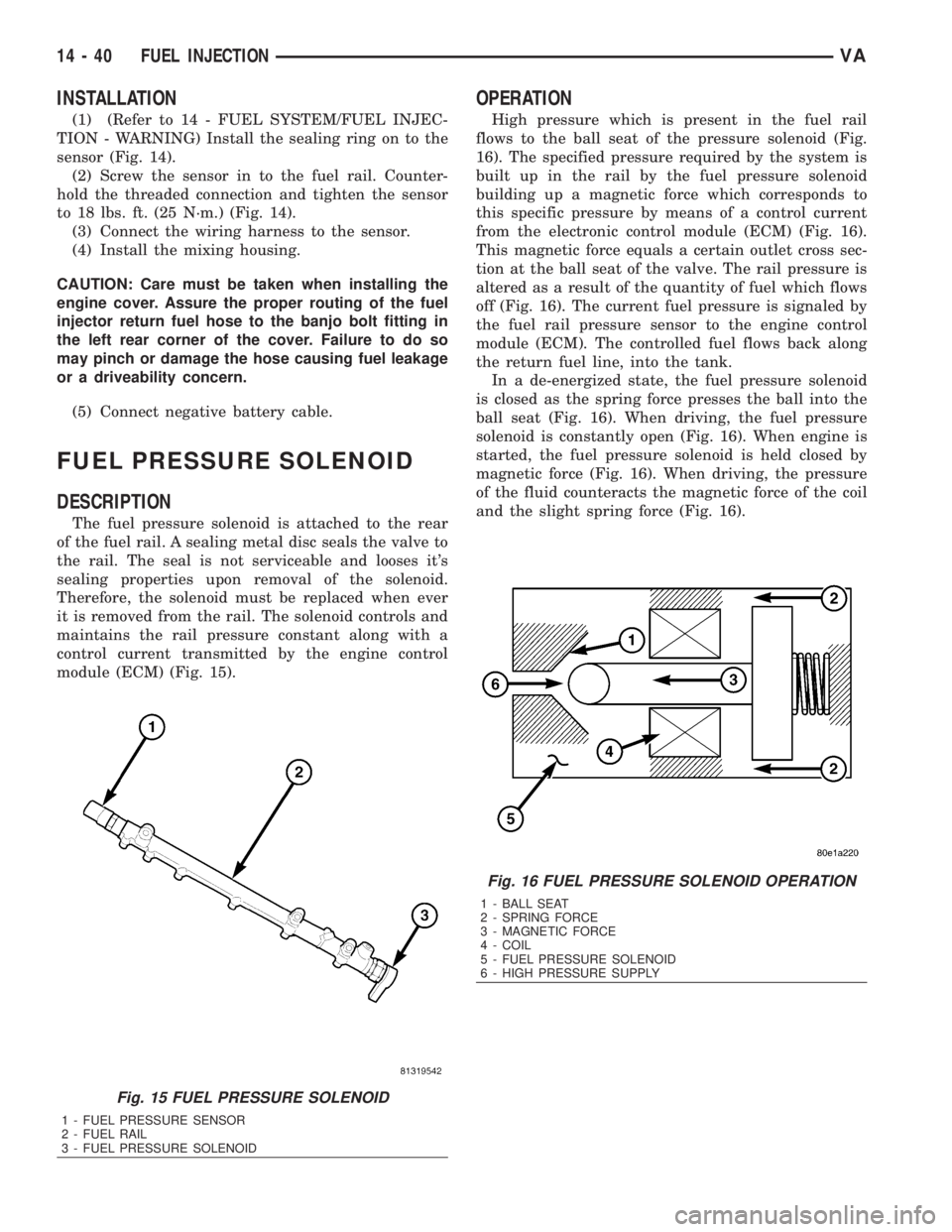
The fuel pressure solenoid is attached to the rear
of the fuel rail. A sealing metal disc seals the valve to
the rail. The seal is not serviceable and looses it's
sealing properties upon removal of the solenoid.
Therefore, the solenoid must be replaced when ever
it is removed from the rail. The solenoid controls and
maintains the rail pressure constant along with a
control current transmitted by the engine control
module (ECM) (Fig. 15).
OPERATION
High pressure which is present in the fuel rail
flows to the ball seat of the pressure solenoid (Fig.
16). The specified pressure required by the system is
built up in the rail by the fuel pressure solenoid
building up a magnetic force which corresponds to
this specific pressure by means of a control current
from the electronic control module (ECM) (Fig. 16).
This magnetic force equals a certain outlet cross sec-
tion at the ball seat of the valve. The rail pressure is
altered as a result of the quantity of fuel which flows
off (Fig. 16). The current fuel pressure is signaled by
the fuel rail pressure sensor to the engine control
module (ECM). The controlled fuel flows back along
the return fuel line, into the tank.
In a de-energized state, the fuel pressure solenoid
is closed as the spring force presses the ball into the
ball seat (Fig. 16). When driving, the fuel pressure
solenoid is constantly open (Fig. 16). When engine is
started, the fuel pressure solenoid is held closed by
magnetic force (Fig. 16). When driving, the pressure
of the fluid counteracts the magnetic force of the coil
and the slight spring force (Fig. 16).
Fig. 15 FUEL PRESSURE SOLENOID
1 - FUEL PRESSURE SENSOR
2 - FUEL RAIL
3 - FUEL PRESSURE SOLENOID
Fig. 16 FUEL PRESSURE SOLENOID OPERATION
1 - BALL SEAT
2 - SPRING FORCE
3 - MAGNETIC FORCE
4 - COIL
5 - FUEL PRESSURE SOLENOID
6 - HIGH PRESSURE SUPPLY
14 - 40 FUEL INJECTIONVA
Page 1722 of 2305
STANDARD PROCEDURE - FUEL PRESSURE
SOLENOID TEST
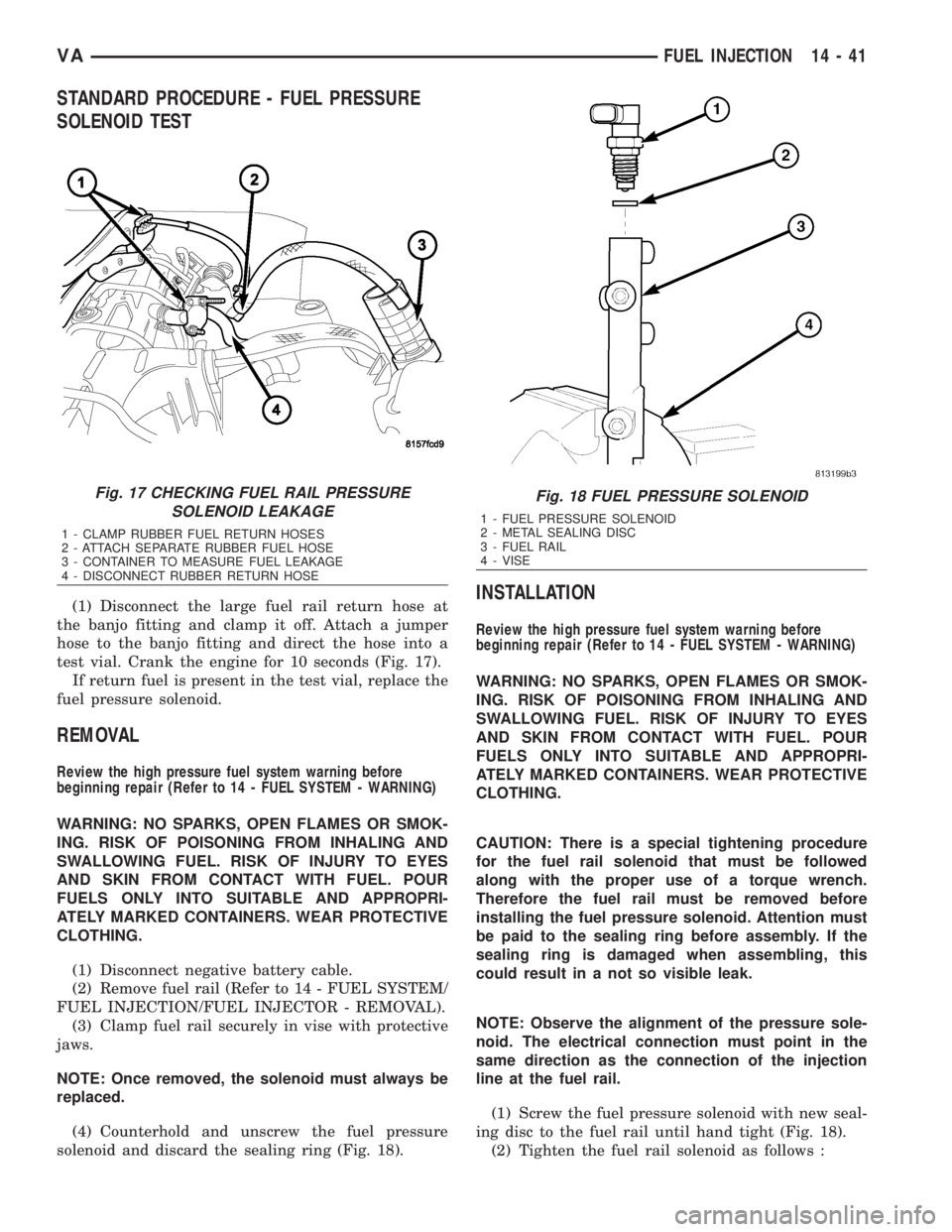
(1) Disconnect the large fuel rail return hose at
the banjo fitting and clamp it off. Attach a jumper
hose to the banjo fitting and direct the hose into a
test vial. Crank the engine for 10 seconds (Fig. 17).
If return fuel is present in the test vial, replace the
fuel pressure solenoid.
REMOVAL
Review the high pressure fuel system warning before
beginning repair (Refer to 14 - FUEL SYSTEM - WARNING)
WARNING: NO SPARKS, OPEN FLAMES OR SMOK-
ING. RISK OF POISONING FROM INHALING AND
SWALLOWING FUEL. RISK OF INJURY TO EYES
AND SKIN FROM CONTACT WITH FUEL. POUR
FUELS ONLY INTO SUITABLE AND APPROPRI-
ATELY MARKED CONTAINERS. WEAR PROTECTIVE
CLOTHING.
(1) Disconnect negative battery cable.
(2) Remove fuel rail (Refer to 14 - FUEL SYSTEM/
FUEL INJECTION/FUEL INJECTOR - REMOVAL).
(3) Clamp fuel rail securely in vise with protective
jaws.
NOTE: Once removed, the solenoid must always be
replaced.
(4) Counterhold and unscrew the fuel pressure
solenoid and discard the sealing ring (Fig. 18).
INSTALLATION
Review the high pressure fuel system warning before
beginning repair (Refer to 14 - FUEL SYSTEM - WARNING)
WARNING: NO SPARKS, OPEN FLAMES OR SMOK-
ING. RISK OF POISONING FROM INHALING AND
SWALLOWING FUEL. RISK OF INJURY TO EYES
AND SKIN FROM CONTACT WITH FUEL. POUR
FUELS ONLY INTO SUITABLE AND APPROPRI-
ATELY MARKED CONTAINERS. WEAR PROTECTIVE
CLOTHING.
CAUTION: There is a special tightening procedure
for the fuel rail solenoid that must be followed
along with the proper use of a torque wrench.
Therefore the fuel rail must be removed before
installing the fuel pressure solenoid. Attention must
be paid to the sealing ring before assembly. If the
sealing ring is damaged when assembling, this
could result in a not so visible leak.
NOTE: Observe the alignment of the pressure sole-
noid. The electrical connection must point in the
same direction as the connection of the injection
line at the fuel rail.
(1) Screw the fuel pressure solenoid with new seal-
ing disc to the fuel rail until hand tight (Fig. 18).
(2) Tighten the fuel rail solenoid as follows :
Fig. 17 CHECKING FUEL RAIL PRESSURE
SOLENOID LEAKAGE
1 - CLAMP RUBBER FUEL RETURN HOSES
2 - ATTACH SEPARATE RUBBER FUEL HOSE
3 - CONTAINER TO MEASURE FUEL LEAKAGE
4 - DISCONNECT RUBBER RETURN HOSE
Fig. 18 FUEL PRESSURE SOLENOID
1 - FUEL PRESSURE SOLENOID
2 - METAL SEALING DISC
3 - FUEL RAIL
4 - VISE
VAFUEL INJECTION 14 - 41
Page 1723 of 2305
²Tighten the nut to 60 N´m (44 ft. lbs.)
²Loosen the nut 90 degrees.
²Retighten the nut to 80 N´m (59 ft. lbs.).
(3) Install fuel rail (Refer to 14 - FUEL SYSTEM/
FUEL INJECTION/FUEL INJECTOR - INSTALLA-
TION).
(4) Connect negative battery cable.
(5) Start engine, allow to warm, turn engine off
and inspect for leaks (Refer to 14 - FUEL SYSTEM -
DIAGNOSIS AND TESTING).
FUEL TEMPERATURE SENSOR
DESCRIPTION
The fuel temperature sensor is integrated in the
high pressure fuel pump next to the fuel quantity
valve. The sensor detects the temperature of the fuel
and supplies that information to the ECM. The sen-
sor ranges from - 40ÉF (- 40C) to 284ÉF (140ÉC). If
the engine is cold, the actual value sent will read
ambient temperature. The value rises after the
engine has been started.
OPERATION
An negative temperature coefficient (NTC) resistor
integrated in the fuel temperature sensor alters it's
electrical resistance in line with the fuel temperature
(the resistance drops as the temperature rises). The
ECM uses this reading to calculate optimum engine
performance under all driving conditions. If the fuel
is to warm, the rail pressure in the system is low-
ered. The controller quantity of the pressure regulat-
ing valve is reduced and the fuel temperature is
lowered.
REMOVAL
NOTE: Capture and properly store all fluid seepage
in appropriately marked containers.
(1) Disconnect the negative battery cable.
(2) Remove the fuel temperature sensor from the
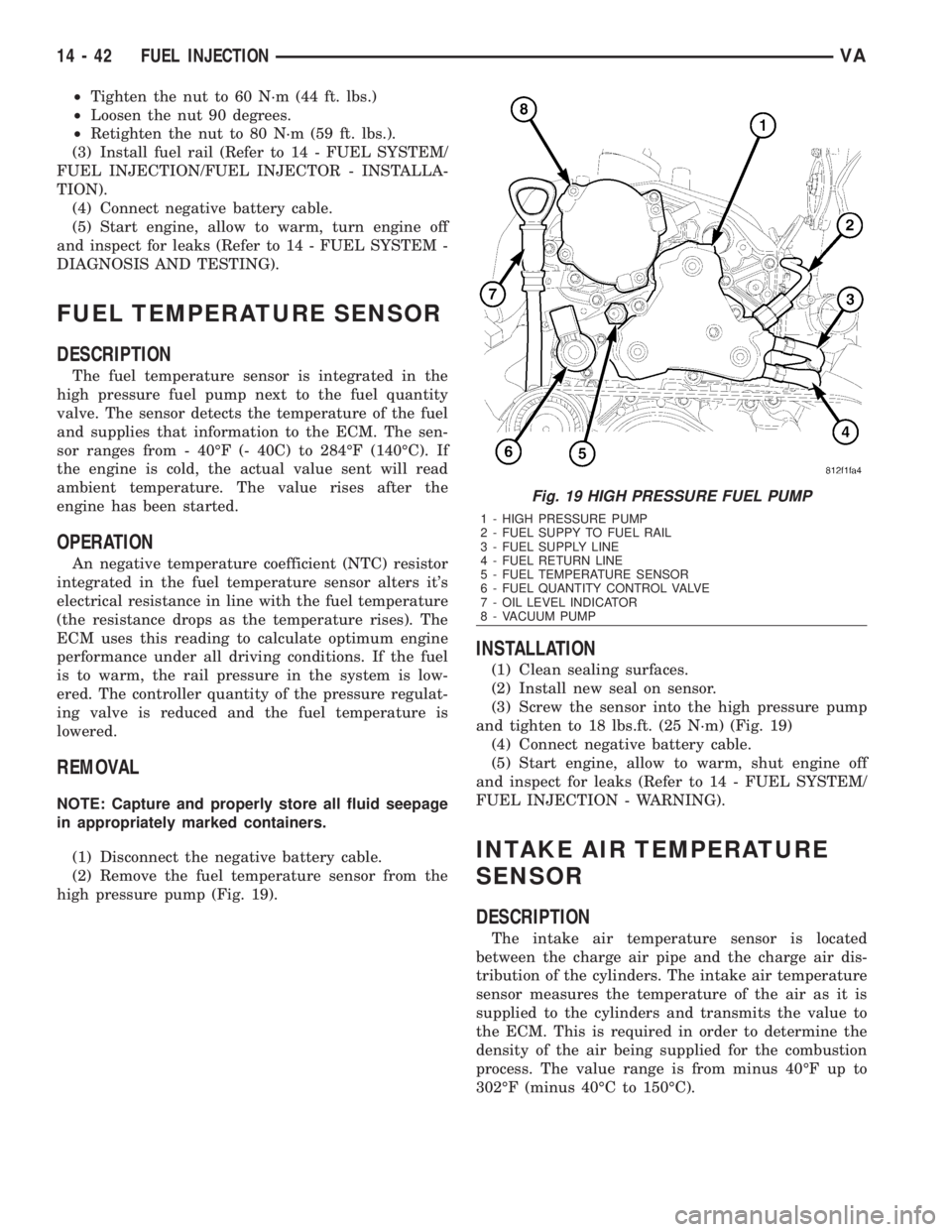
high pressure pump (Fig. 19).
INSTALLATION
(1) Clean sealing surfaces.
(2) Install new seal on sensor.
(3) Screw the sensor into the high pressure pump
and tighten to 18 lbs.ft. (25 N´m) (Fig. 19)
(4) Connect negative battery cable.
(5) Start engine, allow to warm, shut engine off
and inspect for leaks (Refer to 14 - FUEL SYSTEM/
FUEL INJECTION - WARNING).
INTAKE AIR TEMPERATURE
SENSOR
DESCRIPTION
The intake air temperature sensor is located
between the charge air pipe and the charge air dis-
tribution of the cylinders. The intake air temperature
sensor measures the temperature of the air as it is
supplied to the cylinders and transmits the value to
the ECM. This is required in order to determine the
density of the air being supplied for the combustion
process. The value range is from minus 40ÉF up to
302ÉF (minus 40ÉC to 150ÉC).
Fig. 19 HIGH PRESSURE FUEL PUMP
1 - HIGH PRESSURE PUMP
2 - FUEL SUPPY TO FUEL RAIL
3 - FUEL SUPPLY LINE
4 - FUEL RETURN LINE
5 - FUEL TEMPERATURE SENSOR
6 - FUEL QUANTITY CONTROL VALVE
7 - OIL LEVEL INDICATOR
8 - VACUUM PUMP
14 - 42 FUEL INJECTIONVA
Page 1724 of 2305
OPERATION
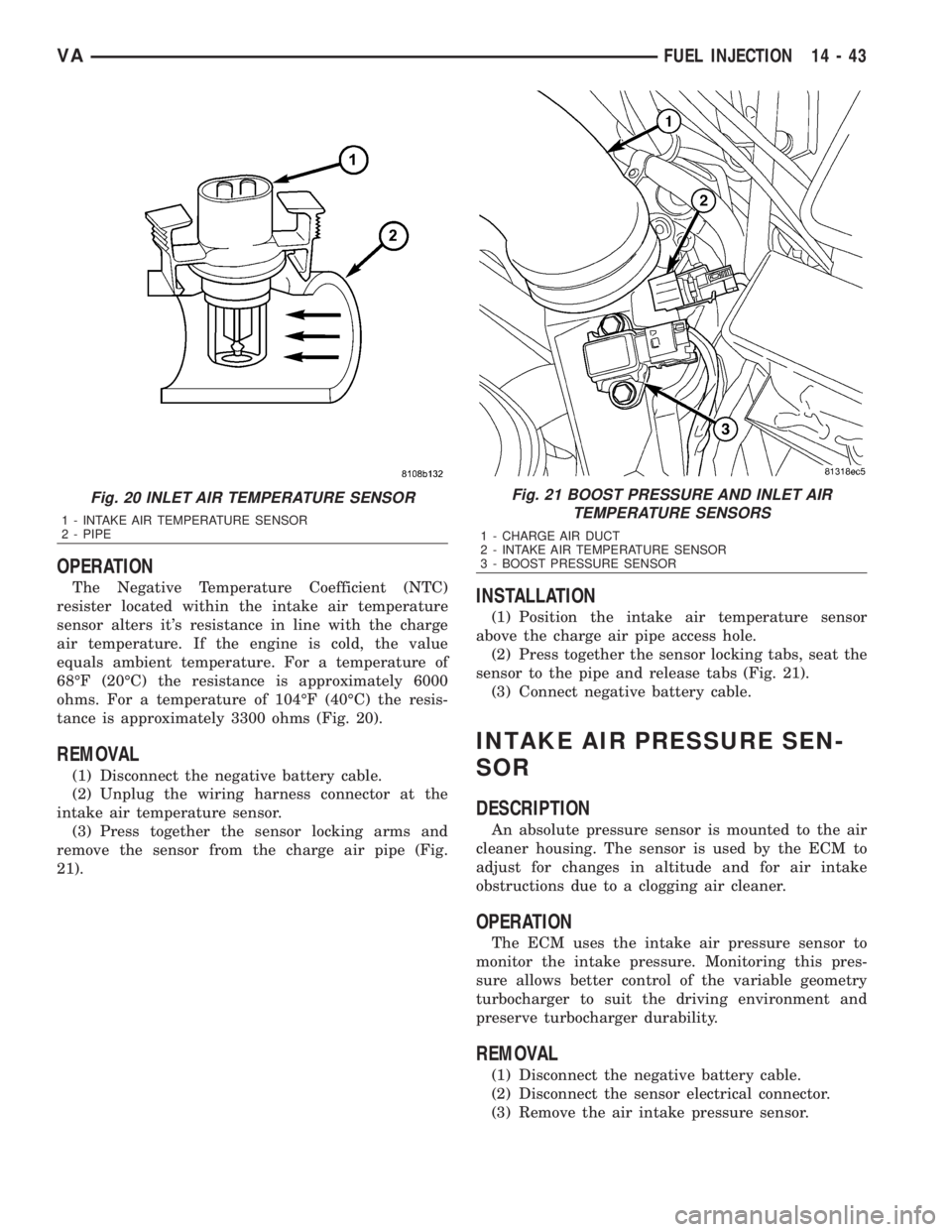
The Negative Temperature Coefficient (NTC)
resister located within the intake air temperature
sensor alters it's resistance in line with the charge
air temperature. If the engine is cold, the value
equals ambient temperature. For a temperature of
68ÉF (20ÉC) the resistance is approximately 6000
ohms. For a temperature of 104ÉF (40ÉC) the resis-
tance is approximately 3300 ohms (Fig. 20).
REMOVAL
(1) Disconnect the negative battery cable.
(2) Unplug the wiring harness connector at the
intake air temperature sensor.
(3) Press together the sensor locking arms and
remove the sensor from the charge air pipe (Fig.
21).
INSTALLATION
(1) Position the intake air temperature sensor
above the charge air pipe access hole.
(2) Press together the sensor locking tabs, seat the
sensor to the pipe and release tabs (Fig. 21).
(3) Connect negative battery cable.
INTAKE AIR PRESSURE SEN-
SOR
DESCRIPTION
An absolute pressure sensor is mounted to the air
cleaner housing. The sensor is used by the ECM to
adjust for changes in altitude and for air intake
obstructions due to a clogging air cleaner.
OPERATION
The ECM uses the intake air pressure sensor to
monitor the intake pressure. Monitoring this pres-
sure allows better control of the variable geometry
turbocharger to suit the driving environment and
preserve turbocharger durability.
REMOVAL
(1) Disconnect the negative battery cable.
(2) Disconnect the sensor electrical connector.
(3) Remove the air intake pressure sensor.
Fig. 20 INLET AIR TEMPERATURE SENSOR
1 - INTAKE AIR TEMPERATURE SENSOR
2 - PIPE
Fig. 21 BOOST PRESSURE AND INLET AIR
TEMPERATURE SENSORS
1 - CHARGE AIR DUCT
2 - INTAKE AIR TEMPERATURE SENSOR
3 - BOOST PRESSURE SENSOR
VAFUEL INJECTION 14 - 43
Page 1730 of 2305
STEERING
TABLE OF CONTENTS
page page
STEERING
DESCRIPTION..........................1
OPERATION............................1
DIAGNOSIS AND TESTING - POWER
STEERING SYSTEM....................1COLUMN................................4
GEAR..................................7
LINKAGE................................9
PUMP..................................11
STEERING
DESCRIPTION
CAUTION: Use approved fluid only in the power
steering system (Refer to LUBRICATION & MAINTE-
NANCE/FLUID TYPES - DESCRIPTION). No other
power steering or automatic transmission fluid is to
be used in the system. Damage may result to the
power steering pump and system if any other fluid
is used, and do not overfill.
Power steering systems consist of:
²Steering column
²Rack and pinion steering gear
²Belt driven hydraulic steering pump
²Pump pressure and return hoses
²Oil Cooler
OPERATION
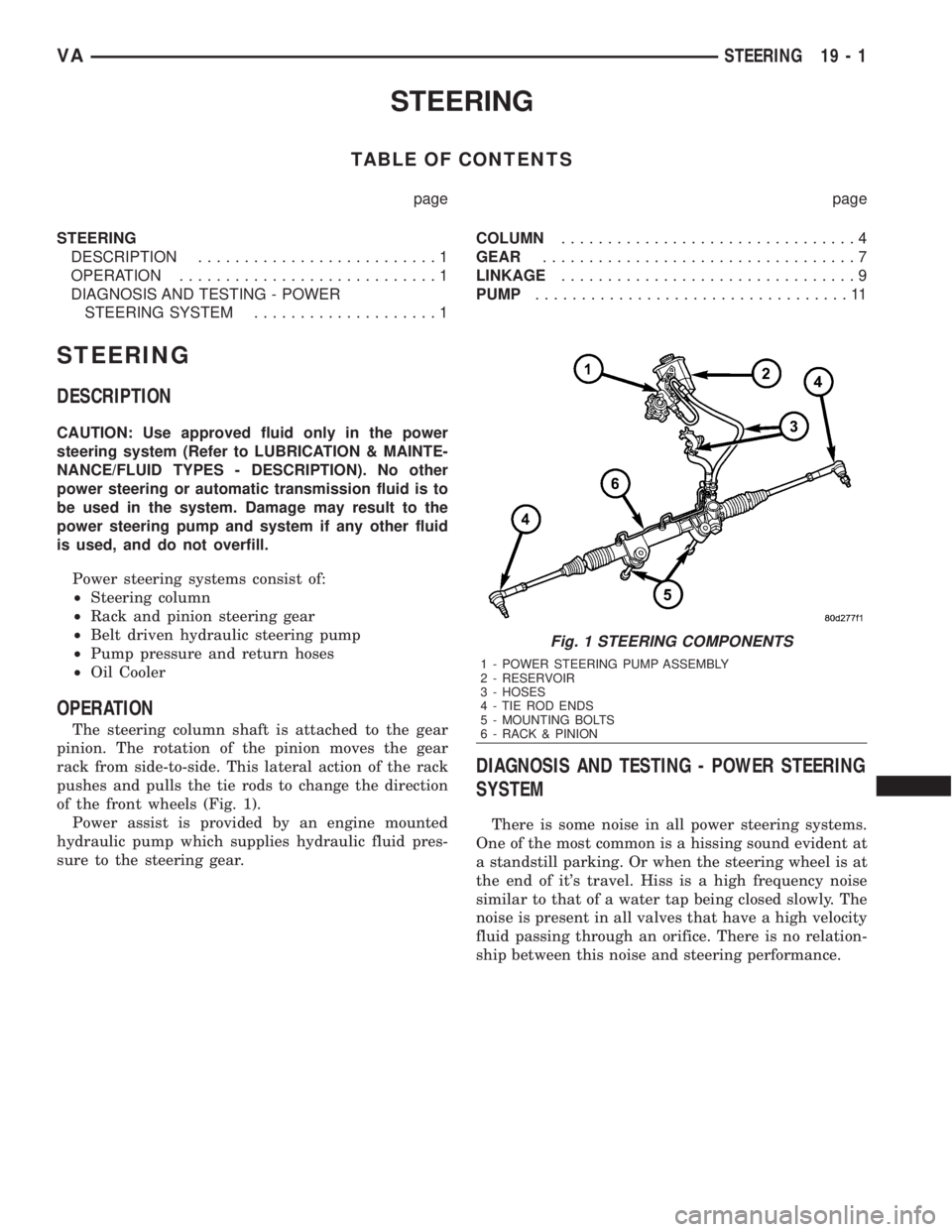
The steering column shaft is attached to the gear
pinion. The rotation of the pinion moves the gear
rack from side-to-side. This lateral action of the rack
pushes and pulls the tie rods to change the direction
of the front wheels (Fig. 1).
Power assist is provided by an engine mounted
hydraulic pump which supplies hydraulic fluid pres-
sure to the steering gear.
DIAGNOSIS AND TESTING - POWER STEERING
SYSTEM
There is some noise in all power steering systems.
One of the most common is a hissing sound evident at
a standstill parking. Or when the steering wheel is at
the end of it's travel. Hiss is a high frequency noise
similar to that of a water tap being closed slowly. The
noise is present in all valves that have a high velocity
fluid passing through an orifice. There is no relation-
ship between this noise and steering performance.
Fig. 1 STEERING COMPONENTS
1 - POWER STEERING PUMP ASSEMBLY
2 - RESERVOIR
3 - HOSES
4 - TIE ROD ENDS
5 - MOUNTING BOLTS
6 - RACK & PINION
VASTEERING 19 - 1
Page 1736 of 2305
GEAR
TABLE OF CONTENTS
page page
GEAR
DESCRIPTION..........................7
REMOVAL.............................7INSTALLATION..........................7
SPECIFICATIONS - TORQUE CHART.........8
GEAR
DESCRIPTION
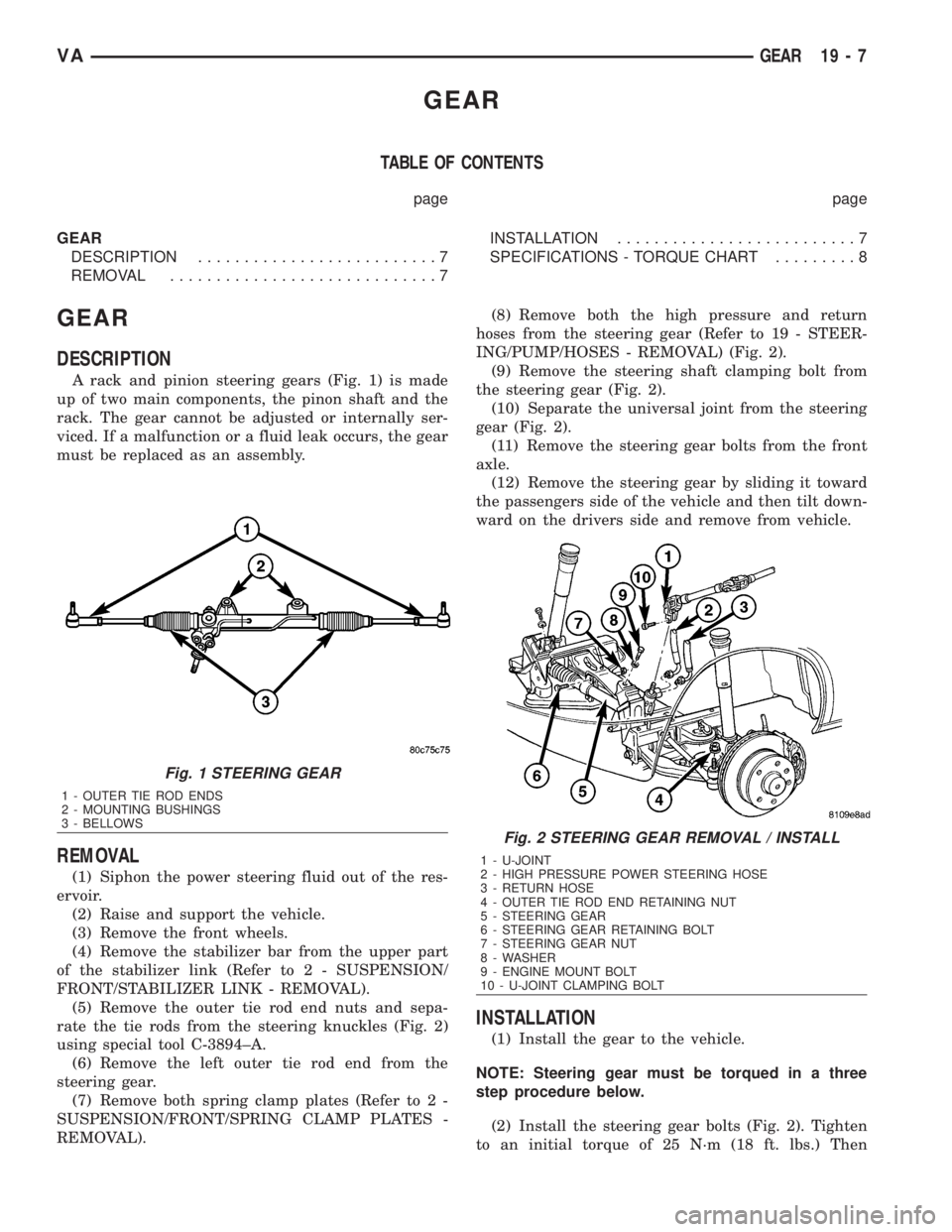
A rack and pinion steering gears (Fig. 1) is made
up of two main components, the pinon shaft and the
rack. The gear cannot be adjusted or internally ser-
viced. If a malfunction or a fluid leak occurs, the gear
must be replaced as an assembly.
REMOVAL
(1) Siphon the power steering fluid out of the res-
ervoir.
(2) Raise and support the vehicle.
(3) Remove the front wheels.
(4) Remove the stabilizer bar from the upper part
of the stabilizer link (Refer to 2 - SUSPENSION/
FRONT/STABILIZER LINK - REMOVAL).
(5) Remove the outer tie rod end nuts and sepa-
rate the tie rods from the steering knuckles (Fig. 2)
using special tool C-3894±A.
(6) Remove the left outer tie rod end from the
steering gear.
(7) Remove both spring clamp plates (Refer to 2 -
SUSPENSION/FRONT/SPRING CLAMP PLATES -
REMOVAL).(8) Remove both the high pressure and return
hoses from the steering gear (Refer to 19 - STEER-
ING/PUMP/HOSES - REMOVAL) (Fig. 2).
(9) Remove the steering shaft clamping bolt from
the steering gear (Fig. 2).
(10) Separate the universal joint from the steering
gear (Fig. 2).
(11) Remove the steering gear bolts from the front
axle.
(12) Remove the steering gear by sliding it toward
the passengers side of the vehicle and then tilt down-
ward on the drivers side and remove from vehicle.
INSTALLATION
(1) Install the gear to the vehicle.
NOTE: Steering gear must be torqued in a three
step procedure below.
(2) Install the steering gear bolts (Fig. 2). Tighten
to an initial torque of 25 N´m (18 ft. lbs.) Then
Fig. 1 STEERING GEAR
1 - OUTER TIE ROD ENDS
2 - MOUNTING BUSHINGS
3 - BELLOWS
Fig. 2 STEERING GEAR REMOVAL / INSTALL
1 - U-JOINT
2 - HIGH PRESSURE POWER STEERING HOSE
3 - RETURN HOSE
4 - OUTER TIE ROD END RETAINING NUT
5 - STEERING GEAR
6 - STEERING GEAR RETAINING BOLT
7 - STEERING GEAR NUT
8 - WASHER
9 - ENGINE MOUNT BOLT
10 - U-JOINT CLAMPING BOLT
VAGEAR 19 - 7