wheel MERCEDES-BENZ SPRINTER 2006 Repair Manual
[x] Cancel search | Manufacturer: MERCEDES-BENZ, Model Year: 2006, Model line: SPRINTER, Model: MERCEDES-BENZ SPRINTER 2006Pages: 2305, PDF Size: 48.12 MB
Page 493 of 2305
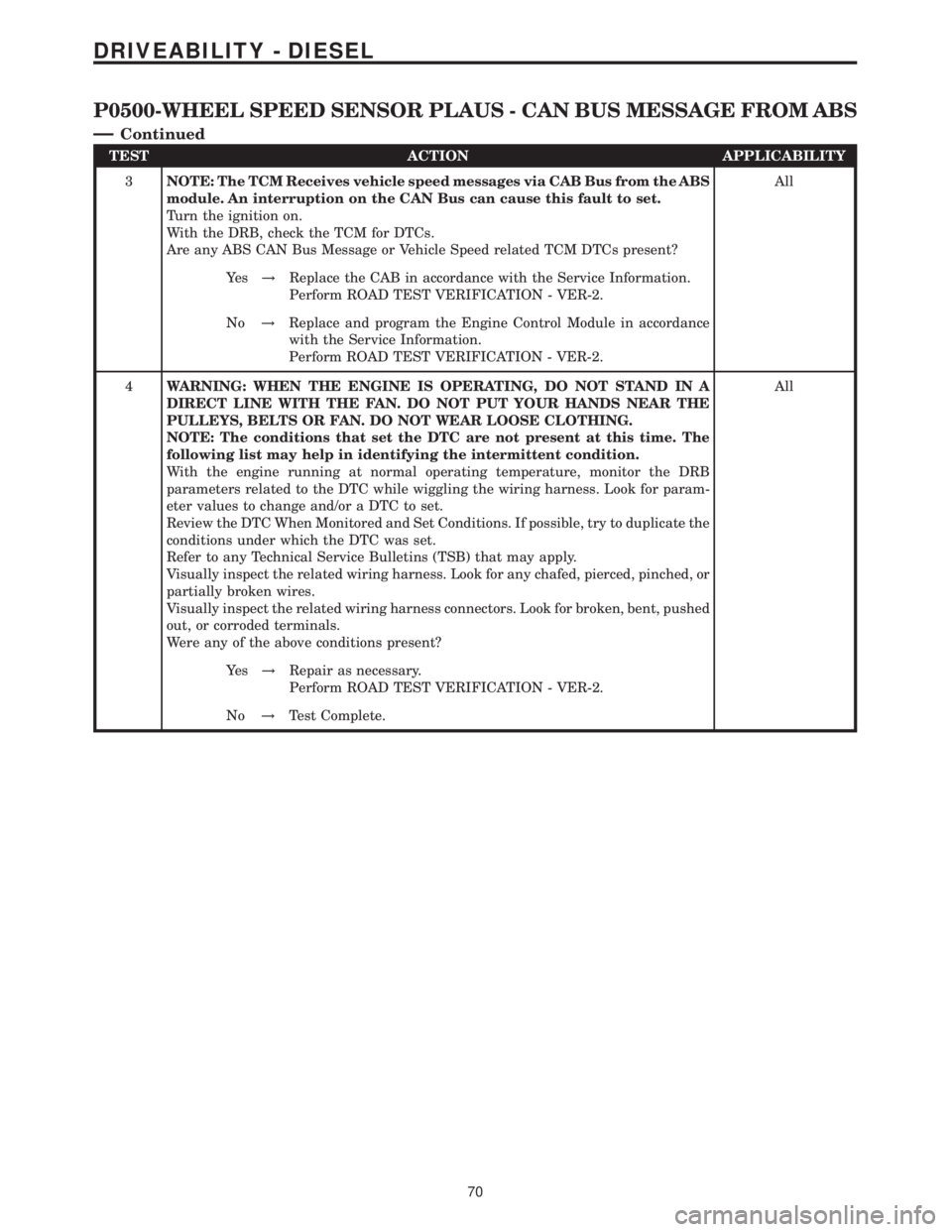
TEST ACTION APPLICABILITY
3NOTE: The TCM Receives vehicle speed messages via CAB Bus from the ABS
module. An interruption on the CAN Bus can cause this fault to set.
Turn the ignition on.
With the DRB, check the TCM for DTCs.
Are any ABS CAN Bus Message or Vehicle Speed related TCM DTCs present?All
Ye s!Replace the CAB in accordance with the Service Information.
Perform ROAD TEST VERIFICATION - VER-2.
No!Replace and program the Engine Control Module in accordance
with the Service Information.
Perform ROAD TEST VERIFICATION - VER-2.
4WARNING: WHEN THE ENGINE IS OPERATING, DO NOT STAND IN A
DIRECT LINE WITH THE FAN. DO NOT PUT YOUR HANDS NEAR THE
PULLEYS, BELTS OR FAN. DO NOT WEAR LOOSE CLOTHING.
NOTE: The conditions that set the DTC are not present at this time. The
following list may help in identifying the intermittent condition.
With the engine running at normal operating temperature, monitor the DRB
parameters related to the DTC while wiggling the wiring harness. Look for param-
eter values to change and/or a DTC to set.
Review the DTC When Monitored and Set Conditions. If possible, try to duplicate the
conditions under which the DTC was set.
Refer to any Technical Service Bulletins (TSB) that may apply.
Visually inspect the related wiring harness. Look for any chafed, pierced, pinched, or
partially broken wires.
Visually inspect the related wiring harness connectors. Look for broken, bent, pushed
out, or corroded terminals.
Were any of the above conditions present?All
Ye s!Repair as necessary.
Perform ROAD TEST VERIFICATION - VER-2.
No!Test Complete.
70
DRIVEABILITY - DIESEL
P0500-WHEEL SPEED SENSOR PLAUS - CAN BUS MESSAGE FROM ABS
Ð
Continued
Page 569 of 2305
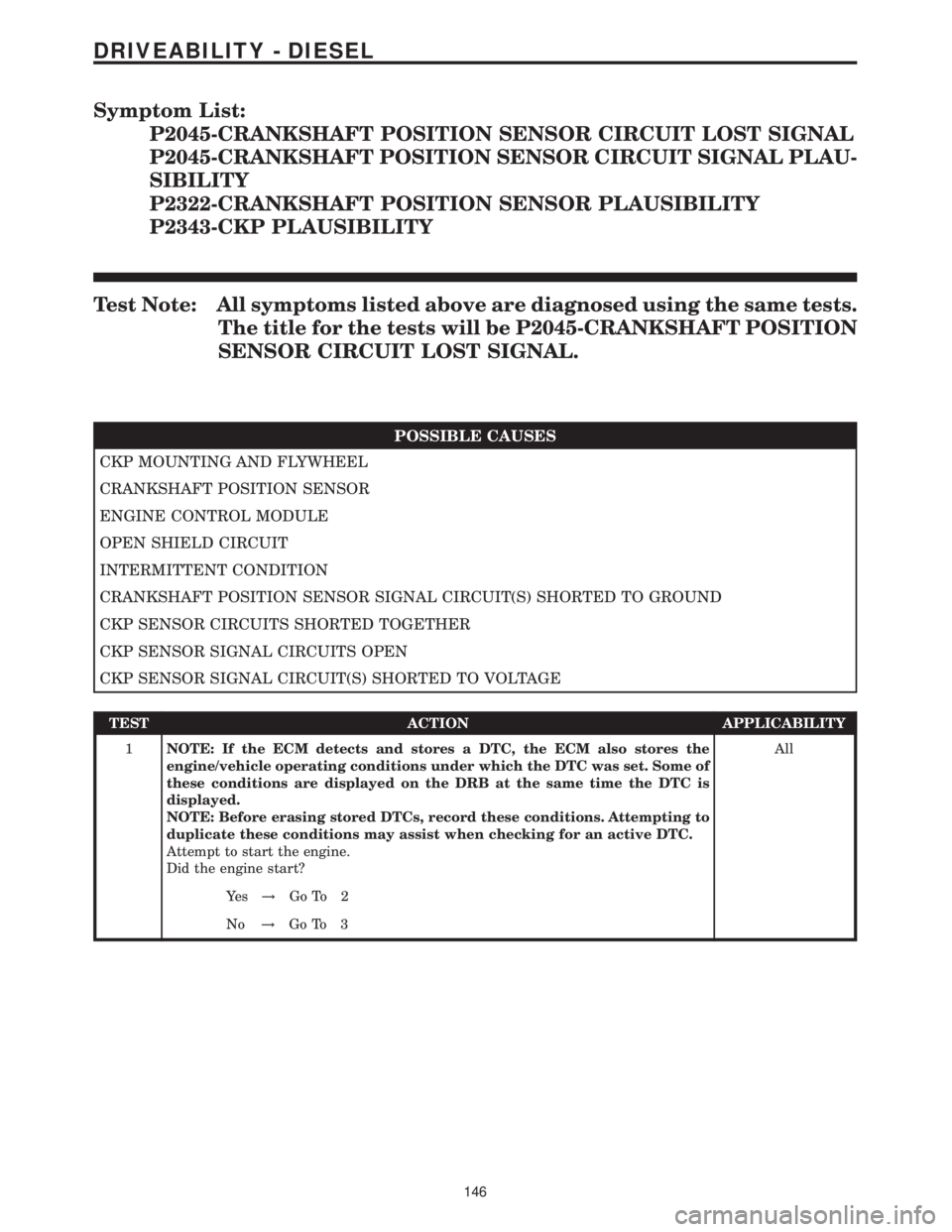
Symptom List:
P2045-CRANKSHAFT POSITION SENSOR CIRCUIT LOST SIGNAL
P2045-CRANKSHAFT POSITION SENSOR CIRCUIT SIGNAL PLAU-
SIBILITY
P2322-CRANKSHAFT POSITION SENSOR PLAUSIBILITY
P2343-CKP PLAUSIBILITY
Test Note: All symptoms listed above are diagnosed using the same tests.
The title for the tests will be P2045-CRANKSHAFT POSITION
SENSOR CIRCUIT LOST SIGNAL.
POSSIBLE CAUSES
CKP MOUNTING AND FLYWHEEL
CRANKSHAFT POSITION SENSOR
ENGINE CONTROL MODULE
OPEN SHIELD CIRCUIT
INTERMITTENT CONDITION
CRANKSHAFT POSITION SENSOR SIGNAL CIRCUIT(S) SHORTED TO GROUND
CKP SENSOR CIRCUITS SHORTED TOGETHER
CKP SENSOR SIGNAL CIRCUITS OPEN
CKP SENSOR SIGNAL CIRCUIT(S) SHORTED TO VOLTAGE
TEST ACTION APPLICABILITY
1NOTE: If the ECM detects and stores a DTC, the ECM also stores the
engine/vehicle operating conditions under which the DTC was set. Some of
these conditions are displayed on the DRB at the same time the DTC is
displayed.
NOTE: Before erasing stored DTCs, record these conditions. Attempting to
duplicate these conditions may assist when checking for an active DTC.
Attempt to start the engine.
Did the engine start?All
Ye s!Go To 2
No!Go To 3
146
DRIVEABILITY - DIESEL
Page 571 of 2305
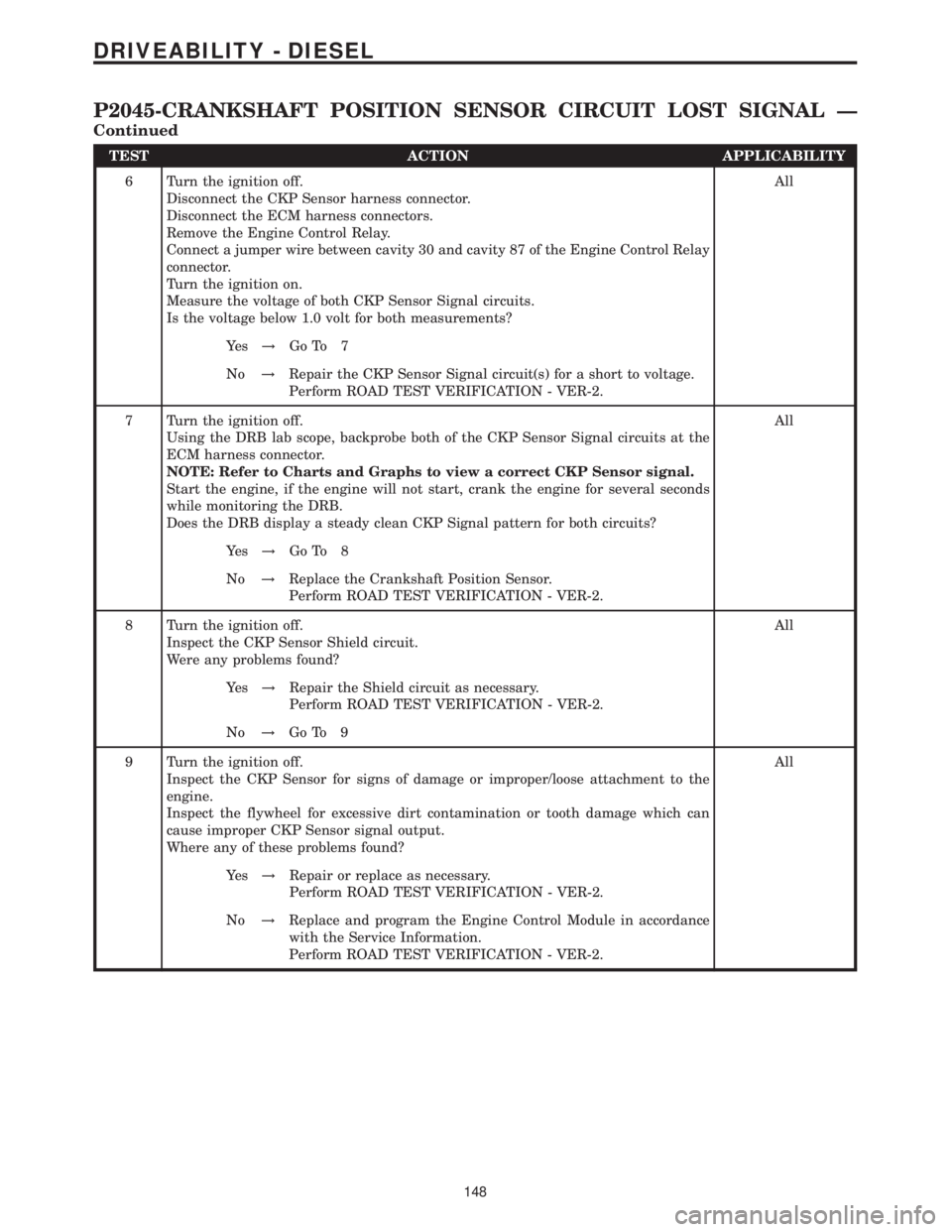
TEST ACTION APPLICABILITY
6 Turn the ignition off.
Disconnect the CKP Sensor harness connector.
Disconnect the ECM harness connectors.
Remove the Engine Control Relay.
Connect a jumper wire between cavity 30 and cavity 87 of the Engine Control Relay
connector.
Turn the ignition on.
Measure the voltage of both CKP Sensor Signal circuits.
Is the voltage below 1.0 volt for both measurements?All
Ye s!Go To 7
No!Repair the CKP Sensor Signal circuit(s) for a short to voltage.
Perform ROAD TEST VERIFICATION - VER-2.
7 Turn the ignition off.
Using the DRB lab scope, backprobe both of the CKP Sensor Signal circuits at the
ECM harness connector.
NOTE: Refer to Charts and Graphs to view a correct CKP Sensor signal.
Start the engine, if the engine will not start, crank the engine for several seconds
while monitoring the DRB.
Does the DRB display a steady clean CKP Signal pattern for both circuits?All
Ye s!Go To 8
No!Replace the Crankshaft Position Sensor.
Perform ROAD TEST VERIFICATION - VER-2.
8 Turn the ignition off.
Inspect the CKP Sensor Shield circuit.
Were any problems found?All
Ye s!Repair the Shield circuit as necessary.
Perform ROAD TEST VERIFICATION - VER-2.
No!Go To 9
9 Turn the ignition off.
Inspect the CKP Sensor for signs of damage or improper/loose attachment to the
engine.
Inspect the flywheel for excessive dirt contamination or tooth damage which can
cause improper CKP Sensor signal output.
Where any of these problems found?All
Ye s!Repair or replace as necessary.
Perform ROAD TEST VERIFICATION - VER-2.
No!Replace and program the Engine Control Module in accordance
with the Service Information.
Perform ROAD TEST VERIFICATION - VER-2.
148
DRIVEABILITY - DIESEL
P2045-CRANKSHAFT POSITION SENSOR CIRCUIT LOST SIGNAL Ð
Continued
Page 611 of 2305
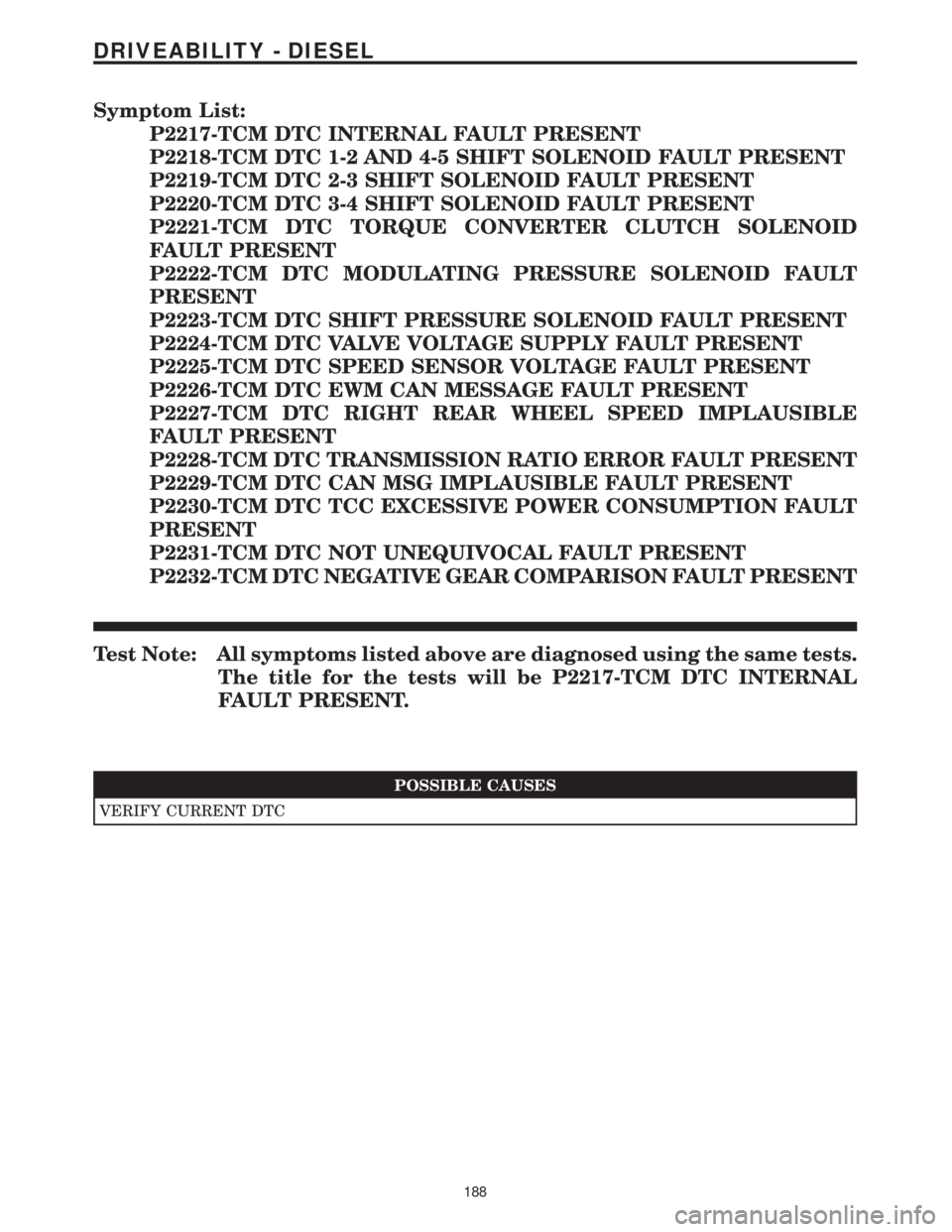
Symptom List:
P2217-TCM DTC INTERNAL FAULT PRESENT
P2218-TCM DTC 1-2 AND 4-5 SHIFT SOLENOID FAULT PRESENT
P2219-TCM DTC 2-3 SHIFT SOLENOID FAULT PRESENT
P2220-TCM DTC 3-4 SHIFT SOLENOID FAULT PRESENT
P2221-TCM DTC TORQUE CONVERTER CLUTCH SOLENOID
FAULT PRESENT
P2222-TCM DTC MODULATING PRESSURE SOLENOID FAULT
PRESENT
P2223-TCM DTC SHIFT PRESSURE SOLENOID FAULT PRESENT
P2224-TCM DTC VALVE VOLTAGE SUPPLY FAULT PRESENT
P2225-TCM DTC SPEED SENSOR VOLTAGE FAULT PRESENT
P2226-TCM DTC EWM CAN MESSAGE FAULT PRESENT
P2227-TCM DTC RIGHT REAR WHEEL SPEED IMPLAUSIBLE
FAULT PRESENT
P2228-TCM DTC TRANSMISSION RATIO ERROR FAULT PRESENT
P2229-TCM DTC CAN MSG IMPLAUSIBLE FAULT PRESENT
P2230-TCM DTC TCC EXCESSIVE POWER CONSUMPTION FAULT
PRESENT
P2231-TCM DTC NOT UNEQUIVOCAL FAULT PRESENT
P2232-TCM DTC NEGATIVE GEAR COMPARISON FAULT PRESENT
Test Note: All symptoms listed above are diagnosed using the same tests.
The title for the tests will be P2217-TCM DTC INTERNAL
FAULT PRESENT.
POSSIBLE CAUSES
VERIFY CURRENT DTC
188
DRIVEABILITY - DIESEL
Page 632 of 2305
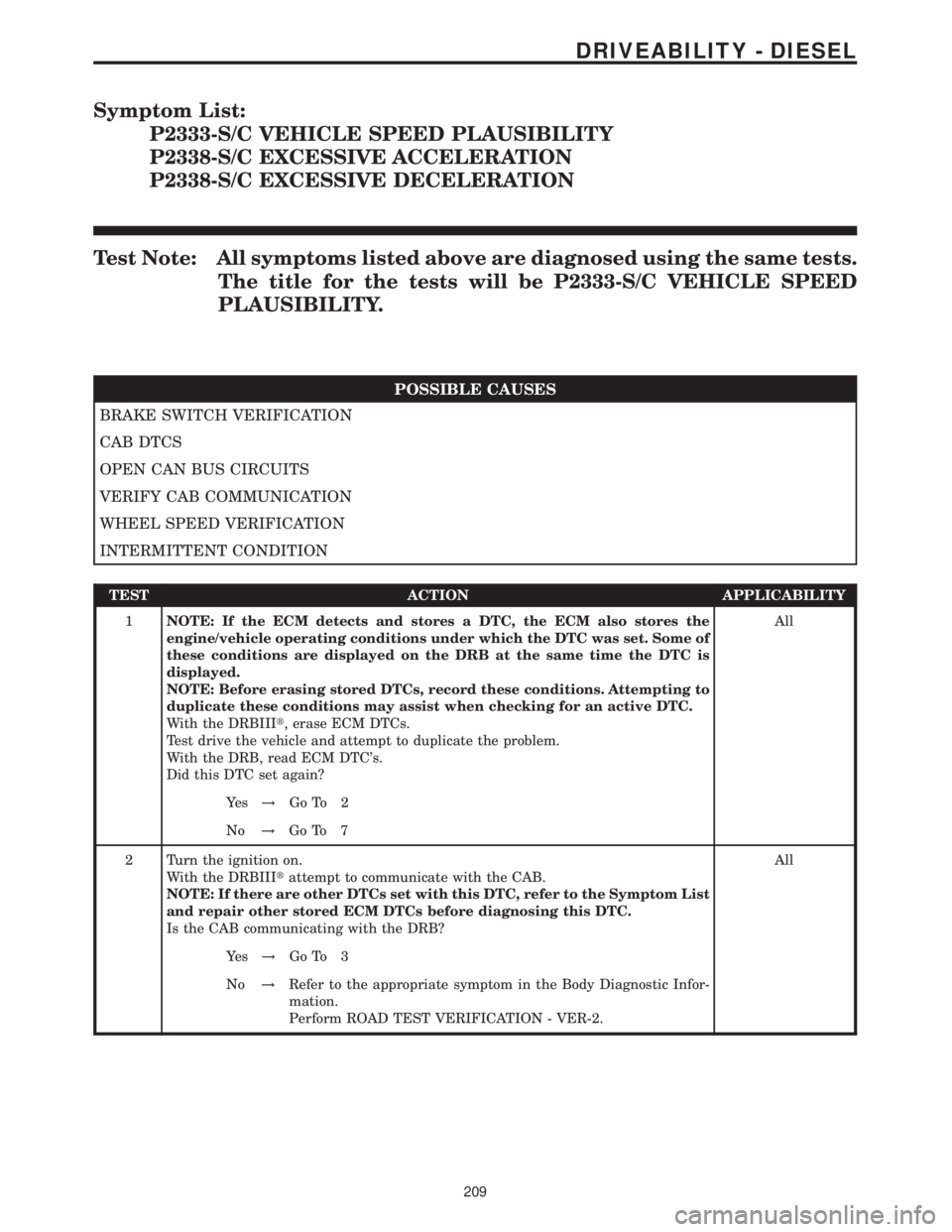
Symptom List:
P2333-S/C VEHICLE SPEED PLAUSIBILITY
P2338-S/C EXCESSIVE ACCELERATION
P2338-S/C EXCESSIVE DECELERATION
Test Note: All symptoms listed above are diagnosed using the same tests.
The title for the tests will be P2333-S/C VEHICLE SPEED
PLAUSIBILITY.
POSSIBLE CAUSES
BRAKE SWITCH VERIFICATION
CAB DTCS
OPEN CAN BUS CIRCUITS
VERIFY CAB COMMUNICATION
WHEEL SPEED VERIFICATION
INTERMITTENT CONDITION
TEST ACTION APPLICABILITY
1NOTE: If the ECM detects and stores a DTC, the ECM also stores the
engine/vehicle operating conditions under which the DTC was set. Some of
these conditions are displayed on the DRB at the same time the DTC is
displayed.
NOTE: Before erasing stored DTCs, record these conditions. Attempting to
duplicate these conditions may assist when checking for an active DTC.
With the DRBIIIt, erase ECM DTCs.
Test drive the vehicle and attempt to duplicate the problem.
With the DRB, read ECM DTC's.
Did this DTC set again?All
Ye s!Go To 2
No!Go To 7
2 Turn the ignition on.
With the DRBIIItattempt to communicate with the CAB.
NOTE: If there are other DTCs set with this DTC, refer to the Symptom List
and repair other stored ECM DTCs before diagnosing this DTC.
Is the CAB communicating with the DRB?All
Ye s!Go To 3
No!Refer to the appropriate symptom in the Body Diagnostic Infor-
mation.
Perform ROAD TEST VERIFICATION - VER-2.
209
DRIVEABILITY - DIESEL
Page 633 of 2305
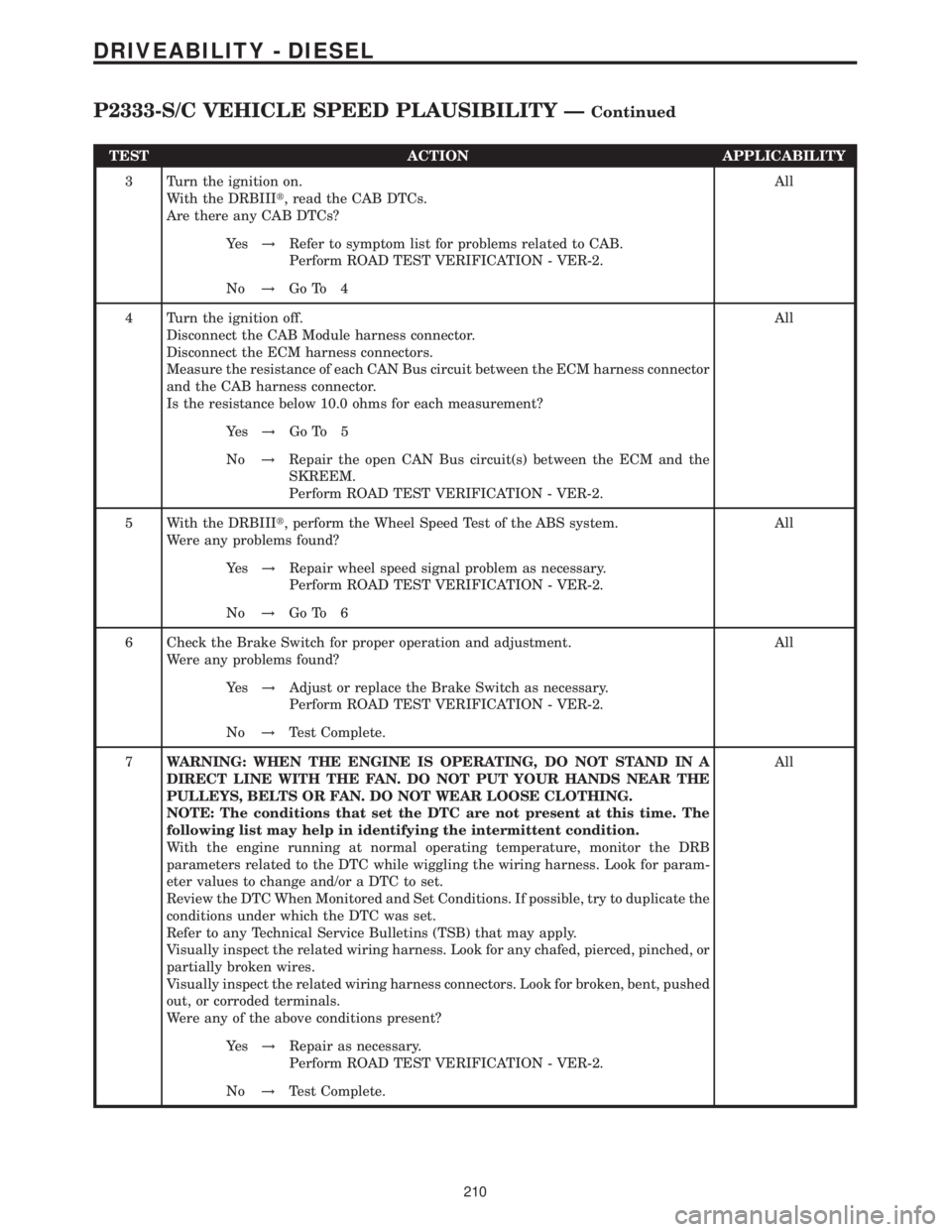
TEST ACTION APPLICABILITY
3 Turn the ignition on.
With the DRBIIIt, read the CAB DTCs.
Are there any CAB DTCs?All
Ye s!Refer to symptom list for problems related to CAB.
Perform ROAD TEST VERIFICATION - VER-2.
No!Go To 4
4 Turn the ignition off.
Disconnect the CAB Module harness connector.
Disconnect the ECM harness connectors.
Measure the resistance of each CAN Bus circuit between the ECM harness connector
and the CAB harness connector.
Is the resistance below 10.0 ohms for each measurement?All
Ye s!Go To 5
No!Repair the open CAN Bus circuit(s) between the ECM and the
SKREEM.
Perform ROAD TEST VERIFICATION - VER-2.
5 With the DRBIIIt, perform the Wheel Speed Test of the ABS system.
Were any problems found?All
Ye s!Repair wheel speed signal problem as necessary.
Perform ROAD TEST VERIFICATION - VER-2.
No!Go To 6
6 Check the Brake Switch for proper operation and adjustment.
Were any problems found?All
Ye s!Adjust or replace the Brake Switch as necessary.
Perform ROAD TEST VERIFICATION - VER-2.
No!Test Complete.
7WARNING: WHEN THE ENGINE IS OPERATING, DO NOT STAND IN A
DIRECT LINE WITH THE FAN. DO NOT PUT YOUR HANDS NEAR THE
PULLEYS, BELTS OR FAN. DO NOT WEAR LOOSE CLOTHING.
NOTE: The conditions that set the DTC are not present at this time. The
following list may help in identifying the intermittent condition.
With the engine running at normal operating temperature, monitor the DRB
parameters related to the DTC while wiggling the wiring harness. Look for param-
eter values to change and/or a DTC to set.
Review the DTC When Monitored and Set Conditions. If possible, try to duplicate the
conditions under which the DTC was set.
Refer to any Technical Service Bulletins (TSB) that may apply.
Visually inspect the related wiring harness. Look for any chafed, pierced, pinched, or
partially broken wires.
Visually inspect the related wiring harness connectors. Look for broken, bent, pushed
out, or corroded terminals.
Were any of the above conditions present?All
Ye s!Repair as necessary.
Perform ROAD TEST VERIFICATION - VER-2.
No!Test Complete.
210
DRIVEABILITY - DIESEL
P2333-S/C VEHICLE SPEED PLAUSIBILITY ÐContinued
Page 680 of 2305
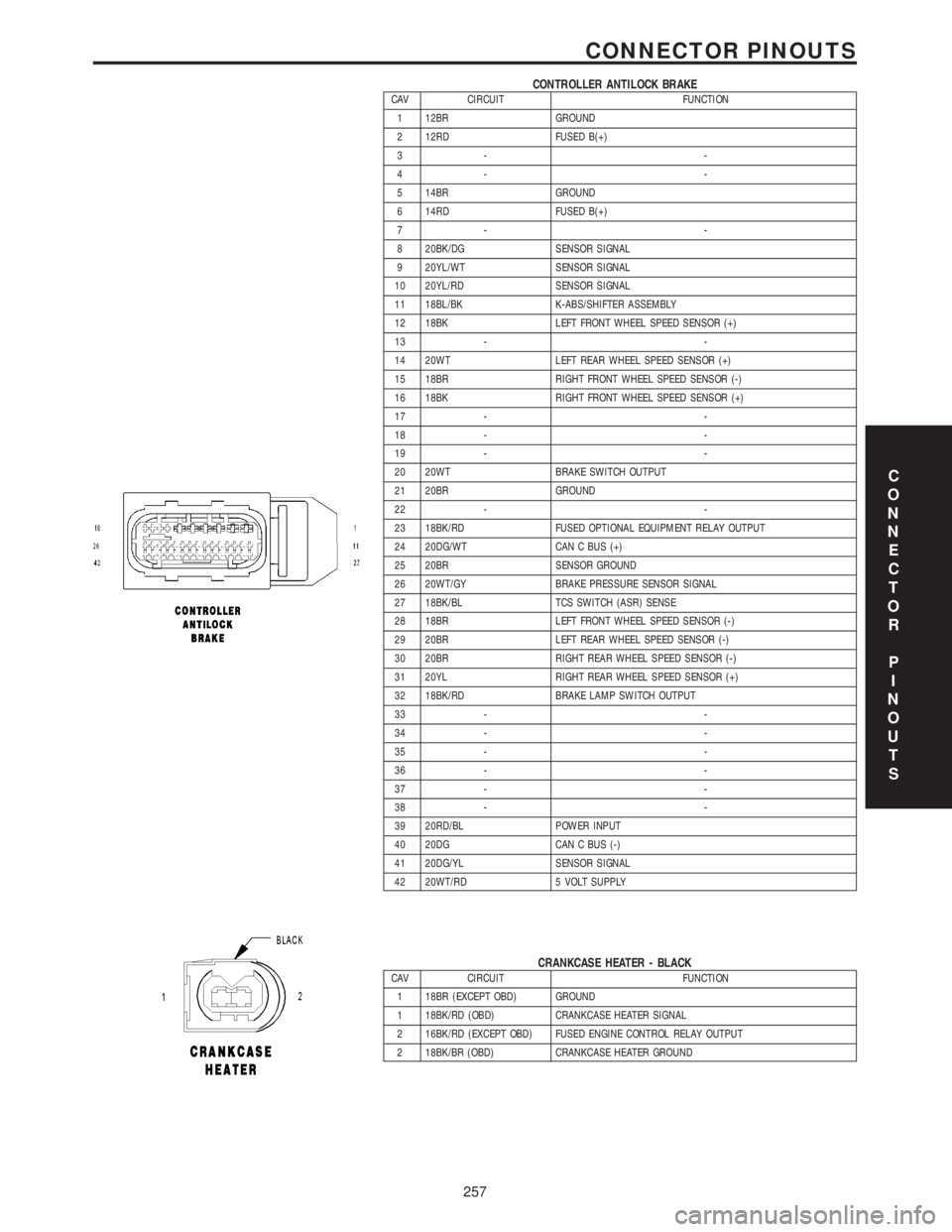
CONTROLLER ANTILOCK BRAKECAV CIRCUIT FUNCTION
1 12BR GROUND
2 12RD FUSED B(+)
3- -
4- -
5 14BR GROUND
6 14RD FUSED B(+)
7- -
8 20BK/DG SENSOR SIGNAL
9 20YL/WT SENSOR SIGNAL
10 20YL/RD SENSOR SIGNAL
11 18BL/BK K-ABS/SHIFTER ASSEMBLY
12 18BK LEFT FRONT WHEEL SPEED SENSOR (+)
13 - -
14 20WT LEFT REAR WHEEL SPEED SENSOR (+)
15 18BR RIGHT FRONT WHEEL SPEED SENSOR (-)
16 18BK RIGHT FRONT WHEEL SPEED SENSOR (+)
17 - -
18 - -
19 - -
20 20WT BRAKE SWITCH OUTPUT
21 20BR GROUND
22 - -
23 18BK/RD FUSED OPTIONAL EQUIPMENT RELAY OUTPUT
24 20DG/WT CAN C BUS (+)
25 20BR SENSOR GROUND
26 20WT/GY BRAKE PRESSURE SENSOR SIGNAL
27 18BK/BL TCS SWITCH (ASR) SENSE
28 18BR LEFT FRONT WHEEL SPEED SENSOR (-)
29 20BR LEFT REAR WHEEL SPEED SENSOR (-)
30 20BR RIGHT REAR WHEEL SPEED SENSOR (-)
31 20YL RIGHT REAR WHEEL SPEED SENSOR (+)
32 18BK/RD BRAKE LAMP SWITCH OUTPUT
33 - -
34 - -
35 - -
36 - -
37 - -
38 - -
39 20RD/BL POWER INPUT
40 20DG CAN C BUS (-)
41 20DG/YL SENSOR SIGNAL
42 20WT/RD 5 VOLT SUPPLY
CRANKCASE HEATER - BLACKCAV CIRCUIT FUNCTION
1 18BR (EXCEPT OBD) GROUND
1 18BK/RD (OBD) CRANKCASE HEATER SIGNAL
2 16BK/RD (EXCEPT OBD) FUSED ENGINE CONTROL RELAY OUTPUT
2 18BK/BR (OBD) CRANKCASE HEATER GROUND
C
O
N
N
E
C
T
O
R
P
I
N
O
U
T
S
257
CONNECTOR PINOUTS
Page 704 of 2305
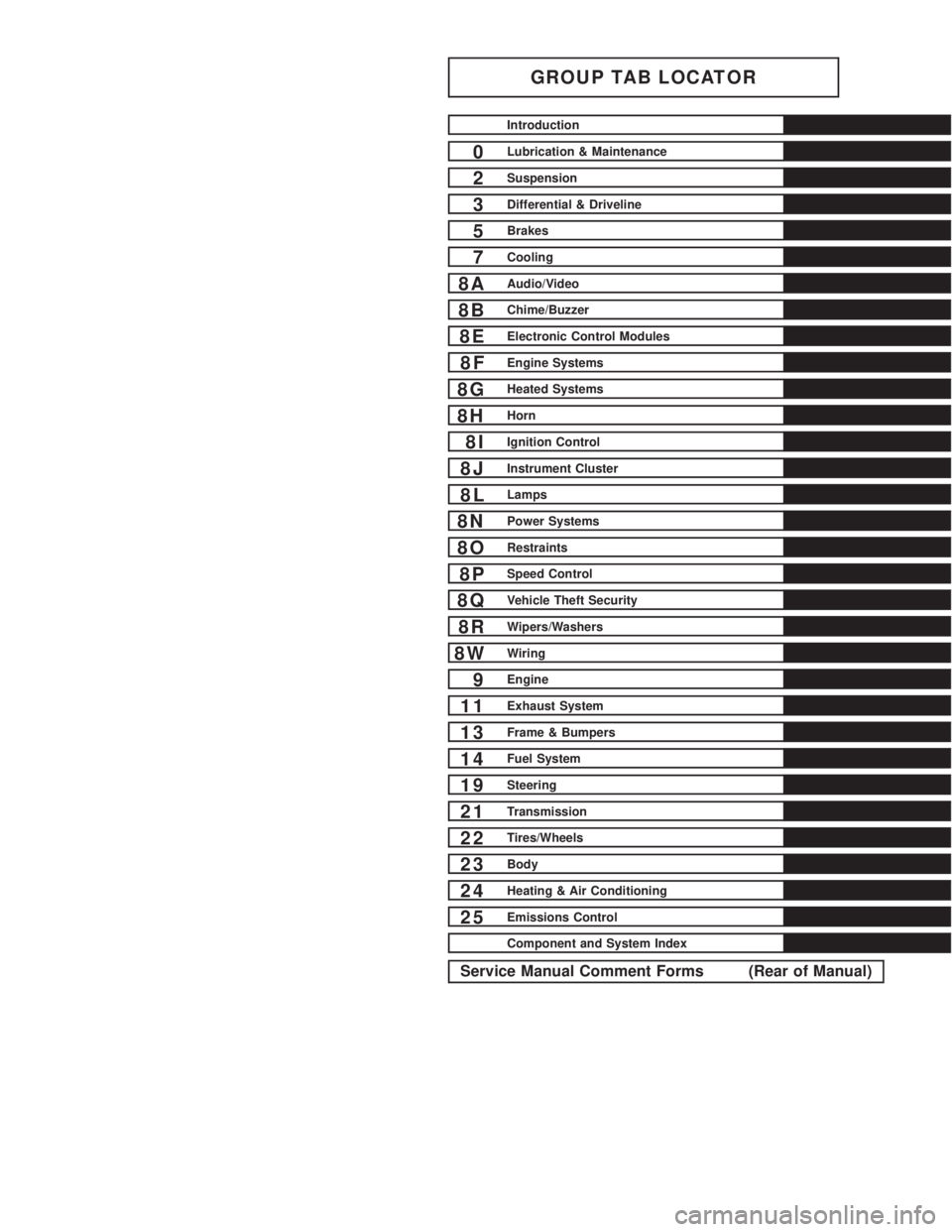
GROUP TAB LOCATOR
Introduction
0Lubrication & Maintenance
2Suspension
3Differential & Driveline
5Brakes
7Cooling
8AAudio/Video
8BChime/Buzzer
8EElectronic Control Modules
8FEngine Systems
8GHeated Systems
8HHorn
8IIgnition Control
8JInstrument Cluster
8LLamps
8NPower Systems
8ORestraints
8PSpeed Control
8QVehicle Theft Security
8RWipers/Washers
8WWiring
9Engine
11Exhaust System
13Frame & Bumpers
14Fuel System
19Steering
21Transmission
22Tires/Wheels
23Body
24Heating & Air Conditioning
25Emissions Control
Component and System Index
Service Manual Comment Forms (Rear of Manual)
Page 707 of 2305
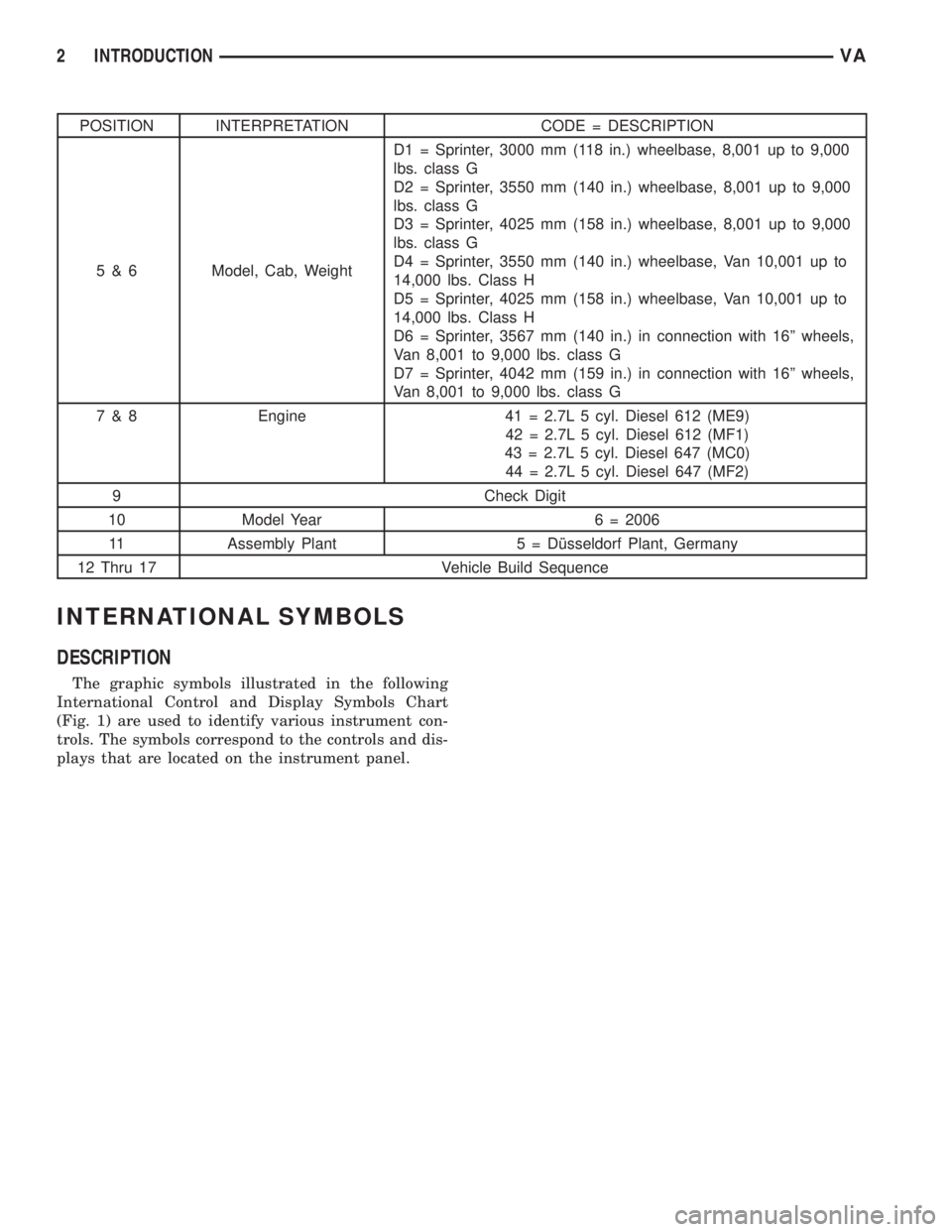
POSITION INTERPRETATION CODE = DESCRIPTION
5 & 6 Model, Cab, WeightD1 = Sprinter, 3000 mm (118 in.) wheelbase, 8,001 up to 9,000
lbs. class G
D2 = Sprinter, 3550 mm (140 in.) wheelbase, 8,001 up to 9,000
lbs. class G
D3 = Sprinter, 4025 mm (158 in.) wheelbase, 8,001 up to 9,000
lbs. class G
D4 = Sprinter, 3550 mm (140 in.) wheelbase, Van 10,001 up to
14,000 lbs. Class H
D5 = Sprinter, 4025 mm (158 in.) wheelbase, Van 10,001 up to
14,000 lbs. Class H
D6 = Sprinter, 3567 mm (140 in.) in connection with 16º wheels,
Van 8,001 to 9,000 lbs. class G
D7 = Sprinter, 4042 mm (159 in.) in connection with 16º wheels,
Van 8,001 to 9,000 lbs. class G
7 & 8 Engine 41 = 2.7L 5 cyl. Diesel 612 (ME9)
42 = 2.7L 5 cyl. Diesel 612 (MF1)
43 = 2.7L 5 cyl. Diesel 647 (MC0)
44 = 2.7L 5 cyl. Diesel 647 (MF2)
9 Check Digit
10 Model Year 6 = 2006
11 Assembly Plant 5 = Dîsseldorf Plant, Germany
12 Thru 17 Vehicle Build Sequence
INTERNATIONAL SYMBOLS
DESCRIPTION
The graphic symbols illustrated in the following
International Control and Display Symbols Chart
(Fig. 1) are used to identify various instrument con-
trols. The symbols correspond to the controls and dis-
plays that are located on the instrument panel.
2 INTRODUCTIONVA
Page 716 of 2305
LUBRICATION & MAINTENANCE
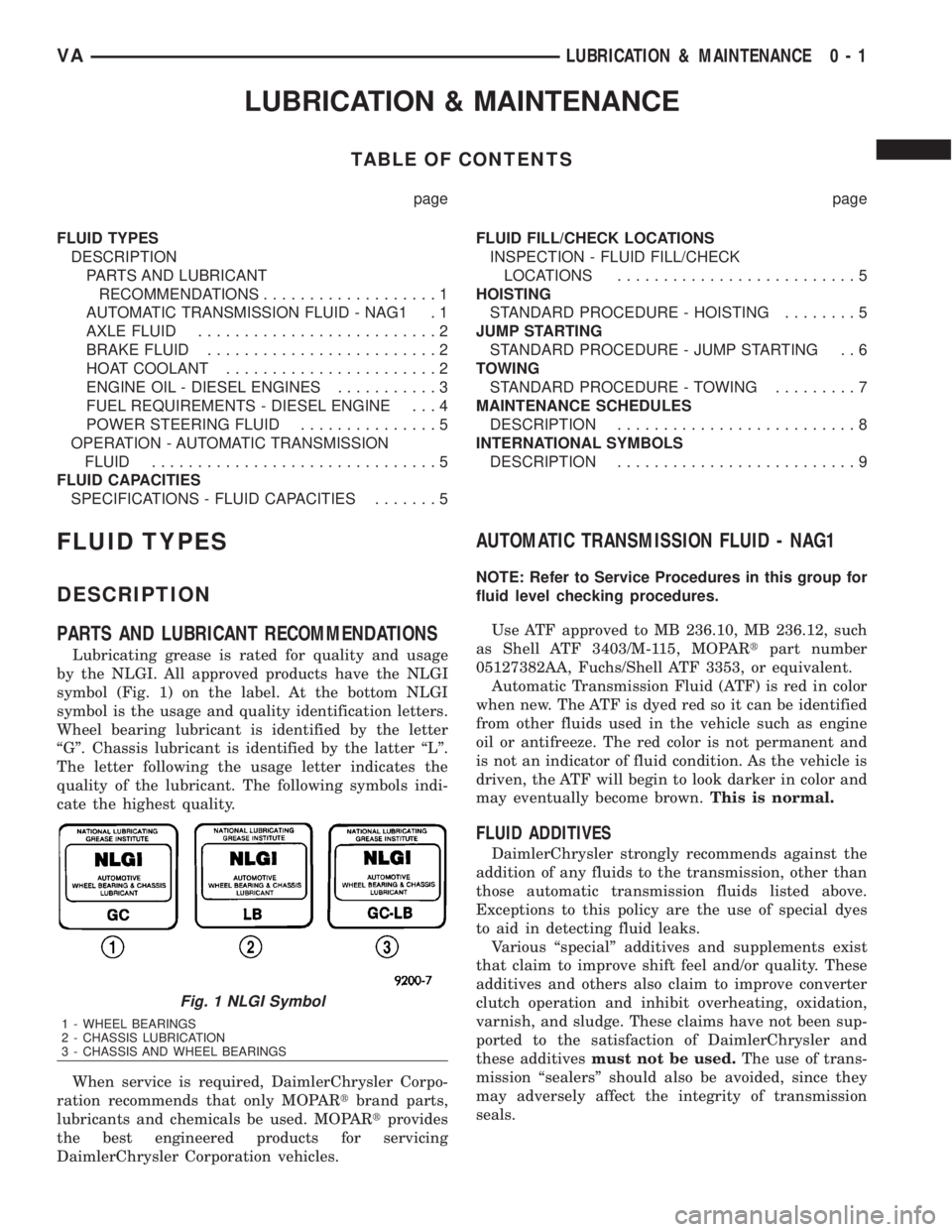
TABLE OF CONTENTS
page page
FLUID TYPES
DESCRIPTION
PARTS AND LUBRICANT
RECOMMENDATIONS...................1
AUTOMATIC TRANSMISSION FLUID - NAG1 . 1
AXLE FLUID..........................2
BRAKE FLUID.........................2
HOAT COOLANT.......................2
ENGINE OIL - DIESEL ENGINES...........3
FUEL REQUIREMENTS - DIESEL ENGINE . . . 4
POWER STEERING FLUID...............5
OPERATION - AUTOMATIC TRANSMISSION
FLUID...............................5
FLUID CAPACITIES
SPECIFICATIONS - FLUID CAPACITIES.......5FLUID FILL/CHECK LOCATIONS
INSPECTION - FLUID FILL/CHECK
LOCATIONS..........................5
HOISTING
STANDARD PROCEDURE - HOISTING........5
JUMP STARTING
STANDARD PROCEDURE - JUMP STARTING . . 6
TOWING
STANDARD PROCEDURE - TOWING.........7
MAINTENANCE SCHEDULES
DESCRIPTION..........................8
INTERNATIONAL SYMBOLS
DESCRIPTION..........................9
FLUID TYPES
DESCRIPTION
PARTS AND LUBRICANT RECOMMENDATIONS
Lubricating grease is rated for quality and usage
by the NLGI. All approved products have the NLGI
symbol (Fig. 1) on the label. At the bottom NLGI
symbol is the usage and quality identification letters.
Wheel bearing lubricant is identified by the letter
ªGº. Chassis lubricant is identified by the latter ªLº.
The letter following the usage letter indicates the
quality of the lubricant. The following symbols indi-
cate the highest quality.
When service is required, DaimlerChrysler Corpo-
ration recommends that only MOPARtbrand parts,
lubricants and chemicals be used. MOPARtprovides
the best engineered products for servicing
DaimlerChrysler Corporation vehicles.
AUTOMATIC TRANSMISSION FLUID - NAG1
NOTE: Refer to Service Procedures in this group for
fluid level checking procedures.
Use ATF approved to MB 236.10, MB 236.12, such
as Shell ATF 3403/M-115, MOPARtpart number
05127382AA, Fuchs/Shell ATF 3353, or equivalent.
Automatic Transmission Fluid (ATF) is red in color
when new. The ATF is dyed red so it can be identified
from other fluids used in the vehicle such as engine
oil or antifreeze. The red color is not permanent and
is not an indicator of fluid condition. As the vehicle is
driven, the ATF will begin to look darker in color and
may eventually become brown.This is normal.
FLUID ADDITIVES
DaimlerChrysler strongly recommends against the
addition of any fluids to the transmission, other than
those automatic transmission fluids listed above.
Exceptions to this policy are the use of special dyes
to aid in detecting fluid leaks.
Various ªspecialº additives and supplements exist
that claim to improve shift feel and/or quality. These
additives and others also claim to improve converter
clutch operation and inhibit overheating, oxidation,
varnish, and sludge. These claims have not been sup-
ported to the satisfaction of DaimlerChrysler and
these additivesmust not be used.The use of trans-
mission ªsealersº should also be avoided, since they
may adversely affect the integrity of transmission
seals.
Fig. 1 NLGI Symbol
1 - WHEEL BEARINGS
2 - CHASSIS LUBRICATION
3 - CHASSIS AND WHEEL BEARINGS
VALUBRICATION & MAINTENANCE 0 - 1