ECO mode MERCEDES-BENZ SPRINTER 2010 MY10 Operator’s Manual
[x] Cancel search | Manufacturer: MERCEDES-BENZ, Model Year: 2010, Model line: SPRINTER, Model: MERCEDES-BENZ SPRINTER 2010Pages: 292, PDF Size: 6.75 MB
Page 101 of 292
Recommendations for optimum climate
control:
R
set the temperature control to the middle
level. Only change
the temperature in small
increments.
R only use the defrosting function until the
windshield is clear again ( Y page 103).
R only use air-recirculation mode briefly, e.g.
in a tunnel. The windows could otherwise
fog up, because the flow of fresh air is cut
off and the air inside the vehicle is
circulated.
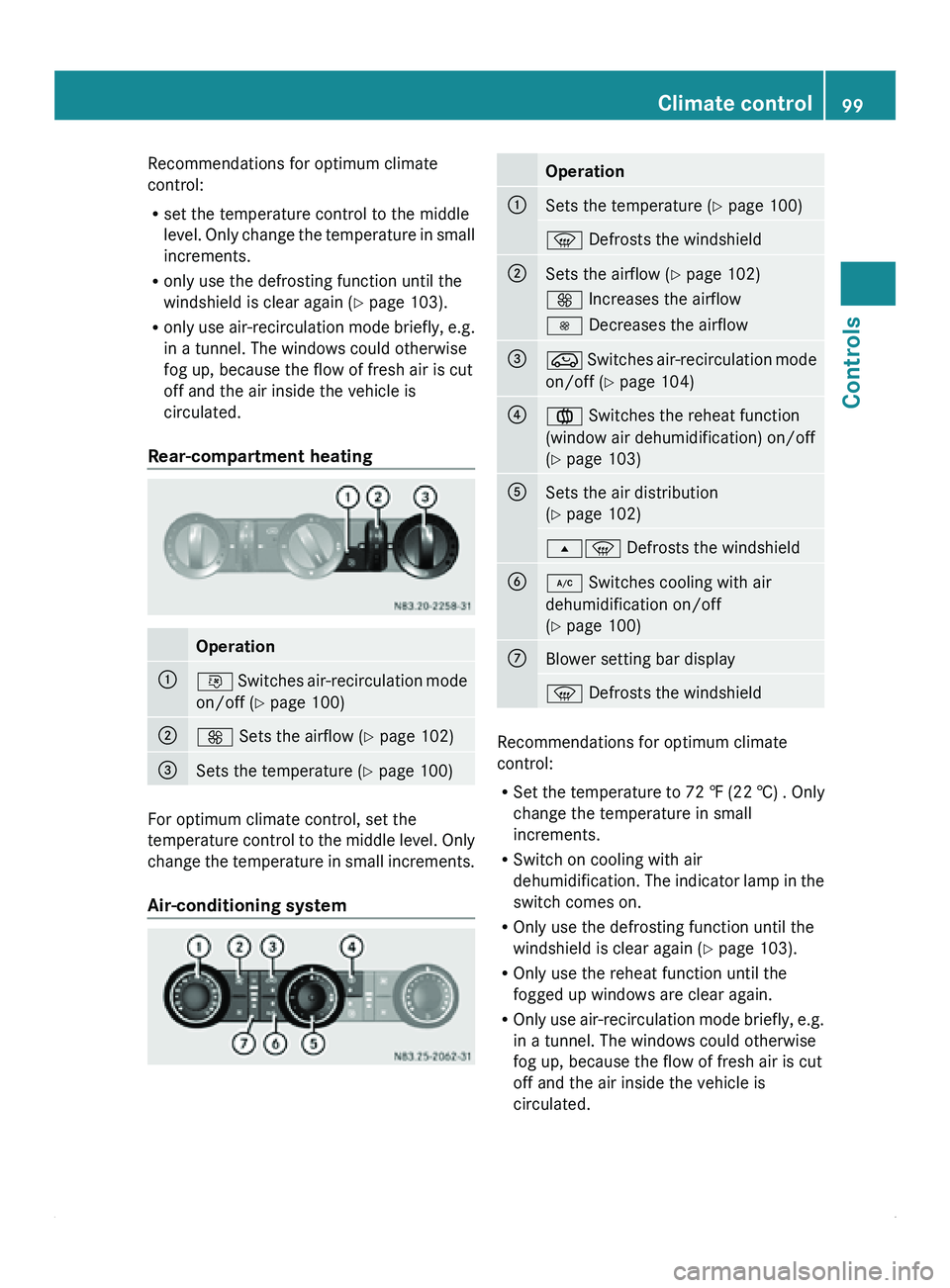
Rear-compartment heating Operation
0046
0076 Switches air-recirculation mode
on/off ( Y page 100) 0047
0099 Sets the airflow (
Y page 102)008A
Sets the temperature (
Y page 100)For optimum climate control, set the
temperature control to
the middle level. Only
change the temperature in small increments.
Air-conditioning system Operation
0046
Sets the temperature (
Y page 100) 0087 Defrosts the windshield
0047
Sets the airflow (
Y page 102)
0099 Increases the airflow
0097 Decreases the airflow 008A
008C Switches air-recirculation mode
on/off (
Y page 104) 0088
0085 Switches the reheat function
(window air dehumidification) on/off
(Y page 103)
0086
Sets the air distribution
(Y page 102)
00800087 Defrosts the windshield
0087
005C Switches cooling with air
dehumidification on/off
(Y page 100)
006E
Blower setting bar display
0087 Defrosts the windshield
Recommendations for optimum climate
control:
R
Set the temperature
to 72 ‡ (22 †) . Only
change the temperature in small
increments.
R Switch on cooling with air
dehumidification. The indicator lamp in the
switch comes on.
R Only use the defrosting function until the
windshield is clear again ( Y page 103).
R Only use the reheat function until the
fogged up windows are clear again.
R Only use air-recirculation mode briefly, e.g.
in a tunnel. The windows could otherwise
fog up, because the flow of fresh air is cut
off and the air inside the vehicle is
circulated. Climate control
99
Controls Z
Page 106 of 292
Windows fogged up on the outside
Only use the following settings until the
windshield is clear again.
X
Switch on the windshield wipers
(Y page 94).
X Adjust air distribution to the footwell
(Y page 102).
X Close the air vents ( Y page 101).Switching air-recirculation mode on/
off
You can deactivate the intake of fresh air if
unpleasant odors enter the vehicle from
outside. The air
inside the vehicle will only be
circulated. G
Warning
At low outside temperatures, only switch over
to air-recirculation mode for brief periods.
Otherwise, the windows could fog up, thus
impairing visibility and endangering yourself
and others. This may prevent you from
observing the traffic conditions and thereby
cause an accident.
Heating/air-conditioning system X
Press the 008C button.
If the indicator
lamp in the button lights up,
air-recirculation mode is activated.
Air-recirculation mode switches off
automatically after about 10 to 30 minutes,
depending on the outside temperature.
Rear-compartment heating/rear-
compartment air conditioning If your vehicle is equipped with rear-
compartment heating
and
rear-compartment
air conditioning, you can activate/deactivate
the air-recirculation mode of the rear-
compartment climate control.
X To activate: set temperature
control of the
rear-compartment heating 008A(Y page 99)
or or temperature control of the rear- compartment air conditioning
0047
(Y page 100) to the center position.
Only one of the two climate control
systems in the rear compartment is
activated and is in air-recirculation mode.
X To deactivate: turn temperature
control of
the rear-compartment heating
008A(Y page 99) or temperature control of
the rear-compartment air conditioning 0047
(Y page 100) clockwise or
counterclockwise. Only change the
temperature in small increments. Auxiliary heating
Important safety notes G
Warning
Exhaust fumes are produced while the
auxiliary heating system
is in operation. If you
breathe in these exhaust fumes, you could be
poisoned. Therefore, always switch off the
auxiliary heating in enclosed spaces without
an extraction system, e.g. a garage. G
Warning
Parts of the vehicle can become very hot
during operation of the auxiliary heating.
Make sure that the exhaust system does not
under any circumstances come into contact
with highly flammable material such as dry
grass or fuels. Otherwise, the highly
flammable material could ignite and set the
vehicle alight.
Auxiliary heating operation is prohibited at
gas stations or when your vehicle is being
refueled. Therefore, the auxiliary heating
must be switched off at gas stations. G
Warning
When transporting hazardous materials,
always observe the relevant safety
regulations.
Spray canisters and gas cartridges or other
pressurized containers carried in the vehicle 104
Climate control
Controls
Page 107 of 292
may be highly flammable and could explode if
heated.
In particular, make sure that the containers
described above are not placed in the hot air
flow from the
auxiliary heating system. Do not
stow such containers directly next to or on top
of the heater.
You could otherwise endanger yourself and
others.
The auxiliary heating system operates
independently of the engine and
complements the vehicle heating or air
conditioning.
You can set the auxiliary heating at an outside
temperature of up to 39 ‡ (4 †) in order to:
R pre-heat the vehicle interior
R additionally warm the coolant, thereby
conserving the engine and saving fuel
R support the vehicle's heating system while
the engine is running and outside
temperatures are low (heater booster
function)
i If the outside temperature rises above
39 ‡ (4 †), the auxiliary heating and heater
booster function switch off automatically.
! Switch on the auxiliary heating system at
regular intervals (at least once a month) for
approximately 10 minutes.
Make sure that the flow of hot air is not
blocked. Otherwise, the auxiliary heating
will overheat and switch off.
i If the interior motion sensor ( Y page 62)
is armed and the auxiliary heating is
switched on, it is possible that the interior
temperature monitoring may cause a false
alarm. In this case, either deactivate the
interior motion sensor or switch off the
auxiliary heating. Before switching on X
The fuel tank must be at least one-quarter
full.
X Set the desired temperature using the
temperature control of the heating or the
air-conditioning system (Y
page 100).
X Set the air distribution as required
(Y page 102).
X Open the center and side air vents and set
them to the middle position (Y page 101).
i The auxiliary heating automatically
switches to heater booster mode after the
engine is started.
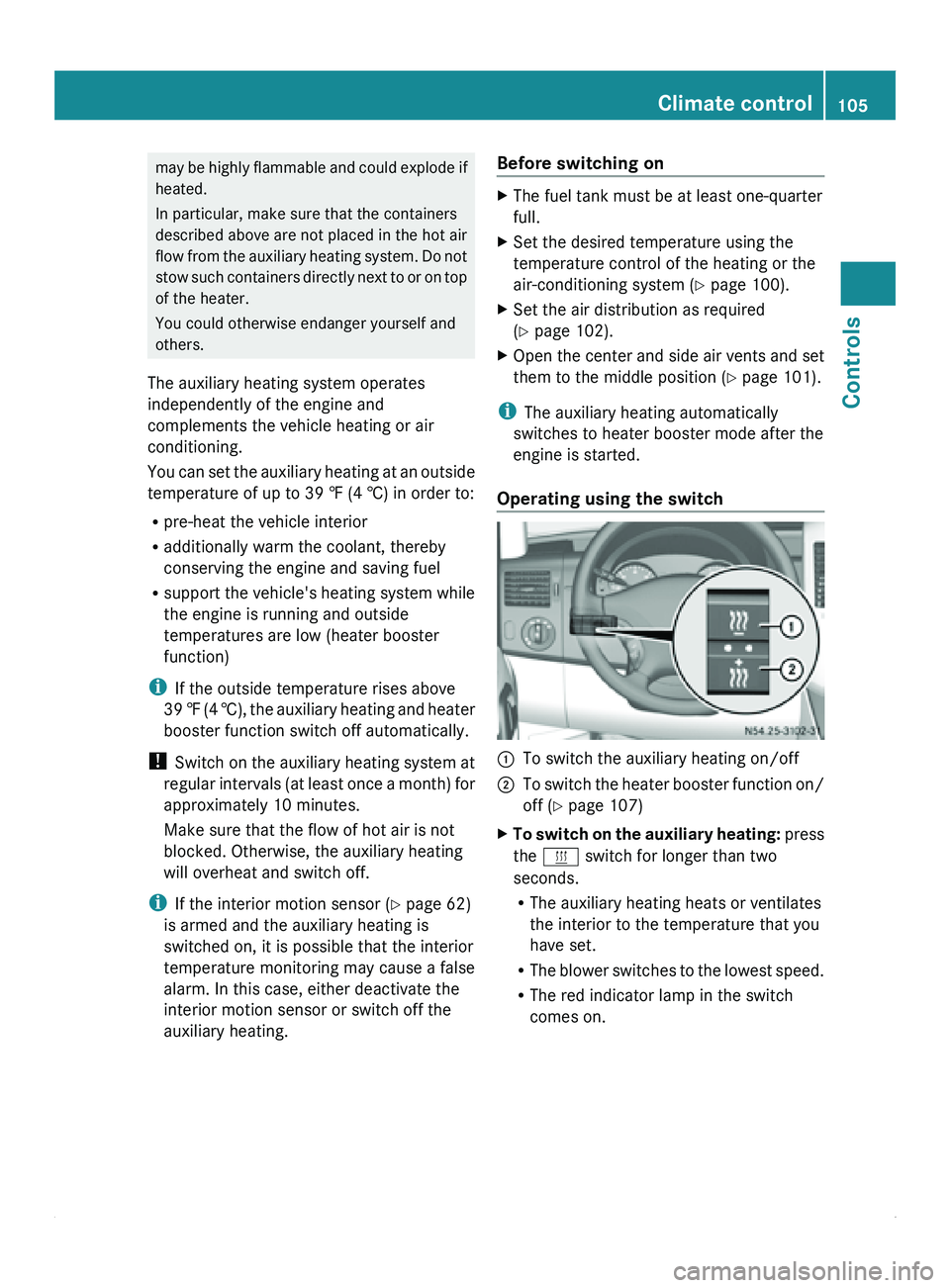
Operating using the switch 0046
To switch the auxiliary heating on/off
0047 To switch the heater booster function on/
off (Y page 107)
X To switch on the auxiliary heating: press
the 0086
switch for longer than two
seconds.
R The auxiliary heating heats or ventilates
the interior to the temperature that you
have set.
R The blower switches to the lowest speed.
R The red indicator lamp in the switch
comes on. Climate control
105
Controls Z
Page 108 of 292
X
To switch off the auxiliary heating: press
the 0086
switch.
or
X Turn the key to position 0 in the ignition
lock.
The red indicator lamp in the switch goes
out.
The auxiliary heating operates for about
another two minutes
and then switches off
automatically.
Selecting a switch-on time You can use the on-board computer to define
up to
three
switch-on times, one of which can
be selected.
On-board computer without steering
wheel buttons
X Turn the SmartKey to position 2 in the
ignition lock.
X Press the 0086 switch.
The 0086 symbol in the display flashes.
or
X Press the 007B menu button on the
instrument cluster repeatedly until the
0086 symbol flashes in the display.
X Use the 0069 or 006A
buttons on the instrument
cluster to select switch-on time 1 to 3
The switch-on time selected is displayed.
X Wait 10 seconds for the standard display to
appear.
The switch-on time is selected. The yellow
indicator lamp in the 0086 switch comes
on.
If you have not preselected a switch-on time
and --:-- is
shown
in the display, this means
that automatic switch-on mode is
deactivated. The yellow indicator lamp in the
0086 switch goes out.
i If you turn the key to position 0 in the
ignition lock, the yellow indicator lamp in
the 0086 switch goes off after 30 minutes. The red indicator lamp in the
0086 switch
comes on when the auxiliary heating
switches on.
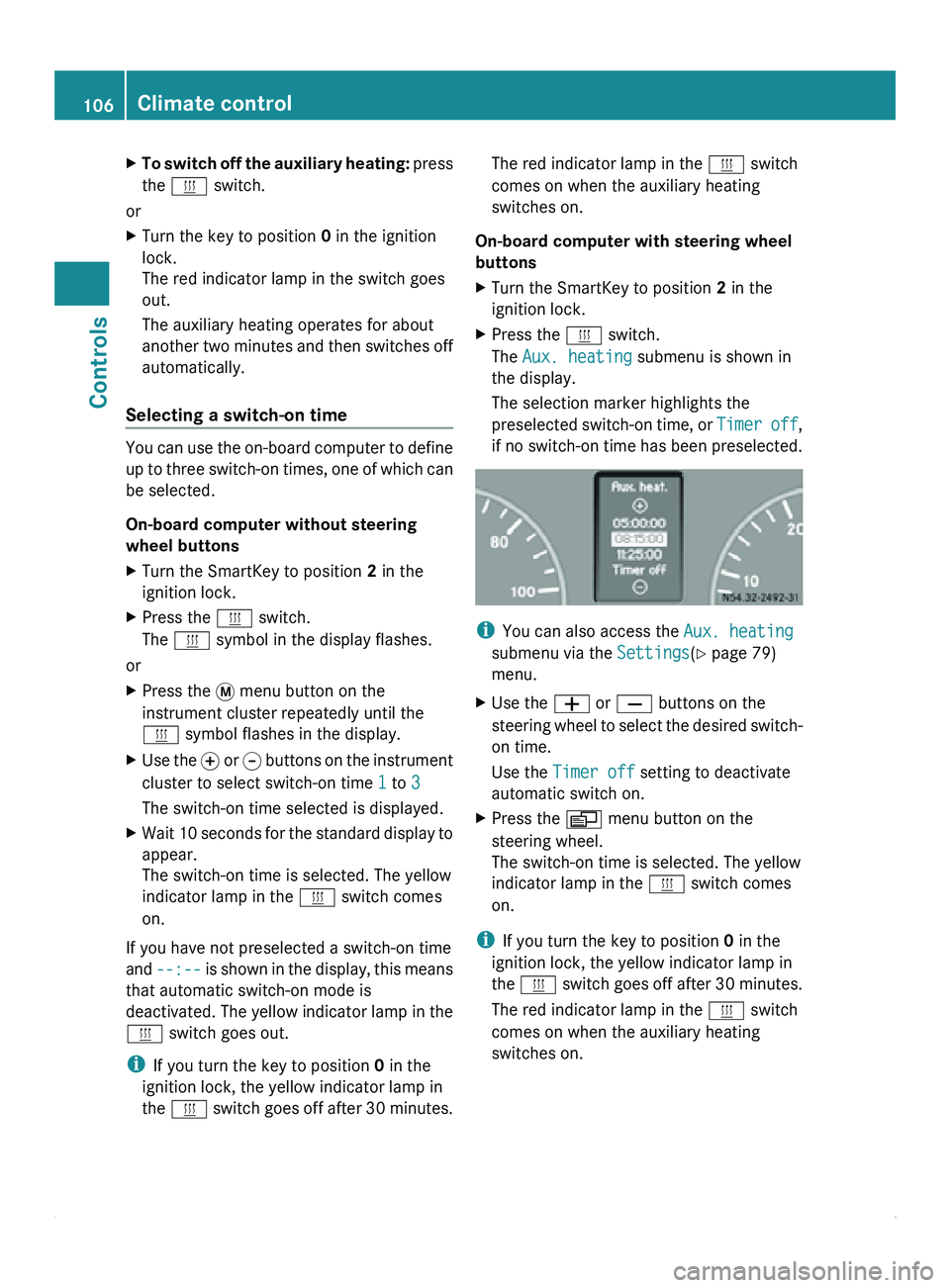
On-board computer with steering wheel
buttons
X Turn the SmartKey to position 2 in the
ignition lock.
X Press the 0086 switch.
The Aux. heating submenu is shown in
the display.
The selection marker highlights the
preselected switch-on
time,
or Timer off,
if no switch-on time has been preselected. i
You can also access the Aux. heating
submenu via the Settings(Y page 79)
menu.
X Use the 005A or 005B buttons on the
steering wheel
to
select the desired switch-
on time.
Use the Timer off setting to deactivate
automatic switch on.
X Press the 0059 menu button on the
steering wheel.
The switch-on time is selected. The yellow
indicator lamp in the 0086 switch comes
on.
i If you turn the key to position 0 in the
ignition lock, the yellow indicator lamp in
the 0086 switch goes
off after 30 minutes.
The red indicator lamp in the 0086 switch
comes on when the auxiliary heating
switches on. 106
Climate control
Controls
Page 117 of 292
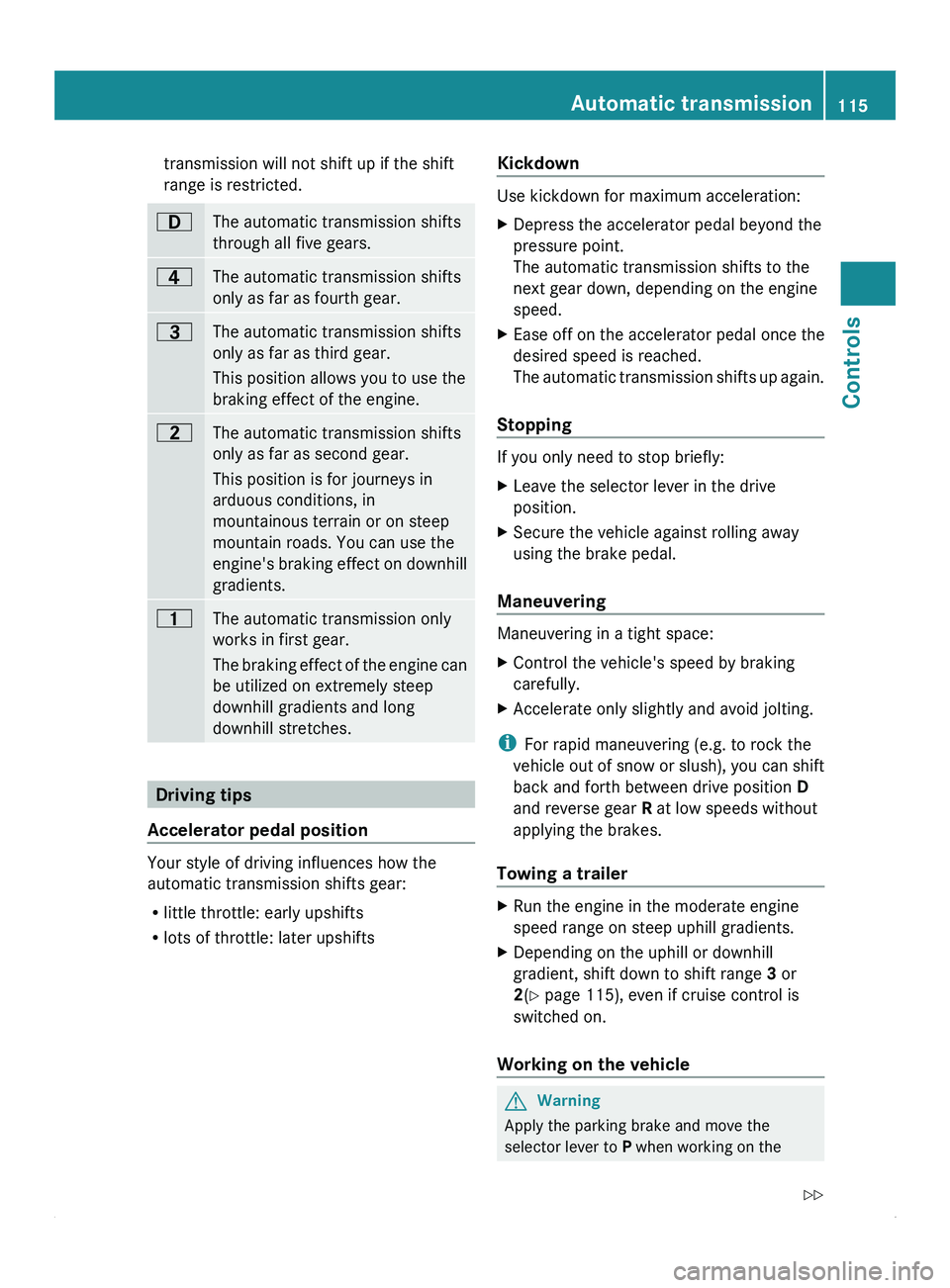
transmission will not shift up if the shift
range is restricted.
003A
The automatic transmission shifts
through all five gears.
0042
The automatic transmission shifts
only as far as fourth gear.
0040
The automatic transmission shifts
only as far as third gear.
This position allows you to use the
braking effect of the engine.
0038
The automatic transmission shifts
only as far as second gear.
This position is for journeys in
arduous conditions, in
mountainous terrain or on steep
mountain roads. You can use the
engine's braking
effect
on downhill
gradients. 0037
The automatic transmission only
works in first gear.
The braking
effect
of the engine can
be utilized on extremely steep
downhill gradients and long
downhill stretches. Driving tips
Accelerator pedal position Your style of driving influences how the
automatic transmission shifts gear:
R
little throttle: early upshifts
R lots of throttle: later upshifts Kickdown Use kickdown for maximum acceleration:
X
Depress the accelerator pedal beyond the
pressure point.
The automatic transmission shifts to the
next gear down, depending on the engine
speed.
X Ease off on the accelerator pedal once the
desired speed is reached.
The automatic transmission
shifts up again.
Stopping If you only need to stop briefly:
X
Leave the selector lever in the drive
position.
X Secure the vehicle against rolling away
using the brake pedal.
Maneuvering Maneuvering in a tight space:
X
Control the vehicle's speed by braking
carefully.
X Accelerate only slightly and avoid jolting.
i For rapid maneuvering (e.g. to rock the
vehicle out of
snow or slush), you can shift
back and forth between drive position D
and reverse gear R at low speeds without
applying the brakes.
Towing a trailer X
Run the engine in the moderate engine
speed range on steep uphill gradients.
X Depending on the uphill or downhill
gradient, shift down to shift range 3 or
2(Y page 115), even if cruise control is
switched on.
Working on the vehicle G
Warning
Apply the parking brake and move the
selector lever to P when working on the Automatic transmission
115
Controls
Z
Page 136 of 292
A navigation system does not supply
information on the load-bearing capacity of
bridges or the overhead clearance of
underpasses.
The driver remains responsible for the safety
of the vehicle at all times.
Observe legal requirements.
Telephones, two-way
radios
and fax machines
without an exterior antenna could interfere
with the vehicle electronics and thus
compromise the operational safety of the
vehicle. There is an increased risk of accident.
Do not use this equipment while the vehicle
is in motion.
Failure to observe the Sprinter installation
specifications can result in the invalidation of
your vehicle's operating permit.
You will find information on retrofitting
electrical or electronic equipment in the
"Technical data" section ( Y page 277).Telephone
G
Warning
A driver's attention to the road must always
be his/her primary focus when driving. For
your safety and the safety of others, we
recommend that you pull over to a safe
location and stop before placing or taking a
telephone call. If you choose to use the
telephone while driving,
please use the hands-
free device and only use the telephone when
weather, road and traffic conditions permit.
Some jurisdictions prohibit the driver from
using a mobile phone while driving a vehicle.
Bear in mind that at a speed of just 30 mph
(approximately 50 km/h ), your vehicle is
covering a distance of 44 feet (approximately
14 m) every second. G
Warning
Excessive electromagnetic radiation may
constitute a health hazard to yourself and
others. Use of an exterior antenna gives consideration to scientific discussion
surrounding the
possible
health risk posed by
electromagnetic fields.
The exterior antenna should only be installed
at a qualified specialist workshop which has
the necessary specialist knowledge and tools
to carry out the work required. We
recommend that you use an authorized
Sprinter Dealer for this purpose. In particular,
work relevant to safety or on safety-related
systems must be carried out at a qualified
specialist workshop.
We recommend the use of an approved
exterior antenna for operating the mobile
phone. Only in this way can optimal mobile
phone reception quality in the vehicle be
ensured and mutual interference between the
vehicle electronics and mobile phones
minimized.
Observe the legal requirements for each
individual country.
The mobile phone fitting includes a hands-
free system integrated into the vehicle. The
microphone for the hands-free system is
installed in the overhead control panel or in
the overhead stowage compartment together
with the front interior light.
In order to use the hands-free system, you will
need a special bracket. The Sprinter range of
accessories includes brackets for various
mobile phone models.
i Mobile phone brackets which are
available from various manufacturers on
the open market are not compatible with
the Sprinter telephone system. You can
recognize suitable phone brackets for your
mobile, by the printed star and the B6 in the
part number on the rear of the phone
bracket.
Detailed instructions for use can be found in
the operating instructions for the mobile
phone bracket and in the separate operating
instructions for the mobile phone fittings.
i The mobile phone battery is charged
depending on the condition of charge 134
Communications
Controls
Page 140 of 292
Vehicle equipment
i Diese Betriebsanleitung beschreibt alle
Modelle, Serien- und
Sonderausstattungen
Ihres Fahrzeugs, die zum Zeitpunkt des
Redaktionsschlusses dieser
Betriebsanleitung erhältlich waren.
Länderspezifische Abweichungen sind
möglich. Beachten Sie, dass Ihr Fahrzeug
nicht mit allen beschriebenen Funktionen
ausgestattet sein könnte. Dies betrifft auch
sicherheitsrelevante Systeme und
Funktionen. Driving tips
Breaking-in
It is of decisive importance for the operating
life, reliability and
economy of the vehicle that
the engine is not subjected to its full rated
load during the breaking-in period.
Up to 1000 miles (1500 km)
R Run the vehicle in carefully. Drive at varying
road and engine speeds.
R Avoid heavy loads (driving at full throttle)
and high engine speeds. Do not exceed ¾
of the maximum speed for each gear.
R Do not change down a gear manually in
order to brake.
R Avoid depressing the accelerator pedal
beyond the pressure point (kickdown) and
only engage gear 4, 3, 2 or 1 while driving
slowly.
After 1000 miles (1500 km)
R Gradually bring the vehicle up to full road
and engine speeds.
i These instructions must also be observed
if you have the engine, the transmission, or
the rear axle differential of your vehicle
replaced. Driving abroad
An extensive network of authorized Sprinter
Dealers is also
at your disposal when you are
traveling abroad. The respective workshop
directories are available from any authorized
Sprinter Dealer.
In some countries, only fuels with a lower
octane rating or a higher sulfur content are
available.
You will find information about fuel in the
"Service products" section (Y page 153).
If you are traveling in countries where
vehicles are driven on the opposite side of the
road to that in which the vehicle is registered,
you must have the headlamps:
R partially masked (halogen headlamps)
R switched over (Bi-Xenon headlamps) G
Warning
Masking the headlamps incorrectly can
impair your visibility when driving with the
headlamps switched on. You could also
impede other road users. Oncoming traffic
may be dazzled.
Always have the headlamps masked/
switched over at a qualified specialist
workshop which has
the necessary specialist
knowledge and tools to carry out the work
required.
For this we recommend an authorized
Sprinter Dealer. All work relevant to safety or
on safety-related systems must be carried out
at a qualified specialist workshop. Driving off-road
When driving the vehicle, particularly on
rough terrain, ensure that the driven wheels
always have sufficient traction.
Avoid letting the drive wheels spin. Spinning
drive wheels can damage the differential.
! Always observe the ground clearance of
the vehicle and avoid obstacles, e.g. deep
ruts. 138
Driving tips
Operation
Page 143 of 292
Engine oil consumption
! If the vehicle is predominantly used for
short-distance driving, this could lead to a
malfunction in the automatic cleaning
function for the diesel particle filter. As a
result, fuel may accumulate in the engine
oil and cause engine failure.
Therefore, if you mainly drive short
distances, you should
drive on a highway or
on rural roads for 20 minutes every
310 miles (500 km). This ensures sufficient
regeneration of the diesel particle filter.
Depending on the driving style, the vehicle
consumes a maximum of 1.0 US qt(1.0 l) of
oil over a distance of 620 miles (1000 km).
Engine oil consumption may be higher if:
R the vehicle is new.
R you mainly operate the vehicle under
arduous operating conditions.
R you frequently drive at high engine speeds.
Regular maintenance is one of the
preconditions for moderate rates of
consumption.
You can only estimate the engine oil
consumption after you have driven a
considerable distance.
Check the engine oil level on a regular basis,
e.g. weekly or each time you refuel
(Y page 171). Speed limiter
You can permanently limit the maximum
speed of your vehicle to 75 mph (120 km/h)
.
We recommend that you have the maximum
speed programmed at an authorized Sprinter
Dealer. This has the necessary specialist
knowledge and tools to carry out the required
work. G
Warning
Exceeding the permissible maximum speed
can cause tire damage, which could lead to
loss of control of the vehicle. As the driver, you must find out about the
maximum speed of the vehicle and the
resulting permissible maximum speed of the
tires (tire and tire pressure).
You must not exceed the speed limit for the
tires listed in the tire pressure tables.
i You will find information about tire
pressure in the "Technical data" section
(Y
page 280).
Reverse warning device
On vehicles with
a reverse warning feature, a
warning signal sounds when reverse gear is
engaged to alert other road users. The volume
of this warning signal can be reduced for
night-time driving. G
Warning
Other road users could fail to hear or could
ignore the reverse warning feature warning
signal. For this reason, the reverse warning
feature cannot guarantee that there are no
people or objects behind your vehicle.
The reverse warning feature is a system
designed to assist you in ensuring the safety
of other road users. It does not, however,
relieve you of
your responsibility to make sure
that there are no persons or objects behind
your vehicle while you are maneuvering.
For this reason, always observe the road and
traffic conditions with due caution. To avoid
damage and injury, make sure that there are
no persons or objects behind the vehicle while
you are maneuvering. Have a second person
assist you when maneuvering if necessary.
X To set the warning signal to quiet:
engage the reverse gear twice in brief
succession.
The volume of the warning signal is
reduced.
i The warning signal sounds at normal
volume by default and will need to be Driving tips
141
Operation Z
Page 216 of 292
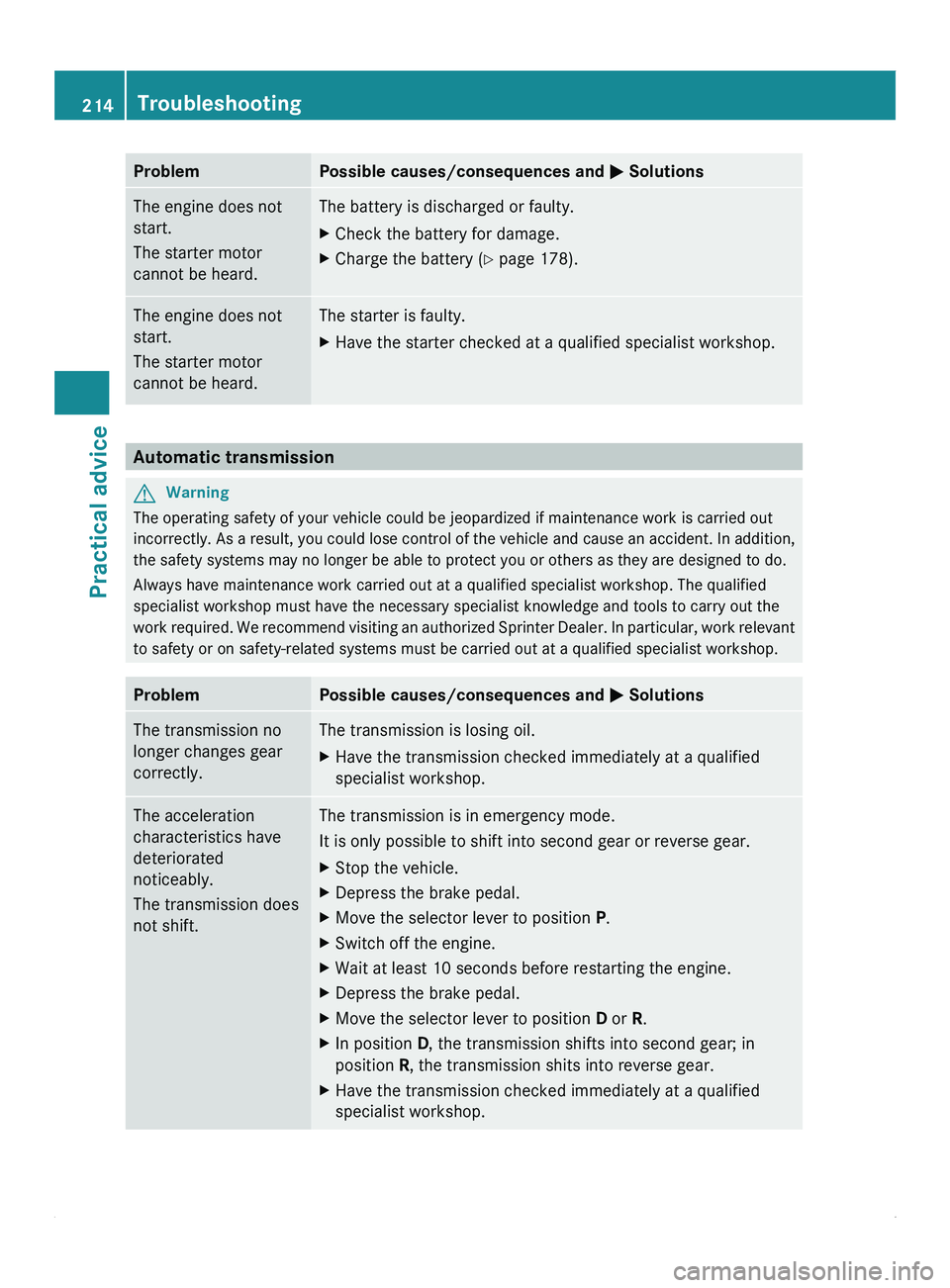
Problem Possible causes/consequences and
0050 SolutionsThe engine does not
start.
The starter motor
cannot be heard. The battery is discharged or faulty.
X
Check the battery for damage.
X Charge the battery ( Y page 178).The engine does not
start.
The starter motor
cannot be heard. The starter is faulty.
X
Have the starter checked at a qualified specialist workshop. Automatic transmission
G
Warning
The operating safety of your vehicle could be jeopardized if maintenance work is carried out
incorrectly. As a
result, you could lose control of the vehicle and cause an accident. In addition,
the safety systems may no longer be able to protect you or others as they are designed to do.
Always have maintenance work carried out at a qualified specialist workshop. The qualified
specialist workshop must have the necessary specialist knowledge and tools to carry out the
work required. We recommend visiting an authorized Sprinter Dealer. In particular, work relevant
to safety or on safety-related systems must be carried out at a qualified specialist workshop. Problem Possible causes/consequences and
0050 SolutionsThe transmission no
longer changes gear
correctly. The transmission is losing oil.
X
Have the transmission checked immediately at a qualified
specialist workshop. The acceleration
characteristics have
deteriorated
noticeably.
The transmission does
not shift. The transmission is in emergency mode.
It is only possible to shift into second gear or reverse gear.
X
Stop the vehicle.
X Depress the brake pedal.
X Move the selector lever to position P.
X Switch off the engine.
X Wait at least 10 seconds before restarting the engine.
X Depress the brake pedal.
X Move the selector lever to position D or R.
X In position D, the transmission shifts into second gear; in
position R, the transmission shits into reverse gear.
X Have the transmission checked immediately at a qualified
specialist workshop.214
Troubleshooting
Practical advice
Page 254 of 292
Vehicle equipment
i Diese Betriebsanleitung beschreibt alle
Modelle, Serien- und
Sonderausstattungen
Ihres Fahrzeugs, die zum Zeitpunkt des
Redaktionsschlusses dieser
Betriebsanleitung erhältlich waren.
Länderspezifische Abweichungen sind
möglich. Beachten Sie, dass Ihr Fahrzeug
nicht mit allen beschriebenen Funktionen
ausgestattet sein könnte. Dies betrifft auch
sicherheitsrelevante Systeme und
Funktionen. Important safety notes
Contact an authorized Sprinter Dealer if you
require information on tested and
recommended tires and wheels for summer
and winter driving.
Advice on purchasing and
caring for tires is also available there. G
Warning
Replace rims or tires with the same
designation, manufacturer and
type as shown
on the original part. For further information,
contact an authorized Sprinter Dealer. If
incorrectly sized rims and tires are mounted,
the wheel brakes or suspension components
can be damaged. Also, the operating
clearance of the wheels and the tires may no
longer be correct. G
Warning!
Worn, old
tires can cause accidents. If the tire
tread is worn to minimum tread depth, or if
the tires have sustained damage, replace
them.
When replacing rims, only use genuine
Sprinter wheel bolts specified for the
particular rim type.
Failure to do so can result
in the bolts loosening and possibly an
accident.
Retreaded tires are not tested or
recommended by the dealer named on the
inside cover page, since previous damage cannot always
be recognized on retreads. The
operating safety of the vehicle cannot be
assured when such tires are used. G
Warning!
Only for vehicles without a tire pressure
monitor:
For safety reasons, we recommend that you
only use tire valves manufactured by
Schrader. These have been tested for use on
your vehicle.
Use only tire valves of type:
R TR 600 for the vehicle types 2500
R TR 418 for the vehicle types 3500
Using other tire inflation valves or valves
made by other manufacturers can result in
tire pressure loss and thereby impair the
operating safety of the vehicle.
! Do not screw additional weights (check
valves, etc.) onto the tire valves. The
electronic components could thus be
damaged. G
Warning
If you feel a sudden significant vibration or
ride disturbance, or
you suspect that possible
damage to your vehicle has occurred, you
should turn on the hazard warning lamps,
carefully slow down, and drive with caution to
an area which is a safe distance from the road.
Inspect the tires and the vehicle underbody
for possible damage. If the vehicle appears
unsafe, have the vehicle towed to the nearest
authorized Sprinter Dealer for repairs. G
Warning
Do not drive with a flat tire. A flat tire affects
the ability to steer or brake the vehicle. You
might lose control of the vehicle. Continued
driving with a
flat tire or driving at high speed
with a flat tire will cause excessive heat build-
up and possibly a fire. 252
Important safety notes
Wheels and tires