lock MERCEDES-BENZ SPRINTER 2011 MY11 Operator’s Manual
[x] Cancel search | Manufacturer: MERCEDES-BENZ, Model Year: 2011, Model line: SPRINTER, Model: MERCEDES-BENZ SPRINTER 2011Pages: 292, PDF Size: 6.75 MB
Page 251 of 292
You could otherwise become locked out
when pushing or towing the vehicle.
! Do not exceed the towing speed of
31 mph (50 km/h). You could otherwise
damage the transmission.
X Turn the key to position 2
in the ignition
lock.
X For a towing distance of up to 30 miles
(50 km), move the selector lever to
position N. G
Warning
A propeller shaft could fall off as it is being
removed and injure
you. Secure the propeller
shaft before removal to prevent it from falling
down, e.g. with the aid of another person or
by tying the propeller shaft up.
X For a towing distance greater than
30 miles(50 km), remove the propeller
shafts to the driven axles.
! Always use new bolts when installing the
propeller shafts.
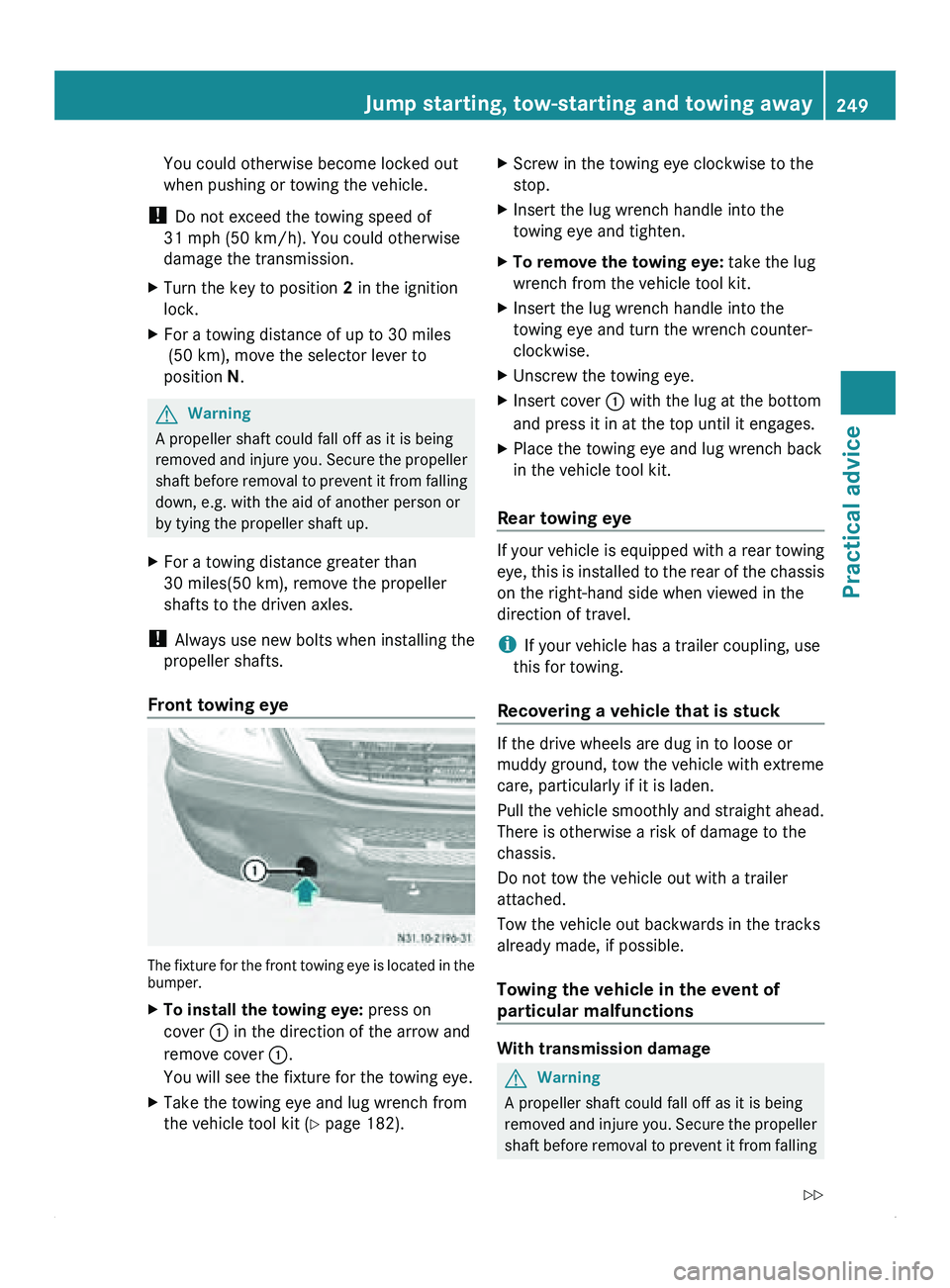
Front towing eye The fixture for the front towing eye is located in the
bumper.
X
To install the towing eye: press on
cover 0046 in the direction of the arrow and
remove cover 0046.
You will see the fixture for the towing eye.
X Take the towing eye and lug wrench from
the vehicle tool kit (Y page 182). X
Screw in the towing eye clockwise to the
stop.
X Insert the lug wrench handle into the
towing eye and tighten.
X To remove the towing eye: take the lug
wrench from the vehicle tool kit.
X Insert the lug wrench handle into the
towing eye and turn the wrench counter-
clockwise.
X Unscrew the towing eye.
X Insert cover 0046 with the lug at the bottom
and press it in at the top until it engages.
X Place the towing eye and lug wrench back
in the vehicle tool kit.
Rear towing eye If your vehicle is equipped with a rear towing
eye, this
is
installed to the rear of the chassis
on the right-hand side when viewed in the
direction of travel.
i If your vehicle has a trailer coupling, use
this for towing.
Recovering a vehicle that is stuck If the drive wheels are dug in to loose or
muddy ground, tow the vehicle with extreme
care, particularly if it is laden.
Pull the
vehicle
smoothly and straight ahead.
There is otherwise a risk of damage to the
chassis.
Do not tow the vehicle out with a trailer
attached.
Tow the vehicle out backwards in the tracks
already made, if possible.
Towing the vehicle in the event of
particular malfunctions With transmission damage
G
Warning
A propeller shaft could fall off as it is being
removed and injure
you. Secure the propeller
shaft before removal to prevent it from falling Jump starting, tow-starting and towing away
249
Practical advice
Z
Page 252 of 292
down, e.g. with the aid of another person or
by tying the propeller shaft up.
X Always remove the propeller shafts leading
to the driven axles.
! Always use new bolts when installing the
propeller shafts.
With front axle damage
X Turn the key to position 1 in the ignition
lock.
X Raise the front axle. G
Warning
A propeller shaft could fall off as it is being
removed and injure
you. Secure the propeller
shaft before removal to prevent it from falling
down, e.g. with the aid of another person or
by tying the propeller shaft up.
! The ignition must be switched off if the
vehicle is being towed with the front or rear
axle raised. Otherwise, ESP ®
may intervene
and damage the brake system.
With rear axle damage
X Turn the key to position 1 in the ignition
lock.
X Raise the rear axle.
Malfunction in the electrical system
If the battery is defective, the automatic
transmission will be locked in position P. To
shift the automatic transmission to
position N, you must provide power to the
vehicle's electrical system in the same way
as jump-starting ( Y page 247).
Have the vehicle
transported on a transporter
or trailer.
Transporting the vehicle The towing
eye can be used to pull the vehicle
onto a special transporter or trailer for
transportation.
! Only lash the
vehicle down by the wheels
or rims, not by vehicle parts such as axle or steering components. There is otherwise a
risk of damage to the vehicle.
X Move the selector lever of the automatic
transmission to position N.250
Jump starting, tow-starting and towing away
Practical advice
Page 255 of 292
Operation
Notes on driving
R If the vehicle
is heavily laden, check the tire
pressures, and correct them, if necessary.
R When parking your vehicle, make sure that
the tires do not get deformed by the curb
or other obstacles. If it is necessary to drive
over curbs, speed humps or similar
elevations, try to do so slowly and at an
obtuse angle. Otherwise, the tires,
particularly the sidewalls, can get
damaged. Notes on regularly inspecting wheels
and tires
G
Warning
Regularly check the tires for damage.
Damaged tires can cause tire inflation
pressure loss. As a result, you could lose
control of your vehicle.
Worn, old tires
can cause accidents. If the tire
tread is worn to minimum tread depth, or if
the tires have sustained damage, replace
them.
R Regularly check the wheels and tires of
your vehicle for damage (e.g. cuts,
punctures, tears, bulges on tires and
deformation or severe corrosion on
wheels), at least once a month, as well as
after driving off-road or on rough roads.
Damaged wheels can cause a loss of tire
pressure.
R Regularly check the tire tread depth and
the condition of the tread across the whole
width of the tire (Y page 253). If necessary,
turn the front wheels to full lock in order to
inspect the inner side of the tire surface.
R All wheels must have a valve cap to protect
the valve against dirt and moisture. Do not
install anything onto the valve (such as tire
pressure monitoring systems) other than the standard valve cap or other valve caps
approved for your vehicle.
R Regularly check the
pressure of all the tires
including the spare wheel, particularly prior
to long trips, and correct the pressure
(Y page 255). Tire tread
G
Warning
Although the
applicable federal motor vehicle
safety laws consider a tire to be worn when
the tread wear indicators (TWI) become
visible at approximately 1
/ 16 in (1.6 mm), we
recommend that you do not allow your tires
to wear down to that level. As tread depth
approaches 1
/ 8 in (3 mm), the adhesion
properties on a
wet road are sharply reduced.
Depending upon the weather and/or road
surface (conditions), the tire traction varies
widely.
Replace tires before they become excessively
worn, as the tire traction on wet road surfaces
decreases significantly when the tread depth
is less than ⅛ in (3 mm).
Tread wear indicators (TWIs) are required by
law. Six indicators are positioned over the tire
tread. They are visible once the tread depth
is approximately 1
/ 16 in (1.6 mm). If this is the
case, the tire is so worn that it must be
replaced.
The recommended tread depth for summer
tires is at least ⅛ in (3 mm). The
recommended tread depth for winter tires is
at least 1/6
in (4 mm). Operation
253
Wheels and tires Z
Page 262 of 292
Calling up tire pressure using the on-
board computer
Vehicles with steering wheel buttons
Using the steering wheel buttons
X
Turn the key to position 2 in the ignition
lock.
X Press the 0059 or 0058 button repeatedly
until the standard display ( Y page 77) is
shown.
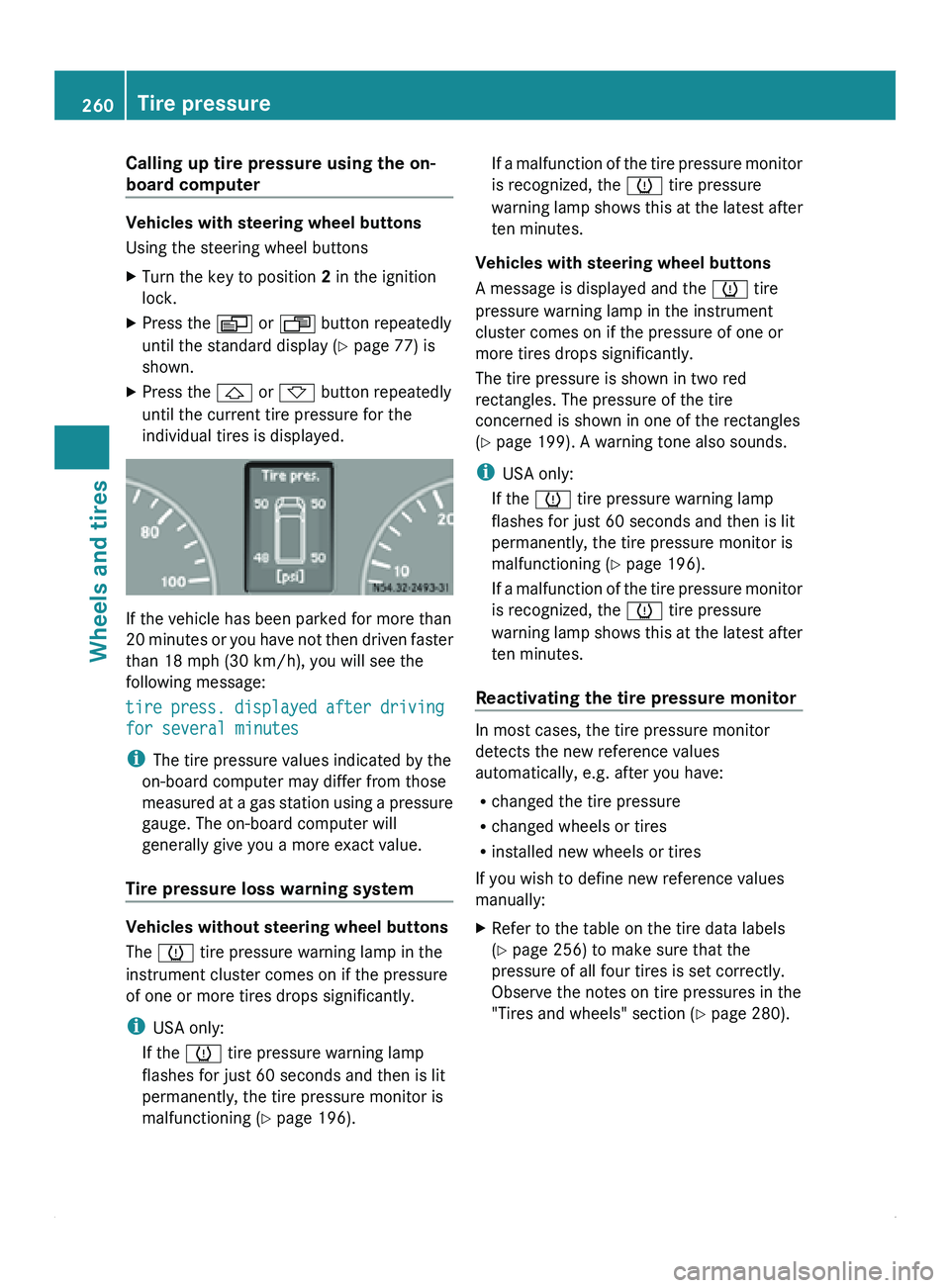
X Press the
0029 or 002D button repeatedly
until the current tire pressure for the
individual tires is displayed. If the vehicle has been parked for more than
20 minutes
or
you have not then driven faster
than 18 mph (30 km/h), you will see the
following message:
tire press. displayed after driving
for several minutes
i The tire pressure values indicated by the
on-board computer may differ from those
measured at a gas station using a pressure
gauge. The on-board computer will
generally give you a more exact value.
Tire pressure loss warning system Vehicles without steering wheel buttons
The 0077 tire pressure warning lamp in the
instrument cluster comes on if the pressure
of one or more tires drops significantly.
i
USA only:
If the 0077 tire pressure warning lamp
flashes for just 60 seconds and then is lit
permanently, the tire pressure monitor is
malfunctioning (Y page 196). If a malfunction of the tire pressure monitor
is recognized, the 0077 tire pressure
warning lamp
shows
this at the latest after
ten minutes.
Vehicles with steering wheel buttons
A message is displayed and the 0077 tire
pressure warning lamp in the instrument
cluster comes on if the pressure of one or
more tires drops significantly.
The tire pressure is shown in two red
rectangles. The pressure of the tire
concerned is shown in one of the rectangles
(Y page 199). A warning tone also sounds.
i USA only:
If the 0077 tire pressure warning lamp
flashes for just 60 seconds and then is lit
permanently, the tire pressure monitor is
malfunctioning (Y page 196).
If a malfunction of the tire pressure monitor
is recognized, the 0077 tire pressure
warning lamp shows this at the latest after
ten minutes.
Reactivating the tire pressure monitor In most cases, the tire pressure monitor
detects the new reference values
automatically, e.g. after you have:
R
changed the tire pressure
R changed wheels or tires
R installed new wheels or tires
If you wish to define new reference values
manually:
X Refer to the table on the tire data labels
(Y page 256) to make sure that the
pressure of all four tires is set correctly.
Observe the notes on tire pressures in the
"Tires and wheels" section ( Y page 280).260
Tire pressure
Wheels and tires
Page 263 of 292
Vehicles without steering wheel buttons
X
Turn the key to position 2 in the ignition
lock.
X Press the 007B menu button on the
instrument cluster repeatedly until the
following message is displayed:
+CAL- TPMS
X Press the 0069 button on the instrument
cluster.
The following message is displayed:
OK TPMS
The tire pressure monitor activation
process has begun. The tire pressures
measured for the individual wheels are
stored as the new reference values,
provided that the tire pressure monitor
considers them to be plausible.
If you wish to cancel the activation process:
X Press the 006A button or the 007B menu button
on the instrument cluster.
The activation process is canceled
automatically if 30 seconds elapse with no
input.
Vehicles with steering wheel buttons
X Turn the key to position 2 in the ignition
lock.
X Press the 0059 or 0058 button on the
steering wheel repeatedly until the
standard display (Y
page 77) appears.
X Press the 0029 or 002D button on the
steering wheel repeatedly
until the current
pressure of the individual tires is displayed,
or the display shows the following
message:
tire press. displayed after
driving for several minutes
X Press the 0048 reset button on the
instrument cluster.
The following message is displayed:
Monitor current tire pressure?
X Press the 005A button on the steering
wheel.
The following message is displayed: tire press. monitor reactivated
The tire pressure monitor activation
process has begun. The tire pressures
measured for the individual wheels are
stored as the new reference values,
provided that the tire pressure monitor
considers them to be plausible.
If you wish to cancel the activation process:
X Press the 005B button on the steering
wheel. Loading the vehicle
Instruction labels for tires and loads
G
Warning!
Do not overload the tires by exceeding the
specified load limit as indicated on the Tire
and Loading Information placard on the
B-pillar on the driver's side or on the vehicle
identification plate on the driver seat frame.
Overloading the tires can overheat them,
possibly causing a blowout. Overloading the
tires can also result in handling or steering
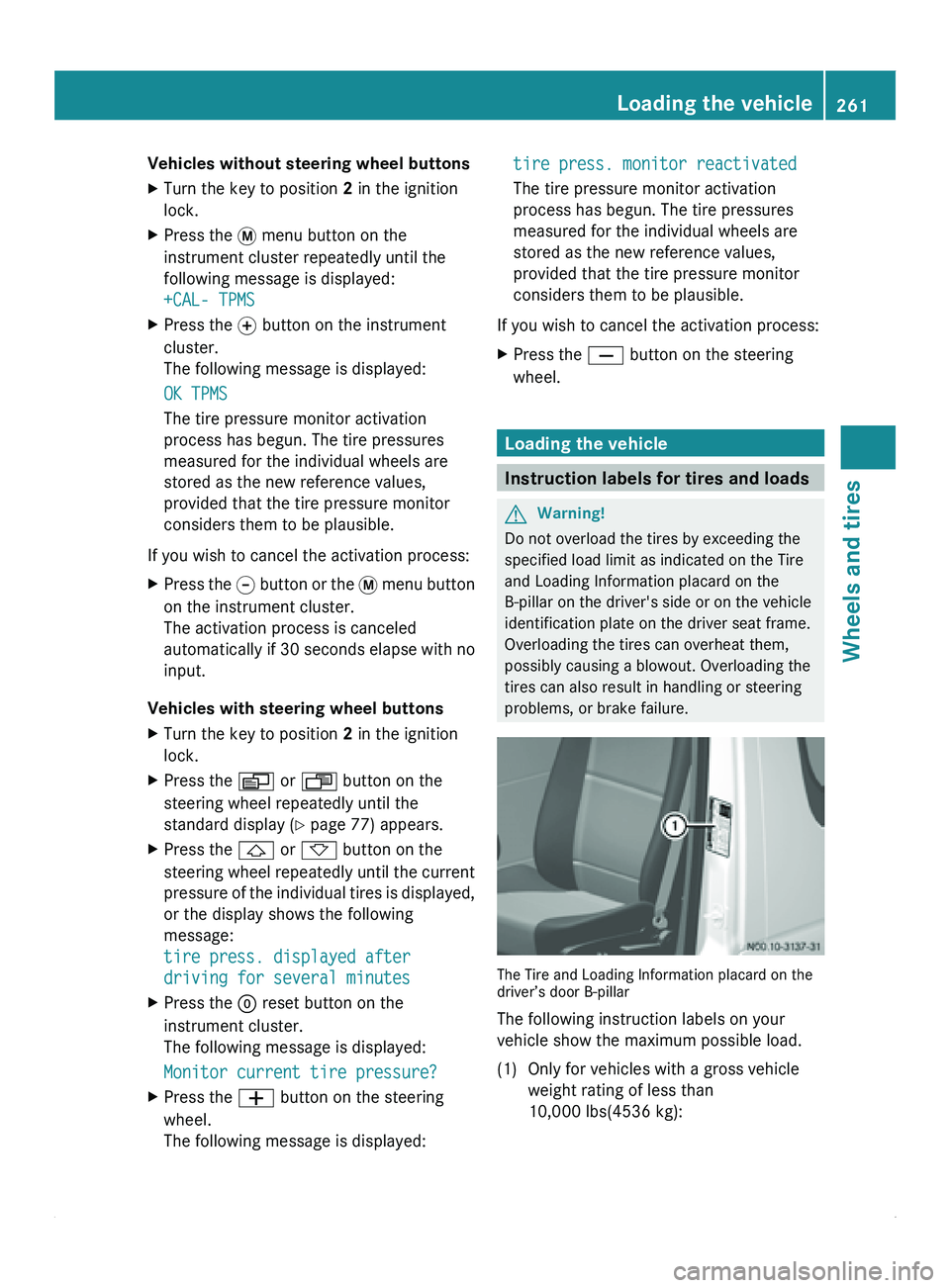
problems, or brake failure. The Tire and Loading Information placard on the
driver’s door B-pillar
The following instruction labels on your
vehicle show the maximum possible load.
(1) Only for vehicles with a gross vehicle
weight rating of less than
10,000 lbs(4536 kg): Loading the vehicle
261
Wheels and tires Z