warning MERCEDES-BENZ SPRINTER 2011 MY11 Operator’s Manual
[x] Cancel search | Manufacturer: MERCEDES-BENZ, Model Year: 2011, Model line: SPRINTER, Model: MERCEDES-BENZ SPRINTER 2011Pages: 292, PDF Size: 6.75 MB
Page 269 of 292
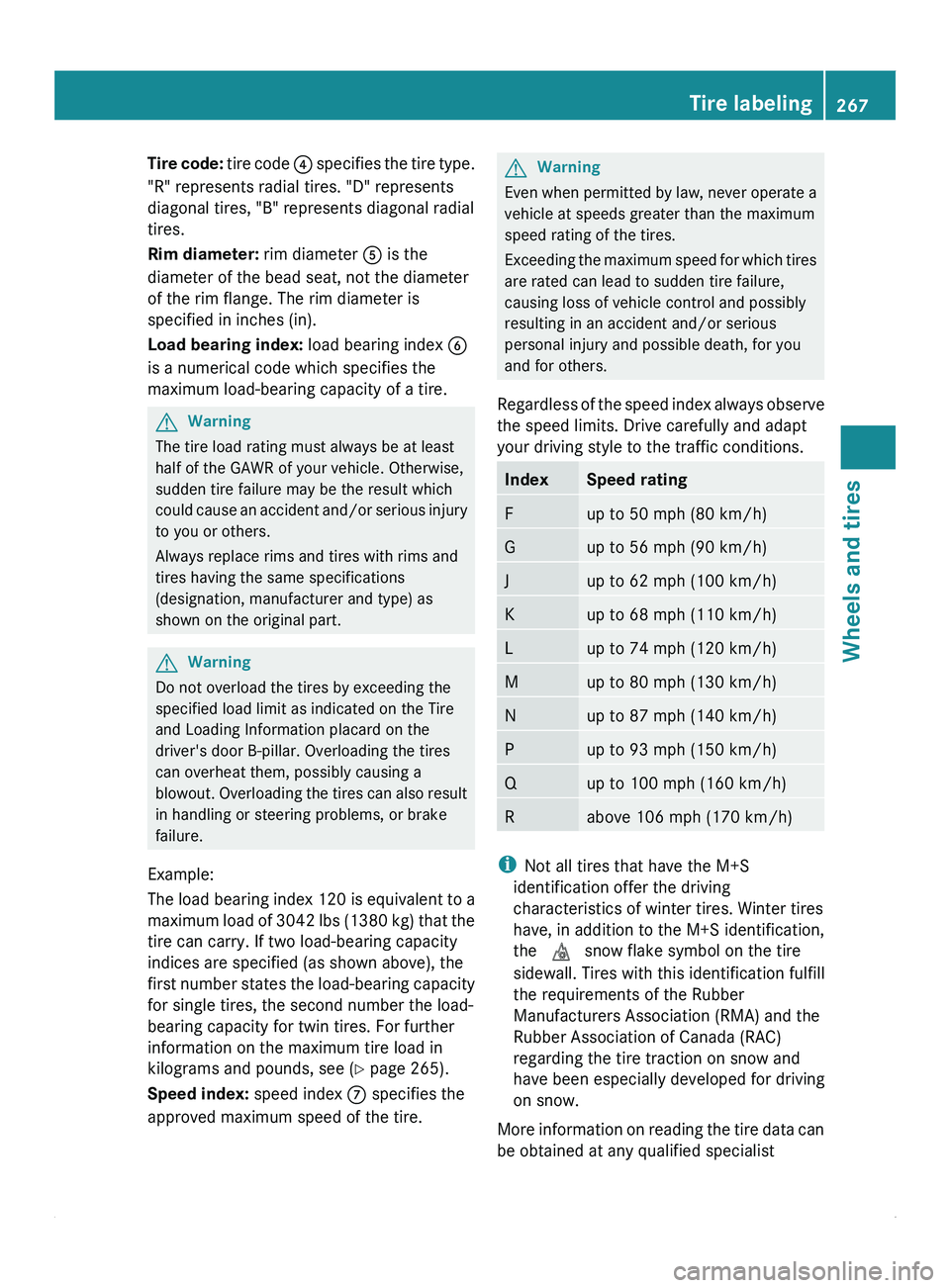
Tire code:
tire code 0088 specifies the tire type.
"R" represents radial tires. "D" represents
diagonal tires, "B" represents diagonal radial
tires.
Rim diameter: rim diameter 0086 is the
diameter of the bead seat, not the diameter
of the rim flange. The rim diameter is
specified in inches (in).
Load bearing index: load bearing index 0087
is a numerical code which specifies the
maximum load-bearing capacity of a tire. G
Warning
The tire load rating must always be at least
half of the GAWR of your vehicle. Otherwise,
sudden tire failure may be the result which
could cause an
accident and/or serious injury
to you or others.
Always replace rims and tires with rims and
tires having the same specifications
(designation, manufacturer and type) as
shown on the original part. G
Warning
Do not overload the tires by exceeding the
specified load limit as indicated on the Tire
and Loading Information placard on the
driver's door B-pillar . Overloading the tires
can overheat them, possibly causing a
blowout. Overloading
the tires can also result
in handling or steering problems, or brake
failure.
Example:
The load bearing index 120 is equivalent to a
maximum load of 3042 lbs (1380 kg) that the
tire can carry. If two load-bearing capacity
indices are specified (as shown above), the
first number states the load-bearing capacity
for single tires, the second number the load-
bearing capacity for twin tires. For further
information on the maximum tire load in
kilograms and pounds, see ( Y page 265).
Speed index: speed index 006E specifies the
approved maximum speed of the tire. G
Warning
Even when permitted by law, never operate a
vehicle at speeds greater than the maximum
speed rating of the tires.
Exceeding the maximum
speed for which tires
are rated can lead to sudden tire failure,
causing loss of vehicle control and possibly
resulting in an accident and/or serious
personal injury and possible death, for you
and for others.
Regardless of the speed index always observe
the speed limits. Drive carefully and adapt
your driving style to the traffic conditions. Index Speed rating
F up to 50 mph (80 km/h)
G up to 56 mph (90 km/h)
J up to 62 mph (100 km/h)
K up to 68 mph (110 km/h)
L up to 74 mph (120 km/h)
M up to 80 mph (130 km/h)
N up to 87 mph (140 km/h)
P up to 93 mph (150 km/h)
Q up to 100 mph (160 km/h)
R above 106 mph (170 km/h)
i
Not all tires that have the M+S
identification offer the driving
characteristics of winter tires. Winter tires
have, in addition
to the M+S identification,
the 004D snow flake symbol on the tire
sidewall. Tires with this identification fulfill
the requirements of the Rubber
Manufacturers Association (RMA) and the
Rubber Association of Canada (RAC)
regarding the tire traction on snow and
have been especially developed for driving
on snow.
More information on reading the tire data can
be obtained at any qualified specialist Tire labeling
267
Wheels and tires Z
Page 273 of 292
a high-capacity battery, are not included in
the unladen weight and the weight of the
accessories.
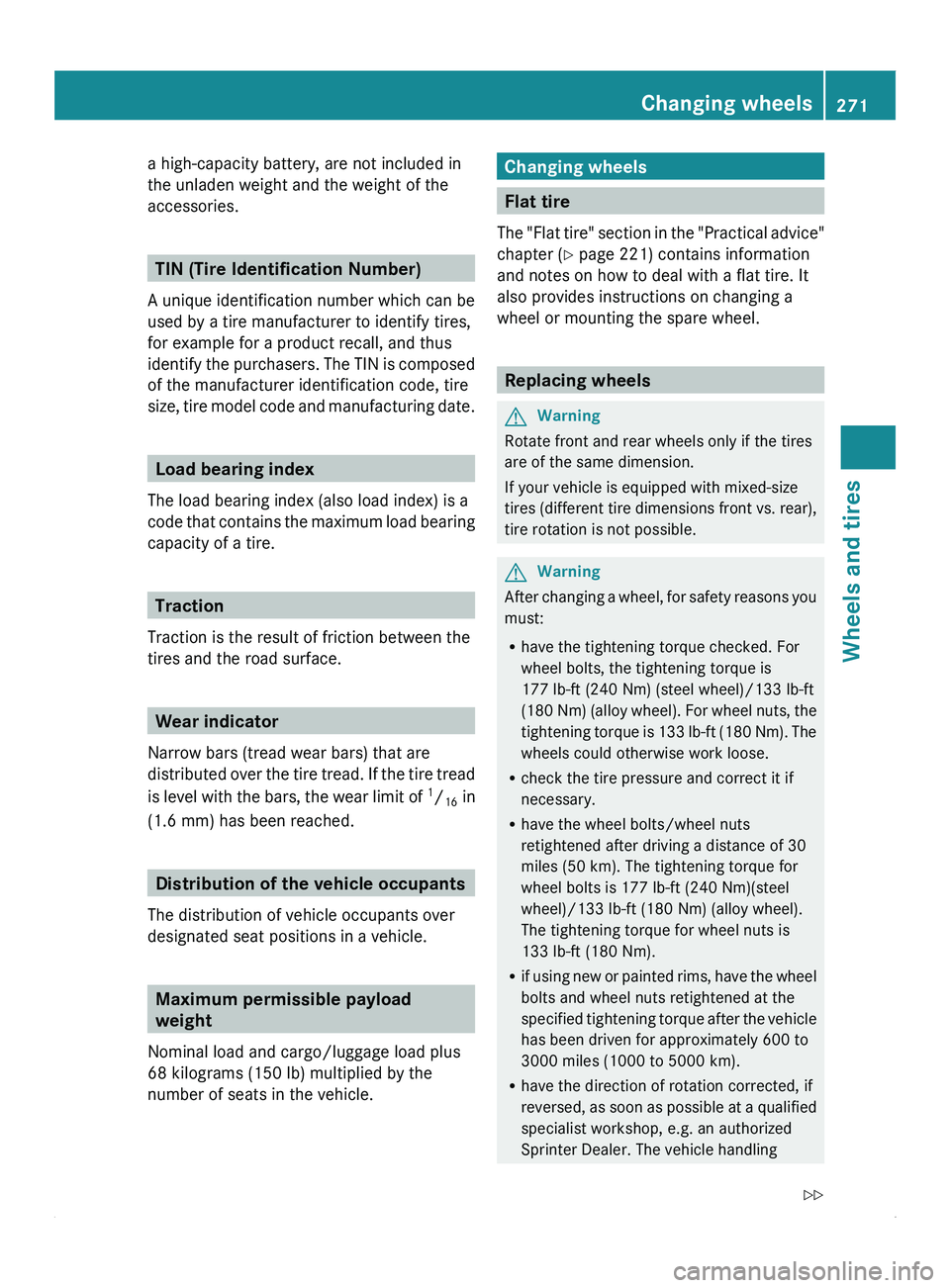
TIN (Tire Identification Number)
A unique identification number which can be
used by a tire manufacturer to identify tires,
for example for a product recall, and thus
identify the purchasers.
The TIN is composed
of the manufacturer identification code, tire
size, tire model code and manufacturing date. Load bearing index
The load bearing index (also load index) is a
code that contains
the maximum load bearing
capacity of a tire. Traction
Traction is the result of friction between the
tires and the road surface. Wear indicator
Narrow bars (tread wear bars) that are
distributed over the
tire tread. If the tire tread
is level with the bars, the wear limit of 1
/ 16 in
(1.6 mm) has been reached. Distribution of the vehicle occupants
The distribution of vehicle occupants over
designated seat positions in a vehicle. Maximum permissible payload
weight
Nominal load and cargo/luggage load plus
68 kilograms (150 lb) multiplied by the
number of seats in the vehicle. Changing wheels
Flat tire
The "Flat tire"
section in the "Practical advice"
chapter (Y page 221) contains information
and notes on how to deal with a flat tire. It
also provides instructions on changing a
wheel or mounting the spare wheel. Replacing wheels
G
Warning
Rotate front and rear wheels only if the tires
are of the same dimension.
If your vehicle is equipped with mixed-size
tires (different tire
dimensions front vs. rear),
tire rotation is not possible. G
Warning
After changing a wheel, for safety reasons you
must:
R have the tightening torque checked. For
wheel bolts, the tightening torque is
177 lb-ft (240 Nm) (steel wheel)/ 133 lb-ft
(180
Nm) (alloy wheel). For wheel nuts, the
tightening torque is 133 lb-ft (180 Nm). The
wheels could otherwise work loose.
R check the tire pressure and correct it if
necessary.
R have the wheel bolts/wheel nuts
retightened after driving a distance of 30
miles (50 km). The tightening torque for
wheel bolts is 177 lb-ft (240 Nm)(steel
wheel)/133 lb-ft (180 Nm) (alloy wheel).
The tightening torque for wheel nuts is
133 lb-ft (180 Nm).
R if using new or painted rims, have the wheel
bolts and wheel nuts retightened at the
specified tightening torque after the vehicle
has been driven for approximately 600 to
3000 miles (1000 to 5000 km).
R have the direction of rotation corrected, if
reversed, as soon as possible at a qualified
specialist workshop, e.g. an authorized
Sprinter Dealer. The vehicle handling Changing wheels
271
Wheels and tires
Z
Page 275 of 292
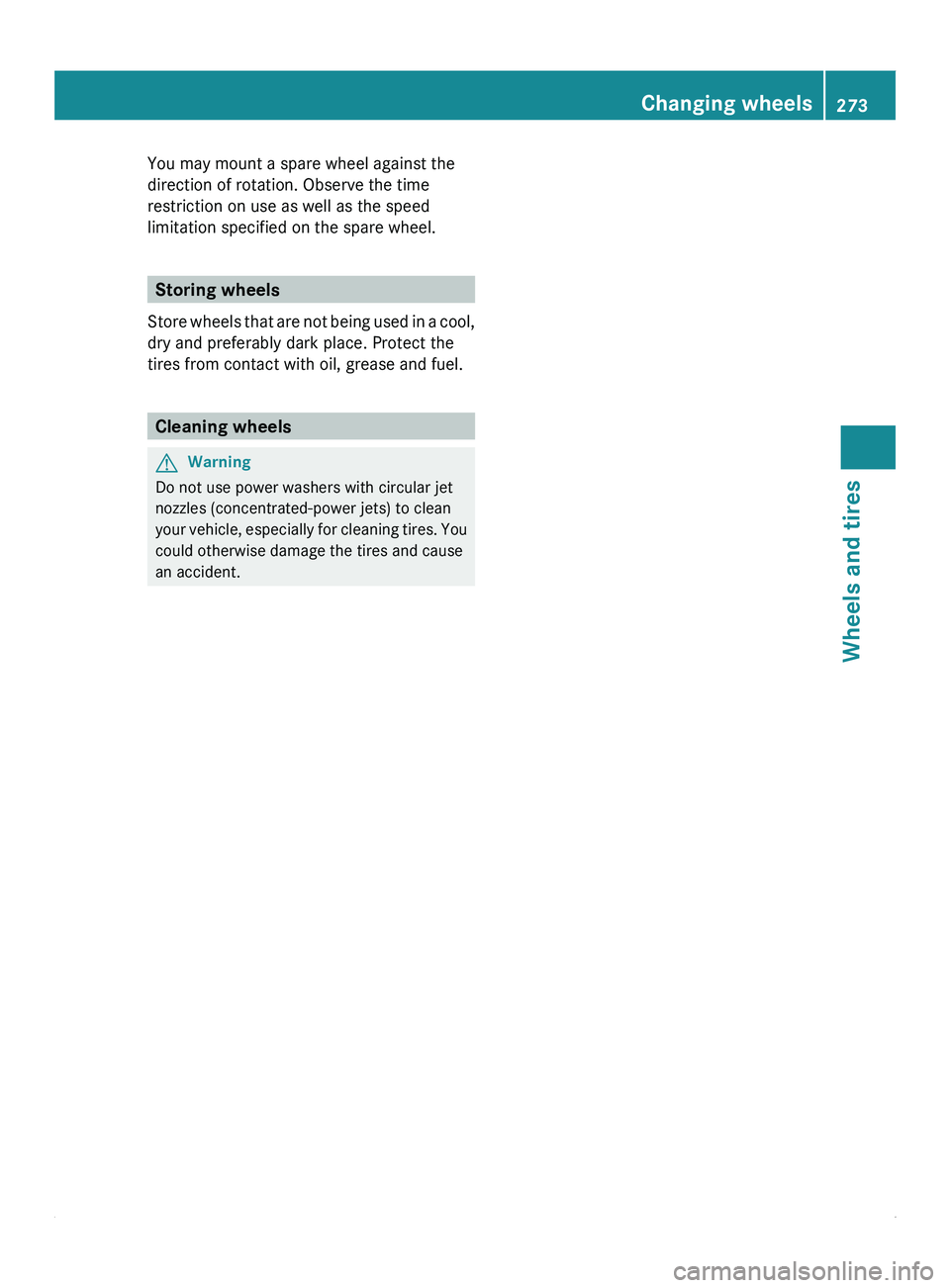
You may mount a spare wheel against the
direction of rotation. Observe the time
restriction on use as well as the speed
limitation specified on the spare wheel.
Storing wheels
Store wheels that
are not being used in a cool,
dry and preferably dark place. Protect the
tires from contact with oil, grease and fuel. Cleaning wheels
G
Warning
Do not use power washers with circular jet
nozzles (concentrated-power jets) to clean
your vehicle, especially
for cleaning tires. You
could otherwise damage the tires and cause
an accident. Changing wheels
273
Wheels and tires Z
Page 278 of 292
Vehicle equipment
i Diese Betriebsanleitung beschreibt alle
Modelle, Serien- und
Sonderausstattungen
Ihres Fahrzeugs, die zum Zeitpunkt des
Redaktionsschlusses dieser
Betriebsanleitung erhältlich waren.
Länderspezifische Abweichungen sind
möglich. Beachten Sie, dass Ihr Fahrzeug
nicht mit allen beschriebenen Funktionen
ausgestattet sein könnte. Dies betrifft auch
sicherheitsrelevante Systeme und
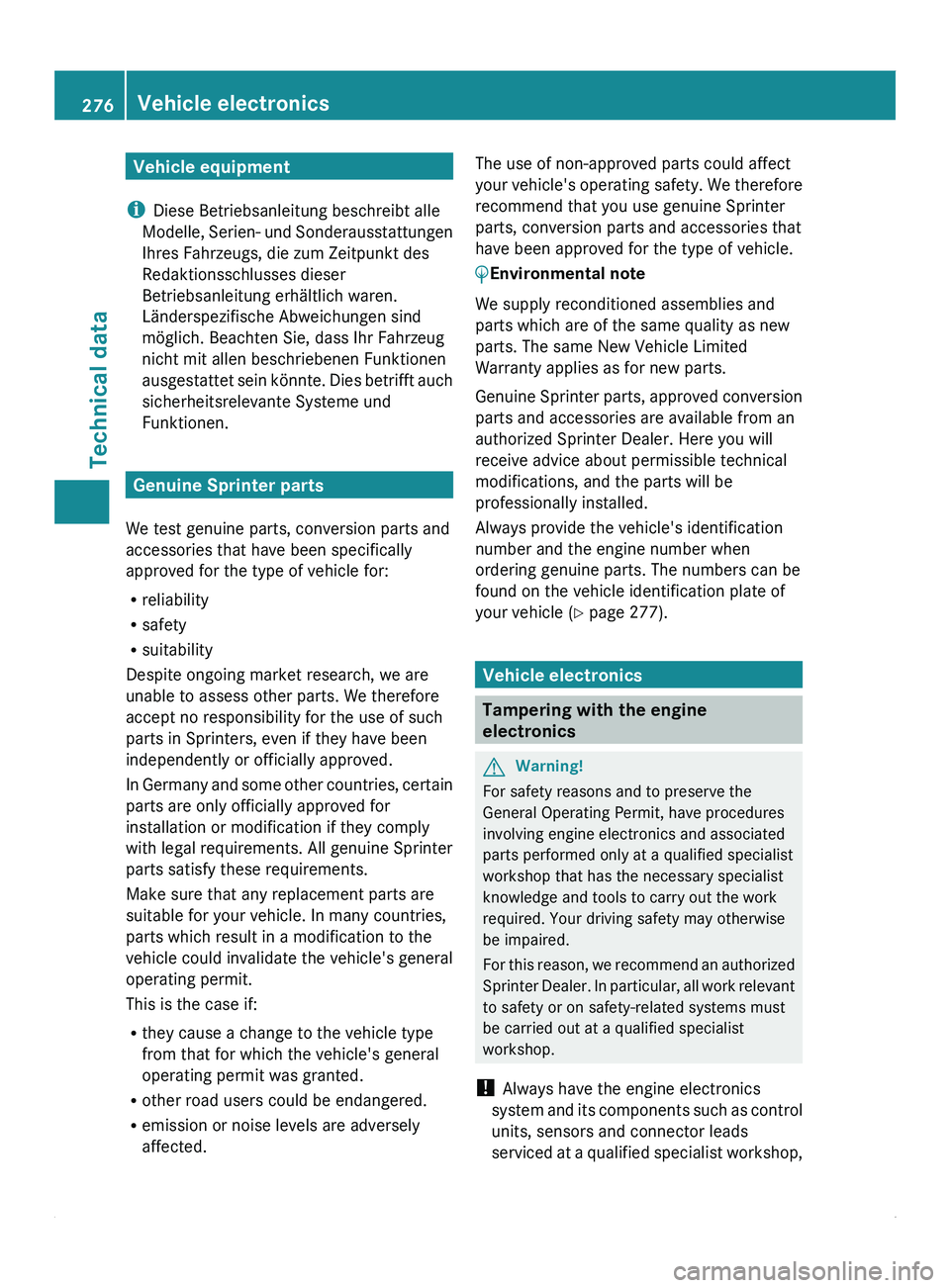
Funktionen. Genuine Sprinter parts
We test genuine parts, conversion parts and
accessories that have been specifically
approved for the type of vehicle for:
R reliability
R safety
R suitability
Despite ongoing market research, we are
unable to assess other parts. We therefore
accept no responsibility for the use of such
parts in Sprinters, even if they have been
independently or officially approved.
In Germany and
some other countries, certain
parts are only officially approved for
installation or modification if they comply
with legal requirements. All genuine Sprinter
parts satisfy these requirements.
Make sure that any replacement parts are
suitable for your vehicle. In many countries,
parts which result in a modification to the
vehicle could invalidate the vehicle's general
operating permit.
This is the case if:
R they cause a change to the vehicle type
from that for which the vehicle's general
operating permit was granted.
R other road users could be endangered.
R emission or noise levels are adversely
affected. The use of non-approved parts could affect
your vehicle's
operating
safety. We therefore
recommend that you use genuine Sprinter
parts, conversion parts and accessories that
have been approved for the type of vehicle.
0040Environmental note
We supply reconditioned assemblies and
parts which are of the same quality as new
parts. The same New Vehicle Limited
Warranty applies as for new parts.
Genuine Sprinter parts, approved conversion
parts and accessories are available from an
authorized Sprinter Dealer. Here you will
receive advice about permissible technical
modifications, and the parts will be
professionally installed.
Always provide the vehicle's identification
number and the engine number when
ordering genuine parts. The numbers can be
found on the vehicle identification plate of
your vehicle ( Y page 277). Vehicle electronics
Tampering with the engine
electronics
G
Warning!
For safety reasons and to preserve the
General Operating Permit, have procedures
involving engine electronics and associated
parts performed only at a qualified specialist
workshop that has the necessary specialist
knowledge and tools to carry out the work
required. Your driving safety may otherwise
be impaired.
For this reason,
we recommend an authorized
Sprinter Dealer. In particular, all work relevant
to safety or on safety-related systems must
be carried out at a qualified specialist
workshop.
! Always have the engine electronics
system and its components such as control
units, sensors and connector leads
serviced at a qualified specialist workshop, 276
Vehicle electronics
Technical data
Page 279 of 292
for example an authorized Sprinter Dealer.
Otherwise, the vehicle parts may wear out
more quickly. This can invalidate the
general operating
permit
and the insurance
cover, and lead to the loss of the New
Vehicle Limited Warranty. Retrofitting electrical or electronic
equipment
Electrical and electronic equipment can
jeopardize the operational safety of the
vehicle. If equipment
of this kind is retrofitted,
it must be type-approved and bear the e
mark. The e mark may be obtained from the
equipment manufacturer or an authorized
testing center.
! Damage or consequential damage arising
from installing equipment that is not
approved for Sprinters is not covered by
the New Vehicle Limited Warranty.
If you wish to install telephones or two-way
radios in the vehicle, you must obtain formal
approval.
For operation of mobile phones and two-way
radios, We recommend connection to an
approved exterior antenna. This is the only
way to ensure optimum reception quality
inside the vehicle and to minimize mutual
interference between the vehicle electronics,
mobile phones and two-way radios. G
Warning
Excessive electromagnetic radiation may
constitute a health hazard to yourself and
others. Use of an exterior antenna gives
consideration to scientific discussion
surrounding the possible
health risk posed by
electromagnetic fields.
The exterior antenna should only be installed
at a qualified specialist workshop which has
the necessary specialist knowledge and tools
to carry out the work required. We
recommend that you use an authorized
Sprinter Dealer for this purpose. In particular,
work relevant to safety or on safety-related systems must be carried out at a qualified
specialist workshop.
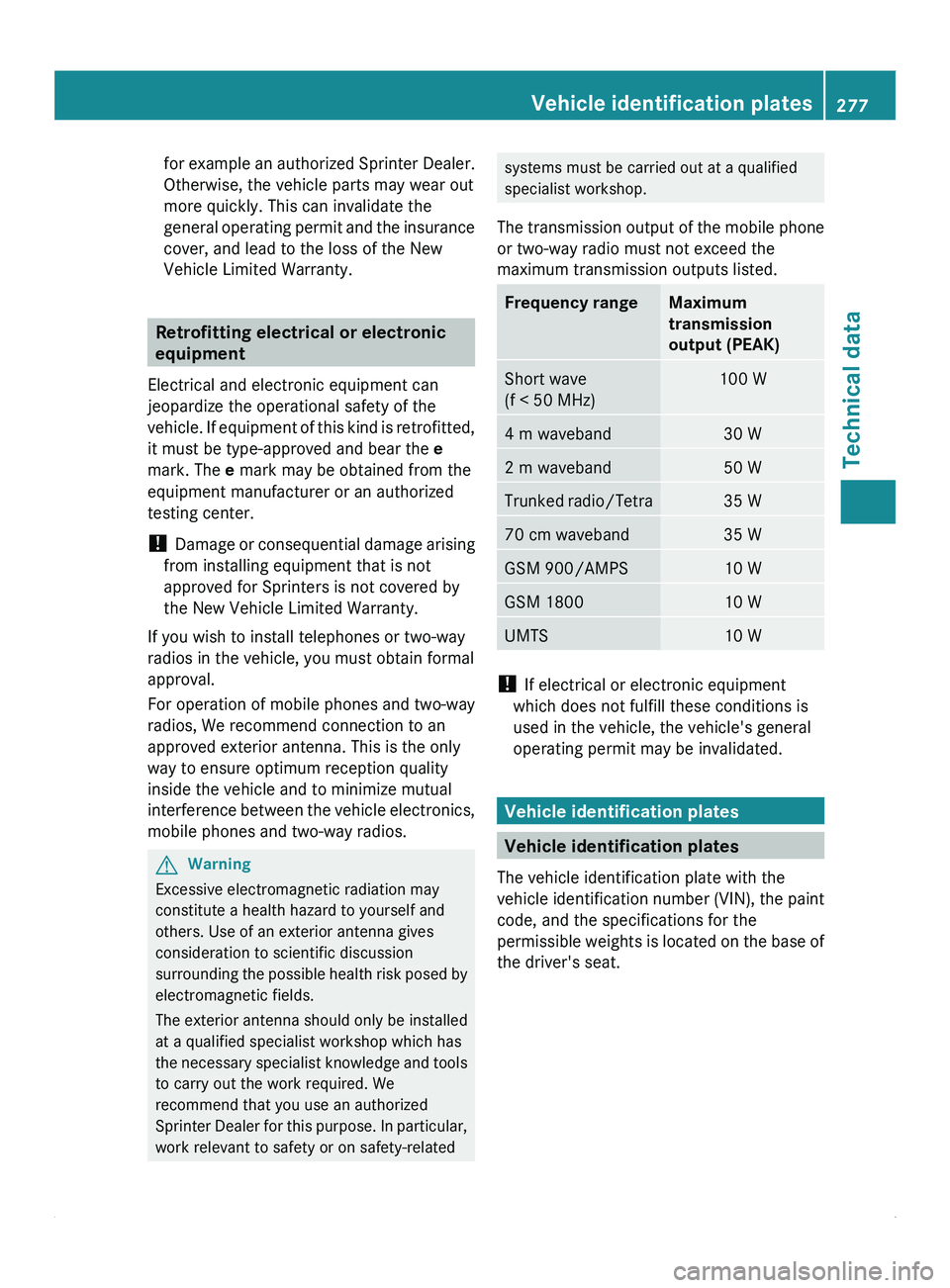
The transmission output
of the mobile phone
or two-way radio must not exceed the
maximum transmission outputs listed. Frequency range Maximum
transmission
output (PEAK)
Short wave
(f < 50 MHz) 100 W
4 m waveband 30 W
2 m waveband 50 W
Trunked radio/Tetra 35 W
70 cm waveband 35 W
GSM 900/AMPS 10 W
GSM 1800 10 W
UMTS 10 W
!
If electrical or electronic equipment
which does not fulfill these conditions is
used in the vehicle, the vehicle's general
operating permit may be invalidated. Vehicle identification plates
Vehicle identification plates
The vehicle identification plate with the
vehicle identification number
(VIN), the paint
code, and the specifications for the
permissible weights is located on the base of
the driver's seat. Vehicle identification plates
277
Technical data Z
Page 283 of 292
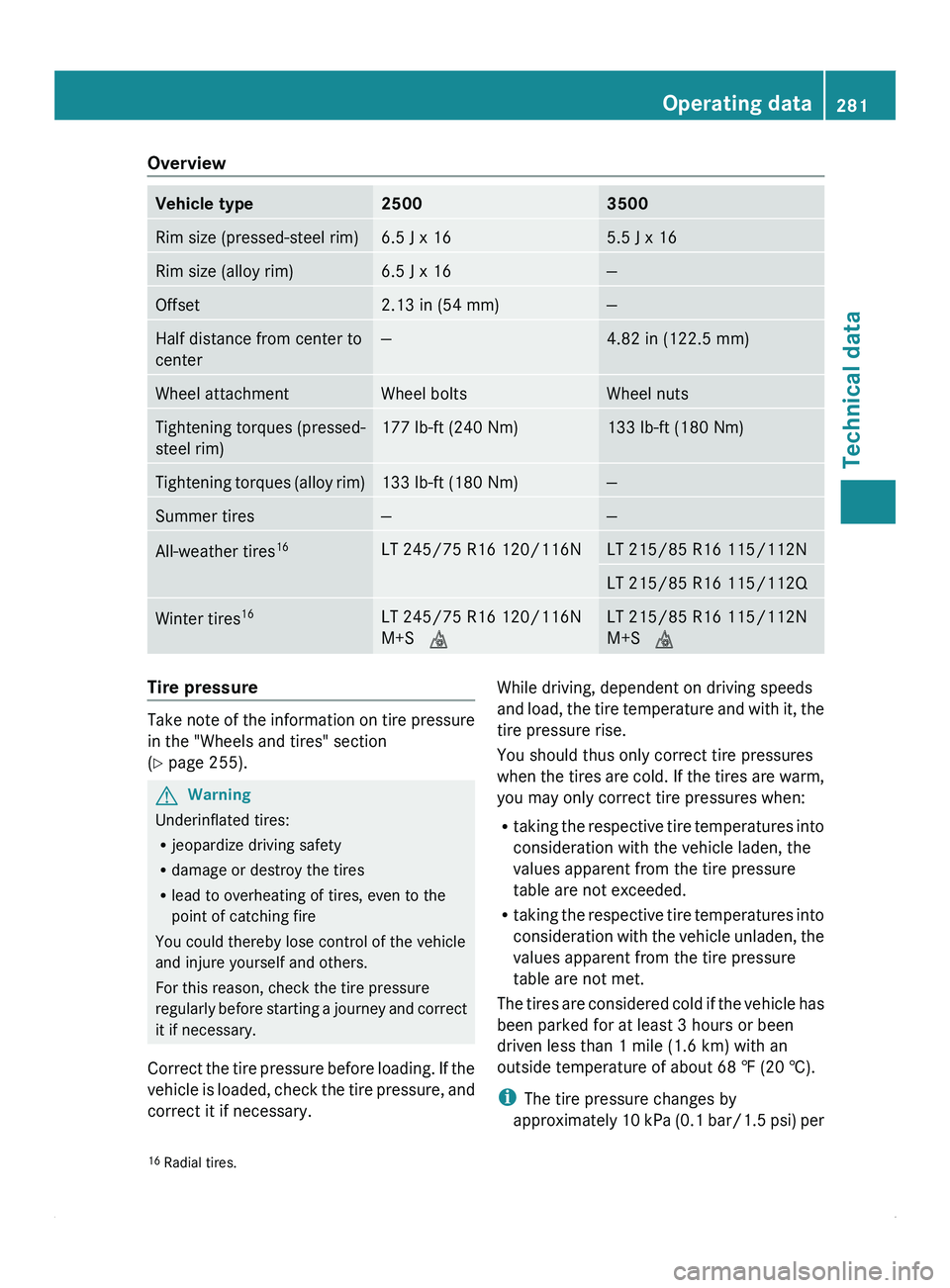
Overview
Vehicle type 2500 3500
Rim size (pressed-steel rim) 6.5 J x 16 5.5 J x 16
Rim size (alloy rim) 6.5 J x 16 —
Offset 2.13 in (54 mm) —
Half distance from center to
center — 4.82 in (122.5 mm)
Wheel attachment Wheel bolts Wheel nuts
Tightening torques (pressed-
steel rim) 177 lb-ft (240 Nm) 133 lb-ft (180 Nm)
Tightening torques (alloy rim) 133 lb-ft (180 Nm) —
Summer tires — —
All-weather tires
16 LT 245/75 R16 120/116N LT 215/85 R16 115/112N
LT 215/85 R16 115/112Q
Winter tires
16 LT 245/75 R16 120/116N
M+S 004D LT 215/85 R16 115/112N
M+S 004D
Tire pressure
Take note of the information on tire pressure
in the "Wheels and tires" section
(Y page 255).
G
Warning
Underinflated tires:
R jeopardize driving safety
R damage or destroy the tires
R lead to overheating of tires, even to the
point of catching fire
You could thereby lose control of the vehicle
and injure yourself and others.
For this reason, check the tire pressure
regularly before starting
a journey and correct
it if necessary.
Correct the tire pressure before loading. If the
vehicle is loaded, check the tire pressure, and
correct it if necessary. While driving, dependent on driving speeds
and
load, the
tire temperature and with it, the
tire pressure rise.
You should thus only correct tire pressures
when the tires are cold. If the tires are warm,
you may only correct tire pressures when:
R taking the respective tire temperatures into
consideration with the vehicle laden, the
values apparent from the tire pressure
table are not exceeded.
R taking the respective tire temperatures into
consideration with the vehicle unladen, the
values apparent from the tire pressure
table are not met.
The tires are considered cold if the vehicle has
been parked for at least 3 hours or been
driven less than 1 mile (1.6 km) with an
outside temperature of about 68 ‡ (20 †).
i The tire pressure changes by
approximately 10 kPa (0.1 bar/1.5 psi) per
16 Radial tires. Operating data
281
Technical data Z
Page 286 of 292
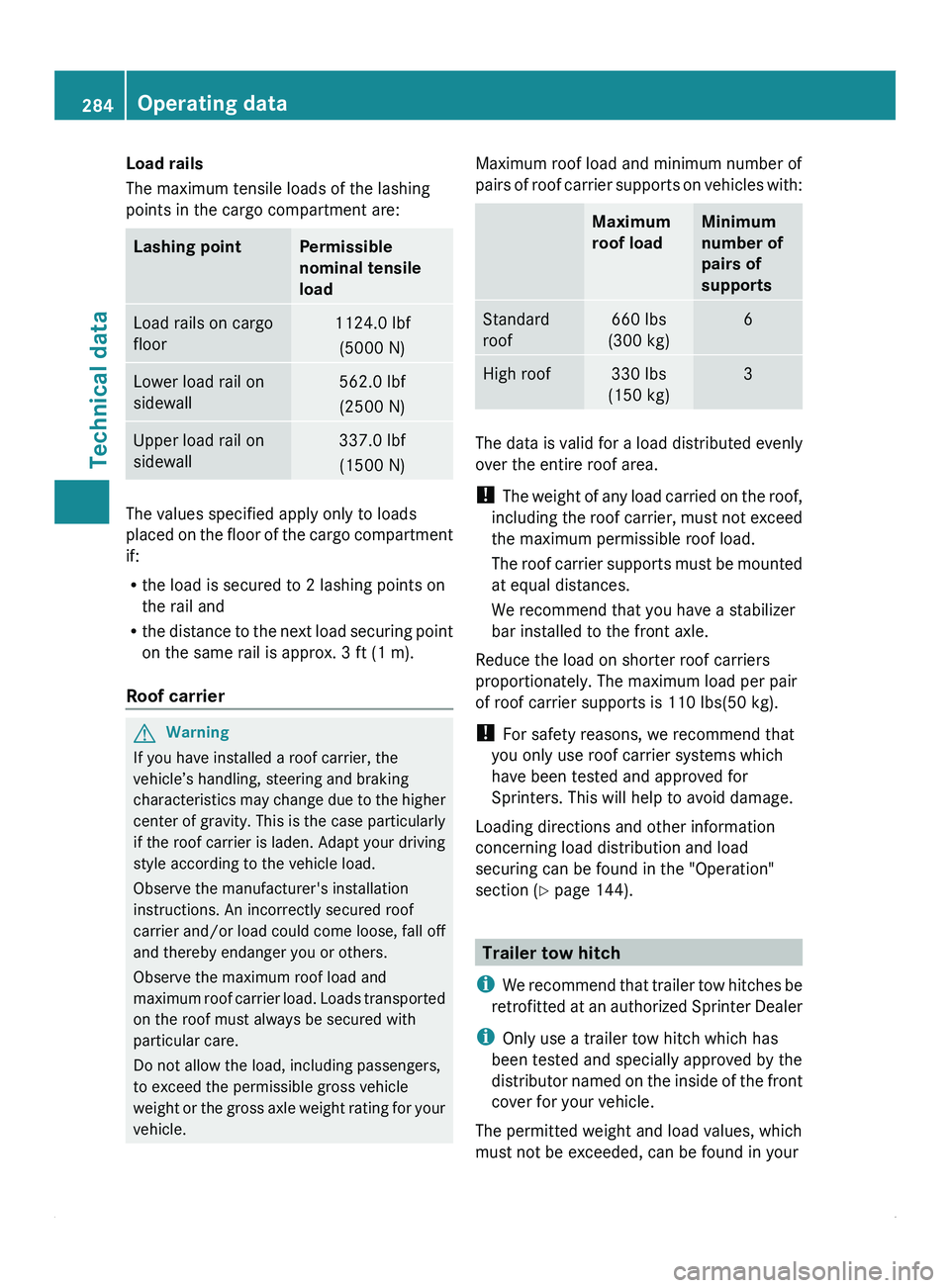
Load rails
The maximum tensile loads of the lashing
points in the cargo compartment are:
Lashing point Permissible
nominal tensile
load
Load rails on cargo
floor 1124.0 lbf
(5000 N) Lower load rail on
sidewall 562.0 lbf
(2500 N) Upper load rail on
sidewall 337.0 lbf
(1500 N) The values specified apply only to loads
placed on
the
floor of the cargo compartment
if:
R the load is secured to 2 lashing points on
the rail and
R the distance to the next load securing point
on the same rail is approx. 3 ft (1 m).
Roof carrier G
Warning
If you have installed a roof carrier, the
vehicle’s handling, steering and braking
characteristics may change
due to the higher
center of gravity. This is the case particularly
if the roof carrier is laden. Adapt your driving
style according to the vehicle load.
Observe the manufacturer's installation
instructions. An incorrectly secured roof
carrier and/or load could come loose, fall off
and thereby endanger you or others.
Observe the maximum roof load and
maximum roof carrier load. Loads transported
on the roof must always be secured with
particular care.
Do not allow the load, including passengers,
to exceed the permissible gross vehicle
weight or the gross axle weight rating for your
vehicle. Maximum roof load and minimum number of
pairs of
roof
carrier supports on vehicles with: Maximum
roof load Minimum
number of
pairs of
supports
Standard
roof 660 lbs
(300 kg) 6
High roof 330 lbs
(150 kg) 3
The data is valid for a load distributed evenly
over the entire roof area.
!
The weight of
any load carried on the roof,
including the roof carrier, must not exceed
the maximum permissible roof load.
The roof carrier supports must be mounted
at equal distances.
We recommend that you have a stabilizer
bar installed to the front axle.
Reduce the load on shorter roof carriers
proportionately. The maximum load per pair
of roof carrier supports is 110 lbs(50 kg).
! For safety reasons, we recommend that
you only use roof carrier systems which
have been tested and approved for
Sprinters. This will help to avoid damage.
Loading directions and other information
concerning load distribution and load
securing can be found in the "Operation"
section ( Y page 144). Trailer tow hitch
i We recommend that
trailer tow hitches be
retrofitted at an authorized Sprinter Dealer
i Only use a trailer tow hitch which has
been tested and specially approved by the
distributor named on the inside of the front
cover for your vehicle.
The permitted weight and load values, which
must not be exceeded, can be found in your 284
Operating data
Technical data