ABS MERCEDES-BENZ SPRINTER 2011 MY11 Operator’s Manual
[x] Cancel search | Manufacturer: MERCEDES-BENZ, Model Year: 2011, Model line: SPRINTER, Model: MERCEDES-BENZ SPRINTER 2011Pages: 292, PDF Size: 6.75 MB
Page 121 of 292
Resuming the stored speed
G
Warning
Only select a stored speed if you know what
that speed is
and whether it is suitable for the
current driving and traffic situation. You can
otherwise endanger yourself and others by
unintentionally triggering sudden
acceleration or braking.
X Briefly pull the cruise control lever in the
direction of arrow 0047.
X Release the accelerator pedal.
Cruise control is
activated and resumes the
vehicle's speed to the last speed stored.
i When you first move the cruise control
lever in the direction of arrow 0047 after
starting the engine, cruise control is
activated and the current road speed is
stored.
Setting the speed G
Warning
The rate at which you increase the speed in
increments of 1 mph (1 km/h) may be faster
than your vehicle is able to accelerate. Your
vehicle may
then continue to accelerate up to
the newly set speed even after you have
released the cruise control lever.
Only increase the speed as the prevailing
conditions permit. Sudden acceleration could
otherwise endanger you and others.
X Briefly push the cruise control lever
upwards 0046 to increase the speed or
downwards 008A to reduce the speed.
The last speed stored is increased/
reduced in increments of 1 mph
(1 km/h
).
or
X Press and hold the cruise control lever
up 0046 or down 008A until the desired speed
has been reached.
X Release the cruise control lever.
The current speed is stored. i
Cruise control is not deactivated if you
depress the accelerator pedal. If you
accelerate briefly, e.g. to overtake, and
then ease off the accelerator pedal again,
cruise control adjusts the vehicle's speed
to the last speed stored.
Deactivating cruise control There are various ways to deactivate cruise
control:
X
Briefly push the cruise control lever
forwards 0088.
or
X Apply the brakes.
The last speed set remains stored.
i The last speed set is deleted when you
switch off the engine.
i Cruise control is deactivated
automatically when:
R you apply the brakes.
R you apply the parking brake and the
0066 indicator lamp in the instrument
cluster lights up.
R you are driving slower than 20 mph
(30 km/h).
R ESP ®
or ASR intervenes.
R you shift the automatic transmission to
neutral position N while the vehicle is in
motion.
R there is a malfunction in the ESP ®
, ASR
or ABS system. PARKTRONIC
General notes G
Warning
PARKTRONIC is only an aid and may not
detect all obstacles. It is not a substitute for
attentive driving.
You are always responsible for safety and
must continue to pay attention to your Driving systems
119
Controls
Z
Page 150 of 292
G
Warning
Do not attempt to modify or repair the lashing
points, cargo tie-down
rings or tie downs. The
load or the cargo tie-down rings could work
loose and cause serious injury to you and
other people as well as material damage.
Spread the load evenly between the lashing
points or cargo tie-down rings.
Observe the loading guidelines.
i Secure loose loads with a tested lashing
net or a tarpaulin.
X Always fasten the lashing net or tarpaulin
to all available
cargo tie-down points. Make
sure that the retaining hooks are secured
against accidental opening.
! Observe the information
on the maximum
loading capacity of the lashing points.
If you use multiple lashing points to secure
a load, you should observe the maximum
loading capacity of the weakest lashing
point.
When you brake hard, for example, forces
apply that can be far higher than the weight
force of the transported load. Always use
multiple lashing points to distribute these
forces, and distribute the load equally
among them.
Information about the maximum loading
capacity of the cargo tie-down points can be
found in the "Technical data" section
(Y page 283).
i If your vehicle is equipped with loading
rails in the cargo floor, you should place
lashing rods directly in front of and behind
the load. The lashing rods directly absorb
the potential shifting forces. G
Warning
If you
tension the lashing straps between the
side walls, or between a side wall and the
cargo floor, the
maximum permissible load for
the loading rails or lashing points or eyelets
could be exceeded if the brakes are applied suddenly, if
the vehicle's direction is changed
abruptly or in the event of an accident.
The load would no longer be secured,
resulting in a risk of serious injury being
caused by the load slipping.
For this reason,
do not tension a lashing strap
between the side walls or between a side wall
and the cargo floor.
Only lashing rods are to be used between the
loading rails on the side walls. Observe the
operating instructions of the lashing rod
manufacturer.
i Securing loads on the cargo floor by
lashing them down is only recommended
for lightweight loads. Place non-slip mats
(anti-slip mats) on the cargo floor to
increase load security. G
Warning
Before releasing
the lashing straps, you must
make sure that
the load is standing firmly and
that it cannot tip over once the straps have
been removed. Otherwise, you or others could
be injured by the load slipping.
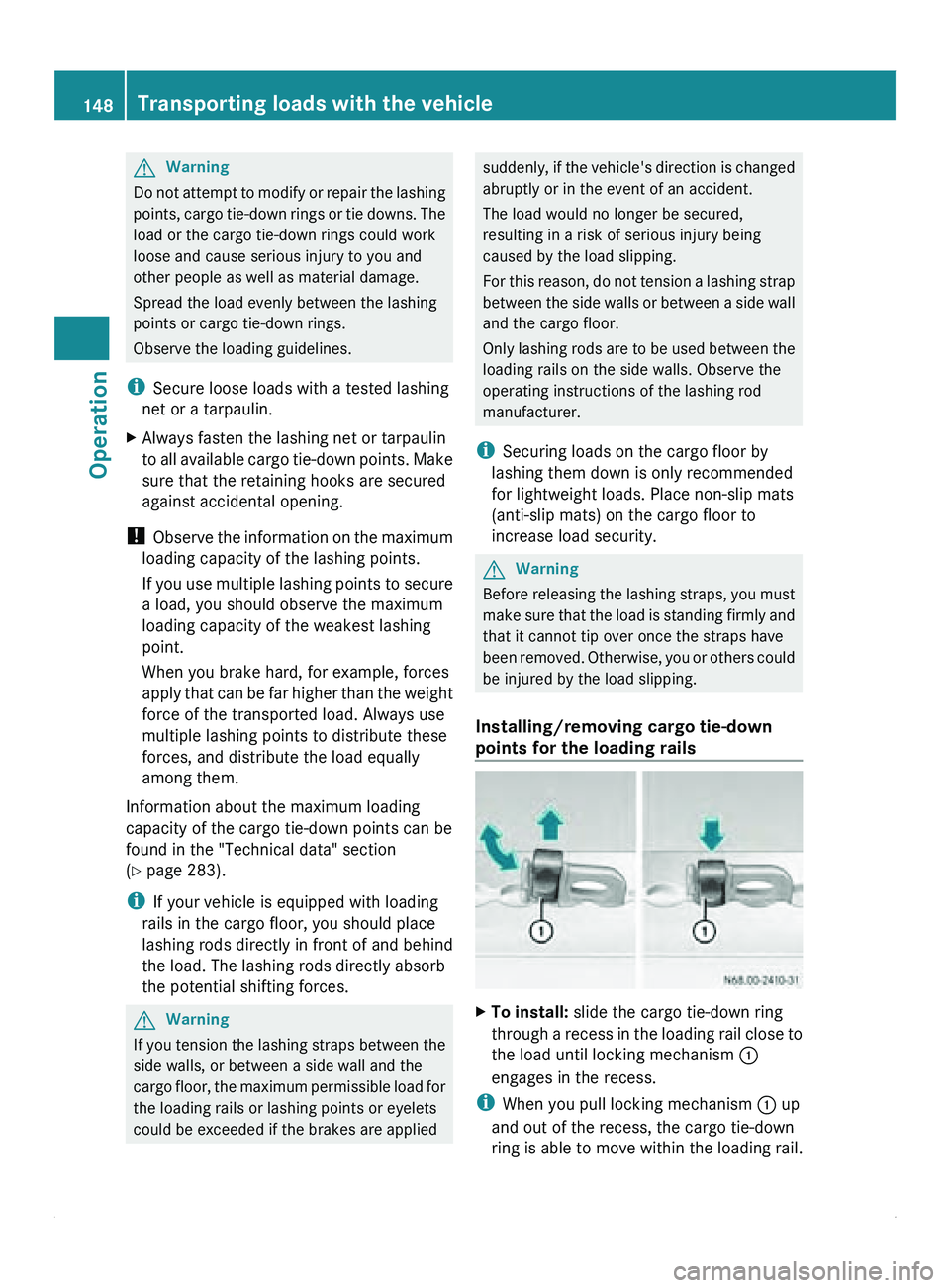
Installing/removing cargo tie-down
points for the loading rails X
To install: slide the cargo tie-down ring
through a recess
in the loading rail close to
the load until locking mechanism 0046
engages in the recess.
i When you pull locking mechanism 0046 up
and out of the recess, the cargo tie-down
ring is able to move within the loading rail. 148
Transporting loads with the vehicle
Operation
Page 161 of 292
Steering
Steering, no maintenance required.
Service product Maintenance
interval Product name/number MB
Sheet
No.
Power steering fluid – Mobil ATF-D,
Exxon Mobil Corporation or
equivalent 236.3
You can obtain further information from any authorized Sprinter Dealer.
Brake fluid
G
Warning
Brake fluid is hazardous to health. Do not
swallow brake fluid.
See a doctor immediately
if you swallow brake fluid.
Make sure that brake fluid does not come into
contact with skin, clothing or eyes. Rinse
affected areas with plenty of clean water and
consult a doctor if necessary.
Always wear gloves and eye protection when
topping up brake fluid.
Store brake fluid only in the original closed
container and keep it out of the reach of
children. Comply with safety regulations
when handling brake fluid.
Use only approved brake fluids that comply
with the MB Specification for Service
Products, Sheet No. 331.0. You must observe
the boiling points (DOT 4 plus).
The brake fluid must have the following
characteristics in accordance with the
FMVSS 116 and ISO 4925 standards:
R boiling point (ERBP) of at least
500 ‡(260 †)
R wet boiling point (WERBP) of at least
356 ‡(180 †)
R viscosity of a maximum of 1500 mm²/s
Over a period of time, the brake fluid absorbs
moisture from the air. This reduces its boiling
point. G
Warning
If the boiling point of the brake fluid is too low,
vapor pockets may form in the brake system
when the brakes
are subjected to a heavy load
(e.g. on long downhill stretches). This would
impair braking efficiency. The vehicle's
stopping distance may then be longer. This
increases the risk of an accident.
Have the brake fluid replaced every
two years with brake fluid approved by the
distributor named on the inside of the front
cover and have the replacement confirmed in
the Maintenance Booklet.
i There is usually a notice in the engine
compartment to remind you when the next
brake fluid change is due.
You can obtain further information from any
authorized Sprinter Dealer. Service products
159Operation Z
Page 189 of 292
Troubleshooting
Indicator and warning lamps in the instrument cluster
G
Warning
The operating safety of your vehicle could be jeopardized if maintenance work is carried out
incorrectly. As a
result, you could lose control of the vehicle and cause an accident. In addition,
the safety systems may no longer be able to protect you or others as they are designed to do.
Always have maintenance work carried out at a qualified specialist workshop. The qualified
specialist workshop must have the necessary specialist knowledge and tools to carry out the
work required. We recommend visiting an authorized Sprinter Dealer. In particular, work relevant
to safety or on safety-related systems must be carried out at a qualified specialist workshop. Problem Possible causes/consequences and
0050 Solutions0067
The yellow
ASR/
ESP ®
warning
lamp flashes
while the vehicle
is in motion. G
Warning!
ESP ®
or ASR is intervening because at least one of the wheels has
reached its tire grip limit.
Cruise control is deactivated for the duration of the intervention.
X Adapt your driving style to suit the road and traffic conditions.
Do not use too much throttle.
X Drive slowly. 0067
The yellow ASR/
ESP ®
warning
lamp is lit while
the engine is
running. G
Warning!
ASR is deactivated.
X Activate ASR again. Exceptions ( Y page 49).
009E 0031 003D 0065
The yellow ESP ®
, ABS
and ASR/BAS warning
lamps, and the red
brake system warning
lamp light up while the
engine is running. G
Warning!
EBD has malfunctioned.
The rear wheels
could lock sooner than expected when you apply
the brakes.
X On vehicles with steering wheel buttons, also observe the
messages in the display ( Y page 197).
X Stop the vehicle as soon as possible, paying attention to road
and traffic conditions.
X Do not drive on.
X Consult a qualified specialist workshop. Troubleshooting
187
Practical advice Z
Page 190 of 292
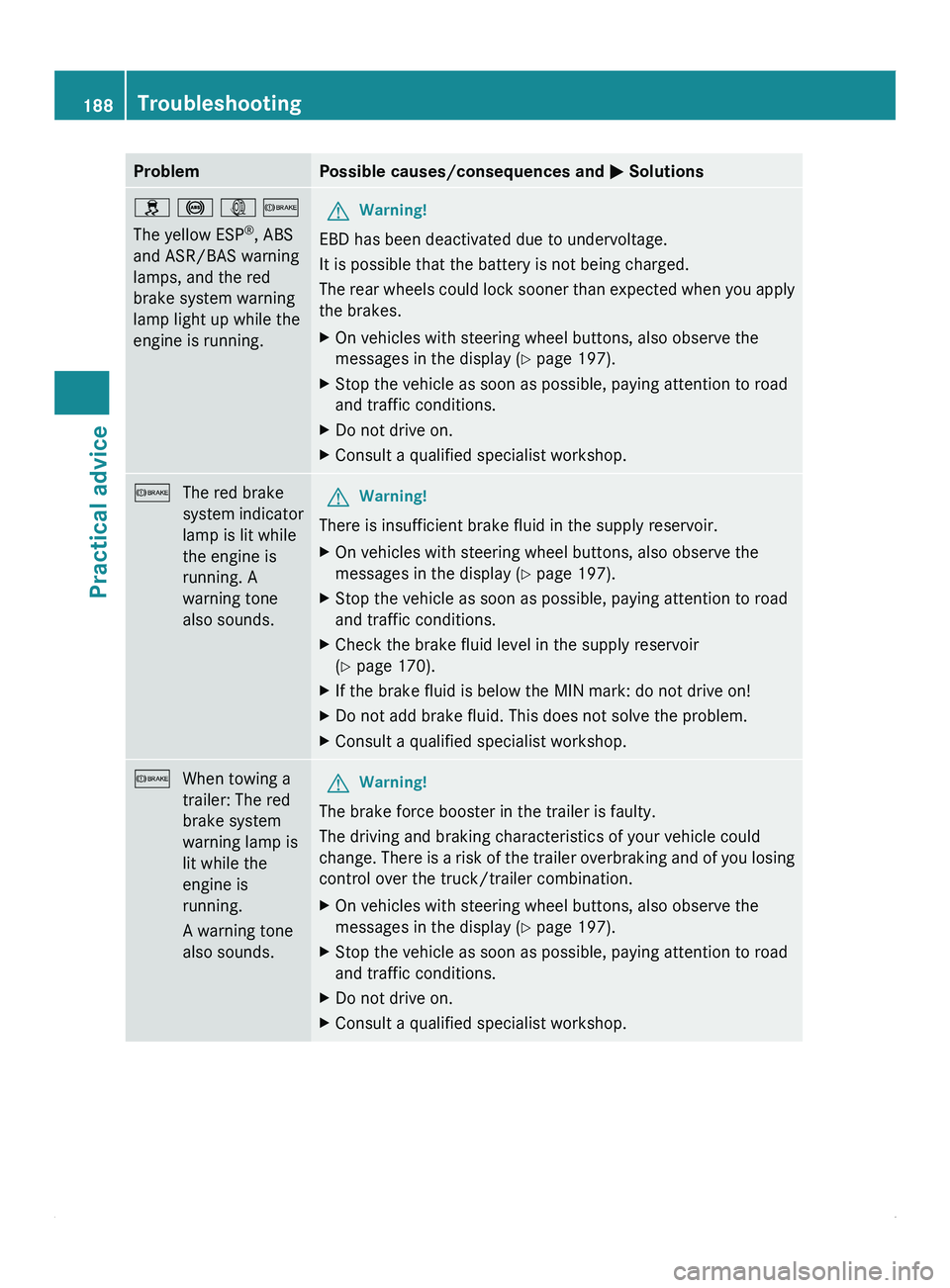
Problem Possible causes/consequences and
0050 Solutions009E 0031 003D 0065
The yellow ESP
®
, ABS
and ASR/BAS warning
lamps, and the red
brake system warning
lamp light up while the
engine is running. G
Warning!
EBD has been deactivated due to undervoltage.
It is possible that the battery is not being charged.
The rear wheels
could lock sooner than expected when you apply
the brakes.
X On vehicles with steering wheel buttons, also observe the
messages in the display ( Y page 197).
X Stop the vehicle as soon as possible, paying attention to road
and traffic conditions.
X Do not drive on.
X Consult a qualified specialist workshop. 0065
The red brake
system indicator
lamp is lit while
the engine is
running. A
warning tone
also sounds. G
Warning!
There is insufficient brake fluid in the supply reservoir.
X On vehicles with steering wheel buttons, also observe the
messages in the display ( Y page 197).
X Stop the vehicle as soon as possible, paying attention to road
and traffic conditions.
X Check the brake fluid level in the supply reservoir
(
Y page 170).
X If the brake fluid is below the MIN mark: do not drive on!
X Do not add brake fluid. This does not solve the problem.
X Consult a qualified specialist workshop. 0065
When towing a
trailer: The red
brake system
warning lamp is
lit while the
engine is
running.
A warning tone
also sounds. G
Warning!
The brake force booster in the trailer is faulty.
The driving and braking characteristics of your vehicle could
change. There is
a risk of the trailer overbraking and of you losing
control over the truck/trailer combination.
X On vehicles with steering wheel buttons, also observe the
messages in the display ( Y page 197).
X Stop the vehicle as soon as possible, paying attention to road
and traffic conditions.
X Do not drive on.
X Consult a qualified specialist workshop.188
Troubleshooting
Practical advice
Page 191 of 292
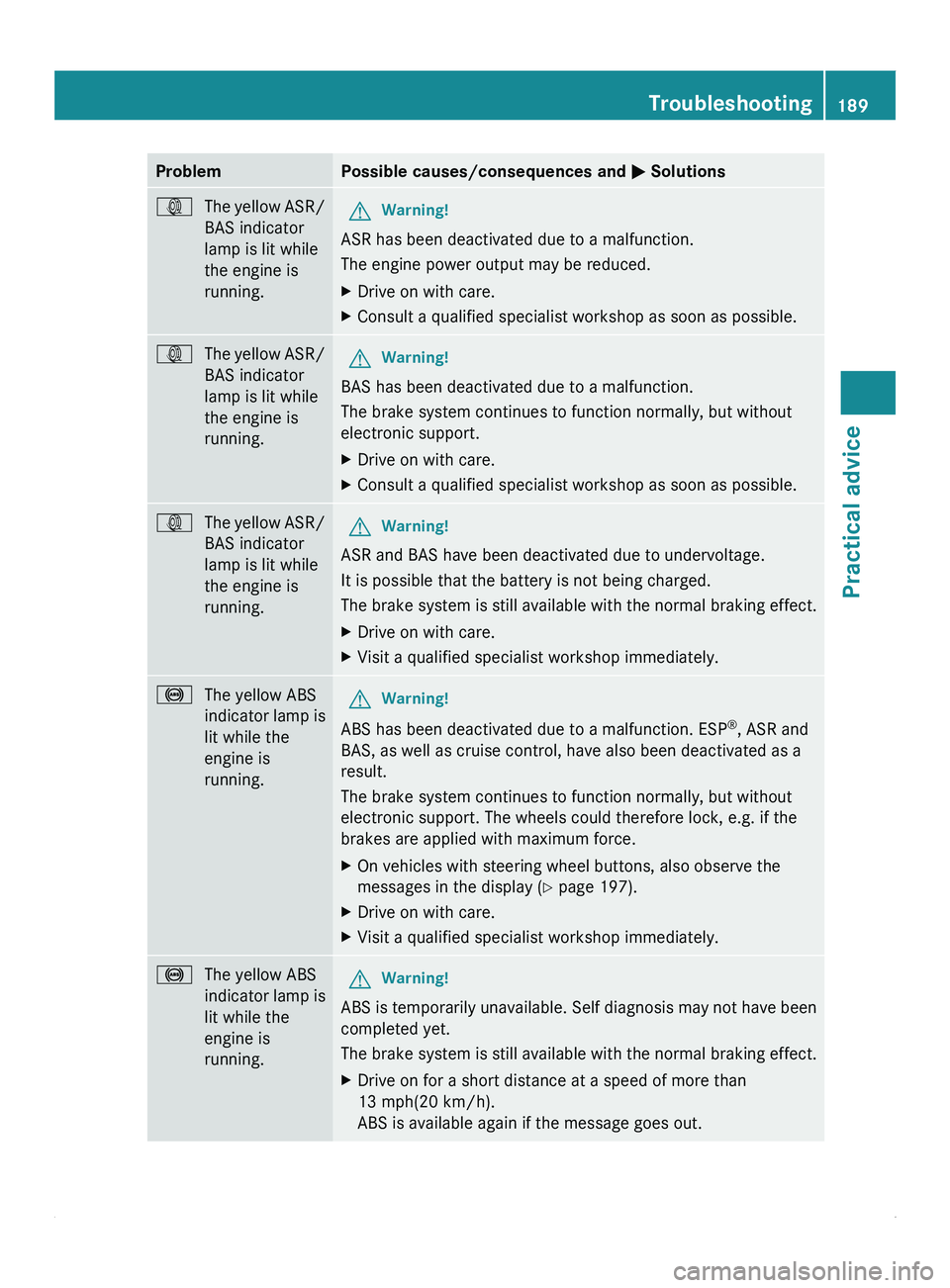
Problem Possible causes/consequences and
0050 Solutions003D
The yellow ASR/
BAS indicator
lamp is lit while
the engine is
running. G
Warning!
ASR has been deactivated due to a malfunction.
The engine power output may be reduced.
X Drive on with care.
X Consult a qualified specialist workshop as soon as possible. 003D
The yellow ASR/
BAS indicator
lamp is lit while
the engine is
running. G
Warning!
BAS has been deactivated due to a malfunction.
The brake system continues to function normally, but without
electronic support.
X Drive on with care.
X Consult a qualified specialist workshop as soon as possible. 003D
The yellow ASR/
BAS indicator
lamp is lit while
the engine is
running. G
Warning!
ASR and BAS have been deactivated due to undervoltage.
It is possible that the battery is not being charged.
The brake system
is still available with the normal braking effect.
X Drive on with care.
X Visit a qualified specialist workshop immediately. 0031
The yellow ABS
indicator lamp is
lit while the
engine is
running. G
Warning!
ABS has been deactivated due to a malfunction. ESP ®
, ASR and
BAS, as well as cruise control, have also been deactivated as a
result.
The brake system continues to function normally, but without
electronic support. The wheels could therefore lock, e.g. if the
brakes are applied with maximum force.
X On vehicles with steering wheel buttons, also observe the
messages in the display ( Y page 197).
X Drive on with care.
X Visit a qualified specialist workshop immediately. 0031
The yellow ABS
indicator lamp is
lit while the
engine is
running. G
Warning!
ABS is temporarily unavailable. Self diagnosis may not have been
completed yet.
The brake system
is still available with the normal braking effect.
X Drive on for a short distance at a speed of more than
13 mph(20 km/h).
ABS is available again if the message goes out. Troubleshooting
189
Practical advice Z
Page 192 of 292
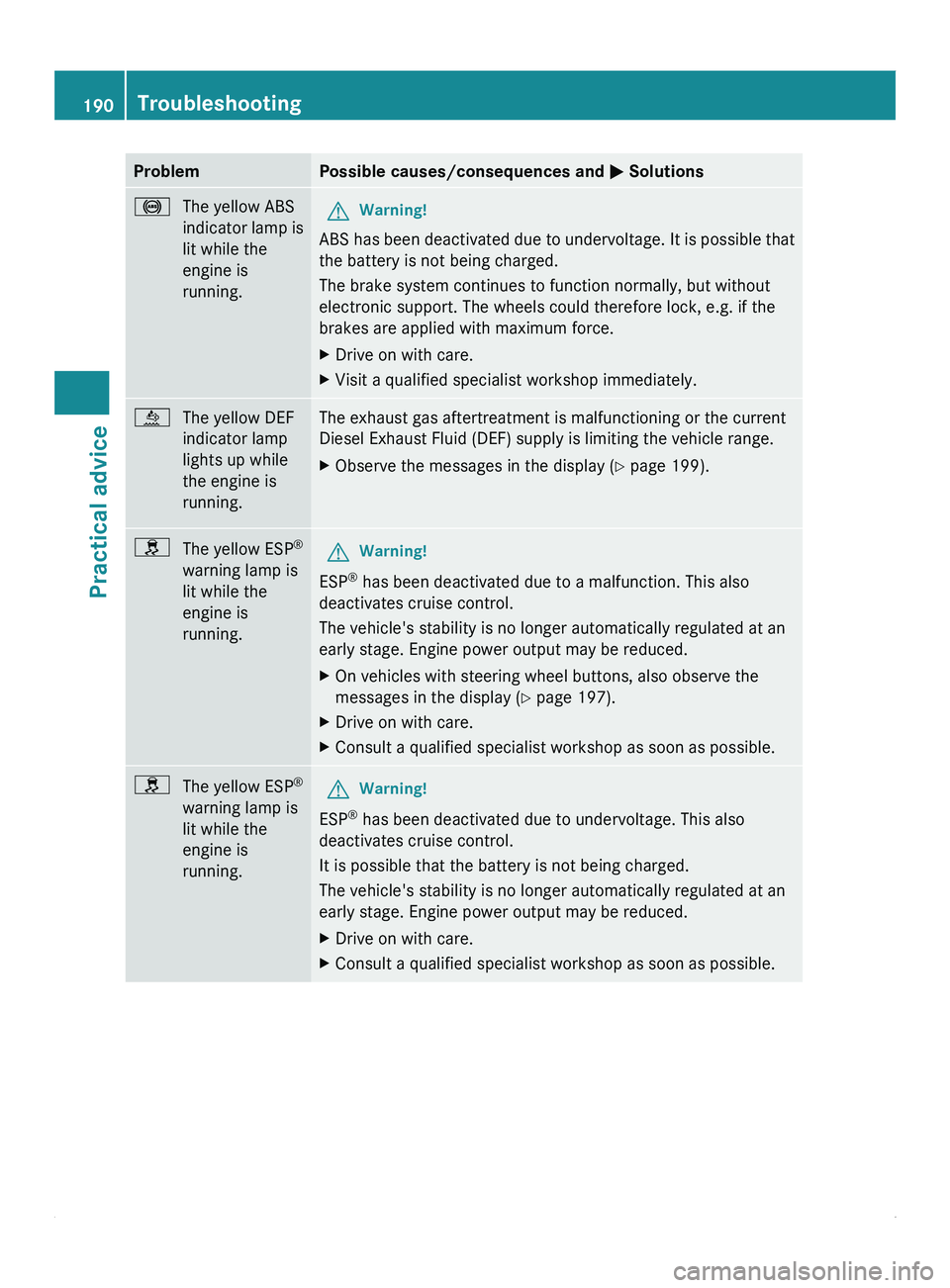
Problem Possible causes/consequences and
0050 Solutions0031
The yellow ABS
indicator lamp is
lit while the
engine is
running. G
Warning!
ABS has been deactivated due to undervoltage. It is possible that
the battery is not being charged.
The brake system continues to function normally, but without
electronic support. The wheels could therefore lock, e.g. if the
brakes are applied with maximum force.
X Drive on with care.
X Visit a qualified specialist workshop immediately. 00E4
The yellow DEF
indicator lamp
lights up while
the engine is
running. The exhaust gas aftertreatment is malfunctioning or the current
Diesel Exhaust Fluid (DEF) supply is limiting the vehicle range.
X
Observe the messages in the display ( Y page 199).009E
The yellow ESP ®
warning lamp is
lit while the
engine is
running. G
Warning!
ESP ®
has been deactivated due to a malfunction. This also
deactivates cruise control.
The vehicle's stability is no longer automatically regulated at an
early stage. Engine power output may be reduced.
X On vehicles with steering wheel buttons, also observe the
messages in the display ( Y page 197).
X Drive on with care.
X Consult a qualified specialist workshop as soon as possible. 009E
The yellow ESP ®
warning lamp is
lit while the
engine is
running. G
Warning!
ESP ®
has been deactivated due to undervoltage. This also
deactivates cruise control.
It is possible that the battery is not being charged.
The vehicle's stability is no longer automatically regulated at an
early stage. Engine power output may be reduced.
X Drive on with care.
X Consult a qualified specialist workshop as soon as possible.190
TroubleshootingPractical advice
Page 203 of 292
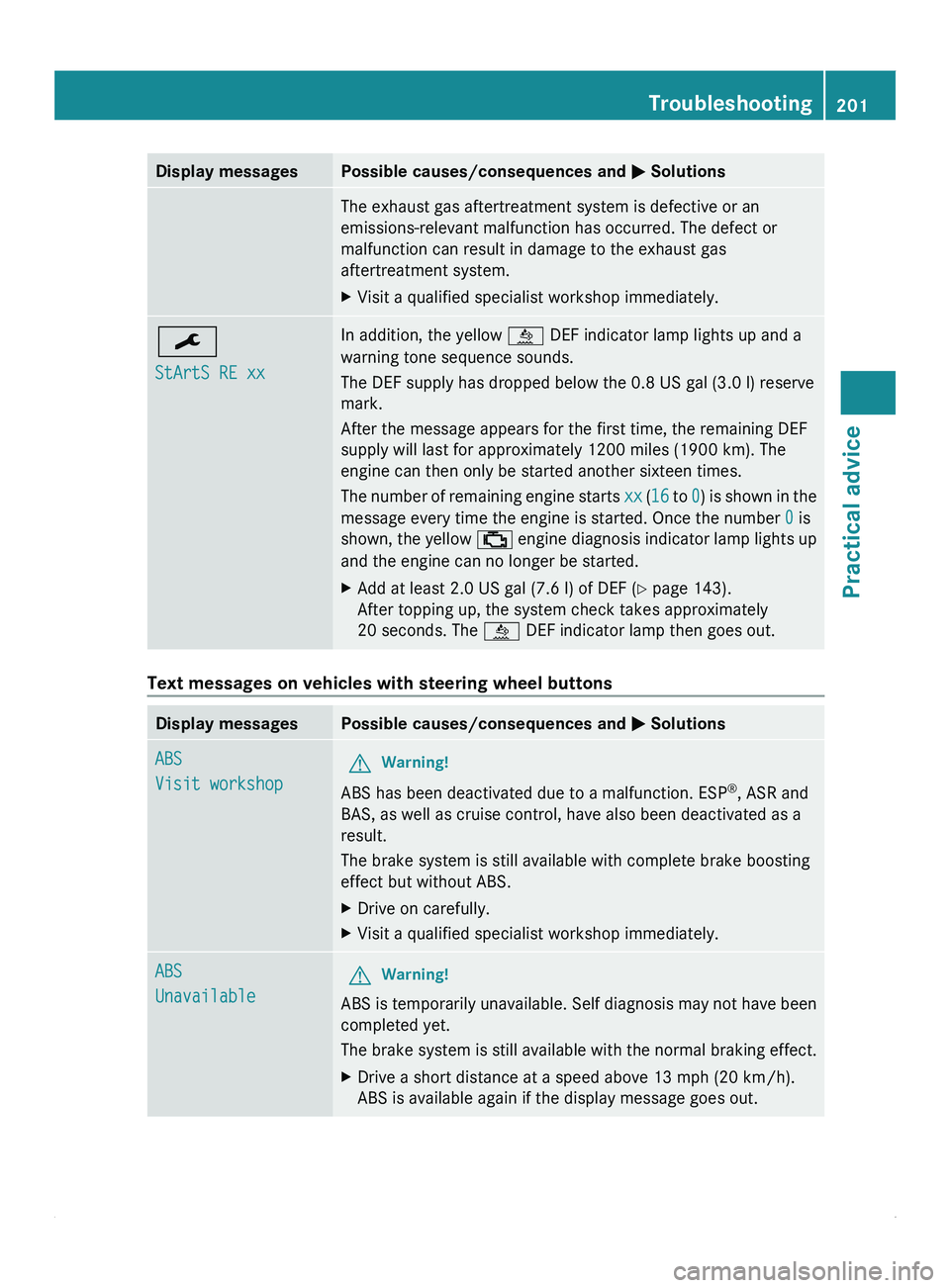
Display messages Possible causes/consequences and
0050 SolutionsThe exhaust gas aftertreatment system is defective or an
emissions-relevant malfunction has occurred. The defect or
malfunction can result in damage to the exhaust gas
aftertreatment system.
X
Visit a qualified specialist workshop immediately. 009B
StArtS RE xx In addition, the yellow
00E4 DEF indicator lamp lights up and a
warning tone sequence sounds.
The DEF supply has dropped below the 0.8 US gal (3.0 l) reserve
mark.
After the message appears for the first time, the remaining DEF
supply will last for approximately 1200 miles (1900 km). The
engine can then only be started another sixteen times.
The
number of remaining engine starts xx (16 to 0) is shown in the
message every time the engine is started. Once the number 0 is
shown, the yellow 00BB engine diagnosis indicator lamp lights up
and the engine can no longer be started.
X Add at least 2.0 US gal (7.6 l) of DEF (Y page 143).
After topping up, the system check takes approximately
20 seconds. The 00E4 DEF indicator lamp then goes out.Text messages on vehicles with steering wheel buttons
Display messages Possible causes/consequences and
0050 SolutionsABS
Visit workshop
G
Warning!
ABS has been deactivated due to a malfunction. ESP ®
, ASR and
BAS, as well as cruise control, have also been deactivated as a
result.
The brake system is still available with complete brake boosting
effect but without ABS.
X Drive on carefully.
X Visit a qualified specialist workshop immediately. ABS
Unavailable
G
Warning!
ABS is temporarily unavailable. Self diagnosis may not have been
completed yet.
The brake system
is still available with the normal braking effect.
X Drive a short distance at a speed above 13 mph (20 km/h).
ABS is available again if the display message goes out. Troubleshooting
201
Practical advice Z
Page 204 of 292
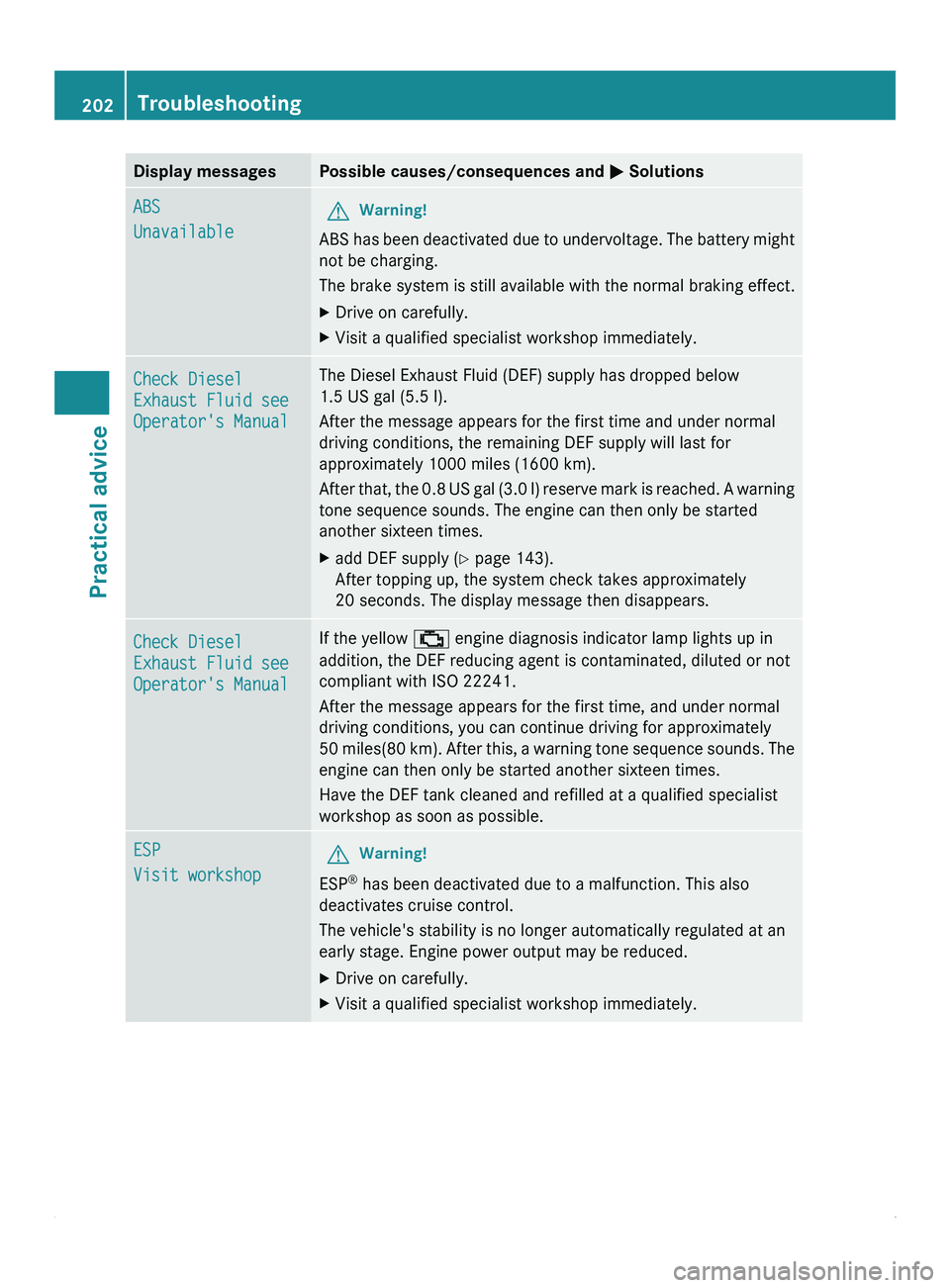
Display messages Possible causes/consequences and
0050 SolutionsABS
Unavailable
G
Warning!
ABS has been deactivated due to undervoltage. The battery might
not be charging.
The brake system
is still available with the normal braking effect.
X Drive on carefully.
X Visit a qualified specialist workshop immediately. Check Diesel
Exhaust Fluid see
Operator's Manual The Diesel Exhaust Fluid (DEF) supply has dropped below
1.5 US gal (5.5 l).
After the message appears for the first time and under normal
driving conditions, the remaining DEF supply will last for
approximately 1000 miles (1600 km).
After
that, the 0.8 US gal (3.0 l) reserve mark is reached. A warning
tone sequence sounds. The engine can then only be started
another sixteen times.
X add DEF supply ( Y page 143).
After topping up, the system check takes approximately
20 seconds. The display message then disappears. Check Diesel
Exhaust Fluid see
Operator's Manual If the yellow
00BB engine diagnosis indicator lamp lights up in
addition, the DEF reducing agent is contaminated, diluted or not
compliant with ISO 22241.
After the message appears for the first time, and under normal
driving conditions, you can continue driving for approximately
50 miles
(80 km). After this, a warning tone sequence sounds. The
engine can then only be started another sixteen times.
Have the DEF tank cleaned and refilled at a qualified specialist
workshop as soon as possible. ESP
Visit workshop
G
Warning!
ESP ®
has been deactivated due to a malfunction. This also
deactivates cruise control.
The vehicle's stability is no longer automatically regulated at an
early stage. Engine power output may be reduced.
X Drive on carefully.
X Visit a qualified specialist workshop immediately.202
Troubleshooting
Practical advice
Page 244 of 292
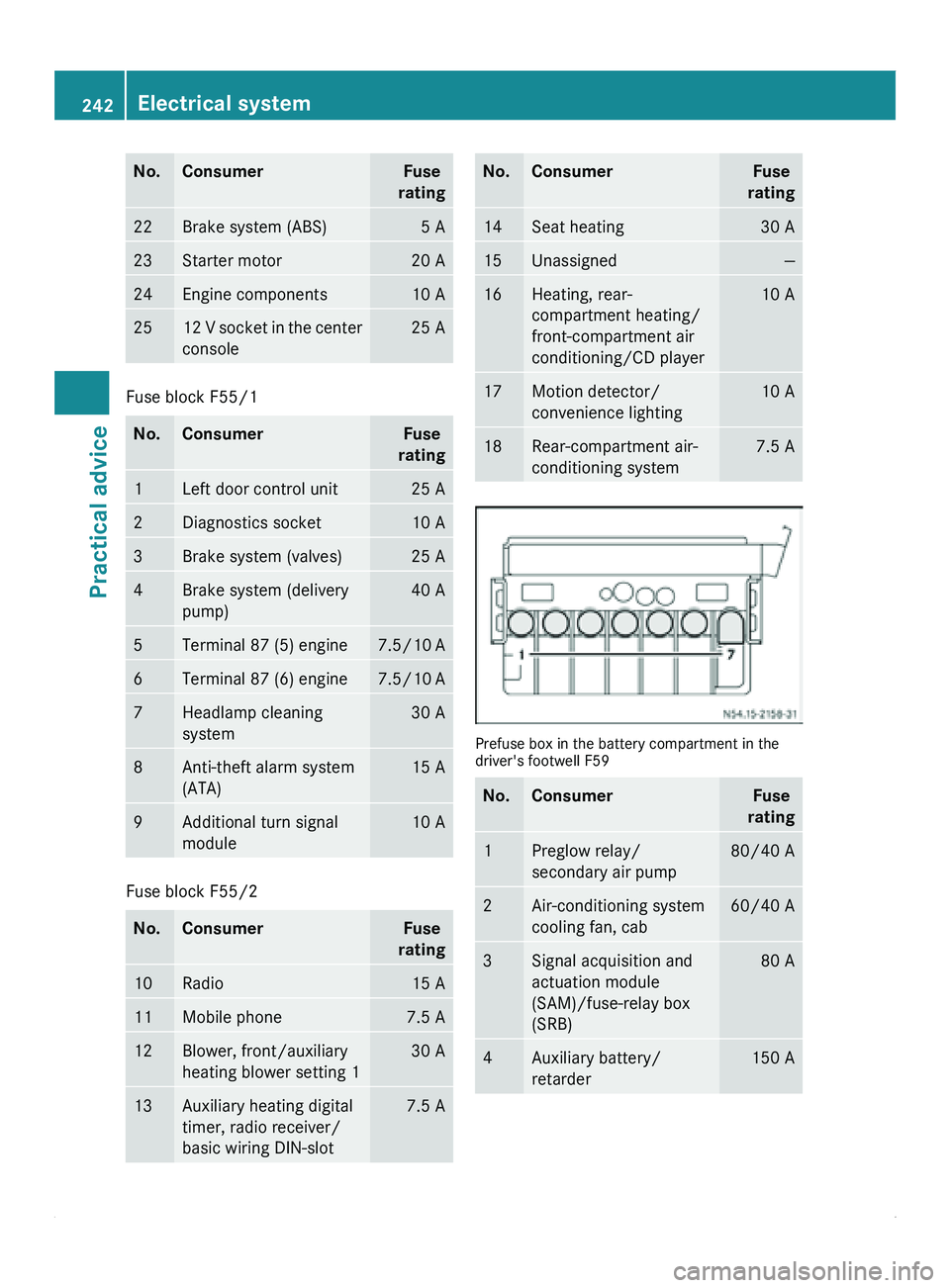
No. Consumer Fuse
rating 22 Brake system (ABS) 5 A
23 Starter motor 20 A
24 Engine components 10 A
25 12 V socket in the center
console 25 A
Fuse block F55/1
No. Consumer Fuse
rating 1 Left door control unit 25 A
2 Diagnostics socket 10 A
3 Brake system (valves) 25 A
4 Brake system (delivery
pump) 40 A
5 Terminal 87 (5) engine 7.5/10 A
6 Terminal 87 (6) engine 7.5/10 A
7 Headlamp cleaning
system 30 A
8 Anti-theft alarm system
(ATA) 15 A
9 Additional turn signal
module 10 A
Fuse block F55/2
No. Consumer Fuse
rating 10 Radio 15 A
11 Mobile phone 7.5 A
12 Blower, front/auxiliary
heating blower setting 1 30 A
13 Auxiliary heating digital
timer, radio receiver/
basic wiring DIN-
slot 7.5 A No. Consumer Fuse
rating 14 Seat heating 30 A
15 Unassigned —
16 Heating, rear-
compartment heating/
front-compartment air
conditioning/CD player 10 A
17 Motion detector/
convenience lighting 10 A
18 Rear-compartment air-
conditioning system 7.5 A
Prefuse box in the battery compartment in the
driver's footwell F59
No. Consumer Fuse
rating 1 Preglow relay/
secondary air pump 80/40 A
2 Air-conditioning system
cooling fan, cab 60/40 A
3 Signal acquisition and
actuation module
(SAM)/fuse-relay box
(SRB) 80 A
4 Auxiliary battery/
retarder 150 A242
Electrical systemPractical advice