brakes MERCEDES-BENZ SPRINTER 2011 MY11 Operator’s Manual
[x] Cancel search | Manufacturer: MERCEDES-BENZ, Model Year: 2011, Model line: SPRINTER, Model: MERCEDES-BENZ SPRINTER 2011Pages: 292, PDF Size: 6.75 MB
Page 121 of 292
Resuming the stored speed
G
Warning
Only select a stored speed if you know what
that speed is
and whether it is suitable for the
current driving and traffic situation. You can
otherwise endanger yourself and others by
unintentionally triggering sudden
acceleration or braking.
X Briefly pull the cruise control lever in the
direction of arrow 0047.
X Release the accelerator pedal.
Cruise control is
activated and resumes the
vehicle's speed to the last speed stored.
i When you first move the cruise control
lever in the direction of arrow 0047 after
starting the engine, cruise control is
activated and the current road speed is
stored.
Setting the speed G
Warning
The rate at which you increase the speed in
increments of 1 mph (1 km/h) may be faster
than your vehicle is able to accelerate. Your
vehicle may
then continue to accelerate up to
the newly set speed even after you have
released the cruise control lever.
Only increase the speed as the prevailing
conditions permit. Sudden acceleration could
otherwise endanger you and others.
X Briefly push the cruise control lever
upwards 0046 to increase the speed or
downwards 008A to reduce the speed.
The last speed stored is increased/
reduced in increments of 1 mph
(1 km/h
).
or
X Press and hold the cruise control lever
up 0046 or down 008A until the desired speed
has been reached.
X Release the cruise control lever.
The current speed is stored. i
Cruise control is not deactivated if you
depress the accelerator pedal. If you
accelerate briefly, e.g. to overtake, and
then ease off the accelerator pedal again,
cruise control adjusts the vehicle's speed
to the last speed stored.
Deactivating cruise control There are various ways to deactivate cruise
control:
X
Briefly push the cruise control lever
forwards 0088.
or
X Apply the brakes.
The last speed set remains stored.
i The last speed set is deleted when you
switch off the engine.
i Cruise control is deactivated
automatically when:
R you apply the brakes.
R you apply the parking brake and the
0066 indicator lamp in the instrument
cluster lights up.
R you are driving slower than 20 mph
(30 km/h).
R ESP ®
or ASR intervenes.
R you shift the automatic transmission to
neutral position N while the vehicle is in
motion.
R there is a malfunction in the ESP ®
, ASR
or ABS system. PARKTRONIC
General notes G
Warning
PARKTRONIC is only an aid and may not
detect all obstacles. It is not a substitute for
attentive driving.
You are always responsible for safety and
must continue to pay attention to your Driving systems
119
Controls
Z
Page 123 of 292
If an obstacle is within this range, all
segments of
the
warning displays light up and
you hear a warning tone. If the distance
between the vehicle and the obstacle falls
below the minimum range, it is possible that
the distance may no longer be displayed.
! Pay particular attention to obstacles
above or below the sensors when parking,
such as flower pots or trailer towbars.
PARKTRONIC does not recognize such
objects when they are in the immediate
vicinity of the vehicle. You could damage
the vehicle or objects.
PARKTRONIC can suffer interference from:
R ultrasonic sources such as a lorry's
compressed-air brakes, an automatic car
wash or a pneumatic drill
R attachments to the vehicle, e.g. rear
mounted racks
R number plates (vehicle license plates)
that are not affixed flat against the
bumper
R dirty or icy sensors
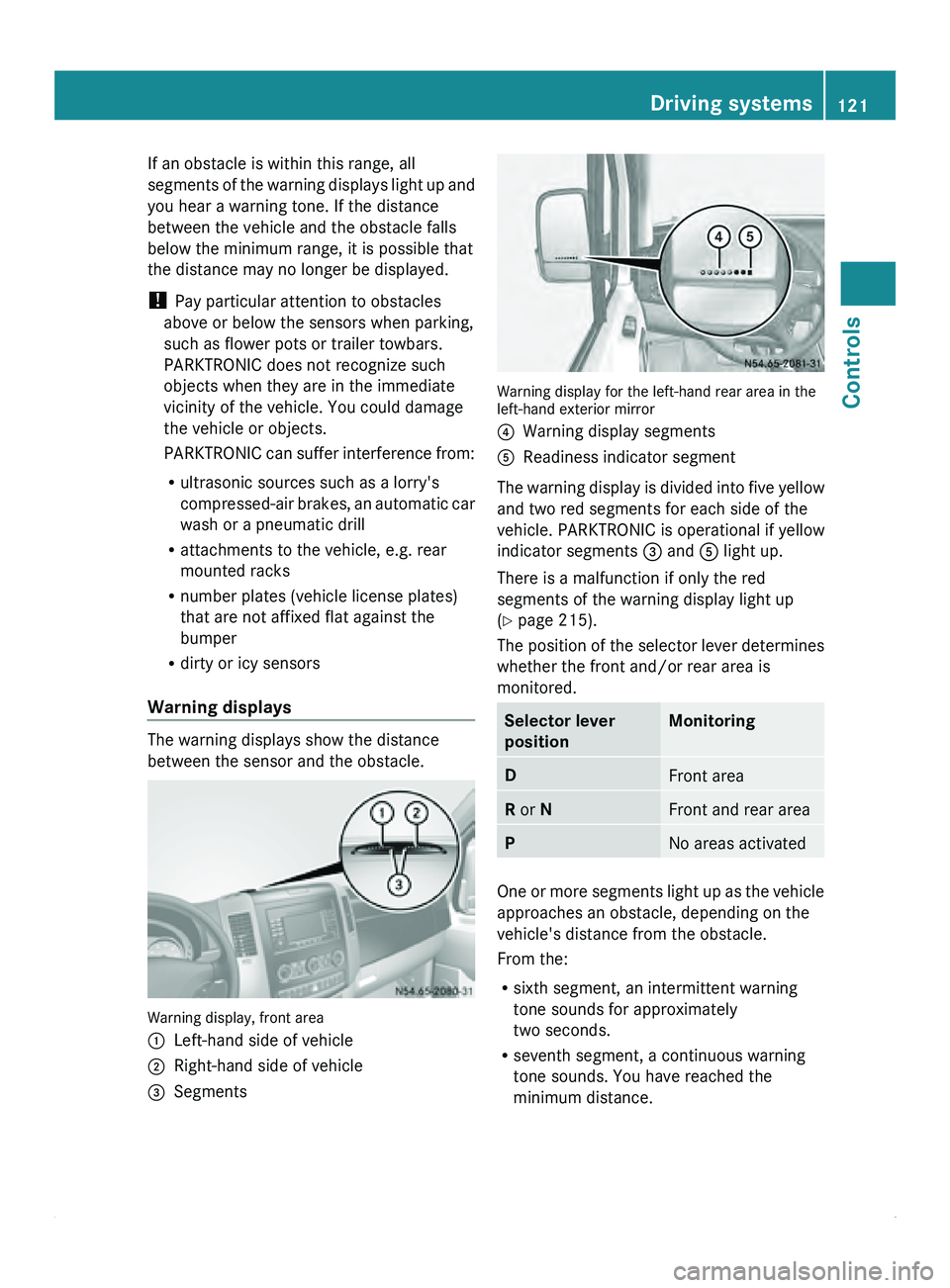
Warning displays The warning displays show the distance
between the sensor and the obstacle.
Warning display, front area
0046
Left-hand side of vehicle
0047 Right-hand side of vehicle
008A Segments Warning display for the left-hand rear area in the
left-hand exterior mirror
0088
Warning display segments
0086 Readiness indicator segment
The warning display is divided into five yellow
and two red segments for each side of the
vehicle. PARKTRONIC is operational if yellow
indicator segments 008A and 0086 light up.
There is a malfunction if only the red
segments of the warning display light up
(Y page 215).
The position of
the selector lever determines
whether the front and/or rear area is
monitored. Selector lever
position Monitoring
D
Front area
R or N Front and rear area
P
No areas activated
One or more segments light up as the vehicle
approaches an obstacle, depending on the
vehicle's distance from the obstacle.
From the:
R
sixth segment, an intermittent warning
tone sounds for approximately
two seconds.
R seventh segment, a continuous warning
tone sounds. You have reached the
minimum distance. Driving systems
121
Controls Z
Page 150 of 292
G
Warning
Do not attempt to modify or repair the lashing
points, cargo tie-down
rings or tie downs. The
load or the cargo tie-down rings could work
loose and cause serious injury to you and
other people as well as material damage.
Spread the load evenly between the lashing
points or cargo tie-down rings.
Observe the loading guidelines.
i Secure loose loads with a tested lashing
net or a tarpaulin.
X Always fasten the lashing net or tarpaulin
to all available
cargo tie-down points. Make
sure that the retaining hooks are secured
against accidental opening.
! Observe the information
on the maximum
loading capacity of the lashing points.
If you use multiple lashing points to secure
a load, you should observe the maximum
loading capacity of the weakest lashing
point.
When you brake hard, for example, forces
apply that can be far higher than the weight
force of the transported load. Always use
multiple lashing points to distribute these
forces, and distribute the load equally
among them.
Information about the maximum loading
capacity of the cargo tie-down points can be
found in the "Technical data" section
(Y page 283).
i If your vehicle is equipped with loading
rails in the cargo floor, you should place
lashing rods directly in front of and behind
the load. The lashing rods directly absorb
the potential shifting forces. G
Warning
If you
tension the lashing straps between the
side walls, or between a side wall and the
cargo floor, the
maximum permissible load for
the loading rails or lashing points or eyelets
could be exceeded if the brakes are applied suddenly, if
the vehicle's direction is changed
abruptly or in the event of an accident.
The load would no longer be secured,
resulting in a risk of serious injury being
caused by the load slipping.
For this reason,
do not tension a lashing strap
between the side walls or between a side wall
and the cargo floor.
Only lashing rods are to be used between the
loading rails on the side walls. Observe the
operating instructions of the lashing rod
manufacturer.
i Securing loads on the cargo floor by
lashing them down is only recommended
for lightweight loads. Place non-slip mats
(anti-slip mats) on the cargo floor to
increase load security. G
Warning
Before releasing
the lashing straps, you must
make sure that
the load is standing firmly and
that it cannot tip over once the straps have
been removed. Otherwise, you or others could
be injured by the load slipping.
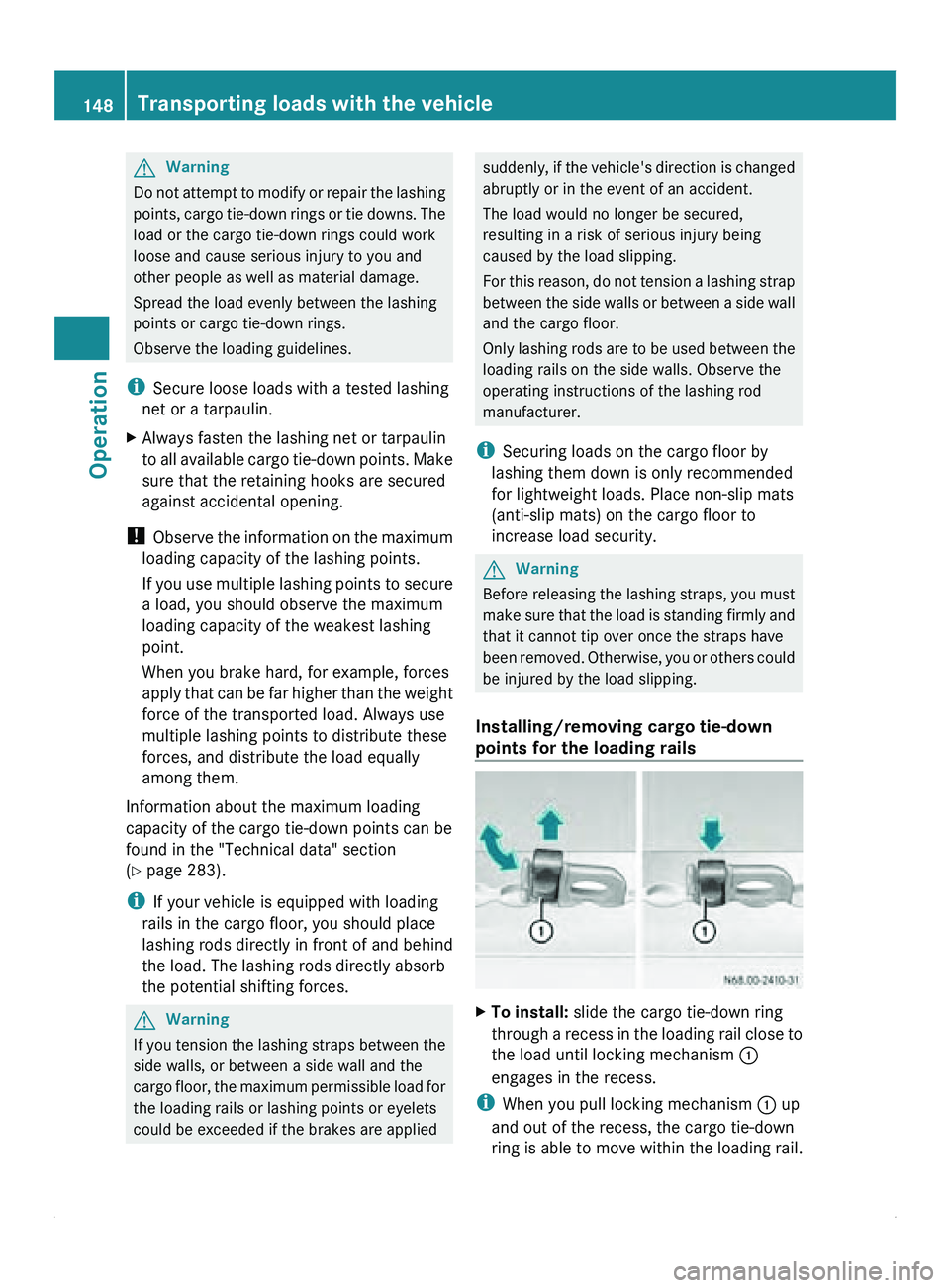
Installing/removing cargo tie-down
points for the loading rails X
To install: slide the cargo tie-down ring
through a recess
in the loading rail close to
the load until locking mechanism 0046
engages in the recess.
i When you pull locking mechanism 0046 up
and out of the recess, the cargo tie-down
ring is able to move within the loading rail. 148
Transporting loads with the vehicle
Operation
Page 152 of 292
Towing a trailer
Notes on trailer towing Important safety notes
The trailer coupling is one of the most
important vehicle parts with regard to road
safety. The notes on operation, care and
maintenance issued by the manufacturer
should be observed.
G
Warning!
Improper equipment or driving technique
while driving with a trailer can cause you to
lose control of your vehicle.
Improper towing or failure to observe the
Operator's Manual can lead to vehicle
damage and/or serious
injuries. Observe the
following guidelines in order to guarantee safe
driving with trailers.
Contact an authorized Sprinter Dealer if you
require any explanation of the information
contained in the Operator's Manual.
General notes
R Install only an approved trailer coupling on
your vehicle.
Further information about availability and
installation of trailer couplings can be
obtained from any authorized Sprinter
Dealer.
R The bumpers of your vehicle are not
suitable for installing detachable trailer
couplings.
R Do not install rented trailer couplings or
other detachable trailer couplings to the
bumpers.
R To reduce the risk of damage to the ball
coupling when using a detachable trailer
coupling, remove the ball coupling from its
mounting when it is not needed.
Coupling up a trailer Observe the maximum permissible trailer
dimensions (width and length). Most federal states and all Canadian
provinces require by law:
R
safety chains between the towing vehicle
and the
trailer.
The chains should be cross-
wound under the trailer drawbar. They must
be fastened to the vehicle's trailer
coupling, not to the bumper or the axle.
Allow for enough play in the chains to
facilitate turning tight corners.
R a separate brake system for certain types
of trailer.
R a safety switch for braked trailers. Check
the specific legal requirements applicable
to your federal state.
If the trailer detaches from the towing
vehicle, the safety switch applies the
trailer's brakes.
i The vehicle's subharness has an electric
cable to the brake light indicator lamp. G
Warning
Follow the manufacturer's operating
instructions for the trailer tow hitch when
using a detachable trailer tow hitch.
Couple and decouple the trailer carefully. A
trailer which is incorrectly coupled to the
towing vehicle could break away. A correctly
coupled trailer must be positioned
horizontally behind the vehicle.
Ensure that the following weights are not
exceeded:
R the permissible noseweight
R the permissible trailer load
R the permissible rear
axle load of the towing
vehicle
R the permissible gross weight for both the
towing vehicle and the trailer
The permissible values, which must not be
exceeded, can be found in your vehicle
documents and on the trailer tow hitch type
plates for the trailer and the vehicle. Where
the values differ, the lowest is valid. 150
Transporting loads with the vehicle
Operation
Page 153 of 292
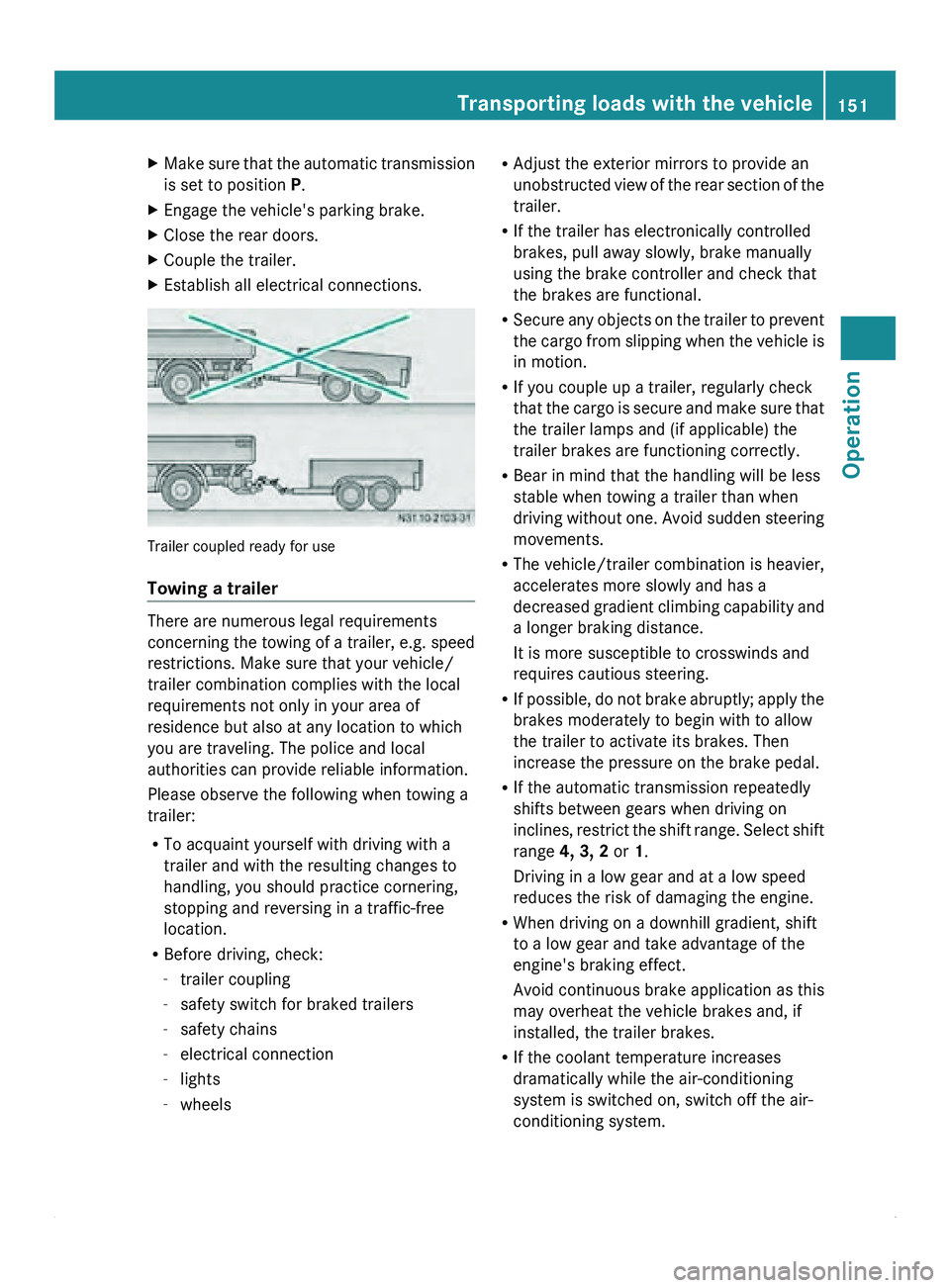
X
Make sure that the automatic transmission
is set to position P.
X Engage the vehicle's parking brake.
X Close the rear doors.
X Couple the trailer.
X Establish all electrical connections. Trailer coupled ready for use
Towing a trailer
There are numerous legal requirements
concerning the
towing
of a trailer, e.g. speed
restrictions. Make sure that your vehicle/
trailer combination complies with the local
requirements not only in your area of
residence but also at any location to which
you are traveling. The police and local
authorities can provide reliable information.
Please observe the following when towing a
trailer:
R To acquaint yourself with driving with a
trailer and with the resulting changes to
handling, you should practice cornering,
stopping and reversing in a traffic-free
location.
R Before driving, check:
-trailer coupling
- safety switch for braked trailers
- safety chains
- electrical connection
- lights
- wheels R
Adjust the exterior mirrors to provide an
unobstructed view of
the rear section of the
trailer.
R If the trailer has electronically controlled
brakes, pull away slowly, brake manually
using the brake controller and check that
the brakes are functional.
R Secure any objects on the trailer to prevent
the cargo from slipping when the vehicle is
in motion.
R If you couple up a trailer, regularly check
that the cargo is secure and make sure that
the trailer lamps and (if applicable) the
trailer brakes are functioning correctly.
R Bear in mind that the handling will be less
stable when towing a trailer than when
driving without one. Avoid sudden steering
movements.
R The vehicle/trailer combination is heavier,
accelerates more slowly and has a
decreased gradient climbing capability and
a longer braking distance.
It is more susceptible to crosswinds and
requires cautious steering.
R If possible, do not brake abruptly; apply the
brakes moderately to begin with to allow
the trailer to activate its brakes. Then
increase the pressure on the brake pedal.
R If the automatic transmission repeatedly
shifts between gears when driving on
inclines, restrict the shift range. Select shift
range 4, 3, 2 or 1.
Driving in a low gear and at a low speed
reduces the risk of damaging the engine.
R When driving on a downhill gradient, shift
to a low gear and take advantage of the
engine's braking effect.
Avoid continuous brake application as this
may overheat the vehicle brakes and, if
installed, the trailer brakes.
R If the coolant temperature increases
dramatically while the air-conditioning
system is switched on, switch off the air-
conditioning system. Transporting loads with the vehicle
151
Operation Z
Page 161 of 292
Steering
Steering, no maintenance required.
Service product Maintenance
interval Product name/number MB
Sheet
No.
Power steering fluid – Mobil ATF-D,
Exxon Mobil Corporation or
equivalent 236.3
You can obtain further information from any authorized Sprinter Dealer.
Brake fluid
G
Warning
Brake fluid is hazardous to health. Do not
swallow brake fluid.
See a doctor immediately
if you swallow brake fluid.
Make sure that brake fluid does not come into
contact with skin, clothing or eyes. Rinse
affected areas with plenty of clean water and
consult a doctor if necessary.
Always wear gloves and eye protection when
topping up brake fluid.
Store brake fluid only in the original closed
container and keep it out of the reach of
children. Comply with safety regulations
when handling brake fluid.
Use only approved brake fluids that comply
with the MB Specification for Service
Products, Sheet No. 331.0. You must observe
the boiling points (DOT 4 plus).
The brake fluid must have the following
characteristics in accordance with the
FMVSS 116 and ISO 4925 standards:
R boiling point (ERBP) of at least
500 ‡(260 †)
R wet boiling point (WERBP) of at least
356 ‡(180 †)
R viscosity of a maximum of 1500 mm²/s
Over a period of time, the brake fluid absorbs
moisture from the air. This reduces its boiling
point. G
Warning
If the boiling point of the brake fluid is too low,
vapor pockets may form in the brake system
when the brakes
are subjected to a heavy load
(e.g. on long downhill stretches). This would
impair braking efficiency. The vehicle's
stopping distance may then be longer. This
increases the risk of an accident.
Have the brake fluid replaced every
two years with brake fluid approved by the
distributor named on the inside of the front
cover and have the replacement confirmed in
the Maintenance Booklet.
i There is usually a notice in the engine
compartment to remind you when the next
brake fluid change is due.
You can obtain further information from any
authorized Sprinter Dealer. Service products
159Operation Z
Page 168 of 292
R
Grab handles
R Wheels, tires and wheel arches
R License plates
X Remove any trapped foreign objects, e.g.
stones.
X Check the wheel suspension for damage. G
Warning
Dirty brake discs and brake pads/linings can
impair braking performance (up to the point
of total failure).
This could lead to an accident.
Check the brake system for operating safety
by testing the brakes before driving the
vehicle on public roads.
In the event of impaired braking, stop the
vehicle while paying attention to the traffic
conditions and contact a qualified specialist
workshop which has the necessary specialist
knowledge and tools for the work required.
For this, we recommend an authorized
Sprinter Dealer. In particular, work relevant to
safety or on safety-related systems must be
carried out at a qualified specialist workshop.
After driving in mud, sand, water or in similar
conditions:
R check the brake system for operating
safety.
R clean the wheels, chassis and brake
system.
R check the wheels, chassis and brake
system for damage. Have any damage
repaired at a qualified specialist workshop,
e.g. an authorized Sprinter Dealer. Maintenance
General notes
The scope and regularity of the maintenance
work primarily depend on the often diverse
operating conditions.
The vehicle Maintenance Booklet describes
the scope and frequency of maintenance
work and contains additional notes on the New Vehicle Limited Warranty and on service
products.
Specialist knowledge beyond the scope of
these Operating
Instructions
is required when
carrying out testing and maintenance work.
Have this work carried out by trained
personnel.
i Maintenance services must be carried out
in accordance with the provisions and
recommendations in the Maintenance
Booklet.
Not doing so could void the warranty claim
and lead to refusal of goodwill gestures
after the manufacturer has submitted a
damage report. G
Warning
Before carrying out maintenance operations
and repairs, you must read the sections
referring to maintenance operations and
repairs:
R this includes relevant sections of the
technical documentation, such as the
operating instructions and workshop
information.
R you should also
familiarize yourself with the
legal requirements, such as work safety
regulations and accident prevention
measures.
You could otherwise fail to recognize dangers
and thereby injure yourself or others.
You must secure the vehicle on axle stands of
sufficient load bearing capacity if work is
being carried out beneath it.
Never use the vehicle jack instead of stands.
The jack could slip and the vehicle could drop.
This could result in serious injury to yourself
or others.
The vehicle jack is intended only to raise the
vehicle for a short time.
Always have maintenance work carried out at
a qualified specialist workshop. The workshop
must have the necessary specialist
knowledge and tools to carry out the work
required. For this, we recommend an 166
Maintenance
Operation
Page 172 of 292
Only open the coolant expansion tank when
the coolant temperature is below 122 ‡
(50 †).
G
Warning
Coolant contains glycol and is therefore toxic.
Do not swallow the coolant. See a doctor
immediately if you swallow coolant.
Make sure that coolant does not come into
contact with skin,
eyes or clothing. In case of
contact with eyes, rinse immediately with
plenty of clean water. Clean affected areas of
skin and clothing with soap and water
immediately. Change any affected clothing
immediately.
X Slowly turn cap 0046 counter-clockwise and
allow the excess pressure to escape.
X Turn cap 0046 further and remove it.
X Add coolant until it is at the MAX mark.
Observe the correct coolant mixture ratio
and the required water quality
(Y page 160).
X Replace cap 0046 and tighten
it until the stop.
! Check the cooling and heating system
regularly for leaks.
If a large quantity of coolant is lost, have
the cause traced
and rectified at a qualified
specialist workshop, e.g. an authorized
Sprinter Dealer. Clutch mechanism and brake system
G
Warning
Brake fluid is hazardous to health. Do not
swallow brake fluid.
See a doctor immediately
if you swallow brake fluid.
Make sure that brake fluid does not come into
contact with skin, clothing or eyes. Rinse
affected areas with plenty of clean water and
consult a doctor if necessary.
Always wear gloves and eye protection when
topping up brake fluid. Store brake fluid only in the original closed
container and keep it out of the reach of
children. Comply with safety regulations
when handling brake fluid.
G
Warning
If the
boiling point of the brake fluid is too low,
vapor pockets may form in the brake system
when the brakes
are subjected to a heavy load
(e.g. on long downhill stretches). This would
impair braking efficiency. The vehicle's
stopping distance may then be longer. This
increases the risk of an accident.
Have the brake fluid renewed every two years.
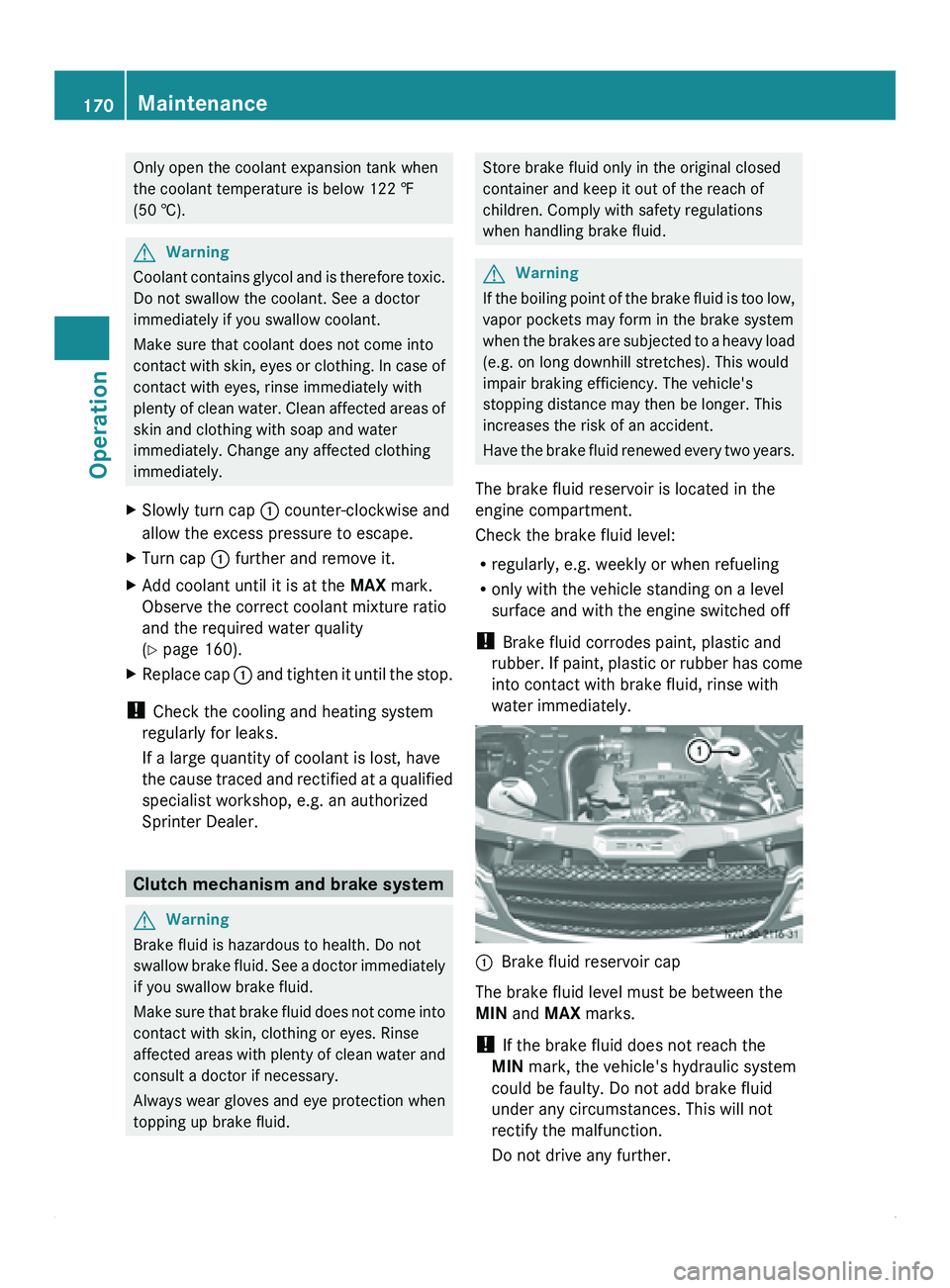
The brake fluid reservoir is located in the
engine compartment.
Check the brake fluid level:
R regularly, e.g. weekly or when refueling
R only with the vehicle standing on a level
surface and with the engine switched off
! Brake fluid corrodes paint, plastic and
rubber. If paint, plastic or rubber has come
into contact with brake fluid, rinse with
water immediately. 0046
Brake fluid reservoir cap
The brake fluid level must be between the
MIN and
MAX marks.
! If the brake fluid does not reach the
MIN mark, the vehicle's hydraulic system
could be faulty. Do not add brake fluid
under any circumstances. This will not
rectify the malfunction.
Do not drive any further. 170
Maintenance
Operation
Page 189 of 292
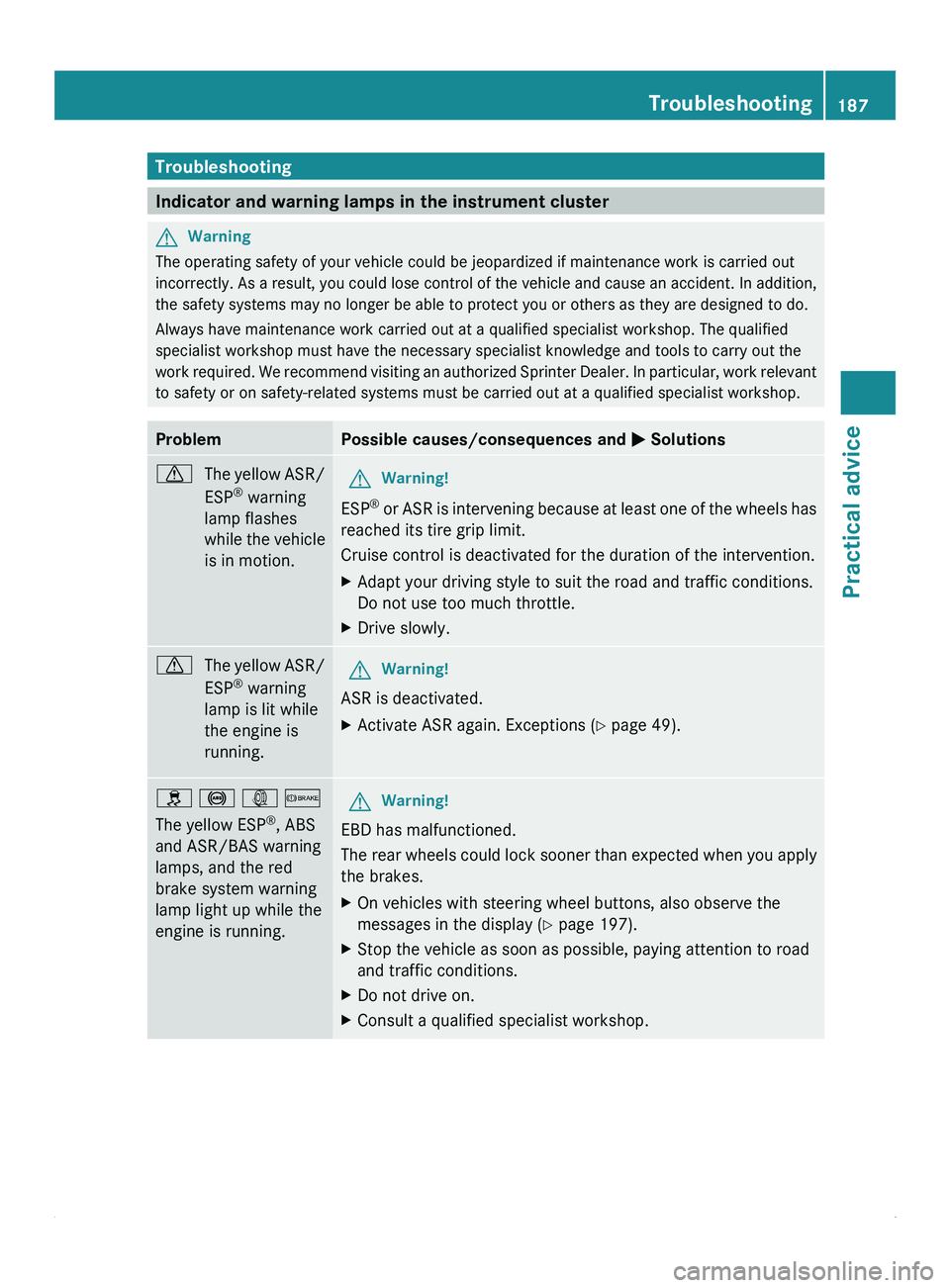
Troubleshooting
Indicator and warning lamps in the instrument cluster
G
Warning
The operating safety of your vehicle could be jeopardized if maintenance work is carried out
incorrectly. As a
result, you could lose control of the vehicle and cause an accident. In addition,
the safety systems may no longer be able to protect you or others as they are designed to do.
Always have maintenance work carried out at a qualified specialist workshop. The qualified
specialist workshop must have the necessary specialist knowledge and tools to carry out the
work required. We recommend visiting an authorized Sprinter Dealer. In particular, work relevant
to safety or on safety-related systems must be carried out at a qualified specialist workshop. Problem Possible causes/consequences and
0050 Solutions0067
The yellow
ASR/
ESP ®
warning
lamp flashes
while the vehicle
is in motion. G
Warning!
ESP ®
or ASR is intervening because at least one of the wheels has
reached its tire grip limit.
Cruise control is deactivated for the duration of the intervention.
X Adapt your driving style to suit the road and traffic conditions.
Do not use too much throttle.
X Drive slowly. 0067
The yellow ASR/
ESP ®
warning
lamp is lit while
the engine is
running. G
Warning!
ASR is deactivated.
X Activate ASR again. Exceptions ( Y page 49).
009E 0031 003D 0065
The yellow ESP ®
, ABS
and ASR/BAS warning
lamps, and the red
brake system warning
lamp light up while the
engine is running. G
Warning!
EBD has malfunctioned.
The rear wheels
could lock sooner than expected when you apply
the brakes.
X On vehicles with steering wheel buttons, also observe the
messages in the display ( Y page 197).
X Stop the vehicle as soon as possible, paying attention to road
and traffic conditions.
X Do not drive on.
X Consult a qualified specialist workshop. Troubleshooting
187
Practical advice Z
Page 190 of 292
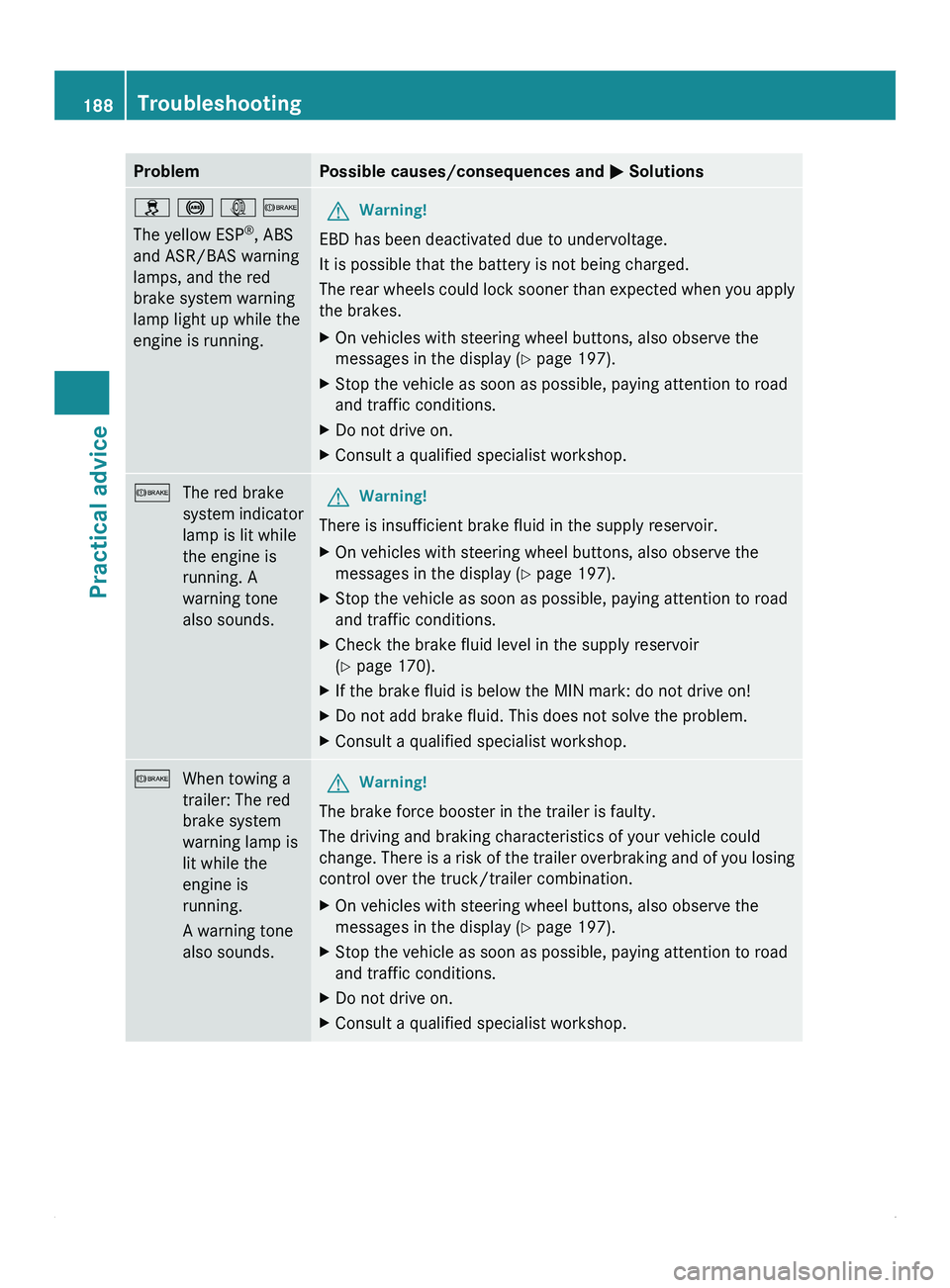
Problem Possible causes/consequences and
0050 Solutions009E 0031 003D 0065
The yellow ESP
®
, ABS
and ASR/BAS warning
lamps, and the red
brake system warning
lamp light up while the
engine is running. G
Warning!
EBD has been deactivated due to undervoltage.
It is possible that the battery is not being charged.
The rear wheels
could lock sooner than expected when you apply
the brakes.
X On vehicles with steering wheel buttons, also observe the
messages in the display ( Y page 197).
X Stop the vehicle as soon as possible, paying attention to road
and traffic conditions.
X Do not drive on.
X Consult a qualified specialist workshop. 0065
The red brake
system indicator
lamp is lit while
the engine is
running. A
warning tone
also sounds. G
Warning!
There is insufficient brake fluid in the supply reservoir.
X On vehicles with steering wheel buttons, also observe the
messages in the display ( Y page 197).
X Stop the vehicle as soon as possible, paying attention to road
and traffic conditions.
X Check the brake fluid level in the supply reservoir
(
Y page 170).
X If the brake fluid is below the MIN mark: do not drive on!
X Do not add brake fluid. This does not solve the problem.
X Consult a qualified specialist workshop. 0065
When towing a
trailer: The red
brake system
warning lamp is
lit while the
engine is
running.
A warning tone
also sounds. G
Warning!
The brake force booster in the trailer is faulty.
The driving and braking characteristics of your vehicle could
change. There is
a risk of the trailer overbraking and of you losing
control over the truck/trailer combination.
X On vehicles with steering wheel buttons, also observe the
messages in the display ( Y page 197).
X Stop the vehicle as soon as possible, paying attention to road
and traffic conditions.
X Do not drive on.
X Consult a qualified specialist workshop.188
Troubleshooting
Practical advice