roof MERCEDES-BENZ SPRINTER 2011 MY11 Operator’s Manual
[x] Cancel search | Manufacturer: MERCEDES-BENZ, Model Year: 2011, Model line: SPRINTER, Model: MERCEDES-BENZ SPRINTER 2011Pages: 292, PDF Size: 6.75 MB
Page 147 of 292
Always make sure that the distribution of the
load is correct and adapt your driving style
according to the load. G
Warning
If you have installed a roof carrier, the
vehicle’s handling, steering and braking
characteristics may change
due to the higher
center of gravity. This is the case particularly
if the roof carrier is laden. Adapt your driving
style according to the vehicle load.
Observe the manufacturer's installation
instructions. An incorrectly secured roof
carrier and/or load could come loose, fall off
and thereby endanger you or others.
Observe the maximum roof load and
maximum roof carrier load. Loads transported
on the roof must always be secured with
particular care.
Do not allow the load, including passengers,
to exceed the permissible gross vehicle
weight or the gross axle weight rating for your
vehicle. G
Warning
When using suitable load securing aids and
lashing material, always follow the
manufacturer's operating instructions, in
particular the notes on discard criteria
contained therein.
Load securing aids and lashing material may
not be used, for example, if:
R identification marks are
missing or illegible
R there are yarn breakages, damage to
bearing seams or other signs of tearing
R there are signs of shearing, deformation,
pinching or other damage
R there is damage to clamping or connecting
elements
Load securing aids and lashing material in this
condition are ready for discard and must be
replaced.
If you use load securing aids or lashing
materials that are ready for discard, the load
is not correctly secured and could cause serious injuries to you and others and cause
material damage.
G
Warning!
After an
accident, have a damaged cargo floor
or cargo area, lashing eyelets and lashing
material checked at a qualified specialist
workshop that has the necessary specialist
knowledge and tools to carry out the work
required. The cargo could otherwise be
insufficiently secured during the next
transport and could lead to serious injury to
you and other persons or material damage.
For this reason,
we recommend an authorized
Sprinter Dealer. In particular, all work relevant
to safety or on safety-related systems must
be carried out at a qualified specialist
workshop.
! If you are using a roof carrier, observe the
maximum roof load and maximum roof
carrier load.
You will find information about the maximum
roof load in the "Technical data" section
(Y page 283) and information about roof
carriers in the "Carrier systems" section
(Y page 149).
Before loading X
Tire pressure: check the
tire pressure and
correct if necessary ( Y page 281).
X Cargo floor: clean the cargo floor.
The cargo floor must be free from oil and
dust, dry and clean swept to prevent the
load from slipping.
X Place non-slip mats (anti-slip mats) on the
cargo floor if necessary.
! As soon as the non-slip mats show signs
of deformation or
develop squashed areas,
or traces of cracking/cutting, they can no
longer be used to secure a load and must
be replaced. Transporting loads with the vehicle
145
Operation Z
Page 151 of 292
Make sure that locking mechanism 0046 is
always engaged in a recess.
G
Warning
If not firmly anchored in the loading rail, the
cargo tie-down ring
may slip or be torn out of
the loading rail in the event of sudden braking.
The load would no longer be secured,
resulting in a risk of serious injury being
caused by the load slipping. For this reason,
always check the cargo tie-down ring for firm
seating after installing.
X Check the cargo tie-down ring for firm
seating.
X To remove:
pull locking
mechanism 0046 up
and pull the cargo tie-down ring towards
the locking mechanism and out of the
loading rail through a recess. Carrier systems
It is possible to install a roof carrier if your
vehicle is equipped
with securing rails on the
roof.
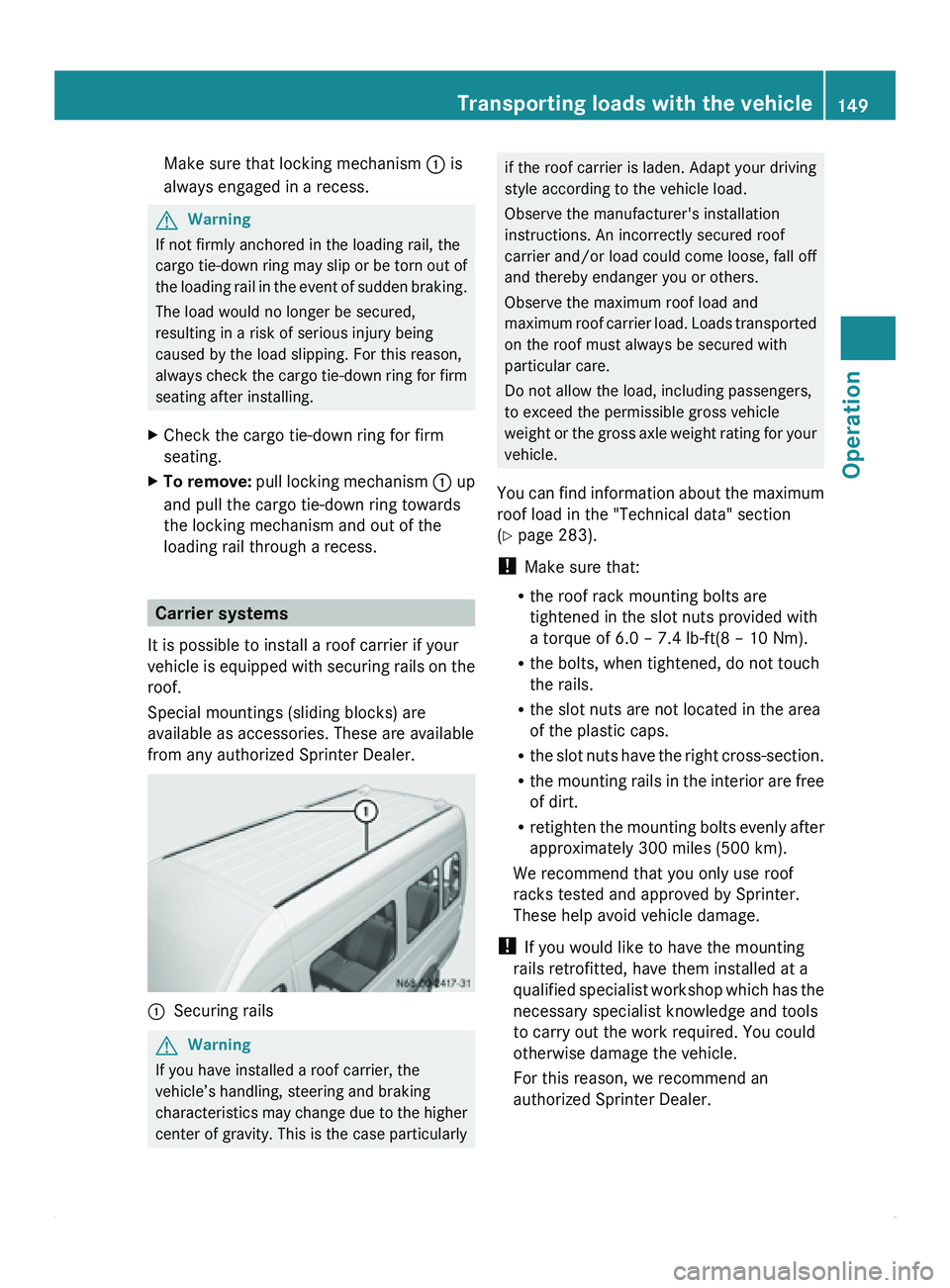
Special mountings (sliding blocks) are
available as accessories. These are available
from any authorized Sprinter Dealer. 0046
Securing rails G
Warning
If you have installed a roof carrier, the
vehicle’s handling, steering and braking
characteristics may change
due to the higher
center of gravity. This is the case particularly if the roof carrier is laden. Adapt your driving
style according to the vehicle load.
Observe the manufacturer's installation
instructions. An incorrectly secured roof
carrier and/or
load
could come loose, fall off
and thereby endanger you or others.
Observe the maximum roof load and
maximum roof carrier load. Loads transported
on the roof must always be secured with
particular care.
Do not allow the load, including passengers,
to exceed the permissible gross vehicle
weight or the gross axle weight rating for your
vehicle.
You can find information about the maximum
roof load in the "Technical data" section
(Y page 283).
! Make sure that:
R the roof rack mounting bolts are
tightened in the slot nuts provided with
a torque of 6.0 – 7.4 lb-ft(8 – 10 Nm).
R the bolts, when tightened, do not touch
the rails.
R the slot nuts are not located in the area
of the plastic caps.
R the slot nuts have the right cross-section.
R the mounting rails in the interior are free
of dirt.
R retighten the mounting bolts evenly after
approximately 300 miles (500 km).
We recommend that you only use roof
racks tested and approved by Sprinter.
These help avoid vehicle damage.
! If you would like to have the mounting
rails retrofitted, have them installed at a
qualified specialist workshop which has the
necessary specialist knowledge and tools
to carry out the work required. You could
otherwise damage the vehicle.
For this reason, we recommend an
authorized Sprinter Dealer. Transporting loads with the vehicle
149
Operation Z
Page 165 of 292
!
In order to avoid consequential damage,
repair damage caused by loose chippings
and remove any dirt immediately, in
particular:
R insect remains
R bird droppings
R flash rust
R tree resin
R oils and grease
R fuels
R tar stains
R salt residue
Wash your vehicle
more frequently if it gets
dirty more often.
! Do not park the vehicle for an extended
period right after cleaning it, particularly
after having cleaned the wheels with wheel
cleaner. Wheel cleaners could cause
increased corrosion of the brake discs and
brake pads/linings. Generally, park the
vehicle at operating temperature after
cleaning.
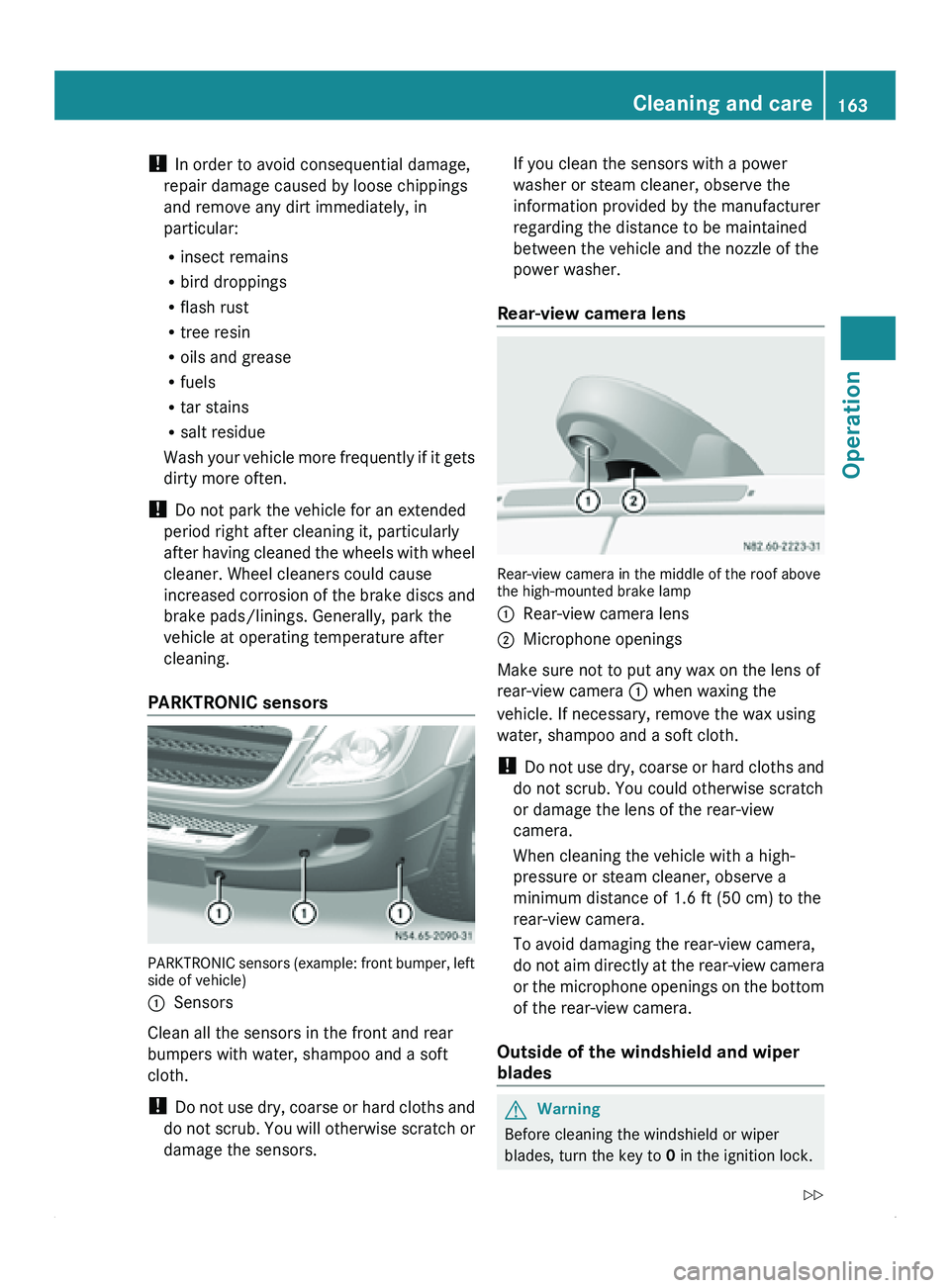
PARKTRONIC sensors PARKTRONIC sensors (example: front bumper, left
side of vehicle)
0046
Sensors
Clean all the sensors in the front and rear
bumpers with water, shampoo and a soft
cloth.
! Do not
use
dry, coarse or hard cloths and
do not scrub. You will otherwise scratch or
damage the sensors. If you clean the sensors with a power
washer or steam cleaner, observe the
information provided by the manufacturer
regarding the distance to be maintained
between the vehicle and the nozzle of the
power washer.
Rear-view camera lens Rear-view camera in the middle of the roof above
the high-mounted brake lamp
0046
Rear-view camera lens
0047 Microphone openings
Make sure not to put any wax on the lens of
rear-view camera 0046 when waxing the
vehicle. If necessary, remove the wax using
water, shampoo and a soft cloth.
! Do not
use
dry, coarse or hard cloths and
do not scrub. You could otherwise scratch
or damage the lens of the rear-view
camera.
When cleaning the vehicle with a high-
pressure or steam cleaner, observe a
minimum distance of 1.6 ft (50 cm) to the
rear-view camera.
To avoid damaging the rear-view camera,
do not aim directly at the rear-view camera
or the microphone openings on the bottom
of the rear-view camera.
Outside of the windshield and wiper
blades G
Warning
Before cleaning the windshield or wiper
blades, turn the key to 0 in the ignition lock. Cleaning and care
163
Operation
Z
Page 175 of 292
Vehicles with a yellow oil dipstick: only check
the oil level when the engine is cold.
X
Park the vehicle on a level surface. X
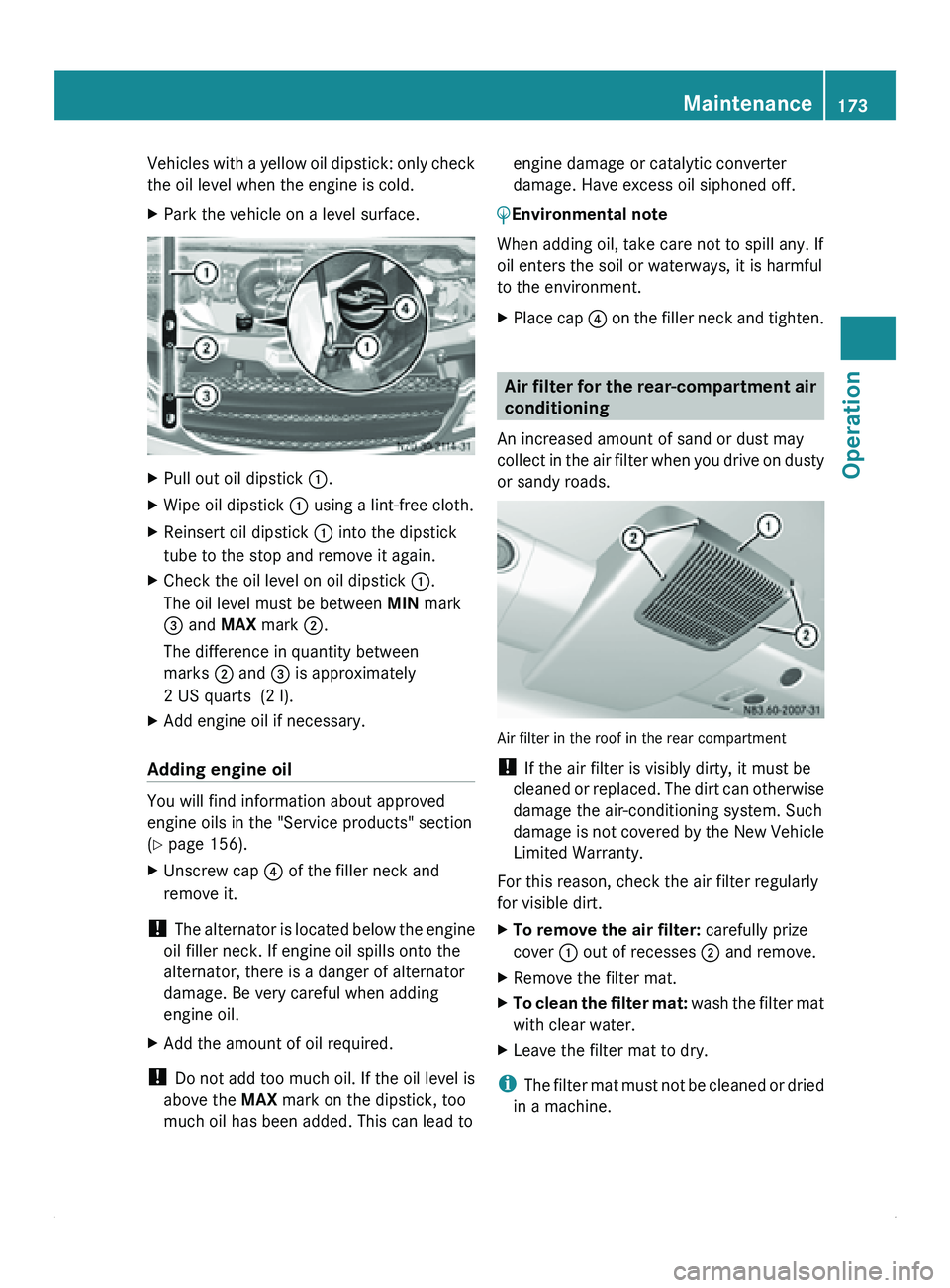
Pull out oil dipstick 0046.
X Wipe oil dipstick 0046 using a lint-free cloth.
X Reinsert oil dipstick 0046 into the dipstick
tube to the stop and remove it again.
X Check the oil level on oil dipstick 0046.
The oil level must be between MIN mark
008A and MAX mark 0047.
The difference in quantity between
marks 0047 and 008A is approximately
2 US quarts (2 l).
X Add engine oil if necessary.
Adding engine oil You will find information about approved
engine oils in the "Service products" section
(Y page 156).
X
Unscrew cap 0088 of the filler neck and
remove it.
! The alternator
is
located below the engine
oil filler neck. If engine oil spills onto the
alternator, there is a danger of alternator
damage. Be very careful when adding
engine oil.
X Add the amount of oil required.
! Do not add
too much oil. If the oil level is
above the MAX mark on the dipstick, too
much oil has been added. This can lead to engine damage or catalytic converter
damage. Have excess oil siphoned off.
0040Environmental note
When adding oil, take care not to spill any. If
oil enters the soil or waterways, it is harmful
to the environment.
X Place cap 0088 on the
filler neck and tighten. Air filter for the rear-compartment air
conditioning
An increased amount of sand or dust may
collect in the
air filter when you drive on dusty
or sandy roads. Air filter in the roof in the rear compartment
!
If the air filter is visibly dirty, it must be
cleaned or replaced.
The dirt can otherwise
damage the air-conditioning system. Such
damage is not covered by the New Vehicle
Limited Warranty.
For this reason, check the air filter regularly
for visible dirt.
X To remove the air filter: carefully prize
cover 0046 out of recesses 0047 and remove.
X Remove the filter mat.
X To clean the filter mat:
wash the
filter mat
with clear water.
X Leave the filter mat to dry.
i The filter mat
must not be cleaned or dried
in a machine. Maintenance
173
Operation Z
Page 177 of 292
Batteries
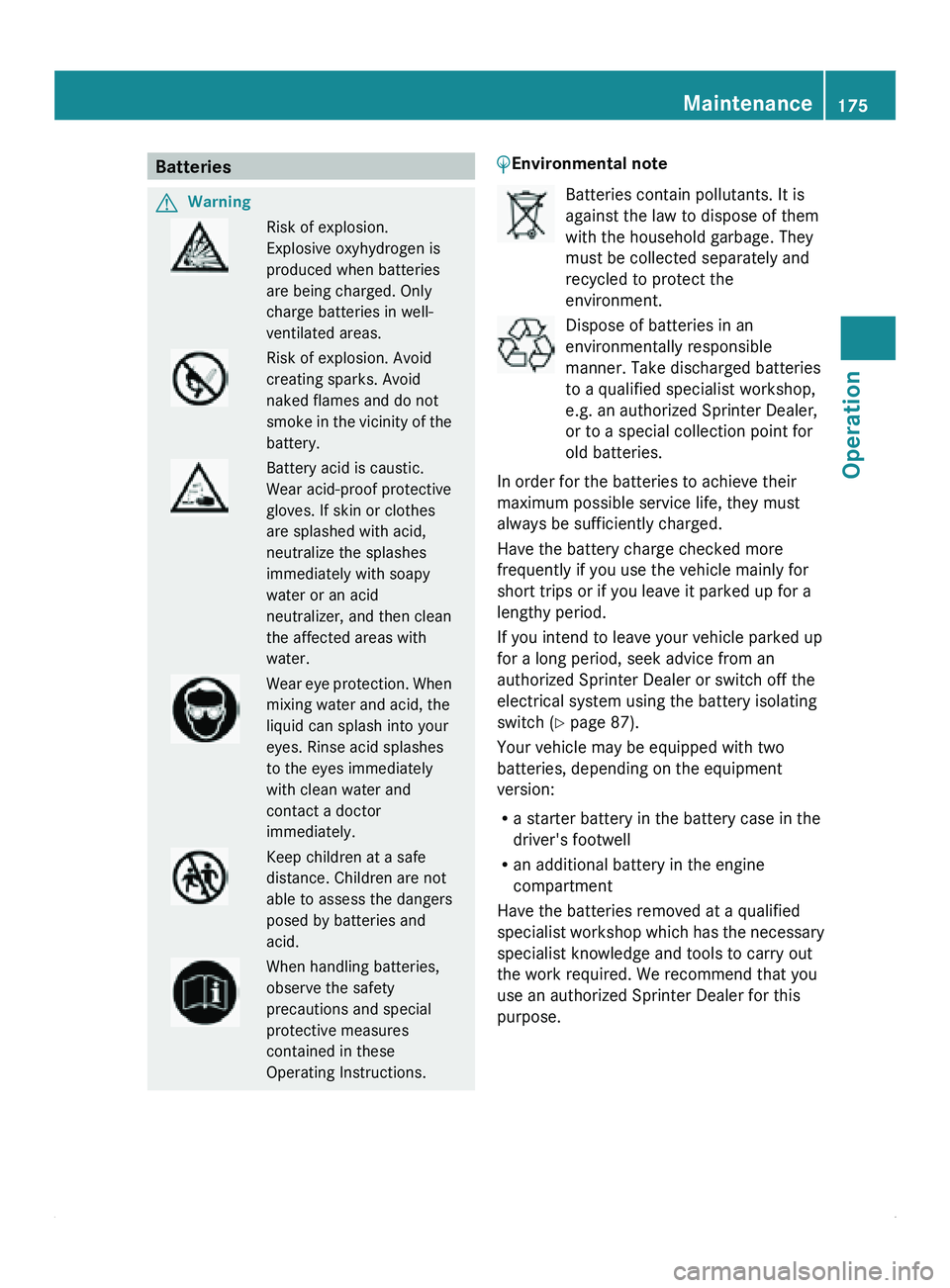
G
Warning Risk of explosion.
Explosive oxyhydrogen is
produced when batteries
are being charged. Only
charge batteries in well-
ventilated areas.
Risk of explosion. Avoid
creating sparks. Avoid
naked flames and do not
smoke in
the
vicinity of the
battery. Battery acid is caustic.
Wear acid-proof protective
gloves. If skin or clothes
are splashed with acid,
neutralize the splashes
immediately with soapy
water or an acid
neutralizer, and then clean
the affected areas with
water.
Wear eye
protection. When
mixing water and acid, the
liquid can splash into your
eyes. Rinse acid splashes
to the eyes immediately
with clean water and
contact a doctor
immediately. Keep children at a safe
distance. Children are not
able to assess the dangers
posed by batteries and
acid.
When handling batteries,
observe the safety
precautions and special
protective measures
contained in these
Operating Instructions. 0040Environmental note Batteries contain pollutants. It is
against the law to dispose of them
with the household garbage. They
must be collected separately and
recycled to protect the
environment.
Dispose of batteries in an
environmentally responsible
manner. Take discharged batteries
to a qualified specialist workshop,
e.g. an authorized Sprinter Dealer,
or to a special collection point for
old batteries.
In order for the batteries to achieve their
maximum possible service life, they must
always be sufficiently charged.
Have the battery charge checked more
frequently if you use the vehicle mainly for
short trips or if you leave it parked up for a
lengthy period.
If you intend to leave your vehicle parked up
for a long period, seek advice from an
authorized Sprinter Dealer or switch off the
electrical system using the battery isolating
switch (Y page 87).
Your vehicle may be equipped with two
batteries, depending on the equipment
version:
R a starter battery in the battery case in the
driver's footwell
R an additional battery in the engine
compartment
Have the batteries removed at a qualified
specialist workshop which
has the necessary
specialist knowledge and tools to carry out
the work required. We recommend that you
use an authorized Sprinter Dealer for this
purpose. Maintenance
175Operation Z
Page 246 of 292
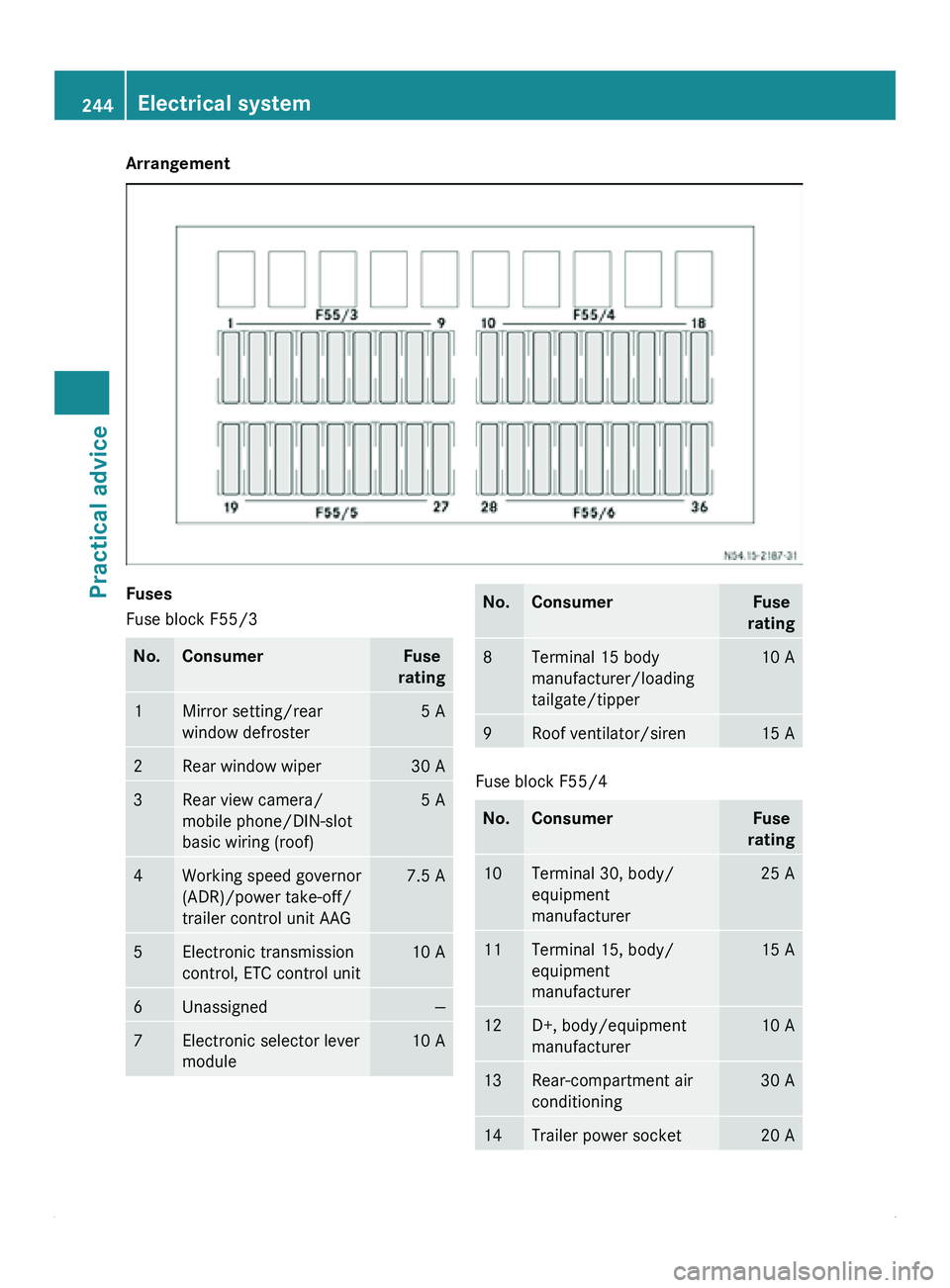
Arrangement
Fuses
Fuse block F55/3
No. Consumer Fuse
rating 1 Mirror setting/rear
window defroster 5 A
2 Rear window wiper 30 A
3 Rear view camera/
mobile phone/DIN-slot
basic wiring (roof) 5 A
4 Working speed governor
(ADR)/power take-off/
trailer control unit AAG 7.5 A
5 Electronic transmission
control, ETC control unit 10 A
6 Unassigned —
7 Electronic selector lever
module 10 A No. Consumer Fuse
rating 8 Terminal 15 body
manufacturer/loading
tailgate/tipper 10 A
9 Roof ventilator/siren 15 A
Fuse block F55/4
No. Consumer Fuse
rating 10 Terminal 30, body/
equipment
manufacturer 25 A
11 Terminal 15, body/
equipment
manufacturer 15 A
12 D+, body/equipment
manufacturer 10 A
13 Rear-compartment air
conditioning 30 A
14 Trailer power socket 20 A244
Electrical systemPractical advice
Page 256 of 292
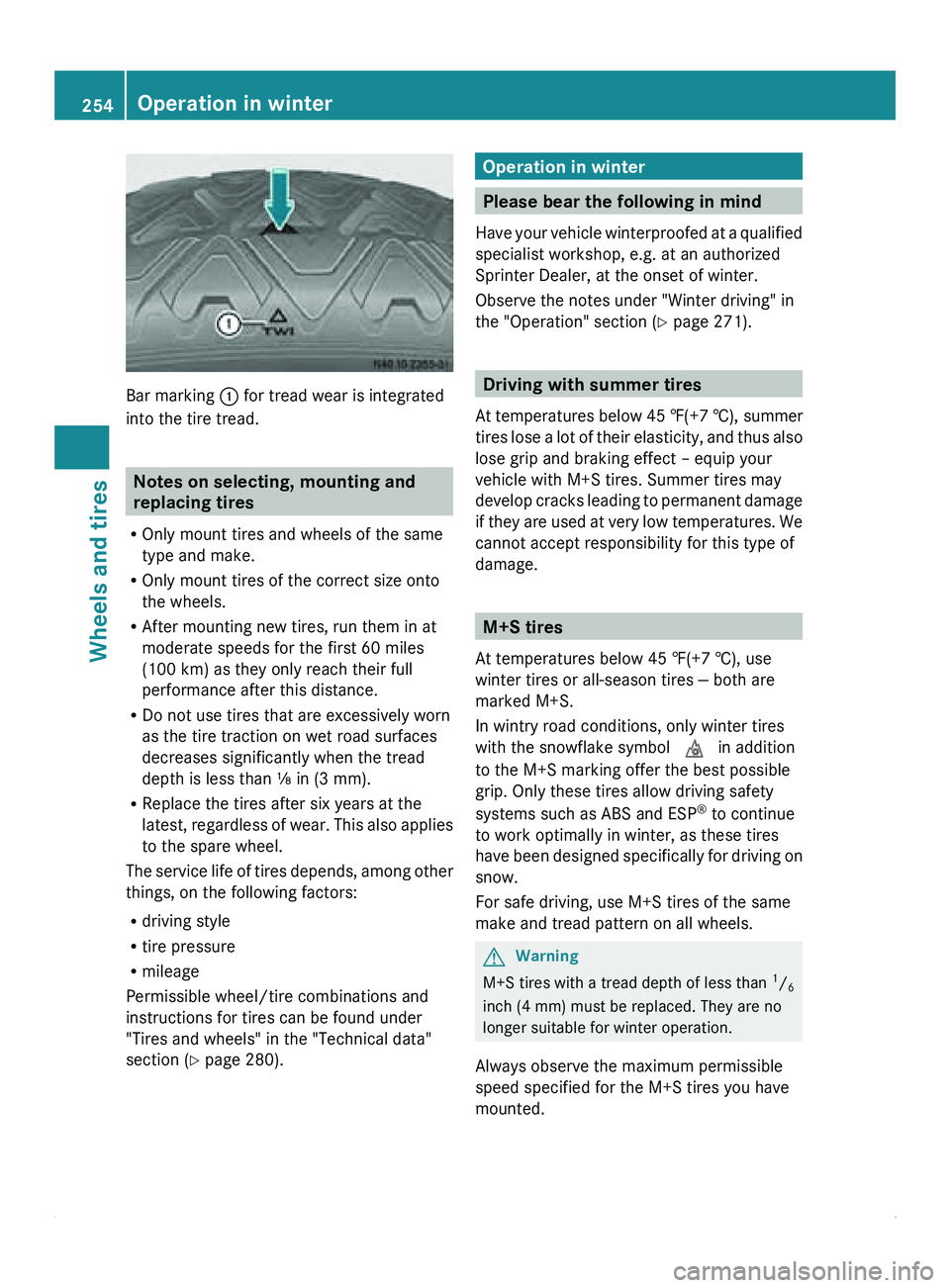
Bar marking 0046 for tread wear is integrated
into the tire tread.
Notes on selecting, mounting and
replacing tires
R Only mount tires and wheels of the same
type and make.
R Only mount tires of the correct size onto
the wheels.
R After mounting new tires, run them in at
moderate speeds for the first 60 miles
(100 km) as they only reach their full
performance after this distance.
R Do not use tires that are excessively worn
as the tire traction on wet road surfaces
decreases significantly when the tread
depth is less than ⅛ in (3 mm).
R Replace the tires after six years at the
latest, regardless of
wear. This also applies
to the spare wheel.
The service life of tires depends, among other
things, on the following factors:
R driving style
R tire pressure
R mileage
Permissible wheel/tire combinations and
instructions for tires can be found under
"Tires and wheels" in the "Technical data"
section ( Y page 280). Operation in winter
Please bear the following in mind
Have your vehicle
winterproofed at a qualified
specialist workshop, e.g. at an authorized
Sprinter Dealer, at the onset of winter.
Observe the notes under "Winter driving" in
the "Operation" section (Y page 271). Driving with summer tires
At temperatures below
45 ‡(+7 †), summer
tires lose a lot of their elasticity, and thus also
lose grip and braking effect – equip your
vehicle with M+S tires. Summer tires may
develop cracks leading to permanent damage
if they are used at very low temperatures. We
cannot accept responsibility for this type of
damage. M+S tires
At temperatures below 45 ‡(+7 †), use
winter tires or all-season tires — both are
marked M+S.
In wintry road conditions, only winter tires
with the snowflake symbol 004D in addition
to the M+S marking offer the best possible
grip. Only these tires allow driving safety
systems such as ABS and ESP ®
to continue
to work optimally in winter, as these tires
have been
designed specifically for driving on
snow.
For safe driving, use M+S tires of the same
make and tread pattern on all wheels. G
Warning
M+S tires with a tread depth of less than 1
/ 6
inch (4 mm) must be replaced. They are no
longer suitable for winter operation.
Always observe the maximum permissible
speed specified for the M+S tires you have
mounted. 254
Operation in winter
Wheels and tires
Page 272 of 292
Maximum weight of the laden vehicle
The maximum weight is the sum of the
unladen weight of the vehicle, the weight of
the accessories, the maximum load and the
weight of the
optional equipment installed at
the factory. Kilopascal (kPa)
Metric unit for tire pressure. 6.9 kPa is
equivalent to
1 psi. Another tire pressure unit
is bar. 100 kilopascal (kPa) is equivalent to
1 bar. Unladen weight
The weight of a vehicle with standard
equipment including the maximum filling
capacity of fuel, oil, and coolant. It also
includes the air-conditioning system and
optional equipment if these are installed on
the vehicle, but does not include passengers
or luggage. Maximum tire load
The maximum tire load in kilograms or
pounds is the maximum weight for which a
tire is approved. Maximum permissible tire pressure
Maximum permissible tire pressure for one
tire. Maximum load on one tire
Maximum load on one tire. This is calculated
by dividing the
maximum axle load of one axle
by two. PSI (Pounds per square inch)
Standard unit of measurement for tire
pressure. Aspect ratio
Relationship between tire
height and width in
percent. Tire pressure
Pressure inside the tire applying an outward
force to every square inch of the tire's
surface. Tire pressure is specified in pounds
per square inch
(psi), in kilopascal (kPa) or in
bar. Tire pressure should only be corrected
when the tires are cold. For this, the vehicle
must have been stationary for at least three
hours or not have traveled more than 1.6 km
(1 mile) in this time. Tire tread
The part of the tire that comes into contact
with the road. Tire bead
The tire bead ensures that the tire sits
securely on the
wheel. There are several steel
wires in the bead to prevent the tire from
coming loose from the wheel rim. Sidewall
The part of
the tire between the tread and the
tire bead. Weight of optional extras
The combined weight
of those optional extras
that weigh more than the replaced standard
part and more than 2.3 kilograms (5 lbs).
These optional extras, such as a roof rack or 270
Definition for tires and loading
Wheels and tires
Page 286 of 292
Load rails
The maximum tensile loads of the lashing
points in the cargo compartment are:
Lashing point Permissible
nominal tensile
load
Load rails on cargo
floor 1124.0 lbf
(5000 N) Lower load rail on
sidewall 562.0 lbf
(2500 N) Upper load rail on
sidewall 337.0 lbf
(1500 N) The values specified apply only to loads
placed on
the
floor of the cargo compartment
if:
R the load is secured to 2 lashing points on
the rail and
R the distance to the next load securing point
on the same rail is approx. 3 ft (1 m).
Roof carrier G
Warning
If you have installed a roof carrier, the
vehicle’s handling, steering and braking
characteristics may change
due to the higher
center of gravity. This is the case particularly
if the roof carrier is laden. Adapt your driving
style according to the vehicle load.
Observe the manufacturer's installation
instructions. An incorrectly secured roof
carrier and/or load could come loose, fall off
and thereby endanger you or others.
Observe the maximum roof load and
maximum roof carrier load. Loads transported
on the roof must always be secured with
particular care.
Do not allow the load, including passengers,
to exceed the permissible gross vehicle
weight or the gross axle weight rating for your
vehicle. Maximum roof load and minimum number of
pairs of
roof
carrier supports on vehicles with: Maximum
roof load Minimum
number of
pairs of
supports
Standard
roof 660 lbs
(300 kg) 6
High roof 330 lbs
(150 kg) 3
The data is valid for a load distributed evenly
over the entire roof area.
!
The weight of
any load carried on the roof,
including the roof carrier, must not exceed
the maximum permissible roof load.
The roof carrier supports must be mounted
at equal distances.
We recommend that you have a stabilizer
bar installed to the front axle.
Reduce the load on shorter roof carriers
proportionately. The maximum load per pair
of roof carrier supports is 110 lbs(50 kg).
! For safety reasons, we recommend that
you only use roof carrier systems which
have been tested and approved for
Sprinters. This will help to avoid damage.
Loading directions and other information
concerning load distribution and load
securing can be found in the "Operation"
section ( Y page 144). Trailer tow hitch
i We recommend that
trailer tow hitches be
retrofitted at an authorized Sprinter Dealer
i Only use a trailer tow hitch which has
been tested and specially approved by the
distributor named on the inside of the front
cover for your vehicle.
The permitted weight and load values, which
must not be exceeded, can be found in your 284
Operating data
Technical data