trailer MERCEDES-BENZ SPRINTER 2011 MY11 Operator’s Manual
[x] Cancel search | Manufacturer: MERCEDES-BENZ, Model Year: 2011, Model line: SPRINTER, Model: MERCEDES-BENZ SPRINTER 2011Pages: 292, PDF Size: 6.75 MB
Page 250 of 292
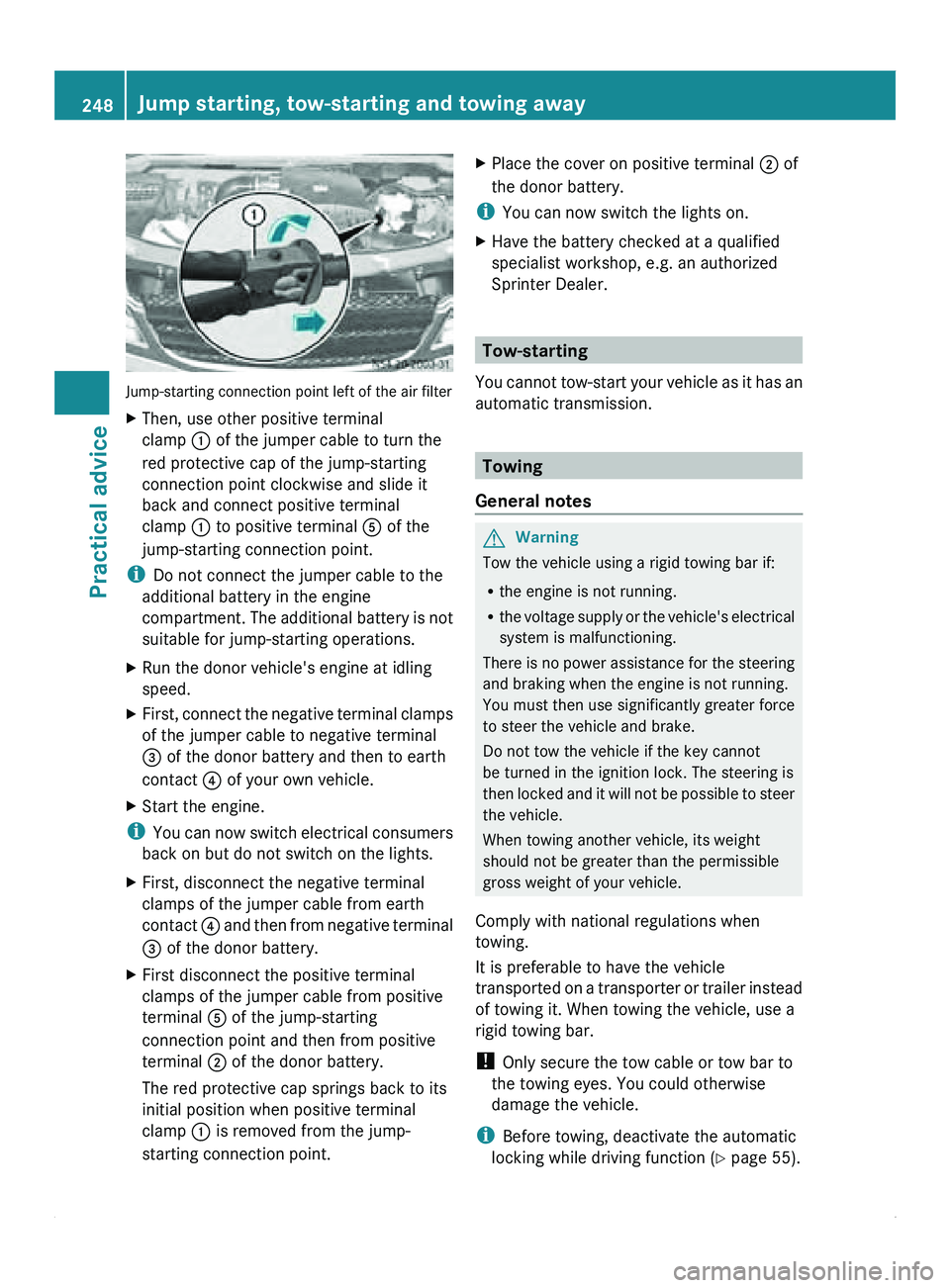
Jump-starting connection point left of the air filter
X
Then, use other positive terminal
clamp 0046 of the jumper cable to turn the
red protective cap of the jump-starting
connection point clockwise and slide it
back and connect positive terminal
clamp 0046 to positive terminal 0086 of the
jump-starting connection point.
i Do not connect the jumper cable to the
additional battery in the engine
compartment. The
additional
battery is not
suitable for jump-starting operations.
X Run the donor vehicle's engine at idling
speed.
X First, connect the negative terminal clamps
of the jumper cable to negative terminal
008A of the donor battery and then to earth
contact 0088 of your own vehicle.
X Start the engine.
i You can
now
switch electrical consumers
back on but do not switch on the lights.
X First, disconnect the negative terminal
clamps of the jumper cable from earth
contact 0088 and then
from negative terminal
008A of the donor battery.
X First disconnect the positive terminal
clamps of the jumper cable from positive
terminal 0086 of the jump-starting
connection point and then from positive
terminal 0047 of the donor battery.
The red protective cap springs back to its
initial position when positive terminal
clamp 0046 is removed from the jump-
starting connection point. X
Place the cover on positive terminal 0047 of
the donor battery.
i You can now switch the lights on.
X Have the battery checked at a qualified
specialist workshop, e.g. an authorized
Sprinter Dealer. Tow-starting
You cannot tow-start
your vehicle as it has an
automatic transmission. Towing
General notes G
Warning
Tow the vehicle using a rigid towing bar if:
R the engine is not running.
R the voltage supply
or the vehicle's electrical
system is malfunctioning.
There is no power assistance for the steering
and braking when the engine is not running.
You must then use significantly greater force
to steer the vehicle and brake.
Do not tow the vehicle if the key cannot
be turned in the ignition lock. The steering is
then locked and it will not be possible to steer
the vehicle.
When towing another vehicle, its weight
should not be greater than the permissible
gross weight of your vehicle.
Comply with national regulations when
towing.
It is preferable to have the vehicle
transported on a transporter or trailer instead
of towing it. When towing the vehicle, use a
rigid towing bar.
! Only secure the tow cable or tow bar to
the towing eyes. You could otherwise
damage the vehicle.
i Before towing, deactivate the automatic
locking while driving function (Y page 55). 248
Jump starting, tow-starting and towing away
Practical advice
Page 251 of 292
You could otherwise become locked out
when pushing or towing the vehicle.
! Do not exceed the towing speed of
31 mph (50 km/h). You could otherwise
damage the transmission.
X Turn the key to position 2
in the ignition
lock.
X For a towing distance of up to 30 miles
(50 km), move the selector lever to
position N. G
Warning
A propeller shaft could fall off as it is being
removed and injure
you. Secure the propeller
shaft before removal to prevent it from falling
down, e.g. with the aid of another person or
by tying the propeller shaft up.
X For a towing distance greater than
30 miles(50 km), remove the propeller
shafts to the driven axles.
! Always use new bolts when installing the
propeller shafts.
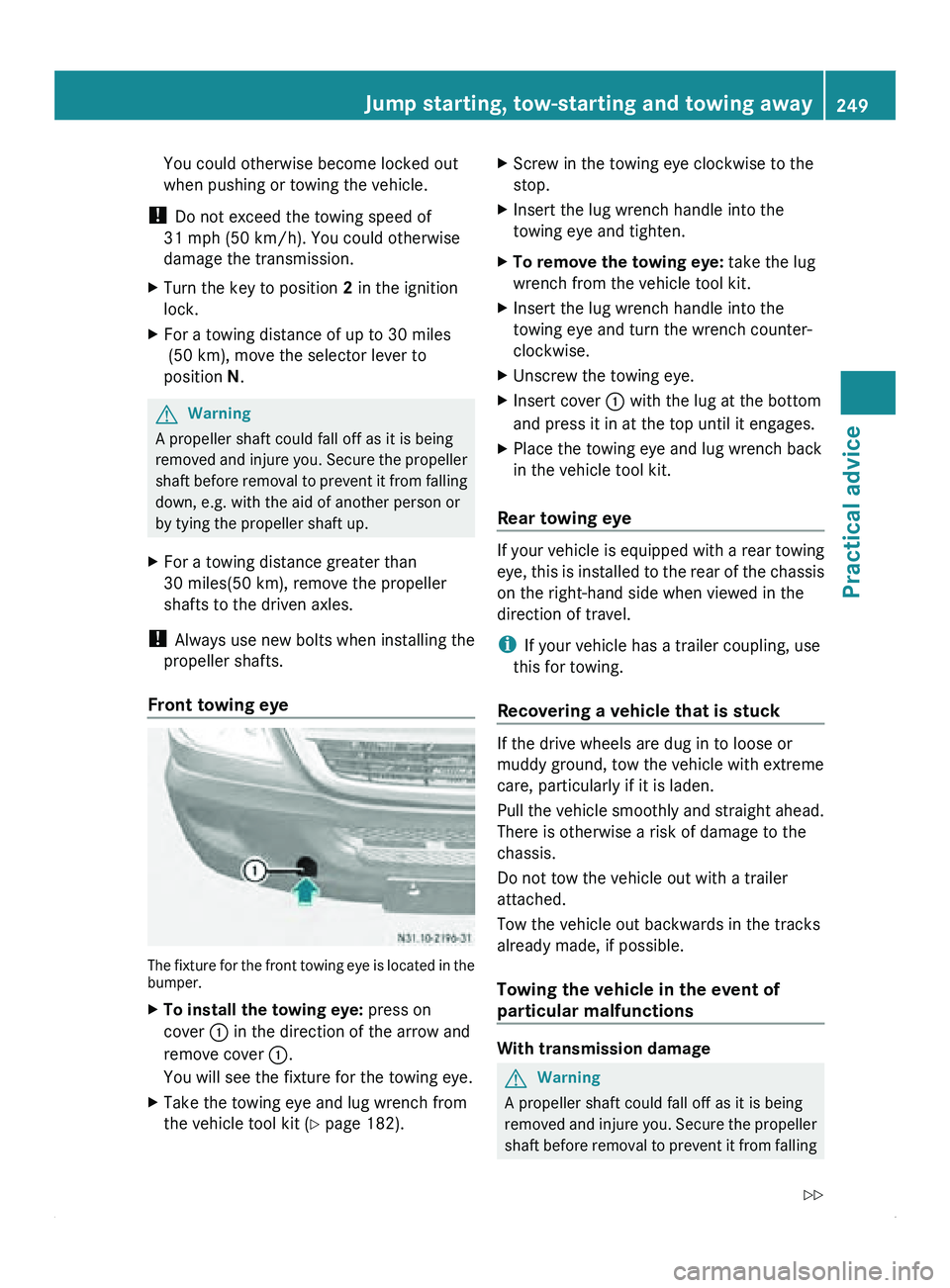
Front towing eye The fixture for the front towing eye is located in the
bumper.
X
To install the towing eye: press on
cover 0046 in the direction of the arrow and
remove cover 0046.
You will see the fixture for the towing eye.
X Take the towing eye and lug wrench from
the vehicle tool kit (Y page 182). X
Screw in the towing eye clockwise to the
stop.
X Insert the lug wrench handle into the
towing eye and tighten.
X To remove the towing eye: take the lug
wrench from the vehicle tool kit.
X Insert the lug wrench handle into the
towing eye and turn the wrench counter-
clockwise.
X Unscrew the towing eye.
X Insert cover 0046 with the lug at the bottom
and press it in at the top until it engages.
X Place the towing eye and lug wrench back
in the vehicle tool kit.
Rear towing eye If your vehicle is equipped with a rear towing
eye, this
is
installed to the rear of the chassis
on the right-hand side when viewed in the
direction of travel.
i If your vehicle has a trailer coupling, use
this for towing.
Recovering a vehicle that is stuck If the drive wheels are dug in to loose or
muddy ground, tow the vehicle with extreme
care, particularly if it is laden.
Pull the
vehicle
smoothly and straight ahead.
There is otherwise a risk of damage to the
chassis.
Do not tow the vehicle out with a trailer
attached.
Tow the vehicle out backwards in the tracks
already made, if possible.
Towing the vehicle in the event of
particular malfunctions With transmission damage
G
Warning
A propeller shaft could fall off as it is being
removed and injure
you. Secure the propeller
shaft before removal to prevent it from falling Jump starting, tow-starting and towing away
249
Practical advice
Z
Page 252 of 292
down, e.g. with the aid of another person or
by tying the propeller shaft up.
X Always remove the propeller shafts leading
to the driven axles.
! Always use new bolts when installing the
propeller shafts.
With front axle damage
X Turn the key to position 1 in the ignition
lock.
X Raise the front axle. G
Warning
A propeller shaft could fall off as it is being
removed and injure
you. Secure the propeller
shaft before removal to prevent it from falling
down, e.g. with the aid of another person or
by tying the propeller shaft up.
! The ignition must be switched off if the
vehicle is being towed with the front or rear
axle raised. Otherwise, ESP ®
may intervene
and damage the brake system.
With rear axle damage
X Turn the key to position 1 in the ignition
lock.
X Raise the rear axle.
Malfunction in the electrical system
If the battery is defective, the automatic
transmission will be locked in position P. To
shift the automatic transmission to
position N, you must provide power to the
vehicle's electrical system in the same way
as jump-starting ( Y page 247).
Have the vehicle
transported on a transporter
or trailer.
Transporting the vehicle The towing
eye can be used to pull the vehicle
onto a special transporter or trailer for
transportation.
! Only lash the
vehicle down by the wheels
or rims, not by vehicle parts such as axle or steering components. There is otherwise a
risk of damage to the vehicle.
X Move the selector lever of the automatic
transmission to position N.250
Jump starting, tow-starting and towing away
Practical advice
Page 264 of 292
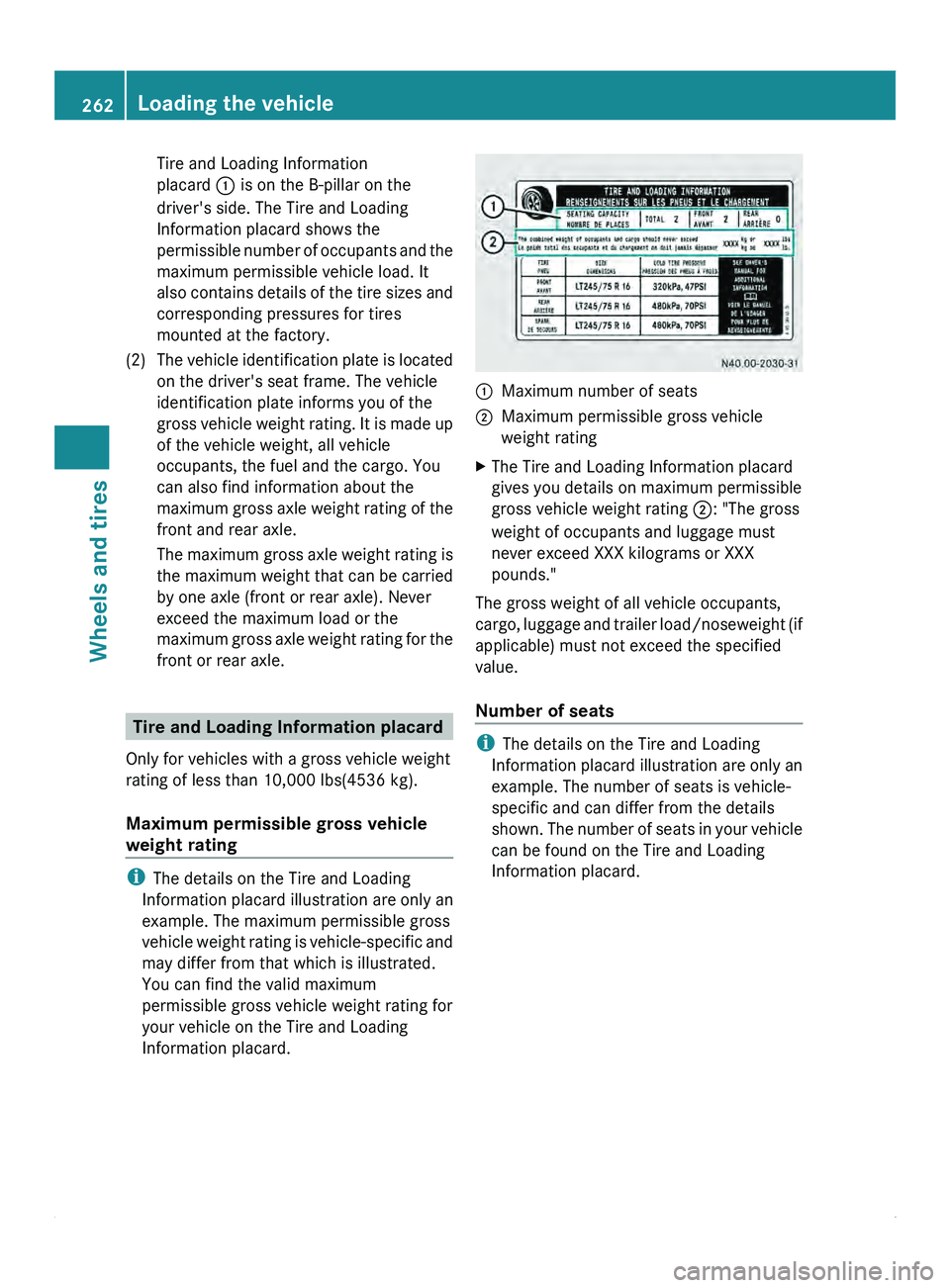
Tire and Loading Information
placard
0046 is on the B-pillar on the
driver's side. The Tire and Loading
Information placard shows the
permissible number of
occupants and the
maximum permissible vehicle load. It
also contains details of the tire sizes and
corresponding pressures for tires
mounted at the factory.
(2) The vehicle identification plate is located on the driver's seat frame. The vehicle
identification plate informs you of the
gross vehicle weight
rating. It is made up
of the vehicle weight, all vehicle
occupants, the fuel and the cargo. You
can also find information about the
maximum gross axle weight rating of the
front and rear axle.
The maximum gross axle weight rating is
the maximum weight that can be carried
by one axle (front or rear axle). Never
exceed the maximum load or the
maximum gross axle weight rating for the
front or rear axle. Tire and Loading Information placard
Only for vehicles with a gross vehicle weight
rating of less than 10,000 lbs(4536 kg).
Maximum permissible gross vehicle
weight rating i
The details on the Tire and Loading
Information placard illustration
are only an
example. The maximum permissible gross
vehicle weight rating is vehicle-specific and
may differ from that which is illustrated.
You can find the valid maximum
permissible gross vehicle weight rating for
your vehicle on the Tire and Loading
Information placard. 0046
Maximum number of seats
0047 Maximum permissible gross vehicle
weight rating
X The Tire and Loading Information placard
gives you details on maximum permissible
gross vehicle weight rating 0047: "The gross
weight of occupants and luggage must
never exceed XXX kilograms or XXX
pounds."
The gross weight of all vehicle occupants,
cargo, luggage
and
trailer load/noseweight (if
applicable) must not exceed the specified
value.
Number of seats i
The details on the Tire and Loading
Information placard illustration
are only an
example. The number of seats is vehicle-
specific and can differ from the details
shown. The number of seats in your vehicle
can be found on the Tire and Loading
Information placard. 262
Loading the vehicle
Wheels and tires
Page 265 of 292
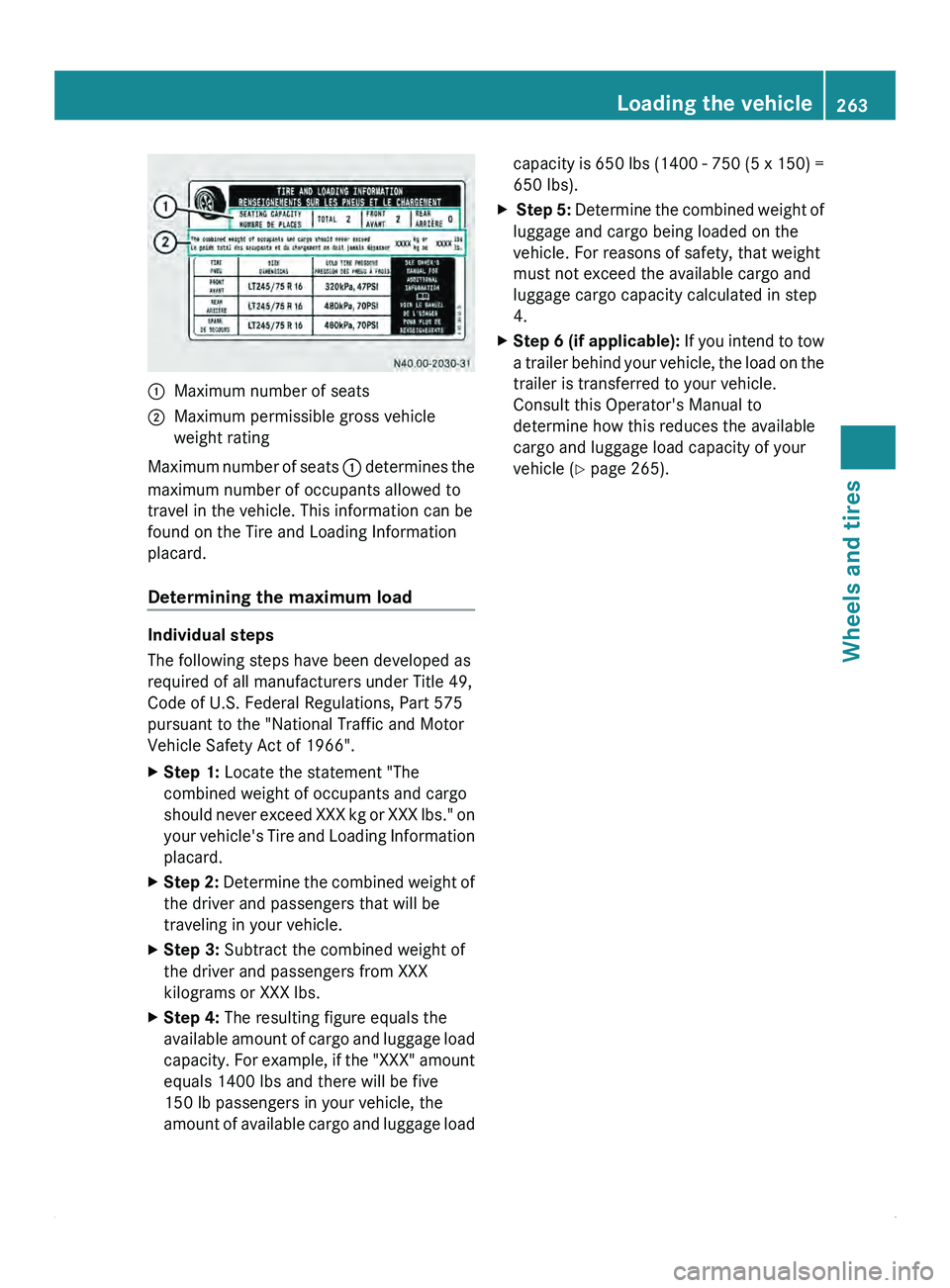
0046
Maximum number of seats
0047 Maximum permissible gross vehicle
weight rating
Maximum number of seats 0046 determines the
maximum number of occupants allowed to
travel in the vehicle. This information can be
found on the Tire and Loading Information
placard.
Determining the maximum load Individual steps
The following steps have been developed as
required of all manufacturers under Title 49,
Code of U.S. Federal Regulations, Part 575
pursuant to the "National Traffic and Motor
Vehicle Safety Act of 1966".
X
Step 1: Locate the statement "The
combined weight of occupants and cargo
should never exceed
XXX kg or XXX lbs." on
your vehicle's Tire and Loading Information
placard.
X Step 2: Determine the combined weight of
the driver and passengers that will be
traveling in your vehicle.
X Step 3: Subtract the combined weight of
the driver and passengers from XXX
kilograms or XXX lbs.
X Step 4: The resulting figure equals the
available amount of
cargo and luggage load
capacity. For example, if the "XXX" amount
equals 1400 lbs and there will be five
150 lb passengers in your vehicle, the
amount of available cargo and luggage load capacity is 650 lbs (1400 - 750 (5 x 150) =
650 lbs).
X Step 5: Determine the combined weight of
luggage and cargo being loaded on the
vehicle. For reasons of safety, that weight
must not exceed the available cargo and
luggage cargo capacity calculated in step
4.
X Step 6
(if applicable): If you
intend to tow
a trailer behind your vehicle, the load on the
trailer is transferred to your vehicle.
Consult this Operator's Manual to
determine how this reduces the available
cargo and luggage load capacity of your
vehicle ( Y page 265). Loading the vehicle
263
Wheels and tires Z
Page 267 of 292
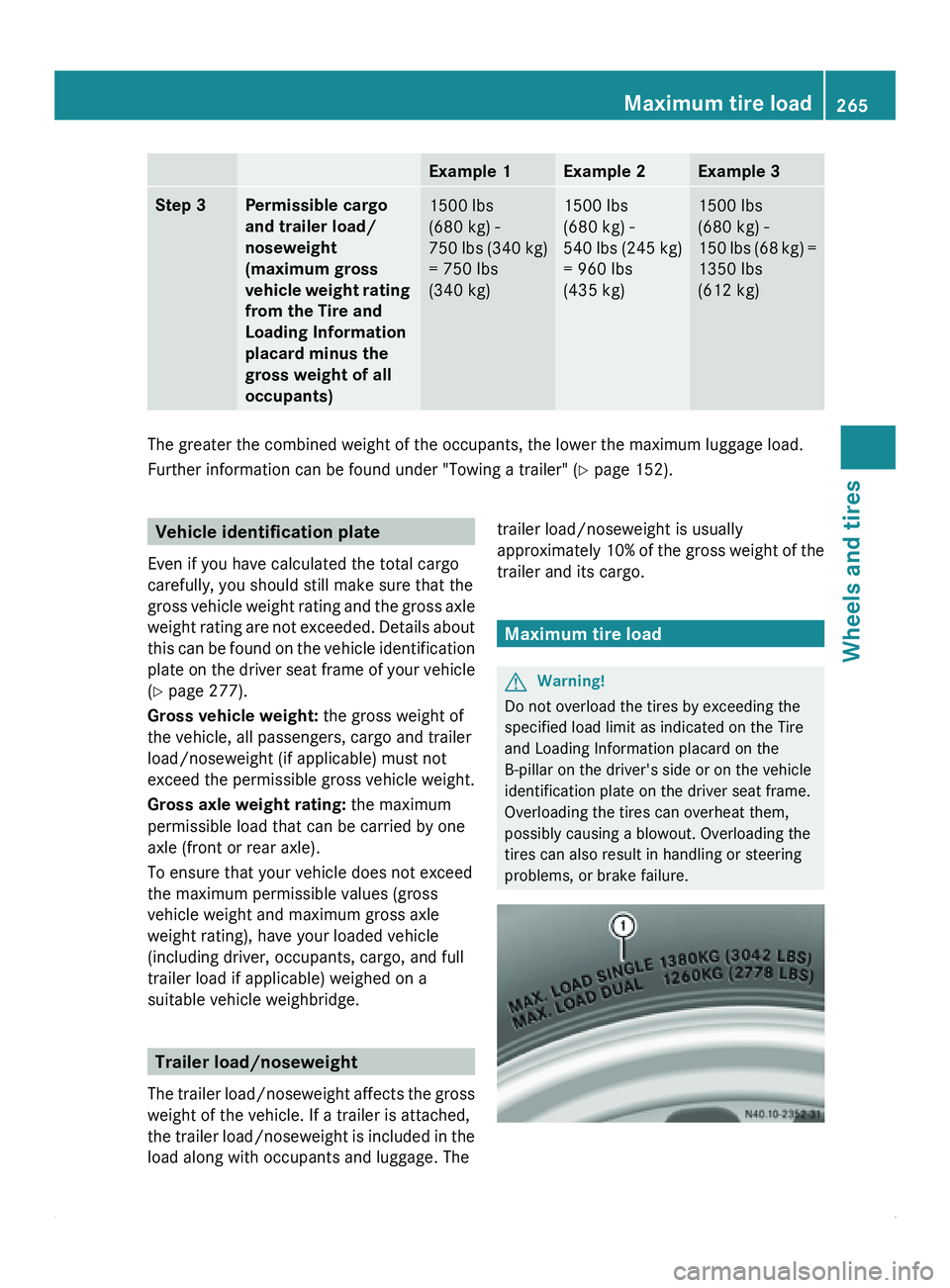
Example 1 Example 2 Example 3
Step 3 Permissible cargo
and trailer load/
noseweight
(maximum gross
vehicle weight
rating
from the Tire and
Loading Information
placard minus the
gross weight of all
occupants) 1500 lbs
(680 kg) -
750 lbs
(340
kg)
= 750 lbs
(340 kg) 1500 lbs
(680 kg) -
540 lbs
(245
kg)
= 960 lbs
(435 kg) 1500 lbs
(680 kg) -
150 lbs
(68
kg) =
1350 lbs
(612 kg) The greater the combined weight of the occupants, the lower the maximum luggage load.
Further information can be found under "Towing a trailer" (
Y page 152). Vehicle identification plate
Even if you have calculated the total cargo
carefully, you should still make sure that the
gross vehicle weight
rating and the gross axle
weight rating are not exceeded. Details about
this can be found on the vehicle identification
plate on the driver seat frame of your vehicle
(Y page 277).
Gross vehicle weight: the gross weight of
the vehicle, all passengers, cargo and trailer
load/noseweight (if applicable) must not
exceed the permissible gross vehicle weight.
Gross axle weight rating: the maximum
permissible load that can be carried by one
axle (front or rear axle).
To ensure that your vehicle does not exceed
the maximum permissible values (gross
vehicle weight and maximum gross axle
weight rating), have your loaded vehicle
(including driver, occupants, cargo, and full
trailer load if applicable) weighed on a
suitable vehicle weighbridge. Trailer load/noseweight
The trailer load/noseweight
affects the gross
weight of the vehicle. If a trailer is attached,
the trailer load/noseweight is included in the
load along with occupants and luggage. The trailer load/noseweight is usually
approximately 10%
of
the gross weight of the
trailer and its cargo. Maximum tire load
G
Warning!
Do not overload the tires by exceeding the
specified load limit as indicated on the Tire
and Loading Information placard on the
B-pillar on the driver's side or on the vehicle
identification plate on the driver seat frame.
Overloading the tires can overheat them,
possibly causing a blowout. Overloading the
tires can also result in handling or steering
problems, or brake failure. Maximum tire load
265
Wheels and tires Z
Page 286 of 292
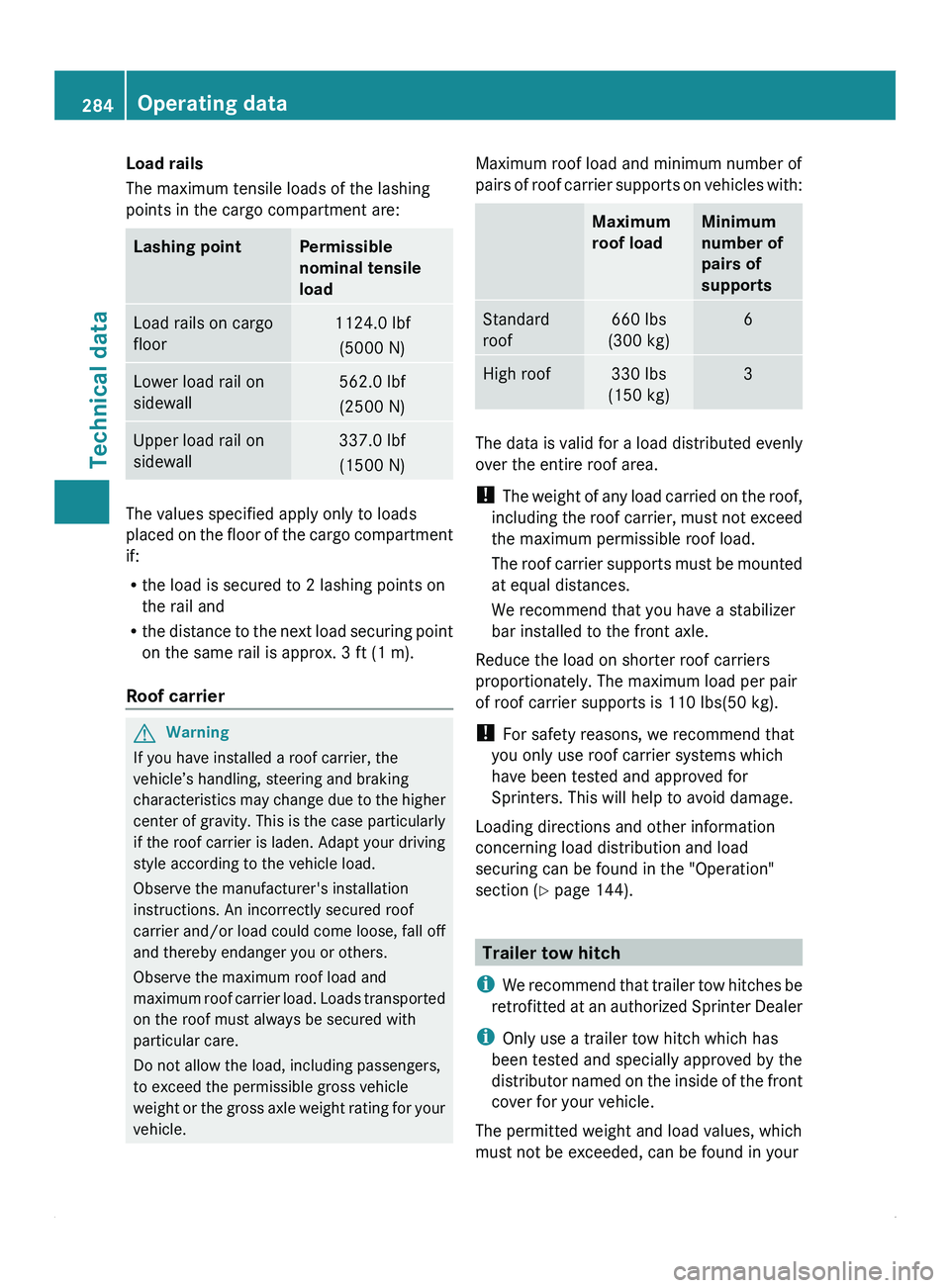
Load rails
The maximum tensile loads of the lashing
points in the cargo compartment are:
Lashing point Permissible
nominal tensile
load
Load rails on cargo
floor 1124.0 lbf
(5000 N) Lower load rail on
sidewall 562.0 lbf
(2500 N) Upper load rail on
sidewall 337.0 lbf
(1500 N) The values specified apply only to loads
placed on
the
floor of the cargo compartment
if:
R the load is secured to 2 lashing points on
the rail and
R the distance to the next load securing point
on the same rail is approx. 3 ft (1 m).
Roof carrier G
Warning
If you have installed a roof carrier, the
vehicle’s handling, steering and braking
characteristics may change
due to the higher
center of gravity. This is the case particularly
if the roof carrier is laden. Adapt your driving
style according to the vehicle load.
Observe the manufacturer's installation
instructions. An incorrectly secured roof
carrier and/or load could come loose, fall off
and thereby endanger you or others.
Observe the maximum roof load and
maximum roof carrier load. Loads transported
on the roof must always be secured with
particular care.
Do not allow the load, including passengers,
to exceed the permissible gross vehicle
weight or the gross axle weight rating for your
vehicle. Maximum roof load and minimum number of
pairs of
roof
carrier supports on vehicles with: Maximum
roof load Minimum
number of
pairs of
supports
Standard
roof 660 lbs
(300 kg) 6
High roof 330 lbs
(150 kg) 3
The data is valid for a load distributed evenly
over the entire roof area.
!
The weight of
any load carried on the roof,
including the roof carrier, must not exceed
the maximum permissible roof load.
The roof carrier supports must be mounted
at equal distances.
We recommend that you have a stabilizer
bar installed to the front axle.
Reduce the load on shorter roof carriers
proportionately. The maximum load per pair
of roof carrier supports is 110 lbs(50 kg).
! For safety reasons, we recommend that
you only use roof carrier systems which
have been tested and approved for
Sprinters. This will help to avoid damage.
Loading directions and other information
concerning load distribution and load
securing can be found in the "Operation"
section ( Y page 144). Trailer tow hitch
i We recommend that
trailer tow hitches be
retrofitted at an authorized Sprinter Dealer
i Only use a trailer tow hitch which has
been tested and specially approved by the
distributor named on the inside of the front
cover for your vehicle.
The permitted weight and load values, which
must not be exceeded, can be found in your 284
Operating data
Technical data
Page 287 of 292
vehicle's registration papers and on the type
plate of
the
trailer coupling, the trailer and the
vehicle identification plate ( Y page 277). In
the event that the data stated differs, the
lower value applies.
Make sure that you adhere to the weight
restrictions by having the weight checked at
a public weighbridge.
! The permissible gross combination
weight is less than the sum of the
permissible gross vehicle weight plus the
permissible trailer load. Exceeding the
permissible gross combination weight can
lead to damage to the drivetrain, to the
transmission or to the trailer tow hitch.
For this reason, applicable values for the
permissible gross vehicle weight or the
permissible trailer load are reduced
accordingly if either the vehicle or the
trailer is fully loaded. In this case, the trailer
or the vehicle may only be partially loaded. Operating data
285
Technical data Z
Page 288 of 292
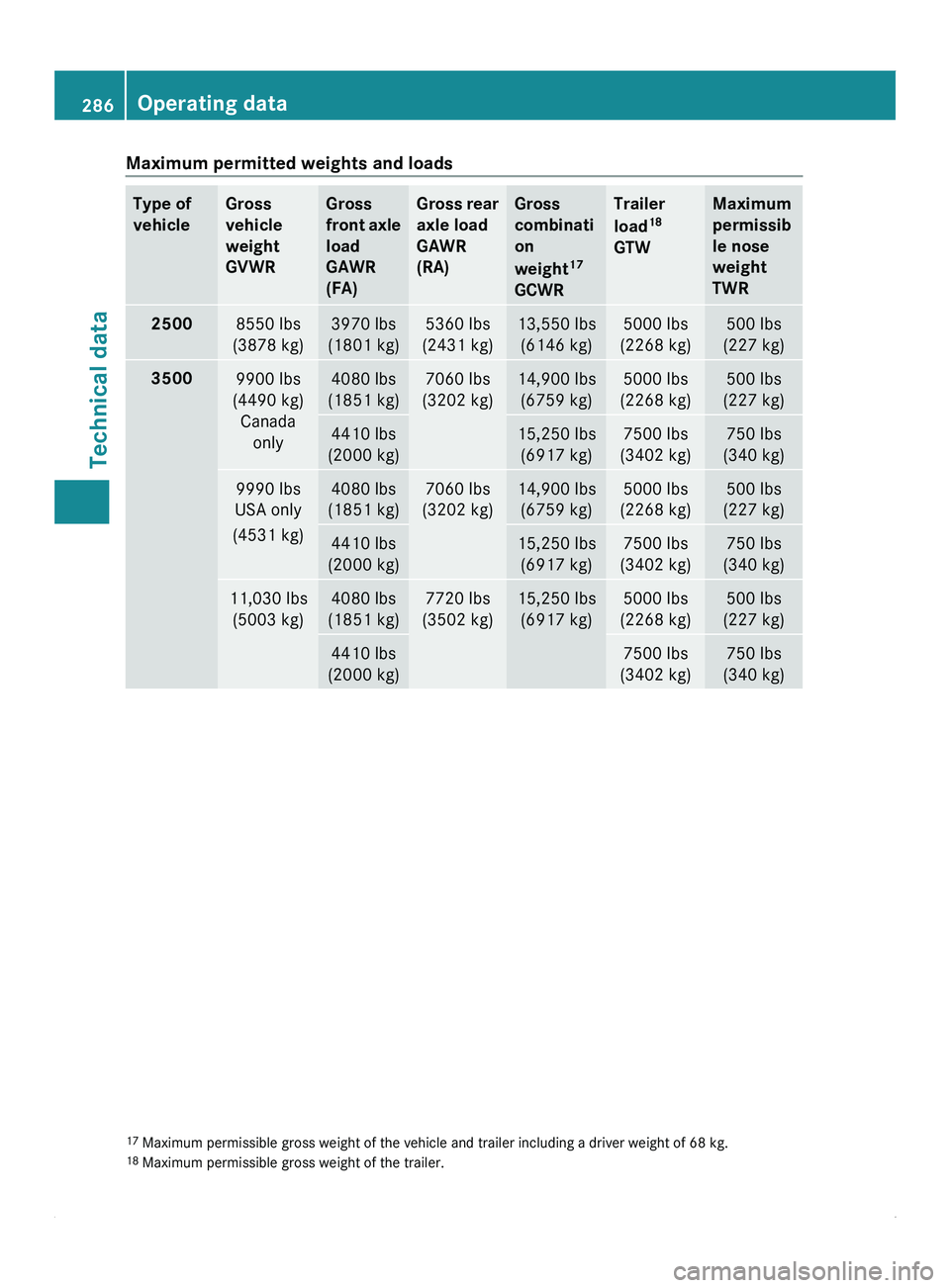
Maximum permitted weights and loads
Type of
vehicle Gross
vehicle
weight
GVWR Gross
front axle
load
GAWR
(FA) Gross rear
axle load
GAWR
(RA) Gross
combinati
on
weight
17
GCWR Trailer
load
18
GTW Maximum
permissib
le nose
weight
TWR
2500
8550 lbs
(3878 kg) 3970 lbs
(1801 kg) 5360 lbs
(2431 kg) 13,550 lbs
(6146 kg) 5000 lbs
(2268 kg) 500 lbs
(227 kg) 3500
9900 lbs
(4490 kg) Canada only 4080 lbs
(1851 kg) 7060 lbs
(3202 kg) 14,900 lbs
(6759 kg) 5000 lbs
(2268 kg) 500 lbs
(227 kg) 4410 lbs
(2000 kg) 15,250 lbs
(6917 kg) 7500 lbs
(3402 kg) 750 lbs
(340 kg) 9990 lbs
USA only
(4531 kg) 4080 lbs
(1851 kg) 7060 lbs
(3202 kg) 14,900 lbs
(6759 kg) 5000 lbs
(2268 kg) 500 lbs
(227 kg) 4410 lbs
(2000 kg) 15,250 lbs
(6917 kg) 7500 lbs
(3402 kg) 750 lbs
(340 kg) 11,030 lbs
(5003 kg) 4080 lbs
(1851 kg) 7720 lbs
(3502 kg) 15,250 lbs
(6917 kg) 5000 lbs
(2268 kg) 500 lbs
(227 kg) 4410 lbs
(2000 kg) 7500 lbs
(3402 kg) 750 lbs
(340 kg) 17
Maximum permissible gross weight of the vehicle and trailer including a driver weight of 68 kg.
18 Maximum permissible gross weight of the trailer.286
Operating dataTechnical data