weight MERCEDES-BENZ SPRINTER 2011 MY11 Operator’s Manual
[x] Cancel search | Manufacturer: MERCEDES-BENZ, Model Year: 2011, Model line: SPRINTER, Model: MERCEDES-BENZ SPRINTER 2011Pages: 292, PDF Size: 6.75 MB
Page 254 of 292
Vehicle equipment
i Diese Betriebsanleitung beschreibt alle
Modelle, Serien- und
Sonderausstattungen
Ihres Fahrzeugs, die zum Zeitpunkt des
Redaktionsschlusses dieser
Betriebsanleitung erhältlich waren.
Länderspezifische Abweichungen sind
möglich. Beachten Sie, dass Ihr Fahrzeug
nicht mit allen beschriebenen Funktionen
ausgestattet sein könnte. Dies betrifft auch
sicherheitsrelevante Systeme und
Funktionen. Important safety notes
Contact an authorized Sprinter Dealer if you
require information on tested and
recommended tires and wheels for summer
and winter driving.
Advice on purchasing and
caring for tires is also available there. G
Warning
Replace rims or tires with the same
designation, manufacturer and
type as shown
on the original part. For further information,
contact an authorized Sprinter Dealer. If
incorrectly sized rims and tires are mounted,
the wheel brakes or suspension components
can be damaged. Also, the operating
clearance of the wheels and the tires may no
longer be correct. G
Warning!
Worn, old
tires can cause accidents. If the tire
tread is worn to minimum tread depth, or if
the tires have sustained damage, replace
them.
When replacing rims, only use genuine
Sprinter wheel bolts specified for the
particular rim type.
Failure to do so can result
in the bolts loosening and possibly an
accident.
Retreaded tires are not tested or
recommended by the dealer named on the
inside cover page, since previous damage cannot always
be recognized on retreads. The
operating safety of the vehicle cannot be
assured when such tires are used. G
Warning!
Only for vehicles without a tire pressure
monitor:
For safety reasons, we recommend that you
only use tire valves manufactured by
Schrader. These have been tested for use on
your vehicle.
Use only tire valves of type:
R TR 600 for the vehicle types 2500
R TR 418 for the vehicle types 3500
Using other tire inflation valves or valves
made by other manufacturers can result in
tire pressure loss and thereby impair the
operating safety of the vehicle.
! Do not screw additional weights (check
valves, etc.) onto the tire valves. The
electronic components could thus be
damaged. G
Warning
If you feel a sudden significant vibration or
ride disturbance, or
you suspect that possible
damage to your vehicle has occurred, you
should turn on the hazard warning lamps,
carefully slow down, and drive with caution to
an area which is a safe distance from the road.
Inspect the tires and the vehicle underbody
for possible damage. If the vehicle appears
unsafe, have the vehicle towed to the nearest
authorized Sprinter Dealer for repairs. G
Warning
Do not drive with a flat tire. A flat tire affects
the ability to steer or brake the vehicle. You
might lose control of the vehicle. Continued
driving with a
flat tire or driving at high speed
with a flat tire will cause excessive heat build-
up and possibly a fire. 252
Important safety notes
Wheels and tires
Page 258 of 292
A table of recommended tire pressures can
be found on the Tire & Loading Information
placard
11
or the tire pressure plate on the
B-pillar on the driver's side of the vehicle
(Y page 256).
Use a tire pressure gauge intended for this
purpose. The outer
appearance of a tire does
not permit any reliable conclusion about the
tire pressure. On vehicles equipped with the
electronic tire pressure monitor, the tire
pressure can be checked using the on-board
computer. G
Warning!
If the tire pressure drops repeatedly:
R check the tires for foreign objects
R check whether the
wheel is losing air or the
valve is leaking
R make sure that only a valve cap approved
by the dealer listed on the inside of the
cover page is on the tire valve
Underinflated tires have a negative effect on
vehicle safety, which could lead you to cause
an accident.
Correct the tire pressure only when the tires
are cold. Tires are cold when the vehicle has
been parked for at least three hours or has
been driven less than 1 mile (1.6 km). Tire
temperature changes depending on the
ambient temperature, driving speed and tire
load. If the tire temperature changes by
18 ‡ (10 †), the tire pressure changes by
approximately 10 kPa (0.1 bar/1.5 psi). Take
this into consideration if you are checking tire
pressure when the tires are warm, and
correct the tire pressure only if it is too low
for current operating conditions. If you check
the tire pressure when the tires are warm, it
results in a higher value than when the tires
are cold. This is normal. Do not under any
circumstances release the air in order to
adjust the pressure to the prescribed value
for cold tires. Tire pressure would then be too
low. Take note of the recommended tire pressure
data for cold tires on the Tire & Loading
Information placard
11
or the tire pressure
plate on the
B-pillar on the driver's side of the
vehicle.
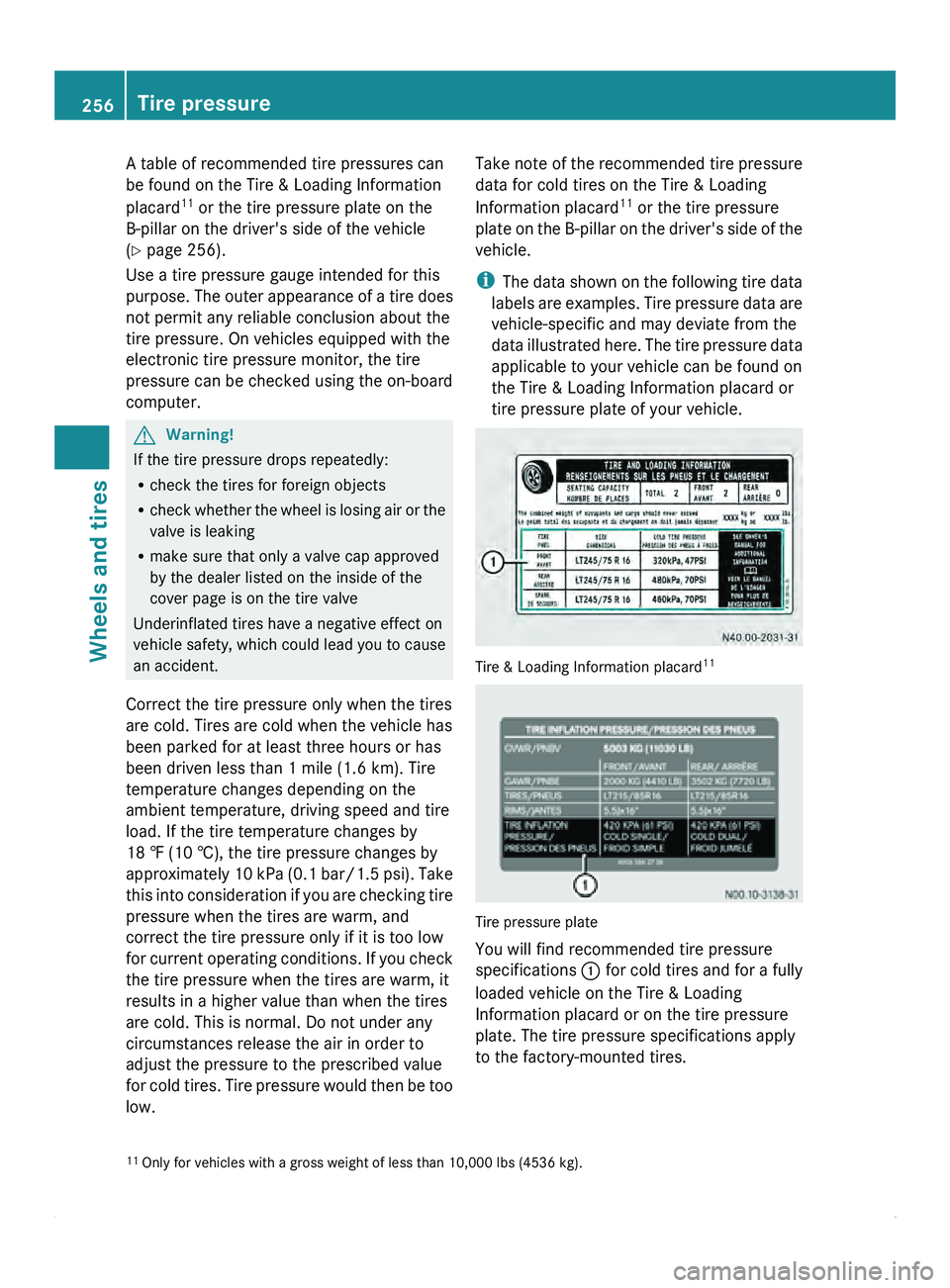
i The data shown on the following tire data
labels are examples. Tire pressure data are
vehicle-specific and may deviate from the
data illustrated here. The tire pressure data
applicable to your vehicle can be found on
the Tire & Loading Information placard or
tire pressure plate of your vehicle. Tire & Loading Information placard
11 Tire pressure plate
You will find recommended tire pressure
specifications
0046 for cold
tires and for a fully
loaded vehicle on the Tire & Loading
Information placard or on the tire pressure
plate. The tire pressure specifications apply
to the factory-mounted tires.
11 Only for vehicles with a gross weight of less than 10,000 lbs (4536 kg).256
Tire pressure
Wheels and tires
Page 260 of 292
Do not overload the tires by exceeding the
specified load limit as indicated on the Tire
and Loading Information placard on the
driver's door B-pillar. Overloading the tires
can overheat them, possibly causing a
blowout. Overloading
the tires can also result
in handling or steering problems, or brake
failure.
Check the tire pressure at least once a month.
Only check and correct tire pressures when
the tires are cold. Checking the tire pressure manually
In order to determine and adjust the tire
pressures, proceed as follows:
X Remove the valve cap of the tire you wish
to check.
X Press the
tire pressure gauge securely onto
the valve.
X Read the tire pressure and compare it with
the recommended value on the Tire and
Loading Information placard12
or on the tire
pressure plate on the B-pillar on the driver's
side of the vehicle.
X If necessary, increase the tire pressure to
the recommended value.
X If the tire pressure is too high, release air
by pressing down
the metal pin in the valve
using the tip of a pen, for example. Then,
check the tire pressure again using the tire
pressure gauge.
X Screw the valve cap onto the valve.
X Repeat the steps for the other tires. Tire pressure monitor
Important safety notes If a tire pressure monitor is installed, the
vehicle's wheels have sensors installed that
monitor the
tire
pressures in all four tires. The
tire pressure monitor warns you when the pressure drops in one or more of the tires. The
tire pressure monitor only functions if the
correct wheel electronics units are installed
in all wheels.
The tire pressure monitor has a yellow
0077
warning lamp in the instrument cluster for
indicating pressure loss/malfunctions (USA)
or pressure loss
(Canada). Depending on how
the warning lamp flashes or lights up, an
underinflated tire or a malfunction in the tire
pressure monitor is displayed:
R if the 0077 warning lamp is lit continuously,
the tire pressure on one or more tires is
significantly too low. The tire pressure
monitor is not malfunctioning.
R USA only: if the 0077 warning lamp flashes
for 60 seconds and then remains lit
constantly, the tire pressure monitor is
malfunctioning. G
Warning
Each tire, including the spare (if provided),
should be checked at least once a month
when cold and inflated to the inflation
pressure recommended by the vehicle
manufacturer on the Tire and Loading
Information placard on the driver’s door B-
pillar or the
tire inflation pressure label on the
inside of the fuel filler flap. If your vehicle has
tires of a different size than the size indicated
on the Tire and Loading Information placard
or the tire inflation pressure label, you should
determine the proper tire inflation pressure
for those tires.
As an added safety feature, your vehicle has
been equipped with a tire pressure monitoring
system (TPMS) that illuminates a low tire
pressure telltale when one or more of your
tires are significantly underinflated.
Accordingly, when the low tire pressure
telltale illuminates, you should stop and check
your tires as soon as possible, and inflate
them to the proper pressure. Driving on a
significantly underinflated tire causes the tire
to overheat and can lead to tire failure.
12 Only for vehicles with a gross vehicle weight rating of less than 10,000 lbs(4536 kg).258
Tire pressure
Wheels and tires
Page 263 of 292
Vehicles without steering wheel buttons
X
Turn the key to position 2 in the ignition
lock.
X Press the 007B menu button on the
instrument cluster repeatedly until the
following message is displayed:
+CAL- TPMS
X Press the 0069 button on the instrument
cluster.
The following message is displayed:
OK TPMS
The tire pressure monitor activation
process has begun. The tire pressures
measured for the individual wheels are
stored as the new reference values,
provided that the tire pressure monitor
considers them to be plausible.
If you wish to cancel the activation process:
X Press the 006A button or the 007B menu button
on the instrument cluster.
The activation process is canceled
automatically if 30 seconds elapse with no
input.
Vehicles with steering wheel buttons
X Turn the key to position 2 in the ignition
lock.
X Press the 0059 or 0058 button on the
steering wheel repeatedly until the
standard display (Y
page 77) appears.
X Press the 0029 or 002D button on the
steering wheel repeatedly
until the current
pressure of the individual tires is displayed,
or the display shows the following
message:
tire press. displayed after
driving for several minutes
X Press the 0048 reset button on the
instrument cluster.
The following message is displayed:
Monitor current tire pressure?
X Press the 005A button on the steering
wheel.
The following message is displayed: tire press. monitor reactivated
The tire pressure monitor activation
process has begun. The tire pressures
measured for the individual wheels are
stored as the new reference values,
provided that the tire pressure monitor
considers them to be plausible.
If you wish to cancel the activation process:
X Press the 005B button on the steering
wheel. Loading the vehicle
Instruction labels for tires and loads
G
Warning!
Do not overload the tires by exceeding the
specified load limit as indicated on the Tire
and Loading Information placard on the
B-pillar on the driver's side or on the vehicle
identification plate on the driver seat frame.
Overloading the tires can overheat them,
possibly causing a blowout. Overloading the
tires can also result in handling or steering
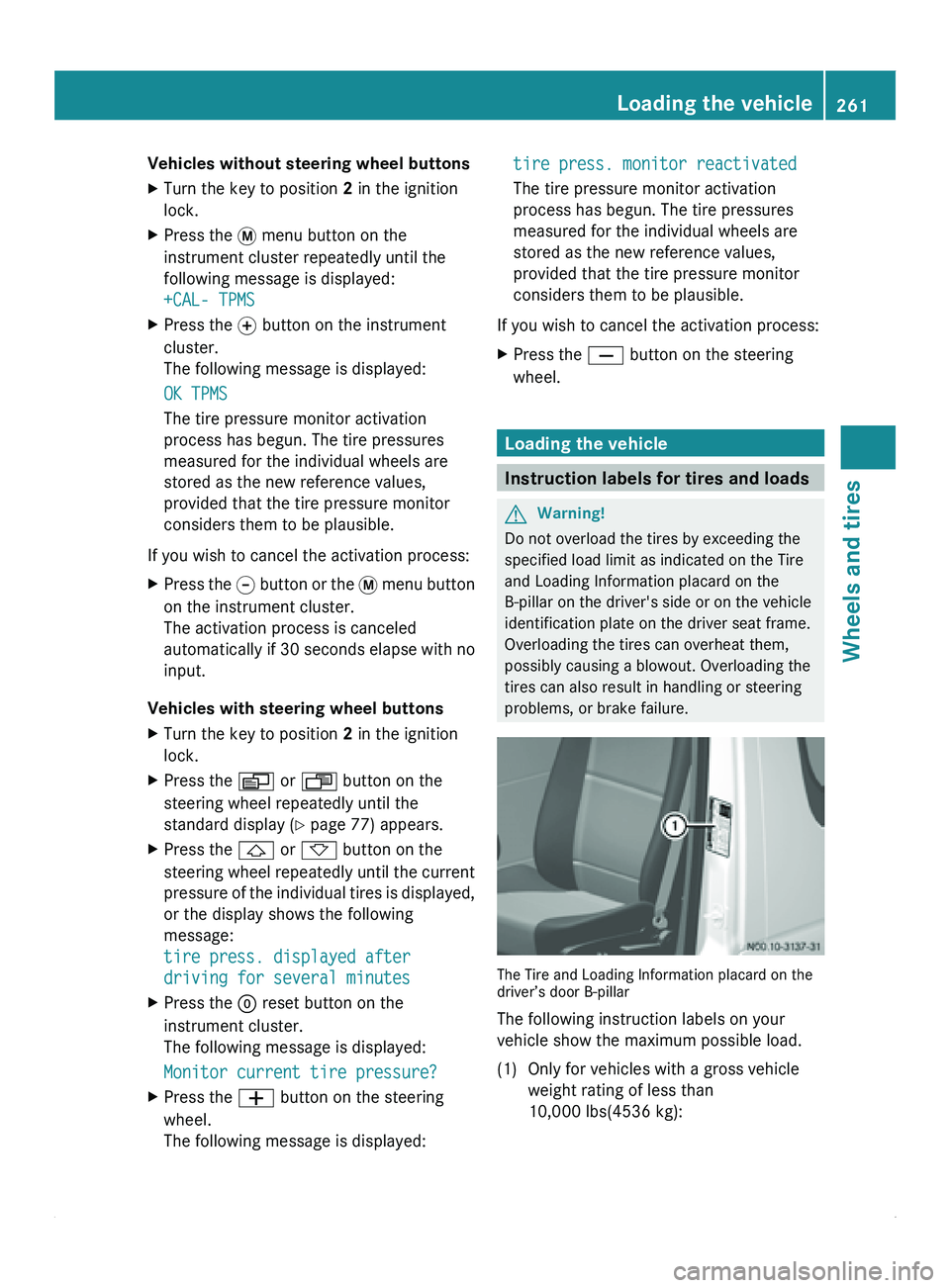
problems, or brake failure. The Tire and Loading Information placard on the
driver’s door B-pillar
The following instruction labels on your
vehicle show the maximum possible load.
(1) Only for vehicles with a gross vehicle
weight rating of less than
10,000 lbs(4536 kg): Loading the vehicle
261
Wheels and tires Z
Page 264 of 292
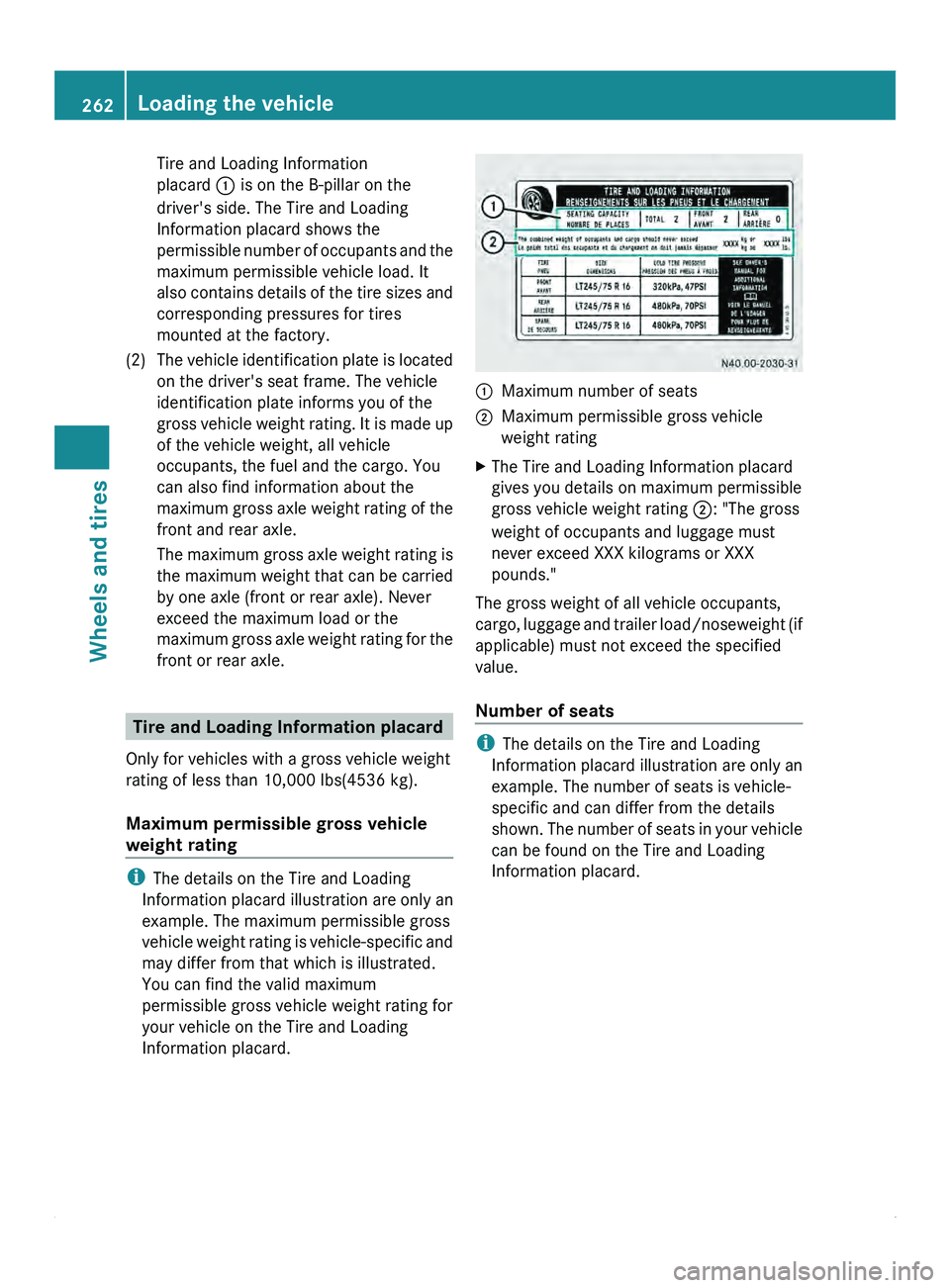
Tire and Loading Information
placard
0046 is on the B-pillar on the
driver's side. The Tire and Loading
Information placard shows the
permissible number of
occupants and the
maximum permissible vehicle load. It
also contains details of the tire sizes and
corresponding pressures for tires
mounted at the factory.
(2) The vehicle identification plate is located on the driver's seat frame. The vehicle
identification plate informs you of the
gross vehicle weight
rating. It is made up
of the vehicle weight, all vehicle
occupants, the fuel and the cargo. You
can also find information about the
maximum gross axle weight rating of the
front and rear axle.
The maximum gross axle weight rating is
the maximum weight that can be carried
by one axle (front or rear axle). Never
exceed the maximum load or the
maximum gross axle weight rating for the
front or rear axle. Tire and Loading Information placard
Only for vehicles with a gross vehicle weight
rating of less than 10,000 lbs(4536 kg).
Maximum permissible gross vehicle
weight rating i
The details on the Tire and Loading
Information placard illustration
are only an
example. The maximum permissible gross
vehicle weight rating is vehicle-specific and
may differ from that which is illustrated.
You can find the valid maximum
permissible gross vehicle weight rating for
your vehicle on the Tire and Loading
Information placard. 0046
Maximum number of seats
0047 Maximum permissible gross vehicle
weight rating
X The Tire and Loading Information placard
gives you details on maximum permissible
gross vehicle weight rating 0047: "The gross
weight of occupants and luggage must
never exceed XXX kilograms or XXX
pounds."
The gross weight of all vehicle occupants,
cargo, luggage
and
trailer load/noseweight (if
applicable) must not exceed the specified
value.
Number of seats i
The details on the Tire and Loading
Information placard illustration
are only an
example. The number of seats is vehicle-
specific and can differ from the details
shown. The number of seats in your vehicle
can be found on the Tire and Loading
Information placard. 262
Loading the vehicle
Wheels and tires
Page 265 of 292
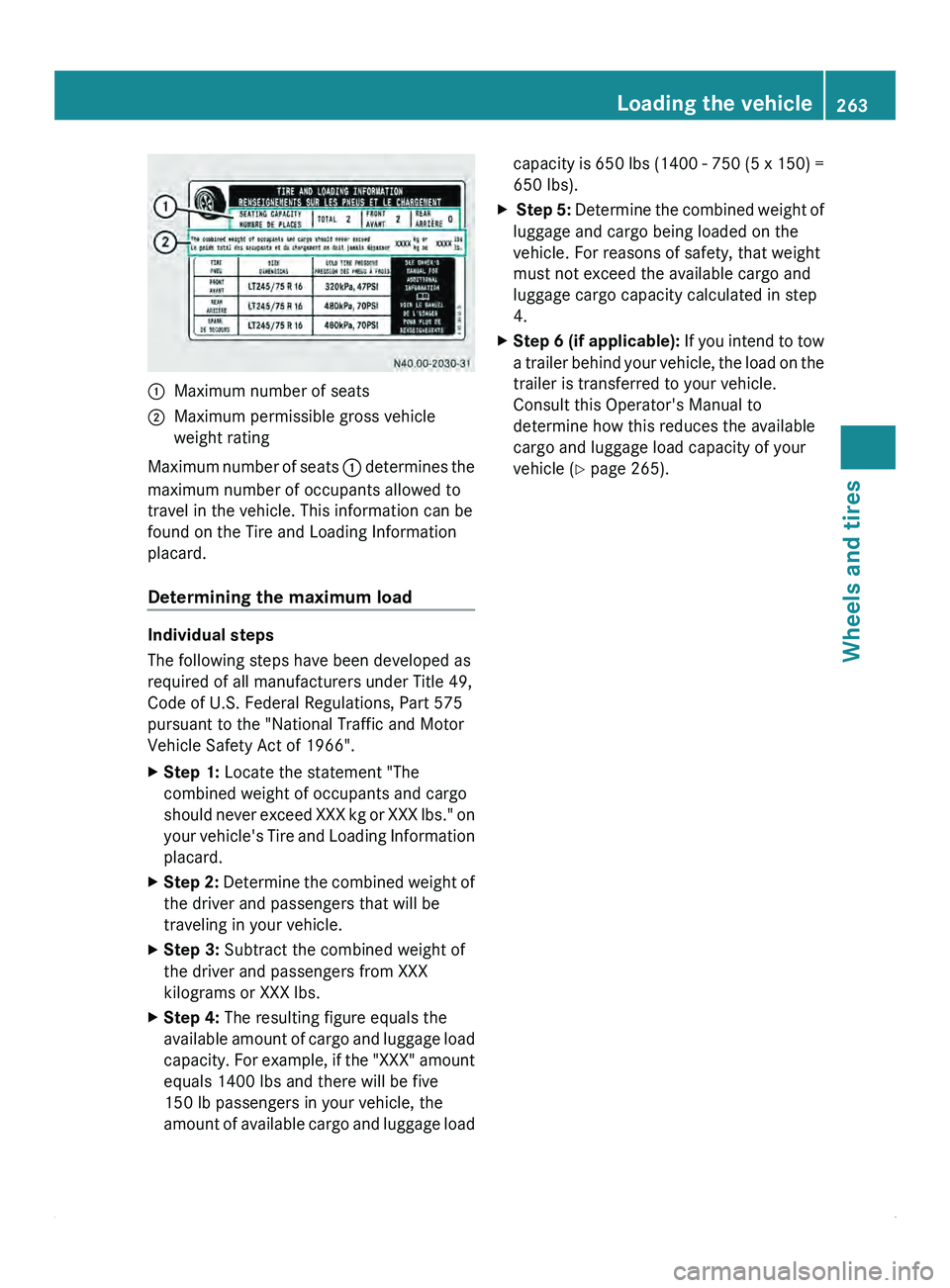
0046
Maximum number of seats
0047 Maximum permissible gross vehicle
weight rating
Maximum number of seats 0046 determines the
maximum number of occupants allowed to
travel in the vehicle. This information can be
found on the Tire and Loading Information
placard.
Determining the maximum load Individual steps
The following steps have been developed as
required of all manufacturers under Title 49,
Code of U.S. Federal Regulations, Part 575
pursuant to the "National Traffic and Motor
Vehicle Safety Act of 1966".
X
Step 1: Locate the statement "The
combined weight of occupants and cargo
should never exceed
XXX kg or XXX lbs." on
your vehicle's Tire and Loading Information
placard.
X Step 2: Determine the combined weight of
the driver and passengers that will be
traveling in your vehicle.
X Step 3: Subtract the combined weight of
the driver and passengers from XXX
kilograms or XXX lbs.
X Step 4: The resulting figure equals the
available amount of
cargo and luggage load
capacity. For example, if the "XXX" amount
equals 1400 lbs and there will be five
150 lb passengers in your vehicle, the
amount of available cargo and luggage load capacity is 650 lbs (1400 - 750 (5 x 150) =
650 lbs).
X Step 5: Determine the combined weight of
luggage and cargo being loaded on the
vehicle. For reasons of safety, that weight
must not exceed the available cargo and
luggage cargo capacity calculated in step
4.
X Step 6
(if applicable): If you
intend to tow
a trailer behind your vehicle, the load on the
trailer is transferred to your vehicle.
Consult this Operator's Manual to
determine how this reduces the available
cargo and luggage load capacity of your
vehicle ( Y page 265). Loading the vehicle
263
Wheels and tires Z
Page 266 of 292
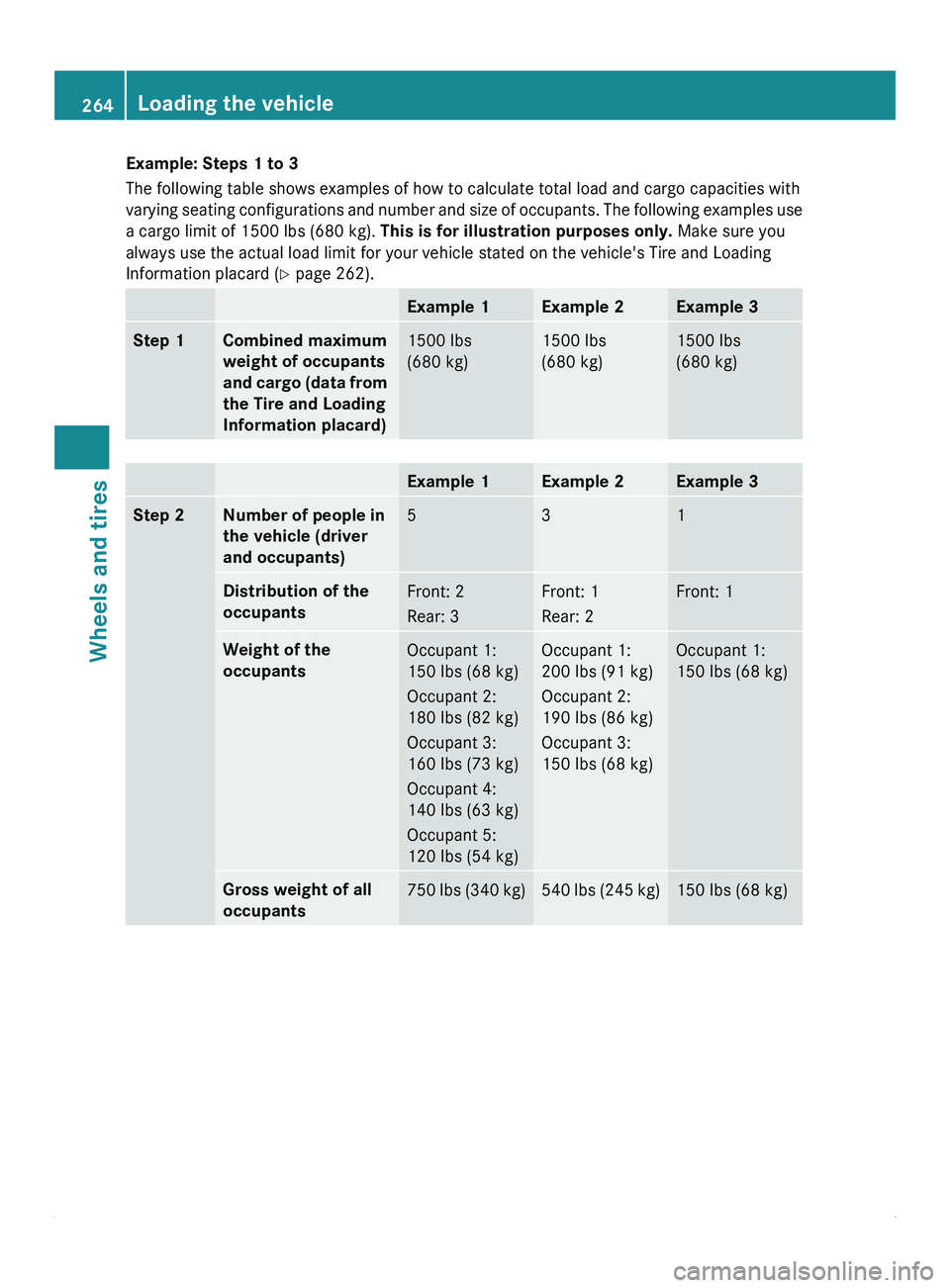
Example: Steps 1 to 3
The following table shows examples of how to calculate total load and cargo capacities with
varying seating
configurations
and number and size of occupants. The following examples use
a cargo limit of 1500 lbs (680 kg). This is for illustration purposes only. Make sure you
always use the actual load limit for your vehicle stated on the vehicle's Tire and Loading
Information placard (Y page 262). Example 1 Example 2 Example 3
Step 1 Combined maximum
weight of occupants
and cargo
(data
from
the Tire and Loading
Information placard) 1500 lbs
(680 kg) 1500 lbs
(680 kg) 1500 lbs
(680 kg)
Example 1 Example 2 Example 3
Step 2 Number of people in
the vehicle (driver
and occupants)
5 3 1
Distribution of the
occupants
Front: 2
Rear: 3 Front: 1
Rear: 2 Front: 1
Weight of the
occupants
Occupant 1:
150 lbs (68 kg)
Occupant 2:
180 lbs (82 kg)
Occupant 3:
160 lbs (73 kg)
Occupant 4:
140 lbs (63 kg)
Occupant 5:
120 lbs (54 kg) Occupant 1:
200 lbs (91 kg)
Occupant 2:
190 lbs (86 kg)
Occupant 3:
150 lbs (68 kg) Occupant 1:
150 lbs (68 kg)
Gross weight of all
occupants
750 lbs (340 kg) 540 lbs (245 kg) 150 lbs (68 kg)264
Loading the vehicle
Wheels and tires
Page 267 of 292
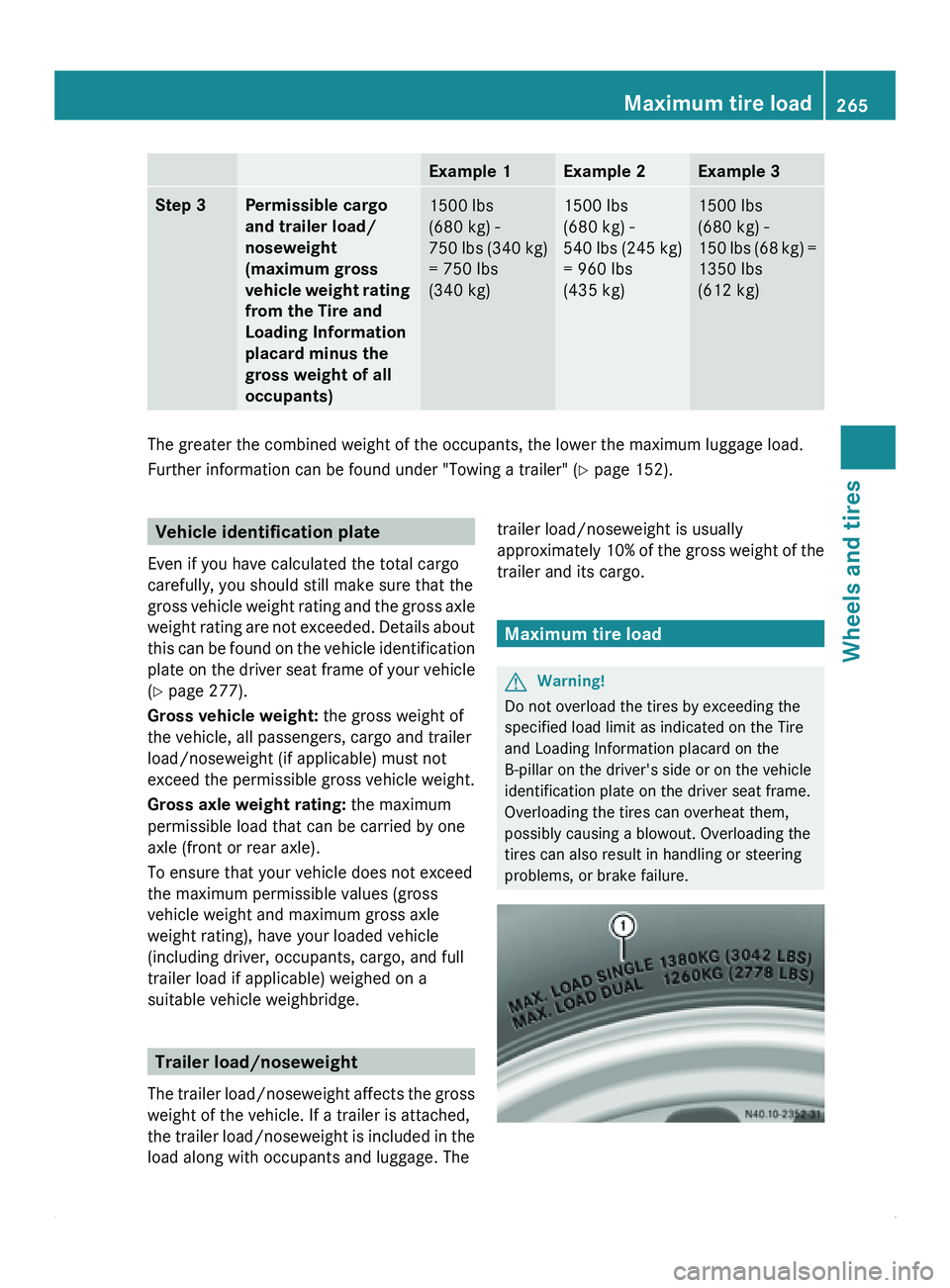
Example 1 Example 2 Example 3
Step 3 Permissible cargo
and trailer load/
noseweight
(maximum gross
vehicle weight
rating
from the Tire and
Loading Information
placard minus the
gross weight of all
occupants) 1500 lbs
(680 kg) -
750 lbs
(340
kg)
= 750 lbs
(340 kg) 1500 lbs
(680 kg) -
540 lbs
(245
kg)
= 960 lbs
(435 kg) 1500 lbs
(680 kg) -
150 lbs
(68
kg) =
1350 lbs
(612 kg) The greater the combined weight of the occupants, the lower the maximum luggage load.
Further information can be found under "Towing a trailer" (
Y page 152). Vehicle identification plate
Even if you have calculated the total cargo
carefully, you should still make sure that the
gross vehicle weight
rating and the gross axle
weight rating are not exceeded. Details about
this can be found on the vehicle identification
plate on the driver seat frame of your vehicle
(Y page 277).
Gross vehicle weight: the gross weight of
the vehicle, all passengers, cargo and trailer
load/noseweight (if applicable) must not
exceed the permissible gross vehicle weight.
Gross axle weight rating: the maximum
permissible load that can be carried by one
axle (front or rear axle).
To ensure that your vehicle does not exceed
the maximum permissible values (gross
vehicle weight and maximum gross axle
weight rating), have your loaded vehicle
(including driver, occupants, cargo, and full
trailer load if applicable) weighed on a
suitable vehicle weighbridge. Trailer load/noseweight
The trailer load/noseweight
affects the gross
weight of the vehicle. If a trailer is attached,
the trailer load/noseweight is included in the
load along with occupants and luggage. The trailer load/noseweight is usually
approximately 10%
of
the gross weight of the
trailer and its cargo. Maximum tire load
G
Warning!
Do not overload the tires by exceeding the
specified load limit as indicated on the Tire
and Loading Information placard on the
B-pillar on the driver's side or on the vehicle
identification plate on the driver seat frame.
Overloading the tires can overheat them,
possibly causing a blowout. Overloading the
tires can also result in handling or steering
problems, or brake failure. Maximum tire load
265
Wheels and tires Z
Page 268 of 292
i
The actual values for tires are specific to
each vehicle and may deviate from the
values in the illustration.
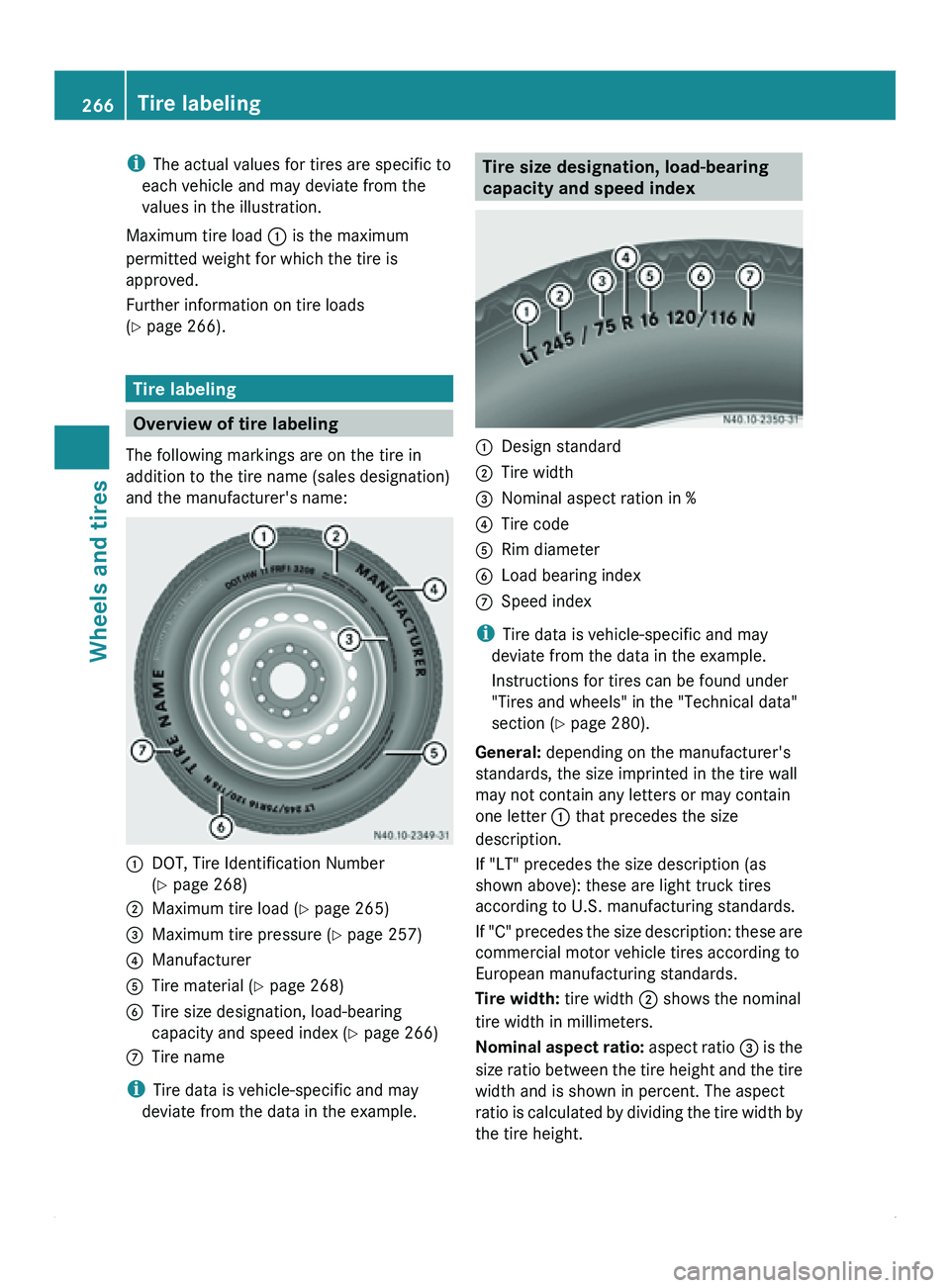
Maximum tire load 0046 is the maximum
permitted weight for which the tire is
approved.
Further information on tire loads
(Y page 266). Tire labeling
Overview of tire labeling
The following markings are on the tire in
addition to the tire name (sales designation)
and the manufacturer's name: 0046
DOT, Tire Identification Number
(Y page 268)
0047 Maximum tire load ( Y page 265)
008A Maximum tire pressure (Y page 257)
0088 Manufacturer
0086 Tire material ( Y page 268)
0087 Tire size designation, load-bearing
capacity and speed index (
Y page 266)
006E Tire name
i Tire data is vehicle-specific and may
deviate from the data in the example. Tire size designation, load-bearing
capacity and speed index
0046
Design standard
0047 Tire width
008A Nominal aspect ration in %
0088 Tire code
0086 Rim diameter
0087 Load bearing index
006E Speed index
i Tire data is vehicle-specific and may
deviate from the data in the example.
Instructions for tires can be found under
"Tires and wheels" in the "Technical data"
section ( Y page 280).
General: depending on the manufacturer's
standards, the size imprinted in the tire wall
may not contain any letters or may contain
one letter 0046 that precedes the size
description.
If "LT" precedes the size description (as
shown above): these are light truck tires
according to U.S. manufacturing standards.
If "C"
precedes
the size description: these are
commercial motor vehicle tires according to
European manufacturing standards.
Tire width: tire width 0047 shows the nominal
tire width in millimeters.
Nominal aspect ratio: aspect ratio 008A is the
size ratio between the tire height and the tire
width and is shown in percent. The aspect
ratio is calculated by dividing the tire width by
the tire height. 266
Tire labeling
Wheels and tires
Page 271 of 292
DOT (Department of Transportation)
Tires with the DOT label fulfill the
requirements of the U.S. Department of
Transportation. Average weight of vehicle occupants
The number of occupants for which the
vehicle is designed
multiplied by 68 kilograms
(150 lb). Uniform Tire Quality Grading
Standards
A uniform standard to grade the quality of
tires with regard
to tread quality, traction and
temperature characteristics. The quality
grading assessment is made by the
manufacturer following specifications from
the U.S. government. The quality grade of a
tire is imprinted on the sidewall of the tire. Recommended tire pressure F
The tire pressure recommended for your
vehicle for normal driving situations. The
recommendation can be found on the Tire &
Loading Information placard 13
or on the tire
pressure plate on the B-pillar on the driver's
side of the vehicle. The recommended tire
pressure provides the best balance between
handling characteristics, ride comfort and
wear. Increased vehicle weight due to
optional equipment
The combined weight of all standard and
optional equipment available for the vehicle,
regardless of whether it is actually installed
on the vehicle or not. Wheel rim
The part of the wheel on which the tire is
mounted. GAWR (Gross Axle Weight Rating)
The GAWR is
the maximum gross axle weight
rating. The actual load on an axle must never
exceed the gross axle weight rating. The
Gross Axle Weight Rating can be found on the
vehicle identification plate on the driver seat
frame (Y page 277). Speed index
The speed index is part of the tire
identification. It specifies
the speed range for
which the tire is approved. GVW (Gross Vehicle Weight)
The gross vehicle weight includes the weight
of the vehicle including fuel, tools, spare
wheel, accessories installed, occupants,
luggage and the drawbar noseweight if
applicable. The gross
vehicle weight may not
exceed the GVWR (Gross Vehicle Weight
Rating) specified on the vehicle identification
plate on the driver seat frame ( Y page 277). GVWR (Gross Vehicle Weight Rating)
The GVWR is
the maximum permissible gross
weight of a fully loaded vehicle (the weight of
the vehicle including all accessories,
occupants, fuel, luggage and the drawbar
noseweight if applicable). The Gross Vehicle
Weight Rating is specified on the vehicle
identification plate on the driver seat frame
(Y page 277).
13 Only for vehicles with a gross weight of less than 10,000 lbs(4536 kg). Definition for tires and loading
269
Wheels and tires Z