battery MERCEDES-BENZ SPRINTER 2011 MY11 Operator’s Manual
[x] Cancel search | Manufacturer: MERCEDES-BENZ, Model Year: 2011, Model line: SPRINTER, Model: MERCEDES-BENZ SPRINTER 2011Pages: 292, PDF Size: 6.75 MB
Page 219 of 292
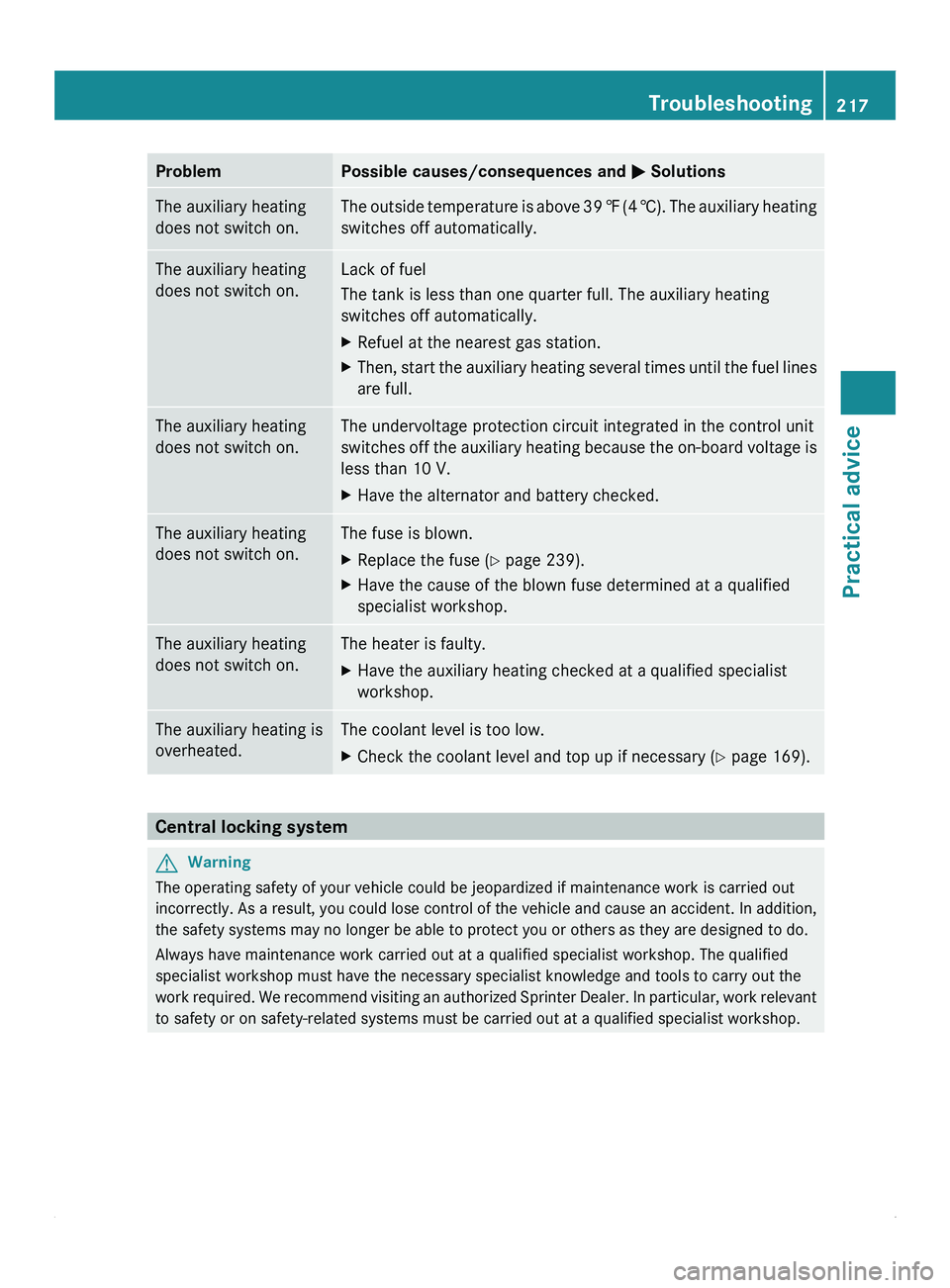
Problem Possible causes/consequences and
0050 SolutionsThe auxiliary heating
does not switch on. The outside temperature is above 39 ‡ (4 †).
The auxiliary heating
switches off automatically. The auxiliary heating
does not switch on. Lack of fuel
The tank is less than one quarter full. The auxiliary heating
switches off automatically.
X
Refuel at the nearest gas station.
X Then, start the auxiliary heating several times until the fuel lines
are full. The auxiliary heating
does not switch on. The undervoltage protection circuit integrated in the control unit
switches off the
auxiliary heating because the on-board voltage is
less than 10 V.
X Have the alternator and battery checked. The auxiliary heating
does not switch on. The fuse is blown.
X
Replace the fuse ( Y page 239).
X Have the cause of the blown fuse determined at a qualified
specialist workshop. The auxiliary heating
does not switch on. The heater is faulty.
X
Have the auxiliary heating checked at a qualified specialist
workshop. The auxiliary heating is
overheated. The coolant level is too low.
X
Check the coolant level and top up if necessary (Y page 169). Central locking system
G
Warning
The operating safety of your vehicle could be jeopardized if maintenance work is carried out
incorrectly. As a
result, you could lose control of the vehicle and cause an accident. In addition,
the safety systems may no longer be able to protect you or others as they are designed to do.
Always have maintenance work carried out at a qualified specialist workshop. The qualified
specialist workshop must have the necessary specialist knowledge and tools to carry out the
work required. We recommend visiting an authorized Sprinter Dealer. In particular, work relevant
to safety or on safety-related systems must be carried out at a qualified specialist workshop. Troubleshooting
217
Practical advice Z
Page 221 of 292
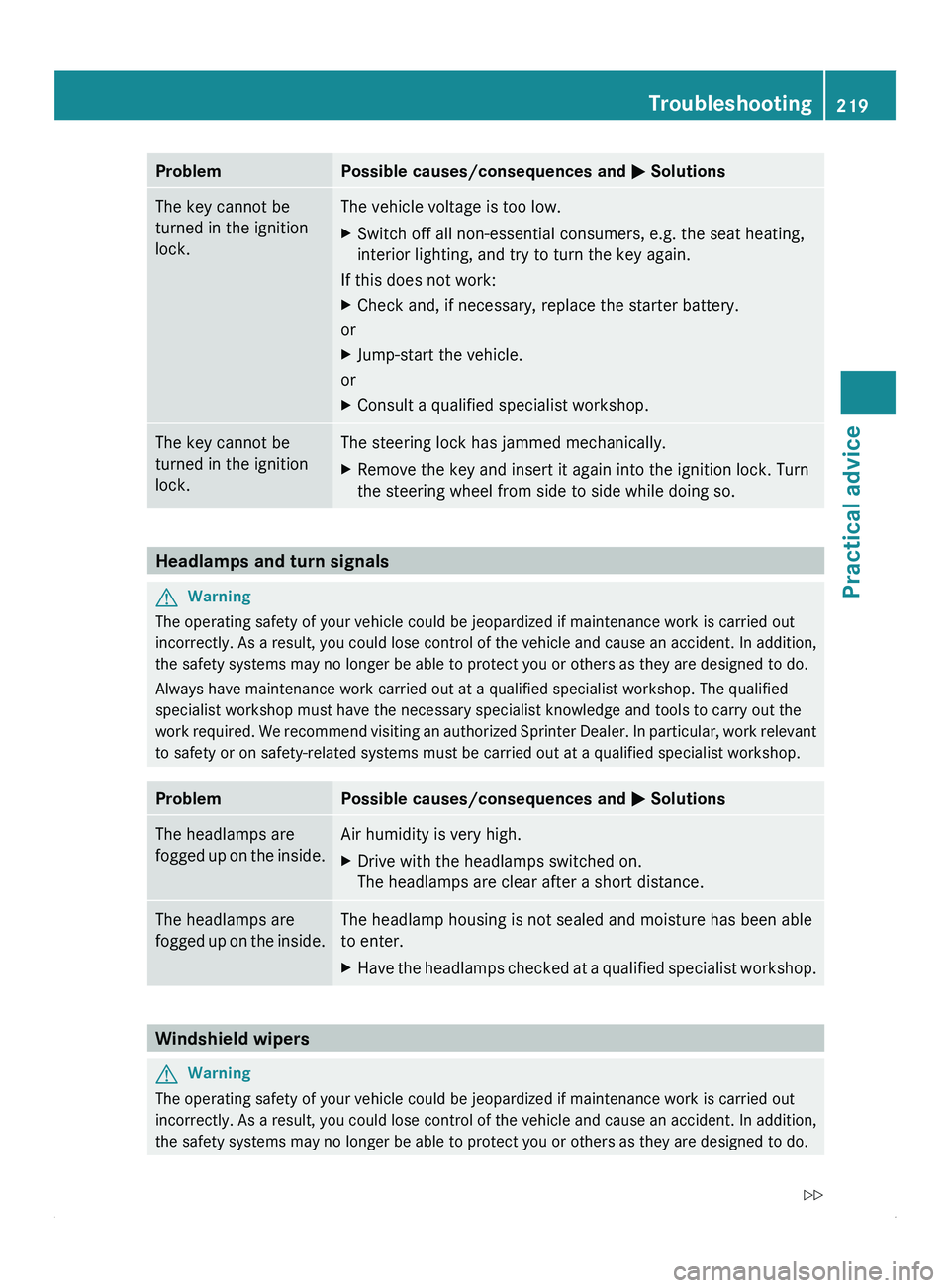
Problem Possible causes/consequences and
0050 SolutionsThe key cannot be
turned in the ignition
lock. The vehicle voltage is too low.
X
Switch off all non-essential consumers, e.g. the seat heating,
interior lighting, and try to turn the key again.
If this does not work:
X Check and, if necessary, replace the starter battery.
or
X Jump-start the vehicle.
or
X Consult a qualified specialist workshop. The key cannot be
turned in the ignition
lock. The steering lock has jammed mechanically.
X
Remove the key and insert it again into the ignition lock. Turn
the steering wheel from side to side while doing so. Headlamps and turn signals
G
Warning
The operating safety of your vehicle could be jeopardized if maintenance work is carried out
incorrectly. As a
result, you could lose control of the vehicle and cause an accident. In addition,
the safety systems may no longer be able to protect you or others as they are designed to do.
Always have maintenance work carried out at a qualified specialist workshop. The qualified
specialist workshop must have the necessary specialist knowledge and tools to carry out the
work required. We recommend visiting an authorized Sprinter Dealer. In particular, work relevant
to safety or on safety-related systems must be carried out at a qualified specialist workshop. Problem Possible causes/consequences and
0050 SolutionsThe headlamps are
fogged up
on
the inside. Air humidity is very high.
X
Drive with the headlamps switched on.
The headlamps are clear after a short distance. The headlamps are
fogged up
on
the inside. The headlamp housing is not sealed and moisture has been able
to enter.
X
Have the headlamps checked at a qualified specialist workshop. Windshield wipers
G
Warning
The operating safety of your vehicle could be jeopardized if maintenance work is carried out
incorrectly. As a
result, you could lose control of the vehicle and cause an accident. In addition,
the safety systems may no longer be able to protect you or others as they are designed to do. Troubleshooting
219
Practical advice
Z
Page 244 of 292
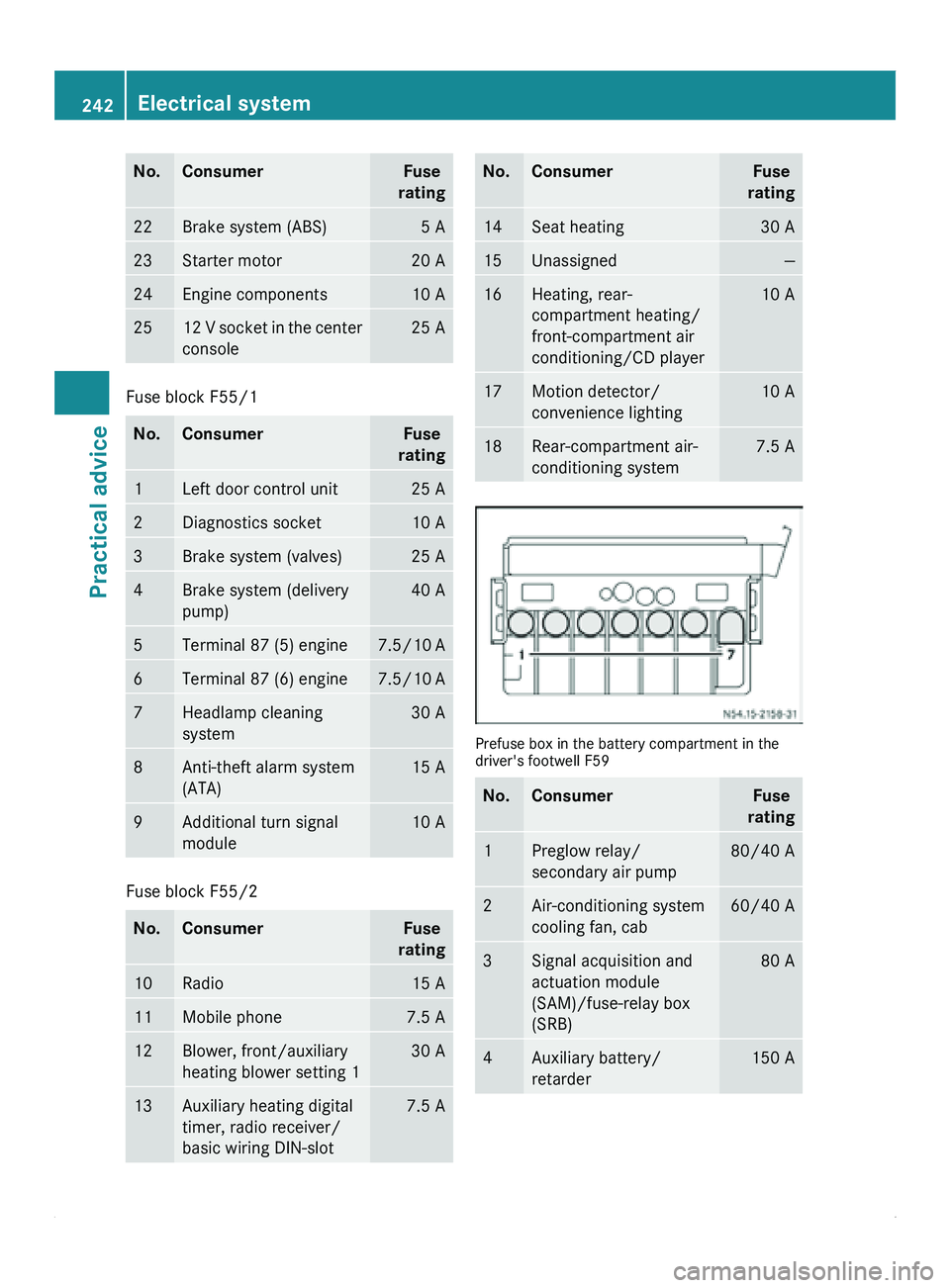
No. Consumer Fuse
rating 22 Brake system (ABS) 5 A
23 Starter motor 20 A
24 Engine components 10 A
25 12 V socket in the center
console 25 A
Fuse block F55/1
No. Consumer Fuse
rating 1 Left door control unit 25 A
2 Diagnostics socket 10 A
3 Brake system (valves) 25 A
4 Brake system (delivery
pump) 40 A
5 Terminal 87 (5) engine 7.5/10 A
6 Terminal 87 (6) engine 7.5/10 A
7 Headlamp cleaning
system 30 A
8 Anti-theft alarm system
(ATA) 15 A
9 Additional turn signal
module 10 A
Fuse block F55/2
No. Consumer Fuse
rating 10 Radio 15 A
11 Mobile phone 7.5 A
12 Blower, front/auxiliary
heating blower setting 1 30 A
13 Auxiliary heating digital
timer, radio receiver/
basic wiring DIN-
slot 7.5 A No. Consumer Fuse
rating 14 Seat heating 30 A
15 Unassigned —
16 Heating, rear-
compartment heating/
front-compartment air
conditioning/CD player 10 A
17 Motion detector/
convenience lighting 10 A
18 Rear-compartment air-
conditioning system 7.5 A
Prefuse box in the battery compartment in the
driver's footwell F59
No. Consumer Fuse
rating 1 Preglow relay/
secondary air pump 80/40 A
2 Air-conditioning system
cooling fan, cab 60/40 A
3 Signal acquisition and
actuation module
(SAM)/fuse-relay box
(SRB) 80 A
4 Auxiliary battery/
retarder 150 A242
Electrical systemPractical advice
Page 247 of 292
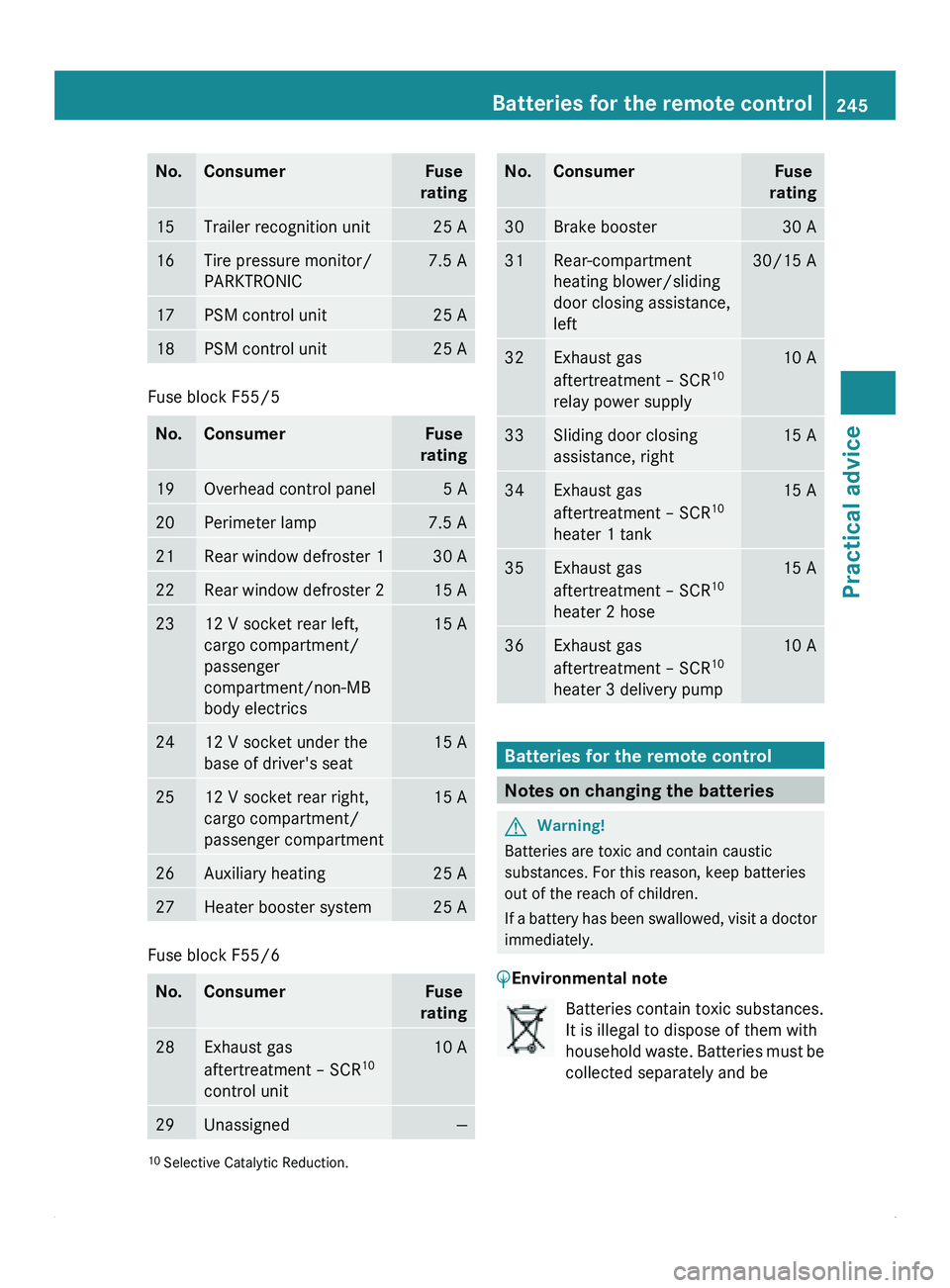
No. Consumer Fuse
rating 15 Trailer recognition unit 25 A
16 Tire pressure monitor/
PARKTRONIC 7.5 A
17 PSM control unit 25 A
18 PSM control unit 25 A
Fuse block F55/5
No. Consumer Fuse
rating 19 Overhead control panel 5 A
20 Perimeter lamp 7.5 A
21 Rear window defroster 1 30 A
22 Rear window defroster 2 15 A
23 12 V socket rear left,
cargo compartment/
passenger
compartment/non-MB
body electrics 15 A
24 12 V socket under the
base of driver's seat 15 A
25 12 V socket rear right,
cargo compartment/
passenger compartment 15 A
26 Auxiliary heating 25 A
27 Heater booster system 25 A
Fuse block F55/6
No. Consumer Fuse
rating 28 Exhaust gas
aftertreatment – SCR
10
control unit 10 A
29 Unassigned — No. Consumer Fuse
rating 30 Brake booster 30 A
31 Rear-compartment
heating blower/sliding
door closing assistance,
left 30/15 A
32 Exhaust gas
aftertreatment – SCR
10
relay power supply 10 A
33 Sliding door closing
assistance, right 15 A
34 Exhaust gas
aftertreatment – SCR
10
heater 1 tank 15 A
35 Exhaust gas
aftertreatment – SCR
10
heater 2 hose 15 A
36 Exhaust gas
aftertreatment – SCR
10
heater 3 delivery pump 10 A
Batteries for the remote control
Notes on changing the batteries
G
Warning!
Batteries are toxic and contain caustic
substances. For this reason, keep batteries
out of the reach of children.
If a battery
has been swallowed, visit a doctor
immediately.
0040Environmental note Batteries contain toxic substances.
It is illegal to dispose of them with
household
waste. Batteries
must be
collected separately and be
10 Selective Catalytic Reduction. Batteries for the remote control
245
Practical advice Z
Page 248 of 292
recycled in an environmentally
responsible manner.
Dispose of old batteries in an
environmentally responsible
manner. Take discharged batteries
to a qualified specialist workshop,
e.g. an authorized Sprinter Dealer,
or to a special collection point for
old batteries.
Key with remote control
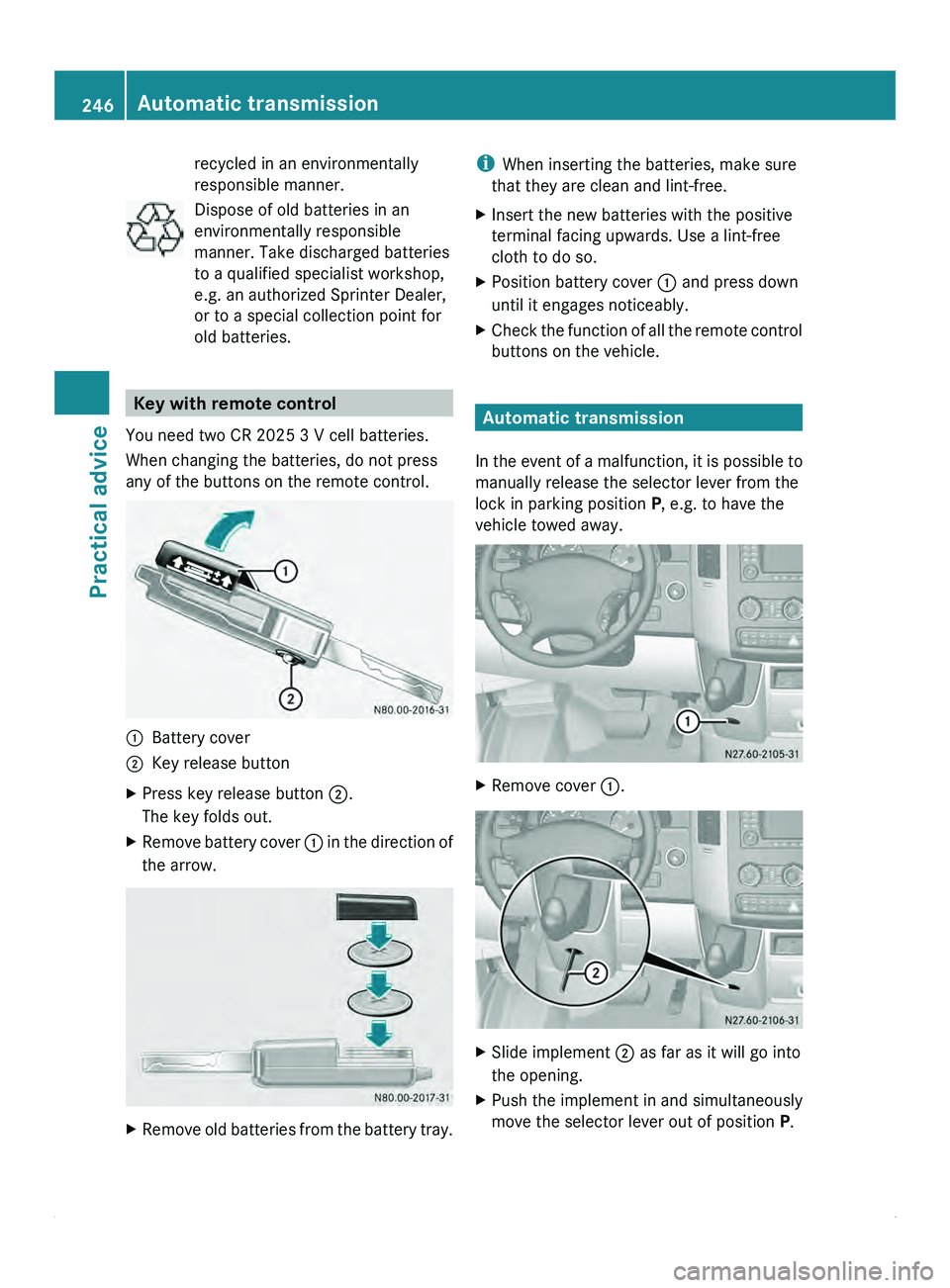
You need two CR 2025 3 V cell batteries.
When changing the batteries, do not press
any of the buttons on the remote control. 0046
Battery cover
0047 Key release button
X Press key release button 0047.
The key folds out.
X Remove battery cover 0046 in
the direction of
the arrow. X
Remove old batteries from the battery tray. i
When inserting the batteries, make sure
that they are clean and lint-free.
X Insert the new batteries with the positive
terminal facing upwards. Use a lint-free
cloth to do so.
X Position battery cover 0046 and press down
until it engages noticeably.
X Check the function of all the remote control
buttons on the vehicle. Automatic transmission
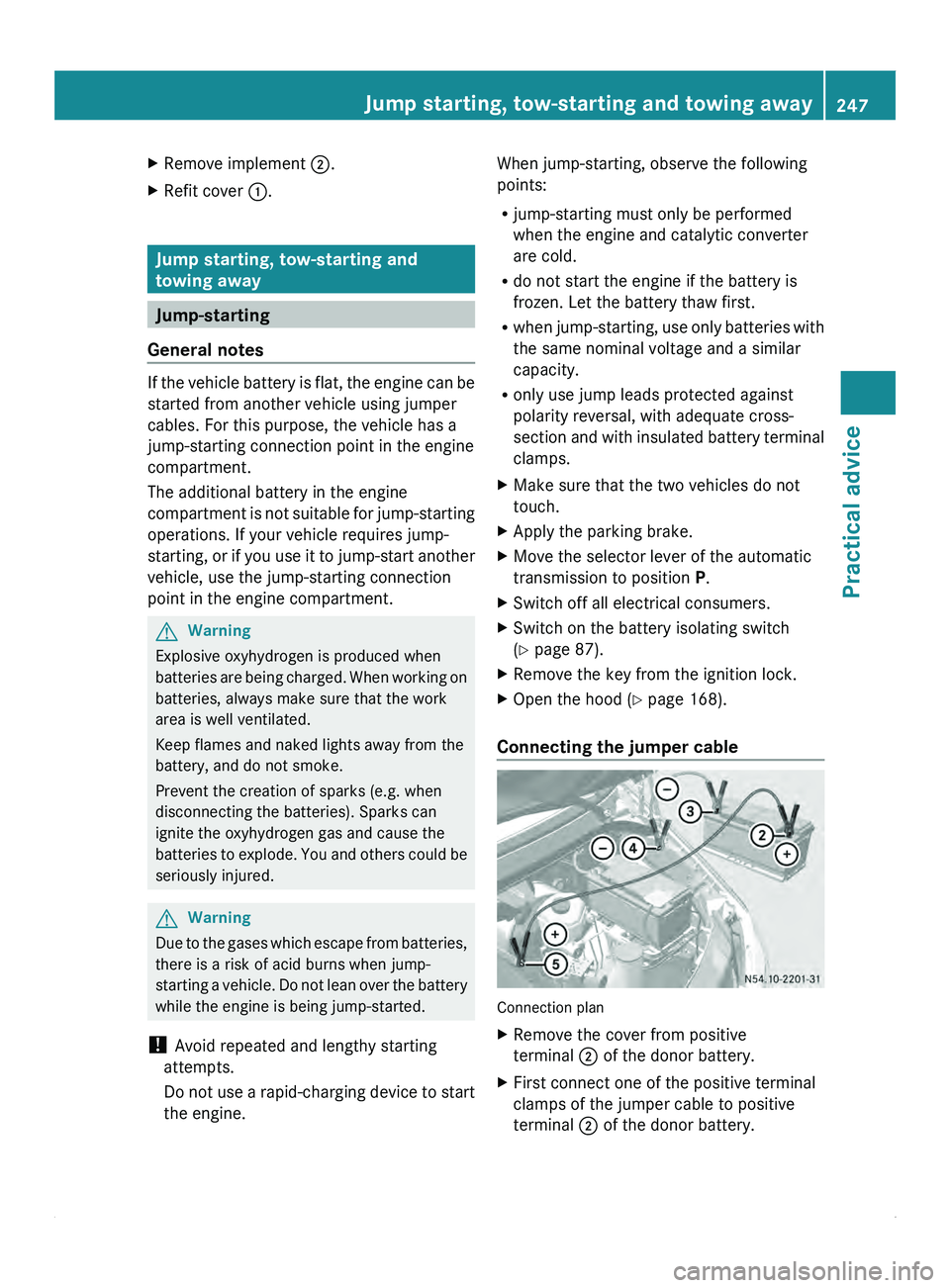
In the event
of a malfunction, it is possible to
manually release the selector lever from the
lock in parking position P, e.g. to have the
vehicle towed away. X
Remove cover 0046. X
Slide implement 0047 as far as it will go into
the opening.
X Push the implement in and simultaneously
move the selector lever out of position P.246
Automatic transmission
Practical advice
Page 249 of 292
X
Remove implement 0047.
X Refit cover 0046. Jump starting, tow-starting and
towing away
Jump-starting
General notes If the vehicle battery is flat, the engine can be
started from another vehicle using jumper
cables. For this purpose, the vehicle has a
jump-starting connection point in the engine
compartment.
The additional battery in the engine
compartment is
not
suitable for jump-starting
operations. If your vehicle requires jump-
starting, or if you use it to jump-start another
vehicle, use the jump-starting connection
point in the engine compartment. G
Warning
Explosive oxyhydrogen is produced when
batteries are being
charged. When working on
batteries, always make sure that the work
area is well ventilated.
Keep flames and naked lights away from the
battery, and do not smoke.
Prevent the creation of sparks (e.g. when
disconnecting the batteries). Sparks can
ignite the oxyhydrogen gas and cause the
batteries to explode. You and others could be
seriously injured. G
Warning
Due to the gases which escape from batteries,
there is a risk of acid burns when jump-
starting a vehicle.
Do not lean over the battery
while the engine is being jump-started.
! Avoid repeated and lengthy starting
attempts.
Do not use a rapid-charging device to start
the engine. When jump-starting, observe the following
points:
R
jump-starting must only be performed
when the engine and catalytic converter
are cold.
R do not start the engine if the battery is
frozen. Let the battery thaw first.
R when jump-starting, use
only batteries with
the same nominal voltage and a similar
capacity.
R only use jump leads protected against
polarity reversal, with adequate cross-
section and with insulated battery terminal
clamps.
X Make sure that the two vehicles do not
touch.
X Apply the parking brake.
X Move the selector lever of the automatic
transmission to position P.
X Switch off all electrical consumers.
X Switch on the battery isolating switch
(Y page 87).
X Remove the key from the ignition lock.
X Open the hood (Y page 168).
Connecting the jumper cable Connection plan
X
Remove the cover from positive
terminal 0047 of the donor battery.
X First connect one of the positive terminal
clamps of the jumper cable to positive
terminal 0047 of the donor battery. Jump starting, tow-starting and towing away
247
Practical advice Z
Page 250 of 292
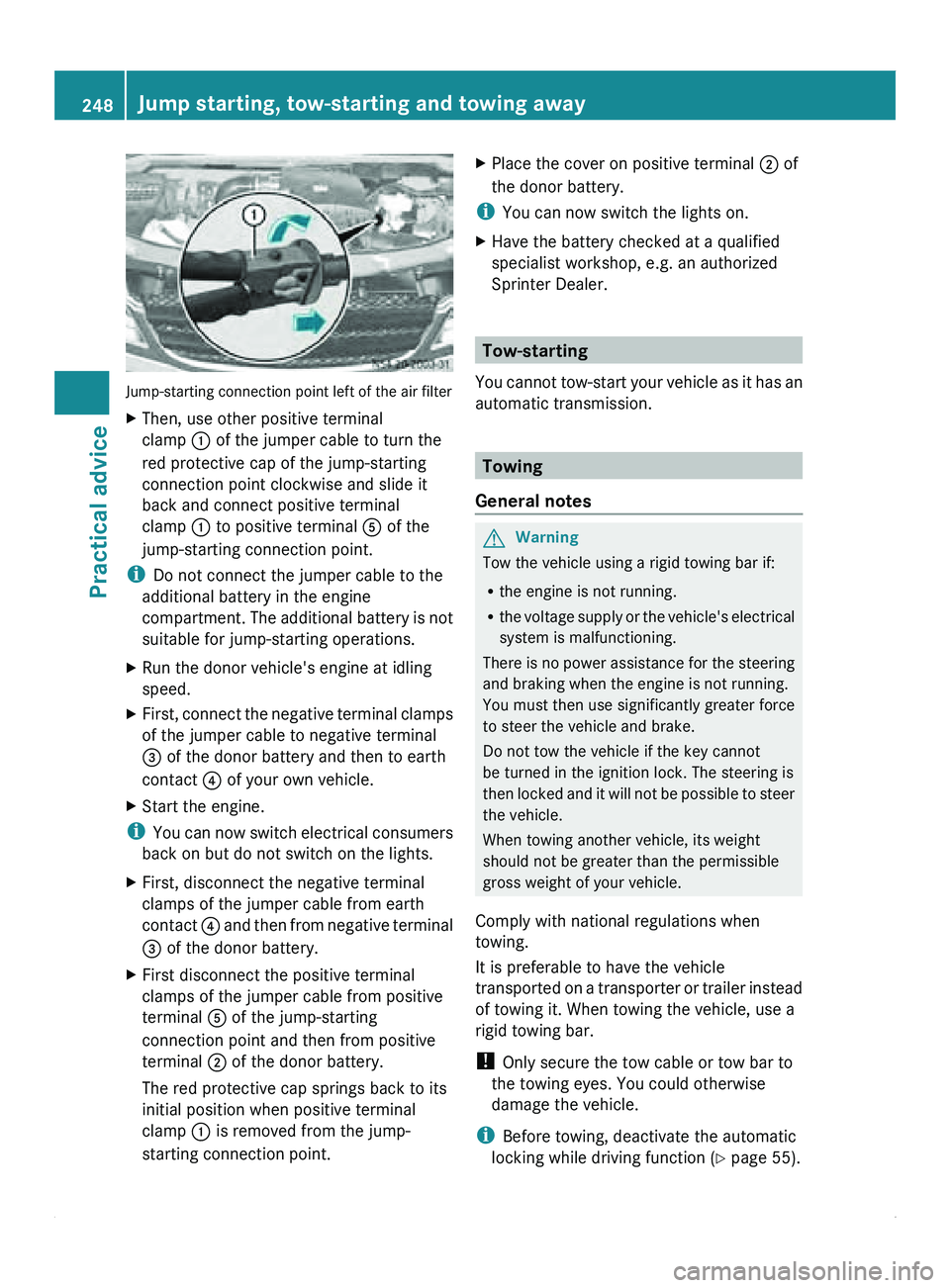
Jump-starting connection point left of the air filter
X
Then, use other positive terminal
clamp 0046 of the jumper cable to turn the
red protective cap of the jump-starting
connection point clockwise and slide it
back and connect positive terminal
clamp 0046 to positive terminal 0086 of the
jump-starting connection point.
i Do not connect the jumper cable to the
additional battery in the engine
compartment. The
additional
battery is not
suitable for jump-starting operations.
X Run the donor vehicle's engine at idling
speed.
X First, connect the negative terminal clamps
of the jumper cable to negative terminal
008A of the donor battery and then to earth
contact 0088 of your own vehicle.
X Start the engine.
i You can
now
switch electrical consumers
back on but do not switch on the lights.
X First, disconnect the negative terminal
clamps of the jumper cable from earth
contact 0088 and then
from negative terminal
008A of the donor battery.
X First disconnect the positive terminal
clamps of the jumper cable from positive
terminal 0086 of the jump-starting
connection point and then from positive
terminal 0047 of the donor battery.
The red protective cap springs back to its
initial position when positive terminal
clamp 0046 is removed from the jump-
starting connection point. X
Place the cover on positive terminal 0047 of
the donor battery.
i You can now switch the lights on.
X Have the battery checked at a qualified
specialist workshop, e.g. an authorized
Sprinter Dealer. Tow-starting
You cannot tow-start
your vehicle as it has an
automatic transmission. Towing
General notes G
Warning
Tow the vehicle using a rigid towing bar if:
R the engine is not running.
R the voltage supply
or the vehicle's electrical
system is malfunctioning.
There is no power assistance for the steering
and braking when the engine is not running.
You must then use significantly greater force
to steer the vehicle and brake.
Do not tow the vehicle if the key cannot
be turned in the ignition lock. The steering is
then locked and it will not be possible to steer
the vehicle.
When towing another vehicle, its weight
should not be greater than the permissible
gross weight of your vehicle.
Comply with national regulations when
towing.
It is preferable to have the vehicle
transported on a transporter or trailer instead
of towing it. When towing the vehicle, use a
rigid towing bar.
! Only secure the tow cable or tow bar to
the towing eyes. You could otherwise
damage the vehicle.
i Before towing, deactivate the automatic
locking while driving function (Y page 55). 248
Jump starting, tow-starting and towing away
Practical advice
Page 252 of 292
down, e.g. with the aid of another person or
by tying the propeller shaft up.
X Always remove the propeller shafts leading
to the driven axles.
! Always use new bolts when installing the
propeller shafts.
With front axle damage
X Turn the key to position 1 in the ignition
lock.
X Raise the front axle. G
Warning
A propeller shaft could fall off as it is being
removed and injure
you. Secure the propeller
shaft before removal to prevent it from falling
down, e.g. with the aid of another person or
by tying the propeller shaft up.
! The ignition must be switched off if the
vehicle is being towed with the front or rear
axle raised. Otherwise, ESP ®
may intervene
and damage the brake system.
With rear axle damage
X Turn the key to position 1 in the ignition
lock.
X Raise the rear axle.
Malfunction in the electrical system
If the battery is defective, the automatic
transmission will be locked in position P. To
shift the automatic transmission to
position N, you must provide power to the
vehicle's electrical system in the same way
as jump-starting ( Y page 247).
Have the vehicle
transported on a transporter
or trailer.
Transporting the vehicle The towing
eye can be used to pull the vehicle
onto a special transporter or trailer for
transportation.
! Only lash the
vehicle down by the wheels
or rims, not by vehicle parts such as axle or steering components. There is otherwise a
risk of damage to the vehicle.
X Move the selector lever of the automatic
transmission to position N.250
Jump starting, tow-starting and towing away
Practical advice
Page 273 of 292
a high-capacity battery, are not included in
the unladen weight and the weight of the
accessories.
TIN (Tire Identification Number)
A unique identification number which can be
used by a tire manufacturer to identify tires,
for example for a product recall, and thus
identify the purchasers.
The TIN is composed
of the manufacturer identification code, tire
size, tire model code and manufacturing date. Load bearing index
The load bearing index (also load index) is a
code that contains
the maximum load bearing
capacity of a tire. Traction
Traction is the result of friction between the
tires and the road surface. Wear indicator
Narrow bars (tread wear bars) that are
distributed over the
tire tread. If the tire tread
is level with the bars, the wear limit of 1
/ 16 in
(1.6 mm) has been reached. Distribution of the vehicle occupants
The distribution of vehicle occupants over
designated seat positions in a vehicle. Maximum permissible payload
weight
Nominal load and cargo/luggage load plus
68 kilograms (150 lb) multiplied by the
number of seats in the vehicle. Changing wheels
Flat tire
The "Flat tire"
section in the "Practical advice"
chapter (Y page 221) contains information
and notes on how to deal with a flat tire. It
also provides instructions on changing a
wheel or mounting the spare wheel. Replacing wheels
G
Warning
Rotate front and rear wheels only if the tires
are of the same dimension.
If your vehicle is equipped with mixed-size
tires (different tire
dimensions front vs. rear),
tire rotation is not possible. G
Warning
After changing a wheel, for safety reasons you
must:
R have the tightening torque checked. For
wheel bolts, the tightening torque is
177 lb-ft (240 Nm) (steel wheel)/ 133 lb-ft
(180
Nm) (alloy wheel). For wheel nuts, the
tightening torque is 133 lb-ft (180 Nm). The
wheels could otherwise work loose.
R check the tire pressure and correct it if
necessary.
R have the wheel bolts/wheel nuts
retightened after driving a distance of 30
miles (50 km). The tightening torque for
wheel bolts is 177 lb-ft (240 Nm)(steel
wheel)/133 lb-ft (180 Nm) (alloy wheel).
The tightening torque for wheel nuts is
133 lb-ft (180 Nm).
R if using new or painted rims, have the wheel
bolts and wheel nuts retightened at the
specified tightening torque after the vehicle
has been driven for approximately 600 to
3000 miles (1000 to 5000 km).
R have the direction of rotation corrected, if
reversed, as soon as possible at a qualified
specialist workshop, e.g. an authorized
Sprinter Dealer. The vehicle handling Changing wheels
271
Wheels and tires
Z